Non-violent Action: A Force for Change Case study lesson: The Struggle for Independence in India Background: The British Empire Horrible Histories British Empire (2.5 mins.) https:www.youtube.comwatch?vHs0DsRSSat8 How did Britain
"Non-violent Action: A Force for Change Case study" is the property of its rightful owner. Permission is granted to
download and print the materials on this website for personal, non-commercial use only, and to display it
on your personal computer provided you do not modify the materials and that you retain all copyright
notices contained in the materials. By downloading content from our website, you accept the terms of this
agreement.
Presentation Transcript
01
Non-violent Action: A Force for Change Case study lesson:
The Struggle for Independence in India<br>
02
Background: The British Empire Horrible Histories British Empire (2.5 mins.) https://www.youtube.com/watch?v=Hs0DsRSSat8
‘How did Britain conquer India’ YouTube Armchair Historian (10 mins.)https://www.youtube.com/watch?v=DzDwz18ng7w
https://www.bbc.co.uk/teach/class-clips-video/gcse-history-why-was-india-so-valuable-to-the-british-Eempire/zv2rwty (3 mins.)<br>
03
The Struggle for Independence in India: Gandhi and the Salt March A Force More Powerful Part 1 9:00-16:20
https://www.youtube.com/watch?v=hpBoHb59iVY&t=540s
Dandi March – Women, Salt and Satyagraha (women’s involvement in the Salt March, 1 min))
https://www.youtube.com/watch?v=E0ojv8MzWkI
Gandhi begins the Salt March (history pod 2 mins):
https://www.youtube.com/watch?v=CV3ixOudYpc<br>
04
The Struggle for Independence in India: Khan Abdul Ghaffar Khan and the Khudai Khidmatgar Citizen of the World – Khan Abdul Ghaffar Khan 1:45-25:12 https://www.youtube.com/watch?v=mcY1QHlRHlo<br>
05
The Salt March Britain ruled in India from 1858 to 1947 but many Indian people were very unhappy with this and decided to try and end British rule.
Mohandas K. Gandhi believed that the only way to be successful against the powerful British Raj would be to engage many Indian people in a non-violent campaign.
On New Year’s Eve 1929 the Indian National Congress declared themselves ready to raise the tricolour flag of India and call for Purna Swaraj (complete self-rule).<br>
06
After careful planning, led by Gandhi the Congress’s Working Committee decided to target the 1882 British Salt Act.
This Act meant that only the British could collect and manufacture salt and when Indians bought salt they had to pay a salt tax to the British government.
Gandhi believed that he could unite Indians of all religious communities, castes and regions against British rule because salt was a basic and crucial dietary need that the British shouldn’t be making money out of at the expense of Indian people.
He decided to encourage all Indians to defy the Salt Laws by manufacturing and selling salt themselves.<br>
07
In order to gain publicity for the action and so get mass support from the Indian people Gandhi and the Working Committee planned to march 240 miles from Gandhi’s ashram in Ahmedabad to the coastal village of Dandi where he would publicly break the Salt Laws by collecting sea water and making salt from it.
The long march would enable many people to learn about the action and thousands of people joined the Gandhi on the way.
He stopped at many villages to talk about the Salt Laws, encouraging Indian officials to resign from their posts and ordinary people to boycott foreign cloth and spin their own cotton cloth.<br>
08
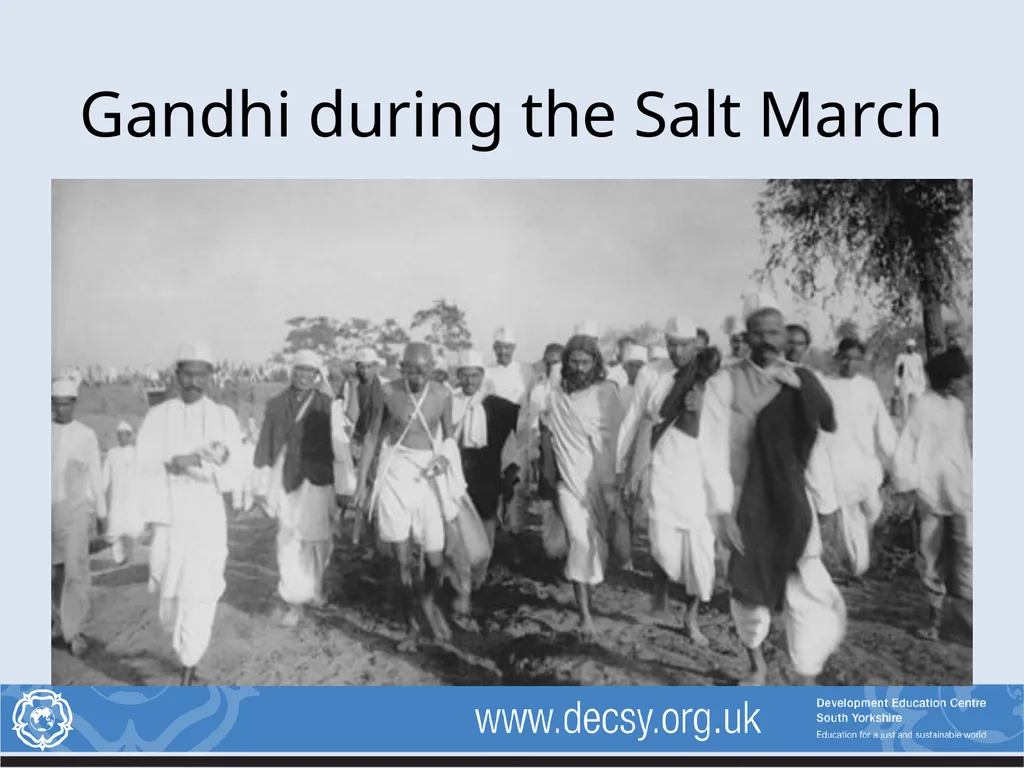
Gandhi during the Salt March<br>
09
The march was so dramatic that journalists from all over the world wrote about it.
On 5th April 1930, after 24 days of walking, Gandhi and his fellow marchers reached the shores of Dandi.
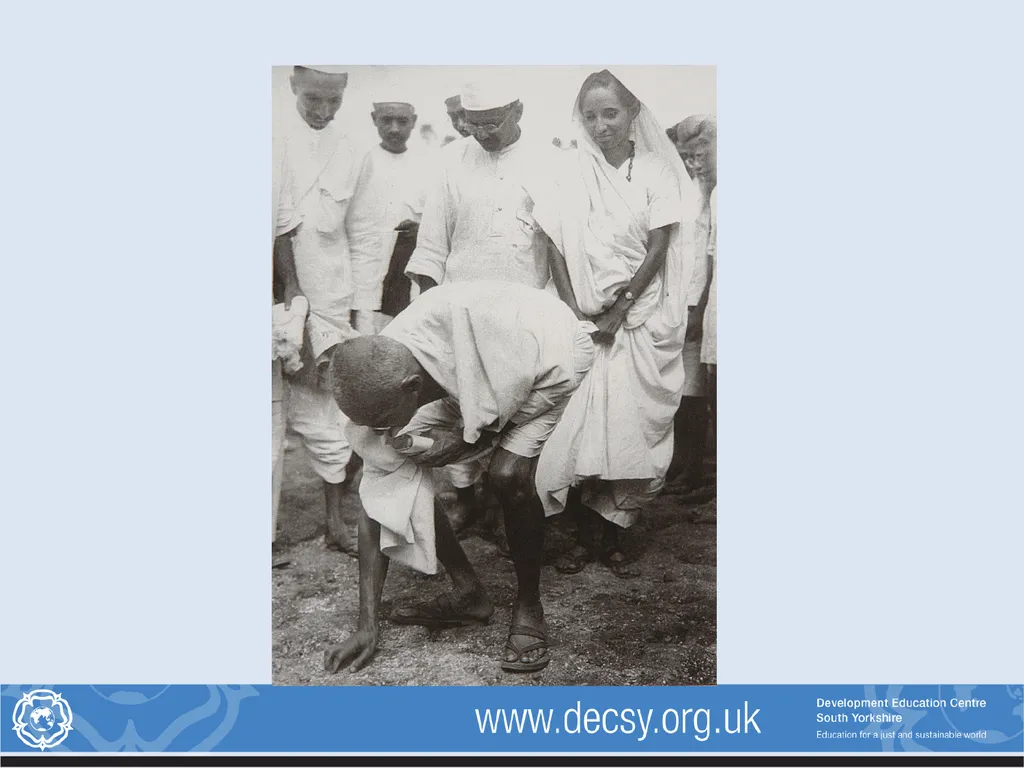
The next morning Gandhi bent down and picked up a clump of mud and salt – symbolising a defiant breakage of the British Salt Laws.
His action gave courage to millions of other Indians to break the Salt Laws by producing it themselves, buying it illegally and refusing to pay the tax.<br>
10
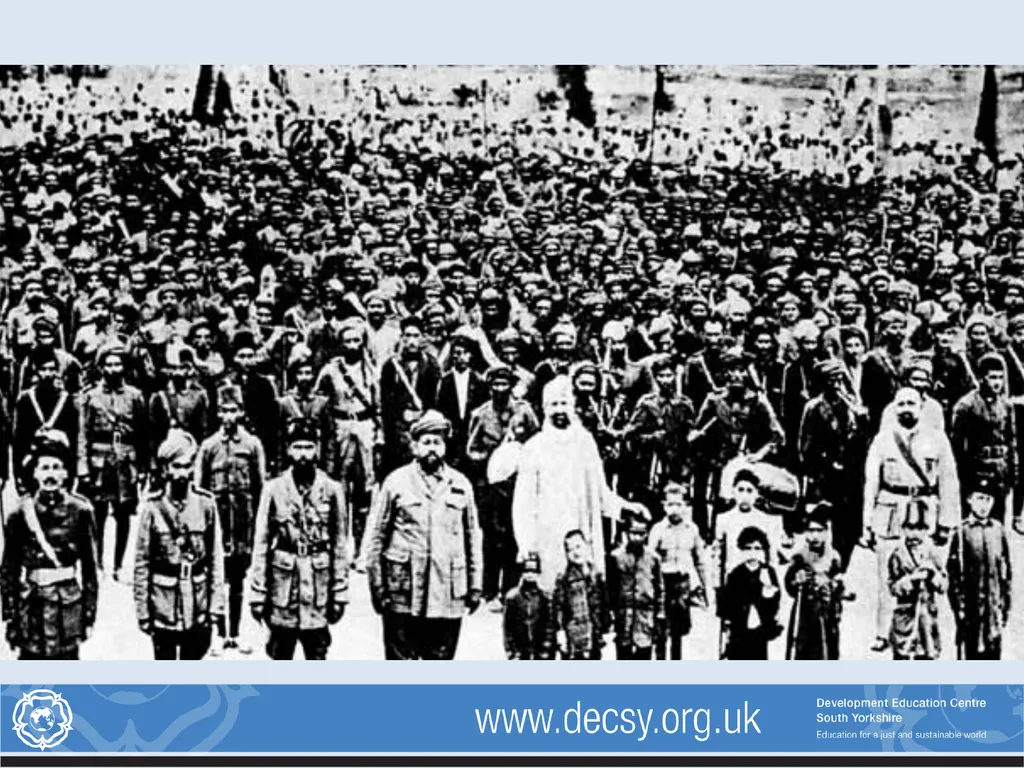
Khudai Khidmatgar The Pashtuns are a Muslim group that lived in the North-West Frontier Province of British India near the present day Afghanistan.
In this area there were repressive laws that stopped anti-government activities and punished whole families and villages for the crimes of one person.
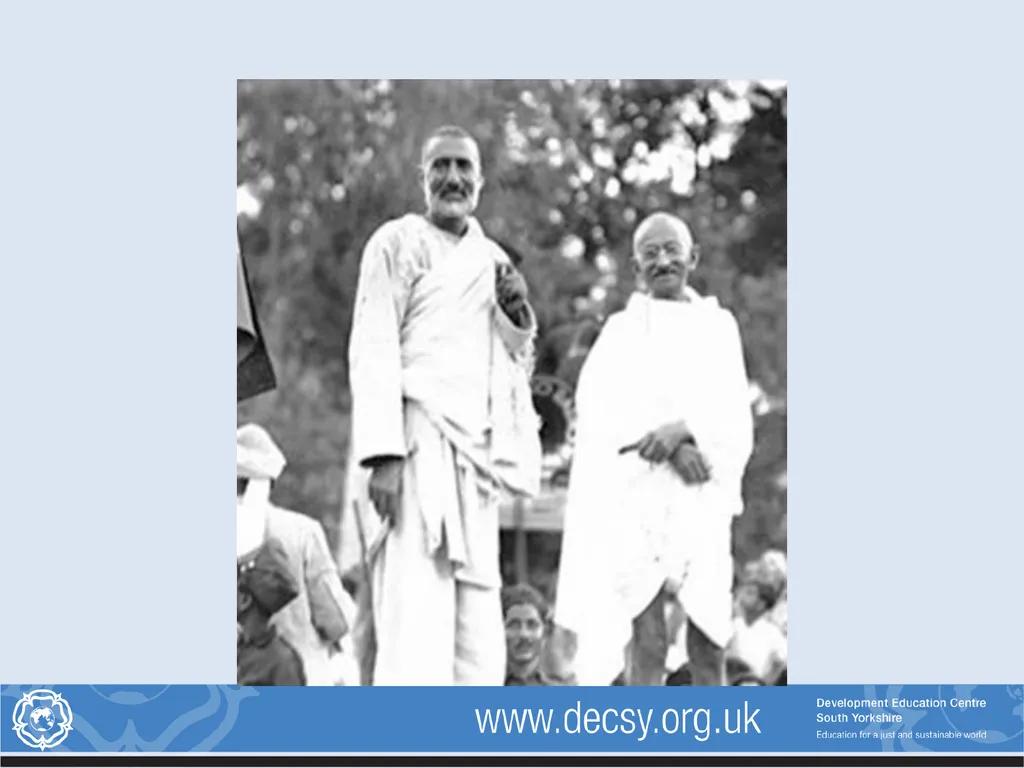
Khan Abdul Ghaffar Khan (also known as Badshah Khan meaning ‘King of Kings’) began his resistance by opening up schools throughout the area educating villagers on the reforms he planned for India.
He was arrested by British authorities and spent three months in prison along with his 95-year-old father and other members of his family.<br>
11
When he came out of prison he joined the Khalifat movement, an anti-British group with Hindu participation as well and also formed the Afghan Reform Society to increase education.
He taught people that they should become involved in work outside of farming, so that the Indian population would not be completely dependent on the British.
After being jailed for three years for his attempts at reform Ghaffar Khan founded the Khudai Khidmatgar ‘Servants of God’ which became the first professional non-violent army.
This was based on Islamic principles of universal brotherhood, submission to God’s will and service to God, with an underlying philosophy rooted in Gandhi’s concept of satyagraha – active non-violence.<br>
12
This was the army’s oath of allegiance:
“I am a Khudai Khidmatgar, and as serving Allah needs no service, but serving Allah’s creation is serving Allah, I promise to serve humanity in his name.
I promise to refrain from taking part in feuds and quarrels and from creating enmity.
I promise to treat every Pathan as my brother and friend.
I promise to refrain from anti-social customs and practices.
I promise to live a simple life, to practise virtue and to refrain from evil.
I promise to practise good manners and good behaviour and not to lead a life of idleness.
I promise to devote at least two hours a day to social work. This is the Oath of the Khudai Khidmatgar Army”<br>
13
The recruits to the army, including women, helped on community projects, maintained order at gatherings and recruited new members.
They were given the nickname surkh posh ‘Red Shirts’ when a couple of people got their white shirts grimy and so dyed them at a local tannery.
This is how the distinctive red brick coloured shirt was adopted as the uniform.
They carried walking sticks instead of weapons.<br>
14
The Pathans’ contempt for fear and cowardice was legendary but they obeyed the oath even in the face of extreme provocation. Musharraf Din wrote about British Army tactics:
"The British used to torture us, throw us into ponds in wintertime, shave our beards, but even then Badshah Khan told his followers not to lose patience…there is an answer to violence, which is more violence. But nothing can conquer non-violence. You cannot kill it. It keeps standing up… The British sent their horses and cars to run over us, but I took my shawl in my mouth to keep from screaming…We were human beings, but we should not cry or express in any way that we were injured or weak."<br>
15
P4C discussion in role In your group study the role card you have been given.
Decide what kind of person you are and imagine what your life is like.
Decide whether you support the non-violent movement for Independence in India or not.
Be ready with 2 or 3 arguments from the role’s perspective either in support or against the actions.<br>
16
Question for Discussion Should we support the non-violent movement to gain Indian Independence?<br>
17
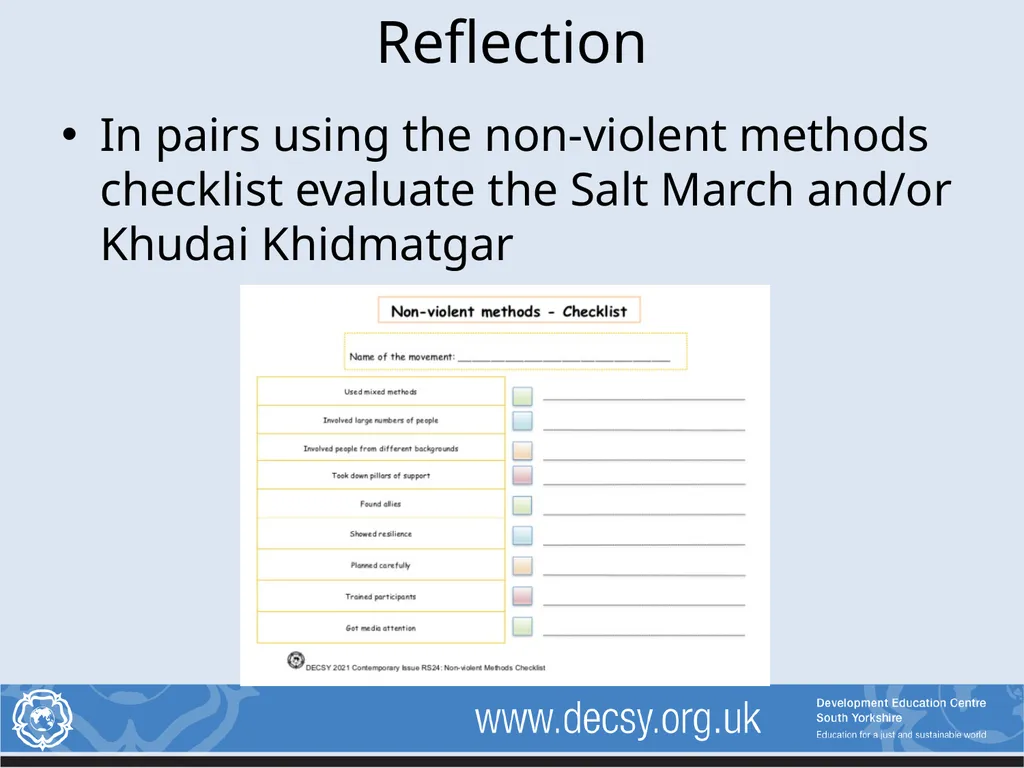
Reflection In pairs using the non-violent methods checklist evaluate the Salt March and/or Khudai Khidmatgar<br>