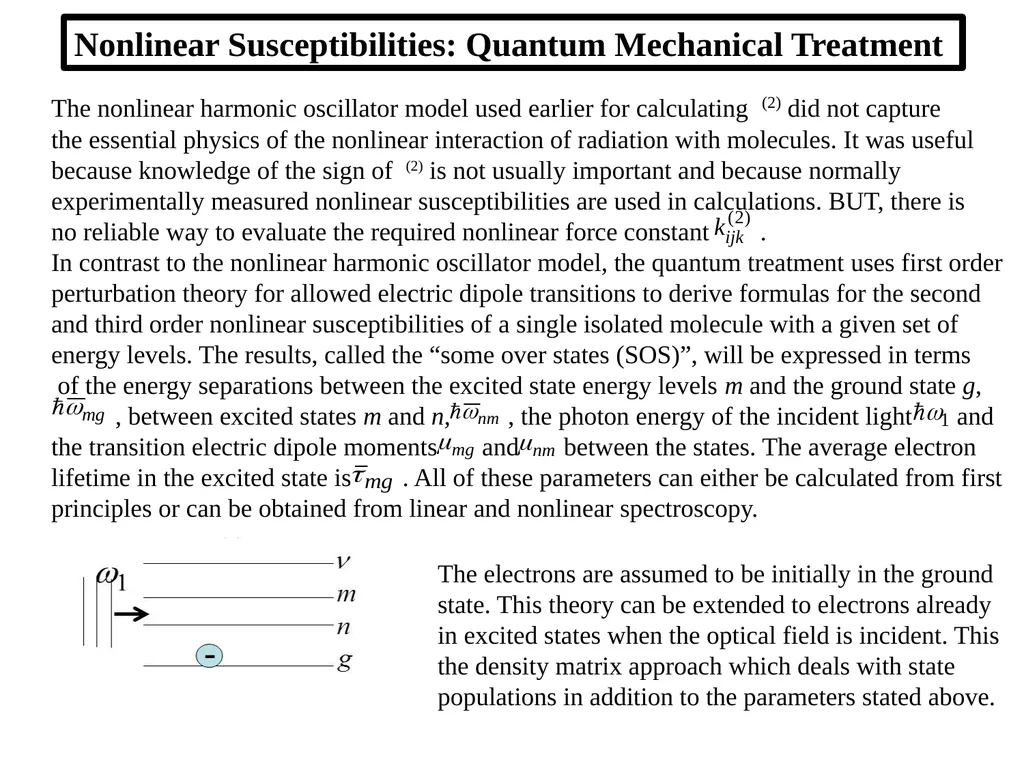
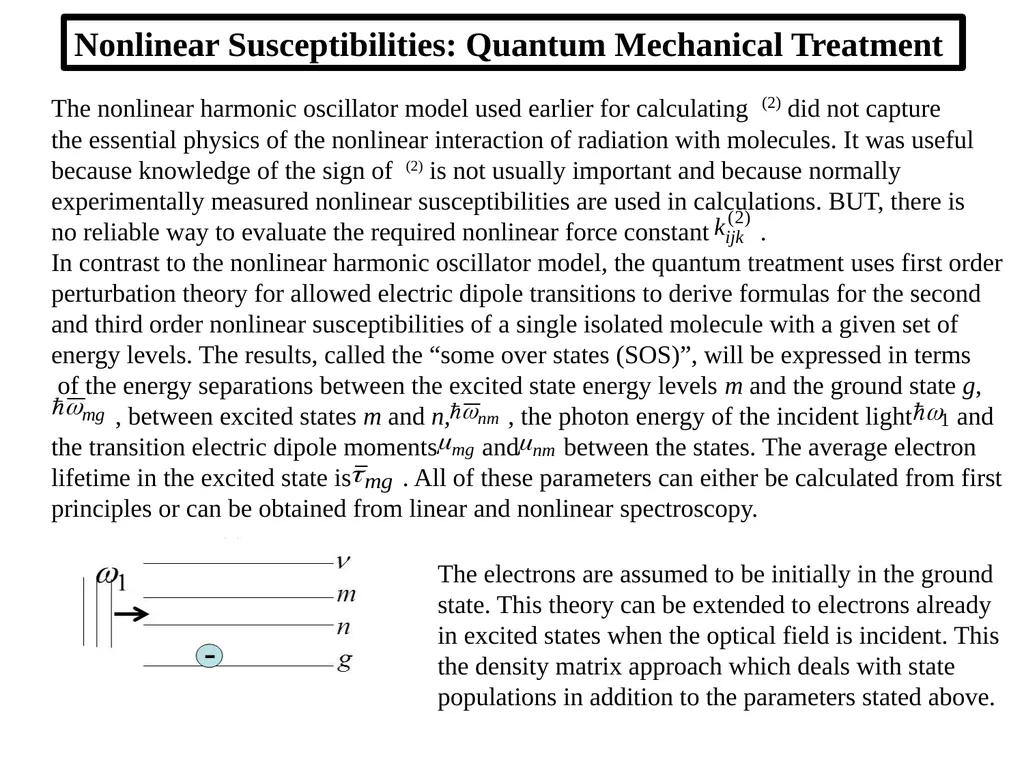
Nonlinear Susceptibilities: Quantum Mechanical Treatment The electrons are assumed to be initially in the ground state. This theory can be extended to electrons already in excited states when the optical field is incident. This the density
"Nonlinear Susceptibilities: Quantum Mechanical" is the property of its rightful owner. Permission is granted to
download and print the materials on this website for personal, non-commercial use only, and to display it
on your personal computer provided you do not modify the materials and that you retain all copyright
notices contained in the materials. By downloading content from our website, you accept the terms of this
agreement.
Presentation Transcript
01
Nonlinear Susceptibilities: Quantum Mechanical Treatment The electrons are assumed to be initially in the ground
state. This theory can be extended to electrons already
in excited states when the optical field is incident. This
the density matrix approach which deals with state
populations in addition to the parameters stated above.<br>
02
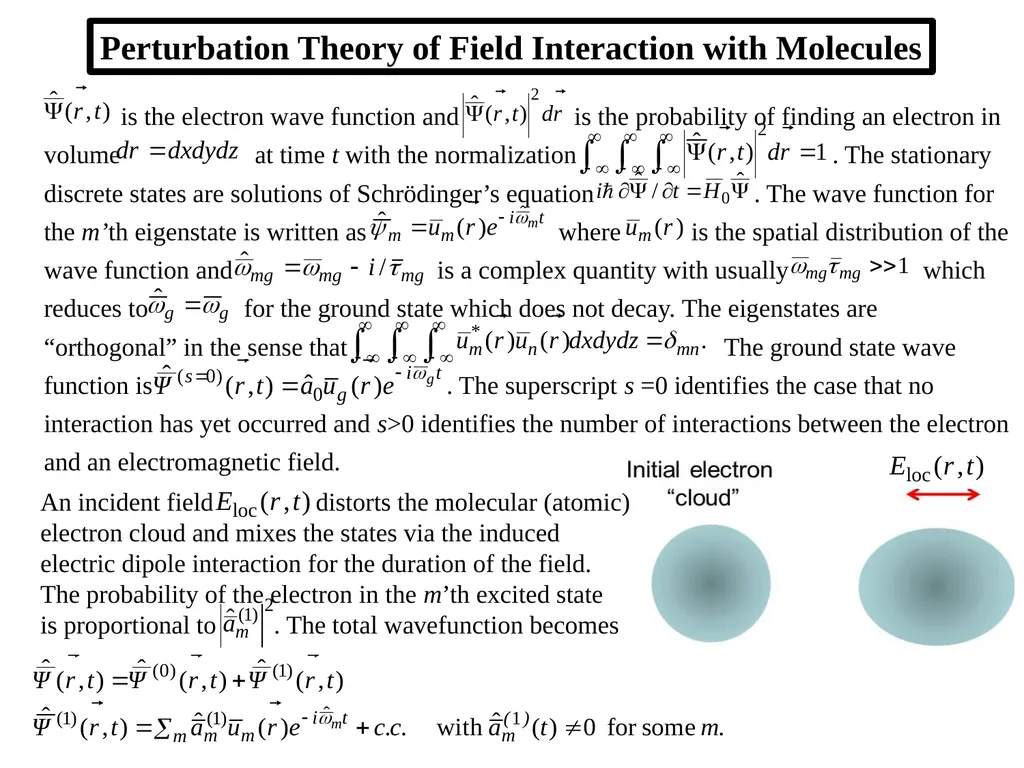
Perturbation Theory of Field Interaction with Molecules<br>
03
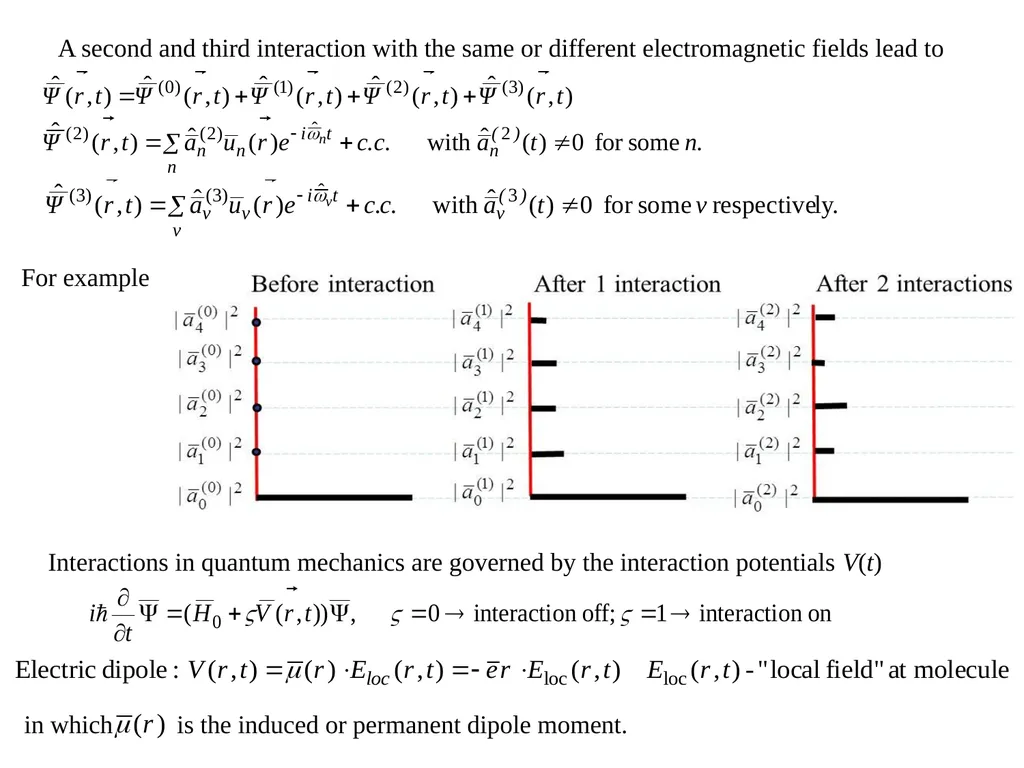
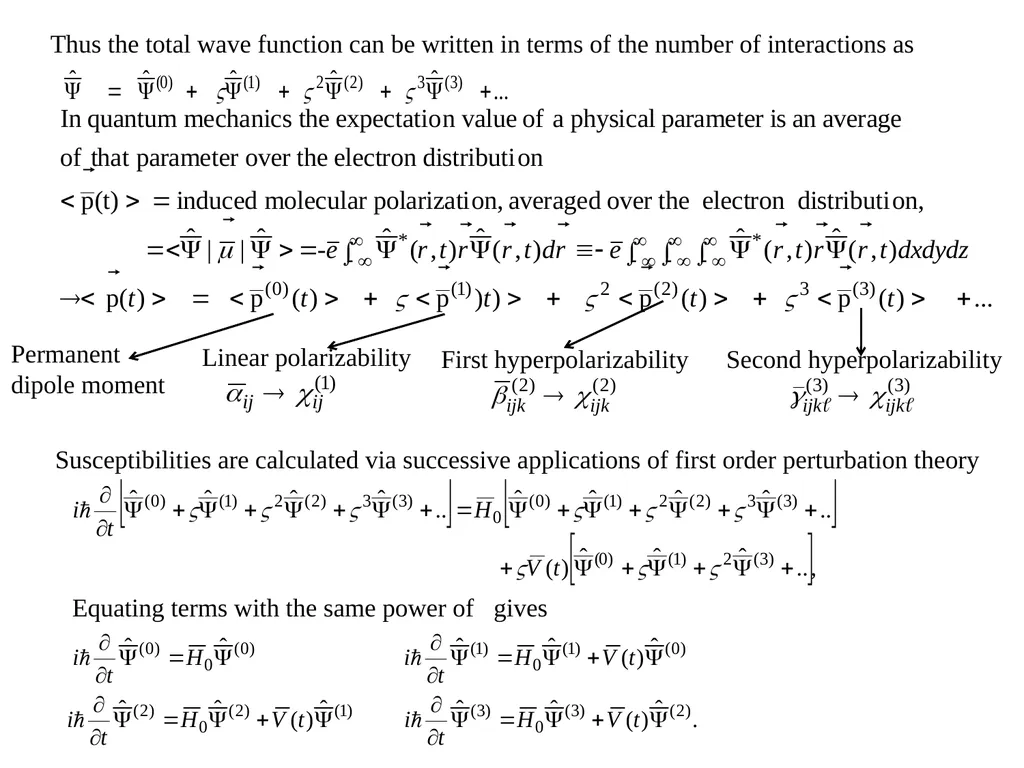
For example Interactions in quantum mechanics are governed by the interaction potentials V(t) in which is the induced or permanent dipole moment.<br>
04
Thus the total wave function can be written in terms of the number of interactions as<br>
05
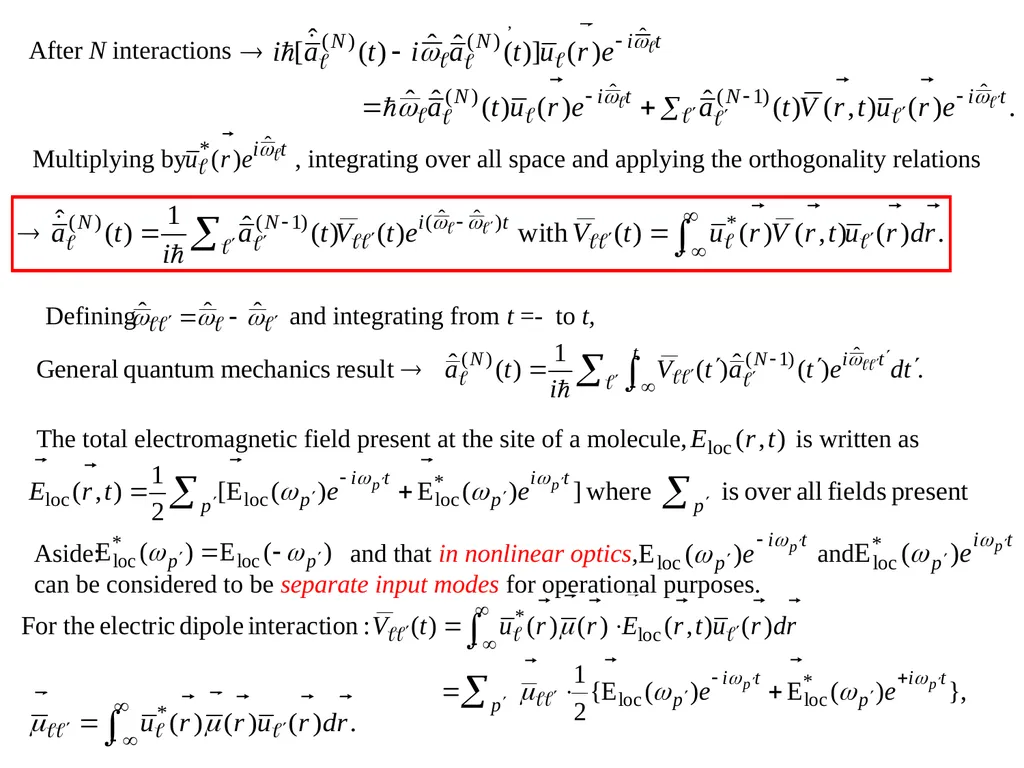
Multiplying by , integrating over all space and applying the orthogonality relations<br>
06
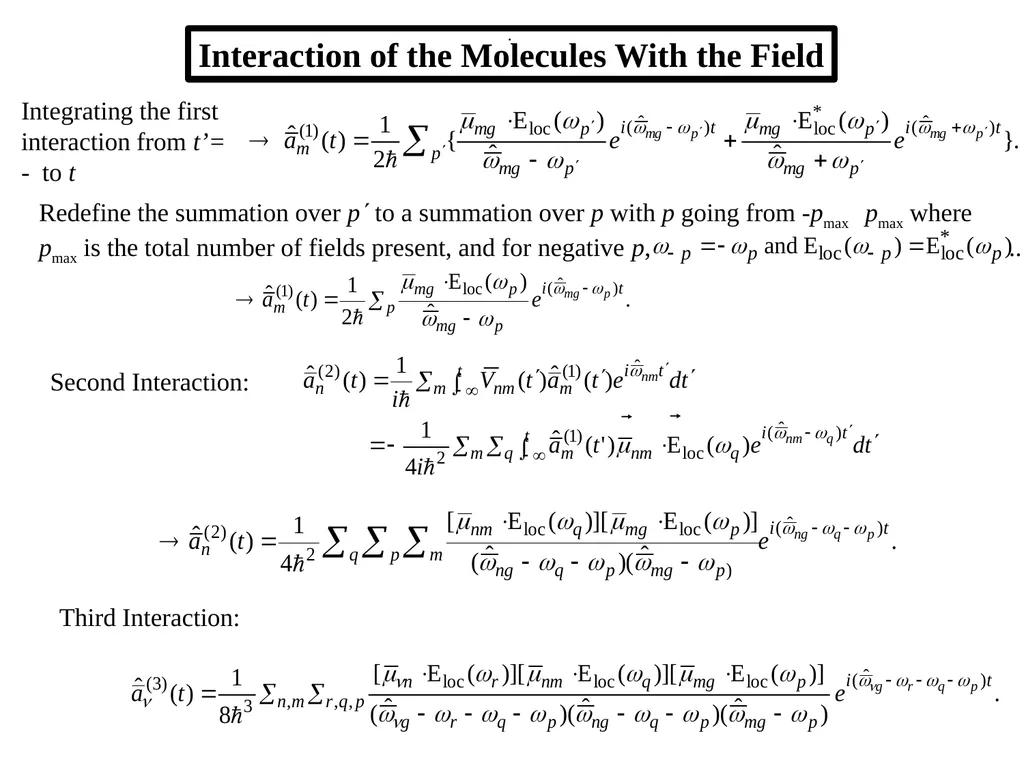
Interaction of the Molecules With the Field Integrating the first
interaction from t’=
- to t Redefine the summation over pʹ to a summation over p with p going from -pmax pmax where
pmax is the total number of fields present, and for negative p, .. . Third Interaction:<br>
07
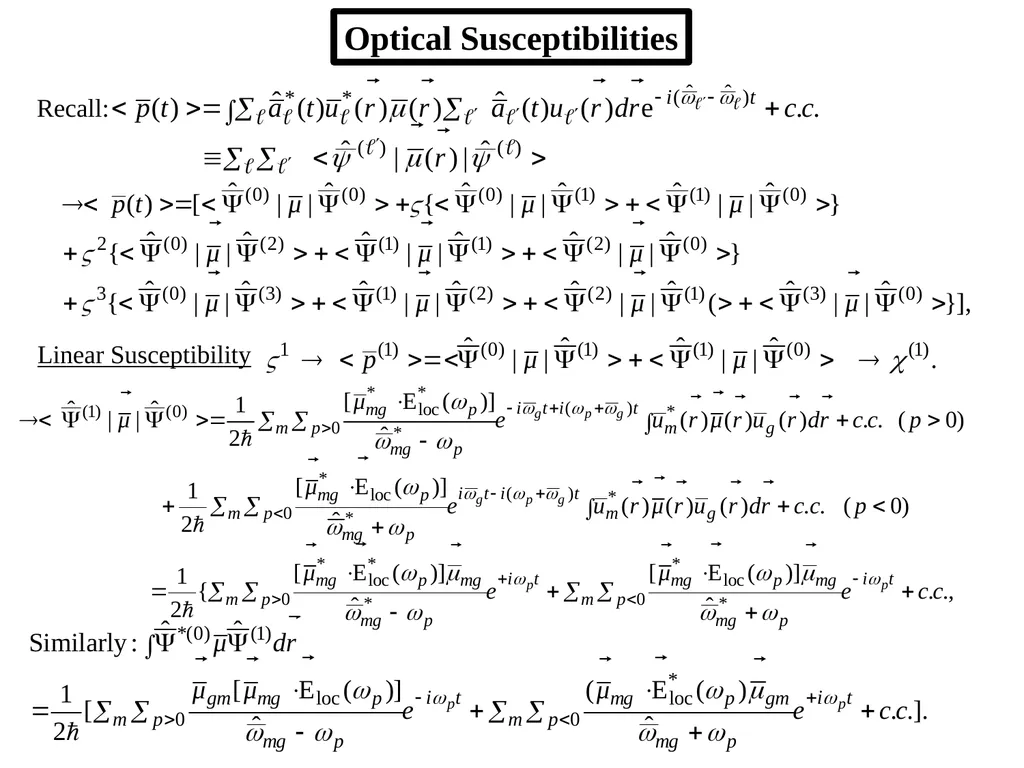
Optical Susceptibilities Linear Susceptibility<br>
08
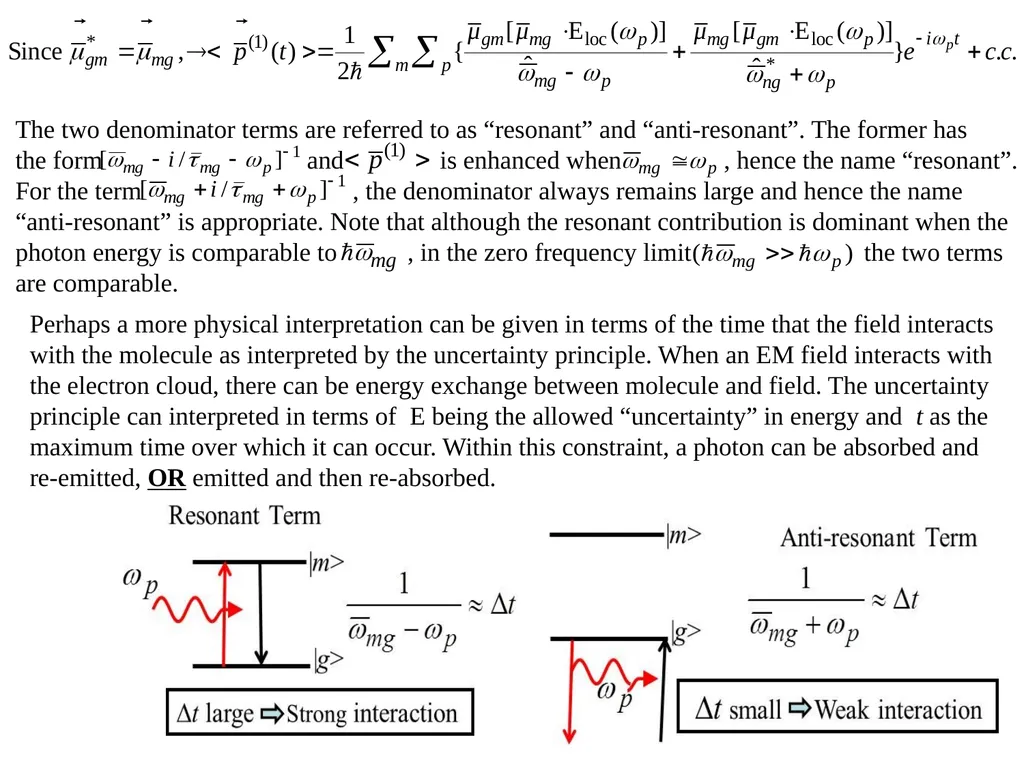
Perhaps a more physical interpretation can be given in terms of the time that the field interacts
with the molecule as interpreted by the uncertainty principle. When an EM field interacts with
the electron cloud, there can be energy exchange between molecule and field. The uncertainty
principle can interpreted in terms of E being the allowed “uncertainty” in energy and t as the
maximum time over which it can occur. Within this constraint, a photon can be absorbed and
re-emitted, OR emitted and then re-absorbed.<br>
09
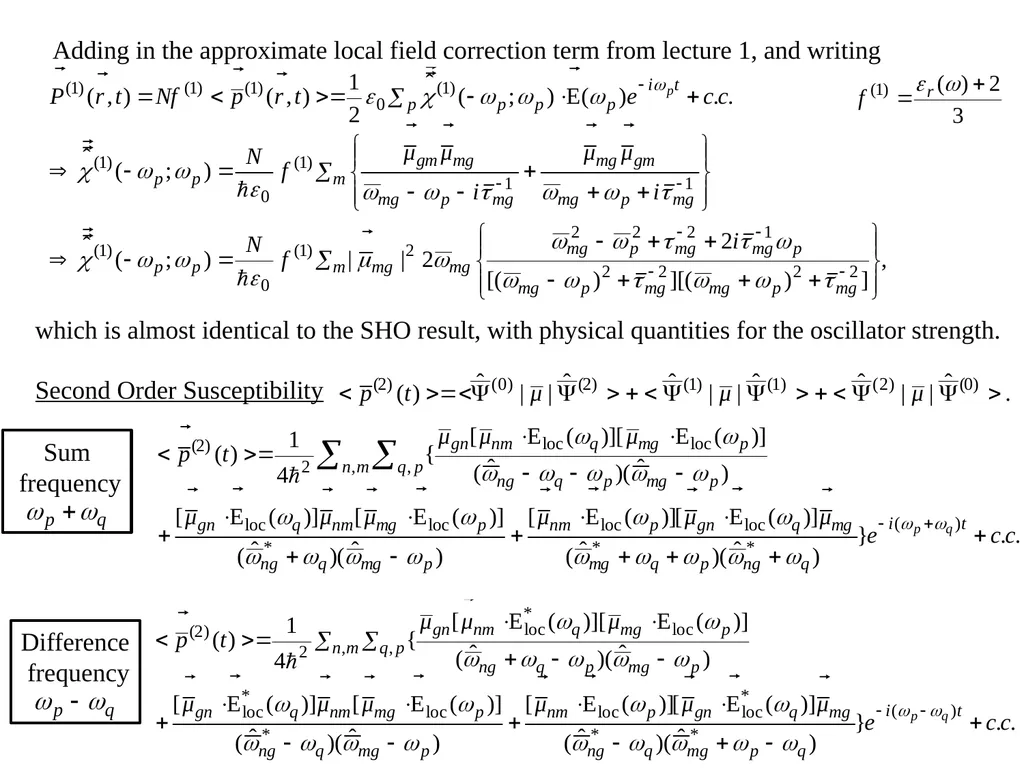
Adding in the approximate local field correction term from lecture 1, and writing which is almost identical to the SHO result, with physical quantities for the oscillator strength. Second Order Susceptibility<br>
10
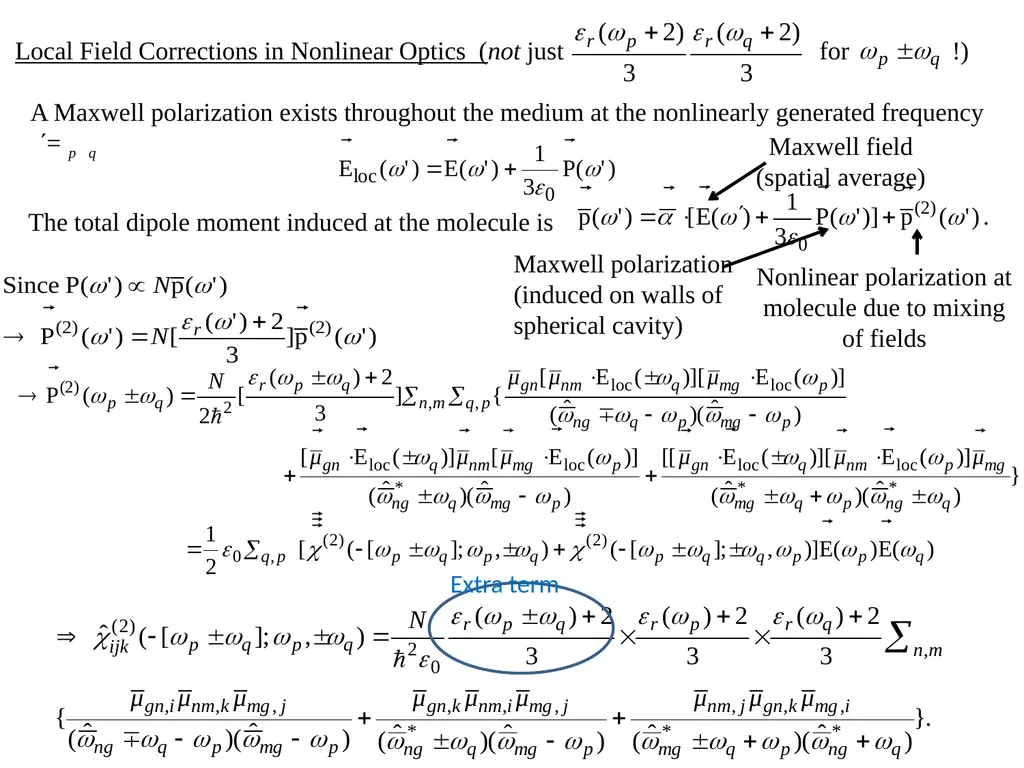
Local Field Corrections in Nonlinear Optics (not just for !) A Maxwell polarization exists throughout the medium at the nonlinearly generated frequency
ʹ=pq The total dipole moment induced at the molecule is Maxwell field
(spatial average) Maxwell polarization
(induced on walls of
spherical cavity) Nonlinear polarization at
molecule due to mixing
of fields<br>
11
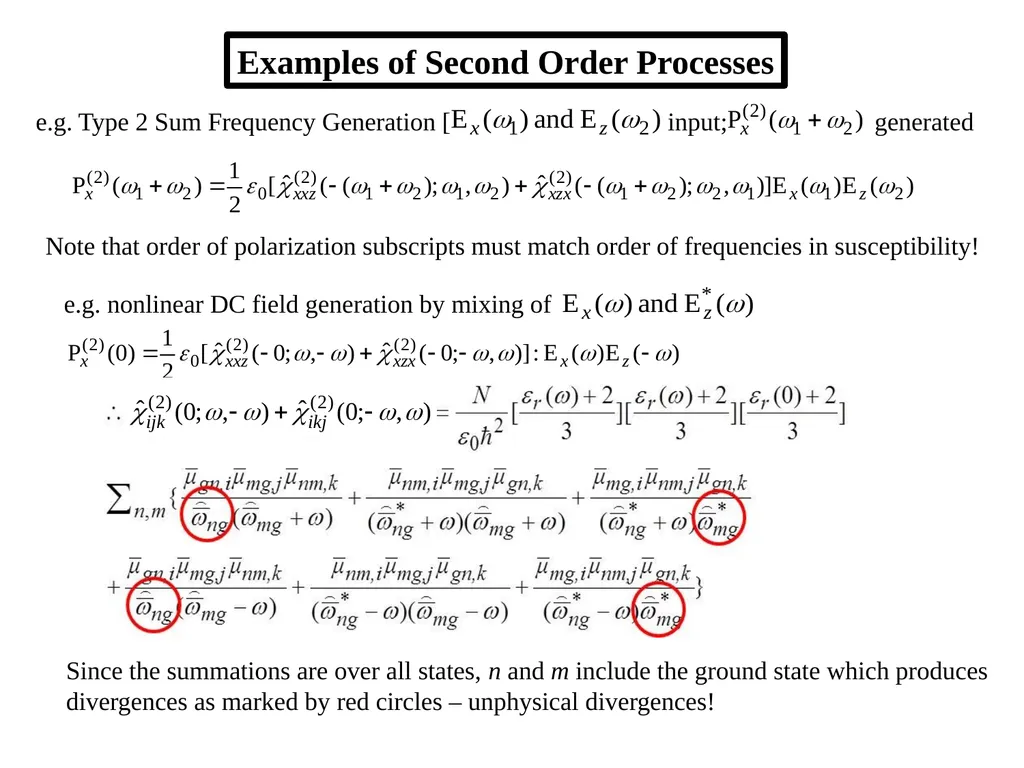
Examples of Second Order Processes e.g. Type 2 Sum Frequency Generation [ input; generated Note that order of polarization subscripts must match order of frequencies in susceptibility! e.g. nonlinear DC field generation by mixing of Since the summations are over all states, n and m include the ground state which produces
divergences as marked by red circles – unphysical divergences!<br>
12
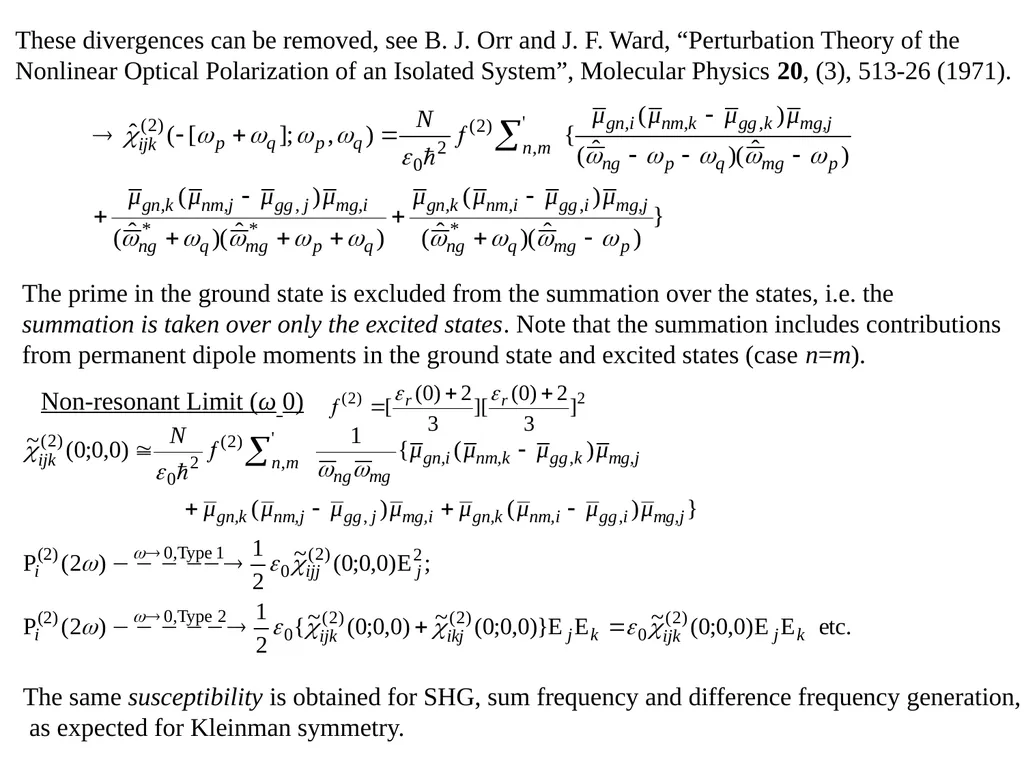
These divergences can be removed, see B. J. Orr and J. F. Ward, “Perturbation Theory of the
Nonlinear Optical Polarization of an Isolated System”, Molecular Physics 20, (3), 513-26 (1971). The prime in the ground state is excluded from the summation over the states, i.e. the
summation is taken over only the excited states. Note that the summation includes contributions
from permanent dipole moments in the ground state and excited states (case n=m). Non-resonant Limit (ω0) The same susceptibility is obtained for SHG, sum frequency and difference frequency generation,
as expected for Kleinman symmetry.<br>
13
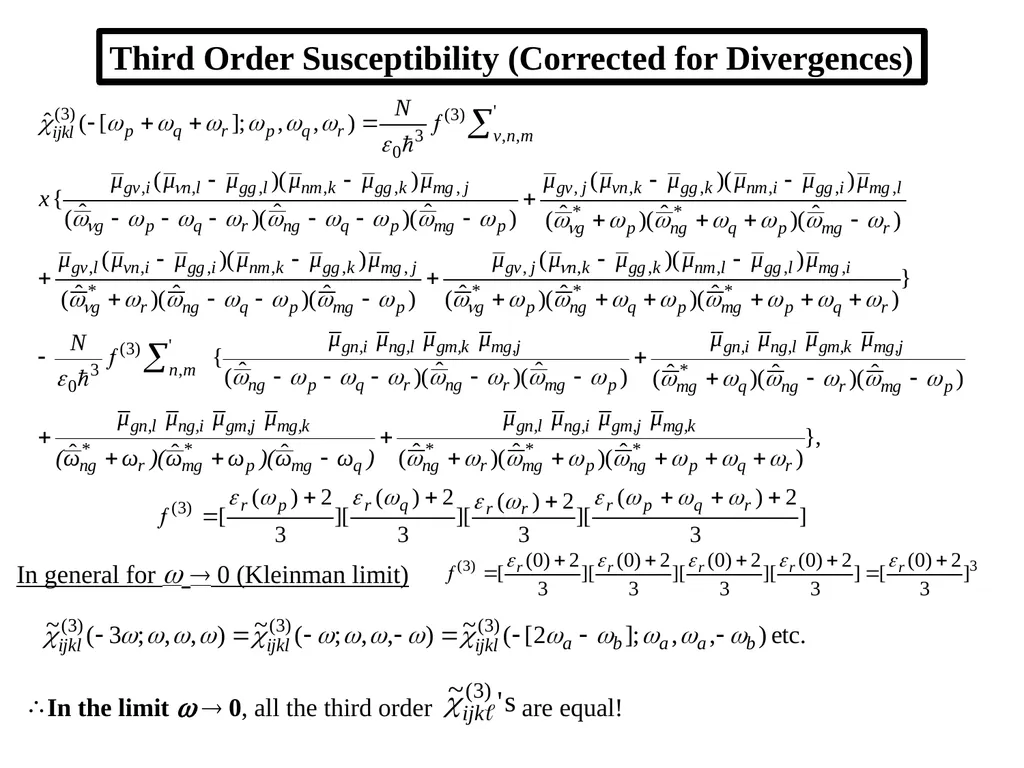
Third Order Susceptibility (Corrected for Divergences)<br>
14
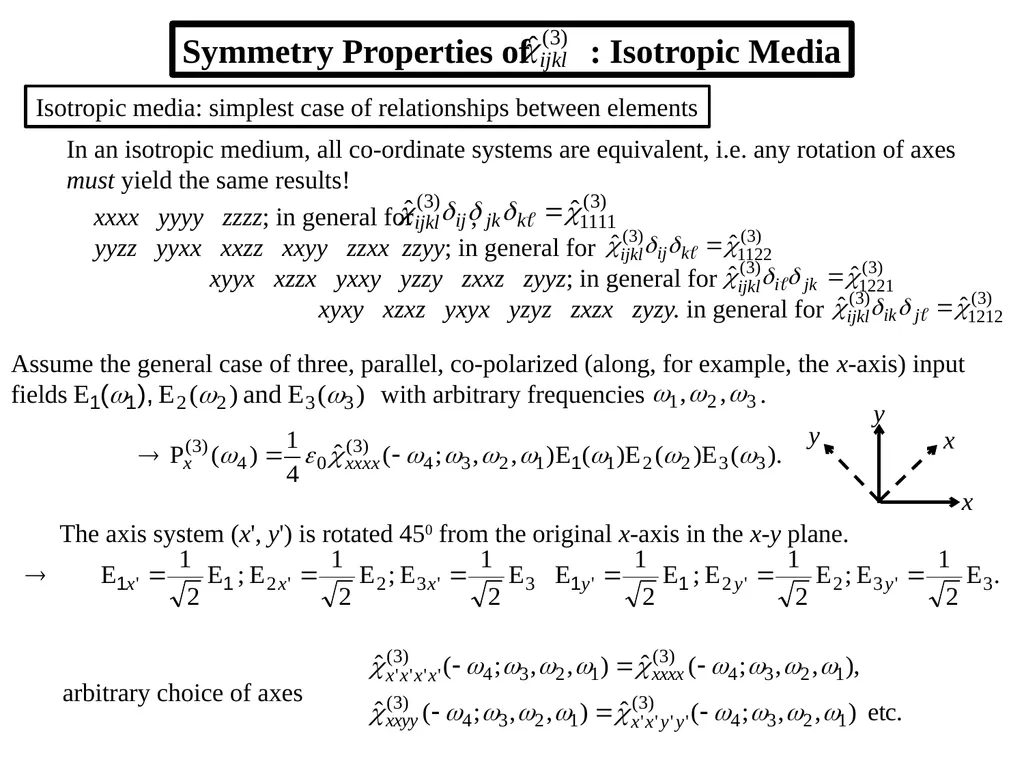
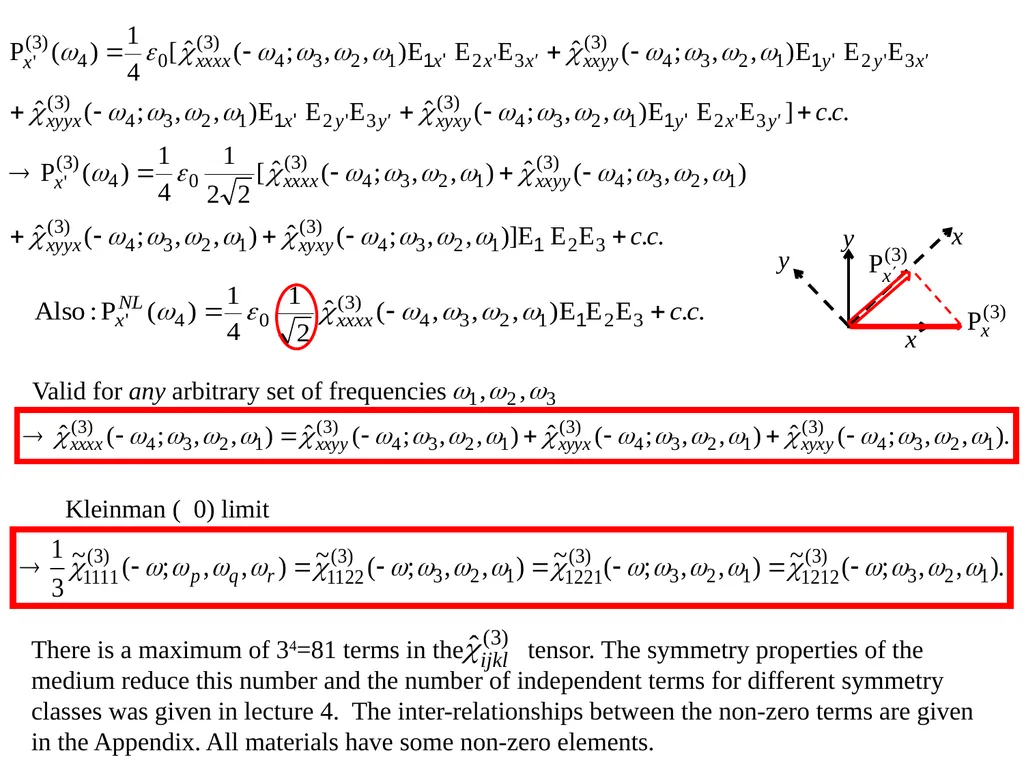
Isotropic media: simplest case of relationships between elements In an isotropic medium, all co-ordinate systems are equivalent, i.e. any rotation of axes
must yield the same results! arbitrary choice of axes <br>
15
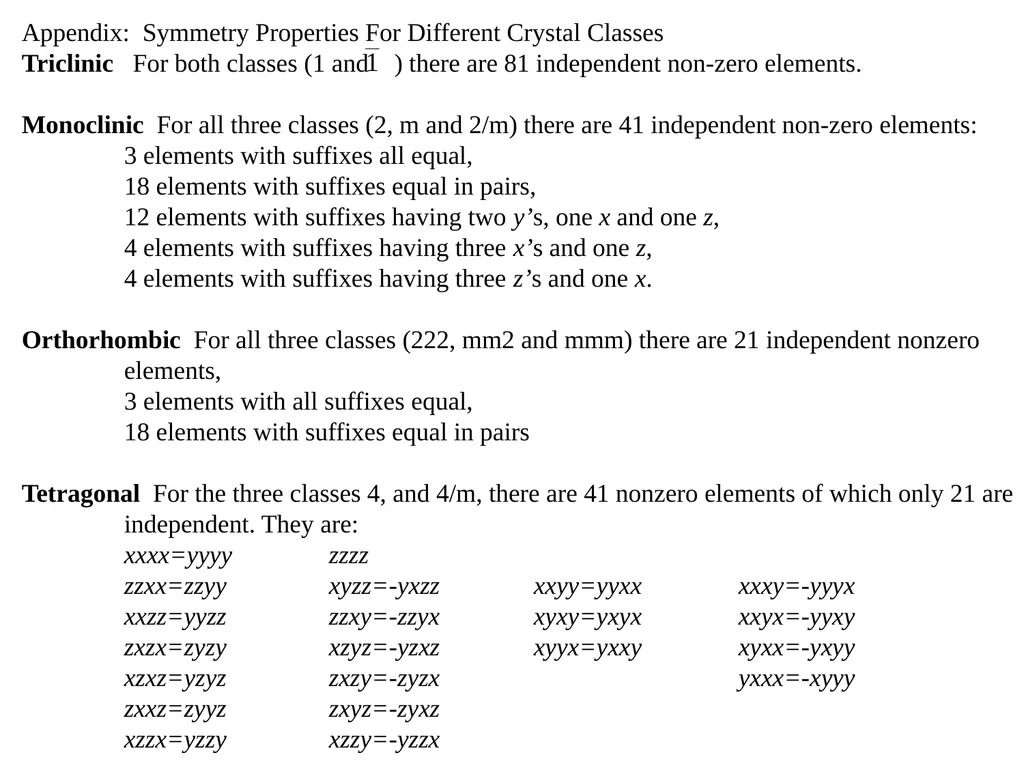
For the four classes 422, 4mm, 4/mmm and 2m, there are 21 nonzero elements of which
only 11 are independent. They are:
xxxx=yyyy zzzz
yyzz=xxzz yzzy=xzzx xxyy=yyxx zzyy=zzxx yzyz=xzzx xyxy=yxyx
zyyz=zxxz zyzy=zxzx xyyx=yxxy
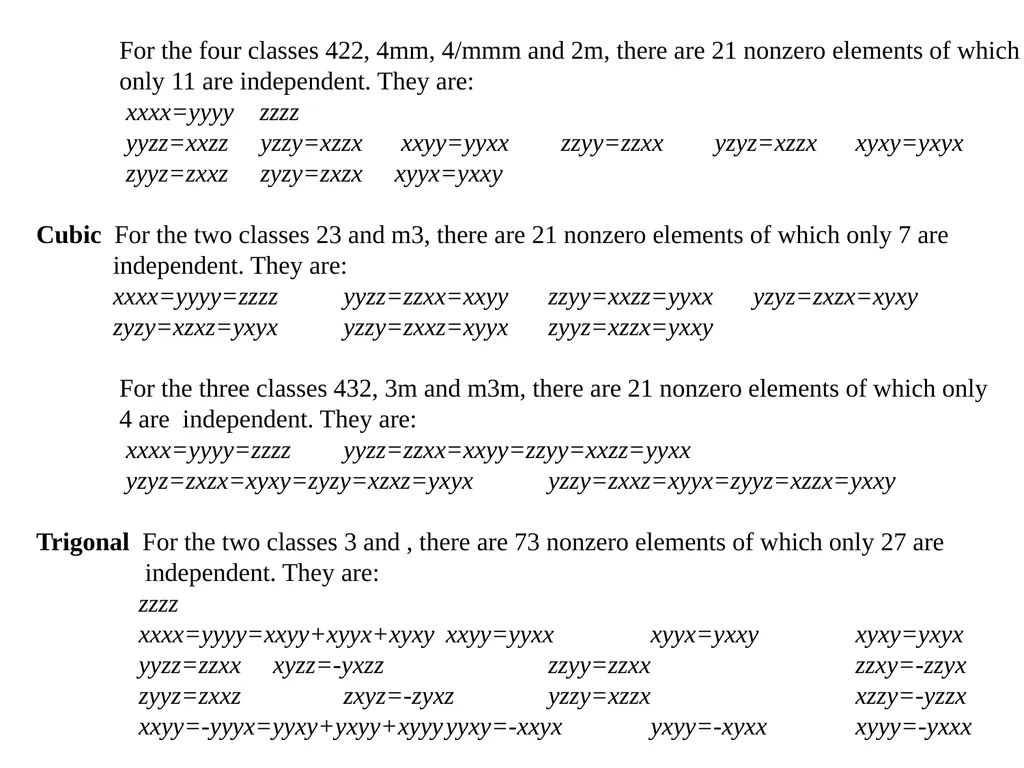
Cubic For the two classes 23 and m3, there are 21 nonzero elements of which only 7 are
independent. They are:
xxxx=yyyy=zzzz yyzz=zzxx=xxyy zzyy=xxzz=yyxx yzyz=zxzx=xyxy
zyzy=xzxz=yxyx yzzy=zxxz=xyyx zyyz=xzzx=yxxy
For the three classes 432, 3m and m3m, there are 21 nonzero elements of which only
4 are independent. They are:
xxxx=yyyy=zzzz yyzz=zzxx=xxyy=zzyy=xxzz=yyxx
yzyz=zxzx=xyxy=zyzy=xzxz=yxyx yzzy=zxxz=xyyx=zyyz=xzzx=yxxy
Trigonal For the two classes 3 and , there are 73 nonzero elements of which only 27 are
independent. They are:
zzzz
xxxx=yyyy=xxyy+xyyx+xyxy xxyy=yyxx xyyx=yxxy xyxy=yxyx
yyzz=zzxx xyzz=-yxzz zzyy=zzxx zzxy=-zzyx
zyyz=zxxz zxyz=-zyxz yzzy=xzzx xzzy=-yzzx
xxyy=-yyyx=yyxy+yxyy+xyyy yyxy=-xxyx yxyy=-xyxx xyyy=-yxxx<br>
16
yyyz=-yxxz=-xyxz=-xxyz yyzy=-yxzx=-xyxz=-xxzy yzyy=-yzxx=-zxyx=-xxzy
zyyy=-zyxx=-zxyx=-zxxy xxxz=-xyyz=-yxyz=-zzxz xxzx=-xyzy=-xyzy=-yyzx
xzxx=-yzxy=-yzyx=-xzyy zxxx=-zxyy=-zyxy=-zyyx
For the three classes 3m, m and 3,2 there are 37 nonzero elements of which only 14 are
independent. They are:
zzzz
xxxx=yyyy=xxyy+xyyx+xyxy xxyy=yyxx xyyx=yxxy xyxy=yxyx
yyzz=xxzz zzyy=zzxx zyyz=zxxz yzzy=xzzx yzyz=xzxz zyzy=zxzx
xxxz=-xyyz=-yxyz=-yyxz xxzx=-xyzy=-yxzy=-yyzx zxxx=-zxyy=-zyxy=-zyyx
Hexagonal For the three classes 6, and 6/m there are 41 non-zero elements of which only 19
are independent. They are:
zzzz
xxxx=yyyy=xxyy+xyyx+xyxy xxyy=yyxx xyyx=yxxy xyxy=yxyx
yyzz=zzxx xyzz=-yxzz zzyy=zzxx zzxy=-zzyx
zyyz=zxxz zxyz=-zyxz yzzy=xzzx xzzy=-yzzx
yzyz=xzxz xzyz=-yzxz zyzy=zxzx zxzy=-zyzx
xxyy=-yyyx=yyxy+yxyy+xyyy yyxy=-xxyx yxyy=-xyxx xyyy=-yxxx
For the four classes 622, 6mm, 6/mmm and m2, there are 21 nonzero elements of
which only 10 are independent. They are:
zzzz
xxxx=yyyy=xxyy+xyyx+xyxy xxyy=yyxx xyyx=yxxy xyxy=yxyx
yyzz=xxzz zzyy=zzxx zyyz=zxxz yzzy=xzzx yzyz=xzxz zyzy=zxzx<br>
17
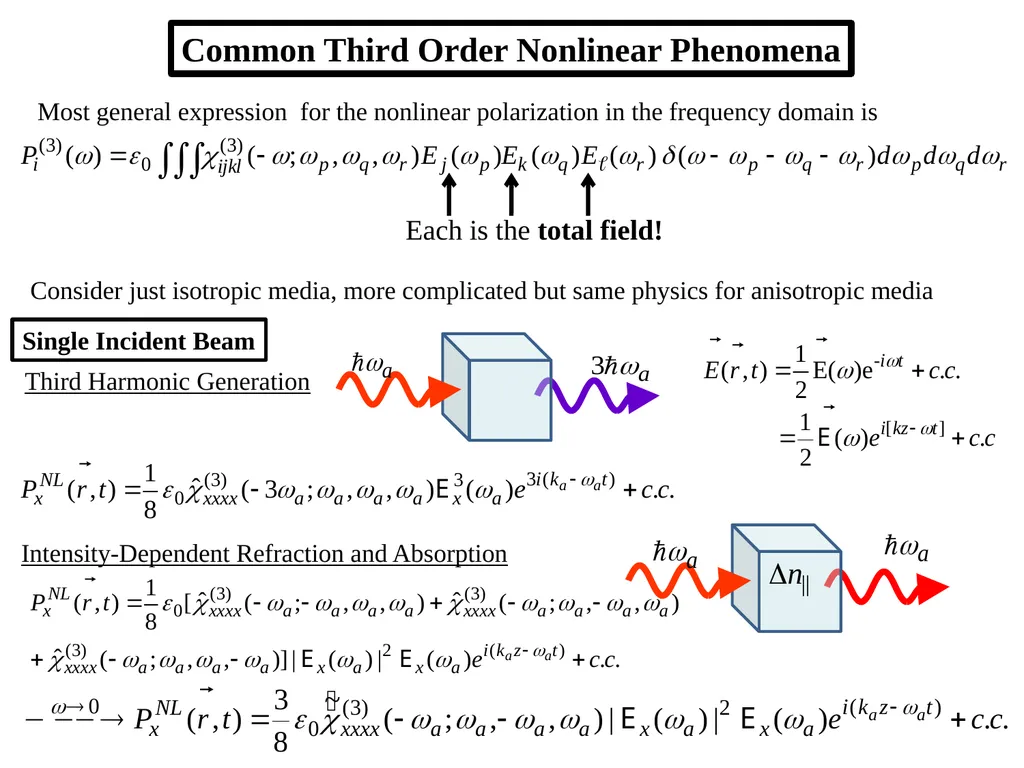
Each is the total field! Common Third Order Nonlinear Phenomena Most general expression for the nonlinear polarization in the frequency domain is Third Harmonic Generation Single Incident Beam Consider just isotropic media, more complicated but same physics for anisotropic media<br>
18
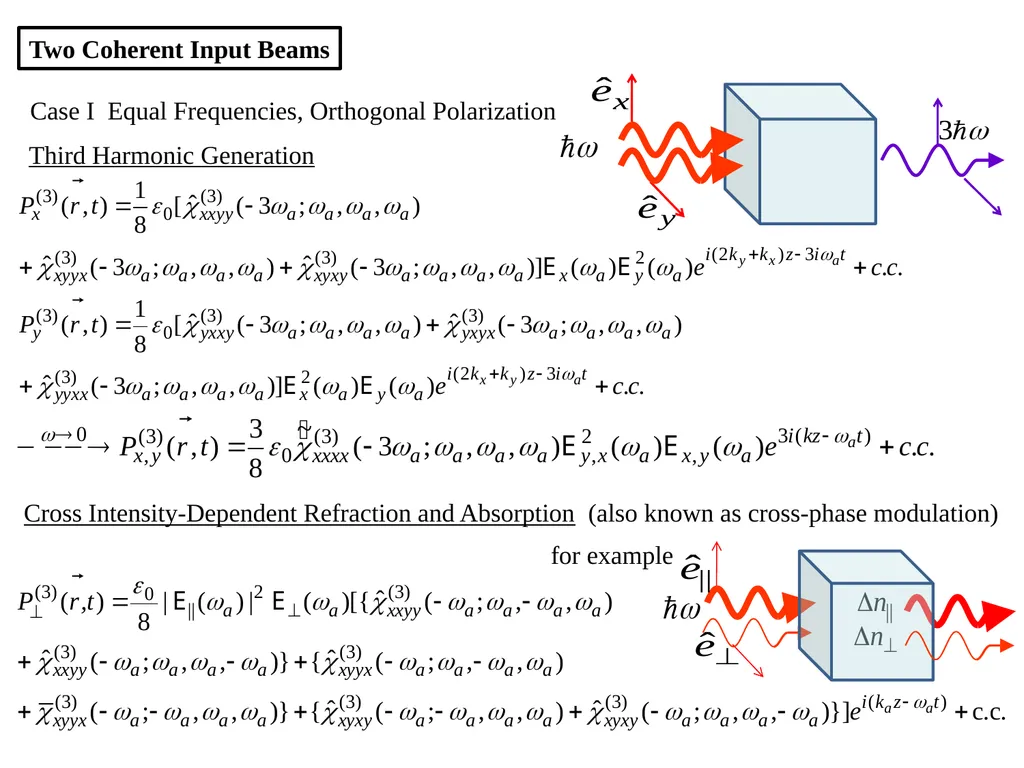
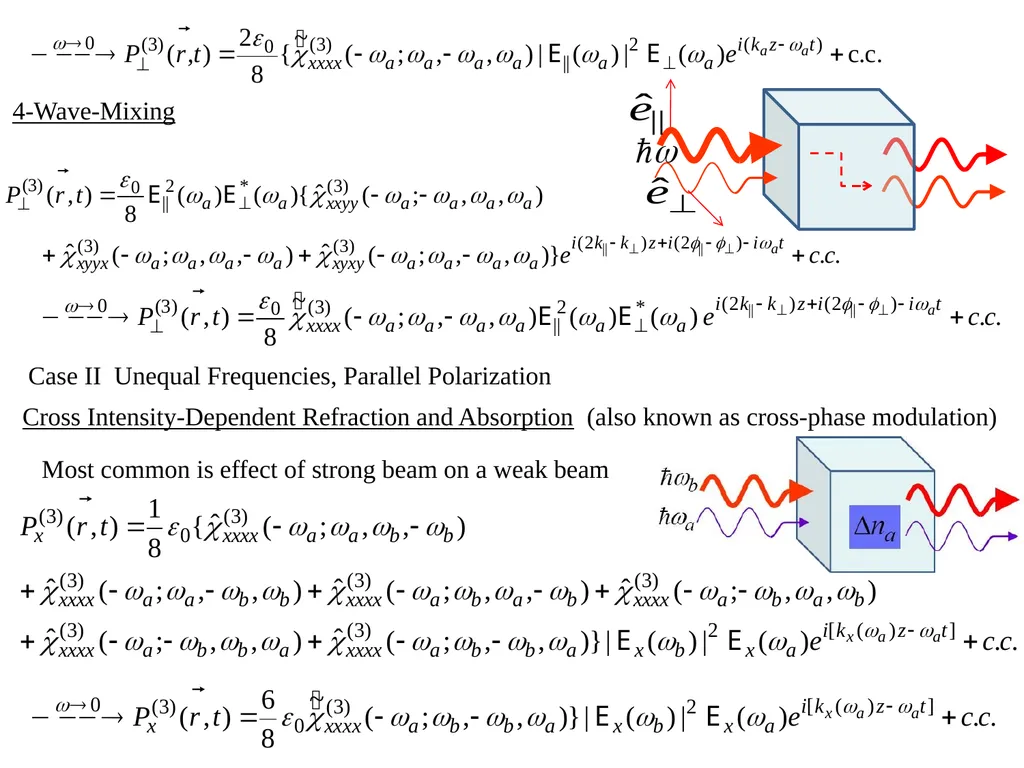
Two Coherent Input Beams Case I Equal Frequencies, Orthogonal Polarization Third Harmonic Generation for example Cross Intensity-Dependent Refraction and Absorption (also known as cross-phase modulation)<br>
19
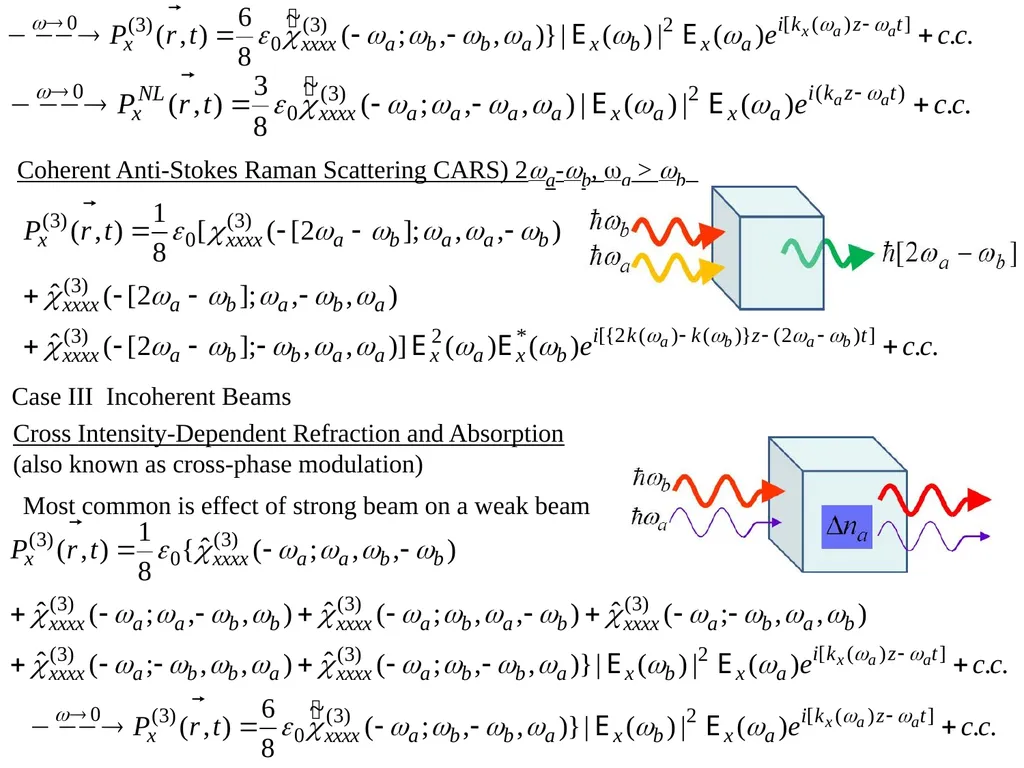
Case II Unequal Frequencies, Parallel Polarization<br>