
Notes for the teacher Context: This lesson will
LO
Published · 22 slides · 0 views
1 / 1
Description
Notes for the teacher Context: This lesson will enable students to explore the nature of God within Christianity. This provides an essential foundation for understanding Christian teachings and the connection between God and human world. It
Related Topics
Share
Embed code
Download this presentation From Below
"Notes for the teacher Context: This lesson will" is the property of its rightful owner. Permission is granted to download and print the materials on this website for personal, non-commercial use only, and to display it on your personal computer provided you do not modify the materials and that you retain all copyright notices contained in the materials. By downloading content from our website, you accept the terms of this agreement.
Presentation Transcript
01
Notes for the teacher Context:
This lesson will enable students to explore the nature of God within Christianity. This provides an essential foundation for understanding Christian teachings and the connection between God and human world. It builds on the KS3 unit How do Christians see the Kingdom of God? and it develops Pathway 1 (The Nature of Belief) and Pathway 6 (The Big Picture).
Misconceptions:
That free will solves the problem of evil when it actually only responds to the problem of moral evil. There is a still a requirement to overcome natural evil.
There is more moral evil that people think. For instance drought (when it has been caused by poor government) can be moral evil. Similar to earthquake destruction in areas of earthquake risk that should have protection. These are choices caused by humans that cause suffering.
Lesson:
-Students will begin by recalling definitions of the key qualities of God and remembering the problem of evil and how the argument structure is linked to the qualities of God. It is important to highlight that both God not existing and God not having the qualities are equally destructive. This links to the previous lesson on God's qualities and how they are linked to God's actions.
-Next, students will explore the theodicy of Augustine. This provides a solution to the problem of evil based on human sin and human action. It focuses on the fall of Adam and Eve. Explore how Christians who believe in a metaphorical creation may approach this. Augustine assumes a literal creation story in Genesis. Highlight strengths and weaknesses of the argument.
- Students will then consider a modern version from John Hick and the vale of soul making. This focuses on the importance of suffering to improve moral development. Students can consider if this overcomes the challenges to Augustine. Enable students to develop their interpretation and analytical skills here and this will be utilised in the next task.
Students will apply this knowledge in a written extension question. This task can be repeated with GCSE specific content for homework.
-Students will round up the lesson with a match up activity quiz to cement learning and increase retention.<br>
This lesson will enable students to explore the nature of God within Christianity. This provides an essential foundation for understanding Christian teachings and the connection between God and human world. It builds on the KS3 unit How do Christians see the Kingdom of God? and it develops Pathway 1 (The Nature of Belief) and Pathway 6 (The Big Picture).
Misconceptions:
That free will solves the problem of evil when it actually only responds to the problem of moral evil. There is a still a requirement to overcome natural evil.
There is more moral evil that people think. For instance drought (when it has been caused by poor government) can be moral evil. Similar to earthquake destruction in areas of earthquake risk that should have protection. These are choices caused by humans that cause suffering.
Lesson:
-Students will begin by recalling definitions of the key qualities of God and remembering the problem of evil and how the argument structure is linked to the qualities of God. It is important to highlight that both God not existing and God not having the qualities are equally destructive. This links to the previous lesson on God's qualities and how they are linked to God's actions.
-Next, students will explore the theodicy of Augustine. This provides a solution to the problem of evil based on human sin and human action. It focuses on the fall of Adam and Eve. Explore how Christians who believe in a metaphorical creation may approach this. Augustine assumes a literal creation story in Genesis. Highlight strengths and weaknesses of the argument.
- Students will then consider a modern version from John Hick and the vale of soul making. This focuses on the importance of suffering to improve moral development. Students can consider if this overcomes the challenges to Augustine. Enable students to develop their interpretation and analytical skills here and this will be utilised in the next task.
Students will apply this knowledge in a written extension question. This task can be repeated with GCSE specific content for homework.
-Students will round up the lesson with a match up activity quiz to cement learning and increase retention.<br>
02
The problem of evil and suffering: is there a solution? Unit: Key Christian Beliefs
Lesson 4 © Pennine Learning Associates Ltd 2024<br>
Lesson 4 © Pennine Learning Associates Ltd 2024<br>
03
To understand and explain theoretical solutions to the problem of evil and suffering. Learning Objective<br>
04
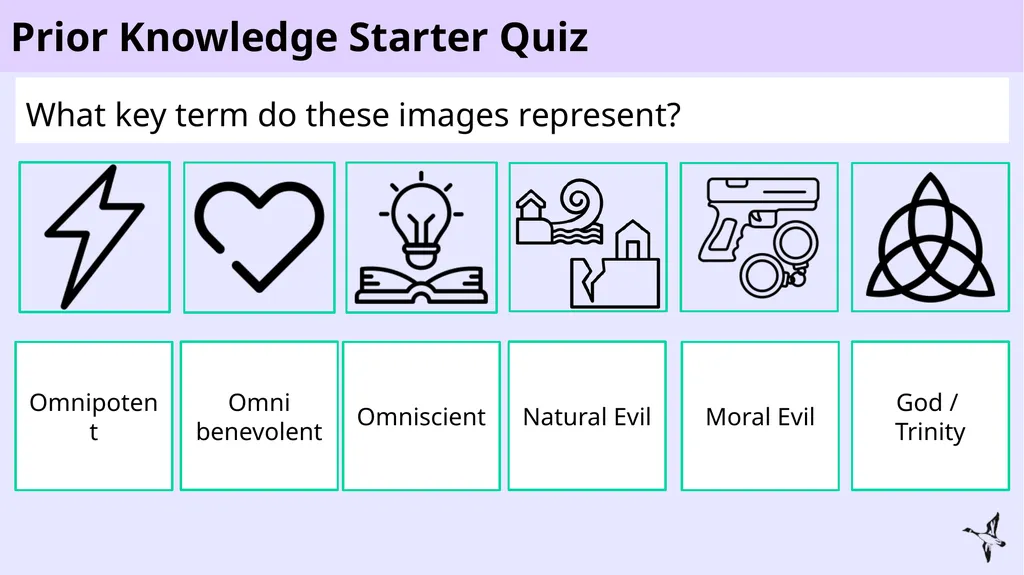
Prior Knowledge Starter Quiz What key term do these images represent? Moral Evil Omniscient God /
Trinity Natural Evil Omnipotent Omni benevolent<br>
Trinity Natural Evil Omnipotent Omni benevolent<br>
05
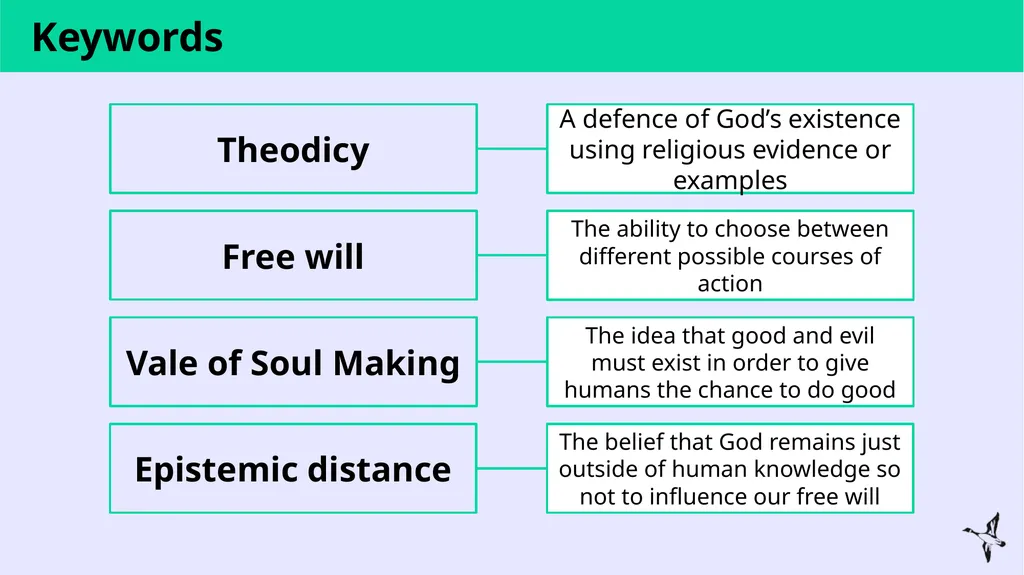
Keywords A defence of God’s existence using religious evidence or examples Theodicy Free will Vale of Soul Making The idea that good and evil must exist in order to give humans the chance to do good The ability to choose between different possible courses of action The belief that God remains just outside of human knowledge so not to influence our free will Epistemic distance<br>
06
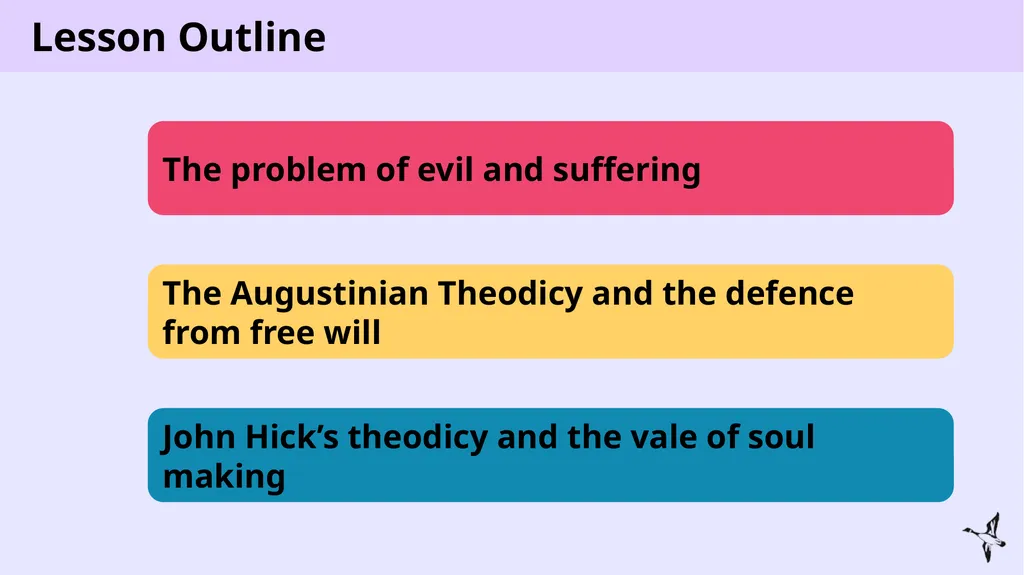
The Augustinian Theodicy and the defence from free will Lesson Outline John Hick’s theodicy and the vale of soul making The problem of evil and suffering<br>
07
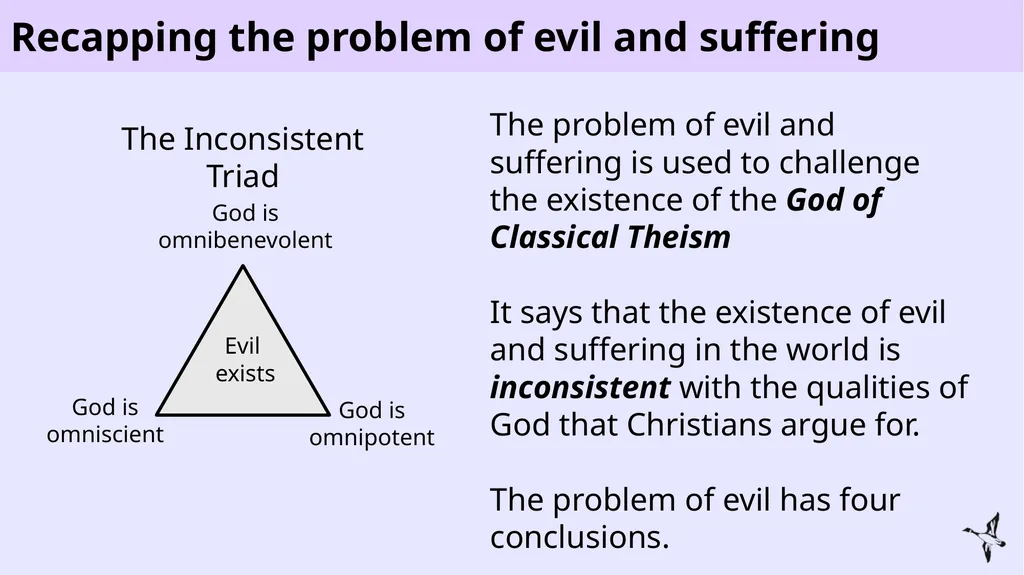
The problem of evil and suffering is used to challenge the existence of the God of Classical Theism
It says that the existence of evil and suffering in the world is inconsistent with the qualities of God that Christians argue for.
The problem of evil has four conclusions. Recapping the problem of evil and suffering God is
omnibenevolent God is
omnipotent God is
omniscient The Inconsistent Triad Evil
exists<br>
It says that the existence of evil and suffering in the world is inconsistent with the qualities of God that Christians argue for.
The problem of evil has four conclusions. Recapping the problem of evil and suffering God is
omnibenevolent God is
omnipotent God is
omniscient The Inconsistent Triad Evil
exists<br>
08
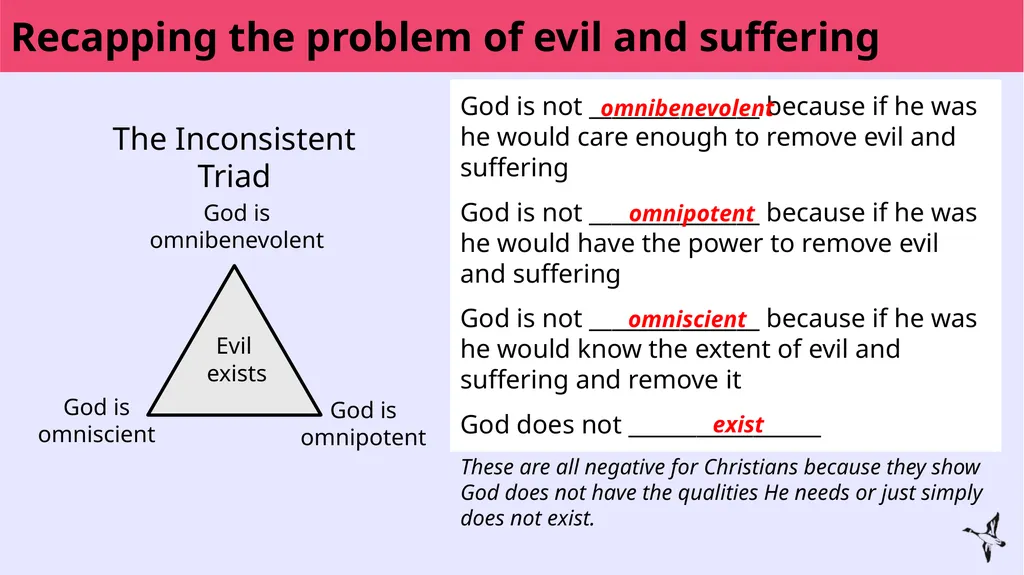
Recapping the problem of evil and suffering God is
omnibenevolent God is
omniscient God is
omnipotent The Inconsistent Triad Evil
exists God is not _______________ because if he was he would care enough to remove evil and suffering
God is not _______________ because if he was he would have the power to remove evil and suffering
God is not _______________ because if he was he would know the extent of evil and suffering and remove it
God does not _________________
These are all negative for Christians because they show God does not have the qualities He needs or just simply does not exist. omnibenevolent omnipotent omniscient exist<br>
omnibenevolent God is
omniscient God is
omnipotent The Inconsistent Triad Evil
exists God is not _______________ because if he was he would care enough to remove evil and suffering
God is not _______________ because if he was he would have the power to remove evil and suffering
God is not _______________ because if he was he would know the extent of evil and suffering and remove it
God does not _________________
These are all negative for Christians because they show God does not have the qualities He needs or just simply does not exist. omnibenevolent omnipotent omniscient exist<br>
09
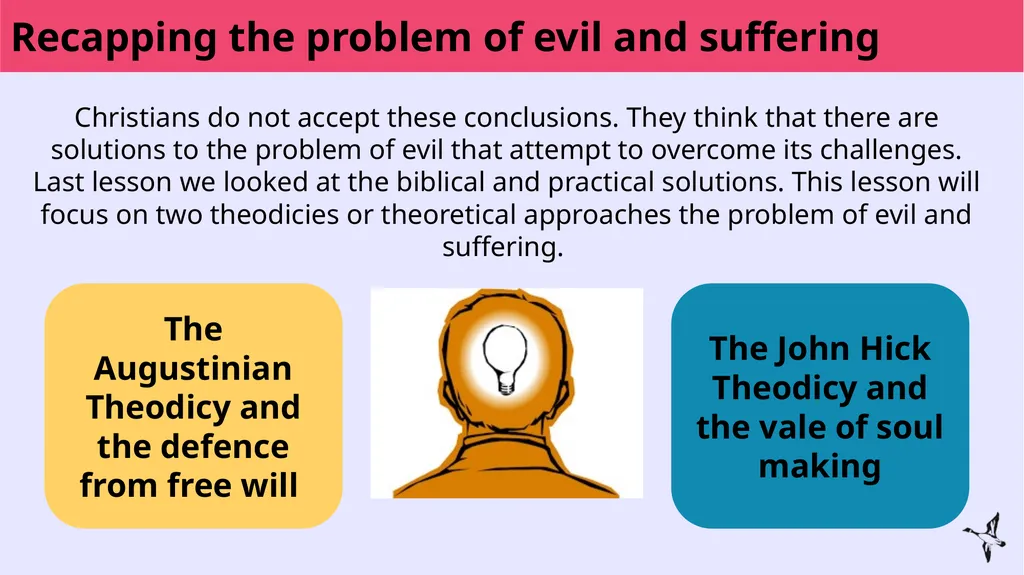
Recapping the problem of evil and suffering Christians do not accept these conclusions. They think that there are solutions to the problem of evil that attempt to overcome its challenges. Last lesson we looked at the biblical and practical solutions. This lesson will focus on two theodicies or theoretical approaches the problem of evil and suffering. The Augustinian Theodicy and the defence from free will The John Hick Theodicy and the vale of soul making<br>
10
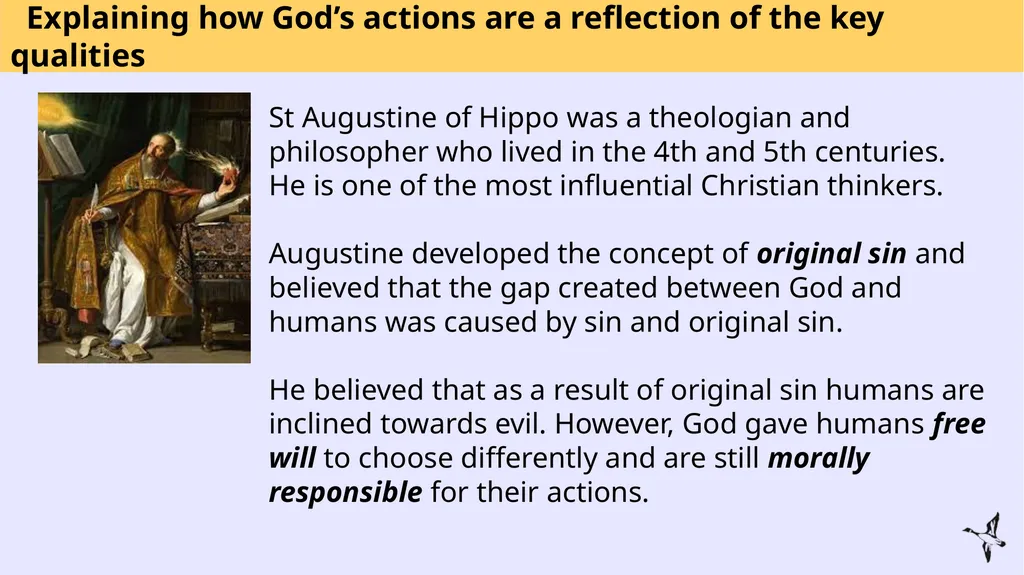
St Augustine of Hippo was a theologian and philosopher who lived in the 4th and 5th centuries. He is one of the most influential Christian thinkers.
Augustine developed the concept of original sin and believed that the gap created between God and humans was caused by sin and original sin.
He believed that as a result of original sin humans are inclined towards evil. However, God gave humans free will to choose differently and are still morally responsible for their actions. Explaining how God’s actions are a reflection of the key qualities<br>
Augustine developed the concept of original sin and believed that the gap created between God and humans was caused by sin and original sin.
He believed that as a result of original sin humans are inclined towards evil. However, God gave humans free will to choose differently and are still morally responsible for their actions. Explaining how God’s actions are a reflection of the key qualities<br>
11
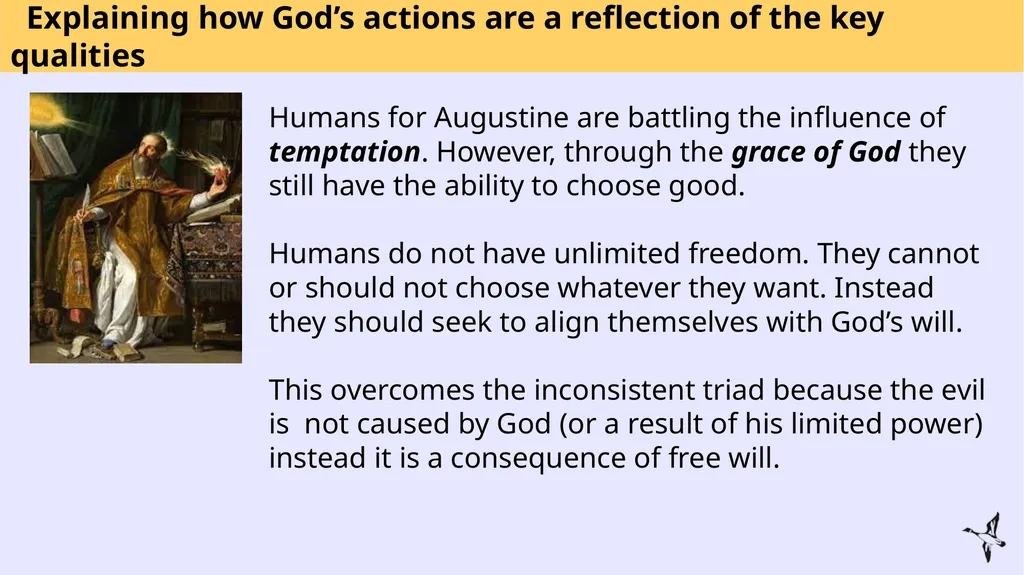
Humans for Augustine are battling the influence of temptation. However, through the grace of God they still have the ability to choose good.
Humans do not have unlimited freedom. They cannot or should not choose whatever they want. Instead they should seek to align themselves with God’s will.
This overcomes the inconsistent triad because the evil is not caused by God (or a result of his limited power) instead it is a consequence of free will. Explaining how God’s actions are a reflection of the key qualities<br>
Humans do not have unlimited freedom. They cannot or should not choose whatever they want. Instead they should seek to align themselves with God’s will.
This overcomes the inconsistent triad because the evil is not caused by God (or a result of his limited power) instead it is a consequence of free will. Explaining how God’s actions are a reflection of the key qualities<br>
12
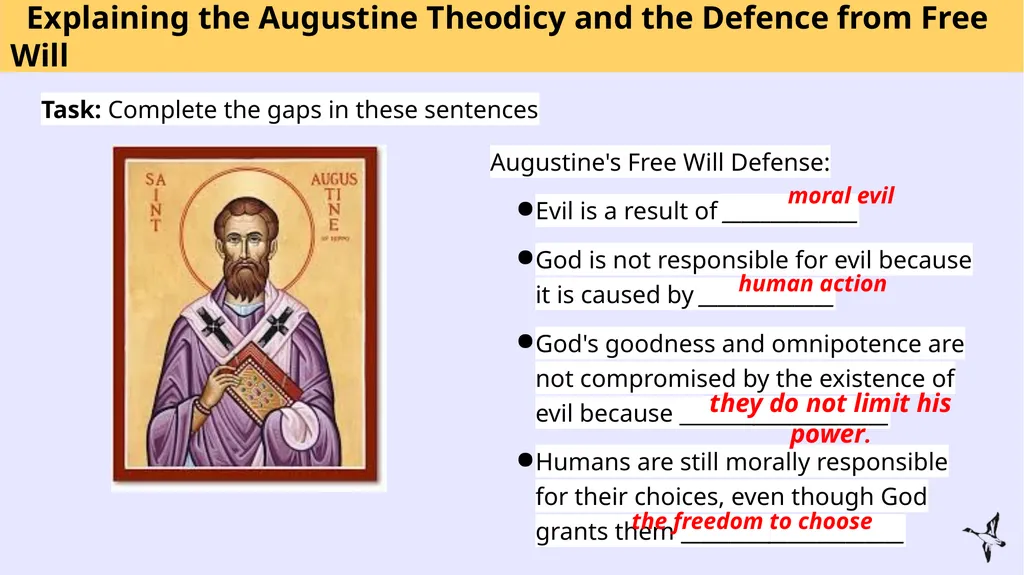
Explaining the Augustine Theodicy and the Defence from Free Will Augustine's Free Will Defense:
Evil is a result of ______________
God is not responsible for evil because it is caused by ______________
God's goodness and omnipotence are not compromised by the existence of evil because _____________________
Humans are still morally responsible for their choices, even though God grants them _______________________ moral evil human action they do not limit his power. the freedom to choose Task: Complete the gaps in these sentences<br>
Evil is a result of ______________
God is not responsible for evil because it is caused by ______________
God's goodness and omnipotence are not compromised by the existence of evil because _____________________
Humans are still morally responsible for their choices, even though God grants them _______________________ moral evil human action they do not limit his power. the freedom to choose Task: Complete the gaps in these sentences<br>
13
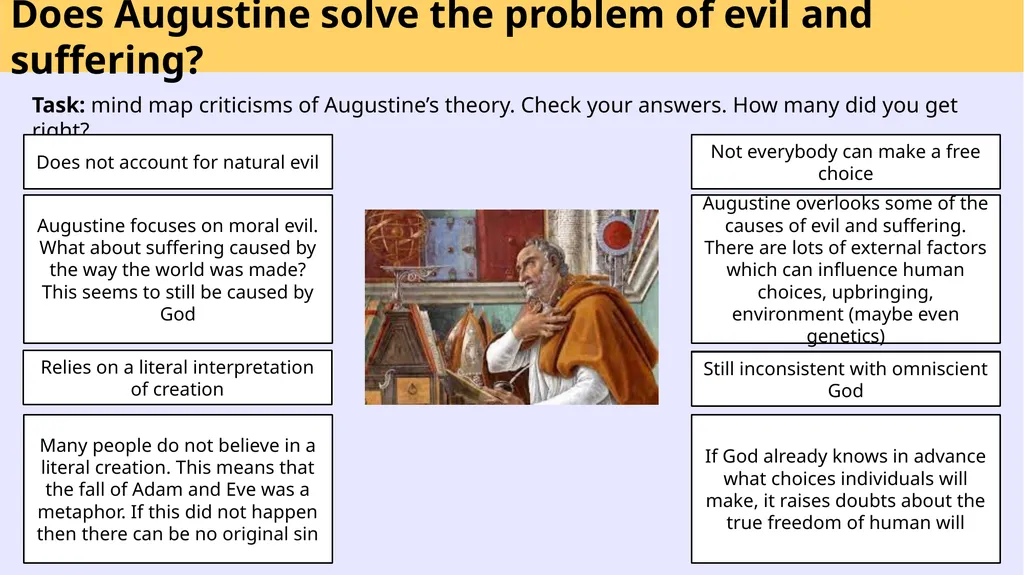
Does Augustine solve the problem of evil and suffering? Task: mind map criticisms of Augustine’s theory. Check your answers. How many did you get right? Augustine focuses on moral evil. What about suffering caused by the way the world was made? This seems to still be caused by God Augustine overlooks some of the causes of evil and suffering. There are lots of external factors which can influence human choices, upbringing, environment (maybe even genetics) Does not account for natural evil Not everybody can make a free choice Relies on a literal interpretation of creation Many people do not believe in a literal creation. This means that the fall of Adam and Eve was a metaphor. If this did not happen then there can be no original sin Still inconsistent with omniscient God If God already knows in advance what choices individuals will make, it raises doubts about the true freedom of human will<br>
14
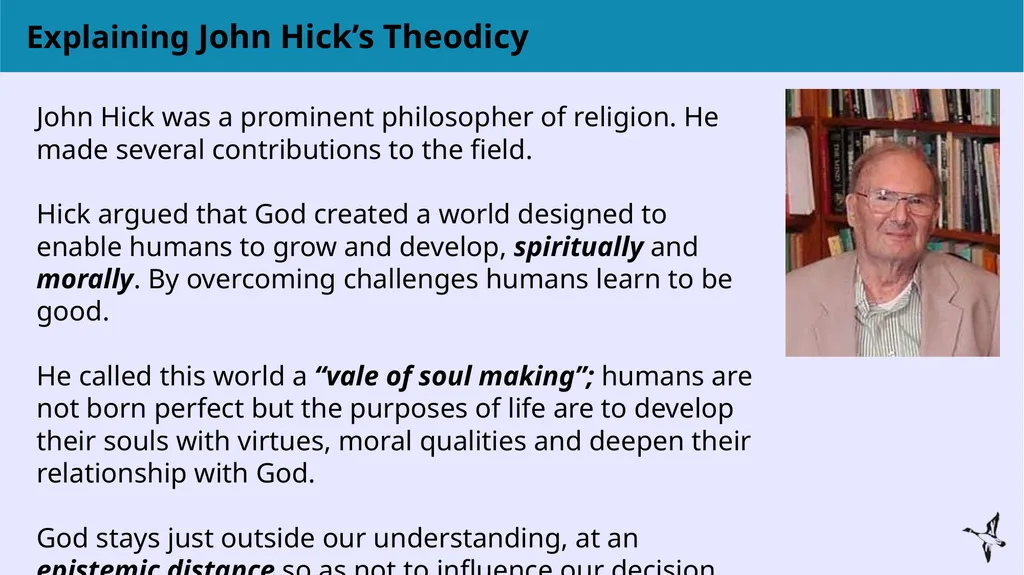
John Hick was a prominent philosopher of religion. He made several contributions to the field.
Hick argued that God created a world designed to enable humans to grow and develop, spiritually and morally. By overcoming challenges humans learn to be good.
He called this world a “vale of soul making”; humans are not born perfect but the purposes of life are to develop their souls with virtues, moral qualities and deepen their relationship with God.
God stays just outside our understanding, at an epistemic distance so as not to influence our decision making. Explaining John Hick’s Theodicy<br>
Hick argued that God created a world designed to enable humans to grow and develop, spiritually and morally. By overcoming challenges humans learn to be good.
He called this world a “vale of soul making”; humans are not born perfect but the purposes of life are to develop their souls with virtues, moral qualities and deepen their relationship with God.
God stays just outside our understanding, at an epistemic distance so as not to influence our decision making. Explaining John Hick’s Theodicy<br>
15
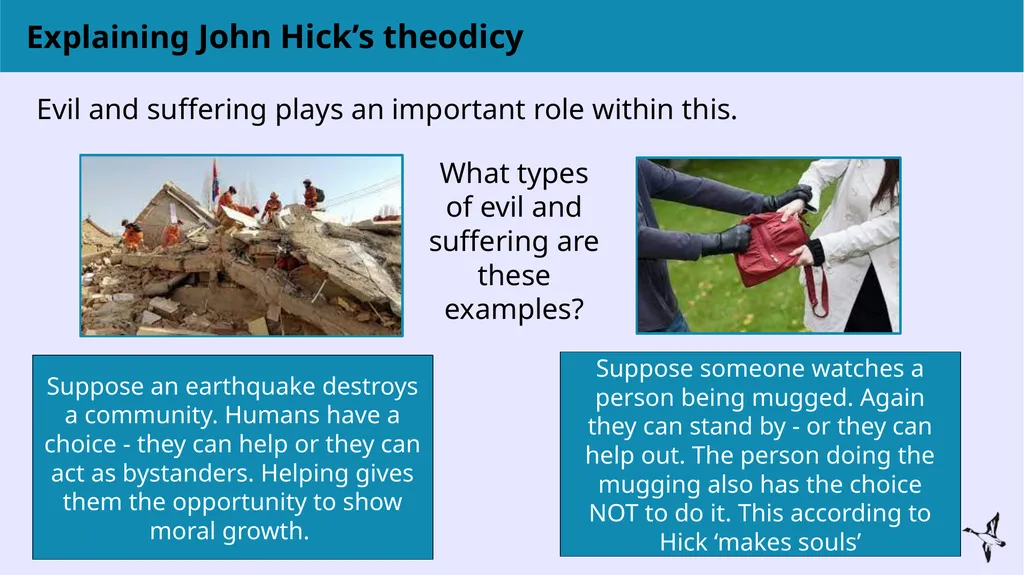
Evil and suffering plays an important role within this. Explaining John Hick’s theodicy Suppose an earthquake destroys a community. Humans have a choice - they can help or they can act as bystanders. Helping gives them the opportunity to show moral growth. Suppose someone watches a person being mugged. Again they can stand by - or they can help out. The person doing the mugging also has the choice NOT to do it. This according to Hick ‘makes souls’ What types of evil and suffering are these examples?<br>
16
John Hick’s Vale of Soul Making Defense:
Evil is necessary for _______________________ development.
Through experiencing and overcoming evil, humans develop _______________________________
God allows evil in order to create a world where humans can _________________
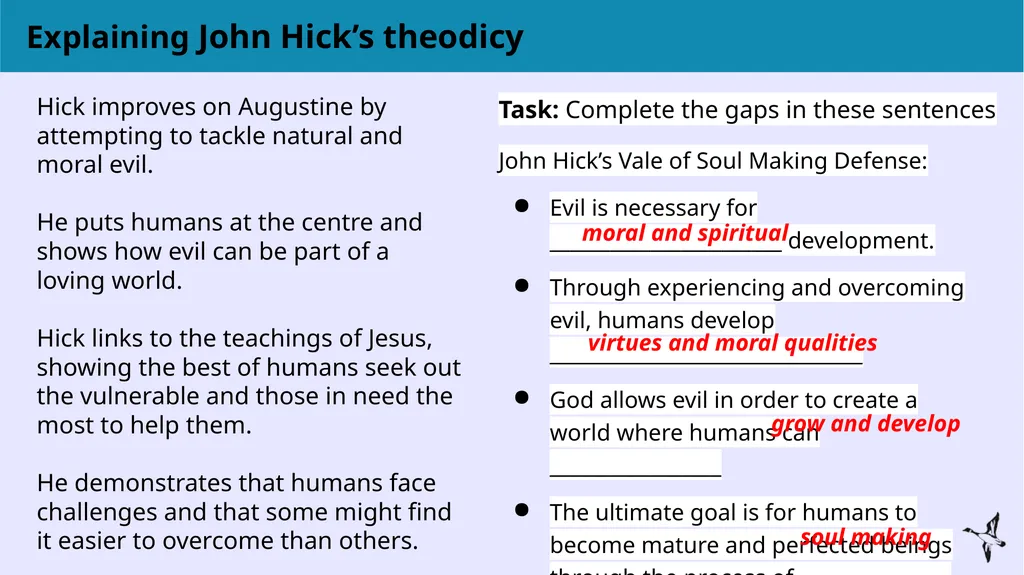
The ultimate goal is for humans to become mature and perfected beings through the process of _______________ Explaining John Hick’s theodicy moral and spiritual virtues and moral qualities grow and develop soul making Hick improves on Augustine by attempting to tackle natural and moral evil.
He puts humans at the centre and shows how evil can be part of a loving world.
Hick links to the teachings of Jesus, showing the best of humans seek out the vulnerable and those in need the most to help them.
He demonstrates that humans face challenges and that some might find it easier to overcome than others. Task: Complete the gaps in these sentences<br>
Evil is necessary for _______________________ development.
Through experiencing and overcoming evil, humans develop _______________________________
God allows evil in order to create a world where humans can _________________
The ultimate goal is for humans to become mature and perfected beings through the process of _______________ Explaining John Hick’s theodicy moral and spiritual virtues and moral qualities grow and develop soul making Hick improves on Augustine by attempting to tackle natural and moral evil.
He puts humans at the centre and shows how evil can be part of a loving world.
Hick links to the teachings of Jesus, showing the best of humans seek out the vulnerable and those in need the most to help them.
He demonstrates that humans face challenges and that some might find it easier to overcome than others. Task: Complete the gaps in these sentences<br>
17
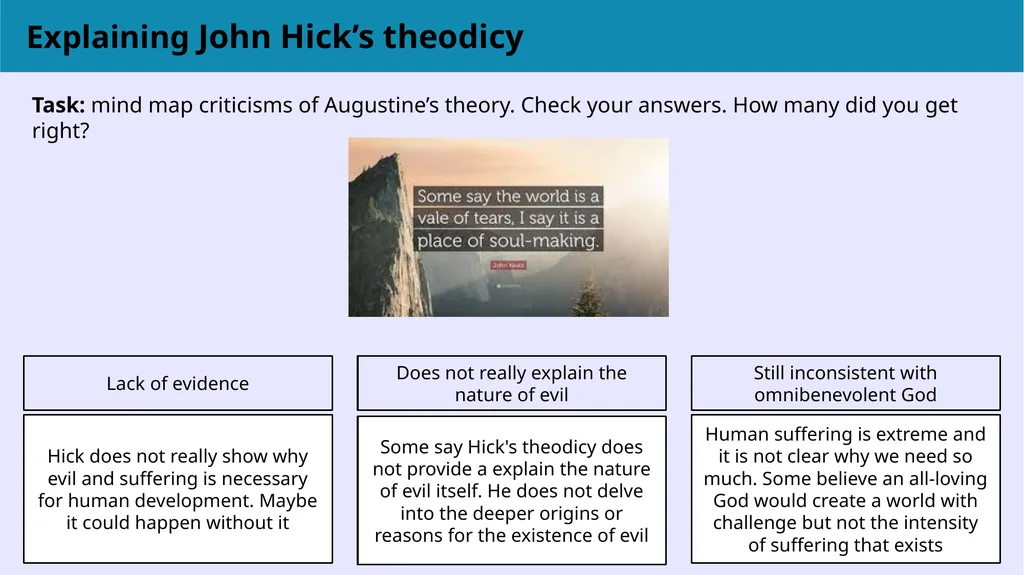
Explaining John Hick’s theodicy Task: mind map criticisms of Augustine’s theory. Check your answers. How many did you get right? Some say Hick's theodicy does not provide a explain the nature of evil itself. He does not delve into the deeper origins or reasons for the existence of evil Does not really explain the nature of evil Lack of evidence Hick does not really show why evil and suffering is necessary for human development. Maybe it could happen without it Still inconsistent with omnibenevolent God Human suffering is extreme and it is not clear why we need so much. Some believe an all-loving God would create a world with challenge but not the intensity of suffering that exists<br>
18
Top Tip
Ensure that you include two clear points with development
Separate them with a line
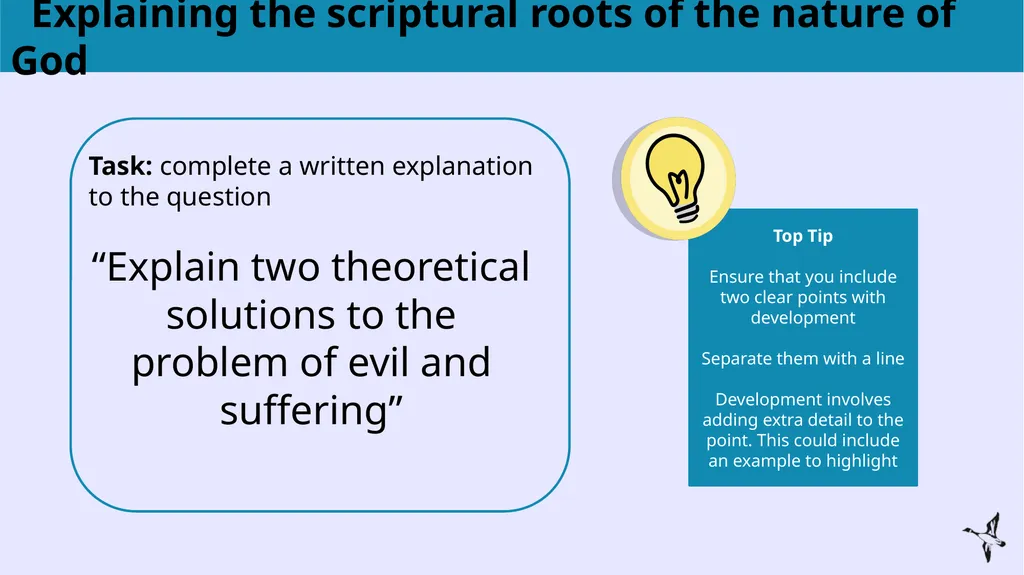
Development involves adding extra detail to the point. This could include an example to highlight Explaining the scriptural roots of the nature of God Task: complete a written explanation to the question
“Explain two theoretical solutions to the problem of evil and suffering”<br>
Ensure that you include two clear points with development
Separate them with a line
Development involves adding extra detail to the point. This could include an example to highlight Explaining the scriptural roots of the nature of God Task: complete a written explanation to the question
“Explain two theoretical solutions to the problem of evil and suffering”<br>
19
…………………………………………………………………….
…………………………………………………………………………….
…………………………………………………………………………….
…………………………………………………………………………….
…………………………………………………………………………….
…………………………………………………………………………….
…………………………………………………………………………….
…………………………………………………………………………….
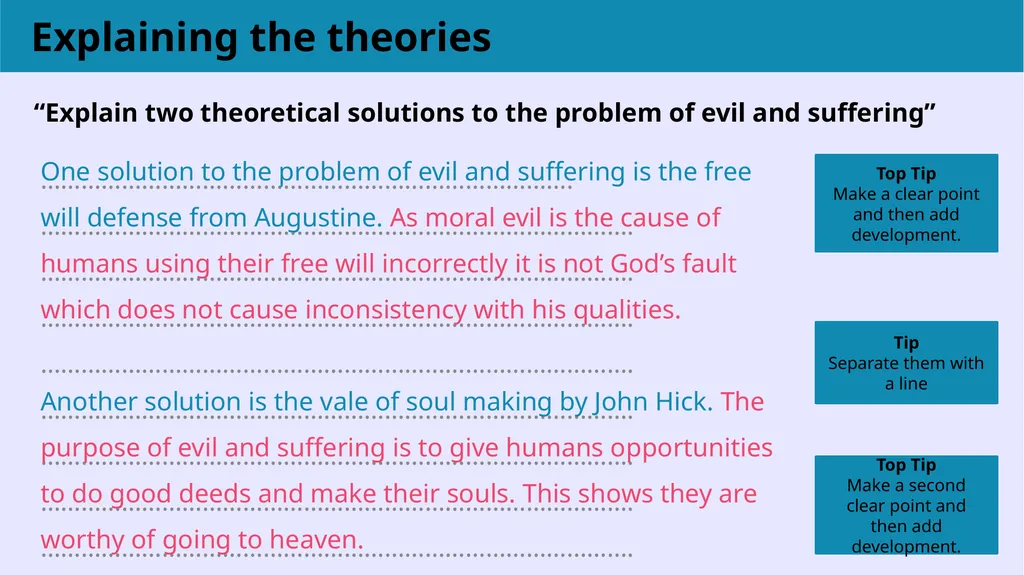
……………………………………………………………………………. One solution to the problem of evil and suffering is the free will defense from Augustine. As moral evil is the cause of humans using their free will incorrectly it is not God’s fault which does not cause inconsistency with his qualities.
Another solution is the vale of soul making by John Hick. The purpose of evil and suffering is to give humans opportunities to do good deeds and make their souls. This shows they are worthy of going to heaven. Top Tip
Make a second clear point and then add development. “Explain two theoretical solutions to the problem of evil and suffering” Explaining the theories Tip
Separate them with a line Top Tip
Make a clear point and then add development.<br>
…………………………………………………………………………….
…………………………………………………………………………….
…………………………………………………………………………….
…………………………………………………………………………….
…………………………………………………………………………….
…………………………………………………………………………….
…………………………………………………………………………….
……………………………………………………………………………. One solution to the problem of evil and suffering is the free will defense from Augustine. As moral evil is the cause of humans using their free will incorrectly it is not God’s fault which does not cause inconsistency with his qualities.
Another solution is the vale of soul making by John Hick. The purpose of evil and suffering is to give humans opportunities to do good deeds and make their souls. This shows they are worthy of going to heaven. Top Tip
Make a second clear point and then add development. “Explain two theoretical solutions to the problem of evil and suffering” Explaining the theories Tip
Separate them with a line Top Tip
Make a clear point and then add development.<br>
20
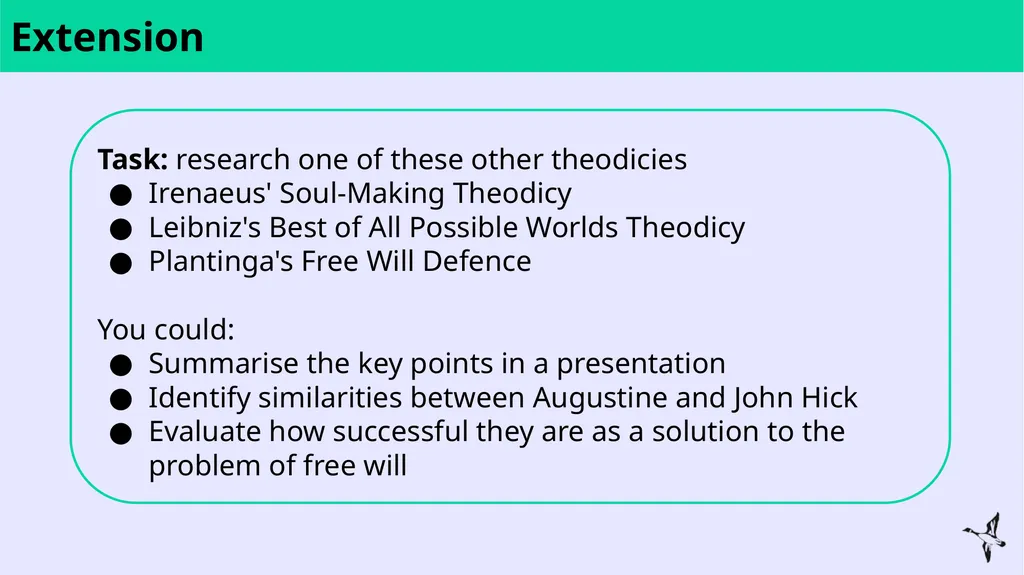
Extension Task: research one of these other theodicies
Irenaeus' Soul-Making Theodicy
Leibniz's Best of All Possible Worlds Theodicy
Plantinga's Free Will Defence
You could:
Summarise the key points in a presentation
Identify similarities between Augustine and John Hick
Evaluate how successful they are as a solution to the problem of free will<br>
Irenaeus' Soul-Making Theodicy
Leibniz's Best of All Possible Worlds Theodicy
Plantinga's Free Will Defence
You could:
Summarise the key points in a presentation
Identify similarities between Augustine and John Hick
Evaluate how successful they are as a solution to the problem of free will<br>
21
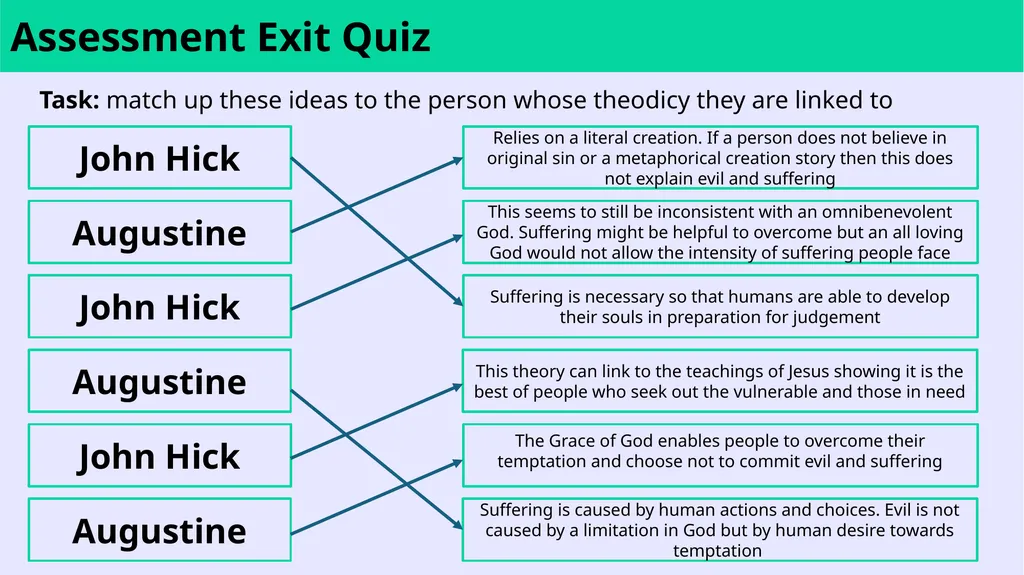
Suffering is caused by human actions and choices. Evil is not caused by a limitation in God but by human desire towards temptation Assessment Exit Quiz John Hick Relies on a literal creation. If a person does not believe in original sin or a metaphorical creation story then this does not explain evil and suffering Augustine John Hick Suffering is necessary so that humans are able to develop their souls in preparation for judgement This theory can link to the teachings of Jesus showing it is the best of people who seek out the vulnerable and those in need Augustine This seems to still be inconsistent with an omnibenevolent God. Suffering might be helpful to overcome but an all loving God would not allow the intensity of suffering people face John Hick Augustine Task: match up these ideas to the person whose theodicy they are linked to The Grace of God enables people to overcome their temptation and choose not to commit evil and suffering<br>
22
The problem of evil and suffering: is there a solution? Unit: Key Christian Beliefs
Lesson 4<br>
Lesson 4<br>