
Noun Clauses Introduction A clause is a group of
PT
Published · 49 slides · 0 views

1 / 1
Description
Noun Clauses Introduction A clause is a group of words containing a subject and a verb. e.g. He ran. A phrase is a group of words that does not contain a subject and a verb. e.g. on the table, under the tree An independent clause is a
Related Topics
Share
Embed code
Download this presentation From Below
"Noun Clauses Introduction A clause is a group of" is the property of its rightful owner. Permission is granted to download and print the materials on this website for personal, non-commercial use only, and to display it on your personal computer provided you do not modify the materials and that you retain all copyright notices contained in the materials. By downloading content from our website, you accept the terms of this agreement.
Presentation Transcript
01
Noun Clauses<br>
02
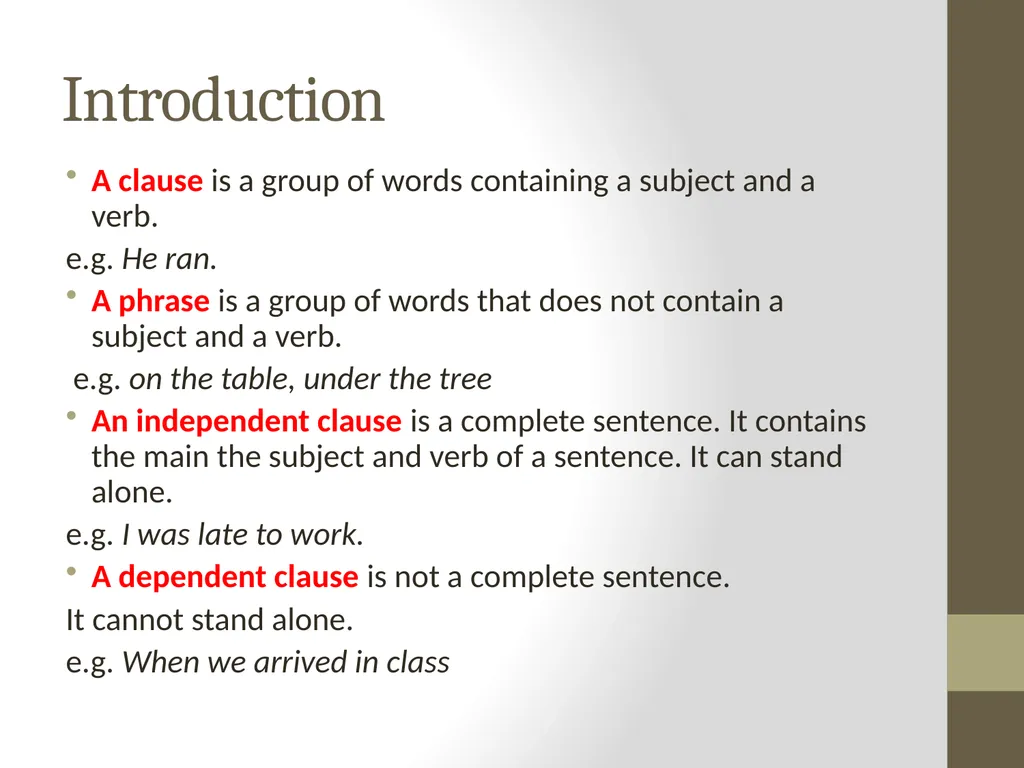
Introduction A clause is a group of words containing a subject and a verb.
e.g. He ran.
A phrase is a group of words that does not contain a subject and a verb.
e.g. on the table, under the tree
An independent clause is a complete sentence. It contains the main the subject and verb of a sentence. It can stand alone.
e.g. I was late to work.
A dependent clause is not a complete sentence.
It cannot stand alone.
e.g. When we arrived in class<br>
03
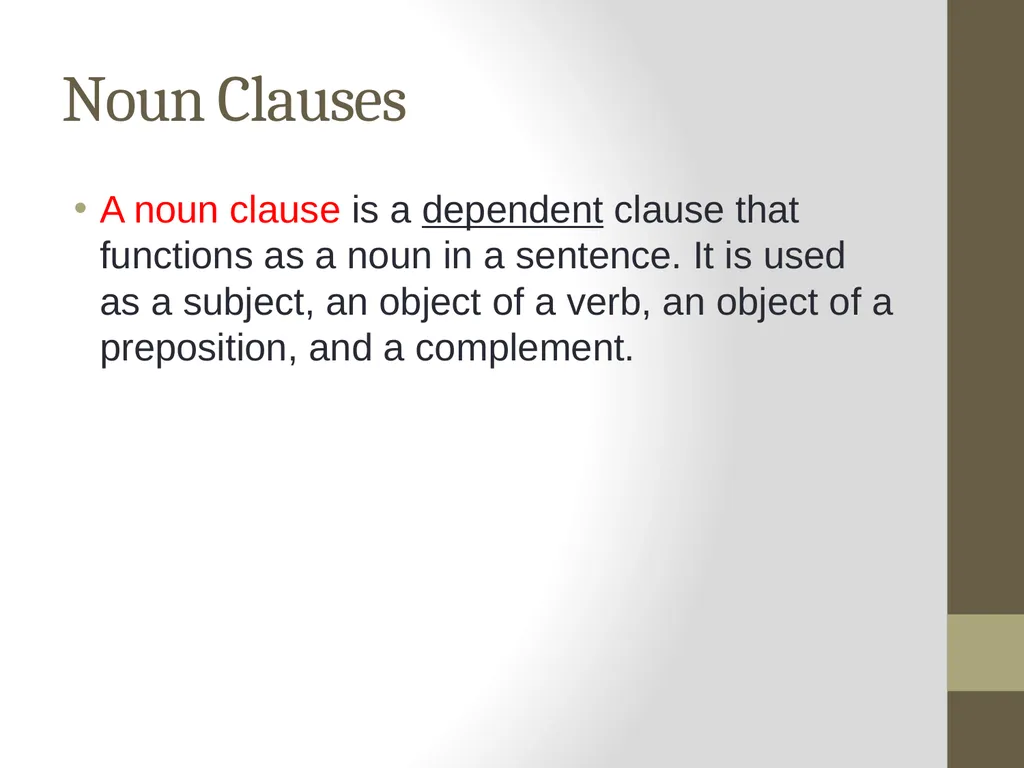
Noun Clauses A noun clause is a dependent clause that functions as a noun in a sentence. It is used as a subject, an object of a verb, an object of a preposition, and a complement.<br>
04
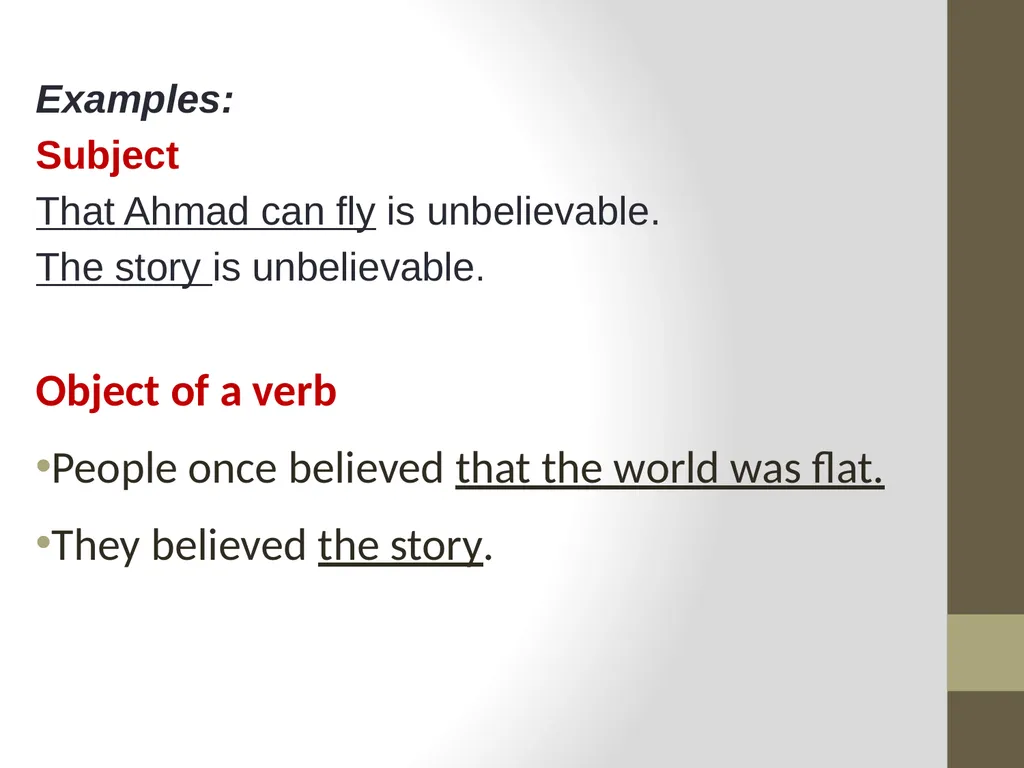
Examples:
Subject
That Ahmad can fly is unbelievable.
The story is unbelievable.
Object of a verb
People once believed that the world was flat.
They believed the story.<br>
Subject
That Ahmad can fly is unbelievable.
The story is unbelievable.
Object of a verb
People once believed that the world was flat.
They believed the story.<br>
05
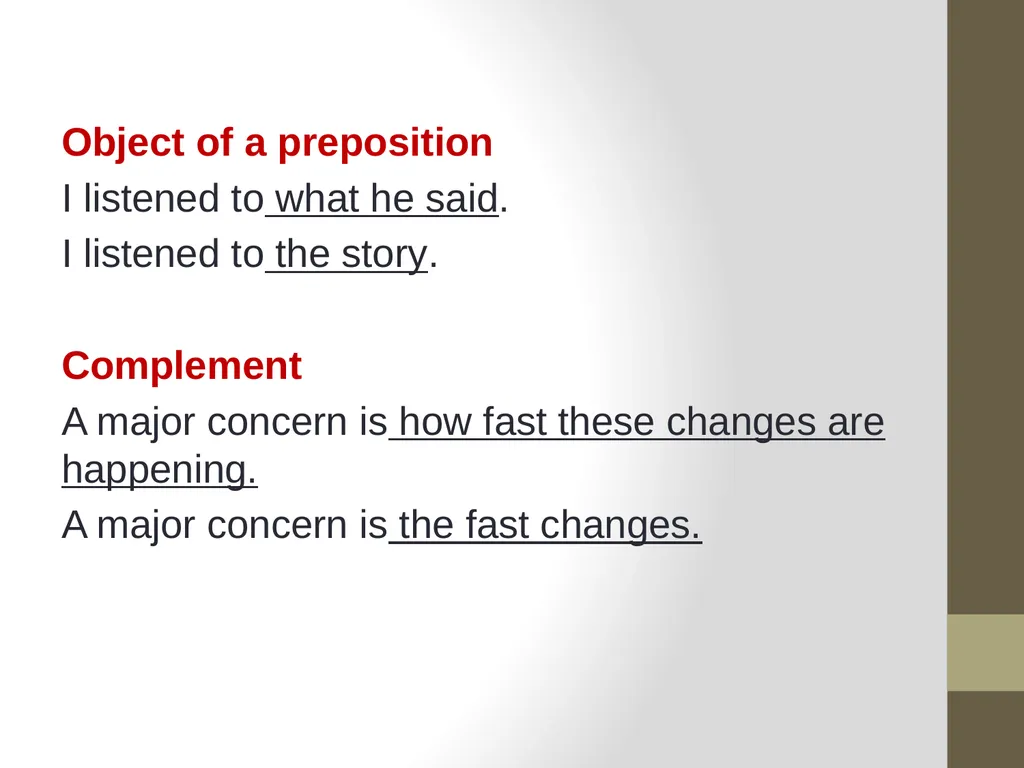
Object of a preposition
I listened to what he said.
I listened to the story.
Complement
A major concern is how fast these changes are happening.
A major concern is the fast changes.<br>
I listened to what he said.
I listened to the story.
Complement
A major concern is how fast these changes are happening.
A major concern is the fast changes.<br>
06
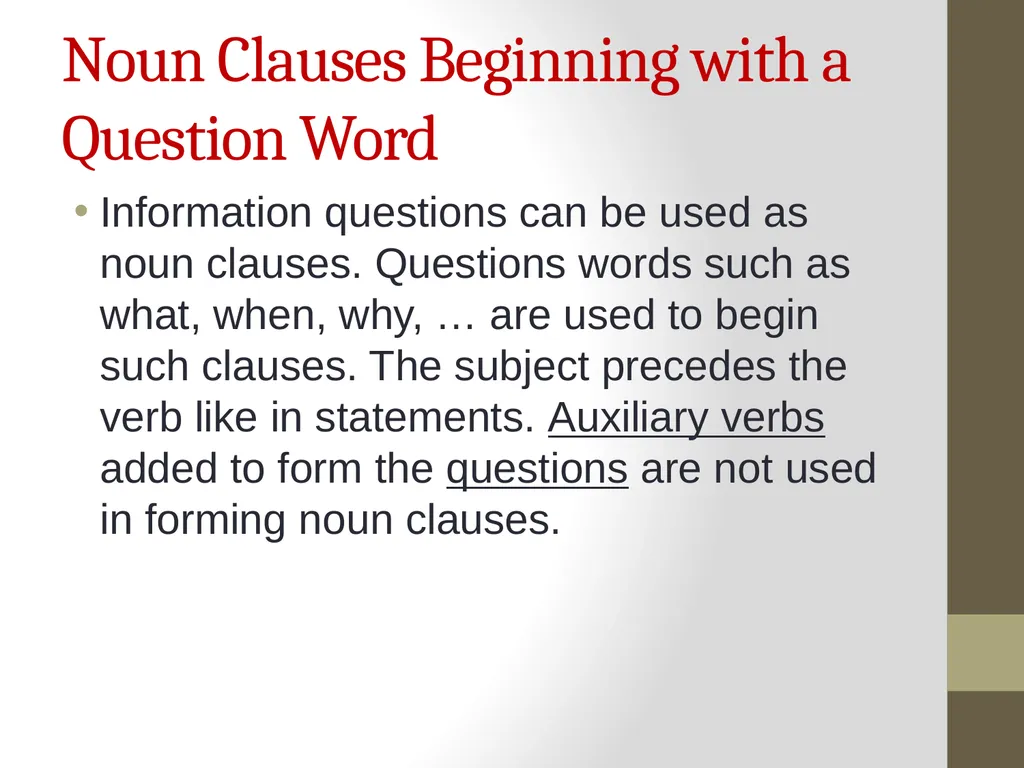
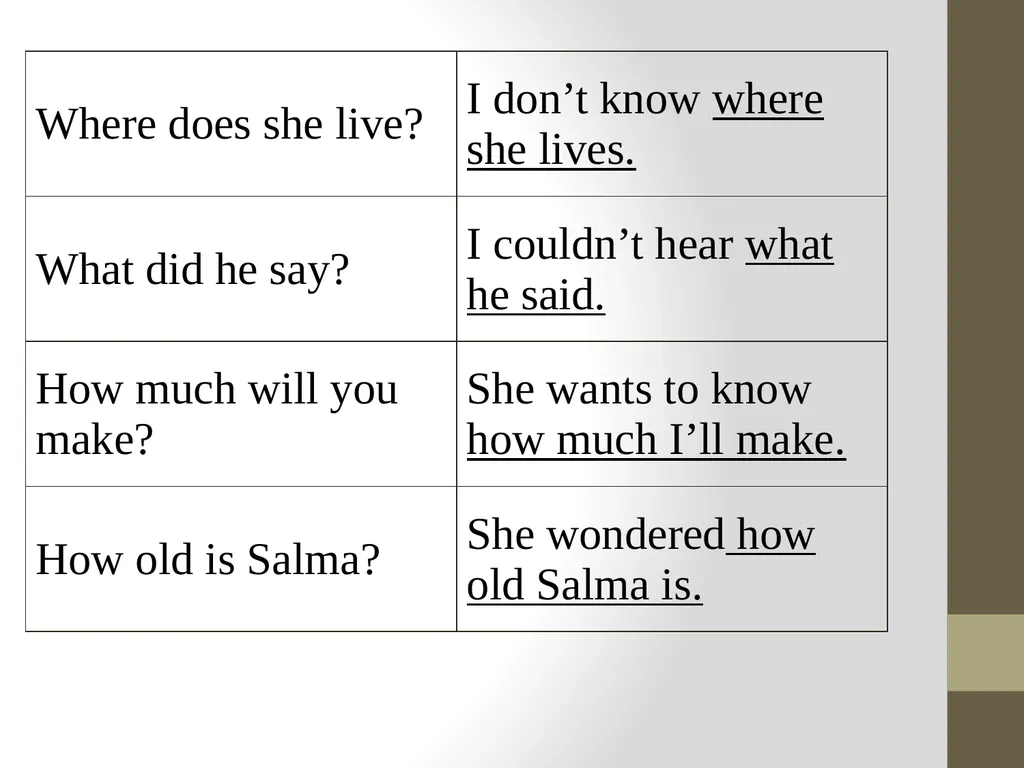
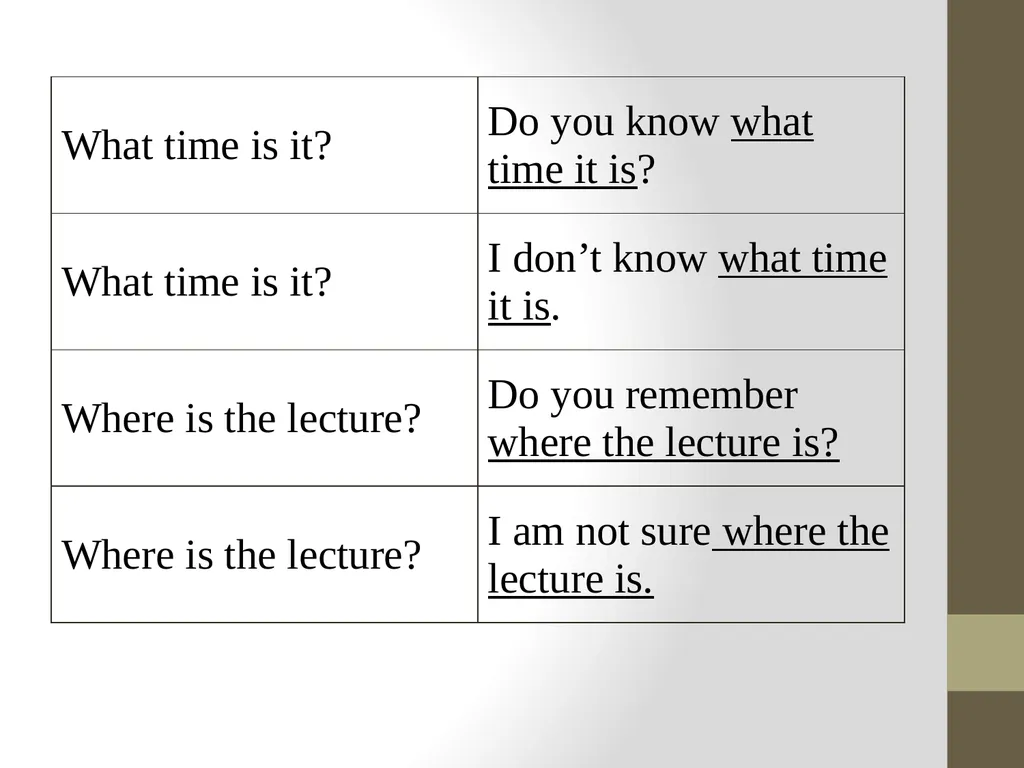
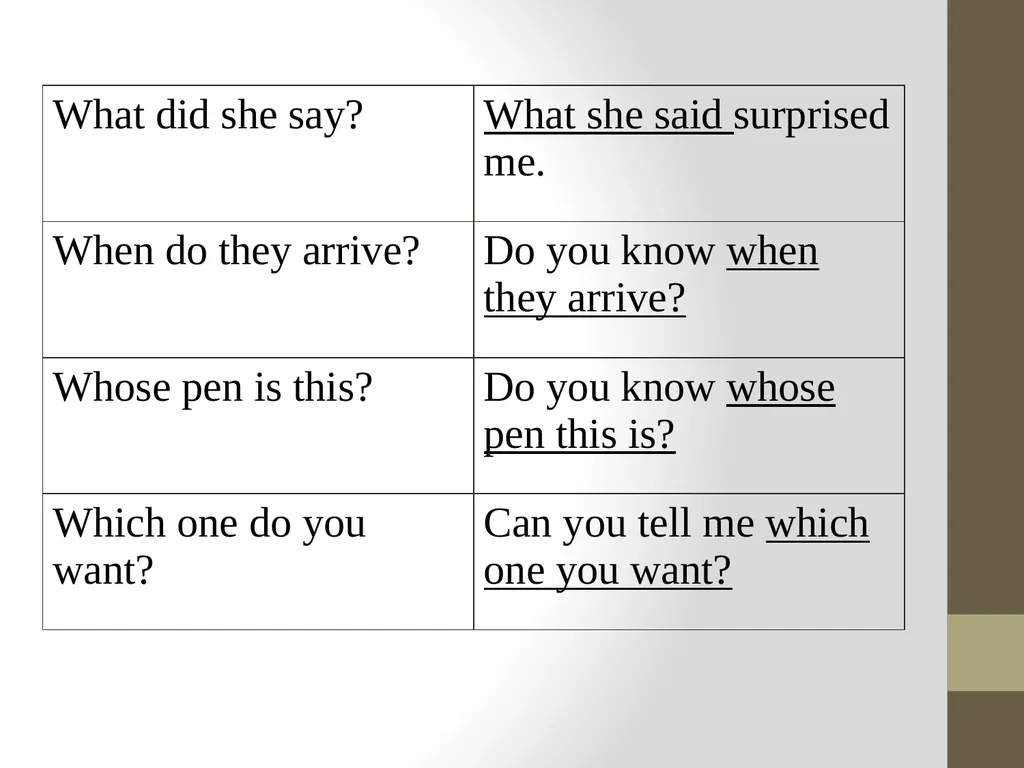
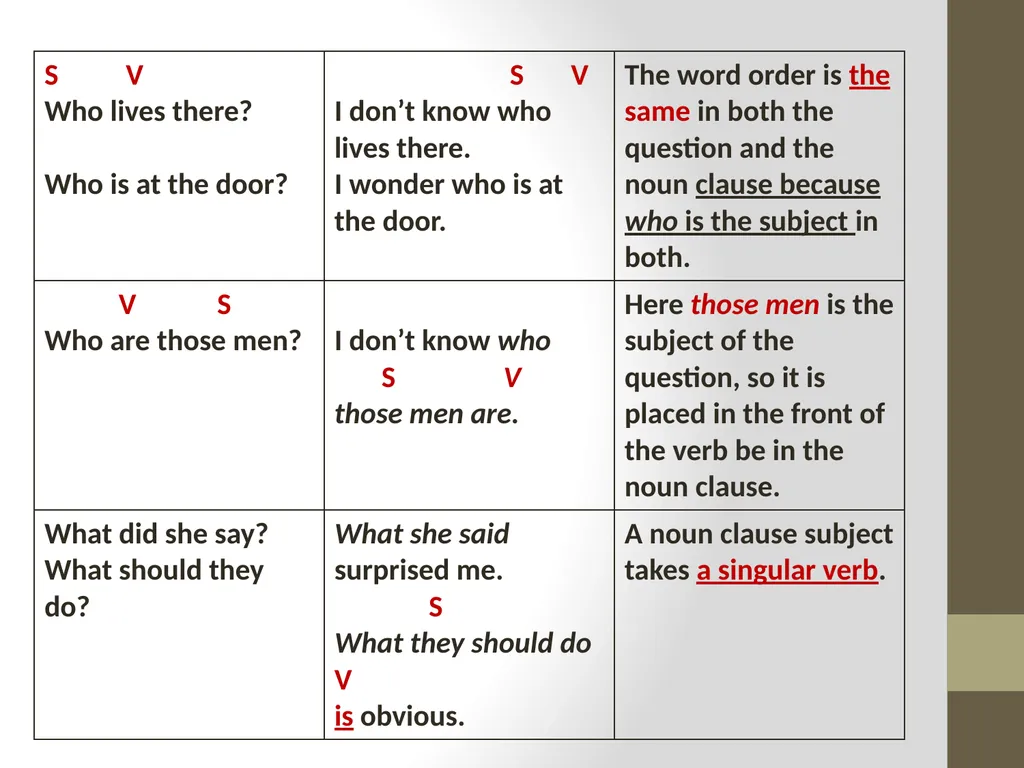
Noun Clauses Beginning with a Question Word Information questions can be used as noun clauses. Questions words such as what, when, why, … are used to begin such clauses. The subject precedes the verb like in statements. Auxiliary verbs added to form the questions are not used in forming noun clauses.<br>
07
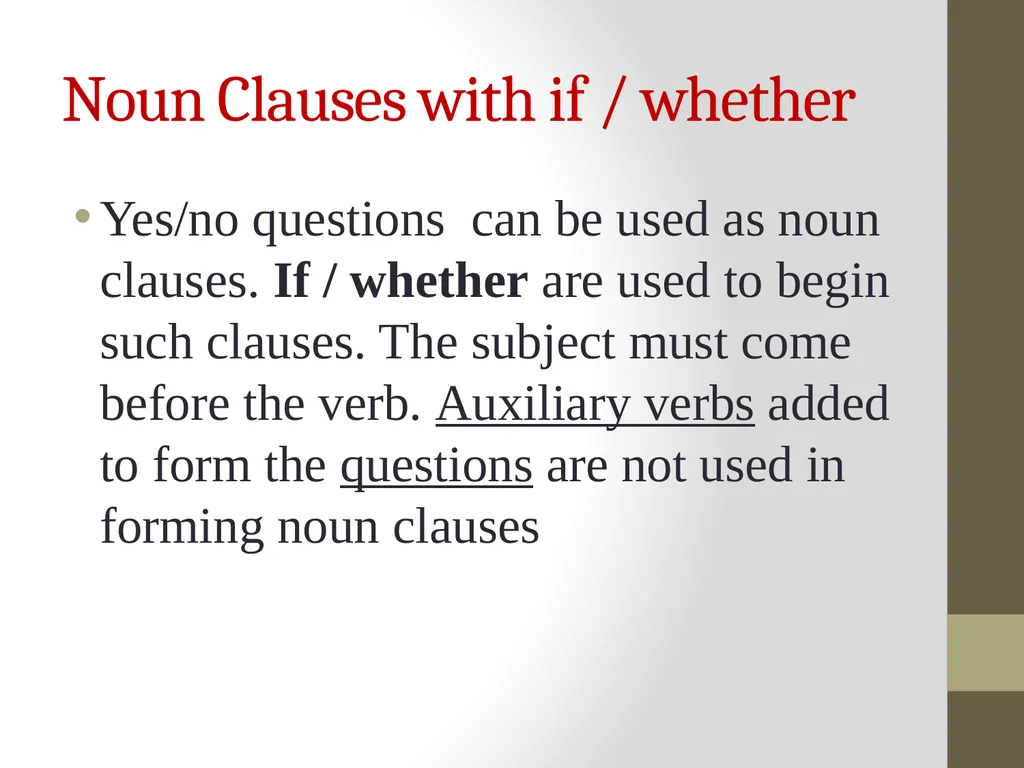
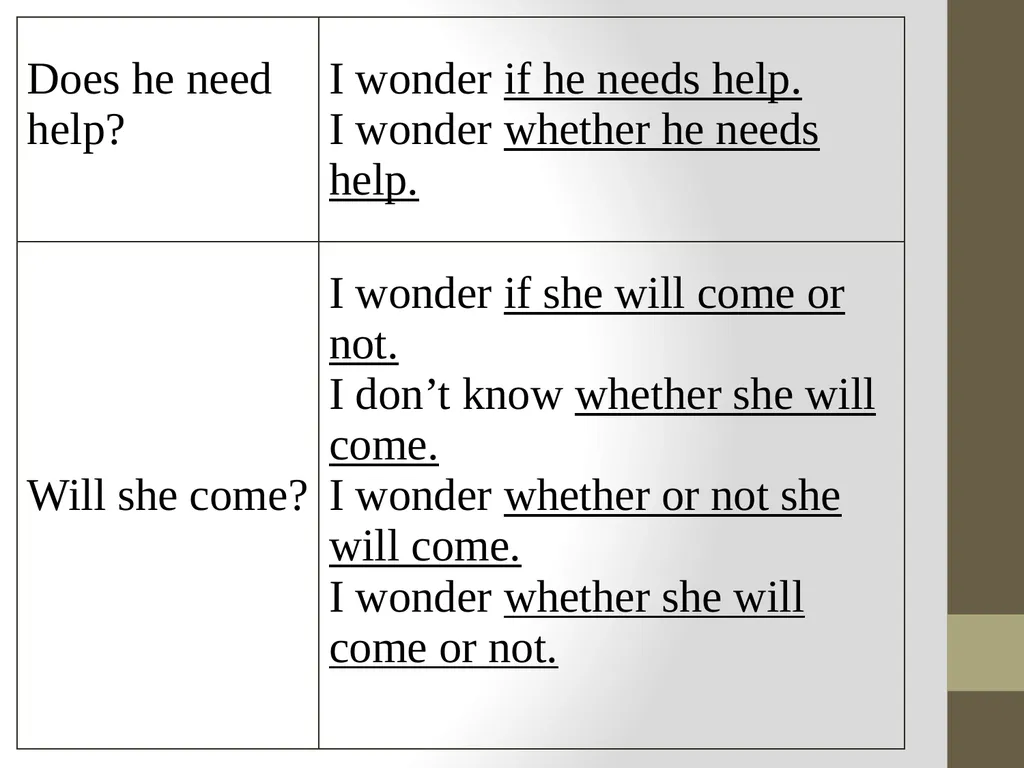
Noun Clauses with if / whether Yes/no questions can be used as noun clauses. If / whether are used to begin such clauses. The subject must come before the verb. Auxiliary verbs added to form the questions are not used in forming noun clauses<br>
08
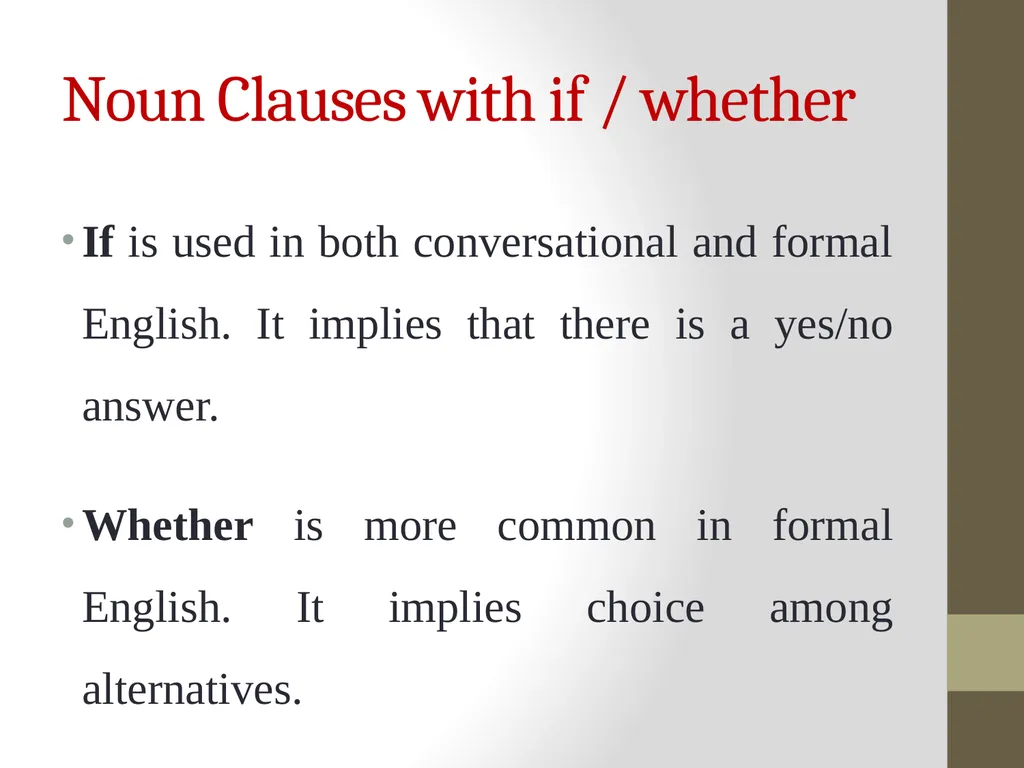
Noun Clauses with if / whether If is used in both conversational and formal English. It implies that there is a yes/no answer.
Whether is more common in formal English. It implies choice among alternatives.<br>
Whether is more common in formal English. It implies choice among alternatives.<br>
09
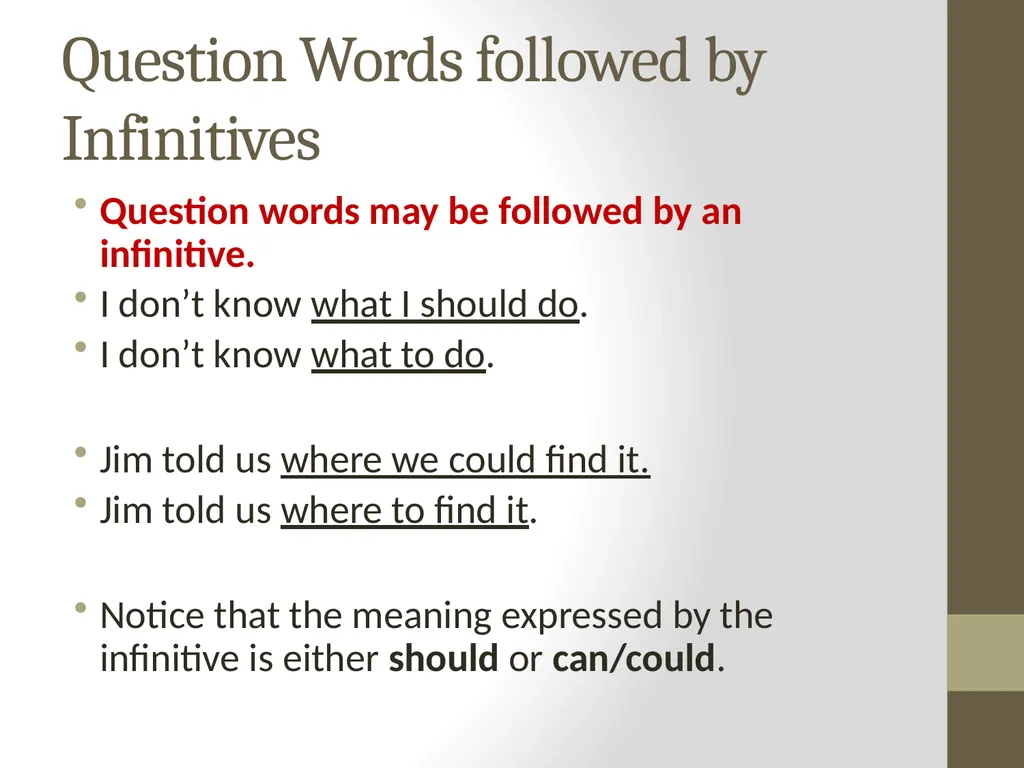
Question Words followed by Infinitives Question words may be followed by an infinitive.
I don’t know what I should do.
I don’t know what to do.
Jim told us where we could find it.
Jim told us where to find it.
Notice that the meaning expressed by the infinitive is either should or can/could.<br>
I don’t know what I should do.
I don’t know what to do.
Jim told us where we could find it.
Jim told us where to find it.
Notice that the meaning expressed by the infinitive is either should or can/could.<br>
10
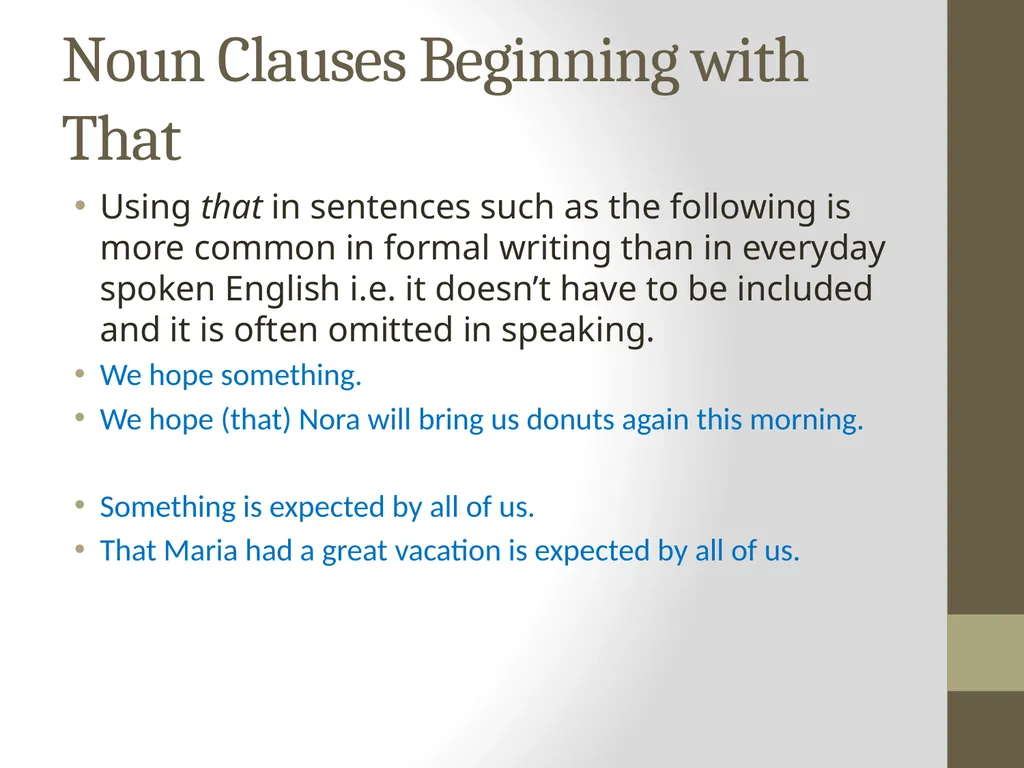
Noun Clauses Beginning with That Using that in sentences such as the following is more common in formal writing than in everyday spoken English i.e. it doesn’t have to be included and it is often omitted in speaking.
We hope something.
We hope (that) Nora will bring us donuts again this morning.
Something is expected by all of us.
That Maria had a great vacation is expected by all of us.<br>
We hope something.
We hope (that) Nora will bring us donuts again this morning.
Something is expected by all of us.
That Maria had a great vacation is expected by all of us.<br>
11
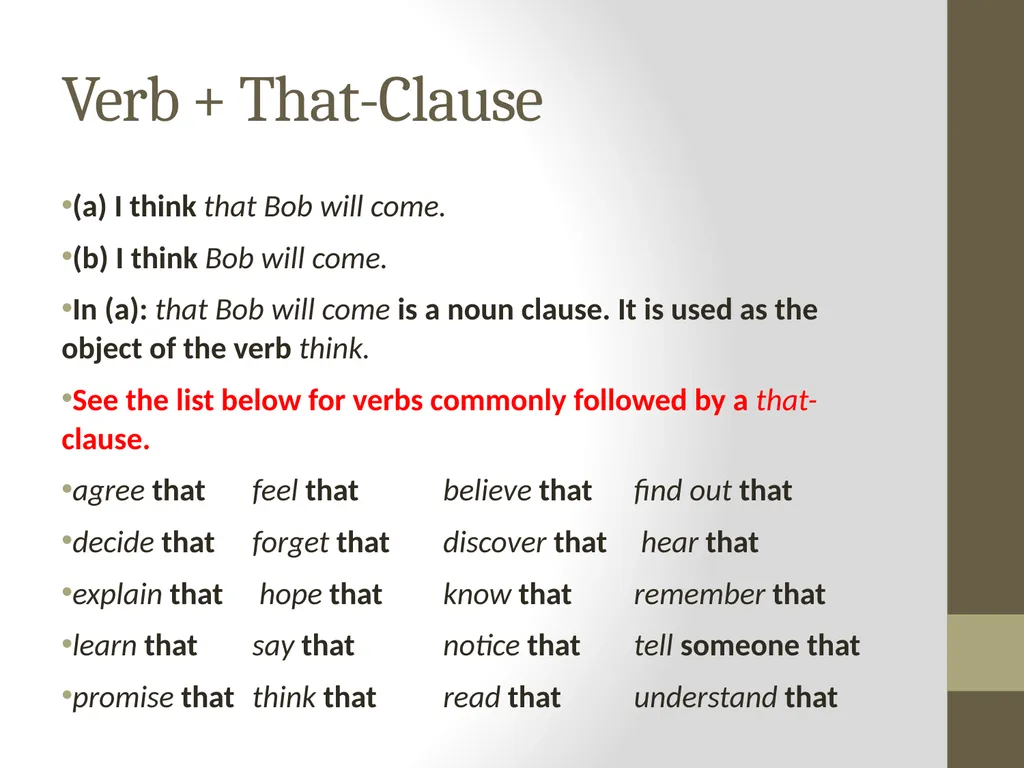
Verb + That-Clause (a) I think that Bob will come.
(b) I think Bob will come.
In (a): that Bob will come is a noun clause. It is used as the object of the verb think.
See the list below for verbs commonly followed by a that- clause.
agree that feel that believe that find out that
decide that forget that discover that hear that
explain that hope that know that remember that
learn that say that notice that tell someone that
promise that think that read that understand that<br>
12
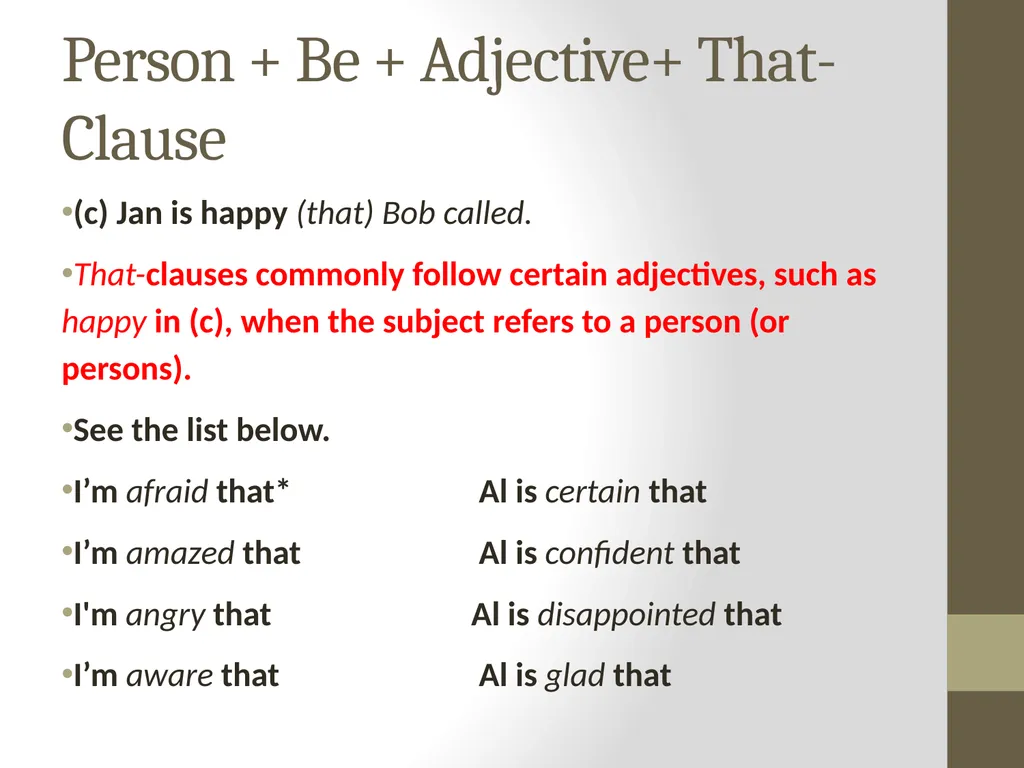
Person + Be + Adjective+ That-Clause (c) Jan is happy (that) Bob called.
That-clauses commonly follow certain adjectives, such as happy in (c), when the subject refers to a person (or persons).
See the list below.
I’m afraid that* Al is certain that
I’m amazed that Al is confident that
I'm angry that Al is disappointed that
I’m aware that Al is glad that<br>
That-clauses commonly follow certain adjectives, such as happy in (c), when the subject refers to a person (or persons).
See the list below.
I’m afraid that* Al is certain that
I’m amazed that Al is confident that
I'm angry that Al is disappointed that
I’m aware that Al is glad that<br>
13
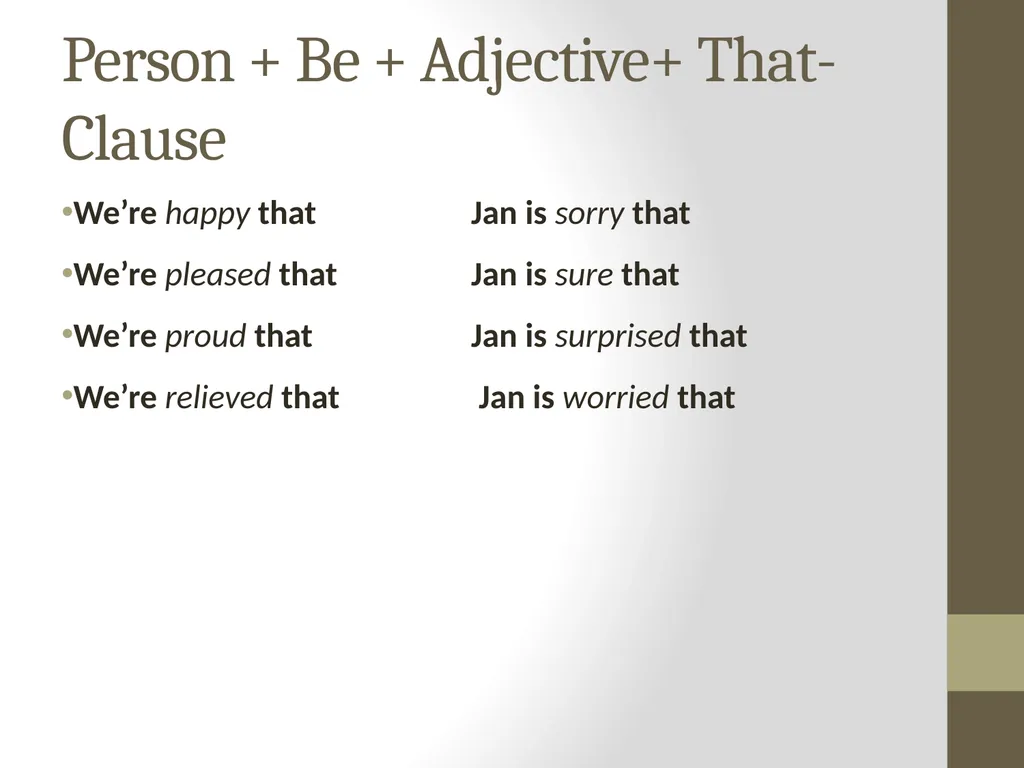
Person + Be + Adjective+ That-Clause We’re happy that Jan is sorry that
We’re pleased that Jan is sure that
We’re proud that Jan is surprised that
We’re relieved that Jan is worried that<br>
We’re pleased that Jan is sure that
We’re proud that Jan is surprised that
We’re relieved that Jan is worried that<br>
14
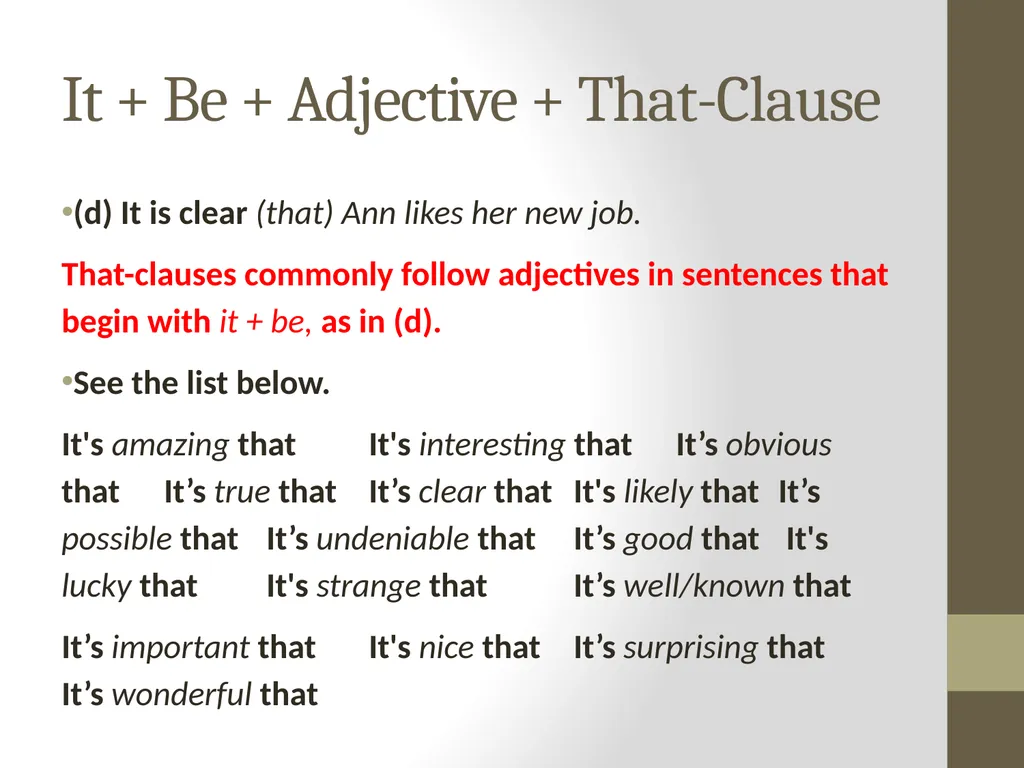
It + Be + Adjective + That-Clause (d) It is clear (that) Ann likes her new job.
That-clauses commonly follow adjectives in sentences that begin with it + be, as in (d).
See the list below.
It's amazing that It's interesting that It’s obvious that It’s true that It’s clear that It's likely that It’s possible that It’s undeniable that It’s good that It's lucky that It's strange that It’s well/known that
It’s important that It's nice that It’s surprising that It’s wonderful that<br>
15
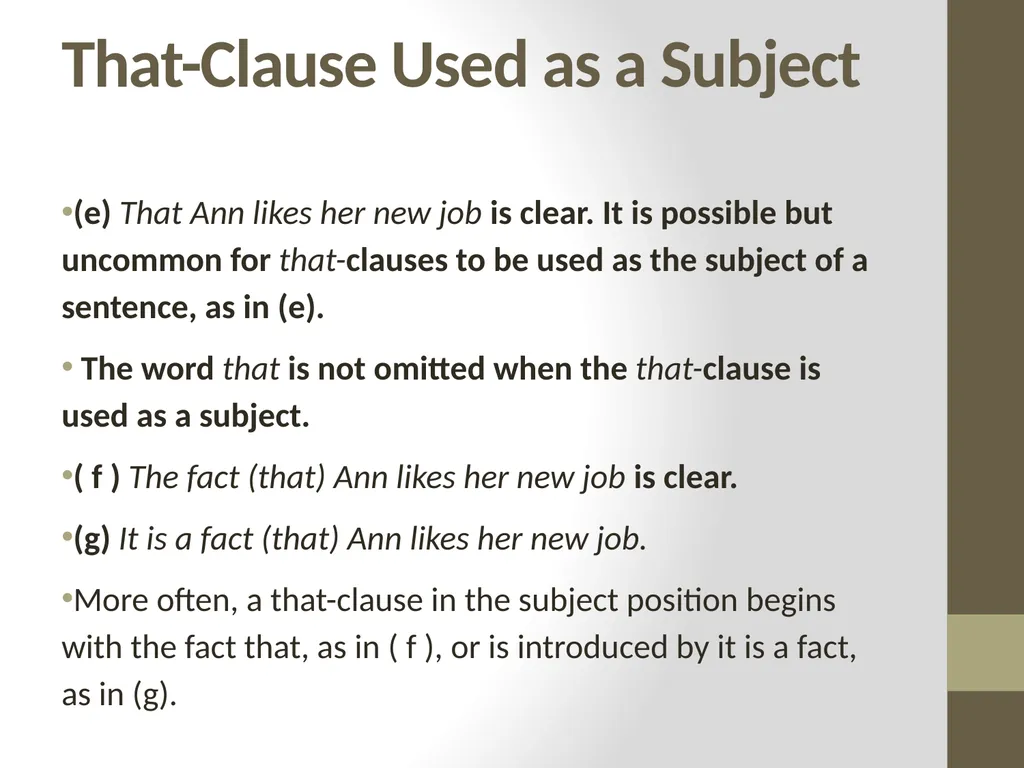
That-Clause Used as a Subject (e) That Ann likes her new job is clear. It is possible but uncommon for that-clauses to be used as the subject of a sentence, as in (e).
The word that is not omitted when the that-clause is used as a subject.
( f ) The fact (that) Ann likes her new job is clear.
(g) It is a fact (that) Ann likes her new job.
More often, a that-clause in the subject position begins with the fact that, as in ( f ), or is introduced by it is a fact, as in (g).<br>
16
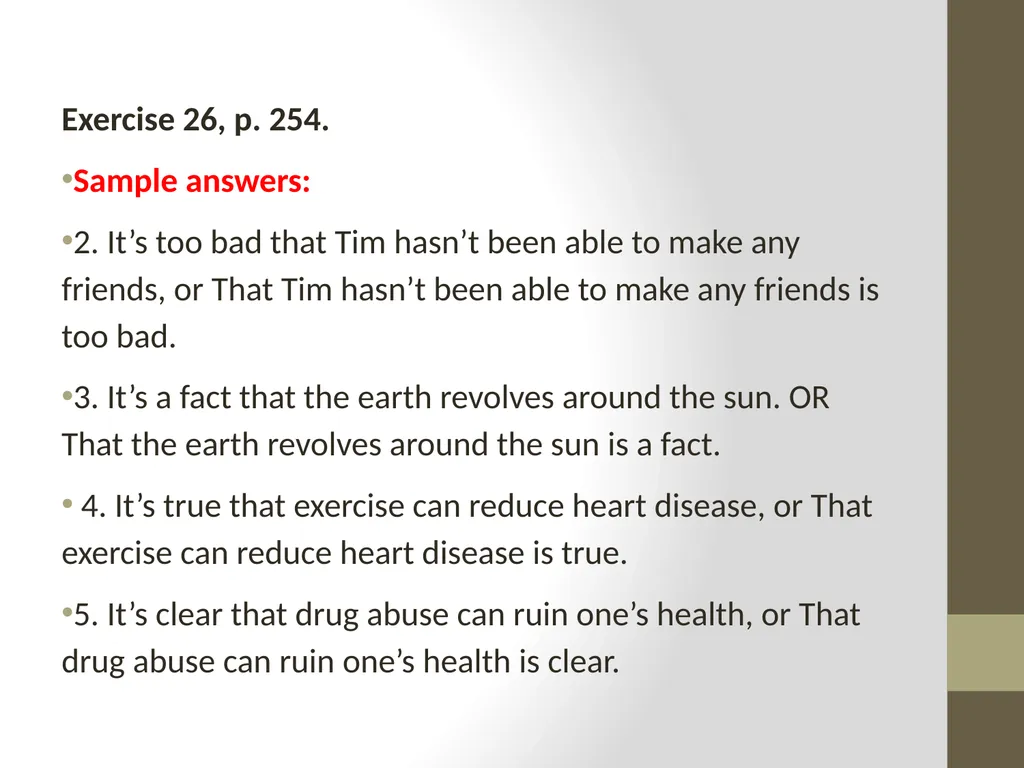
Exercise 26, p. 254.
Sample answers:
2. It’s too bad that Tim hasn’t been able to make any friends, or That Tim hasn’t been able to make any friends is too bad.
3. It’s a fact that the earth revolves around the sun. OR That the earth revolves around the sun is a fact.
4. It’s true that exercise can reduce heart disease, or That exercise can reduce heart disease is true.
5. It’s clear that drug abuse can ruin one’s health, or That drug abuse can ruin one’s health is clear.<br>
17
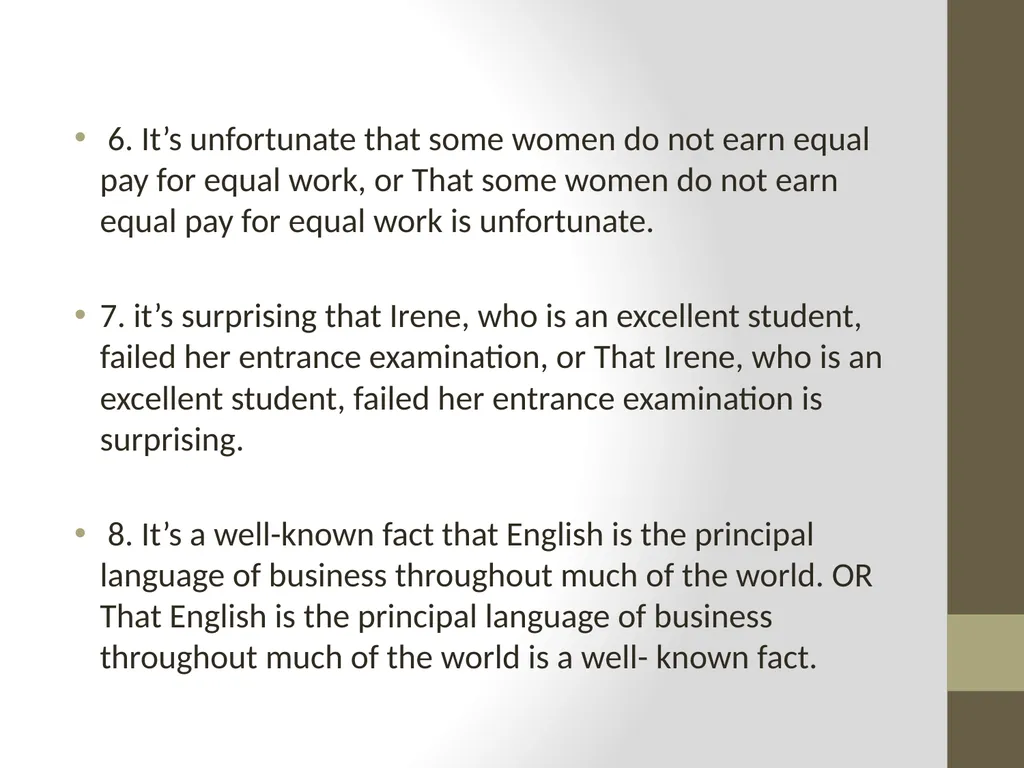
6. It’s unfortunate that some women do not earn equal pay for equal work, or That some women do not earn equal pay for equal work is unfortunate.
7. it’s surprising that Irene, who is an excellent student, failed her entrance examination, or That Irene, who is an excellent student, failed her entrance examination is surprising.
8. It’s a well-known fact that English is the principal language of business throughout much of the world. OR That English is the principal language of business throughout much of the world is a well- known fact.<br>
18
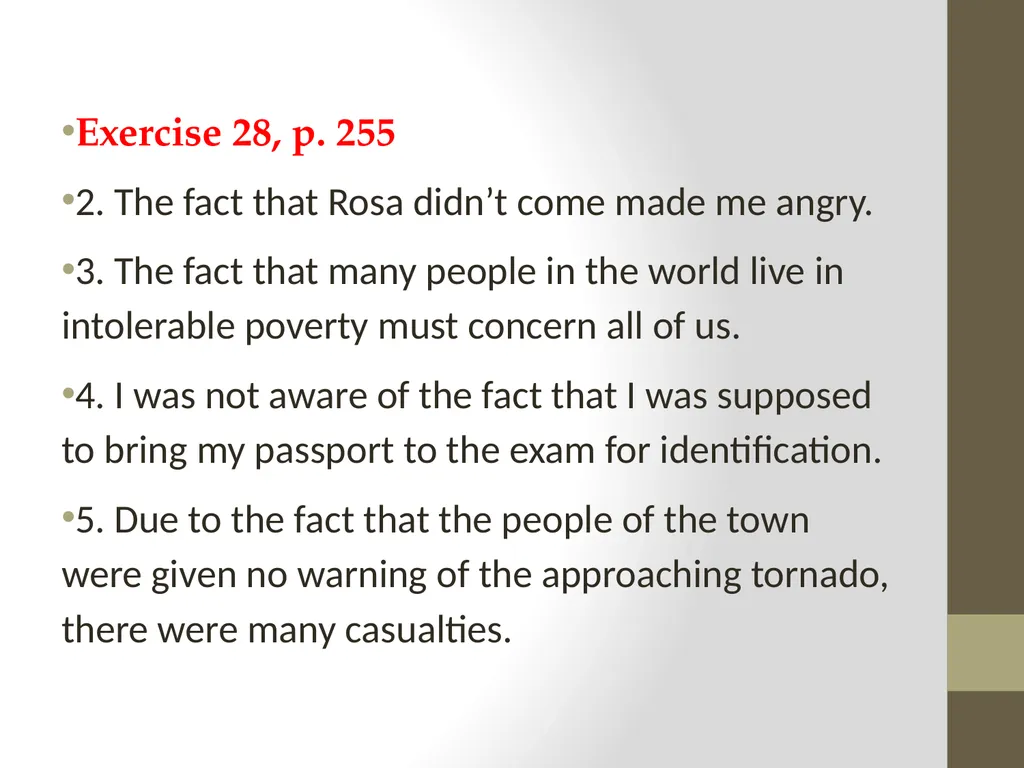
Exercise 28, p. 255
2. The fact that Rosa didn’t come made me angry.
3. The fact that many people in the world live in intolerable poverty must concern all of us.
4. I was not aware of the fact that I was supposed to bring my passport to the exam for identification.
5. Due to the fact that the people of the town were given no warning of the approaching tornado, there were many casualties.<br>
19
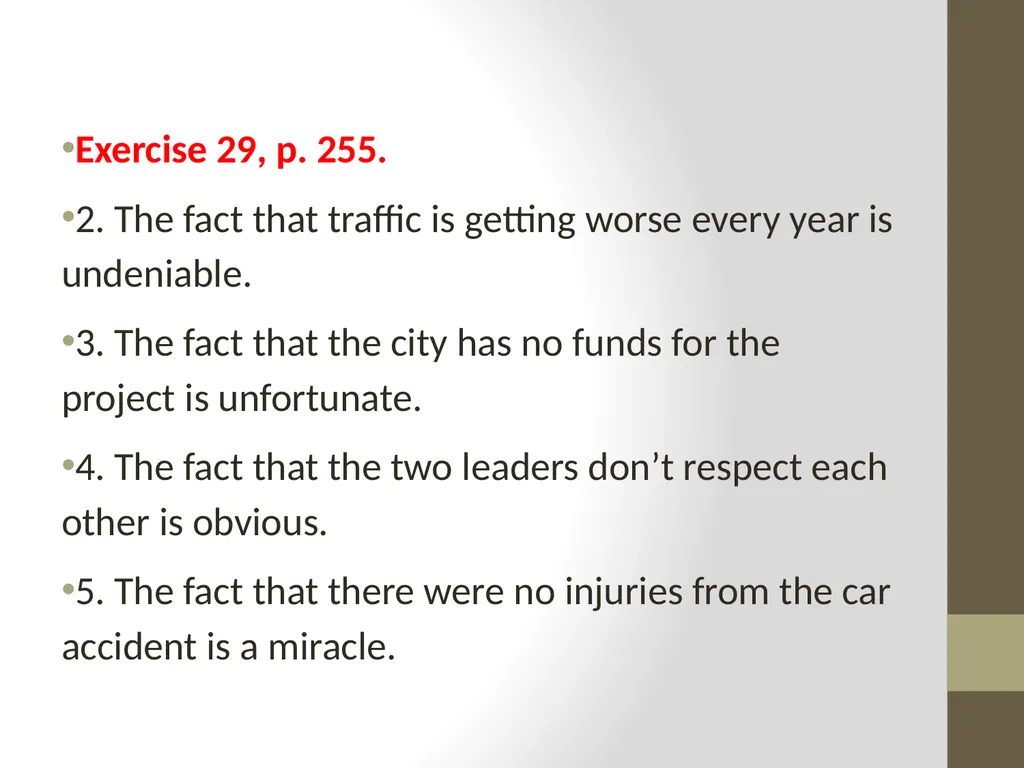
Exercise 29, p. 255.
2. The fact that traffic is getting worse every year is undeniable.
3. The fact that the city has no funds for the project is unfortunate.
4. The fact that the two leaders don’t respect each other is obvious.
5. The fact that there were no injuries from the car accident is a miracle.<br>
2. The fact that traffic is getting worse every year is undeniable.
3. The fact that the city has no funds for the project is unfortunate.
4. The fact that the two leaders don’t respect each other is obvious.
5. The fact that there were no injuries from the car accident is a miracle.<br>
20
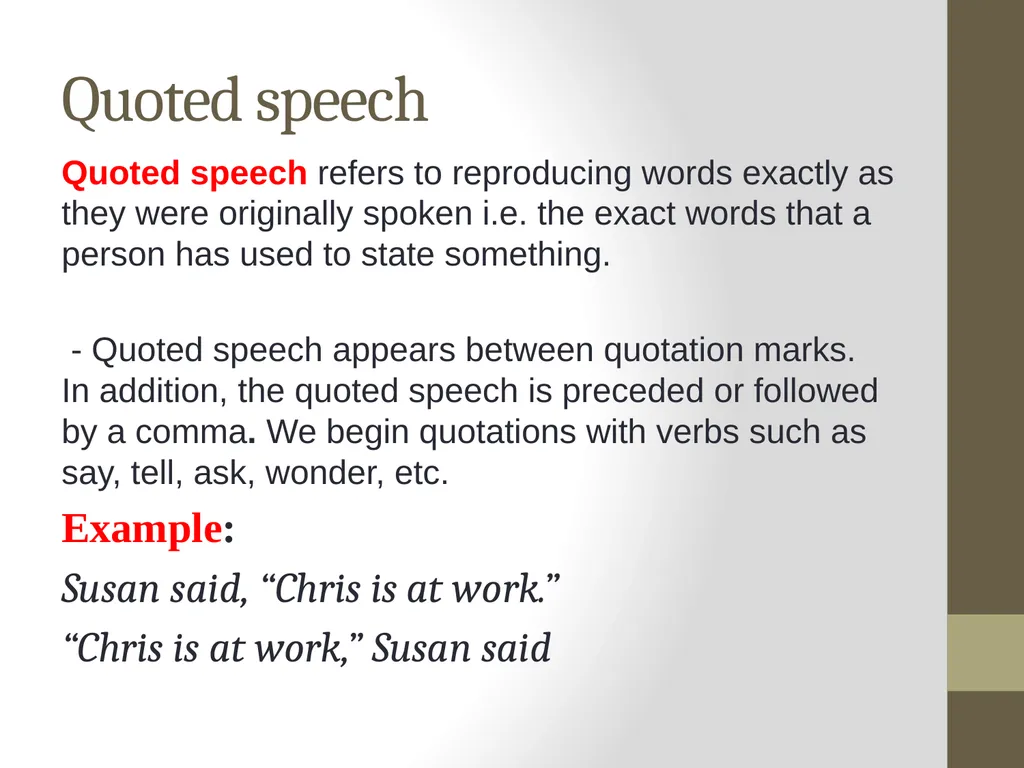
Quoted speech Quoted speech refers to reproducing words exactly as they were originally spoken i.e. the exact words that a person has used to state something.
- Quoted speech appears between quotation marks. In addition, the quoted speech is preceded or followed by a comma. We begin quotations with verbs such as say, tell, ask, wonder, etc.
Example:
Susan said, “Chris is at work.”
“Chris is at work,” Susan said<br>
- Quoted speech appears between quotation marks. In addition, the quoted speech is preceded or followed by a comma. We begin quotations with verbs such as say, tell, ask, wonder, etc.
Example:
Susan said, “Chris is at work.”
“Chris is at work,” Susan said<br>
21
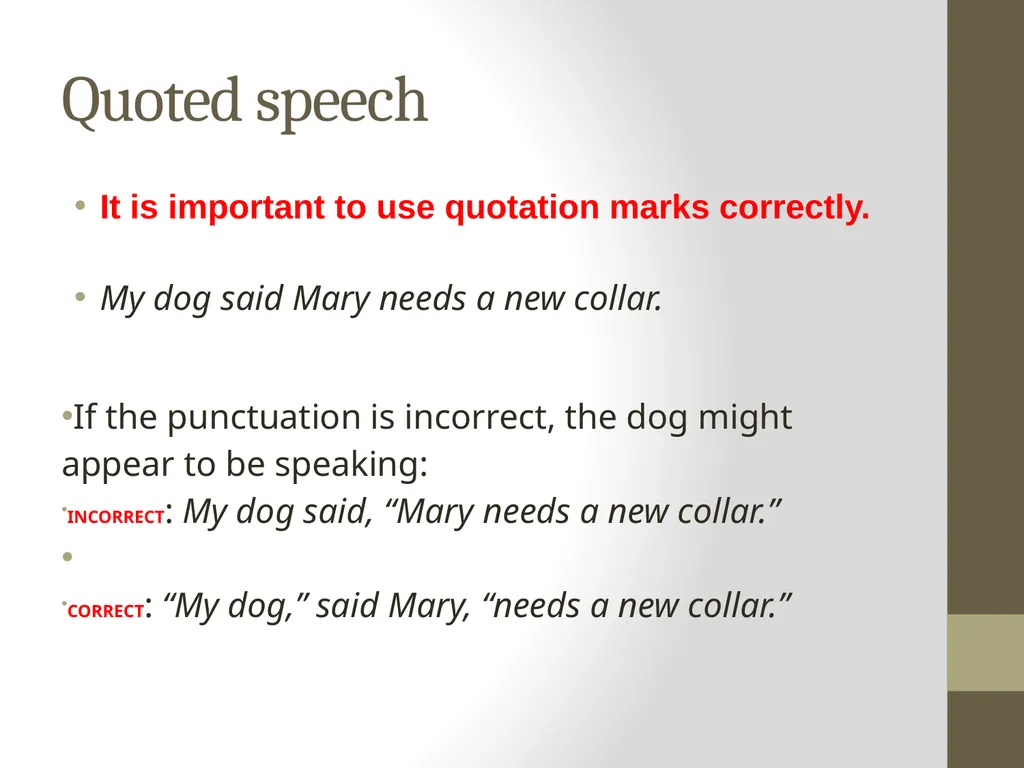
Quoted speech It is important to use quotation marks correctly.
My dog said Mary needs a new collar.
If the punctuation is incorrect, the dog might appear to be speaking:
INCORRECT: My dog said, “Mary needs a new collar.”
CORRECT: “My dog,” said Mary, “needs a new collar.”<br>
My dog said Mary needs a new collar.
If the punctuation is incorrect, the dog might appear to be speaking:
INCORRECT: My dog said, “Mary needs a new collar.”
CORRECT: “My dog,” said Mary, “needs a new collar.”<br>
22
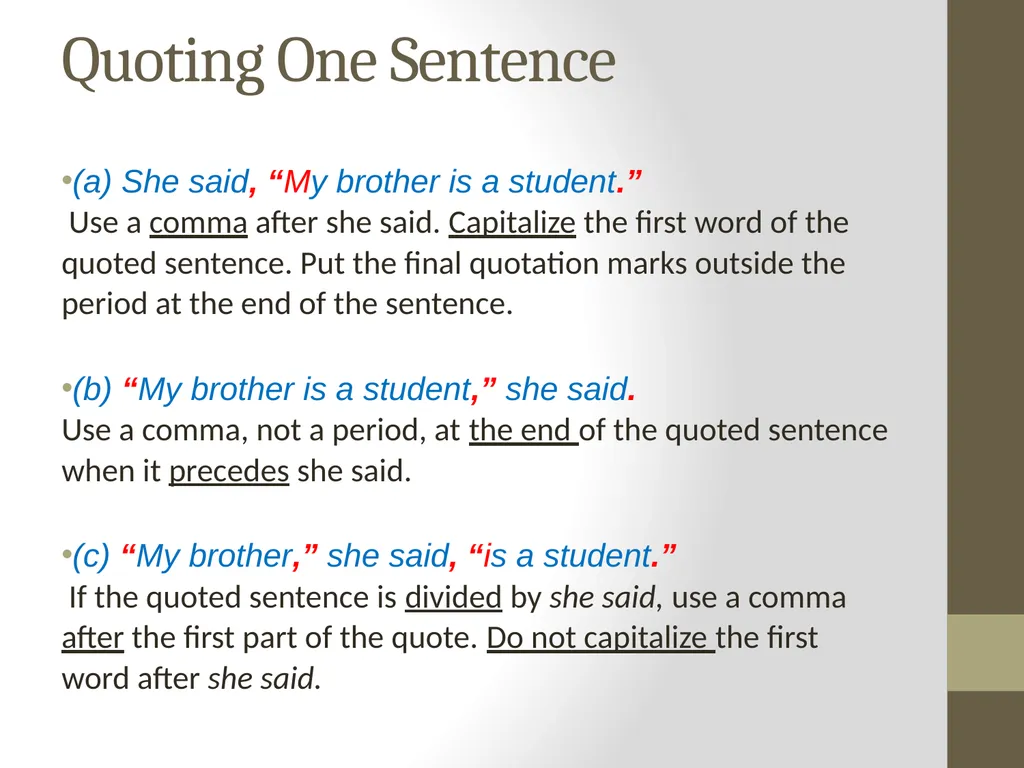
Quoting One Sentence (a) She said, “My brother is a student.”
Use a comma after she said. Capitalize the first word of the quoted sentence. Put the final quotation marks outside the period at the end of the sentence.
(b) “My brother is a student,” she said.
Use a comma, not a period, at the end of the quoted sentence when it precedes she said.
(c) “My brother,” she said, “is a student.”
If the quoted sentence is divided by she said, use a comma after the first part of the quote. Do not capitalize the first word after she said.<br>
23
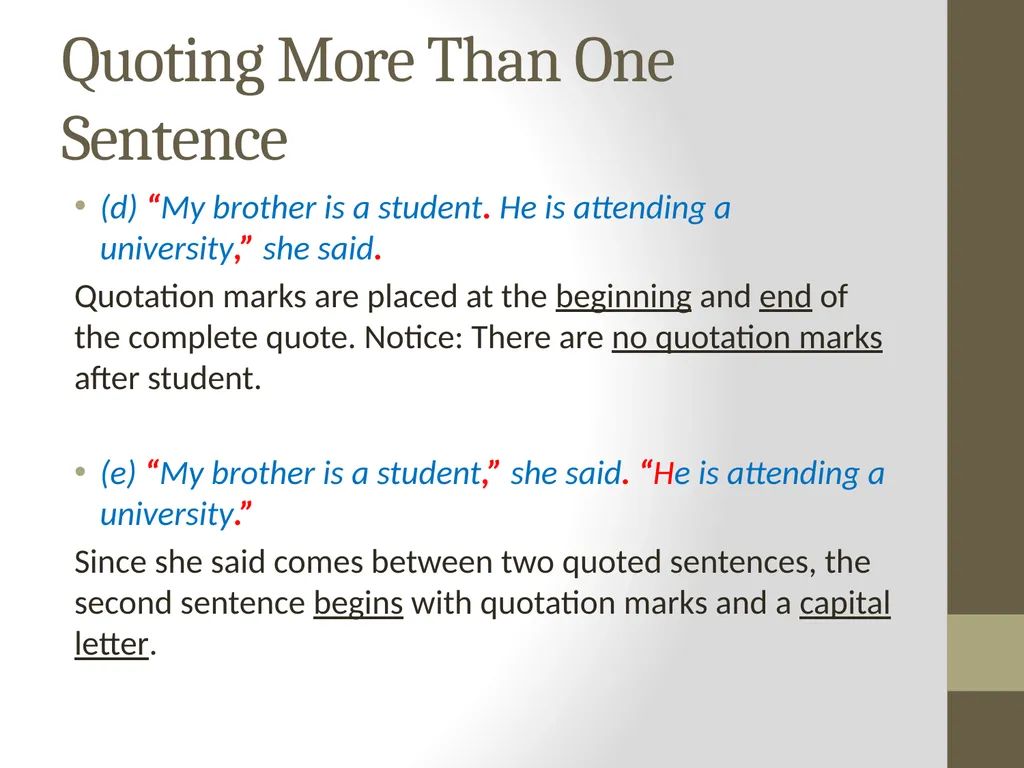
Quoting More Than One Sentence (d) “My brother is a student. He is attending a university,” she said.
Quotation marks are placed at the beginning and end of the complete quote. Notice: There are no quotation marks after student.
(e) “My brother is a student,” she said. “He is attending a university.”
Since she said comes between two quoted sentences, the second sentence begins with quotation marks and a capital letter.<br>
24
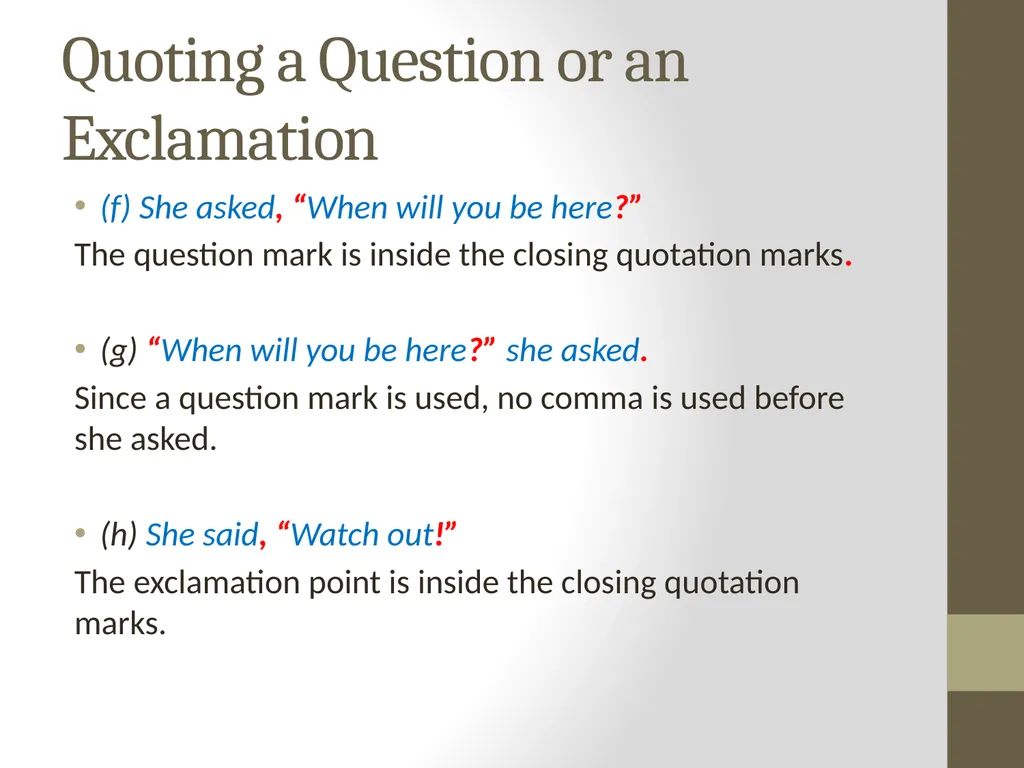
Quoting a Question or an Exclamation (f) She asked, “When will you be here?”
The question mark is inside the closing quotation marks.
(g) “When will you be here?” she asked.
Since a question mark is used, no comma is used before she asked.
(h) She said, “Watch out!”
The exclamation point is inside the closing quotation marks.<br>
The question mark is inside the closing quotation marks.
(g) “When will you be here?” she asked.
Since a question mark is used, no comma is used before she asked.
(h) She said, “Watch out!”
The exclamation point is inside the closing quotation marks.<br>
25
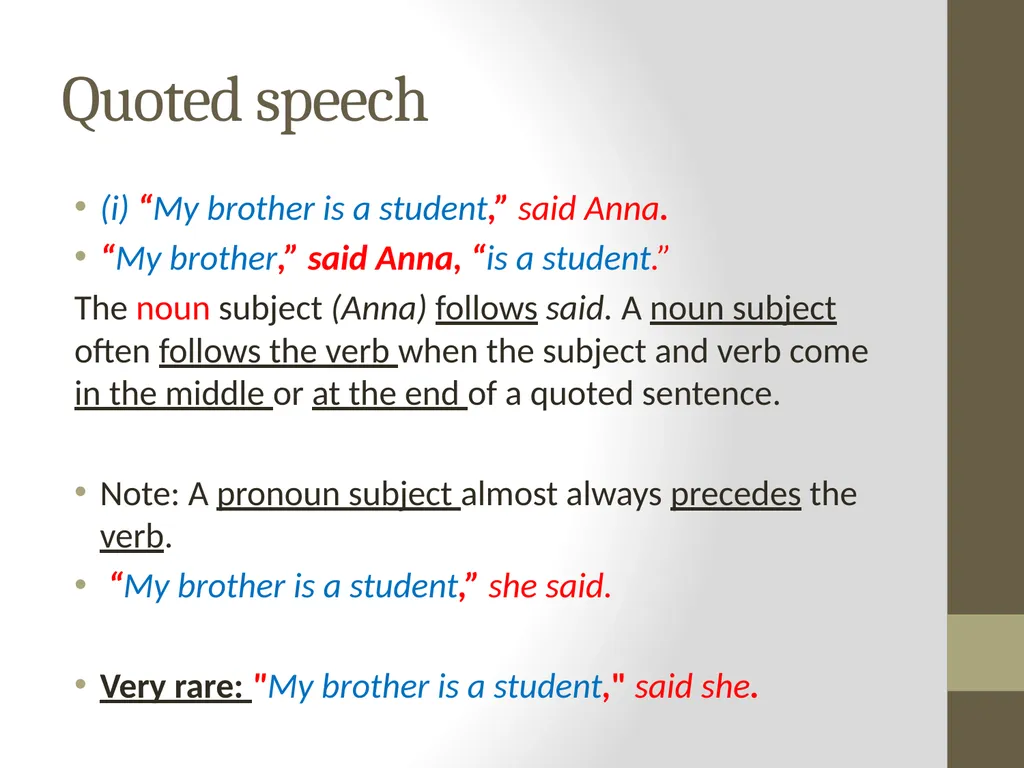
Quoted speech (i) “My brother is a student,” said Anna.
“My brother,” said Anna, “is a student.”
The noun subject (Anna) follows said. A noun subject often follows the verb when the subject and verb come in the middle or at the end of a quoted sentence.
Note: A pronoun subject almost always precedes the verb.
“My brother is a student,” she said.
Very rare: "My brother is a student," said she.<br>
26
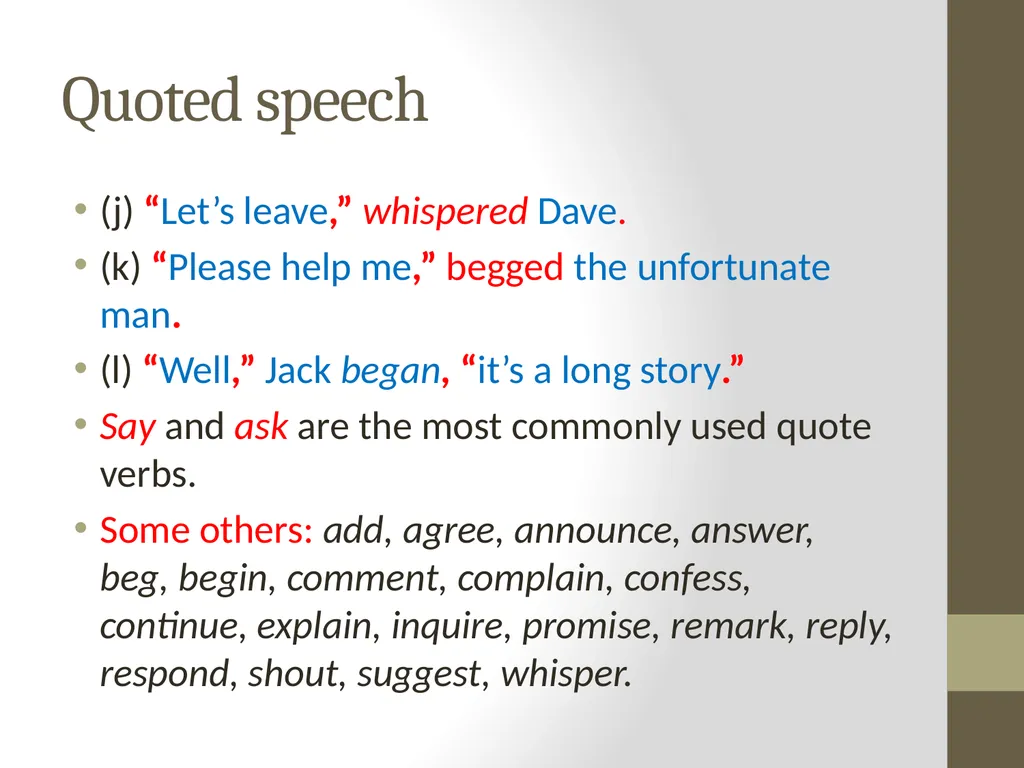
Quoted speech (j) “Let’s leave,” whispered Dave.
(k) “Please help me,” begged the unfortunate man.
(l) “Well,” Jack began, “it’s a long story.”
Say and ask are the most commonly used quote verbs.
Some others: add, agree, announce, answer, beg, begin, comment, complain, confess, continue, explain, inquire, promise, remark, reply, respond, shout, suggest, whisper.<br>
27
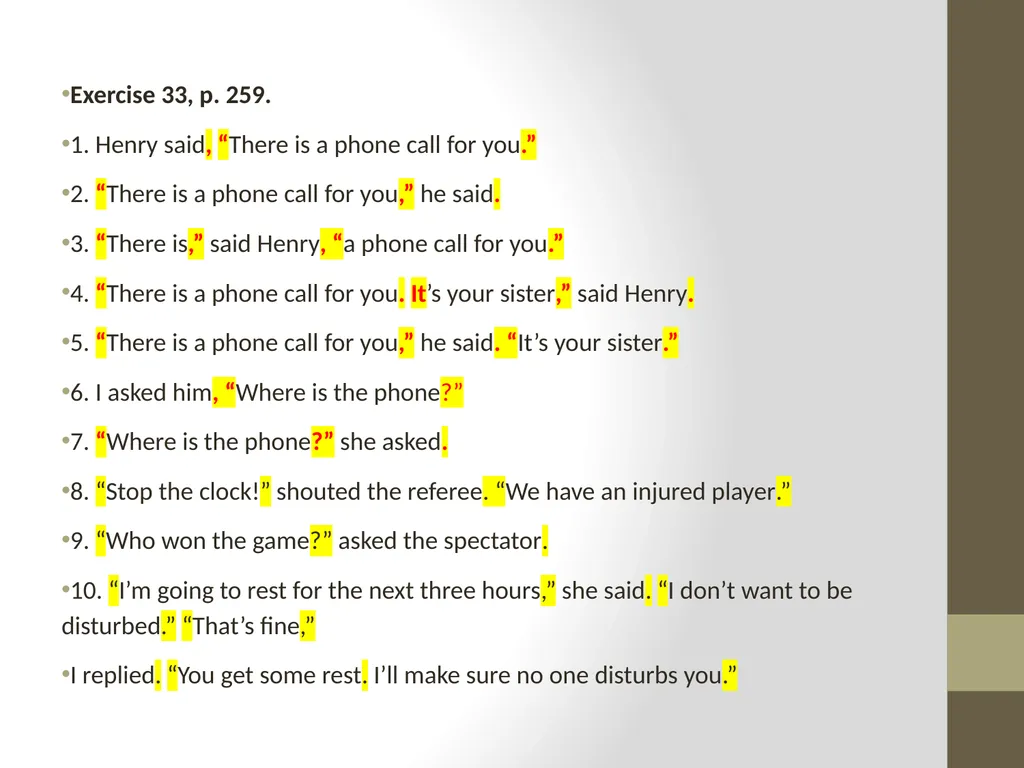
Exercise 33, p. 259.
1. Henry said, “There is a phone call for you.”
2. “There is a phone call for you,” he said.
3. “There is,” said Henry, “a phone call for you.”
4. “There is a phone call for you. It’s your sister,” said Henry.
5. “There is a phone call for you,” he said. “It’s your sister.”
6. I asked him, “Where is the phone?”
7. “Where is the phone?” she asked.
8. “Stop the clock!” shouted the referee. “We have an injured player.”
9. “Who won the game?” asked the spectator.
10. “I’m going to rest for the next three hours,” she said. “I don’t want to be disturbed.” “That’s fine,”
I replied. “You get some rest. I’ll make sure no one disturbs you.”<br>
28
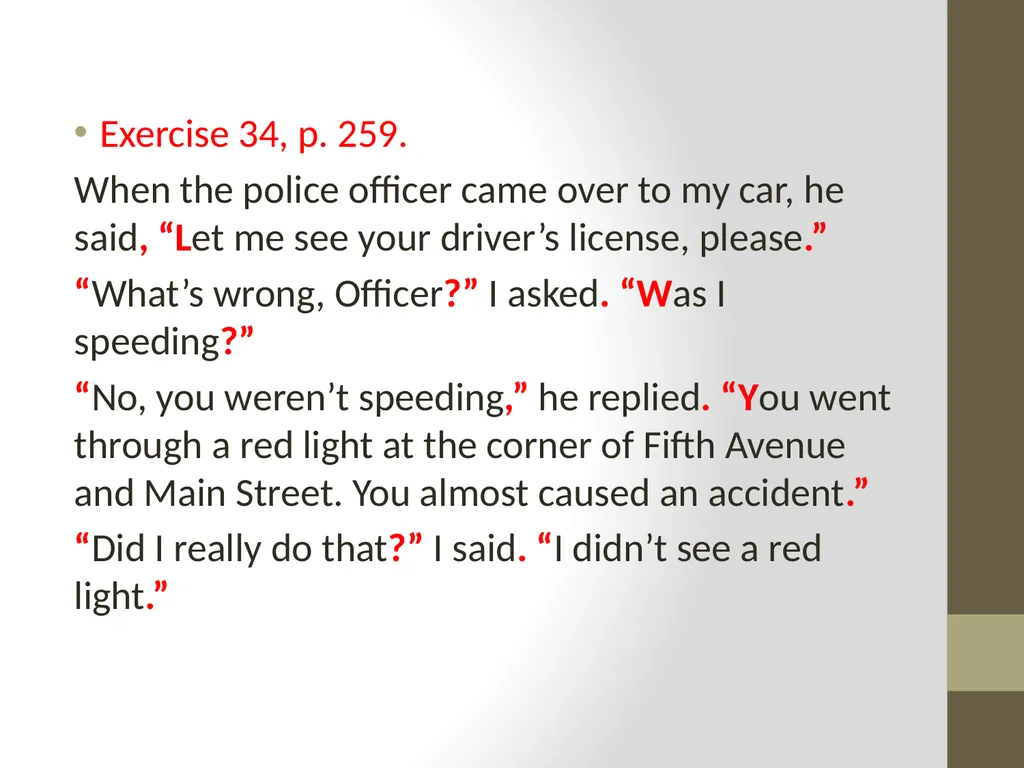
Exercise 34, p. 259.
When the police officer came over to my car, he said, “Let me see your driver’s license, please.”
“What’s wrong, Officer?” I asked. “Was I speeding?”
“No, you weren’t speeding,” he replied. “You went through a red light at the corner of Fifth Avenue and Main Street. You almost caused an accident.”
“Did I really do that?” I said. “I didn’t see a red light.”<br>
29
Reported Speech: Verb Forms in Noun Clauses Reported speech refers to using a noun clause to report what someone has said.
It involves paraphrasing. You tell the same ideas but with different words. There is no need for commas or quotation marks. Also, some changes are required in reported speech.<br>
It involves paraphrasing. You tell the same ideas but with different words. There is no need for commas or quotation marks. Also, some changes are required in reported speech.<br>
30
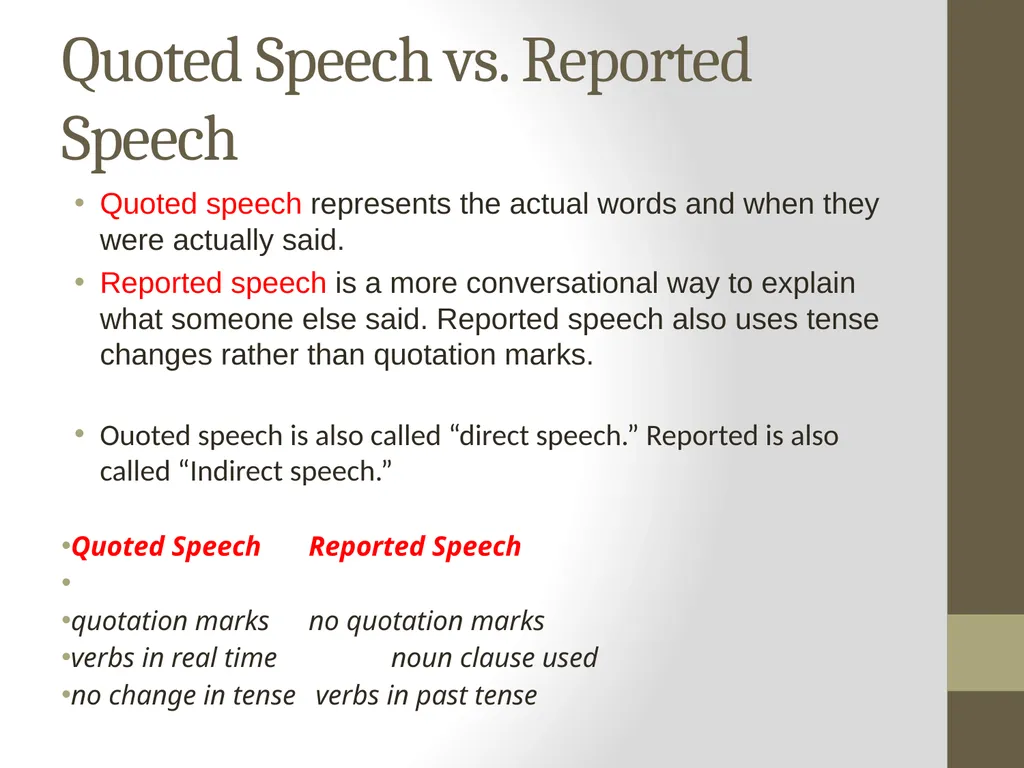
Quoted Speech vs. Reported Speech Quoted speech represents the actual words and when they were actually said.
Reported speech is a more conversational way to explain what someone else said. Reported speech also uses tense changes rather than quotation marks.
Ouoted speech is also called “direct speech.” Reported is also called “Indirect speech.”
Quoted Speech Reported Speech
quotation marks no quotation marks
verbs in real time noun clause used
no change in tense verbs in past tense<br>
31
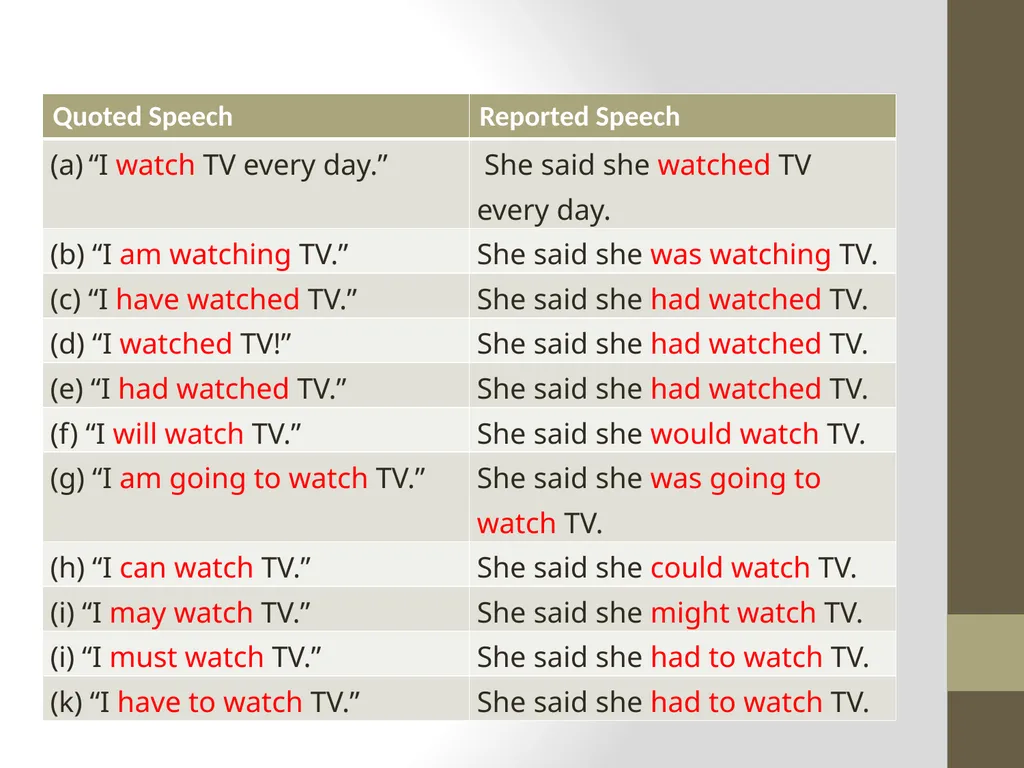
Reported Speech If the reporting verb (the main verb of the sentence, e.g., said) is simple past, the verb in the noun clause will usually be one of the past tenses.<br>
32
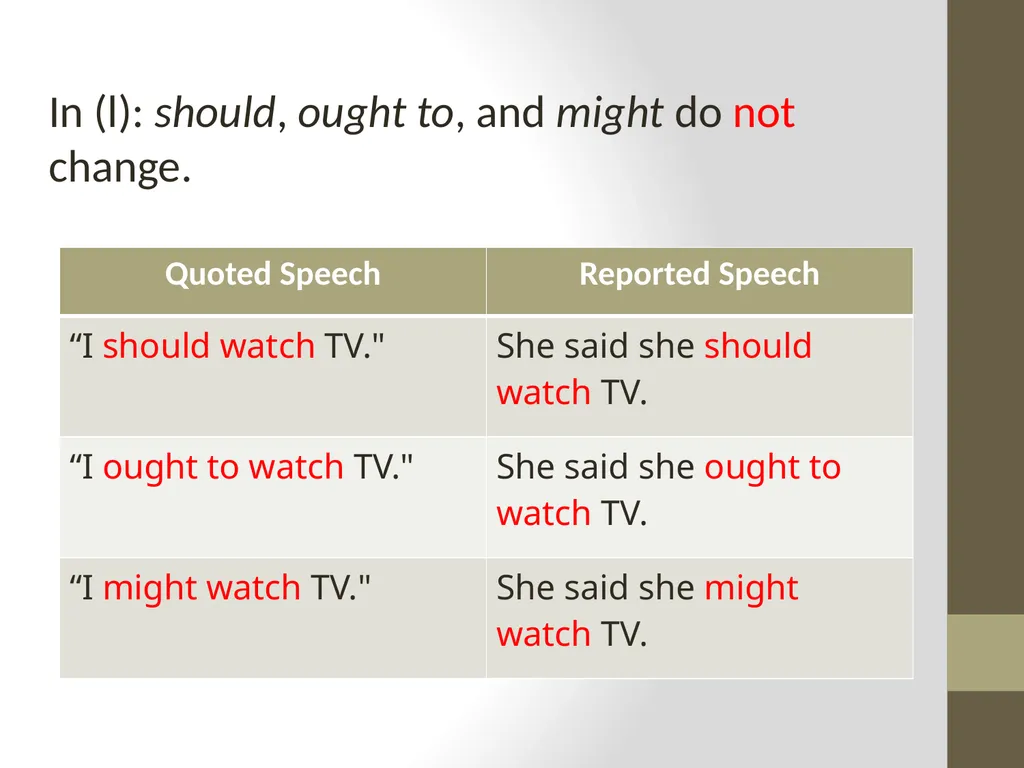
In (l): should, ought to, and might do not change.<br>
33
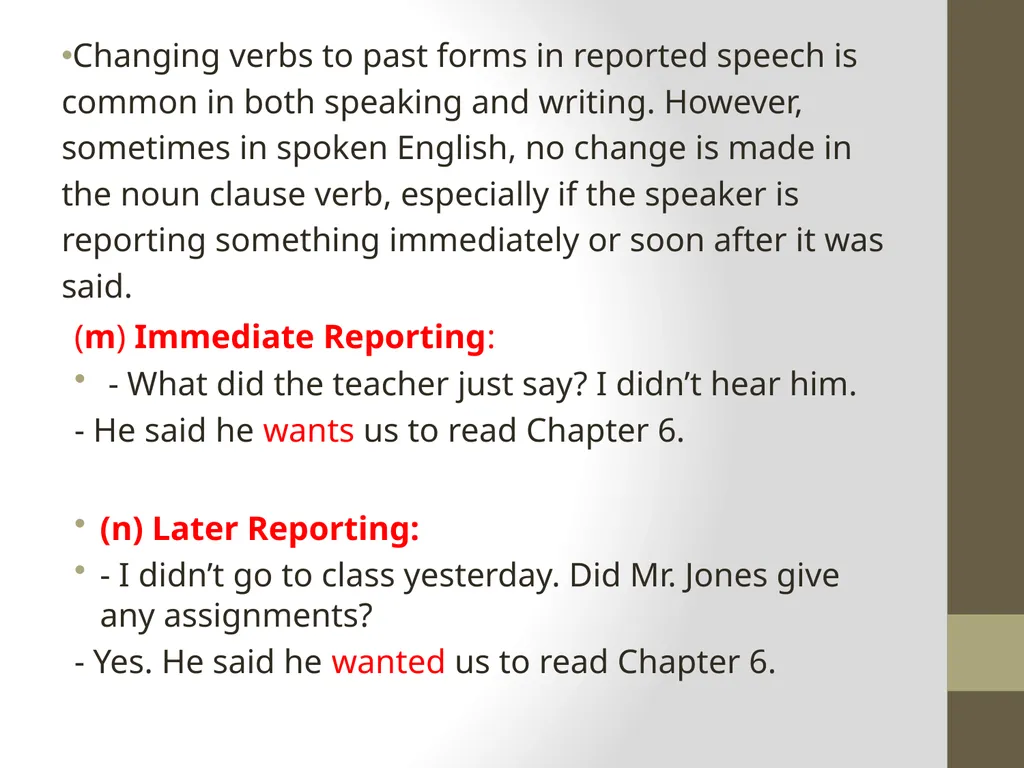
Changing verbs to past forms in reported speech is common in both speaking and writing. However, sometimes in spoken English, no change is made in the noun clause verb, especially if the speaker is reporting something immediately or soon after it was said.
(m) Immediate Reporting:
- What did the teacher just say? I didn’t hear him.
- He said he wants us to read Chapter 6.
(n) Later Reporting:
- I didn’t go to class yesterday. Did Mr. Jones give any assignments?
- Yes. He said he wanted us to read Chapter 6.<br>
(m) Immediate Reporting:
- What did the teacher just say? I didn’t hear him.
- He said he wants us to read Chapter 6.
(n) Later Reporting:
- I didn’t go to class yesterday. Did Mr. Jones give any assignments?
- Yes. He said he wanted us to read Chapter 6.<br>
34
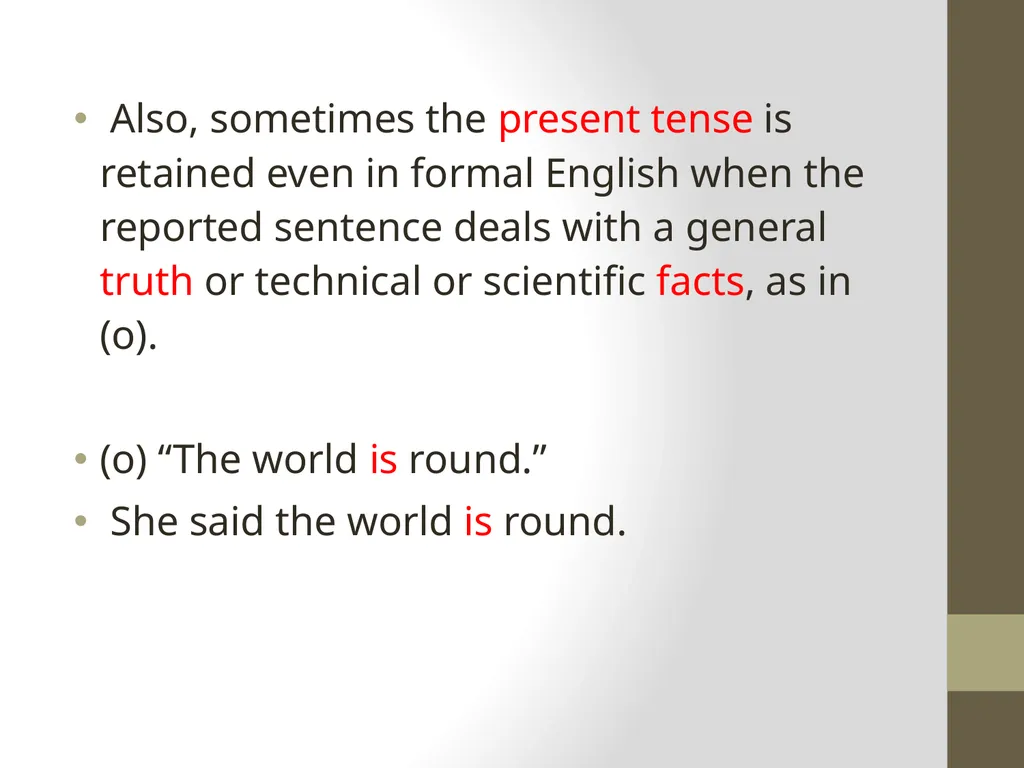
Also, sometimes the present tense is retained even in formal English when the reported sentence deals with a general truth or technical or scientific facts, as in (o).
(o) “The world is round.”
She said the world is round.<br>
(o) “The world is round.”
She said the world is round.<br>
35
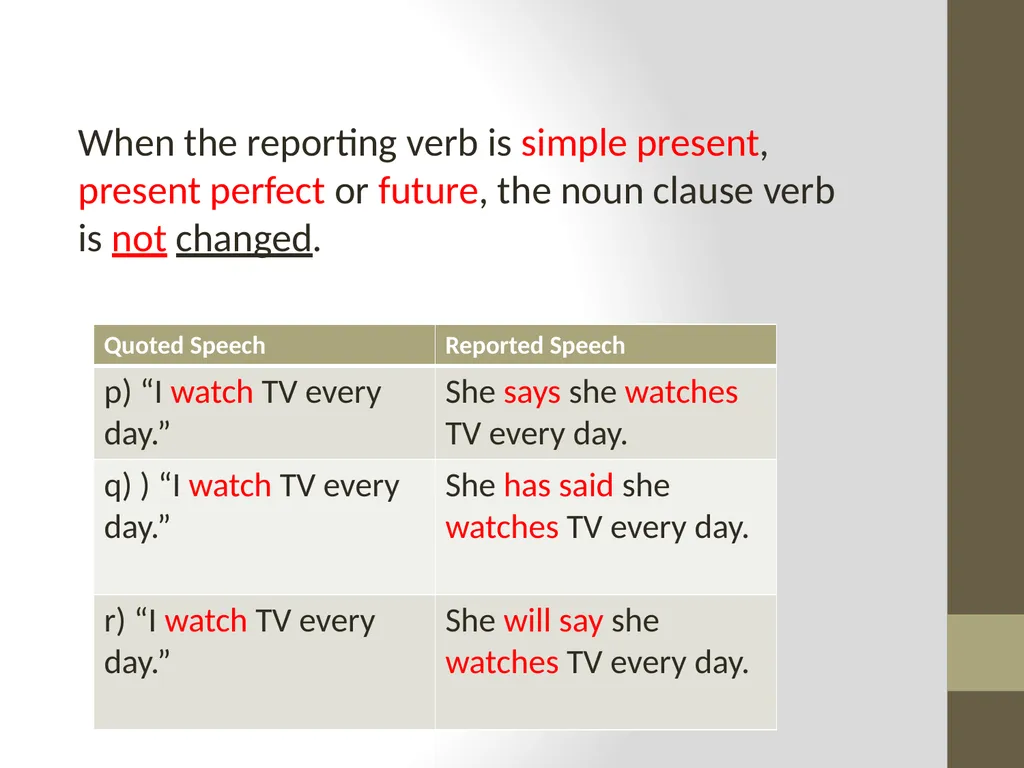
When the reporting verb is simple present, present perfect or future, the noun clause verb is not changed.<br>
36
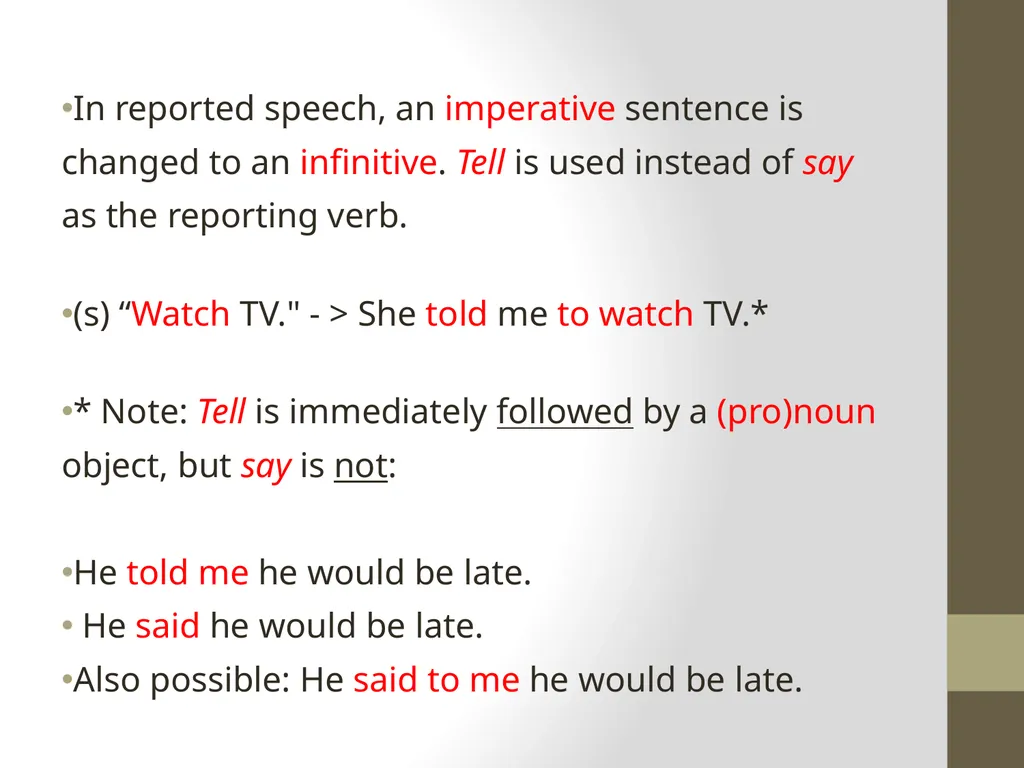
In reported speech, an imperative sentence is changed to an infinitive. Tell is used instead of say as the reporting verb.
(s) “Watch TV." - > She told me to watch TV.*
* Note: Tell is immediately followed by a (pro)noun object, but say is not:
He told me he would be late.
He said he would be late.
Also possible: He said to me he would be late.<br>
(s) “Watch TV." - > She told me to watch TV.*
* Note: Tell is immediately followed by a (pro)noun object, but say is not:
He told me he would be late.
He said he would be late.
Also possible: He said to me he would be late.<br>
37
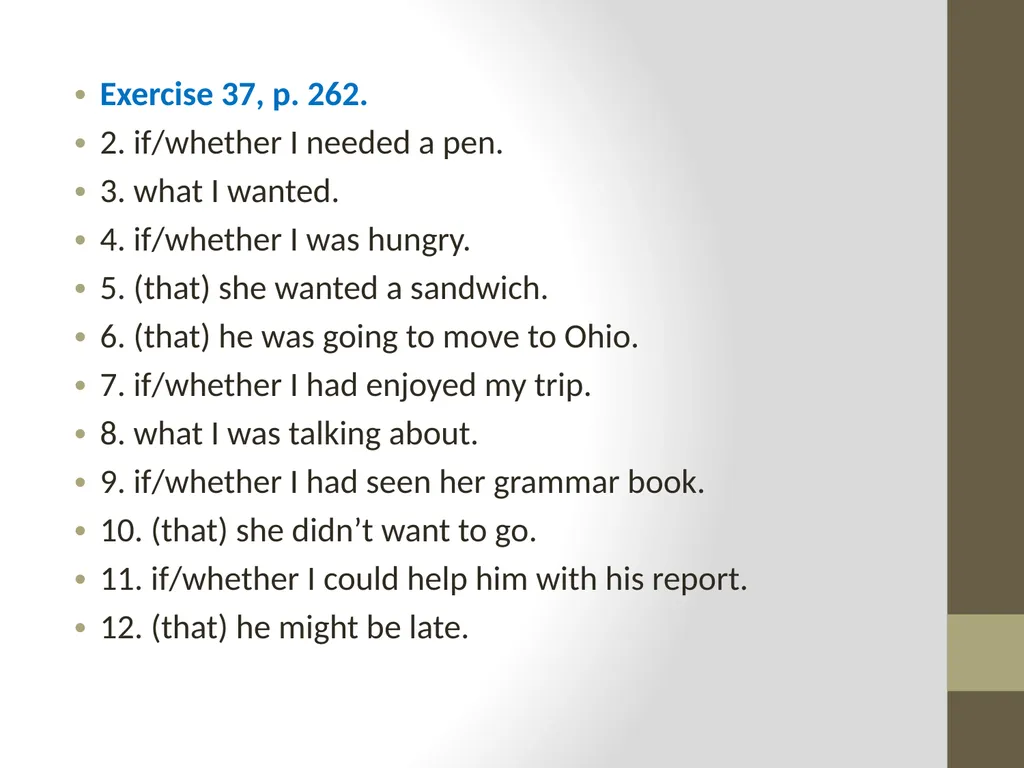
Exercise 37, p. 262.
2. if/whether I needed a pen.
3. what I wanted.
4. if/whether I was hungry.
5. (that) she wanted a sandwich.
6. (that) he was going to move to Ohio.
7. if/whether I had enjoyed my trip.
8. what I was talking about.
9. if/whether I had seen her grammar book.
10. (that) she didn’t want to go.
11. if/whether I could help him with his report.
12. (that) he might be late.<br>
38
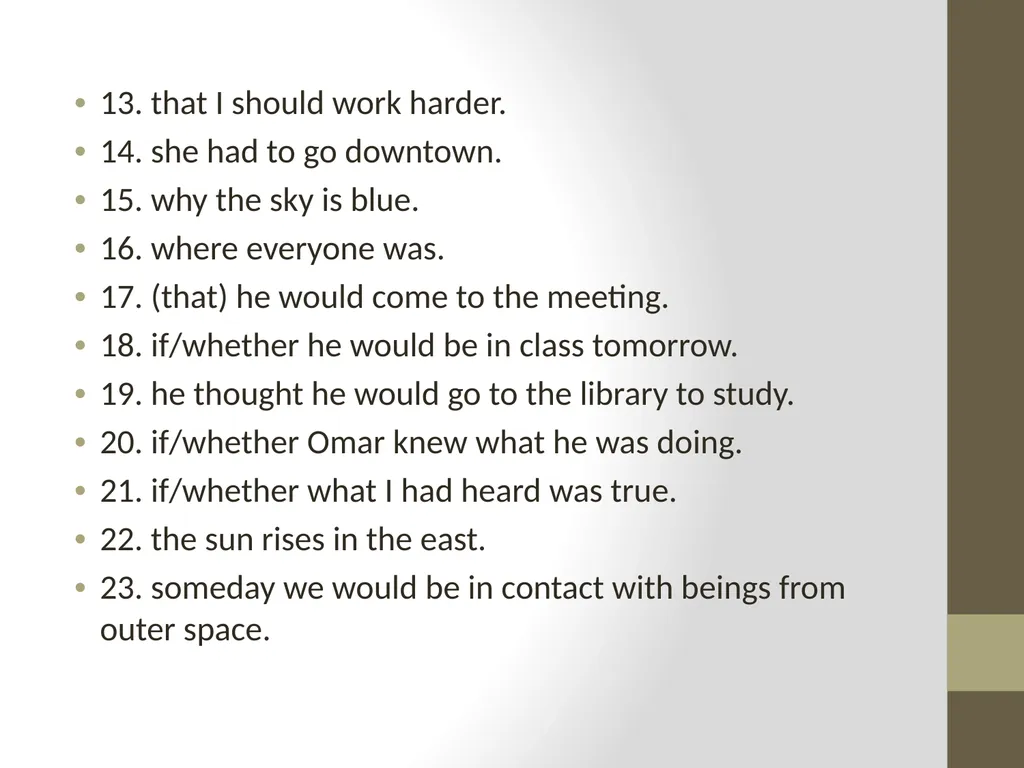
13. that I should work harder.
14. she had to go downtown.
15. why the sky is blue.
16. where everyone was.
17. (that) he would come to the meeting.
18. if/whether he would be in class tomorrow.
19. he thought he would go to the library to study.
20. if/whether Omar knew what he was doing.
21. if/whether what I had heard was true.
22. the sun rises in the east.
23. someday we would be in contact with beings from outer space.<br>
39
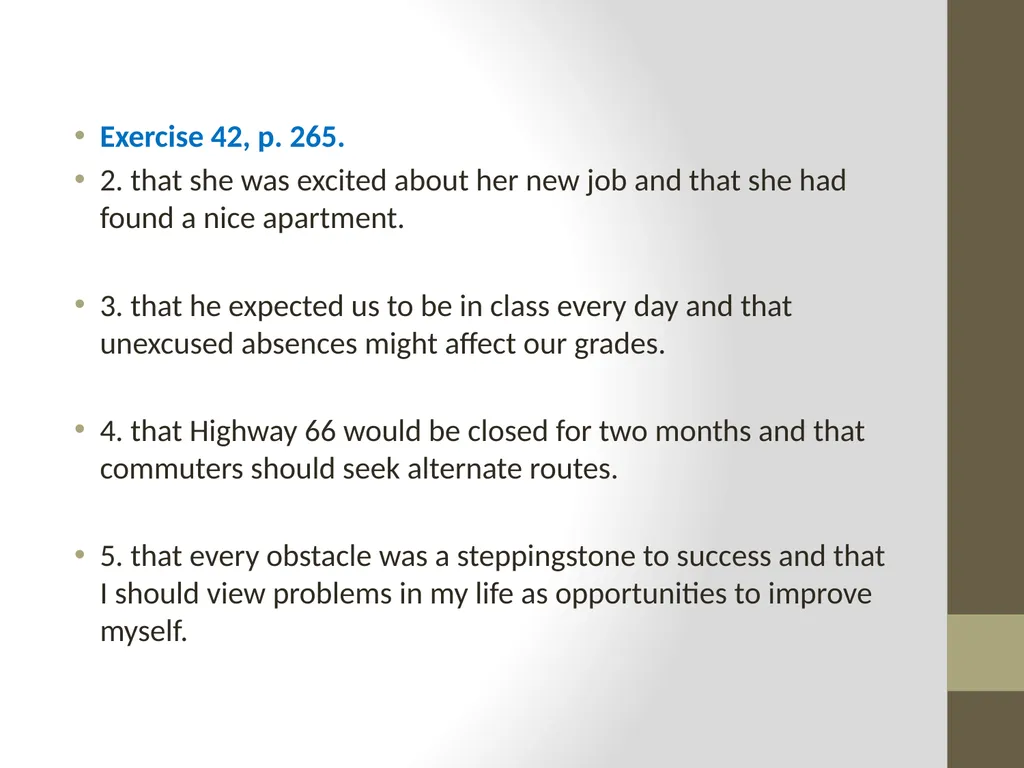
Exercise 42, p. 265.
2. that she was excited about her new job and that she had found a nice apartment.
3. that he expected us to be in class every day and that unexcused absences might affect our grades.
4. that Highway 66 would be closed for two months and that commuters should seek alternate routes.
5. that every obstacle was a steppingstone to success and that I should view problems in my life as opportunities to improve myself.<br>
40
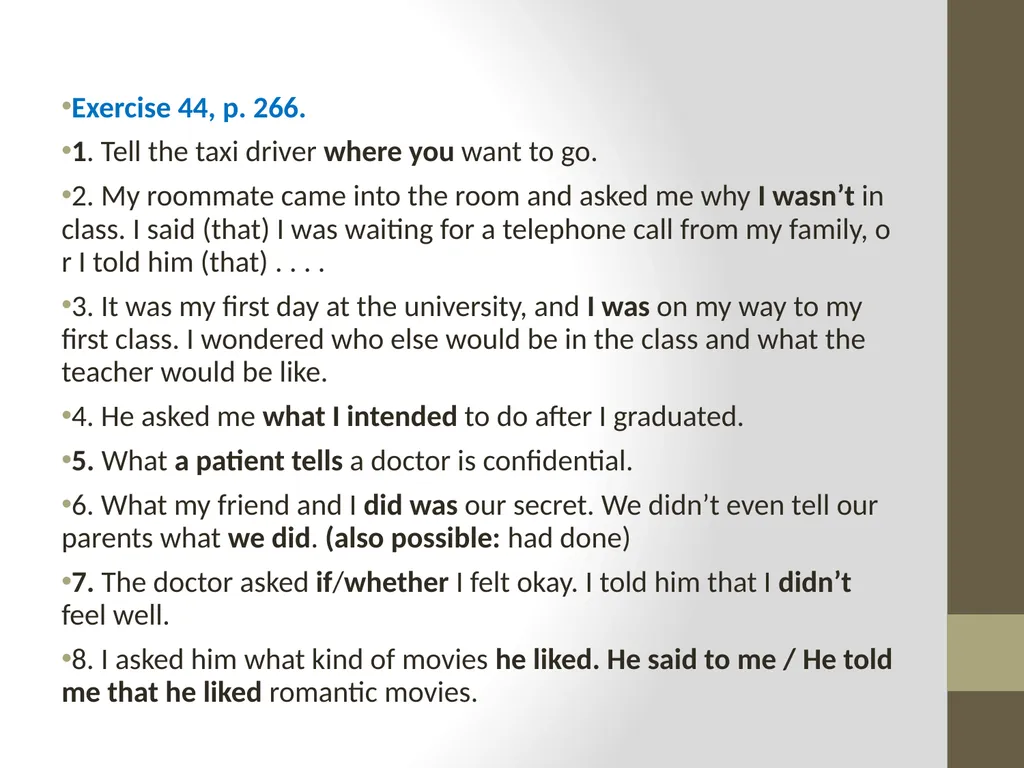
Exercise 44, p. 266.
1. Tell the taxi driver where you want to go.
2. My roommate came into the room and asked me why I wasn’t in class. I said (that) I was waiting for a telephone call from my family, o r I told him (that) . . . .
3. It was my first day at the university, and I was on my way to my first class. I wondered who else would be in the class and what the teacher would be like.
4. He asked me what I intended to do after I graduated.
5. What a patient tells a doctor is confidential.
6. What my friend and I did was our secret. We didn’t even tell our parents what we did. (also possible: had done)
7. The doctor asked if/whether I felt okay. I told him that I didn’t feel well.
8. I asked him what kind of movies he liked. He said to me / He told me that he liked romantic movies.<br>
41
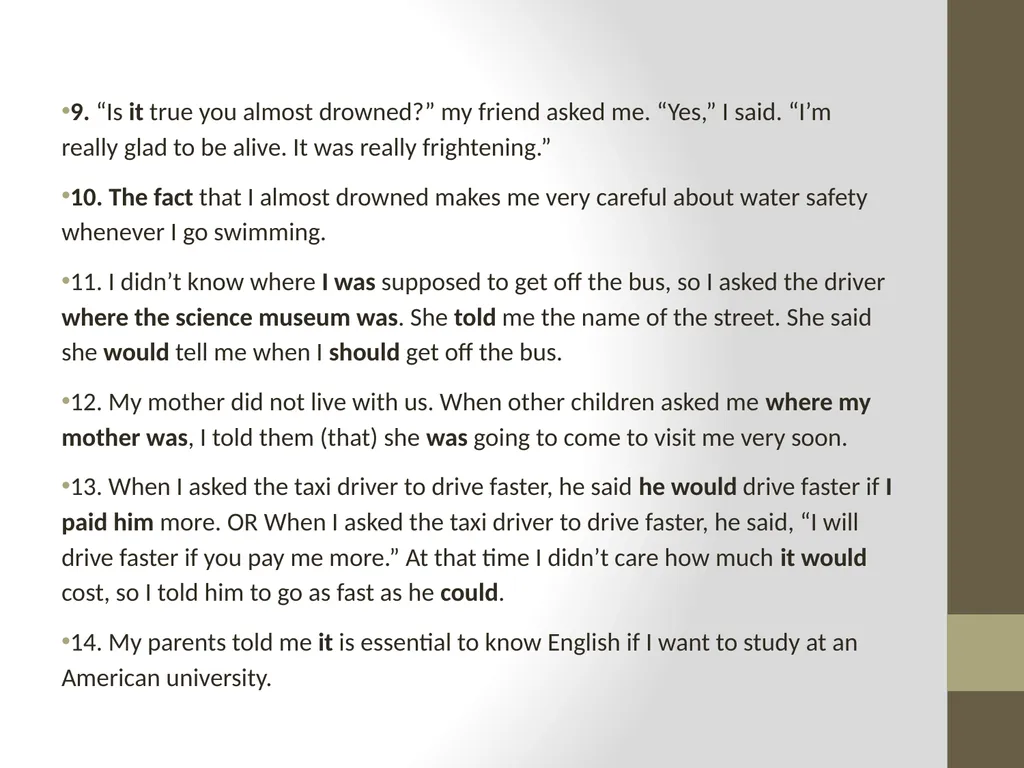
9. “Is it true you almost drowned?” my friend asked me. “Yes,” I said. “I’m really glad to be alive. It was really frightening.”
10. The fact that I almost drowned makes me very careful about water safety whenever I go swimming.
11. I didn’t know where I was supposed to get off the bus, so I asked the driver where the science museum was. She told me the name of the street. She said she would tell me when I should get off the bus.
12. My mother did not live with us. When other children asked me where my mother was, I told them (that) she was going to come to visit me very soon.
13. When I asked the taxi driver to drive faster, he said he would drive faster if I paid him more. OR When I asked the taxi driver to drive faster, he said, “I will drive faster if you pay me more.” At that time I didn’t care how much it would cost, so I told him to go as fast as he could.
14. My parents told me it is essential to know English if I want to study at an American university.<br>
42
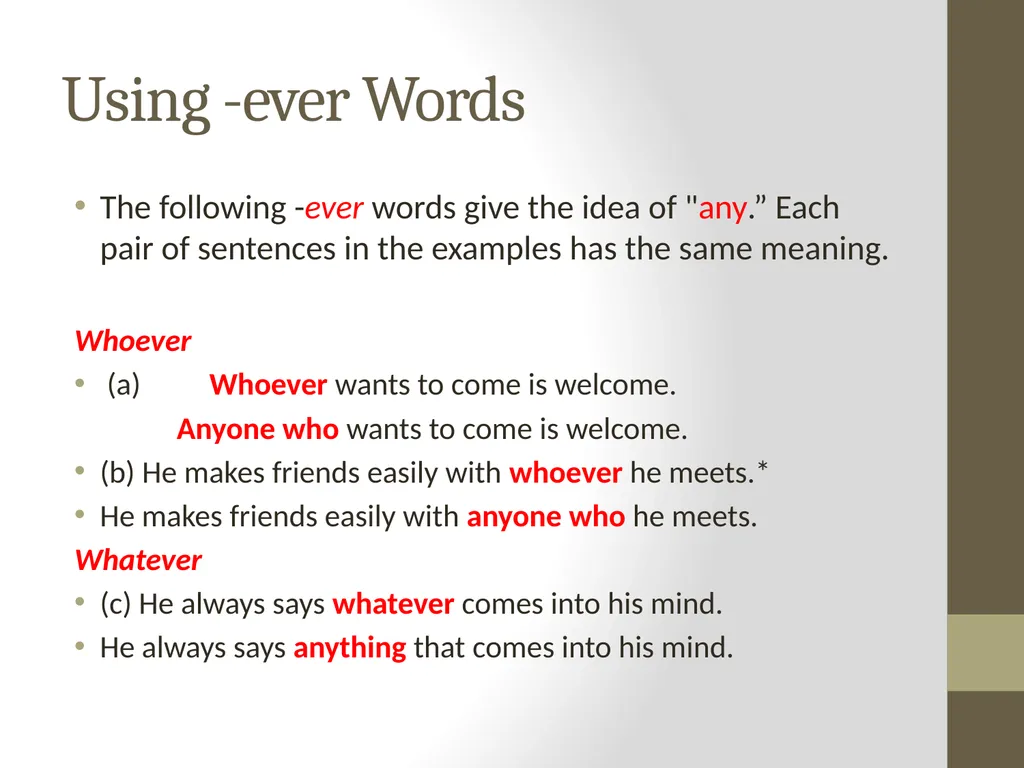
Using -ever Words The following -ever words give the idea of "any.” Each pair of sentences in the examples has the same meaning.
Whoever
(a) Whoever wants to come is welcome.
Anyone who wants to come is welcome.
(b) He makes friends easily with whoever he meets.*
He makes friends easily with anyone who he meets.
Whatever
(c) He always says whatever comes into his mind.
He always says anything that comes into his mind.<br>
Whoever
(a) Whoever wants to come is welcome.
Anyone who wants to come is welcome.
(b) He makes friends easily with whoever he meets.*
He makes friends easily with anyone who he meets.
Whatever
(c) He always says whatever comes into his mind.
He always says anything that comes into his mind.<br>
43
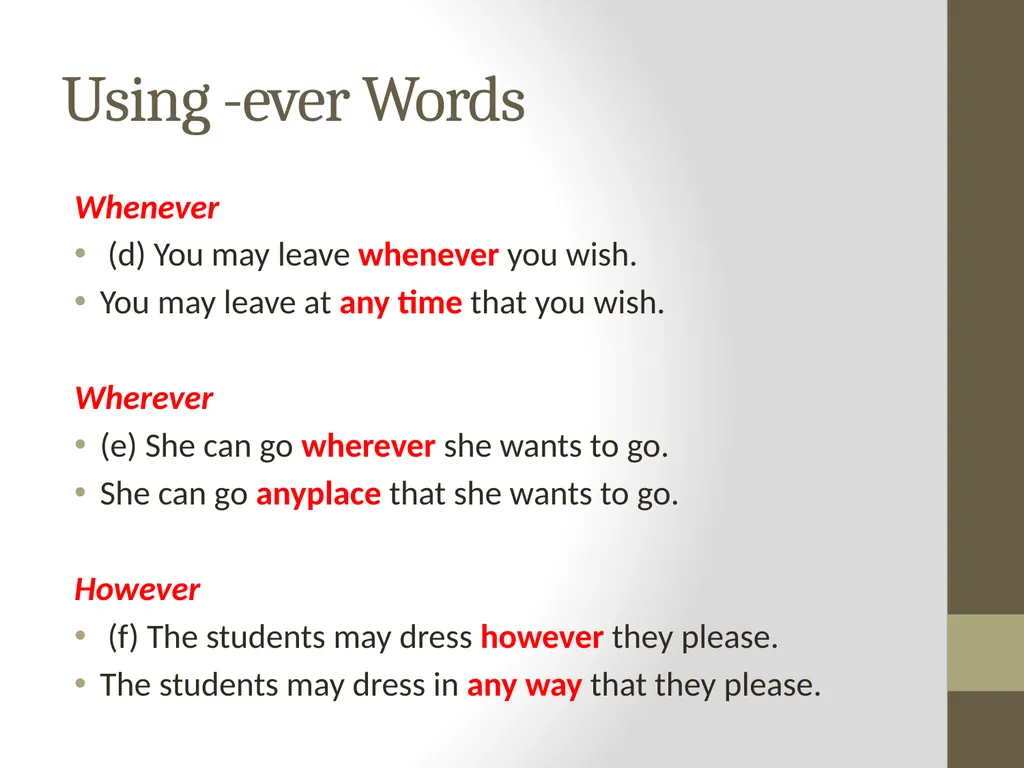
Using -ever Words Whenever
(d) You may leave whenever you wish.
You may leave at any time that you wish.
Wherever
(e) She can go wherever she wants to go.
She can go anyplace that she wants to go.
However
(f) The students may dress however they please.
The students may dress in any way that they please.<br>
(d) You may leave whenever you wish.
You may leave at any time that you wish.
Wherever
(e) She can go wherever she wants to go.
She can go anyplace that she wants to go.
However
(f) The students may dress however they please.
The students may dress in any way that they please.<br>