
NUCLEAR SAFETY, SECURITY AND SAFEGUARDS IN THE
TD
Published · 29 slides · 0 views

1 / 1

Description
NUCLEAR SAFETY, SECURITY AND SAFEGUARDS IN THE MINING AND TRANSPORT OF URANIUM ORE CONCENTRATE IN NAMIBIA. Dr Jeremiah Kebwaro Dean School of Pure and Applied Sciences Karatina University. Kenya 24 March 2021 ISTC WEBINAR SERIES
Related Topics
Share
Embed code
Download this presentation From Below
"NUCLEAR SAFETY, SECURITY AND SAFEGUARDS IN THE" is the property of its rightful owner. Permission is granted to download and print the materials on this website for personal, non-commercial use only, and to display it on your personal computer provided you do not modify the materials and that you retain all copyright notices contained in the materials. By downloading content from our website, you accept the terms of this agreement.
Presentation Transcript
01
NUCLEAR SAFETY, SECURITY AND SAFEGUARDS IN THE MINING AND TRANSPORT OF URANIUM ORE CONCENTRATE IN NAMIBIA.
Dr Jeremiah Kebwaro
Dean School of Pure and Applied Sciences
Karatina University. Kenya
24 March 2021 ISTC WEBINAR SERIES<br>
Dr Jeremiah Kebwaro
Dean School of Pure and Applied Sciences
Karatina University. Kenya
24 March 2021 ISTC WEBINAR SERIES<br>
02
Introduction This is a report under EU funded Project MC 5.01/15b – Support to the Southern African States in Nuclear Safety and Safeguards.
The report presents a case study of Namibia and analyzes the country’s declared uranium exploitation status;
The existing legal and institutional frameworks and implementation capacities.<br>
The report presents a case study of Namibia and analyzes the country’s declared uranium exploitation status;
The existing legal and institutional frameworks and implementation capacities.<br>
03
The goal of this study was to review the current safety, security and safeguards policies and regulations for uranium mining and transportation in Namibia and identify challenges and opportunities in the current frameworks.
Propose strategies for strengthening the existing framework and a roadmap for regional approximation Goal of the study<br>
Propose strategies for strengthening the existing framework and a roadmap for regional approximation Goal of the study<br>
04
Methodology Desk-based research, including an extensive review of the laws, policies, regulations and agreements that govern the national mining sector,
as well as relevant literature on the sector that include Annual reports compiled by the mining companies.
Relevant Agency documents that include IAEA GSR ,IAEA NSS, IAEA TS-G
UN regulations on transport of dangerous goods ST/SG/AC.10/1/Rev.21
The review also included study of the united nations country reports and approved committee matrixes in the United nations 1540 UN committee resolutions.<br>
as well as relevant literature on the sector that include Annual reports compiled by the mining companies.
Relevant Agency documents that include IAEA GSR ,IAEA NSS, IAEA TS-G
UN regulations on transport of dangerous goods ST/SG/AC.10/1/Rev.21
The review also included study of the united nations country reports and approved committee matrixes in the United nations 1540 UN committee resolutions.<br>
05
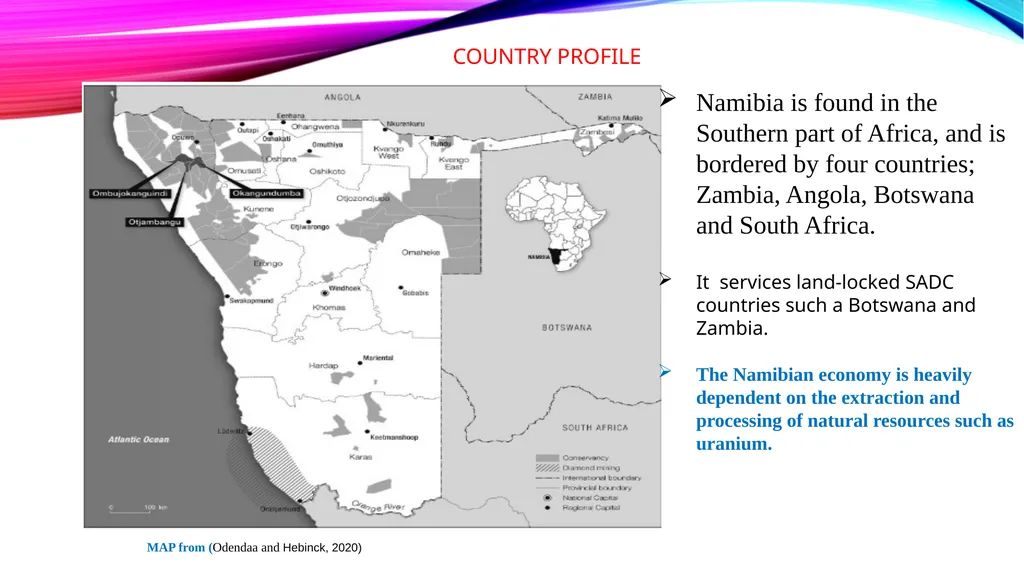
COUNTRY PROFILE Namibia is found in the Southern part of Africa, and is bordered by four countries; Zambia, Angola, Botswana and South Africa.
It services land-locked SADC countries such a Botswana and Zambia.
The Namibian economy is heavily dependent on the extraction and processing of natural resources such as uranium. MAP from (Odendaa and Hebinck, 2020)<br>
It services land-locked SADC countries such a Botswana and Zambia.
The Namibian economy is heavily dependent on the extraction and processing of natural resources such as uranium. MAP from (Odendaa and Hebinck, 2020)<br>
06
Transport infrastructure
Namibia has a well-established road infrastructure, and The majority of towns and communities can be reached via a road network.
Namibia has 4 transport corridors ,Trans-Kalahari via Bostwana, Trans-Caprivi, Trans-Cunene via Angola to DRC and Trans-Oranje via South Africa that links to SADC countries
All the Uranium mines are well connected to the road network.
Namibia has a railway line that runs from the Port of Walvis Bay to other towns. The Rossing mine is connected to this railway line and utilizes it in transport of Uranium ore concentrate to the port of Walvis Bay.<br>
Namibia has a well-established road infrastructure, and The majority of towns and communities can be reached via a road network.
Namibia has 4 transport corridors ,Trans-Kalahari via Bostwana, Trans-Caprivi, Trans-Cunene via Angola to DRC and Trans-Oranje via South Africa that links to SADC countries
All the Uranium mines are well connected to the road network.
Namibia has a railway line that runs from the Port of Walvis Bay to other towns. The Rossing mine is connected to this railway line and utilizes it in transport of Uranium ore concentrate to the port of Walvis Bay.<br>
07
Overview of Uranium industry in Namibia
Uranium minerals in Namibia were first discovered in Namib desert at today’s Rössing Mine in 1928, but exploration did not start until in 1950s
Commercial Uranium mining began in the year 1976
As result of the demand, a number of companies started uranium exploration leading to identification of more Uranium deposits.
Exploration and expansion of the mining sector is heavily influenced by global Uranium prices.
E.g Good prices in the year 2000 motivated the establishment of more mines while dipping of prices in 2018 affected production.<br>
Uranium minerals in Namibia were first discovered in Namib desert at today’s Rössing Mine in 1928, but exploration did not start until in 1950s
Commercial Uranium mining began in the year 1976
As result of the demand, a number of companies started uranium exploration leading to identification of more Uranium deposits.
Exploration and expansion of the mining sector is heavily influenced by global Uranium prices.
E.g Good prices in the year 2000 motivated the establishment of more mines while dipping of prices in 2018 affected production.<br>
08
Overview continued In 2019, Namibia’s Uranium resources were estimated to be about 7% of the Global Uranium resources
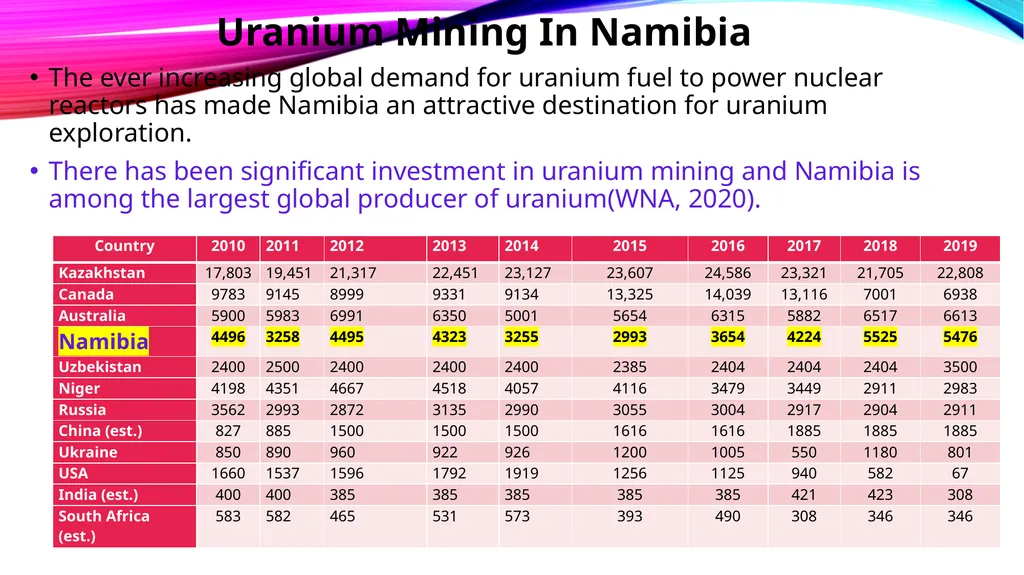
Namibia was also considered as the 4th producer of Uranium behind Kazakhstan, Canada and Australia
Effects of Covid-19
In March 2020, Rössing suspended normal mining operations in response to the coronavirus pandemic.
Minimal mining operations and essential mine and plant maintenance continued, and already-mined ore used to minimize the impact on production<br>
Namibia was also considered as the 4th producer of Uranium behind Kazakhstan, Canada and Australia
Effects of Covid-19
In March 2020, Rössing suspended normal mining operations in response to the coronavirus pandemic.
Minimal mining operations and essential mine and plant maintenance continued, and already-mined ore used to minimize the impact on production<br>
09
Uranium Mining In Namibia
The ever increasing global demand for uranium fuel to power nuclear reactors has made Namibia an attractive destination for uranium exploration.
There has been significant investment in uranium mining and Namibia is among the largest global producer of uranium(WNA, 2020). Units are in tonnes<br>
The ever increasing global demand for uranium fuel to power nuclear reactors has made Namibia an attractive destination for uranium exploration.
There has been significant investment in uranium mining and Namibia is among the largest global producer of uranium(WNA, 2020). Units are in tonnes<br>
10
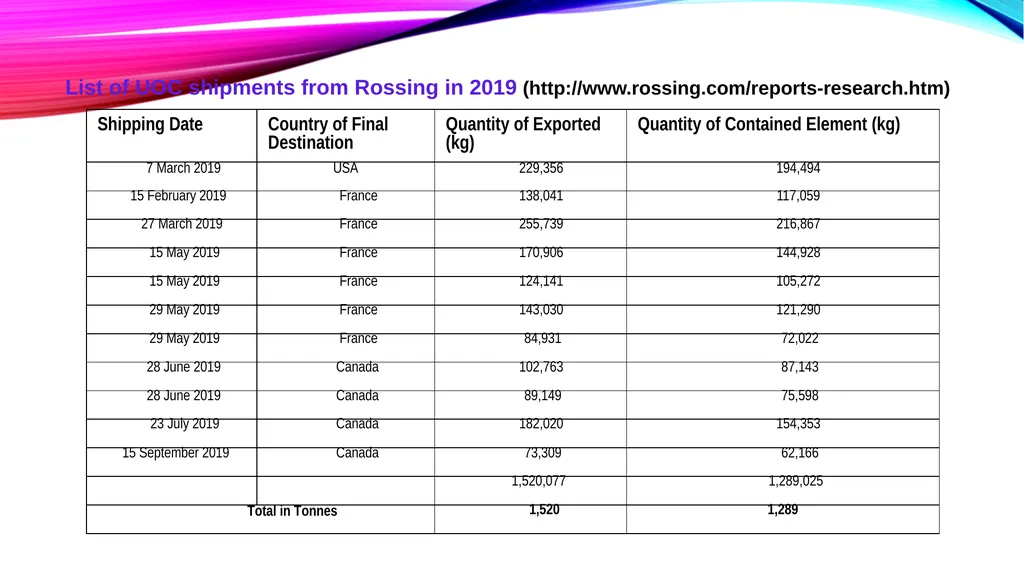
List of UOC shipments from Rossing in 2019 (http://www.rossing.com/reports-research.htm)<br>
11
In Namibia uranium deposits are mined in open pits, as this practice makes it more cost effective than underground mining
Most uranium resources contain only a fraction of uranium: e.g 1,000 kg of ore produces about 500 grams of usable uranium.
The Mined Uranium ore is taken through milling to turn it into a finished product-Uranium powder, also known as Yellowcake.<br>
Most uranium resources contain only a fraction of uranium: e.g 1,000 kg of ore produces about 500 grams of usable uranium.
The Mined Uranium ore is taken through milling to turn it into a finished product-Uranium powder, also known as Yellowcake.<br>
12
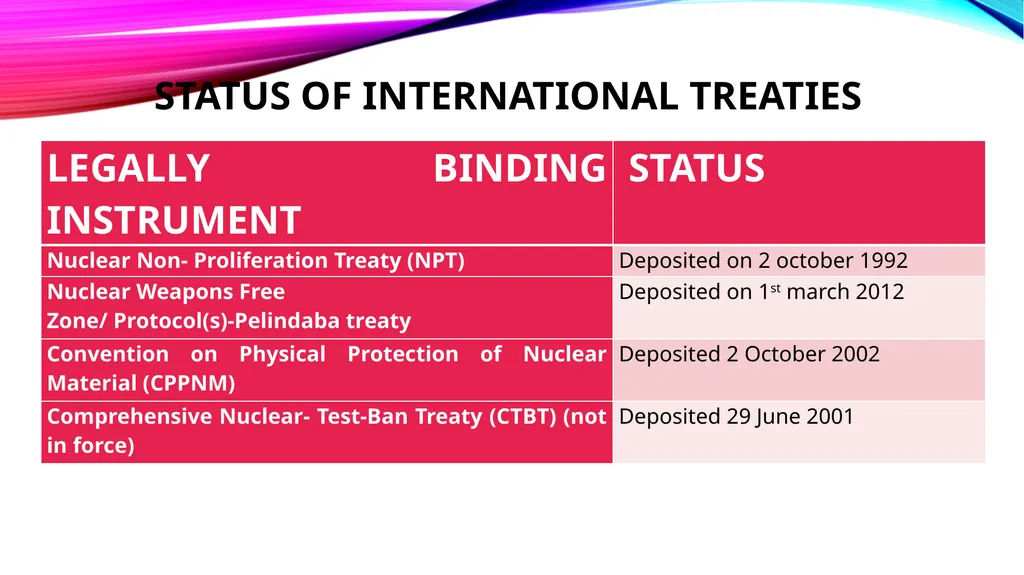
Laws governing mining activities in Namibia Namibia’s legislative framework takes cognisance of its international obligations to promote peace and security by acceding to international treaties and agreements.
Acceded international treaties
Non- Proliferation Treaty,
Safeguards Agreement,
Pelindaba Treaty
Convention on the Physical Protection of Nuclear Material.<br>
Acceded international treaties
Non- Proliferation Treaty,
Safeguards Agreement,
Pelindaba Treaty
Convention on the Physical Protection of Nuclear Material.<br>
13
Status of international treaties<br>
14
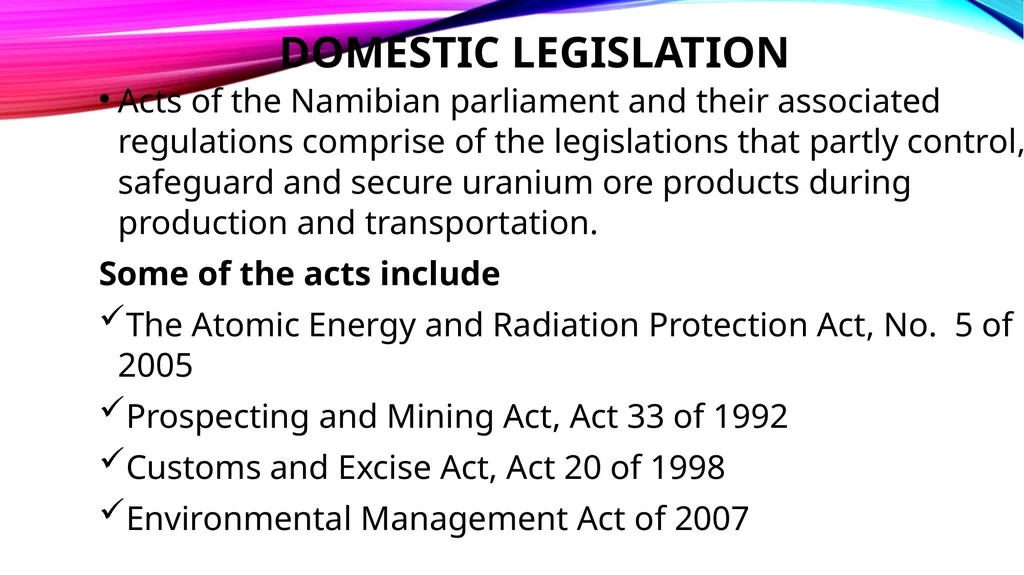
Domestic legislation Acts of the Namibian parliament and their associated regulations comprise of the legislations that partly control, safeguard and secure uranium ore products during production and transportation.
Some of the acts include
The Atomic Energy and Radiation Protection Act, No. 5 of 2005
Prospecting and Mining Act, Act 33 of 1992
Customs and Excise Act, Act 20 of 1998
Environmental Management Act of 2007<br>
Some of the acts include
The Atomic Energy and Radiation Protection Act, No. 5 of 2005
Prospecting and Mining Act, Act 33 of 1992
Customs and Excise Act, Act 20 of 1998
Environmental Management Act of 2007<br>
15
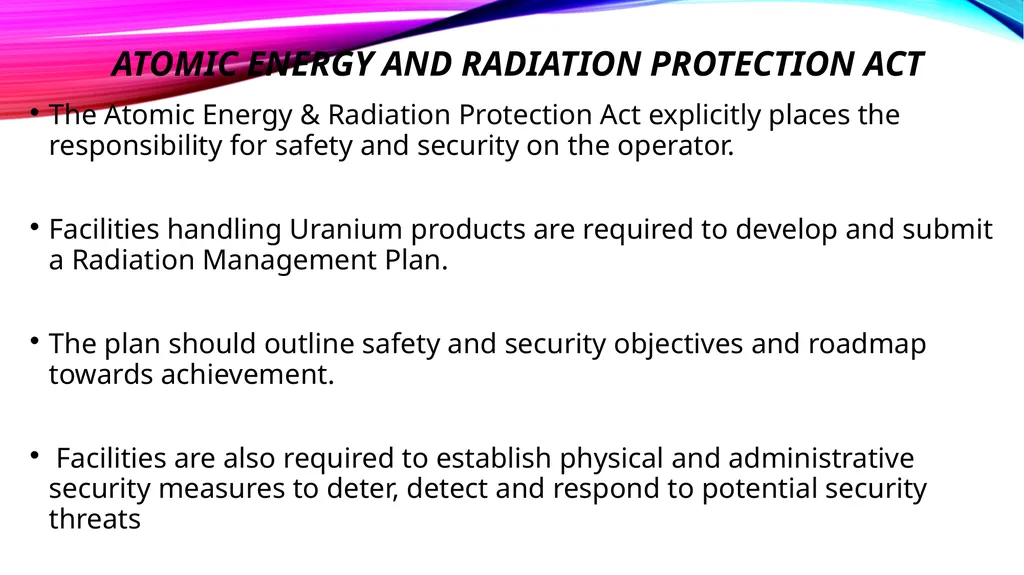
Atomic Energy and Radiation Protection Act The Atomic Energy & Radiation Protection Act explicitly places the responsibility for safety and security on the operator.
Facilities handling Uranium products are required to develop and submit a Radiation Management Plan.
The plan should outline safety and security objectives and roadmap towards achievement.
Facilities are also required to establish physical and administrative security measures to deter, detect and respond to potential security threats<br>
Facilities handling Uranium products are required to develop and submit a Radiation Management Plan.
The plan should outline safety and security objectives and roadmap towards achievement.
Facilities are also required to establish physical and administrative security measures to deter, detect and respond to potential security threats<br>
16
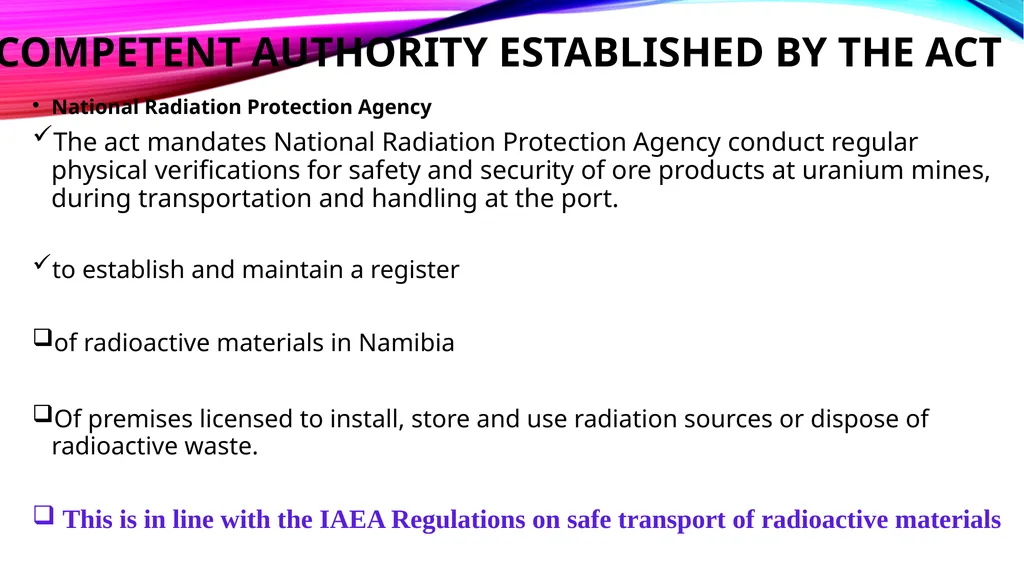
Competent authority established by the act National Radiation Protection Agency
The act mandates National Radiation Protection Agency conduct regular physical verifications for safety and security of ore products at uranium mines, during transportation and handling at the port.
to establish and maintain a register
of radioactive materials in Namibia
Of premises licensed to install, store and use radiation sources or dispose of radioactive waste.
This is in line with the IAEA Regulations on safe transport of radioactive materials<br>
The act mandates National Radiation Protection Agency conduct regular physical verifications for safety and security of ore products at uranium mines, during transportation and handling at the port.
to establish and maintain a register
of radioactive materials in Namibia
Of premises licensed to install, store and use radiation sources or dispose of radioactive waste.
This is in line with the IAEA Regulations on safe transport of radioactive materials<br>
17
Minerals (Prospecting and Mining) Act The Minerals (Prospecting and Mining) Act (1992) is the central piece of legislation governing the mining sector in Namibia.
The Act provides for the issuing for exploration and mining licenses. It further provides for the control of import, export and trade of the Namibia minerals including the ore product.
The act outlines the mineral rights in the country, describes how the sector is to be administered, lays out obligations relating to mining licences available in Namibia.
It also includes information on royalty rates and penalties for any infractions and sets mine closure requirements.<br>
The Act provides for the issuing for exploration and mining licenses. It further provides for the control of import, export and trade of the Namibia minerals including the ore product.
The act outlines the mineral rights in the country, describes how the sector is to be administered, lays out obligations relating to mining licences available in Namibia.
It also includes information on royalty rates and penalties for any infractions and sets mine closure requirements.<br>
18
Environmental Management Act The Environmental Management Act (EMA) and the Environmental Impact Assessment Regulations govern the environmental aspects of the mining life cycle.
In accordance with the Act and its regulations, a number of listed activities relevant to exploration, mining and quarrying cannot be undertaken without an environmental clearance certificate (ECC).
The EMA describes the steps that must be successfully completed by applicants prior to being granted an ECC;
A valid ECC is required for the application of various mining licences and license renewals<br>
In accordance with the Act and its regulations, a number of listed activities relevant to exploration, mining and quarrying cannot be undertaken without an environmental clearance certificate (ECC).
The EMA describes the steps that must be successfully completed by applicants prior to being granted an ECC;
A valid ECC is required for the application of various mining licences and license renewals<br>
19
MINERALS POLICY OF NAMIBIA, 2002
Adopted in 2002, the Policy lays out a vision for the responsible development of Namibia’s mining sector for sustainable socioeconomic development.
As per the policy mining Companies are expected to take responsibility for minimizing impacts to the environment, for mine closure, and for ensuring meaningful community involvement.
They are also expected to support the empowerment of previously disadvantaged groups in their areas of operation.<br>
Adopted in 2002, the Policy lays out a vision for the responsible development of Namibia’s mining sector for sustainable socioeconomic development.
As per the policy mining Companies are expected to take responsibility for minimizing impacts to the environment, for mine closure, and for ensuring meaningful community involvement.
They are also expected to support the empowerment of previously disadvantaged groups in their areas of operation.<br>
20
Customs and Excise Act of 1998 The Customs and Excise Act mandates Customs officials to verify the documents and seal so submitted against the physical stock being imported or exported.
Upon Customs satisfaction with the verifications, containers are sealed with a temper proof seal which must be only broke- opened at the final destination<br>
Upon Customs satisfaction with the verifications, containers are sealed with a temper proof seal which must be only broke- opened at the final destination<br>
21
Nuclear security enforcement Security of uranium ore products at the mine
Access to the product recovering and storage area is restricted to personnel working in the area only.
Biometric and electronic cards are used for access.
All the mines are under 24 hours surveillance and mining area is fenced.
Removal of the product from the storage area strictly follows specific administrative procedures to ensure compliance with security requirements.
All personnel and vehicles leaving the mine sites are searched by the security officers at the security check point.<br>
Access to the product recovering and storage area is restricted to personnel working in the area only.
Biometric and electronic cards are used for access.
All the mines are under 24 hours surveillance and mining area is fenced.
Removal of the product from the storage area strictly follows specific administrative procedures to ensure compliance with security requirements.
All personnel and vehicles leaving the mine sites are searched by the security officers at the security check point.<br>
22
Security of uranium ore products during transport
Uranium products from the mine to the harbour are transported by companies licensed by the NRPA to transport radioactive material.
Thorough inspection of containers by relevant personnel
The consignments are escorted by the mines security personnel and radiation safety officer.
Consignment from Rossing is transported by rail.<br>
Uranium products from the mine to the harbour are transported by companies licensed by the NRPA to transport radioactive material.
Thorough inspection of containers by relevant personnel
The consignments are escorted by the mines security personnel and radiation safety officer.
Consignment from Rossing is transported by rail.<br>
23
TRANSPORT OF URANIUM ORE CONCENTRATE FROM NEIGHBOURING COUNTRIES
The UOC From Neighboring countries is transported in trucks to Walvis Bay
The longest transport route is that for uranium mined at Kayelekera in Malawi, which passes through Malawi, Zambia and Namibia on its ways to Walvis Bay.
For such consignment from neighbouring countries, it is a requirement that containers be sealed with company seals endorsed on the manifest from the country of departure.
The national police in each state escorts the trucks in stages, based on bilateral agreements with the other states along the route.<br>
The UOC From Neighboring countries is transported in trucks to Walvis Bay
The longest transport route is that for uranium mined at Kayelekera in Malawi, which passes through Malawi, Zambia and Namibia on its ways to Walvis Bay.
For such consignment from neighbouring countries, it is a requirement that containers be sealed with company seals endorsed on the manifest from the country of departure.
The national police in each state escorts the trucks in stages, based on bilateral agreements with the other states along the route.<br>
24
The NRPA issues license for the transit of products from other member states.
The license outlines the route, the container number and the number of drums in the container.
Custom officials are required to verify the consignment details.
The NRPA from time to time conducts verification of the transport of the products during transit to ensure that the requirements are met<br>
The license outlines the route, the container number and the number of drums in the container.
Custom officials are required to verify the consignment details.
The NRPA from time to time conducts verification of the transport of the products during transit to ensure that the requirements are met<br>
25
Challenges and opportunities
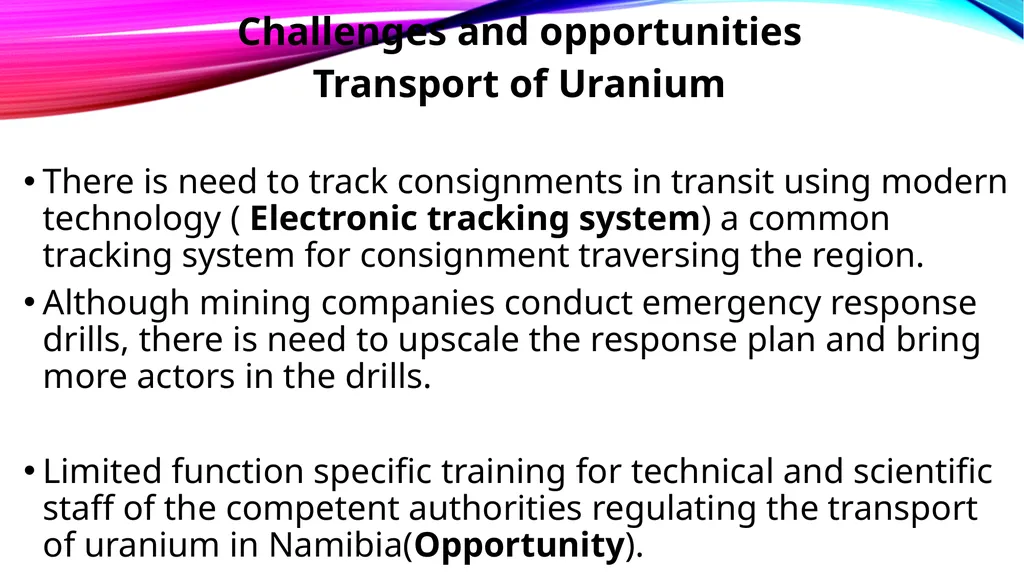
Transport of Uranium
There is need to track consignments in transit using modern technology ( Electronic tracking system) a common tracking system for consignment traversing the region.
Although mining companies conduct emergency response drills, there is need to upscale the response plan and bring more actors in the drills.
Limited function specific training for technical and scientific staff of the competent authorities regulating the transport of uranium in Namibia(Opportunity).<br>
Transport of Uranium
There is need to track consignments in transit using modern technology ( Electronic tracking system) a common tracking system for consignment traversing the region.
Although mining companies conduct emergency response drills, there is need to upscale the response plan and bring more actors in the drills.
Limited function specific training for technical and scientific staff of the competent authorities regulating the transport of uranium in Namibia(Opportunity).<br>
26
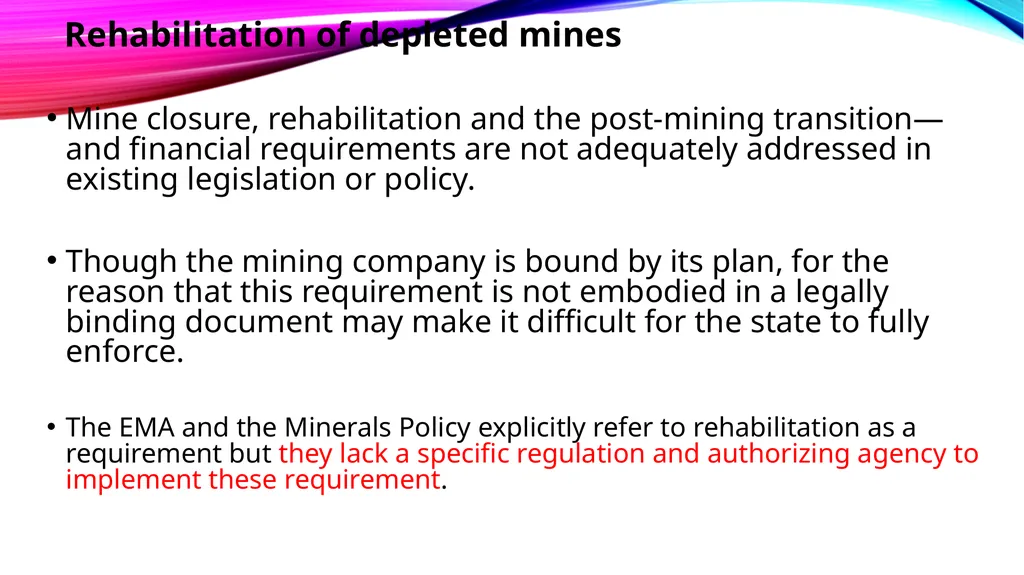
Rehabilitation of depleted mines
Mine closure, rehabilitation and the post-mining transition—and financial requirements are not adequately addressed in existing legislation or policy.
Though the mining company is bound by its plan, for the reason that this requirement is not embodied in a legally binding document may make it difficult for the state to fully enforce.
The EMA and the Minerals Policy explicitly refer to rehabilitation as a requirement but they lack a specific regulation and authorizing agency to implement these requirement.<br>
Mine closure, rehabilitation and the post-mining transition—and financial requirements are not adequately addressed in existing legislation or policy.
Though the mining company is bound by its plan, for the reason that this requirement is not embodied in a legally binding document may make it difficult for the state to fully enforce.
The EMA and the Minerals Policy explicitly refer to rehabilitation as a requirement but they lack a specific regulation and authorizing agency to implement these requirement.<br>
27
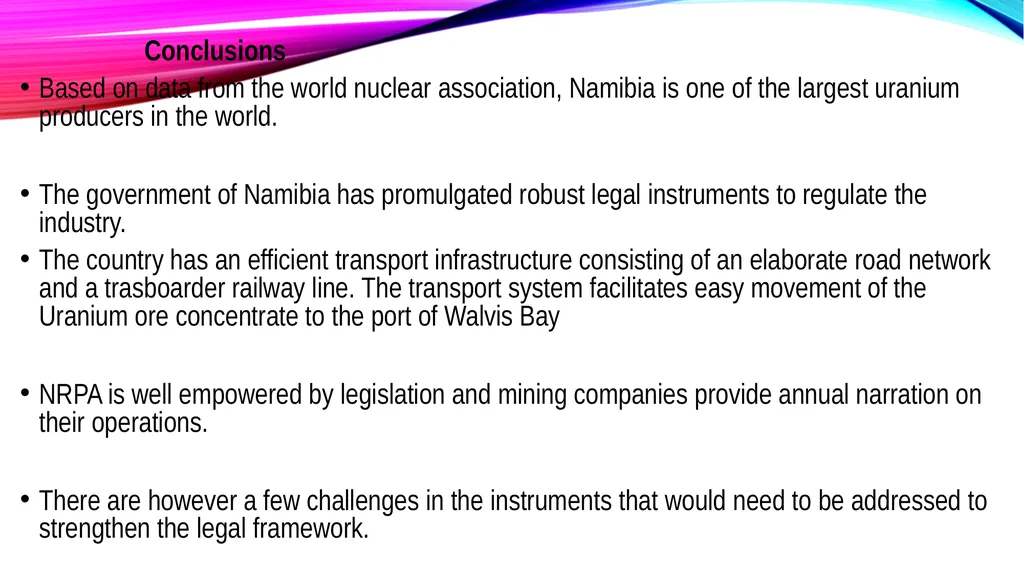
Conclusions
Based on data from the world nuclear association, Namibia is one of the largest uranium producers in the world.
The government of Namibia has promulgated robust legal instruments to regulate the industry.
The country has an efficient transport infrastructure consisting of an elaborate road network and a trasboarder railway line. The transport system facilitates easy movement of the Uranium ore concentrate to the port of Walvis Bay
NRPA is well empowered by legislation and mining companies provide annual narration on their operations.
There are however a few challenges in the instruments that would need to be addressed to strengthen the legal framework.<br>
Based on data from the world nuclear association, Namibia is one of the largest uranium producers in the world.
The government of Namibia has promulgated robust legal instruments to regulate the industry.
The country has an efficient transport infrastructure consisting of an elaborate road network and a trasboarder railway line. The transport system facilitates easy movement of the Uranium ore concentrate to the port of Walvis Bay
NRPA is well empowered by legislation and mining companies provide annual narration on their operations.
There are however a few challenges in the instruments that would need to be addressed to strengthen the legal framework.<br>
28
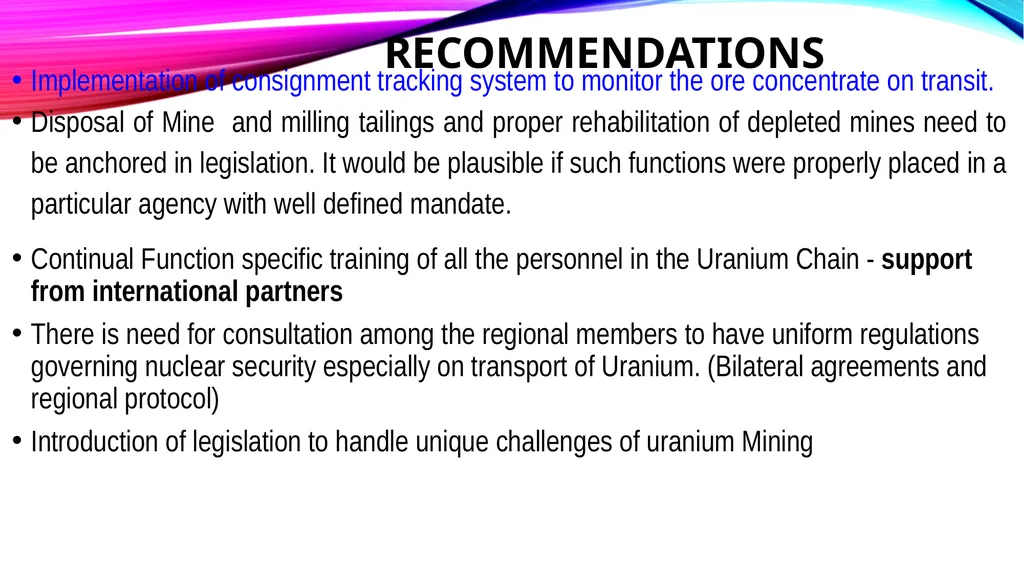
Recommendations Implementation of consignment tracking system to monitor the ore concentrate on transit.
Disposal of Mine and milling tailings and proper rehabilitation of depleted mines need to be anchored in legislation. It would be plausible if such functions were properly placed in a particular agency with well defined mandate.
Continual Function specific training of all the personnel in the Uranium Chain - support from international partners
There is need for consultation among the regional members to have uniform regulations governing nuclear security especially on transport of Uranium. (Bilateral agreements and regional protocol)
Introduction of legislation to handle unique challenges of uranium Mining<br>
Disposal of Mine and milling tailings and proper rehabilitation of depleted mines need to be anchored in legislation. It would be plausible if such functions were properly placed in a particular agency with well defined mandate.
Continual Function specific training of all the personnel in the Uranium Chain - support from international partners
There is need for consultation among the regional members to have uniform regulations governing nuclear security especially on transport of Uranium. (Bilateral agreements and regional protocol)
Introduction of legislation to handle unique challenges of uranium Mining<br>
29
Thank you<br>