
Nutrition specimens and models Dr. Nitin Kumar
AM
Published · 40 slides · 0 views
1 / 1






Description
Nutrition specimens and models Dr. Nitin Kumar Pathak Professor G S Medical College, Hapur Nutrition dietetics Nutrition Latin nutritic nourishment: The science of food and its relationship to health ..the process of intake,
Related Topics
Share
Embed code
Download this presentation From Below
"Nutrition specimens and models Dr. Nitin Kumar" is the property of its rightful owner. Permission is granted to download and print the materials on this website for personal, non-commercial use only, and to display it on your personal computer provided you do not modify the materials and that you retain all copyright notices contained in the materials. By downloading content from our website, you accept the terms of this agreement.
Presentation Transcript
01
Nutrition specimens and models Dr. Nitin Kumar Pathak
Professor
G S Medical College, Hapur<br>
Professor
G S Medical College, Hapur<br>
02
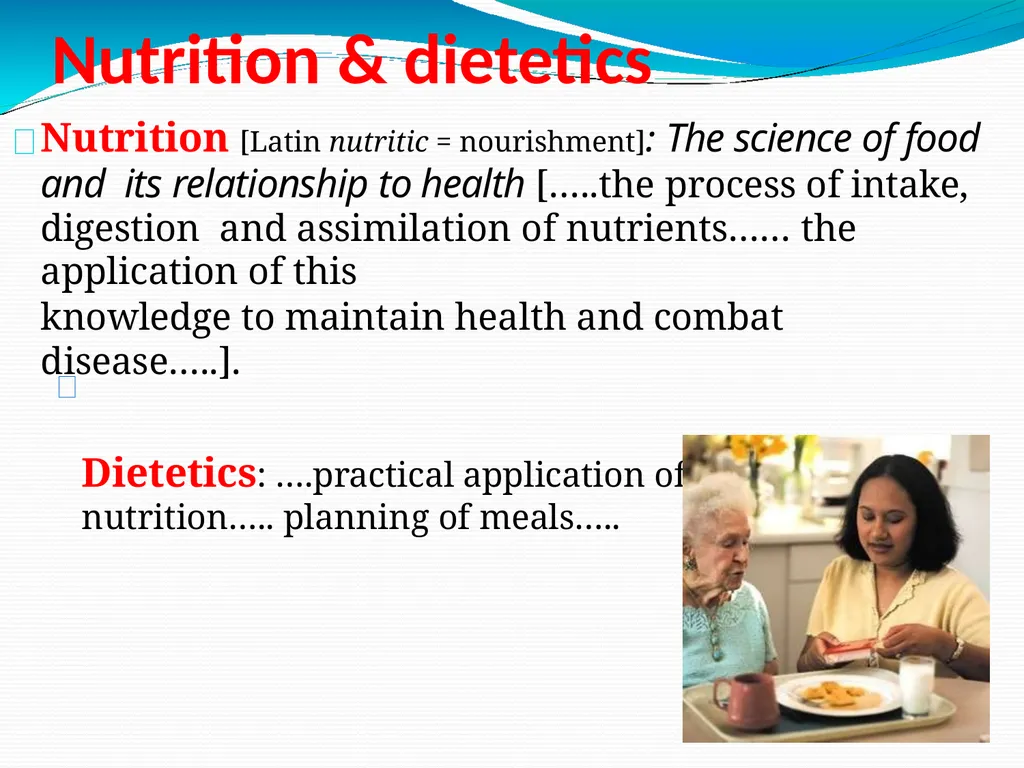
Nutrition & dietetics Nutrition [Latin nutritic = nourishment]: The science of food and its relationship to health […..the process of intake, digestion and assimilation of nutrients…… the application of this
knowledge to maintain health and combat disease…..].
Dietetics: ….practical application of principles of
nutrition….. planning of meals…..<br>
knowledge to maintain health and combat disease…..].
Dietetics: ….practical application of principles of
nutrition….. planning of meals…..<br>
03
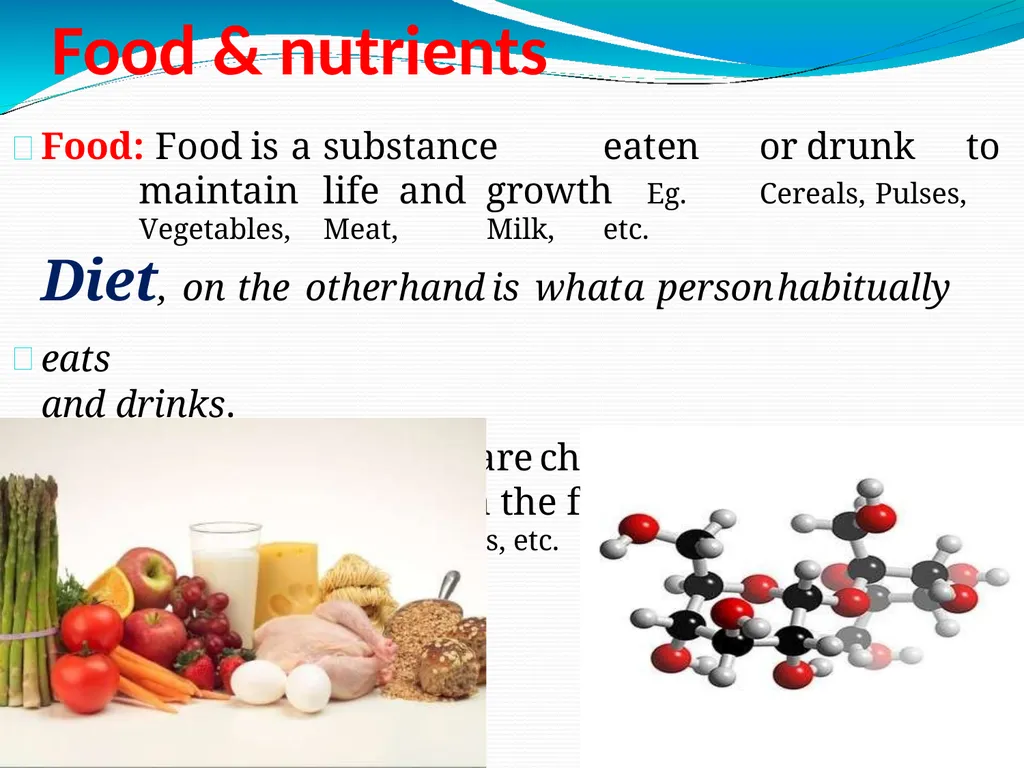
Food & nutrients Food: Food is a substance eaten or drunk to maintain life and growth Eg. Cereals, Pulses, Vegetables, Meat, Milk, etc.
Diet, on the other hand is what a person habitually eats
and drinks.
Nutrients: The nutrients are chemical substances that are present in the food we eat. Eg. Carbohydrates, Proteins, Vitamins, etc.<br>
Diet, on the other hand is what a person habitually eats
and drinks.
Nutrients: The nutrients are chemical substances that are present in the food we eat. Eg. Carbohydrates, Proteins, Vitamins, etc.<br>
04
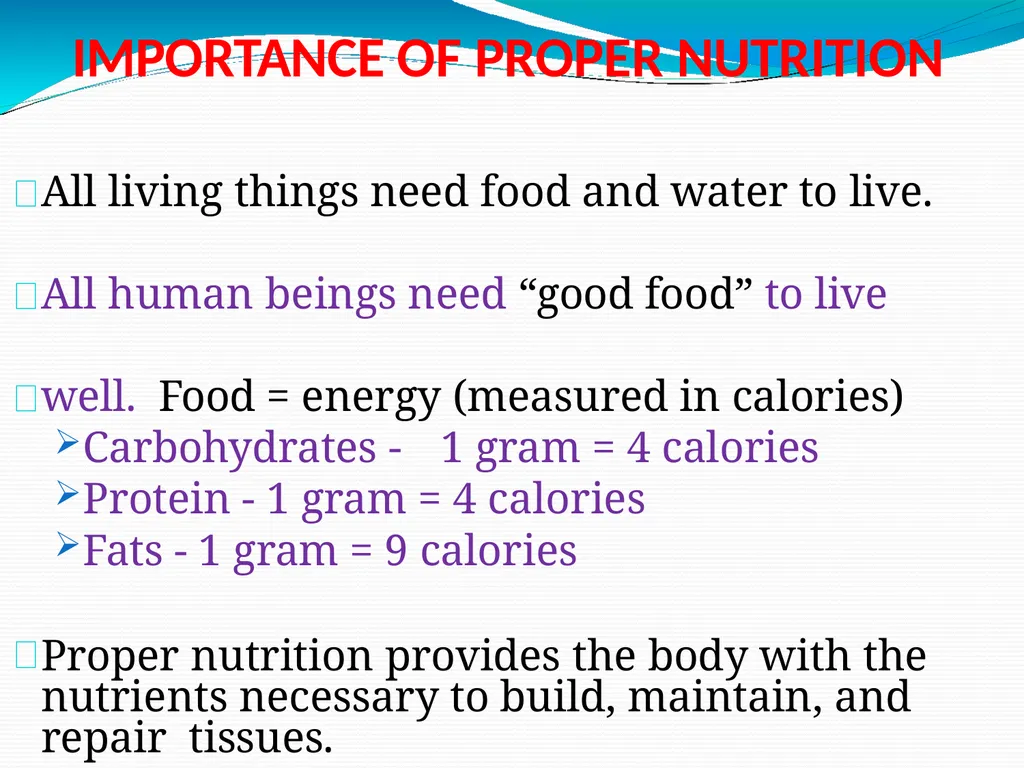
IMPORTANCE OF PROPER NUTRITION All living things need food and water to live.
All human beings need “good food” to live well. Food = energy (measured in calories)
Carbohydrates - 1 gram = 4 calories
Protein - 1 gram = 4 calories
Fats - 1 gram = 9 calories
Proper nutrition provides the body with the nutrients necessary to build, maintain, and repair tissues.<br>
All human beings need “good food” to live well. Food = energy (measured in calories)
Carbohydrates - 1 gram = 4 calories
Protein - 1 gram = 4 calories
Fats - 1 gram = 9 calories
Proper nutrition provides the body with the nutrients necessary to build, maintain, and repair tissues.<br>
05
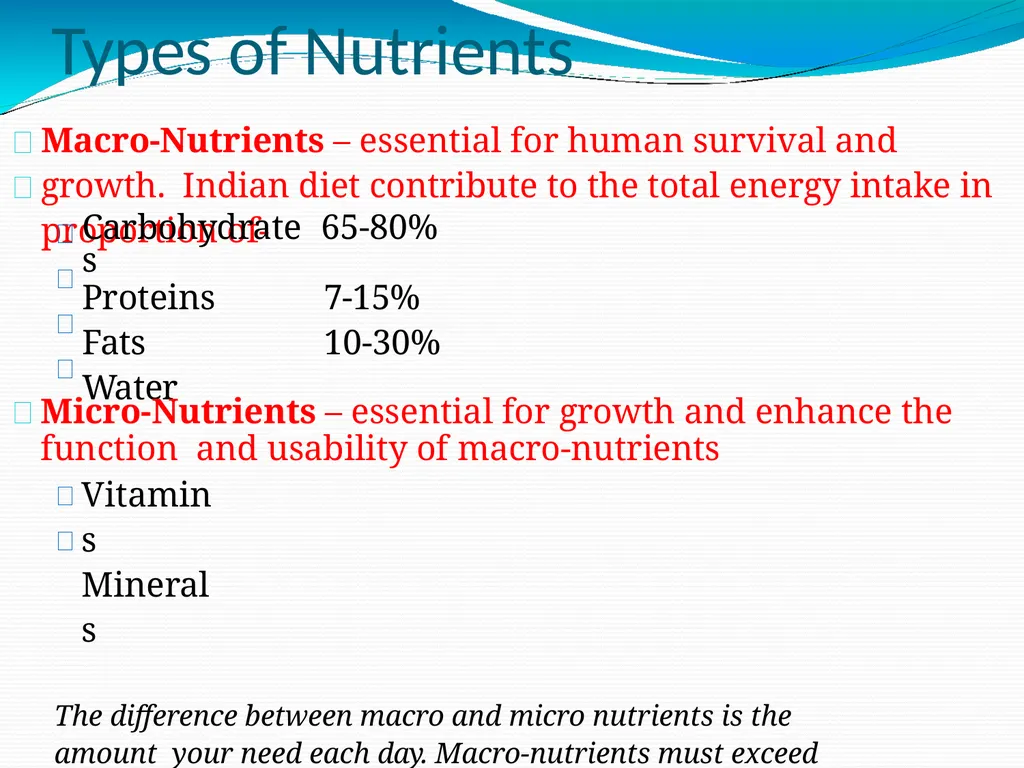
Types of Nutrients Macro-Nutrients – essential for human survival and growth. Indian diet contribute to the total energy intake in proportion of- Micro-Nutrients – essential for growth and enhance the function and usability of macro-nutrients
Vitamins Minerals
The difference between macro and micro nutrients is the amount your need each day. Macro-nutrients must exceed one gram per day.<br>
Vitamins Minerals
The difference between macro and micro nutrients is the amount your need each day. Macro-nutrients must exceed one gram per day.<br>
06
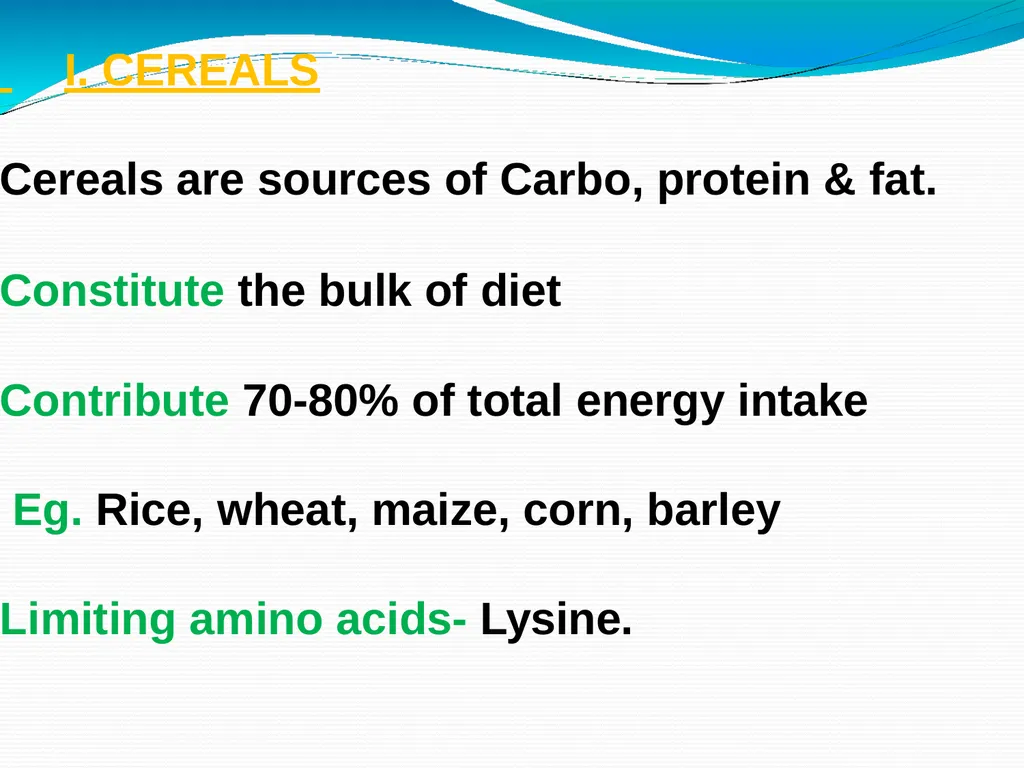
I. CEREALS Cereals are sources of Carbo, protein & fat.
Constitute the bulk of diet
Contribute 70-80% of total energy intake Eg. Rice, wheat, maize, corn, barley Limiting amino acids- Lysine.<br>
Constitute the bulk of diet
Contribute 70-80% of total energy intake Eg. Rice, wheat, maize, corn, barley Limiting amino acids- Lysine.<br>
07
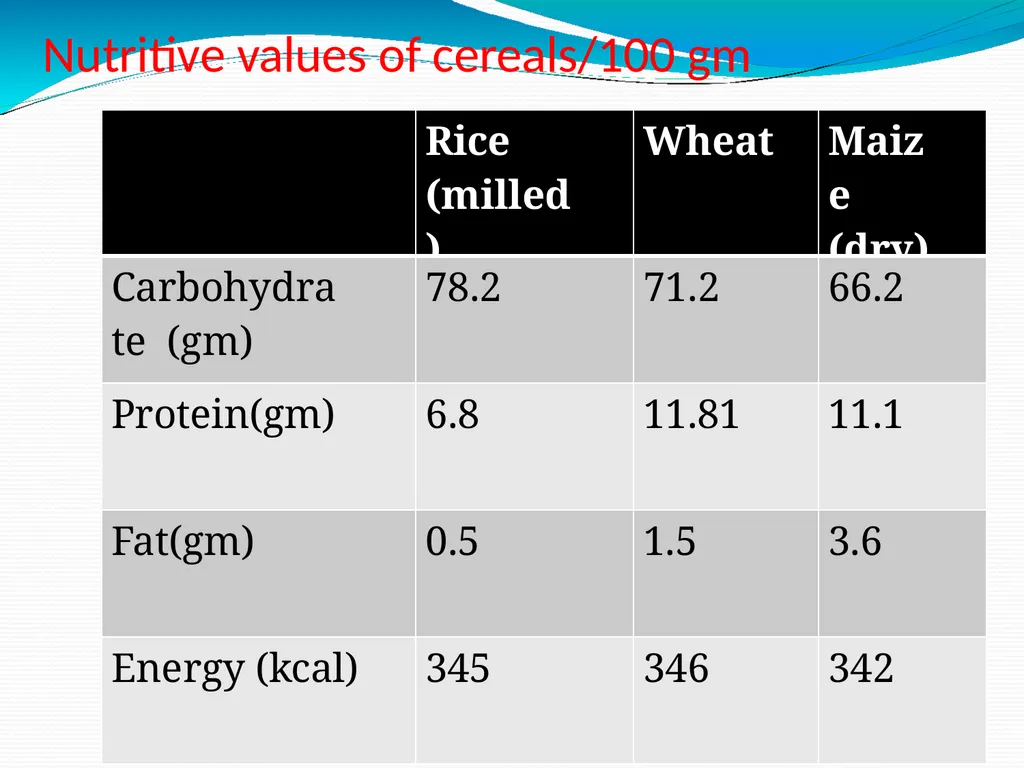
Nutritive values of cereals/100 gm<br>
08
1. RICE:-Rice is a type of cereal and is staple food for South India.
NUTRITIVE VALUE ( PER 100 g) Carbohydrates Fat
Proteins
B-complex Minerals Energy DEFICIENT : 80gms.
: 0.5 gm
: 6-7gms, rich in lysine.
: Thiamine – 0.06 mg
:Niacin - 1.9 mg
:Riboflavin – 0.06 mg
: 0.6gms
: 345kcal
: Vitamins A , D & C PUBLIC HEALTH IMPORTANCE : Super ORS
Milling process & washing in large quantities of water, discarding the water used for cooking deprives nutrients especially B-complex .<br>
NUTRITIVE VALUE ( PER 100 g) Carbohydrates Fat
Proteins
B-complex Minerals Energy DEFICIENT : 80gms.
: 0.5 gm
: 6-7gms, rich in lysine.
: Thiamine – 0.06 mg
:Niacin - 1.9 mg
:Riboflavin – 0.06 mg
: 0.6gms
: 345kcal
: Vitamins A , D & C PUBLIC HEALTH IMPORTANCE : Super ORS
Milling process & washing in large quantities of water, discarding the water used for cooking deprives nutrients especially B-complex .<br>
09
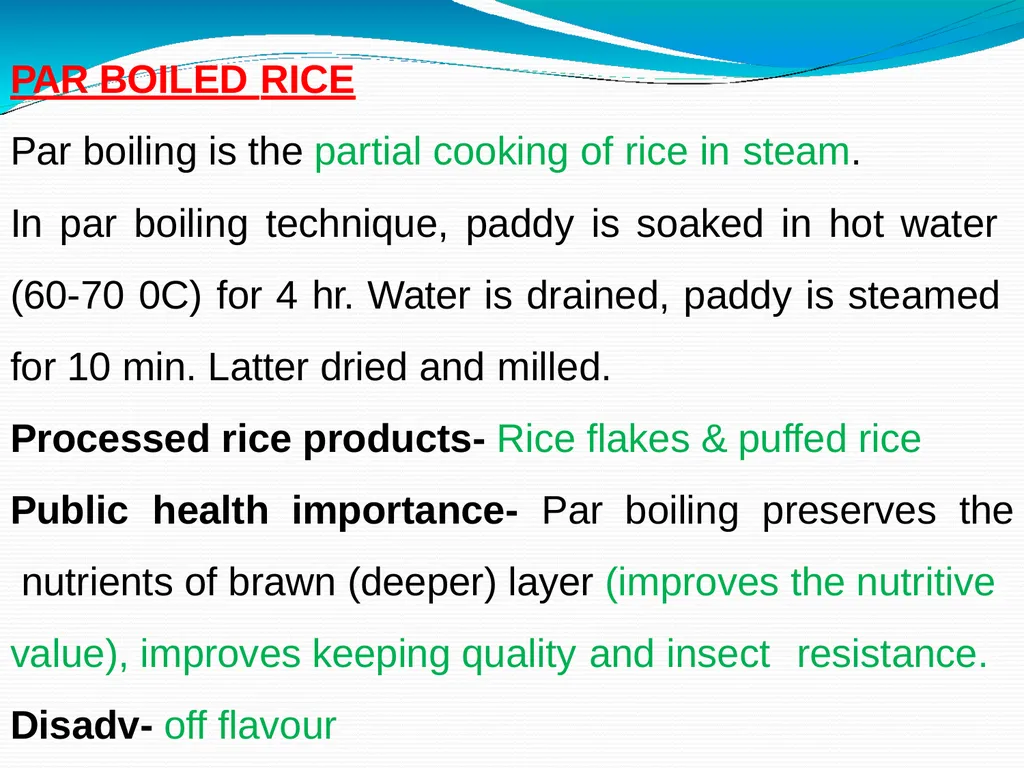
PAR BOILED RICE
Par boiling is the partial cooking of rice in steam.
In par boiling technique, paddy is soaked in hot water (60-70 0C) for 4 hr. Water is drained, paddy is steamed for 10 min. Latter dried and milled.
Processed rice products- Rice flakes & puffed rice Public health importance- Par boiling preserves the nutrients of brawn (deeper) layer (improves the nutritive value), improves keeping quality and insect resistance.
Disadv- off flavour<br>
Par boiling is the partial cooking of rice in steam.
In par boiling technique, paddy is soaked in hot water (60-70 0C) for 4 hr. Water is drained, paddy is steamed for 10 min. Latter dried and milled.
Processed rice products- Rice flakes & puffed rice Public health importance- Par boiling preserves the nutrients of brawn (deeper) layer (improves the nutritive value), improves keeping quality and insect resistance.
Disadv- off flavour<br>
10
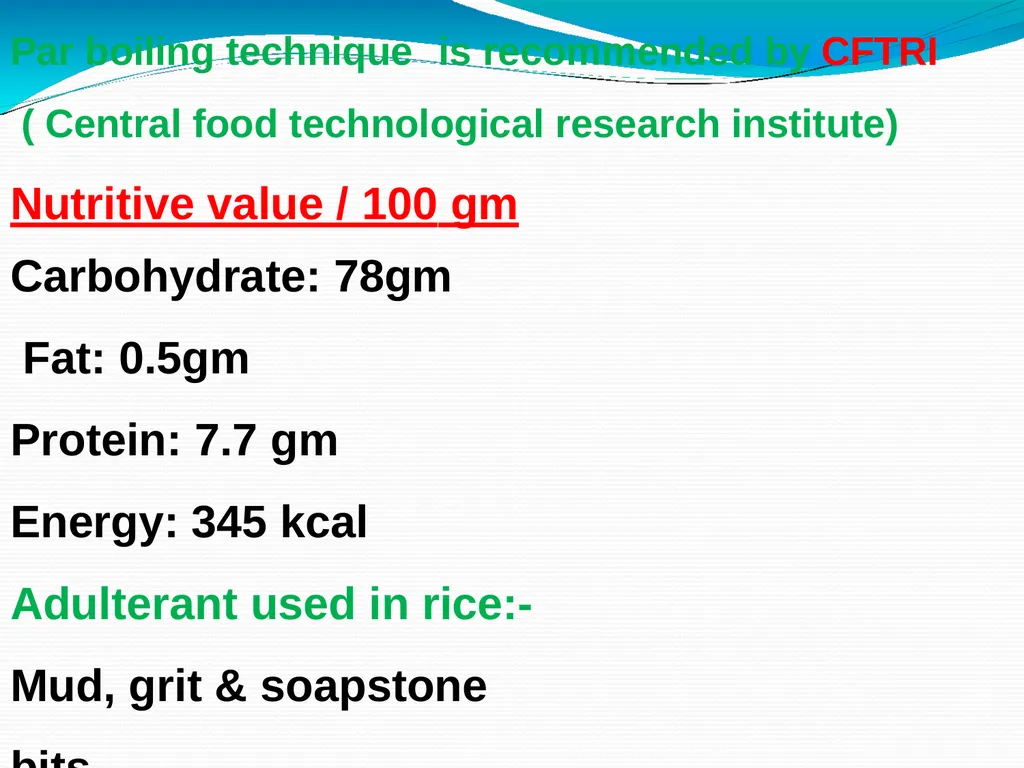
Par boiling technique is recommended by CFTRI ( Central food technological research institute) Nutritive value / 100 gm Carbohydrate: 78gm Fat: 0.5gm
Protein: 7.7 gm
Energy: 345 kcal Adulterant used in rice:- Mud, grit & soapstone bits<br>
Protein: 7.7 gm
Energy: 345 kcal Adulterant used in rice:- Mud, grit & soapstone bits<br>
11
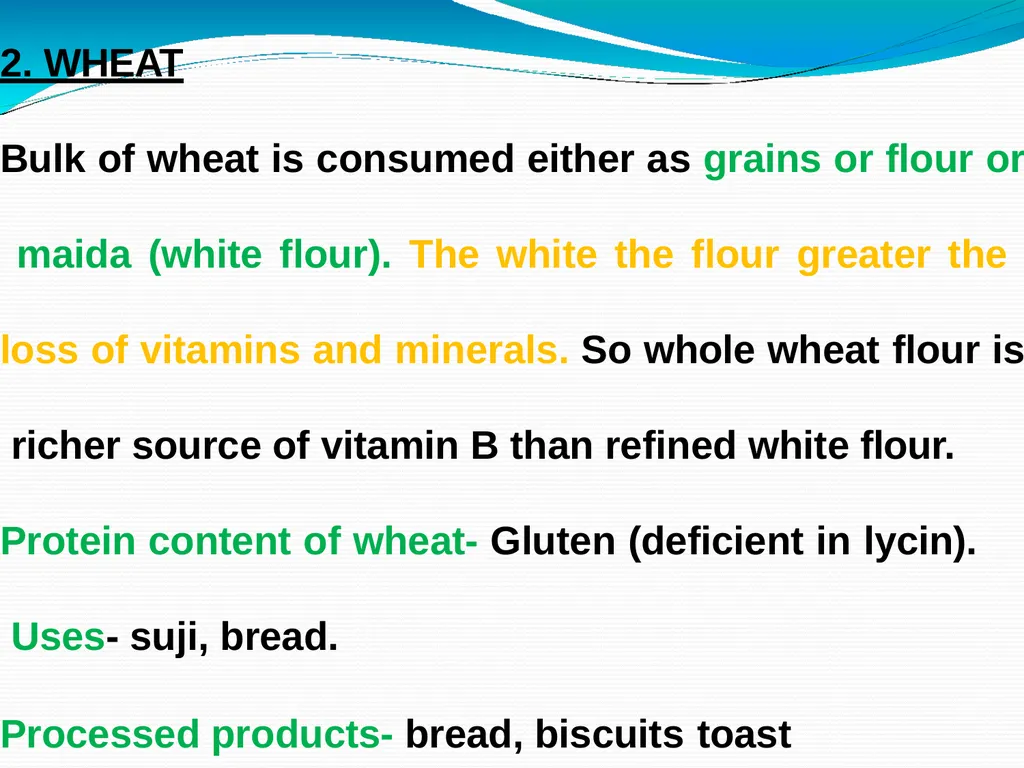
2. WHEAT
Bulk of wheat is consumed either as grains or flour or maida (white flour). The white the flour greater the loss of vitamins and minerals. So whole wheat flour is richer source of vitamin B than refined white flour.
Protein content of wheat- Gluten (deficient in lycin). Uses- suji, bread.
Processed products- bread, biscuits toast<br>
Bulk of wheat is consumed either as grains or flour or maida (white flour). The white the flour greater the loss of vitamins and minerals. So whole wheat flour is richer source of vitamin B than refined white flour.
Protein content of wheat- Gluten (deficient in lycin). Uses- suji, bread.
Processed products- bread, biscuits toast<br>
12
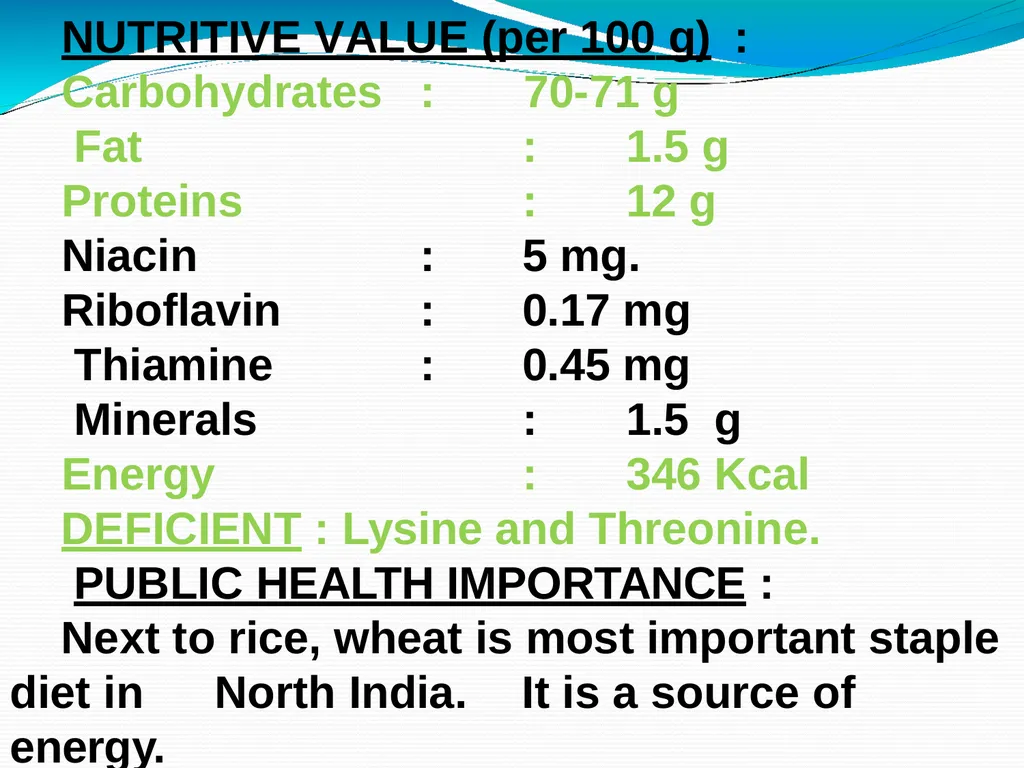
NUTRITIVE VALUE (per 100 g) : : 70-71 g : 1.5 g
: 12 g :
:
: 5 mg.
0.17 mg
0.45 mg Carbohydrates Fat
Proteins Niacin Riboflavin Thiamine Minerals Energy : 1.5 g
: 346 Kcal DEFICIENT : Lysine and Threonine. PUBLIC HEALTH IMPORTANCE :
Next to rice, wheat is most important staple diet in North India. It is a source of energy.<br>
: 12 g :
:
: 5 mg.
0.17 mg
0.45 mg Carbohydrates Fat
Proteins Niacin Riboflavin Thiamine Minerals Energy : 1.5 g
: 346 Kcal DEFICIENT : Lysine and Threonine. PUBLIC HEALTH IMPORTANCE :
Next to rice, wheat is most important staple diet in North India. It is a source of energy.<br>
13
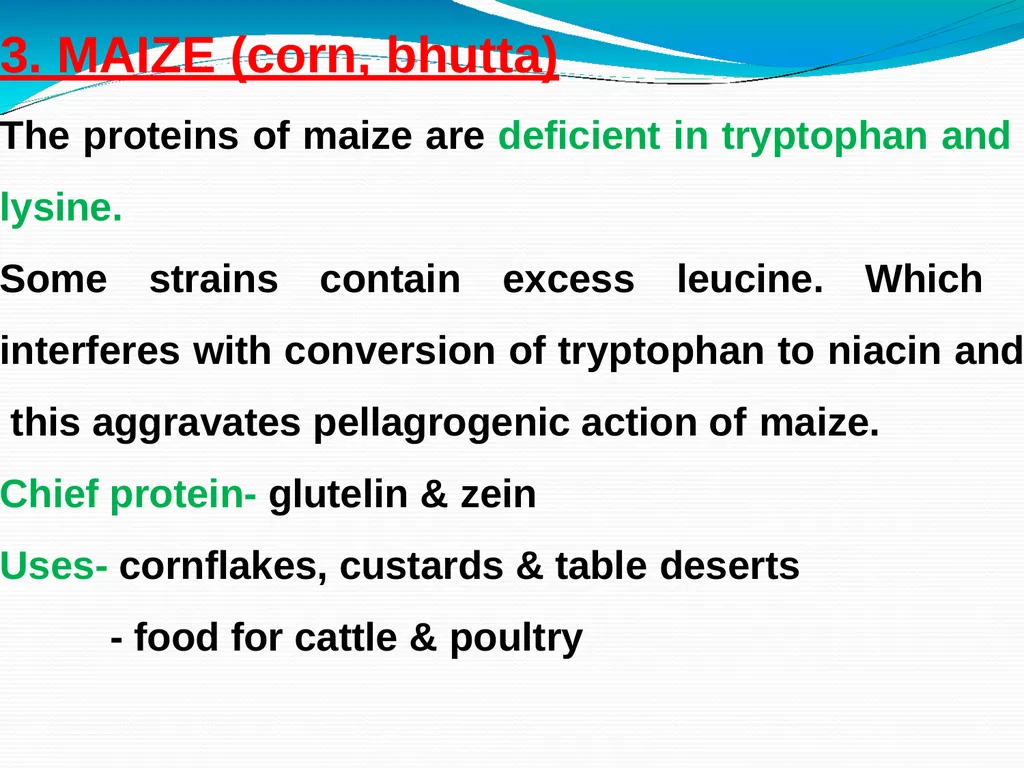
3. MAIZE (corn, bhutta) The proteins of maize are deficient in tryptophan and lysine.
Some strains contain excess leucine. Which interferes with conversion of tryptophan to niacin and this aggravates pellagrogenic action of maize.
Chief protein- glutelin & zein
Uses- cornflakes, custards & table deserts
- food for cattle & poultry<br>
Some strains contain excess leucine. Which interferes with conversion of tryptophan to niacin and this aggravates pellagrogenic action of maize.
Chief protein- glutelin & zein
Uses- cornflakes, custards & table deserts
- food for cattle & poultry<br>
14
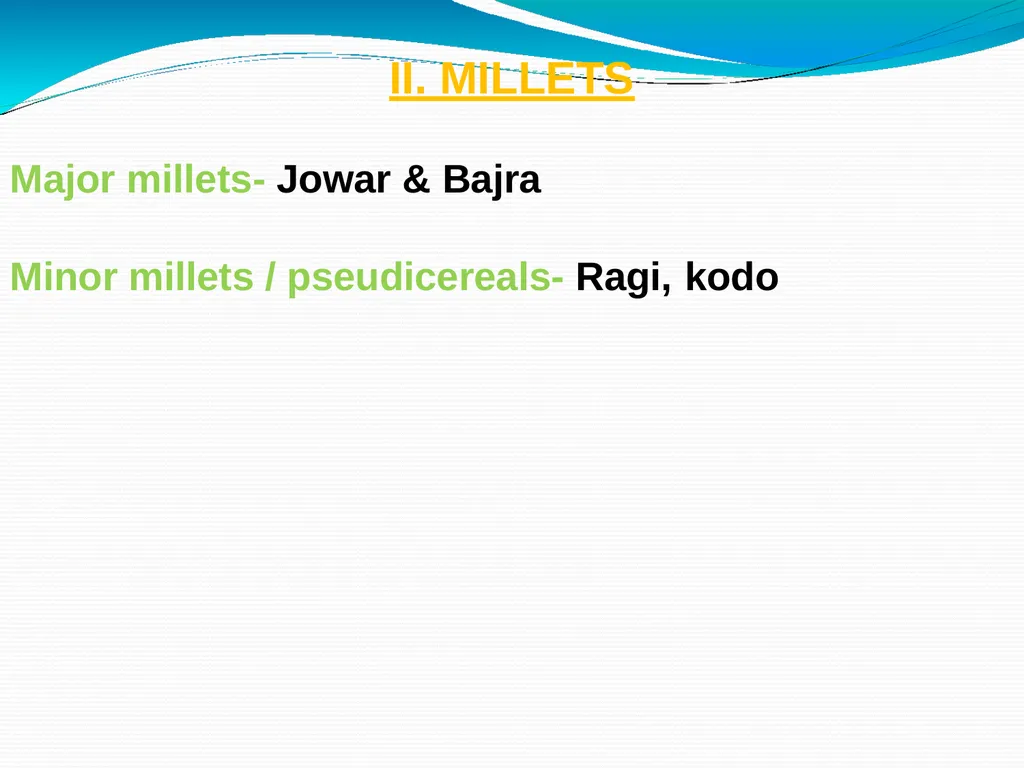
II. MILLETS Major millets- Jowar & Bajra
Minor millets / pseudicereals- Ragi, kodo<br>
Minor millets / pseudicereals- Ragi, kodo<br>
15
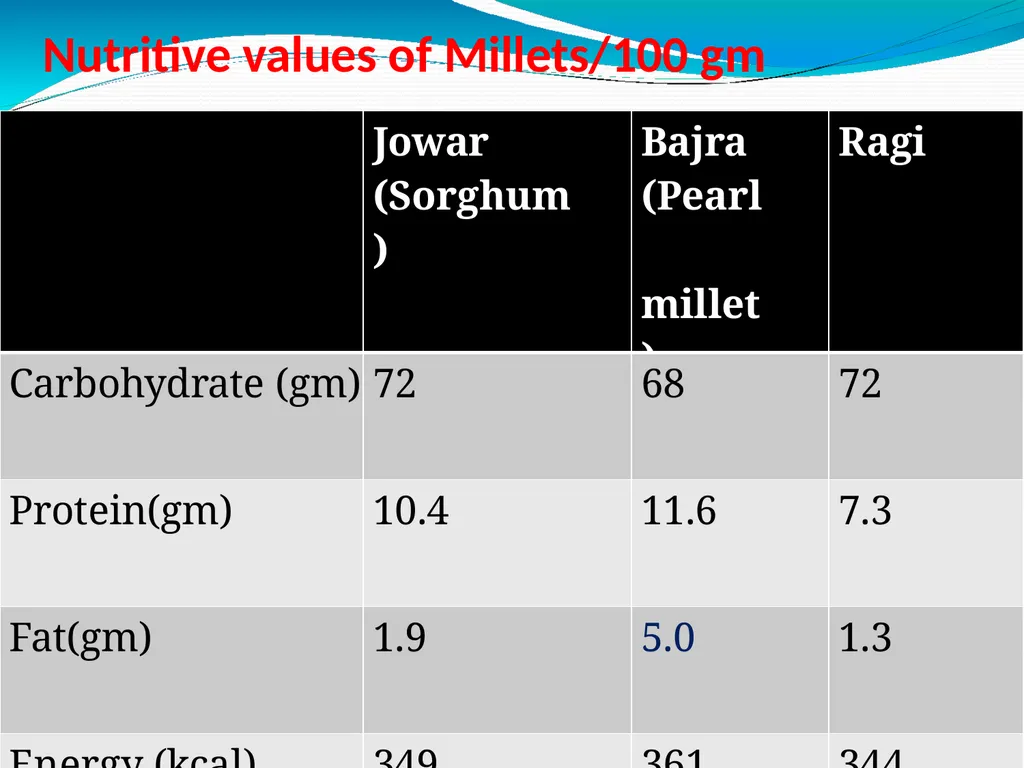
Nutritive values of Millets/100 gm<br>
16
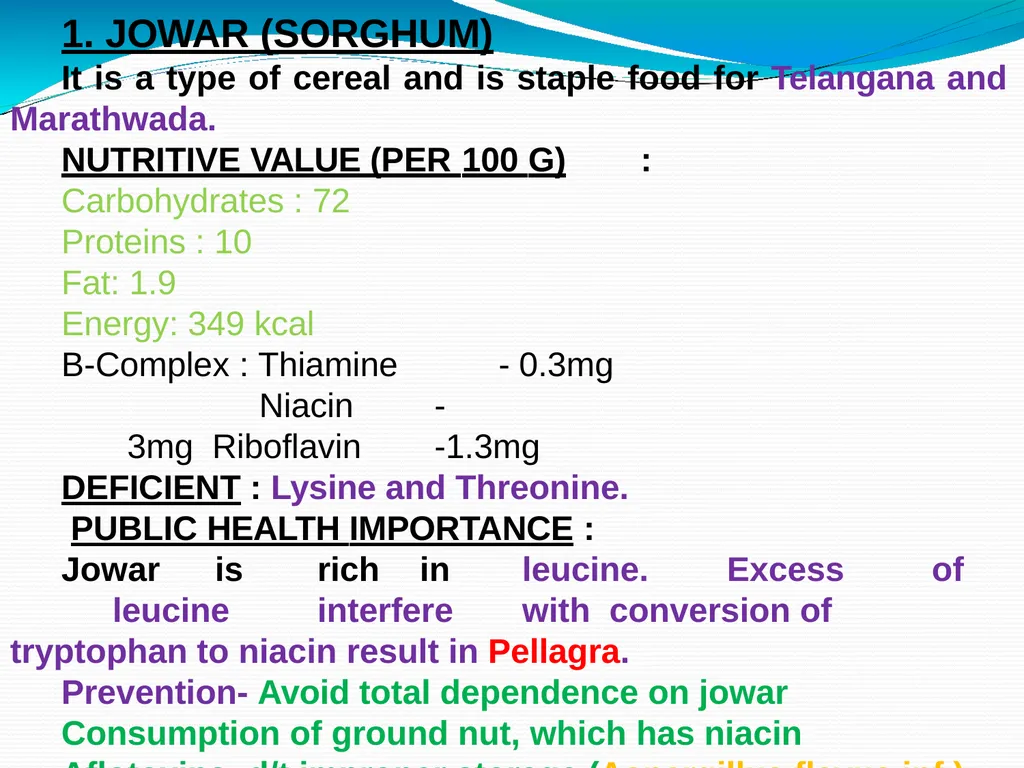
1. JOWAR (SORGHUM) It is a type of cereal and is staple food for Telangana and
Marathwada.
NUTRITIVE VALUE (PER 100 G) :
Carbohydrates : 72
Proteins : 10
Fat: 1.9
Energy: 349 kcal
B-Complex : Thiamine - 0.3mg
Niacin - 3mg Riboflavin -1.3mg
DEFICIENT : Lysine and Threonine. PUBLIC HEALTH IMPORTANCE :
Jowar is rich in leucine. Excess of leucine interfere with conversion of tryptophan to niacin result in Pellagra.
Prevention- Avoid total dependence on jowar Consumption of ground nut, which has niacin Aflotoxins- d/t improper storage (Aspergillus flavus inf.)<br>
Marathwada.
NUTRITIVE VALUE (PER 100 G) :
Carbohydrates : 72
Proteins : 10
Fat: 1.9
Energy: 349 kcal
B-Complex : Thiamine - 0.3mg
Niacin - 3mg Riboflavin -1.3mg
DEFICIENT : Lysine and Threonine. PUBLIC HEALTH IMPORTANCE :
Jowar is rich in leucine. Excess of leucine interfere with conversion of tryptophan to niacin result in Pellagra.
Prevention- Avoid total dependence on jowar Consumption of ground nut, which has niacin Aflotoxins- d/t improper storage (Aspergillus flavus inf.)<br>
17
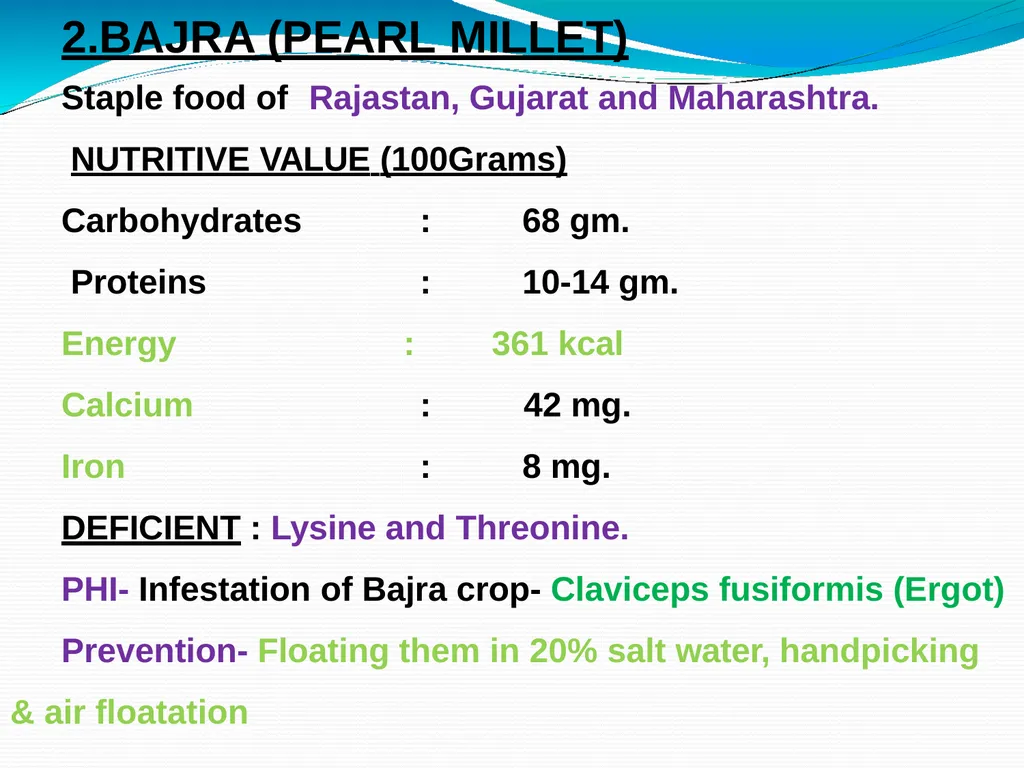
2.BAJRA (PEARL MILLET) Staple food of Rajastan, Gujarat and Maharashtra. NUTRITIVE VALUE (100Grams) :
: : Carbohydrates Proteins Energy Calcium
Iron :
: 68 gm.
10-14 gm.
361 kcal
42 mg.
8 mg. DEFICIENT : Lysine and Threonine.
PHI- Infestation of Bajra crop- Claviceps fusiformis (Ergot)
Prevention- Floating them in 20% salt water, handpicking & air floatation<br>
: : Carbohydrates Proteins Energy Calcium
Iron :
: 68 gm.
10-14 gm.
361 kcal
42 mg.
8 mg. DEFICIENT : Lysine and Threonine.
PHI- Infestation of Bajra crop- Claviceps fusiformis (Ergot)
Prevention- Floating them in 20% salt water, handpicking & air floatation<br>
18
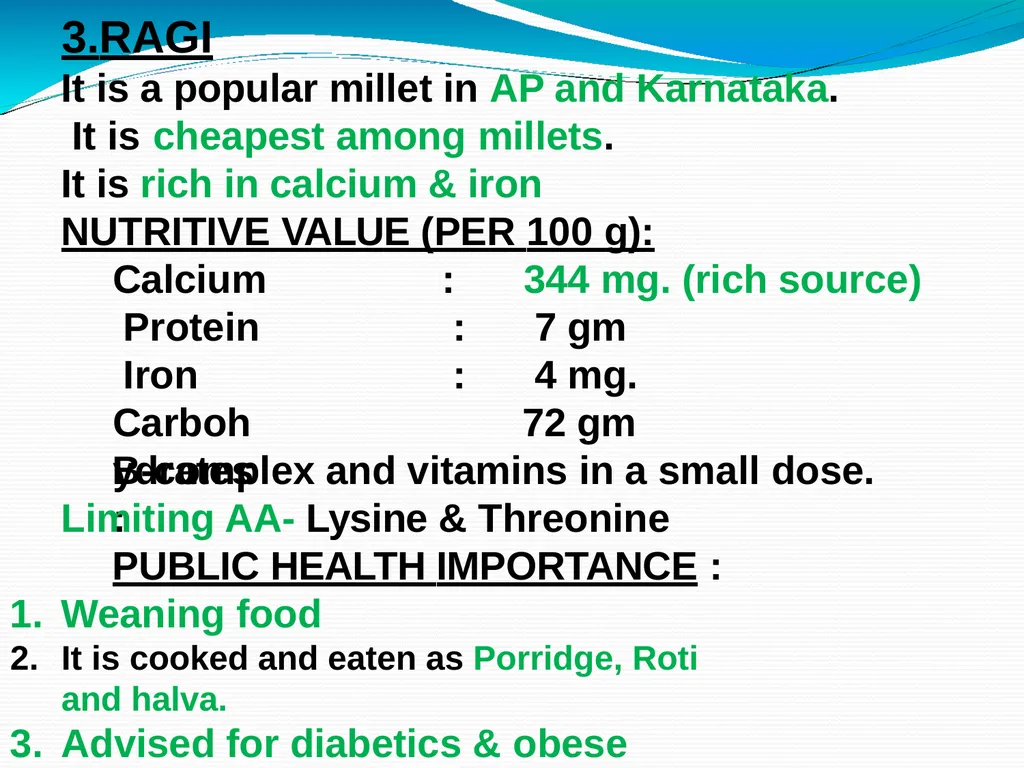
3.RAGI It is a popular millet in AP and Karnataka. It is cheapest among millets.
It is rich in calcium & iron NUTRITIVE VALUE (PER 100 g): Calcium Protein Iron
Carbohydrates : : 344 mg. (rich source)
: 7 gm
: 4 mg.
72 gm B-complex and vitamins in a small dose.
Limiting AA- Lysine & Threonine PUBLIC HEALTH IMPORTANCE :
Weaning food
It is cooked and eaten as Porridge, Roti and halva.
Advised for diabetics & obese<br>
It is rich in calcium & iron NUTRITIVE VALUE (PER 100 g): Calcium Protein Iron
Carbohydrates : : 344 mg. (rich source)
: 7 gm
: 4 mg.
72 gm B-complex and vitamins in a small dose.
Limiting AA- Lysine & Threonine PUBLIC HEALTH IMPORTANCE :
Weaning food
It is cooked and eaten as Porridge, Roti and halva.
Advised for diabetics & obese<br>
19
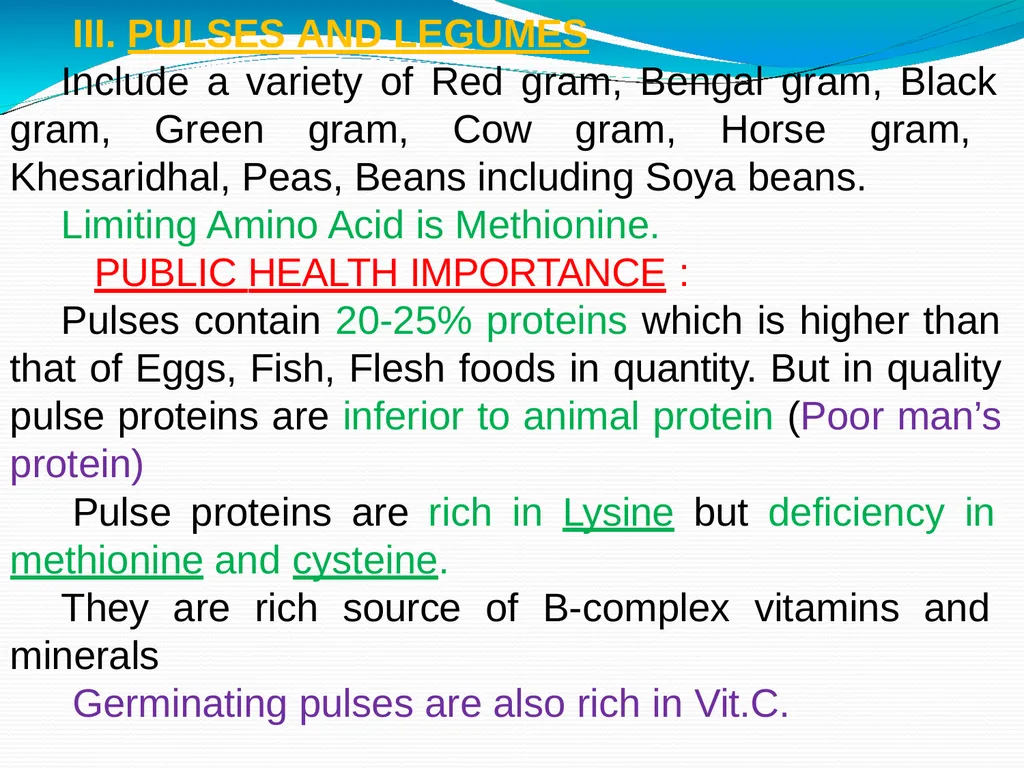
III. PULSES AND LEGUMES
Include a variety of Red gram, Bengal gram, Black gram, Green gram, Cow gram, Horse gram, Khesaridhal, Peas, Beans including Soya beans.
Limiting Amino Acid is Methionine.
PUBLIC HEALTH IMPORTANCE :
Pulses contain 20-25% proteins which is higher than that of Eggs, Fish, Flesh foods in quantity. But in quality pulse proteins are inferior to animal protein (Poor man’s protein)
Pulse proteins are rich in Lysine but deficiency in methionine and cysteine.
They are rich source of B-complex vitamins and minerals
Germinating pulses are also rich in Vit.C.<br>
Include a variety of Red gram, Bengal gram, Black gram, Green gram, Cow gram, Horse gram, Khesaridhal, Peas, Beans including Soya beans.
Limiting Amino Acid is Methionine.
PUBLIC HEALTH IMPORTANCE :
Pulses contain 20-25% proteins which is higher than that of Eggs, Fish, Flesh foods in quantity. But in quality pulse proteins are inferior to animal protein (Poor man’s protein)
Pulse proteins are rich in Lysine but deficiency in methionine and cysteine.
They are rich source of B-complex vitamins and minerals
Germinating pulses are also rich in Vit.C.<br>
20
1.SOYABEAN (“QUEEN” of all legumes) It is a type of pulse, high nutritive value.
NUTRITIVE VALUE (PER 100 G) :
Proteins : 40 gms Carbo- 20 gms
Energy- 432 kcal Fat Minerals : 20 gms
: 4 gms Calcium : 240 mg
Iron : 10.4 mg DEFICIENT : Methionine.
PUBLIC HEALTH IMPORTANCE : PEM
It contains high proteins, Ca, Iron and Vitamins.
It can be consumed as Dhal (or) mixing its powder with wheat flour. It can also be consumed in the form of soyabean milk, curd, baby foods.
Source of linolenic & linoleic acid<br>
NUTRITIVE VALUE (PER 100 G) :
Proteins : 40 gms Carbo- 20 gms
Energy- 432 kcal Fat Minerals : 20 gms
: 4 gms Calcium : 240 mg
Iron : 10.4 mg DEFICIENT : Methionine.
PUBLIC HEALTH IMPORTANCE : PEM
It contains high proteins, Ca, Iron and Vitamins.
It can be consumed as Dhal (or) mixing its powder with wheat flour. It can also be consumed in the form of soyabean milk, curd, baby foods.
Source of linolenic & linoleic acid<br>
21
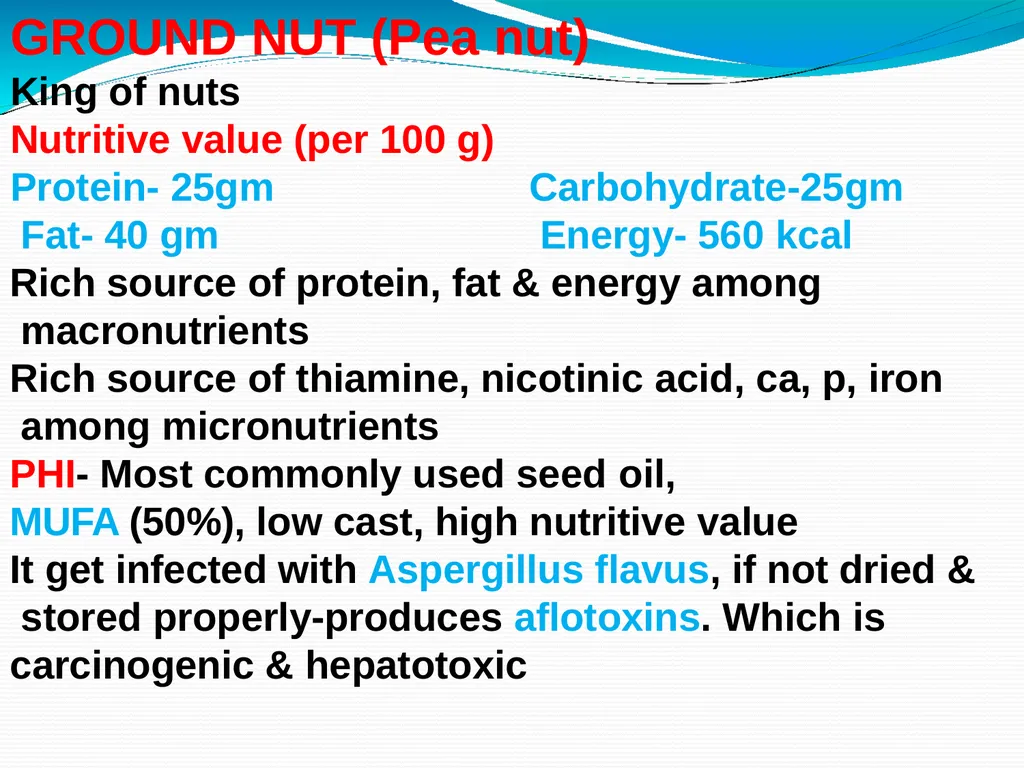
GROUND NUT (Pea nut) King of nuts
Nutritive value (per 100 g) Protein- 25gm Fat- 40 gm Carbohydrate-25gm Energy- 560 kcal Rich source of protein, fat & energy among macronutrients
Rich source of thiamine, nicotinic acid, ca, p, iron among micronutrients
PHI- Most commonly used seed oil,
MUFA (50%), low cast, high nutritive value
It get infected with Aspergillus flavus, if not dried & stored properly-produces aflotoxins. Which is carcinogenic & hepatotoxic<br>
Nutritive value (per 100 g) Protein- 25gm Fat- 40 gm Carbohydrate-25gm Energy- 560 kcal Rich source of protein, fat & energy among macronutrients
Rich source of thiamine, nicotinic acid, ca, p, iron among micronutrients
PHI- Most commonly used seed oil,
MUFA (50%), low cast, high nutritive value
It get infected with Aspergillus flavus, if not dried & stored properly-produces aflotoxins. Which is carcinogenic & hepatotoxic<br>
22
LOBIA / Black eyed peas : (Nutritive value / 100 gm) Carbohydrate-54.5 gm
Protein-24.1gm Fat-1gm
Energy-323 kcal Calcium-77 mg
Iron-8.6 mg
PHI- Lobia are cooked as dal in India and Pakistan. They help in toning of spleen and stomach plus high fibre content inside them helps in improving diabetes<br>
Protein-24.1gm Fat-1gm
Energy-323 kcal Calcium-77 mg
Iron-8.6 mg
PHI- Lobia are cooked as dal in India and Pakistan. They help in toning of spleen and stomach plus high fibre content inside them helps in improving diabetes<br>
23
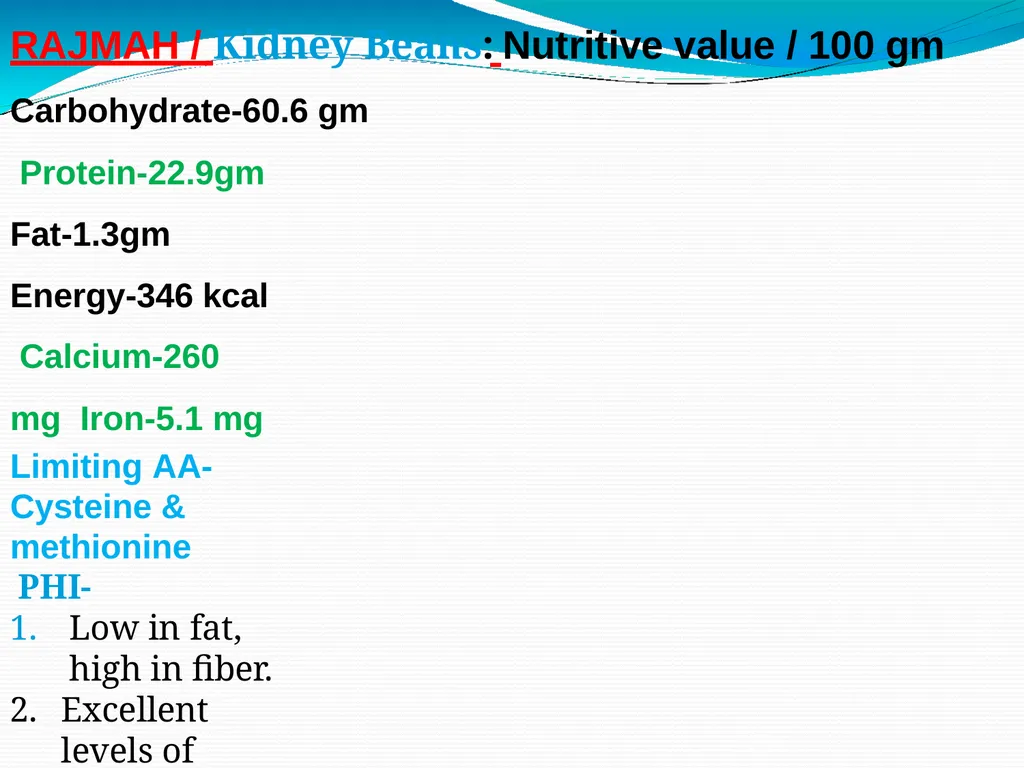
RAJMAH / Kidney Beans: Nutritive value / 100 gm Carbohydrate-60.6 gm Protein-22.9gm
Fat-1.3gm Energy-346 kcal Calcium-260 mg Iron-5.1 mg
Limiting AA- Cysteine & methionine
PHI-
Low in fat, high in fiber.
Excellent levels of Vitamin C.
Rich in protein.
Cholesterol free.
Rich in omega-3 and omega-6 fatty acids.
Rich in the antioxidants like lutein, zeaxanthin and beta caroten<br>
Fat-1.3gm Energy-346 kcal Calcium-260 mg Iron-5.1 mg
Limiting AA- Cysteine & methionine
PHI-
Low in fat, high in fiber.
Excellent levels of Vitamin C.
Rich in protein.
Cholesterol free.
Rich in omega-3 and omega-6 fatty acids.
Rich in the antioxidants like lutein, zeaxanthin and beta caroten<br>
24
2. Bengal Gram (Chana) It is type of pulse.
Nutritive value (per 100 g) : 17.1gm. Proteins : Fats Calcium Iron : 5.3 gm.
: 202 mg.
: 4.6 mg. Little amount of B-complex and Vit.C.
PHI- Nutritive value can be increased by germination & fermentation.<br>
Nutritive value (per 100 g) : 17.1gm. Proteins : Fats Calcium Iron : 5.3 gm.
: 202 mg.
: 4.6 mg. Little amount of B-complex and Vit.C.
PHI- Nutritive value can be increased by germination & fermentation.<br>
25
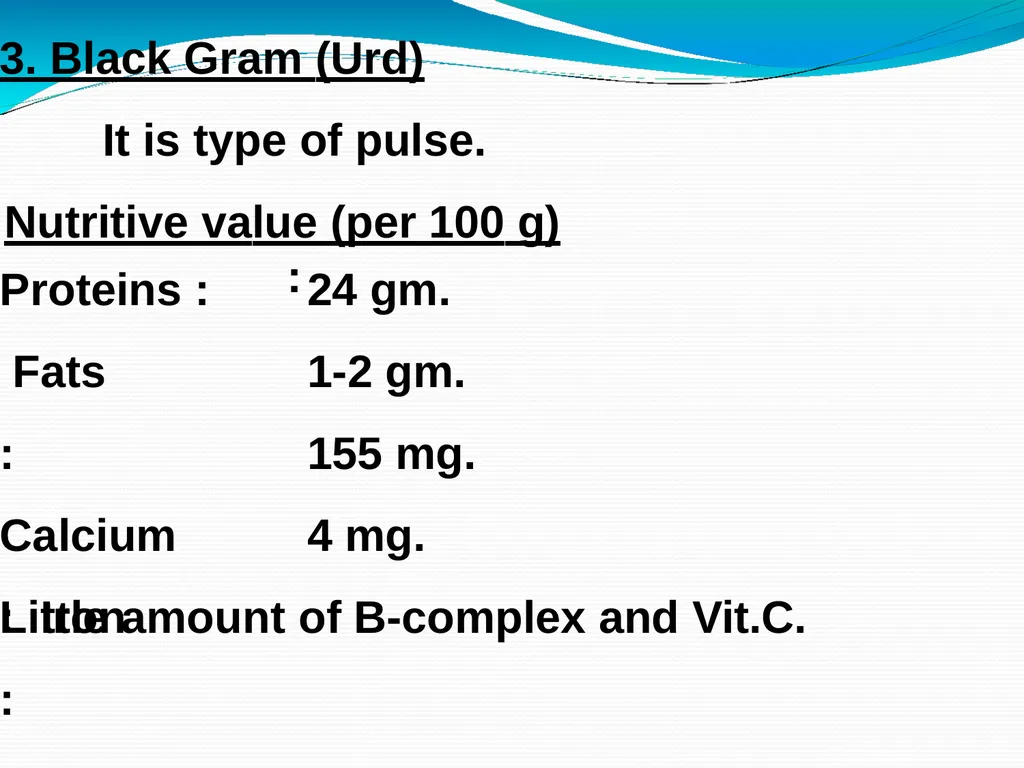
3. Black Gram (Urd)
It is type of pulse.
Nutritive value (per 100 g) : Proteins : Fats :
Calcium : Iron : 24 gm.
1-2 gm.
155 mg.
4 mg. Little amount of B-complex and Vit.C.<br>
It is type of pulse.
Nutritive value (per 100 g) : Proteins : Fats :
Calcium : Iron : 24 gm.
1-2 gm.
155 mg.
4 mg. Little amount of B-complex and Vit.C.<br>
26
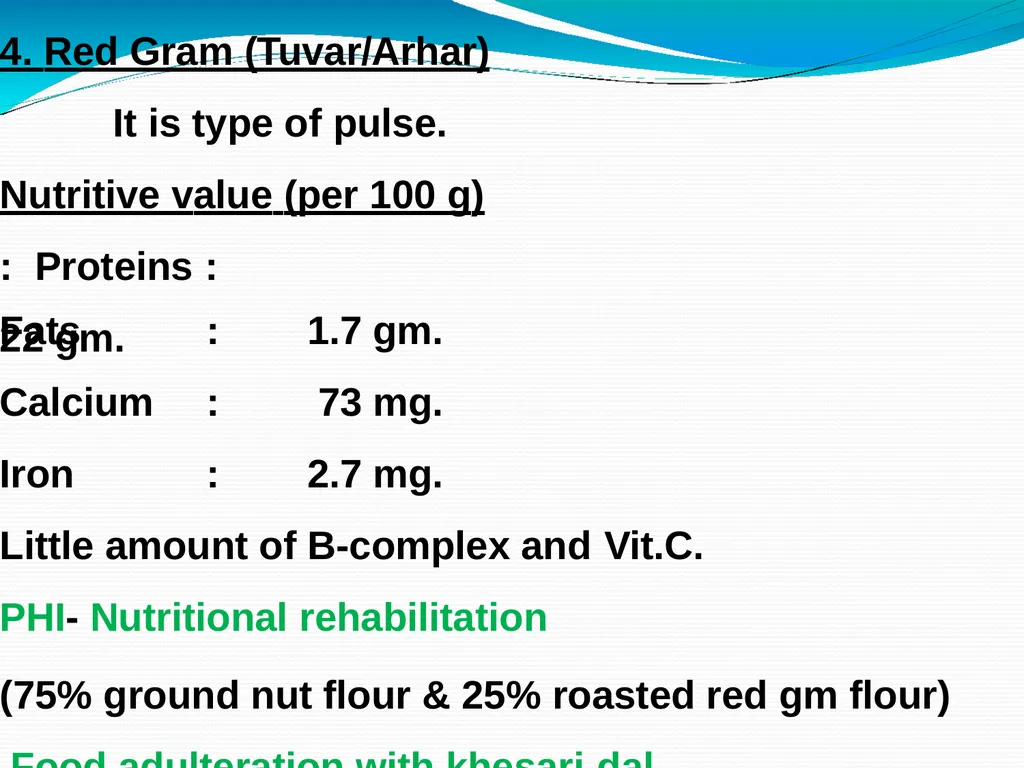
4. Red Gram (Tuvar/Arhar) It is type of pulse.
Nutritive value (per 100 g) : Proteins : 22 gm. Fats :
Calcium :
Iron : 1.7 gm. 73 mg.
2.7 mg. Little amount of B-complex and Vit.C.
PHI- Nutritional rehabilitation
(75% ground nut flour & 25% roasted red gm flour) Food adulteration with khesari dal<br>
Nutritive value (per 100 g) : Proteins : 22 gm. Fats :
Calcium :
Iron : 1.7 gm. 73 mg.
2.7 mg. Little amount of B-complex and Vit.C.
PHI- Nutritional rehabilitation
(75% ground nut flour & 25% roasted red gm flour) Food adulteration with khesari dal<br>
27
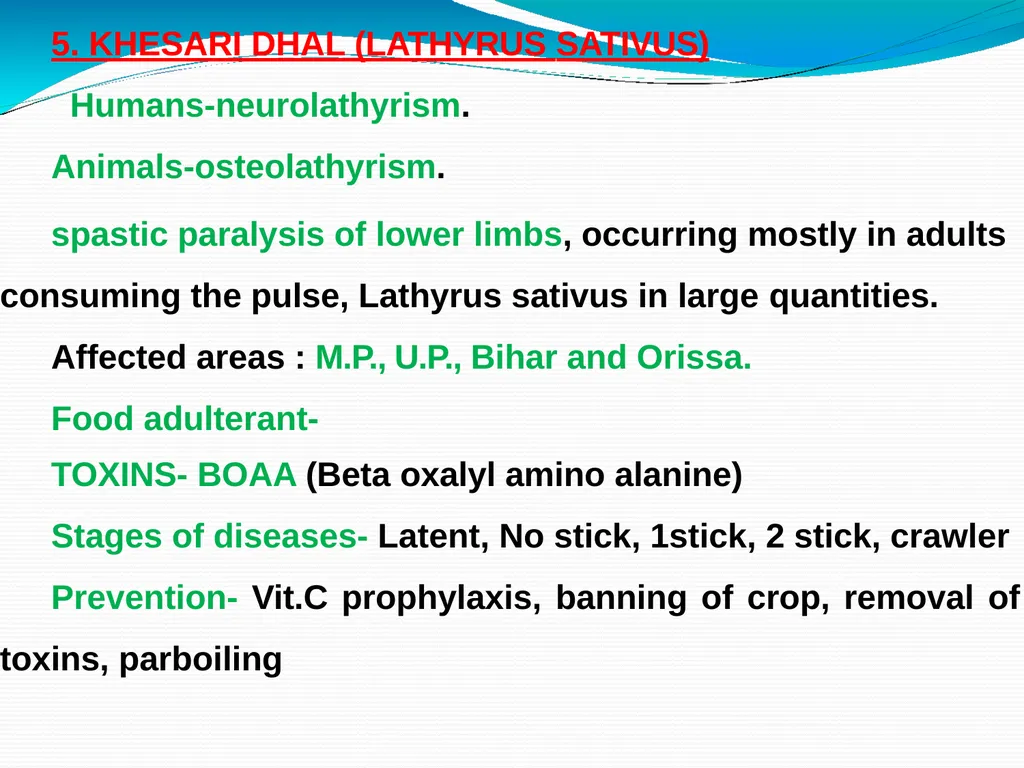
5. KHESARI DHAL (LATHYRUS SATIVUS)
Humans-neurolathyrism.
Animals-osteolathyrism.
spastic paralysis of lower limbs, occurring mostly in adults consuming the pulse, Lathyrus sativus in large quantities.
Affected areas : M.P., U.P., Bihar and Orissa. Food adulterant-
TOXINS- BOAA (Beta oxalyl amino alanine)
Stages of diseases- Latent, No stick, 1stick, 2 stick, crawler Prevention- Vit.C prophylaxis, banning of crop, removal of
toxins, parboiling<br>
Humans-neurolathyrism.
Animals-osteolathyrism.
spastic paralysis of lower limbs, occurring mostly in adults consuming the pulse, Lathyrus sativus in large quantities.
Affected areas : M.P., U.P., Bihar and Orissa. Food adulterant-
TOXINS- BOAA (Beta oxalyl amino alanine)
Stages of diseases- Latent, No stick, 1stick, 2 stick, crawler Prevention- Vit.C prophylaxis, banning of crop, removal of
toxins, parboiling<br>
28
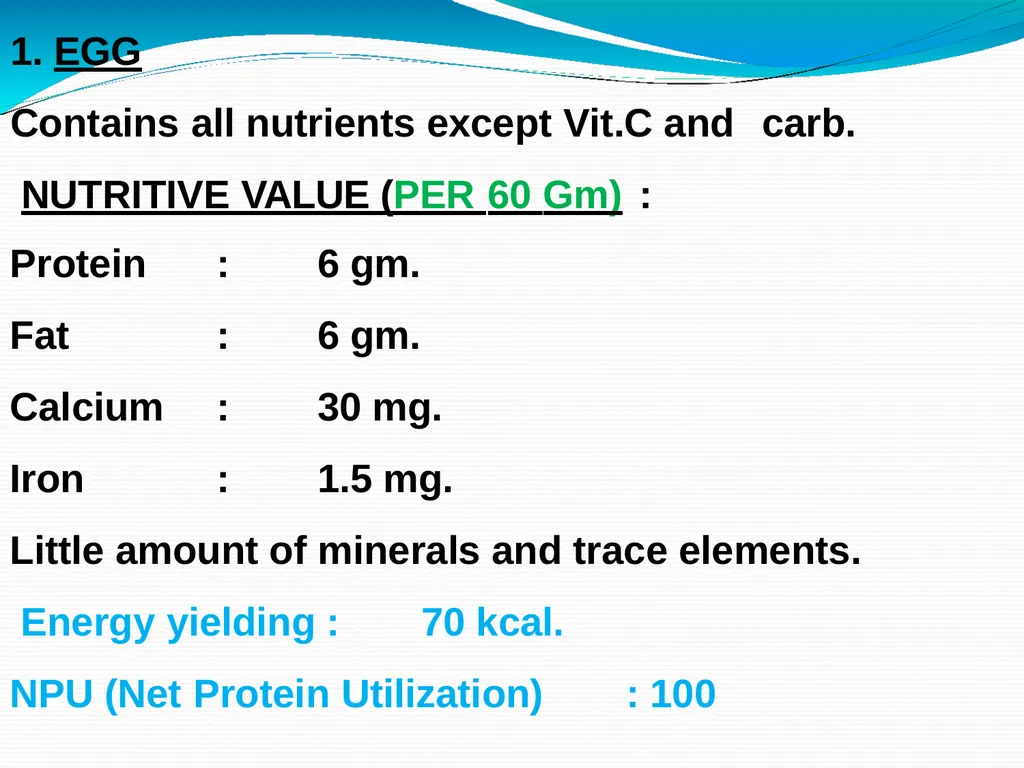
1. EGG
Contains all nutrients except Vit.C and carb. NUTRITIVE VALUE (PER 60 Gm) : Protein :
Fat :
Calcium :
Iron : 6 gm.
6 gm.
30 mg.
1.5 mg. Little amount of minerals and trace elements. Energy yielding : 70 kcal.
NPU (Net Protein Utilization) : 100<br>
Contains all nutrients except Vit.C and carb. NUTRITIVE VALUE (PER 60 Gm) : Protein :
Fat :
Calcium :
Iron : 6 gm.
6 gm.
30 mg.
1.5 mg. Little amount of minerals and trace elements. Energy yielding : 70 kcal.
NPU (Net Protein Utilization) : 100<br>
29
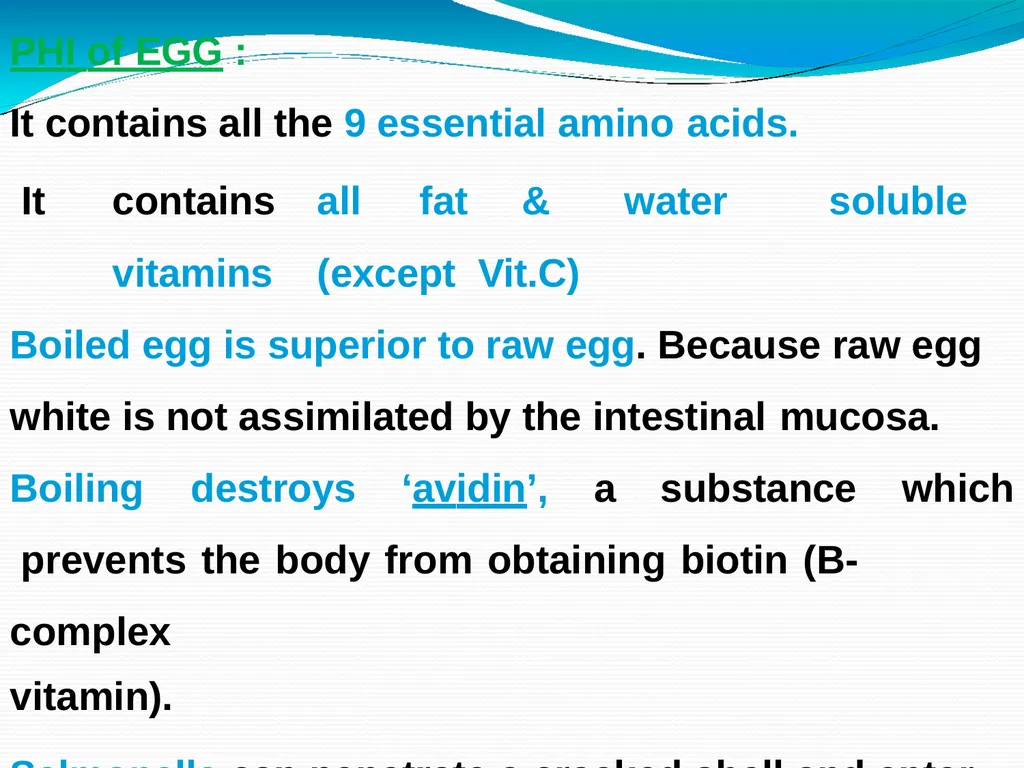
PHI of EGG :
It contains all the 9 essential amino acids.
It contains all fat & water soluble vitamins (except Vit.C)
Boiled egg is superior to raw egg. Because raw egg white is not assimilated by the intestinal mucosa.
Boiling destroys ‘avidin’, a substance which prevents the body from obtaining biotin (B-complex
vitamin).
Salmonella can penetrate a cracked shell and enter the egg.<br>
It contains all the 9 essential amino acids.
It contains all fat & water soluble vitamins (except Vit.C)
Boiled egg is superior to raw egg. Because raw egg white is not assimilated by the intestinal mucosa.
Boiling destroys ‘avidin’, a substance which prevents the body from obtaining biotin (B-complex
vitamin).
Salmonella can penetrate a cracked shell and enter the egg.<br>
30
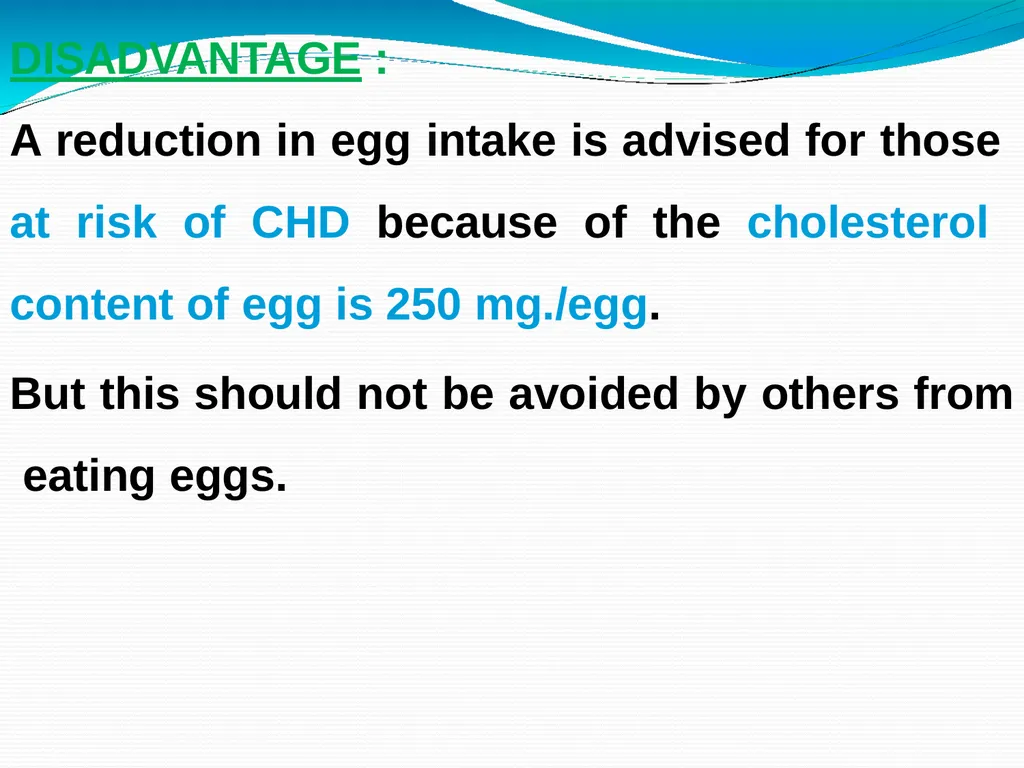
DISADVANTAGE :
A reduction in egg intake is advised for those at risk of CHD because of the cholesterol content of egg is 250 mg./egg.
But this should not be avoided by others from eating eggs.<br>
A reduction in egg intake is advised for those at risk of CHD because of the cholesterol content of egg is 250 mg./egg.
But this should not be avoided by others from eating eggs.<br>
31
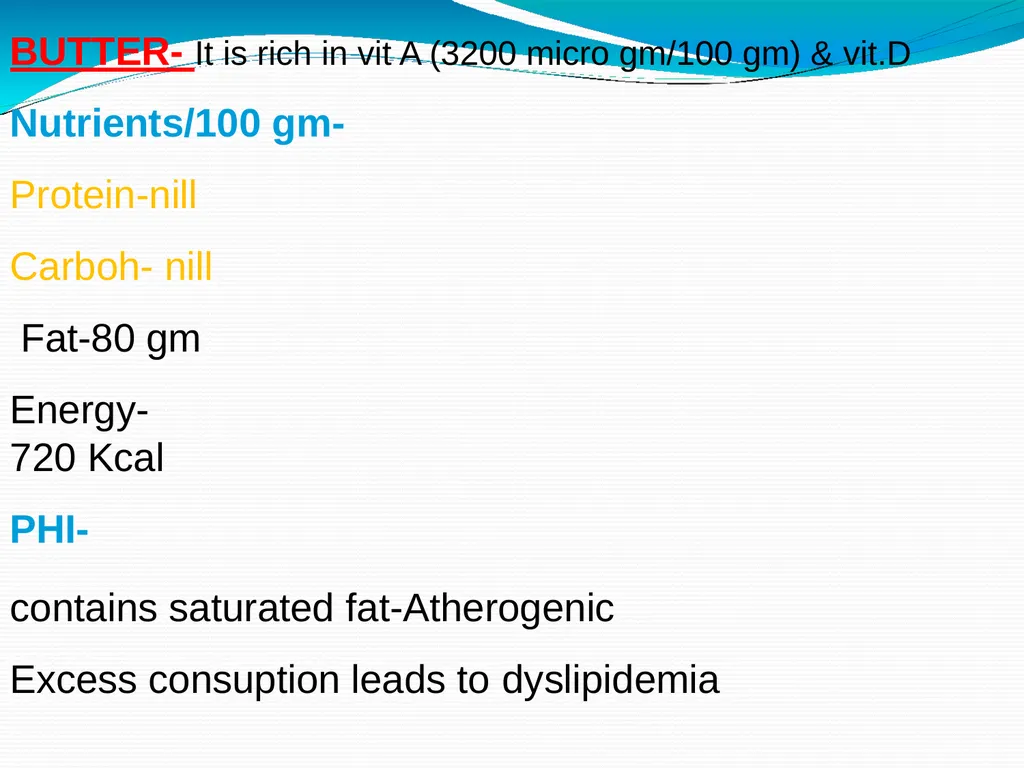
BUTTER- It is rich in vit A (3200 micro gm/100 gm) & vit.D
Nutrients/100 gm-
Protein-nill Carboh- nill Fat-80 gm
Energy-720 Kcal
PHI-
contains saturated fat-Atherogenic Excess consuption leads to dyslipidemia<br>
Nutrients/100 gm-
Protein-nill Carboh- nill Fat-80 gm
Energy-720 Kcal
PHI-
contains saturated fat-Atherogenic Excess consuption leads to dyslipidemia<br>
32
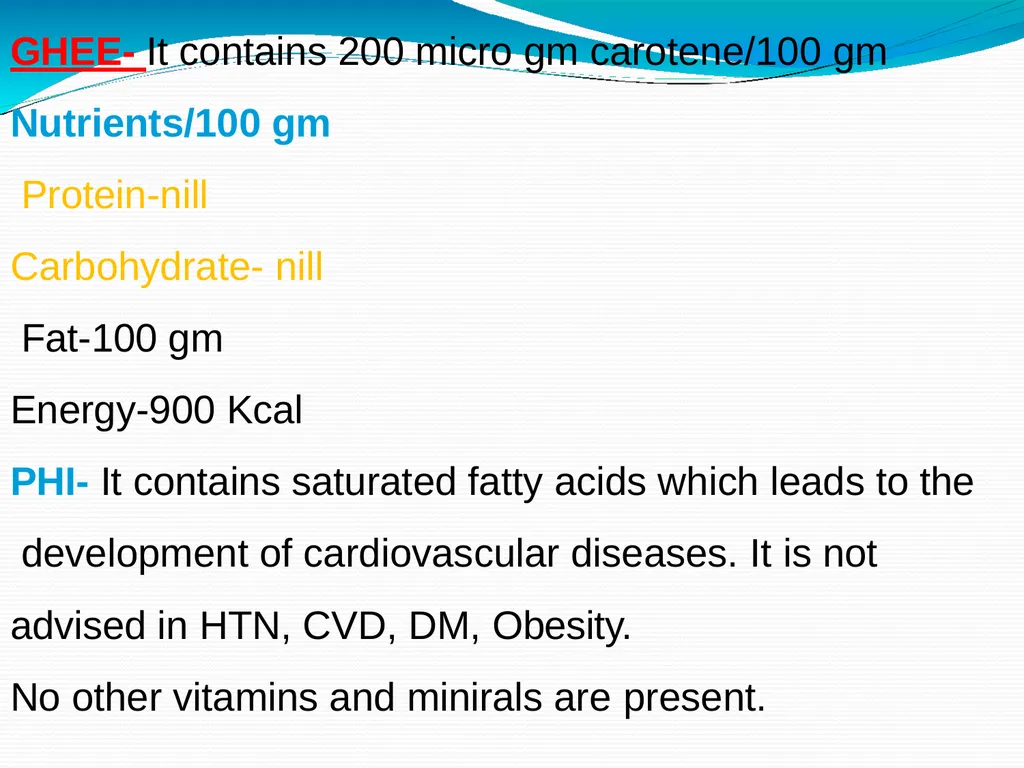
GHEE- It contains 200 micro gm carotene/100 gm
Nutrients/100 gm Protein-nill Carbohydrate- nill Fat-100 gm Energy-900 Kcal
PHI- It contains saturated fatty acids which leads to the development of cardiovascular diseases. It is not advised in HTN, CVD, DM, Obesity.
No other vitamins and minirals are present.<br>
Nutrients/100 gm Protein-nill Carbohydrate- nill Fat-100 gm Energy-900 Kcal
PHI- It contains saturated fatty acids which leads to the development of cardiovascular diseases. It is not advised in HTN, CVD, DM, Obesity.
No other vitamins and minirals are present.<br>
33
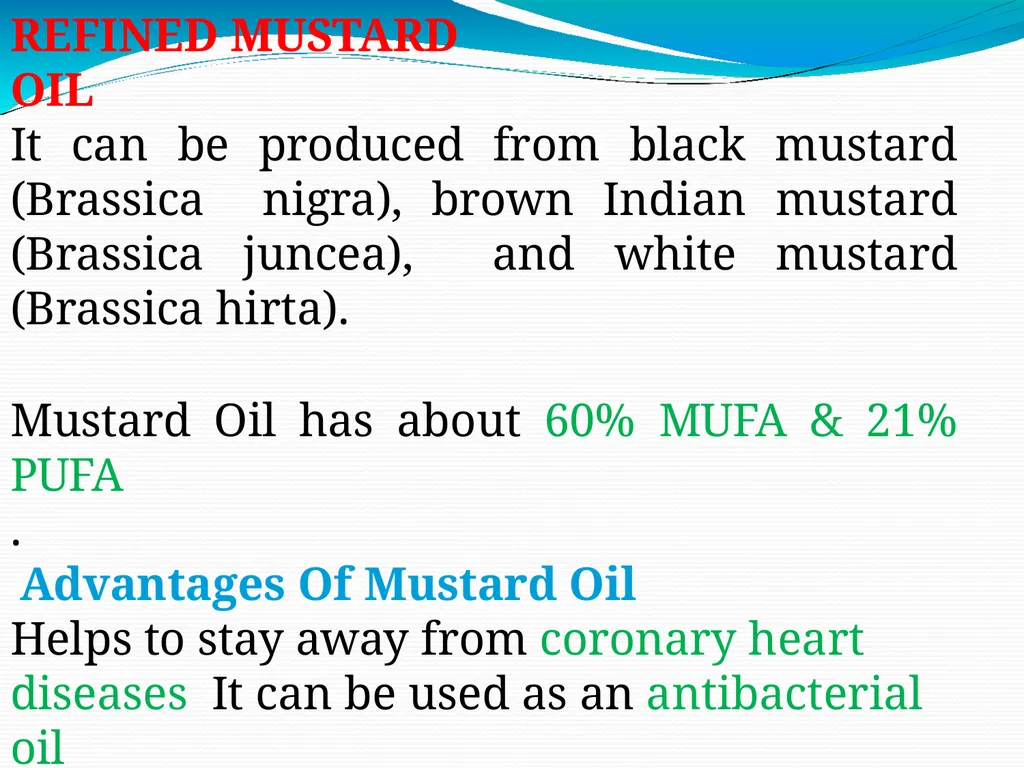
REFINED MUSTARD OIL It can be produced from black mustard (Brassica nigra), brown Indian mustard (Brassica juncea), and white mustard (Brassica hirta).
Mustard Oil has about 60% MUFA & 21% PUFA
.
Advantages Of Mustard Oil
Helps to stay away from coronary heart diseases It can be used as an antibacterial oil
Useful for treating cough and cold<br>
Mustard Oil has about 60% MUFA & 21% PUFA
.
Advantages Of Mustard Oil
Helps to stay away from coronary heart diseases It can be used as an antibacterial oil
Useful for treating cough and cold<br>
34
REFINED SOYABEAN OIL
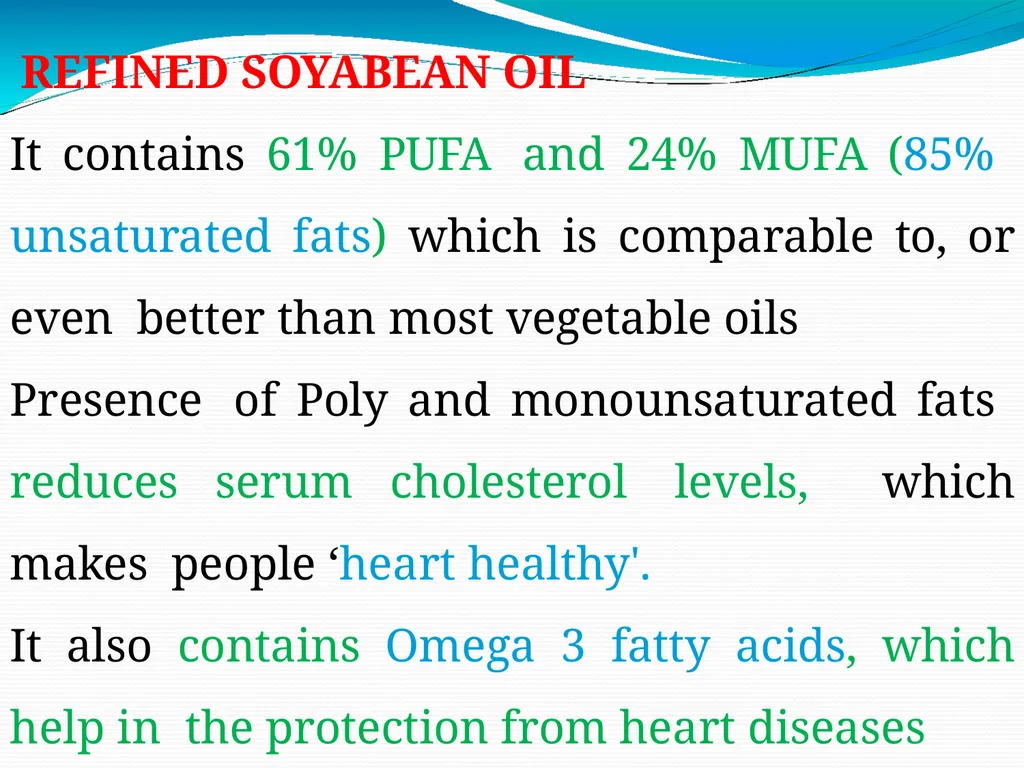
It contains 61% PUFA and 24% MUFA (85% unsaturated fats) which is comparable to, or even better than most vegetable oils
Presence of Poly and monounsaturated fats reduces serum cholesterol levels, which makes people ‘heart healthy'.
It also contains Omega 3 fatty acids, which help in the protection from heart diseases<br>
It contains 61% PUFA and 24% MUFA (85% unsaturated fats) which is comparable to, or even better than most vegetable oils
Presence of Poly and monounsaturated fats reduces serum cholesterol levels, which makes people ‘heart healthy'.
It also contains Omega 3 fatty acids, which help in the protection from heart diseases<br>
35
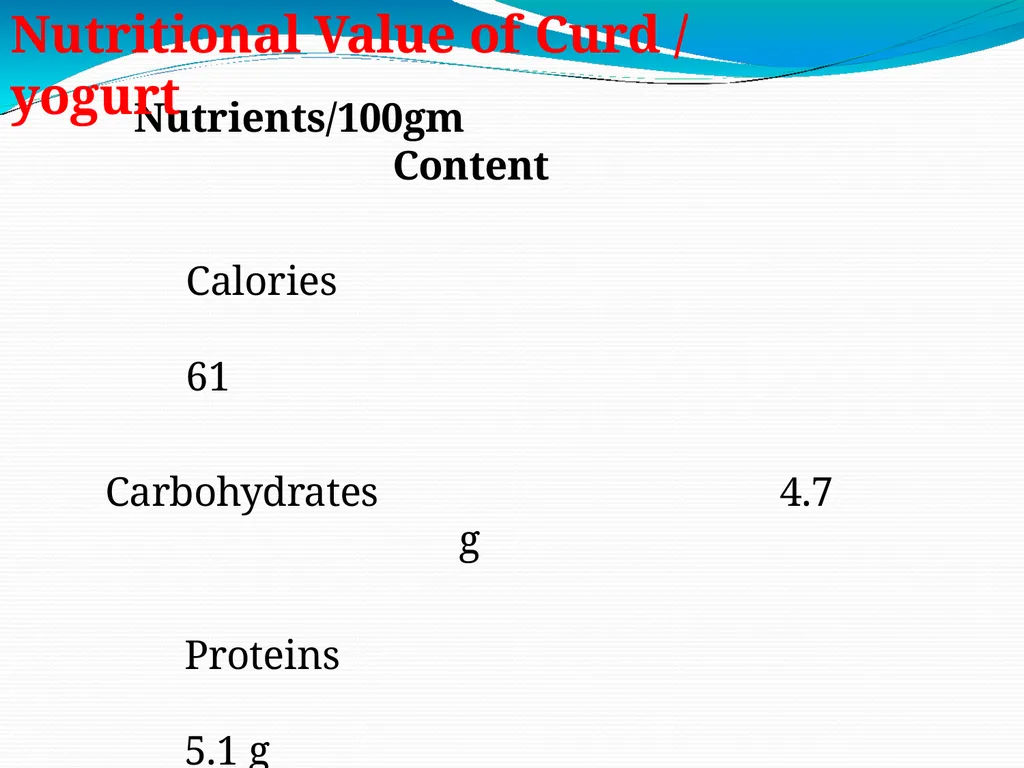
Nutrients/100gm Content
Calories 61
Carbohydrates 4.7 g
Proteins 5.1 g
Total Fats 3.5 g
Minerals, vit,& electrolite Nutritional Value of Curd / yogurt<br>
Calories 61
Carbohydrates 4.7 g
Proteins 5.1 g
Total Fats 3.5 g
Minerals, vit,& electrolite Nutritional Value of Curd / yogurt<br>
36
Health & nutrition benefits of eating yogurt/curd Consumption of curd - strengthening of the immune system.
The bacteria in curd can help digest food .
Curd might help reduce the risk of high blood pressure. Beneficial in case of constipation and colon cancer.
A very good snack for those trying to lose weight.
Being rich in calcium, curd is good for the bones & teeth Curd is effective in controlling dandruff.
Curd is effective in lowering blood pressure.
Reduces bad cholesterol and lowers the risk of heart<br>
The bacteria in curd can help digest food .
Curd might help reduce the risk of high blood pressure. Beneficial in case of constipation and colon cancer.
A very good snack for those trying to lose weight.
Being rich in calcium, curd is good for the bones & teeth Curd is effective in controlling dandruff.
Curd is effective in lowering blood pressure.
Reduces bad cholesterol and lowers the risk of heart<br>
37
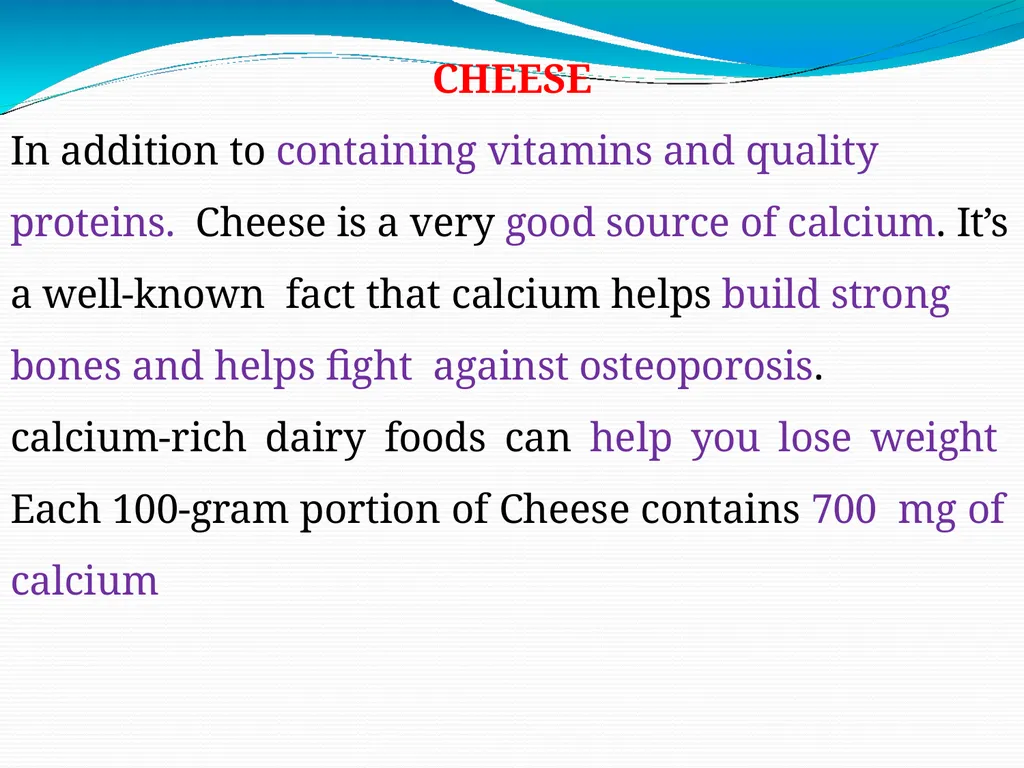
CHEESE
In addition to containing vitamins and quality proteins. Cheese is a very good source of calcium. It’s a well-known fact that calcium helps build strong bones and helps fight against osteoporosis.
calcium-rich dairy foods can help you lose weight Each 100-gram portion of Cheese contains 700 mg of calcium<br>
In addition to containing vitamins and quality proteins. Cheese is a very good source of calcium. It’s a well-known fact that calcium helps build strong bones and helps fight against osteoporosis.
calcium-rich dairy foods can help you lose weight Each 100-gram portion of Cheese contains 700 mg of calcium<br>
38
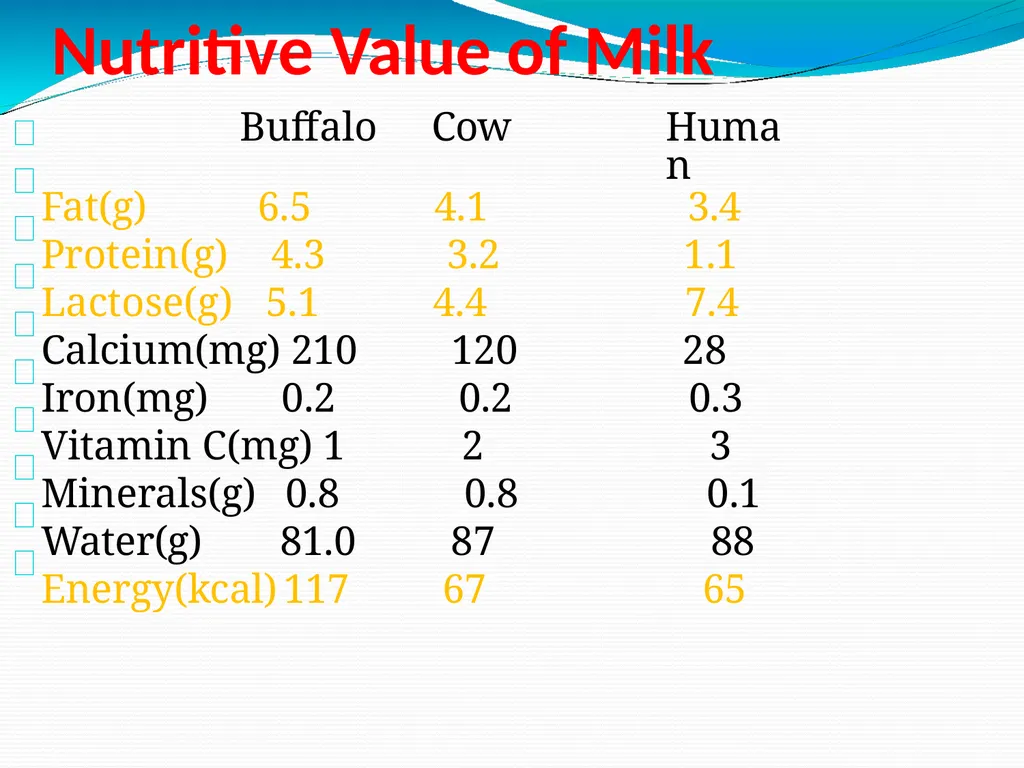
Nutritive Value of Milk<br>
39
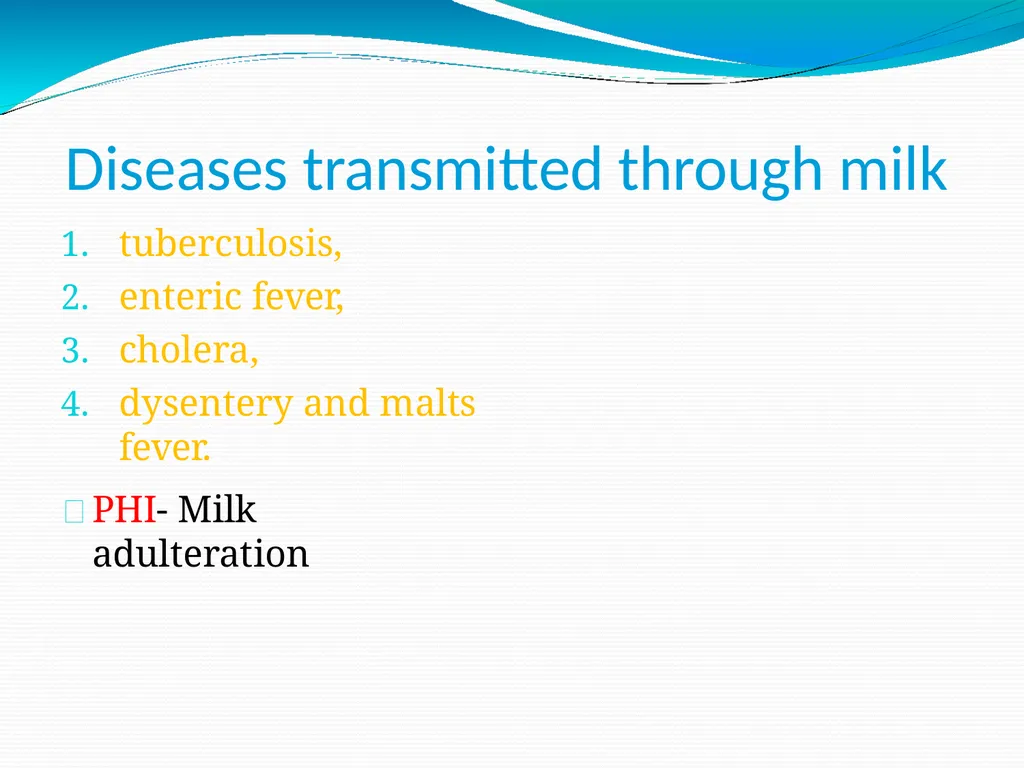
Diseases transmitted through milk tuberculosis,
enteric fever,
cholera,
dysentery and malts fever. PHI- Milk adulteration<br>
enteric fever,
cholera,
dysentery and malts fever. PHI- Milk adulteration<br>
40
THANK YOU!<br>