03
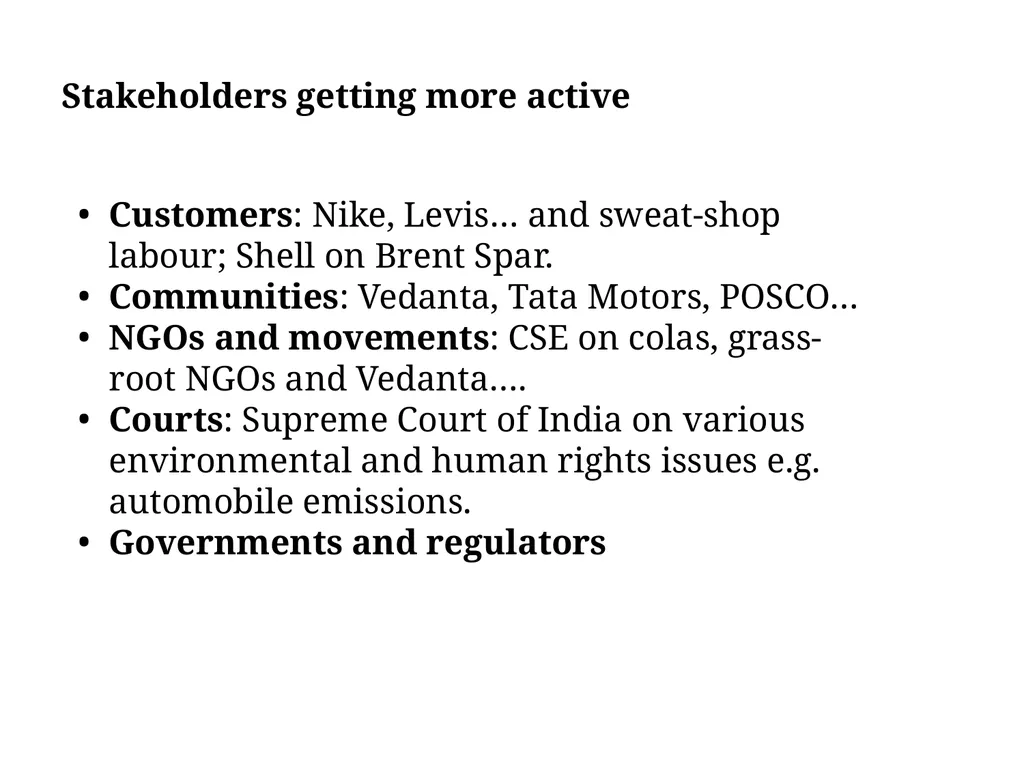
Stakeholders getting more active Customers: Nike, Levis… and sweat-shop labour; Shell on Brent Spar.
Communities: Vedanta, Tata Motors, POSCO…
NGOs and movements: CSE on colas, grass-root NGOs and Vedanta….
Courts: Supreme Court of India on various environmental and human rights issues e.g. automobile emissions.
Governments and regulators<br>
04
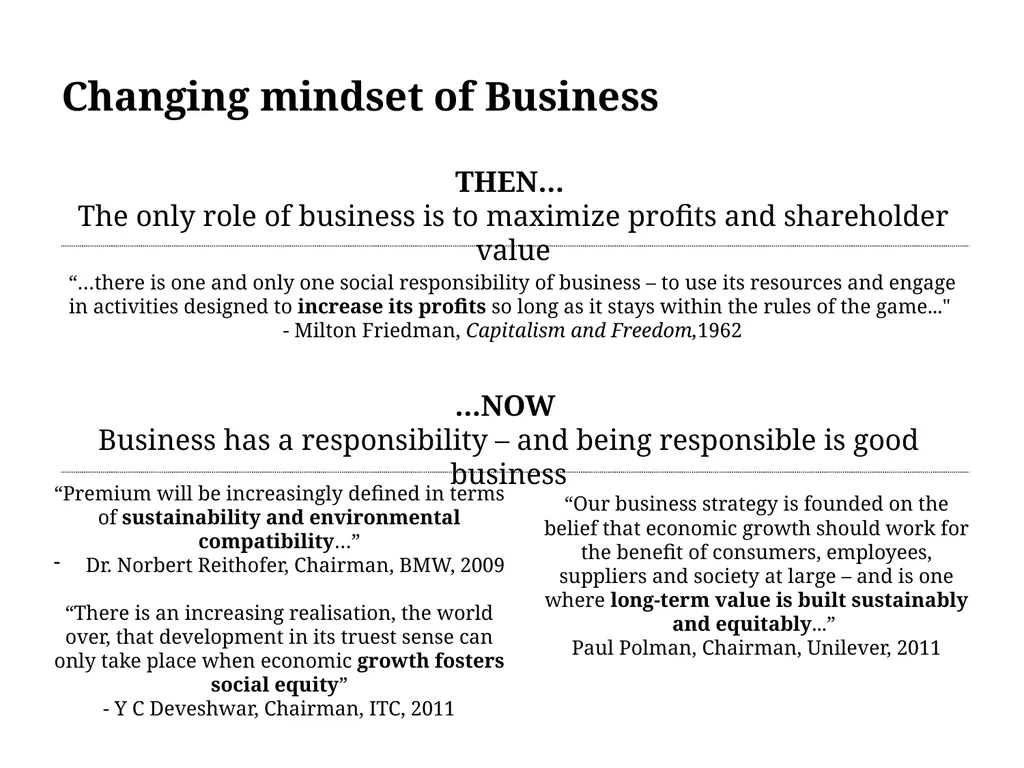
Changing mindset of Business “…there is one and only one social responsibility of business – to use its resources and engage in activities designed to increase its profits so long as it stays within the rules of the game..."
- Milton Friedman, Capitalism and Freedom,1962 THEN…
The only role of business is to maximize profits and shareholder value …NOW
Business has a responsibility – and being responsible is good business “Premium will be increasingly defined in terms of sustainability and environmental compatibility…”
Dr. Norbert Reithofer, Chairman, BMW, 2009
“There is an increasing realisation, the world over, that development in its truest sense can only take place when economic growth fosters social equity”
- Y C Deveshwar, Chairman, ITC, 2011 “Our business strategy is founded on the belief that economic growth should work for the benefit of consumers, employees, suppliers and society at large – and is one where long-term value is built sustainably and equitably...”
Paul Polman, Chairman, Unilever, 2011<br>
05
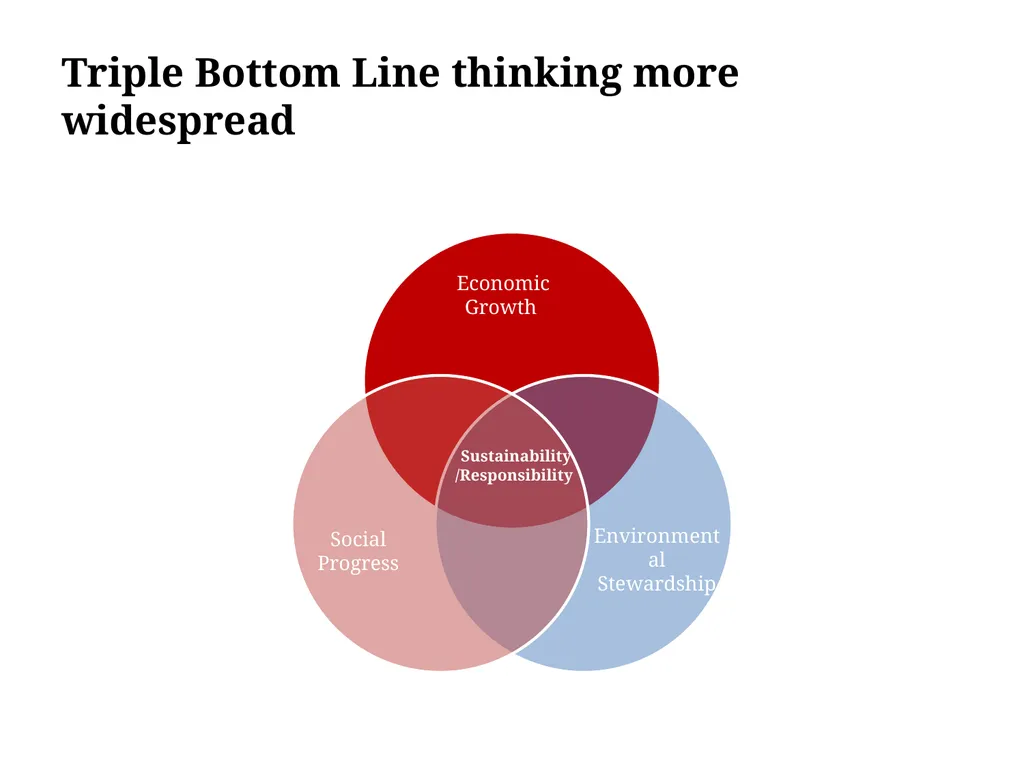
Triple Bottom Line thinking more widespread Sustainability
/Responsibility Economic Growth Social Progress Environmental Stewardship<br>
06
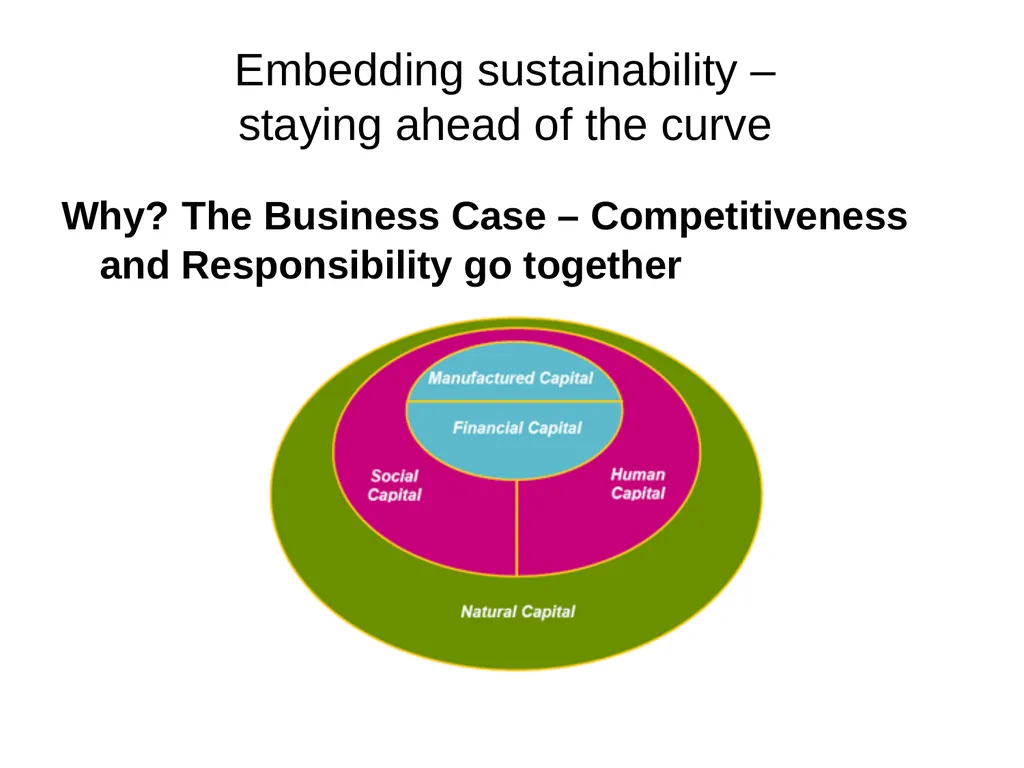
Embedding sustainability – �staying ahead of the curve Why? The Business Case – Competitiveness and Responsibility go together<br>
07
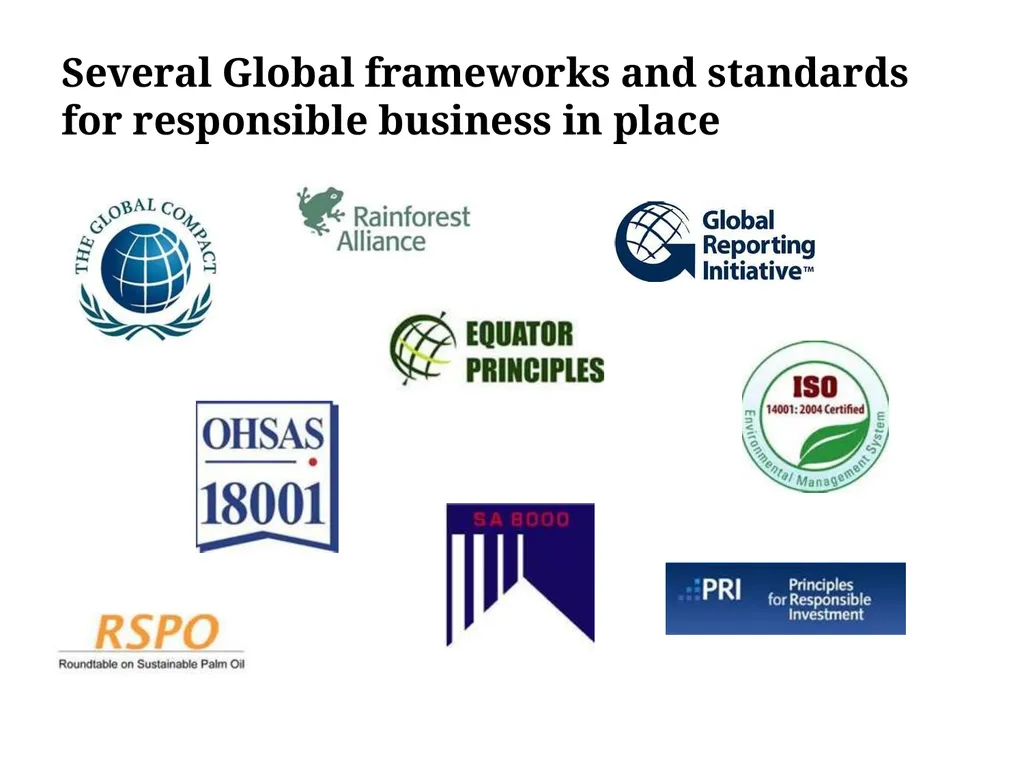
Several Global frameworks and standards for responsible business in place<br>
08
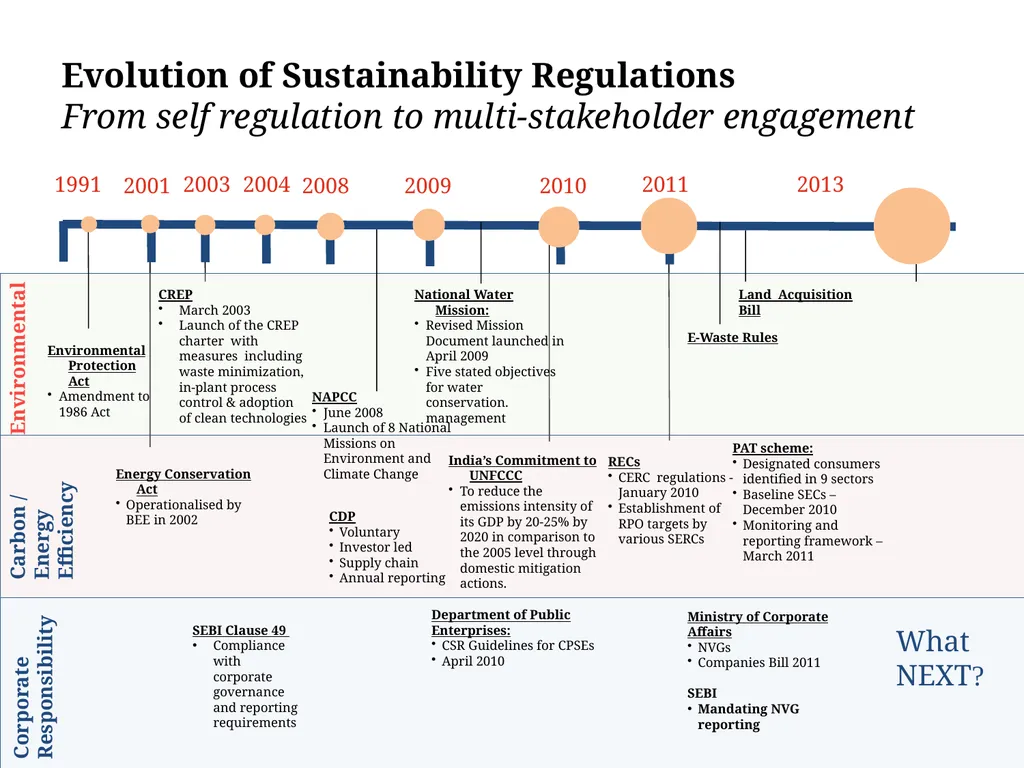
Evolution of Sustainability Regulations�From self regulation to multi-stakeholder engagement Environmental NAPCC
June 2008
Launch of 8 National Missions on Environment and Climate Change PAT scheme:
Designated consumers identified in 9 sectors
Baseline SECs – December 2010
Monitoring and reporting framework – March 2011 2003 2008 2010 Environmental Protection Act
Amendment to 1986 Act 2013 CDP
Voluntary
Investor led
Supply chain
Annual reporting 1991 India’s Commitment to UNFCCC
To reduce the emissions intensity of its GDP by 20-25% by 2020 in comparison to the 2005 level through domestic mitigation actions. 2009 Carbon / �Energy �Efficiency Corporate�Responsibility CREP
March 2003
Launch of the CREP charter with measures including waste minimization, in-plant process control & adoption of clean technologies Department of Public Enterprises:
CSR Guidelines for CPSEs
April 2010 2011 2001 Energy Conservation Act
Operationalised by BEE in 2002 RECs
CERC regulations - January 2010
Establishment of RPO targets by various SERCs 2004 SEBI Clause 49
Compliance with corporate governance and reporting requirements Ministry of Corporate Affairs
NVGs
Companies Bill 2011
SEBI
Mandating NVG reporting National Water Mission:
Revised Mission Document launched in April 2009
Five stated objectives for water conservation. management E-Waste Rules Land Acquisition Bill What NEXT<br>
09
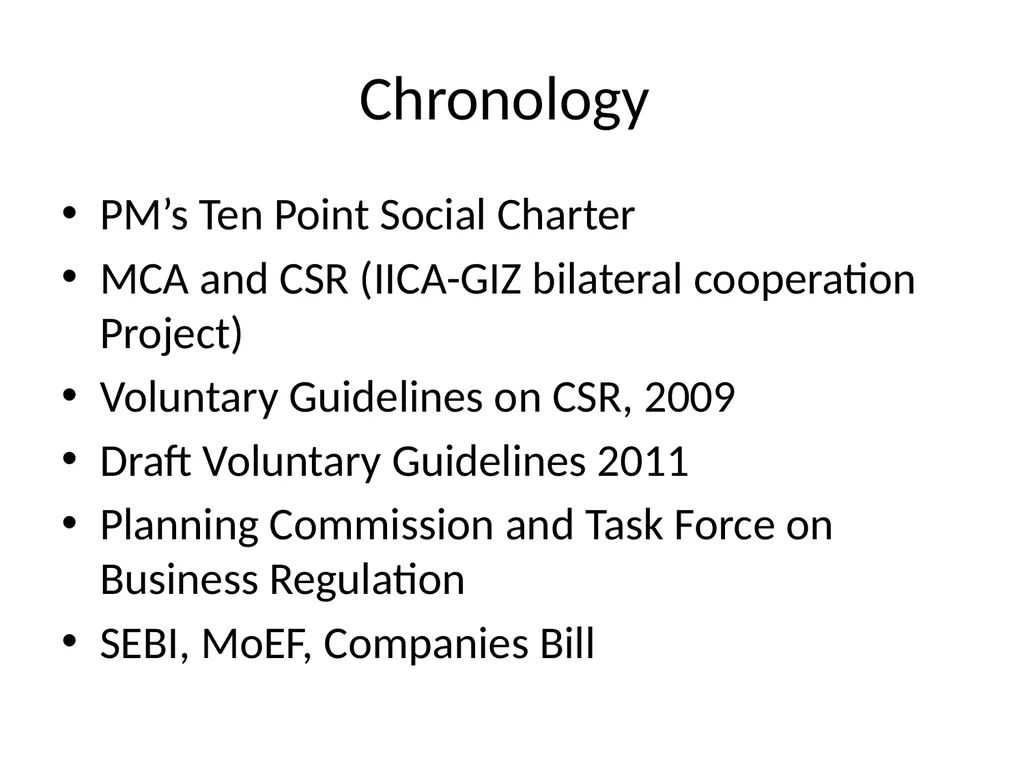
Chronology PM’s Ten Point Social Charter
MCA and CSR (IICA-GIZ bilateral cooperation Project)
Voluntary Guidelines on CSR, 2009
Draft Voluntary Guidelines 2011
Planning Commission and Task Force on Business Regulation
SEBI, MoEF, Companies Bill<br>
10
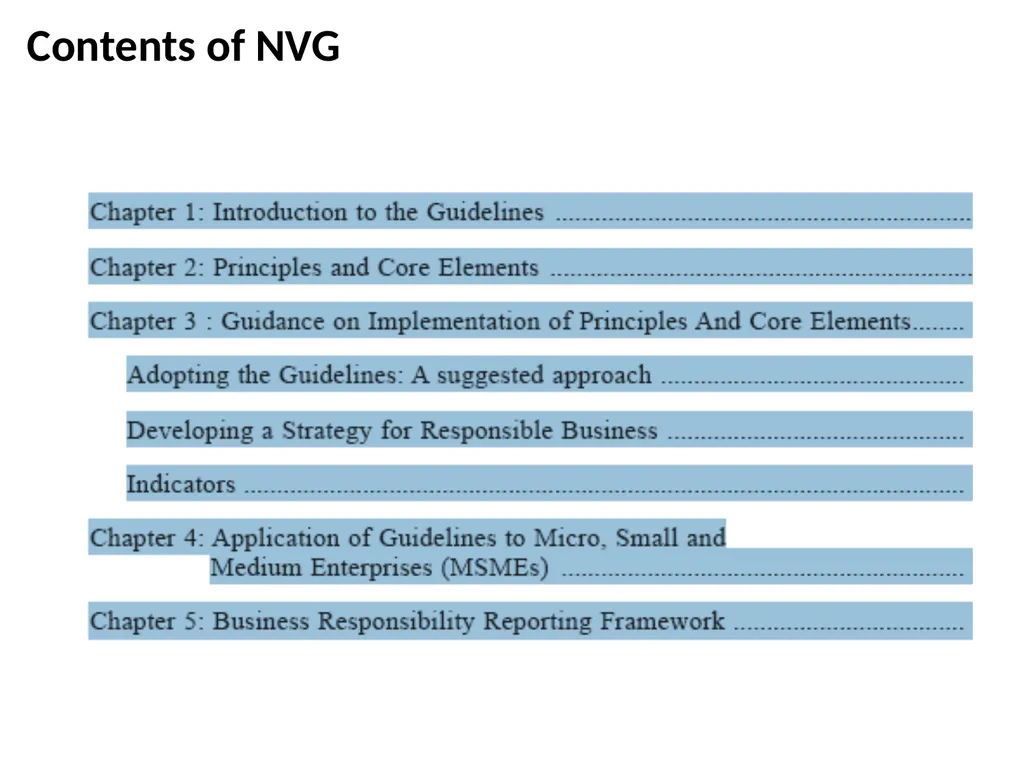
Developing the Nvg<br>
11
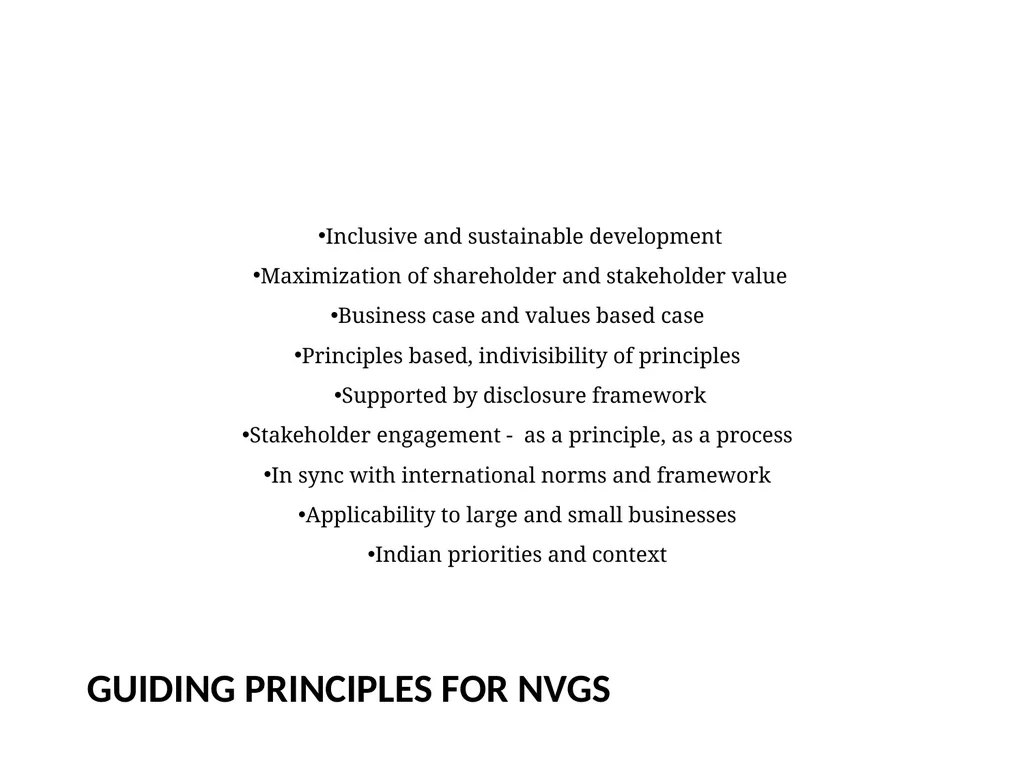
Guiding Principles for NVGs Inclusive and sustainable development
Maximization of shareholder and stakeholder value
Business case and values based case
Principles based, indivisibility of principles
Supported by disclosure framework
Stakeholder engagement - as a principle, as a process
In sync with international norms and framework
Applicability to large and small businesses
Indian priorities and context<br>
12
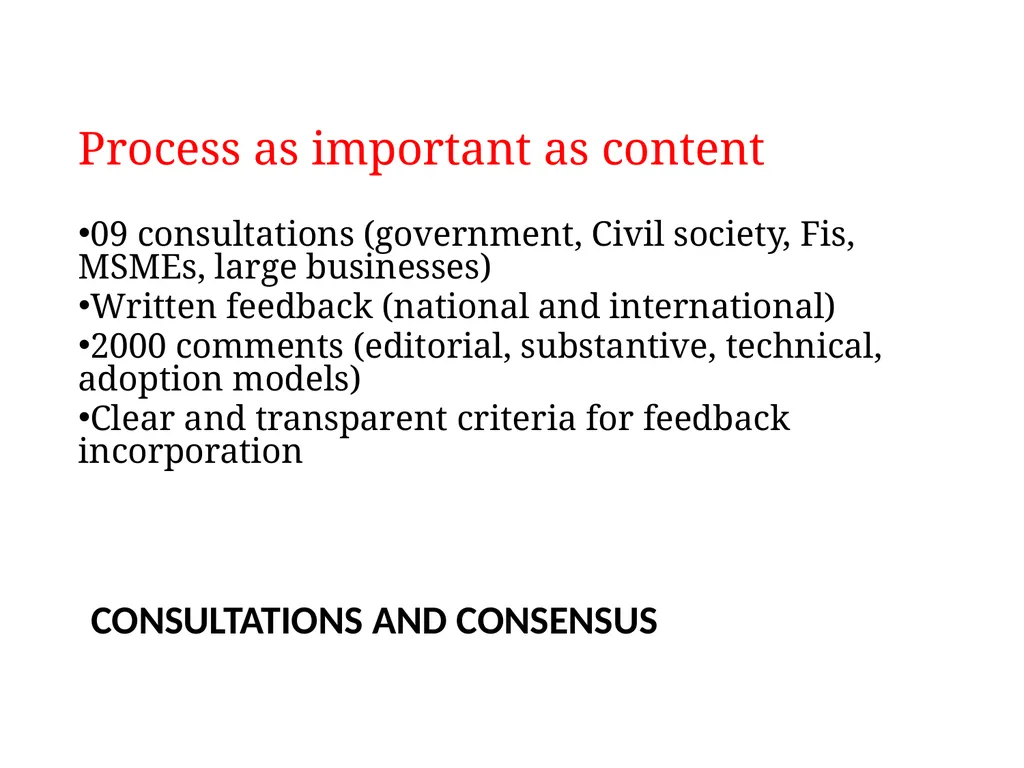
Consultations and Consensus Process as important as content
09 consultations (government, Civil society, Fis, MSMEs, large businesses)
Written feedback (national and international)
2000 comments (editorial, substantive, technical, adoption models)
Clear and transparent criteria for feedback incorporation<br>
14
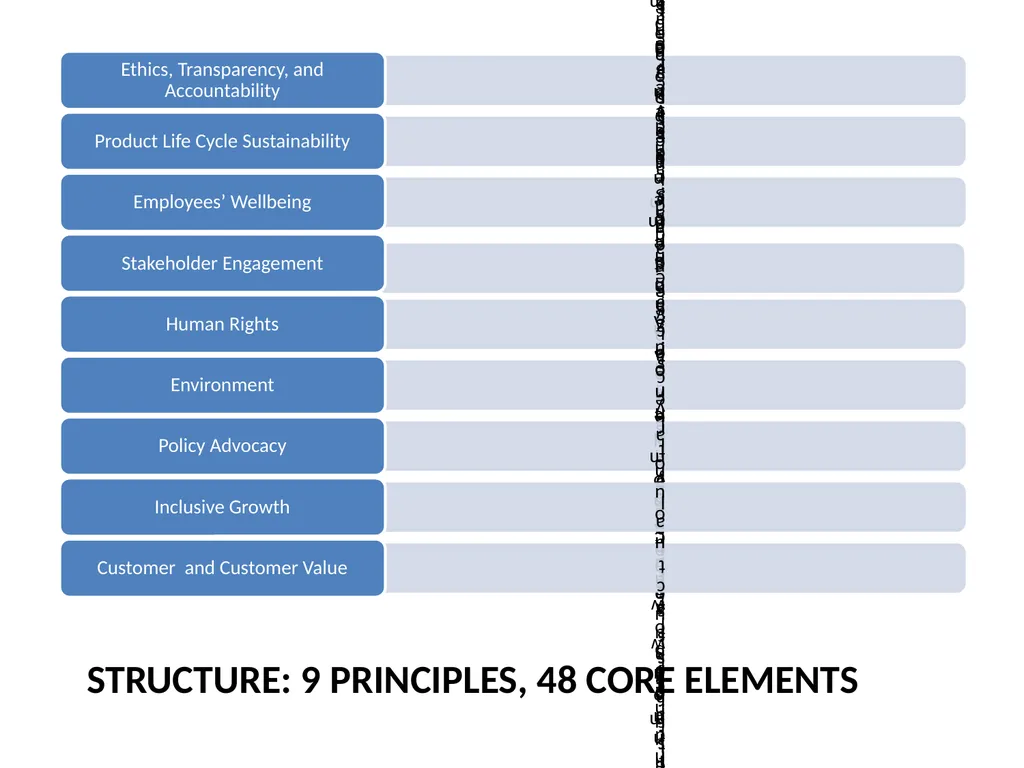
Structure: 9 principles, 48 Core elements<br>
15
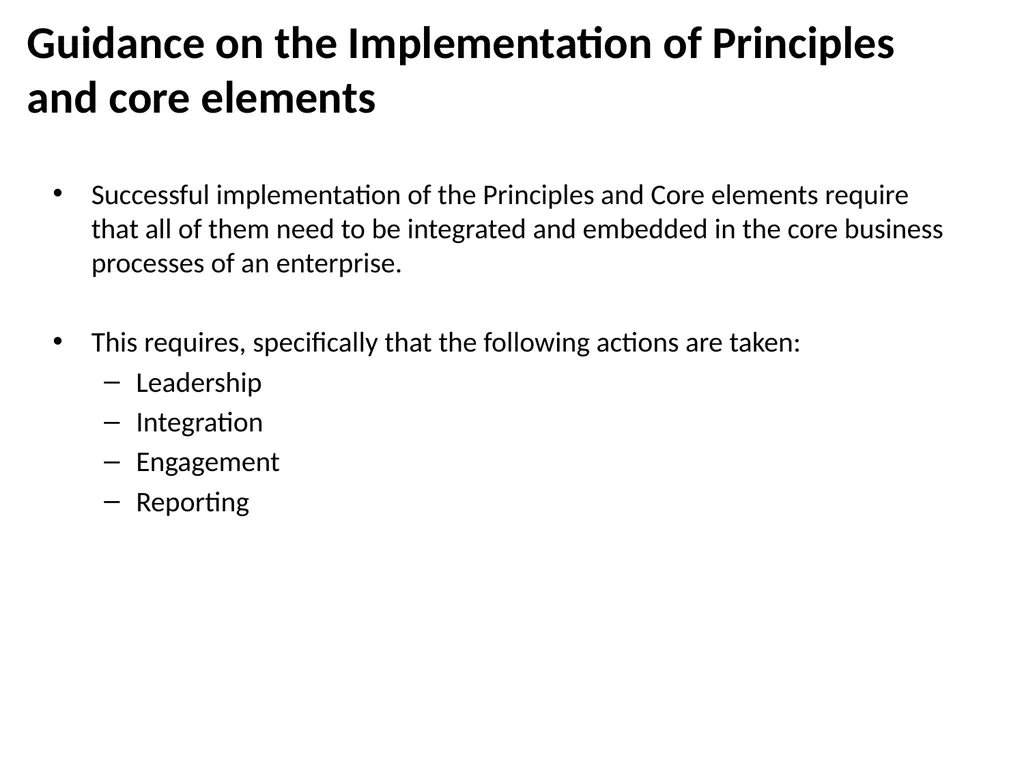
Guidance on the Implementation of Principles and core elements Successful implementation of the Principles and Core elements require that all of them need to be integrated and embedded in the core business processes of an enterprise.
This requires, specifically that the following actions are taken:
Leadership
Integration
Engagement
Reporting<br>
16
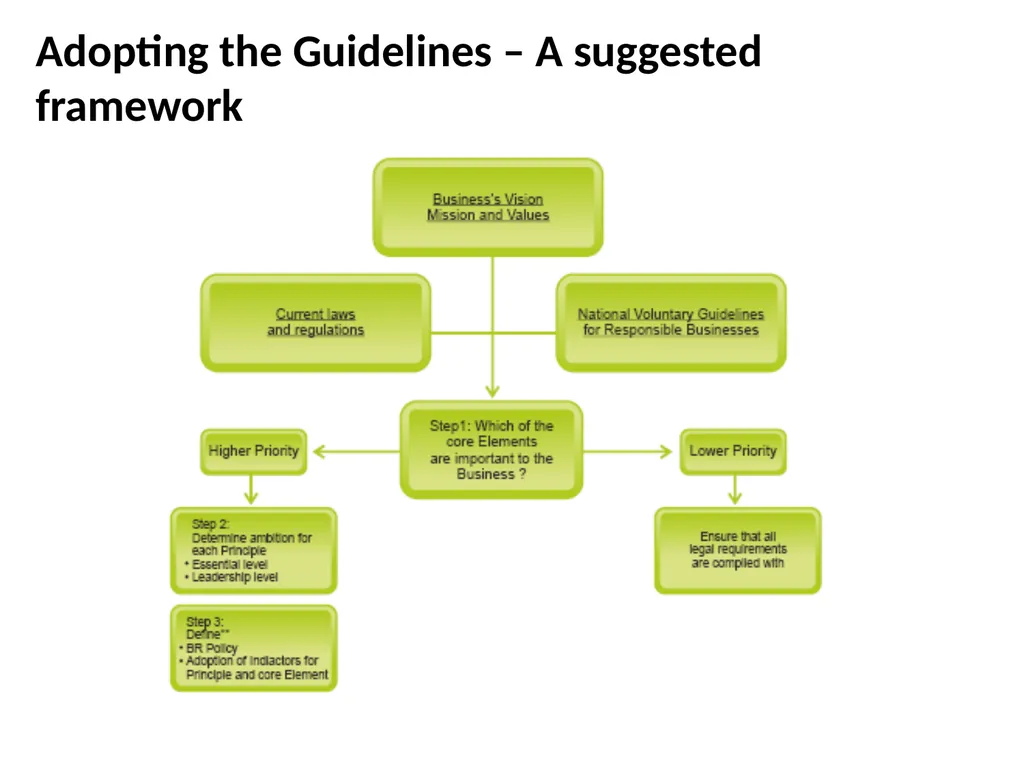
Adopting the Guidelines – A suggested framework<br>
17
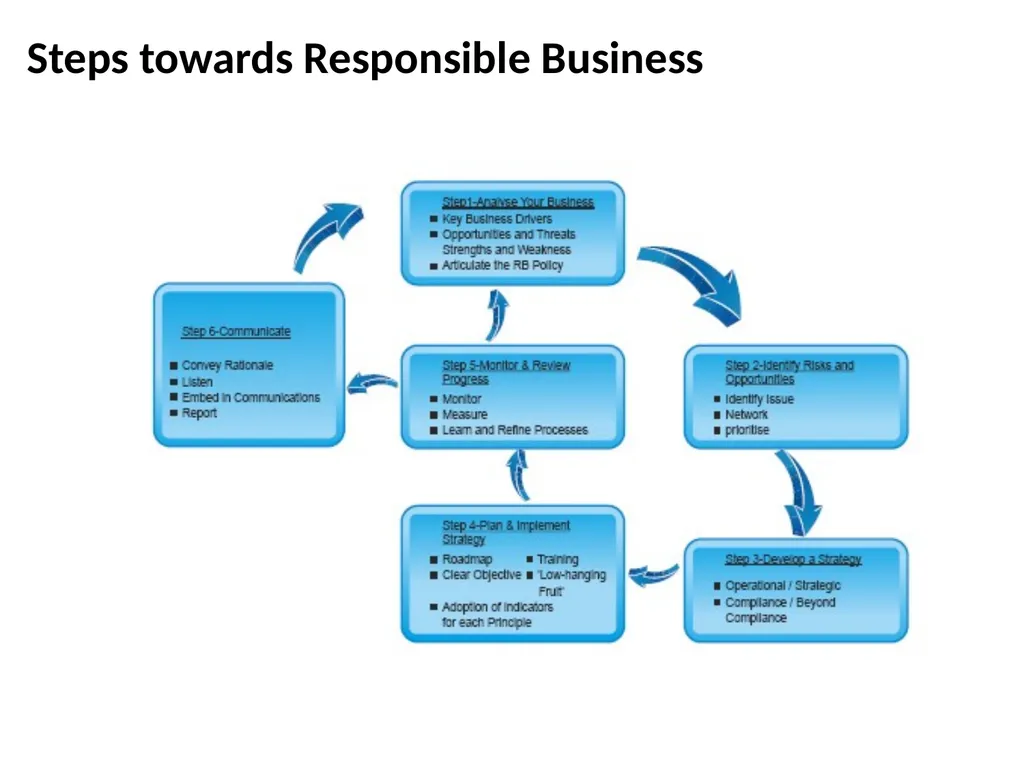
Steps towards Responsible Business<br>
18
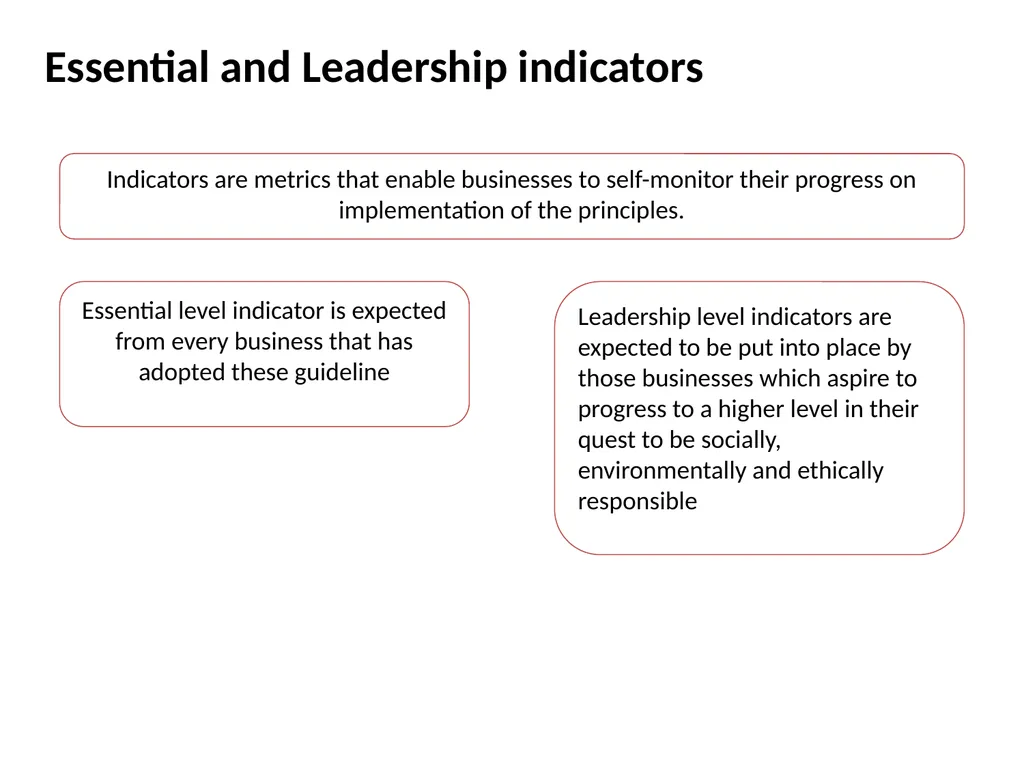
Essential and Leadership indicators Essential level indicator is expected from every business that has adopted these guideline Indicators are metrics that enable businesses to self-monitor their progress on implementation of the principles. Leadership level indicators are expected to be put into place by those businesses which aspire to progress to a higher level in their quest to be socially, environmentally and ethically responsible<br>
19
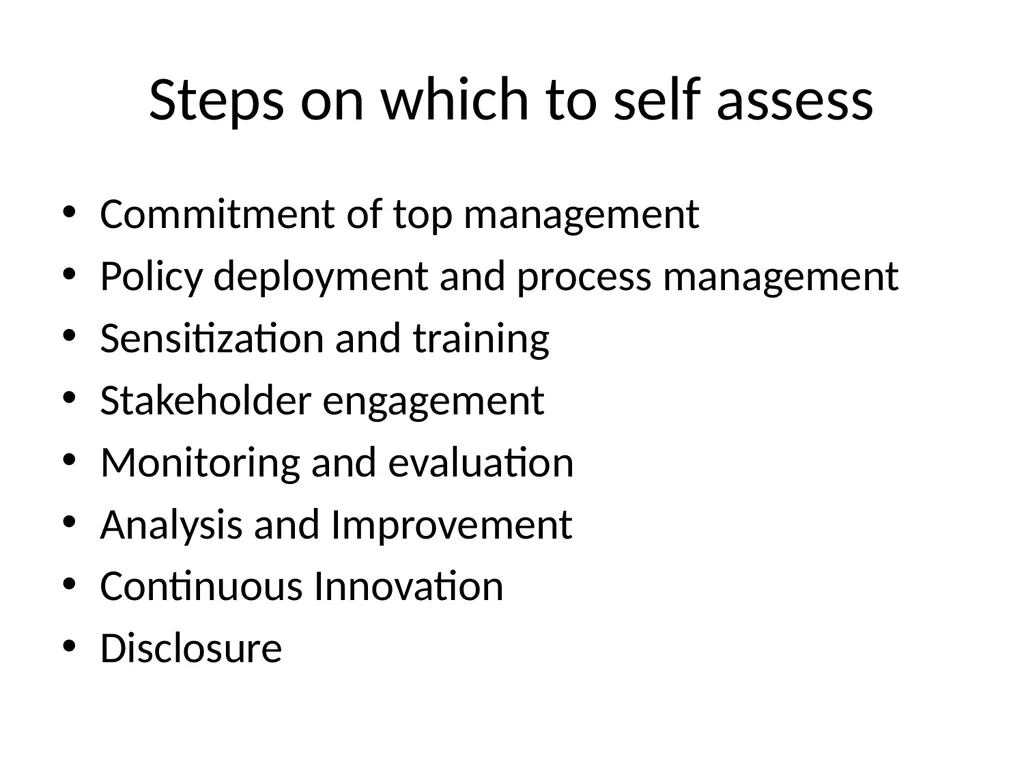
Steps on which to self assess Commitment of top management
Policy deployment and process management
Sensitization and training
Stakeholder engagement
Monitoring and evaluation
Analysis and Improvement
Continuous Innovation
Disclosure<br>
20
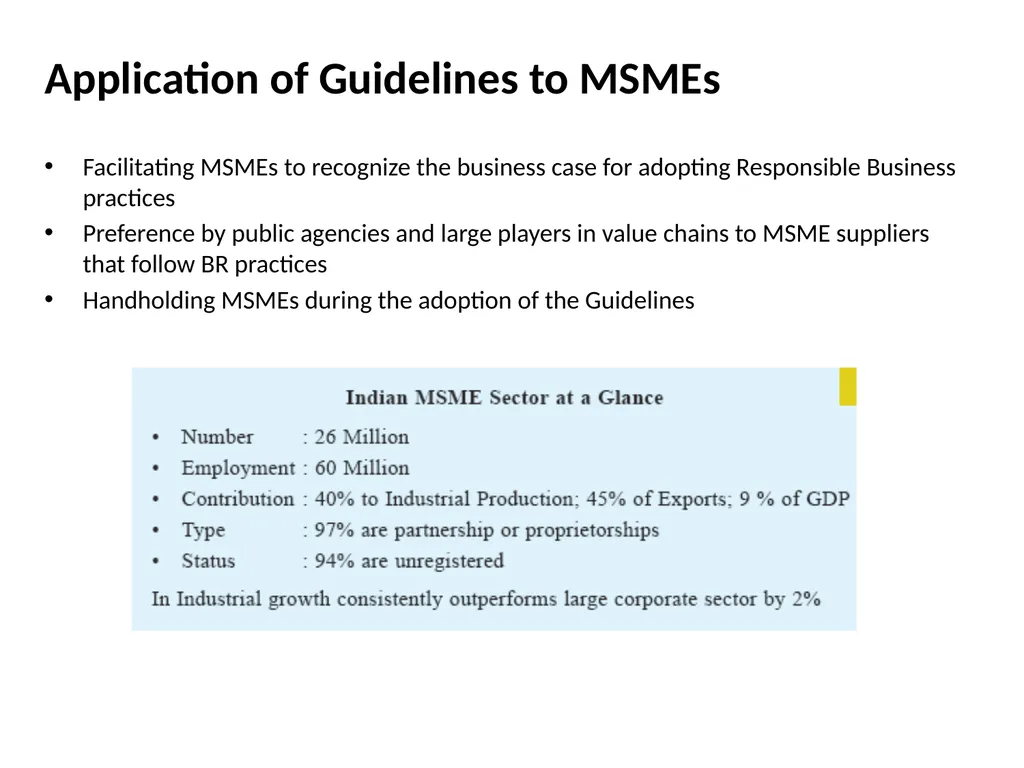
Application of Guidelines to MSMEs Facilitating MSMEs to recognize the business case for adopting Responsible Business practices
Preference by public agencies and large players in value chains to MSME suppliers that follow BR practices
Handholding MSMEs during the adoption of the Guidelines<br>
21
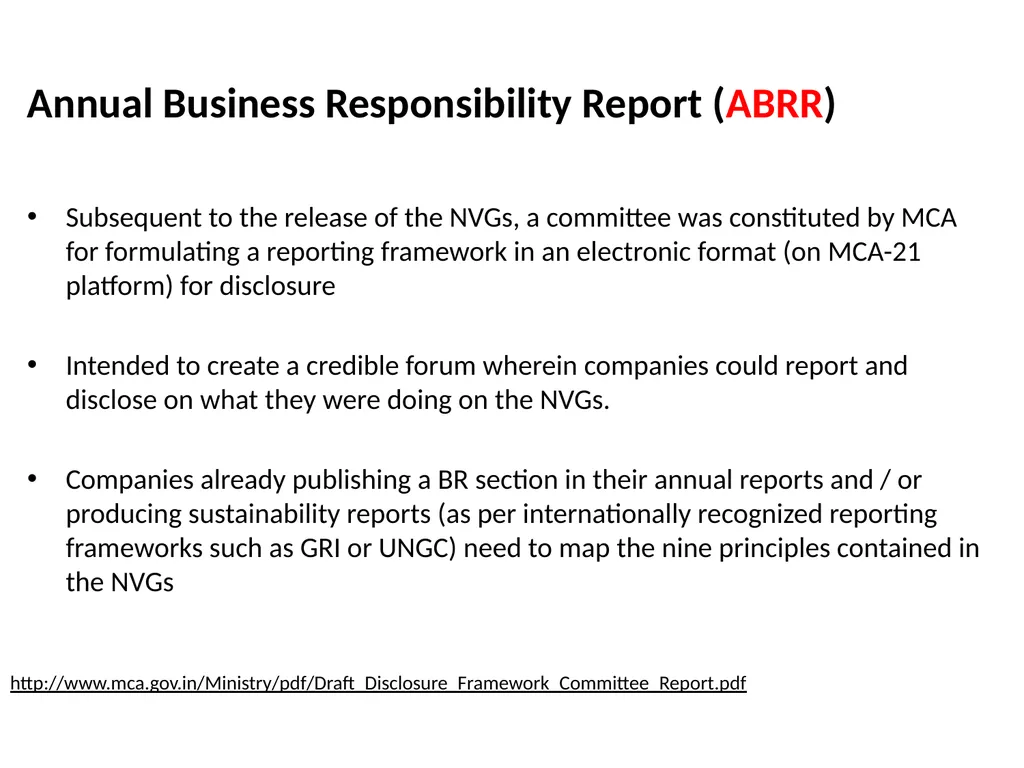
Annual Business Responsibility Report (ABRR) Subsequent to the release of the NVGs, a committee was constituted by MCA for formulating a reporting framework in an electronic format (on MCA-21 platform) for disclosure
Intended to create a credible forum wherein companies could report and disclose on what they were doing on the NVGs.
Companies already publishing a BR section in their annual reports and / or producing sustainability reports (as per internationally recognized reporting frameworks such as GRI or UNGC) need to map the nine principles contained in the NVGs http://www.mca.gov.in/Ministry/pdf/Draft_Disclosure_Framework_Committee_Report.pdf<br>
22
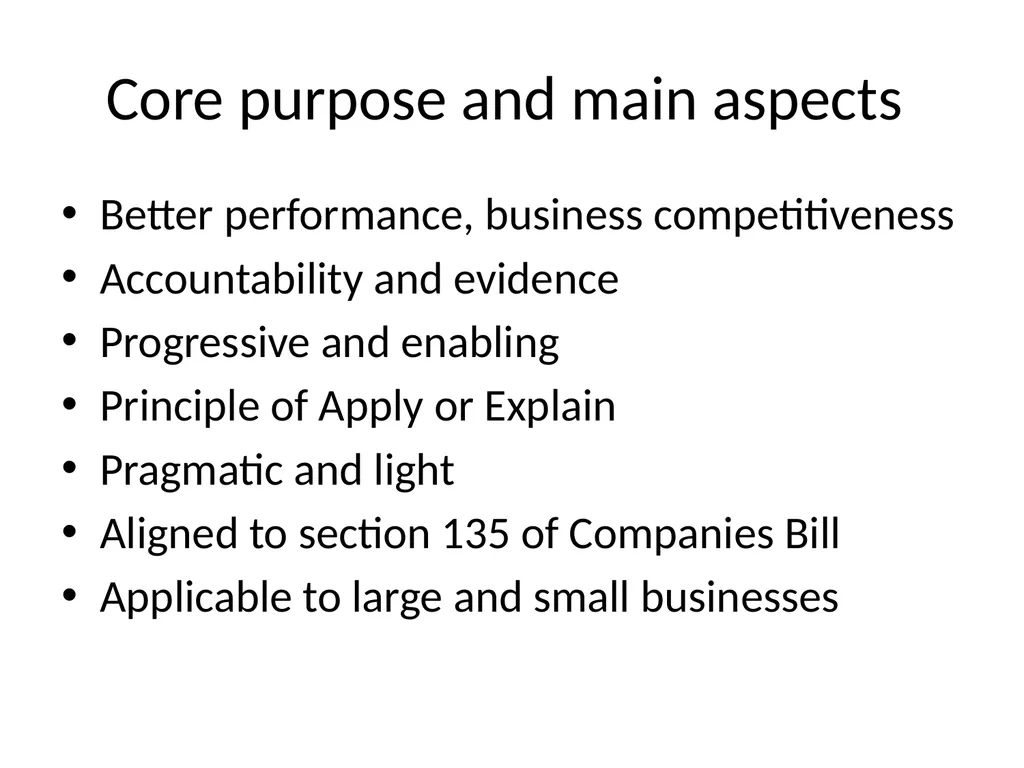
Core purpose and main aspects Better performance, business competitiveness
Accountability and evidence
Progressive and enabling
Principle of Apply or Explain
Pragmatic and light
Aligned to section 135 of Companies Bill
Applicable to large and small businesses<br>
23
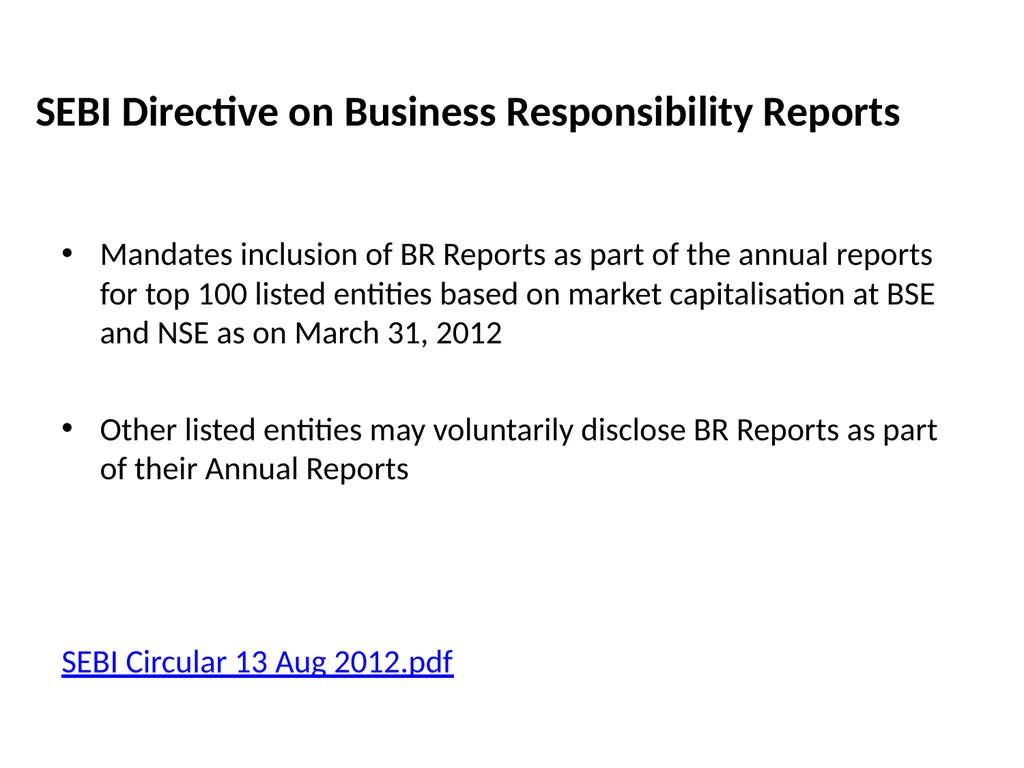
SEBI Directive on Business Responsibility Reports Mandates inclusion of BR Reports as part of the annual reports for top 100 listed entities based on market capitalisation at BSE and NSE as on March 31, 2012
Other listed entities may voluntarily disclose BR Reports as part of their Annual Reports
SEBI Circular 13 Aug 2012.pdf<br>
24
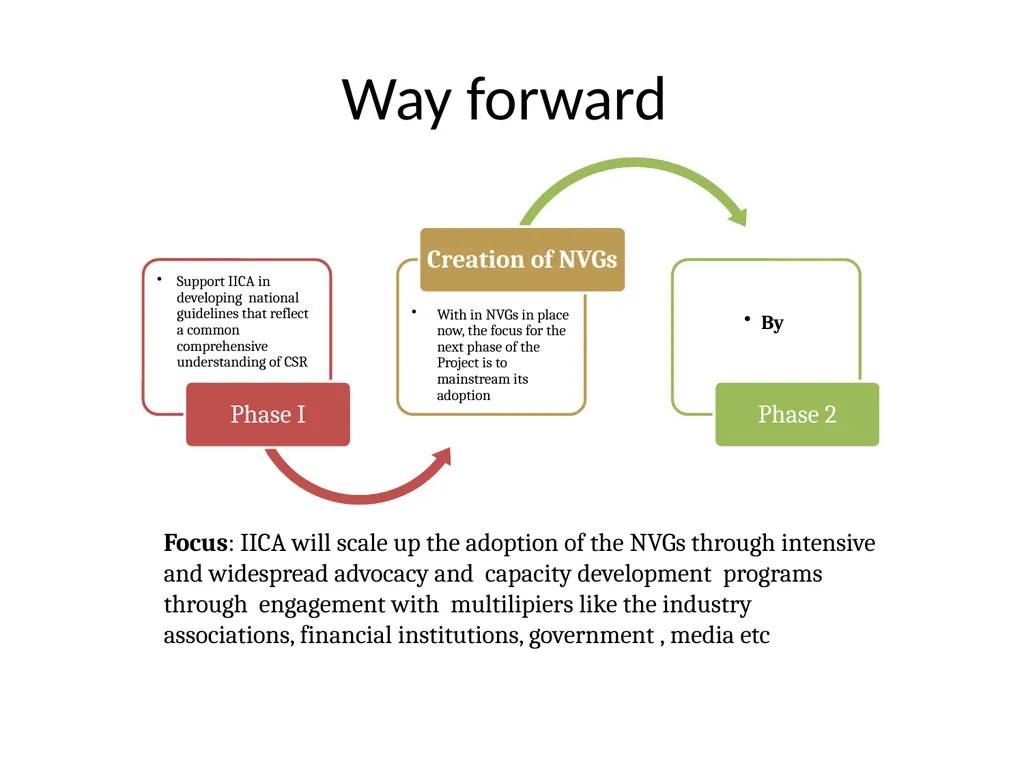
Way forward Focus: IICA will scale up the adoption of the NVGs through intensive and widespread advocacy and capacity development programs through engagement with multilipiers like the industry associations, financial institutions, government , media etc<br>
25
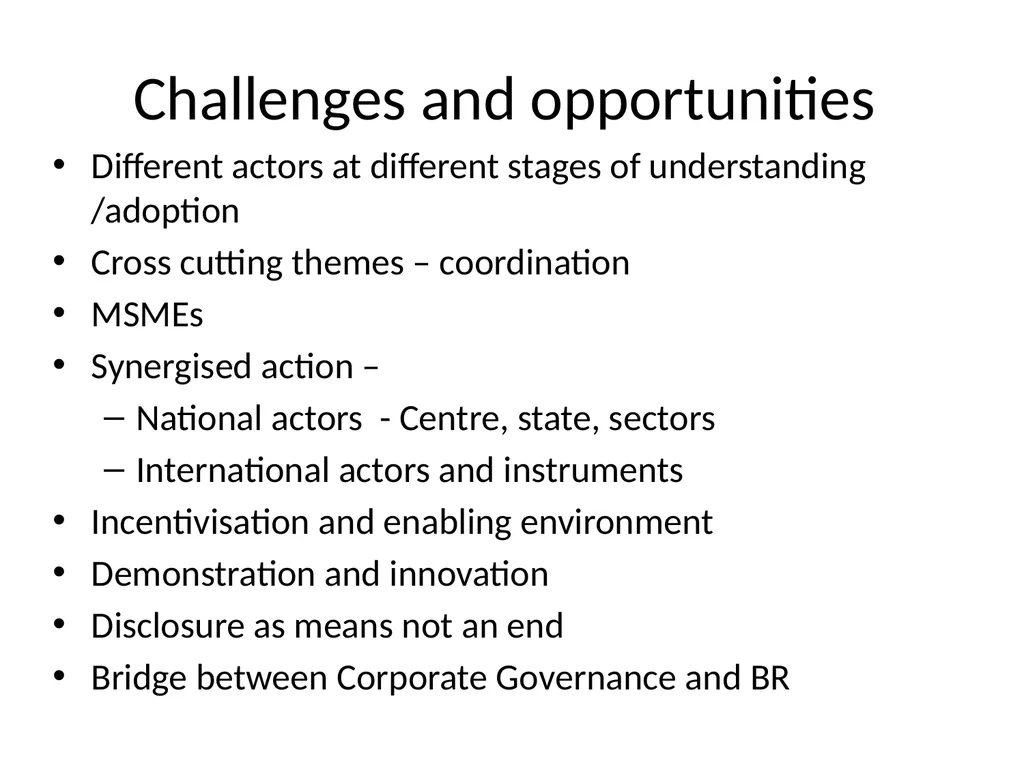
Challenges and opportunities Different actors at different stages of understanding /adoption
Cross cutting themes – coordination
MSMEs
Synergised action –
National actors - Centre, state, sectors
International actors and instruments
Incentivisation and enabling environment
Demonstration and innovation
Disclosure as means not an end
Bridge between Corporate Governance and BR<br>
26
Thank you: Floor is yours!<br>