OBJECTIVES OF MEWAR UNIVERSITY COLLABORATIONS With

Published  . 0 views
↓ Download
OBJECTIVES OF MEWAR UNIVERSITY COLLABORATIONS With
1 / 1
OBJECTIVES OF MEWAR UNIVERSITY COLLABORATIONS With - slide 1 of 18 OBJECTIVES OF MEWAR UNIVERSITY COLLABORATIONS With - slide 2 of 18 OBJECTIVES OF MEWAR UNIVERSITY COLLABORATIONS With - slide 3 of 18 OBJECTIVES OF MEWAR UNIVERSITY COLLABORATIONS With - slide 4 of 18 OBJECTIVES OF MEWAR UNIVERSITY COLLABORATIONS With - slide 5 of 18 OBJECTIVES OF MEWAR UNIVERSITY COLLABORATIONS With - slide 6 of 18 OBJECTIVES OF MEWAR UNIVERSITY COLLABORATIONS With - slide 7 of 18 OBJECTIVES OF MEWAR UNIVERSITY COLLABORATIONS With - slide 8 of 18 OBJECTIVES OF MEWAR UNIVERSITY COLLABORATIONS With - slide 9 of 18 OBJECTIVES OF MEWAR UNIVERSITY COLLABORATIONS With - slide 10 of 18 OBJECTIVES OF MEWAR UNIVERSITY COLLABORATIONS With - slide 11 of 18 OBJECTIVES OF MEWAR UNIVERSITY COLLABORATIONS With - slide 12 of 18 OBJECTIVES OF MEWAR UNIVERSITY COLLABORATIONS With - slide 13 of 18 OBJECTIVES OF MEWAR UNIVERSITY COLLABORATIONS With - slide 14 of 18 OBJECTIVES OF MEWAR UNIVERSITY COLLABORATIONS With - slide 15 of 18 OBJECTIVES OF MEWAR UNIVERSITY COLLABORATIONS With - slide 16 of 18 OBJECTIVES OF MEWAR UNIVERSITY COLLABORATIONS With - slide 17 of 18 OBJECTIVES OF MEWAR UNIVERSITY COLLABORATIONS With - slide 18 of 18
Description: OBJECTIVES OF MEWAR UNIVERSITY COLLABORATIONS With Institutions for short term training and in house training for a semester and Research and Development Centre With Govt. Organisations for short term training and in house training for a

Related Topics

Download Presentation

"OBJECTIVES OF MEWAR UNIVERSITY COLLABORATIONS With" is the property of its rightful owner. Permission is granted to download and print the materials on this website for personal, non-commercial use only, and to display it on your personal computer provided you do not modify the materials and that you retain all copyright notices contained in the materials. By downloading content from our website, you accept the terms of this agreement.

Presentation Transcript

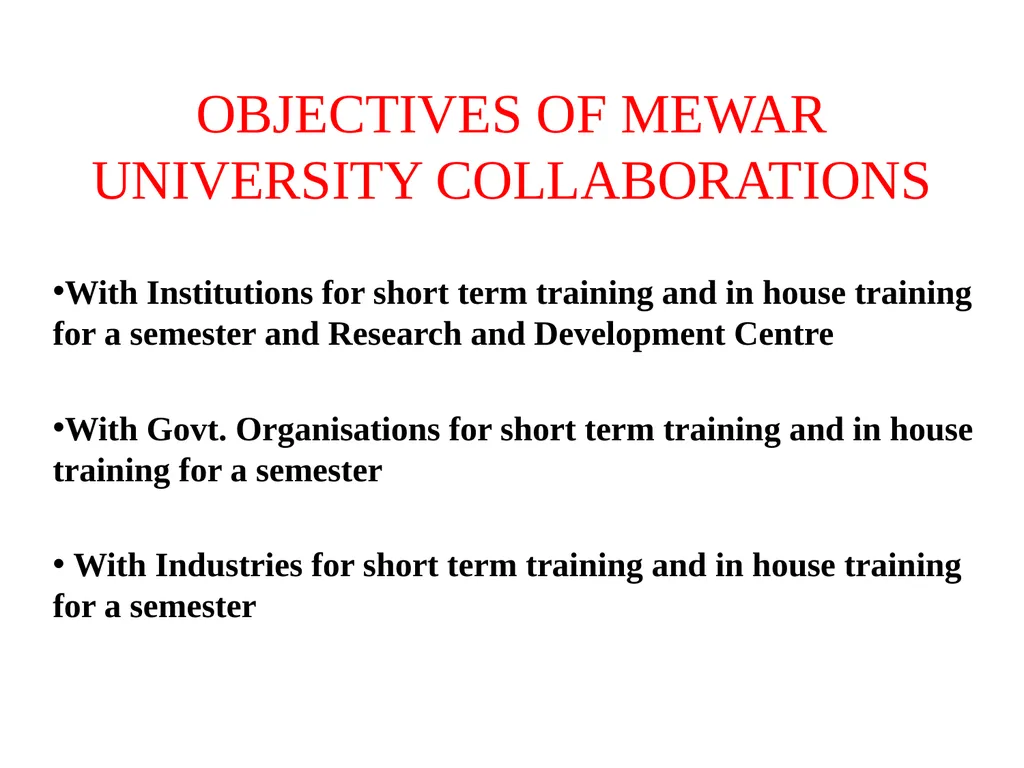
slide1. OBJECTIVES OF MEWAR UNIVERSITY COLLABORATIONS With Institutions for short term training and in house training for a semester and Research and Development Centre

With Govt. Organisations for short term training and in house training for a semester

With Industries for short term training and in house training for a semester<br>
slide2. COLLABORATIONS ALREADY DONE Institute of Apparel Management, Gurgaon, Ministry of Textile, Govt. of India
CIDC, New Delhi, Established by Planning Commission, Govt. of India
ITDC, Govt. of India
FFDI (MSME), Govt. of India
ISLE-LET(UK), New Delhi
IFVT, Mumbai<br>
slide3. COLLABORATIONS UNDER PROGRESS SITRAIN (SIEMEN’s) Centre, Panchkula
FDDI, Govt. of India
CDOS, Govt. of Rajasthan
NIELT, Govt. of India
CIPET, Govt. of India<br>
slide4. MU-ISLE-LET (UK) Indian Society of Lighting Engineers (ISLE) was founded in 1984 and is the apex body of lighting practitioners engaged in the promotion of the Science, Technology and the Art of Lighting in India.

Lighting Education Trust (LET) was established in 1995 in the UK as a charitable trust which is the joint undertaking between the Chartered Institution of Building Services Engineers (CIBSE) and the Institution of Lighting Engineers.<br>
slide5. About Advance Certificate and Diploma Programmes The proposed programmes on Energy and Lighting Technology are the outcome of the joint MoU signed by the Mewar University with ISLE-LET (UK) on April 13, 2012.

Under this MoU, Mewar University will launch Advance Certificate and Diploma in Energy and Lighting Technology in first phase.<br>
slide6. Advance Certificate in Energy and Lighting Technology (ACELT) Eligibility for Admission: The Advance Certificate in Energy and Lighting Technology (ACELT) is an inter-disciplinary programme. A candidate for being eligible for admission to the ACELT may be a candidate who has passed 10+2 with PCM or purusing Diploma or B.Tech/M.Tech or M.Sc or equivalent programmes.

They can do this programme seperately or concurrently with their ongoing programmes. This will be much needed value addition programmes and open new windows for their employment in the lighting industry under flexible dual degree programme as recommended by UGC.

Duration of the Programme: The normal duration of programme shall be two Semesters. The duration may be extended up to four semesters with the approval of the Vice-Chancellor.<br>
slide7. Overview of the Programme The ACELT programme seeks to provide more accessible and quality education and practical training to lighting personnel to meet the real work needs of manufacturing/ production industry and prepare them for the modern techniques, latest technologies, markets and employment patterns.

This programme has been designed to enhance quality and productivity of the personnel in the area of lighting and energy savings.

The ACELT is of 28 credits and comprises of 4courses and industrial visit in second semester.

A student has to obtain at least 40 % marks to pass the examination (both internal and external examination separately) for all the courses specified in the scheme of the programme.<br>
slide8. COURSE STRUCTURE First Semester Courses:
 
ACELT-101: Fundamentals of Vision and Lighting Technology (4 credits)
ACELT-102: Fundamentals of Photometry (4 credits)
ACELT-103: Fundamentals of Energy and Lighting Management (4 credits)

Second Semester Courses:
 
ACELT-201: Light Auditing and Lighting Measurement Lab (2 credits)
ACELT-202: Green Building and Day Lighting (4 credits)
ACELT-203: Integrated Lighting Design (4 credits)

ACELT-301: Industrial Training (6 credits): There will be in plant training in lighting and energy industry for 45 days during vacation.

Fee of the Programme:

The fee of the programme is Rs. 7500 per semester.<br>
slide9. Diploma in Energy and Lighting Technology (DLT) Eligibility for Admission: The Diploma in Energy and Lighting Technology (DLT) is an inter-disciplinary programme. A candidate for being eligible for admission to the DLT may be a candidate who has passed 10+2 with PCM or ACELT or purusing Diploma or B.Tech/M.Tech or M.Sc or equivalent programmes or their equivelent. They can do this programme concurrently with their ongoing programmes. This will be much needed value addition programmes and open new windows for their employment in the lighting industry under flexible dual degree programme as recommended by UGC.
 
Overview of the Programme: The programme consists of a mix of energy courses and lighting science courses. The idea is that a student should get an advance knowledge of energy, energy audit techniques, lighting audit and science technology and latest developments in the area. The normal duration of programme shall be two years (four Semesters). The duration of the programme is extendable up to three years with approval of the Vice-Chancellor of the University.<br>
slide10. DLT STRUCTURE First Semester
 
DLT-101: Fundamentals of Illuminating Technology (4 Credits)
DLT-102: Solar Active and Passive Buildings and Conservation (4 Credits)
DLT-103: Fundamentals of Energy and Lighting Management (4 Credits)

Second Semester
 
DLT-201: Light Auditing and Lighting Measurement Lab (2 Credits)
DLT-202: Green Building and Day Lighting (4 Credits)
DLT-203: Integrated Lighting Design (4 Credits)
DLT-204: Solid State Lighting and Controls (4 Credits)

Third/Fourth Semester  
 
DLT-301: Commercial Lighting Controls (4 Credits)
DLT-302: LEDs and Energy Efficient Lighting (4 Credits)
DLT-303: Hospitality Lighting System and Trends (4 Credits)

Third/Fourth Semester

DLT-401: Industrial Training/Project (16 Credits)
DLT-402:Comprehensive Academic and General Proficiency Viva-Voce (4 Credits)

Fee of the Programme:

The fee of the programme is Rs. 10000 per semester.<br>
slide11. IFVT Mumbai The Institute of Film and Video Technology (IFVT) shall offer the following courses as approved by the Mewar University in two phases:

Phase-1:

An Awareness Programme on Cinema Production (10 days): Fee Rs. 5000/-
An Integrated Certificate Programme On Cinema Technology (3 months): Fee Rs. 15000/-
Integrated Diploma in Cinema Technology (1 year), Fee Rs. 25000/-
Doctor in Philosophy (Ph. D.): Fee Rs. 1.5 Lakh for three years

Phase-2:

Bachelor in Cinema (B.CN) with specialization in Direction, Cinematography, Screen Play Writing, Editing, Audiography, and Acting: Fee Rs. 40000 for three years
Masters in Cinema (M.CN): Fee Rs. 30000 for two years<br>
slide12. ITDC, Govt. of India Skill Training Programme under Hunar se Rozgar Jointly with ITDC

Food & Beverages Service
Food Production
House Keeping
Bakery and Patisserie<br>
slide13. Footwear Design & Development Institute (FDDI) , Govt. of India Certificate, Diploma, B.Tech and M.Tech in different Streams:

STREAMS

Footwear Technology & Management
Leather Goods and Accessories Design
Fashion Designing
Fashion Merchandising & Retail Management<br>
slide14. FFDC, MSME, Govt. of India Fragrance & Flavour Development Centre, Ministry of MSME, Govt. of India, GT Road, Kannauj (UP)<br>
slide15. CIPET, Govt. of India central institute of plastic engineering & echnology, having its H.O. at T.V.K. Industrial Estate Guindy, Chennai – 600 032<br>
slide16. NIELIT, Govt. of India National Institute of Electronics and Information Technology, Dept. of Information Technology, Govt. of India

Short Term, Certificate, Diploma, Graduate, M.Tech and Ph.D<br>
slide17. Institute of Apparel Management (IAM), Gurgaon B.Tech in Fashion and Life Style Design

MBA in Fashion, Merchandising and Marketing

MBA (Executive)

Ph.D in Fashion, Merchandising and Life Style<br>
slide18. CIDC, Planning Commission Programmes to be offered
B. Tech in Civil Engineering
M.Tech in Construction Technology
M. Tech in Trenchless Technology
M. Tech in -------------Technology
Vocational programmes in various streams of entrepreneurship and engineering<br>