
Occupational Specialism: Electrotechnical
AM
Published · 43 slides · 0 views
1 / 1
















Description
Occupational Specialism: Electrotechnical Engineering K1.5 Application of the fundamental principles of national standards PowerPoint 1.5b: Chapter 52 Selection and erection of wiring systems Introduction What factors would you consider
Related Topics
Share
Embed code
Download this presentation From Below
"Occupational Specialism: Electrotechnical" is the property of its rightful owner. Permission is granted to download and print the materials on this website for personal, non-commercial use only, and to display it on your personal computer provided you do not modify the materials and that you retain all copyright notices contained in the materials. By downloading content from our website, you accept the terms of this agreement.
Presentation Transcript
01
Occupational Specialism: Electrotechnical Engineering
K1.5 Application of the fundamental principles of national standards
PowerPoint 1.5b: Chapter 52 Selection and erection of wiring systems<br>
K1.5 Application of the fundamental principles of national standards
PowerPoint 1.5b: Chapter 52 Selection and erection of wiring systems<br>
02
Introduction What factors would you consider when choosing a wiring system for a damp or thermally insulated environment?<br>
03
Objectives You should be able to:
Recall the main types of wiring systems and their reference installation methods
Explain how to select and erect wiring in accordance with BS 7671, taking account of external influences and safety regulations<br>
Recall the main types of wiring systems and their reference installation methods
Explain how to select and erect wiring in accordance with BS 7671, taking account of external influences and safety regulations<br>
04
Chapter 52: Selection and erection of wiring systems<br>
05
520.4: General Consideration shall be given to the application of the fundamental principles of Chapter 13 as it applies to:
cables and conductors
their connections, terminations and/or jointing
their associated supports or suspensions
their enclosure or methods of protection against external influences.<br>
cables and conductors
their connections, terminations and/or jointing
their associated supports or suspensions
their enclosure or methods of protection against external influences.<br>
06
521: Types of wiring system 521.1
The installation method of a wiring system in relation to the type of conductor or cable used shall be in accordance with Table 4A1 of Appendix 4 (page 432) provided the external influences are taken into account according to Section 522.
521.2 and 521.3 The installation method shall be in accordance with Table 4A2 or Appendix 4. Examples of wiring systems are shown in Table 4A2 including reference methods for obtaining current-carrying capacity.<br>
521.2 and 521.3 The installation method shall be in accordance with Table 4A2 or Appendix 4. Examples of wiring systems are shown in Table 4A2 including reference methods for obtaining current-carrying capacity.<br>
07
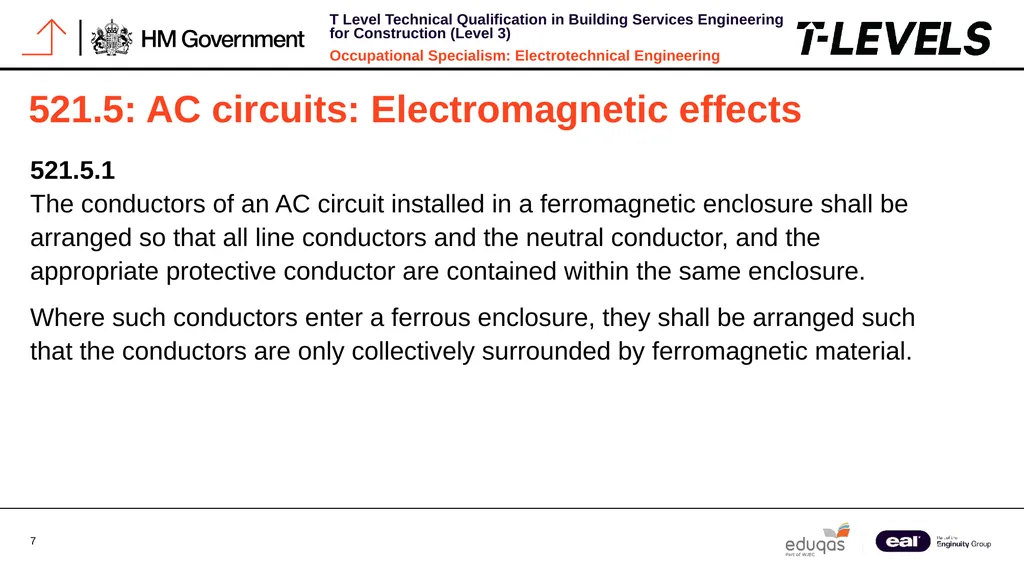
521.5: AC circuits: Electromagnetic effects 521.5.1
The conductors of an AC circuit installed in a ferromagnetic enclosure shall be arranged so that all line conductors and the neutral conductor, and the appropriate protective conductor are contained within the same enclosure.
Where such conductors enter a ferrous enclosure, they shall be arranged such that the conductors are only collectively surrounded by ferromagnetic material.<br>
Where such conductors enter a ferrous enclosure, they shall be arranged such that the conductors are only collectively surrounded by ferromagnetic material.<br>
08
521.5 AC circuits: Electromagnetic effects 521.5.2
Single-core cables armoured with steel wire or steel tape shall not be used for an AC circuit.
Note: the steel wire or steel tape armour of a single-core cable is regarded as a ferromagnetic enclosure. For single-core armoured cables, the use of aluminium armour may be considered.
521.5.201 Every conductor or cable shall have adequate strength and be so installed as to withstand the electromechanical forces that may be caused by current, including fault current, it may have to carry in service.<br>
Note: the steel wire or steel tape armour of a single-core cable is regarded as a ferromagnetic enclosure. For single-core armoured cables, the use of aluminium armour may be considered.
521.5.201 Every conductor or cable shall have adequate strength and be so installed as to withstand the electromechanical forces that may be caused by current, including fault current, it may have to carry in service.<br>
09
What are eddy currents? Currents that are induced into a conductive material (usually perpendicular to a magnetic field).
Generated by a changing magnetic field/flux (such as those created in an AC circuit).<br>
Generated by a changing magnetic field/flux (such as those created in an AC circuit).<br>
10
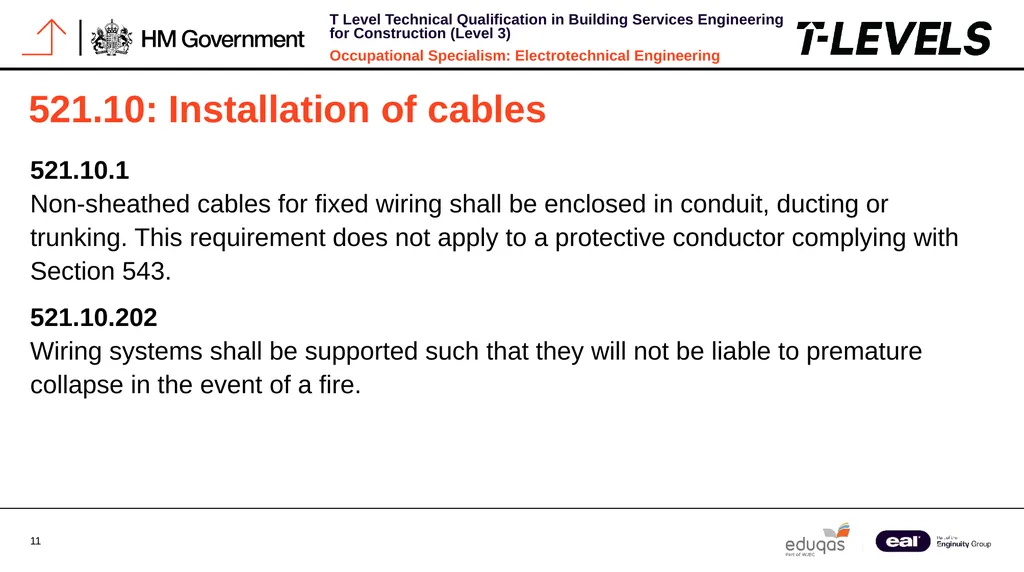
521.10: Installation of cables 521.10.1
Non-sheathed cables for fixed wiring shall be enclosed in conduit, ducting or trunking. This requirement does not apply to a protective conductor complying with Section 543.
521.10.202 Wiring systems shall be supported such that they will not be liable to premature collapse in the event of a fire.<br>
521.10.202 Wiring systems shall be supported such that they will not be liable to premature collapse in the event of a fire.<br>
11
521.10: Installation of cables Note 3: This regulation precludes, for example, the use of non-metallic cable clips or cable ties as the sole means of support where cables are clipped directly to exposed surfaces or suspended under the cable tray and the use of non-metallic cable trunking as the sole means of support of the cables therein.
Note 4: Suitably spaced steel or copper clips, saddles or ties are examples that will meet the requirements of this regulation.<br>
Note 4: Suitably spaced steel or copper clips, saddles or ties are examples that will meet the requirements of this regulation.<br>
12
521.8: Circuit arrangements 521.8.1
Circuits shall not be distributed over different multi-core cables or systems.
521.8.2 Line and neutral of each final circuit to be electrically separate from the other final circuits to prevent indirect energising of an isolated circuit.
No borrowed neutrals.<br>
521.8.2 Line and neutral of each final circuit to be electrically separate from the other final circuits to prevent indirect energising of an isolated circuit.
No borrowed neutrals.<br>
13
522: Selection and erection of wiring systems in relation to external influences The installation method selected shall be such that protection against the expected external influences is provided.
Note: the external influences categorised in Appendix 5 which are of significance to wiring systems are included in this section.
Appendix 5 (page 492) is split into three areas which are subdivided further.
A: Environment
B: Utilisation
C: Construction of building.<br>
Note: the external influences categorised in Appendix 5 which are of significance to wiring systems are included in this section.
Appendix 5 (page 492) is split into three areas which are subdivided further.
A: Environment
B: Utilisation
C: Construction of building.<br>
14
522.5: Presence of corrosive, polluting substances (AF) 522.5.2
Dissimilar metals liable to initiate electrolytic action shall not be placed in contact with each other, unless special arrangements are made to avoid the consequences of such contact.
522.5.3 Materials liable to cause mutual or individual deterioration or hazardous degradation shall not be placed in contact with each other.<br>
522.5.3 Materials liable to cause mutual or individual deterioration or hazardous degradation shall not be placed in contact with each other.<br>
15
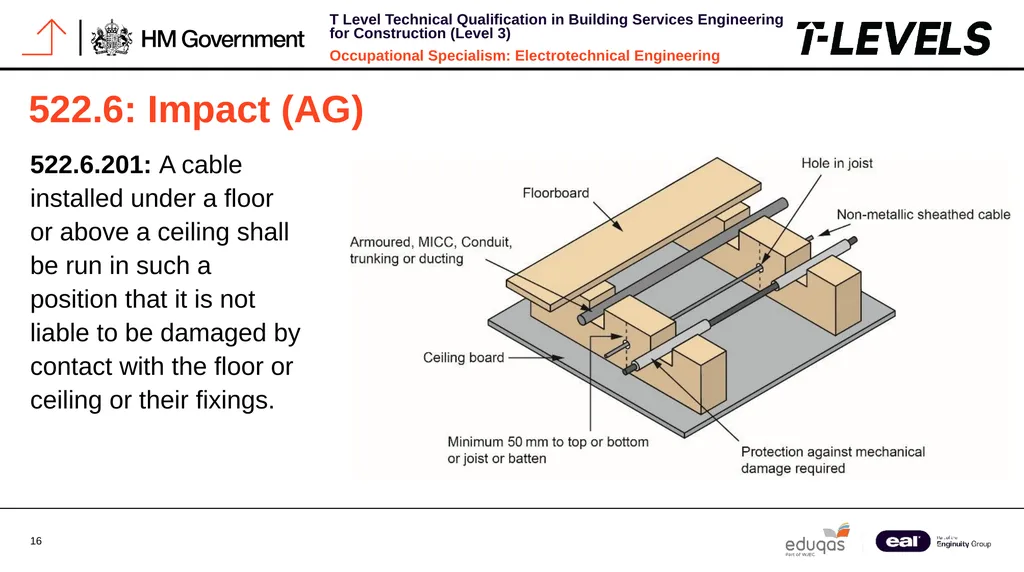
522.6: Impact (AG) 522.6.201: A cable installed under a floor or above a ceiling shall be run in such a position that it is not liable to be damaged by contact with the floor or ceiling or their fixings.<br>
16
522.6: Impact (AG) 522.6.201: A cable passing through a joist within a floor or ceiling construction or through a ceiling support (e.g., under floorboards), shall:
i. be installed at least 50mm measured vertically from the top, or bottom as appropriate, of the joist or batten
or
ii. comply with Regulation 522.6.204.<br>
i. be installed at least 50mm measured vertically from the top, or bottom as appropriate, of the joist or batten
or
ii. comply with Regulation 522.6.204.<br>
17
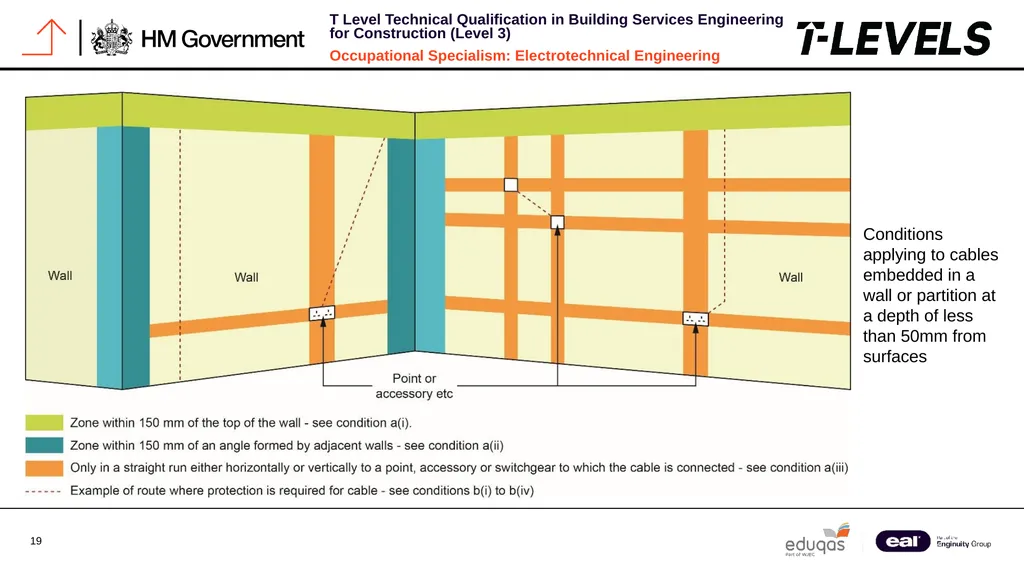
522.6.202 All cables should be in a safe zone and:
cables to be 50mm deep or
incorporate an earthed metal covering or
enclosed in earthed metal conduit or
mechanically protected (capping not sufficient).
Additional protection by RCD may be required: If it is necessary to install cables outside of these zones, they must be of the armoured type, installed in steel conduit, steel trunking or have mechanical protection from nails and screws.<br>
cables to be 50mm deep or
incorporate an earthed metal covering or
enclosed in earthed metal conduit or
mechanically protected (capping not sufficient).
Additional protection by RCD may be required: If it is necessary to install cables outside of these zones, they must be of the armoured type, installed in steel conduit, steel trunking or have mechanical protection from nails and screws.<br>
18
Conditions applying to cables embedded in a wall or partition at a depth of less than 50mm from surfaces<br>
19
522.6.203 Irrespective of its buried depth, a cable concealed in a wall or partition, the internal construction of which includes metallic parts, other than metallic fixings such as nails, screws and the like shall:
i. be provided with additional protection by means of an RCD having the characteristics specified in Regulation 415.1.1
or
ii. comply with Regulation 522.6.204.
For a cable installed at a depth of less than 50mm from the surface of a wall or partition, the requirements of Regulation 522.6.202(i) shall also apply.<br>
i. be provided with additional protection by means of an RCD having the characteristics specified in Regulation 415.1.1
or
ii. comply with Regulation 522.6.204.
For a cable installed at a depth of less than 50mm from the surface of a wall or partition, the requirements of Regulation 522.6.202(i) shall also apply.<br>
20
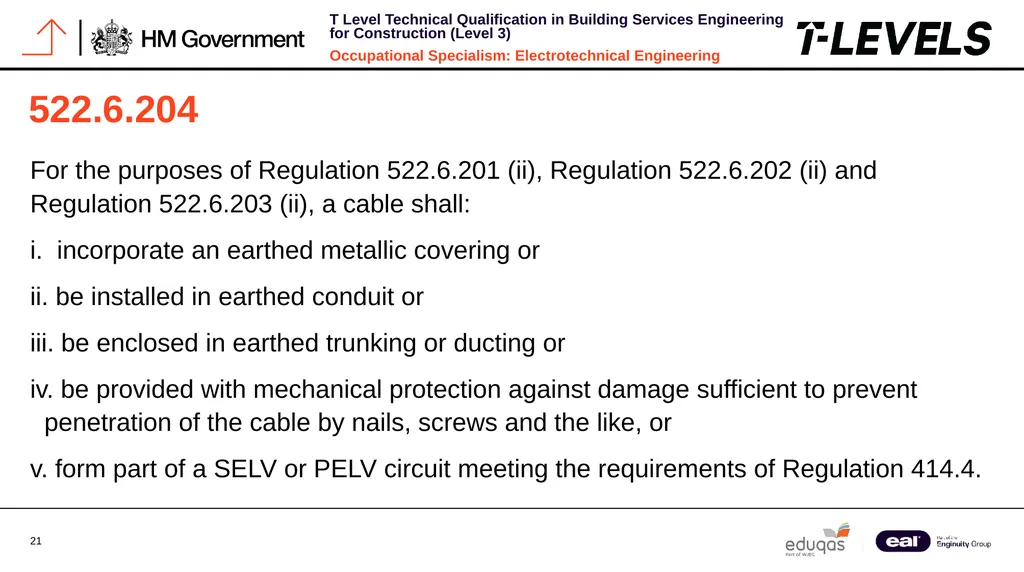
522.6.204 For the purposes of Regulation 522.6.201 (ii), Regulation 522.6.202 (ii) and Regulation 522.6.203 (ii), a cable shall:
i. incorporate an earthed metallic covering or
ii. be installed in earthed conduit or
iii. be enclosed in earthed trunking or ducting or
iv. be provided with mechanical protection against damage sufficient to prevent penetration of the cable by nails, screws and the like, or
v. form part of a SELV or PELV circuit meeting the requirements of Regulation 414.4.<br>
i. incorporate an earthed metallic covering or
ii. be installed in earthed conduit or
iii. be enclosed in earthed trunking or ducting or
iv. be provided with mechanical protection against damage sufficient to prevent penetration of the cable by nails, screws and the like, or
v. form part of a SELV or PELV circuit meeting the requirements of Regulation 414.4.<br>
21
522.7: Vibration (AH) 522.7.1
A wiring system supported by or fixed to a structure or equipment subject to vibration of medium severity (AH2) or high severity (AH3) shall be suitable for such conditions, particularly where cables and cable connections are concerned.<br>
22
522.8: Other mechanical stresses (AJ) 522.8.1: Damage to cables, terminations not to occur during installation or maintenance. Lubricants that may damage cables not to be used.
522.8.2: Conduit systems to be erected prior to installation cable.
522.8.3: Bending radii to be correct for the system and the cable.
522.8.4: Cables to be supported at appropriate intervals.
522.8.5: Cables to be supported to reduce mechanical strain (including tails).<br>
522.8.2: Conduit systems to be erected prior to installation cable.
522.8.3: Bending radii to be correct for the system and the cable.
522.8.4: Cables to be supported at appropriate intervals.
522.8.5: Cables to be supported to reduce mechanical strain (including tails).<br>
23
522.8.10 Except where installed in a conduit or duct that provides equivalent protection against mechanical damage, a cable buried in the ground shall incorporate an earthed armour or metal sheath or both, suitable for use as a protective conductor. The location of buried cables shall be marked by cable covers or a suitable marker tape.<br>
24
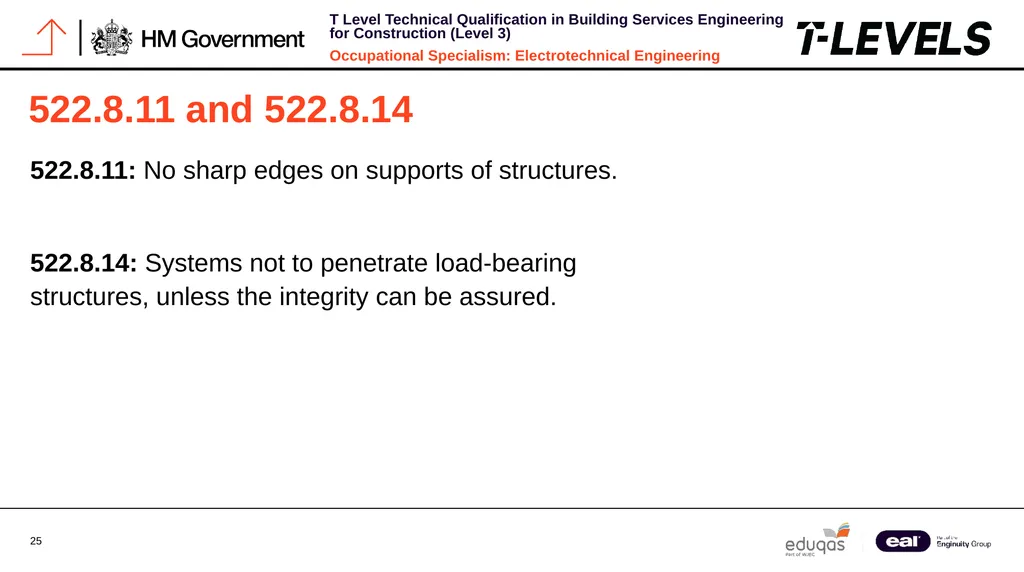
522.8.11 and 522.8.14 522.8.11: No sharp edges on supports of structures.
522.8.14: Systems not to penetrate load-bearing structures, unless the integrity can be assured.<br>
522.8.14: Systems not to penetrate load-bearing structures, unless the integrity can be assured.<br>
25
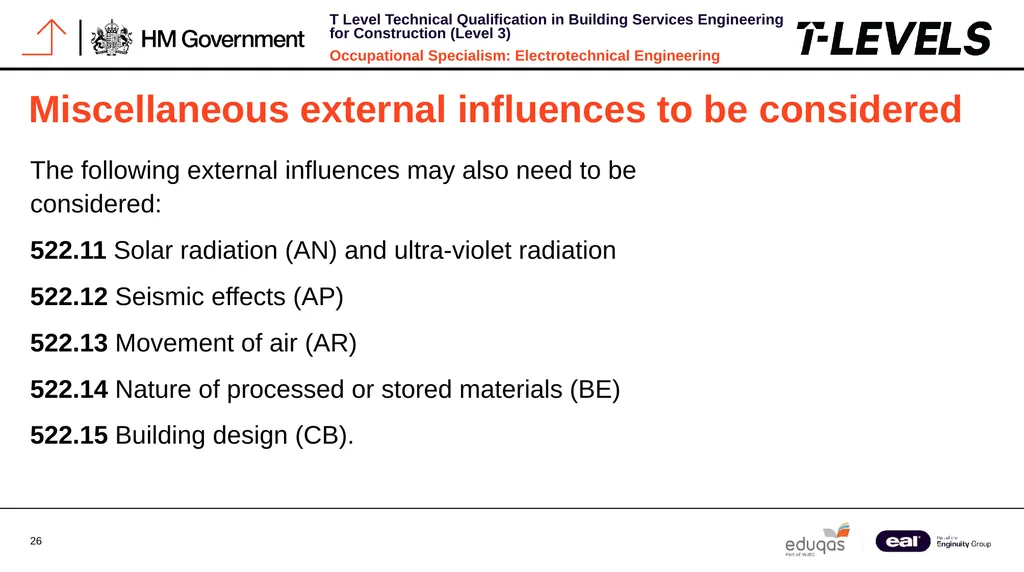
Miscellaneous external influences to be considered The following external influences may also need to be considered:
522.11 Solar radiation (AN) and ultra-violet radiation
522.12 Seismic effects (AP)
522.13 Movement of air (AR)
522.14 Nature of processed or stored materials (BE)
522.15 Building design (CB).<br>
522.11 Solar radiation (AN) and ultra-violet radiation
522.12 Seismic effects (AP)
522.13 Movement of air (AR)
522.14 Nature of processed or stored materials (BE)
522.15 Building design (CB).<br>
26
523: Current-carrying capacities of cables Cable sizing is a process of calculating a cable’s cross-sectional area (CSA) taking into consideration the load on the conductors and voltage drop.
Refer to Appendix 4 of BS 7671 for current-carrying capacity and voltage drop for cables and flexible cords.<br>
Refer to Appendix 4 of BS 7671 for current-carrying capacity and voltage drop for cables and flexible cords.<br>
27
Installation methods<br>
28
523: Current-carrying capacities of cables 523.1
The current, including any harmonic current, to be carried by any conductor for sustained periods during normal operation shall be such that the appropriate temperature limit specified in Table 52.1 is not exceeded.<br>
29
Harmonic currents What are harmonic currents?
Picture a voltage sine wave: A voltage applied across a constant resistance creates a current (also in the form of a sine wave). However, when the wave form is distorted by a non-linear load (such as an electronic lighting ballast), it can distort the current wave form and create harmonic currents.<br>
Picture a voltage sine wave: A voltage applied across a constant resistance creates a current (also in the form of a sine wave). However, when the wave form is distorted by a non-linear load (such as an electronic lighting ballast), it can distort the current wave form and create harmonic currents.<br>
30
523.2 The requirement of Regulation 523.1 is considered to be satisfied if the current for non-sheathed and sheathed cables does not exceed the appropriate values selected from the tables of current-carrying capacity given in Appendix 4 with reference to Table 4A2, subject to any necessary rating factors.<br>
31
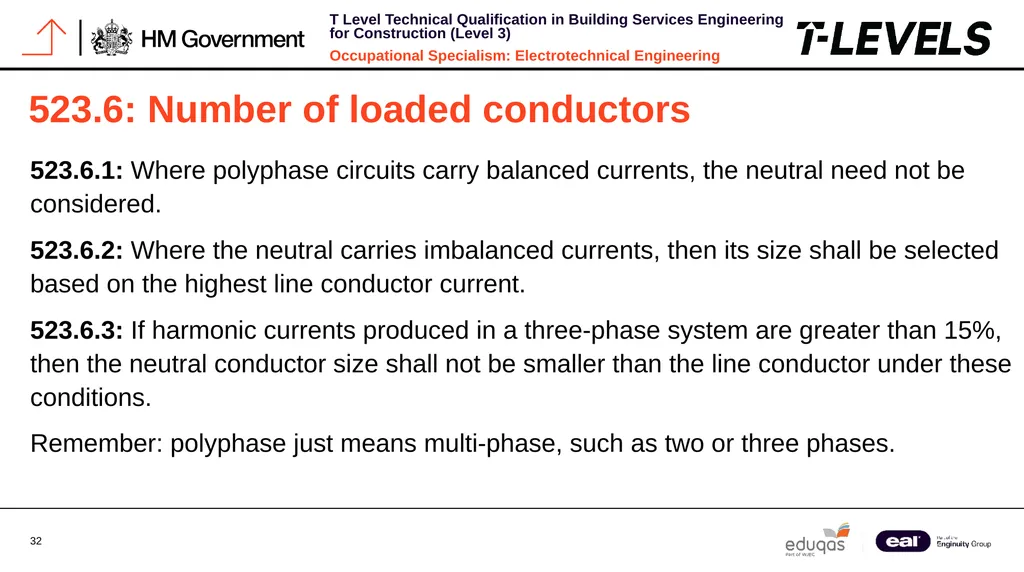
523.6: Number of loaded conductors 523.6.1: Where polyphase circuits carry balanced currents, the neutral need not be considered.
523.6.2: Where the neutral carries imbalanced currents, then its size shall be selected based on the highest line conductor current.
523.6.3: If harmonic currents produced in a three-phase system are greater than 15%, then the neutral conductor size shall not be smaller than the line conductor under these conditions.
Remember: polyphase just means multi-phase, such as two or three phases.<br>
523.6.2: Where the neutral carries imbalanced currents, then its size shall be selected based on the highest line conductor current.
523.6.3: If harmonic currents produced in a three-phase system are greater than 15%, then the neutral conductor size shall not be smaller than the line conductor under these conditions.
Remember: polyphase just means multi-phase, such as two or three phases.<br>
32
523.9: Cables in thermal insulation Avoid insulation coverage: Wherever possible, don’t route cables where they might be enclosed by thermal insulation.
Partially insulated runs: If a cable lies against an insulated wall or ceiling (contact on one side), use the current-carrying capacities in Appendix 4.
Fully surrounded ≥ 0.5 m: For a single cable completely encased in insulation over 0.5 m or more, assume 50% of its open-air, surface-clipped rating (Reference method C).
Fully surrounded < 0.5 m: Apply the appropriate derating factors from Appendix 4, item 2.6 (for conductors up to 10 mm²).<br>
Partially insulated runs: If a cable lies against an insulated wall or ceiling (contact on one side), use the current-carrying capacities in Appendix 4.
Fully surrounded ≥ 0.5 m: For a single cable completely encased in insulation over 0.5 m or more, assume 50% of its open-air, surface-clipped rating (Reference method C).
Fully surrounded < 0.5 m: Apply the appropriate derating factors from Appendix 4, item 2.6 (for conductors up to 10 mm²).<br>
33
Correction factor terminology Correction factors (for when carrying out current-carrying capacity calculations) are referred to as ‘rating factors’.<br>
34
526: Electrical connections 526.3: Every connection shall be accessible for inspection, testing and maintenance, except:
joint designed for burial
compound-filled joint
cold tail connections
welded, soldered, brazed, compression
part of equipment with appropriate product standard
equipment complying with BS 5733 for maintenance free.<br>
joint designed for burial
compound-filled joint
cold tail connections
welded, soldered, brazed, compression
part of equipment with appropriate product standard
equipment complying with BS 5733 for maintenance free.<br>
35
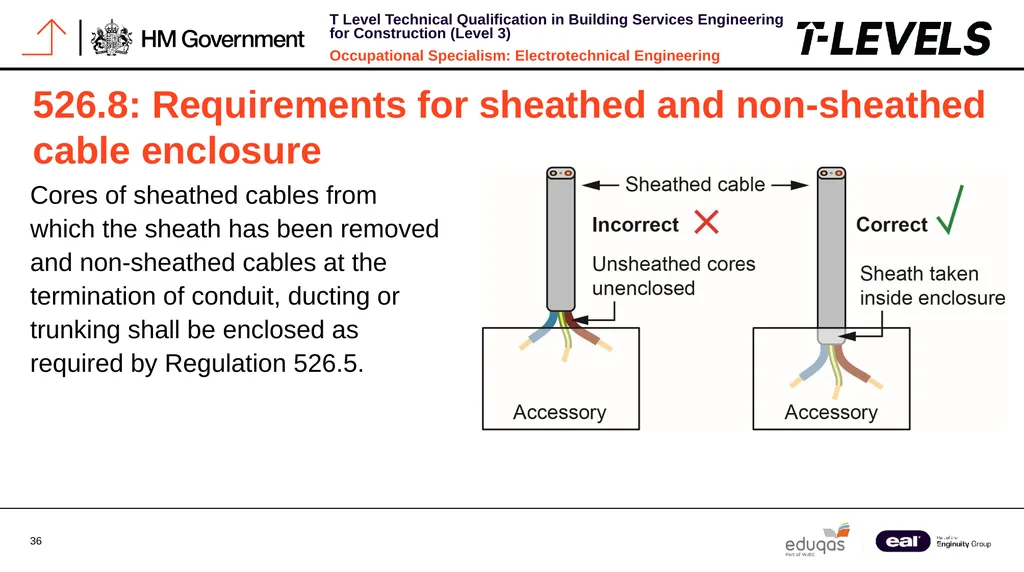
526.8: Requirements for sheathed and non-sheathed cable enclosure Cores of sheathed cables from which the sheath has been removed and non-sheathed cables at the termination of conduit, ducting or trunking shall be enclosed as required by Regulation 526.5.<br>
36
Selection and erection of wiring systems to minimise the spread of fire Regulation 527.1.3: This states that cables also need to satisfy the requirements of the Construction Products Regulation (CPR) in respect of their reaction to fire.
Regulation 527.2.1: Where a wiring system passes through elements of building construction such as floors, walls, roofs, ceilings, partitions or cavity barriers, the openings remaining after passage of the wiring system shall be sealed according to the degree of fire-resistance (if any) prescribed for the respective element of building construction before penetration.<br>
Regulation 527.2.1: Where a wiring system passes through elements of building construction such as floors, walls, roofs, ceilings, partitions or cavity barriers, the openings remaining after passage of the wiring system shall be sealed according to the degree of fire-resistance (if any) prescribed for the respective element of building construction before penetration.<br>
37
Multi-service barrier<br>
38
528 Section 528 sets out requirements for measures to be taken where electrical equipment, including wiring systems, are in close proximity to other electrical services and to non-electrical services.<br>
39
528: Proximity of wiring systems to other services 528.3.1: A wiring system shall not be installed in the vicinity of services that produce heat, smoke or fumes likely to be detrimental to the wiring, unless it is protected from harmful effects by shielding.
528.3.2: Where a wiring system is routed below services liable to cause condensation (such as water, steam or gas services), precautions shall be taken to protect the wiring system from deleterious effects.
528.3.5: No cable shall be run in a lift or hoist well unless it forms part of the lift installation.<br>
528.3.2: Where a wiring system is routed below services liable to cause condensation (such as water, steam or gas services), precautions shall be taken to protect the wiring system from deleterious effects.
528.3.5: No cable shall be run in a lift or hoist well unless it forms part of the lift installation.<br>
40
529: Selection and erection of wiring systems in relation to maintainability, including cleaning 529.1: With regard to maintainability, reference shall be made to Regulation 132.12 (accessibility).
529.3: Provision shall be made for safe and adequate access to all parts or a wiring system which may require maintenance, ladders, walkways etc.<br>
529.3: Provision shall be made for safe and adequate access to all parts or a wiring system which may require maintenance, ladders, walkways etc.<br>
41
Summary You should now be able to:
Recall the main types of wiring systems and their reference installation methods
Explain how to select and erect wiring in accordance with BS 7671, taking account of external influences and safety regulations<br>
Recall the main types of wiring systems and their reference installation methods
Explain how to select and erect wiring in accordance with BS 7671, taking account of external influences and safety regulations<br>
42
Any questions? Copyright in this document belongs to and is used under licence from the Department for Education, © 2025.
‘T-LEVELS’ and ‘T Level’ are registered trademarks of the Department for Education.
WJEC is authorised by the Department for Education to develop and deliver this T Level Technical Qualification.
WJEC operates in England under the name Eduqas which is a registered trademark of WJEC.<br>
‘T-LEVELS’ and ‘T Level’ are registered trademarks of the Department for Education.
WJEC is authorised by the Department for Education to develop and deliver this T Level Technical Qualification.
WJEC operates in England under the name Eduqas which is a registered trademark of WJEC.<br>