OCR A Level Computer Science H446 Paper 1 Stacks Unit 7 Data structures Be familiar with the concept and uses of a stack Be able to describe the creation and maintenance of data within a stack Be able to describe and apply the following
"OCR A Level Computer Science H446 – Paper 1 Stacks" is the property of its rightful owner. Permission is granted to
download and print the materials on this website for personal, non-commercial use only, and to display it
on your personal computer provided you do not modify the materials and that you retain all copyright
notices contained in the materials. By downloading content from our website, you accept the terms of this
agreement.
Presentation Transcript
01
OCR
A Level
Computer Science
H446 – Paper 1 Stacks
Unit 7
Data structures<br>
02
Be familiar with the concept and uses of a stack
Be able to describe the creation and maintenance of data within a stack
Be able to describe and apply the following operations: push, pop, peek (or top), test for empty stack, test for full stack
Be able to explain how a stack frame is used with subroutine calls to store return addresses, parameters and local variables Objectives<br>
03
Abstraction Three abstract data types (ADTs) covered so far are a queue, list, and linked list
How are the concepts of data hiding and encapsulation used in the implementation of an abstract data type?<br>
04
Stack definition Think of a stack of textbooks
The teacher adds to the top of the stack
The students removes from the top of the stack
Last In First Out = LIFO<br>
05
Using a stack Many examples of stacks occur in everyday life – can you think of examples?
Can you think of any examples related to computing?
What operations are needed to implement a stack?<br>
06
Modelling a stack The basic operations needed are:
Add an item to the top
Remove an item from the top
Check if the stack is full
Check if the stack is empty<br>
07
Programming operations These methods could be written to implement the required functionality of a stack
push(item) – adds item to the top of the stack
pop() – removes and returns the item on the top of the stack
isFull() – checks if the stack is full
isEmpty() – checks if the stack is empty
You might also want to write methods to:
peek() – return the top item without removing it
size() – return the number of items on the stack<br>
08
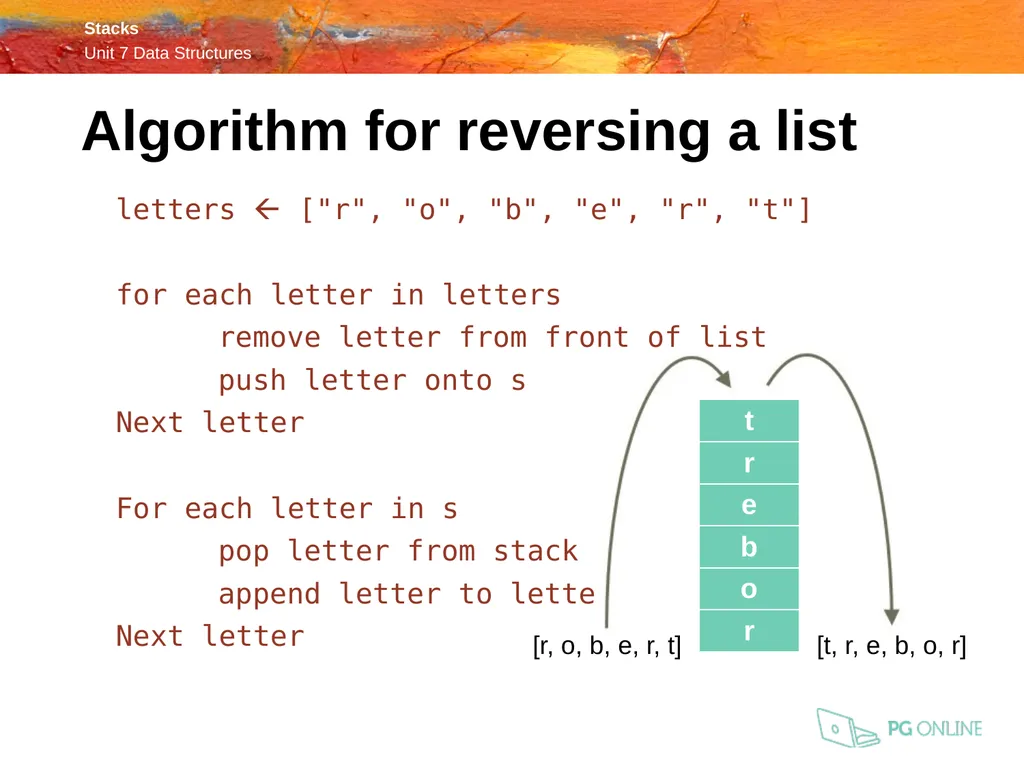
Using a stack ADT In computing, a stack is an important data structure; one reason is that the order of insertion is the reverse of the order of removal
Suppose you pop the letters r, o, b, e, r, t from a list letters, pushing each one onto a stack s
Now remove all these letters from the stack, adding each letter back into the list – what does the list look like now?<br>
09
Algorithm for reversing a list letters ["r", "o", "b", "e", "r", "t"]
for each letter in letters
remove letter from front of list
push letter onto s
Next letter
For each letter in s
pop letter from stack
append letter to letters
Next letter [r, o, b, e, r, t] [t, r, e, b, o, r]<br>
10
Implementing a stack as a list It’s very easy to implement a stack as a list
What list methods could you use to implement these functions?
Add an item to a stack
Remove an item from a stack
Check if the stack is empty
Find the number of items in the stack<br>
11
Using a list Using built-in list operations, you could use the following list methods:
append(item) – add item to the top of the stack
pop() – remove and returns the item on the top of the stack
len(stack) – find the length (height) of the stack<br>
12
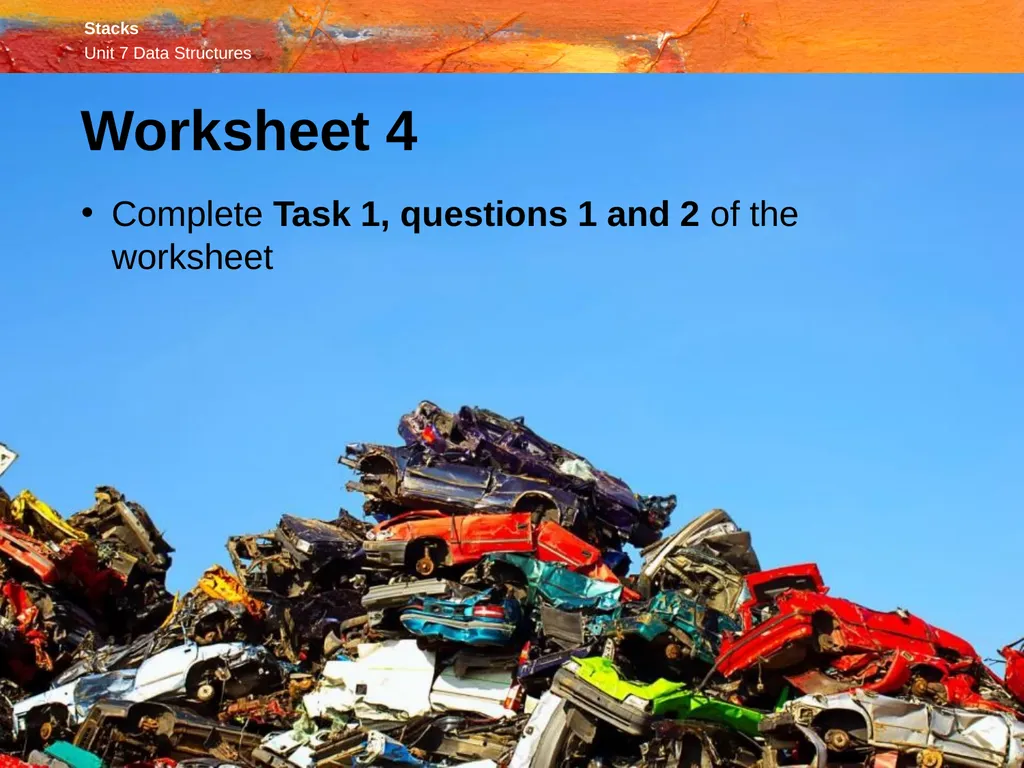
Worksheet 4 Complete Task 1, questions 1 and 2 of the worksheet<br>
13
Overflow and underflow Overflow – attempting to push onto a stack that is full
Underflow – attempting to pop from a stack that is empty
Note that if a stack is implemented using a dynamic list structure, there may be no “stack full” test. The computer may simply give a “stack overflow” error when it runs out of memory<br>
14
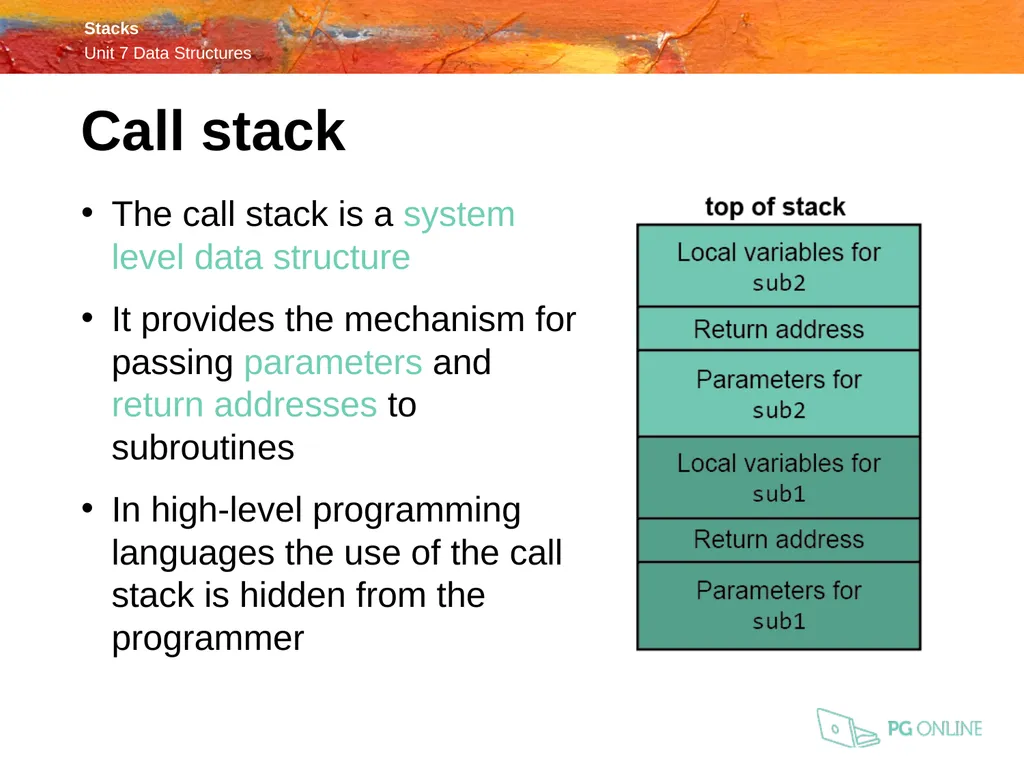
Call stack The call stack is a system level data structure
It provides the mechanism for passing parameters and return addresses to subroutines
In high-level programming languages the use of the call stack is hidden from the programmer<br>
15
Call stack What happens when this code is executed?
bigger = max (num1, num2)
The programmer doesn’t need to know how the arguments (num1, num2) are sent to the function max, or how the result is returned to the calling program
The values of num1 and num2 and the return address (the line after the call statement), are saved on the stack
These values are popped when the function completes<br>
16
Subroutine calls Calls to subroutines are executed as follows:
The parameters are saved onto the stack
The address to which execution returns after the end of the subroutine is reached is saved onto the stack
Execution is transferred to the subroutine code<br>
17
Subroutine execution Subroutines are executed as follows:
Stack space is allocated for local variables
The subroutine code executes
The return address is retrieved
The parameters are popped
Execution is transferred back to the return address<br>
18
Plenary Describe a stack
Describe the operations on a stack
Give examples of the use of a stack
Compare the behaviour of a stack with the behaviour of a queue<br>
19
Plenary Stack - a last-in, first-out data structure
Operations: PUSH and POP, test for full and empty stack
Uses:
Holding return addresses, parameters and local variables when subroutines are called
Holding website addresses just visited
Holding operations just performed in word processor, spreadsheet etc.
Compare with a queue – queue is FIFO, stack is LIFO<br>