
Ohio Collaborative LE Certification Program 2023
PC
Published · 55 slides · 0 views
1 / 1
Description
Ohio Collaborative LE Certification Program 2023 Learning Objectives Law Enforcement Response to Mass ProtestsDemonstrations The ability of the police to perform their duties is dependent upon public approval of police existence, actions,
Related Topics
Share
Embed code
Download this presentation From Below
"Ohio Collaborative LE Certification Program 2023" is the property of its rightful owner. Permission is granted to download and print the materials on this website for personal, non-commercial use only, and to display it on your personal computer provided you do not modify the materials and that you retain all copyright notices contained in the materials. By downloading content from our website, you accept the terms of this agreement.
Presentation Transcript
01
Ohio Collaborative LE Certification Program 2023<br>
02
Learning Objectives<br>
03
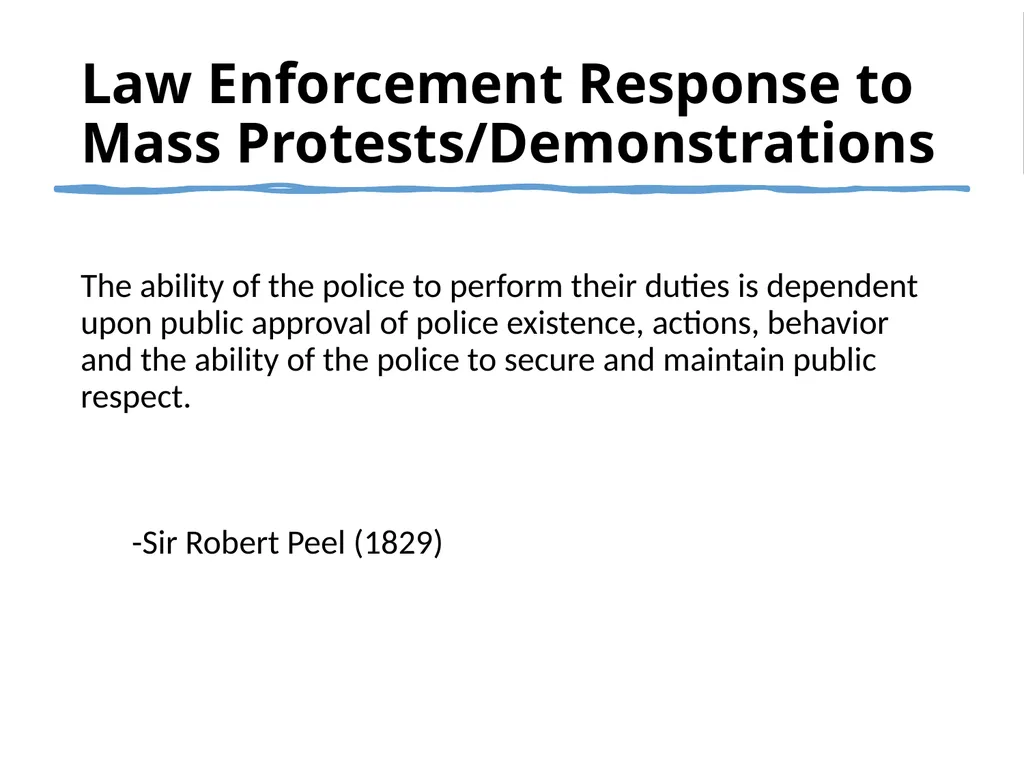
Law Enforcement Response to Mass Protests/Demonstrations The ability of the police to perform their duties is dependent upon public approval of police existence, actions, behavior and the ability of the police to secure and maintain public respect.
-Sir Robert Peel (1829)<br>
-Sir Robert Peel (1829)<br>
04
Law Enforcement Response to Mass Protests/Demonstrations<br>
05
Law Enforcement Response to Mass Protests/Demonstrations In 2021, The Ohio Collaborative Community-Police Advisory Board adopted the State of Ohio Standard for Law Enforcement Response to Mass Protests/Demonstrations.<br>
06
Law Enforcement Response to Mass Protests/Demonstrations Purpose:
Policing agencies must implement practices that enable Ohio’s citizens to safely and peacefully exercise their constitutional rights of expression, of assembly, and of freedom of the press while also ensuring public safety and the safety of their officers.<br>
Policing agencies must implement practices that enable Ohio’s citizens to safely and peacefully exercise their constitutional rights of expression, of assembly, and of freedom of the press while also ensuring public safety and the safety of their officers.<br>
07
Law Enforcement Response to Mass Protests/Demonstrations Standard:
Law enforcement agencies that may respond to mass protests/demonstrations must establish a related written policy that addresses the following:
Knowledge of applicable legal standards
Deployment of proper use of force, weapons, and tactics
Effective information-gathering techniques<br>
Law enforcement agencies that may respond to mass protests/demonstrations must establish a related written policy that addresses the following:
Knowledge of applicable legal standards
Deployment of proper use of force, weapons, and tactics
Effective information-gathering techniques<br>
08
Law Enforcement Response to Mass Protests/Demonstrations<br>
09
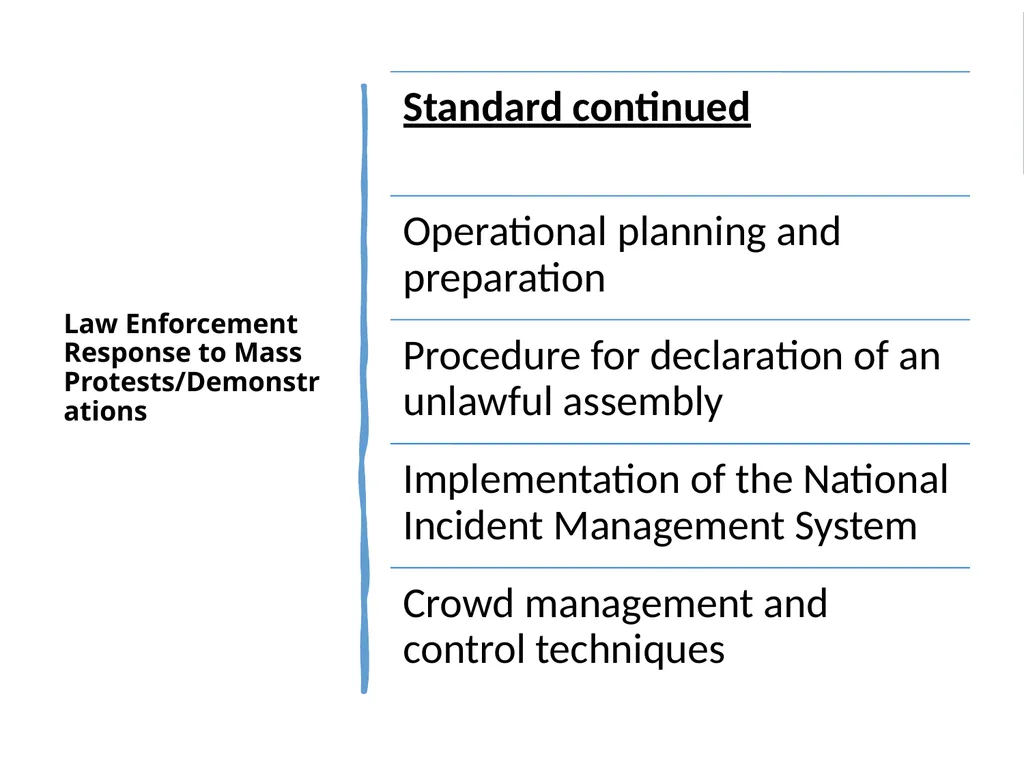
Law Enforcement Response to Mass Protests/Demonstrations Standard continued
Communication plans that include communicating with the media and the public that strongly consider the use of social media
Mutual aid agreements or memoranda of understanding with other police agencies and first responders; including guidance for requesting and directing responding agencies for mass protests/demonstrations
Deactivation of deployment protocol and after-action review<br>
Communication plans that include communicating with the media and the public that strongly consider the use of social media
Mutual aid agreements or memoranda of understanding with other police agencies and first responders; including guidance for requesting and directing responding agencies for mass protests/demonstrations
Deactivation of deployment protocol and after-action review<br>
10
Law Enforcement Response to Mass Protests/Demonstrations<br>
11
Law Enforcement Response to Mass Protests/Demonstrations Standard Commentary
A mass protest or demonstration is an occasion, either organized or spontaneous, where the number of people attending is sufficient enough to strain the planning and response resources of the community, city or state. They can be motivated by natural disasters or conflict.<br>
A mass protest or demonstration is an occasion, either organized or spontaneous, where the number of people attending is sufficient enough to strain the planning and response resources of the community, city or state. They can be motivated by natural disasters or conflict.<br>
12
Law Enforcement Response to Mass Protests/Demonstrations Standard Commentary continued
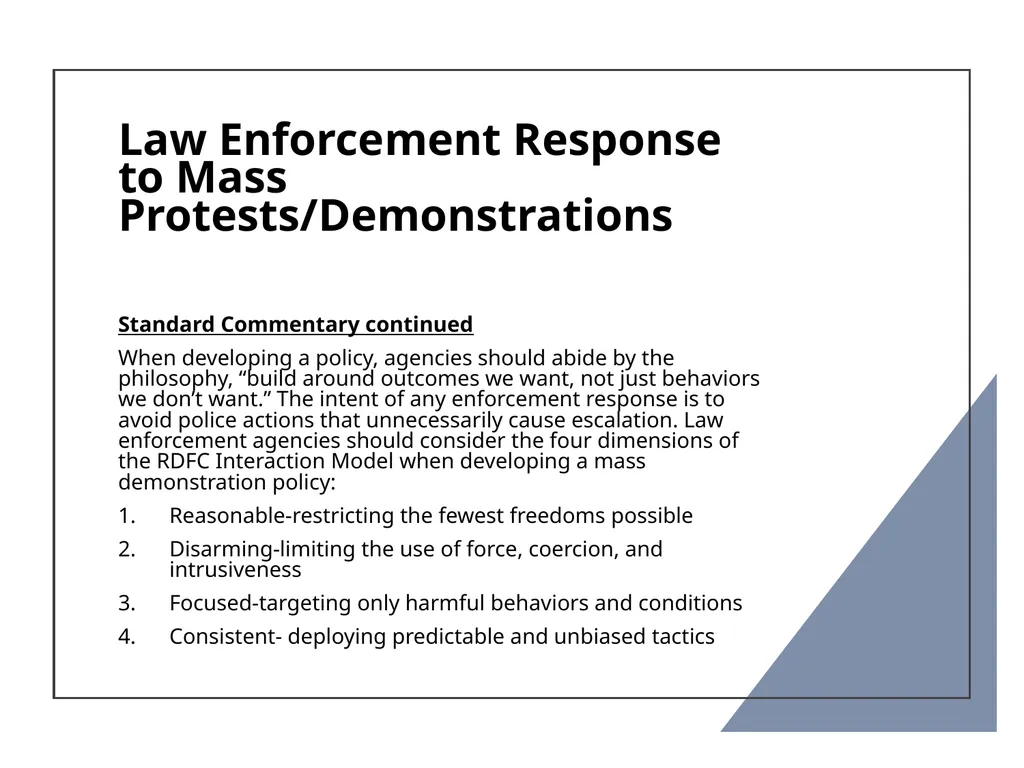
When developing a policy, agencies should abide by the philosophy, “build around outcomes we want, not just behaviors we don’t want.” The intent of any enforcement response is to avoid police actions that unnecessarily cause escalation. Law enforcement agencies should consider the four dimensions of the RDFC Interaction Model when developing a mass demonstration policy:
Reasonable-restricting the fewest freedoms possible
Disarming-limiting the use of force, coercion, and intrusiveness
Focused-targeting only harmful behaviors and conditions
Consistent- deploying predictable and unbiased tactics<br>
When developing a policy, agencies should abide by the philosophy, “build around outcomes we want, not just behaviors we don’t want.” The intent of any enforcement response is to avoid police actions that unnecessarily cause escalation. Law enforcement agencies should consider the four dimensions of the RDFC Interaction Model when developing a mass demonstration policy:
Reasonable-restricting the fewest freedoms possible
Disarming-limiting the use of force, coercion, and intrusiveness
Focused-targeting only harmful behaviors and conditions
Consistent- deploying predictable and unbiased tactics<br>
13
Law Enforcement Response to Mass Protests/Demonstrations Standard Commentary continued
Participating in a peaceful demonstration or protest is a constitutional right afforded to all citizens, and as such, law enforcement must protect these rights while maintaining public safety and officer safety. Law enforcement should engage with demonstration leaders to understand the intent of the demonstration and to discuss how they can work together to achieve the demonstrator's desired outcomes while preserving order and preventing conflict. Law enforcement should have open and transparent communication with the public before, during, and after any mass gatherings.<br>
Participating in a peaceful demonstration or protest is a constitutional right afforded to all citizens, and as such, law enforcement must protect these rights while maintaining public safety and officer safety. Law enforcement should engage with demonstration leaders to understand the intent of the demonstration and to discuss how they can work together to achieve the demonstrator's desired outcomes while preserving order and preventing conflict. Law enforcement should have open and transparent communication with the public before, during, and after any mass gatherings.<br>
14
Law Enforcement Response to Mass Protests/Demonstrations Standard Commentary continued
Law enforcement should be careful to ensure their response to mass demonstrations are proportional to the actions and the mood of the crowd. Police should incorporate a tiered response plan that starts at their lowest level of crowd response and allows for prompt escalation only when necessary. When police action is needed, it should be directed toward only those individuals displaying harmful behaviors, such as violence, property destruction, or other serious crimes.<br>
Law enforcement should be careful to ensure their response to mass demonstrations are proportional to the actions and the mood of the crowd. Police should incorporate a tiered response plan that starts at their lowest level of crowd response and allows for prompt escalation only when necessary. When police action is needed, it should be directed toward only those individuals displaying harmful behaviors, such as violence, property destruction, or other serious crimes.<br>
15
Law Enforcement Response to Mass Protests/Demonstrations Model Policy
Policing agencies must implement practices that enable Ohio’s citizens to safely and peaceful exercise their constitutional right to freely assemble and allow for freedom of the press while also ensuring public safety and the safety of their officers.
A mass protest or demonstration is an occasion, either organized or spontaneous, where the number of people attending is sufficient enough to strain the planning and response resources of the community, city, or state. They can be motivated by natural disasters or conflict.<br>
Policing agencies must implement practices that enable Ohio’s citizens to safely and peaceful exercise their constitutional right to freely assemble and allow for freedom of the press while also ensuring public safety and the safety of their officers.
A mass protest or demonstration is an occasion, either organized or spontaneous, where the number of people attending is sufficient enough to strain the planning and response resources of the community, city, or state. They can be motivated by natural disasters or conflict.<br>
16
Law Enforcement Response to Mass Protests/Demonstrations Model Policy continued
When developing a policy, agencies should abide by the philosophy, “build around outcomes we want, not just behaviors we don’t want.” The intent of any enforcement response is to avoid police actions that unnecessarily cause escalation. Law enforcement agencies should consider the four dimensions of the RDFC Interaction when developing a mass demonstration policy:
Reasonable—restricting the fewest freedoms possible
Disarming—limiting the use of force, coercion, and intrusiveness
Focused—targeting only harmful behaviors and conditions
Consistent—deploying predictable and unbiased tactics<br>
When developing a policy, agencies should abide by the philosophy, “build around outcomes we want, not just behaviors we don’t want.” The intent of any enforcement response is to avoid police actions that unnecessarily cause escalation. Law enforcement agencies should consider the four dimensions of the RDFC Interaction when developing a mass demonstration policy:
Reasonable—restricting the fewest freedoms possible
Disarming—limiting the use of force, coercion, and intrusiveness
Focused—targeting only harmful behaviors and conditions
Consistent—deploying predictable and unbiased tactics<br>
17
Law Enforcement Response to Mass Protests/Demonstrations Model Policy continued
Participating in a peaceful demonstration or protest is a constitutional right afforded to all citizens, and as such, law enforcement must protect these rights while maintaining public safety and officer safety. Law enforcement should engage with demonstration leaders to understand the intent of the demonstration and to discuss how they can work together to achieve the demonstrators’ desired outcomes while preserving order and preventing conflict. Law enforcement should have open and transparent communication with the public before, during, and after any mass gathering.<br>
Participating in a peaceful demonstration or protest is a constitutional right afforded to all citizens, and as such, law enforcement must protect these rights while maintaining public safety and officer safety. Law enforcement should engage with demonstration leaders to understand the intent of the demonstration and to discuss how they can work together to achieve the demonstrators’ desired outcomes while preserving order and preventing conflict. Law enforcement should have open and transparent communication with the public before, during, and after any mass gathering.<br>
18
Law Enforcement Response to Mass Protests/Demonstrations Model Policy continued
Law enforcement should be careful to ensure their responses to mass demonstrations are proportional to the actions and the mood of the crowd. Police should incorporate a tiered response plan that starts at their lowest level of crowd response and allows for prompt escalation only when necessary. When police action is needed, it should be directed toward only these individuals displaying harmful behaviors, such as violence, property destruction, or other serious crimes.<br>
Law enforcement should be careful to ensure their responses to mass demonstrations are proportional to the actions and the mood of the crowd. Police should incorporate a tiered response plan that starts at their lowest level of crowd response and allows for prompt escalation only when necessary. When police action is needed, it should be directed toward only these individuals displaying harmful behaviors, such as violence, property destruction, or other serious crimes.<br>
19
Law Enforcement Response to Mass Protests/Demonstrations Model Policy continued
The Constitution of the State of Ohio Article 1 § 3
The people have the right to assemble together, in a peaceable manner, to consult for the common good; to instruct their Representatives; and to petition the General Assembly for the redress of grievances.
The Constitution of the State of Ohio Article 1 § 11
Every citizen may freely speak, write, and publish his sentiments on all subjects, being responsible for the abuse of the right; and no law shall be passed to restrain or abridge the liberty of speech, or of the press.<br>
The Constitution of the State of Ohio Article 1 § 3
The people have the right to assemble together, in a peaceable manner, to consult for the common good; to instruct their Representatives; and to petition the General Assembly for the redress of grievances.
The Constitution of the State of Ohio Article 1 § 11
Every citizen may freely speak, write, and publish his sentiments on all subjects, being responsible for the abuse of the right; and no law shall be passed to restrain or abridge the liberty of speech, or of the press.<br>
20
Law Enforcement Response to Mass Protests/Demonstrations Model Policy continued
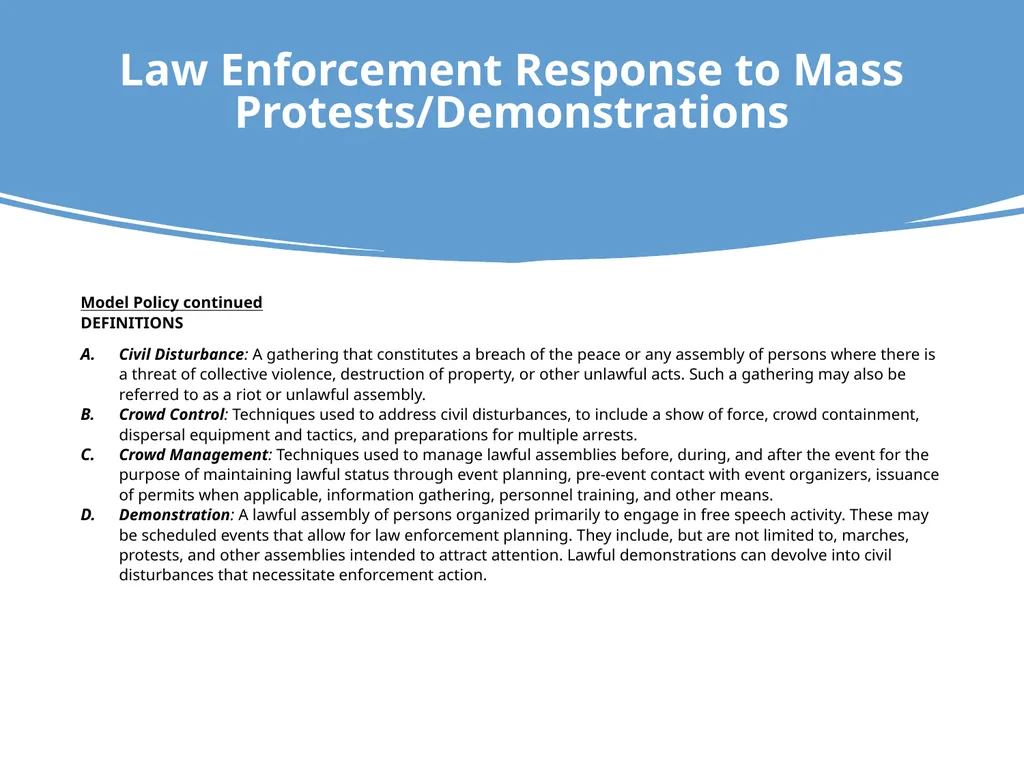
Definitions
Civil Disturbance: A gathering that constitutes a breach of the peace or any assembly of persons where there is a threat of collective violence, destruction of property, or other unlawful acts. Such a gathering may also be referred to as a riot or unlawful assembly.
Crowd Control: Techniques used to address civil disturbances, to include a show of force, crowd containment, dispersal equipment and tactics, and preparations for multiple arrests.
Crowd Management: Techniques used to manage lawful assemblies before, during, and after the event for the purpose of maintaining lawful status through event planning, pre-event contact with event organizers, issuance of permits when applicable, information gathering, personnel training, and other means.
Demonstration: A lawful assembly of persons organized primarily to engage in free speech activity. These may be scheduled events that allow for law enforcement planning. They include, but are not limited to, marches, protests, and other assemblies intended to attract attention. Lawful demonstrations can devolve into civil disturbances that necessitate enforcement action.<br>
Definitions
Civil Disturbance: A gathering that constitutes a breach of the peace or any assembly of persons where there is a threat of collective violence, destruction of property, or other unlawful acts. Such a gathering may also be referred to as a riot or unlawful assembly.
Crowd Control: Techniques used to address civil disturbances, to include a show of force, crowd containment, dispersal equipment and tactics, and preparations for multiple arrests.
Crowd Management: Techniques used to manage lawful assemblies before, during, and after the event for the purpose of maintaining lawful status through event planning, pre-event contact with event organizers, issuance of permits when applicable, information gathering, personnel training, and other means.
Demonstration: A lawful assembly of persons organized primarily to engage in free speech activity. These may be scheduled events that allow for law enforcement planning. They include, but are not limited to, marches, protests, and other assemblies intended to attract attention. Lawful demonstrations can devolve into civil disturbances that necessitate enforcement action.<br>
21
Law Enforcement Response to Mass Protests/Demonstrations Model Policy continued
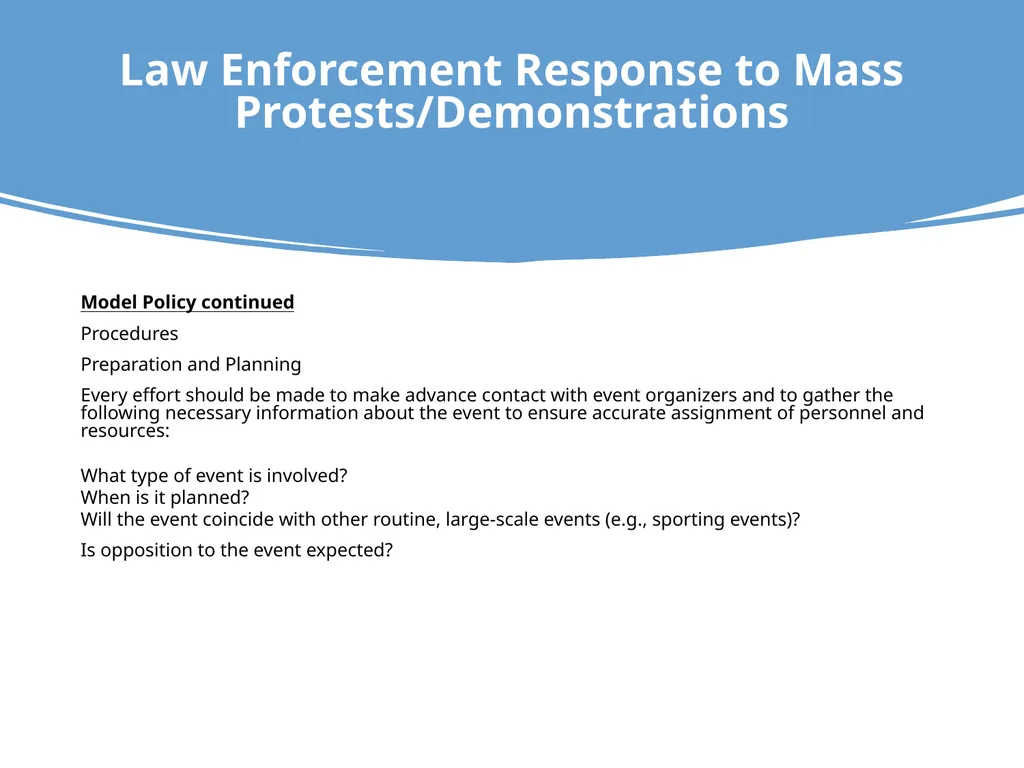
Procedures
Preparation and Planning
Every effort should be made to make advance contact with event organizers and to gather the following necessary information about the event to ensure accurate assignment of personnel and resources:
What type of event is involved?
When is it planned?
Will the event coincide with other routine, large-scale events (e.g., sporting events)?
Is opposition to the event expected?<br>
Procedures
Preparation and Planning
Every effort should be made to make advance contact with event organizers and to gather the following necessary information about the event to ensure accurate assignment of personnel and resources:
What type of event is involved?
When is it planned?
Will the event coincide with other routine, large-scale events (e.g., sporting events)?
Is opposition to the event expected?<br>
22
Law Enforcement Response to Mass Protests/Demonstrations Model Policy continued
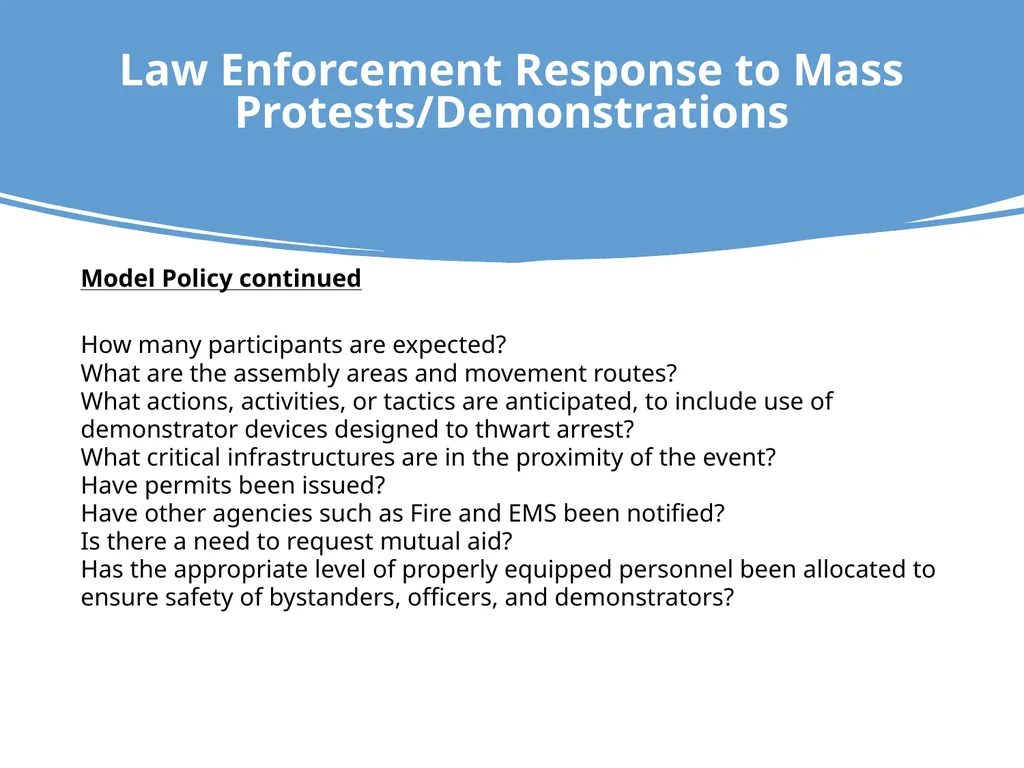
How many participants are expected?
What are the assembly areas and movement routes?
What actions, activities, or tactics are anticipated, to include use of demonstrator devices designed to thwart arrest?
What critical infrastructures are in the proximity of the event?
Have permits been issued?
Have other agencies such as Fire and EMS been notified?
Is there a need to request mutual aid?
Has the appropriate level of properly equipped personnel been allocated to ensure safety of bystanders, officers, and demonstrators?<br>
How many participants are expected?
What are the assembly areas and movement routes?
What actions, activities, or tactics are anticipated, to include use of demonstrator devices designed to thwart arrest?
What critical infrastructures are in the proximity of the event?
Have permits been issued?
Have other agencies such as Fire and EMS been notified?
Is there a need to request mutual aid?
Has the appropriate level of properly equipped personnel been allocated to ensure safety of bystanders, officers, and demonstrators?<br>
23
Law Enforcement Response to Mass Protests/Demonstrations Model Policy continued
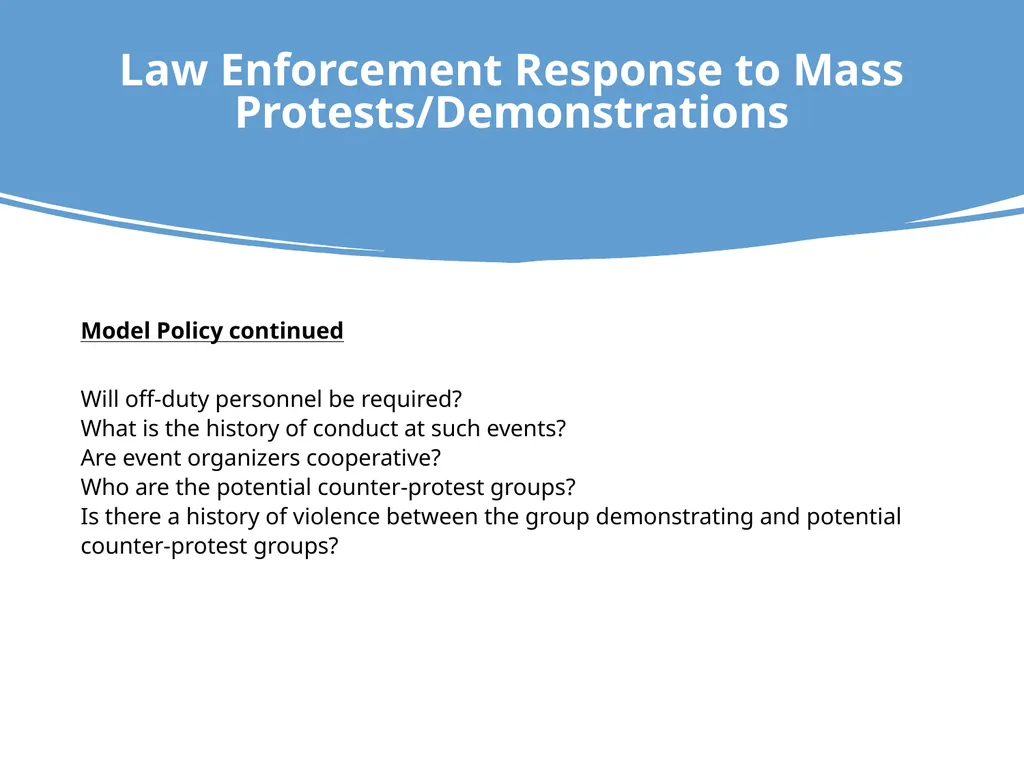
Will off-duty personnel be required?
What is the history of conduct at such events?
Are event organizers cooperative?
Who are the potential counter-protest groups?
Is there a history of violence between the group demonstrating and potential counter-protest groups?<br>
Will off-duty personnel be required?
What is the history of conduct at such events?
Are event organizers cooperative?
Who are the potential counter-protest groups?
Is there a history of violence between the group demonstrating and potential counter-protest groups?<br>
24
Law Enforcement Response to Mass Protests/Demonstrations Model Policy continued
The incident commander (IC) or a designee, shall prepare a written plan subject to the approval of the chief executive officer or his or her designee. The plan should address the following and be distributed to all participating agencies.
Command assignments and responsibilities
Personnel, unit structure, and deployment considerations to include the need for special response teams (i.e., SWAT, emergency medical personnel, and plainclothes officers).<br>
The incident commander (IC) or a designee, shall prepare a written plan subject to the approval of the chief executive officer or his or her designee. The plan should address the following and be distributed to all participating agencies.
Command assignments and responsibilities
Personnel, unit structure, and deployment considerations to include the need for special response teams (i.e., SWAT, emergency medical personnel, and plainclothes officers).<br>
25
Law Enforcement Response to Mass Protests/Demonstrations Model Policy continued
The incident commander (IC) or a designee, shall prepare a written plan subject to the approval of the chief executive officer or his or her designee. (continued)
Regular communication with legal advisors
Liaison with event planners, to include their legal advisors, where applicable
Liaison with outside agencies
Communications plan, to include release of information to the media
Pre-event intelligence analysis
Weather and terrain at the event location
Transportation, support, and relief of personnel<br>
The incident commander (IC) or a designee, shall prepare a written plan subject to the approval of the chief executive officer or his or her designee. (continued)
Regular communication with legal advisors
Liaison with event planners, to include their legal advisors, where applicable
Liaison with outside agencies
Communications plan, to include release of information to the media
Pre-event intelligence analysis
Weather and terrain at the event location
Transportation, support, and relief of personnel<br>
26
Law Enforcement Response to Mass Protests/Demonstrations Model Policy continued
The incident commander (IC) or a designee, shall prepare a written plan subject to the approval of the chief executive officer or his or her designee. (continued)
Staging points for additional resources and equipment
Traffic management, including perimeter security
First aid stations established in coordination with EMS providers
Demonstrator devices, extrication teams, and equipment
Transportation of prisoners
Arrestee processing areas
Any laws, ordinances, or administrative rules specific to the event<br>
The incident commander (IC) or a designee, shall prepare a written plan subject to the approval of the chief executive officer or his or her designee. (continued)
Staging points for additional resources and equipment
Traffic management, including perimeter security
First aid stations established in coordination with EMS providers
Demonstrator devices, extrication teams, and equipment
Transportation of prisoners
Arrestee processing areas
Any laws, ordinances, or administrative rules specific to the event<br>
27
Law Enforcement Response to Mass Protests/Demonstrations Model Policy continued
Use of Force
Officers should follow their agency’s policy on use of force.
Unless exigent circumstances justify immediate action, officers shall not independently make arrests or employ force without command authorization.
The following restrictions and limitations on the use of force should be observed during demonstrations and civil disturbances. In all cases, weapons should be carried and deployed only by trained and authorized officers.<br>
Use of Force
Officers should follow their agency’s policy on use of force.
Unless exigent circumstances justify immediate action, officers shall not independently make arrests or employ force without command authorization.
The following restrictions and limitations on the use of force should be observed during demonstrations and civil disturbances. In all cases, weapons should be carried and deployed only by trained and authorized officers.<br>
28
Law Enforcement Response to Mass Protests/Demonstrations Model Policy continued
Use of Force continued
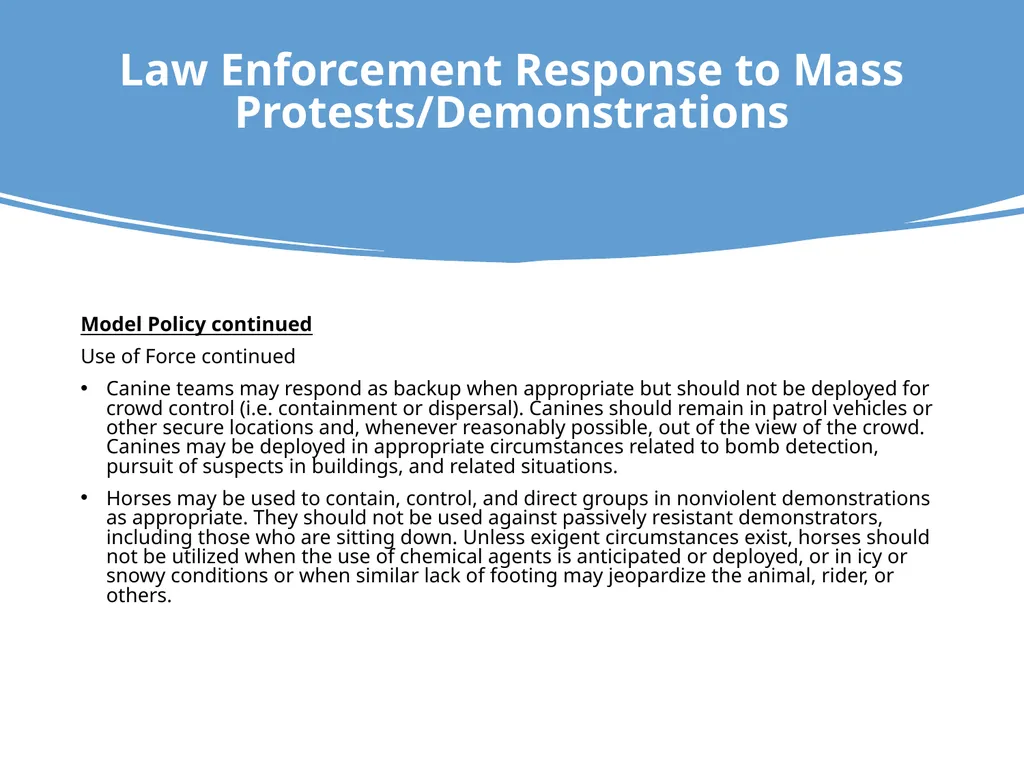
Canine teams may respond as backup when appropriate but should not be deployed for crowd control (i.e. containment or dispersal). Canines should remain in patrol vehicles or other secure locations and, whenever reasonably possible, out of the view of the crowd. Canines may be deployed in appropriate circumstances related to bomb detection, pursuit of suspects in buildings, and related situations.
Horses may be used to contain, control, and direct groups in nonviolent demonstrations as appropriate. They should not be used against passively resistant demonstrators, including those who are sitting down. Unless exigent circumstances exist, horses should not be utilized when the use of chemical agents is anticipated or deployed, or in icy or snowy conditions or when similar lack of footing may jeopardize the animal, rider, or others.<br>
Use of Force continued
Canine teams may respond as backup when appropriate but should not be deployed for crowd control (i.e. containment or dispersal). Canines should remain in patrol vehicles or other secure locations and, whenever reasonably possible, out of the view of the crowd. Canines may be deployed in appropriate circumstances related to bomb detection, pursuit of suspects in buildings, and related situations.
Horses may be used to contain, control, and direct groups in nonviolent demonstrations as appropriate. They should not be used against passively resistant demonstrators, including those who are sitting down. Unless exigent circumstances exist, horses should not be utilized when the use of chemical agents is anticipated or deployed, or in icy or snowy conditions or when similar lack of footing may jeopardize the animal, rider, or others.<br>
29
Law Enforcement Response to Mass Protests/Demonstrations Model Policy continued
Use of Force continued
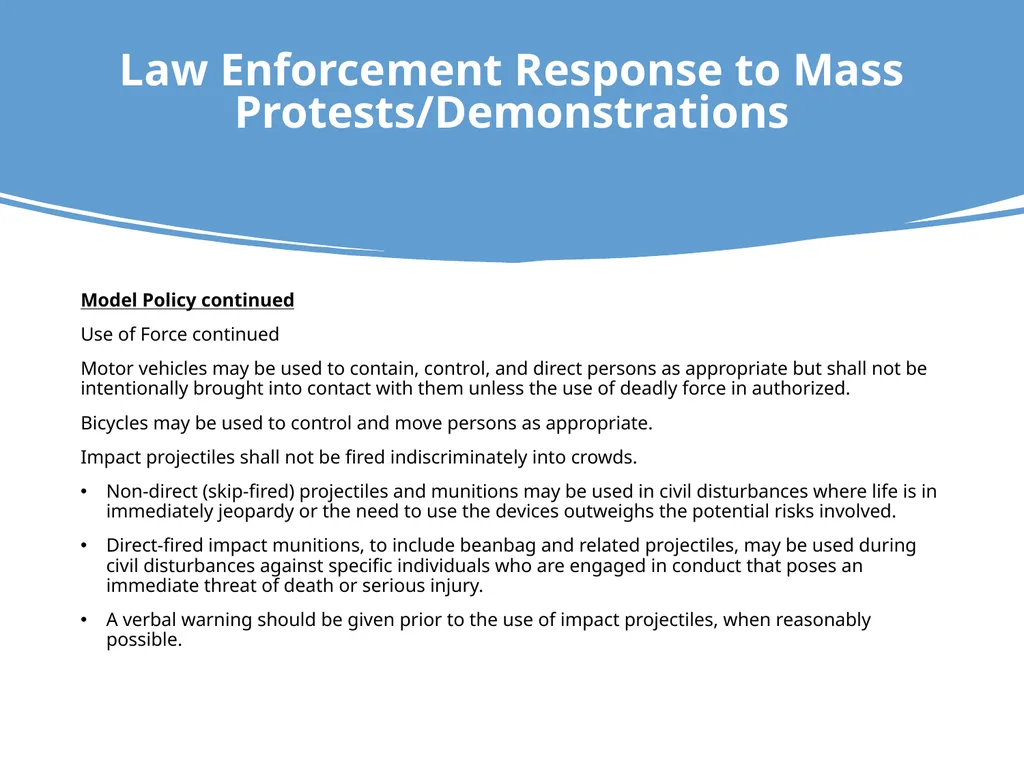
Motor vehicles may be used to contain, control, and direct persons as appropriate but shall not be intentionally brought into contact with them unless the use of deadly force in authorized.
Bicycles may be used to control and move persons as appropriate.
Impact projectiles shall not be fired indiscriminately into crowds.
Non-direct (skip-fired) projectiles and munitions may be used in civil disturbances where life is in immediately jeopardy or the need to use the devices outweighs the potential risks involved.
Direct-fired impact munitions, to include beanbag and related projectiles, may be used during civil disturbances against specific individuals who are engaged in conduct that poses an immediate threat of death or serious injury.
A verbal warning should be given prior to the use of impact projectiles, when reasonably possible.<br>
Use of Force continued
Motor vehicles may be used to contain, control, and direct persons as appropriate but shall not be intentionally brought into contact with them unless the use of deadly force in authorized.
Bicycles may be used to control and move persons as appropriate.
Impact projectiles shall not be fired indiscriminately into crowds.
Non-direct (skip-fired) projectiles and munitions may be used in civil disturbances where life is in immediately jeopardy or the need to use the devices outweighs the potential risks involved.
Direct-fired impact munitions, to include beanbag and related projectiles, may be used during civil disturbances against specific individuals who are engaged in conduct that poses an immediate threat of death or serious injury.
A verbal warning should be given prior to the use of impact projectiles, when reasonably possible.<br>
30
Law Enforcement Response to Mass Protests/Demonstrations Model Policy continued
Use of Force continued
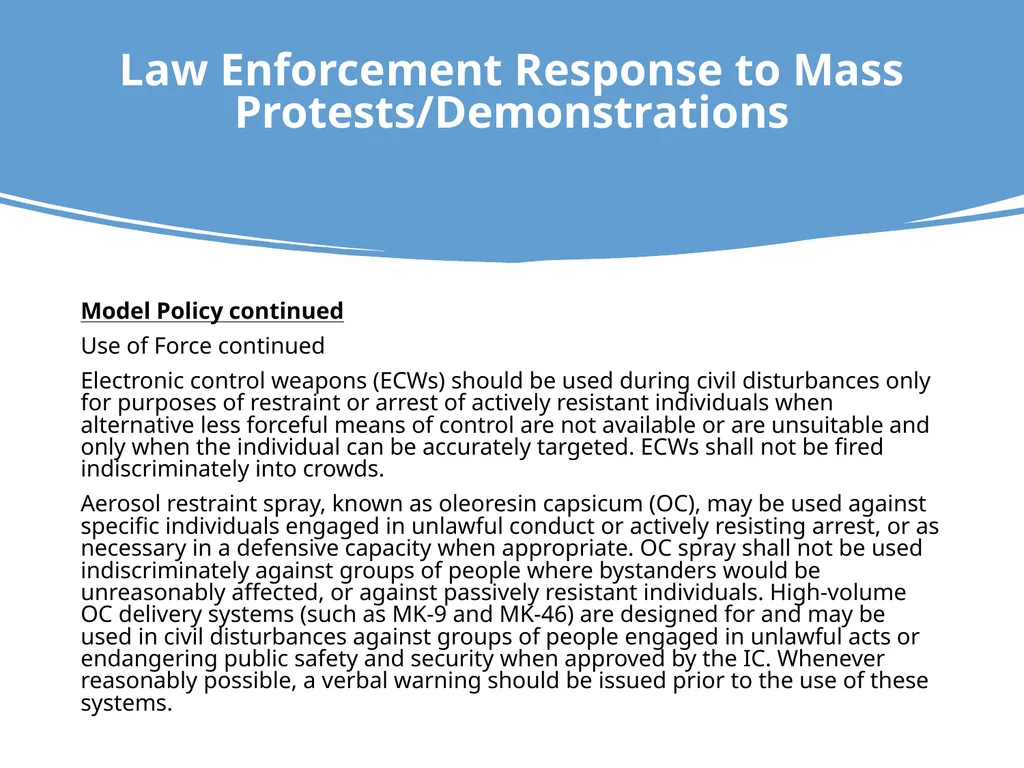
Electronic control weapons (ECWs) should be used during civil disturbances only for purposes of restraint or arrest of actively resistant individuals when alternative less forceful means of control are not available or are unsuitable and only when the individual can be accurately targeted. ECWs shall not be fired indiscriminately into crowds.
Aerosol restraint spray, known as oleoresin capsicum (OC), may be used against specific individuals engaged in unlawful conduct or actively resisting arrest, or as necessary in a defensive capacity when appropriate. OC spray shall not be used indiscriminately against groups of people where bystanders would be unreasonably affected, or against passively resistant individuals. High-volume OC delivery systems (such as MK-9 and MK-46) are designed for and may be used in civil disturbances against groups of people engaged in unlawful acts or endangering public safety and security when approved by the IC. Whenever reasonably possible, a verbal warning should be issued prior to the use of these systems.<br>
Use of Force continued
Electronic control weapons (ECWs) should be used during civil disturbances only for purposes of restraint or arrest of actively resistant individuals when alternative less forceful means of control are not available or are unsuitable and only when the individual can be accurately targeted. ECWs shall not be fired indiscriminately into crowds.
Aerosol restraint spray, known as oleoresin capsicum (OC), may be used against specific individuals engaged in unlawful conduct or actively resisting arrest, or as necessary in a defensive capacity when appropriate. OC spray shall not be used indiscriminately against groups of people where bystanders would be unreasonably affected, or against passively resistant individuals. High-volume OC delivery systems (such as MK-9 and MK-46) are designed for and may be used in civil disturbances against groups of people engaged in unlawful acts or endangering public safety and security when approved by the IC. Whenever reasonably possible, a verbal warning should be issued prior to the use of these systems.<br>
31
Law Enforcement Response to Mass Protests/Demonstrations Model Policy continued
Use of Force continued
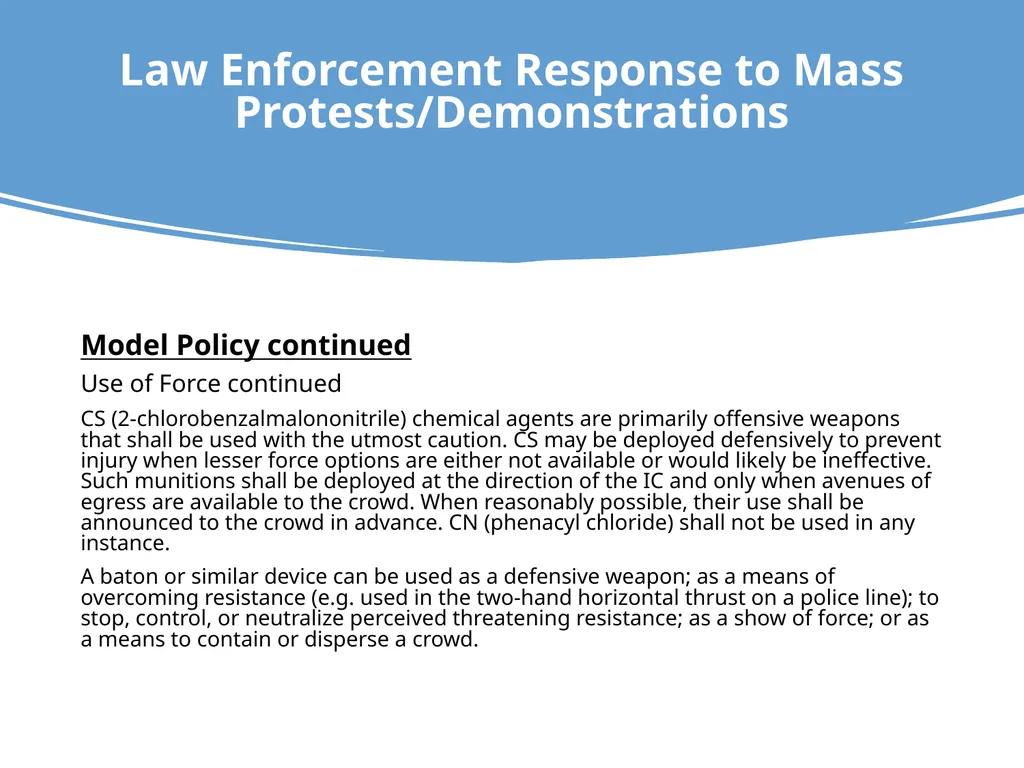
CS (2-chlorobenzalmalononitrile) chemical agents are primarily offensive weapons that shall be used with the utmost caution. CS may be deployed defensively to prevent injury when lesser force options are either not available or would likely be ineffective. Such munitions shall be deployed at the direction of the IC and only when avenues of egress are available to the crowd. When reasonably possible, their use shall be announced to the crowd in advance. CN (phenacyl chloride) shall not be used in any instance.
A baton or similar device can be used as a defensive weapon; as a means of overcoming resistance (e.g. used in the two-hand horizontal thrust on a police line); to stop, control, or neutralize perceived threatening resistance; as a show of force; or as a means to contain or disperse a crowd.<br>
Use of Force continued
CS (2-chlorobenzalmalononitrile) chemical agents are primarily offensive weapons that shall be used with the utmost caution. CS may be deployed defensively to prevent injury when lesser force options are either not available or would likely be ineffective. Such munitions shall be deployed at the direction of the IC and only when avenues of egress are available to the crowd. When reasonably possible, their use shall be announced to the crowd in advance. CN (phenacyl chloride) shall not be used in any instance.
A baton or similar device can be used as a defensive weapon; as a means of overcoming resistance (e.g. used in the two-hand horizontal thrust on a police line); to stop, control, or neutralize perceived threatening resistance; as a show of force; or as a means to contain or disperse a crowd.<br>
32
Law Enforcement Response to Mass Protests/Demonstrations Model Policy continued
Use of Force continued
All uses of force shall be reported and investigated in accordance with agency policy.
Management and Organization Principles
Government may impose reasonable restrictions on the time, place, and manner in which persons assemble and engage in free speech activity. This agency shall place only those limitations and restrictions on demonstrations necessary to maintain public safety and order and, to the degree possible, facilitate uninhibited speech, commerce, and freedom of movement.<br>
Use of Force continued
All uses of force shall be reported and investigated in accordance with agency policy.
Management and Organization Principles
Government may impose reasonable restrictions on the time, place, and manner in which persons assemble and engage in free speech activity. This agency shall place only those limitations and restrictions on demonstrations necessary to maintain public safety and order and, to the degree possible, facilitate uninhibited speech, commerce, and freedom of movement.<br>
33
Law Enforcement Response to Mass Protests/Demonstrations Model Policy continued
Management and Organization Principles continued
An Incident Command System (ICS) shall be used in crowd management and civil disturbances to ensure control and unified command.
The Incident Commander (IC) should also ensure that:
Adequate security is provided to fire and EMS personnel for emergency tasks
Support and relief for personnel
A secure staging area for emergency responders and equipment is designated
Liaison and staging points for media are established and available information is provided as appropriate
The IC event log is maintained to document activities and actions taken during the course of the incident
Photographic or video evidence is preserved, in accordance with applicable law and agency policy, of crowd actions and officer response
The need for full mobilization of sworn officers and the recall of off-duty officers are determined<br>
Management and Organization Principles continued
An Incident Command System (ICS) shall be used in crowd management and civil disturbances to ensure control and unified command.
The Incident Commander (IC) should also ensure that:
Adequate security is provided to fire and EMS personnel for emergency tasks
Support and relief for personnel
A secure staging area for emergency responders and equipment is designated
Liaison and staging points for media are established and available information is provided as appropriate
The IC event log is maintained to document activities and actions taken during the course of the incident
Photographic or video evidence is preserved, in accordance with applicable law and agency policy, of crowd actions and officer response
The need for full mobilization of sworn officers and the recall of off-duty officers are determined<br>
34
Law Enforcement Response to Mass Protests/Demonstrations Model Policy continued
Management and Organization Principles continued
A clearly defined command structure that is consistent with the National Incident Management System (NIMS) should be established as resources are deployed.
The CEO shall designate an incident commander (IC) responsible for overall control of a demonstration or civil disturbance.
The IC shall implement the written plan
In the case of a widely dispersed demonstration or disturbance, or event with multiple locations, multiple ICs may be assigned at the discretion of the CEO.
The IC shall be responsible for preparing operations plans and management details associated with planned demonstrations<br>
Management and Organization Principles continued
A clearly defined command structure that is consistent with the National Incident Management System (NIMS) should be established as resources are deployed.
The CEO shall designate an incident commander (IC) responsible for overall control of a demonstration or civil disturbance.
The IC shall implement the written plan
In the case of a widely dispersed demonstration or disturbance, or event with multiple locations, multiple ICs may be assigned at the discretion of the CEO.
The IC shall be responsible for preparing operations plans and management details associated with planned demonstrations<br>
35
Law Enforcement Response to Mass Protests/Demonstrations Model Policy continued
Management and Organization Principles continued
The primary objectives of the IC at a civil disturbance are to accomplish the following:
Protect persons, regardless of their participation in the disturbance
Disperse disorderly or threatening crowds in order to eliminate the immediate risks of continued escalation and further violence
Arrest law violators, including those responsible for property damage, and remove or isolate persons inciting violent behavior.
Officers shall be briefed on what to expect and appropriate responses. They shall be informed that the IC or their designee(s) shall be responsible for ordering any response deemed appropriate.<br>
Management and Organization Principles continued
The primary objectives of the IC at a civil disturbance are to accomplish the following:
Protect persons, regardless of their participation in the disturbance
Disperse disorderly or threatening crowds in order to eliminate the immediate risks of continued escalation and further violence
Arrest law violators, including those responsible for property damage, and remove or isolate persons inciting violent behavior.
Officers shall be briefed on what to expect and appropriate responses. They shall be informed that the IC or their designee(s) shall be responsible for ordering any response deemed appropriate.<br>
36
Law Enforcement Response to Mass Protests/Demonstrations Model Policy continued
General Crowd Response
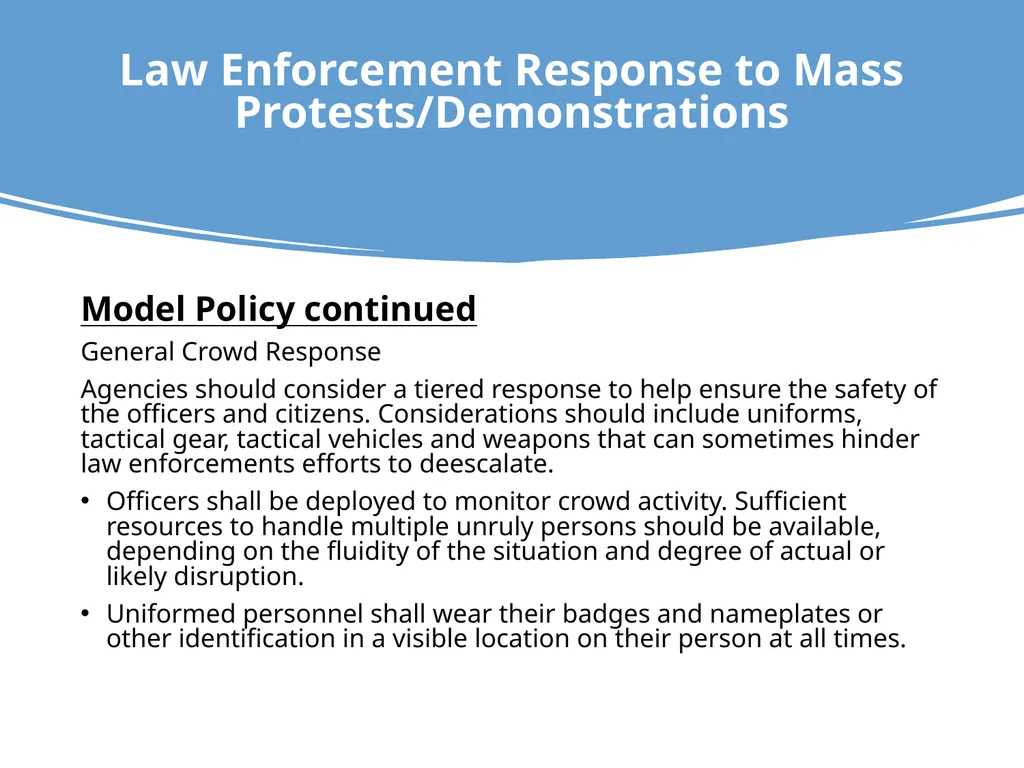
Agencies should consider a tiered response to help ensure the safety of the officers and citizens. Considerations should include uniforms, tactical gear, tactical vehicles and weapons that can sometimes hinder law enforcements efforts to deescalate.
Officers shall be deployed to monitor crowd activity. Sufficient resources to handle multiple unruly persons should be available, depending on the fluidity of the situation and degree of actual or likely disruption.
Uniformed personnel shall wear their badges and nameplates or other identification in a visible location on their person at all times.<br>
General Crowd Response
Agencies should consider a tiered response to help ensure the safety of the officers and citizens. Considerations should include uniforms, tactical gear, tactical vehicles and weapons that can sometimes hinder law enforcements efforts to deescalate.
Officers shall be deployed to monitor crowd activity. Sufficient resources to handle multiple unruly persons should be available, depending on the fluidity of the situation and degree of actual or likely disruption.
Uniformed personnel shall wear their badges and nameplates or other identification in a visible location on their person at all times.<br>
37
Law Enforcement Response to Mass Protests/Demonstrations Model Policy continued
General Crowd Response continued
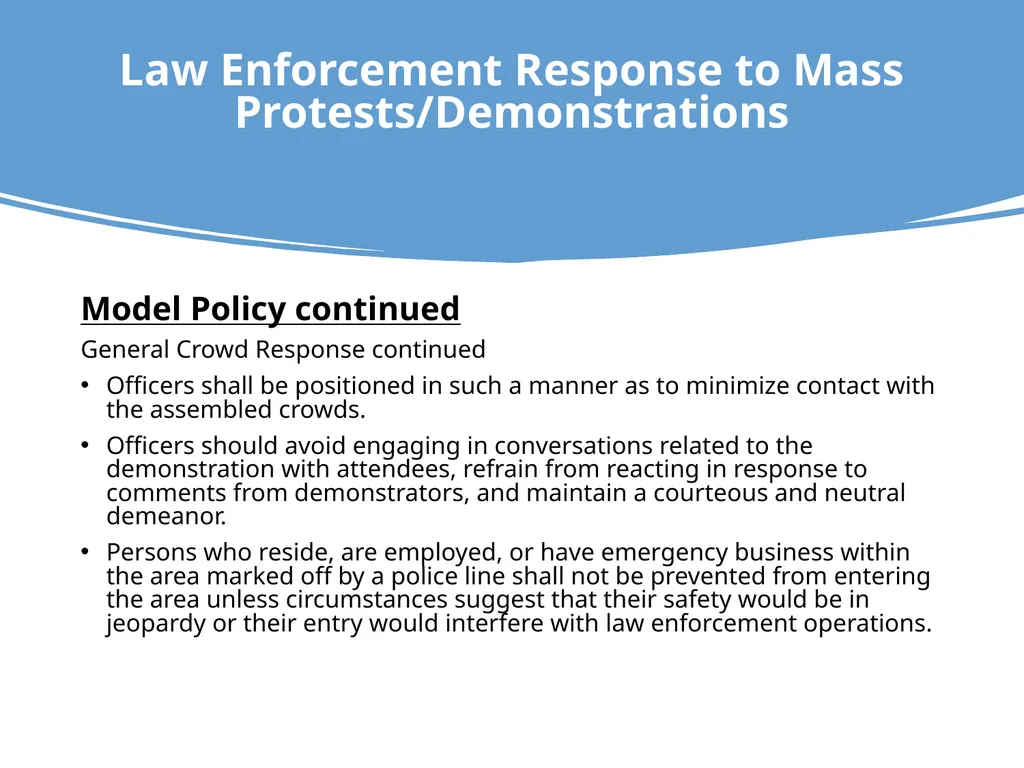
Officers shall be positioned in such a manner as to minimize contact with the assembled crowds.
Officers should avoid engaging in conversations related to the demonstration with attendees, refrain from reacting in response to comments from demonstrators, and maintain a courteous and neutral demeanor.
Persons who reside, are employed, or have emergency business within the area marked off by a police line shall not be prevented from entering the area unless circumstances suggest that their safety would be in jeopardy or their entry would interfere with law enforcement operations.<br>
General Crowd Response continued
Officers shall be positioned in such a manner as to minimize contact with the assembled crowds.
Officers should avoid engaging in conversations related to the demonstration with attendees, refrain from reacting in response to comments from demonstrators, and maintain a courteous and neutral demeanor.
Persons who reside, are employed, or have emergency business within the area marked off by a police line shall not be prevented from entering the area unless circumstances suggest that their safety would be in jeopardy or their entry would interfere with law enforcement operations.<br>
38
Law Enforcement Response to Mass Protests/Demonstrations Model Policy continued
General Crowd Response continued
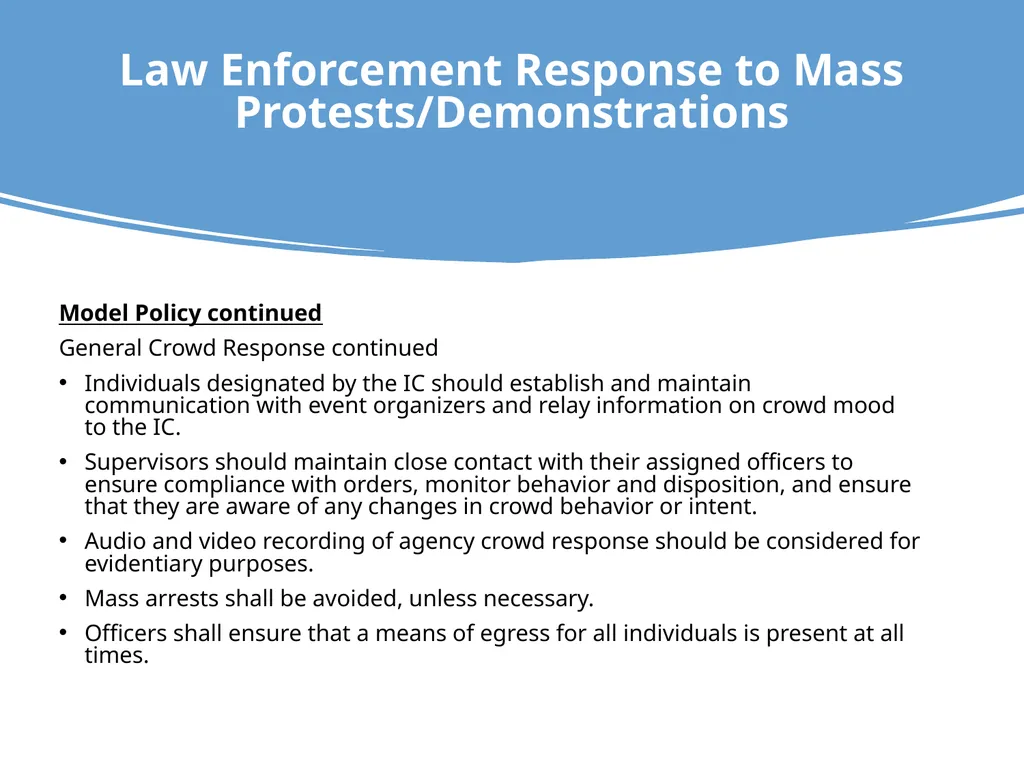
Individuals designated by the IC should establish and maintain communication with event organizers and relay information on crowd mood to the IC.
Supervisors should maintain close contact with their assigned officers to ensure compliance with orders, monitor behavior and disposition, and ensure that they are aware of any changes in crowd behavior or intent.
Audio and video recording of agency crowd response should be considered for evidentiary purposes.
Mass arrests shall be avoided, unless necessary.
Officers shall ensure that a means of egress for all individuals is present at all times.<br>
General Crowd Response continued
Individuals designated by the IC should establish and maintain communication with event organizers and relay information on crowd mood to the IC.
Supervisors should maintain close contact with their assigned officers to ensure compliance with orders, monitor behavior and disposition, and ensure that they are aware of any changes in crowd behavior or intent.
Audio and video recording of agency crowd response should be considered for evidentiary purposes.
Mass arrests shall be avoided, unless necessary.
Officers shall ensure that a means of egress for all individuals is present at all times.<br>
39
Law Enforcement Response to Mass Protests/Demonstrations Model Policy continued
Response to Spontaneous Civil Disturbances
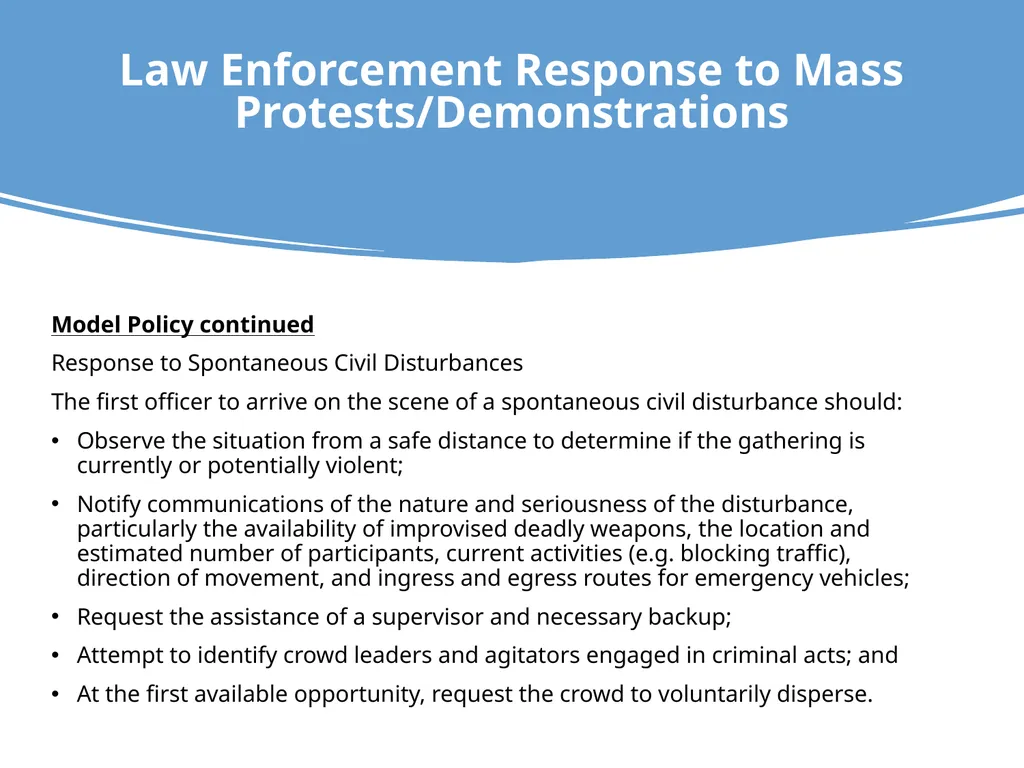
The first officer to arrive on the scene of a spontaneous civil disturbance should:
Observe the situation from a safe distance to determine if the gathering is currently or potentially violent;
Notify communications of the nature and seriousness of the disturbance, particularly the availability of improvised deadly weapons, the location and estimated number of participants, current activities (e.g. blocking traffic), direction of movement, and ingress and egress routes for emergency vehicles;
Request the assistance of a supervisor and necessary backup;
Attempt to identify crowd leaders and agitators engaged in criminal acts; and
At the first available opportunity, request the crowd to voluntarily disperse.<br>
Response to Spontaneous Civil Disturbances
The first officer to arrive on the scene of a spontaneous civil disturbance should:
Observe the situation from a safe distance to determine if the gathering is currently or potentially violent;
Notify communications of the nature and seriousness of the disturbance, particularly the availability of improvised deadly weapons, the location and estimated number of participants, current activities (e.g. blocking traffic), direction of movement, and ingress and egress routes for emergency vehicles;
Request the assistance of a supervisor and necessary backup;
Attempt to identify crowd leaders and agitators engaged in criminal acts; and
At the first available opportunity, request the crowd to voluntarily disperse.<br>
40
Law Enforcement Response to Mass Protests/Demonstrations Model Policy continued
Response to Spontaneous Civil Disturbances continued
The first officer or supervisor in charge at the scene should:
Deploy officers at vantage points to report on crowd actions;
Establish a perimeter sufficient to contain the disturbance and prohibit entrance into the affected area;
Ensure that, to the degree possible, uninvolved individuals are evacuated from the immediate area of the disturbance;
Establish a temporary command post;
Provide ongoing assessment to communications;
Move and reroute pedestrian and vehicular traffic around the disorder;
Control unauthorized ingress and egress by participants; and
Prevent outside attempts to assist or reinforce participants.<br>
Response to Spontaneous Civil Disturbances continued
The first officer or supervisor in charge at the scene should:
Deploy officers at vantage points to report on crowd actions;
Establish a perimeter sufficient to contain the disturbance and prohibit entrance into the affected area;
Ensure that, to the degree possible, uninvolved individuals are evacuated from the immediate area of the disturbance;
Establish a temporary command post;
Provide ongoing assessment to communications;
Move and reroute pedestrian and vehicular traffic around the disorder;
Control unauthorized ingress and egress by participants; and
Prevent outside attempts to assist or reinforce participants.<br>
41
Law Enforcement Response to Mass Protests/Demonstrations Model Policy continued
Response to Spontaneous Civil Disturbances continued
The IC should also ensure that:
Adequate security is provided to fire and EMS personnel in the performance of emergency tasks;
Support and relief for personnel are available;
A secure staging area for emergency responders and equipment is designated;
Liaison and staging points for media representatives are established and available information is provided as appropriate;
The IC event log is maintained to document activities and actions taken during the course of the incident;
Photographic or video evidence is preserved, in accordance with applicable law and agency, of crowd actions and officer response;
Photographs or videos are taken of any injuries sustained by law enforcement officers or the public; and
The need for full mobilization of sworn officers and the recall of off-duty officers are determined.<br>
Response to Spontaneous Civil Disturbances continued
The IC should also ensure that:
Adequate security is provided to fire and EMS personnel in the performance of emergency tasks;
Support and relief for personnel are available;
A secure staging area for emergency responders and equipment is designated;
Liaison and staging points for media representatives are established and available information is provided as appropriate;
The IC event log is maintained to document activities and actions taken during the course of the incident;
Photographic or video evidence is preserved, in accordance with applicable law and agency, of crowd actions and officer response;
Photographs or videos are taken of any injuries sustained by law enforcement officers or the public; and
The need for full mobilization of sworn officers and the recall of off-duty officers are determined.<br>
42
Law Enforcement Response to Mass Protests/Demonstrations Model Policy continued
Crowd Dispersal and Unlawful Assemblies
Before ordering forced dispersal of a civil disturbance, the IC should determine whether lesser alternatives may be effective. These alternatives include the use of containment and dialogue, as follows:
Establish contact with event organizers or crowd leaders to assess their intentions and motivations and develop a mutually acceptable plan for de-escalation and dispersal.
Communicate to the participants that their assembly is in violation of the law and that the agency wishes to resolve the incident peacefully, but that acts of violence will be dealt with swiftly and decisively.
Target specific violent or disruptive individuals for arrest.
Prior to issuing dispersal orders, the IC should ensure that all potentially necessary law enforcement, fire, and EMS equipment and personnel are on hand to successfully carry out tactical operations and that logistical needs for making mass arrests are in place.<br>
Crowd Dispersal and Unlawful Assemblies
Before ordering forced dispersal of a civil disturbance, the IC should determine whether lesser alternatives may be effective. These alternatives include the use of containment and dialogue, as follows:
Establish contact with event organizers or crowd leaders to assess their intentions and motivations and develop a mutually acceptable plan for de-escalation and dispersal.
Communicate to the participants that their assembly is in violation of the law and that the agency wishes to resolve the incident peacefully, but that acts of violence will be dealt with swiftly and decisively.
Target specific violent or disruptive individuals for arrest.
Prior to issuing dispersal orders, the IC should ensure that all potentially necessary law enforcement, fire, and EMS equipment and personnel are on hand to successfully carry out tactical operations and that logistical needs for making mass arrests are in place.<br>
43
Law Enforcement Response to Mass Protests/Demonstrations Model Policy continued
Crowd Dispersal and Unlawful Assemblies continued
When the IC has made a determination that crowd dispersal is required, he or she shall direct unit commanders, where time and circumstances permit, to issue warnings prior to taking action to disperse the crowd.
The warning shall consist of an announcement citing the offenses or violations being committed, an order to disperse, and designated dispersal routes.
A second and third warning should be issued at reasonable time intervals before designated actions are taken to disperse the crowd.
Where possible, the warnings should be audio and video recorded and the time and the names of the issuing officers recorded in the IC’s event log.
Specific crowd dispersal tactics should be ordered as necessary where the crowd does not heed warnings. These include, but are not limited to, any one or combination of the following:
Display of forceful presence to include police lines combined with motorcycles, law enforcement vehicles, mounted units, bicycle units, and mobile field forces
Multiple simultaneous arrests
Use of aerosol crowd control chemical agents
Law enforcement formations and the use of batons for forcing crowd movement<br>
Crowd Dispersal and Unlawful Assemblies continued
When the IC has made a determination that crowd dispersal is required, he or she shall direct unit commanders, where time and circumstances permit, to issue warnings prior to taking action to disperse the crowd.
The warning shall consist of an announcement citing the offenses or violations being committed, an order to disperse, and designated dispersal routes.
A second and third warning should be issued at reasonable time intervals before designated actions are taken to disperse the crowd.
Where possible, the warnings should be audio and video recorded and the time and the names of the issuing officers recorded in the IC’s event log.
Specific crowd dispersal tactics should be ordered as necessary where the crowd does not heed warnings. These include, but are not limited to, any one or combination of the following:
Display of forceful presence to include police lines combined with motorcycles, law enforcement vehicles, mounted units, bicycle units, and mobile field forces
Multiple simultaneous arrests
Use of aerosol crowd control chemical agents
Law enforcement formations and the use of batons for forcing crowd movement<br>
44
Law Enforcement Response to Mass Protests/Demonstrations Model Policy continued
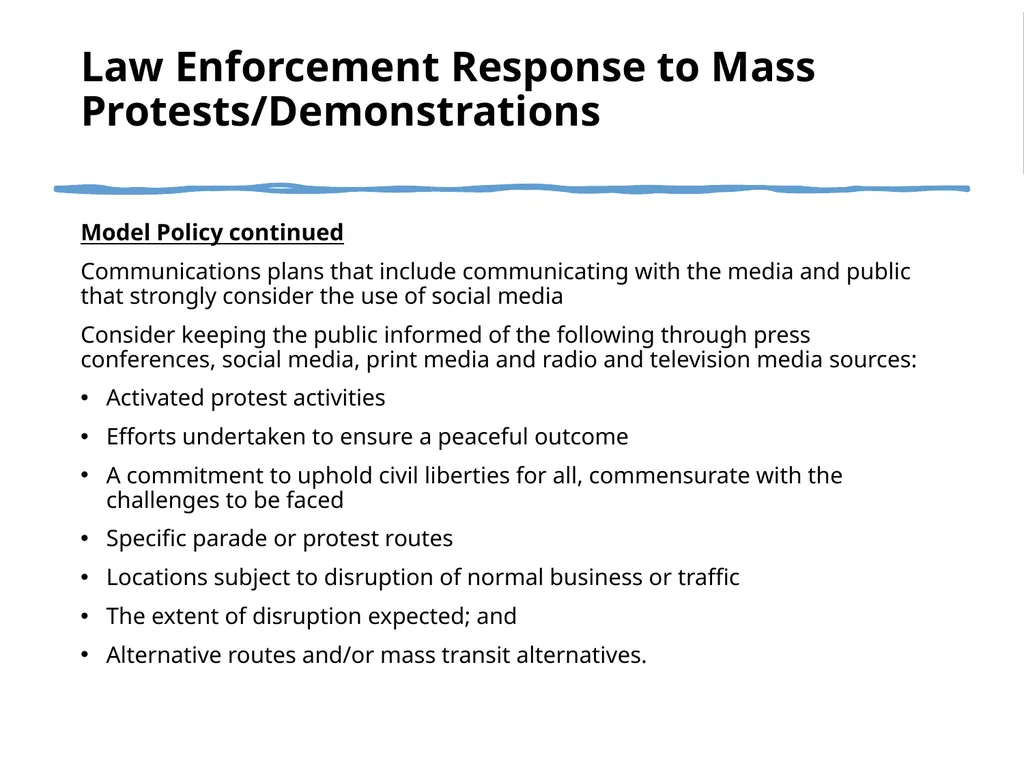
Communications plans that include communicating with the media and public that strongly consider the use of social media
Consider keeping the public informed of the following through press conferences, social media, print media and radio and television media sources:
Activated protest activities
Efforts undertaken to ensure a peaceful outcome
A commitment to uphold civil liberties for all, commensurate with the challenges to be faced
Specific parade or protest routes
Locations subject to disruption of normal business or traffic
The extent of disruption expected; and
Alternative routes and/or mass transit alternatives.<br>
Communications plans that include communicating with the media and public that strongly consider the use of social media
Consider keeping the public informed of the following through press conferences, social media, print media and radio and television media sources:
Activated protest activities
Efforts undertaken to ensure a peaceful outcome
A commitment to uphold civil liberties for all, commensurate with the challenges to be faced
Specific parade or protest routes
Locations subject to disruption of normal business or traffic
The extent of disruption expected; and
Alternative routes and/or mass transit alternatives.<br>
45
Law Enforcement Response to Mass Protests/Demonstrations Model Policy continued
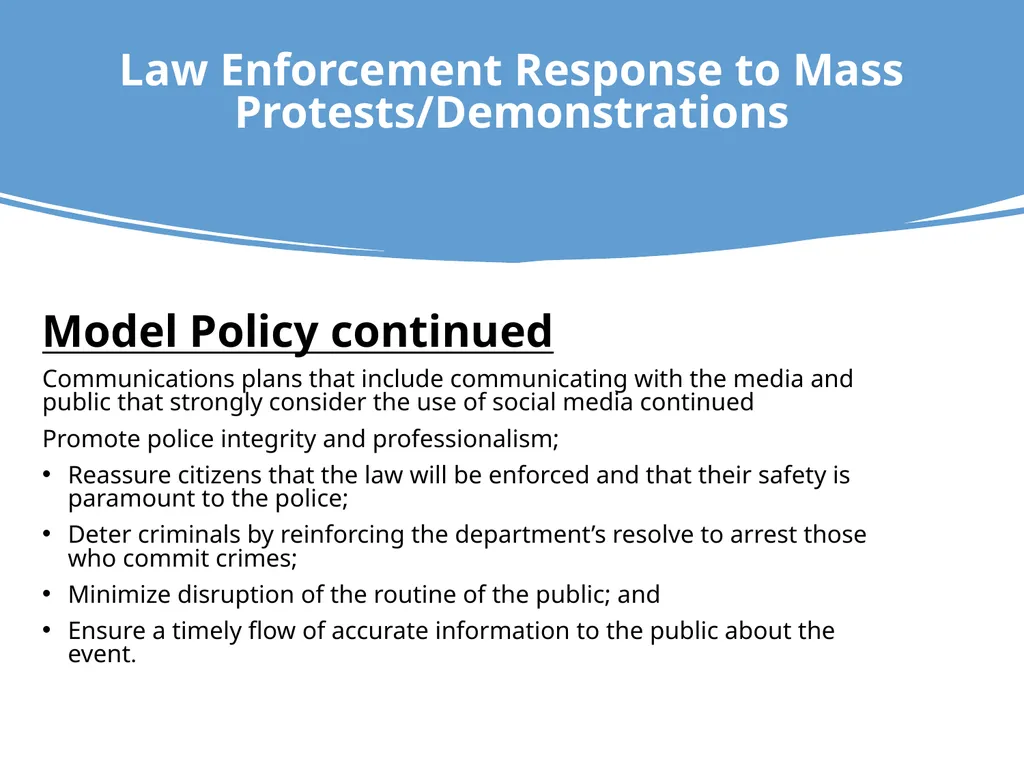
Communications plans that include communicating with the media and public that strongly consider the use of social media continued
Promote police integrity and professionalism;
Reassure citizens that the law will be enforced and that their safety is paramount to the police;
Deter criminals by reinforcing the department’s resolve to arrest those who commit crimes;
Minimize disruption of the routine of the public; and
Ensure a timely flow of accurate information to the public about the event.<br>
Communications plans that include communicating with the media and public that strongly consider the use of social media continued
Promote police integrity and professionalism;
Reassure citizens that the law will be enforced and that their safety is paramount to the police;
Deter criminals by reinforcing the department’s resolve to arrest those who commit crimes;
Minimize disruption of the routine of the public; and
Ensure a timely flow of accurate information to the public about the event.<br>
46
Law Enforcement Response to Mass Protests/Demonstrations Model Policy continued
Mutual aid agreements or memoranda of understanding
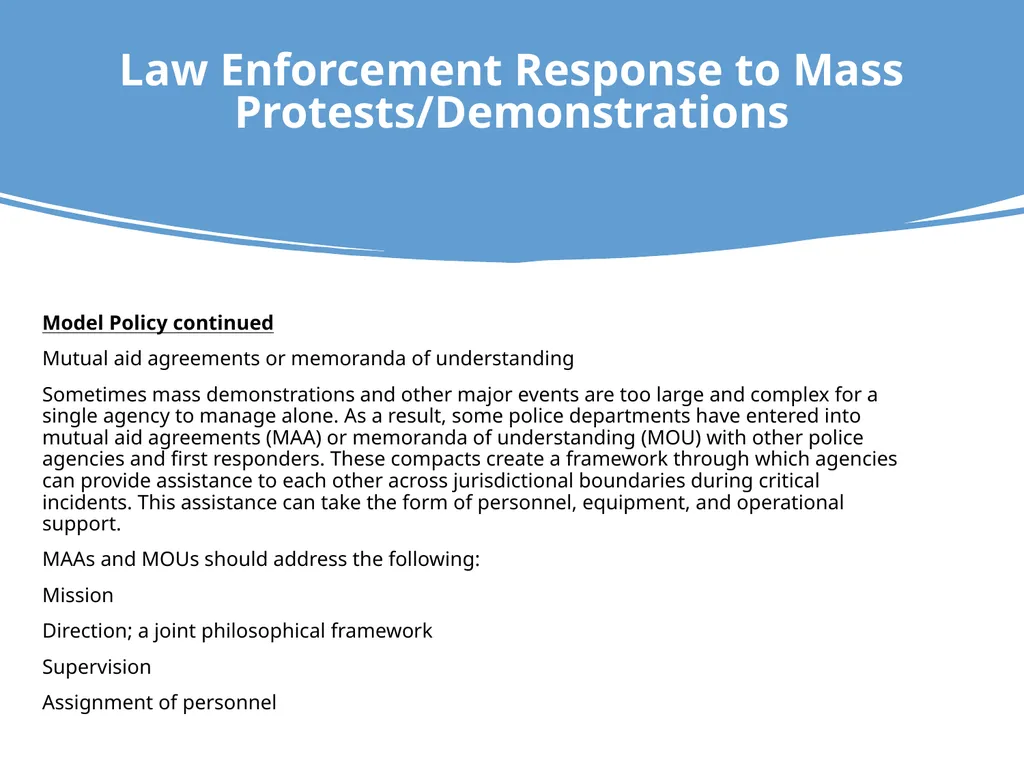
Sometimes mass demonstrations and other major events are too large and complex for a single agency to manage alone. As a result, some police departments have entered into mutual aid agreements (MAA) or memoranda of understanding (MOU) with other police agencies and first responders. These compacts create a framework through which agencies can provide assistance to each other across jurisdictional boundaries during critical incidents. This assistance can take the form of personnel, equipment, and operational support.
MAAs and MOUs should address the following:
Mission
Direction; a joint philosophical framework
Supervision
Assignment of personnel<br>
Mutual aid agreements or memoranda of understanding
Sometimes mass demonstrations and other major events are too large and complex for a single agency to manage alone. As a result, some police departments have entered into mutual aid agreements (MAA) or memoranda of understanding (MOU) with other police agencies and first responders. These compacts create a framework through which agencies can provide assistance to each other across jurisdictional boundaries during critical incidents. This assistance can take the form of personnel, equipment, and operational support.
MAAs and MOUs should address the following:
Mission
Direction; a joint philosophical framework
Supervision
Assignment of personnel<br>
47
Law Enforcement Response to Mass Protests/Demonstrations<br>
48
Law Enforcement Response to Mass Protests/Demonstrations Model Policy continued
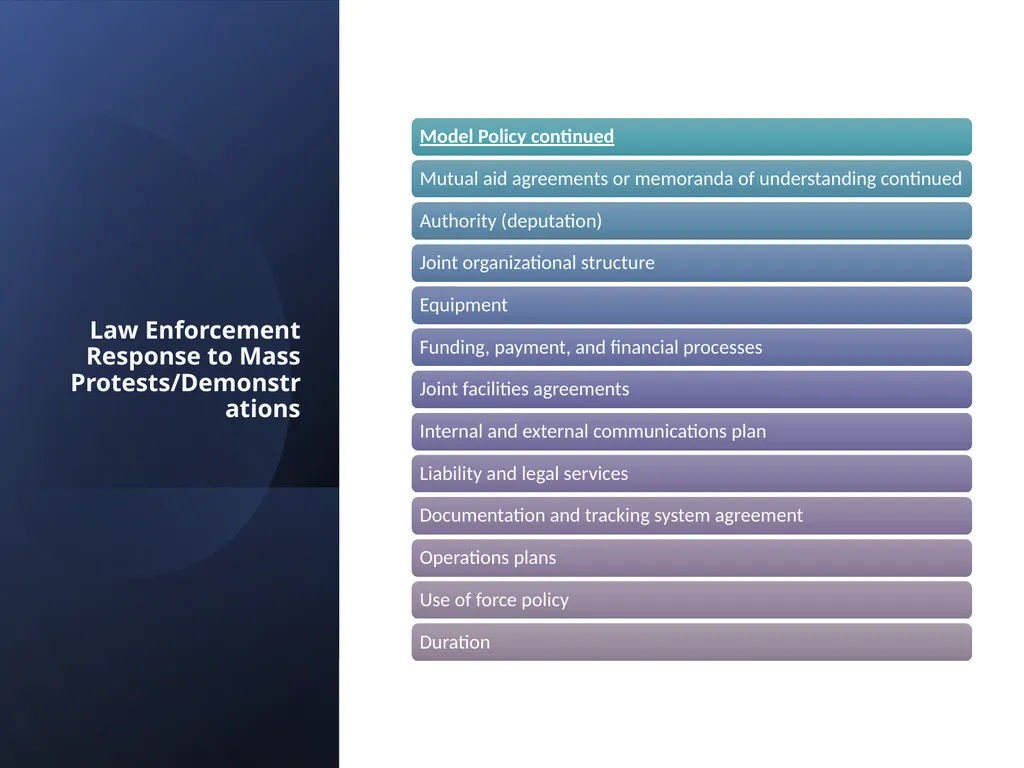
Mutual aid agreements or memoranda of understanding continued
Ensure MAAs and MOUs are in place before a mass demonstration or other major event. These agreements should address how officers from neighboring jurisdictions will deploy, how they will be used, what rules of engagement will be followed, and what guiding philosophy will inform their joint response to a mass demonstration. This ensures that all agencies are working together toward the same mission. Before any mission, lead agencies should provide clear direction on goals and objectives.
Make MAAs and MOUs as specific as possible, including precise information about how many personnel with given areas of expertise (such as SWAT or intelligence analysis) will be deployed.
Make it clear which agency is in charge and whose rules (especially regarding use of force) and command will be followed. Ensure partner agencies agree to this command structure in advance of a mass demonstration.<br>
Mutual aid agreements or memoranda of understanding continued
Ensure MAAs and MOUs are in place before a mass demonstration or other major event. These agreements should address how officers from neighboring jurisdictions will deploy, how they will be used, what rules of engagement will be followed, and what guiding philosophy will inform their joint response to a mass demonstration. This ensures that all agencies are working together toward the same mission. Before any mission, lead agencies should provide clear direction on goals and objectives.
Make MAAs and MOUs as specific as possible, including precise information about how many personnel with given areas of expertise (such as SWAT or intelligence analysis) will be deployed.
Make it clear which agency is in charge and whose rules (especially regarding use of force) and command will be followed. Ensure partner agencies agree to this command structure in advance of a mass demonstration.<br>
49
Law Enforcement Response to Mass Protests/Demonstrations Model Policy continued
Mutual aid agreements or memoranda of understanding continued
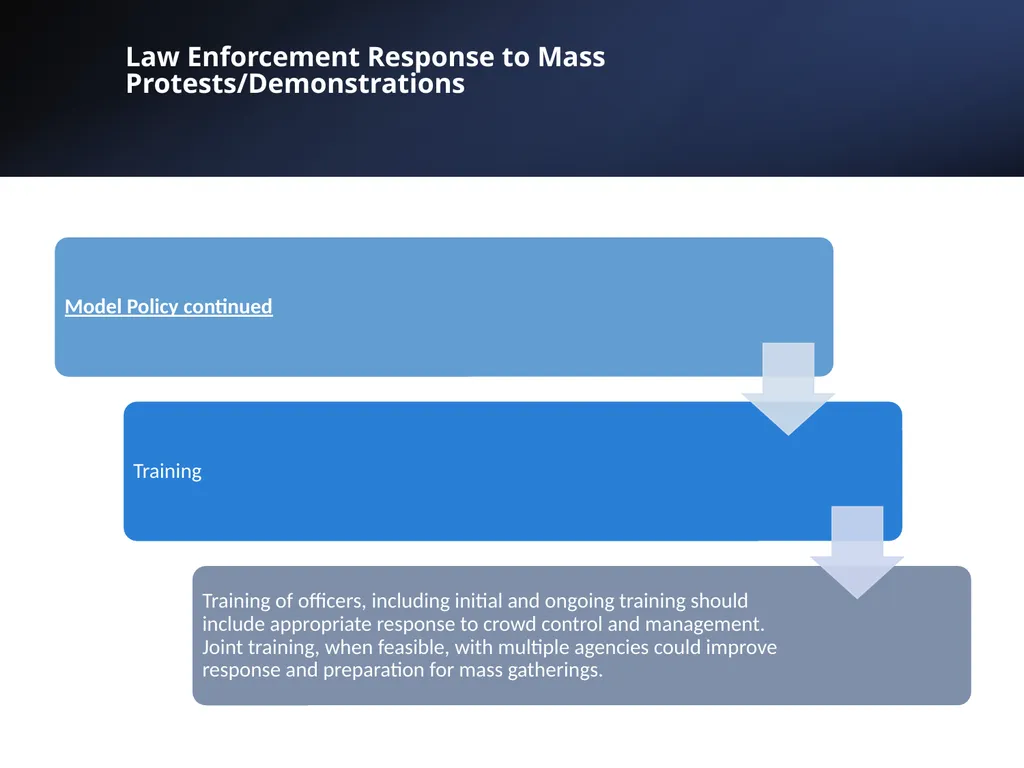
Train together with all partner agencies so responses to mass demonstrations are well-coordinated at all levels, from officers on the line through command staff.
Ensure policies and terminology on the use of force and civil disobedience are consistent across agencies to prevent misunderstandings and loss of control during mass demonstrations. If necessary, resolve any inconsistencies in advance of a mass demonstration in a mutually agreed-upon unified command proposal.
Use ICS so all responding agencies are well coordinated.
Provide written guidance to mutual aid partners that includes rules of engagement, expectations of responding agencies and individuals officers, and a list of which munitions are allowed.<br>
Mutual aid agreements or memoranda of understanding continued
Train together with all partner agencies so responses to mass demonstrations are well-coordinated at all levels, from officers on the line through command staff.
Ensure policies and terminology on the use of force and civil disobedience are consistent across agencies to prevent misunderstandings and loss of control during mass demonstrations. If necessary, resolve any inconsistencies in advance of a mass demonstration in a mutually agreed-upon unified command proposal.
Use ICS so all responding agencies are well coordinated.
Provide written guidance to mutual aid partners that includes rules of engagement, expectations of responding agencies and individuals officers, and a list of which munitions are allowed.<br>
50
Law Enforcement Response to Mass Protests/Demonstrations Model Policy continued
Deactivation of deployment protocol and after-action review
When the disturbance has been brought under control:
All personnel engaged in the incident shall be accounted for and an assessment and documentation made of personal injuries.
Witnesses, suspects, and others should be interviewed or questioned.
All necessary personnel should be debriefed as required.
Any equipment utilized by officers should be replaced.
All written reports shall be completed as soon as possible after the incident.
Comprehensive documentation should include the basis for the incident and the agency’s response to the incident, with a statement of impact to include the costs of equipment, personnel, and related items.<br>
Deactivation of deployment protocol and after-action review
When the disturbance has been brought under control:
All personnel engaged in the incident shall be accounted for and an assessment and documentation made of personal injuries.
Witnesses, suspects, and others should be interviewed or questioned.
All necessary personnel should be debriefed as required.
Any equipment utilized by officers should be replaced.
All written reports shall be completed as soon as possible after the incident.
Comprehensive documentation should include the basis for the incident and the agency’s response to the incident, with a statement of impact to include the costs of equipment, personnel, and related items.<br>
51
Law Enforcement Response to Mass Protests/Demonstrations Model Policy continued
Mass Arrest
During a civil disturbance, it may be necessary to make arrests of numerous individuals over a relatively short period of time. For this process to be handled efficiently, safely, and legally, the following should be observed:
Mass arrests should be conducted by designated squads.
An adequate secure area should be designated for holding arrestees after processing and while awaiting transportation to a detention center.
Arrest teams should be advised of the basic offenses to be charged in all arrests, and all arrestees shall be advised of these charges.
Arrestees who are sitting or lying down but agree to walk shall be escorted to the transportation vehicle for processing. Two or more officers should carry those who refuse to walk.<br>
Mass Arrest
During a civil disturbance, it may be necessary to make arrests of numerous individuals over a relatively short period of time. For this process to be handled efficiently, safely, and legally, the following should be observed:
Mass arrests should be conducted by designated squads.
An adequate secure area should be designated for holding arrestees after processing and while awaiting transportation to a detention center.
Arrest teams should be advised of the basic offenses to be charged in all arrests, and all arrestees shall be advised of these charges.
Arrestees who are sitting or lying down but agree to walk shall be escorted to the transportation vehicle for processing. Two or more officers should carry those who refuse to walk.<br>
52
Law Enforcement Response to Mass Protests/Demonstrations Model Policy continued
Mass Arrest continued
Arrestees shall be searched incident to arrest for weapons, evidence of the crime of arrest, and contraband.
Photographs should be taken of the arrestee and any arrestee property, and a field arrest form shall be completed.
Transporting officers should not accept arrestees with a properly prepared field arrest form and photographs and shall ensure that all property is properly processed.
Anyone who is injured, to include arrestees, shall be provided medical attention. Photographs should be taken of all known injuries.<br>
Mass Arrest continued
Arrestees shall be searched incident to arrest for weapons, evidence of the crime of arrest, and contraband.
Photographs should be taken of the arrestee and any arrestee property, and a field arrest form shall be completed.
Transporting officers should not accept arrestees with a properly prepared field arrest form and photographs and shall ensure that all property is properly processed.
Anyone who is injured, to include arrestees, shall be provided medical attention. Photographs should be taken of all known injuries.<br>
53
Law Enforcement Response to Mass Protests/Demonstrations<br>
54
Law Enforcement Response to Mass Protests/Demonstrations<br>
55
Law Enforcement Response to Mass Protests/Demonstrations Ohio Collaborative Annual Standard Review
The intent of any Ohio Collaborative Annual Review is to :
Review policy and reporting procedures to determine if agency needs are being met;
Review patterns and trends with any data collected;
Review training needs in any;
Review equipment needs in any.
This information is crucial in assisting the CEO and command staff with making informed decisions for agencies. Each agency has unique challenges and circumstances in providing their citizens with the best service possible. Ensure your agency is using this template, and any other information gathering deemed necessary by the agency, to ascertain best results.<br>
The intent of any Ohio Collaborative Annual Review is to :
Review policy and reporting procedures to determine if agency needs are being met;
Review patterns and trends with any data collected;
Review training needs in any;
Review equipment needs in any.
This information is crucial in assisting the CEO and command staff with making informed decisions for agencies. Each agency has unique challenges and circumstances in providing their citizens with the best service possible. Ensure your agency is using this template, and any other information gathering deemed necessary by the agency, to ascertain best results.<br>
56
For more information on the Ohio Collaborative or other OCJS Law enforcement initiatives, contact
Ed Burkhammer
Director of LE services
Office of criminal justice services
edburkhammer@dps.ohio.gov
or visit https://ocjs.ohio.gov/law-enforcement-services<br>