OMB Open Comment Period Why Now: 5 Year Lookback at OMB Uniform Guidance Offer More Clarity Align with Presidents Management Agenda Results Oriented Accountability What do we focus on: Subpart D, 200.3XX Post Award OMB Open Comment
"OMB Open Comment Period Why Now: 5 Year Lookback" is the property of its rightful owner. Permission is granted to
download and print the materials on this website for personal, non-commercial use only, and to display it
on your personal computer provided you do not modify the materials and that you retain all copyright
notices contained in the materials. By downloading content from our website, you accept the terms of this
agreement.
Presentation Transcript
01
OMB Open Comment Period Why Now:
5 Year Lookback at OMB Uniform Guidance
Offer More Clarity
Align with President's Management Agenda
Results Oriented Accountability
What do we focus on:
Subpart D, 200.3XX – Post Award<br>
02
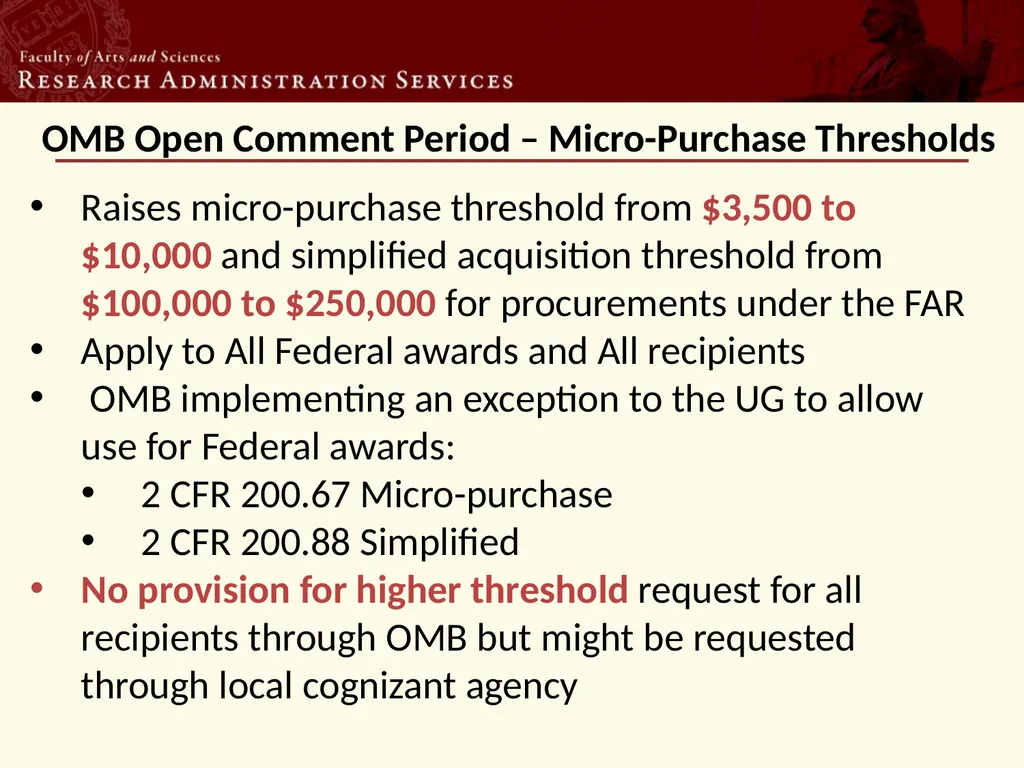
OMB Open Comment Period – Micro-Purchase Thresholds Raises micro-purchase threshold from $3,500 to $10,000 and simplified acquisition threshold from $100,000 to $250,000 for procurements under the FAR
Apply to All Federal awards and All recipients
OMB implementing an exception to the UG to allow use for Federal awards:
2 CFR 200.67 Micro-purchase
2 CFR 200.88 Simplified
No provision for higher threshold request for all recipients through OMB but might be requested through local cognizant agency<br>
03
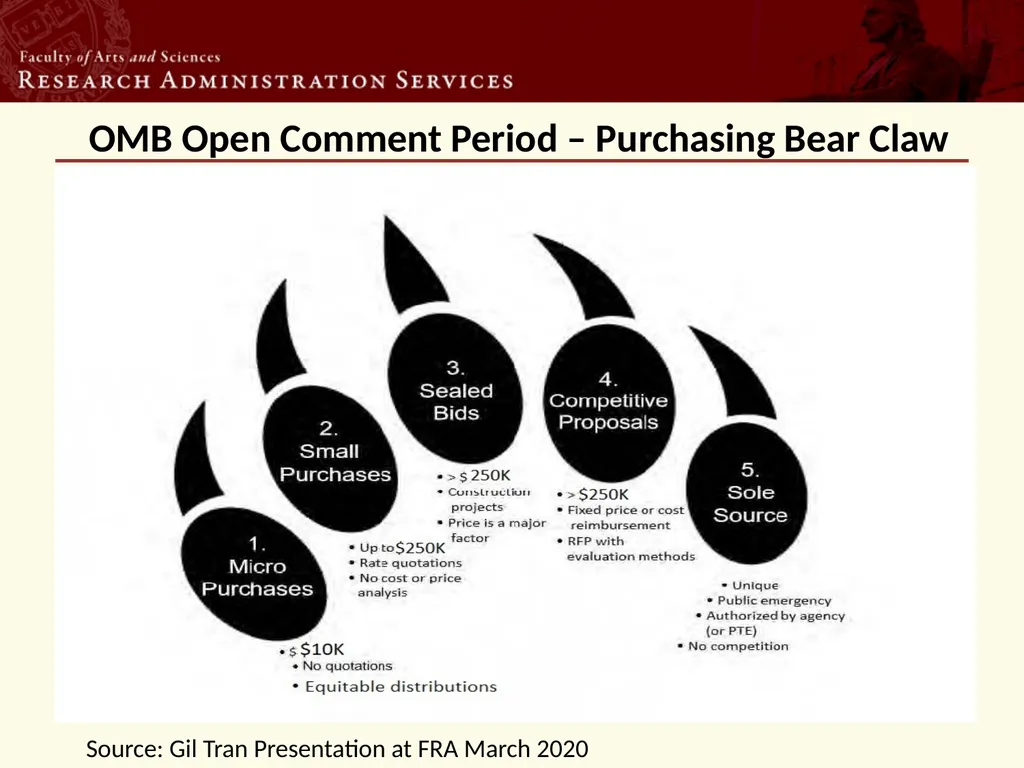
OMB Open Comment Period – Purchasing Bear Claw Source: Gil Tran Presentation at FRA March 2020<br>
04
OMB Open Comment Period – Other Purchasing Guidance Aligning 2 CFR with the 2019 NDAA section 889
Prohibition on certain telecommunication and video surveillance services or equipment, which prohibit Federal award recipients from using government funds to enter into contracts (or extend or renew contracts) with entities that use covered telecommunications equipment or services.
Aligning 2 CFR with the General Accepted Accounting Principles conform with Generally Accepted Accounting Principles (GAAP)
continue to claim pension costs that are both actual and funded<br>
05
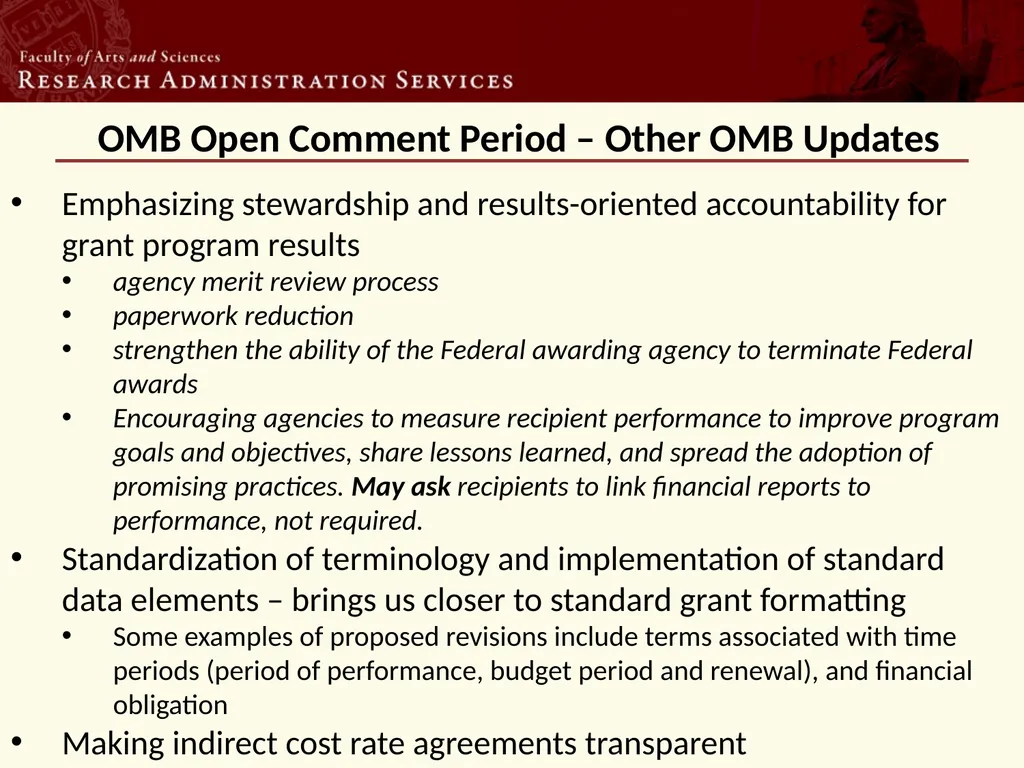
OMB Open Comment Period – Other OMB Updates Emphasizing stewardship and results-oriented accountability for grant program results
agency merit review process
paperwork reduction
strengthen the ability of the Federal awarding agency to terminate Federal awards
Encouraging agencies to measure recipient performance to improve program goals and objectives, share lessons learned, and spread the adoption of promising practices. May ask recipients to link financial reports to performance, not required.
Standardization of terminology and implementation of standard data elements – brings us closer to standard grant formatting
Some examples of proposed revisions include terms associated with time periods (period of performance, budget period and renewal), and financial obligation
Making indirect cost rate agreements transparent<br>
06
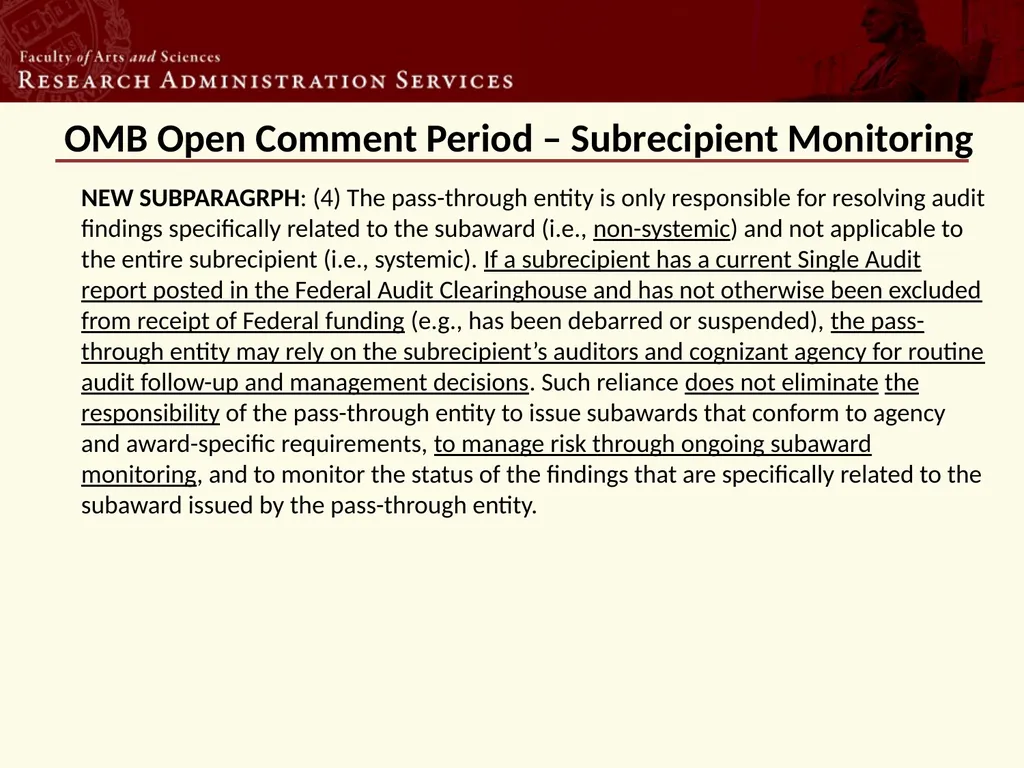
OMB Open Comment Period – Subrecipient Monitoring NEW SUBPARAGRPH: (4) The pass-through entity is only responsible for resolving audit findings specifically related to the subaward (i.e., non-systemic) and not applicable to the entire subrecipient (i.e., systemic). If a subrecipient has a current Single Audit report posted in the Federal Audit Clearinghouse and has not otherwise been excluded from receipt of Federal funding (e.g., has been debarred or suspended), the pass-through entity may rely on the subrecipient’s auditors and cognizant agency for routine audit follow-up and management decisions. Such reliance does not eliminate the responsibility of the pass-through entity to issue subawards that conform to agency and award-specific requirements, to manage risk through ongoing subaward monitoring, and to monitor the status of the findings that are specifically related to the subaward issued by the pass-through entity.<br>