
OMD Safety Policy Training EXPOSURE CONTROL PLAN /


Description: OMD Safety Policy Training EXPOSURE CONTROL PLAN BLOODBORNE PATHOGENS AUTHORITYREFERENCE OMD SAFETY POLICY 99.200.03 EFFECTIVE DATE 9.30.2025 OAR 437-002-1030 OAR 437-002-1035 29 CFR 1910.1030 29 CFR 1910 SUBPART I LOCATION OF DOCUMENTS
Related Topics
Download Presentation
"OMD Safety Policy Training EXPOSURE CONTROL PLAN /" is the property of its rightful owner. Permission is granted to download and print the materials on this website for personal, non-commercial use only, and to display it on your personal computer provided you do not modify the materials and that you retain all copyright notices contained in the materials. By downloading content from our website, you accept the terms of this agreement.
Presentation Transcript
slide1. OMD Safety Policy Training EXPOSURE CONTROL PLAN /
BLOODBORNE PATHOGENS<br>
slide2. AUTHORITY/REFERENCE OMD SAFETY POLICY 99.200.03
EFFECTIVE DATE 9.30.2025
OAR 437-002-1030
OAR 437-002-1035
29 CFR 1910.1030
29 CFR 1910 SUBPART I<br>
slide3. LOCATION OF DOCUMENTS OMD WEBSITE HOMEPAGE https://www.oregon.gov/omd/pages/home.aspx
STATE PERSONNEL OFFICE HOME PAGE UNDER EMPLOYEE RESOURCES
SAFETY PAGE
SCROLL TO AGP POLICY 99.200.03 AND FIND ATTACHMENTS THERE<br>
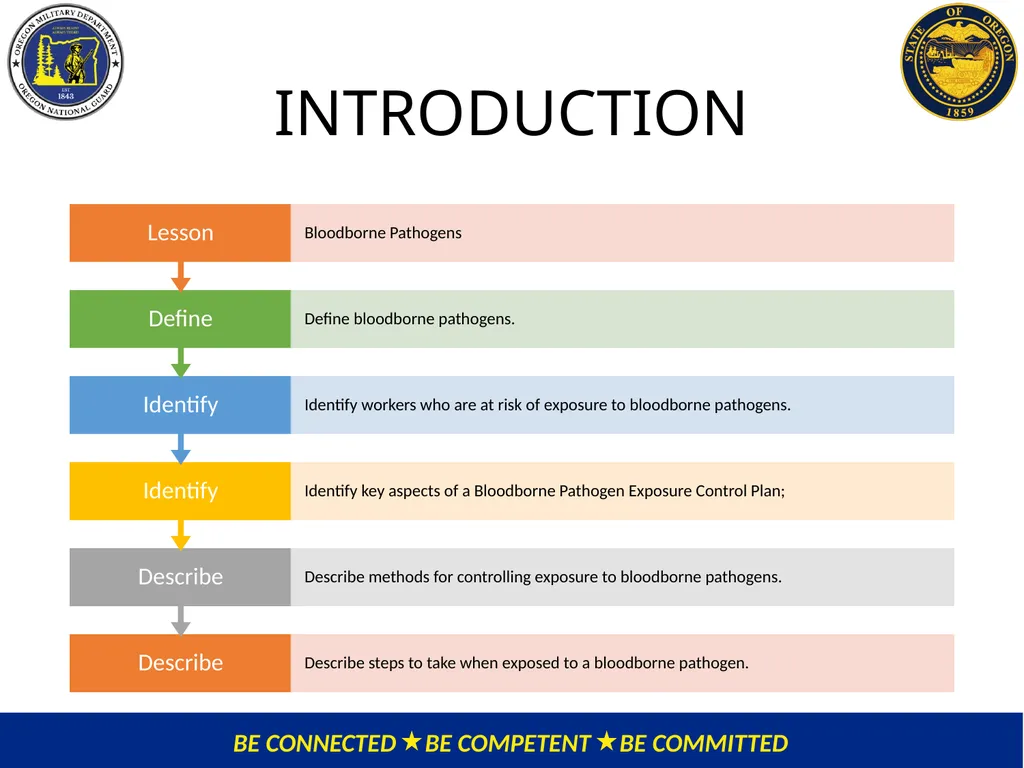
slide4. INTRODUCTION<br>
slide5. BLOODBORNE PATHOGENS What are bloodborne pathogens?
Pathogenic microorganisms present in human blood that can lead to diseases
Examples of primary concern
Hepatitis B (HBV)
Hepatitis C (HCV)
Human Immunodeficiency Virus (HIV)<br>
slide6. BLOODBORNE PATHOGENS Hepatitis B (HBV)
Over 12 million Americans are infected (1 in 20)*
Silent infection; symptoms include jaundice, fatigue, abdominal pain, loss of appetite, intermittent nausea, vomiting; may lead to chronic liver disease, liver cancer, and death
HBV can survive for at least one week in dried blood
Up to 40,000 people in US will become newly infected each year*<br>
slide7. BLOODBORNE PATHOGENS Hepatitis C (HCV)
Hepatitis C is the most common chronic bloodborne infection in the U.S.
Symptoms include jaundice, fatigue, abdominal pain, loss of appetite, intermittent nausea, vomiting
May lead to chronic liver disease and death<br>
slide8. BLOODBORNE PATHOGENS Human Immunodeficiency Virus (HIV)
HIV is the virus that leads to AIDS
HIV affects the body’s immune system
HIV does not survive well outside the body
Estimated >1.1 million people living with HIV
Infected for life<br>
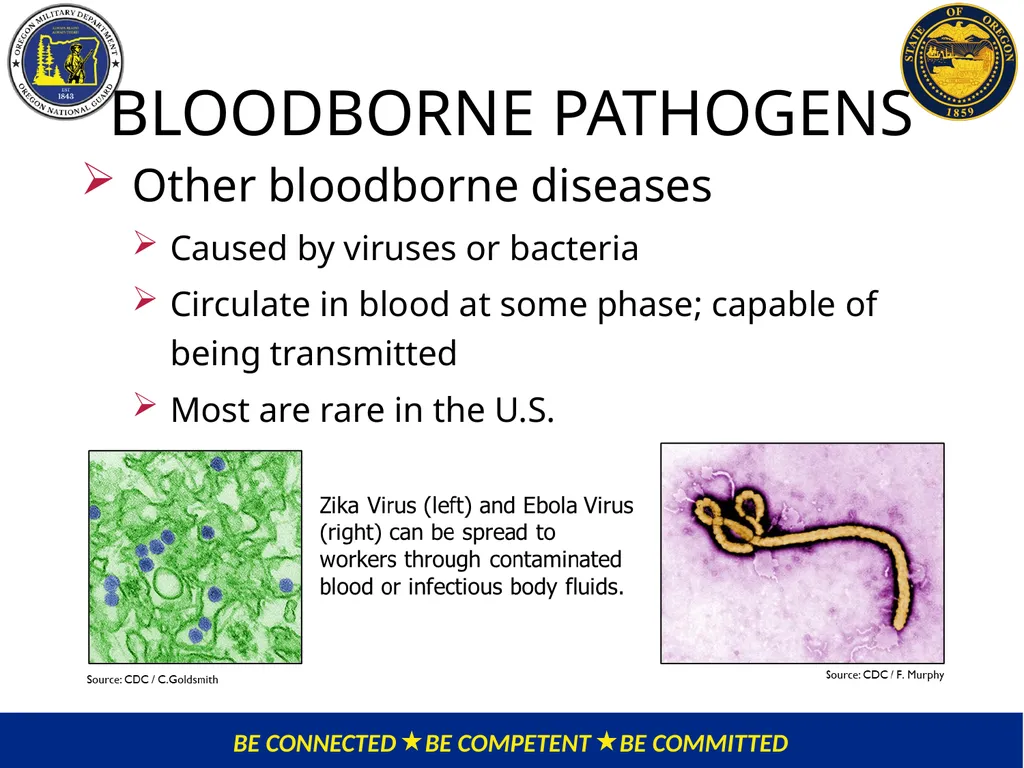
slide9. BLOODBORNE PATHOGENS Other bloodborne diseases
Caused by viruses or bacteria
Circulate in blood at some phase; capable of being transmitted
Most are rare in the U.S.<br>
slide10. BLOODBORNE PATHOGENS Examples
Hepatitis D (HDV)
Syphilis
Malaria
Babesiosis
Brucellosis
Leptospirosis
Arboviral Infections
Relapsing fever
Creutzfeldt-Jakob Disease
Human T-Lymphotropic Virus Type I
Viral Hemorrhagic Fever<br>
slide11. RISK OF EXPOSURE Contamination sources:
Blood
Other potentially infectious materials (OPIM)
Human body fluids
Any unfixed tissue or organ from human
Cultures, culture mediums, or other solutions
Experimental animal blood, tissues, or organs infected with HIV or HBV<br>
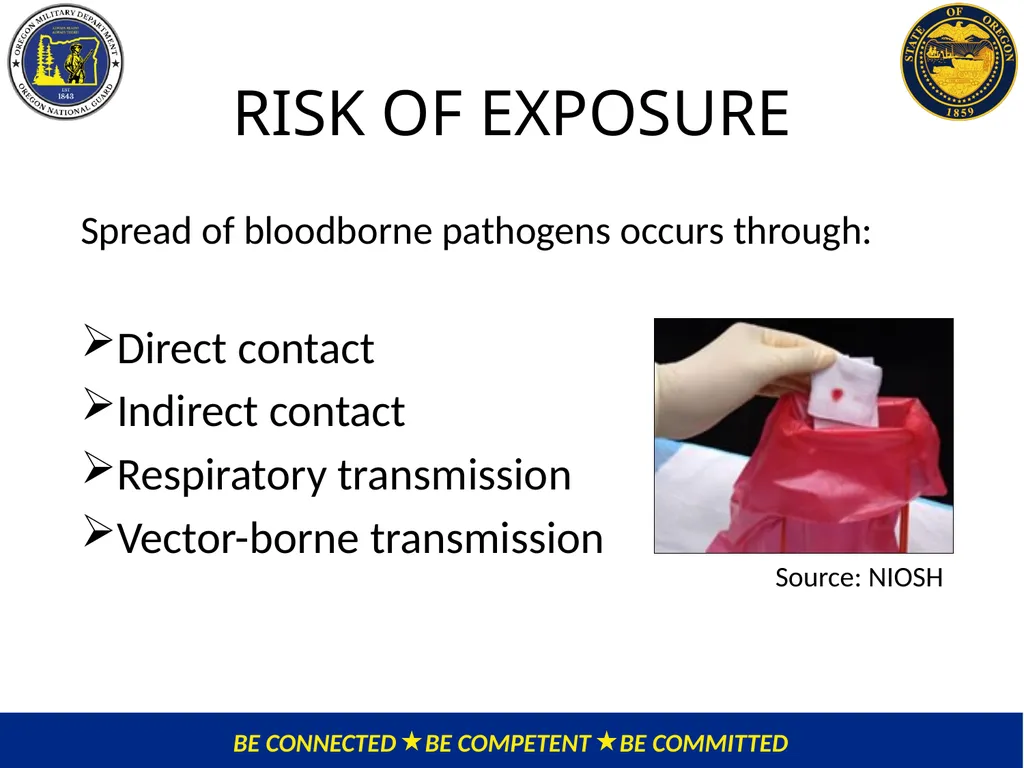
slide12. RISK OF EXPOSURE Spread of bloodborne pathogens occurs through:
Direct contact
Indirect contact
Respiratory transmission
Vector-borne transmission Source: NIOSH<br>
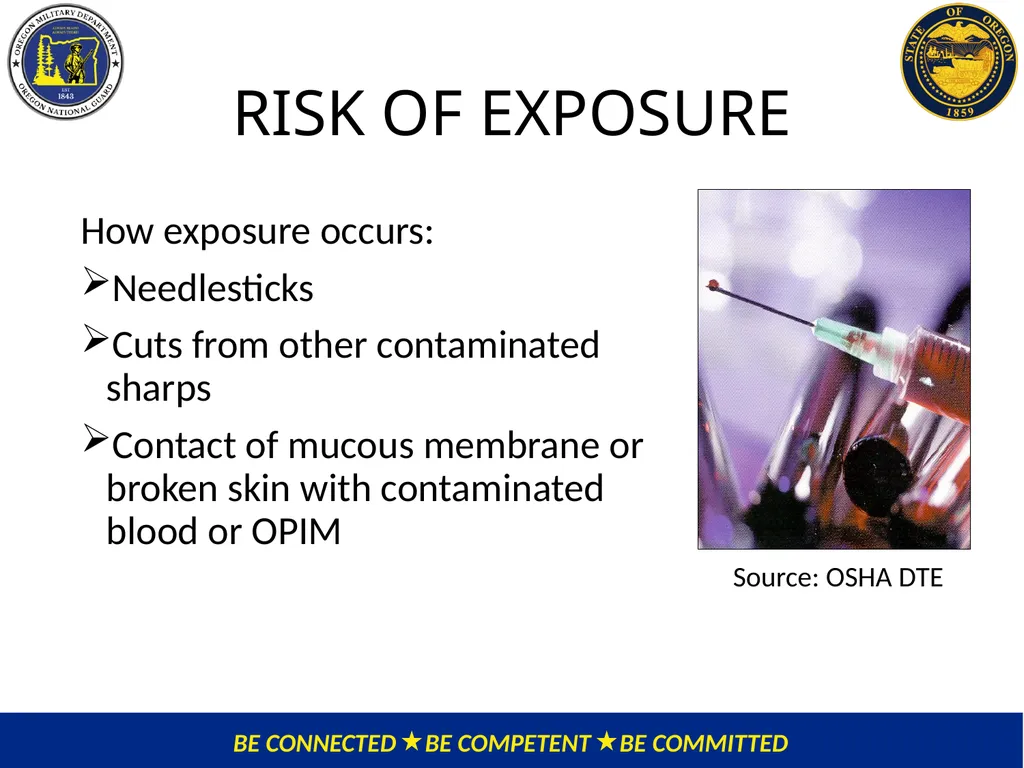
slide13. RISK OF EXPOSURE How exposure occurs:
Needlesticks
Cuts from other contaminated sharps
Contact of mucous membrane or broken skin with contaminated blood or OPIM Source: OSHA DTE<br>
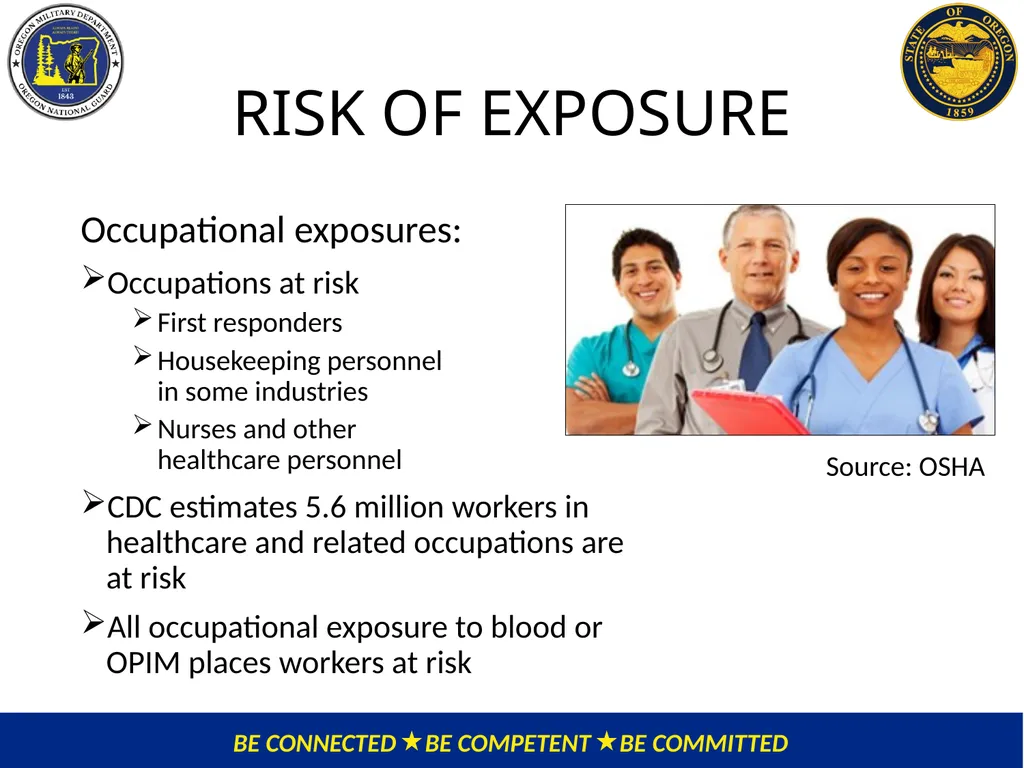
slide14. RISK OF EXPOSURE Occupational exposures:
Occupations at risk
First responders
Housekeeping personnel in some industries
Nurses and other healthcare personnel
CDC estimates 5.6 million workers in healthcare and related occupations are at risk
All occupational exposure to blood or OPIM places workers at risk Source: OSHA<br>
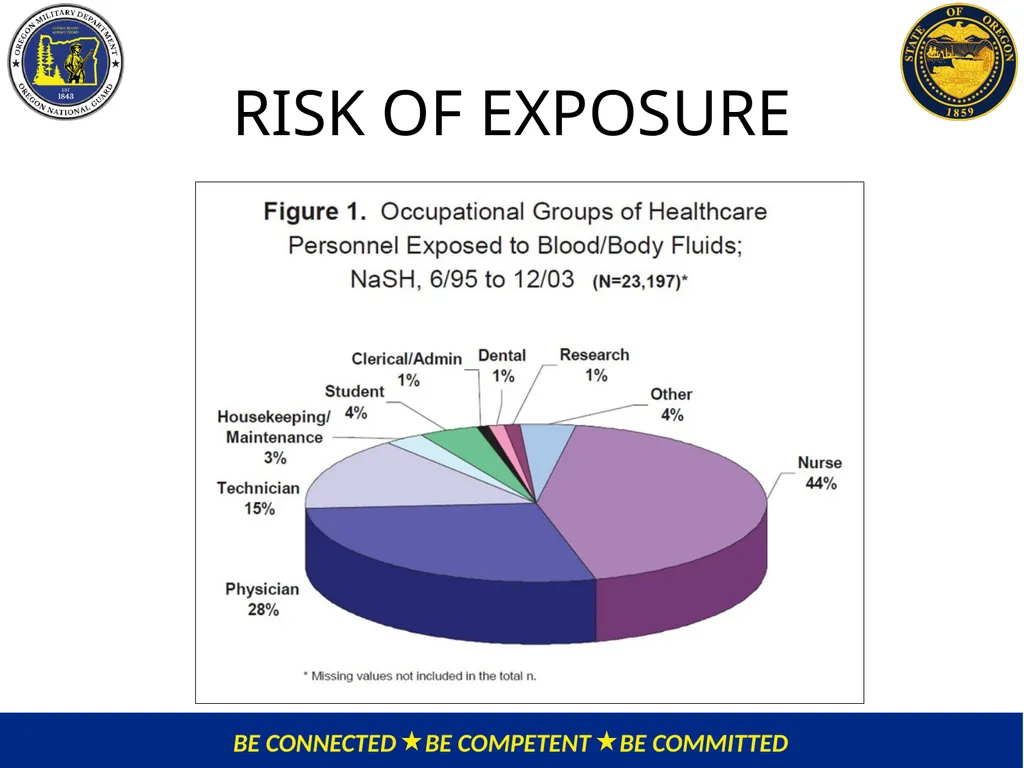
slide15. RISK OF EXPOSURE<br>
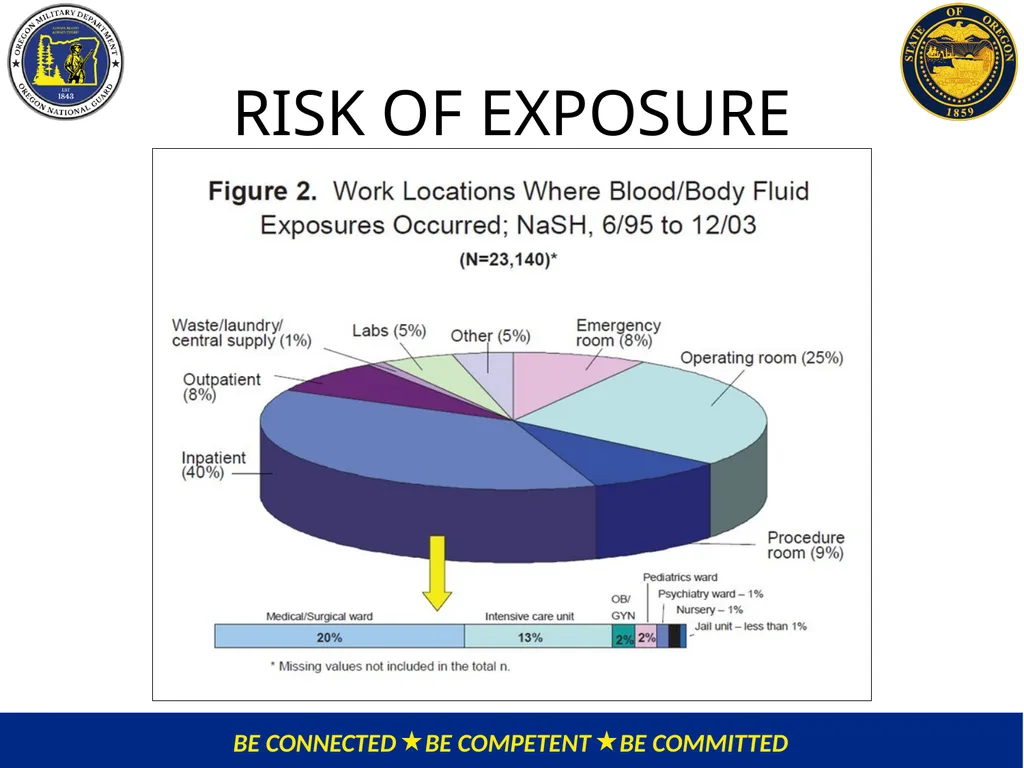
slide16. RISK OF EXPOSURE<br>
slide17. EXPOSURE CONTROL PLAN (ECP) Establish an Exposure Control Plan
Written plan
Review and update plan<br>
slide18. EXPOSURE CONTROL PLAN (ECP) Required elements of Exposure Control plan include:
Exposure determination
Schedule and method of implementation
Procedure for evaluation of exposure incidents<br>
slide19. EXPOSURE CONTROL PLAN (ECP) Required elements of Exposure Control plan include:
Exposure determination
Schedule and method of implementation
Procedure for evaluation of exposure incidents<br>
slide20. EXPOSURE CONTROL PLAN (ECP) Accessible to employees
Review and update
Annually
When new or modified tasks/procedures are implemented<br>
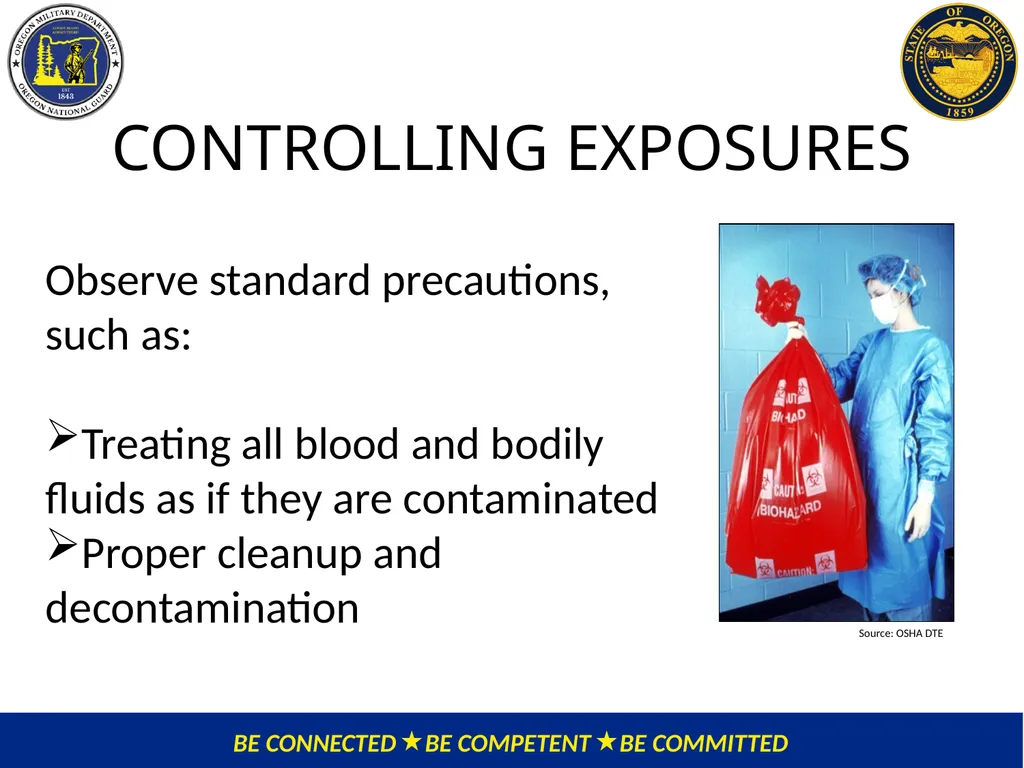
slide21. CONTROLLING EXPOSURES Observe standard precautions, such as:
Treating all blood and bodily fluids as if they are contaminated
Proper cleanup and decontamination Source: OSHA DTE<br>
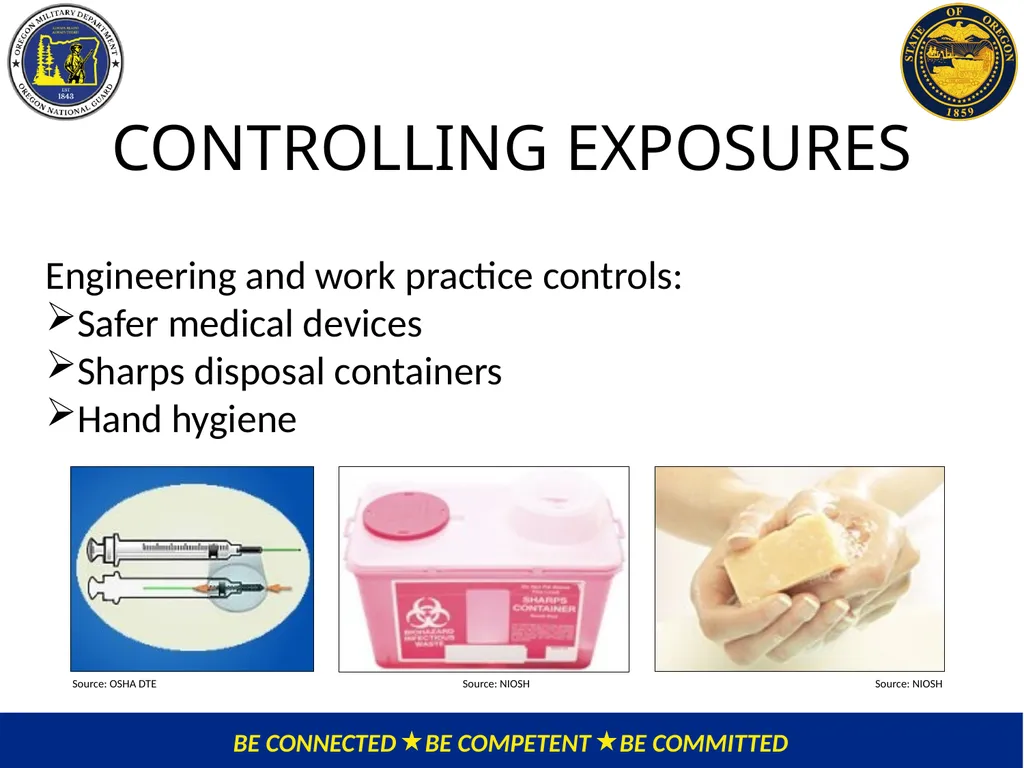
slide22. CONTROLLING EXPOSURES Engineering and work practice controls:
Safer medical devices
Sharps disposal containers
Hand hygiene Source: OSHA DTE Source: NIOSH Source: NIOSH<br>
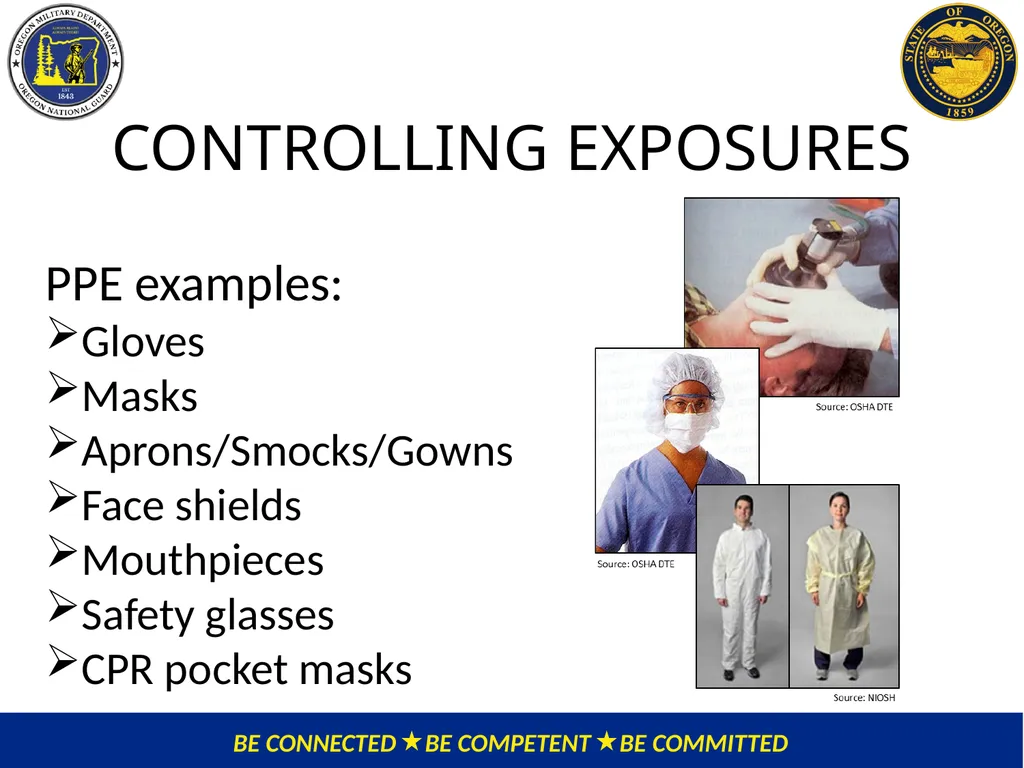
slide23. CONTROLLING EXPOSURES PPE examples:
Gloves
Masks
Aprons/Smocks/Gowns
Face shields
Mouthpieces
Safety glasses
CPR pocket masks<br>
slide24. CONTROLLING EXPOSURES Employer’s responsibilities:
Perform hazard assessment
Identify and provide appropriate PPE to employee at no cost
Train employees on use and care
Maintain/replace PPE
Review, update, evaluate PPE program<br>
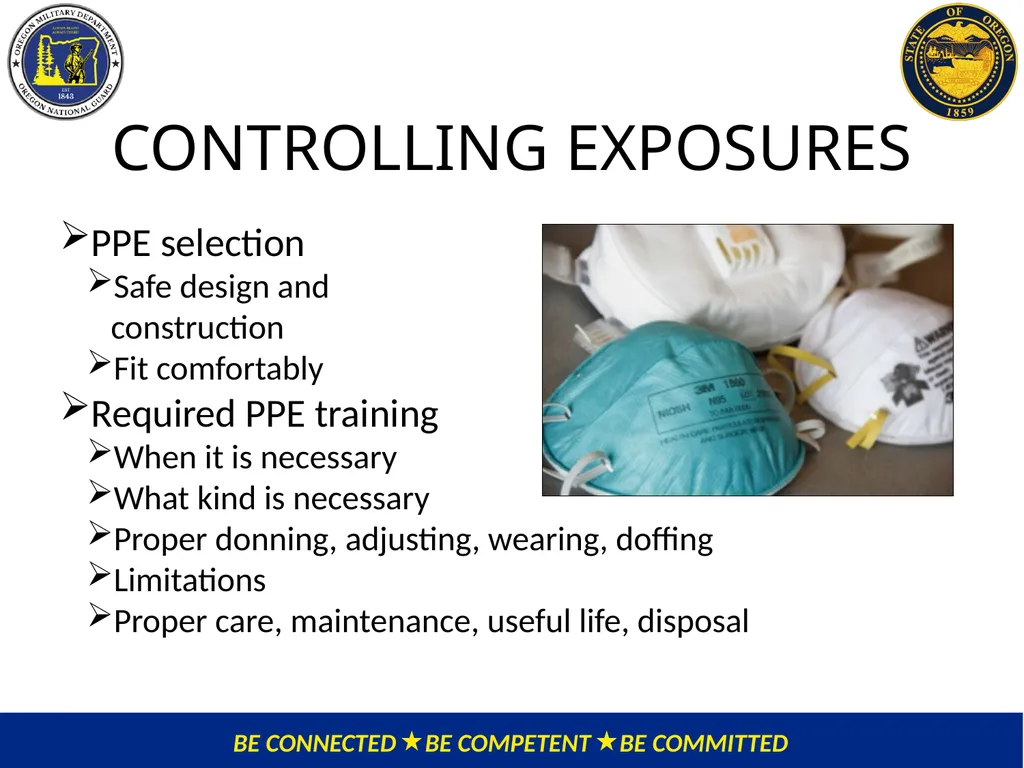
slide25. CONTROLLING EXPOSURES PPE selection
Safe design and construction
Fit comfortably
Required PPE training
When it is necessary
What kind is necessary
Proper donning, adjusting, wearing, doffing
Limitations
Proper care, maintenance, useful life, disposal<br>
slide26. CONTROLLING EXPOSURES Employee’s responsibilities:
Properly wear PPE
Attend training
Care for, clean, and maintain
Notify when repairs/replacement needed<br>
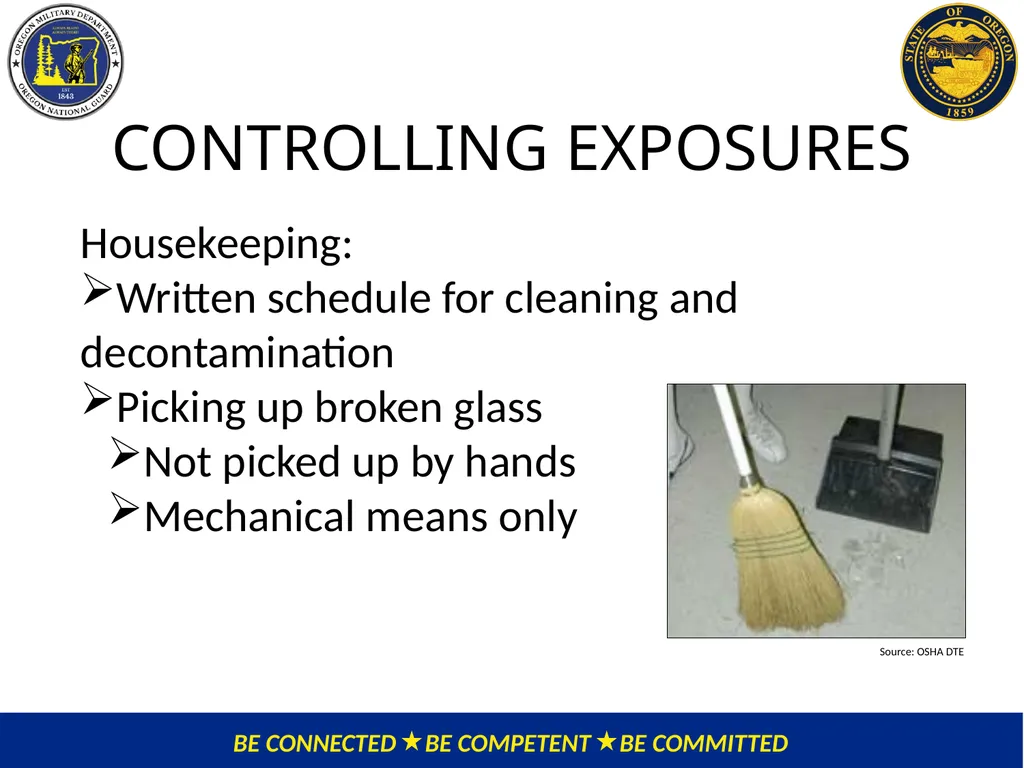
slide27. CONTROLLING EXPOSURES Housekeeping:
Written schedule for cleaning and decontamination
Picking up broken glass
Not picked up by hands
Mechanical means only Source: OSHA DTE<br>
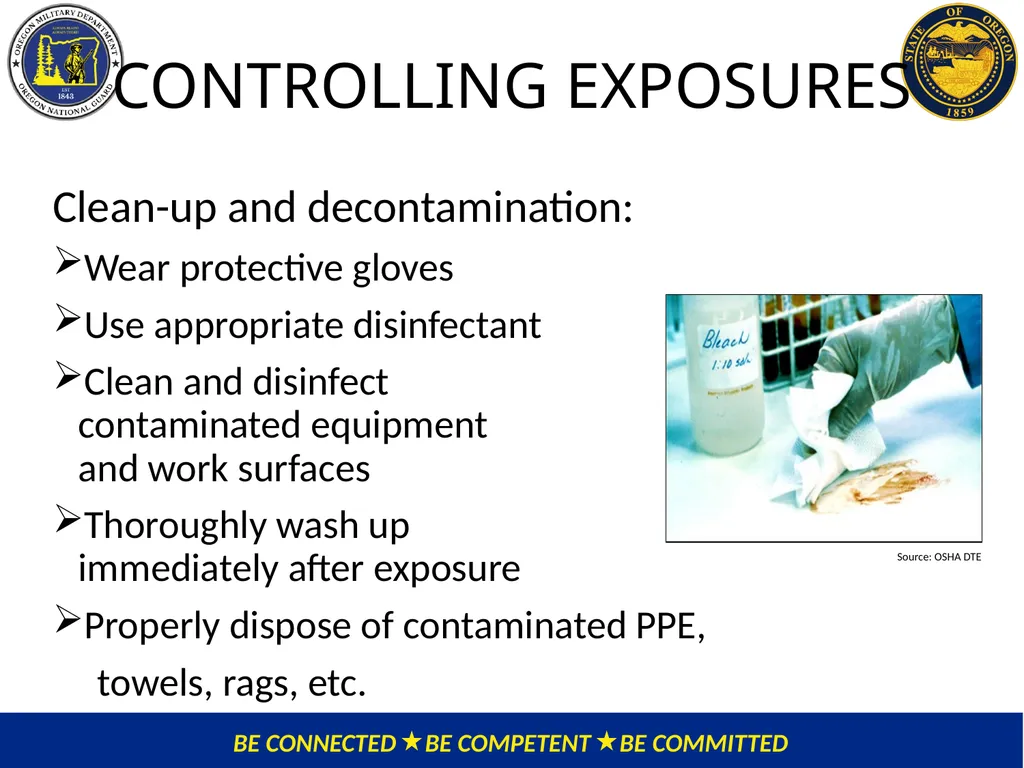
slide28. CONTROLLING EXPOSURES Clean-up and decontamination:
Wear protective gloves
Use appropriate disinfectant
Clean and disinfect contaminated equipment and work surfaces
Thoroughly wash up immediately after exposure
Properly dispose of contaminated PPE,
towels, rags, etc. Source: OSHA DTE<br>
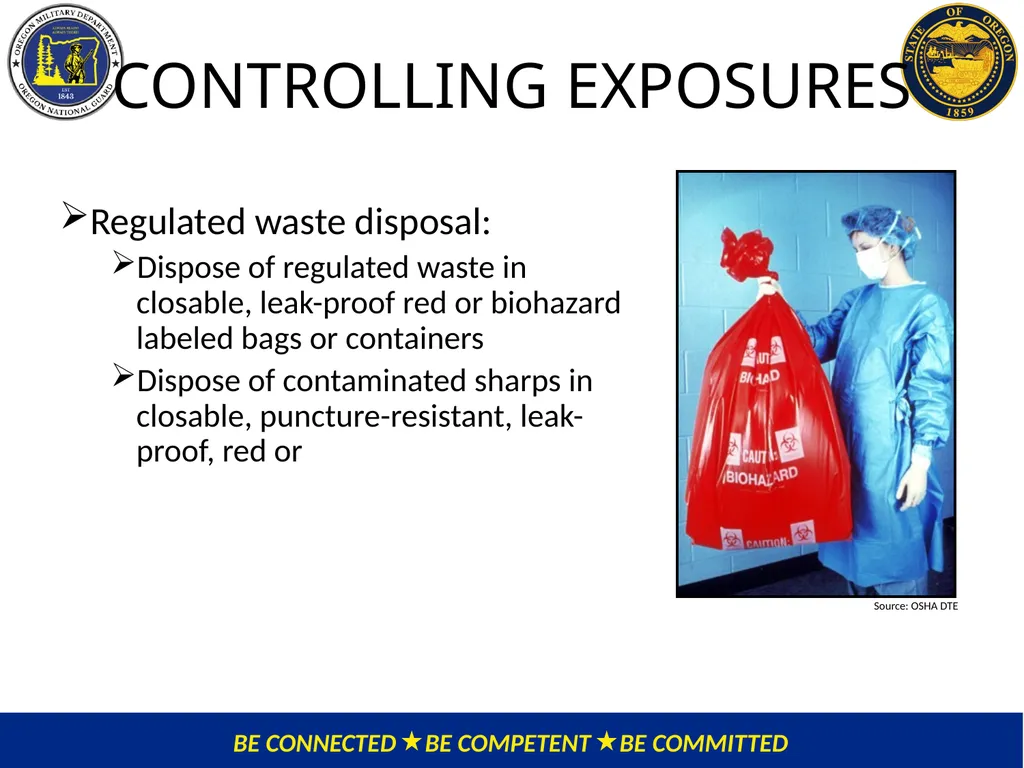
slide29. CONTROLLING EXPOSURES Regulated waste disposal:
Dispose of regulated waste in closable, leak-proof red or biohazard labeled bags or containers
Dispose of contaminated sharps in closable, puncture-resistant, leak-proof, red or Source: OSHA DTE<br>
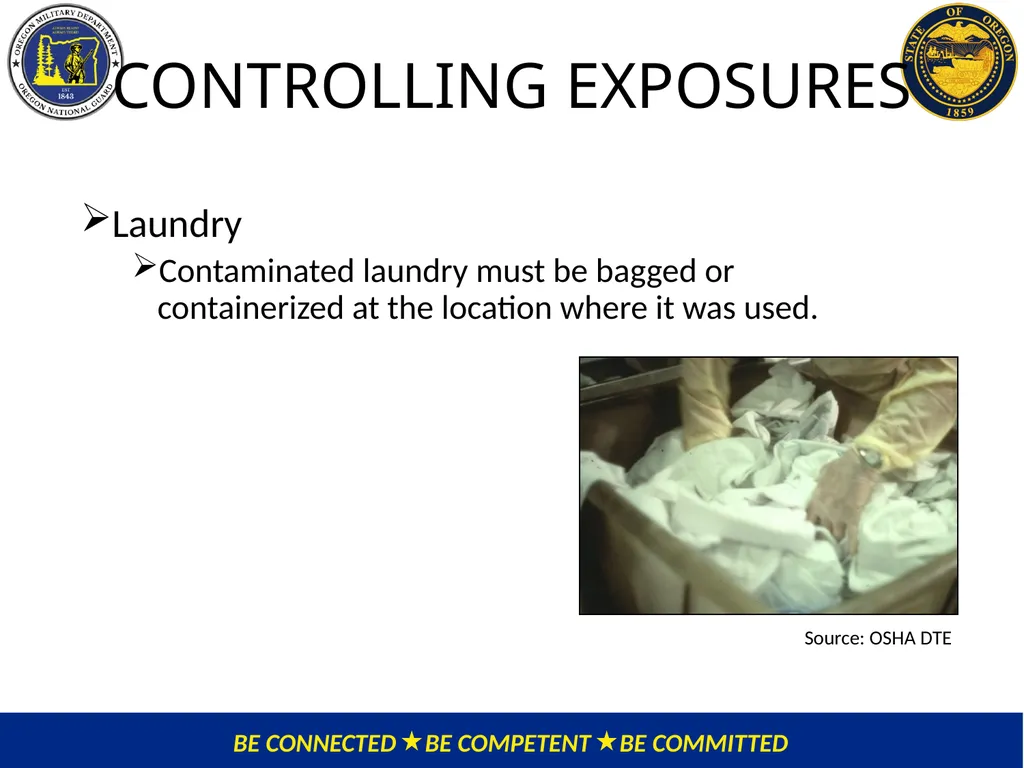
slide30. CONTROLLING EXPOSURES Laundry
Contaminated laundry must be bagged or containerized at the location where it was used. Source: OSHA DTE<br>
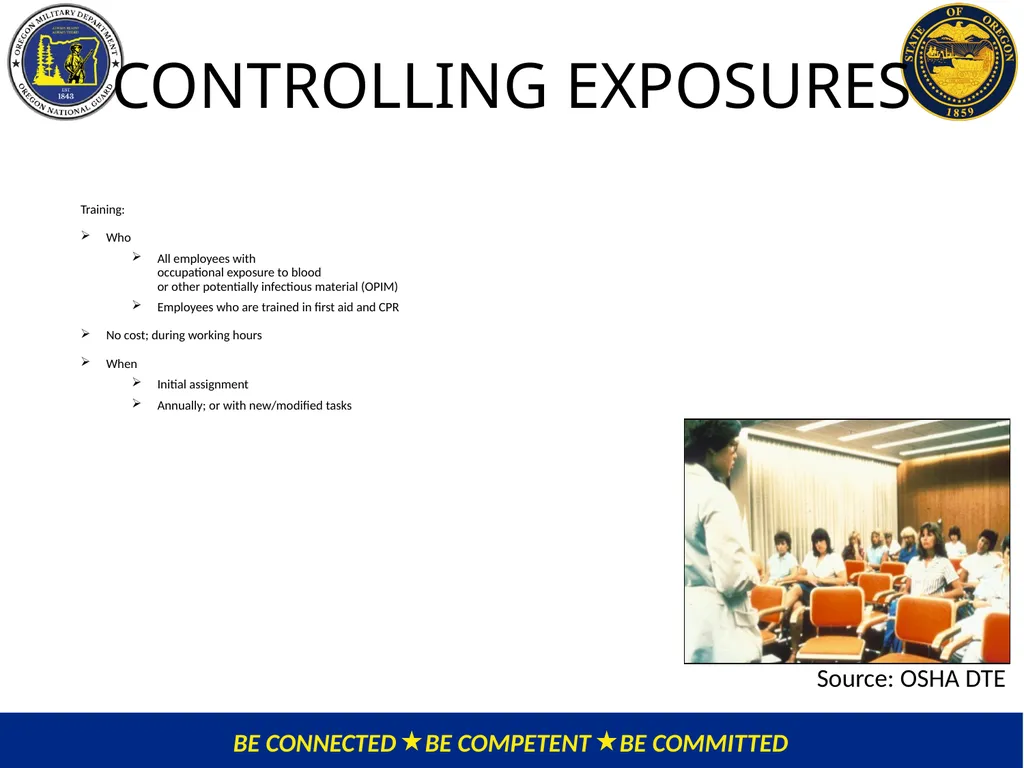
slide31. CONTROLLING EXPOSURES Training:
Who
All employees with occupational exposure to blood or other potentially infectious material (OPIM)
Employees who are trained in first aid and CPR
No cost; during working hours
When
Initial assignment
Annually; or with new/modified tasks Source: OSHA DTE<br>
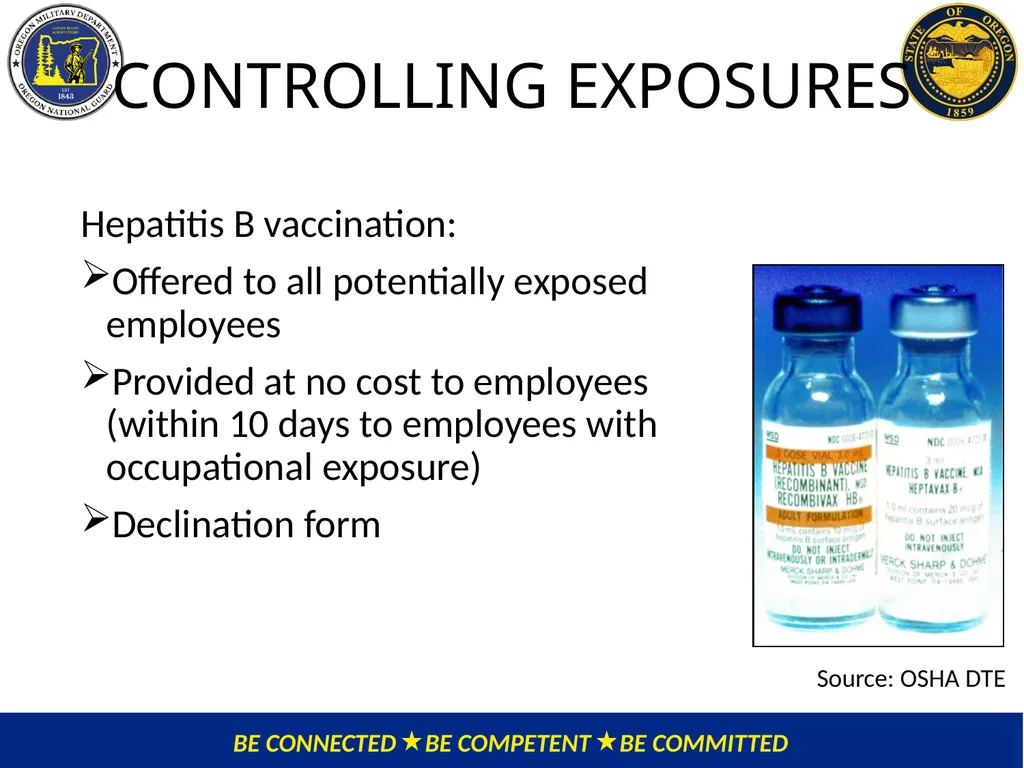
slide32. CONTROLLING EXPOSURES Hepatitis B vaccination:
Offered to all potentially exposed employees
Provided at no cost to employees (within 10 days to employees with occupational exposure)
Declination form Source: OSHA DTE<br>
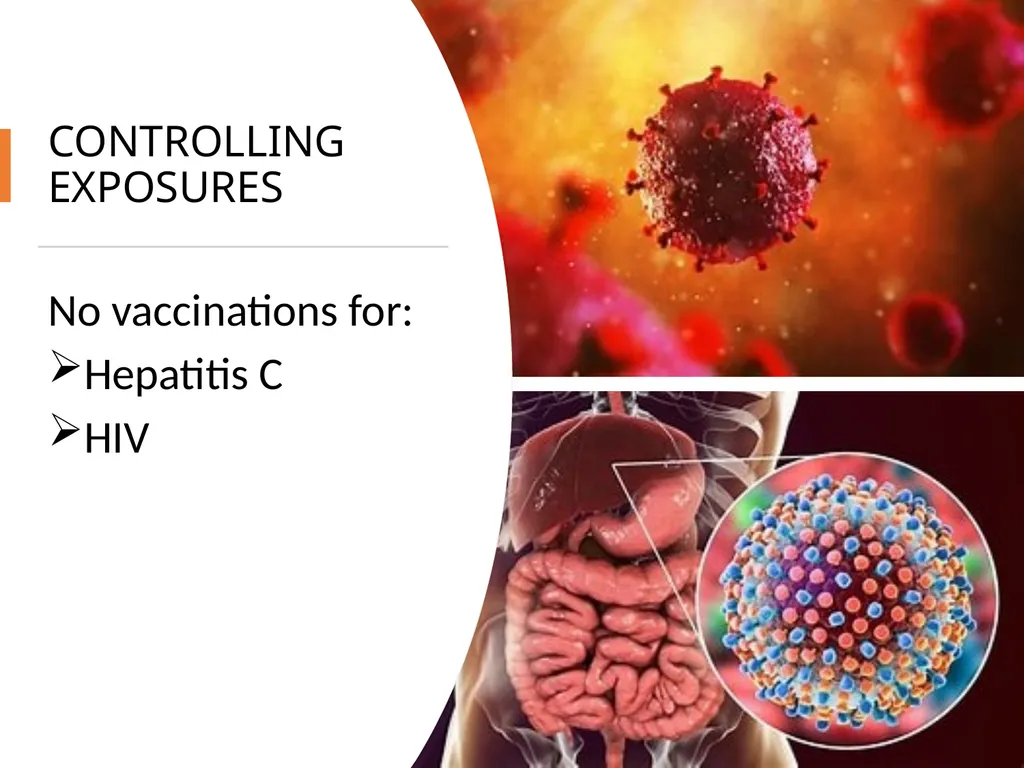
slide33. CONTROLLING EXPOSURES No vaccinations for:
Hepatitis C
HIV<br>
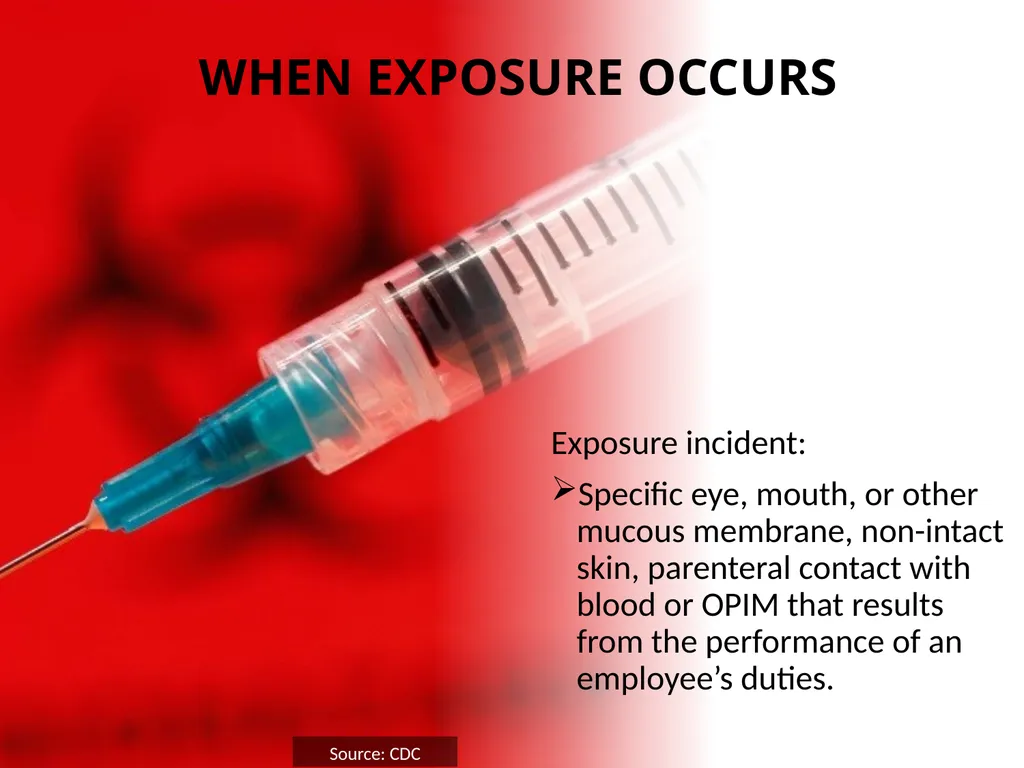
slide34. WHEN EXPOSURE OCCURS Exposure incident:
Specific eye, mouth, or other mucous membrane, non-intact skin, parenteral contact with blood or OPIM that results from the performance of an employee’s duties. Source: CDC<br>
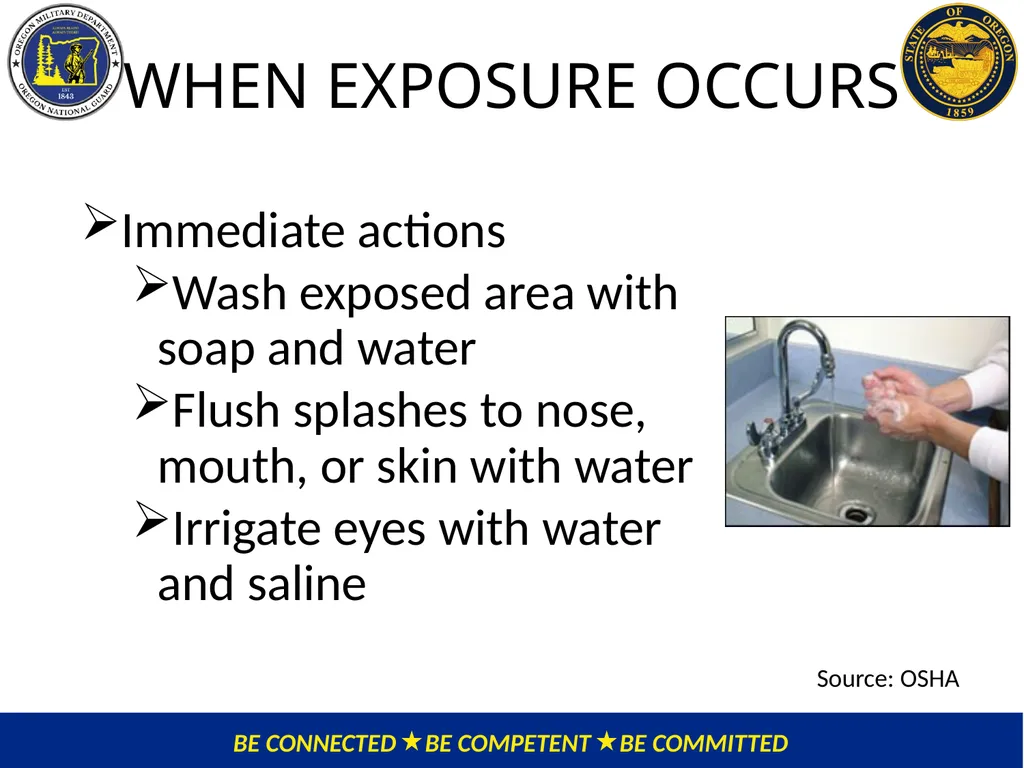
slide35. WHEN EXPOSURE OCCURS Immediate actions
Wash exposed area with soap and water
Flush splashes to nose, mouth, or skin with water
Irrigate eyes with water and saline Source: OSHA<br>
slide36. WHEN EXPOSURE OCCURS Report exposure immediately
Direct employee to healthcare professional for treatment<br>
slide37. WHEN EXPOSURE OCCURS Confidential medical evaluation and follow-up
Route(s) of exposure and circumstances
Source individual
Collect/test blood for HBV and HIV serological status
Post exposure prophylaxis (when medically indicated)
Counseling
Evaluation<br>
slide38. KNOWLEDGE CHECK Bloodborne pathogens can be transmitted by ___.
sexual intercourse or intravenous drug use
rubbing an eye after coming in contact with potentially infectious material
potentially infectious material coming in contact with inflamed acne or sunburn blisters
all of the above Answer: d. All of the above<br>
slide39. KNOWLEDGE CHECK Employees should use PPE when ____.
there is a reasonable anticipation of contact with blood or OPIM
cleaning up spills
responding to an emergency
all of the above Answer: d. All of the above<br>
slide40. KNOWLEDGE CHECK Which of the following is an example of a work practice control?
Spill kits
Accessible handwashing stations
Proper decontamination of spill areas
Red hazardous waste bags Answer: c. Proper decontamination of spill areas<br>
slide41. KNOWLEDGE CHECK Which of the following is a standard precaution for workers exposed to bloodborne pathogens?
Treat all liquids as hazardous for HIV
Treat all blood and bodily fluids of patients as potentially infectious materials
Test all blood and unknown bodily fluids for HIV after spills
Label unknown liquids with hazard signs Answer: b. Treat all blood and bodily fluids of patients as potentially infectious materials<br>
slide42. KNOWLEDGE CHECK Hepatitis B is an inflammation of which body organ?
Kidney
Lungs
Larynx
Liver Answer: d. Liver<br>
slide43. KNOWLEDGE CHECK In the event of an exposure incident, which following action should be taken first?
Notify appropriate personnel
Wash the area thoroughly
Seek medical treatment
Complete an incident or accident report Answer: b. Wash the area thoroughly<br>
slide44. KNOWLEDGE CHECK Which of the following actions can help prevent exposure to bloodborne pathogens?
Wearing latex gloves
Wearing goggles
Washing hands
All of the above Answer: d. All of the above.<br>
slide45. KNOWLEDGE CHECK A vaccine is only available for which of the following major bloodborne pathogen viruses?
HIV
Hepatitis B
Hepatitis C
No vaccines are available for any of the three major BBP viruses Answer: b. Hepatitis B<br>
slide46. KNOWLEDGE CHECK Which of the following are potential routes of entry for bloodborne pathogens?
Mucous membranes of the eyes, nose, and mouth
Non-intact skin
Penetration by a contaminated sharp object
All of the above Answer: d. All of the above<br>
slide47. What Questions Do You Have?<br>
BLOODBORNE PATHOGENS<br>
slide2. AUTHORITY/REFERENCE OMD SAFETY POLICY 99.200.03
EFFECTIVE DATE 9.30.2025
OAR 437-002-1030
OAR 437-002-1035
29 CFR 1910.1030
29 CFR 1910 SUBPART I<br>
slide3. LOCATION OF DOCUMENTS OMD WEBSITE HOMEPAGE https://www.oregon.gov/omd/pages/home.aspx
STATE PERSONNEL OFFICE HOME PAGE UNDER EMPLOYEE RESOURCES
SAFETY PAGE
SCROLL TO AGP POLICY 99.200.03 AND FIND ATTACHMENTS THERE<br>
slide4. INTRODUCTION<br>
slide5. BLOODBORNE PATHOGENS What are bloodborne pathogens?
Pathogenic microorganisms present in human blood that can lead to diseases
Examples of primary concern
Hepatitis B (HBV)
Hepatitis C (HCV)
Human Immunodeficiency Virus (HIV)<br>
slide6. BLOODBORNE PATHOGENS Hepatitis B (HBV)
Over 12 million Americans are infected (1 in 20)*
Silent infection; symptoms include jaundice, fatigue, abdominal pain, loss of appetite, intermittent nausea, vomiting; may lead to chronic liver disease, liver cancer, and death
HBV can survive for at least one week in dried blood
Up to 40,000 people in US will become newly infected each year*<br>
slide7. BLOODBORNE PATHOGENS Hepatitis C (HCV)
Hepatitis C is the most common chronic bloodborne infection in the U.S.
Symptoms include jaundice, fatigue, abdominal pain, loss of appetite, intermittent nausea, vomiting
May lead to chronic liver disease and death<br>
slide8. BLOODBORNE PATHOGENS Human Immunodeficiency Virus (HIV)
HIV is the virus that leads to AIDS
HIV affects the body’s immune system
HIV does not survive well outside the body
Estimated >1.1 million people living with HIV
Infected for life<br>
slide9. BLOODBORNE PATHOGENS Other bloodborne diseases
Caused by viruses or bacteria
Circulate in blood at some phase; capable of being transmitted
Most are rare in the U.S.<br>
slide10. BLOODBORNE PATHOGENS Examples
Hepatitis D (HDV)
Syphilis
Malaria
Babesiosis
Brucellosis
Leptospirosis
Arboviral Infections
Relapsing fever
Creutzfeldt-Jakob Disease
Human T-Lymphotropic Virus Type I
Viral Hemorrhagic Fever<br>
slide11. RISK OF EXPOSURE Contamination sources:
Blood
Other potentially infectious materials (OPIM)
Human body fluids
Any unfixed tissue or organ from human
Cultures, culture mediums, or other solutions
Experimental animal blood, tissues, or organs infected with HIV or HBV<br>
slide12. RISK OF EXPOSURE Spread of bloodborne pathogens occurs through:
Direct contact
Indirect contact
Respiratory transmission
Vector-borne transmission Source: NIOSH<br>
slide13. RISK OF EXPOSURE How exposure occurs:
Needlesticks
Cuts from other contaminated sharps
Contact of mucous membrane or broken skin with contaminated blood or OPIM Source: OSHA DTE<br>
slide14. RISK OF EXPOSURE Occupational exposures:
Occupations at risk
First responders
Housekeeping personnel in some industries
Nurses and other healthcare personnel
CDC estimates 5.6 million workers in healthcare and related occupations are at risk
All occupational exposure to blood or OPIM places workers at risk Source: OSHA<br>
slide15. RISK OF EXPOSURE<br>
slide16. RISK OF EXPOSURE<br>
slide17. EXPOSURE CONTROL PLAN (ECP) Establish an Exposure Control Plan
Written plan
Review and update plan<br>
slide18. EXPOSURE CONTROL PLAN (ECP) Required elements of Exposure Control plan include:
Exposure determination
Schedule and method of implementation
Procedure for evaluation of exposure incidents<br>
slide19. EXPOSURE CONTROL PLAN (ECP) Required elements of Exposure Control plan include:
Exposure determination
Schedule and method of implementation
Procedure for evaluation of exposure incidents<br>
slide20. EXPOSURE CONTROL PLAN (ECP) Accessible to employees
Review and update
Annually
When new or modified tasks/procedures are implemented<br>
slide21. CONTROLLING EXPOSURES Observe standard precautions, such as:
Treating all blood and bodily fluids as if they are contaminated
Proper cleanup and decontamination Source: OSHA DTE<br>
slide22. CONTROLLING EXPOSURES Engineering and work practice controls:
Safer medical devices
Sharps disposal containers
Hand hygiene Source: OSHA DTE Source: NIOSH Source: NIOSH<br>
slide23. CONTROLLING EXPOSURES PPE examples:
Gloves
Masks
Aprons/Smocks/Gowns
Face shields
Mouthpieces
Safety glasses
CPR pocket masks<br>
slide24. CONTROLLING EXPOSURES Employer’s responsibilities:
Perform hazard assessment
Identify and provide appropriate PPE to employee at no cost
Train employees on use and care
Maintain/replace PPE
Review, update, evaluate PPE program<br>
slide25. CONTROLLING EXPOSURES PPE selection
Safe design and construction
Fit comfortably
Required PPE training
When it is necessary
What kind is necessary
Proper donning, adjusting, wearing, doffing
Limitations
Proper care, maintenance, useful life, disposal<br>
slide26. CONTROLLING EXPOSURES Employee’s responsibilities:
Properly wear PPE
Attend training
Care for, clean, and maintain
Notify when repairs/replacement needed<br>
slide27. CONTROLLING EXPOSURES Housekeeping:
Written schedule for cleaning and decontamination
Picking up broken glass
Not picked up by hands
Mechanical means only Source: OSHA DTE<br>
slide28. CONTROLLING EXPOSURES Clean-up and decontamination:
Wear protective gloves
Use appropriate disinfectant
Clean and disinfect contaminated equipment and work surfaces
Thoroughly wash up immediately after exposure
Properly dispose of contaminated PPE,
towels, rags, etc. Source: OSHA DTE<br>
slide29. CONTROLLING EXPOSURES Regulated waste disposal:
Dispose of regulated waste in closable, leak-proof red or biohazard labeled bags or containers
Dispose of contaminated sharps in closable, puncture-resistant, leak-proof, red or Source: OSHA DTE<br>
slide30. CONTROLLING EXPOSURES Laundry
Contaminated laundry must be bagged or containerized at the location where it was used. Source: OSHA DTE<br>
slide31. CONTROLLING EXPOSURES Training:
Who
All employees with occupational exposure to blood or other potentially infectious material (OPIM)
Employees who are trained in first aid and CPR
No cost; during working hours
When
Initial assignment
Annually; or with new/modified tasks Source: OSHA DTE<br>
slide32. CONTROLLING EXPOSURES Hepatitis B vaccination:
Offered to all potentially exposed employees
Provided at no cost to employees (within 10 days to employees with occupational exposure)
Declination form Source: OSHA DTE<br>
slide33. CONTROLLING EXPOSURES No vaccinations for:
Hepatitis C
HIV<br>
slide34. WHEN EXPOSURE OCCURS Exposure incident:
Specific eye, mouth, or other mucous membrane, non-intact skin, parenteral contact with blood or OPIM that results from the performance of an employee’s duties. Source: CDC<br>
slide35. WHEN EXPOSURE OCCURS Immediate actions
Wash exposed area with soap and water
Flush splashes to nose, mouth, or skin with water
Irrigate eyes with water and saline Source: OSHA<br>
slide36. WHEN EXPOSURE OCCURS Report exposure immediately
Direct employee to healthcare professional for treatment<br>
slide37. WHEN EXPOSURE OCCURS Confidential medical evaluation and follow-up
Route(s) of exposure and circumstances
Source individual
Collect/test blood for HBV and HIV serological status
Post exposure prophylaxis (when medically indicated)
Counseling
Evaluation<br>
slide38. KNOWLEDGE CHECK Bloodborne pathogens can be transmitted by ___.
sexual intercourse or intravenous drug use
rubbing an eye after coming in contact with potentially infectious material
potentially infectious material coming in contact with inflamed acne or sunburn blisters
all of the above Answer: d. All of the above<br>
slide39. KNOWLEDGE CHECK Employees should use PPE when ____.
there is a reasonable anticipation of contact with blood or OPIM
cleaning up spills
responding to an emergency
all of the above Answer: d. All of the above<br>
slide40. KNOWLEDGE CHECK Which of the following is an example of a work practice control?
Spill kits
Accessible handwashing stations
Proper decontamination of spill areas
Red hazardous waste bags Answer: c. Proper decontamination of spill areas<br>
slide41. KNOWLEDGE CHECK Which of the following is a standard precaution for workers exposed to bloodborne pathogens?
Treat all liquids as hazardous for HIV
Treat all blood and bodily fluids of patients as potentially infectious materials
Test all blood and unknown bodily fluids for HIV after spills
Label unknown liquids with hazard signs Answer: b. Treat all blood and bodily fluids of patients as potentially infectious materials<br>
slide42. KNOWLEDGE CHECK Hepatitis B is an inflammation of which body organ?
Kidney
Lungs
Larynx
Liver Answer: d. Liver<br>
slide43. KNOWLEDGE CHECK In the event of an exposure incident, which following action should be taken first?
Notify appropriate personnel
Wash the area thoroughly
Seek medical treatment
Complete an incident or accident report Answer: b. Wash the area thoroughly<br>
slide44. KNOWLEDGE CHECK Which of the following actions can help prevent exposure to bloodborne pathogens?
Wearing latex gloves
Wearing goggles
Washing hands
All of the above Answer: d. All of the above.<br>
slide45. KNOWLEDGE CHECK A vaccine is only available for which of the following major bloodborne pathogen viruses?
HIV
Hepatitis B
Hepatitis C
No vaccines are available for any of the three major BBP viruses Answer: b. Hepatitis B<br>
slide46. KNOWLEDGE CHECK Which of the following are potential routes of entry for bloodborne pathogens?
Mucous membranes of the eyes, nose, and mouth
Non-intact skin
Penetration by a contaminated sharp object
All of the above Answer: d. All of the above<br>
slide47. What Questions Do You Have?<br>