
Optimisation of Photovoltaic Systems for Different

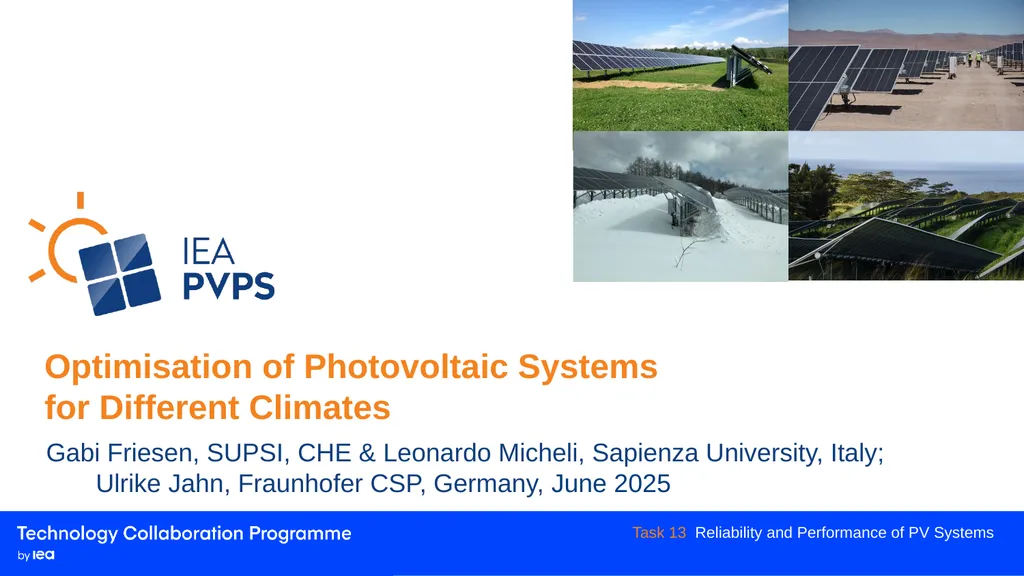
Description: Optimisation of Photovoltaic Systems for Different Climates Gabi Friesen, SUPSI, CHE Leonardo Micheli, Sapienza University, Italy; Ulrike Jahn, Fraunhofer CSP, Germany, June 2025 Task 13 Reliability and Performance of PV Systems
Related Topics
Download Presentation
"Optimisation of Photovoltaic Systems for Different" is the property of its rightful owner. Permission is granted to download and print the materials on this website for personal, non-commercial use only, and to display it on your personal computer provided you do not modify the materials and that you retain all copyright notices contained in the materials. By downloading content from our website, you accept the terms of this agreement.
Presentation Transcript
slide1. Optimisation of Photovoltaic Systems for Different Climates Gabi Friesen, SUPSI, CHE & Leonardo Micheli, Sapienza University, Italy; Ulrike Jahn, Fraunhofer CSP, Germany, June 2025 Task 13 Reliability and Performance of PV Systems<br>
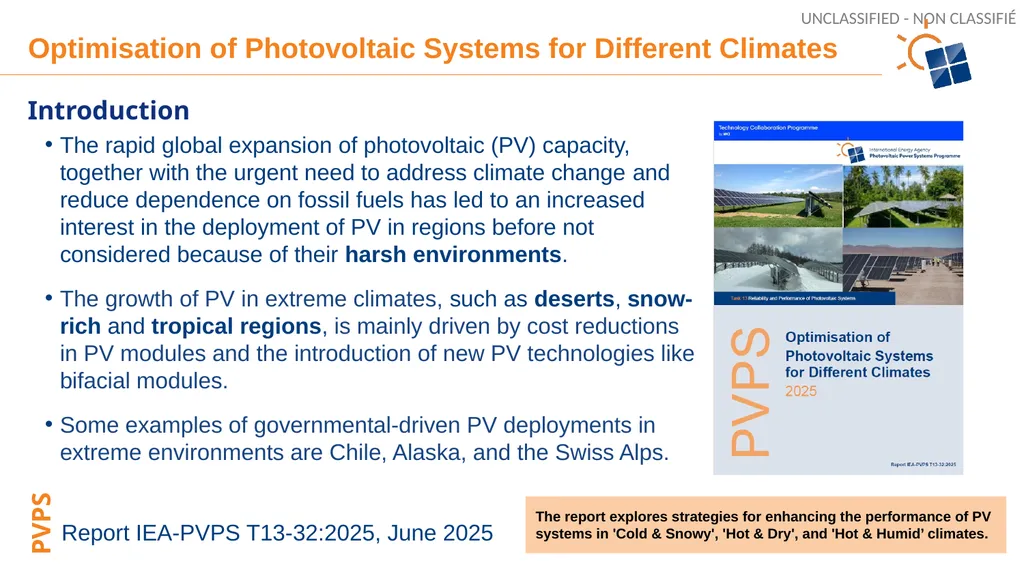
slide2. Optimisation of Photovoltaic Systems for Different Climates The rapid global expansion of photovoltaic (PV) capacity, together with the urgent need to address climate change and reduce dependence on fossil fuels has led to an increased interest in the deployment of PV in regions before not considered because of their harsh environments.
The growth of PV in extreme climates, such as deserts, snow-rich and tropical regions, is mainly driven by cost reductions in PV modules and the introduction of new PV technologies like bifacial modules.
Some examples of governmental-driven PV deployments in extreme environments are Chile, Alaska, and the Swiss Alps. Report IEA-PVPS T13-32:2025, June 2025 The report explores strategies for enhancing the performance of PV systems in 'Cold & Snowy', 'Hot & Dry', and 'Hot & Humid’ climates. Introduction<br>
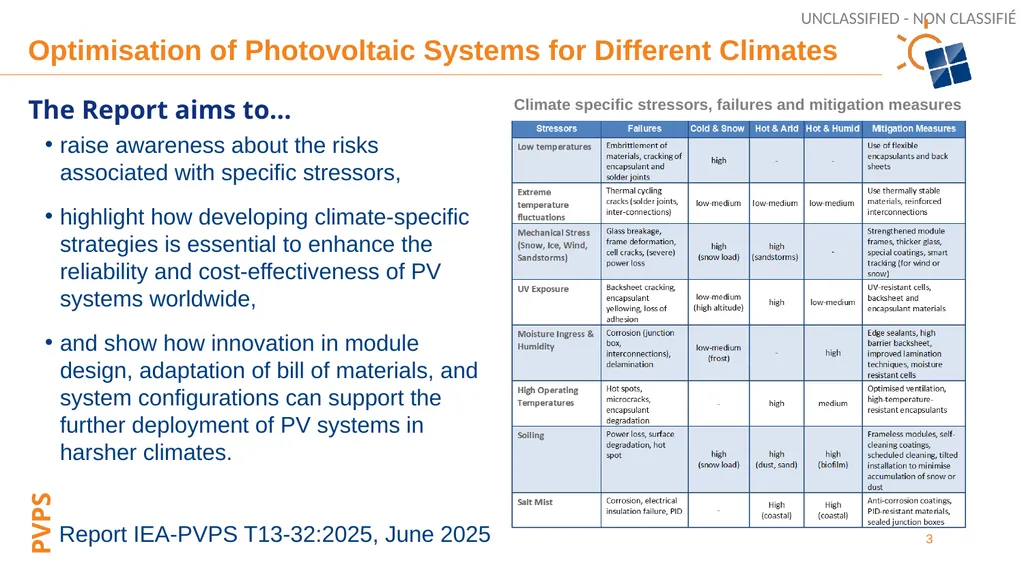
slide3. The Report aims to… raise awareness about the risks associated with specific stressors,
highlight how developing climate-specific strategies is essential to enhance the reliability and cost-effectiveness of PV systems worldwide,
and show how innovation in module design, adaptation of bill of materials, and system configurations can support the further deployment of PV systems in harsher climates. Optimisation of Photovoltaic Systems for Different Climates Report IEA-PVPS T13-32:2025, June 2025 Climate specific stressors, failures and mitigation measures<br>
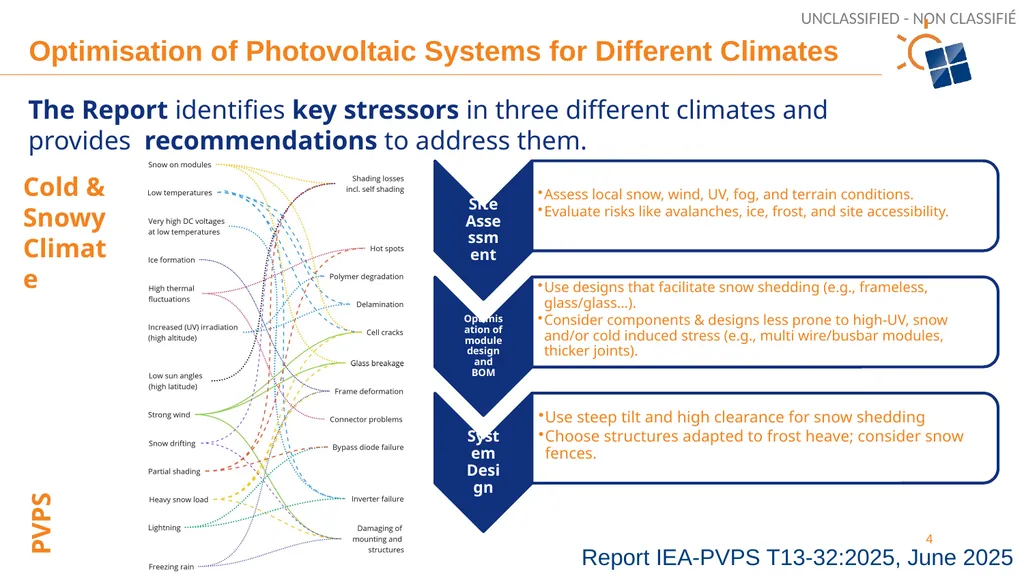
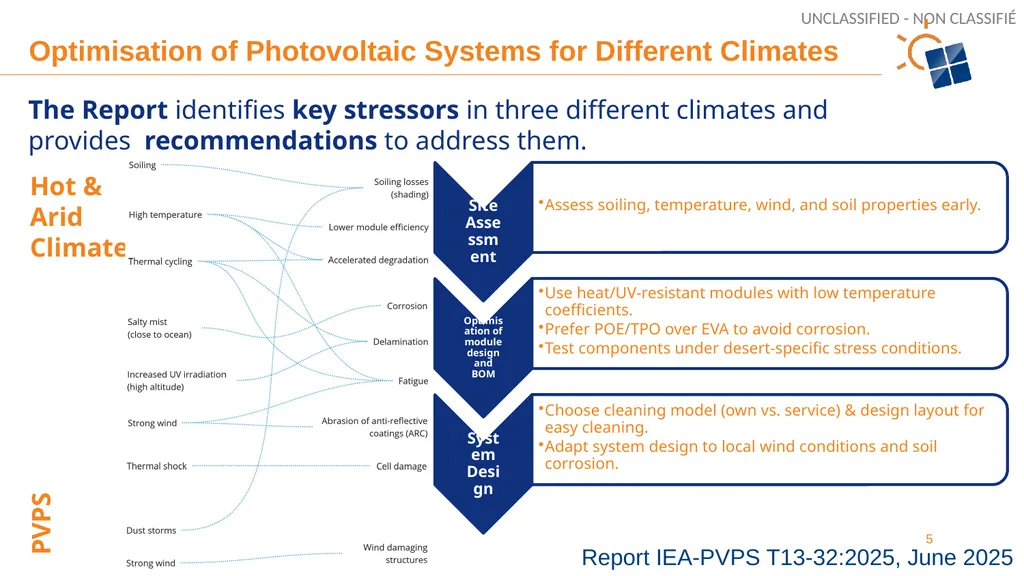
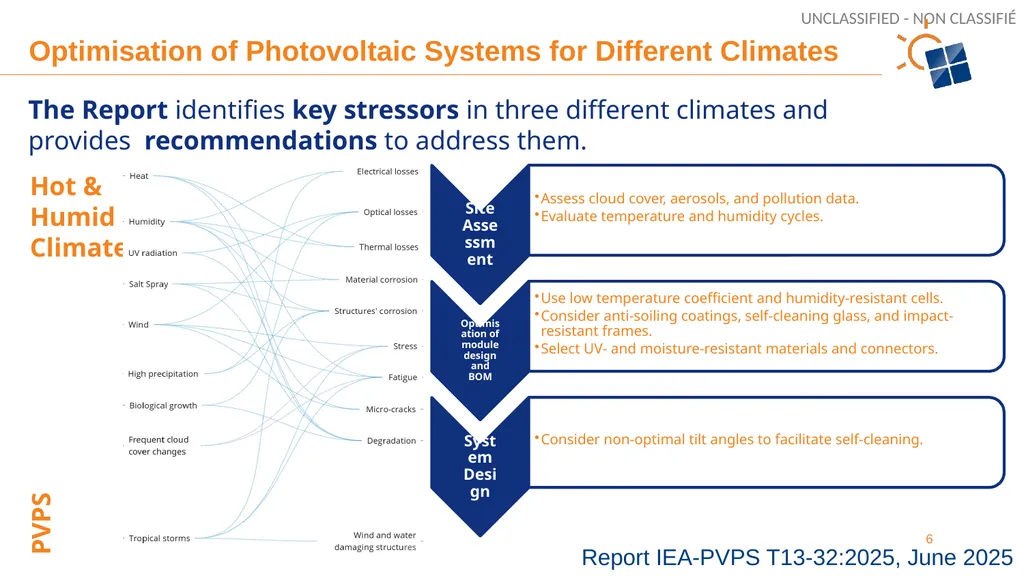
slide4. Optimisation of Photovoltaic Systems for Different Climates The Report identifies key stressors in three different climates and provides recommendations to address them. Cold & Snowy
Climate Report IEA-PVPS T13-32:2025, June 2025<br>
slide5. Optimisation of Photovoltaic Systems for Different Climates The Report identifies key stressors in three different climates and provides recommendations to address them. Hot & Arid
Climate Report IEA-PVPS T13-32:2025, June 2025<br>
slide6. Optimisation of Photovoltaic Systems for Different Climates The Report identifies key stressors in three different climates and provides recommendations to address them. Hot & Humid
Climate Report IEA-PVPS T13-32:2025, June 2025<br>
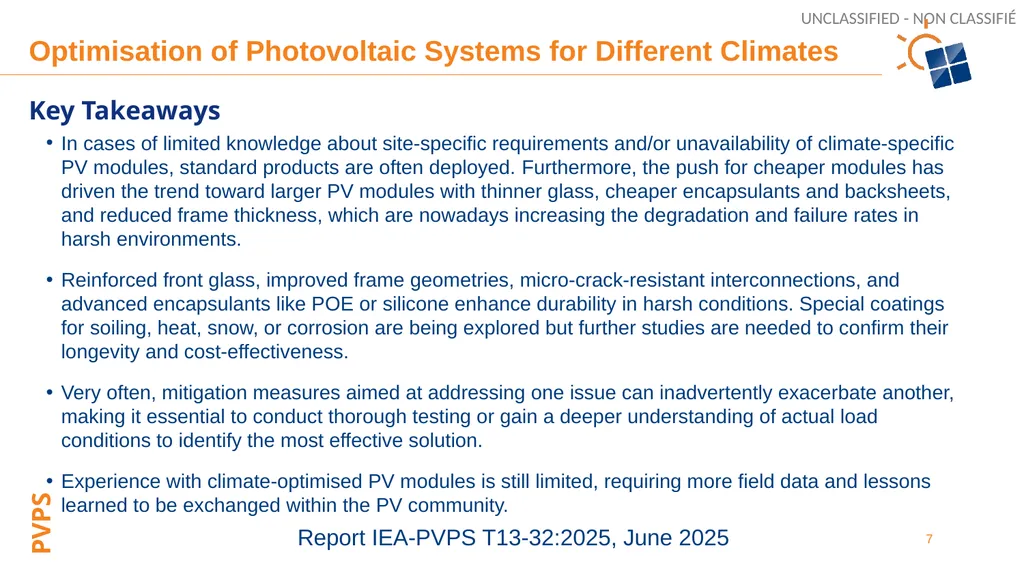
slide7. Key Takeaways Report IEA-PVPS T13-32:2025, June 2025 Optimisation of Photovoltaic Systems for Different Climates In cases of limited knowledge about site-specific requirements and/or unavailability of climate-specific PV modules, standard products are often deployed. Furthermore, the push for cheaper modules has driven the trend toward larger PV modules with thinner glass, cheaper encapsulants and backsheets, and reduced frame thickness, which are nowadays increasing the degradation and failure rates in harsh environments.
Reinforced front glass, improved frame geometries, micro-crack-resistant interconnections, and advanced encapsulants like POE or silicone enhance durability in harsh conditions. Special coatings for soiling, heat, snow, or corrosion are being explored but further studies are needed to confirm their longevity and cost-effectiveness.
Very often, mitigation measures aimed at addressing one issue can inadvertently exacerbate another, making it essential to conduct thorough testing or gain a deeper understanding of actual load conditions to identify the most effective solution.
Experience with climate-optimised PV modules is still limited, requiring more field data and lessons learned to be exchanged within the PV community.<br>
slide2. Optimisation of Photovoltaic Systems for Different Climates The rapid global expansion of photovoltaic (PV) capacity, together with the urgent need to address climate change and reduce dependence on fossil fuels has led to an increased interest in the deployment of PV in regions before not considered because of their harsh environments.
The growth of PV in extreme climates, such as deserts, snow-rich and tropical regions, is mainly driven by cost reductions in PV modules and the introduction of new PV technologies like bifacial modules.
Some examples of governmental-driven PV deployments in extreme environments are Chile, Alaska, and the Swiss Alps. Report IEA-PVPS T13-32:2025, June 2025 The report explores strategies for enhancing the performance of PV systems in 'Cold & Snowy', 'Hot & Dry', and 'Hot & Humid’ climates. Introduction<br>
slide3. The Report aims to… raise awareness about the risks associated with specific stressors,
highlight how developing climate-specific strategies is essential to enhance the reliability and cost-effectiveness of PV systems worldwide,
and show how innovation in module design, adaptation of bill of materials, and system configurations can support the further deployment of PV systems in harsher climates. Optimisation of Photovoltaic Systems for Different Climates Report IEA-PVPS T13-32:2025, June 2025 Climate specific stressors, failures and mitigation measures<br>
slide4. Optimisation of Photovoltaic Systems for Different Climates The Report identifies key stressors in three different climates and provides recommendations to address them. Cold & Snowy
Climate Report IEA-PVPS T13-32:2025, June 2025<br>
slide5. Optimisation of Photovoltaic Systems for Different Climates The Report identifies key stressors in three different climates and provides recommendations to address them. Hot & Arid
Climate Report IEA-PVPS T13-32:2025, June 2025<br>
slide6. Optimisation of Photovoltaic Systems for Different Climates The Report identifies key stressors in three different climates and provides recommendations to address them. Hot & Humid
Climate Report IEA-PVPS T13-32:2025, June 2025<br>
slide7. Key Takeaways Report IEA-PVPS T13-32:2025, June 2025 Optimisation of Photovoltaic Systems for Different Climates In cases of limited knowledge about site-specific requirements and/or unavailability of climate-specific PV modules, standard products are often deployed. Furthermore, the push for cheaper modules has driven the trend toward larger PV modules with thinner glass, cheaper encapsulants and backsheets, and reduced frame thickness, which are nowadays increasing the degradation and failure rates in harsh environments.
Reinforced front glass, improved frame geometries, micro-crack-resistant interconnections, and advanced encapsulants like POE or silicone enhance durability in harsh conditions. Special coatings for soiling, heat, snow, or corrosion are being explored but further studies are needed to confirm their longevity and cost-effectiveness.
Very often, mitigation measures aimed at addressing one issue can inadvertently exacerbate another, making it essential to conduct thorough testing or gain a deeper understanding of actual load conditions to identify the most effective solution.
Experience with climate-optimised PV modules is still limited, requiring more field data and lessons learned to be exchanged within the PV community.<br>