Option course: Investigating Individual Learner Differences COURSE ORGANISER: DR FARAH AKBAR email: farah.akbared.ac.uk MSc TESOL MSc Language Education MSc Language and Intercultural Communication Why do individuals differ so much in
"Option course: Investigating Individual Learner" is the property of its rightful owner. Permission is granted to
download and print the materials on this website for personal, non-commercial use only, and to display it
on your personal computer provided you do not modify the materials and that you retain all copyright
notices contained in the materials. By downloading content from our website, you accept the terms of this
agreement.
COURSE ORGANISER: DR FARAH AKBAR
email: farah.akbar@ed.ac.uk MSc TESOL MSc Language Education MSc Language and Intercultural Communication<br>
02
Why do individuals differ so much in second language attainment success? Language learning context
Teaching environment
Teaching materials
Time spent on task
Amount of exposure to the L2
Individual learning differences<br>
03
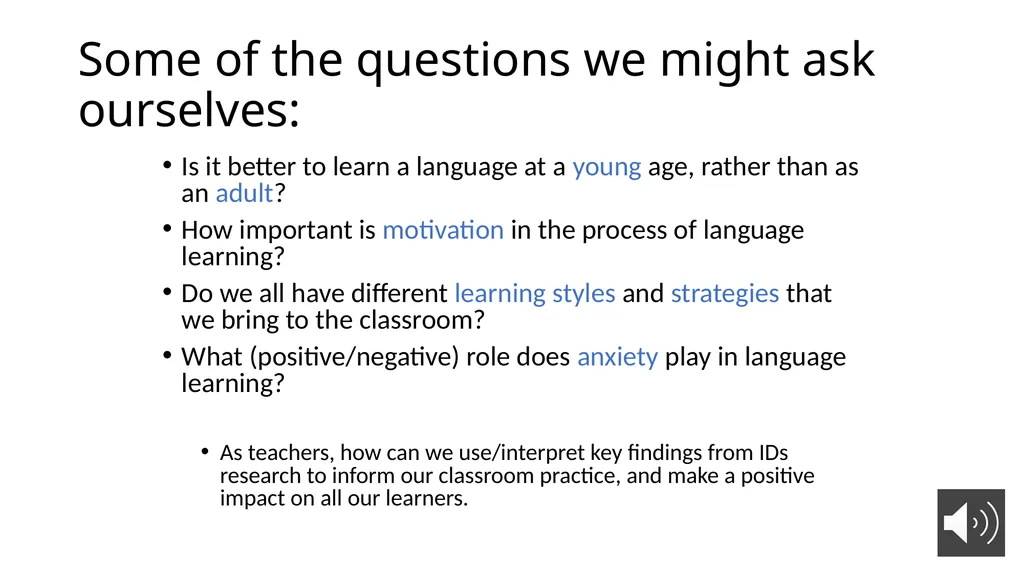
Some of the questions we might ask ourselves: Is it better to learn a language at a young age, rather than as an adult?
How important is motivation in the process of language learning?
Do we all have different learning styles and strategies that we bring to the classroom?
What (positive/negative) role does anxiety play in language learning?
As teachers, how can we use/interpret key findings from IDs research to inform our classroom practice, and make a positive impact on all our learners.<br>
04
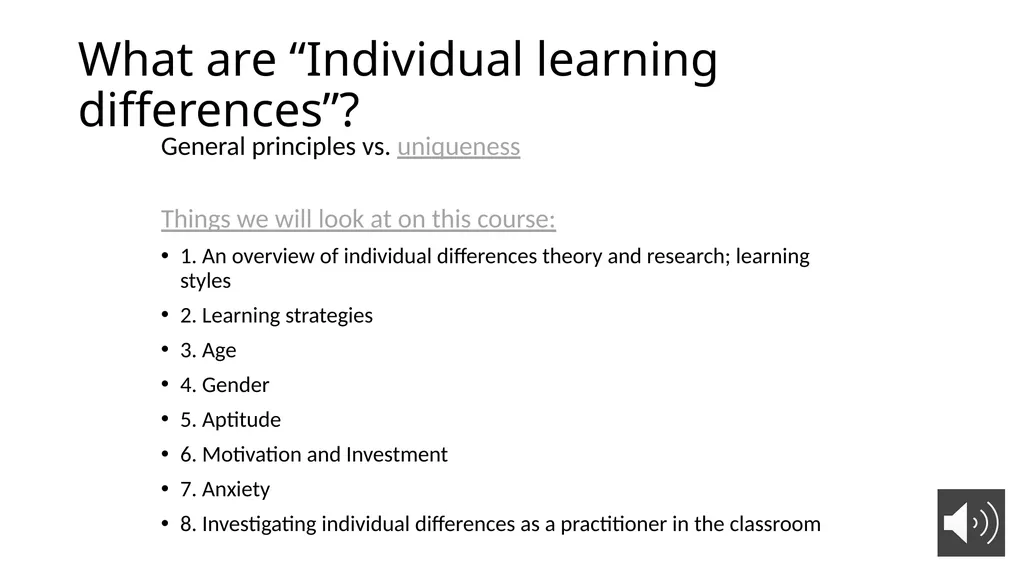
What are “Individual learning differences”? General principles vs. uniqueness
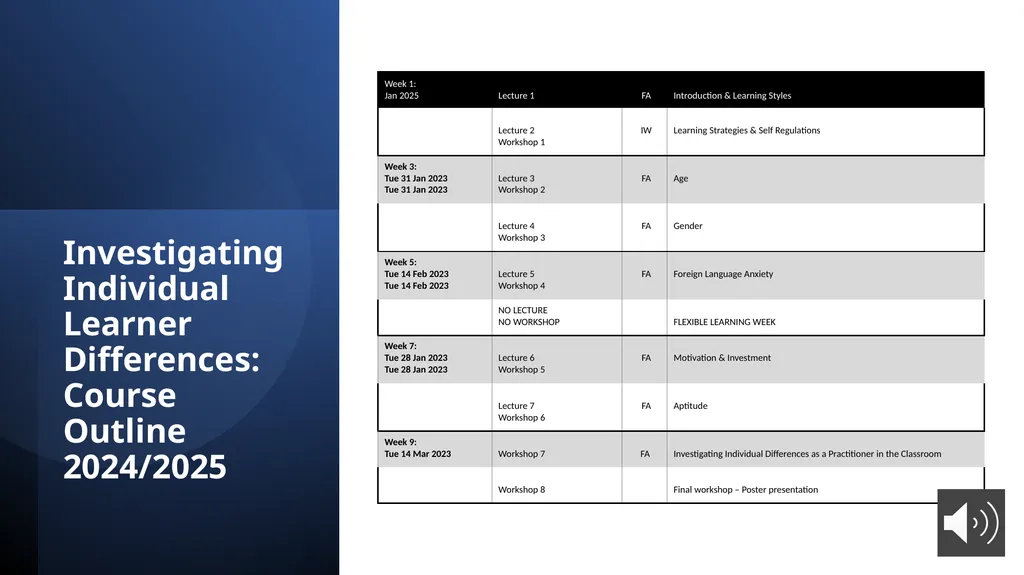
Things we will look at on this course:
1. An overview of individual differences theory and research; learning styles
2. Learning strategies
3. Age
4. Gender
5. Aptitude
6. Motivation and Investment
7. Anxiety
8. Investigating individual differences as a practitioner in the classroom<br>
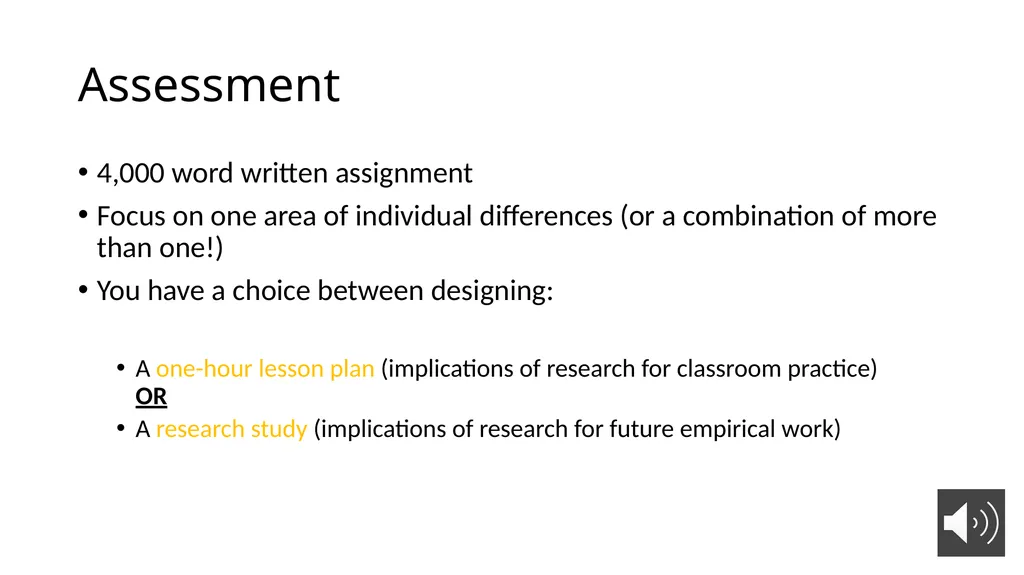
Assessment 4,000 word written assignment
Focus on one area of individual differences (or a combination of more than one!)
You have a choice between designing:
A one-hour lesson plan (implications of research for classroom practice) OR
A research study (implications of research for future empirical work)<br>
09
Assessment Assessment (4,000 words)
Provide a brief overview of research into one particular aspect of individual learner differences examined on the course. Then select two relevant studies to critically consider in more detail. What are the implications of the studies you have chosen for teaching practice? How do they specifically relate to your own professional context? In light of your discussion so far design a one hour lesson plan that demonstrates your application of the research in this particular learner difference area to your teaching practice.
OR
Provide an overview of research into one particular aspect of individual learner differences examined on the course. Identifying a gap in the research, design a research study you could carry out in your language teaching classroom to investigate a specific aspect of your chosen individual difference. Explain how the study might inform and impact on your professional practice.<br>
10
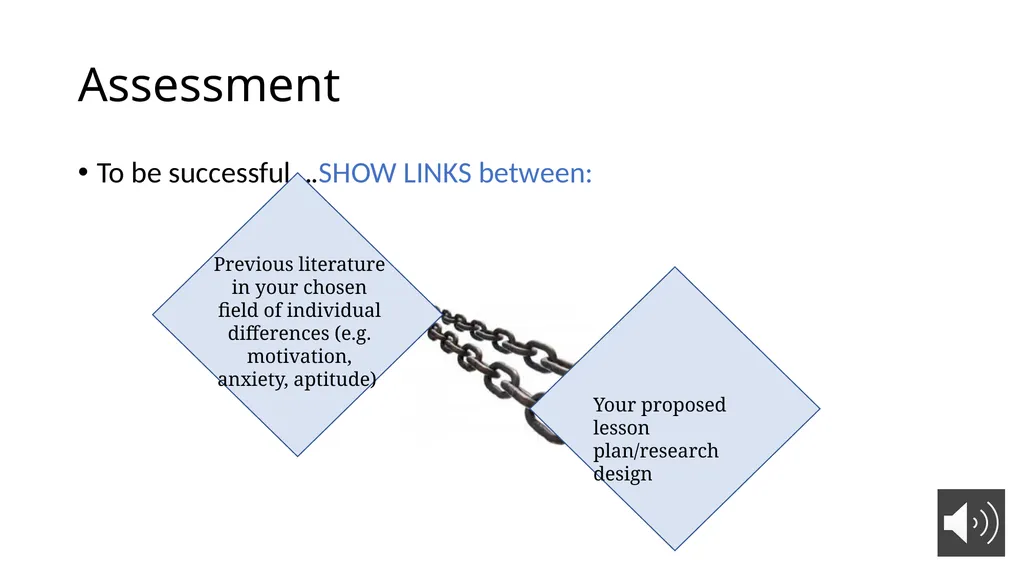
Assessment To be successful….SHOW LINKS between:<br>
11
Preliminary reading…<br>
12
Core reading Burns, A. (2011) Action Research In B.Paltridge & A. Phakiti Continuum Companion to Research Methods in Applied Linguistics London:Continuum,Chapter
Dörnyei,Z. (2010) Introduction: Definition, Brief History, and Taxonomy of Individual Differences In The Psychology of the Language Learner: Individual Differences in Second Language Acquisition London: Routledge, Chapter 1
Horwitz,E.(2001)Language anxiety and achievement Annual Review of Applied Linguistics 21, pp.112-126
MacIntyre, P.D, Mackinnon, S.P. & Clément, R. (2010) The baby, the bath water, and the future of language learning motivation research InZ. Dörnyei E. Ushioda (Eds.)Motivation, Language Identity and the L2 Self Bristol:MultilingualMatters
Marinova-Todd, S.H. Bradford Marshall, D. & Snow, C.E. (2000) Three Misconceptions about Age and L2 Learning TESOL Quarterly 34 (1), p.9-34
Rubin, J., Chamot, A.U., Harris, V. & Anderson, N.J. (2007) Intervening in the use of strategies. In A. Cohen & E. Macaro (Eds.) Language Learner Strategies: Thirty Years of Research and Practice Oxford: Oxford University Press, Chapter 7
Sparks, R.& Ganschow, L.(2001) Aptitude for learning a foreign language Annual Review of Applied Linguistics 21,pp.90-111
Williams,M., Burden,W.& Lanvers, U.(2002)‘French is the Language of Love and Stuff’: student perceptions of issues related to motivation in learning a foreign language British Educational Research Journal 2 (4), pp.503-528<br>
13
Some student feedback from a previous year What did you like about this course?
Students had a central role during workshops
The course structure
What did you learn from this course?
How to be more critical
How to work better in a group
How to relate research to practice<br>