04
TAXIS (plural Taxes)
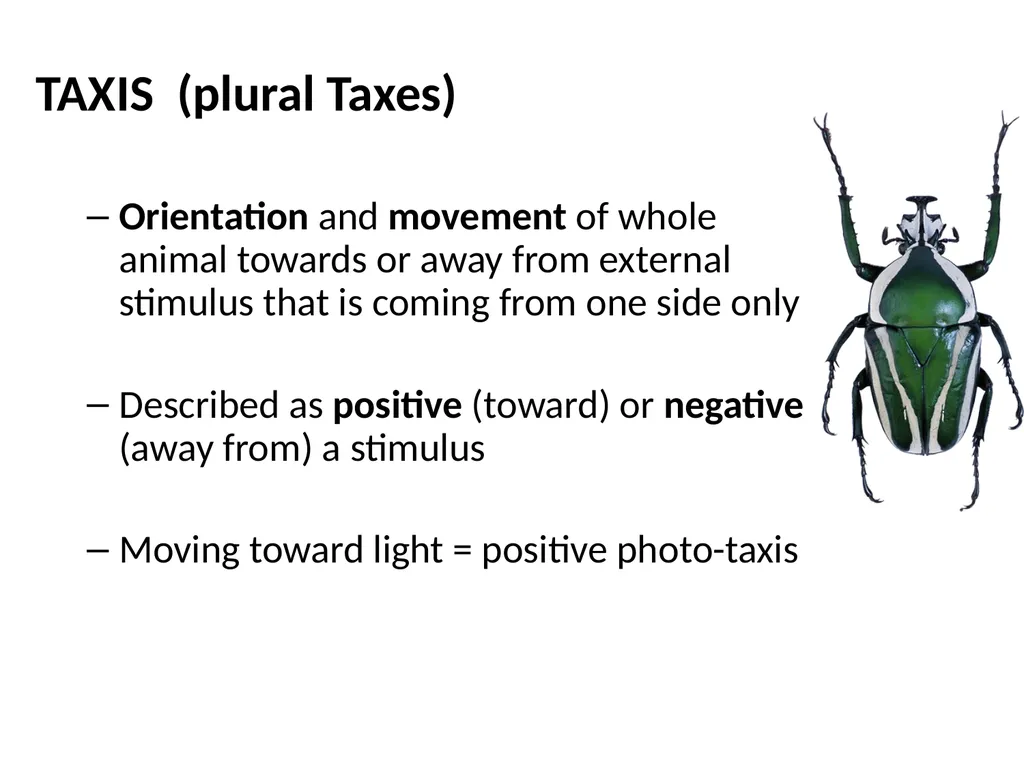
Orientation and movement of whole animal towards or away from external stimulus that is coming from one side only
Described as positive (toward) or negative (away from) a stimulus
Moving toward light = positive photo-taxis<br>
05
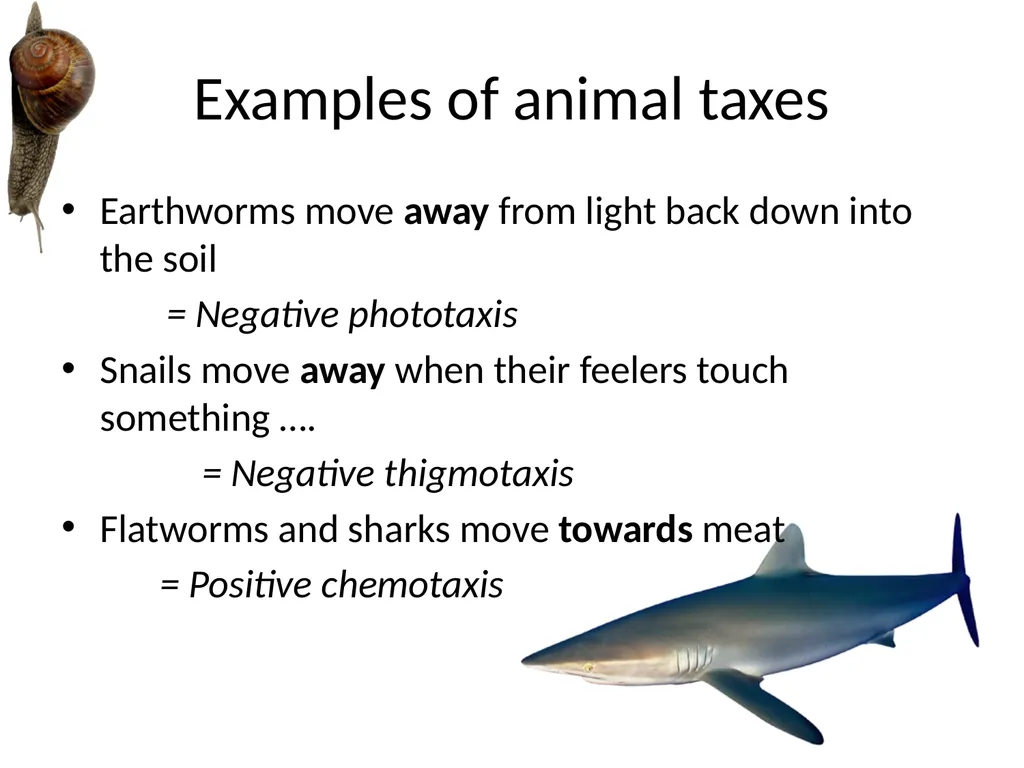
Examples of animal taxes Earthworms move away from light back down into the soil
= Negative phototaxis
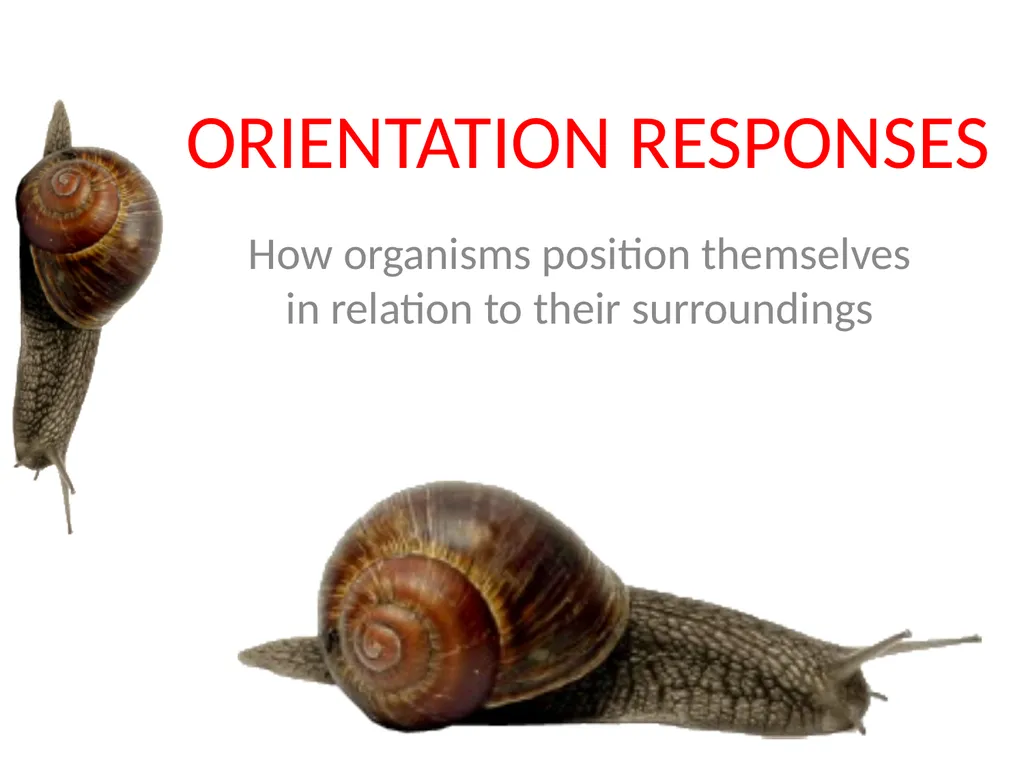
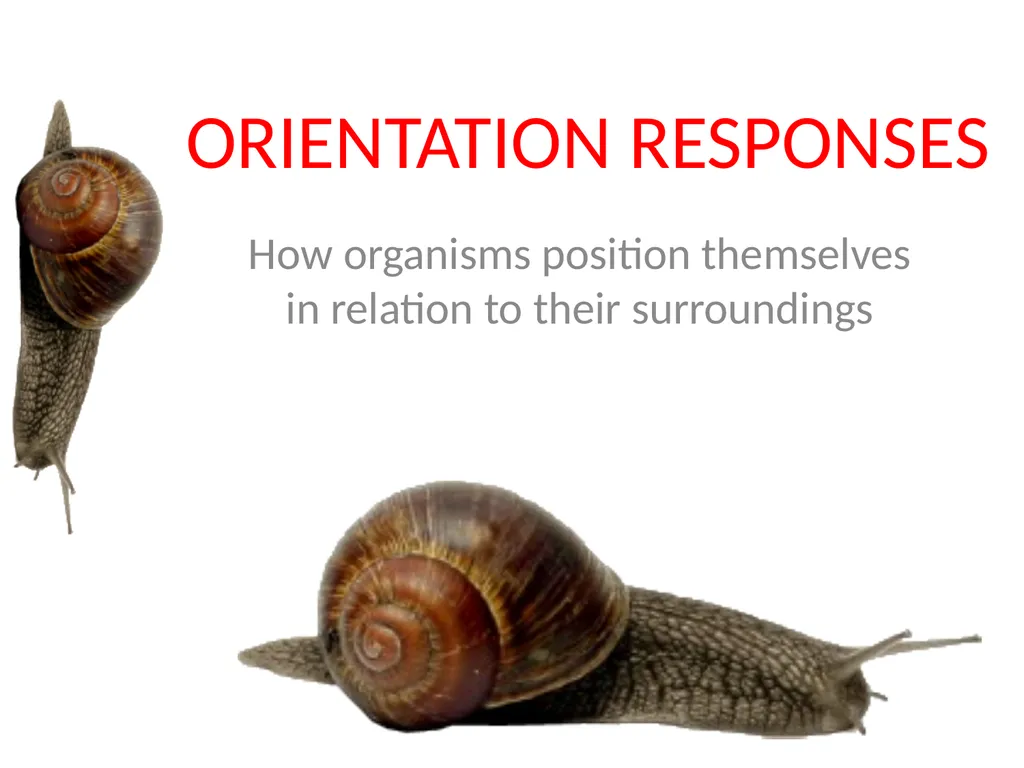
Snails move away when their feelers touch something ….
= Negative thigmotaxis
Flatworms and sharks move towards meat
= Positive chemotaxis<br>
06
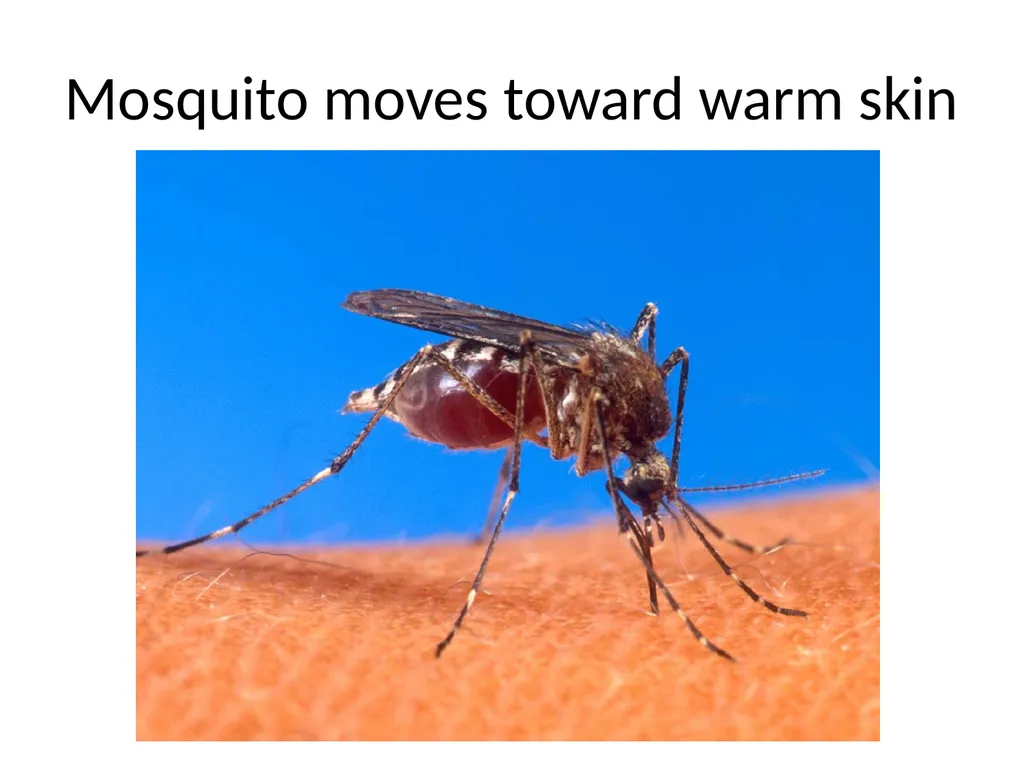
Mosquito moves toward warm skin<br>
07
What’s the advantage? Puts the animal in a more favourable position
Avoids unfavourable conditions (hot, cold etc)
Increased survival and reproduction<br>
08
How do animals determine the direction of the stimulus? Two sense organs: By comparing the input from receptors on each side of the animal at the same time
Differences between sides show the direction of the stimulus (eg. Snail antennae)
OR One sense organ: Compare the change from a single sensor over time, using its body orientation to determine stimulus direction<br>
09
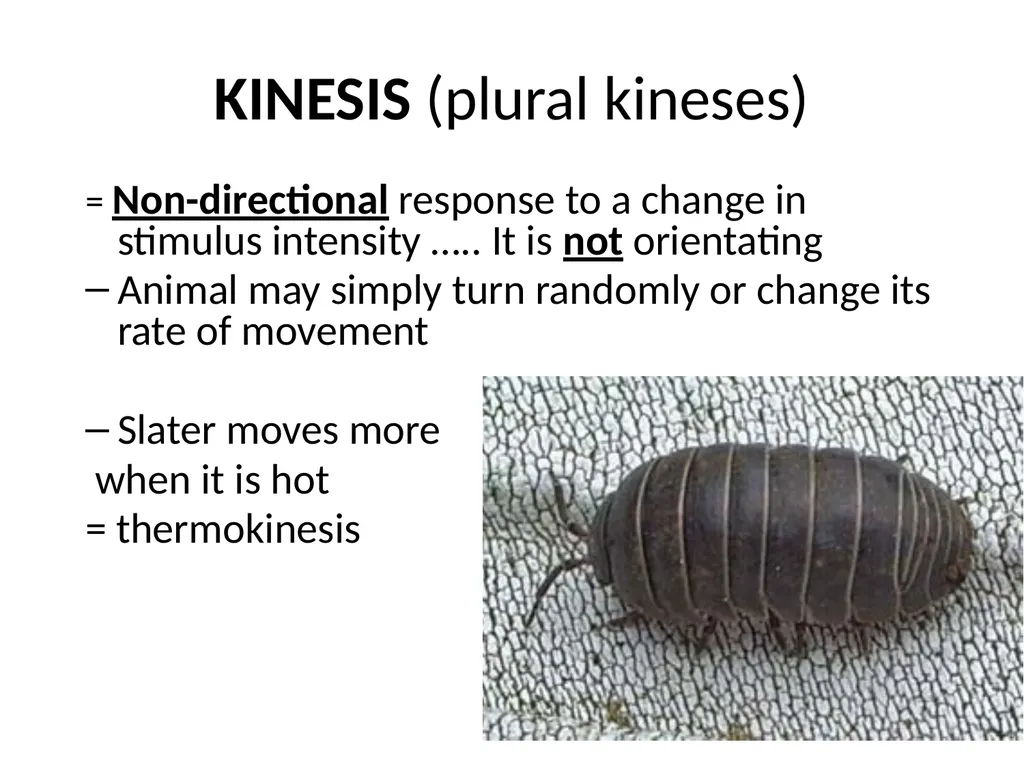
KINESIS (plural kineses) = Non-directional response to a change in stimulus intensity ….. It is not orientating
Animal may simply turn randomly or change its rate of movement
Slater moves more
when it is hot
= thermokinesis<br>
10
More terms to know Orthokinesis = the stimulus intensity determines the organism’s speed of movement
Klinokinesis = the stimulus intensity
determines the organism’s
rate of turning<br>
11
Examples of Kineses Slaters move faster in bright light and slower in dim light
= photo-orthokinesis (or photokinesis)
Woodlice: move faster and turn more in high humidity vs. low humidity (hygro-)
= hygro-orthokinesis, hygro-klinokinesis
(or hygrokinesis)
Human body lice turn more at 35°C than at lower temps
= thermo-klinokinesis (or thermokinesis)<br>
12
What’s the advantage? Puts the animal in a more favourable position by moving faster or randomly turning
Eg. Slaters will end up in dark, damp places which prevents drying out (dessication)
Avoids unfavourable conditions (hot, cold etc)
Increased survival and reproduction<br>
13
BIOZONE questions Taxes and Kineses
Do all the questions on page 5<br>
14
NCEA 2006 question Much of animal behaviour is innate, or inborn. Such behaviour patterns may be quite simple, or are produced in response to simple stimuli. They include kineses and taxes.
(a) Describe an example of kinesis in a named animal.
(b) Explain why this behaviour would be an advantage to your named animal in its normal environment.<br>
15
Plant Orientation Responses Plants are capable of a number of movements in response to environmental stimuli.
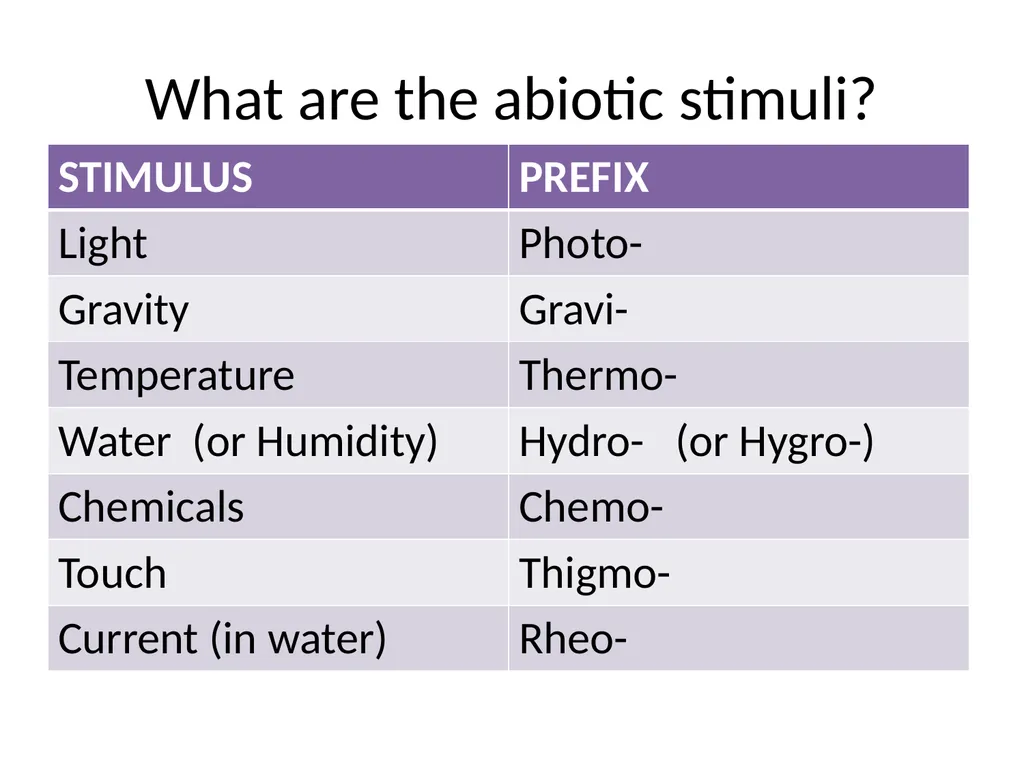
eg. Temperature, humidity, light, touch, chemicals
1. NASTIC RESPONSES: non-directional responses to stimuli
2. TROPISMS: Directional growth responses towards or away from a directional stimulus<br>
16
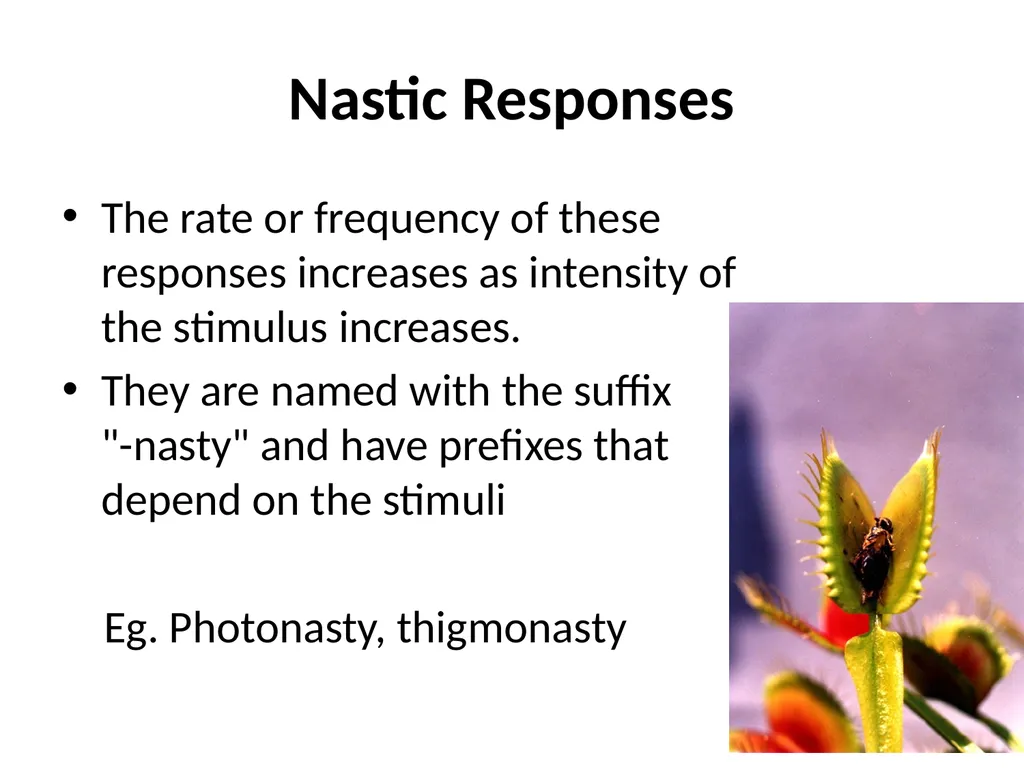
Nastic Responses The rate or frequency of these responses increases as intensity of the stimulus increases.
They are named with the suffix "-nasty" and have prefixes that depend on the stimuli
Eg. Photonasty, thigmonasty<br>
17
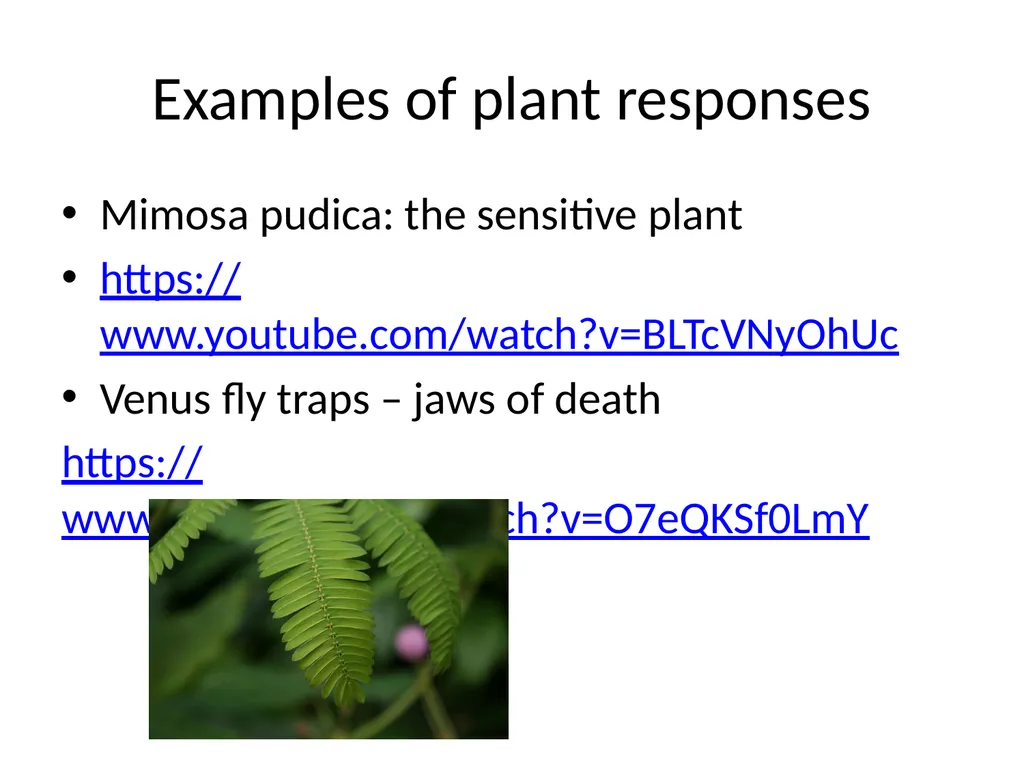
Examples of plant responses Mimosa pudica: the sensitive plant
https://www.youtube.com/watch?v=BLTcVNyOhUc
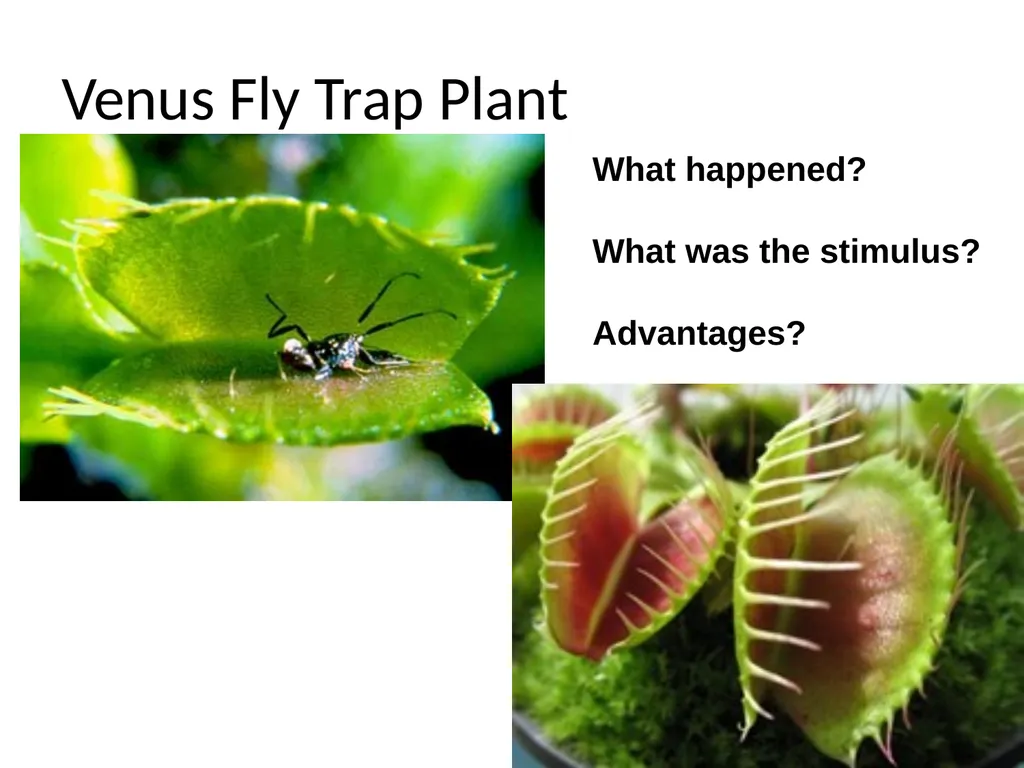
Venus fly traps – jaws of death
https://www.youtube.com/watch?v=O7eQKSf0LmY<br>
18
Eg. Mimosa plant When the sensitive leaves are touched, they droop down and fold up rapidly
Thigmonasty
Advantage: why?
Reduces the plant’s
Surface area for grazing
And abiotic stress.<br>
19
Venus Fly Trap Plant What happened?
What was the stimulus?
Advantages?<br>
20
Other examples Opening/closing of tulip flowers due to changes in air temperature
Called?
Opening of evening-primrose flowers at dusk
Called?<br>
21
PLANT TROPISMS Directional growth response that occurs in response to an external directional stimulus
May be positive (towards stimulus) or negative (away from stimulus)
Tropism comes from a Greek word ‘tropos’ meaning “to turn” or “to change”<br>
22
Why? Plants can alter their growth so they can grow towards more favourable conditions
(eg. More light, more water etc)
Must detect where the conditions are better then alter their growth to "move" in the appropriate direction<br>
23
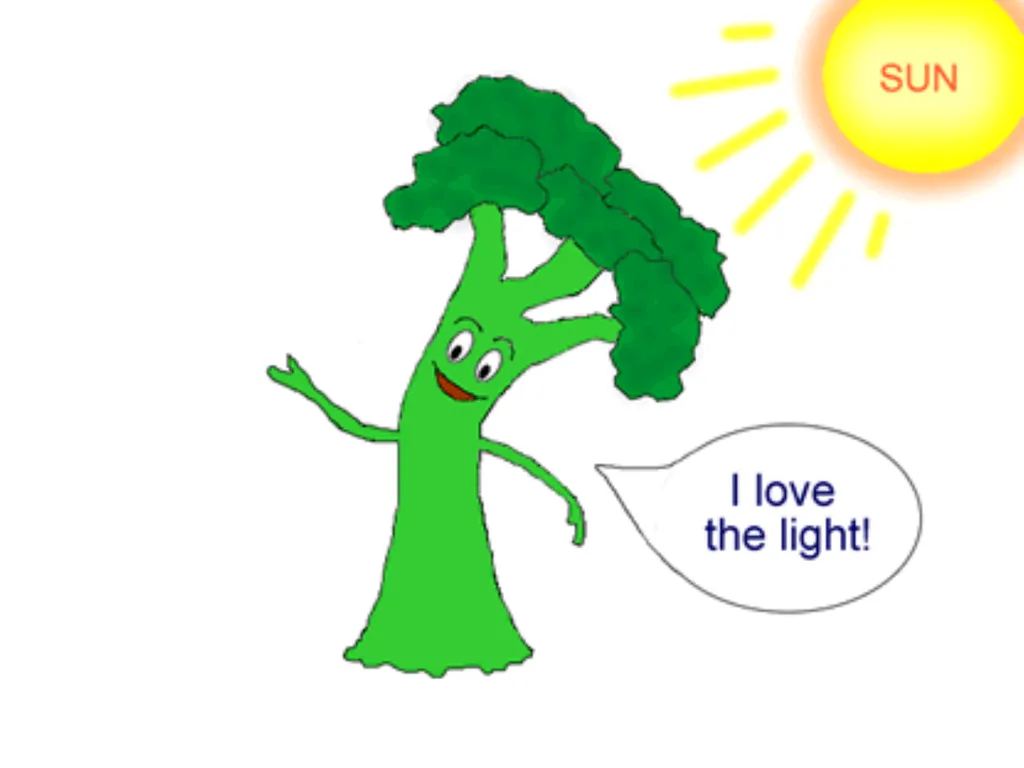
PHOTOTROPISM = the directional growth response of a plant in response to a light stimulus.
Different parts of a plant exhibit different reactions to light.
Stems and shoots exhibit positive phototropism (grow toward light)
Most roots exhibit negative phototropism (grow away from light)<br>
24
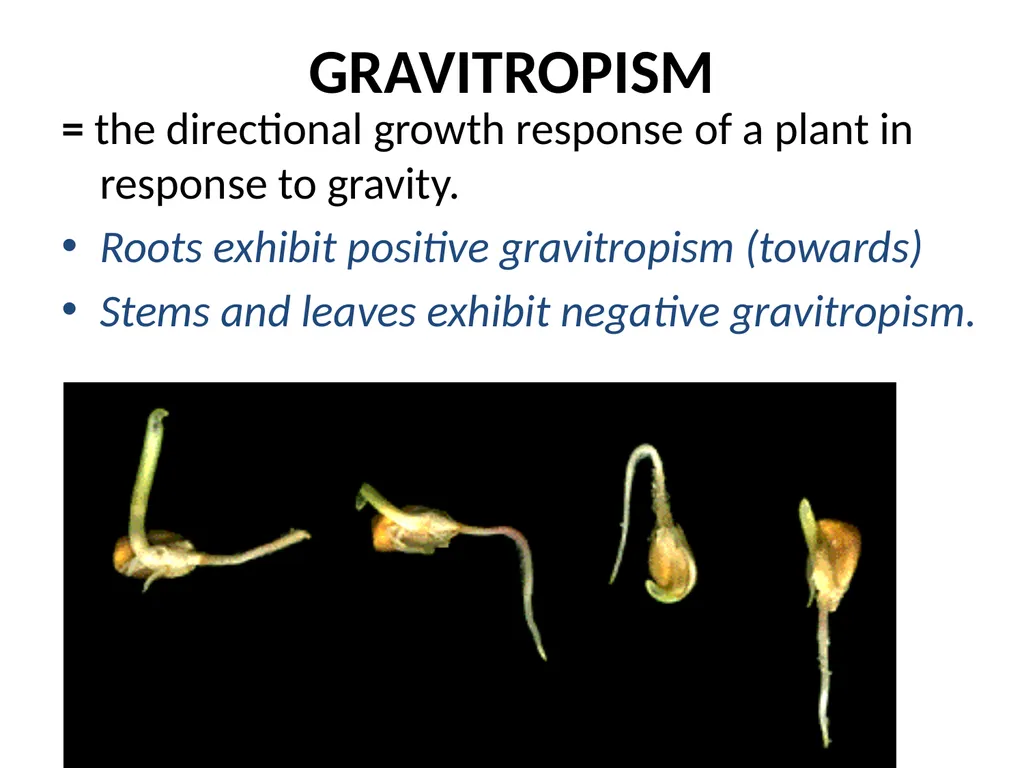
GRAVITROPISM = the directional growth response of a plant in response to gravity.
Roots exhibit positive gravitropism (towards)
Stems and leaves exhibit negative gravitropism.<br>
25
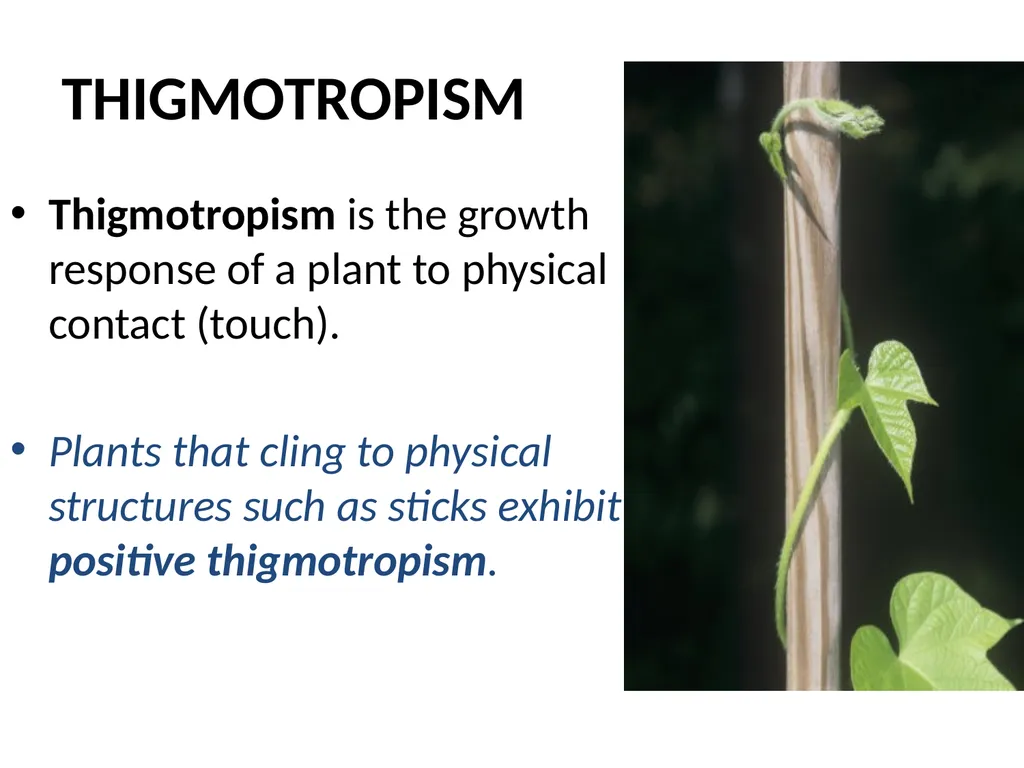
THIGMOTROPISM Thigmotropism is the growth response of a plant to physical contact (touch).
Plants that cling to physical structures such as sticks exhibit positive thigmotropism.<br>
26
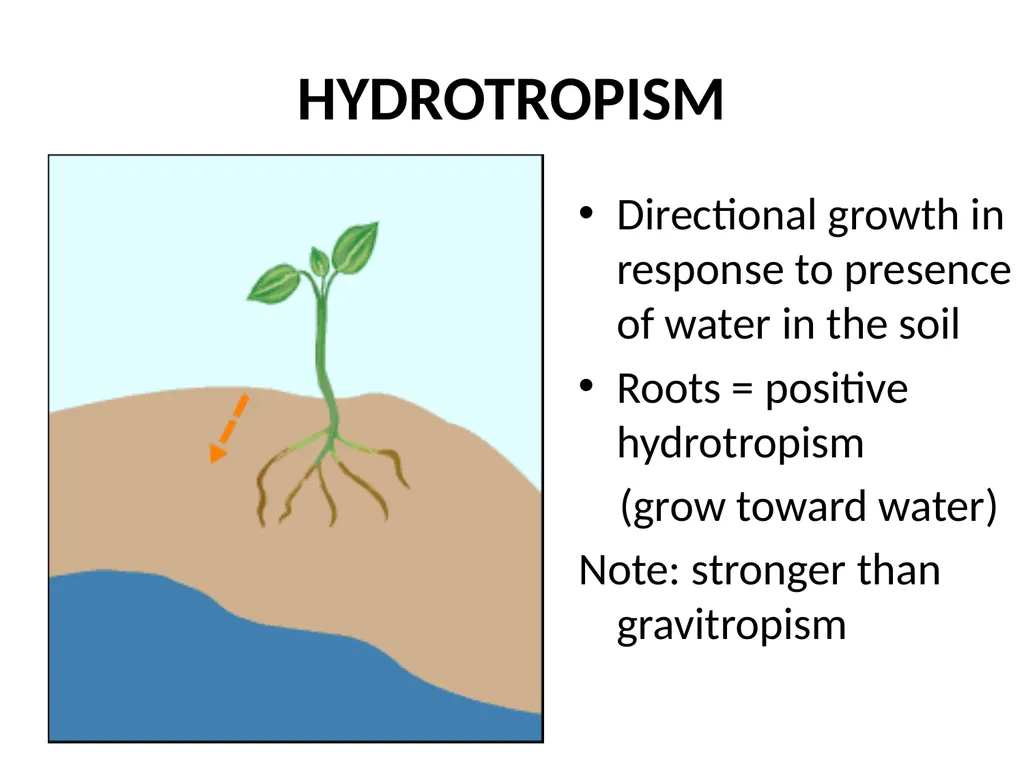
HYDROTROPISM Directional growth in response to presence of water in the soil
Roots = positive hydrotropism
(grow toward water)
Note: stronger than gravitropism<br>
27
CHEMOTROPISM Directional growth in response to a chemical stimulus
eg. Roots can grow towards or away from chemicals in the soil (copper pipe)
eg. Growth of pollen tube towards ovary in flowers (ovary releases chemicals)<br>
28
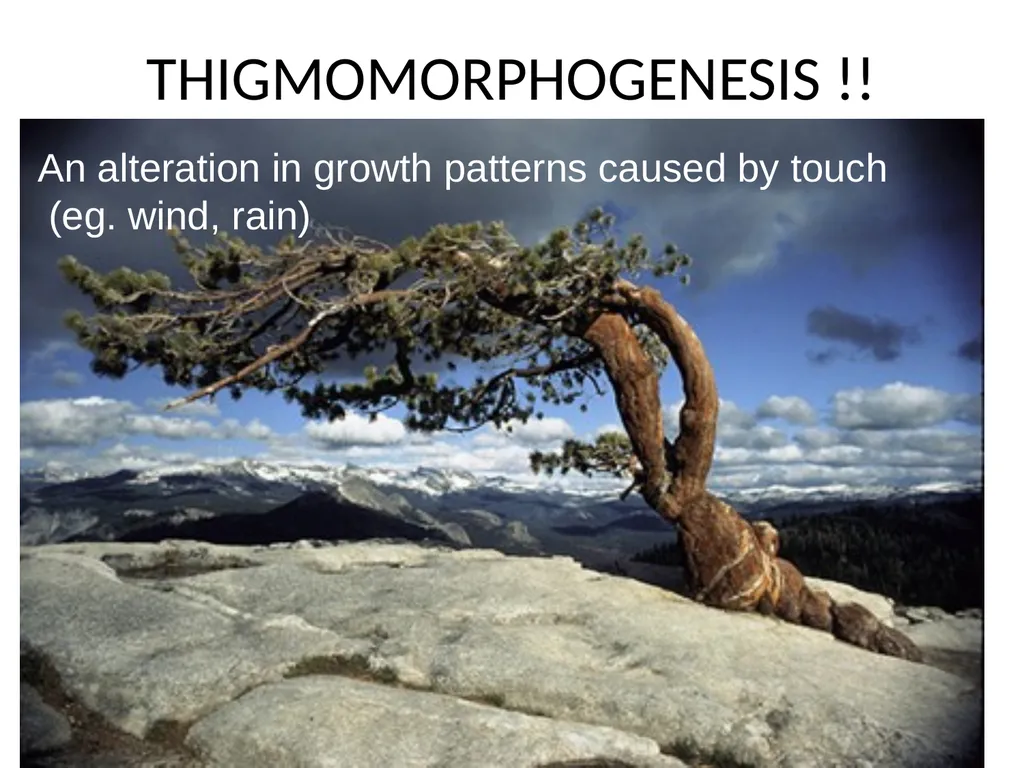
THIGMOMORPHOGENESIS !! An alteration in growth patterns caused by touch
(eg. wind, rain)<br>
29
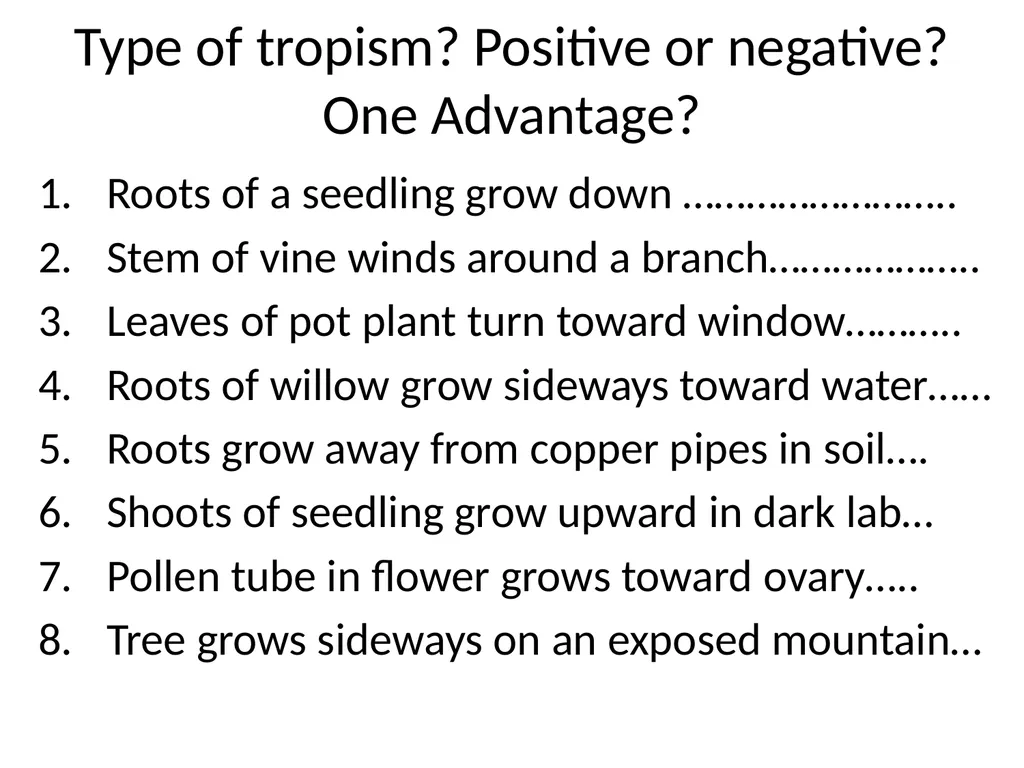
Type of tropism? Positive or negative? One Advantage? Roots of a seedling grow down ……………………..
Stem of vine winds around a branch………………..
Leaves of pot plant turn toward window………..
Roots of willow grow sideways toward water……
Roots grow away from copper pipes in soil….
Shoots of seedling grow upward in dark lab…
Pollen tube in flower grows toward ovary…..
Tree grows sideways on an exposed mountain…<br>
30
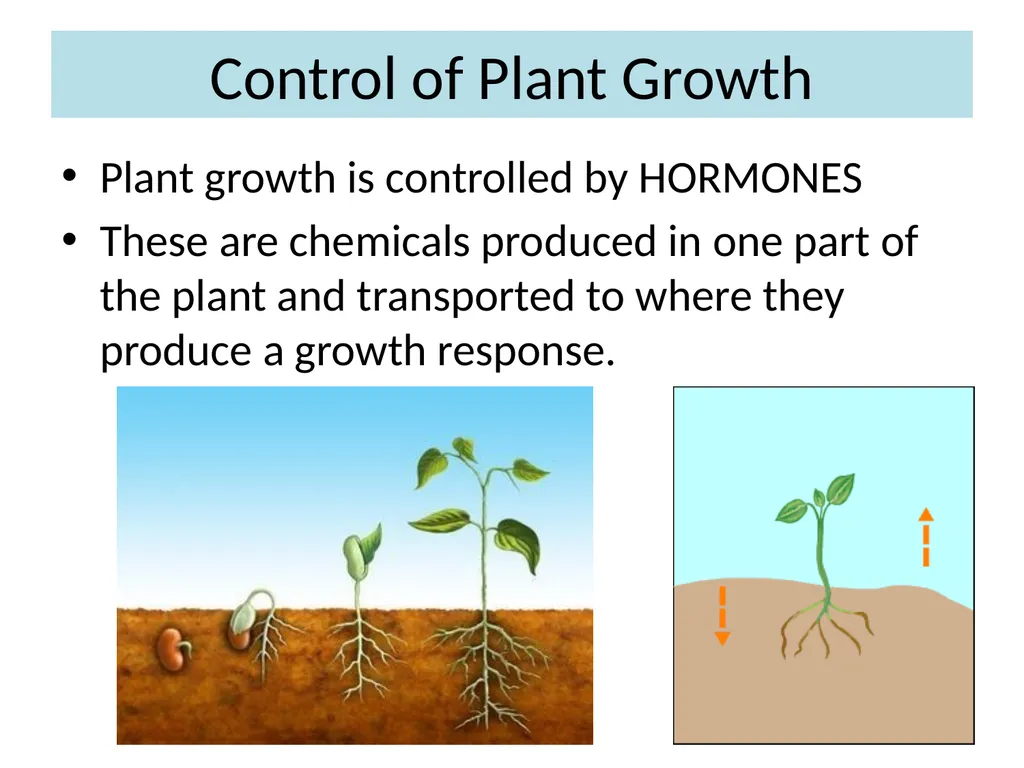
Control of Plant Growth Plant growth is controlled by HORMONES
These are chemicals produced in one part of the plant and transported to where they produce a growth response.<br>
31
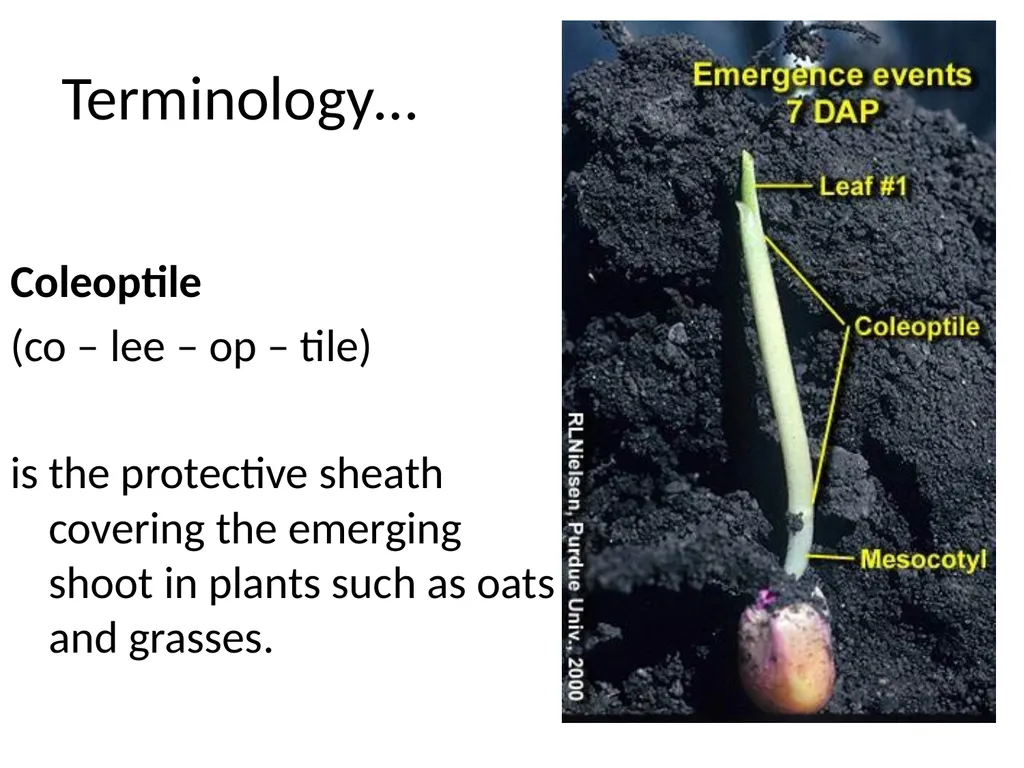
Terminology… Coleoptile
(co – lee – op – tile)
is the protective sheath covering the emerging shoot in plants such as oats and grasses.<br>
32
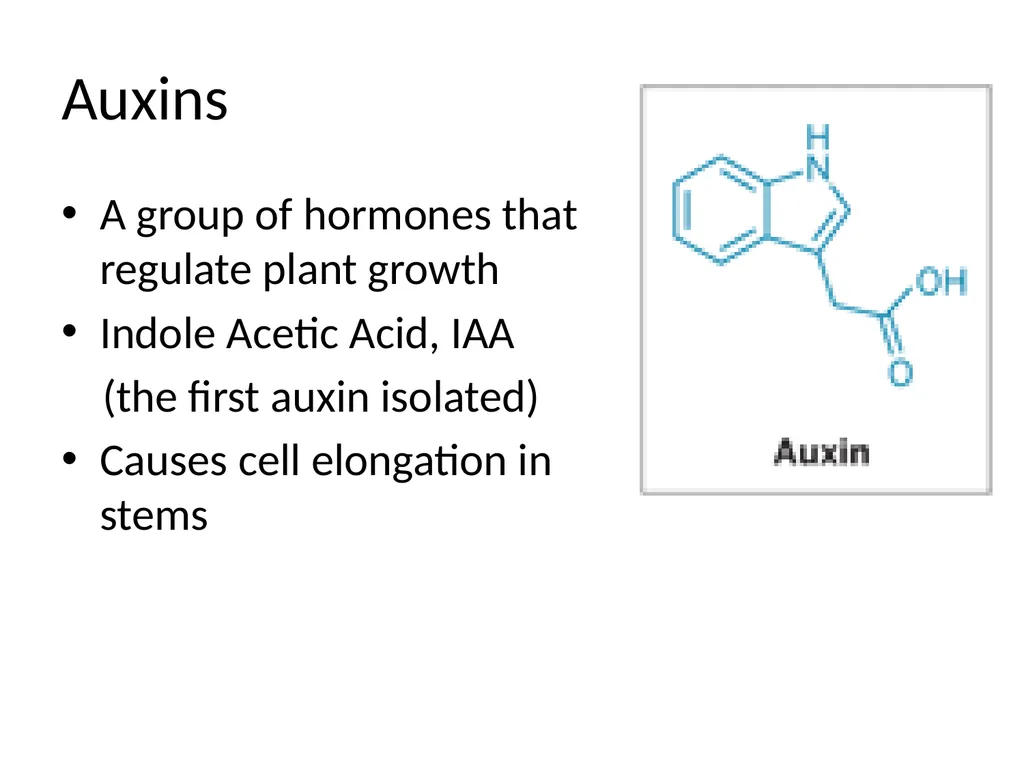
Auxins A group of hormones that regulate plant growth
Indole Acetic Acid, IAA
(the first auxin isolated)
Causes cell elongation in stems<br>
33
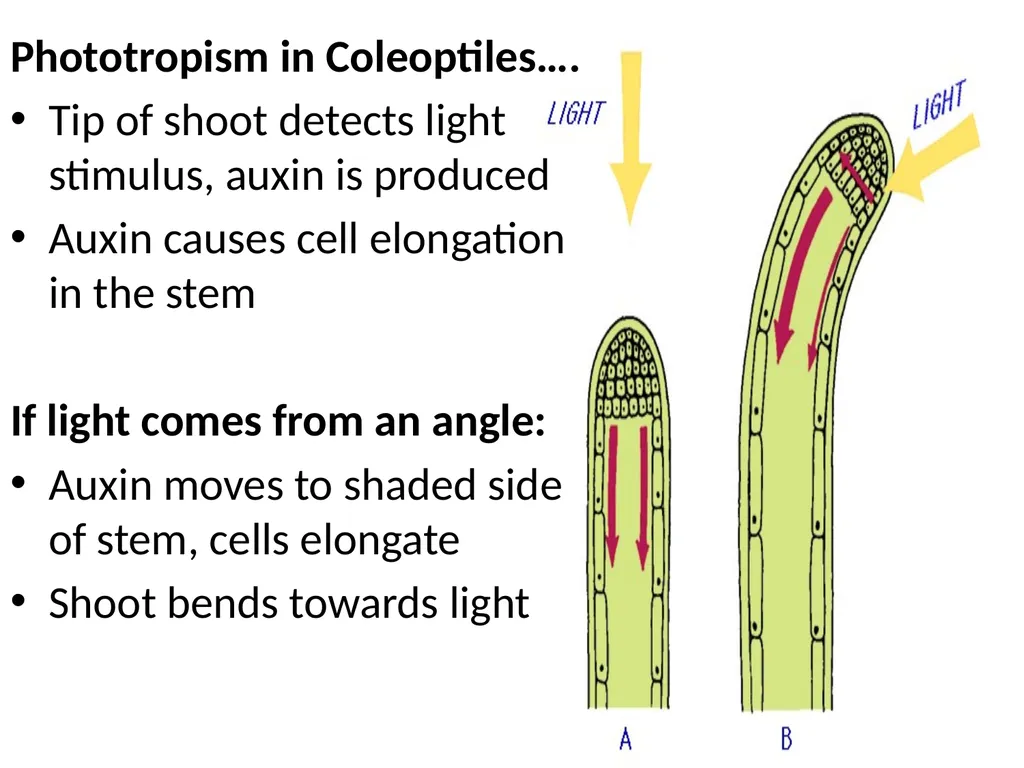
Phototropism in Coleoptiles….
Tip of shoot detects light stimulus, auxin is produced
Auxin causes cell elongation in the stem
If light comes from an angle:
Auxin moves to shaded side of stem, cells elongate
Shoot bends towards light<br>
34
Auxin moves to shaded side and causes cell elongation - stem bends towards light source<br>
35
More auxin on the shaded side
Cells elongate
Stem bends toward light over time<br>
36
TROPISMS….. You tube clip: Plant Physiology: Phototropic Response
http://www.youtube.com/watch?v=zctM_TWg5Ik<br>
37
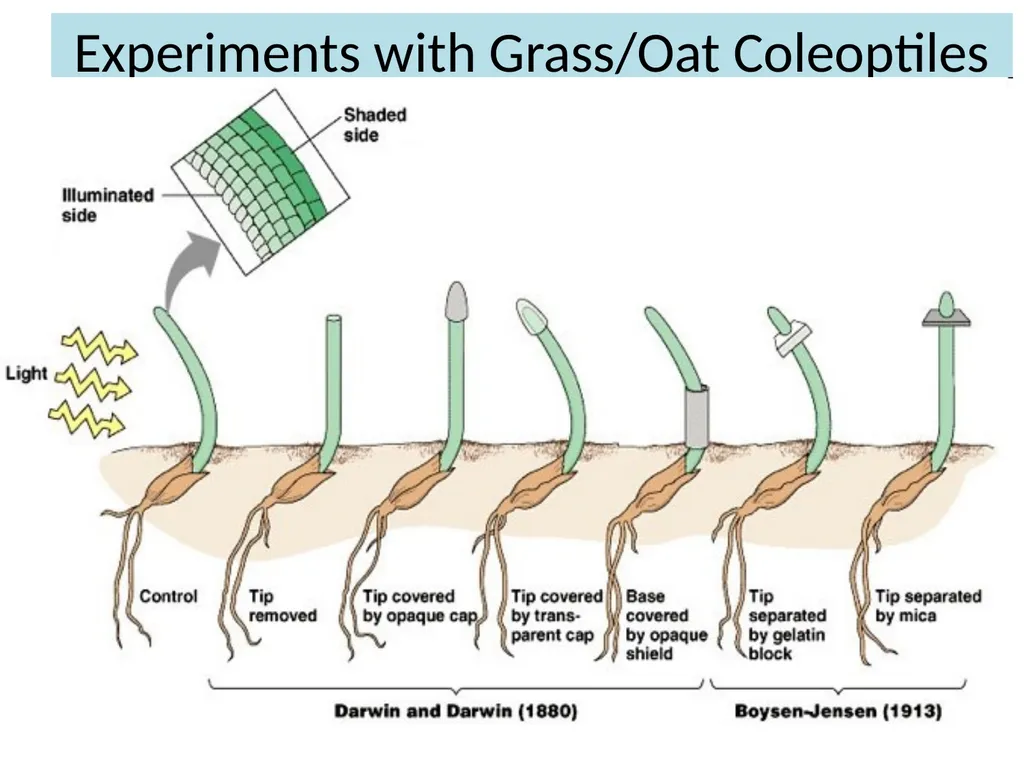
Experiments with Grass/Oat Coleoptiles<br>
38
Gravitropism in roots In roots, perception of gravity appears to depend on the settling of specialised organelles called statoliths in root-cap cells.
When the plant is turned, within minutes the statoliths sink toward the source of gravity, to the side that is down.
Auxin builds up on the lower side of the root cap, causing cell elongation and downwards growth of the root<br>
39
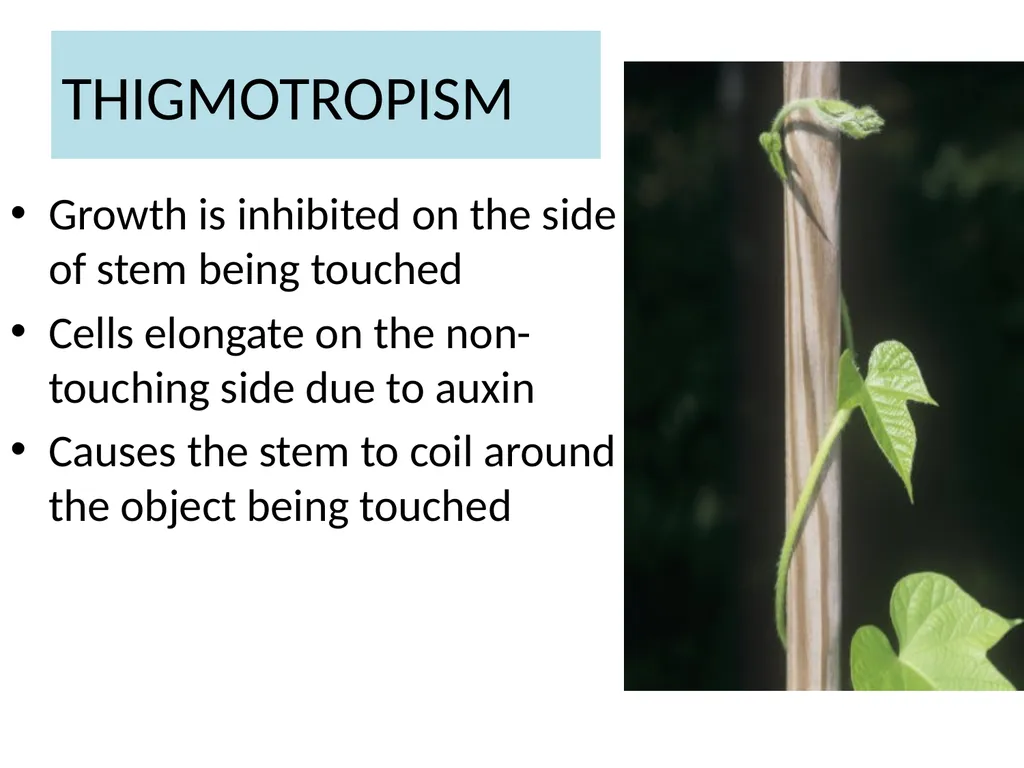
THIGMOTROPISM Growth is inhibited on the side of stem being touched
Cells elongate on the non-touching side due to auxin
Causes the stem to coil around the object being touched<br>
40
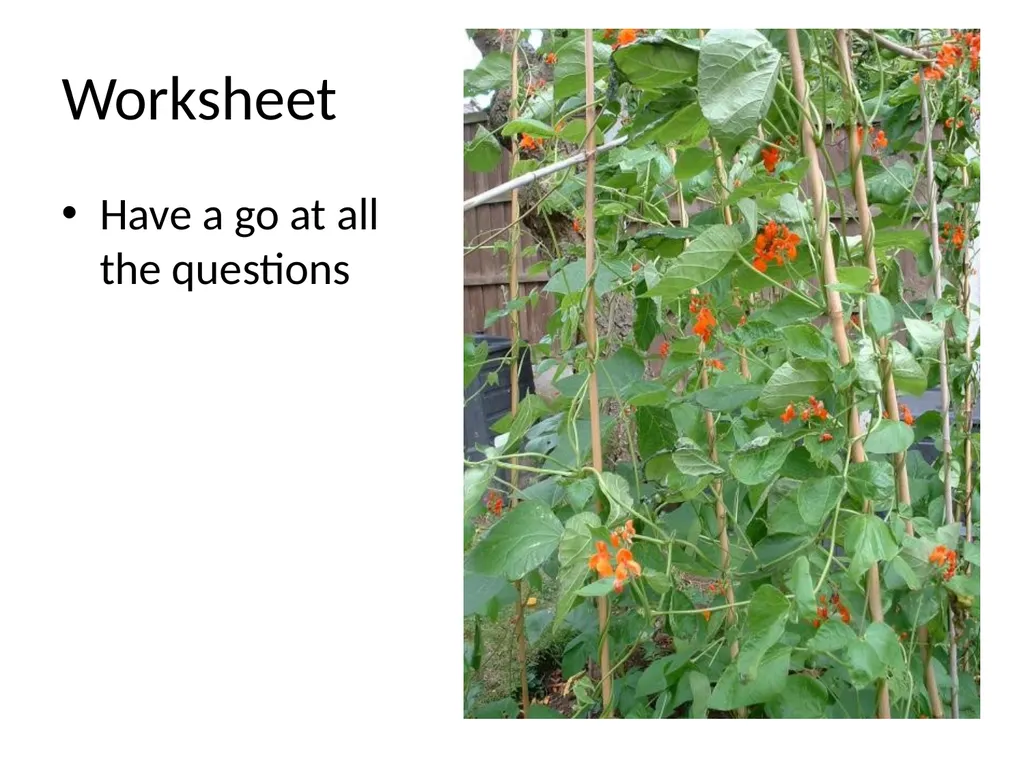
Worksheet Have a go at all the questions<br>
41
Terminology time! COLEOPTILE = the protective sheath covering tip of the first new shoot from a seed
Darwin studied phototropism in canary grass and oat coleoptiles. The coleoptile is a hollow sheath of tissue which surrounds the apical axis (stem) of these and other grasses. Darwin demonstrated that these coleoptiles are phototropic in that they bend toward a light source. When he covered the tips of the coleoptiles, they were not phototropic but when he covered the lower portions of the coleoptiles, they were phototropic. Darwin concluded from these and other experiments that (a) the tip of the coleoptile is the most photosensitive region; (b) the middle of the coleoptile is responsible for most of the bending; and (c) an influence which causes bending is transmitted from the top to the middle of the coleoptile.��Read more: Phototropism - History Of Phototropism Research - Coleoptile, Darwin, Coleoptiles, Plant, Agar, and Light http://science.jrank.org/pages/5197/Phototropism-History-phototropism-research.html#ixzz10OQbtO20<br>