
‘Othello’ Act 3 Ms Deasy Act 3, Scenes 1 &
KB
Published · 37 slides · 0 views

1 / 1











Description
Othello Act 3 Ms Deasy Act 3, Scenes 1 2 Summary The first of these scenes is a morning one. Cassio has hired musicians to entertain Othello and Desdemona. Othello, not caring much for what he hears, sends a Clown, or professional
Related Topics
Share
Embed code
Download this presentation From Below
"‘Othello’ Act 3 Ms Deasy Act 3, Scenes 1 &" is the property of its rightful owner. Permission is granted to download and print the materials on this website for personal, non-commercial use only, and to display it on your personal computer provided you do not modify the materials and that you retain all copyright notices contained in the materials. By downloading content from our website, you accept the terms of this agreement.
Presentation Transcript
01
‘Othello’ Act 3 Ms Deasy<br>
02
Act 3, Scenes 1 & 2 Summary The first of these scenes is a morning one. Cassio has hired musicians to entertain Othello and Desdemona. Othello, not caring much for what he hears, sends a Clown, or professional jester to banish the musicians. Iago’s plot takes a step forward: Cassio asks the Clown to fetch Emilia, but Iago, arriving at an opportune moment, sends his wife to Cassio, promising to get Othello out of the way so that the conversation between Cassio and Desdemona may be uninhibited. Emilia brings good news; Othello with reinstate Cassio at the earliest opportunity.<br>
03
Cassio, however, wants to speak to Desdemona about his problem, and Emilia arranges an interview. The short second scene shows Othello, accompanied by Iago, about to undertake and inspection of the Venetian forces.<br>
04
Act 3, Scenes 1 & 2 Quotes ‘The General and his wife are talking of is,
And she speaks for you stoutly’
Before Cassio has had time to ask Desdemona to intercede with Othello on his behalf, she is already doing so. Thus Iago exploits the natural actions of his victims to their disadvantage.
(Act III Scene 1)<br>
And she speaks for you stoutly’
Before Cassio has had time to ask Desdemona to intercede with Othello on his behalf, she is already doing so. Thus Iago exploits the natural actions of his victims to their disadvantage.
(Act III Scene 1)<br>
05
‘This fortification, gentlemen, shall we see’t?’
This very brief scene has various purposes: to show Othello taking his responsibilities seriously, to mark the passing of time and to remove Othello from the action temporarily so that he may return to witness Cassio and Desdemona together.
(Act III Scene 2)<br>
This very brief scene has various purposes: to show Othello taking his responsibilities seriously, to mark the passing of time and to remove Othello from the action temporarily so that he may return to witness Cassio and Desdemona together.
(Act III Scene 2)<br>
06
Act 3, Scenes 1 & 2 Questions What significance is there in Othello’s message to the effect that he does not like the music provided by Cassio?
Comment on the timing of Iago’s arrival on the scene.
There are various ironies in this scene. Comment on them.
How does Cassio create new problems for Desdemona about himself here?<br>
Comment on the timing of Iago’s arrival on the scene.
There are various ironies in this scene. Comment on them.
How does Cassio create new problems for Desdemona about himself here?<br>
07
Act 3, Scene 3 Summary This is the ‘temptation scene’, the longest and most important in the play; in this scene Iago’s plot comes to a head. It falls naturally into five parts:<br>
08
1. Cassio, Desdemona and Emilia (1-41) Desdemona, encouraged by Emilia’s persuasion, tries to set Cassio’s mind at rest by assuring him that she will plead zealously with Othello on his behalf. Her promise is made with frank, almost childlike, enthusiasm: she is responding only too readily to Emilia’s promptings. Emilia, however, is unaware of Iago’s true intentions; when she tells Cassio that his predicament grieves Iago, she is speaking the truth as she sees it.<br>
09
Cassio’s sudden anxiety to leave Desdemona as Othello approaches give Iago the kind of opening he likes. Cassio does not want to confront Othello because, presumably, he is ashamed of his recent behaviour. Iago, however, puts a more sinister interpretation on his parting: ‘I cannot think it / That he would sneak away so guilty-like’.<br>
10
2. Desdemona’s plea for Cassio (42-90) Othello’s mood at this point is dour. He has not been favourable impressed by the furtive manner of Cassio’s departure, and matters are not improved by Desdemona’s insistent, repetitious, irritating pleading on Cassio’s behalf. He dismisses her with barely concealed impatience. Given the nature of their relationship up to this, his method of closing the conversation seems curt and formal (‘I will deny thee nothing, / Wherein I do beseech thee grant me this, / To leave me but a little to myself’). This exchange marks a distinct deterioration in the quality of the Desdemona-Othello relationship.<br>
11
3. Iago’s first temptation of Othello (94-286) Iago immediately sets to work, using the slender evidence so far to hand against Cassio. He concentrates first on Cassio’s role as a go-between in Othello’s wooing of Desdemona, and allows Othello to recall the circumstances of Cassio’s departure from Desdemona, and his own reservations about it (‘When Cassio left my wife: what didst thou not like?’). Iago’s main strategy at this point is to throw out dark, mysterious hints of something that he pretends he does not want to bother Othello with, certain at the same time that his victim will want to hear more. And so he does (‘show me thy thoughts’).<br>
12
Iago succeeds in giving the impression that there are some disreputable truths behind his insinuations, which would horrify Othello if he were to hear them. (‘It were not for your quiet, nor your good, / Nor for my manhood, honesty, or wisdom, / To let you know my thoughts’). Othello’s suspicions inevitably grow, as Iago warns him of the dangers of jealousy, and as he subtly introduces a reference to the unhappy lot of the deceived husband, ‘who dotes, yet doubts, suspects, yet fondly loves!’ Iago’s warning to Othello to resist the temptation to jealousy is soon followed by hints which are carefully calculated to inflame his now growing jealousy.<br>
13
Iago, the Venetian insider, tells the Moorish outsider that Venetian women (Desdemona being one) are notorious for infidelity to their husbands. He reminds Othello of Desdemona’s deception of her father in marrying him, and points out the unnaturalness of her choice of Othello in preference to someone of her own race, the implication here being that she must inevitably regret her marriage and look elsewhere. Othello’s first soliloquy in the play, which closes this part of the scene shows how much moral damage Iago has been able to inflict on him<br>
14
Othello is now so convinced of Iago’s honesty and knowledge of human nature that he searches for reasons for Desdemona’s infidelity (‘I am black . . . I am declin’d, / Into the vale of years’). It is significant that he now treats this as an established fact (‘She is gone, I am abus’d’).<br>
15
4. Othello, Desdemona and the handkerchief (283-334) The sight of Desdemona causes confusion in Othello’s mind. She has earlier arranged with Emilia to remind him that he should be at a dinner he has earlier arranged for the Cypriots. She notices a distressing change in his attitude and behaviour, and, in trying to help him, drops her handkerchief, a gift from Othello, and a token to which he attaches enormous significance.
The accidental loss of the handkerchief is a further example of Iago’s incredible good luck, and will provide him with his most potent weapon against Desdemona and Cassio. Emilia picks up the handkerchief and gives it to her husband, who has often asked her to steal it. Iago decides to leave the handkerchief at Cassio’s lodgings.<br>
The accidental loss of the handkerchief is a further example of Iago’s incredible good luck, and will provide him with his most potent weapon against Desdemona and Cassio. Emilia picks up the handkerchief and gives it to her husband, who has often asked her to steal it. Iago decides to leave the handkerchief at Cassio’s lodgings.<br>
16
5. Iago’s second temptation of Othello (335-486) When Othello returns, he is, in his own words ‘on the rack’. He has lost his sense of proportion, and his speech becomes irrational. He grasps vainly at incompatible ways of relieving his mind, first abusing Iago for having opened his eyes to Desdemona’s ‘waywardness’ and then demanding ‘ocular proof’ of her guilt. Iago, of course, cannot offer any proof, but argues that strong circumstantial evidence ought to be enough to satisfy Othello. He mentions two pieces of manufactured testimony.<br>
17
Cassio’s dream, and Cassio’s possession of Desdemona’s handkerchief. Iago well knows that the falsehood of the first cannot be detected, and as for the second, he suggests that Othello should ask Desdemona to produce the handkerchief, a request which, he knows, can only lead to trouble for Desdemona, and a reinforcement of Othello’s suspicions. Othello orders Cassio’s death, decides to kill Desdemona, and makes Iago his lieutenant.<br>
18
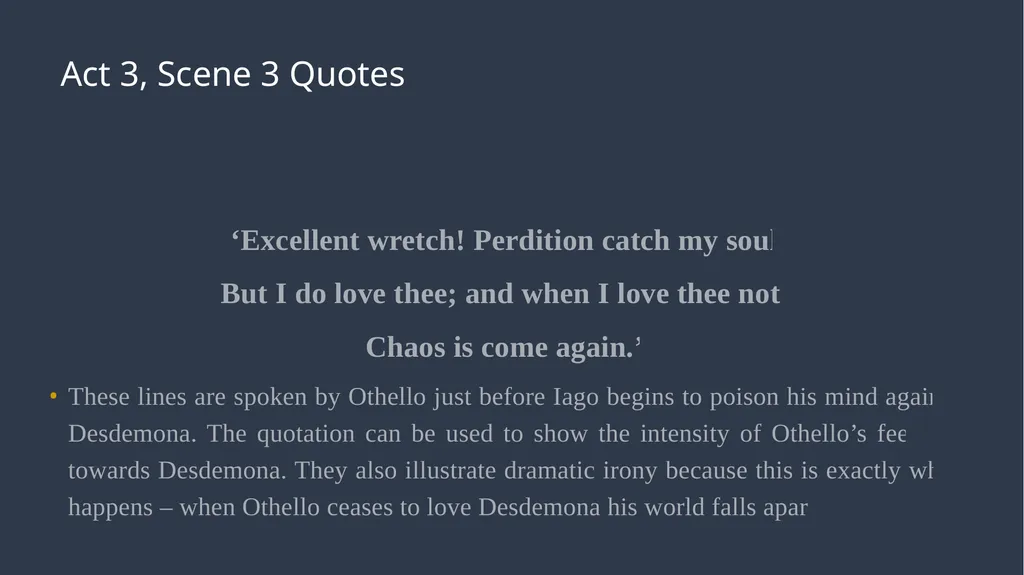
Act 3, Scene 3 Quotes ‘Excellent wretch! Perdition catch my soul
But I do love thee; and when I love thee not,
Chaos is come again.’
These lines are spoken by Othello just before Iago begins to poison his mind against Desdemona. The quotation can be used to show the intensity of Othello’s feelings towards Desdemona. They also illustrate dramatic irony because this is exactly what happens – when Othello ceases to love Desdemona his world falls apart.<br>
But I do love thee; and when I love thee not,
Chaos is come again.’
These lines are spoken by Othello just before Iago begins to poison his mind against Desdemona. The quotation can be used to show the intensity of Othello’s feelings towards Desdemona. They also illustrate dramatic irony because this is exactly what happens – when Othello ceases to love Desdemona his world falls apart.<br>
19
‘As where’s that palace, whereinto foul things
Sometimes intrude not?’
Iago speaks of how the purest soul may suffer the intrusion of foul things at times. This echoes exactly what is happening in this scene, where Iago pours his foul poison into the mind of Othello.<br>
Sometimes intrude not?’
Iago speaks of how the purest soul may suffer the intrusion of foul things at times. This echoes exactly what is happening in this scene, where Iago pours his foul poison into the mind of Othello.<br>
20
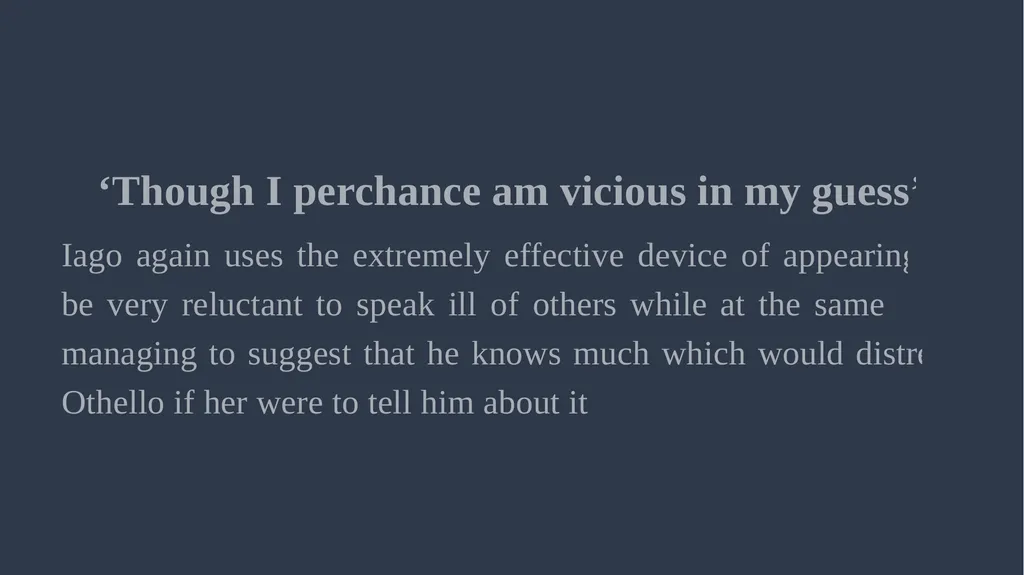
‘Though I perchance am vicious in my guess’
Iago again uses the extremely effective device of appearing to be very reluctant to speak ill of others while at the same time managing to suggest that he knows much which would distress Othello if her were to tell him about it.<br>
Iago again uses the extremely effective device of appearing to be very reluctant to speak ill of others while at the same time managing to suggest that he knows much which would distress Othello if her were to tell him about it.<br>
21
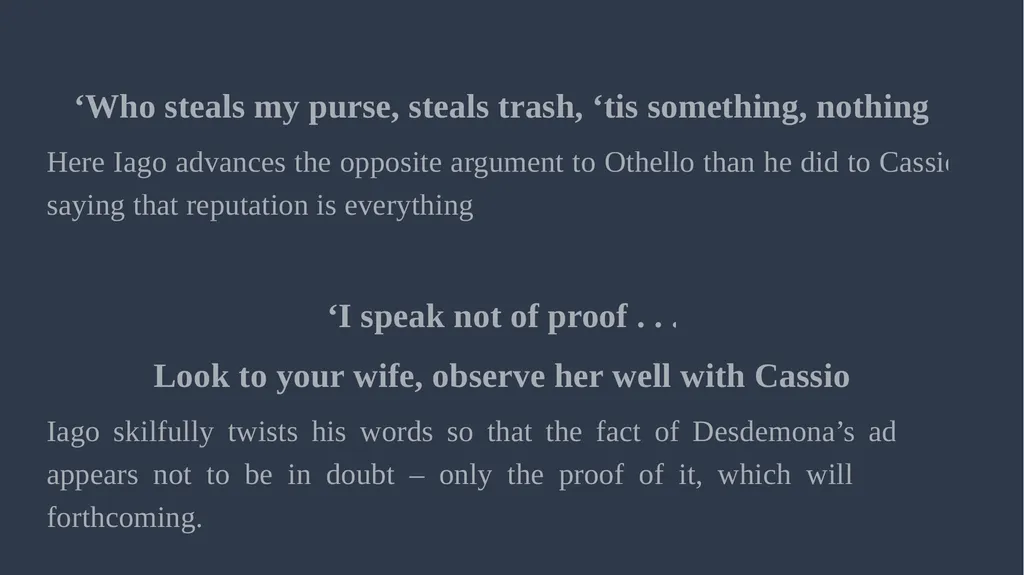
‘Who steals my purse, steals trash, ‘tis something, nothing’
Here Iago advances the opposite argument to Othello than he did to Cassio, saying that reputation is everything.
‘I speak not of proof . . .
Look to your wife, observe her well with Cassio’
Iago skilfully twists his words so that the fact of Desdemona’s adultery appears not to be in doubt – only the proof of it, which will soon be forthcoming.<br>
Here Iago advances the opposite argument to Othello than he did to Cassio, saying that reputation is everything.
‘I speak not of proof . . .
Look to your wife, observe her well with Cassio’
Iago skilfully twists his words so that the fact of Desdemona’s adultery appears not to be in doubt – only the proof of it, which will soon be forthcoming.<br>
22
‘I think my wife be honest, and think she is not,
I think that thou art just, and think thou art not’
Here we see Othello wavering between suspicion and loyalty as he struggles with himself to determine the truth. This proves to be an important turning point for Othello, whose character is such that he finds it difficult to release a notion once it is formed in his mind.<br>
I think that thou art just, and think thou art not’
Here we see Othello wavering between suspicion and loyalty as he struggles with himself to determine the truth. This proves to be an important turning point for Othello, whose character is such that he finds it difficult to release a notion once it is formed in his mind.<br>
23
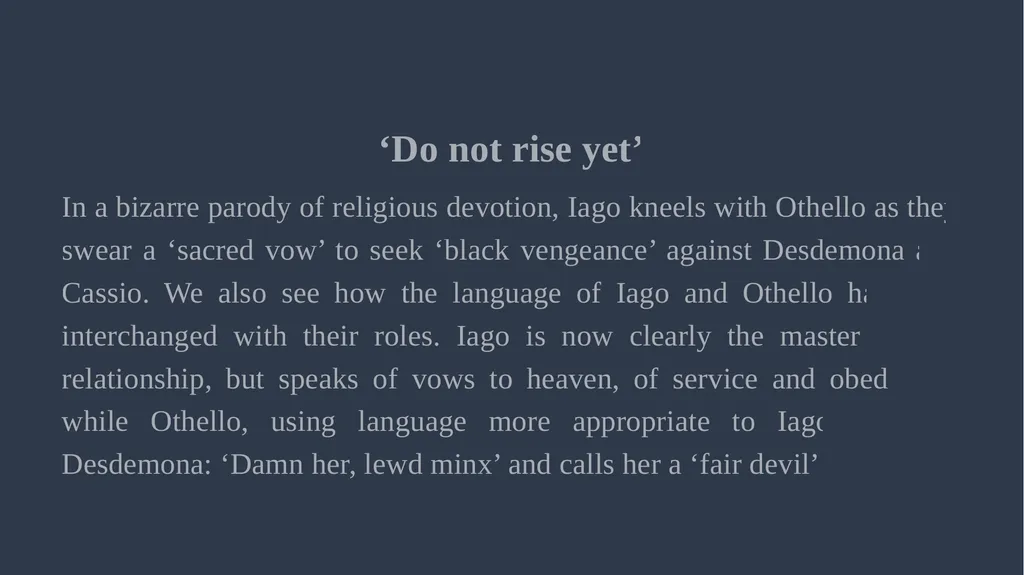
‘Do not rise yet’
In a bizarre parody of religious devotion, Iago kneels with Othello as they swear a ‘sacred vow’ to seek ‘black vengeance’ against Desdemona and Cassio. We also see how the language of Iago and Othello has been interchanged with their roles. Iago is now clearly the master in this relationship, but speaks of vows to heaven, of service and obedience, while Othello, using language more appropriate to Iago, says of Desdemona: ‘Damn her, lewd minx’ and calls her a ‘fair devil’.<br>
In a bizarre parody of religious devotion, Iago kneels with Othello as they swear a ‘sacred vow’ to seek ‘black vengeance’ against Desdemona and Cassio. We also see how the language of Iago and Othello has been interchanged with their roles. Iago is now clearly the master in this relationship, but speaks of vows to heaven, of service and obedience, while Othello, using language more appropriate to Iago, says of Desdemona: ‘Damn her, lewd minx’ and calls her a ‘fair devil’.<br>
24
‘I had rather be a toad,
And live upon the vapour of a dungeon,
Than keep a corner in the thing I love
For others’ uses.’
These lines are spoken by Othello when his mind is beginning to be corrupted by Iago’s insinuations. The quotation may be used to illustrate how Othello’s language and imagery is becoming debased from the noble poetry of the earlier scenes.<br>
And live upon the vapour of a dungeon,
Than keep a corner in the thing I love
For others’ uses.’
These lines are spoken by Othello when his mind is beginning to be corrupted by Iago’s insinuations. The quotation may be used to illustrate how Othello’s language and imagery is becoming debased from the noble poetry of the earlier scenes.<br>
25
Act 3, Scene 3 Questions The first seven lines of the scene are profoundly ironic. Explain.
Comment on the significance of ‘For thy solicitor shall rather die / Than give thy cause away’ (27-28).
Iago’s first attempt to arouse Othello’s suspicion of Desdemona and Cassio fails (‘Ha! I like not that’ l35). Why?
Desdemona’s pleadings on Cassio’s behalf (42-90) are not very successful. Why?
How does Iago succeed so well in unsettling Othello’s mind about Cassio’s honesty?
Why does Iago stress the need for Othello to avoid being jealous?
Othello’s speech on jealousy (180-196) reveals some important things about him. Comment on these. How does Iago make use of them for his own purposes?<br>
Comment on the significance of ‘For thy solicitor shall rather die / Than give thy cause away’ (27-28).
Iago’s first attempt to arouse Othello’s suspicion of Desdemona and Cassio fails (‘Ha! I like not that’ l35). Why?
Desdemona’s pleadings on Cassio’s behalf (42-90) are not very successful. Why?
How does Iago succeed so well in unsettling Othello’s mind about Cassio’s honesty?
Why does Iago stress the need for Othello to avoid being jealous?
Othello’s speech on jealousy (180-196) reveals some important things about him. Comment on these. How does Iago make use of them for his own purposes?<br>
26
8. What doubts about Desdemona does Iago create in Othello’s mind from line 200 to line 242?
9. Consider the significance of Othello’s lines ‘Farewell, if more / Thou dost observe, let me know more, set on / Thy wife to observe; leave me Iago’ (242-244). Why do these lines mark an important stage in Othello’s fall?
10. Iago advises Othello to leave the matters he has raised ‘to time’ (249). What is he hoping here?
11. Describe Othello’s state of mind in the speech beginning ‘This fellow’s of exceeding honesty’ (262). How does it differ from what has gone before? Comment on the significance of the imagery.
12. Desdemona’s loss of the handkerchief is a vitally important incident. Consider its implications for those it affects.
13. Othello’s attitude from line 365 to line 397 poses a threat to Iago. What is the nature of the threat, and how does he deal with it?<br>
9. Consider the significance of Othello’s lines ‘Farewell, if more / Thou dost observe, let me know more, set on / Thy wife to observe; leave me Iago’ (242-244). Why do these lines mark an important stage in Othello’s fall?
10. Iago advises Othello to leave the matters he has raised ‘to time’ (249). What is he hoping here?
11. Describe Othello’s state of mind in the speech beginning ‘This fellow’s of exceeding honesty’ (262). How does it differ from what has gone before? Comment on the significance of the imagery.
12. Desdemona’s loss of the handkerchief is a vitally important incident. Consider its implications for those it affects.
13. Othello’s attitude from line 365 to line 397 poses a threat to Iago. What is the nature of the threat, and how does he deal with it?<br>
27
14. Cassio’s ‘dream’ and his alleged possession of the handkerchief have a crucial effect on Othello. Explain.
15. Since the beginning of this scene Othello has undergone a remarkable change. Describe this briefly. How can it be accounted for?
16. Have any features of Othello’s character contributed to the success of Iago’s schemes?<br>
15. Since the beginning of this scene Othello has undergone a remarkable change. Describe this briefly. How can it be accounted for?
16. Have any features of Othello’s character contributed to the success of Iago’s schemes?<br>
28
Act 3, Scene 4 Summary Everything Desdemona does from now on puts her in danger. Here we find her seeking our Cassio. The message she tells the Clown to give him is fraught with irony: ‘Tell him I have moved my lord on his behalf, and hope all will be well’. The implications of ‘moved’ are particularly disturbing: Othello has already been moved to a murderous rage, partly through her innocent activities on Cassio’s behalf: the audience knows this but she does not. Desdemona anxiously enquires of Emilia about the loss of the handkerchief; the latter’s reply, ‘I know not, madam’, helps to seal Desdemona’s fate, since the recovery of the handkerchief at this point, and a true account of its loss, would make it impossible for Iago’s plans to succeed.<br>
29
Othello enters, finding it difficult to be civil to Desdemona. His mode of address (‘Well, my good lady’) is disturbing: he has never so far spoken to her in such formal terms. Her warm, moist hand has a sinister significance for him: it confirms his view that she is too free with her affections.<br>
30
There is a further menace in his demand for the handkerchief. In his exotic account of its origins, it ceases to be a commonplace article, and becomes a symbol of married love; its loss, therefore, suddenly takes on frightening significance. Desdemona’s behaviour at this point makes her position more desperate. First she lies about the handkerchief, claiming that it is not lost, but this frightened lie only increases Othello’s suspicions. Then her challenge to him, ‘It is not lost, but what an if it were?’, makes the case even worse in his eyes.<br>
31
Finally, she foolishly insists on pressing Cassio’s case for reinstatement. Othello’s fury mounts, and he leaves in a jealous rage. Emilia, seeing this and knowing the connection between his jealousy and the handkerchief, still fails to reveal what she knows, but contents herself with a cynical comment on the wayward moods and appetites of husbands.<br>
32
Iago arrives, urging Cassio to continue pressing Desdemona to act as his advocate with Othello. Bianca’s arrival heralds a further deterioration in Desdemona’s chances of survival. What happens between Cassio and Bianca represents a further piece of good luck for Iago and misfortune for Desdemona. Cassio give Bianca the handkerchief and asks her to have it copied.<br>
33
Act 3, Scene 4 Quotes ‘The handkerchief!’
We do not know whether Othello’s comments about the magical properties of the handkerchief reflect what he really believes, or are just a device to inflate its importance for his purposes here. However, notice how the idea of Othello having used witchcraft to woo Desdemona surfaces again here and serves to remind us once more of his status as an outsider and also to suggest that he is now becoming identified with the dark forces of superstition and evil. There is evidence of the changes which Iago has brought about in him.<br>
We do not know whether Othello’s comments about the magical properties of the handkerchief reflect what he really believes, or are just a device to inflate its importance for his purposes here. However, notice how the idea of Othello having used witchcraft to woo Desdemona surfaces again here and serves to remind us once more of his status as an outsider and also to suggest that he is now becoming identified with the dark forces of superstition and evil. There is evidence of the changes which Iago has brought about in him.<br>
34
‘Tis not a year or two shows us a man:
They are all but stomachs, and we all but food’
Emilia at once recognises that Othello’s temper is fuelled by jealousy. Her more realistic measuring of human nature reflects her more matter-of-fact approach to life than that of her mistress. Emilia sees both good and bad in people but accepts this as the way of the world, whereas Desdemona is astonished at this unusual behaviour of her husband.<br>
They are all but stomachs, and we all but food’
Emilia at once recognises that Othello’s temper is fuelled by jealousy. Her more realistic measuring of human nature reflects her more matter-of-fact approach to life than that of her mistress. Emilia sees both good and bad in people but accepts this as the way of the world, whereas Desdemona is astonished at this unusual behaviour of her husband.<br>
35
‘They are not ever jealous for the cause,
But jealous for they are jealous’
Emilia comments on the danger which Desdemona now faces. She knows, from her broader experience of life, that there is no protection for Desdemona in her assertion that she never gave Othello cause to be jealous. Jealousy is a self-controlled emotion which fuels itself upon its own existence, not necessarily upon the truth.<br>
But jealous for they are jealous’
Emilia comments on the danger which Desdemona now faces. She knows, from her broader experience of life, that there is no protection for Desdemona in her assertion that she never gave Othello cause to be jealous. Jealousy is a self-controlled emotion which fuels itself upon its own existence, not necessarily upon the truth.<br>
36
‘Throw your vile guesses in the devil’s teeth,
From whence you have them; you are jealous now’
Cassio’s relationship with Bianca is clearly more than a simple one of customer and prostitute, which is how several other characters see her. Notice how the handkerchief has provoked another heated exchange – this time from a woman’s perspective – about unwarranted jealousy.<br>
From whence you have them; you are jealous now’
Cassio’s relationship with Bianca is clearly more than a simple one of customer and prostitute, which is how several other characters see her. Notice how the handkerchief has provoked another heated exchange – this time from a woman’s perspective – about unwarranted jealousy.<br>
37
Act 3, Scene 4 Questions It is very often pointed out that Othello and Desdemona do not know each other very well. How is this demonstrated here?
The handkerchief takes on a new significance in this scene. Explain.
Desdemona’s responses during Othello’s interrogation (48-95) are unfortunate from her point of view. Why? Mention a similar instance in another scene.
What do we learn about Emilia from this scene?
Comment on the instances of irony in this scene.
What is Bianca’s function in the play?<br>
The handkerchief takes on a new significance in this scene. Explain.
Desdemona’s responses during Othello’s interrogation (48-95) are unfortunate from her point of view. Why? Mention a similar instance in another scene.
What do we learn about Emilia from this scene?
Comment on the instances of irony in this scene.
What is Bianca’s function in the play?<br>