04
Share:
our new approach to Equality, Diversity and Inclusion (EDI)
learning from our Equality Outcomes public consultation
how we’ll deliver the outcomes
Purpose: Your feedback will inform the develop of new EDI resources for the sector<br>
05
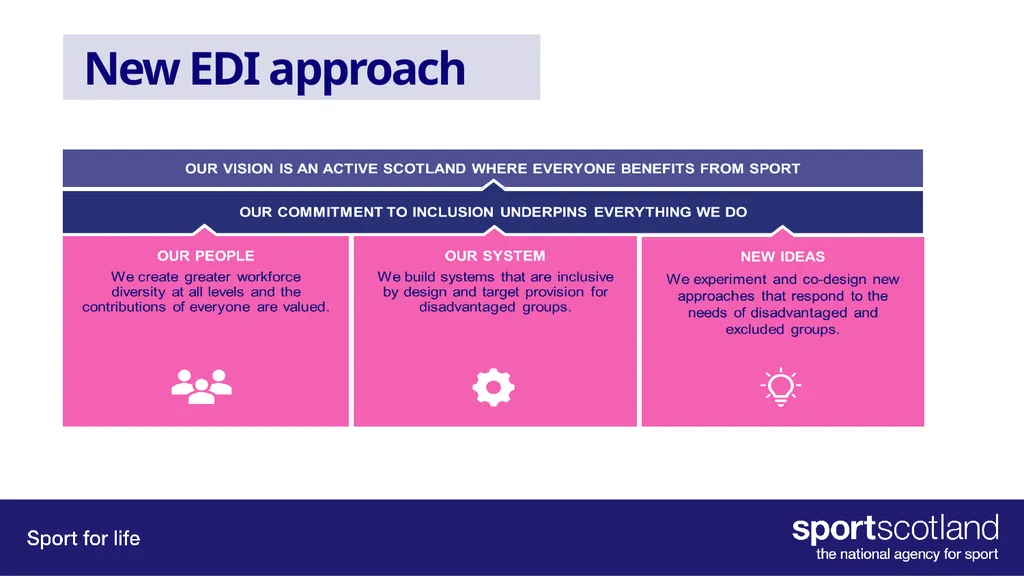
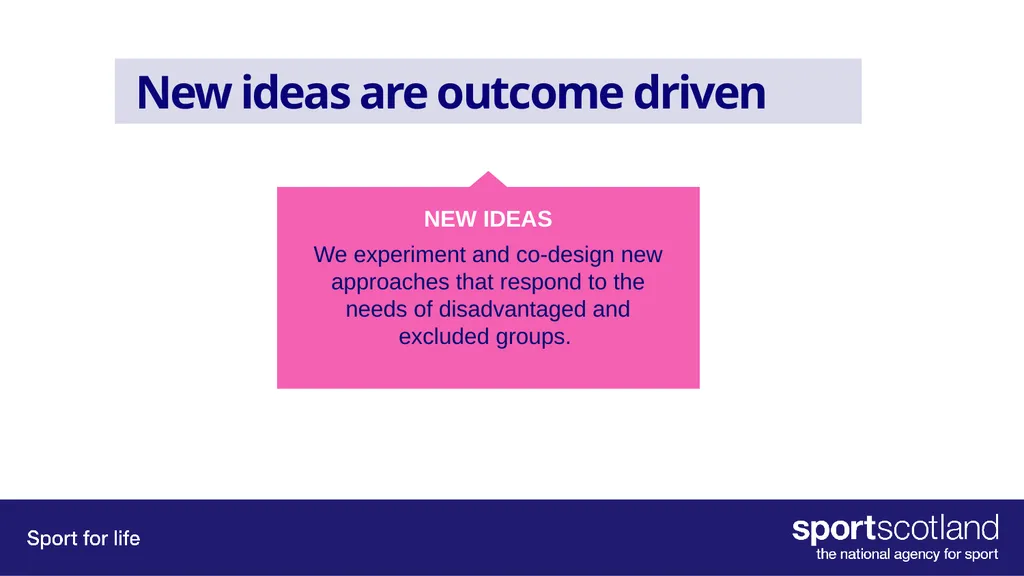
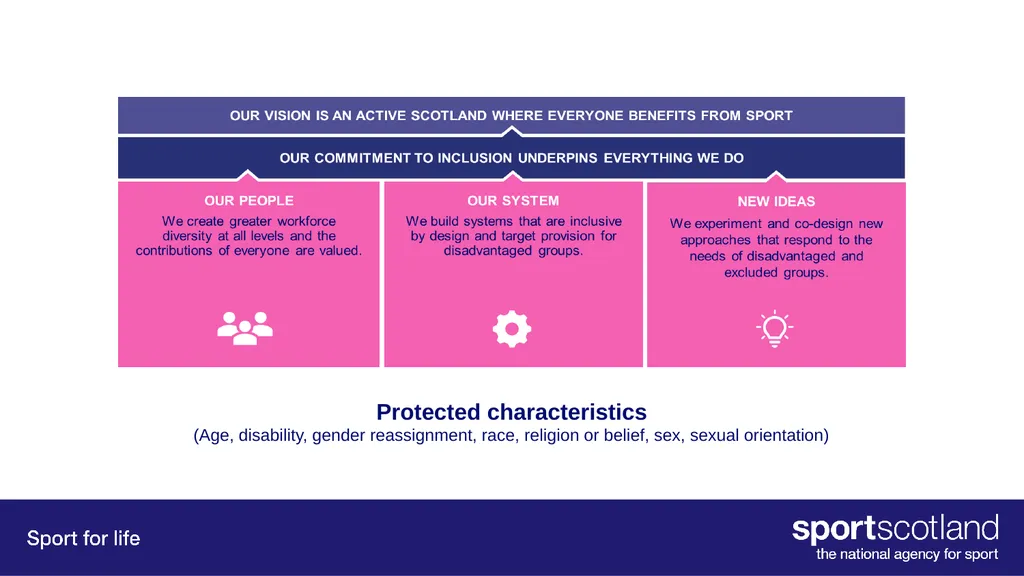
NEW IDEAS
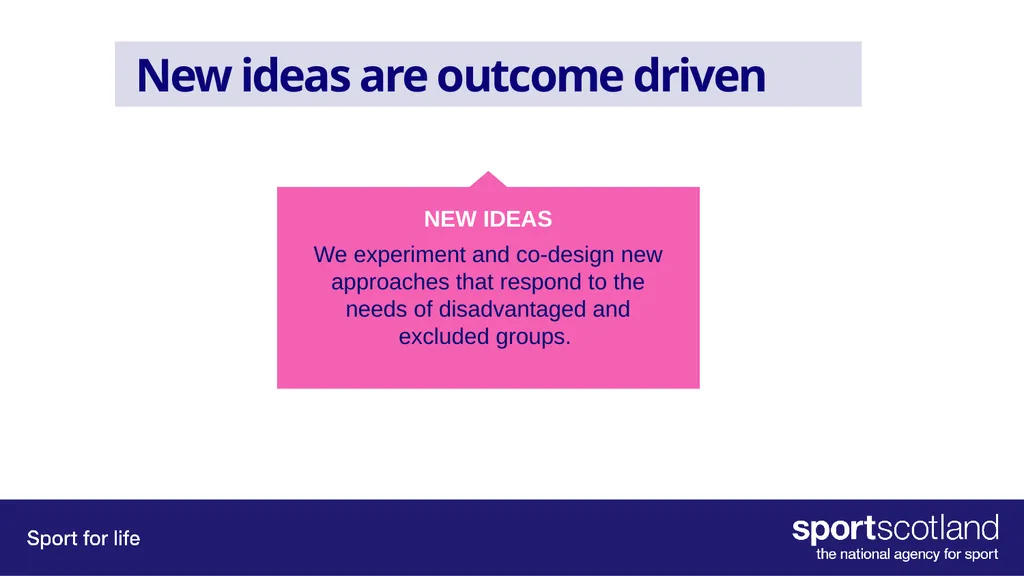
We experiment and co-design new approaches that respond to the needs of disadvantaged and excluded groups. New ideas are outcome driven<br>
06
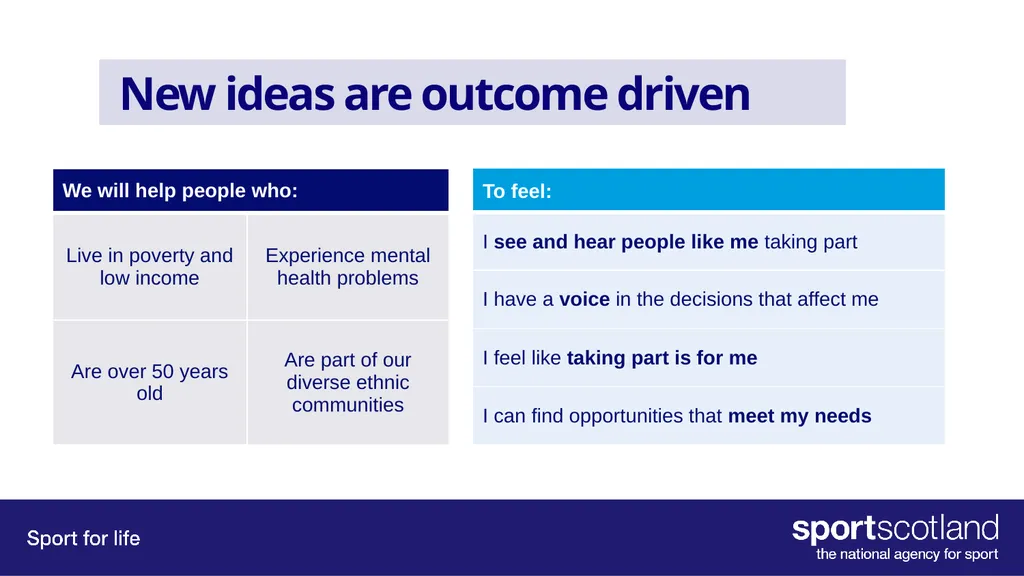
New ideas are outcome driven<br>
07
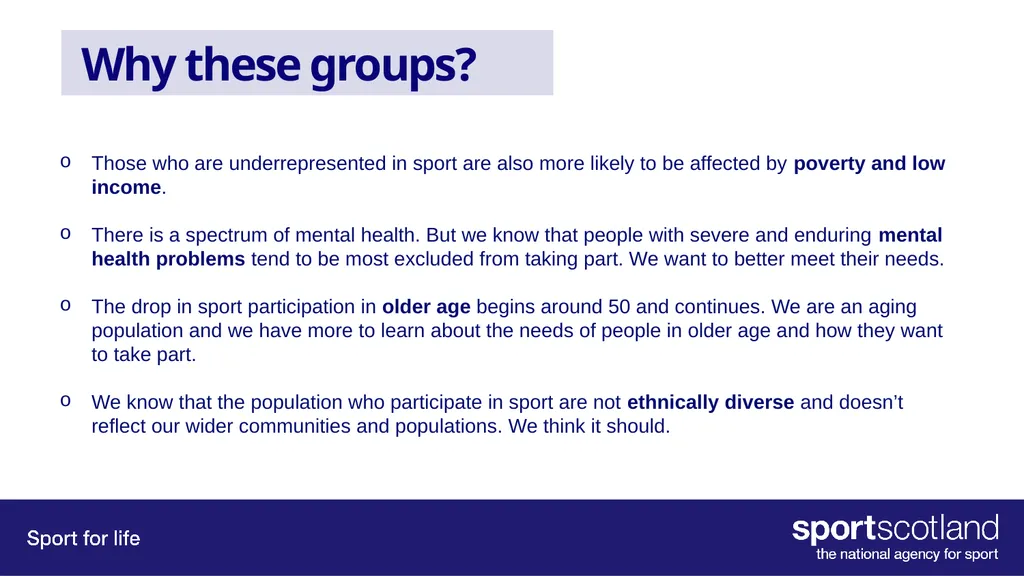
Why these groups? Those who are underrepresented in sport are also more likely to be affected by poverty and low income.
There is a spectrum of mental health. But we know that people with severe and enduring mental health problems tend to be most excluded from taking part. We want to better meet their needs.
The drop in sport participation in older age begins around 50 and continues. We are an aging population and we have more to learn about the needs of people in older age and how they want to take part.
We know that the population who participate in sport are not ethnically diverse and doesn’t reflect our wider communities and populations. We think it should.<br>
08
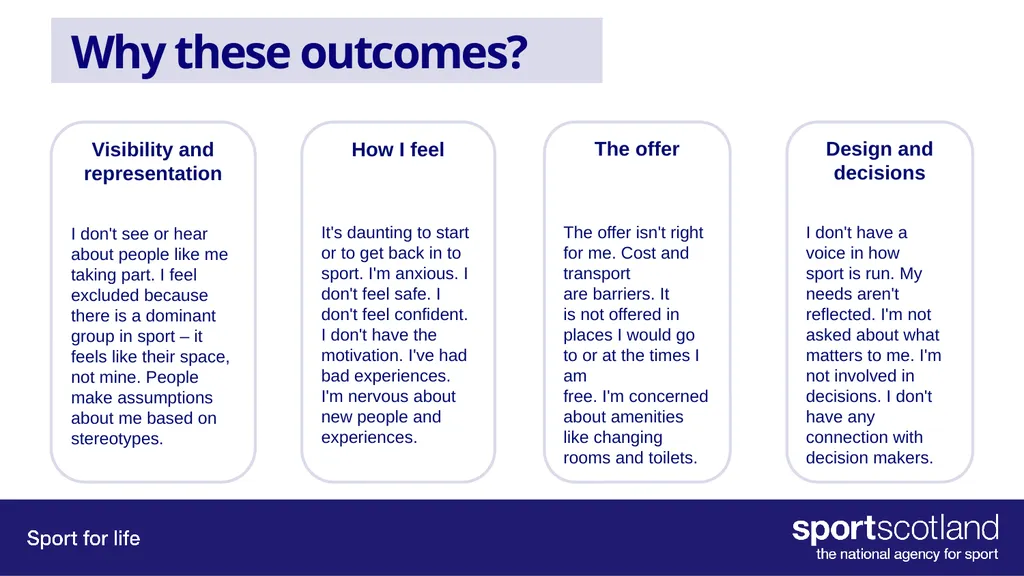
Why these outcomes?<br>
09
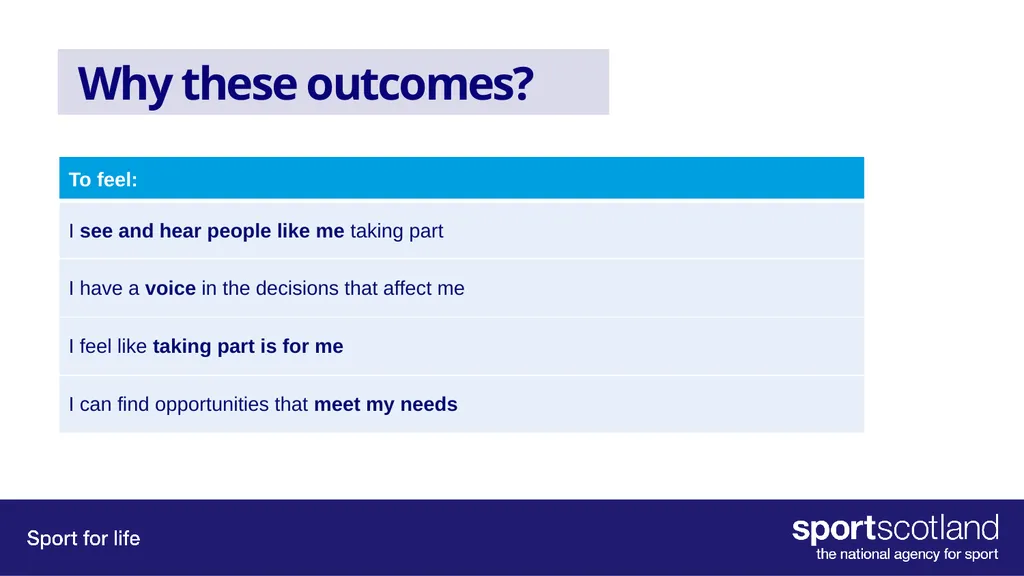
Why these outcomes? Visibility and representation
I don't see or hear about people like me taking part. I feel excluded because there is a dominant group in sport – it feels like their space, not mine. People make assumptions about me based on stereotypes. Design and decisions
I don't have a voice in how sport is run. My needs aren't reflected. I'm not asked about what matters to me. I'm not involved in decisions. I don't have any connection with decision makers. How I feel
It's daunting to start or to get back in to sport. I'm anxious. I don't feel safe. I don't feel confident. I don't have the motivation. I've had bad experiences. I'm nervous about new people and experiences. The offer
The offer isn't right for me. Cost and transport are barriers. It is not offered in places I would go to or at the times I am free. I'm concerned about amenities like changing rooms and toilets.<br>
10
Protected characteristics
(Age, disability, gender reassignment, race, religion or belief, sex, sexual orientation)<br>
11
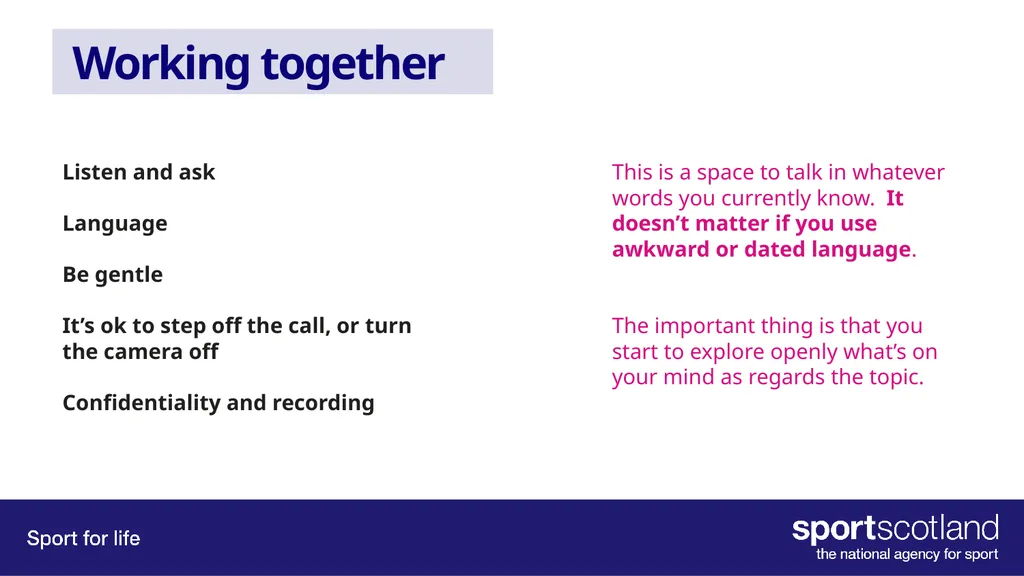
Working together Listen and ask
Language
Be gentle
It’s ok to step off the call, or turn the camera off
Confidentiality and recording This is a space to talk in whatever words you currently know. It doesn’t matter if you use awkward or dated language.
The important thing is that you start to explore openly what’s on your mind as regards the topic.<br>
12
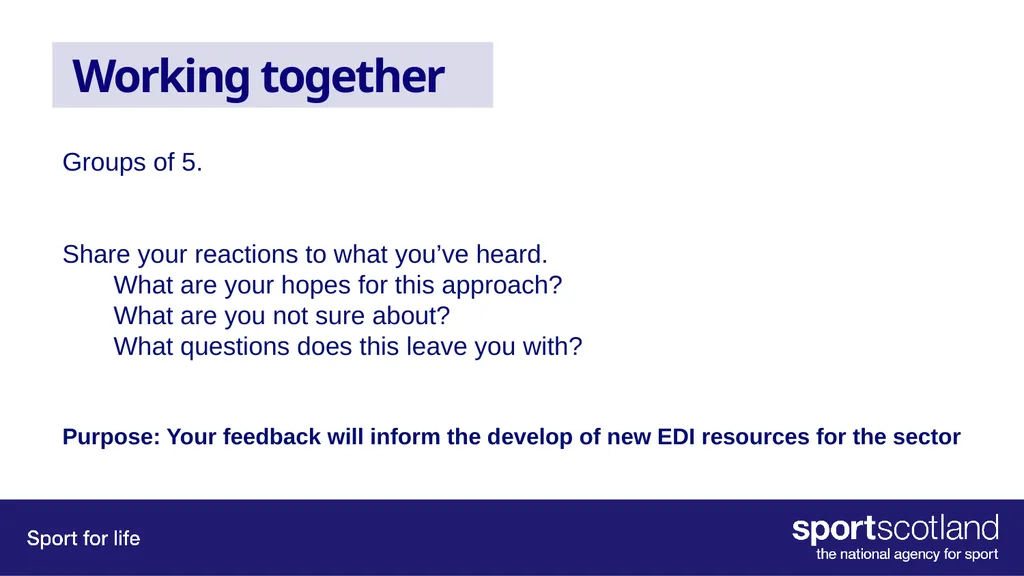
Working together Groups of 5.
Share your reactions to what you’ve heard.
What are your hopes for this approach?
What are you not sure about?
What questions does this leave you with?
Purpose: Your feedback will inform the develop of new EDI resources for the sector<br>
13
Working together Cara Viola
EDI@sportscotland.org.uk<br>
14
Break time! 11:50 – 11:55 The main session will restart at:11:55<br>
15
People at the heart of decision making New Ideas<br>
16
Delivering our "New Ideas"
is about putting people at the heart of decision-making People at the heart of decision making<br>
17
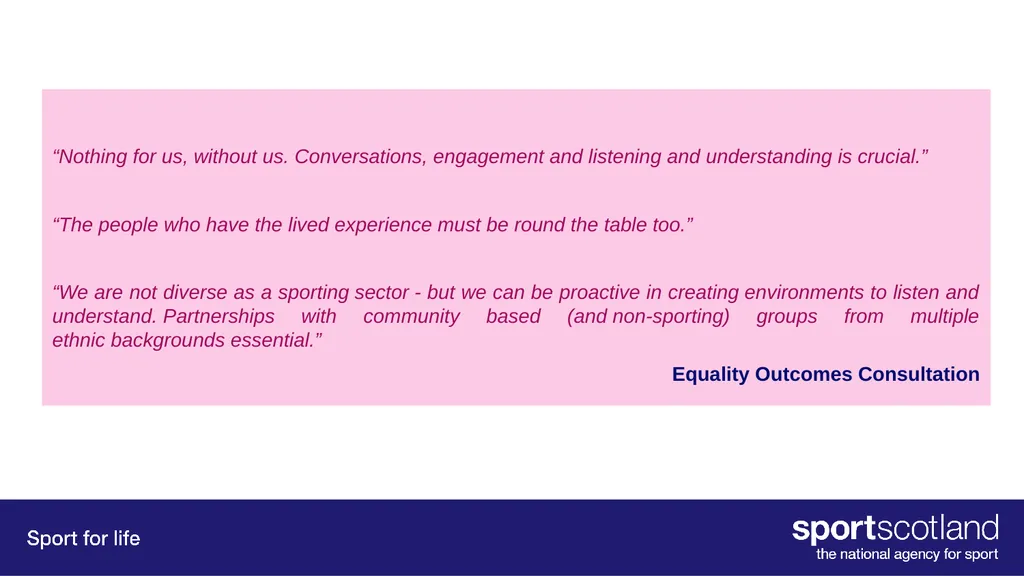
“Nothing for us, without us. Conversations, engagement and listening and understanding is crucial.”
“The people who have the lived experience must be round the table too.”
“We are not diverse as a sporting sector - but we can be proactive in creating environments to listen and understand. Partnerships with community based (and non-sporting) groups from multiple ethnic backgrounds essential.”
Equality Outcomes Consultation<br>
18
NEW IDEAS
We experiment and co-design new approaches that respond to the needs of disadvantaged and excluded groups. New ideas are outcome driven<br>
19
Lets explore this idea of involvement together now, so
-we understand this better
-we can put this into practice together
Purpose: Your views and experience will inform our approach to involvement and how we work together.<br>
20
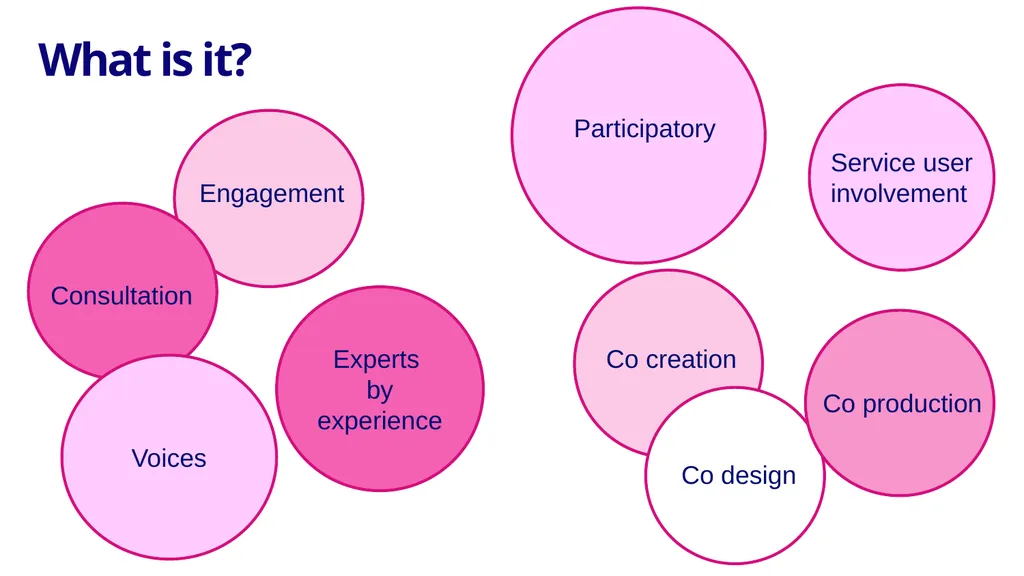
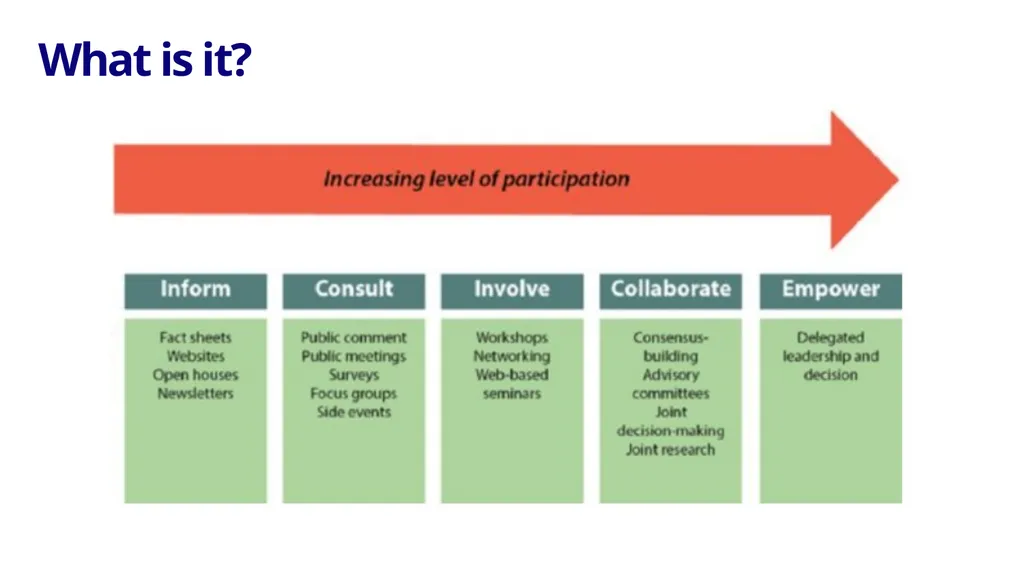
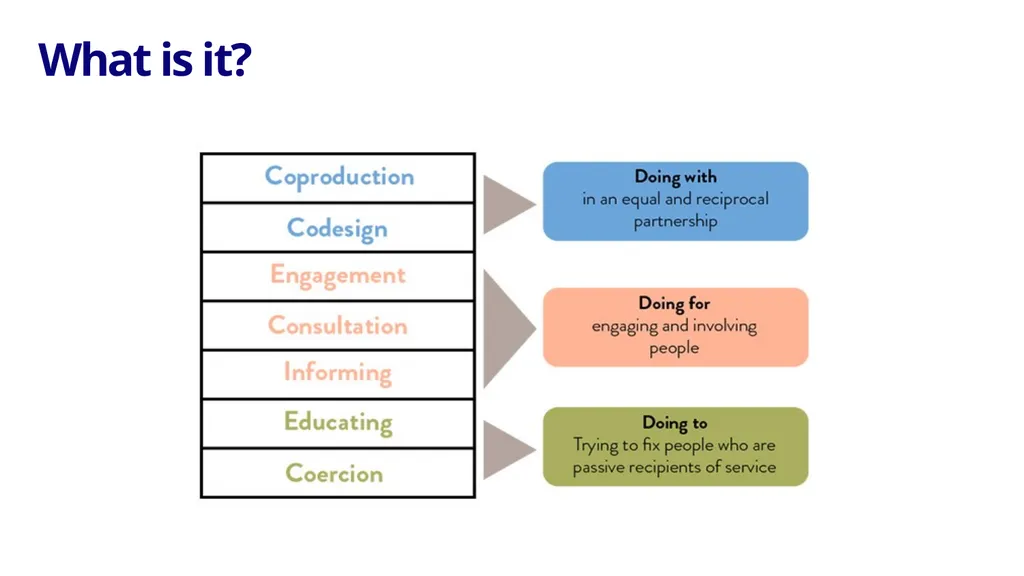
Participatory Service user involvement Co production Co design Consultation Engagement Co creation Experts
by experience Voices What is it?<br>
23
Co-production is where professionals and citizens share power to plan and deliver support services together, recognising that both partners have a vital contribution to make. What is it?<br>
24
Coproduction refers specifically to work with people with lived experience of the service or policy in question, rather than any citizen.
Co-creation or co-design, where people are involved in coming up with ideas, is not full coproduction but may be a step on the road to embedding coproduction in your way of working. What is it? Source: Coproduction and service user involvement — NCVO Knowhow<br>
25
Involving people who use services in the design and delivery of services can increase your impact. Why do this?<br>
27
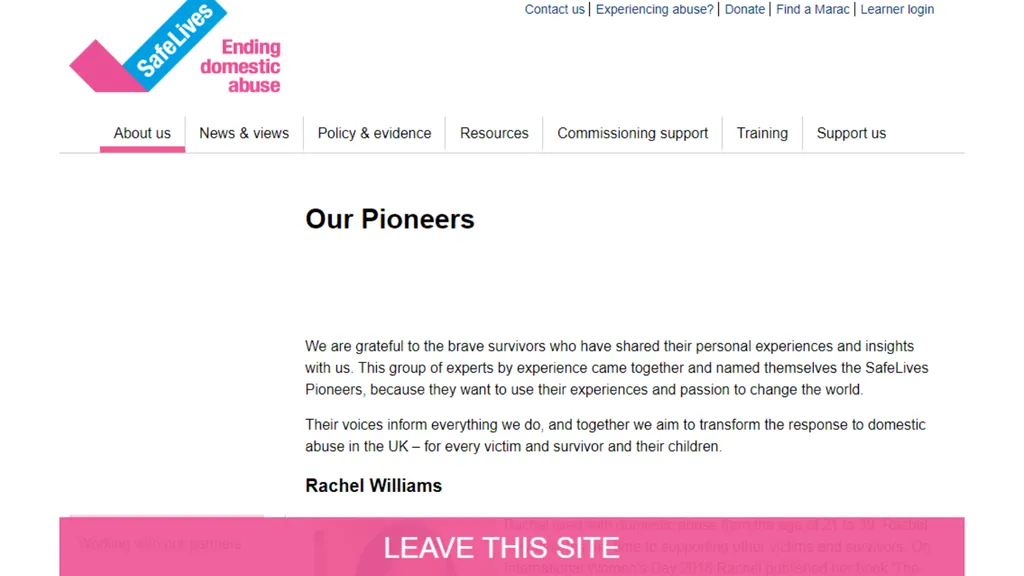
SafeLives is a UK-wide charity dedicated to ending domestic abuse, for everyone and for good. Survivors of abuse
“should feed into decisions because they are the experts by experience… by gathering the experience of survivors and understanding their reality an appropriate and realistic response can be formulated.”<br>
28
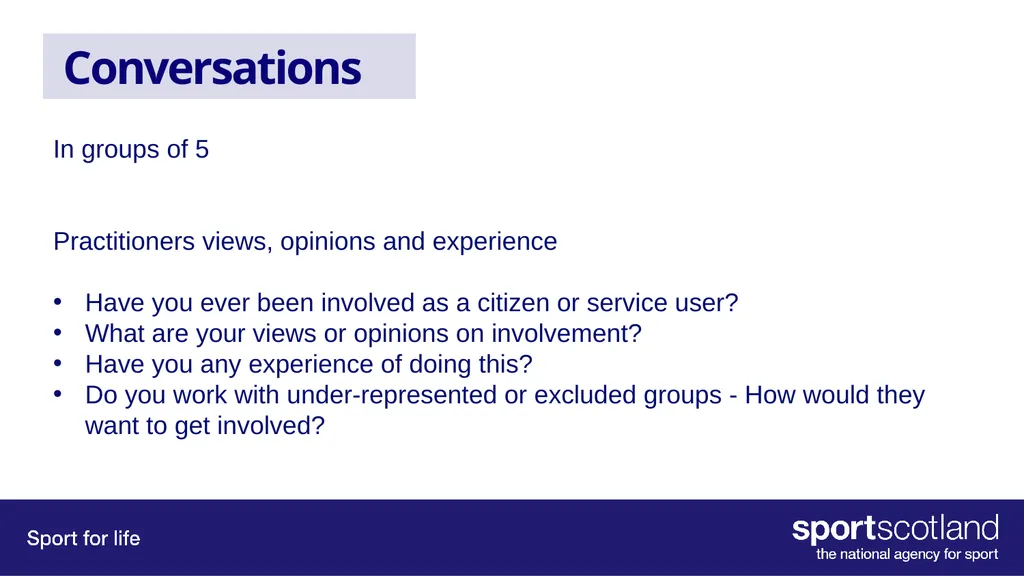
Conversations In groups of 5
Practitioners views, opinions and experience
Have you ever been involved as a citizen or service user?
What are your views or opinions on involvement?
Have you any experience of doing this?
Do you work with under-represented or excluded groups - How would they want to get involved?<br>
29
How are you feeling now? Please put a few words in the chat <br>
30
Your input will help us develop:
EDI resources for the sector
our involvement approach
We email a feedback form and keeping in touch information next week
Updates website with today’s slides and next steps Keeping in touch EDI@sportscotland.org.uk<br>
31
EDI@sportscotland.org.uk Thank you<br>
32
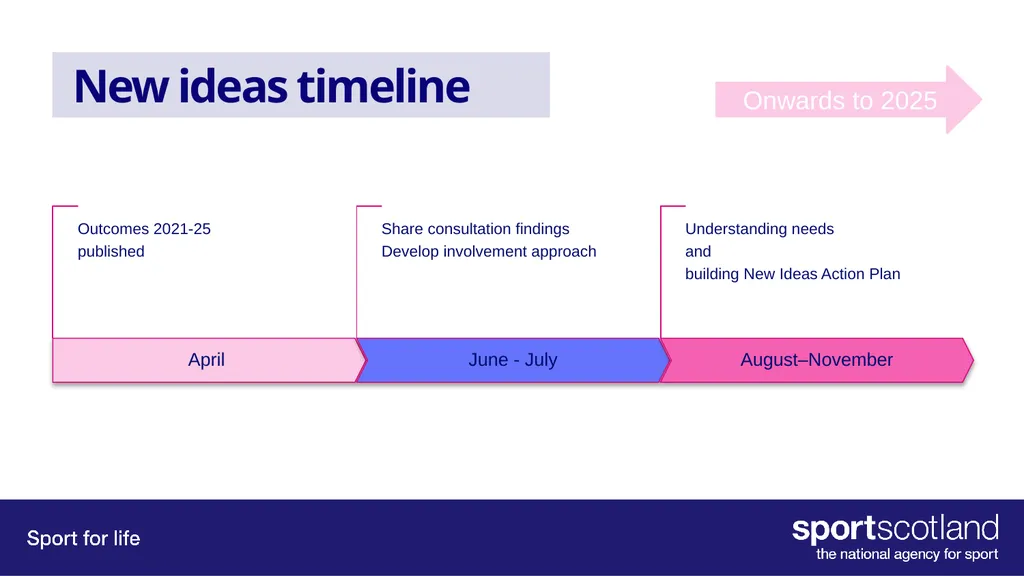
New ideas timeline Onwards to 2025<br>
33
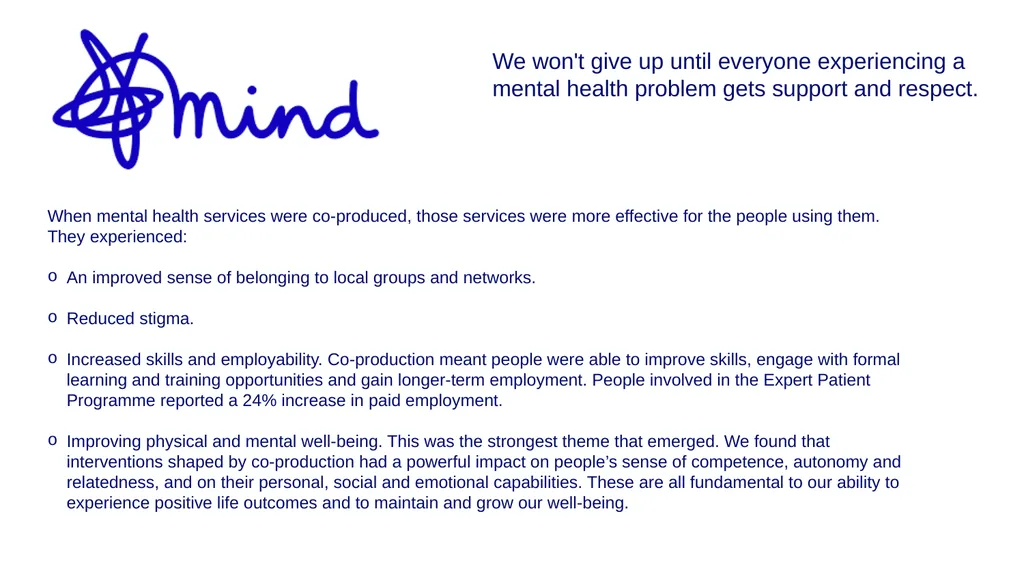
When mental health services were co-produced, those services were more effective for the people using them.
They experienced:
An improved sense of belonging to local groups and networks.
Reduced stigma. �
Increased skills and employability. Co-production meant people were able to improve skills, engage with formal learning and training opportunities and gain longer-term employment. People involved in the Expert Patient Programme reported a 24% increase in paid employment.�
Improving physical and mental well-being. This was the strongest theme that emerged. We found that interventions shaped by co-production had a powerful impact on people’s sense of competence, autonomy and relatedness, and on their personal, social and emotional capabilities. These are all fundamental to our ability to experience positive life outcomes and to maintain and grow our well-being. We won't give up until everyone experiencing a mental health problem gets support and respect.<br>