
Our safeguarding arrangements will effectively
FD
Published · 31 slides · 0 views
1 / 1
Description
Our safeguarding arrangements will effectively prevent and respond to adult abuse Creating Safer Cultures Our safeguarding arrangements will effectively prevent and respond to adult abuse Todays presentation What is a closed culture?
Related Topics
Share
Embed code
Download this presentation From Below
"Our safeguarding arrangements will effectively" is the property of its rightful owner. Permission is granted to download and print the materials on this website for personal, non-commercial use only, and to display it on your personal computer provided you do not modify the materials and that you retain all copyright notices contained in the materials. By downloading content from our website, you accept the terms of this agreement.
Presentation Transcript
01
Our safeguarding arrangements will effectively prevent and respond to adult abuse Creating Safer Cultures<br>
02
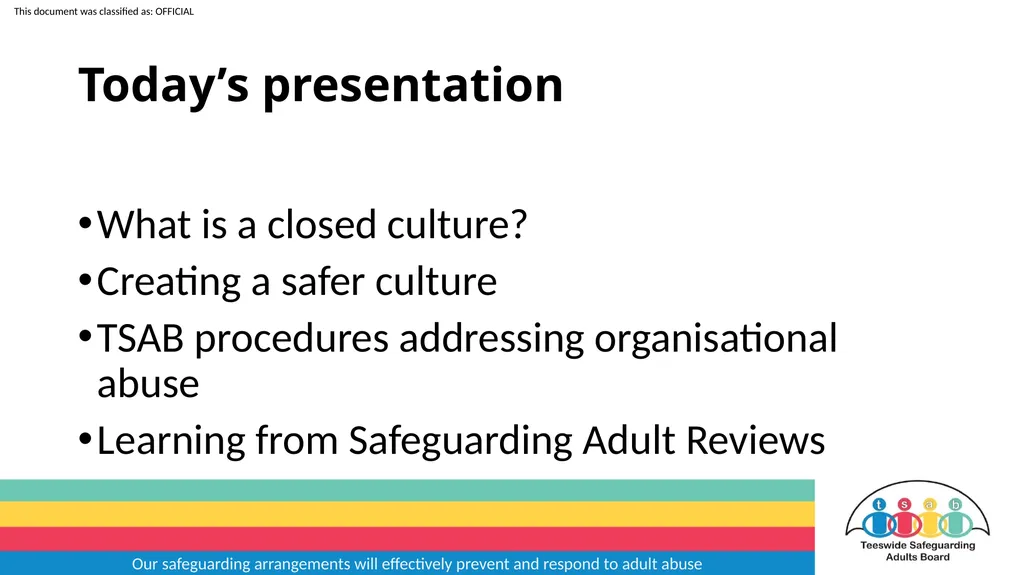
Our safeguarding arrangements will effectively prevent and respond to adult abuse Today’s presentation What is a closed culture?
Creating a safer culture
TSAB procedures addressing organisational abuse
Learning from Safeguarding Adult Reviews<br>
Creating a safer culture
TSAB procedures addressing organisational abuse
Learning from Safeguarding Adult Reviews<br>
03
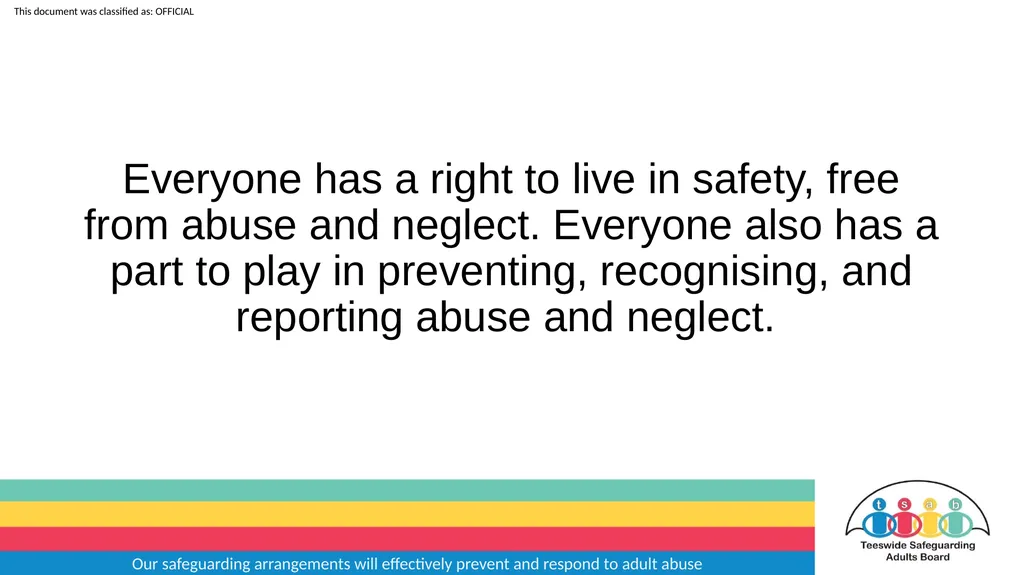
Our safeguarding arrangements will effectively prevent and respond to adult abuse Everyone has a right to live in safety, free from abuse and neglect. Everyone also has a part to play in preventing, recognising, and reporting abuse and neglect.<br>
04
Our safeguarding arrangements will effectively prevent and respond to adult abuse What is a closed culture? The Care Quality Commission (CQC) describes a closed culture as:
“a poor culture that can lead to harm, including human rights breaches, such as abuse”
Any service that delivers care can have a closed culture. In these services, people are more likely to be at risk of deliberate or unintentional harm.
This is seen as organisational abuse.<br>
“a poor culture that can lead to harm, including human rights breaches, such as abuse”
Any service that delivers care can have a closed culture. In these services, people are more likely to be at risk of deliberate or unintentional harm.
This is seen as organisational abuse.<br>
05
Our safeguarding arrangements will effectively prevent and respond to adult abuse What is Organisational Abuse? The Care Act 2014 describes organisational abuse as:
‘Neglect and poor care practice within a specific care setting. This could be a hospital, care home, but also the care received in a person’s own home.’<br>
‘Neglect and poor care practice within a specific care setting. This could be a hospital, care home, but also the care received in a person’s own home.’<br>
06
Our safeguarding arrangements will effectively prevent and respond to adult abuse What is Organisational Abuse? Organisational abuse can range from a one-off incident to ongoing ill-treatment and can involve one or more perpetrators.
High profile examples of organisational abuse include: Mid-Staffordshire Hospital, Winterbourne View, Whorlton Hall and more recently Joanna, John and Ben<br>
High profile examples of organisational abuse include: Mid-Staffordshire Hospital, Winterbourne View, Whorlton Hall and more recently Joanna, John and Ben<br>
07
Our safeguarding arrangements will effectively prevent and respond to adult abuse What is Organisational Abuse? In some instances, acts of neglect can seem minor, however if neglect continues and a person’s needs are continually unmet, this can lead to organisational abuse.
Experiencing prolonged neglect can have a detrimental impact on a person’s physical and mental health.<br>
Experiencing prolonged neglect can have a detrimental impact on a person’s physical and mental health.<br>
08
Our safeguarding arrangements will effectively prevent and respond to adult abuse Case Study “Amanda's story
When I was a patient in a closed culture on a psychiatric ward, I felt completely vulnerable. The staff had all the power and I felt that whatever I did or said I was completely powerless. Some of the senior staff were so arrogant that they controlled everything. I could tell that some of the more junior staff disagreed with what was happening, but even they didn't feel able to speak up for the patients' rights (and presumably for their own working environment too). Even when I did try to say that things weren't safe, I was ignored. It felt like all my experiences, past education, training and work counted for nothing because I was the one who was mentally ill and they were the ‘professionals'. I may have been unwell, but I still knew that what was happening was wrong and was rejected when I tried to articulate this to the ‘powers' in the organisation.<br>
When I was a patient in a closed culture on a psychiatric ward, I felt completely vulnerable. The staff had all the power and I felt that whatever I did or said I was completely powerless. Some of the senior staff were so arrogant that they controlled everything. I could tell that some of the more junior staff disagreed with what was happening, but even they didn't feel able to speak up for the patients' rights (and presumably for their own working environment too). Even when I did try to say that things weren't safe, I was ignored. It felt like all my experiences, past education, training and work counted for nothing because I was the one who was mentally ill and they were the ‘professionals'. I may have been unwell, but I still knew that what was happening was wrong and was rejected when I tried to articulate this to the ‘powers' in the organisation.<br>
09
Our safeguarding arrangements will effectively prevent and respond to adult abuse Case Study “I’m Jack. I’m 71 years old and in hospital because of a stroke. I can’t speak because of the stroke, but can understand what people say to me. I can’t move anything on my right side and need help to eat, dress, wash and go to the toilet. I have sometimes wet the bed, because I haven’t been able to reach the buzzer to call for a nurse. It’s so embarrassing. I tried to tell staff today what I wanted to eat, but she couldn’t understand me so brought me a jacket potato. I couldn't use the knife and fork to cut it up and it went cold. She’s taken it away thinking I’m not hungry. I’ve been told by the doctor that I’ve lost a lot of weight recently and need to build my strength up. I’m so hungry, but I can’t explain to staff that I need help”.<br>
10
Our safeguarding arrangements will effectively prevent and respond to adult abuse What can a closed culture look like? Staff not understanding or speaking warmly about the people they are caring for.
Staff belittling, excluding or taunting people.
Care plans not being individualised or reflecting the person's voice.
Poor or absent communication plans for people who have communication needs and or communication plans not being followed.<br>
Staff belittling, excluding or taunting people.
Care plans not being individualised or reflecting the person's voice.
Poor or absent communication plans for people who have communication needs and or communication plans not being followed.<br>
11
Our safeguarding arrangements will effectively prevent and respond to adult abuse What can a closed culture look like? Restrictions, including restraint, long-term segregation and prolonged seclusion, being imposed on people without an assessment of need, legal authority/legitimate aim or that have been imposed legitimately but are not subject to review and or do not ease over time.
Blanket practices for all residents.
People being asked to go to their rooms or another area and prevented from leaving.<br>
Blanket practices for all residents.
People being asked to go to their rooms or another area and prevented from leaving.<br>
12
Our safeguarding arrangements will effectively prevent and respond to adult abuse What can a closed culture look like? Poor application or understanding of the Mental Capacity Act (MCA) and Mental Health Act (MHA), including not following the MCA, DoLS and MHA Codes of Practice.
Concerns about medicine management including inappropriate use of medicines to restrain or control behaviour.
Staff not speaking out about concerns for fear of repercussions<br>
Concerns about medicine management including inappropriate use of medicines to restrain or control behaviour.
Staff not speaking out about concerns for fear of repercussions<br>
13
Our safeguarding arrangements will effectively prevent and respond to adult abuse What can a closed culture look like? Lack of visible, accessible or supportive senior staff/managers
Poorly trained staff
Poor communication and information sharing (internally and externally)
Resistance to learn from mistakes, complaints, near misses, safeguarding concerns or serious incidents<br>
Poorly trained staff
Poor communication and information sharing (internally and externally)
Resistance to learn from mistakes, complaints, near misses, safeguarding concerns or serious incidents<br>
14
Our safeguarding arrangements will effectively prevent and respond to adult abuse Creating a Safer Culture The foundations for building a safer culture are to...
✓ Listen
✓ Learn
✓ Lead
If these basic foundations aren’t in place this can lead to organisational abuse.<br>
✓ Listen
✓ Learn
✓ Lead
If these basic foundations aren’t in place this can lead to organisational abuse.<br>
15
Our safeguarding arrangements will effectively prevent and respond to adult abuse Creating a Safer Culture - The adult Seek people’s views and wishes
Make Every Contact Count
Professional Curiosity - if in doubt, check it out
Flexibility and person centred care<br>
Make Every Contact Count
Professional Curiosity - if in doubt, check it out
Flexibility and person centred care<br>
16
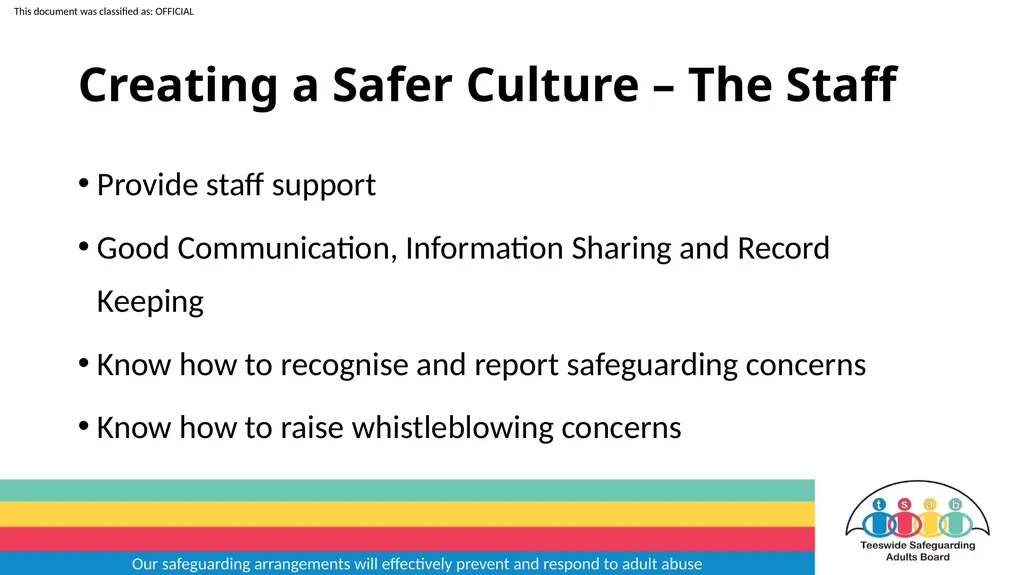
Our safeguarding arrangements will effectively prevent and respond to adult abuse Creating a Safer Culture – The Staff Provide staff support
Good Communication, Information Sharing and Record Keeping
Know how to recognise and report safeguarding concerns
Know how to raise whistleblowing concerns<br>
Good Communication, Information Sharing and Record Keeping
Know how to recognise and report safeguarding concerns
Know how to raise whistleblowing concerns<br>
17
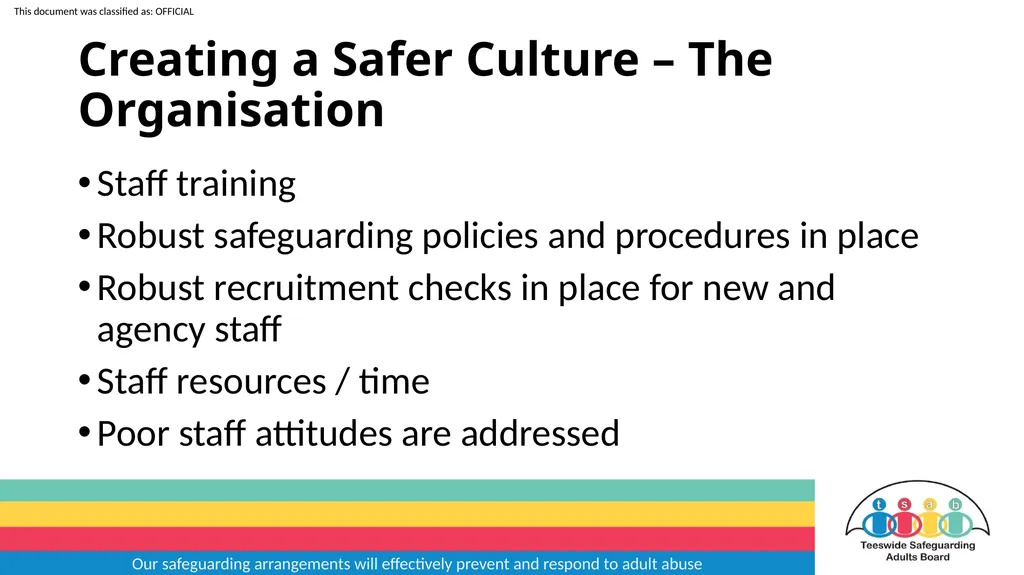
Our safeguarding arrangements will effectively prevent and respond to adult abuse Creating a Safer Culture – The Organisation Staff training
Robust safeguarding policies and procedures in place
Robust recruitment checks in place for new and agency staff
Staff resources / time
Poor staff attitudes are addressed<br>
Robust safeguarding policies and procedures in place
Robust recruitment checks in place for new and agency staff
Staff resources / time
Poor staff attitudes are addressed<br>
18
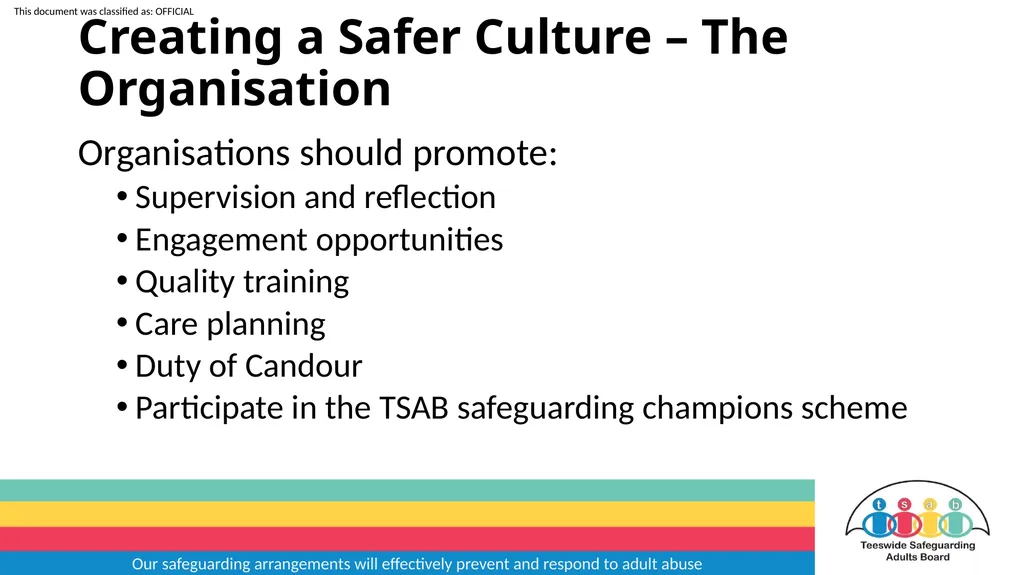
Our safeguarding arrangements will effectively prevent and respond to adult abuse Creating a Safer Culture – The Organisation Organisations should promote:
Supervision and reflection
Engagement opportunities
Quality training
Care planning
Duty of Candour
Participate in the TSAB safeguarding champions scheme<br>
Supervision and reflection
Engagement opportunities
Quality training
Care planning
Duty of Candour
Participate in the TSAB safeguarding champions scheme<br>
19
Our safeguarding arrangements will effectively prevent and respond to adult abuse TSAB policies and procedures TSAB have policies and procedures to respond to organisational abuse – Responding to and Addressing Serious Concerns (RASC)<br>
20
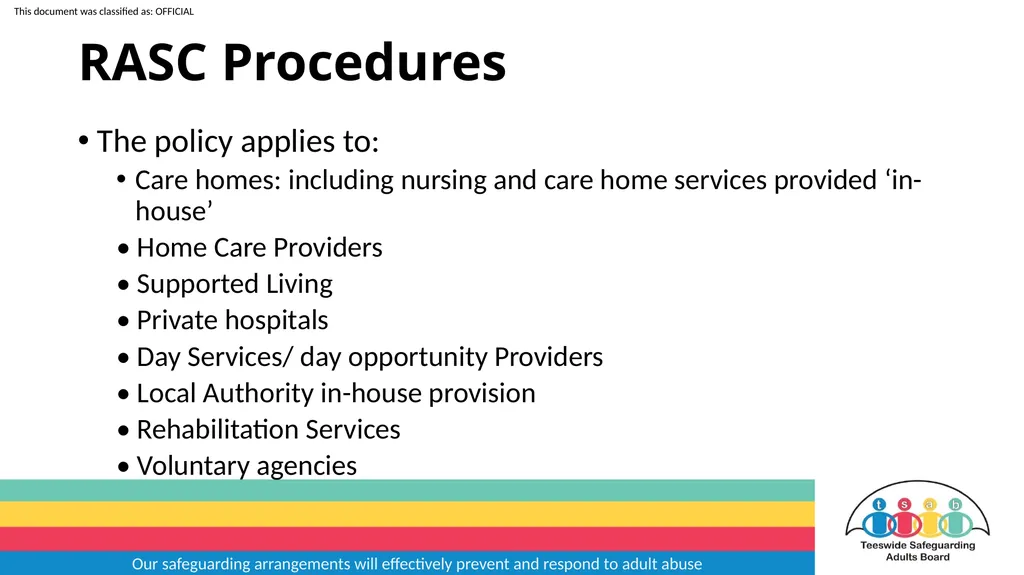
Our safeguarding arrangements will effectively prevent and respond to adult abuse RASC Procedures The policy applies to:
Care homes: including nursing and care home services provided ‘in-house’
• Home Care Providers
• Supported Living
• Private hospitals
• Day Services/ day opportunity Providers
• Local Authority in-house provision
• Rehabilitation Services
• Voluntary agencies<br>
Care homes: including nursing and care home services provided ‘in-house’
• Home Care Providers
• Supported Living
• Private hospitals
• Day Services/ day opportunity Providers
• Local Authority in-house provision
• Rehabilitation Services
• Voluntary agencies<br>
21
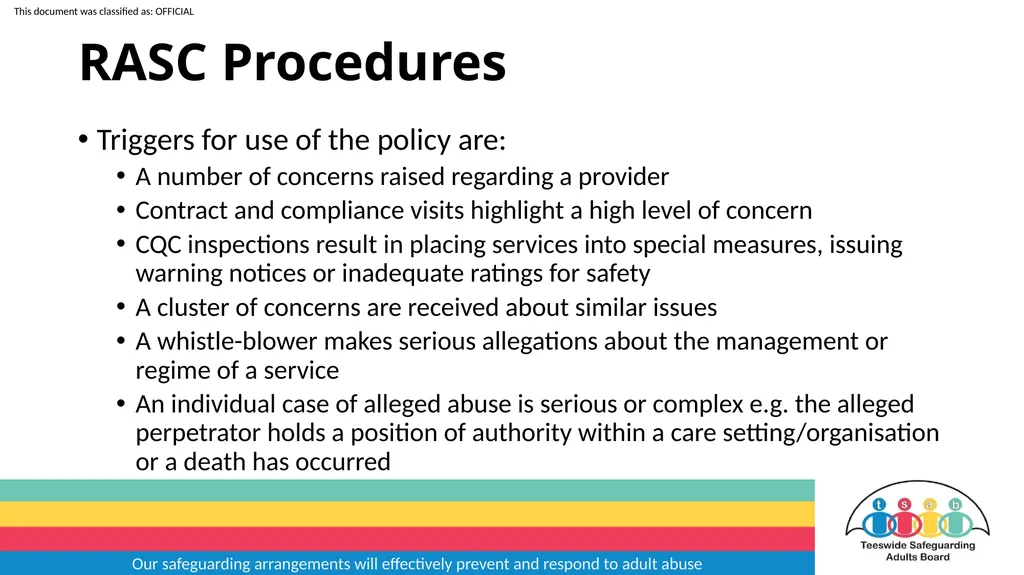
Our safeguarding arrangements will effectively prevent and respond to adult abuse RASC Procedures Triggers for use of the policy are:
A number of concerns raised regarding a provider
Contract and compliance visits highlight a high level of concern
CQC inspections result in placing services into special measures, issuing warning notices or inadequate ratings for safety
A cluster of concerns are received about similar issues
A whistle-blower makes serious allegations about the management or regime of a service
An individual case of alleged abuse is serious or complex e.g. the alleged perpetrator holds a position of authority within a care setting/organisation or a death has occurred<br>
A number of concerns raised regarding a provider
Contract and compliance visits highlight a high level of concern
CQC inspections result in placing services into special measures, issuing warning notices or inadequate ratings for safety
A cluster of concerns are received about similar issues
A whistle-blower makes serious allegations about the management or regime of a service
An individual case of alleged abuse is serious or complex e.g. the alleged perpetrator holds a position of authority within a care setting/organisation or a death has occurred<br>
22
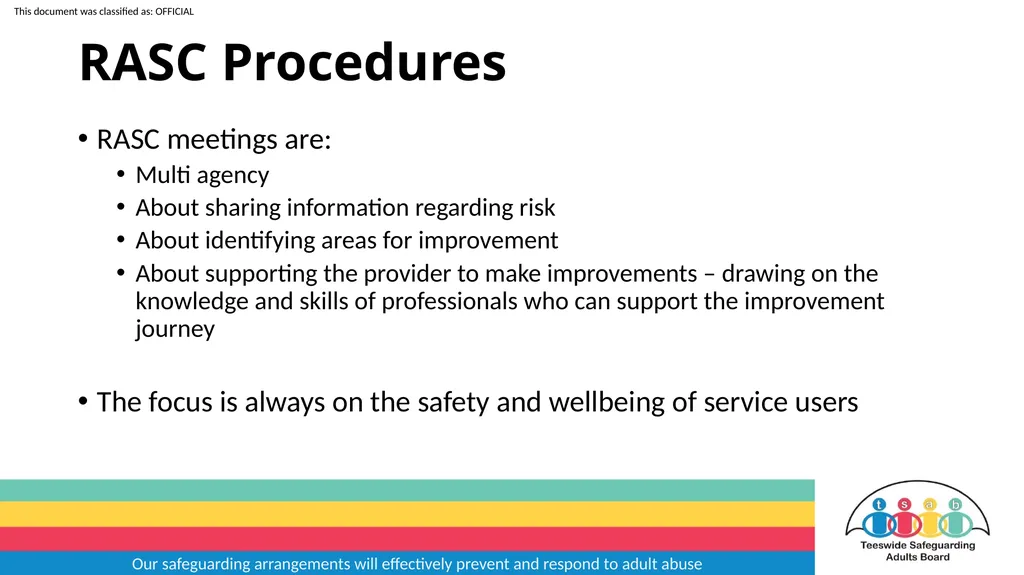
Our safeguarding arrangements will effectively prevent and respond to adult abuse RASC Procedures RASC meetings are:
Multi agency
About sharing information regarding risk
About identifying areas for improvement
About supporting the provider to make improvements – drawing on the knowledge and skills of professionals who can support the improvement journey
The focus is always on the safety and wellbeing of service users<br>
Multi agency
About sharing information regarding risk
About identifying areas for improvement
About supporting the provider to make improvements – drawing on the knowledge and skills of professionals who can support the improvement journey
The focus is always on the safety and wellbeing of service users<br>
23
Our safeguarding arrangements will effectively prevent and respond to adult abuse Learning from Safeguarding Adult Reviews It is important that we learn from the most serious instances of abuse and neglect and apply this to our own practice.
This is to prevent similar instances occurring again.<br>
This is to prevent similar instances occurring again.<br>
24
Our safeguarding arrangements will effectively prevent and respond to adult abuse Learning from Safeguarding Adults Reviews Safeguarding Adults Reviews are defined in legislation – the Care act 2014<br>
25
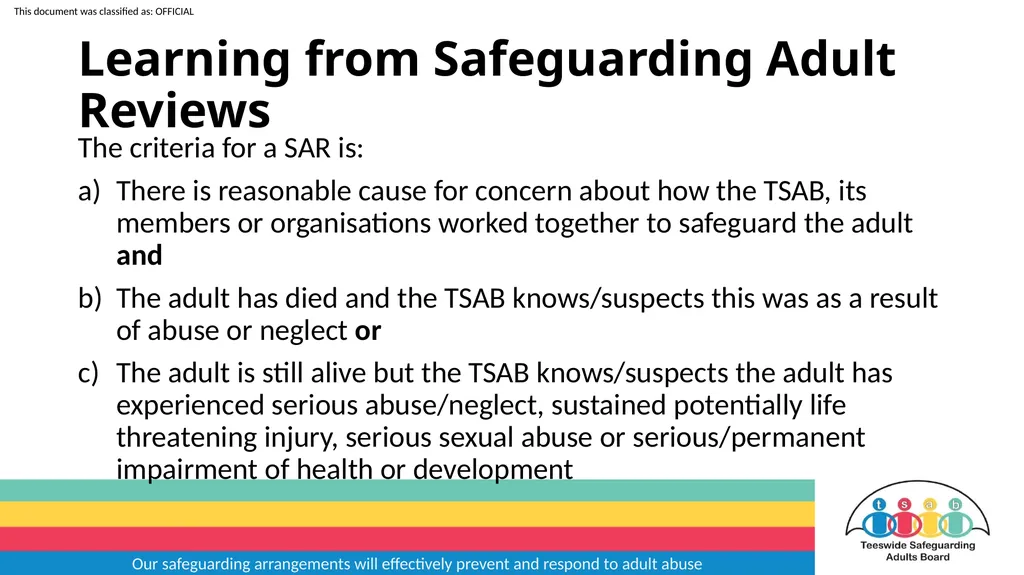
Our safeguarding arrangements will effectively prevent and respond to adult abuse Learning from Safeguarding Adult Reviews The criteria for a SAR is:
There is reasonable cause for concern about how the TSAB, its members or organisations worked together to safeguard the adult and
The adult has died and the TSAB knows/suspects this was as a result of abuse or neglect or
The adult is still alive but the TSAB knows/suspects the adult has experienced serious abuse/neglect, sustained potentially life threatening injury, serious sexual abuse or serious/permanent impairment of health or development<br>
There is reasonable cause for concern about how the TSAB, its members or organisations worked together to safeguard the adult and
The adult has died and the TSAB knows/suspects this was as a result of abuse or neglect or
The adult is still alive but the TSAB knows/suspects the adult has experienced serious abuse/neglect, sustained potentially life threatening injury, serious sexual abuse or serious/permanent impairment of health or development<br>
26
Our safeguarding arrangements will effectively prevent and respond to adult abuse Learning from Safeguarding Adult Reviews The Board publishes their learning reviews:
https://www.tsab.org.uk/professionals/safeguarding-adult-review-sar-reports/
And also reflects on regional and national SARs from a Tees perspective:
https://www.tsab.org.uk/professionals/learning-from-regional-and-national-sar-cases/<br>
https://www.tsab.org.uk/professionals/safeguarding-adult-review-sar-reports/
And also reflects on regional and national SARs from a Tees perspective:
https://www.tsab.org.uk/professionals/learning-from-regional-and-national-sar-cases/<br>
27
Our safeguarding arrangements will effectively prevent and respond to adult abuse In Summary, think about… Are you able to have open conversations about what’s working well and what needs to improve or change?
Do you openly talk about safeguarding people and avoiding or preventing harm?
Do you regularly communicate with colleagues about near misses or complex cases so that they are aware of what to avoid/ how to address similar issues?
Do you feel able to recognise a safeguarding concern?
Do you know how to raise a safeguarding concern?<br>
Do you openly talk about safeguarding people and avoiding or preventing harm?
Do you regularly communicate with colleagues about near misses or complex cases so that they are aware of what to avoid/ how to address similar issues?
Do you feel able to recognise a safeguarding concern?
Do you know how to raise a safeguarding concern?<br>
28
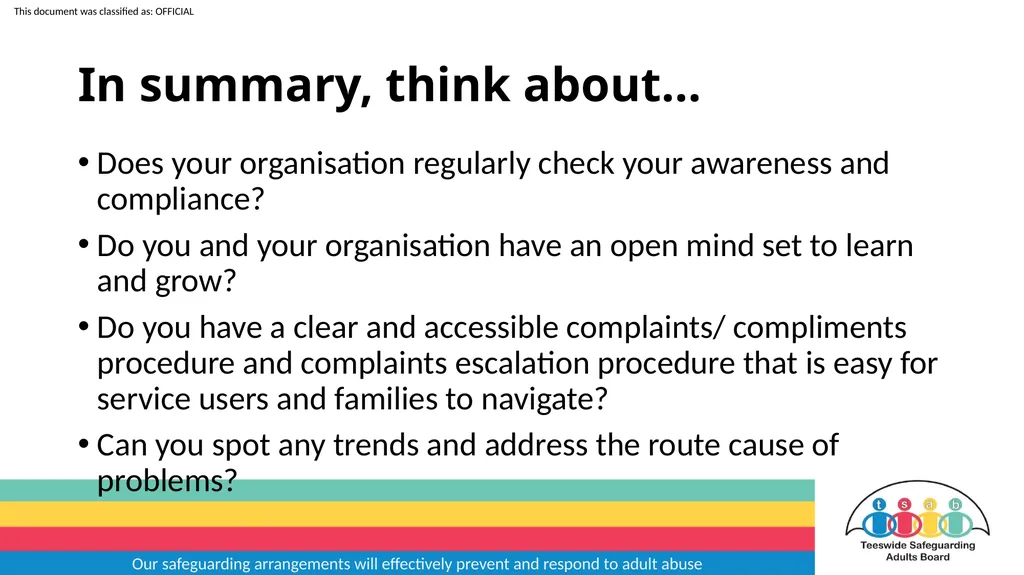
Our safeguarding arrangements will effectively prevent and respond to adult abuse In summary, think about… Does your organisation regularly check your awareness and compliance?
Do you and your organisation have an open mind set to learn and grow?
Do you have a clear and accessible complaints/ compliments procedure and complaints escalation procedure that is easy for service users and families to navigate?
Can you spot any trends and address the route cause of problems?<br>
Do you and your organisation have an open mind set to learn and grow?
Do you have a clear and accessible complaints/ compliments procedure and complaints escalation procedure that is easy for service users and families to navigate?
Can you spot any trends and address the route cause of problems?<br>
29
Our safeguarding arrangements will effectively prevent and respond to adult abuse Creating a Safer Culture
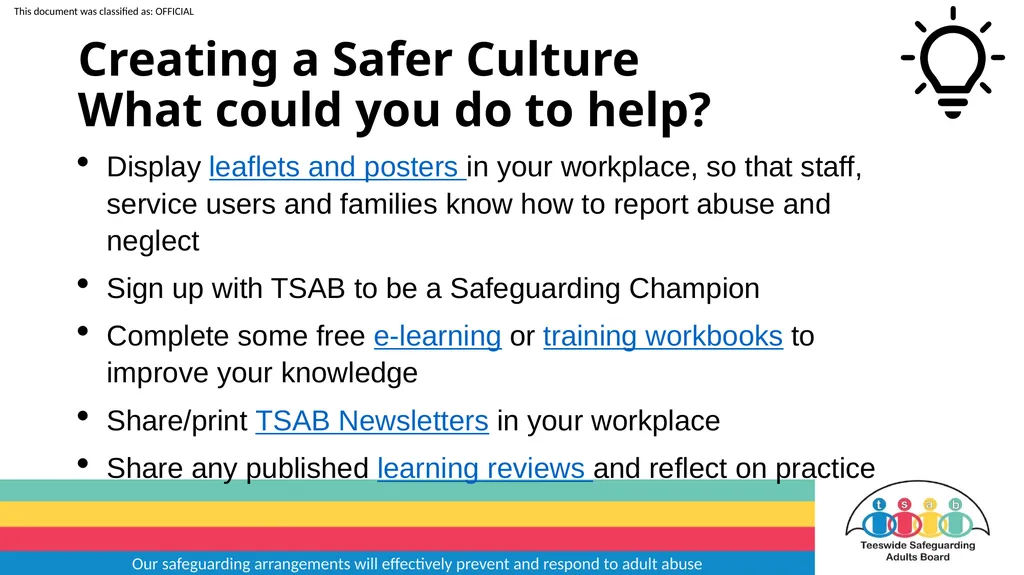
What could you do to help? Display leaflets and posters in your workplace, so that staff, service users and families know how to report abuse and neglect
Sign up with TSAB to be a Safeguarding Champion
Complete some free e-learning or training workbooks to improve your knowledge
Share/print TSAB Newsletters in your workplace
Share any published learning reviews and reflect on practice<br>
Sign up with TSAB to be a Safeguarding Champion
Complete some free e-learning or training workbooks to improve your knowledge
Share/print TSAB Newsletters in your workplace
Share any published learning reviews and reflect on practice<br>
30
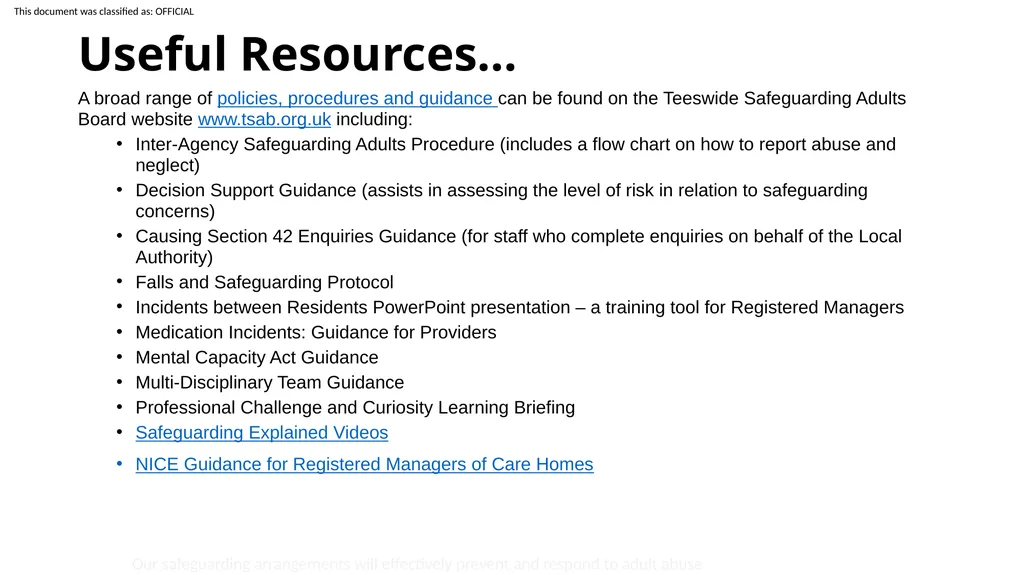
Our safeguarding arrangements will effectively prevent and respond to adult abuse Useful Resources… A broad range of policies, procedures and guidance can be found on the Teeswide Safeguarding Adults Board website www.tsab.org.uk including:
Inter-Agency Safeguarding Adults Procedure (includes a flow chart on how to report abuse and neglect)
Decision Support Guidance (assists in assessing the level of risk in relation to safeguarding concerns)
Causing Section 42 Enquiries Guidance (for staff who complete enquiries on behalf of the Local Authority)
Falls and Safeguarding Protocol
Incidents between Residents PowerPoint presentation – a training tool for Registered Managers
Medication Incidents: Guidance for Providers
Mental Capacity Act Guidance
Multi-Disciplinary Team Guidance
Professional Challenge and Curiosity Learning Briefing
Safeguarding Explained Videos
NICE Guidance for Registered Managers of Care Homes<br>
Inter-Agency Safeguarding Adults Procedure (includes a flow chart on how to report abuse and neglect)
Decision Support Guidance (assists in assessing the level of risk in relation to safeguarding concerns)
Causing Section 42 Enquiries Guidance (for staff who complete enquiries on behalf of the Local Authority)
Falls and Safeguarding Protocol
Incidents between Residents PowerPoint presentation – a training tool for Registered Managers
Medication Incidents: Guidance for Providers
Mental Capacity Act Guidance
Multi-Disciplinary Team Guidance
Professional Challenge and Curiosity Learning Briefing
Safeguarding Explained Videos
NICE Guidance for Registered Managers of Care Homes<br>
31
Our safeguarding arrangements will effectively prevent and respond to adult abuse Any Questions?<br>