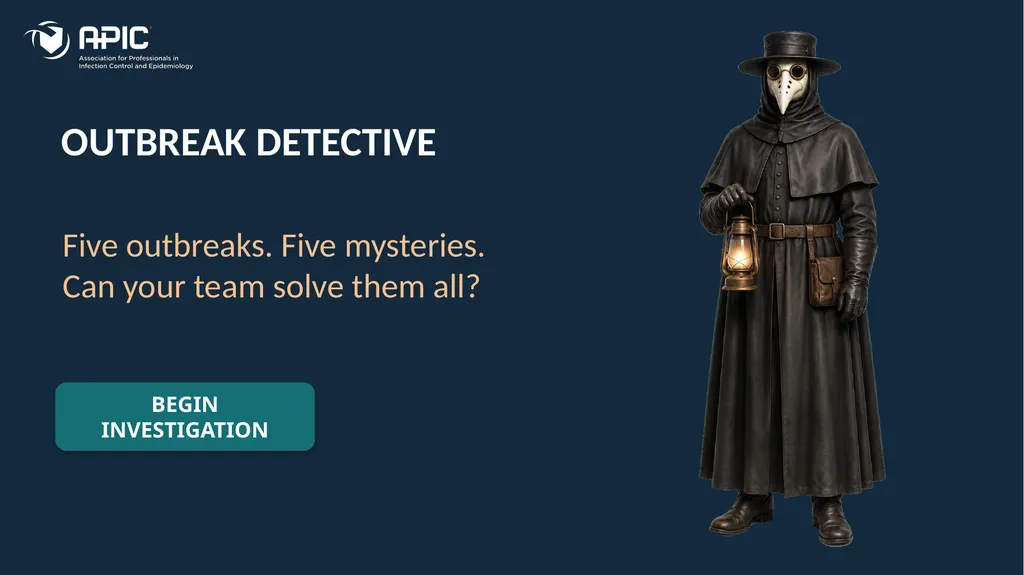
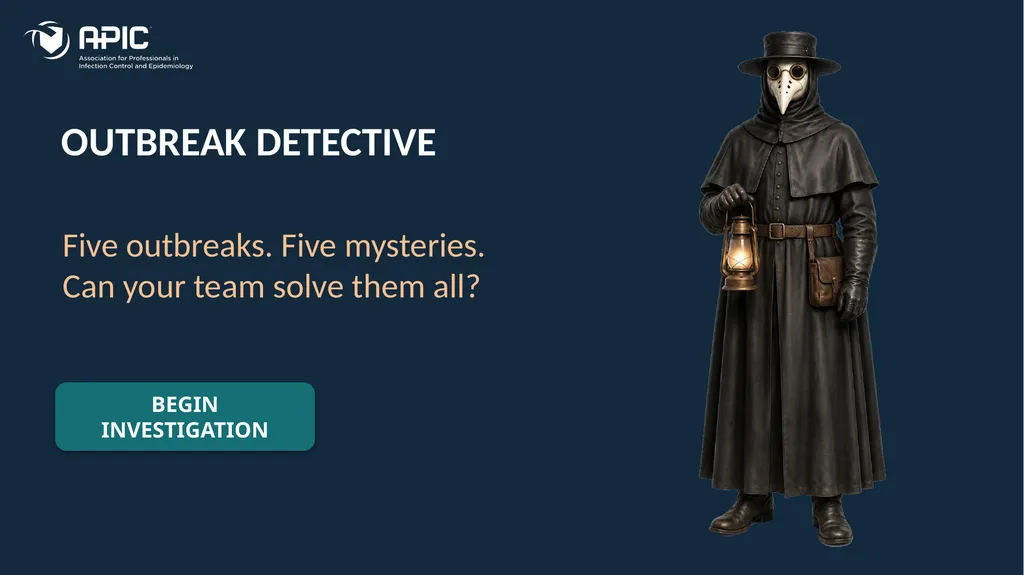
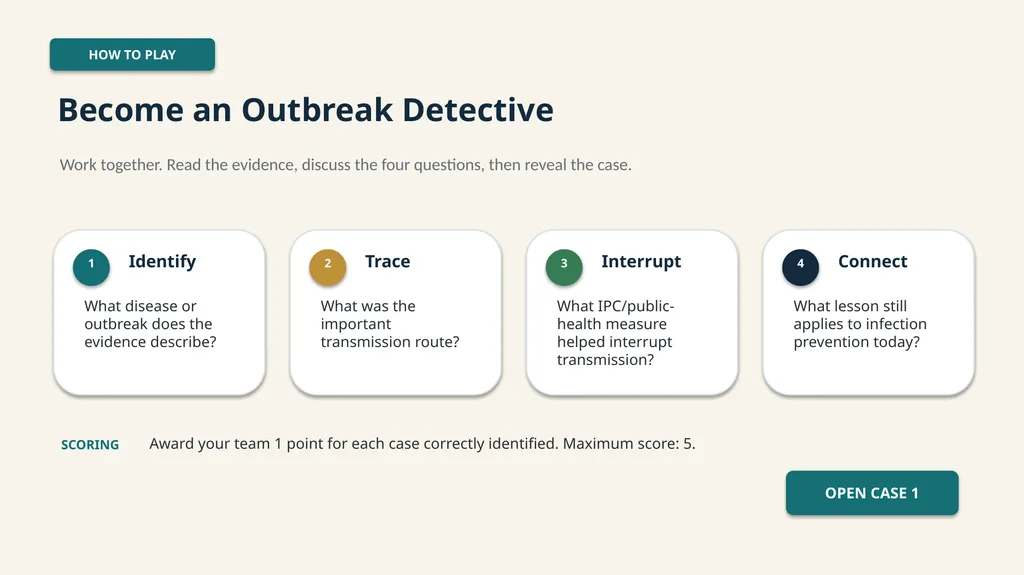
OUTBREAK DETECTIVE Five outbreaks. Five mysteries. Can your team solve them all? Plague Cholera BEGIN INVESTIGATION HOW TO PLAY Become an Outbreak Detective Work together. Read the evidence, discuss the four questions, then reveal the case.
"OUTBREAK DETECTIVE Five outbreaks. Five mysteries." is the property of its rightful owner. Permission is granted to
download and print the materials on this website for personal, non-commercial use only, and to display it
on your personal computer provided you do not modify the materials and that you retain all copyright
notices contained in the materials. By downloading content from our website, you accept the terms of this
agreement.
Presentation Transcript
01
OUTBREAK DETECTIVE Five outbreaks. Five mysteries. Can your team solve them all? Plague Cholera BEGIN INVESTIGATION<br>
02
HOW TO PLAY Become an Outbreak Detective Work together. Read the evidence, discuss the four questions, then reveal the case. 1 Identify What disease or outbreak does the evidence describe? 2 Trace What was the important transmission route? 3 Interrupt What IPC/public-health measure helped interrupt transmission? 4 Connect What lesson still applies to infection prevention today? SCORING Award your team 1 point for each case correctly identified. Maximum score: 5. OPEN CASE 1<br>
03
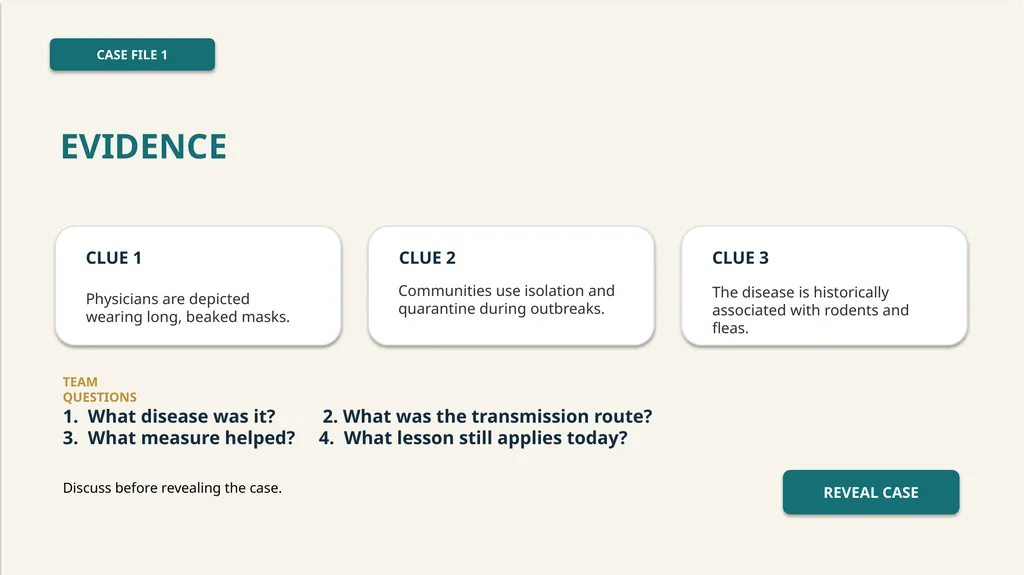
CASE FILE 1 EVIDENCE CLUE 1 Physicians are depicted wearing long, beaked masks. CLUE 2 Communities use isolation and quarantine during outbreaks. CLUE 3 The disease is historically associated with rodents and fleas. TEAM QUESTIONS 1. What disease was it? 2. What was the transmission route? 3. What measure helped? 4. What lesson still applies today? Discuss before revealing the case. REVEAL CASE<br>
04
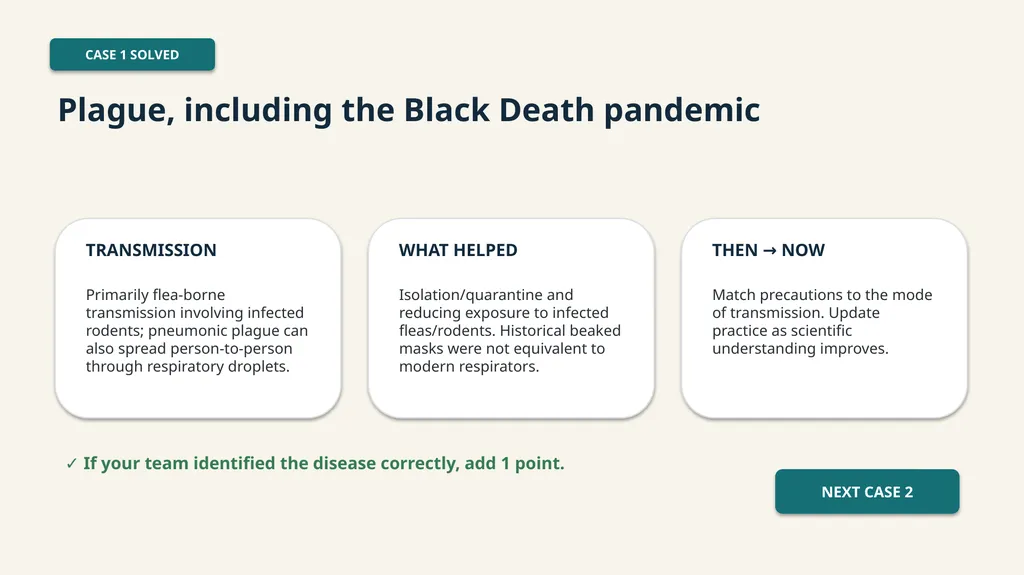
CASE 1 SOLVED Plague, including the Black Death pandemic TRANSMISSION Primarily flea-borne transmission involving infected rodents; pneumonic plague can also spread person-to-person through respiratory droplets. WHAT HELPED Isolation/quarantine and reducing exposure to infected fleas/rodents. Historical beaked masks were not equivalent to modern respirators. THEN → NOW Match precautions to the mode of transmission. Update practice as scientific understanding improves. ✓ If your team identified the disease correctly, add 1 point. NEXT CASE 2<br>
05
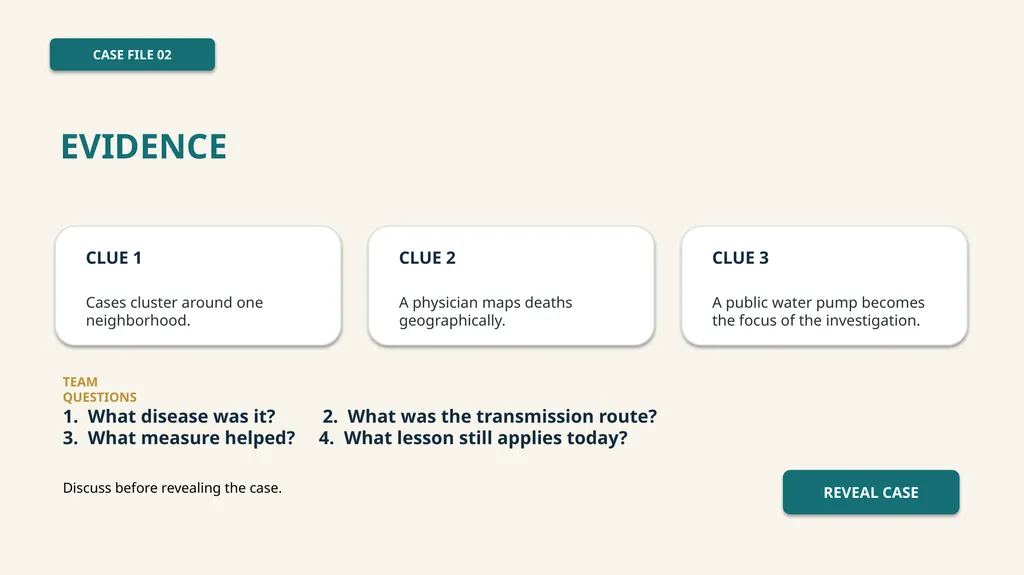
CASE FILE 02 CLUE 1 Cases cluster around one neighborhood. CLUE 2 A physician maps deaths geographically. CLUE 3 A public water pump becomes the focus of the investigation. TEAM QUESTIONS 1. What disease was it? 2. What was the transmission route? 3. What measure helped? 4. What lesson still applies today? Discuss before revealing the case. REVEAL CASE EVIDENCE<br>
06
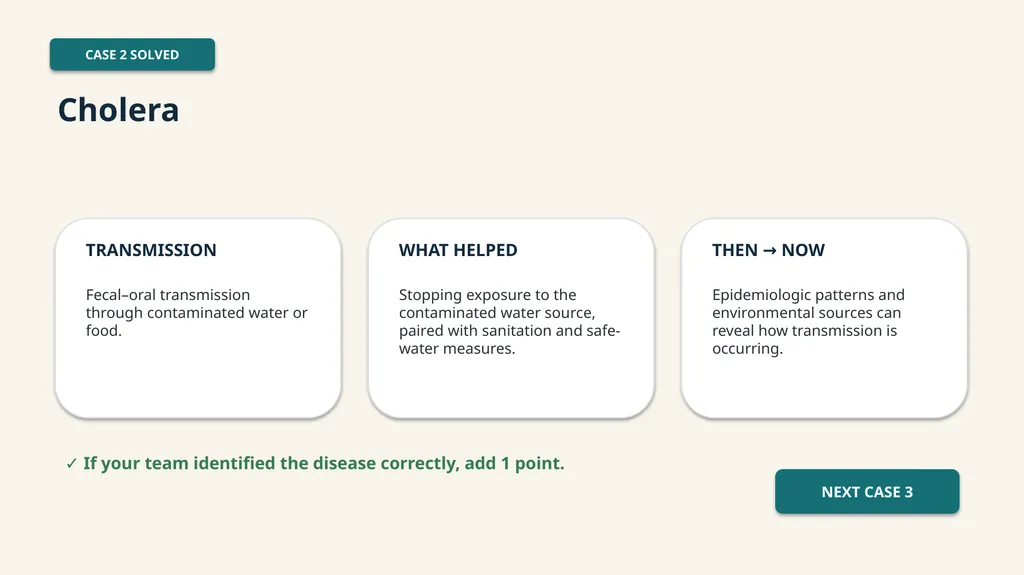
CASE 2 SOLVED Cholera TRANSMISSION Fecal–oral transmission through contaminated water or food. WHAT HELPED Stopping exposure to the contaminated water source, paired with sanitation and safe-water measures. THEN → NOW Epidemiologic patterns and environmental sources can reveal how transmission is occurring. ✓ If your team identified the disease correctly, add 1 point. NEXT CASE 3<br>
07
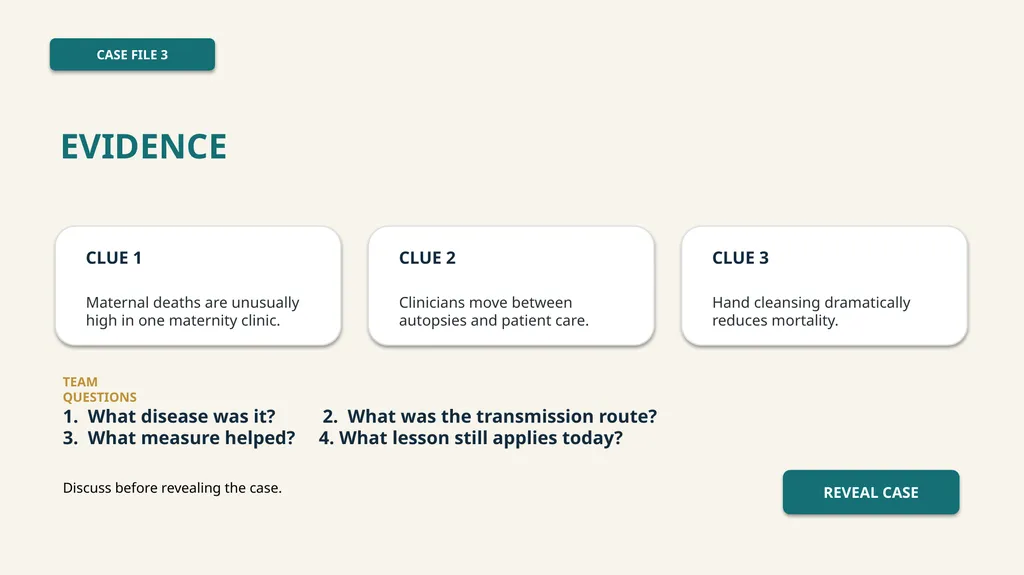
CASE FILE 3 CLUE 1 Maternal deaths are unusually high in one maternity clinic. CLUE 2 Clinicians move between autopsies and patient care. CLUE 3 Hand cleansing dramatically reduces mortality. TEAM QUESTIONS 1. What disease was it? 2. What was the transmission route? 3. What measure helped? 4. What lesson still applies today? Discuss before revealing the case. REVEAL CASE EVIDENCE<br>
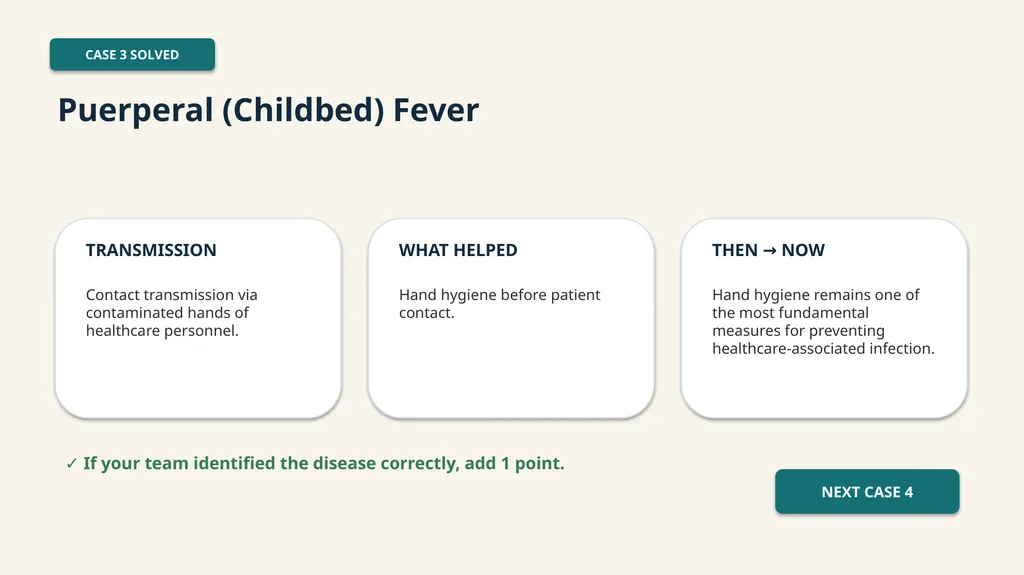
08
CASE 3 SOLVED Puerperal (Childbed) Fever TRANSMISSION Contact transmission via contaminated hands of healthcare personnel. WHAT HELPED Hand hygiene before patient contact. THEN → NOW Hand hygiene remains one of the most fundamental measures for preventing healthcare-associated infection. ✓ If your team identified the disease correctly, add 1 point. NEXT CASE 4<br>
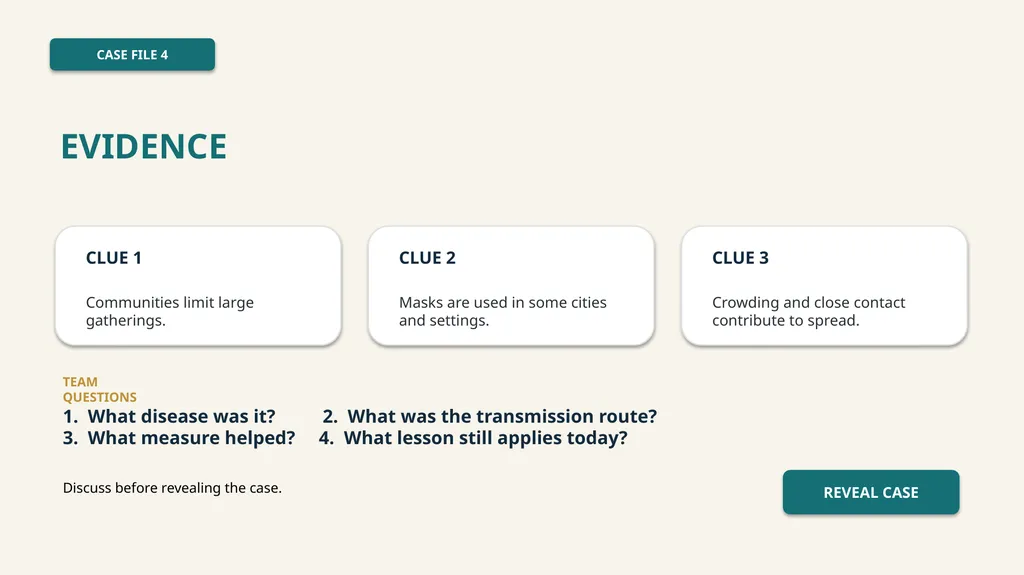
09
CASE FILE 4 CLUE 1 Communities limit large gatherings. CLUE 2 Masks are used in some cities and settings. CLUE 3 Crowding and close contact contribute to spread. TEAM QUESTIONS 1. What disease was it? 2. What was the transmission route? 3. What measure helped? 4. What lesson still applies today? Discuss before revealing the case. REVEAL CASE EVIDENCE<br>
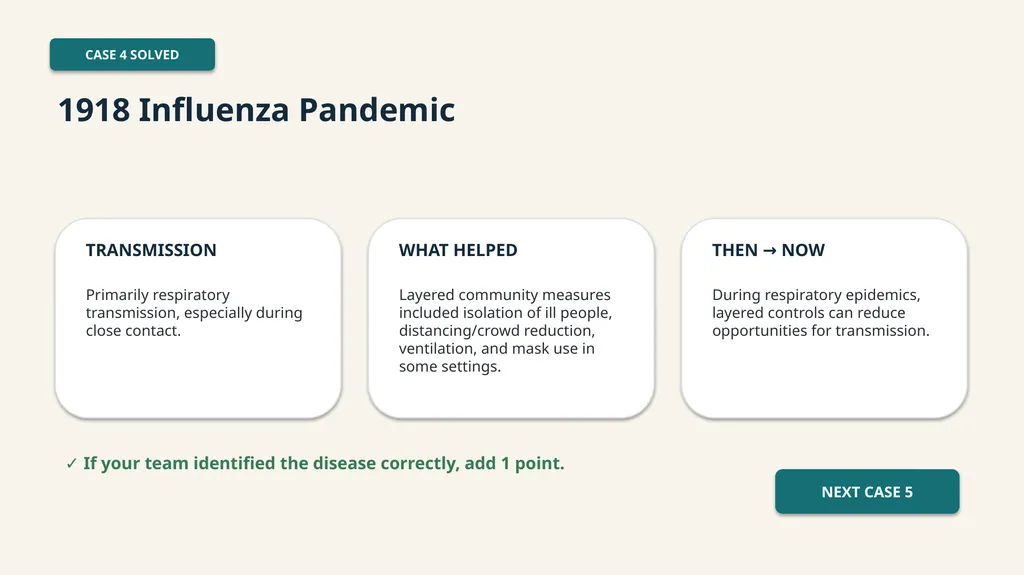
10
CASE 4 SOLVED 1918 Influenza Pandemic TRANSMISSION Primarily respiratory transmission, especially during close contact. WHAT HELPED Layered community measures included isolation of ill people, distancing/crowd reduction, ventilation, and mask use in some settings. THEN → NOW During respiratory epidemics, layered controls can reduce opportunities for transmission. ✓ If your team identified the disease correctly, add 1 point. NEXT CASE 5<br>
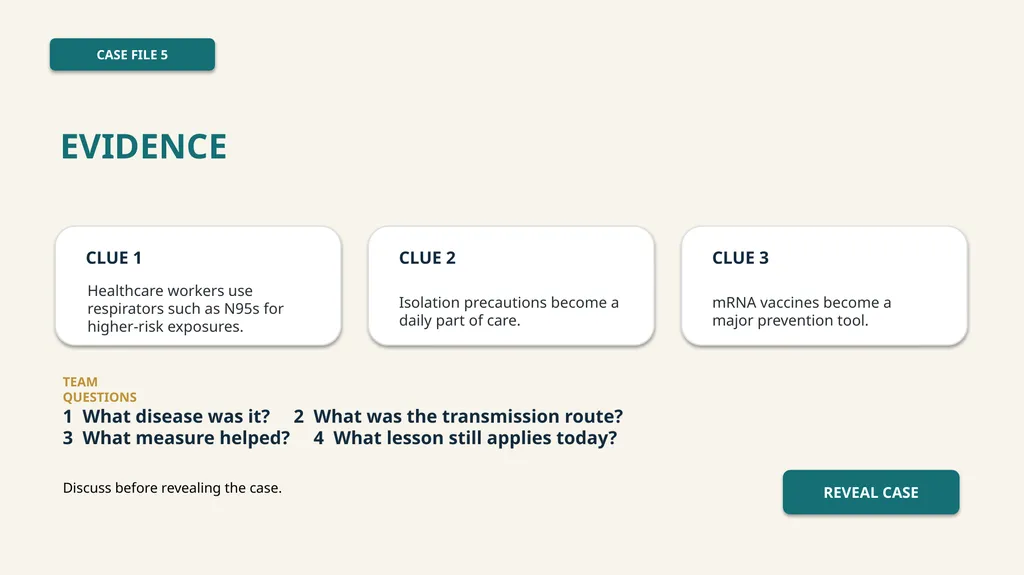
11
CASE FILE 5 CLUE 1 Healthcare workers use respirators such as N95s for higher-risk exposures. CLUE 2 Isolation precautions become a daily part of care. CLUE 3 mRNA vaccines become a major prevention tool. TEAM QUESTIONS 1 What disease was it? 2 What was the transmission route? 3 What measure helped? 4 What lesson still applies today? Discuss before revealing the case. REVEAL CASE EVIDENCE<br>
12
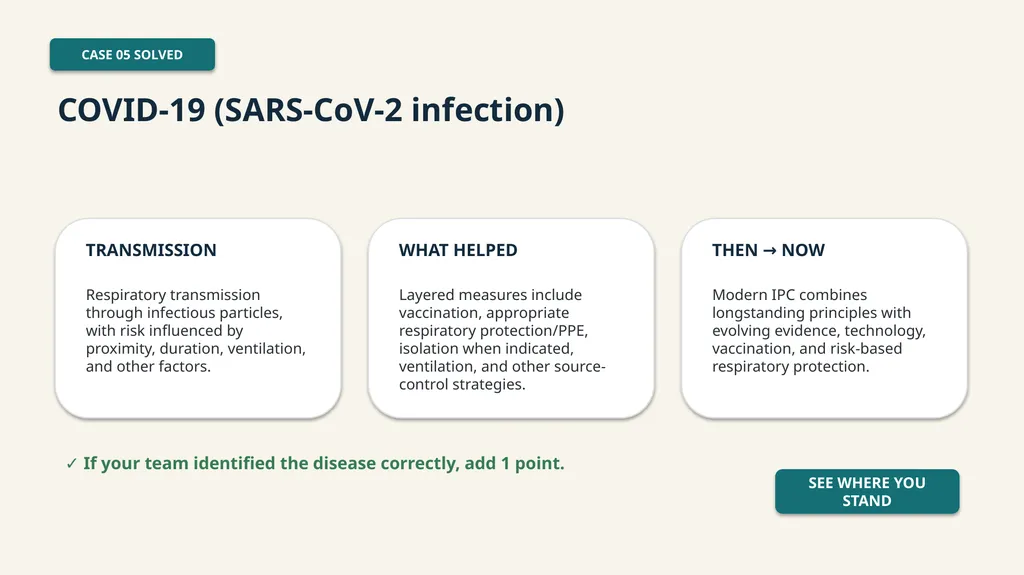
CASE 05 SOLVED COVID-19 (SARS-CoV-2 infection) TRANSMISSION Respiratory transmission through infectious particles, with risk influenced by proximity, duration, ventilation, and other factors. WHAT HELPED Layered measures include vaccination, appropriate respiratory protection/PPE, isolation when indicated, ventilation, and other source-control strategies. THEN → NOW Modern IPC combines longstanding principles with evolving evidence, technology, vaccination, and risk-based respiratory protection. ✓ If your team identified the disease correctly, add 1 point. SEE WHERE YOU STAND<br>
13
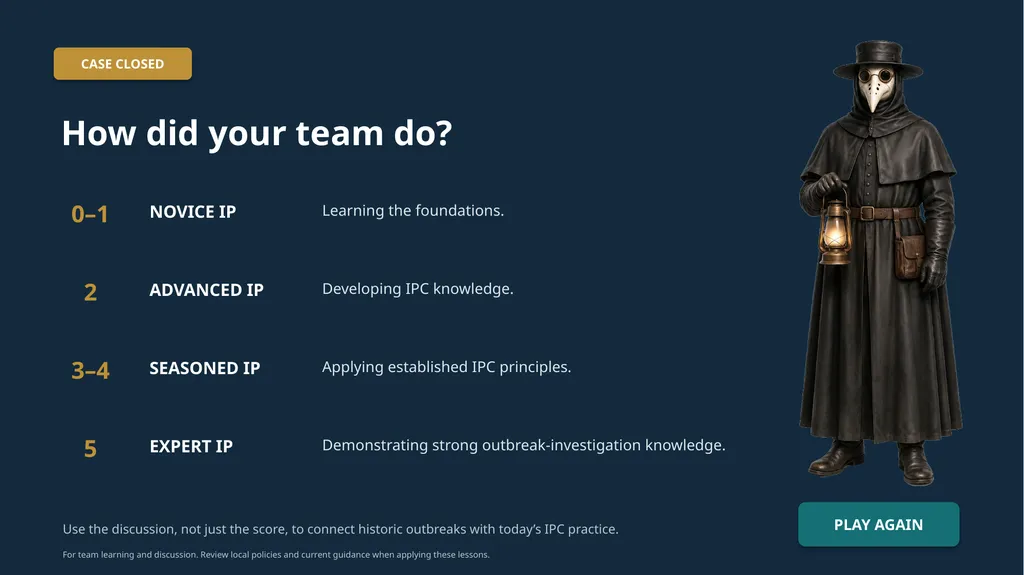
CASE CLOSED How did your team do? 0–1 NOVICE IP Learning the foundations. 2 ADVANCED IP Developing IPC knowledge. 3–4 SEASONED IP Applying established IPC principles. 5 EXPERT IP Demonstrating strong outbreak-investigation knowledge. Use the discussion, not just the score, to connect historic outbreaks with today’s IPC practice. PLAY AGAIN For team learning and discussion. Review local policies and current guidance when applying these lessons.<br>