
Outbreak Management including Quarantine,
TF
Published · 28 slides · 0 views
1 / 1
Description
Outbreak Management including Quarantine, Isolation, Contact Tracing Pandemic Module 3.1 Dr. Swati Khan Community Medicine Competency addressed The student should be able to: Level (SH) Demonstrate the ability to conduct various
Related Topics
Share
Embed code
Download this presentation From Below
"Outbreak Management including Quarantine," is the property of its rightful owner. Permission is granted to download and print the materials on this website for personal, non-commercial use only, and to display it on your personal computer provided you do not modify the materials and that you retain all copyright notices contained in the materials. By downloading content from our website, you accept the terms of this agreement.
Presentation Transcript
01
Outbreak Management including Quarantine, Isolation, Contact Tracing
Pandemic Module 3.1 Dr. Swati Khan
Community Medicine<br>
Community Medicine<br>
02
Competency addressed The student should be able to: Level (SH)
Demonstrate the ability to conduct various epidemiological investigation related to pandemics - Level ( or in a simulated environment)<br>
Demonstrate the ability to conduct various epidemiological investigation related to pandemics - Level ( or in a simulated environment)<br>
03
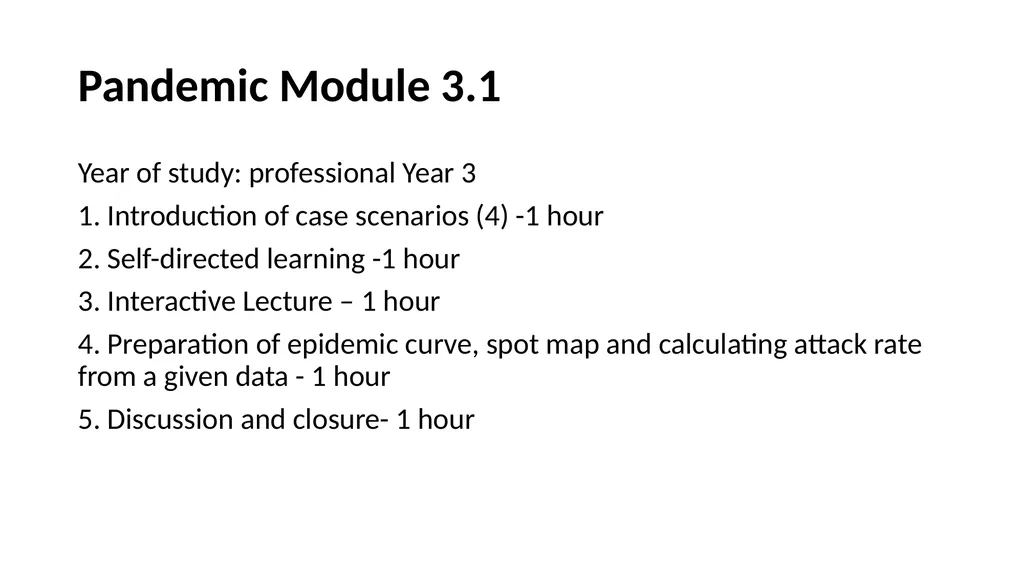
Pandemic Module 3.1 Year of study: professional Year 3
1. Introduction of case scenarios (4) -1 hour
2. Self-directed learning -1 hour
3. Interactive Lecture – 1 hour
4. Preparation of epidemic curve, spot map and calculating attack rate from a given data - 1 hour
5. Discussion and closure- 1 hour<br>
1. Introduction of case scenarios (4) -1 hour
2. Self-directed learning -1 hour
3. Interactive Lecture – 1 hour
4. Preparation of epidemic curve, spot map and calculating attack rate from a given data - 1 hour
5. Discussion and closure- 1 hour<br>
04
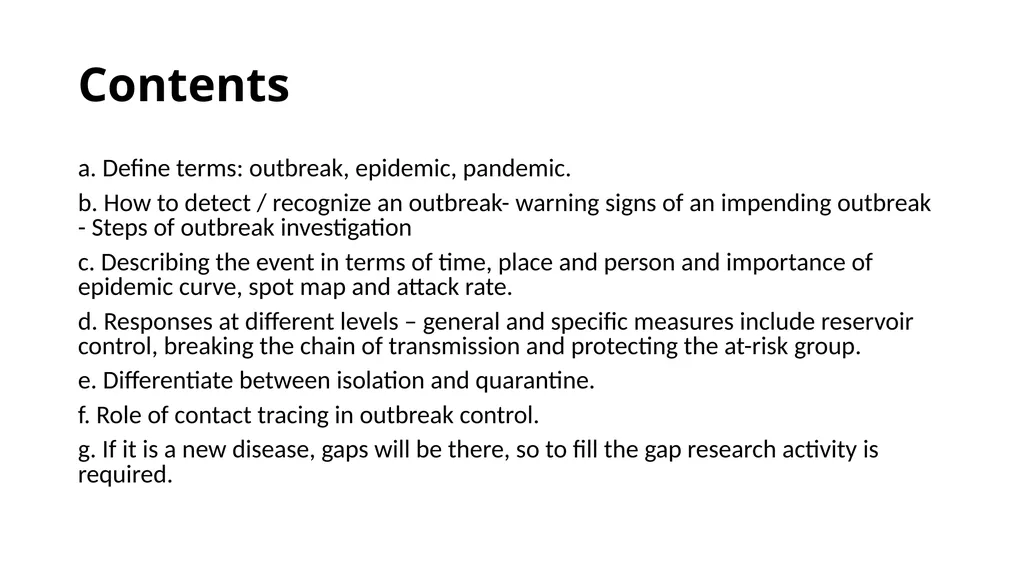
Contents a. Define terms: outbreak, epidemic, pandemic.
b. How to detect / recognize an outbreak- warning signs of an impending outbreak - Steps of outbreak investigation
c. Describing the event in terms of time, place and person and importance of epidemic curve, spot map and attack rate.
d. Responses at different levels – general and specific measures include reservoir control, breaking the chain of transmission and protecting the at-risk group.
e. Differentiate between isolation and quarantine.
f. Role of contact tracing in outbreak control.
g. If it is a new disease, gaps will be there, so to fill the gap research activity is required.<br>
b. How to detect / recognize an outbreak- warning signs of an impending outbreak - Steps of outbreak investigation
c. Describing the event in terms of time, place and person and importance of epidemic curve, spot map and attack rate.
d. Responses at different levels – general and specific measures include reservoir control, breaking the chain of transmission and protecting the at-risk group.
e. Differentiate between isolation and quarantine.
f. Role of contact tracing in outbreak control.
g. If it is a new disease, gaps will be there, so to fill the gap research activity is required.<br>
05
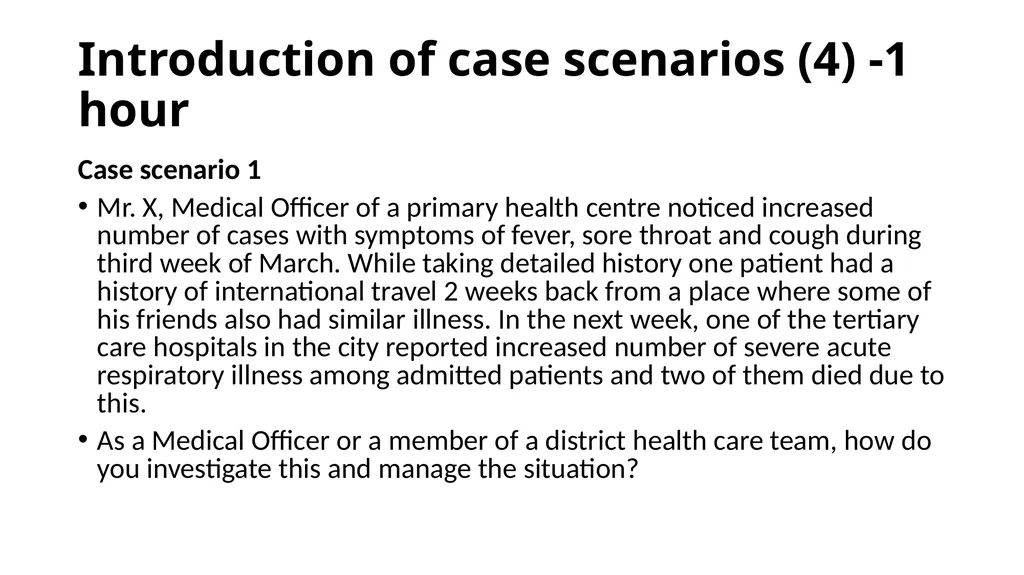
Introduction of case scenarios (4) -1 hour Case scenario 1
Mr. X, Medical Officer of a primary health centre noticed increased number of cases with symptoms of fever, sore throat and cough during third week of March. While taking detailed history one patient had a history of international travel 2 weeks back from a place where some of his friends also had similar illness. In the next week, one of the tertiary care hospitals in the city reported increased number of severe acute respiratory illness among admitted patients and two of them died due to this.
As a Medical Officer or a member of a district health care team, how do you investigate this and manage the situation?<br>
Mr. X, Medical Officer of a primary health centre noticed increased number of cases with symptoms of fever, sore throat and cough during third week of March. While taking detailed history one patient had a history of international travel 2 weeks back from a place where some of his friends also had similar illness. In the next week, one of the tertiary care hospitals in the city reported increased number of severe acute respiratory illness among admitted patients and two of them died due to this.
As a Medical Officer or a member of a district health care team, how do you investigate this and manage the situation?<br>
06
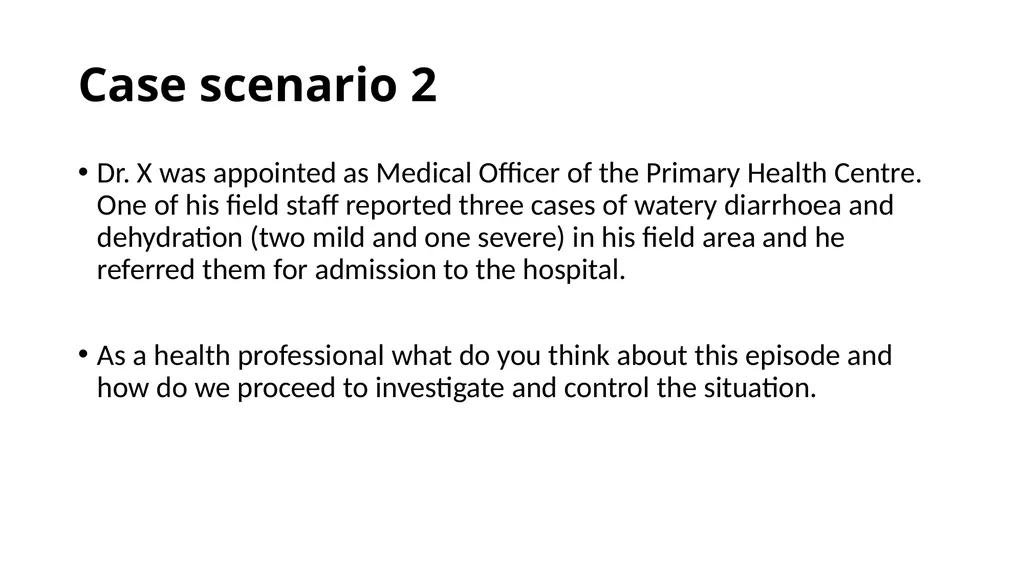
Case scenario 2 Dr. X was appointed as Medical Officer of the Primary Health Centre. One of his field staff reported three cases of watery diarrhoea and dehydration (two mild and one severe) in his field area and he referred them for admission to the hospital.
As a health professional what do you think about this episode and how do we proceed to investigate and control the situation.<br>
As a health professional what do you think about this episode and how do we proceed to investigate and control the situation.<br>
07
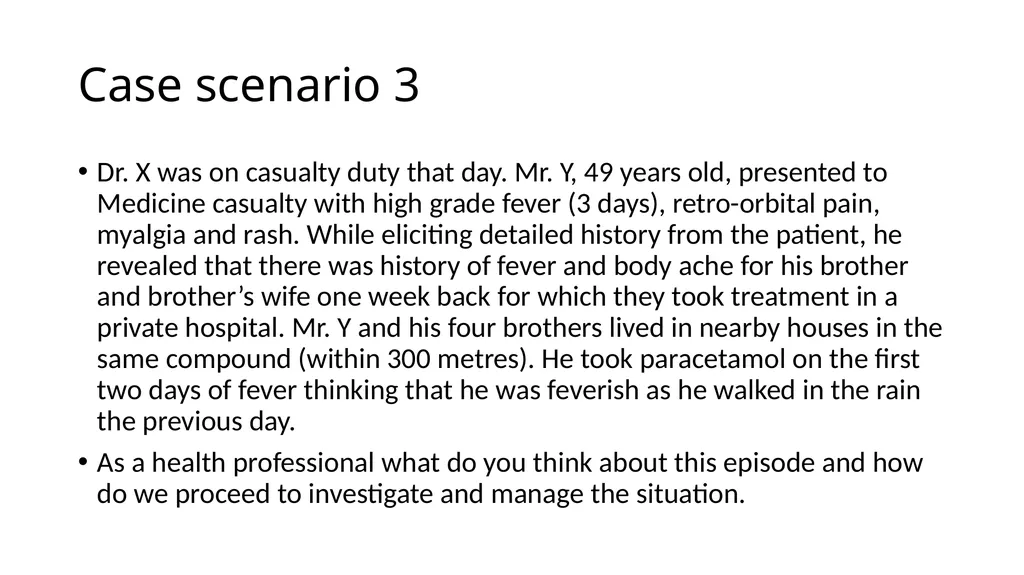
Case scenario 3 Dr. X was on casualty duty that day. Mr. Y, 49 years old, presented to Medicine casualty with high grade fever (3 days), retro-orbital pain, myalgia and rash. While eliciting detailed history from the patient, he revealed that there was history of fever and body ache for his brother and brother’s wife one week back for which they took treatment in a private hospital. Mr. Y and his four brothers lived in nearby houses in the same compound (within 300 metres). He took paracetamol on the first two days of fever thinking that he was feverish as he walked in the rain the previous day.
As a health professional what do you think about this episode and how do we proceed to investigate and manage the situation.<br>
As a health professional what do you think about this episode and how do we proceed to investigate and manage the situation.<br>
08
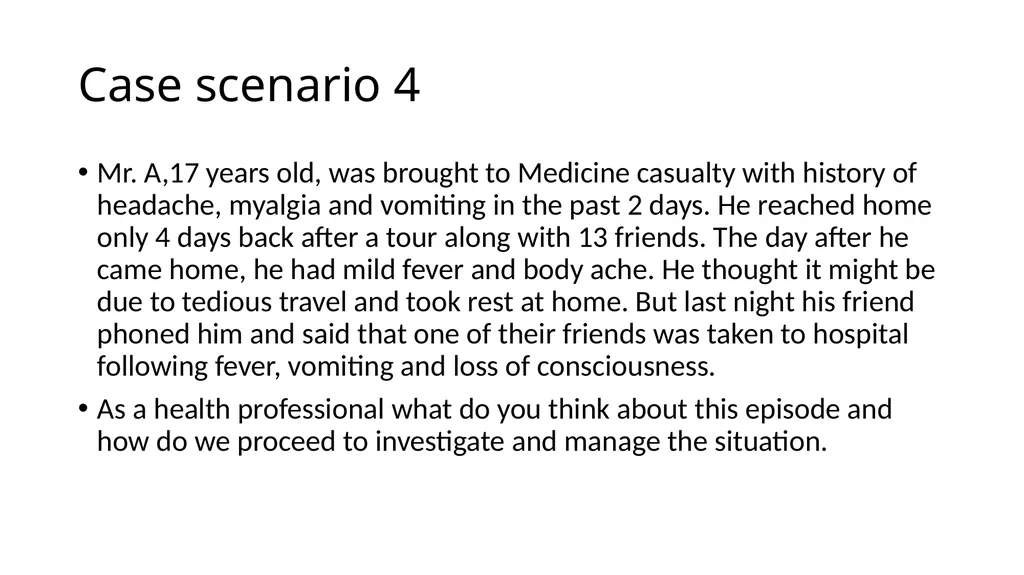
Case scenario 4 Mr. A,17 years old, was brought to Medicine casualty with history of headache, myalgia and vomiting in the past 2 days. He reached home only 4 days back after a tour along with 13 friends. The day after he came home, he had mild fever and body ache. He thought it might be due to tedious travel and took rest at home. But last night his friend phoned him and said that one of their friends was taken to hospital following fever, vomiting and loss of consciousness.
As a health professional what do you think about this episode and how do we proceed to investigate and manage the situation.<br>
As a health professional what do you think about this episode and how do we proceed to investigate and manage the situation.<br>
09
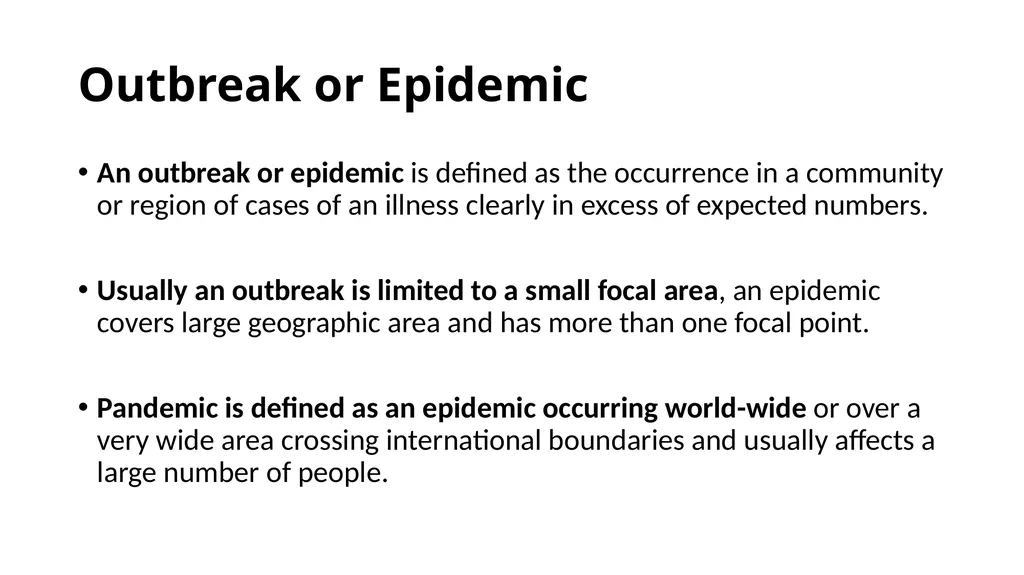
Outbreak or Epidemic An outbreak or epidemic is defined as the occurrence in a community or region of cases of an illness clearly in excess of expected numbers.
Usually an outbreak is limited to a small focal area, an epidemic covers large geographic area and has more than one focal point.
Pandemic is defined as an epidemic occurring world-wide or over a very wide area crossing international boundaries and usually affects a large number of people.<br>
Usually an outbreak is limited to a small focal area, an epidemic covers large geographic area and has more than one focal point.
Pandemic is defined as an epidemic occurring world-wide or over a very wide area crossing international boundaries and usually affects a large number of people.<br>
10
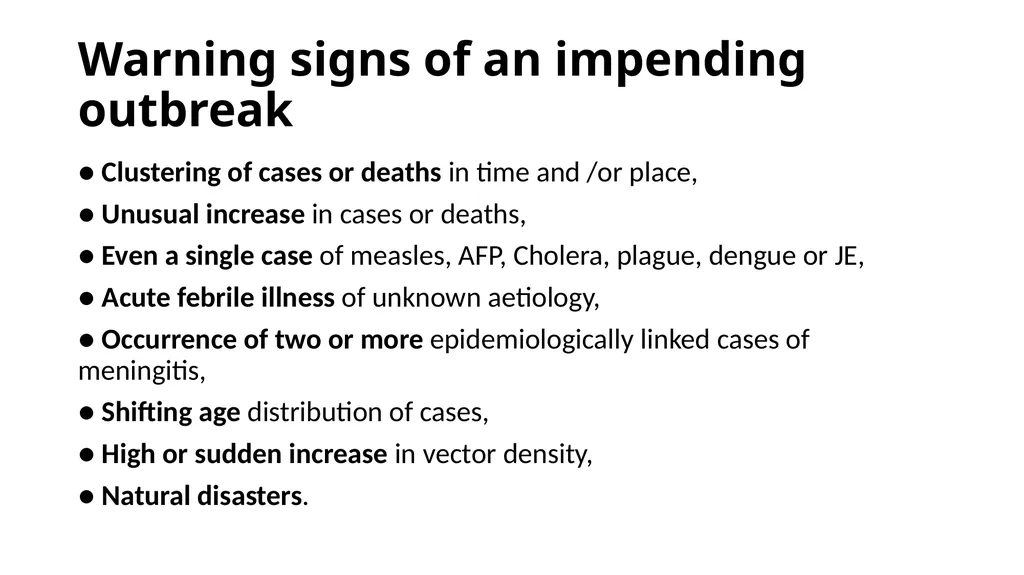
Warning signs of an impending outbreak ● Clustering of cases or deaths in time and /or place,
● Unusual increase in cases or deaths,
● Even a single case of measles, AFP, Cholera, plague, dengue or JE,
● Acute febrile illness of unknown aetiology,
● Occurrence of two or more epidemiologically linked cases of meningitis,
● Shifting age distribution of cases,
● High or sudden increase in vector density,
● Natural disasters.<br>
● Unusual increase in cases or deaths,
● Even a single case of measles, AFP, Cholera, plague, dengue or JE,
● Acute febrile illness of unknown aetiology,
● Occurrence of two or more epidemiologically linked cases of meningitis,
● Shifting age distribution of cases,
● High or sudden increase in vector density,
● Natural disasters.<br>
11
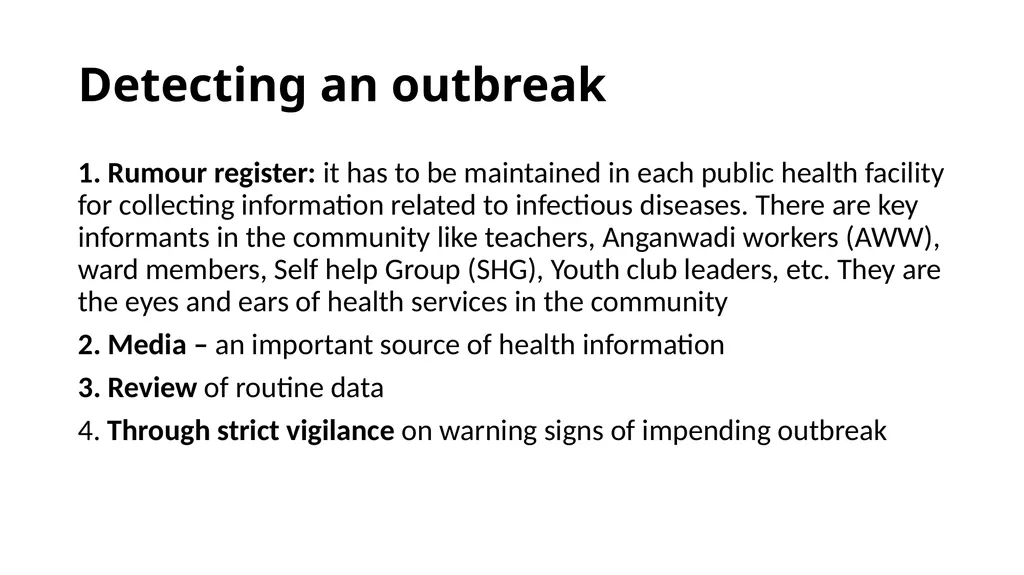
Detecting an outbreak 1. Rumour register: it has to be maintained in each public health facility for collecting information related to infectious diseases. There are key informants in the community like teachers, Anganwadi workers (AWW), ward members, Self help Group (SHG), Youth club leaders, etc. They are the eyes and ears of health services in the community
2. Media – an important source of health information
3. Review of routine data
4. Through strict vigilance on warning signs of impending outbreak<br>
2. Media – an important source of health information
3. Review of routine data
4. Through strict vigilance on warning signs of impending outbreak<br>
12
Steps of outbreak investigation: Verification of the diagnosis:
The first and foremost step in outbreak investigation would be to verify the diagnosis.
A clinical examination along with laboratory investigations of a sample of cases may be sufficient for this, but the epidemiological investigation should not be delayed until laboratory results are available.<br>
The first and foremost step in outbreak investigation would be to verify the diagnosis.
A clinical examination along with laboratory investigations of a sample of cases may be sufficient for this, but the epidemiological investigation should not be delayed until laboratory results are available.<br>
13
Confirmation of existence of an outbreak: For this, Medical Officer should check
● If there is an abnormal increase in the number of cases, or
● See there is clustering of cases, or
● If the cases are epidemiologically linked, or
● If some trigger events have occurred, or
● If many deaths have occurred.<br>
● If there is an abnormal increase in the number of cases, or
● See there is clustering of cases, or
● If the cases are epidemiologically linked, or
● If some trigger events have occurred, or
● If many deaths have occurred.<br>
14
The Rapid Response Team (RRT) An arbitrary limit of two standard errors from the endemic occurrence is used to define epidemic threshold for common diseases like influenza.
If there is evidence of an outbreak, and if the aetiology, source and route of transmission are known, specific control measures need to be initiated immediately.
If anyone of the above is unknown, the outbreak must be investigated to identify the specific cause.
The Rapid Response Team (RRT) which was formed during the phase of epidemic preparedness should be alerted and requested to further investigate the outbreak. At the same time general control measures should be started.<br>
If there is evidence of an outbreak, and if the aetiology, source and route of transmission are known, specific control measures need to be initiated immediately.
If anyone of the above is unknown, the outbreak must be investigated to identify the specific cause.
The Rapid Response Team (RRT) which was formed during the phase of epidemic preparedness should be alerted and requested to further investigate the outbreak. At the same time general control measures should be started.<br>
15
Defining population at risk Defining population at risk: before starting investigation, it is necessary to have the attack rates.<br>
16
Rapid search area map Rapid search area map and age gender distribution of entire population in the area.
This is essential for calculating for all cases and their characteristics: this is to identify all cases including those who have not sought medical care and those possibly exposed to the risk.<br>
This is essential for calculating for all cases and their characteristics: this is to identify all cases including those who have not sought medical care and those possibly exposed to the risk.<br>
17
Epidemiological case sheet. For this, we can use a carefully designed epidemiological case sheet. The information collected should be relevant to the disease under study.
Based on the information collected from the affected ones, search for more cases and their contacts should be continued. Laboratory investigations are done with the help of microbiologist.
Microbiologist may advise on what samples are required, mode of collection and transport and also the laboratory to which these are to be sent. Entomological investigation should also be done if the outbreak warrants it.<br>
Based on the information collected from the affected ones, search for more cases and their contacts should be continued. Laboratory investigations are done with the help of microbiologist.
Microbiologist may advise on what samples are required, mode of collection and transport and also the laboratory to which these are to be sent. Entomological investigation should also be done if the outbreak warrants it.<br>
18
Data Analysis Data Analysis:
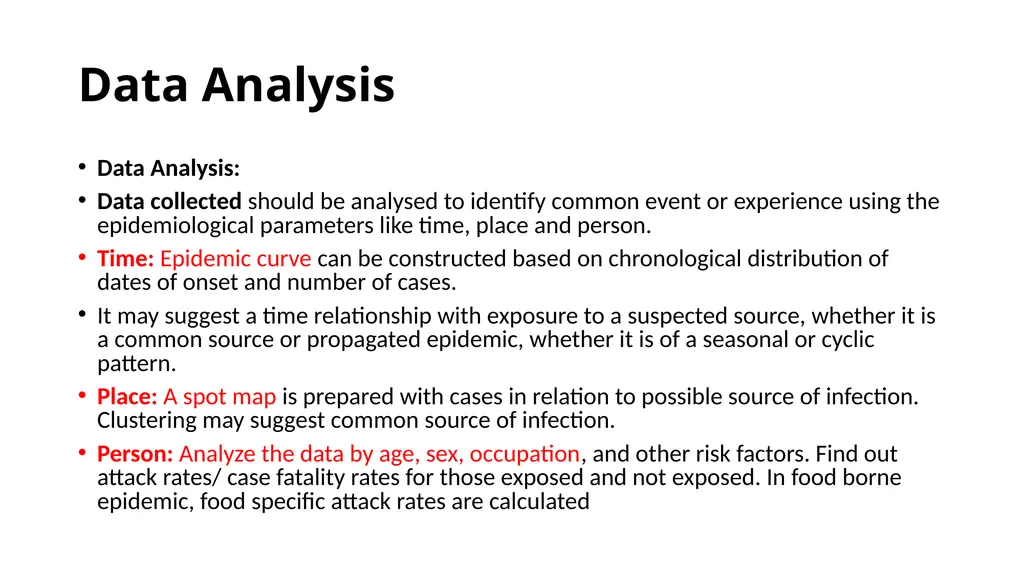
Data collected should be analysed to identify common event or experience using the epidemiological parameters like time, place and person.
Time: Epidemic curve can be constructed based on chronological distribution of dates of onset and number of cases.
It may suggest a time relationship with exposure to a suspected source, whether it is a common source or propagated epidemic, whether it is of a seasonal or cyclic pattern.
Place: A spot map is prepared with cases in relation to possible source of infection. Clustering may suggest common source of infection.
Person: Analyze the data by age, sex, occupation, and other risk factors. Find out attack rates/ case fatality rates for those exposed and not exposed. In food borne epidemic, food specific attack rates are calculated<br>
Data collected should be analysed to identify common event or experience using the epidemiological parameters like time, place and person.
Time: Epidemic curve can be constructed based on chronological distribution of dates of onset and number of cases.
It may suggest a time relationship with exposure to a suspected source, whether it is a common source or propagated epidemic, whether it is of a seasonal or cyclic pattern.
Place: A spot map is prepared with cases in relation to possible source of infection. Clustering may suggest common source of infection.
Person: Analyze the data by age, sex, occupation, and other risk factors. Find out attack rates/ case fatality rates for those exposed and not exposed. In food borne epidemic, food specific attack rates are calculated<br>
19
Formulation of hypothesis: Formulation of hypothesis: on the basis of time, place and person analysis, hypothesis is formulated to explain the epidemic in terms of possible source, causative agent, possible modes of spread, people at risk and the environmental factors<br>
20
Testing the hypothesis: Testing the hypothesis: If the hypothesis fits with the facts, response measures can be initiated; otherwise, further analytical investigation in terms of case control studies will need to be carried out. In the meantime, general control measures are carried out.<br>
21
Evaluation of ecologic factors: Evaluation of ecologic factors:
This is to prevent further transmission of disease.
Ecologic factors include sanitary status of eating establishments, water and milk supply, break down in water supply, population movements, atmospheric changes, population dynamics of insects and animal reservoirs.<br>
This is to prevent further transmission of disease.
Ecologic factors include sanitary status of eating establishments, water and milk supply, break down in water supply, population movements, atmospheric changes, population dynamics of insects and animal reservoirs.<br>
22
Further investigation of population at risk: Further investigation of population at risk: To obtain additional information, for e.g. serological study may reveal clinically in-apparent cases and throw light on the pathogenesis of the condition.<br>
23
Writing the report: Writing the report: This can be an interim report which includes details of the investigation, the diagnosis and control measures initiated. Once the outbreak is coming under control, we should make follow up visits to see whether control measures are implemented adequately and also help to collect new information which was missed in the previous visits. The final report is given within 10 days of the outbreak being declared to be over. The outbreak is declared over when there are no new cases for a period of two incubation period since the onset of last case.<br>
24
Responses to an outbreak Responses to an outbreak
1. General measures is till the specific source and route of transmission is identified.
For example, if one is suspecting a droplet infection outbreak, start a campaign requesting people to follow social distancing, use of mask and hand hygiene.<br>
1. General measures is till the specific source and route of transmission is identified.
For example, if one is suspecting a droplet infection outbreak, start a campaign requesting people to follow social distancing, use of mask and hand hygiene.<br>
25
Specific measures Specific measures depend on the causative agent.
The broad steps are:
● Identification and nullification of the source of outbreak like chlorinating wells,
● Minimizing transmission to prevent further exposure: vector control,
● Protection of the host- immunization / chemoprophylaxis,
● Controlling the reservoir include early diagnosis, notification, isolation, treatment, quarantine<br>
The broad steps are:
● Identification and nullification of the source of outbreak like chlorinating wells,
● Minimizing transmission to prevent further exposure: vector control,
● Protection of the host- immunization / chemoprophylaxis,
● Controlling the reservoir include early diagnosis, notification, isolation, treatment, quarantine<br>
26
Isolation: Isolation:
Separation of infected persons or animals for the period of communicability from others in such places and conditions as to prevent or limit the direct or indirect transmission of infectious agent from those infected to those who are susceptible.
Purpose is to protect the community by preventing transfer of infection from the reservoir to the possible susceptible host.<br>
Separation of infected persons or animals for the period of communicability from others in such places and conditions as to prevent or limit the direct or indirect transmission of infectious agent from those infected to those who are susceptible.
Purpose is to protect the community by preventing transfer of infection from the reservoir to the possible susceptible host.<br>
27
Quarantine: Quarantine:
Limitation of freedom of movement of healthy person or domestic animals exposed to communicable disease for a period not longer than the longest usual incubation period of the disease to prevent contact with those not so exposed.<br>
Limitation of freedom of movement of healthy person or domestic animals exposed to communicable disease for a period not longer than the longest usual incubation period of the disease to prevent contact with those not so exposed.<br>
28
Contact tracing: Contact tracing:
The process of identifying, assessing and managing people who have been exposed to a disease to prevent onward transmission. When systematically applied, this will break the chain of transmission of an infectious disease and is an effective tool in public health. This has to be explained according to the scenario provided.<br>
The process of identifying, assessing and managing people who have been exposed to a disease to prevent onward transmission. When systematically applied, this will break the chain of transmission of an infectious disease and is an effective tool in public health. This has to be explained according to the scenario provided.<br>