Pathophysiology Dr.Wasfi Dhahir Abid Ali Department of medical sciences College of Nursing University of Basrah INFLAMMATION Inflammation is a immune system response to stimulus. This can be bacteria colonizing a wound or a splinter
"Pathophysiology Dr.Wasfi Dhahir Abid Ali" is the property of its rightful owner. Permission is granted to
download and print the materials on this website for personal, non-commercial use only, and to display it
on your personal computer provided you do not modify the materials and that you retain all copyright
notices contained in the materials. By downloading content from our website, you accept the terms of this
agreement.
Presentation Transcript
01
Pathophysiology
Dr.Wasfi Dhahir Abid Ali
Department of medical sciences –College of Nursing –
University of Basrah<br>
02
INFLAMMATION<br>
03
Inflammation is a immune system 'response to stimulus. This can be bacteria colonizing a wound or a splinter piercing your finger, for example. Inflammation happens when the immune system fights against something that may turn out to be harmful.
And also inflammation define as apart of the complex biological and a protective response of body tissues to harmful stimuli, such as pathogens, damaged cells, or irritants. It involves immune cells, blood vessels, and molecular mediators. Inflammation<br>
04
Type of defenses First - Non-Specific defenses
Defenses Against Infection. Natural barriers and the immune system defend the body against organisms that can cause infection. Natural barriers include the skin, mucous membranes, tears, earwax, mucus, and stomach acid. Also, the normal flow of urine washes out microorganisms that enter the urinary tract.<br>
05
Second:Humoral Defense
This line of defense against infection specifically targets molecules called antigens B cells are primarily responsible for humoral immunity (relating to antibodies).The molecules responsible for humoral immunity to disease are called immunoglobulins, also known as antibodies,They are proteinaceous cell markers. humoral response mainly protects against extracellular pathogens and toxins
There are five major classes of immunoglobulins
1- Immunoglobulin G (IgG) accounting for over 80% of all of the circulating immunoglobulins.
2- Immunoglobulin A (IgA) composes about 15% of the circulating antibodies.
3- Immunoglobulin E (IgE) has a structure similar to that of IgG.
4- Immunoglobulin D (IgD) is also a single molecule, and is found in very small (0.2%) concentrations.
5- Immunoglobulin M (IgM) is the largest of the immunoglobulins, composing about 5% of the total quantity of circulating antibodies<br>
06
Third: Cell-Mediated Defense (CMI)
Several cell types are responsible for the cell-mediated immune response . CMI is responsible for detecting and destroying intracellular pathogens
1-Natural killer cells (N-K cells) They target and destroy host cells which have been invaded by viruses.
2- CytotoxicT cells have CD8 markers and kill any cell expressing foreign antigens.
3- T memory cells retain genetic information about specific antigens.
4-T helper and T suppressor cells regulate the activities of other specific immune cell types.<br>
07
1-Pain(Dolor) due to fluid pressure on nerve ends
2-Heat(Calor)
3-Redness(Ruber)due to increase blood flow
4-swelling(Edema) accumulation of protein and fluids in the interstitial space.
5-loss of function(lake of nutrition) local effects(inflammatory response)<br>
08
1-vascular stage: increases increase blood flow ,vessels permeability led to edema,
2-Cellular stage :immigration of leukocytes, cell release chemical mediators(bradykinin,histamine and prostoglandin
3-chemotaxic stage(distribution of chemotaxic factors (cytokinin)
4-phagositosis:phagositosis of debris by microphages
5- microbial killing :killing of bacteria by lysosome, complements,H2O2 Stages of inflammation<br>
09
Acute inflammation
Is a short-term process, usually appearing within a few minutes or hours and begins to cease upon the removal of the injurious stimulus. It is characterized by five cardinal signs include pain, redness, immobility (loss of function), swelling and heat Types of inflammation<br>
10
Chronic inflammation
If the injurious agent persists then chronic inflammation will ensue. This process, marked by inflammation lasting many days, months or even years, may lead to the formation of a chronic wound. Chronic inflammation is characterized by the dominating presence of macrophages in the injured tissue. These cells are powerful defensive agents of the body, but the toxins they release (including reactive oxygen species) are injurious to the organism's own tissues as well as invading agents. As a consequence, chronic inflammation is almost always accompanied by tissue destruction.<br>
11
Physical:
Burns ,Frostbite ,Physical injury, blunt or penetrating ,Foreign bodies, including splinters, dirt and debris Trauma ,Ionizing radiation
Biological:
Infection by pathogens ,Immune reactions due to hypersensitivity ,Stress
Chemical:
Chemical irritants. Toxins and alcohol
Psychological:
Embarrassment and Excitement Causes of inflammation<br>
12
Granulomatous inflammation: Characterized by the formation of granulomas, they are the result of a limited but diverse number of diseases, which include among others tuberculosis, leprosy, sarcoidosis, and syphilis.
Fibrinous inflammation: Inflammation resulting in a large increase in vascular permeability allows fibrin to pass through the blood vessels. tubes can be formed. Morphological type of inflammations<br>
13
Purulent inflammation: Inflammation resulting in large amount of pus, which consists of neutrophils, dead cells, and fluid. Infection by pyogenic bacteria such as staphylococci is characteristic of this kind of inflammation. Large, localized collections of pus enclosed by surrounding tissues are called abscesses.
Serous inflammation: Characterized by the copious effusion of non-viscous serous fluid, commonly produced by mesothelial cells of serous membranes, but may be derived from blood plasma. Skin blisters exemplify this pattern of inflammation.<br>
14
Ulcerative inflammation:
Inflammation occurring near an epithelium can result in the necrotic loss of tissue from the surface, exposing lower layers. The subsequent excavation in the epithelium is known as an ulcer.<br>
15
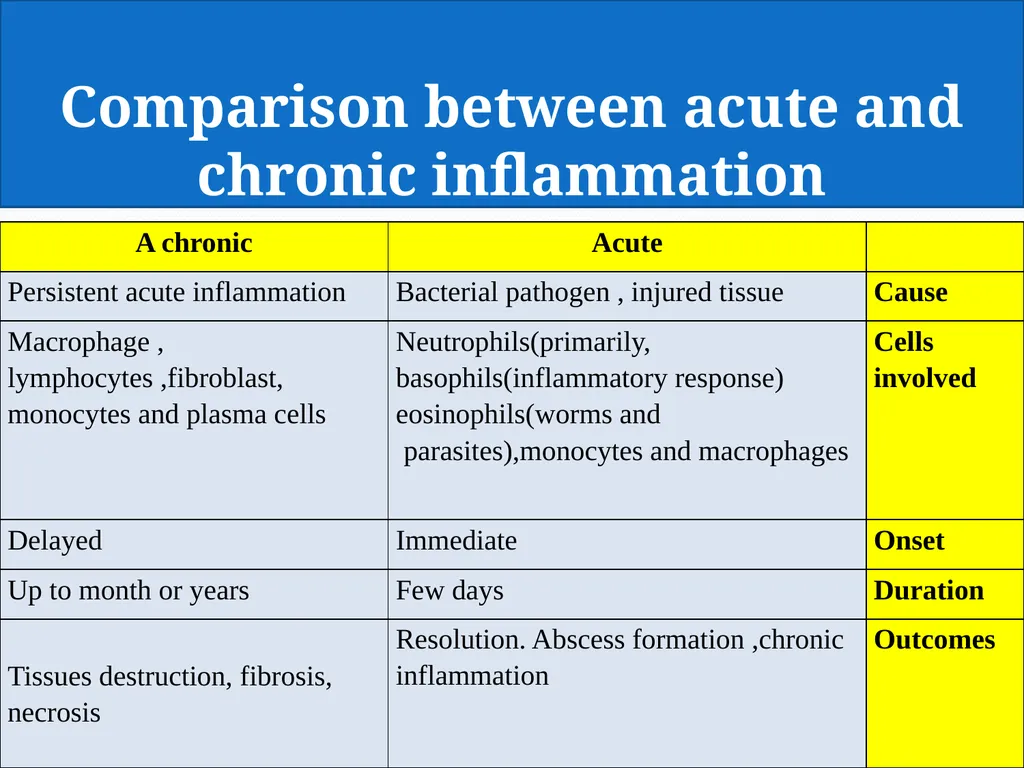
Comparison between acute and chronic inflammation<br>