Perception: Cross-cultural studies by Balaji Niwlikar https:www.careershodh.com 1 Cross-Cultural Studies of Perception people from different cultures often see things quite differently. Picture Perception by Hudson (1960, 1967)
"Perception: Cross-cultural studies by Balaji" is the property of its rightful owner. Permission is granted to
download and print the materials on this website for personal, non-commercial use only, and to display it
on your personal computer provided you do not modify the materials and that you retain all copyright
notices contained in the materials. By downloading content from our website, you accept the terms of this
agreement.
Presentation Transcript
01
Perception: Cross-cultural studies by
Balaji Niwlikar https://www.careershodh.com/ 1<br>
02
Cross-Cultural Studies of Perception people from different cultures often “see things” quite differently.
Picture Perception
by Hudson (1960, 1967)
demonstrated that people from different cultures frequently do not see eye to eye. Hudson began with the intuition that Bantu workers in South African mines and factories seemed to have difficulty interpreting posters and films.
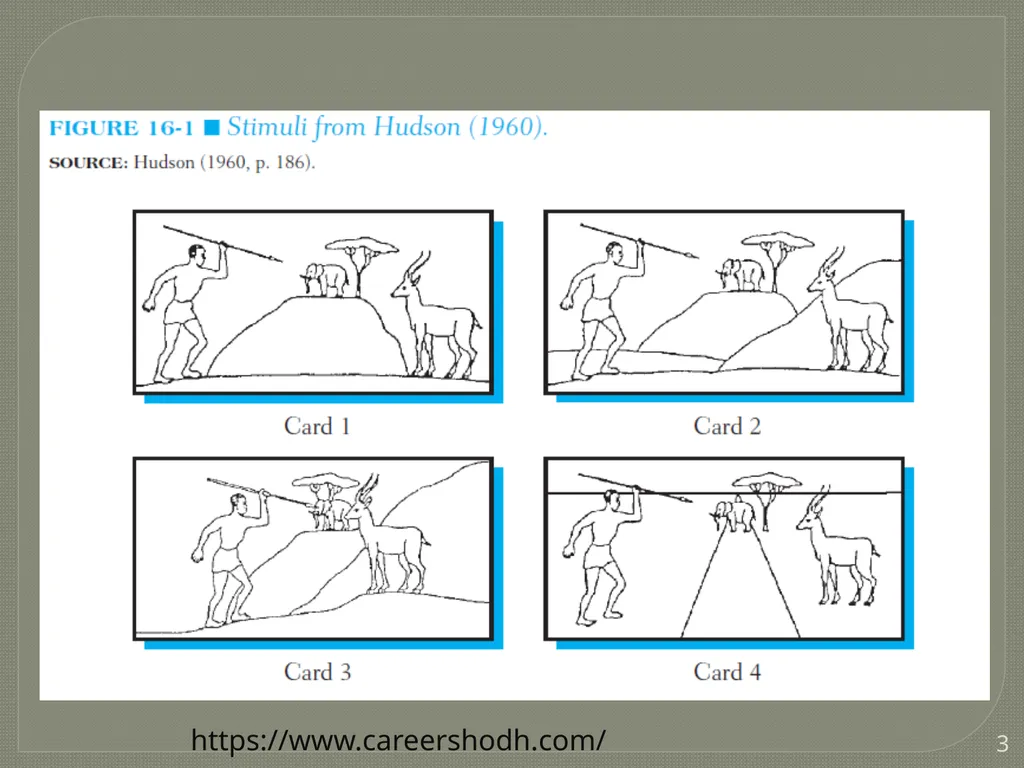
To investigate why, he presented a variety of South Africans (both black and white, schooled and unschooled) with pictures
The cards differ in the depth cues presented.
Card 1 uses object size (objects farther away are rendered smaller).
Cards 2 and 3 also use superposition (nearer objects partially occlude farther objects).
Card 4 uses all these cues, and in addition, some cues of linear perspective (lines that are parallel appear to meet in the distance; other outlines or contours are scaled to fit in this framework).
Participants were asked to describe what they saw, what they thought the figures in the pictures were doing, and which pairs of figures were closest to each other.
Conclusion --black workers had greater difficulty coming to three-dimensional pictorial interpretations. https://www.careershodh.com/ 2<br>
03
https://www.careershodh.com/ 3<br>
04
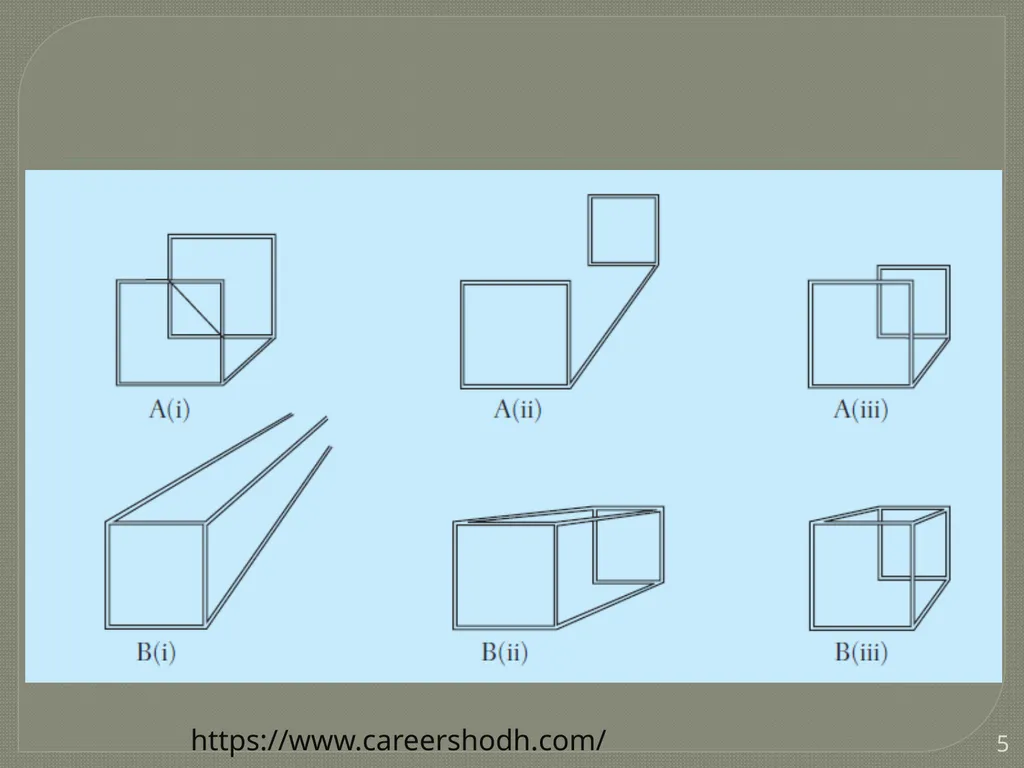
Cross-Cultural Studies of Perception Deregowski (1968),
studying children and adult workers in Zambia, Central Africa,
He found that although more than 80% of the participants failed to perceive the Hudson pictures three-dimensionally, more than half constructed three- rather than two-dimensional models.
Reason –difficulty https://www.careershodh.com/ 4<br>
05
https://www.careershodh.com/ 5<br>
06
Cross-Cultural Studies of Perception Cole and Scribner (1974) concluded from these and other studies that it is too simplistic to conclude that people either can or cannot perceive pictures three-dimensionally.
They concluded the reasons
content of the pictures (depictions of people and animals and depictions of abstract geometric forms) also influences perception.
mode of response (answering a question, building a model) influences the way people perceive pictures. https://www.careershodh.com/ 6<br>
07
Liddell (1997).
South African children in grades 1, 2, and 3 various color pictures of people and scenes of African origin. Compare with British children.
“interpreting” the pictures, these South African children tended instead to provide factual, even disembodied, pieces of information about them.
Moreover, the tendency to provide interpretations decreased as a function of years of schooling, with grade 3 children providing fewer than grade 1 or 2 children
Reason- difference may lie in the South African system of elementary education, which emphasizes factual and descriptive lessons https://www.careershodh.com/ 7<br>
08
Miyamoto, Nisbett, and Masuda (2006)
Took photographs in three U.S. cities of various sizes (New York; Ann Arbor, Michigan; Chelsea, Michigan) along with three comparable cities in Japan (Tokyo, Hikone, Torahime).
Findings –
Japanese scenes may encourage more perception of context than do American scenes
American participants in a change blindness task noticed more changes in the focal objects, whereas Japanese participants were more sensitive to changes in “background” or contextual objects (Masuda & Nisbett, 2006). https://www.careershodh.com/ 8<br>
09
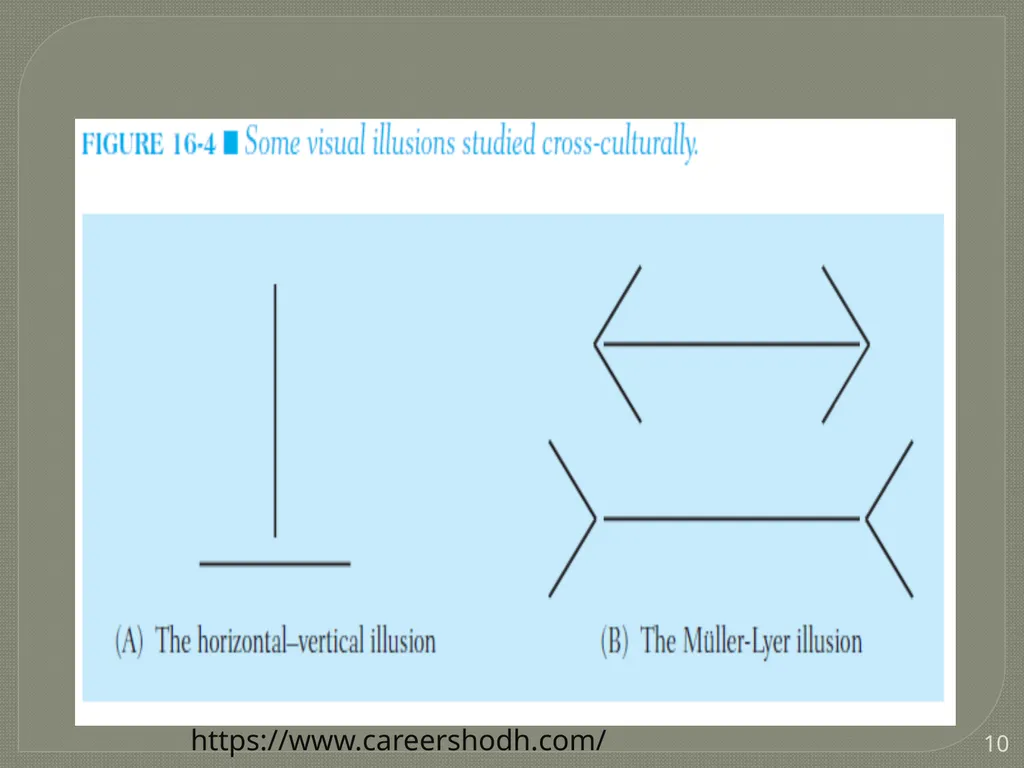
Visual Illusions
Rivers (1905) studied aspects of visual perception of people from the Torres Straits (Papuans from New Guinea) along with the Todas, people from southern India.
Shows --relative to Western samples, the people he worked with were more prone to the horizontal– vertical illusion but less prone to the Muller-Lyer illusion. https://www.careershodh.com/ 9<br>
10
https://www.careershodh.com/ 10<br>
11
Segall, Campbell, and Herskovits (1966) followed up on this observation, Classic study.- They used the Muller-Lyer and the horizontal–vertical illusions to test the Hypothesis - people’s previous experience would affect their susceptibility to the illusions. On experiment on carpenter they conclude- the [top] horizontal would “have to be” shorter than the drawing makes it out, and the [bottom] horizontal would “have to be” longer. (Segall et al., 1966)
Base --Egon Brunswik (1956): People interpret cues in any situation according to the ways in which they have interpreted such cues in the past.
Segall et al. (1966) found out that people from cultures where the horizon is a part of the everyday landscape (desert /plains dwellers) would be more prone to the horizontal–vertical illusion than would people (jungle dwellers) from cultures where the environment does not afford opportunities to view vast distances. https://www.careershodh.com/ 11<br>
12
Studies of perception, how people interpret their sensory information, and not sensation, the acquisition of information.
No one claims there are cross-cultural differences in the way the visual (or auditory or olfactory) system works, simply in the stages of cognitive processing that follow the initial acquisition of the information.
However,
the claim is made that culture affects the way people interpret sensory information https://www.careershodh.com/ 12<br>
13
Get more free study material on https://www.careershodh.com/.
If you like it, share with others !