
Perception of non-native contrast: Consonant

Description: Perception of non-native contrast: Consonant length and L1 English listeners Vincent Porretta Benjamin V. Tucker University of Alberta 7112012 1 SLP 2012 Intro Questions Experiment 1 Experiment 2 Discussion Consonant Length
Related Topics
Download Presentation
"Perception of non-native contrast: Consonant" is the property of its rightful owner. Permission is granted to download and print the materials on this website for personal, non-commercial use only, and to display it on your personal computer provided you do not modify the materials and that you retain all copyright notices contained in the materials. By downloading content from our website, you accept the terms of this agreement.
Presentation Transcript
slide1. Perception of non-native contrast: Consonant length and L1 English listeners Vincent Porretta & Benjamin V. Tucker
University of Alberta 7/11/2012 1 SLP 2012<br>
slide2. Intro > Questions > Experiment 1 > Experiment 2 > Discussion Consonant Length
Phonemic contrast in numerous languages
Duration primary cue (Hankamer, Lahiri, & Koreman, 1989; Lahiri & Hankamer, 1988; Lehtonen, 1970; Ylinen et al., 2005)
English: length plays a role in…
Production (Klatt, 1976; Oller, 1973; Umeda, 1977)
Perception (Lisker, 1957; Repp, 1978; Pickett & Decker, 1960) 7/11/2012 2 SLP 2012<br>
slide3. Intro > Questions > Experiment 1 > Experiment 2 > Discussion Consonant Length in L2 Learning
L1 phonology influences how well listeners perceive phonemic length contrasts (McAllister et al., 2002).
English-speaking learners do not initially maintain a phonemic contrast for length (Hayes, 2002)
Generally increases with experience (Hayes, 2002; Heeren & Schouten, 2008; Kato, 2002; Takeuchi, 2010; Ylinen et al., 2005) and/or auditory-perceptual training (Motohashi-Saigo & Hardison, 2009)
Learners can eventually acquire a contrast (MacKain et al., 1981). 7/11/2012 3 SLP 2012<br>
slide4. Intro > Questions > Experiment 1 > Experiment 2 > Discussion Perception of Contrasts
Information influences perception (Niedzielski, 1999; Janson & Schulman, 1983)
Effect of attention to nature of contrast (Hisagi & Strange, 2011)
“Phonemic” vs. “Phonetic” vs. “Auditory” levels of processing (Werker & Tees, 1984; Werker & Logan, 1985) 7/11/2012 4 SLP 2012<br>
slide5. Intro > Questions > Experiment 1 > Experiment 2 > Discussion Questions
Can naive L1 English speakers discriminate a normal Finnish singleton/geminate contrast and identify normal Finnish geminate consonants?
Do longer contrasts (between pairs) and longer consonant lengths increase an English speaker’s ability to discriminate and identify differences in consonant length? 7/11/2012 5 SLP 2012<br>
slide6. Intro > Questions > Experiment 1 > Experiment 2 > Discussion Questions
Is there a difference in the perception of geminate consonants based on manner of articulation?
Does additional information about consonant length and the resulting attention to it influence perception of length in naive English listeners? 7/11/2012 6 SLP 2012<br>
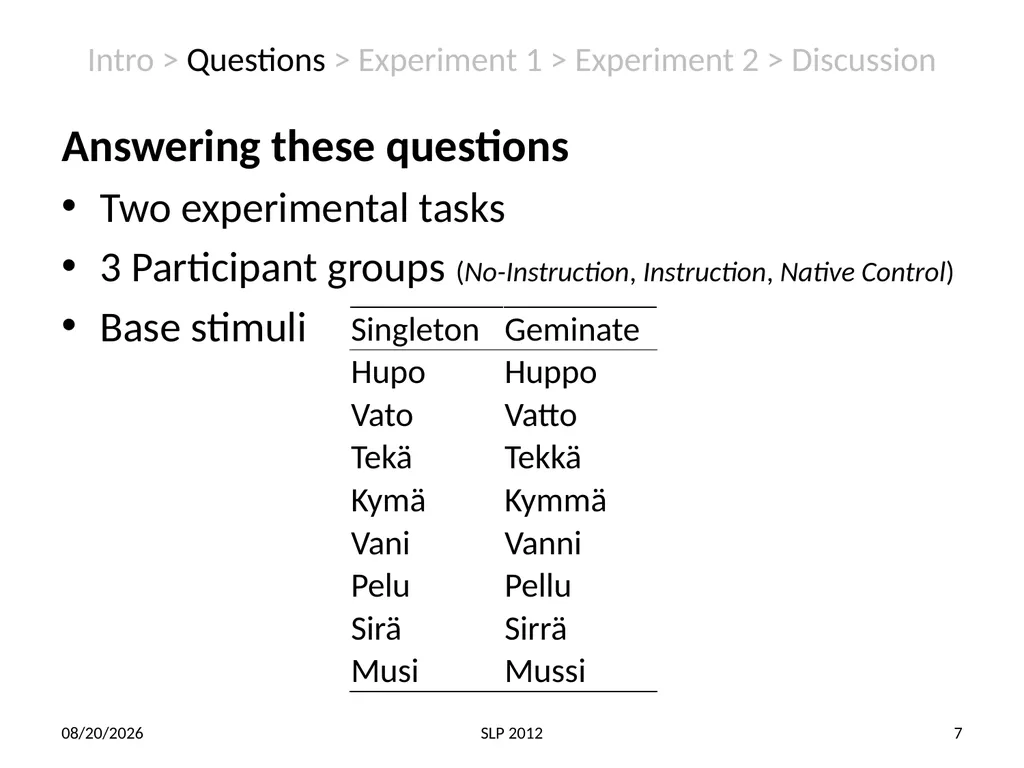
slide7. Intro > Questions > Experiment 1 > Experiment 2 > Discussion Answering these questions
Two experimental tasks
3 Participant groups (No-Instruction, Instruction, Native Control)
Base stimuli 7/11/2012 7 SLP 2012<br>
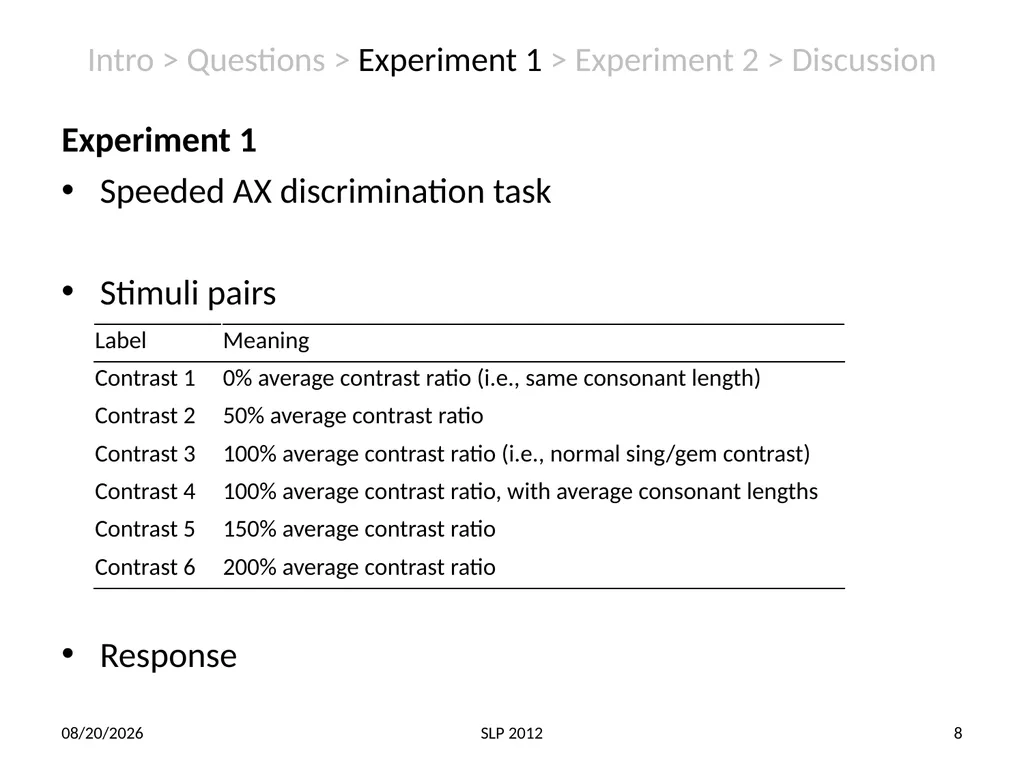
slide8. Intro > Questions > Experiment 1 > Experiment 2 > Discussion Experiment 1
Speeded AX discrimination task
Stimuli pairs
Response 7/11/2012 8 SLP 2012<br>
slide9. Intro > Questions > Experiment 1 > Experiment 2 > Discussion Method of Analysis
Mixed-effects regression
Takes into consideration variation that is not generalizable to the independent variables.
E.g., across different speakers or different words
Allows both continuous and discrete dependent and independent variables and interactions between any combination of those variables 7/11/2012 9 SLP 2012<br>
slide10. Intro > Questions > Experiment 1 > Experiment 2 > Discussion Analysis
Logistic mixed-effects regression in R using LME4 (Bates & Maechler, 2010)
Response variable: Same/Different Response
Random-effect variables: Item and Participant
Fixed-effect variables: Contrast, Condition, L2 Proficiency, Consonant, Log Adjusted Reaction Time
Multiple models
Combined dataset, English-only, Finn-only 7/11/2012 10 SLP 2012<br>
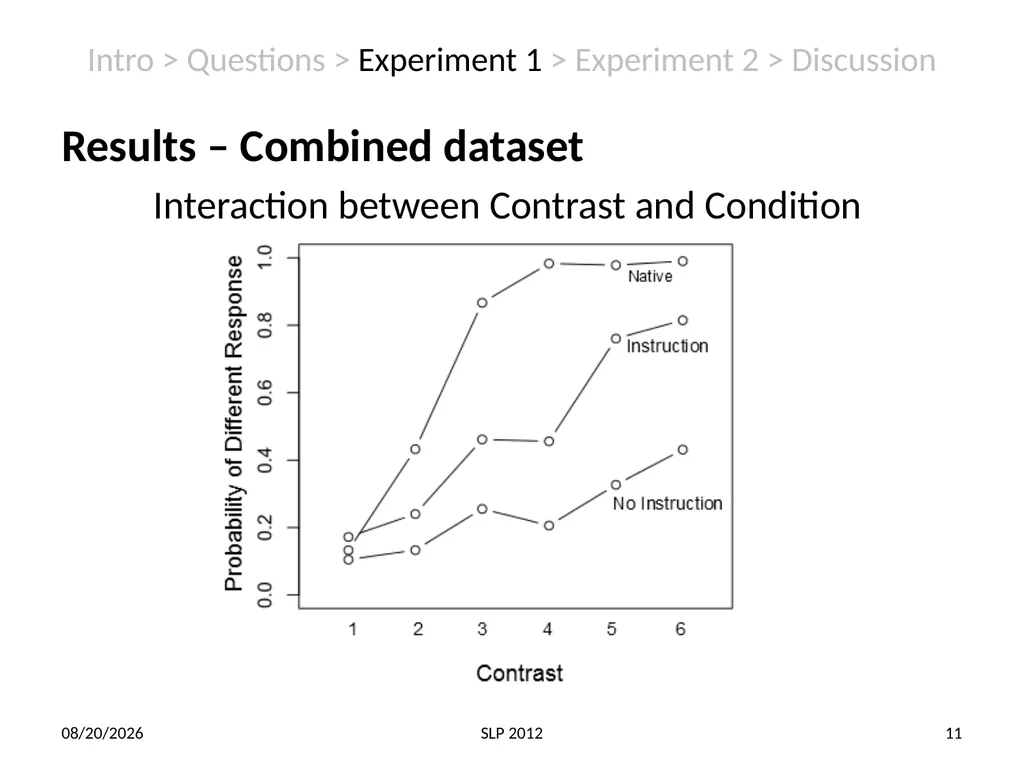
slide11. Intro > Questions > Experiment 1 > Experiment 2 > Discussion Results – Combined dataset
Interaction between Contrast and Condition 7/11/2012 11 SLP 2012<br>
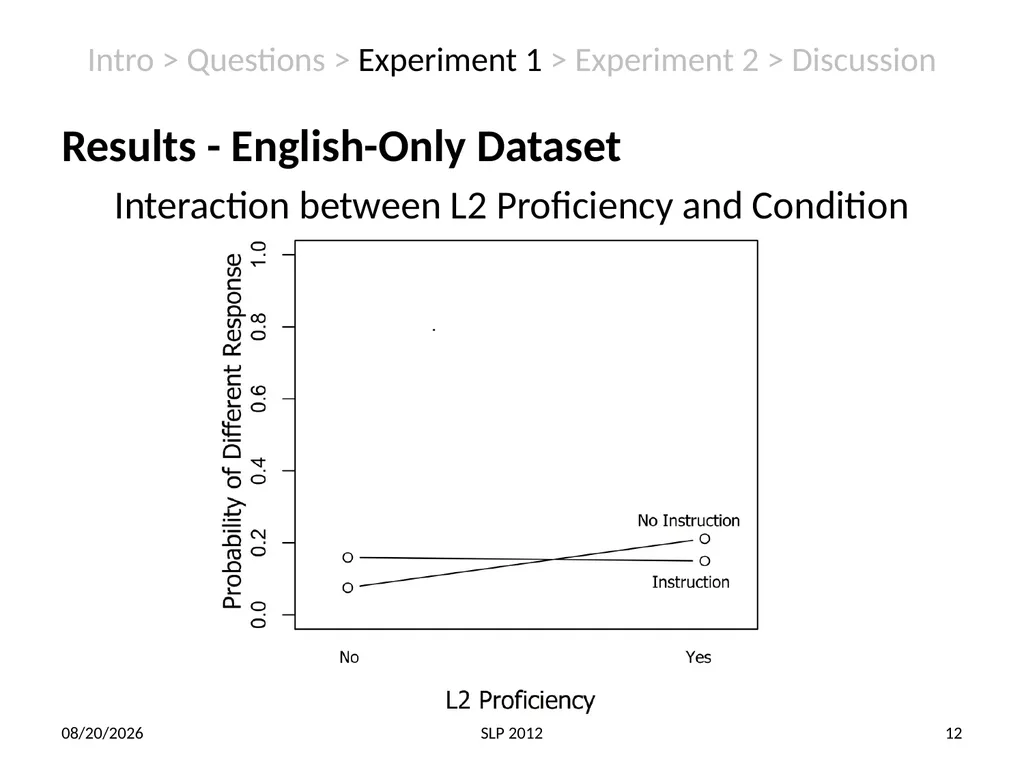
slide12. Intro > Questions > Experiment 1 > Experiment 2 > Discussion Results - English-Only Dataset
Interaction between L2 Proficiency and Condition 7/11/2012 12 SLP 2012<br>
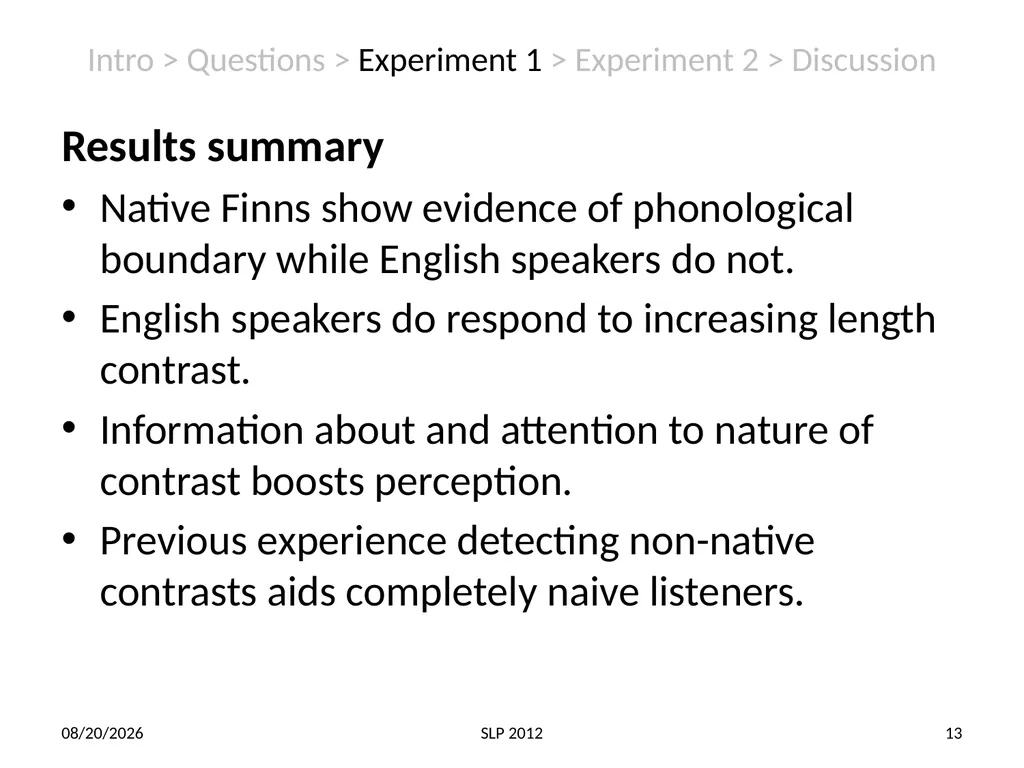
slide13. Intro > Questions > Experiment 1 > Experiment 2 > Discussion Results summary
Native Finns show evidence of phonological boundary while English speakers do not.
English speakers do respond to increasing length contrast.
Information about and attention to nature of contrast boosts perception.
Previous experience detecting non-native contrasts aids completely naive listeners. 7/11/2012 13 SLP 2012<br>
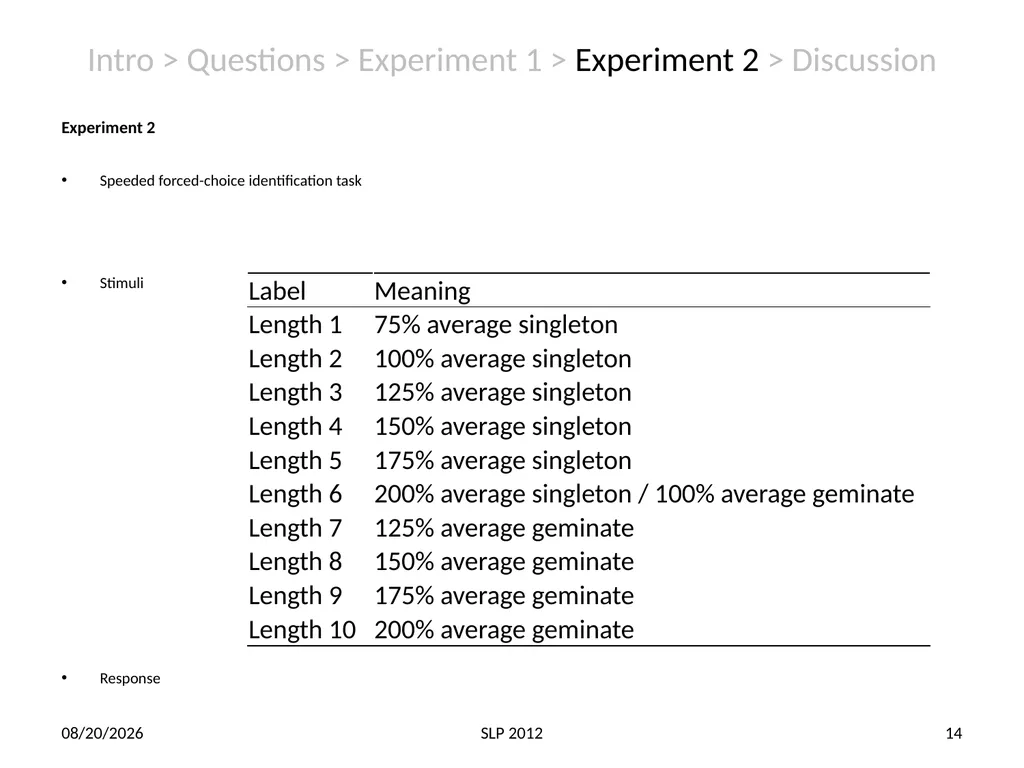
slide14. Intro > Questions > Experiment 1 > Experiment 2 > Discussion Experiment 2
Speeded forced-choice identification task
Stimuli
Response 7/11/2012 14 SLP 2012<br>
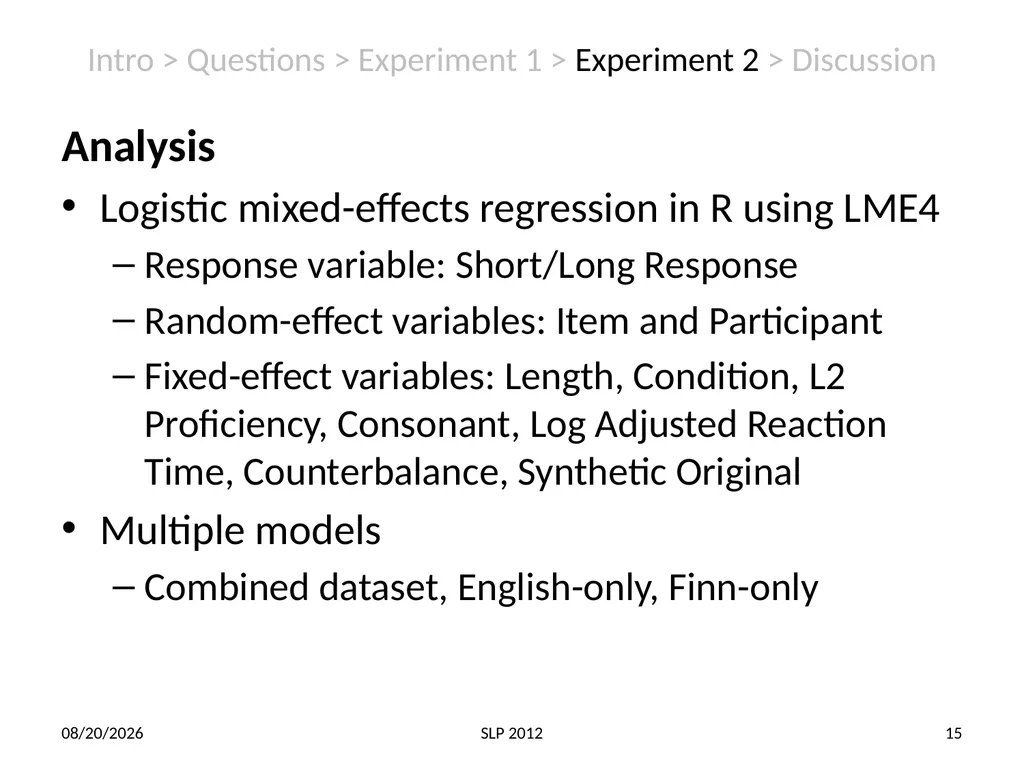
slide15. Intro > Questions > Experiment 1 > Experiment 2 > Discussion Analysis
Logistic mixed-effects regression in R using LME4
Response variable: Short/Long Response
Random-effect variables: Item and Participant
Fixed-effect variables: Length, Condition, L2 Proficiency, Consonant, Log Adjusted Reaction Time, Counterbalance, Synthetic Original
Multiple models
Combined dataset, English-only, Finn-only 7/11/2012 15 SLP 2012<br>
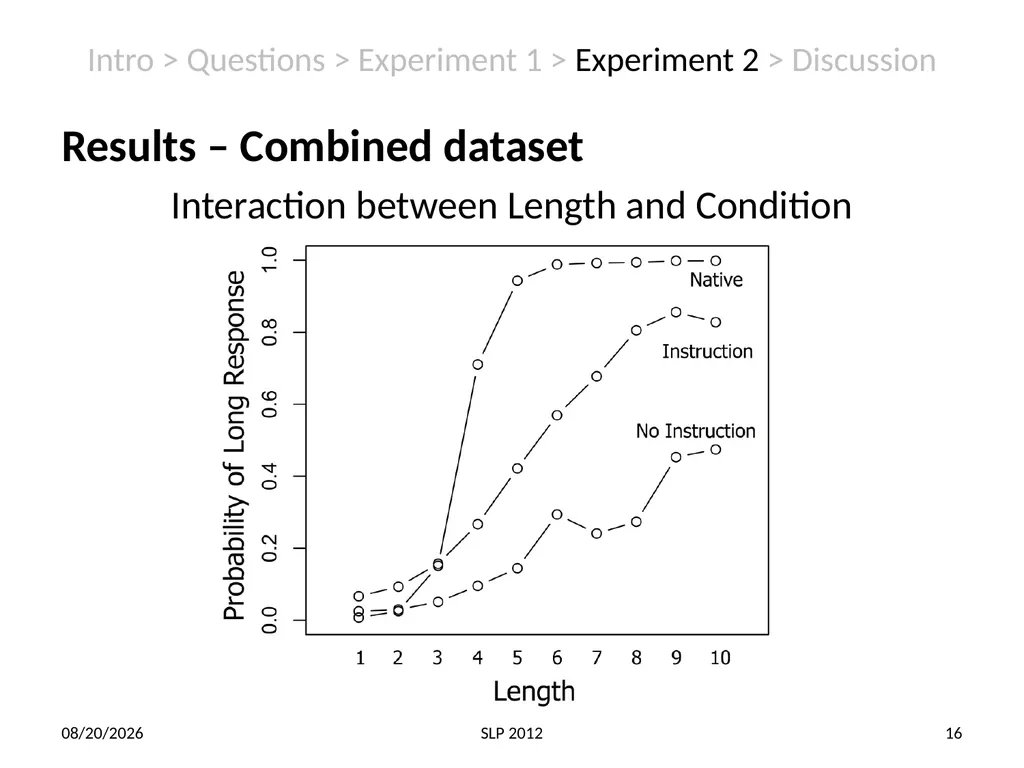
slide16. Intro > Questions > Experiment 1 > Experiment 2 > Discussion Results – Combined dataset
Interaction between Length and Condition 7/11/2012 16 SLP 2012<br>
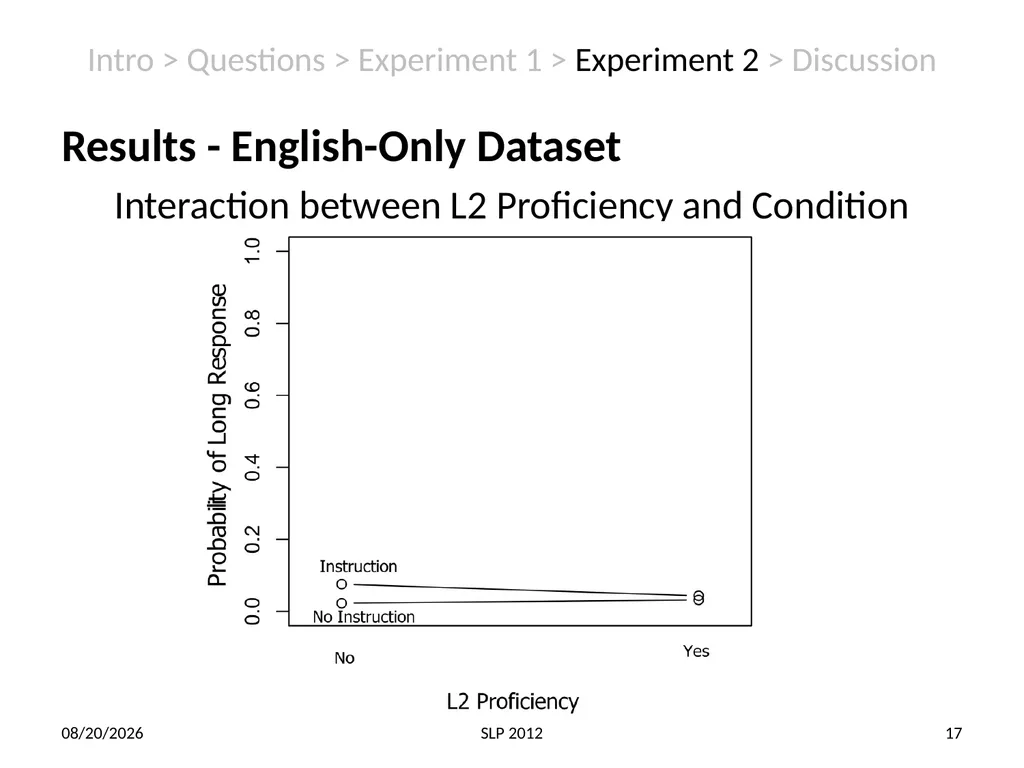
slide17. Intro > Questions > Experiment 1 > Experiment 2 > Discussion Results - English-Only Dataset
Interaction between L2 Proficiency and Condition 7/11/2012 17 SLP 2012<br>
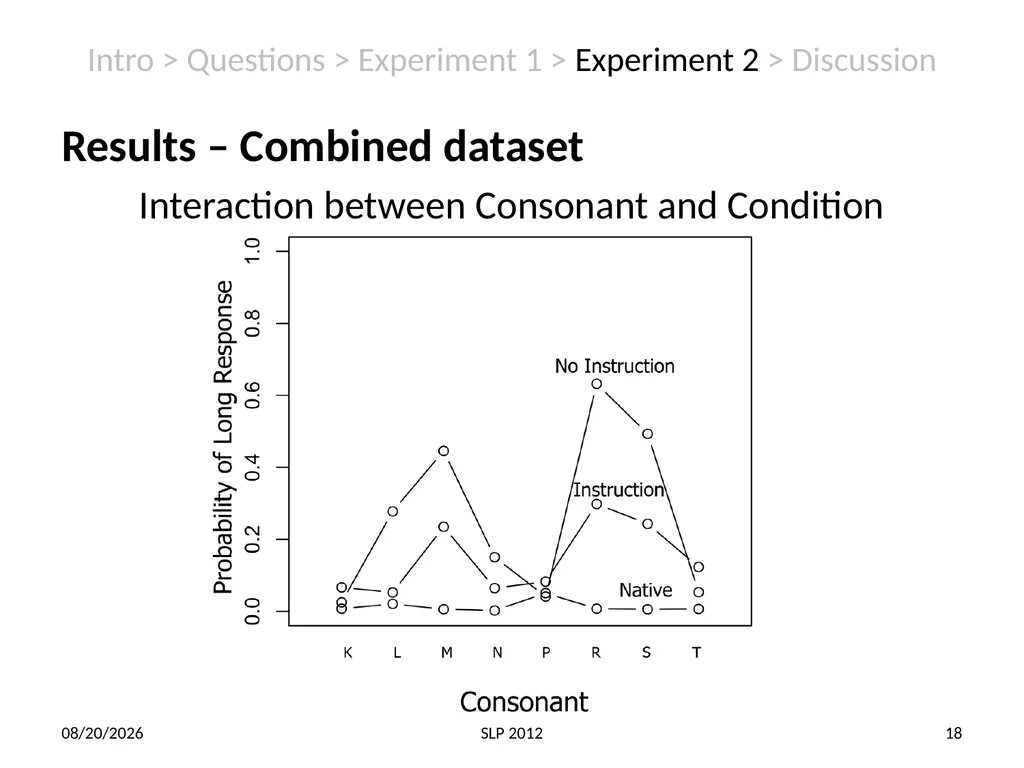
slide18. Intro > Questions > Experiment 1 > Experiment 2 > Discussion Results – Combined dataset
Interaction between Consonant and Condition 7/11/2012 18 SLP 2012<br>
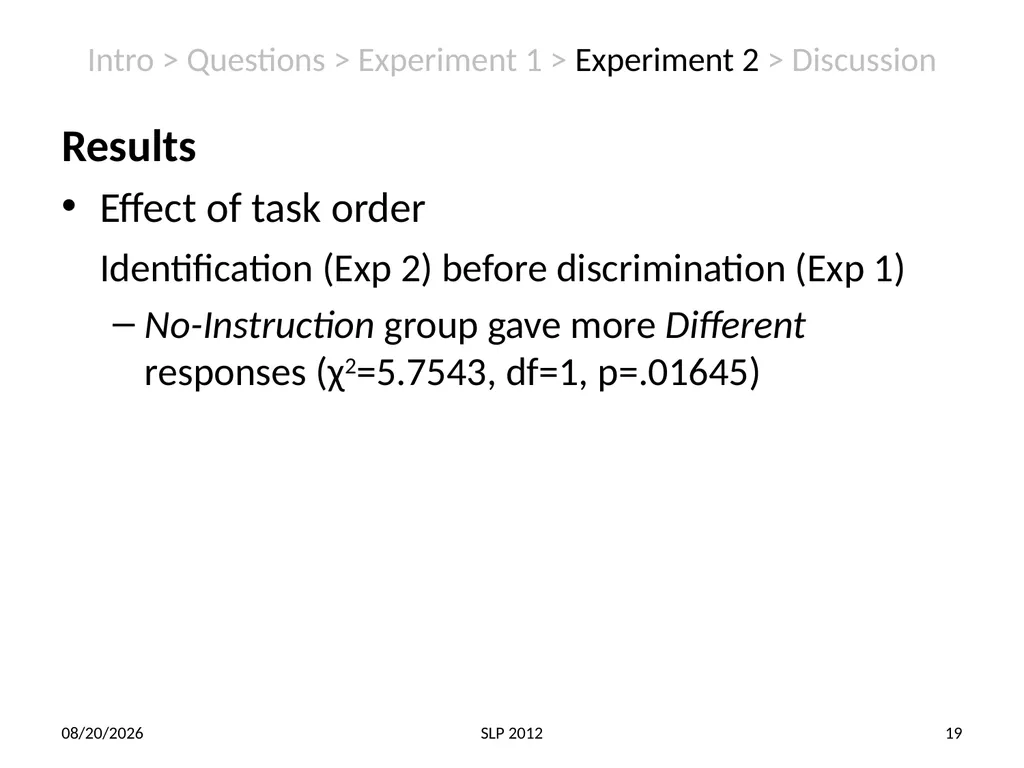
slide19. Intro > Questions > Experiment 1 > Experiment 2 > Discussion Results
Effect of task order
Identification (Exp 2) before discrimination (Exp 1)
No-Instruction group gave more Different responses (χ2=5.7543, df=1, p=.01645) 7/11/2012 19 SLP 2012<br>
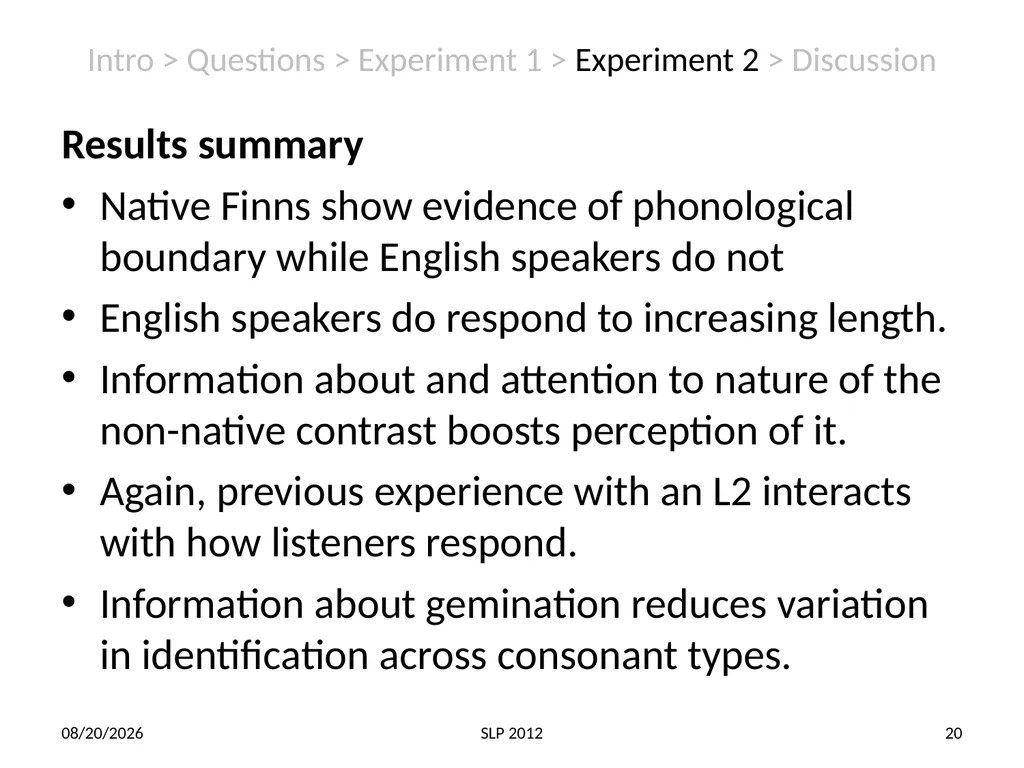
slide20. Intro > Questions > Experiment 1 > Experiment 2 > Discussion Results summary
Native Finns show evidence of phonological boundary while English speakers do not
English speakers do respond to increasing length.
Information about and attention to nature of the non-native contrast boosts perception of it.
Again, previous experience with an L2 interacts with how listeners respond.
Information about gemination reduces variation in identification across consonant types. 7/11/2012 20 SLP 2012<br>
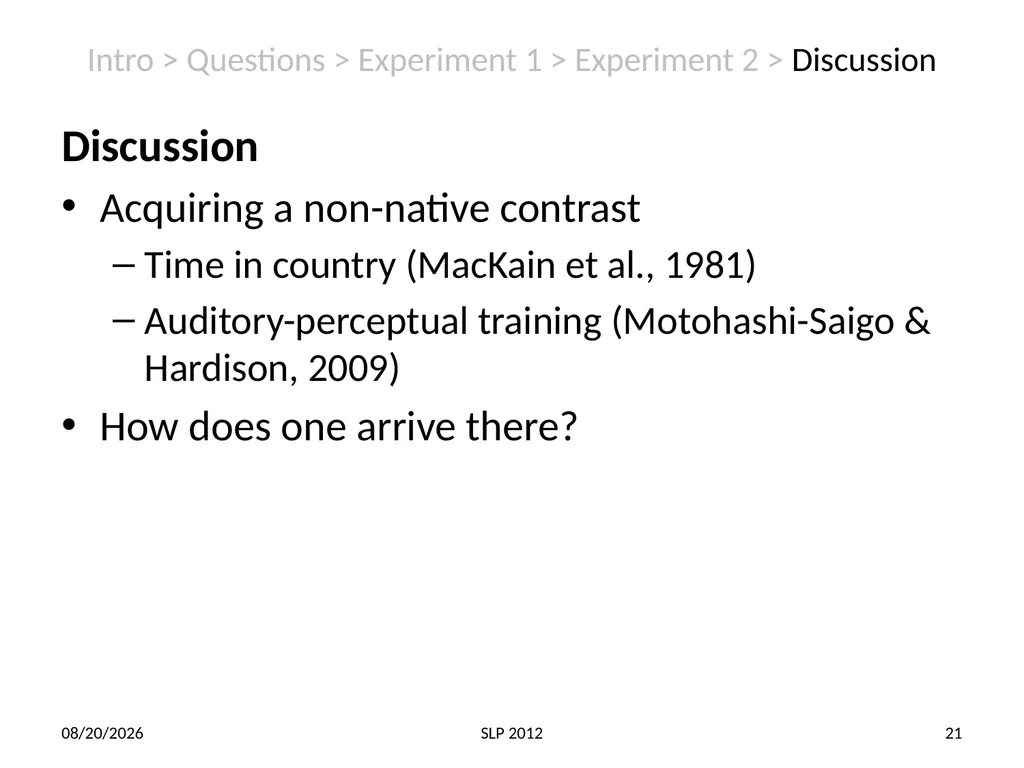
slide21. Intro > Questions > Experiment 1 > Experiment 2 > Discussion Discussion
Acquiring a non-native contrast
Time in country (MacKain et al., 1981)
Auditory-perceptual training (Motohashi-Saigo & Hardison, 2009)
How does one arrive there? 7/11/2012 21 SLP 2012<br>
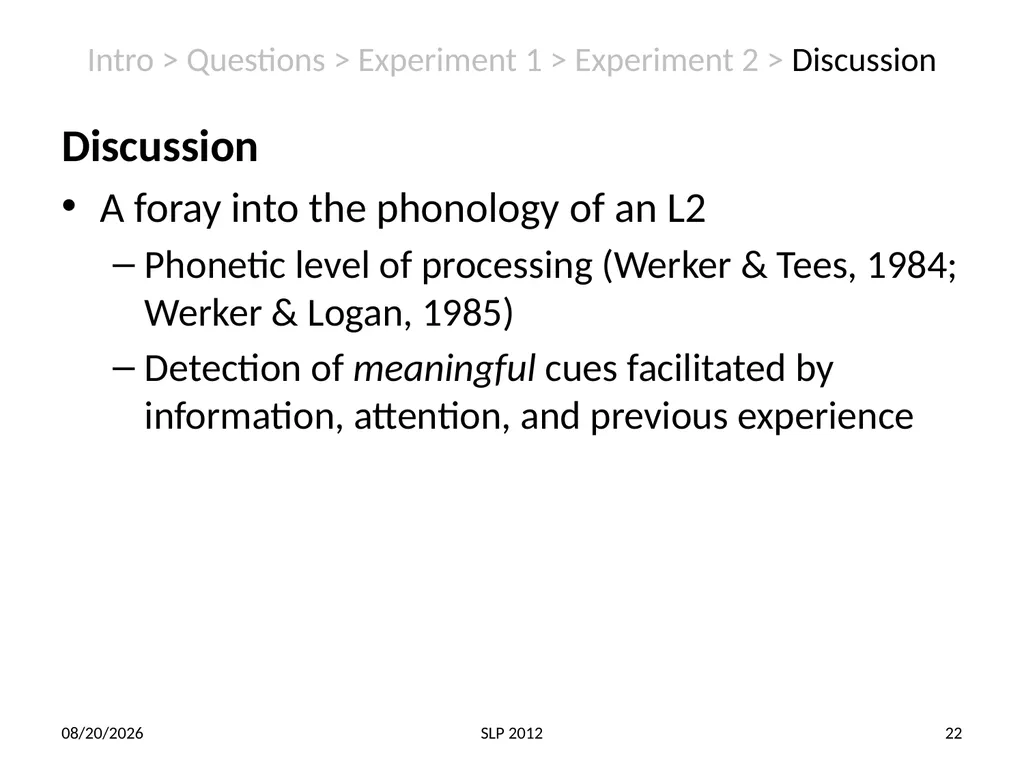
slide22. Intro > Questions > Experiment 1 > Experiment 2 > Discussion Discussion
A foray into the phonology of an L2
Phonetic level of processing (Werker & Tees, 1984; Werker & Logan, 1985)
Detection of meaningful cues facilitated by information, attention, and previous experience 7/11/2012 22 SLP 2012<br>
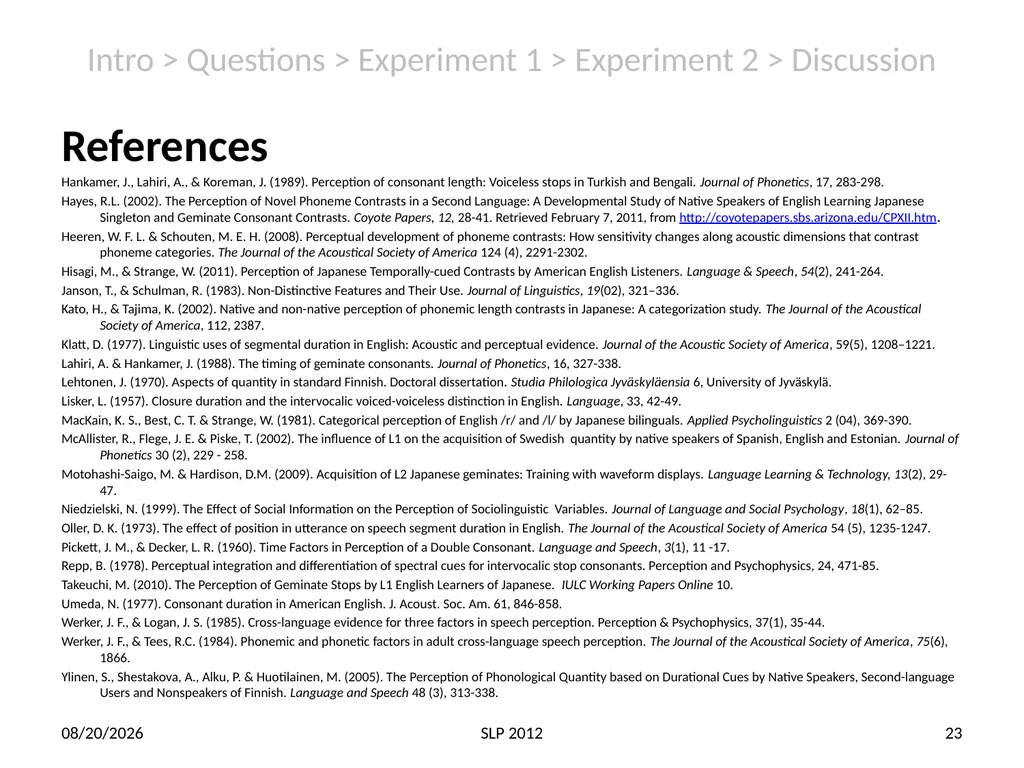
slide23. Intro > Questions > Experiment 1 > Experiment 2 > Discussion References
Hankamer, J., Lahiri, A., & Koreman, J. (1989). Perception of consonant length: Voiceless stops in Turkish and Bengali. Journal of Phonetics, 17, 283-298.
Hayes, R.L. (2002). The Perception of Novel Phoneme Contrasts in a Second Language: A Developmental Study of Native Speakers of English Learning Japanese Singleton and Geminate Consonant Contrasts. Coyote Papers, 12, 28-41. Retrieved February 7, 2011, from http://coyotepapers.sbs.arizona.edu/CPXII.htm.
Heeren, W. F. L. & Schouten, M. E. H. (2008). Perceptual development of phoneme contrasts: How sensitivity changes along acoustic dimensions that contrast phoneme categories. The Journal of the Acoustical Society of America 124 (4), 2291-2302.
Hisagi, M., & Strange, W. (2011). Perception of Japanese Temporally-cued Contrasts by American English Listeners. Language & Speech, 54(2), 241-264.
Janson, T., & Schulman, R. (1983). Non-Distinctive Features and Their Use. Journal of Linguistics, 19(02), 321–336.
Kato, H., & Tajima, K. (2002). Native and non-native perception of phonemic length contrasts in Japanese: A categorization study. The Journal of the Acoustical Society of America, 112, 2387.
Klatt, D. (1977). Linguistic uses of segmental duration in English: Acoustic and perceptual evidence. Journal of the Acoustic Society of America, 59(5), 1208–1221.
Lahiri, A. & Hankamer, J. (1988). The timing of geminate consonants. Journal of Phonetics, 16, 327-338.
Lehtonen, J. (1970). Aspects of quantity in standard Finnish. Doctoral dissertation. Studia Philologica Jyväskyläensia 6, University of Jyväskylä.
Lisker, L. (1957). Closure duration and the intervocalic voiced-voiceless distinction in English. Language, 33, 42-49.
MacKain, K. S., Best, C. T. & Strange, W. (1981). Categorical perception of English /r/ and /l/ by Japanese bilinguals. Applied Psycholinguistics 2 (04), 369-390.
McAllister, R., Flege, J. E. & Piske, T. (2002). The influence of L1 on the acquisition of Swedish quantity by native speakers of Spanish, English and Estonian. Journal of Phonetics 30 (2), 229 - 258.
Motohashi-Saigo, M. & Hardison, D.M. (2009). Acquisition of L2 Japanese geminates: Training with waveform displays. Language Learning & Technology, 13(2), 29-47.
Niedzielski, N. (1999). The Effect of Social Information on the Perception of Sociolinguistic Variables. Journal of Language and Social Psychology, 18(1), 62–85.
Oller, D. K. (1973). The effect of position in utterance on speech segment duration in English. The Journal of the Acoustical Society of America 54 (5), 1235-1247.
Pickett, J. M., & Decker, L. R. (1960). Time Factors in Perception of a Double Consonant. Language and Speech, 3(1), 11 -17.
Repp, B. (1978). Perceptual integration and differentiation of spectral cues for intervocalic stop consonants. Perception and Psychophysics, 24, 471-85.
Takeuchi, M. (2010). The Perception of Geminate Stops by L1 English Learners of Japanese. IULC Working Papers Online 10.
Umeda, N. (1977). Consonant duration in American English. J. Acoust. Soc. Am. 61, 846-858.
Werker, J. F., & Logan, J. S. (1985). Cross-language evidence for three factors in speech perception. Perception & Psychophysics, 37(1), 35-44.
Werker, J. F., & Tees, R.C. (1984). Phonemic and phonetic factors in adult cross-language speech perception. The Journal of the Acoustical Society of America, 75(6), 1866.
Ylinen, S., Shestakova, A., Alku, P. & Huotilainen, M. (2005). The Perception of Phonological Quantity based on Durational Cues by Native Speakers, Second-language Users and Nonspeakers of Finnish. Language and Speech 48 (3), 313-338. 7/11/2012 23 SLP 2012<br>
University of Alberta 7/11/2012 1 SLP 2012<br>
slide2. Intro > Questions > Experiment 1 > Experiment 2 > Discussion Consonant Length
Phonemic contrast in numerous languages
Duration primary cue (Hankamer, Lahiri, & Koreman, 1989; Lahiri & Hankamer, 1988; Lehtonen, 1970; Ylinen et al., 2005)
English: length plays a role in…
Production (Klatt, 1976; Oller, 1973; Umeda, 1977)
Perception (Lisker, 1957; Repp, 1978; Pickett & Decker, 1960) 7/11/2012 2 SLP 2012<br>
slide3. Intro > Questions > Experiment 1 > Experiment 2 > Discussion Consonant Length in L2 Learning
L1 phonology influences how well listeners perceive phonemic length contrasts (McAllister et al., 2002).
English-speaking learners do not initially maintain a phonemic contrast for length (Hayes, 2002)
Generally increases with experience (Hayes, 2002; Heeren & Schouten, 2008; Kato, 2002; Takeuchi, 2010; Ylinen et al., 2005) and/or auditory-perceptual training (Motohashi-Saigo & Hardison, 2009)
Learners can eventually acquire a contrast (MacKain et al., 1981). 7/11/2012 3 SLP 2012<br>
slide4. Intro > Questions > Experiment 1 > Experiment 2 > Discussion Perception of Contrasts
Information influences perception (Niedzielski, 1999; Janson & Schulman, 1983)
Effect of attention to nature of contrast (Hisagi & Strange, 2011)
“Phonemic” vs. “Phonetic” vs. “Auditory” levels of processing (Werker & Tees, 1984; Werker & Logan, 1985) 7/11/2012 4 SLP 2012<br>
slide5. Intro > Questions > Experiment 1 > Experiment 2 > Discussion Questions
Can naive L1 English speakers discriminate a normal Finnish singleton/geminate contrast and identify normal Finnish geminate consonants?
Do longer contrasts (between pairs) and longer consonant lengths increase an English speaker’s ability to discriminate and identify differences in consonant length? 7/11/2012 5 SLP 2012<br>
slide6. Intro > Questions > Experiment 1 > Experiment 2 > Discussion Questions
Is there a difference in the perception of geminate consonants based on manner of articulation?
Does additional information about consonant length and the resulting attention to it influence perception of length in naive English listeners? 7/11/2012 6 SLP 2012<br>
slide7. Intro > Questions > Experiment 1 > Experiment 2 > Discussion Answering these questions
Two experimental tasks
3 Participant groups (No-Instruction, Instruction, Native Control)
Base stimuli 7/11/2012 7 SLP 2012<br>
slide8. Intro > Questions > Experiment 1 > Experiment 2 > Discussion Experiment 1
Speeded AX discrimination task
Stimuli pairs
Response 7/11/2012 8 SLP 2012<br>
slide9. Intro > Questions > Experiment 1 > Experiment 2 > Discussion Method of Analysis
Mixed-effects regression
Takes into consideration variation that is not generalizable to the independent variables.
E.g., across different speakers or different words
Allows both continuous and discrete dependent and independent variables and interactions between any combination of those variables 7/11/2012 9 SLP 2012<br>
slide10. Intro > Questions > Experiment 1 > Experiment 2 > Discussion Analysis
Logistic mixed-effects regression in R using LME4 (Bates & Maechler, 2010)
Response variable: Same/Different Response
Random-effect variables: Item and Participant
Fixed-effect variables: Contrast, Condition, L2 Proficiency, Consonant, Log Adjusted Reaction Time
Multiple models
Combined dataset, English-only, Finn-only 7/11/2012 10 SLP 2012<br>
slide11. Intro > Questions > Experiment 1 > Experiment 2 > Discussion Results – Combined dataset
Interaction between Contrast and Condition 7/11/2012 11 SLP 2012<br>
slide12. Intro > Questions > Experiment 1 > Experiment 2 > Discussion Results - English-Only Dataset
Interaction between L2 Proficiency and Condition 7/11/2012 12 SLP 2012<br>
slide13. Intro > Questions > Experiment 1 > Experiment 2 > Discussion Results summary
Native Finns show evidence of phonological boundary while English speakers do not.
English speakers do respond to increasing length contrast.
Information about and attention to nature of contrast boosts perception.
Previous experience detecting non-native contrasts aids completely naive listeners. 7/11/2012 13 SLP 2012<br>
slide14. Intro > Questions > Experiment 1 > Experiment 2 > Discussion Experiment 2
Speeded forced-choice identification task
Stimuli
Response 7/11/2012 14 SLP 2012<br>
slide15. Intro > Questions > Experiment 1 > Experiment 2 > Discussion Analysis
Logistic mixed-effects regression in R using LME4
Response variable: Short/Long Response
Random-effect variables: Item and Participant
Fixed-effect variables: Length, Condition, L2 Proficiency, Consonant, Log Adjusted Reaction Time, Counterbalance, Synthetic Original
Multiple models
Combined dataset, English-only, Finn-only 7/11/2012 15 SLP 2012<br>
slide16. Intro > Questions > Experiment 1 > Experiment 2 > Discussion Results – Combined dataset
Interaction between Length and Condition 7/11/2012 16 SLP 2012<br>
slide17. Intro > Questions > Experiment 1 > Experiment 2 > Discussion Results - English-Only Dataset
Interaction between L2 Proficiency and Condition 7/11/2012 17 SLP 2012<br>
slide18. Intro > Questions > Experiment 1 > Experiment 2 > Discussion Results – Combined dataset
Interaction between Consonant and Condition 7/11/2012 18 SLP 2012<br>
slide19. Intro > Questions > Experiment 1 > Experiment 2 > Discussion Results
Effect of task order
Identification (Exp 2) before discrimination (Exp 1)
No-Instruction group gave more Different responses (χ2=5.7543, df=1, p=.01645) 7/11/2012 19 SLP 2012<br>
slide20. Intro > Questions > Experiment 1 > Experiment 2 > Discussion Results summary
Native Finns show evidence of phonological boundary while English speakers do not
English speakers do respond to increasing length.
Information about and attention to nature of the non-native contrast boosts perception of it.
Again, previous experience with an L2 interacts with how listeners respond.
Information about gemination reduces variation in identification across consonant types. 7/11/2012 20 SLP 2012<br>
slide21. Intro > Questions > Experiment 1 > Experiment 2 > Discussion Discussion
Acquiring a non-native contrast
Time in country (MacKain et al., 1981)
Auditory-perceptual training (Motohashi-Saigo & Hardison, 2009)
How does one arrive there? 7/11/2012 21 SLP 2012<br>
slide22. Intro > Questions > Experiment 1 > Experiment 2 > Discussion Discussion
A foray into the phonology of an L2
Phonetic level of processing (Werker & Tees, 1984; Werker & Logan, 1985)
Detection of meaningful cues facilitated by information, attention, and previous experience 7/11/2012 22 SLP 2012<br>
slide23. Intro > Questions > Experiment 1 > Experiment 2 > Discussion References
Hankamer, J., Lahiri, A., & Koreman, J. (1989). Perception of consonant length: Voiceless stops in Turkish and Bengali. Journal of Phonetics, 17, 283-298.
Hayes, R.L. (2002). The Perception of Novel Phoneme Contrasts in a Second Language: A Developmental Study of Native Speakers of English Learning Japanese Singleton and Geminate Consonant Contrasts. Coyote Papers, 12, 28-41. Retrieved February 7, 2011, from http://coyotepapers.sbs.arizona.edu/CPXII.htm.
Heeren, W. F. L. & Schouten, M. E. H. (2008). Perceptual development of phoneme contrasts: How sensitivity changes along acoustic dimensions that contrast phoneme categories. The Journal of the Acoustical Society of America 124 (4), 2291-2302.
Hisagi, M., & Strange, W. (2011). Perception of Japanese Temporally-cued Contrasts by American English Listeners. Language & Speech, 54(2), 241-264.
Janson, T., & Schulman, R. (1983). Non-Distinctive Features and Their Use. Journal of Linguistics, 19(02), 321–336.
Kato, H., & Tajima, K. (2002). Native and non-native perception of phonemic length contrasts in Japanese: A categorization study. The Journal of the Acoustical Society of America, 112, 2387.
Klatt, D. (1977). Linguistic uses of segmental duration in English: Acoustic and perceptual evidence. Journal of the Acoustic Society of America, 59(5), 1208–1221.
Lahiri, A. & Hankamer, J. (1988). The timing of geminate consonants. Journal of Phonetics, 16, 327-338.
Lehtonen, J. (1970). Aspects of quantity in standard Finnish. Doctoral dissertation. Studia Philologica Jyväskyläensia 6, University of Jyväskylä.
Lisker, L. (1957). Closure duration and the intervocalic voiced-voiceless distinction in English. Language, 33, 42-49.
MacKain, K. S., Best, C. T. & Strange, W. (1981). Categorical perception of English /r/ and /l/ by Japanese bilinguals. Applied Psycholinguistics 2 (04), 369-390.
McAllister, R., Flege, J. E. & Piske, T. (2002). The influence of L1 on the acquisition of Swedish quantity by native speakers of Spanish, English and Estonian. Journal of Phonetics 30 (2), 229 - 258.
Motohashi-Saigo, M. & Hardison, D.M. (2009). Acquisition of L2 Japanese geminates: Training with waveform displays. Language Learning & Technology, 13(2), 29-47.
Niedzielski, N. (1999). The Effect of Social Information on the Perception of Sociolinguistic Variables. Journal of Language and Social Psychology, 18(1), 62–85.
Oller, D. K. (1973). The effect of position in utterance on speech segment duration in English. The Journal of the Acoustical Society of America 54 (5), 1235-1247.
Pickett, J. M., & Decker, L. R. (1960). Time Factors in Perception of a Double Consonant. Language and Speech, 3(1), 11 -17.
Repp, B. (1978). Perceptual integration and differentiation of spectral cues for intervocalic stop consonants. Perception and Psychophysics, 24, 471-85.
Takeuchi, M. (2010). The Perception of Geminate Stops by L1 English Learners of Japanese. IULC Working Papers Online 10.
Umeda, N. (1977). Consonant duration in American English. J. Acoust. Soc. Am. 61, 846-858.
Werker, J. F., & Logan, J. S. (1985). Cross-language evidence for three factors in speech perception. Perception & Psychophysics, 37(1), 35-44.
Werker, J. F., & Tees, R.C. (1984). Phonemic and phonetic factors in adult cross-language speech perception. The Journal of the Acoustical Society of America, 75(6), 1866.
Ylinen, S., Shestakova, A., Alku, P. & Huotilainen, M. (2005). The Perception of Phonological Quantity based on Durational Cues by Native Speakers, Second-language Users and Nonspeakers of Finnish. Language and Speech 48 (3), 313-338. 7/11/2012 23 SLP 2012<br>