
Performance: Big Picture Professor Ken Birman
PM
Published · 50 slides · 0 views

1 / 1




Description
Performance: Big Picture Professor Ken Birman CS4414 Lecture 11 Cornell CS4414 - Fall 2021. 1 Idea Map For Today Cornell CS4414 - Fall 2021. 2 With so much to keep in mind, how can we possibly understand performance? Today will be a big
Related Topics
Share
Embed code
Download this presentation From Below
"Performance: Big Picture Professor Ken Birman" is the property of its rightful owner. Permission is granted to download and print the materials on this website for personal, non-commercial use only, and to display it on your personal computer provided you do not modify the materials and that you retain all copyright notices contained in the materials. By downloading content from our website, you accept the terms of this agreement.
Presentation Transcript
01
Performance: Big Picture Professor Ken Birman
CS4414 Lecture 11 Cornell CS4414 - Fall 2021. 1<br>
CS4414 Lecture 11 Cornell CS4414 - Fall 2021. 1<br>
02
Idea Map For Today Cornell CS4414 - Fall 2021. 2 With so much to keep in mind, how can we possibly understand performance? Today will be a “big picture” lecture talking about the challenge of visualizing all those different elements<br>
03
Your job? Be a detective! You suspect that your program isn’t the fastest it could be.
You need to be the sleuth and track down the bottleneck!
This centers on developing a mental image of your code as it executes
You’ll need to have a theory of how fast it “could be”, than search for evidence that something is slowing it down Cornell CS4414 - Fall 2021. 3 Nancy Drew<br>
You need to be the sleuth and track down the bottleneck!
This centers on developing a mental image of your code as it executes
You’ll need to have a theory of how fast it “could be”, than search for evidence that something is slowing it down Cornell CS4414 - Fall 2021. 3 Nancy Drew<br>
04
A good detective has an open mind You do need a mental image… but your theory could be wrong.
Sometimes the most obvious “issue” isn’t the root cause – it may be a symptom of the real cause, but “downstream” from it.
Example: your code isn’t scanning files quickly. Is it the algorithm?
Perhaps, the issue isn’t the scanning logic itself. Maybe something else is causing this slowdown, and the scanner is just “waiting” Cornell CS4414 - Fall 2021. 4<br>
Sometimes the most obvious “issue” isn’t the root cause – it may be a symptom of the real cause, but “downstream” from it.
Example: your code isn’t scanning files quickly. Is it the algorithm?
Perhaps, the issue isn’t the scanning logic itself. Maybe something else is causing this slowdown, and the scanner is just “waiting” Cornell CS4414 - Fall 2021. 4<br>
05
Good performance versus busy work One huge challenge for performance tuning is that a busy machine often isn’t an optimized machine!
We can be busy for a good reason, like training a machine-learning model
But often a busy computer is “thrashing” – doing work pointlessly Cornell CS4414 - Fall 2021. 5<br>
We can be busy for a good reason, like training a machine-learning model
But often a busy computer is “thrashing” – doing work pointlessly Cornell CS4414 - Fall 2021. 5<br>
06
Ideal versus reality… Ideally, we want all the “moving parts” seamlessly interacting to provide a smooth, efficient workflow
In practice we often find that most parts of the system are bottlenecked behind some very busy but ineffective component Cornell CS4414 - Fall 2021. 6<br>
In practice we often find that most parts of the system are bottlenecked behind some very busy but ineffective component Cornell CS4414 - Fall 2021. 6<br>
07
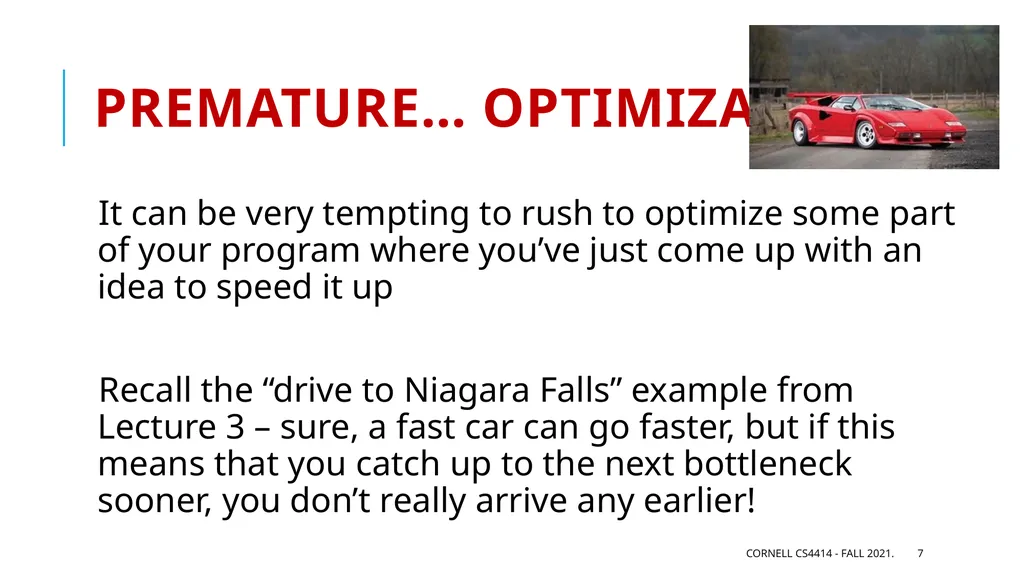
Premature… optimization It can be very tempting to rush to optimize some part of your program where you’ve just come up with an idea to speed it up
Recall the “drive to Niagara Falls” example from Lecture 3 – sure, a fast car can go faster, but if this means that you catch up to the next bottleneck sooner, you don’t really arrive any earlier! Cornell CS4414 - Fall 2021. 7<br>
Recall the “drive to Niagara Falls” example from Lecture 3 – sure, a fast car can go faster, but if this means that you catch up to the next bottleneck sooner, you don’t really arrive any earlier! Cornell CS4414 - Fall 2021. 7<br>
08
Big Picture process It is important to approach a systems programming challenge by really visualizing the whole task – all aspects of the solution
This includes the tasks that the operating system or network will be responsible for, and perhaps even things that other services are providing (in larger settings your programs often talk to services that run on other machines or in the cloud) Cornell CS4414 - Fall 2021. 8<br>
This includes the tasks that the operating system or network will be responsible for, and perhaps even things that other services are providing (in larger settings your programs often talk to services that run on other machines or in the cloud) Cornell CS4414 - Fall 2021. 8<br>
09
Domain crossings can be costly A domain crossing occurs when we move data from the storage device to the Linux kernel or from kernel to user memory
They also occur when the user process issues a system call, requesting that Linux do something (like open a file, read data)
And they even occur if threads share a resource and must take turns accessing it (we’ll talk about this case a lot in future classes) Cornell CS4414 - Fall 2021. 9<br>
They also occur when the user process issues a system call, requesting that Linux do something (like open a file, read data)
And they even occur if threads share a resource and must take turns accessing it (we’ll talk about this case a lot in future classes) Cornell CS4414 - Fall 2021. 9<br>
10
Modern systems hide these costs Your code can access data without considering costs, and Linux will conceal the overheads
But this means that the same logic might be faster or slower depending on factors you aren’t controlling.
Gaining control involves intentionally designing code to ensure that data will be in the most efficient place at the right time Cornell CS4414 - Fall 2021. 10<br>
But this means that the same logic might be faster or slower depending on factors you aren’t controlling.
Gaining control involves intentionally designing code to ensure that data will be in the most efficient place at the right time Cornell CS4414 - Fall 2021. 10<br>
11
Tools of the trade When you approach a performance question, pause and think about this big picture, and try to visualize all aspects
Is your program reading files? How many? How big?
Overall, are you working with a really large amount of data, like gigabytes, or smaller things?
How fast is the hardware you’ll run on?
Complexity of the algorithms you’ll be using. Cornell CS4414 - Fall 2021. 11<br>
Is your program reading files? How many? How big?
Overall, are you working with a really large amount of data, like gigabytes, or smaller things?
How fast is the hardware you’ll run on?
Complexity of the algorithms you’ll be using. Cornell CS4414 - Fall 2021. 11<br>
12
Isolation Testing Used to study some component of your application. You create a dedicated specialized test to measure its speed or hunt for bugs.
You often can do this by “breaking” your application – with some special argument, main just calls the test logic, then exits.
This allows you to understand the speed of that element and to tune it, without worrying about the rest of your program. Cornell CS4414 - Fall 2021. 12<br>
You often can do this by “breaking” your application – with some special argument, main just calls the test logic, then exits.
This allows you to understand the speed of that element and to tune it, without worrying about the rest of your program. Cornell CS4414 - Fall 2021. 12<br>
13
How fast “should” your code be? With a whiteboarding process you can often arrive at very crude estimates – rough but still very useful!
Time needed to do the file I/O
Computational time per “data item”, and “how many items”?
Will there be a great deal of copying needed?
What aspects look very sequential to you? Cornell CS4414 - Fall 2021. 13<br>
Time needed to do the file I/O
Computational time per “data item”, and “how many items”?
Will there be a great deal of copying needed?
What aspects look very sequential to you? Cornell CS4414 - Fall 2021. 13<br>
14
Hierarchy of delay Think of each part of your application in terms of
Bandwidth: How fast data can be moved through it.
Latency: How long it takes.
Keep in mind that the disk and Linux and the network are all parts of your application even if you didn’t code those Cornell CS4414 - Fall 2021. 14<br>
Bandwidth: How fast data can be moved through it.
Latency: How long it takes.
Keep in mind that the disk and Linux and the network are all parts of your application even if you didn’t code those Cornell CS4414 - Fall 2021. 14<br>
15
A busy thing causes delay. But so does an idle thing! We tend to think that delay is always caused by heavy loads
This is sometimes true. If you put a storage device under heavy load, it bogs down. But this might not consume CPU time.
But often, being “overloaded” shows up as “100% idle”. That component is spending all its time waiting, not computing. Cornell CS4414 - Fall 2021. 15<br>
This is sometimes true. If you put a storage device under heavy load, it bogs down. But this might not consume CPU time.
But often, being “overloaded” shows up as “100% idle”. That component is spending all its time waiting, not computing. Cornell CS4414 - Fall 2021. 15<br>
16
CPU is not always the issue! Sometimes we see components that are waiting for other things.
Each type of device has a minimal delay. This can grow if a backlog occurs due to overload.
Reading from a storage device? Normally < 1 ms
Reading over a network? Similar, but also depends on
…. Where the service resides
…. How you talk to it Cornell CS4414 - Fall 2021. 16<br>
Each type of device has a minimal delay. This can grow if a backlog occurs due to overload.
Reading from a storage device? Normally < 1 ms
Reading over a network? Similar, but also depends on
…. Where the service resides
…. How you talk to it Cornell CS4414 - Fall 2021. 16<br>
17
Network types The fastest networks are used in high speed clusters or data centers. Some use hardware accelerators called RDMA (remote DMA transfer over the network – ultra high bandwidth)
TCP/IP is fast in a cluster or inside a data center, but can be much slower with a wide-area link.
Terms: LAN means “local area network”. WAN: “wide area”. Cornell CS4414 - Fall 2021. 17<br>
TCP/IP is fast in a cluster or inside a data center, but can be much slower with a wide-area link.
Terms: LAN means “local area network”. WAN: “wide area”. Cornell CS4414 - Fall 2021. 17<br>
18
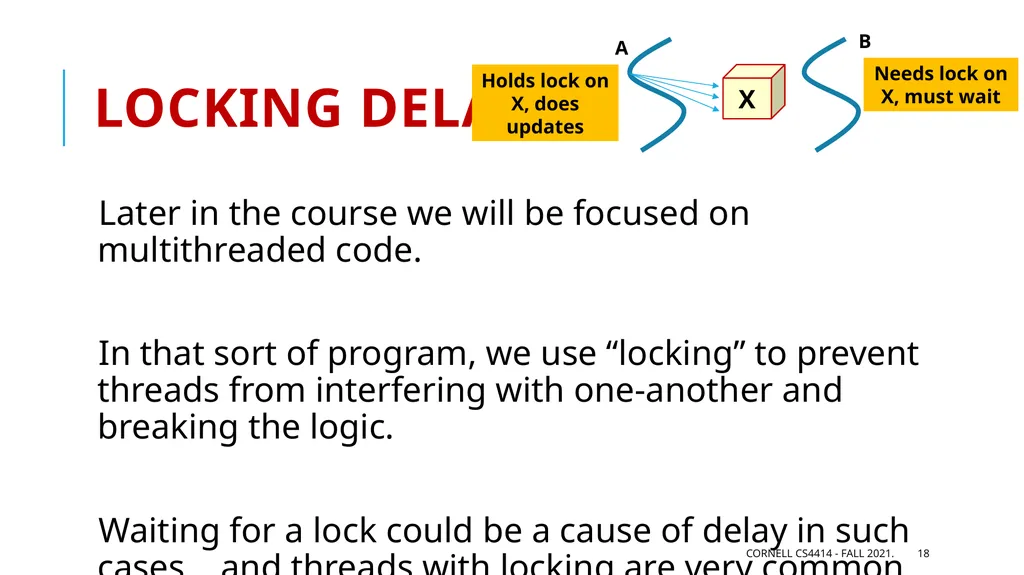
Locking delays Later in the course we will be focused on multithreaded code.
In that sort of program, we use “locking” to prevent threads from interfering with one-another and breaking the logic.
Waiting for a lock could be a cause of delay in such cases… and threads with locking are very common these days! Cornell CS4414 - Fall 2021. 18 X A B Holds lock on X, does updates Needs lock on X, must wait<br>
In that sort of program, we use “locking” to prevent threads from interfering with one-another and breaking the logic.
Waiting for a lock could be a cause of delay in such cases… and threads with locking are very common these days! Cornell CS4414 - Fall 2021. 18 X A B Holds lock on X, does updates Needs lock on X, must wait<br>
19
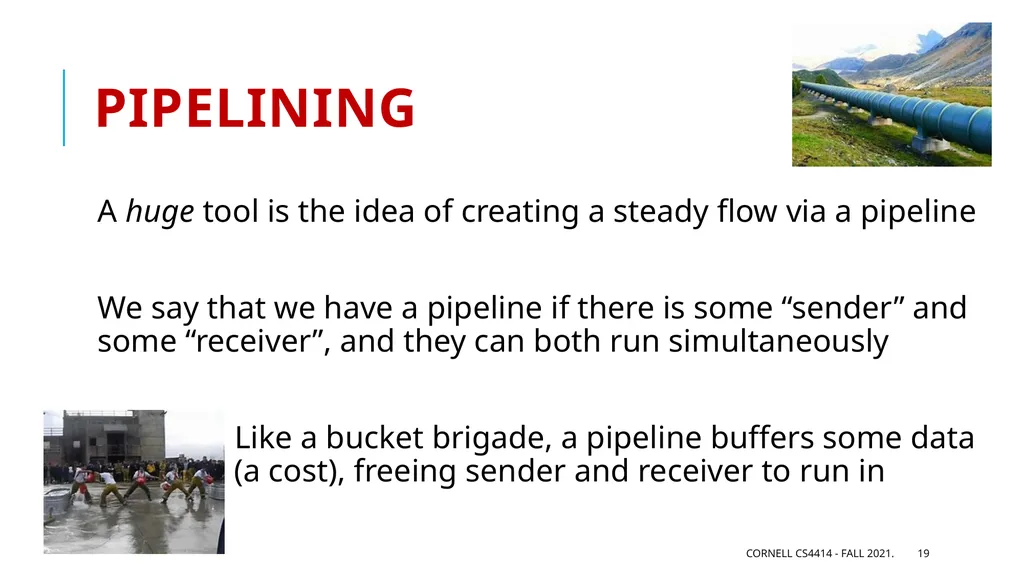
Pipelining A huge tool is the idea of creating a steady flow via a pipeline
We say that we have a pipeline if there is some “sender” and some “receiver”, and they can both run simultaneously
Like a bucket brigade, a pipeline buffers some data (a cost), freeing sender and receiver to run in parallel Cornell CS4414 - Fall 2021. 19<br>
We say that we have a pipeline if there is some “sender” and some “receiver”, and they can both run simultaneously
Like a bucket brigade, a pipeline buffers some data (a cost), freeing sender and receiver to run in parallel Cornell CS4414 - Fall 2021. 19<br>
20
Pipelines hide delay! They let us request something “long before” we need it
If the data shows up when we aren’t yet ready to process it, that data just waits in the pipeline Cornell CS4414 - Fall 2021. 20<br>
If the data shows up when we aren’t yet ready to process it, that data just waits in the pipeline Cornell CS4414 - Fall 2021. 20<br>
21
Notice the idea of spending “memory space” to gain “parallelism” This is a remarkably common and valuable pattern
In a pipeline, we dedicate buffering space (memory) to free up our sender to go get the next data, and our receiver to continue working with prior data.
A pipeline is like a cache, holding data the receiver needs soon Cornell CS4414 - Fall 2021. 21<br>
In a pipeline, we dedicate buffering space (memory) to free up our sender to go get the next data, and our receiver to continue working with prior data.
A pipeline is like a cache, holding data the receiver needs soon Cornell CS4414 - Fall 2021. 21<br>
22
Notice the idea of spending “memory space” to gain “parallelism” Ken’s version of word-count was using this same concept, but not just for data. That program had a “pipeline” of file opening operations, in order to “pre-open” files before reading them
Goal was to get the delay for “file open” off the critical path. Resource here was “open file handles” Cornell CS4414 - Fall 2021. 22<br>
Goal was to get the delay for “file open” off the critical path. Resource here was “open file handles” Cornell CS4414 - Fall 2021. 22<br>
23
You can’t let pipelines get “too deep” If a pipeline is holding huge amounts of data, or huge amounts of some other resources, costs accumulate
That memory could have been useful elsewhere
Linux limits how many files can be open all at once
Data might even become stale, if the underlying files change
Use your analysis to select a smart pipeline size – “depth” Cornell CS4414 - Fall 2021. 23<br>
That memory could have been useful elsewhere
Linux limits how many files can be open all at once
Data might even become stale, if the underlying files change
Use your analysis to select a smart pipeline size – “depth” Cornell CS4414 - Fall 2021. 23<br>
24
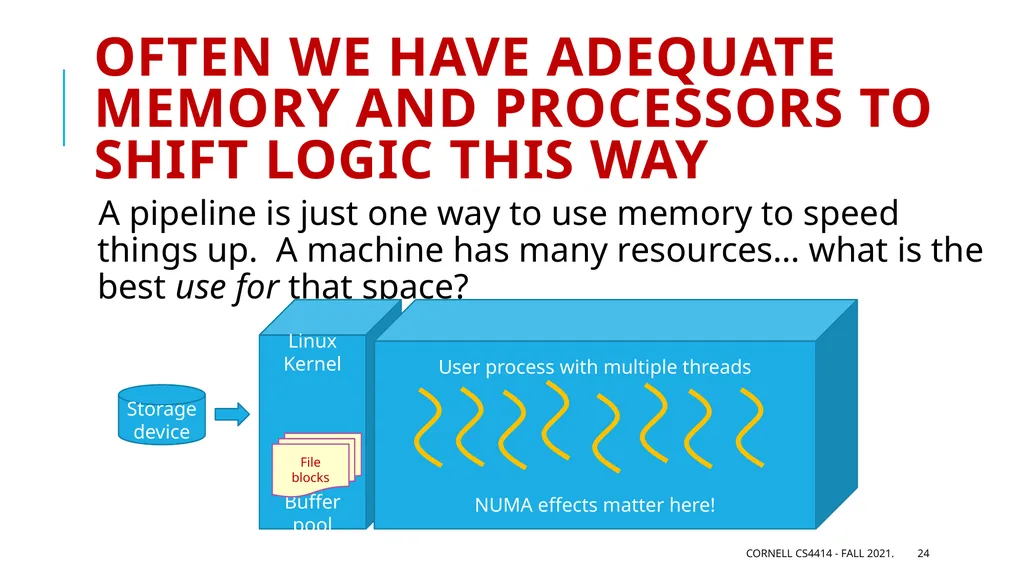
Often we have adequate memory and processors to shift logic this way A pipeline is just one way to use memory to speed things up. A machine has many resources… what is the best use for that space? Cornell CS4414 - Fall 2021. 24 Storage
device Linux Kernel
Buffer pool File blocks User process with multiple threads
NUMA effects matter here!<br>
Buffer pool File blocks User process with multiple threads
NUMA effects matter here!<br>
25
Hierarchy of data-access delays Costs vary. For example, the cost of accessing data depends on how close data is to your computation.
Data on the storage device is far away, costly to access. Requesting it long in advance of use pays off!
Data in the kernel is closer… a mapped file is even better
In your process, data in a remote DRAM module is more costly to access than data close to the core running your thread
Data in cache is closer than data in DRAM. Cornell CS4414 - Fall 2021. 25<br>
Data on the storage device is far away, costly to access. Requesting it long in advance of use pays off!
Data in the kernel is closer… a mapped file is even better
In your process, data in a remote DRAM module is more costly to access than data close to the core running your thread
Data in cache is closer than data in DRAM. Cornell CS4414 - Fall 2021. 25<br>
26
Register memory: Fastest of all The same machine instruction can run faster or slower depending on where data resides!
If your code is looping, the machine instruction itself will be in the i-cache. This saves time because the CPU won’t need to fetch it from DRAM.
Cached data (d-cache, which has multiple levels) is good…
… data in registers is best of all Cornell CS4414 - Fall 2021. 26<br>
If your code is looping, the machine instruction itself will be in the i-cache. This saves time because the CPU won’t need to fetch it from DRAM.
Cached data (d-cache, which has multiple levels) is good…
… data in registers is best of all Cornell CS4414 - Fall 2021. 26<br>
27
You can’t force data into registers… but your coding style gives hints Fortunately, C++ itself understands the register advantage.
What you can and should do is to learn to write code in ways that make it easy for C++ to discover opportunities to leverage the registers (constants are great too: those can be saved right into the machine instructions, so they are loaded “for free”)
Think of the compiler as your partner. You help each other out. Cornell CS4414 - Fall 2021. 27<br>
What you can and should do is to learn to write code in ways that make it easy for C++ to discover opportunities to leverage the registers (constants are great too: those can be saved right into the machine instructions, so they are loaded “for free”)
Think of the compiler as your partner. You help each other out. Cornell CS4414 - Fall 2021. 27<br>
28
What kinds of hints? C++ will optimize inner loops with integer loop variables and
simple termination conditions, putting loop variables in registers
The compiler will put pointers into registers in “tight loops”
Values reused close to one-another will be held in registers
Methods with modest numbers of “native type” arguments will be called using registers to pass the parameters Cornell CS4414 - Fall 2021. 28<br>
The compiler will put pointers into registers in “tight loops”
Values reused close to one-another will be held in registers
Methods with modest numbers of “native type” arguments will be called using registers to pass the parameters Cornell CS4414 - Fall 2021. 28<br>
29
Write your code as if you were describing the desired machine code The cleaner the mapping to efficient machine code, the easier it will be for C++ to discover your intent and generate great code
In contrast, very complex logic may be harder for it to optimize
This matters for performance-critical code, but not for “general” logic. When tuning a critical path component, aim for simple, ultra-efficient C++ code that the compiler can easily optimize Cornell CS4414 - Fall 2021. 29<br>
In contrast, very complex logic may be harder for it to optimize
This matters for performance-critical code, but not for “general” logic. When tuning a critical path component, aim for simple, ultra-efficient C++ code that the compiler can easily optimize Cornell CS4414 - Fall 2021. 29<br>
30
Examples Compilers do best with loops that have “simple” termination conditions, not complicated expressions that call functions.
They are very good at sequentially scanning data structures or arrays in memory.
Any form of straightline code will compile well. Cornell CS4414 - Fall 2021. 30<br>
They are very good at sequentially scanning data structures or arrays in memory.
Any form of straightline code will compile well. Cornell CS4414 - Fall 2021. 30<br>
31
The opposite of what you want Loop conditions that involve lots of function calls to functions that can’t be “pre-evaluated” at compile time.
Lots of inline if statements with unpredictable test conditions
Complicated array indexing with expressions that can only be evaluated “at runtime” Cornell CS4414 - Fall 2021. 31<br>
Lots of inline if statements with unpredictable test conditions
Complicated array indexing with expressions that can only be evaluated “at runtime” Cornell CS4414 - Fall 2021. 31<br>
32
What about all the classes and Templates? C++ eliminates these at compile time, and once you understand how it does this, you can “visualize” the resulting code.
It does end up with very long, messy, variable names. But names are just compile time information and won’t change the machine code.
Once templates are eliminated, constant expression evaluation eliminates most remaining overheads due to classes and generics! Cornell CS4414 - Fall 2021. 32 This is in contrast to Java or Python, and one reason C++ performs so well!<br>
It does end up with very long, messy, variable names. But names are just compile time information and won’t change the machine code.
Once templates are eliminated, constant expression evaluation eliminates most remaining overheads due to classes and generics! Cornell CS4414 - Fall 2021. 32 This is in contrast to Java or Python, and one reason C++ performs so well!<br>
33
The CPU plays a big role, too! After C++ maps your code to machine instructions we aren’t even finished!
The CPU itself will look ahead at many instructions and try to pre-load operands and might even reorder instructions! It also predicts which way branches (ifs, loops) will go.
The rule is to “preserve the semantics, not the rigid ordering.” Cornell CS4414 - Fall 2021. 33<br>
The CPU itself will look ahead at many instructions and try to pre-load operands and might even reorder instructions! It also predicts which way branches (ifs, loops) will go.
The rule is to “preserve the semantics, not the rigid ordering.” Cornell CS4414 - Fall 2021. 33<br>
34
Everything is programmable. But not always directly using C++ code We have many ways to “take control” of the operating system, or the devices, or choices the compiler will make.
They are not always the identical mechanism. Our C++ code is our way of talking to the compiler, and through it, ending up with machine code matched to the hardware.
But the pattern of system calls we issue is our way of talking to Linux Cornell CS4414 - Fall 2021. 34<br>
They are not always the identical mechanism. Our C++ code is our way of talking to the compiler, and through it, ending up with machine code matched to the hardware.
But the pattern of system calls we issue is our way of talking to Linux Cornell CS4414 - Fall 2021. 34<br>
35
Example: Ken’s Word COunt By having one thread opening the next 100 files, while other threads were scanning those files, his C++ code was very similar to logic that opened files “as needed”
Yet much faster: Pipelining the file open overhead was a win.
This “pattern” offered Linux a way to overlap the work of opening files with Ken’s word-count logic (in other threads) scanning them Cornell CS4414 - Fall 2021. 35<br>
Yet much faster: Pipelining the file open overhead was a win.
This “pattern” offered Linux a way to overlap the work of opening files with Ken’s word-count logic (in other threads) scanning them Cornell CS4414 - Fall 2021. 35<br>
36
Example: Buffered Printing When a program is being debugged we often send output to the console.
This is very helpful for debugging. (Useful features: ^Z to pause the program, fg to restart it, ^S/^Q to pause/resume printing)
But for this to work, your program will do one I/O system call either per line, or per character. (Default: per line) Cornell CS4414 - Fall 2021. 36<br>
This is very helpful for debugging. (Useful features: ^Z to pause the program, fg to restart it, ^S/^Q to pause/resume printing)
But for this to work, your program will do one I/O system call either per line, or per character. (Default: per line) Cornell CS4414 - Fall 2021. 36<br>
37
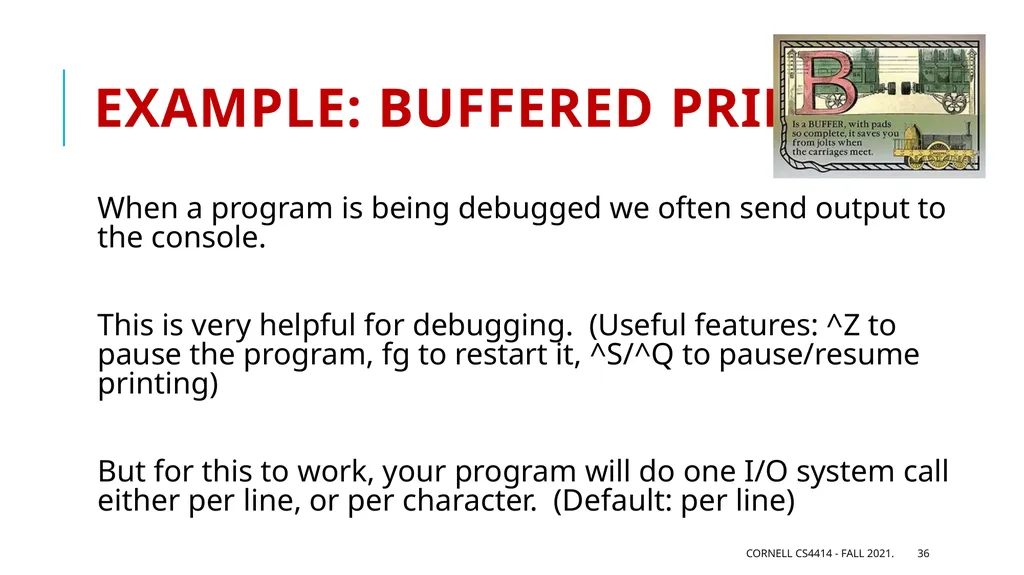
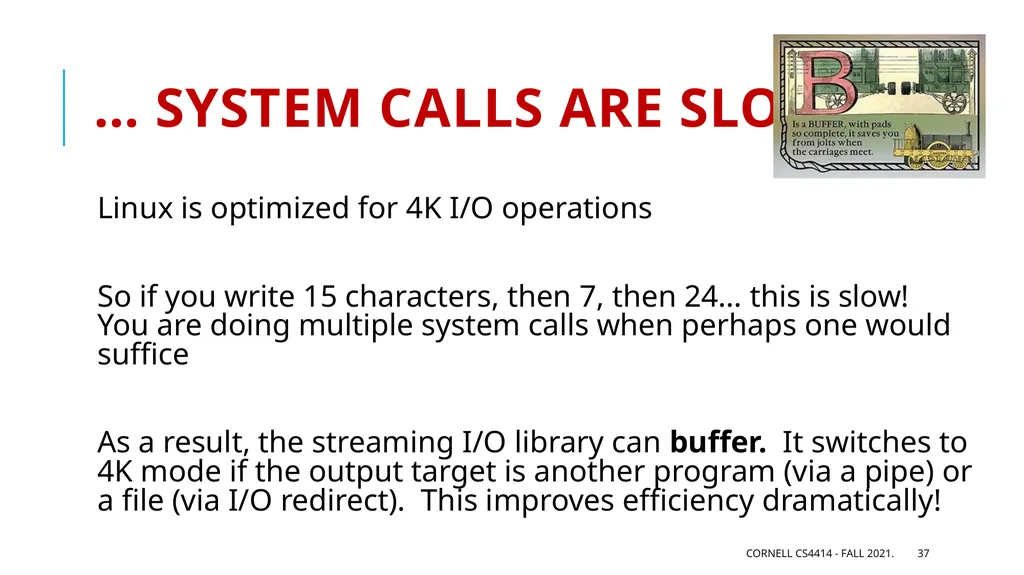
… system calls are slow! Linux is optimized for 4K I/O operations
So if you write 15 characters, then 7, then 24… this is slow! You are doing multiple system calls when perhaps one would suffice
As a result, the streaming I/O library can buffer. It switches to 4K mode if the output target is another program (via a pipe) or a file (via I/O redirect). This improves efficiency dramatically! Cornell CS4414 - Fall 2021. 37<br>
So if you write 15 characters, then 7, then 24… this is slow! You are doing multiple system calls when perhaps one would suffice
As a result, the streaming I/O library can buffer. It switches to 4K mode if the output target is another program (via a pipe) or a file (via I/O redirect). This improves efficiency dramatically! Cornell CS4414 - Fall 2021. 37<br>
38
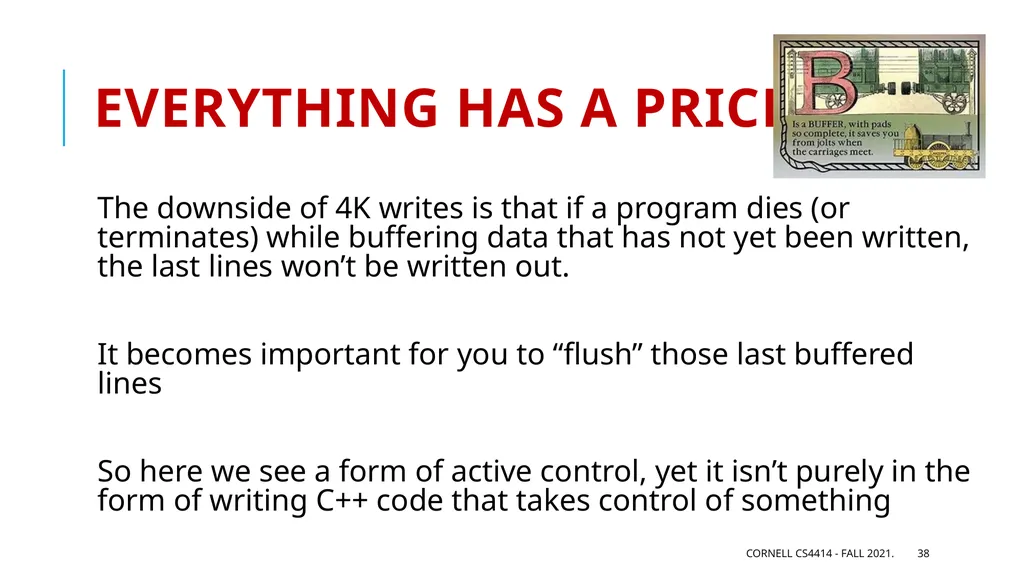
Everything Has a price… The downside of 4K writes is that if a program dies (or terminates) while buffering data that has not yet been written, the last lines won’t be written out.
It becomes important for you to “flush” those last buffered lines
So here we see a form of active control, yet it isn’t purely in the form of writing C++ code that takes control of something Cornell CS4414 - Fall 2021. 38<br>
It becomes important for you to “flush” those last buffered lines
So here we see a form of active control, yet it isn’t purely in the form of writing C++ code that takes control of something Cornell CS4414 - Fall 2021. 38<br>
39
What was the price? You gained performance, but accepted that I/O will be buffered and hence that your program might run for a while before each new write occurs.
This creates a mental cost: if the program stops unexpectedly or crashes, some I/O might not have been done. You need to be sure to flush that I/O – and this is the cost of buffering.
“Simpler, but slower” versus “faster, but a little harder to understand” Cornell CS4414 - Fall 2021. 39<br>
This creates a mental cost: if the program stops unexpectedly or crashes, some I/O might not have been done. You need to be sure to flush that I/O – and this is the cost of buffering.
“Simpler, but slower” versus “faster, but a little harder to understand” Cornell CS4414 - Fall 2021. 39<br>
40
Don’t sweat the small stuff Start by trying to understand whether something is 10x slower than it should be.
Finding the major bottlenecks, or the very inefficient pieces of a solution, can pay off: fixing those first gives dramatic improvements… After that, you can focus on smaller things Cornell CS4414 - Fall 2021. 40<br>
Finding the major bottlenecks, or the very inefficient pieces of a solution, can pay off: fixing those first gives dramatic improvements… After that, you can focus on smaller things Cornell CS4414 - Fall 2021. 40<br>
41
Algorithms (sometimes) matter… As a student you’ve learned a lot about algorithms
If the complexity genuinely reflects the costly resource, and we are in a situation where asymptotic costs are the bottleneck, picking the right algorithm is key.
But those two “ifs” are not minor points! Cornell CS4414 - Fall 2021. 41<br>
If the complexity genuinely reflects the costly resource, and we are in a situation where asymptotic costs are the bottleneck, picking the right algorithm is key.
But those two “ifs” are not minor points! Cornell CS4414 - Fall 2021. 41<br>
42
Efficient Algorithms don’t always focus on the costly resource Many algorithms were created using standard metrics like compute time for one thread, or space consumed
In a parallel setting with a lot of memory, we might be fine with spending memory to save time – we saw examples earlier today.
And computing may actually be “cheap” too! Cornell CS4414 - Fall 2021. 42<br>
In a parallel setting with a lot of memory, we might be fine with spending memory to save time – we saw examples earlier today.
And computing may actually be “cheap” too! Cornell CS4414 - Fall 2021. 42<br>
43
What would be a costly resource other than memory or CPU time? Think about disk access
If an algorithm is designed to focus on, say, balancing a tree for constant depth, but the tree is on a disk, the tree nodes might not really match one-to-one with 4K disk blocks.
The algorithm might do a lot of disk block reads and writes that the complexity metric doesn’t count. Those I/Os are costly! Cornell CS4414 - Fall 2021. 43<br>
If an algorithm is designed to focus on, say, balancing a tree for constant depth, but the tree is on a disk, the tree nodes might not really match one-to-one with 4K disk blocks.
The algorithm might do a lot of disk block reads and writes that the complexity metric doesn’t count. Those I/Os are costly! Cornell CS4414 - Fall 2021. 43<br>
44
… algorithms are conceptual tools When we work with algorithms we are working in a very conceptual way, highly abstracted from concrete resources. An algorithm is a design pattern
Our challenge as systems builders – engineers – is to map our understanding of the application into “relevant” algorithmic questions where the metrics we optimize are the costly aspects of the overall application pipeline. Cornell CS4414 - Fall 2021. 44<br>
Our challenge as systems builders – engineers – is to map our understanding of the application into “relevant” algorithmic questions where the metrics we optimize are the costly aspects of the overall application pipeline. Cornell CS4414 - Fall 2021. 44<br>
45
Summary The big picture is central to performance-oriented systems programming. Concurrency can hide pipeline delays.
We “gain control” over mechanisms in many ways – sometimes with our direct C++ code, but sometimes by arranging our program in clever ways, or by giving useful hints to the C++ compiler or Linux knowing they will make smart choices Cornell CS4414 - Fall 2021. 45<br>
We “gain control” over mechanisms in many ways – sometimes with our direct C++ code, but sometimes by arranging our program in clever ways, or by giving useful hints to the C++ compiler or Linux knowing they will make smart choices Cornell CS4414 - Fall 2021. 45<br>
46
Summary Start by understanding bottlenecks and visualizing the desired flow of your computation.
You won’t be able to improve performance unless you understand goals, and understand where you started.
Random changes just make code messy, add bugs, and might not help – we want to only make the right changes. Cornell CS4414 - Fall 2021. 46<br>
You won’t be able to improve performance unless you understand goals, and understand where you started.
Random changes just make code messy, add bugs, and might not help – we want to only make the right changes. Cornell CS4414 - Fall 2021. 46<br>
47
Summary: Bottlenecks They really come in two forms
Unavoidable work being done as efficiently as possible
Accidental work (or delays, perhaps even idle time) arising from some form of mismatch between our code and the system
Once you identify a bottleneck, you can often intervene to improve exactly the slow step Cornell CS4414 - Fall 2021. 47<br>
Unavoidable work being done as efficiently as possible
Accidental work (or delays, perhaps even idle time) arising from some form of mismatch between our code and the system
Once you identify a bottleneck, you can often intervene to improve exactly the slow step Cornell CS4414 - Fall 2021. 47<br>
48
Should we worry about
Ecocomputing? A busier machine will have increased energy costs
Modern NUMA systems power-down unused components
Choice: Use fewer cores, or use more to finish the job sooner? Cornell CS4414 - Fall 2021. 48 Either turn off the machine or use it “fully” and efficiently.<br>
Modern NUMA systems power-down unused components
Choice: Use fewer cores, or use more to finish the job sooner? Cornell CS4414 - Fall 2021. 48 Either turn off the machine or use it “fully” and efficiently.<br>
49
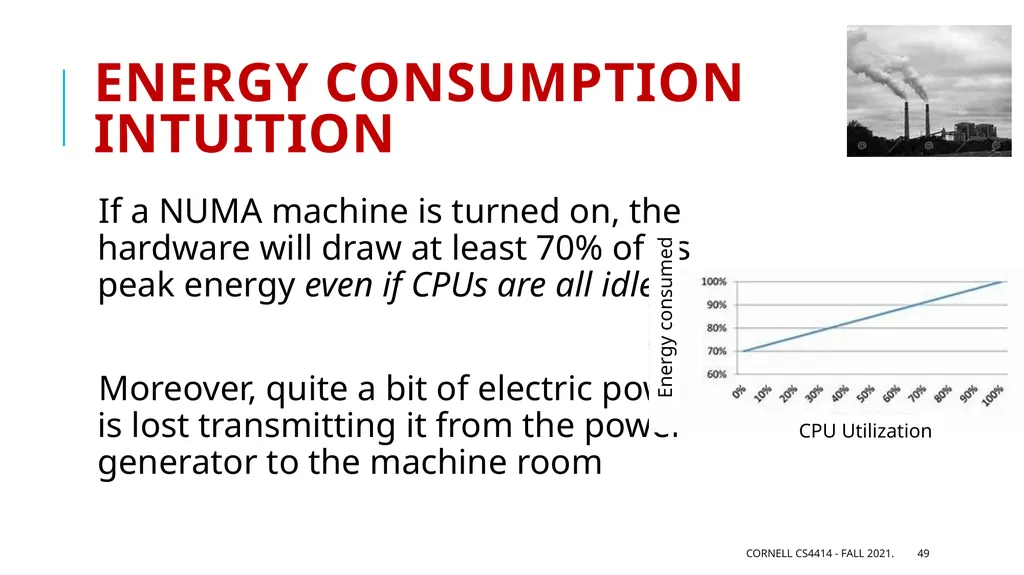
Energy consumption intuition If a NUMA machine is turned on, the
hardware will draw at least 70% of its
peak energy even if CPUs are all idle
Moreover, quite a bit of electric power is lost transmitting it from the power generator to the machine room Cornell CS4414 - Fall 2021. 49 Energy consumed CPU Utilization<br>
Moreover, quite a bit of electric power is lost transmitting it from the power generator to the machine room Cornell CS4414 - Fall 2021. 49 Energy consumed CPU Utilization<br>
50
Next lecture: Performance monitoring Linux is full of tools we can use to measure performance and even understand overhead sources
These tools enable us to compare actual behavior of a program with our conceptual expectations
We’ll see how they can let us find bottlenecks Cornell CS4414 - Fall 2021. 50<br>
These tools enable us to compare actual behavior of a program with our conceptual expectations
We’ll see how they can let us find bottlenecks Cornell CS4414 - Fall 2021. 50<br>