
Performance Management Training for Supervisors


Description: Performance Management Training for Supervisors WELCOME! Performance Management Training 2 Introduction Performance management is the broad collection of activities designed to maximize individual and, by extension, organizational
Related Topics
Download Presentation
"Performance Management Training for Supervisors" is the property of its rightful owner. Permission is granted to download and print the materials on this website for personal, non-commercial use only, and to display it on your personal computer provided you do not modify the materials and that you retain all copyright notices contained in the materials. By downloading content from our website, you accept the terms of this agreement.
Presentation Transcript
slide1. Performance Management Training for Supervisors<br>
slide2. WELCOME! Performance Management Training 2<br>
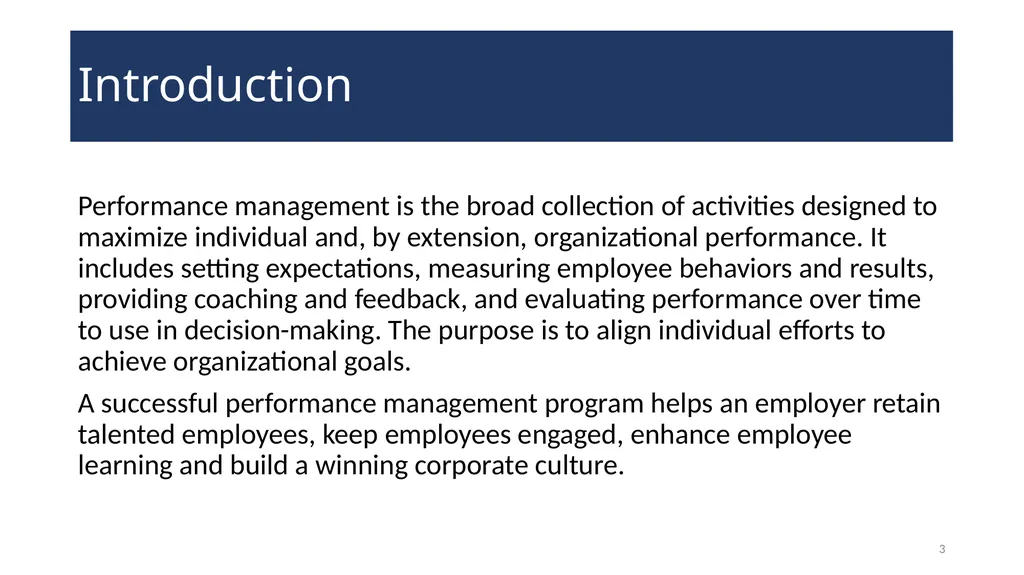
slide3. Introduction Performance management is the broad collection of activities designed to maximize individual and, by extension, organizational performance. It includes setting expectations, measuring employee behaviors and results, providing coaching and feedback, and evaluating performance over time to use in decision-making. The purpose is to align individual efforts to achieve organizational goals.
A successful performance management program helps an employer retain talented employees, keep employees engaged, enhance employee learning and build a winning corporate culture. 3<br>
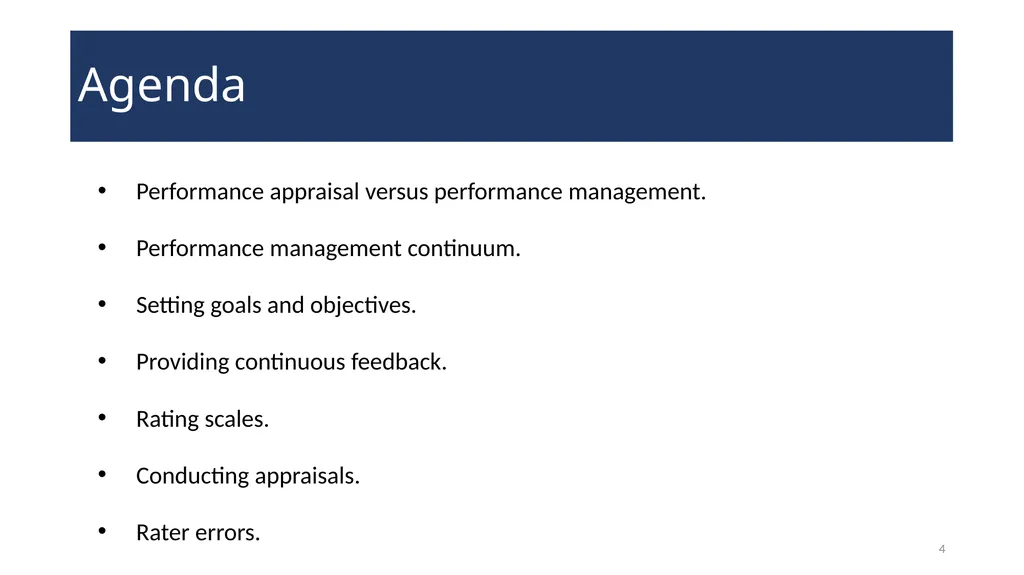
slide4. Agenda Performance appraisal versus performance management.
Performance management continuum.
Setting goals and objectives.
Providing continuous feedback.
Rating scales.
Conducting appraisals.
Rater errors. 4<br>
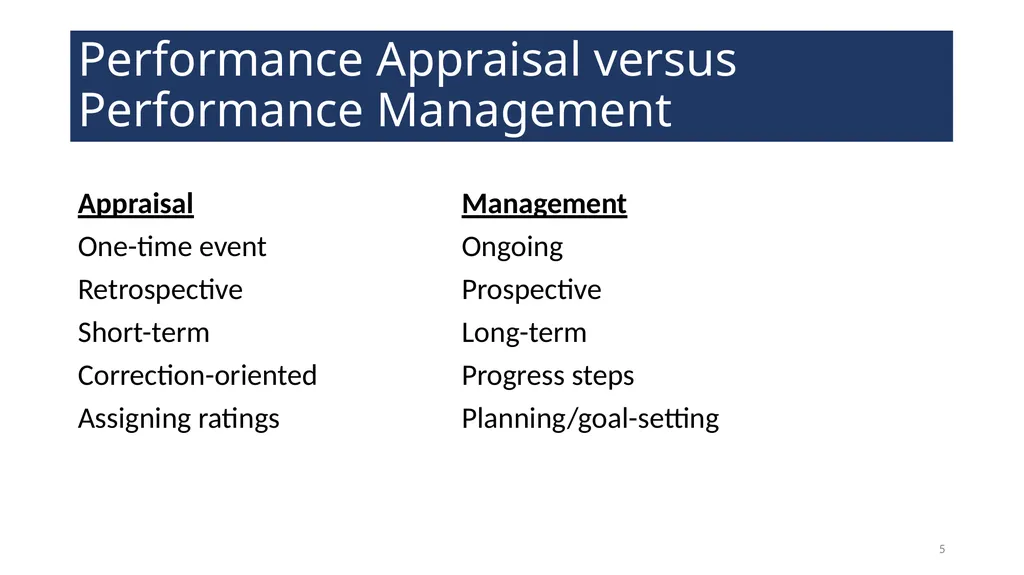
slide5. Performance Appraisal versus Performance Management Appraisal Management
One-time event Ongoing
Retrospective Prospective
Short-term Long-term
Correction-oriented Progress steps
Assigning ratings Planning/goal-setting 5<br>
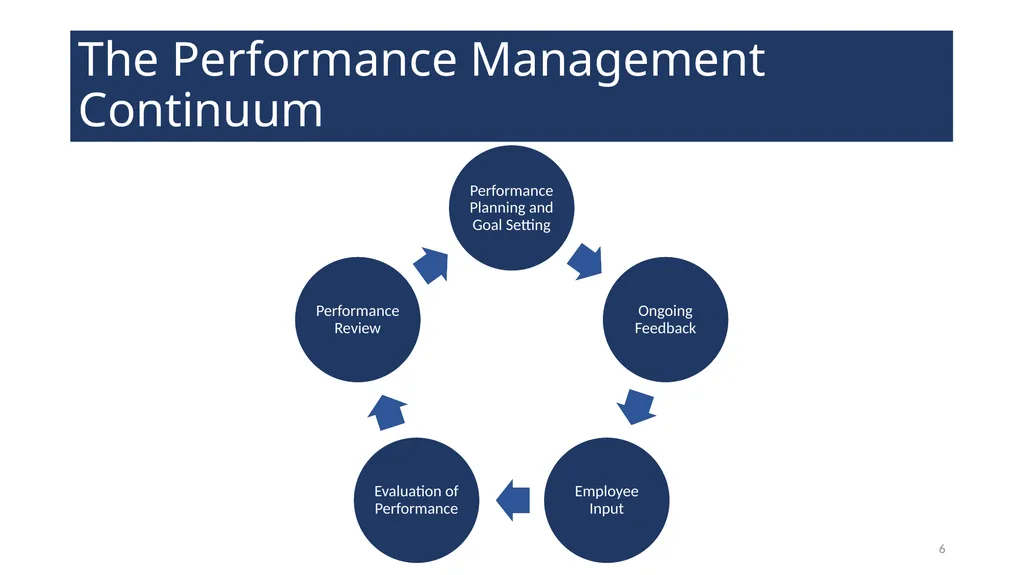
slide6. The Performance Management Continuum 6<br>
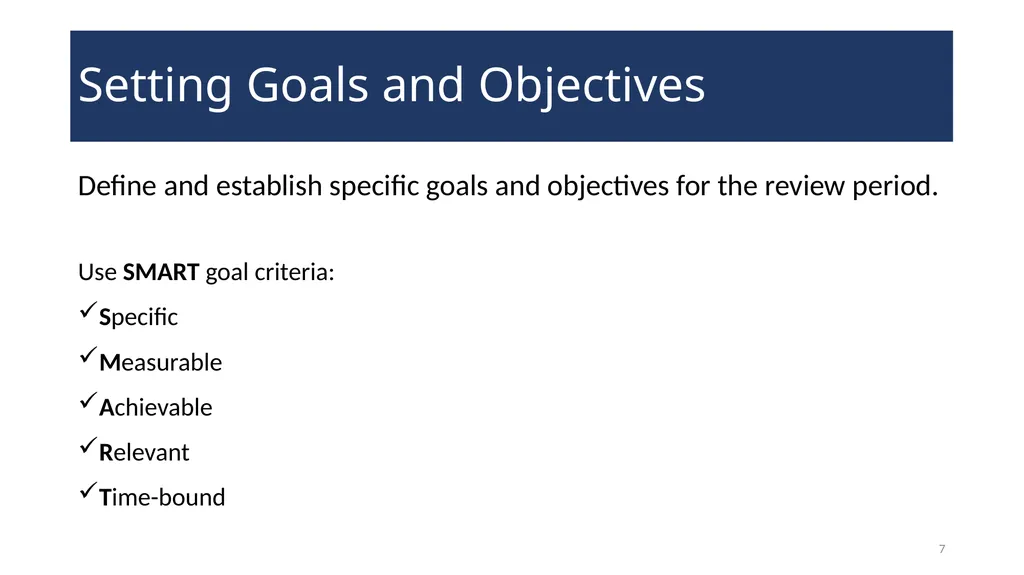
slide7. Setting Goals and Objectives Define and establish specific goals and objectives for the review period.
Use SMART goal criteria:
Specific
Measurable
Achievable
Relevant
Time-bound 7<br>
slide8. Setting Goals and Objectives (cont.) Align goals and objectives with the organization’s business plan.
Establish mutually agreed-upon goals between the employee and the manager.
Establish milestone review dates.
Communicate changes or redirection of goals and objectives in a timely manner. 8<br>
slide9. Questions? Comments? 9<br>
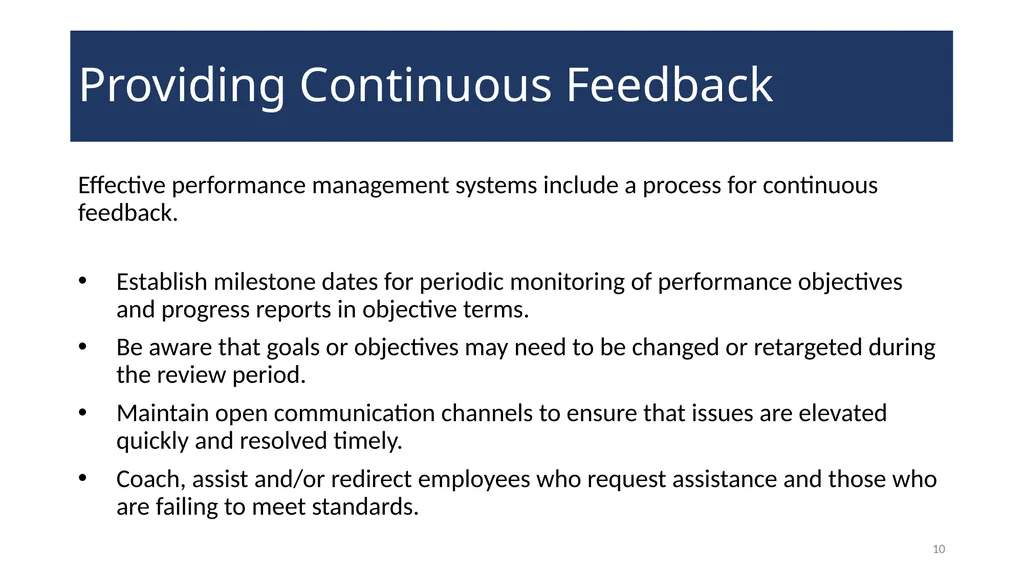
slide10. Providing Continuous Feedback Effective performance management systems include a process for continuous feedback.
Establish milestone dates for periodic monitoring of performance objectives and progress reports in objective terms.
Be aware that goals or objectives may need to be changed or retargeted during the review period.
Maintain open communication channels to ensure that issues are elevated quickly and resolved timely.
Coach, assist and/or redirect employees who request assistance and those who are failing to meet standards. 10<br>
slide11. Questions? Comments? 11<br>
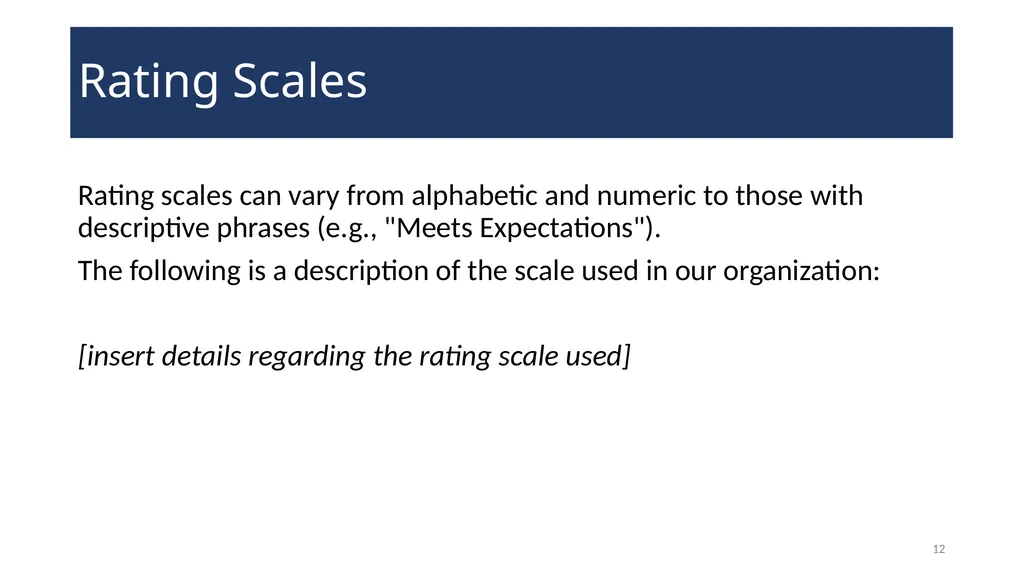
slide12. Rating Scales Rating scales can vary from alphabetic and numeric to those with descriptive phrases (e.g., "Meets Expectations").
The following is a description of the scale used in our organization:
[insert details regarding the rating scale used] 12<br>
slide13. Questions? Comments? 13<br>
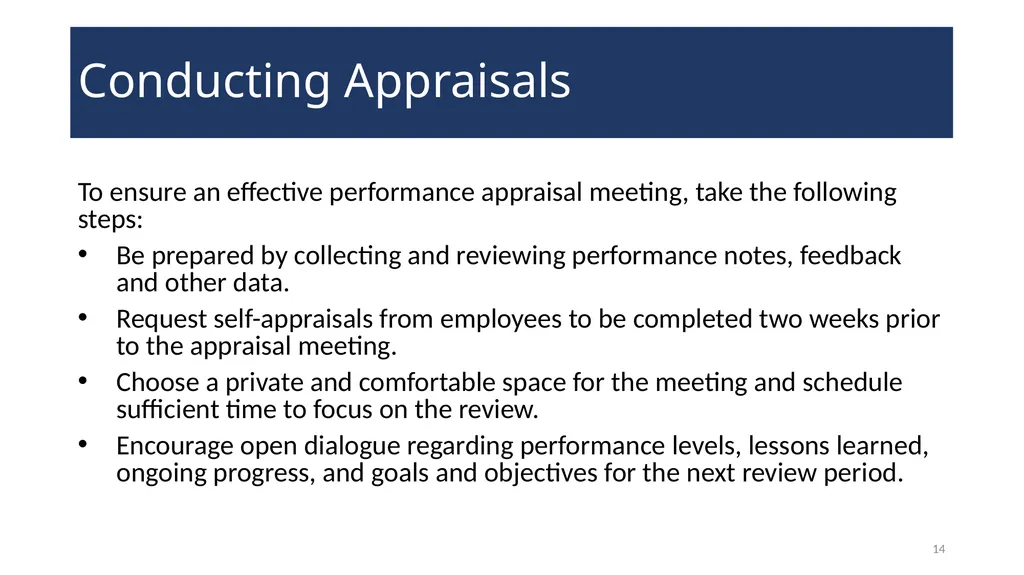
slide14. Conducting Appraisals To ensure an effective performance appraisal meeting, take the following steps:
Be prepared by collecting and reviewing performance notes, feedback and other data.
Request self-appraisals from employees to be completed two weeks prior to the appraisal meeting.
Choose a private and comfortable space for the meeting and schedule sufficient time to focus on the review.
Encourage open dialogue regarding performance levels, lessons learned, ongoing progress, and goals and objectives for the next review period. 14<br>
slide15. Questions? Comments? 15<br>
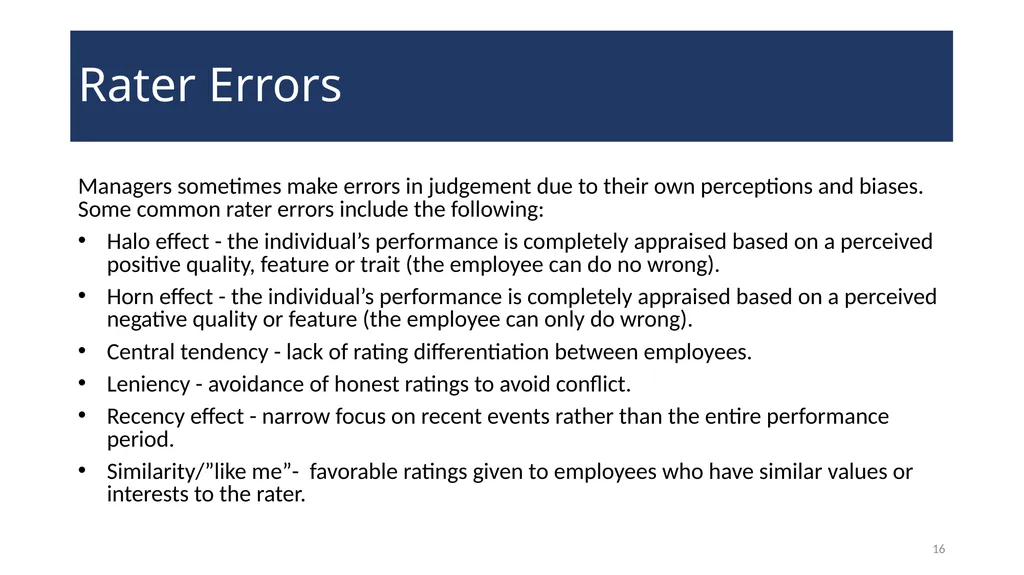
slide16. Rater Errors Managers sometimes make errors in judgement due to their own perceptions and biases. Some common rater errors include the following:
Halo effect - the individual’s performance is completely appraised based on a perceived positive quality, feature or trait (the employee can do no wrong).
Horn effect - the individual’s performance is completely appraised based on a perceived negative quality or feature (the employee can only do wrong).
Central tendency - lack of rating differentiation between employees.
Leniency - avoidance of honest ratings to avoid conflict.
Recency effect - narrow focus on recent events rather than the entire performance period.
Similarity/”like me”- favorable ratings given to employees who have similar values or interests to the rater. 16<br>
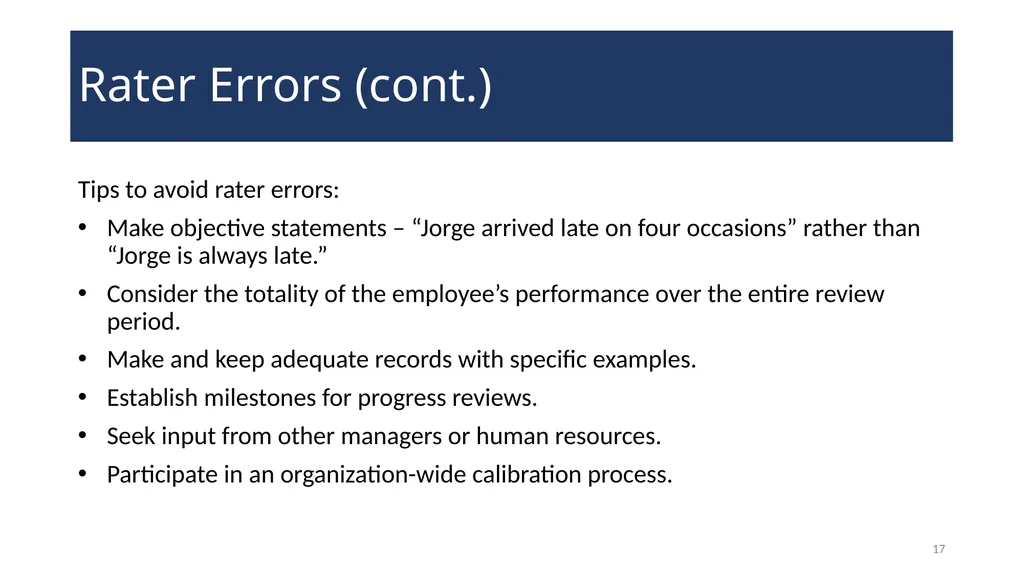
slide17. Rater Errors (cont.) Tips to avoid rater errors:
Make objective statements – “Jorge arrived late on four occasions” rather than “Jorge is always late.”
Consider the totality of the employee’s performance over the entire review period.
Make and keep adequate records with specific examples.
Establish milestones for progress reviews.
Seek input from other managers or human resources.
Participate in an organization-wide calibration process. 17<br>
slide18. Questions? Comments? 18<br>
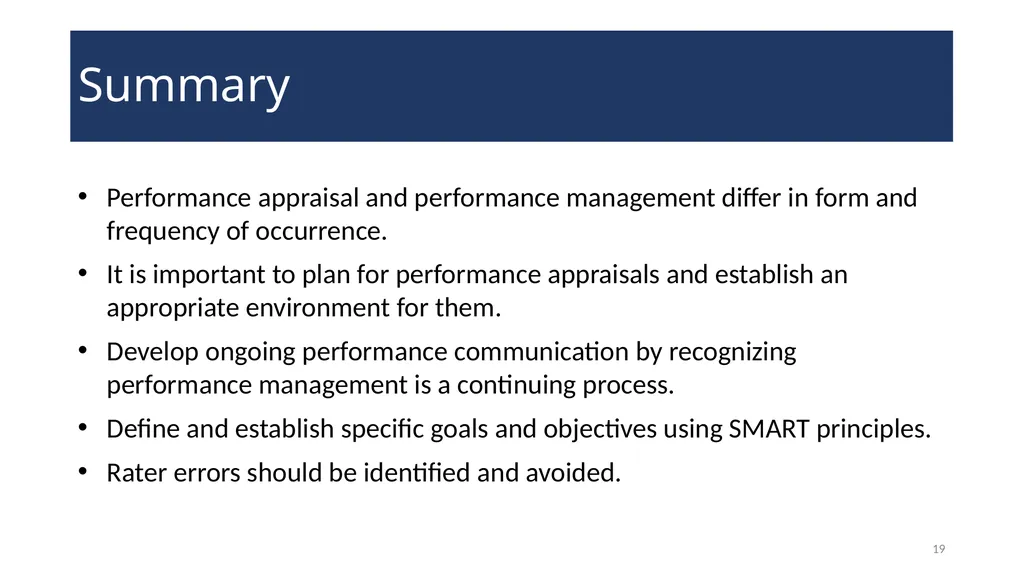
slide19. Summary 19 Performance appraisal and performance management differ in form and frequency of occurrence.
It is important to plan for performance appraisals and establish an appropriate environment for them.
Develop ongoing performance communication by recognizing performance management is a continuing process.
Define and establish specific goals and objectives using SMART principles.
Rater errors should be identified and avoided.<br>
slide20. Questions? Comments? 20<br>
slide21. Training Evaluation Please complete the training evaluation sheet included in the handouts.
Thank you for your interest and attention! 21<br>
slide2. WELCOME! Performance Management Training 2<br>
slide3. Introduction Performance management is the broad collection of activities designed to maximize individual and, by extension, organizational performance. It includes setting expectations, measuring employee behaviors and results, providing coaching and feedback, and evaluating performance over time to use in decision-making. The purpose is to align individual efforts to achieve organizational goals.
A successful performance management program helps an employer retain talented employees, keep employees engaged, enhance employee learning and build a winning corporate culture. 3<br>
slide4. Agenda Performance appraisal versus performance management.
Performance management continuum.
Setting goals and objectives.
Providing continuous feedback.
Rating scales.
Conducting appraisals.
Rater errors. 4<br>
slide5. Performance Appraisal versus Performance Management Appraisal Management
One-time event Ongoing
Retrospective Prospective
Short-term Long-term
Correction-oriented Progress steps
Assigning ratings Planning/goal-setting 5<br>
slide6. The Performance Management Continuum 6<br>
slide7. Setting Goals and Objectives Define and establish specific goals and objectives for the review period.
Use SMART goal criteria:
Specific
Measurable
Achievable
Relevant
Time-bound 7<br>
slide8. Setting Goals and Objectives (cont.) Align goals and objectives with the organization’s business plan.
Establish mutually agreed-upon goals between the employee and the manager.
Establish milestone review dates.
Communicate changes or redirection of goals and objectives in a timely manner. 8<br>
slide9. Questions? Comments? 9<br>
slide10. Providing Continuous Feedback Effective performance management systems include a process for continuous feedback.
Establish milestone dates for periodic monitoring of performance objectives and progress reports in objective terms.
Be aware that goals or objectives may need to be changed or retargeted during the review period.
Maintain open communication channels to ensure that issues are elevated quickly and resolved timely.
Coach, assist and/or redirect employees who request assistance and those who are failing to meet standards. 10<br>
slide11. Questions? Comments? 11<br>
slide12. Rating Scales Rating scales can vary from alphabetic and numeric to those with descriptive phrases (e.g., "Meets Expectations").
The following is a description of the scale used in our organization:
[insert details regarding the rating scale used] 12<br>
slide13. Questions? Comments? 13<br>
slide14. Conducting Appraisals To ensure an effective performance appraisal meeting, take the following steps:
Be prepared by collecting and reviewing performance notes, feedback and other data.
Request self-appraisals from employees to be completed two weeks prior to the appraisal meeting.
Choose a private and comfortable space for the meeting and schedule sufficient time to focus on the review.
Encourage open dialogue regarding performance levels, lessons learned, ongoing progress, and goals and objectives for the next review period. 14<br>
slide15. Questions? Comments? 15<br>
slide16. Rater Errors Managers sometimes make errors in judgement due to their own perceptions and biases. Some common rater errors include the following:
Halo effect - the individual’s performance is completely appraised based on a perceived positive quality, feature or trait (the employee can do no wrong).
Horn effect - the individual’s performance is completely appraised based on a perceived negative quality or feature (the employee can only do wrong).
Central tendency - lack of rating differentiation between employees.
Leniency - avoidance of honest ratings to avoid conflict.
Recency effect - narrow focus on recent events rather than the entire performance period.
Similarity/”like me”- favorable ratings given to employees who have similar values or interests to the rater. 16<br>
slide17. Rater Errors (cont.) Tips to avoid rater errors:
Make objective statements – “Jorge arrived late on four occasions” rather than “Jorge is always late.”
Consider the totality of the employee’s performance over the entire review period.
Make and keep adequate records with specific examples.
Establish milestones for progress reviews.
Seek input from other managers or human resources.
Participate in an organization-wide calibration process. 17<br>
slide18. Questions? Comments? 18<br>
slide19. Summary 19 Performance appraisal and performance management differ in form and frequency of occurrence.
It is important to plan for performance appraisals and establish an appropriate environment for them.
Develop ongoing performance communication by recognizing performance management is a continuing process.
Define and establish specific goals and objectives using SMART principles.
Rater errors should be identified and avoided.<br>
slide20. Questions? Comments? 20<br>
slide21. Training Evaluation Please complete the training evaluation sheet included in the handouts.
Thank you for your interest and attention! 21<br>