Pharmaceutical Inorganic chemistry Limit Test Presented By Ms. M. ANUSHA (Assistant Professor) St. Peters Institute of Pharmaceutical Sciences. Limit tests:- Definition: Limit tests are quantitative or semi quantitative test designed to
"Pharmaceutical Inorganic chemistry Limit Test" is the property of its rightful owner. Permission is granted to
download and print the materials on this website for personal, non-commercial use only, and to display it
on your personal computer provided you do not modify the materials and that you retain all copyright
notices contained in the materials. By downloading content from our website, you accept the terms of this
agreement.
Presentation Transcript
01
Pharmaceutical Inorganic chemistry Limit Test Presented By
Ms. M. ANUSHA
(Assistant Professor) St. Peter’s Institute of Pharmaceutical Sciences.<br>
02
Limit tests:- Definition: Limit tests are quantitative or semi quantitative test designed to identify and control small quantities of impurities which are likely to be present in the substances.
Tests being used to identify the impurity.
Tests being used to control the impurity.<br>
03
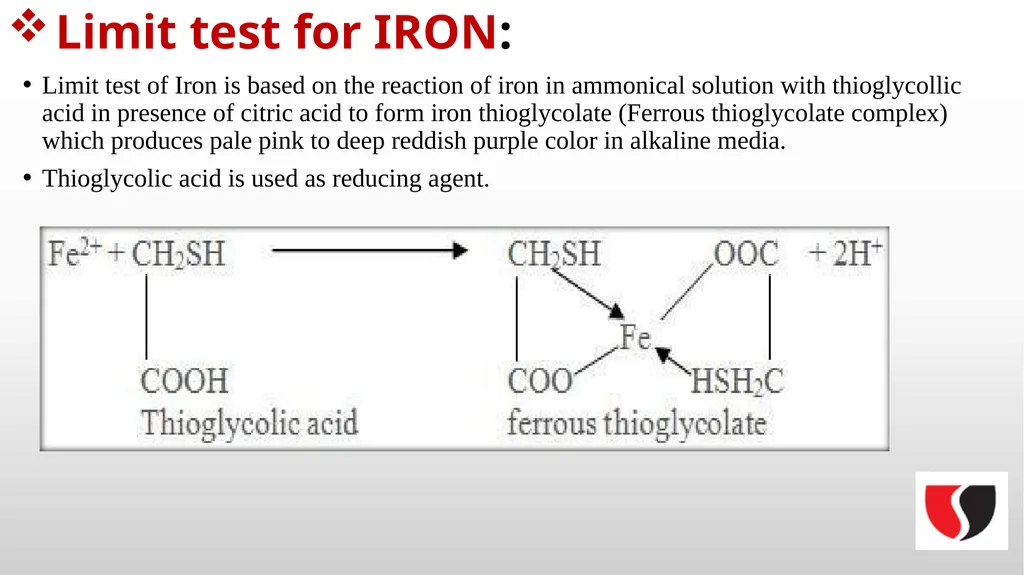
Limit test for IRON: Limit test of Iron is based on the reaction of iron in ammonical solution with thioglycollic acid in presence of citric acid to form iron thioglycolate (Ferrous thioglycolate complex) which produces pale pink to deep reddish purple color in alkaline media.
Thioglycolic acid is used as reducing agent.<br>
04
The color of the Ferrous thioglycolate complex fades in the presence of air due to oxidation.
Also, the color is destroyed in presence of oxidizing agents and strong alkalis.
The purple color is developed only in alkaline media. So ammonia solution is used.
But ammonia reacts with iron, forms precipitate of ferrous hydroxide.
Thus citric acid is used which prevents the precipitate of iron with Ammonia by forming a complex with iron as iron citrate.<br>
05
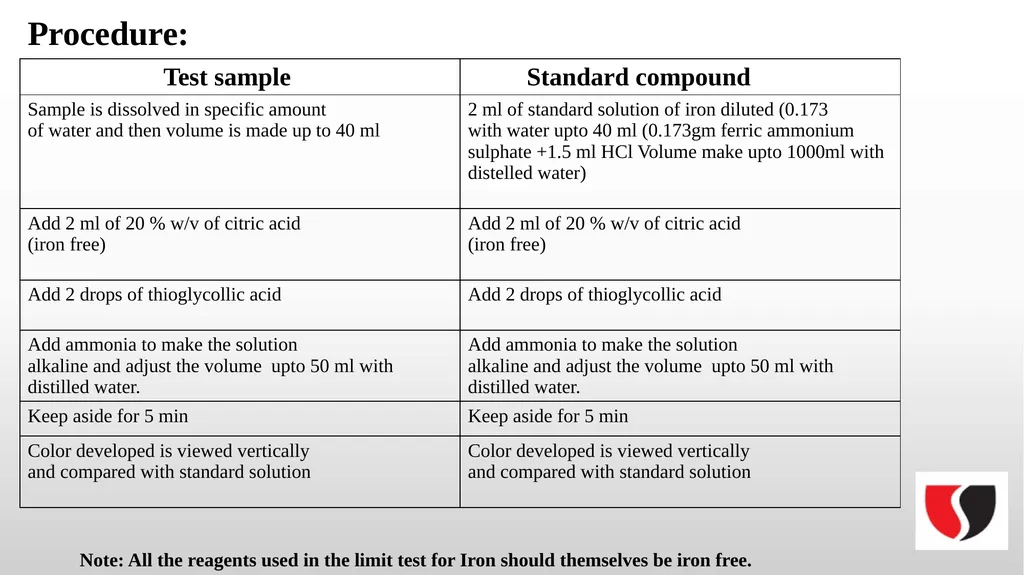
Procedure: Note: All the reagents used in the limit test for Iron should themselves be iron free.<br>
06
Observation:
The purple color produce in sample solution should not be greater than standard solution. If purple color produces in sample solution is less than the standard solution, the sample will pass the limit test of iron and vice versa.
Reasons:
Citric acid forms complex with metal cation and helps precipitation of iron by ammonia by forming a complex with it.
Thioglycolic acid helps to oxidize iron (II) to iron (III).
Ammonia is added to make solution alkaline. The pale pink color is visible only in the alkaline media. The color is not visible in acidic media as ferrous thioglycolate complex decomposes in high acidic media.<br>