
Phase 1 Progress Review Discussion Template GSA,
Description: Phase 1 Progress Review Discussion Template GSA, Office of Shared Solutions and Performance Improvement Month, Year This template is intended to guide a Progress Review discussion between a Customer, Provider and Key Stakeholders. Questions
Related Topics
Download Presentation
"Phase 1 Progress Review Discussion Template GSA," is the property of its rightful owner. Permission is granted to download and print the materials on this website for personal, non-commercial use only, and to display it on your personal computer provided you do not modify the materials and that you retain all copyright notices contained in the materials. By downloading content from our website, you accept the terms of this agreement.
Presentation Transcript
slide1. Phase 1 Progress Review Discussion Template GSA, Office of Shared Solutions and Performance Improvement
Month, Year<br>
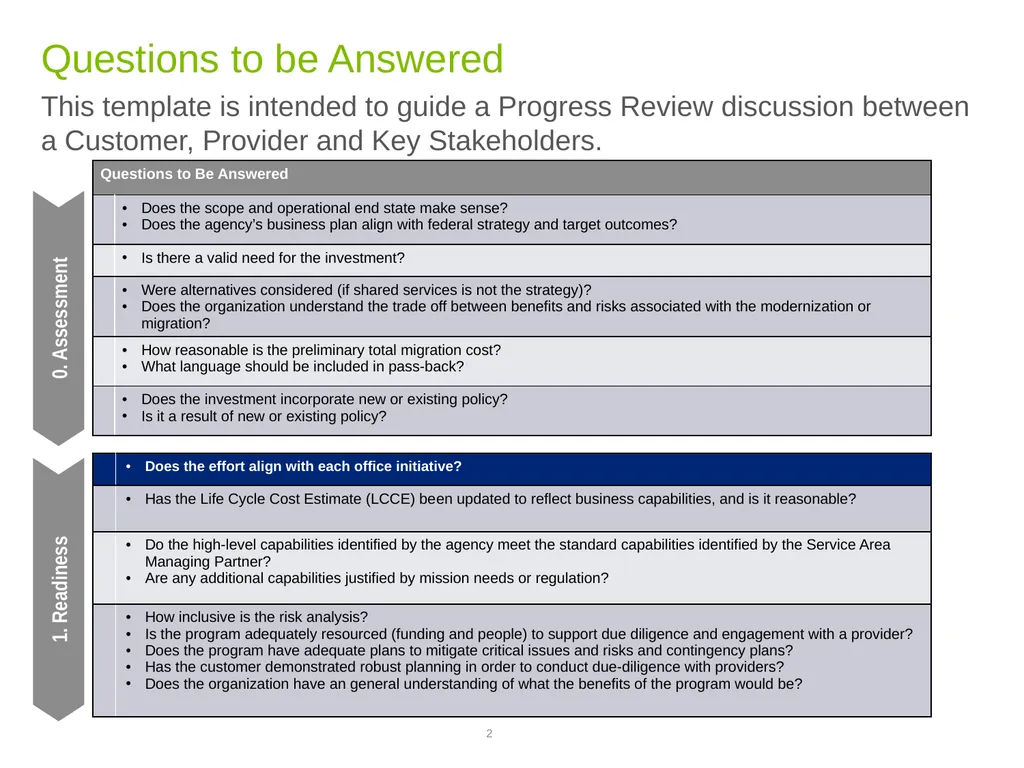
slide2. This template is intended to guide a Progress Review discussion between a Customer, Provider and Key Stakeholders. Questions to be Answered 0. Assessment 1. Readiness<br>
slide3. This template is intended to guide a Progress Review discussion between a Customer, Provider and Key Stakeholders. Instructions for Completing This Template To use this template:
Use the source documents included within each slide to develop summary-level information that will help guide the Progress Review
Be prepared to discuss specific questions/content included on each slide before or during the Progress Review
Once complete, schedule a Progress Review meeting<br>
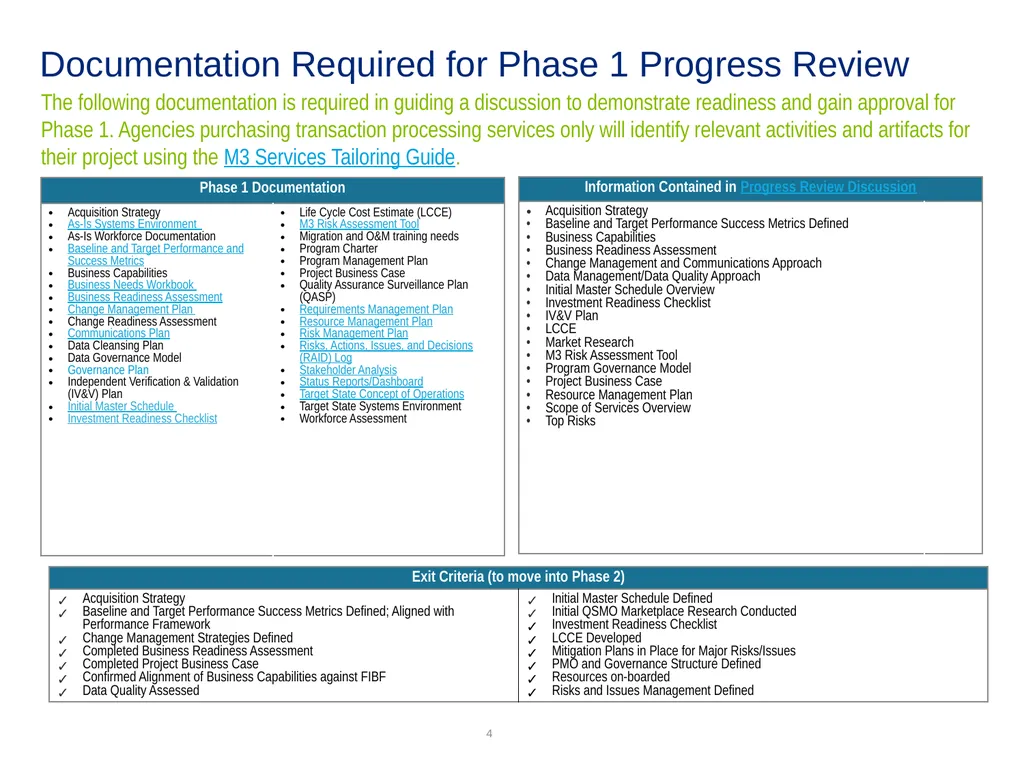
slide4. Documentation Required for Phase 1 Progress Review The following documentation is required in guiding a discussion to demonstrate readiness and gain approval for Phase 1. Agencies purchasing transaction processing services only will identify relevant activities and artifacts for their project using the M3 Services Tailoring Guide.<br>
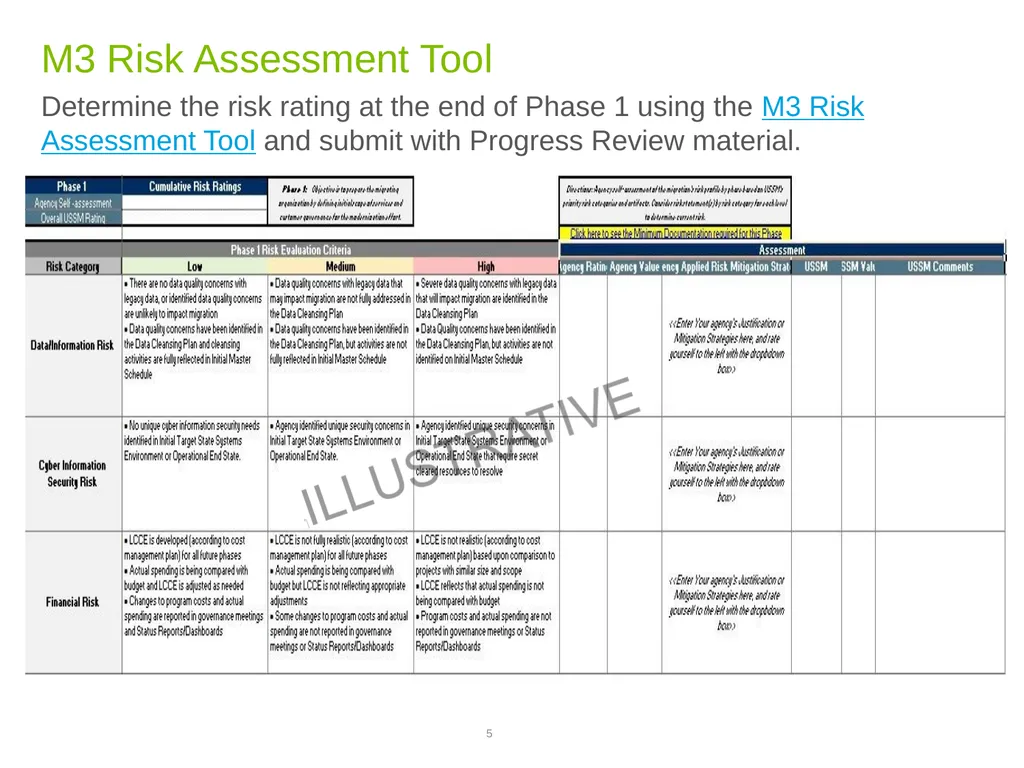
slide5. Determine the risk rating at the end of Phase 1 using the M3 Risk Assessment Tool and submit with Progress Review material. M3 Risk Assessment Tool<br>
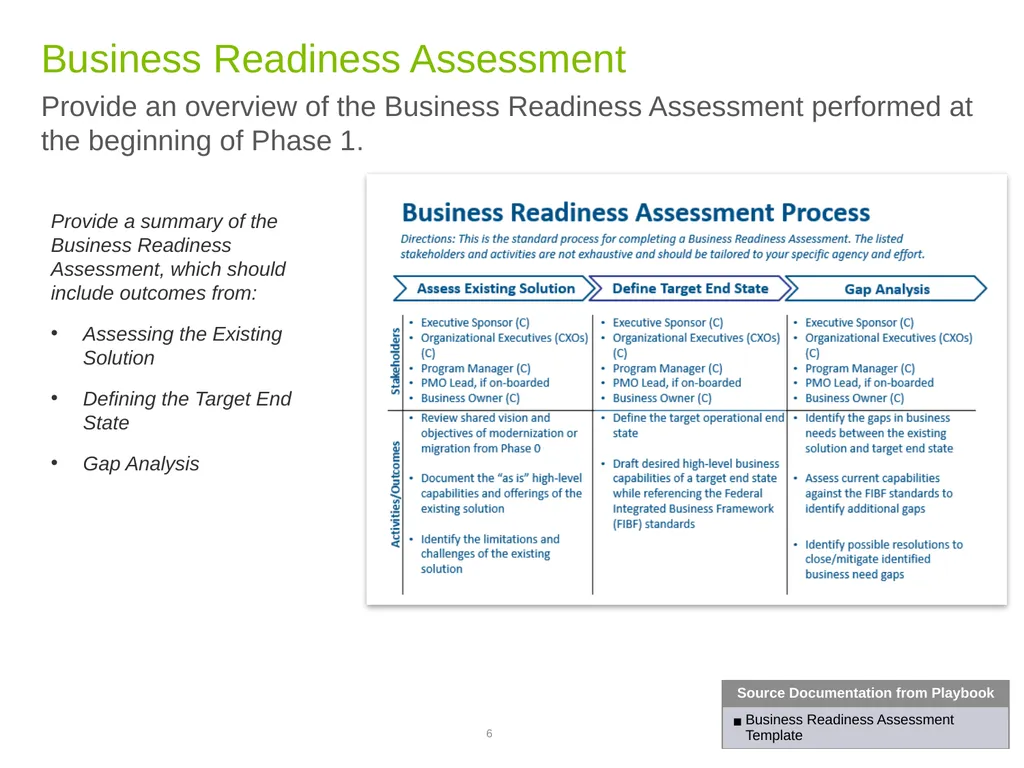
slide6. Provide an overview of the Business Readiness Assessment performed at the beginning of Phase 1. Business Readiness Assessment Provide a summary of the Business Readiness Assessment, which should include outcomes from:
Assessing the Existing Solution
Defining the Target End State
Gap Analysis<br>
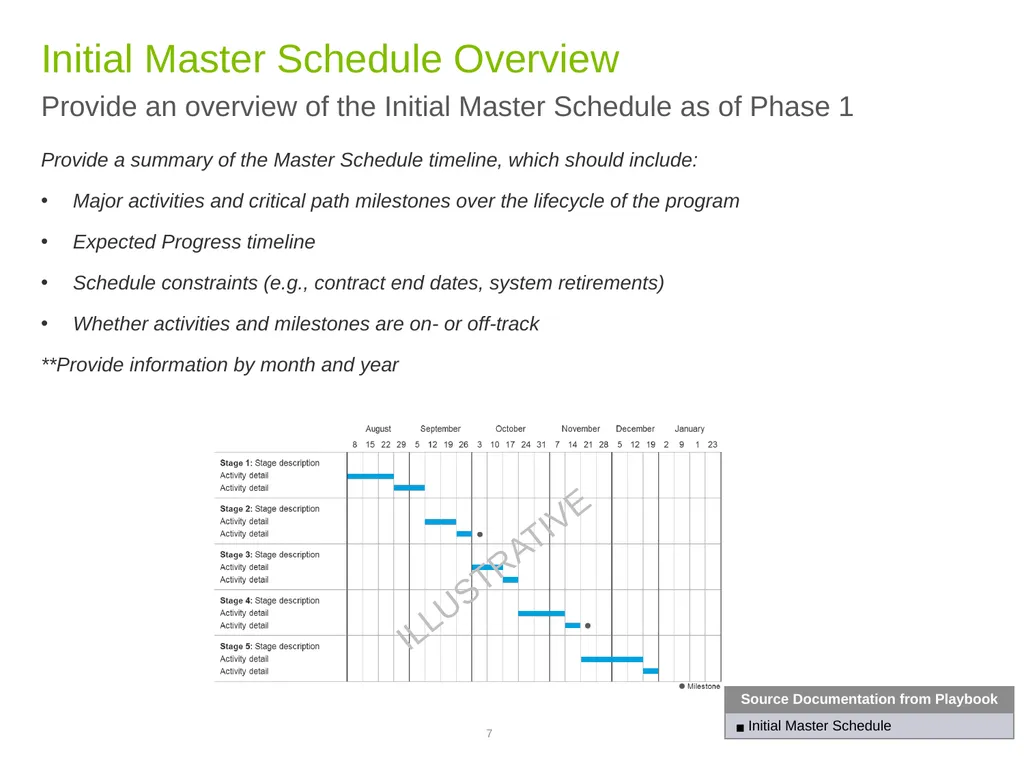
slide7. Provide an overview of the Initial Master Schedule as of Phase 1 Initial Master Schedule Overview Provide a summary of the Master Schedule timeline, which should include:
Major activities and critical path milestones over the lifecycle of the program
Expected Progress timeline
Schedule constraints (e.g., contract end dates, system retirements)
Whether activities and milestones are on- or off-track
**Provide information by month and year ILLUSTRATIVE<br>
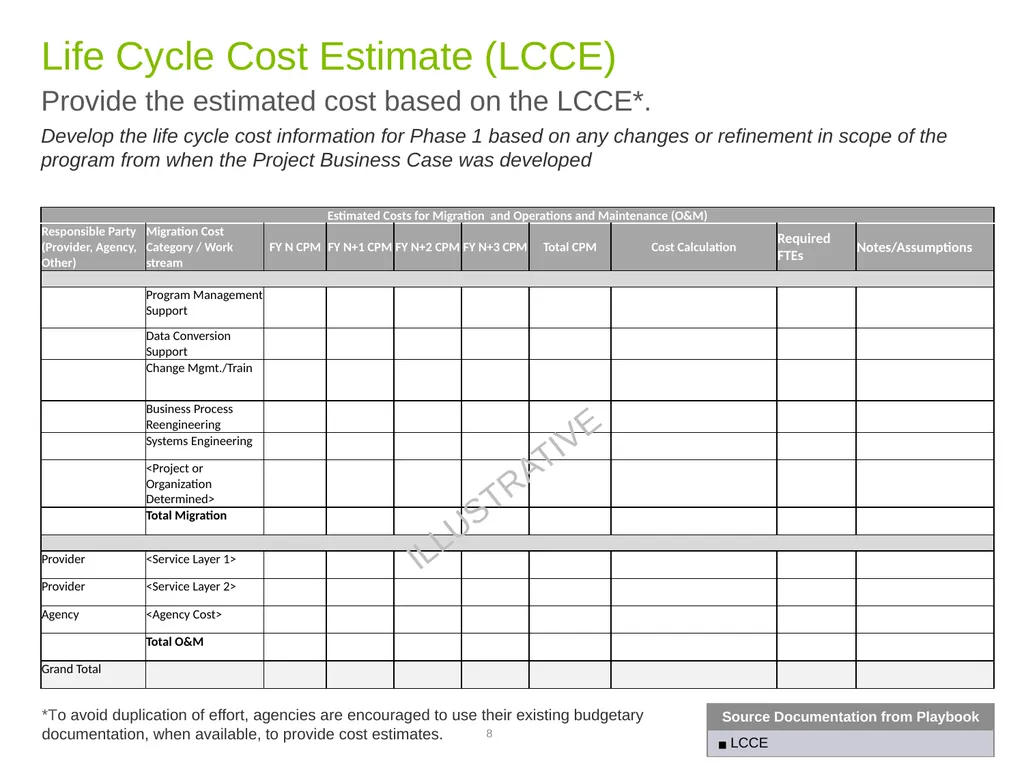
slide8. Provide the estimated cost based on the LCCE*. Life Cycle Cost Estimate (LCCE) Develop the life cycle cost information for Phase 1 based on any changes or refinement in scope of the program from when the Project Business Case was developed ILLUSTRATIVE *To avoid duplication of effort, agencies are encouraged to use their existing budgetary documentation, when available, to provide cost estimates.<br>
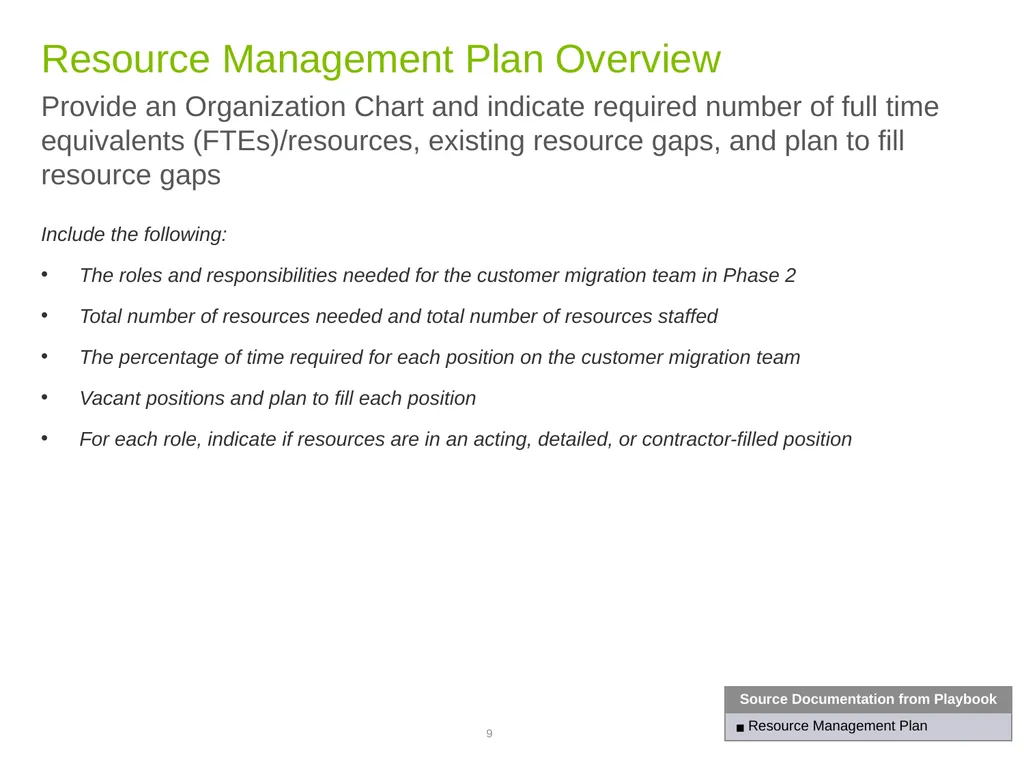
slide9. Provide an Organization Chart and indicate required number of full time equivalents (FTEs)/resources, existing resource gaps, and plan to fill resource gaps Resource Management Plan Overview Include the following:
The roles and responsibilities needed for the customer migration team in Phase 2
Total number of resources needed and total number of resources staffed
The percentage of time required for each position on the customer migration team
Vacant positions and plan to fill each position
For each role, indicate if resources are in an acting, detailed, or contractor-filled position<br>
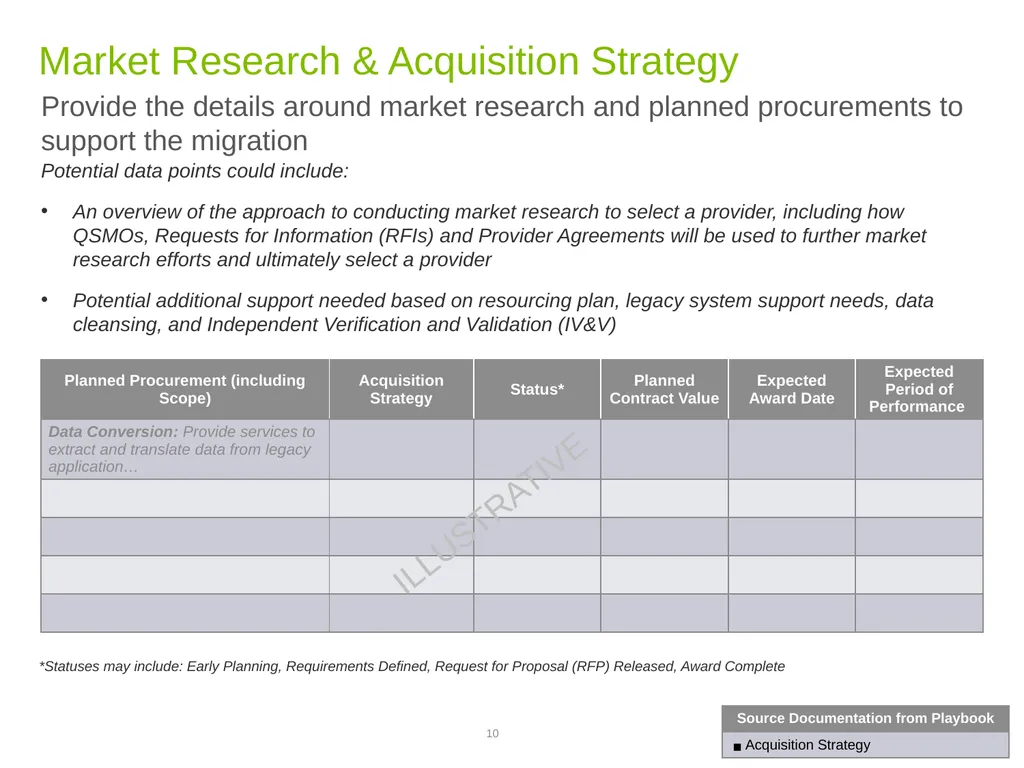
slide10. Provide the details around market research and planned procurements to support the migration Market Research & Acquisition Strategy Potential data points could include:
An overview of the approach to conducting market research to select a provider, including how QSMOs, Requests for Information (RFIs) and Provider Agreements will be used to further market research efforts and ultimately select a provider
Potential additional support needed based on resourcing plan, legacy system support needs, data cleansing, and Independent Verification and Validation (IV&V) ILLUSTRATIVE *Statuses may include: Early Planning, Requirements Defined, Request for Proposal (RFP) Released, Award Complete<br>
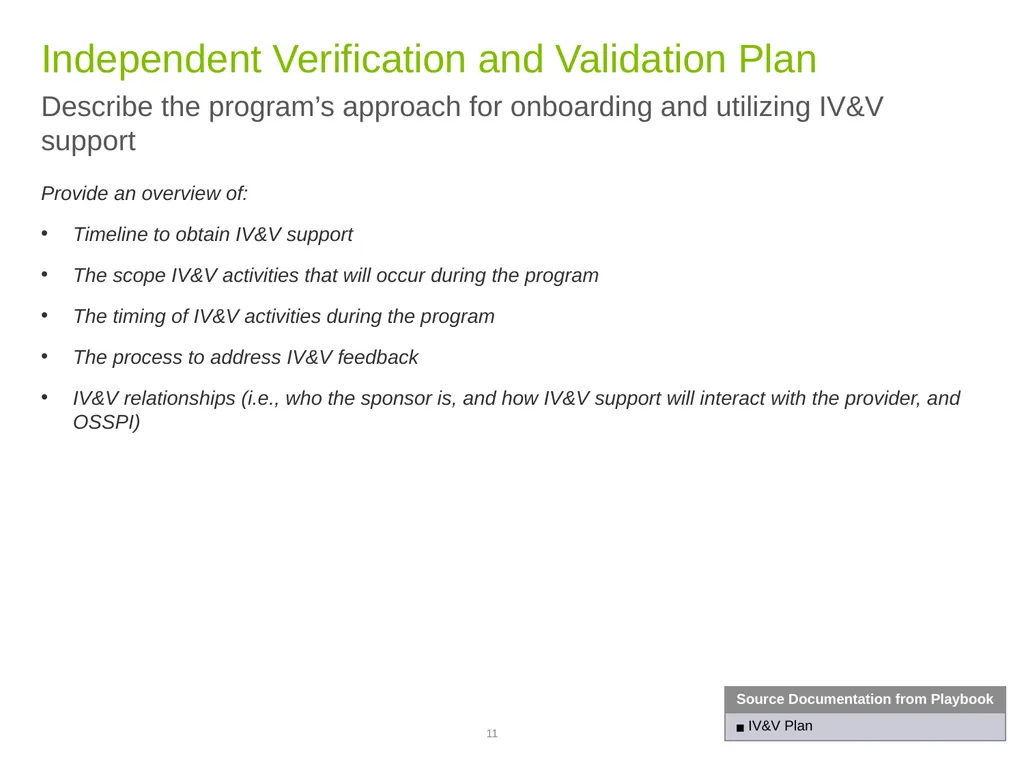
slide11. Describe the program’s approach for onboarding and utilizing IV&V support Independent Verification and Validation Plan Provide an overview of:
Timeline to obtain IV&V support
The scope IV&V activities that will occur during the program
The timing of IV&V activities during the program
The process to address IV&V feedback
IV&V relationships (i.e., who the sponsor is, and how IV&V support will interact with the provider, and OSSPI)<br>
slide12. Describe the program’s governance model Program Governance Model Consider including the following:
The governance structure, which identifies the roles, responsibilities, and which offices are represented
The process, cadence, and timeline to make decisions
The process and criteria used to escalate decisions, issues, and risks
The scope of the governance (i.e., whether or not the program manager has the authority to approve changes that do not extend the schedule, the maximum dollar value of the costs, and increases or decreases to the scope)<br>
slide13. Describe which services the organization desires for migration and Operations and Maintenance (O&M) Scope of Services Overview Migration O&M Describe required O&M services, including:
Desired service (e.g., Financial Management, HR, Acquisition)
Function (e.g., Payable Management)
Description of selected service layers (i.e., system platform, transaction processing, business application support) Describe required migration services (e.g., training, data conversion, systems integration) from the provider<br>
slide14. Describe the stakeholders that will be impacted by the migration Change Management and Communications Approach Consider including information on the following:
The process for identifying impacted stakeholders
Analysis of stakeholder awareness by the community
Communications best practices that the stakeholder community will use<br>
slide15. Provide an overview of the data management and quality approach including an overview of findings from the initial data assessment Data Management/Data Quality Approach Consider including information on the following:
The results of your data quality assessment
Data cleansing activities that have already begun
The timeline for future data cleansing activities
Success criteria used to measure data quality<br>
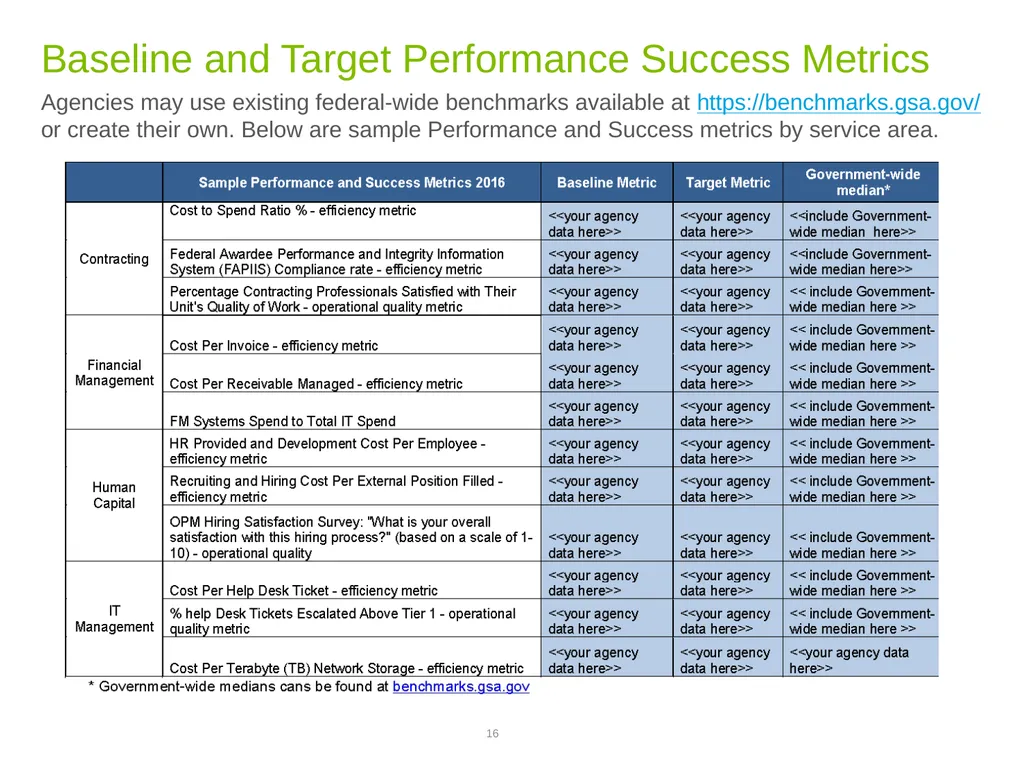
slide16. Agencies may use existing federal-wide benchmarks available at https://benchmarks.gsa.gov/ or create their own. Below are sample Performance and Success metrics by service area. Baseline and Target Performance Success Metrics<br>
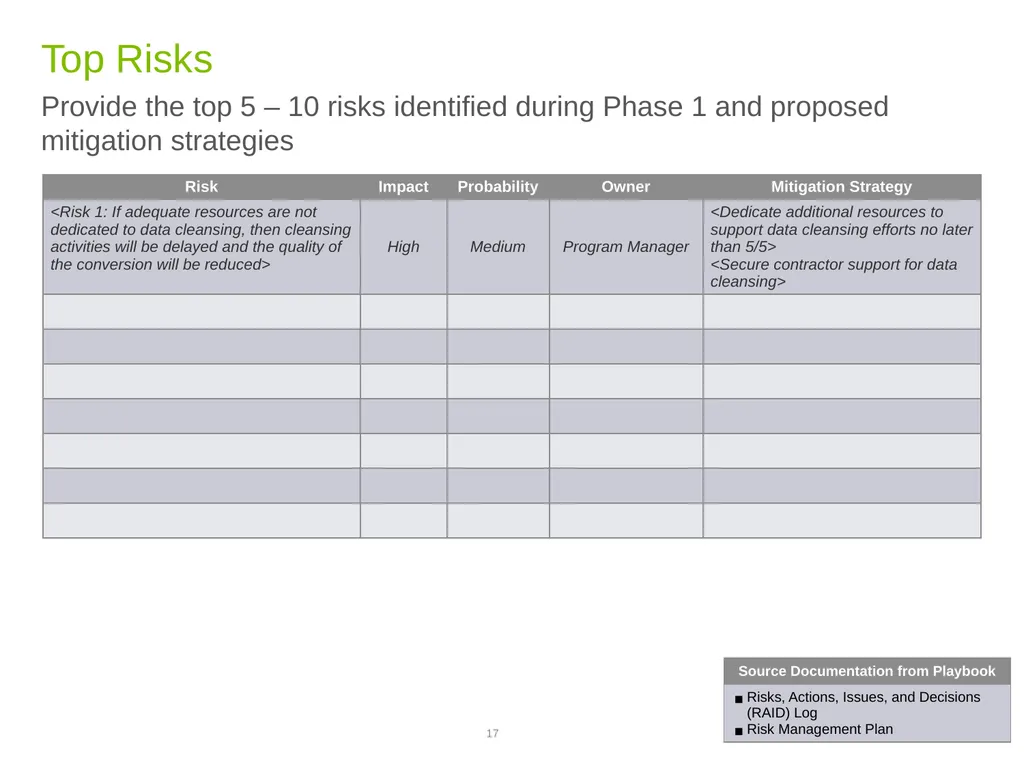
slide17. Provide the top 5 – 10 risks identified during Phase 1 and proposed mitigation strategies Top Risks<br>
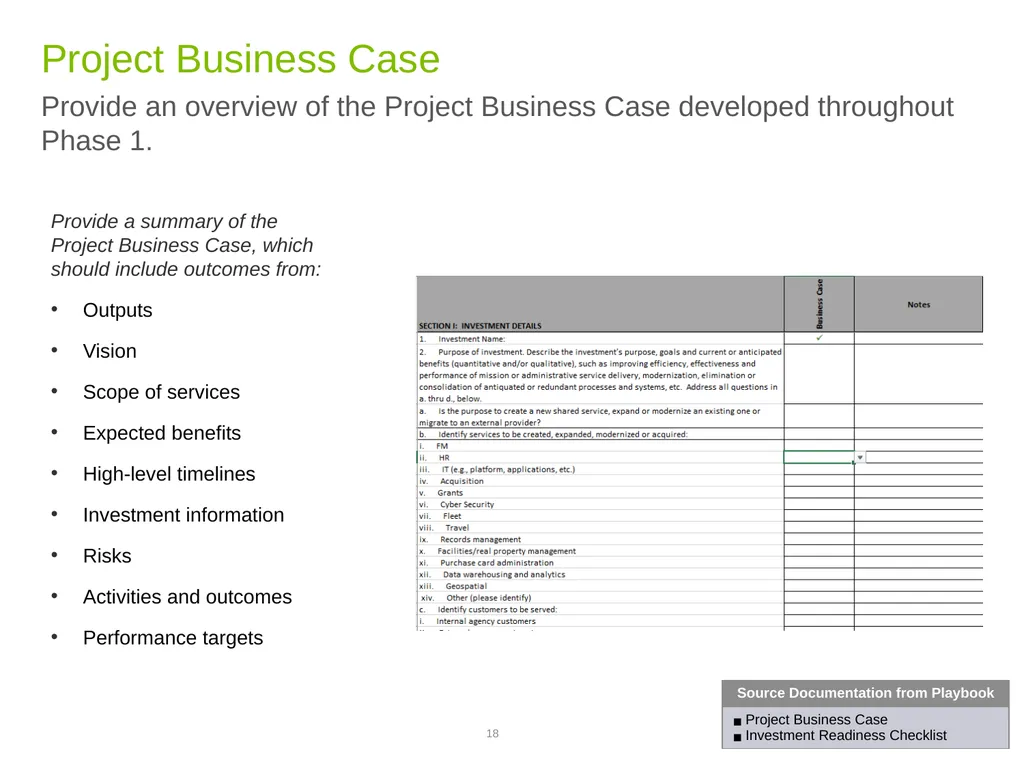
slide18. Provide an overview of the Project Business Case developed throughout Phase 1. Project Business Case Provide a summary of the Project Business Case, which should include outcomes from:
Outputs
Vision
Scope of services
Expected benefits
High-level timelines
Investment information
Risks
Activities and outcomes
Performance targets<br>
slide19. Please describe the activities planned for the next 30, 60, and 90 days Next Steps<br>
Month, Year<br>
slide2. This template is intended to guide a Progress Review discussion between a Customer, Provider and Key Stakeholders. Questions to be Answered 0. Assessment 1. Readiness<br>
slide3. This template is intended to guide a Progress Review discussion between a Customer, Provider and Key Stakeholders. Instructions for Completing This Template To use this template:
Use the source documents included within each slide to develop summary-level information that will help guide the Progress Review
Be prepared to discuss specific questions/content included on each slide before or during the Progress Review
Once complete, schedule a Progress Review meeting<br>
slide4. Documentation Required for Phase 1 Progress Review The following documentation is required in guiding a discussion to demonstrate readiness and gain approval for Phase 1. Agencies purchasing transaction processing services only will identify relevant activities and artifacts for their project using the M3 Services Tailoring Guide.<br>
slide5. Determine the risk rating at the end of Phase 1 using the M3 Risk Assessment Tool and submit with Progress Review material. M3 Risk Assessment Tool<br>
slide6. Provide an overview of the Business Readiness Assessment performed at the beginning of Phase 1. Business Readiness Assessment Provide a summary of the Business Readiness Assessment, which should include outcomes from:
Assessing the Existing Solution
Defining the Target End State
Gap Analysis<br>
slide7. Provide an overview of the Initial Master Schedule as of Phase 1 Initial Master Schedule Overview Provide a summary of the Master Schedule timeline, which should include:
Major activities and critical path milestones over the lifecycle of the program
Expected Progress timeline
Schedule constraints (e.g., contract end dates, system retirements)
Whether activities and milestones are on- or off-track
**Provide information by month and year ILLUSTRATIVE<br>
slide8. Provide the estimated cost based on the LCCE*. Life Cycle Cost Estimate (LCCE) Develop the life cycle cost information for Phase 1 based on any changes or refinement in scope of the program from when the Project Business Case was developed ILLUSTRATIVE *To avoid duplication of effort, agencies are encouraged to use their existing budgetary documentation, when available, to provide cost estimates.<br>
slide9. Provide an Organization Chart and indicate required number of full time equivalents (FTEs)/resources, existing resource gaps, and plan to fill resource gaps Resource Management Plan Overview Include the following:
The roles and responsibilities needed for the customer migration team in Phase 2
Total number of resources needed and total number of resources staffed
The percentage of time required for each position on the customer migration team
Vacant positions and plan to fill each position
For each role, indicate if resources are in an acting, detailed, or contractor-filled position<br>
slide10. Provide the details around market research and planned procurements to support the migration Market Research & Acquisition Strategy Potential data points could include:
An overview of the approach to conducting market research to select a provider, including how QSMOs, Requests for Information (RFIs) and Provider Agreements will be used to further market research efforts and ultimately select a provider
Potential additional support needed based on resourcing plan, legacy system support needs, data cleansing, and Independent Verification and Validation (IV&V) ILLUSTRATIVE *Statuses may include: Early Planning, Requirements Defined, Request for Proposal (RFP) Released, Award Complete<br>
slide11. Describe the program’s approach for onboarding and utilizing IV&V support Independent Verification and Validation Plan Provide an overview of:
Timeline to obtain IV&V support
The scope IV&V activities that will occur during the program
The timing of IV&V activities during the program
The process to address IV&V feedback
IV&V relationships (i.e., who the sponsor is, and how IV&V support will interact with the provider, and OSSPI)<br>
slide12. Describe the program’s governance model Program Governance Model Consider including the following:
The governance structure, which identifies the roles, responsibilities, and which offices are represented
The process, cadence, and timeline to make decisions
The process and criteria used to escalate decisions, issues, and risks
The scope of the governance (i.e., whether or not the program manager has the authority to approve changes that do not extend the schedule, the maximum dollar value of the costs, and increases or decreases to the scope)<br>
slide13. Describe which services the organization desires for migration and Operations and Maintenance (O&M) Scope of Services Overview Migration O&M Describe required O&M services, including:
Desired service (e.g., Financial Management, HR, Acquisition)
Function (e.g., Payable Management)
Description of selected service layers (i.e., system platform, transaction processing, business application support) Describe required migration services (e.g., training, data conversion, systems integration) from the provider<br>
slide14. Describe the stakeholders that will be impacted by the migration Change Management and Communications Approach Consider including information on the following:
The process for identifying impacted stakeholders
Analysis of stakeholder awareness by the community
Communications best practices that the stakeholder community will use<br>
slide15. Provide an overview of the data management and quality approach including an overview of findings from the initial data assessment Data Management/Data Quality Approach Consider including information on the following:
The results of your data quality assessment
Data cleansing activities that have already begun
The timeline for future data cleansing activities
Success criteria used to measure data quality<br>
slide16. Agencies may use existing federal-wide benchmarks available at https://benchmarks.gsa.gov/ or create their own. Below are sample Performance and Success metrics by service area. Baseline and Target Performance Success Metrics<br>
slide17. Provide the top 5 – 10 risks identified during Phase 1 and proposed mitigation strategies Top Risks<br>
slide18. Provide an overview of the Project Business Case developed throughout Phase 1. Project Business Case Provide a summary of the Project Business Case, which should include outcomes from:
Outputs
Vision
Scope of services
Expected benefits
High-level timelines
Investment information
Risks
Activities and outcomes
Performance targets<br>
slide19. Please describe the activities planned for the next 30, 60, and 90 days Next Steps<br>