PHONIC EVENING 2024 Welcome Aims! To help you support your child with saying their sounds, decoding words reading .and writing their letters. To give you a better idea of how your child is being taught at school and feel confident about
"PHONIC EVENING 2024 Welcome Aims! To help you" is the property of its rightful owner. Permission is granted to
download and print the materials on this website for personal, non-commercial use only, and to display it
on your personal computer provided you do not modify the materials and that you retain all copyright
notices contained in the materials. By downloading content from our website, you accept the terms of this
agreement.
Presentation Transcript
01
PHONIC EVENING 2024 Welcome Aims!
To help you support your child with saying their sounds, decoding words – reading ….and writing their letters.
To give you a better idea of how your child is being taught at school and feel confident about supporting their reading at home.
To understand some of the language we use in school when teaching your child so that you can reinforce this at home
How to encourage and build in your child a lifelong reader with a true love of books!<br>
02
How do we say our sounds (phonemes) in class? Autumn Term
Autumn 1 Sounds
https://youtu.be/-ZtjFIvA_fs
Autumn 2 Sounds
https://youtu.be/qDu3JAjf-U0
Spring Term Sounds
https://youtu.be/DvOuc7cWXxc
(These videos can be found on the school website in – How to support your child at home)
Have a look at the Grow the Code chart! Almost all of the words in the English Language can be worked out using what we call the Alphabetic code that we are teaching in school- this is made up of 44 sounds.<br>
03
How do we teach tricky words? The Alphabetic code is made up of 44 sounds…..but…. many of these sounds can be spelled in a few different ways, but some spellings are far more common than others so we teach these first! Once these are secure we teach some of the more unusual ways of spelling the 44 sounds. There are a few words with unusual spellings that the children need to read and write a lot even in the early stages words such as he said was and we teach them as we go along.
Look at was- why is it tricky?
We show the children which is the Tricky part of the word (the bit we get cross with!) The middle and final letters are tricky.
We teach the most common tricky words first as these are the ones they will encounter in their reading groups first.<br>
04
Sounding out/Blending/ Reading with your child In our lessons the children are taught to recognise the connection between the sounds (phonemes) and the letters used to write them down (graphemes)
When we read we see the letters written down and change them back into sound. We join them together and read! (this is called sounding out and blending ) This is why it is so important to make sure that the sounds are pure- no ah/uh at the end of a sound!
Early books have sound buttons to help- dots and dashes
Please have a go on your whiteboards to put in the sound buttons - shop/ check/ clearing
Moving quickly towards reading words without dots and dashes
Encourage Reading with pace and fluency and confidence- no robot talking…(prosody- model with your child and repeat)- Blending in your head<br>
05
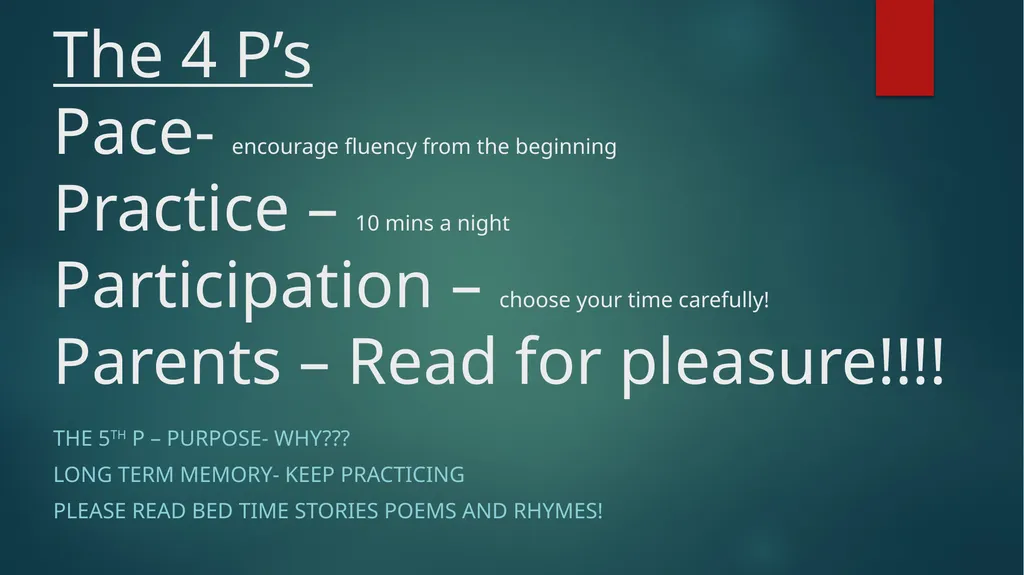
The 4 P’s Pace- encourage fluency from the beginning Practice – 10 mins a night Participation – choose your time carefully! Parents – Read for pleasure!!!! The 5th P – PURPOSE- Why???
Long term memory- keep practicing
PLEASE Read bed time stories POEMS and rhymes!<br>
06
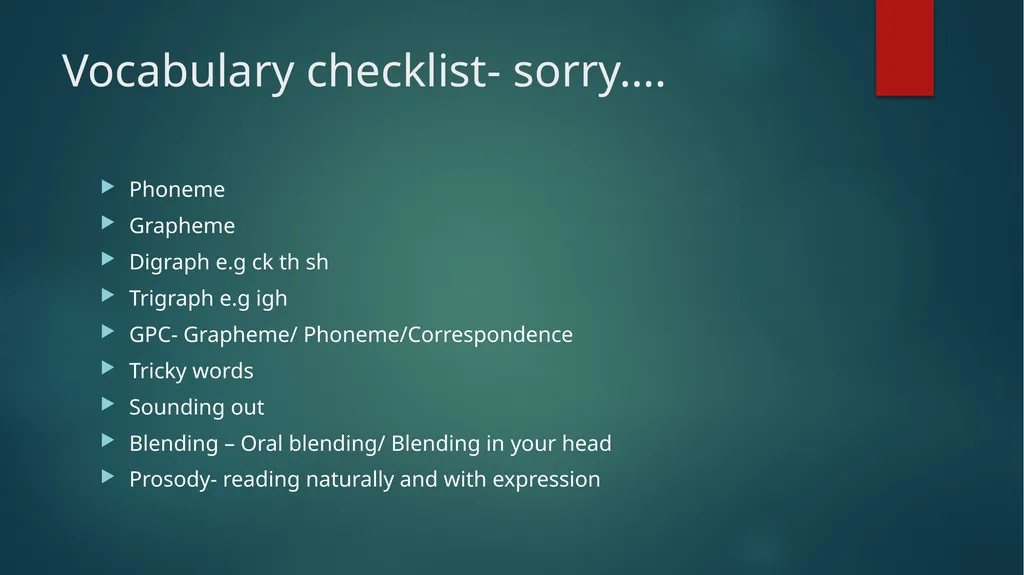
Vocabulary checklist- sorry…. Phoneme
Grapheme
Digraph e.g ck th sh
Trigraph e.g igh
GPC- Grapheme/ Phoneme/Correspondence
Tricky words
Sounding out
Blending – Oral blending/ Blending in your head
Prosody- reading naturally and with expression<br>
07
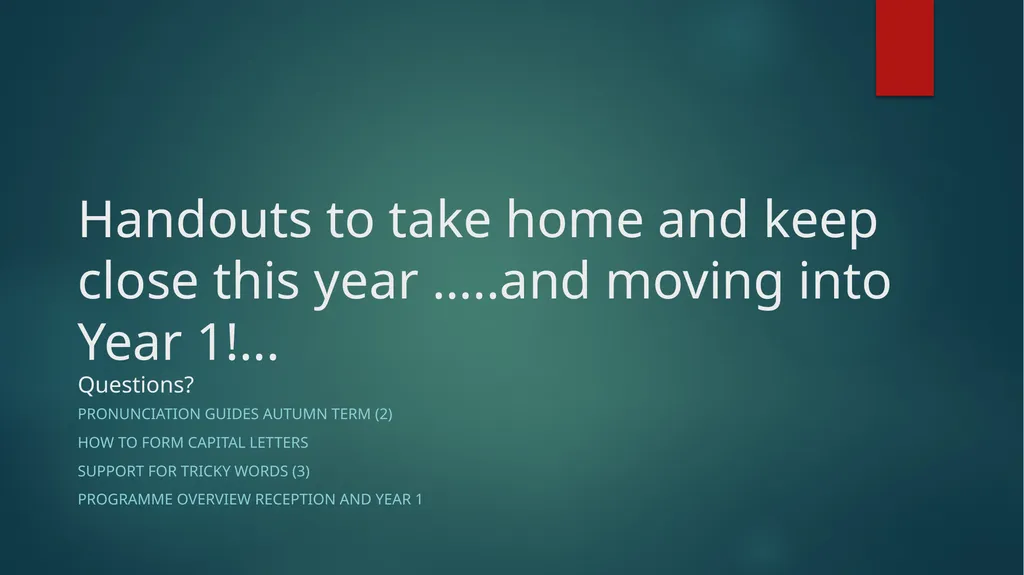
Handouts to take home and keep close this year …..and moving into Year 1!... Questions? Pronunciation guides Autumn Term (2)
How to form capital letters
Support for tricky words (3)
Programme overview Reception and Year 1<br>