
Piaget’s Theory of Cognitive Development Presented





Description: Piagets Theory of Cognitive Development Presented By: Nidhi Yadav (Teacher Educator) Born - August 9,1896 ,Switzerland Died - 16 September 1980 (age 84) Education: Received Ph.D. from University of Neuchatel in 1918. Wife : Married to
Related Topics
Download Presentation
"Piaget’s Theory of Cognitive Development Presented" is the property of its rightful owner. Permission is granted to download and print the materials on this website for personal, non-commercial use only, and to display it on your personal computer provided you do not modify the materials and that you retain all copyright notices contained in the materials. By downloading content from our website, you accept the terms of this agreement.
Presentation Transcript
slide1. Piaget’s Theory of Cognitive Development Presented By:
Nidhi Yadav (Teacher Educator)<br>
slide2. Born - August 9,1896 ,Switzerland
Died - 16 September 1980 (age 84)
Education: Received Ph.D. from
University of Neuchatel in 1918.
Wife : Married to Valentine Chatenay
Children : 3 children whose intellectual development from infancy to language was studied by Piaget . Who was Piaget?<br>
slide3. Piaget (1896-1980) was one of the 20th centaury's most influential researchers in the area of developmental psychology.
He was originally trained in the area of biology and philosophy and considered himself a “ Genetic Epistemologist”.
Piaget wanted to know how children learned through their development in the study of knowledge.
He administered Binet’s IQ test in Paris and observed that children’s answers were qualitatively different.
Piaget theory is based on the idea that the developing child builds cognitive structure.
Piaget’s Theory of infant development were based on his observations of his own three children. Introduction<br>
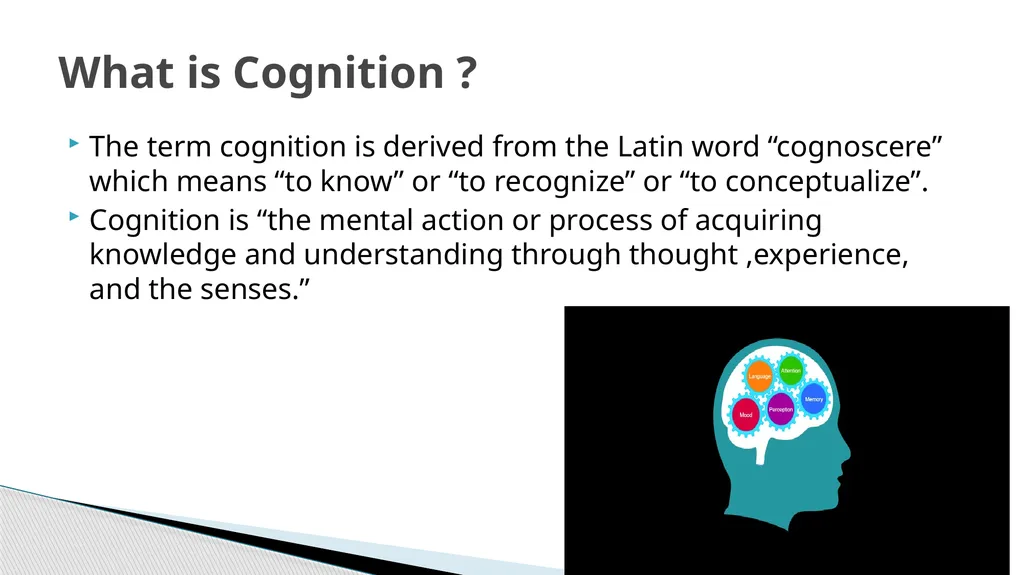
slide4. The term cognition is derived from the Latin word “cognoscere” which means “to know” or “to recognize” or “to conceptualize”.
Cognition is “the mental action or process of acquiring knowledge and understanding through thought ,experience, and the senses.” What is Cognition ?<br>
slide5. Cognitive Development is the emergence of the ability to think and understand.
The acquisition of the ability to think, reason and problem solve.
It is the process by which people’s thinking changes across the life span.
Piaget studied cognitive Development by observing children in particular, to examine how their thought processes changed with age.
it is the growing apprehension and adaptation to the physical and social environment. What is Cognitive Development?<br>
slide6. Cognitive Development is gradual and orderly changes by which mental process becomes more complex and sophisticated.
The essential development of cognition is the establishment of new schemes.
Assimilation and Accommodation are both the processes of the ways of cognitive Development.
The Equilibration is the symbol of a new stage of the cognitive Development. How Cognitive Development occurs?<br>
slide7. Schema : schema is an internal representation of the world. It helps an individual understand the world they inhabit. They are cognitive structures that represent a certain aspect of the world, and can be seen as categories which have certain pre-conceived ideas in them.
For example, My schema for Christmas includes: Christmas trees, presents giving, money ,green, red, gold, winter, Santa Claus etc. someone else may have an entirely different schema , such as Jesus ,birth, church, holiday, Christianity etc. Key Concepts:<br>
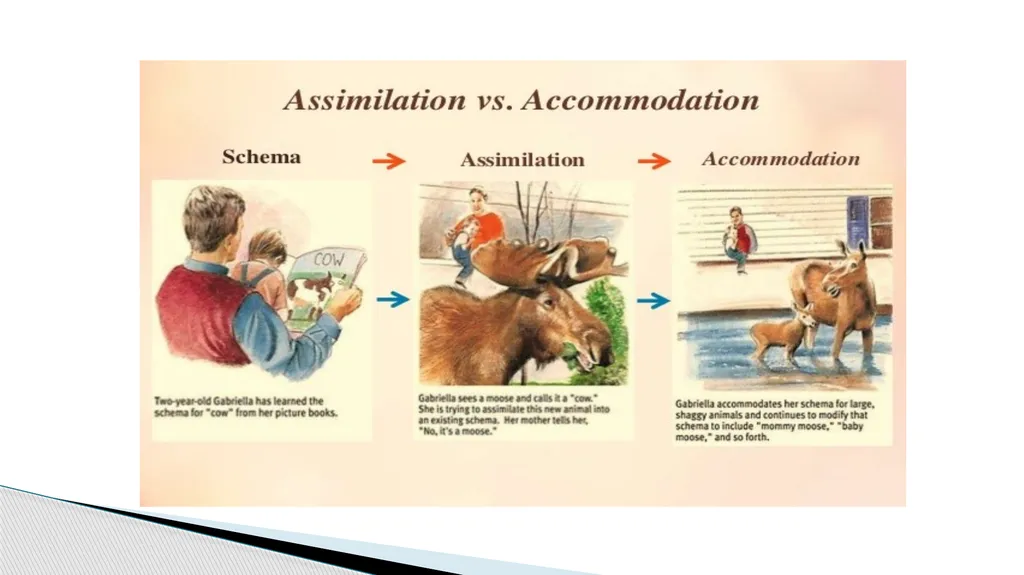
slide8. It is using an existing schema to deal with a new object or situation . Here, the learner fits the new idea into what he already knows. In Assimilation, the schema is not changed, it is only modified.
Example : A 2year old child sees a man who is bald on top of his head and has long frizzy hair on the sides. To his father’s horror, the toddler shouts “clown, clown”. Assimilation :<br>
slide9. This happens when the existing schema (knowledge) does not work and needs to be changed to deal with a new object or situation. In Accommodation, the schema is altered ; a new schema maybe developed.
Example : In the clown incident the boy’s father explained to his son that the man was not a clown and that even though his hair was like a clown’s , he was not wearing funny costumes and was not doing silly things to make people laugh.
With this new knowledge, the boy was able to change his schema of “clown” and make this idea fit better to standard concept of “clown”. Accommodation :<br>
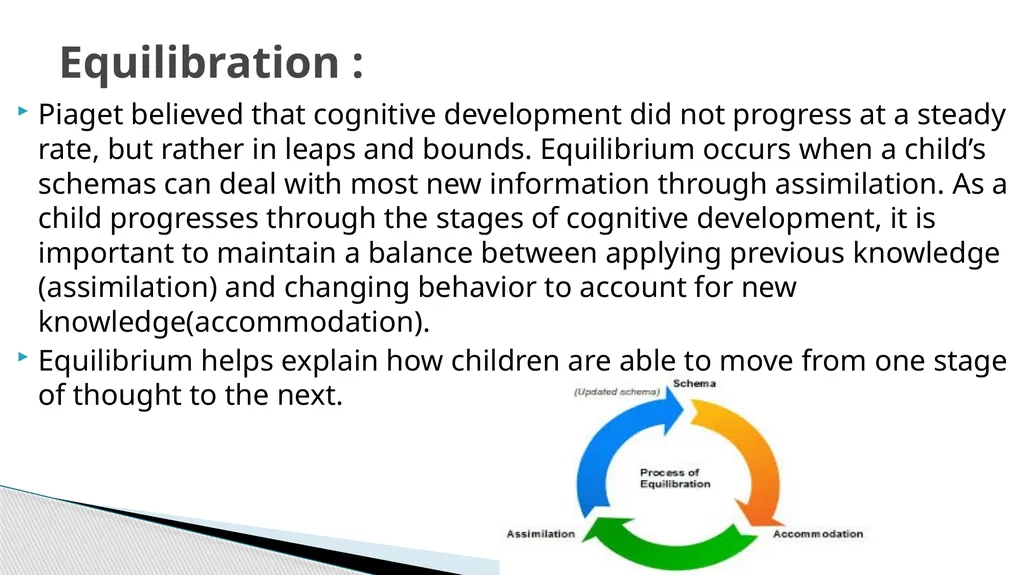
slide11. Piaget believed that cognitive development did not progress at a steady rate, but rather in leaps and bounds. Equilibrium occurs when a child’s schemas can deal with most new information through assimilation. As a child progresses through the stages of cognitive development, it is important to maintain a balance between applying previous knowledge (assimilation) and changing behavior to account for new knowledge(accommodation).
Equilibrium helps explain how children are able to move from one stage of thought to the next. Equilibration :<br>
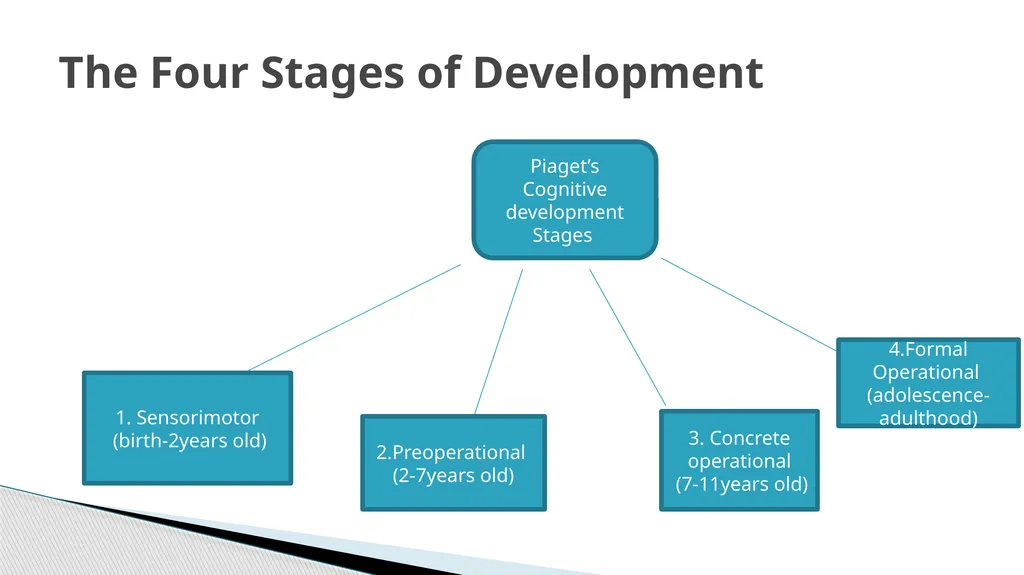
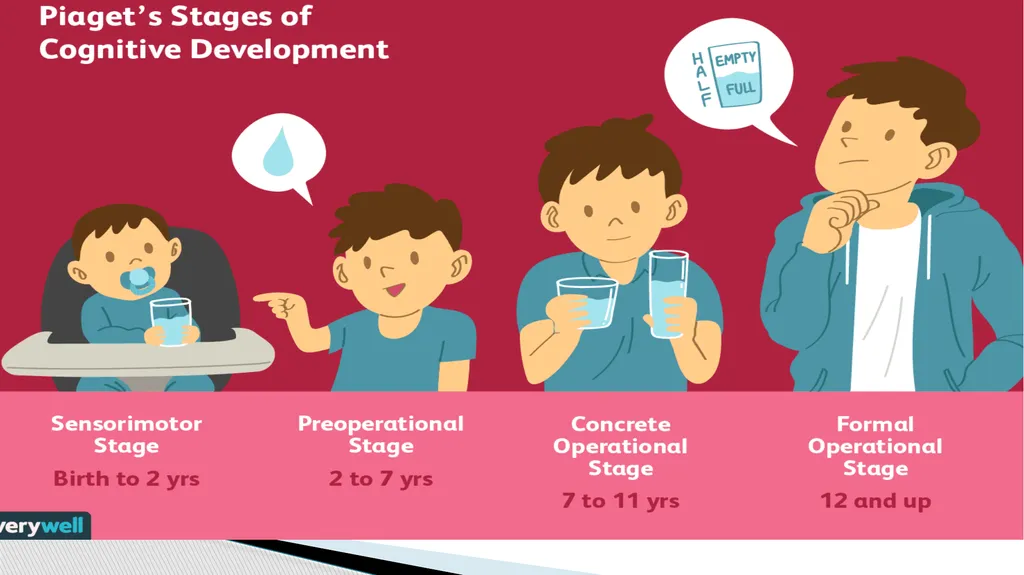
slide12. The Four Stages of Development Piaget’s Cognitive development Stages 1. Sensorimotor
(birth-2years old) 2.Preoperational
(2-7years old) 3. Concrete operational
(7-11years old) 4.Formal Operational
(adolescence-adulthood)<br>
slide14. Infant construct an understanding of the world by coordinating sensory experiences (seeing ,hearing) with motor actions ( reaching ,touching).
Develop Object Permanence (memory)- Realize that objects exist even if they are out of sight.
Infant progress from reflexive, instinctual actions at birth to the beginning of problem solving (intellectual) and symbolic abilities (language) toward the end of this stage. The Sensorimotor Stage (Birth to 2yrs) -Infancy<br>
slide15. This stage begins when the child starts to use symbols and language. This is a period of developing language and concepts. So , the child is capable of more complex mental representations (i.e, words and images). He is still unable to use ‘operation’ ,ie, logical mental rules, such as rules of arithmetic. This is further divided into 2 sub-stages:
Preconceptual stage (2-4yrs): Increased use of verbal representation but speech is egocentric. The child uses symbols to stands for actions; a toy doll stands for a real baby or the child plays mummy or daddy.
Intuitive stage( 4-7yrs): Speech becomes more social, less egocentric. Here the child base their knowledge on what they feel or sense to be true, yet they cannot explain the underlying principles behind what they feel or sense. Preoperational Stage (2-7yrs) -Toddler and Early childhood<br>
slide16. The following are the key features of this stage :
Egocentrism: The child’s thought and communications are typically egocentric (i.e about themselves or their own point of view). Eg: “If I can’t see you ,you also can’t see me” . It is the inability to see the world from anyone else’s eyes. It is well explained by Piaget as Three Mountain Task.
Animism: Treating inanimate objects as living ones. Eg.: children dressing and feeding their dolls as if they are alive.
Concentration: The process of concentrating on one limited aspects of a stimulus and ignoring other aspects. It is noticed in conservation.
Conservation on the other hand is the knowledge that quantity is unrelated to the arrangement and physical appearance of objects. Children at this stage are unaware of conservation.<br>
slide17. The concrete operational stage is characterized by the appropriate use of logic. Important processes during this stage are:
Seriation: The ability to sort objects in an order according to size , shape or any other characteristic . Eg.: if given different-sized objects, they may place them accordingly.
Transitivity: The ability to recognize logical relationship among elements in a serial order. Eg.: if A is taller than B and B is taller than C, then A must be taller than C.
Classification : The ability to group objects together on the basis of common features. The child also begins to get the idea that one set can include another . Eg. : there is a class of objects called dogs . There is also class called animals. But all dogs are also animals,so the class of animals includes that of dogs. Concrete Operational Stage (7-12yrs) -Childhood and early Adolescence<br>
slide18. Decentering : The ability to take multiple aspects of a situation into account. Eg.: The child will no longer perceive an exceptionally-wide but short cup to contain less than a normally-wide,taller cup.
Reversibility : the child understands that numbers or objects can be changed, then returned to their original state. E.g..: the child will rapidly determine that if 4 +4=8 then 8-4=4, the original quantity.
Conservation: Understanding that the quantity, length or number of items is unrelated to the arrangement or appearance of the object or item.
Elimination of Egocentrism : the ability to view things from another’s perspective.
The child performs operations: Combining, separating, multiplying, repeating, dividing etc.<br>
slide19. The thought become increasingly flexible and abstract, i.e, can carry out systematic experiments.
The ability to systematically solve a problem in a logical and methodological way.
Understands that nothing is absolute; everything is relative.
Develops skills such as logical thought, deductive reasoning as well as inductive reasoning and systematic planning etc.
Understands that the rules of any game or social system are developed by a man by mutual agreement and hence could be changed or modified.
The child’s way of thinking is at its most advanced, although the knowledge it has to work with , will change. Formal Operational Stage (12yrs & above) -Adolescence and Adulthood<br>
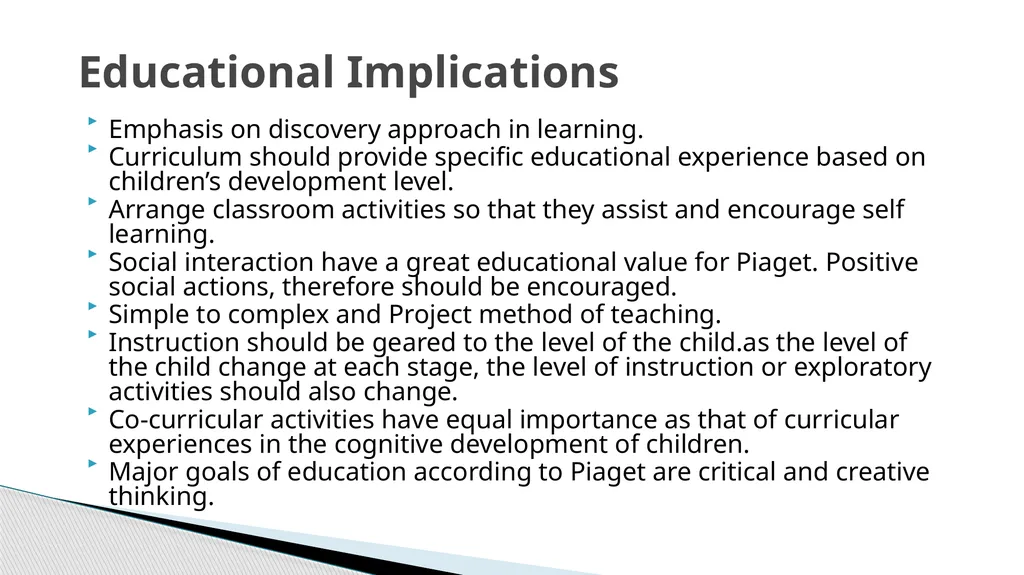
slide20. Emphasis on discovery approach in learning.
Curriculum should provide specific educational experience based on children’s development level.
Arrange classroom activities so that they assist and encourage self learning.
Social interaction have a great educational value for Piaget. Positive social actions, therefore should be encouraged.
Simple to complex and Project method of teaching.
Instruction should be geared to the level of the child.as the level of the child change at each stage, the level of instruction or exploratory activities should also change.
Co-curricular activities have equal importance as that of curricular experiences in the cognitive development of children.
Major goals of education according to Piaget are critical and creative thinking. Educational Implications<br>
slide21. Thank you<br>
Nidhi Yadav (Teacher Educator)<br>
slide2. Born - August 9,1896 ,Switzerland
Died - 16 September 1980 (age 84)
Education: Received Ph.D. from
University of Neuchatel in 1918.
Wife : Married to Valentine Chatenay
Children : 3 children whose intellectual development from infancy to language was studied by Piaget . Who was Piaget?<br>
slide3. Piaget (1896-1980) was one of the 20th centaury's most influential researchers in the area of developmental psychology.
He was originally trained in the area of biology and philosophy and considered himself a “ Genetic Epistemologist”.
Piaget wanted to know how children learned through their development in the study of knowledge.
He administered Binet’s IQ test in Paris and observed that children’s answers were qualitatively different.
Piaget theory is based on the idea that the developing child builds cognitive structure.
Piaget’s Theory of infant development were based on his observations of his own three children. Introduction<br>
slide4. The term cognition is derived from the Latin word “cognoscere” which means “to know” or “to recognize” or “to conceptualize”.
Cognition is “the mental action or process of acquiring knowledge and understanding through thought ,experience, and the senses.” What is Cognition ?<br>
slide5. Cognitive Development is the emergence of the ability to think and understand.
The acquisition of the ability to think, reason and problem solve.
It is the process by which people’s thinking changes across the life span.
Piaget studied cognitive Development by observing children in particular, to examine how their thought processes changed with age.
it is the growing apprehension and adaptation to the physical and social environment. What is Cognitive Development?<br>
slide6. Cognitive Development is gradual and orderly changes by which mental process becomes more complex and sophisticated.
The essential development of cognition is the establishment of new schemes.
Assimilation and Accommodation are both the processes of the ways of cognitive Development.
The Equilibration is the symbol of a new stage of the cognitive Development. How Cognitive Development occurs?<br>
slide7. Schema : schema is an internal representation of the world. It helps an individual understand the world they inhabit. They are cognitive structures that represent a certain aspect of the world, and can be seen as categories which have certain pre-conceived ideas in them.
For example, My schema for Christmas includes: Christmas trees, presents giving, money ,green, red, gold, winter, Santa Claus etc. someone else may have an entirely different schema , such as Jesus ,birth, church, holiday, Christianity etc. Key Concepts:<br>
slide8. It is using an existing schema to deal with a new object or situation . Here, the learner fits the new idea into what he already knows. In Assimilation, the schema is not changed, it is only modified.
Example : A 2year old child sees a man who is bald on top of his head and has long frizzy hair on the sides. To his father’s horror, the toddler shouts “clown, clown”. Assimilation :<br>
slide9. This happens when the existing schema (knowledge) does not work and needs to be changed to deal with a new object or situation. In Accommodation, the schema is altered ; a new schema maybe developed.
Example : In the clown incident the boy’s father explained to his son that the man was not a clown and that even though his hair was like a clown’s , he was not wearing funny costumes and was not doing silly things to make people laugh.
With this new knowledge, the boy was able to change his schema of “clown” and make this idea fit better to standard concept of “clown”. Accommodation :<br>
slide11. Piaget believed that cognitive development did not progress at a steady rate, but rather in leaps and bounds. Equilibrium occurs when a child’s schemas can deal with most new information through assimilation. As a child progresses through the stages of cognitive development, it is important to maintain a balance between applying previous knowledge (assimilation) and changing behavior to account for new knowledge(accommodation).
Equilibrium helps explain how children are able to move from one stage of thought to the next. Equilibration :<br>
slide12. The Four Stages of Development Piaget’s Cognitive development Stages 1. Sensorimotor
(birth-2years old) 2.Preoperational
(2-7years old) 3. Concrete operational
(7-11years old) 4.Formal Operational
(adolescence-adulthood)<br>
slide14. Infant construct an understanding of the world by coordinating sensory experiences (seeing ,hearing) with motor actions ( reaching ,touching).
Develop Object Permanence (memory)- Realize that objects exist even if they are out of sight.
Infant progress from reflexive, instinctual actions at birth to the beginning of problem solving (intellectual) and symbolic abilities (language) toward the end of this stage. The Sensorimotor Stage (Birth to 2yrs) -Infancy<br>
slide15. This stage begins when the child starts to use symbols and language. This is a period of developing language and concepts. So , the child is capable of more complex mental representations (i.e, words and images). He is still unable to use ‘operation’ ,ie, logical mental rules, such as rules of arithmetic. This is further divided into 2 sub-stages:
Preconceptual stage (2-4yrs): Increased use of verbal representation but speech is egocentric. The child uses symbols to stands for actions; a toy doll stands for a real baby or the child plays mummy or daddy.
Intuitive stage( 4-7yrs): Speech becomes more social, less egocentric. Here the child base their knowledge on what they feel or sense to be true, yet they cannot explain the underlying principles behind what they feel or sense. Preoperational Stage (2-7yrs) -Toddler and Early childhood<br>
slide16. The following are the key features of this stage :
Egocentrism: The child’s thought and communications are typically egocentric (i.e about themselves or their own point of view). Eg: “If I can’t see you ,you also can’t see me” . It is the inability to see the world from anyone else’s eyes. It is well explained by Piaget as Three Mountain Task.
Animism: Treating inanimate objects as living ones. Eg.: children dressing and feeding their dolls as if they are alive.
Concentration: The process of concentrating on one limited aspects of a stimulus and ignoring other aspects. It is noticed in conservation.
Conservation on the other hand is the knowledge that quantity is unrelated to the arrangement and physical appearance of objects. Children at this stage are unaware of conservation.<br>
slide17. The concrete operational stage is characterized by the appropriate use of logic. Important processes during this stage are:
Seriation: The ability to sort objects in an order according to size , shape or any other characteristic . Eg.: if given different-sized objects, they may place them accordingly.
Transitivity: The ability to recognize logical relationship among elements in a serial order. Eg.: if A is taller than B and B is taller than C, then A must be taller than C.
Classification : The ability to group objects together on the basis of common features. The child also begins to get the idea that one set can include another . Eg. : there is a class of objects called dogs . There is also class called animals. But all dogs are also animals,so the class of animals includes that of dogs. Concrete Operational Stage (7-12yrs) -Childhood and early Adolescence<br>
slide18. Decentering : The ability to take multiple aspects of a situation into account. Eg.: The child will no longer perceive an exceptionally-wide but short cup to contain less than a normally-wide,taller cup.
Reversibility : the child understands that numbers or objects can be changed, then returned to their original state. E.g..: the child will rapidly determine that if 4 +4=8 then 8-4=4, the original quantity.
Conservation: Understanding that the quantity, length or number of items is unrelated to the arrangement or appearance of the object or item.
Elimination of Egocentrism : the ability to view things from another’s perspective.
The child performs operations: Combining, separating, multiplying, repeating, dividing etc.<br>
slide19. The thought become increasingly flexible and abstract, i.e, can carry out systematic experiments.
The ability to systematically solve a problem in a logical and methodological way.
Understands that nothing is absolute; everything is relative.
Develops skills such as logical thought, deductive reasoning as well as inductive reasoning and systematic planning etc.
Understands that the rules of any game or social system are developed by a man by mutual agreement and hence could be changed or modified.
The child’s way of thinking is at its most advanced, although the knowledge it has to work with , will change. Formal Operational Stage (12yrs & above) -Adolescence and Adulthood<br>
slide20. Emphasis on discovery approach in learning.
Curriculum should provide specific educational experience based on children’s development level.
Arrange classroom activities so that they assist and encourage self learning.
Social interaction have a great educational value for Piaget. Positive social actions, therefore should be encouraged.
Simple to complex and Project method of teaching.
Instruction should be geared to the level of the child.as the level of the child change at each stage, the level of instruction or exploratory activities should also change.
Co-curricular activities have equal importance as that of curricular experiences in the cognitive development of children.
Major goals of education according to Piaget are critical and creative thinking. Educational Implications<br>
slide21. Thank you<br>