
PIM-Enabled Instructions A Low-Overhead,
BR
Published · 64 slides · 0 views
1 / 1





Description
PIM-Enabled Instructions A Low-Overhead, Locality-Aware Processing-in-Memory Architecture Junwhan Ahn, Sungjoo Yoo, Onur Mutlu, Kiyoung Choi ISCA 2015 Matthias Möhr Problem sketch Contemporary data-intense applications Increasingly fast
Related Topics
Share
Embed code
Download this presentation From Below
"PIM-Enabled Instructions A Low-Overhead," is the property of its rightful owner. Permission is granted to download and print the materials on this website for personal, non-commercial use only, and to display it on your personal computer provided you do not modify the materials and that you retain all copyright notices contained in the materials. By downloading content from our website, you accept the terms of this agreement.
Presentation Transcript
01
PIM-Enabled Instructions A Low-Overhead, Locality-Aware Processing-in-Memory Architecture Junwhan Ahn, Sungjoo Yoo, Onur Mutlu, Kiyoung Choi ISCA 2015 Matthias Möhr<br>
02
Problem sketch Contemporary data-intense applications
Increasingly fast processors
Memory Wall<br>
Increasingly fast processors
Memory Wall<br>
03
Processing in memory Higher memory bandwidth
Lower memory latency
Better energy efficiency<br>
Lower memory latency
Better energy efficiency<br>
04
Processing in memory: A short history Idea not new
Practicality concerns in earlier studies
Expensive hardware, new programming models
Not taking advantage of on-chip caches
New memory technologies today: Hybrid memory cube<br>
Practicality concerns in earlier studies
Expensive hardware, new programming models
Not taking advantage of on-chip caches
New memory technologies today: Hybrid memory cube<br>
05
Key challenges for processing in memory Cost
Programming model
Cache Coherence/Virtual memory use<br>
Programming model
Cache Coherence/Virtual memory use<br>
06
Key challenges for processing in memories Cost
Programming model
Coherence/Virtual memory use HMC<br>
Programming model
Coherence/Virtual memory use HMC<br>
07
Key challenges for processing in memories Cost
Programming model
Coherence/Virtual memory use HMC ? ?<br>
Programming model
Coherence/Virtual memory use HMC ? ?<br>
08
Goals of the paper Provide an intuitive programming model for PIM
Support cache coherence and virtual memory
Reduce the implementation overhead of PIM units<br>
Support cache coherence and virtual memory
Reduce the implementation overhead of PIM units<br>
09
Idea Exploit new stacking technologies to improve system performance and energy efficiency
Use only minimal extension of the host processor’s ISA
Only allow simple in-memory computation
Careful with PIM! Usage may as well lead to performance degradation
Benefit of PIM heavily depends on data locality<br>
Use only minimal extension of the host processor’s ISA
Only allow simple in-memory computation
Careful with PIM! Usage may as well lead to performance degradation
Benefit of PIM heavily depends on data locality<br>
10
Major Contribution Introduce PIM-enabled instructions (=: PEI)
PEI are instructions that can be executed in memory but they don’t have to; they can also be executed in the host processor
PIM := programming in memory
Introduction of single cache block restriction:
Memory region that can be accessed during the execution of a PEI is limited to one last-level cache block<br>
11
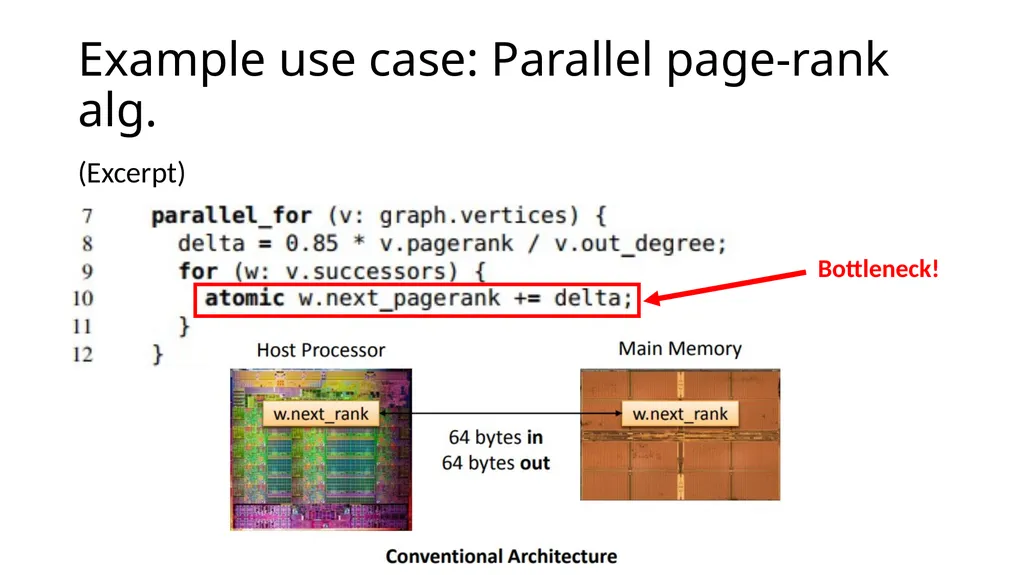
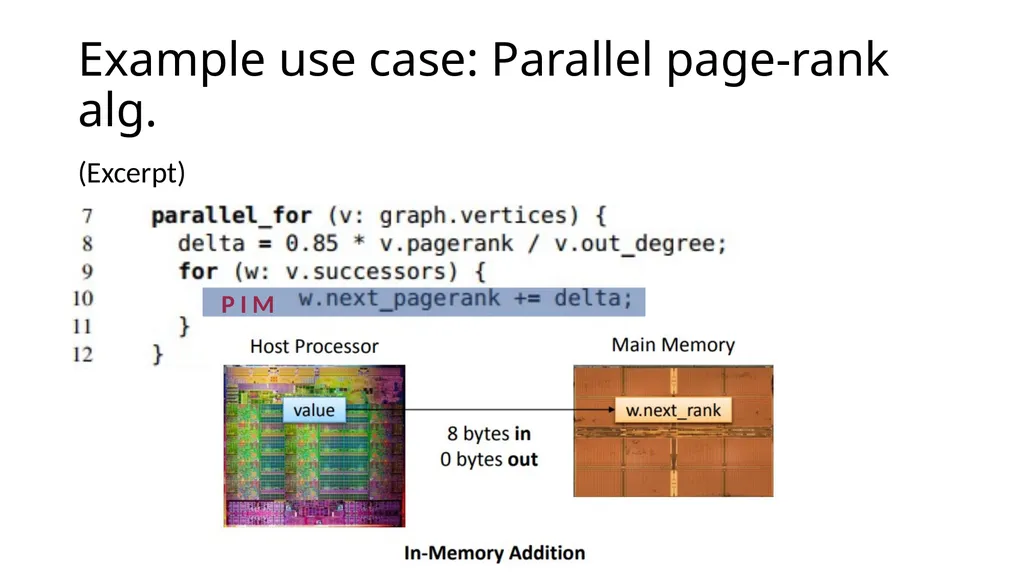
Example use case: Parallel page-rank alg. (Excerpt) Bottleneck!<br>
12
Example use case: Parallel page-rank alg. (Excerpt) PIM<br>
13
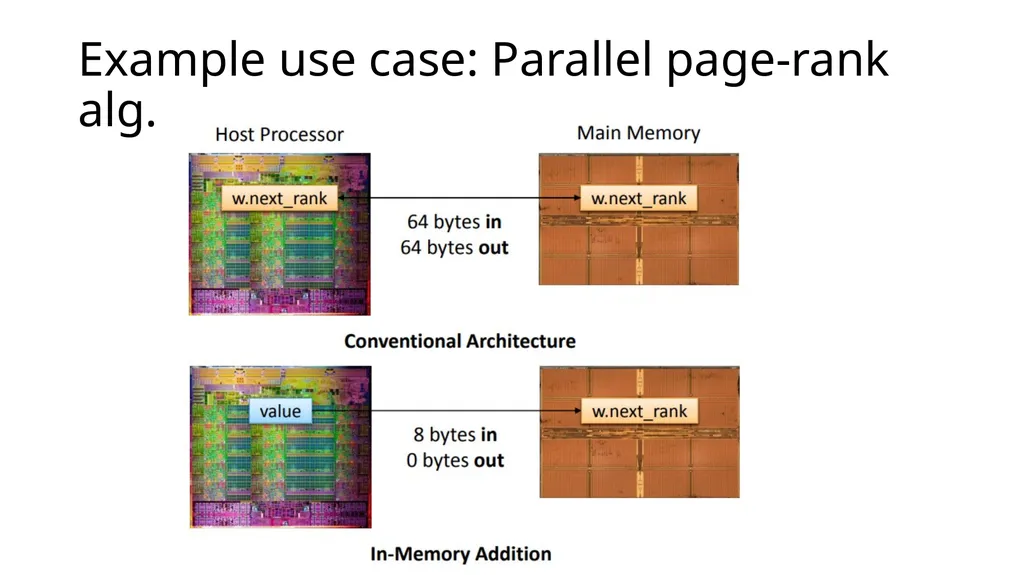
Example use case: Parallel page-rank alg.<br>
14
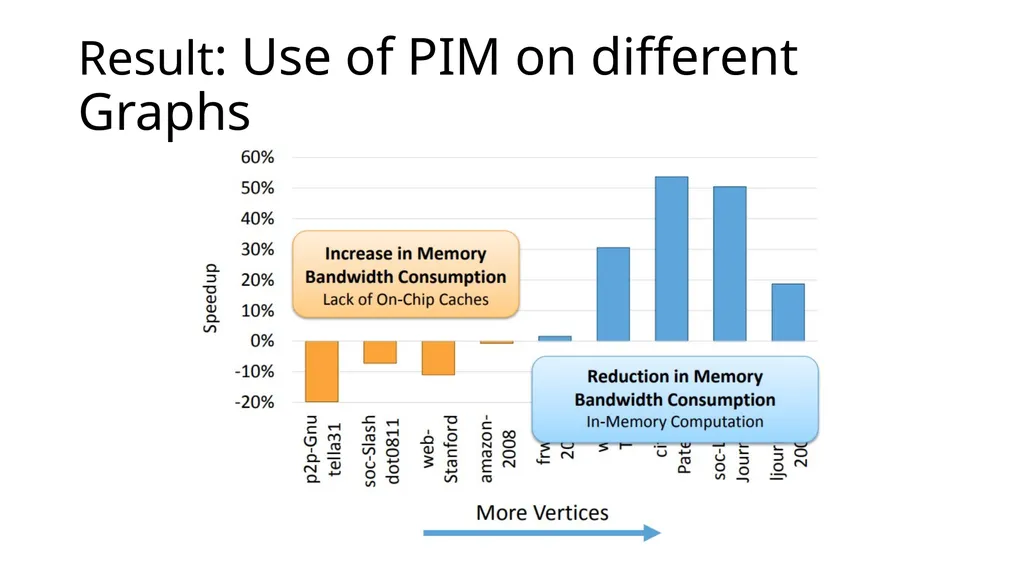
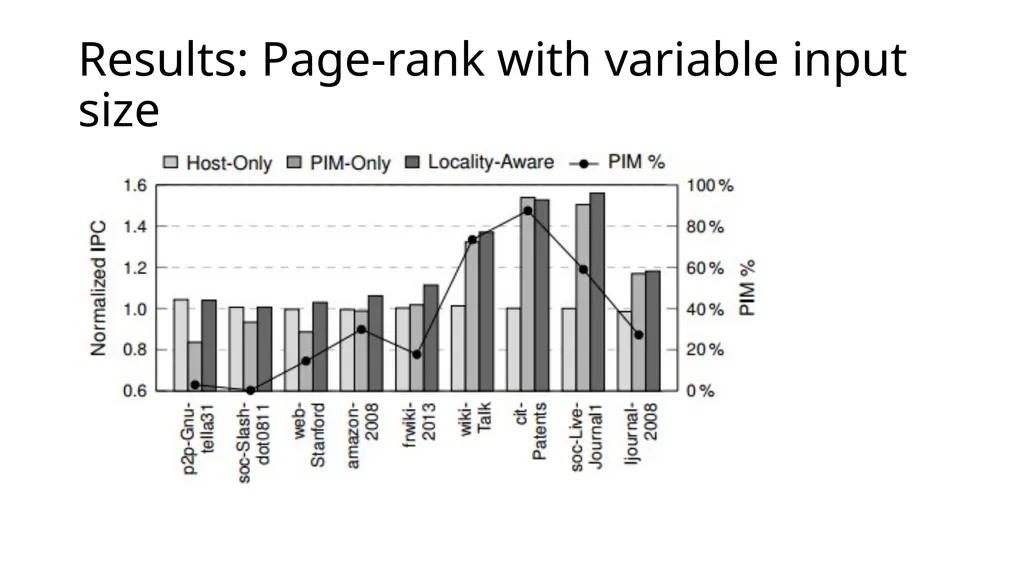
Result: Use of PIM on different Graphs<br>
15
PEI Processing-in-memory-enabled instructions<br>
16
Mechanism PEI are expressed as specialized instructions of the host processor
For any supported PIM instruction of the memory, the host’s ISA is extended by a corresponding PEI
For page rank: If the memory supports an atomic add, host has to provide a PIM-enabled atomic add to the user<br>
For any supported PIM instruction of the memory, the host’s ISA is extended by a corresponding PEI
For page rank: If the memory supports an atomic add, host has to provide a PIM-enabled atomic add to the user<br>
17
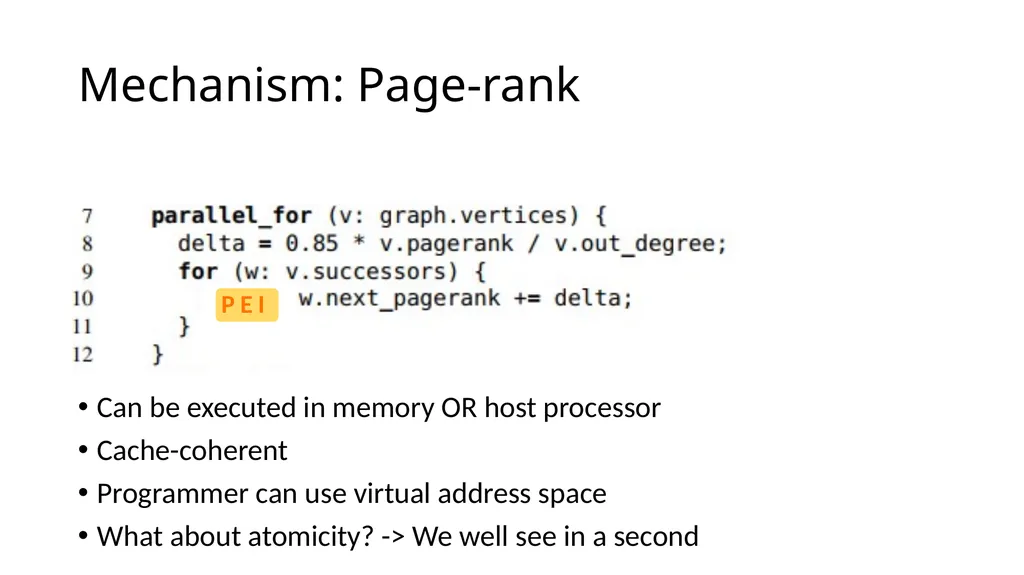
Can be executed in memory OR host processor
Cache-coherent
Programmer can use virtual address space
What about atomicity? -> We well see in a second Mechanism: Page-rank PEI<br>
Cache-coherent
Programmer can use virtual address space
What about atomicity? -> We well see in a second Mechanism: Page-rank PEI<br>
18
Mechanism PEI are expressed as specialized instructions of the host processor
For any supported PIM instruction of the memory, the host’s ISA is extended by a corresponding PEI
For page rank: If the memory supports an atomic add, host has to provide a PIM-enabled atomic add to the user
Integration into existing software is done through simple instruction replacement
Hardware mechanism decides dynamically and per operation where to execute a command
Software is unaware of that decision<br>
19
Atomicity Atomicity of a PEI between any PEI given by the architecture
Atomicity of PEI with respect to normal instructions not guaranteed
To prevent this, every memory access would have to be checked -> introduces overhead for regular instructions
Host processor is supposed to provide a PIM memory fence instruction to enforce memory ordering<br>
Atomicity of PEI with respect to normal instructions not guaranteed
To prevent this, every memory access would have to be checked -> introduces overhead for regular instructions
Host processor is supposed to provide a PIM memory fence instruction to enforce memory ordering<br>
20
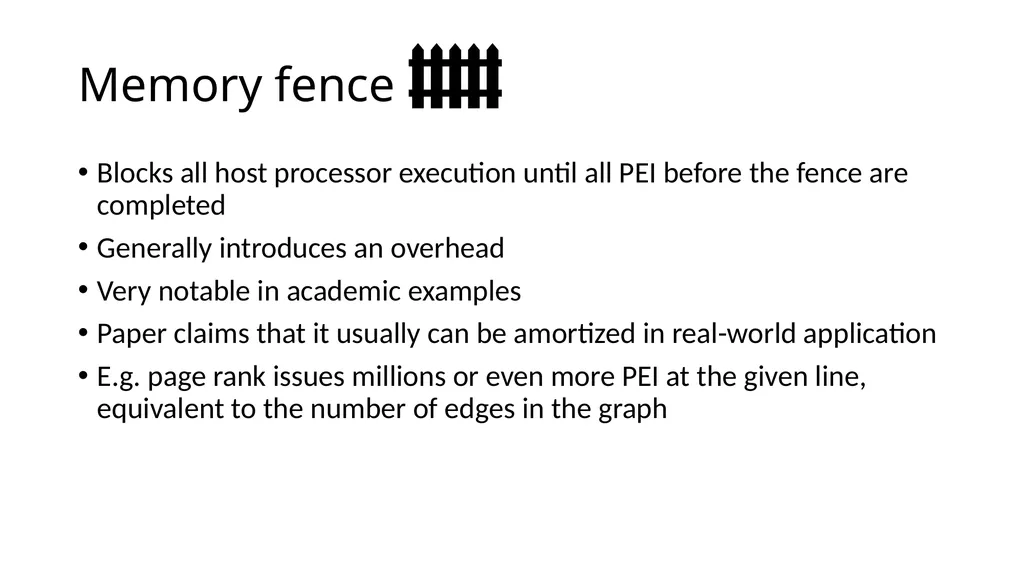
Memory fence Blocks all host processor execution until all PEI before the fence are completed
Generally introduces an overhead
Very notable in academic examples
Paper claims that it usually can be amortized in real-world application
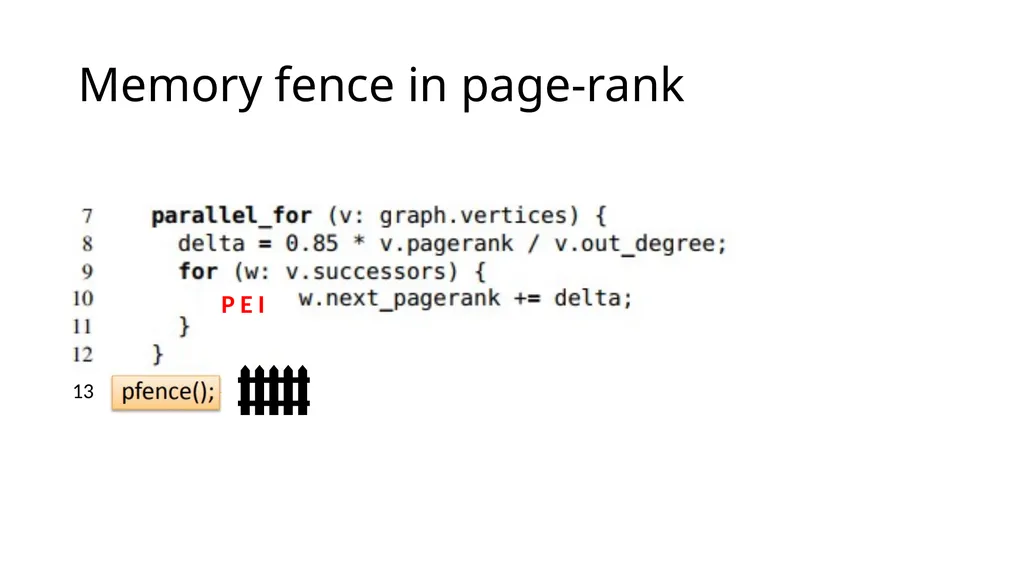
E.g. page rank issues millions or even more PEI at the given line, equivalent to the number of edges in the graph<br>
Generally introduces an overhead
Very notable in academic examples
Paper claims that it usually can be amortized in real-world application
E.g. page rank issues millions or even more PEI at the given line, equivalent to the number of edges in the graph<br>
21
Memory fence in page-rank PEI 13<br>
22
Single cache block restriction revisited Restrict data access of one PEI to a single last-level cache block
Why?
Ensures that accessed data is bounded to a single DRAM module
Cache coherence and virtual memory management for PIM can use the same hardware that supports those for last-level cache
Locality of data can easily be identified using the tag array of the last-level cache<br>
Why?
Ensures that accessed data is bounded to a single DRAM module
Cache coherence and virtual memory management for PIM can use the same hardware that supports those for last-level cache
Locality of data can easily be identified using the tag array of the last-level cache<br>
23
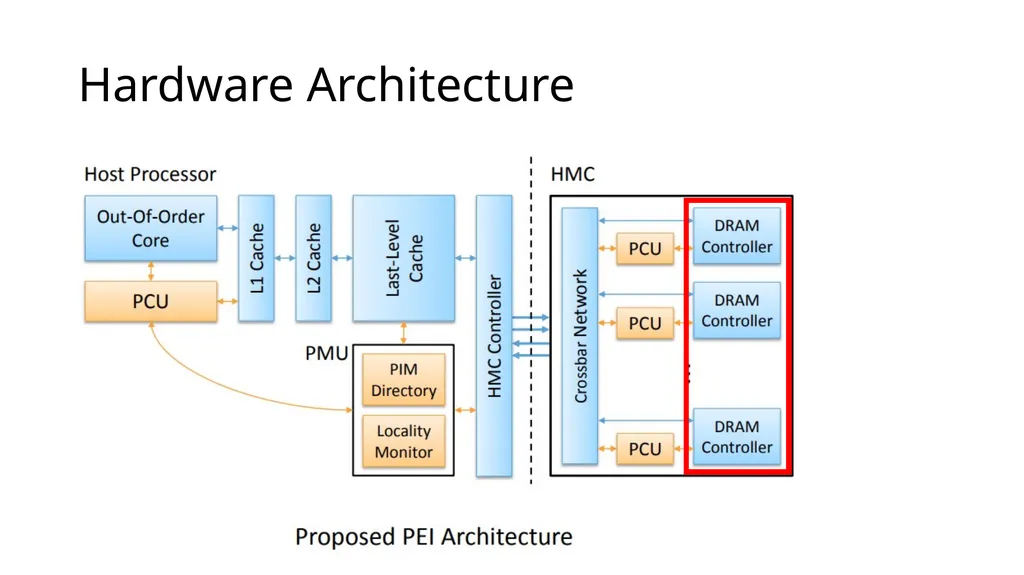
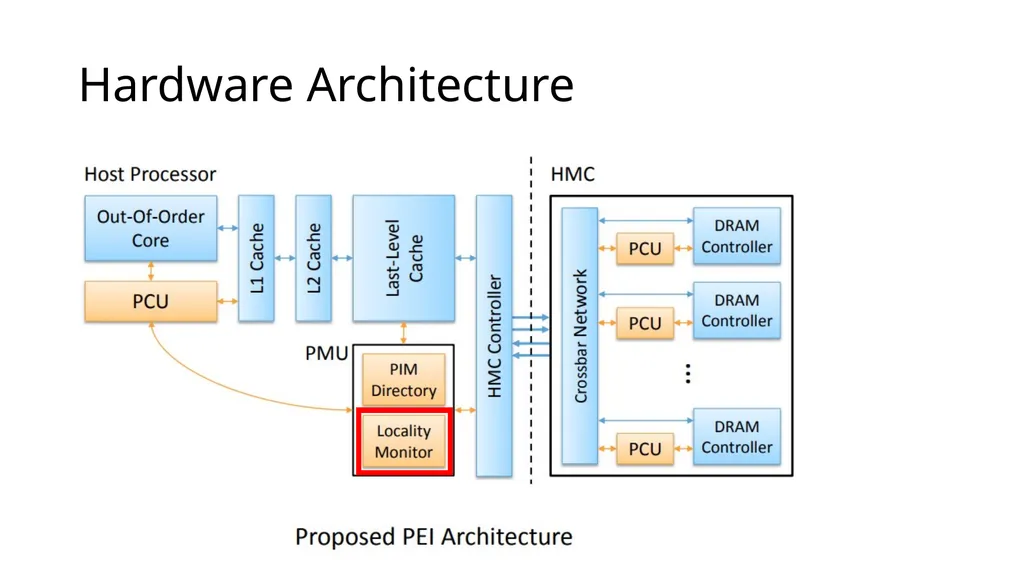
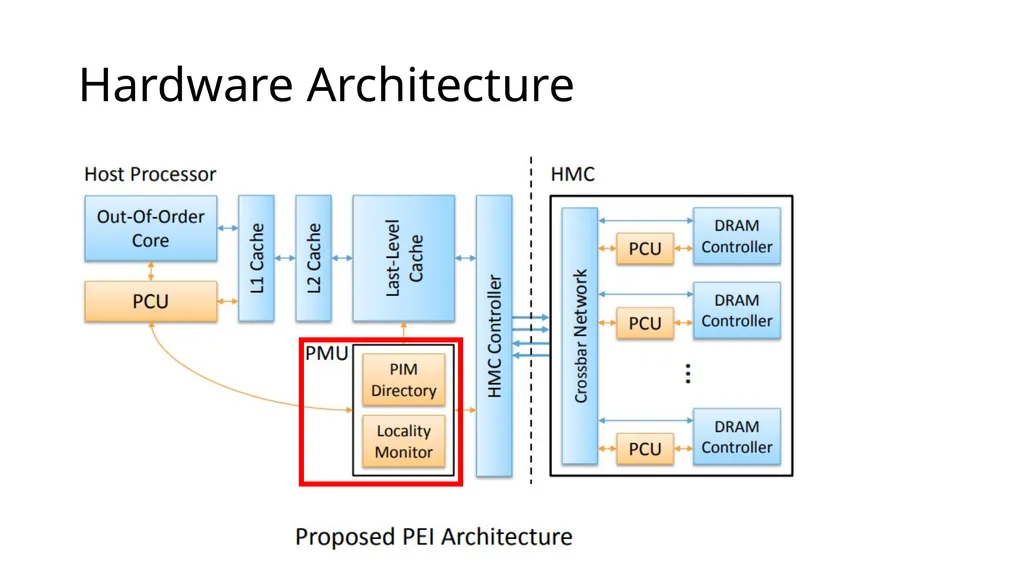
Hardware Architecture Not limited to specific types of instructions
Can easily implement any simple general purpose PIM operation
Assumes to use Hyper Memory Cube
Multiple vertical DRAM partitions
Every DRAM partition has separate DRAM controllers on the logic unit
Easily transferable design, does not depend on very specific memory properties<br>
Can easily implement any simple general purpose PIM operation
Assumes to use Hyper Memory Cube
Multiple vertical DRAM partitions
Every DRAM partition has separate DRAM controllers on the logic unit
Easily transferable design, does not depend on very specific memory properties<br>
24
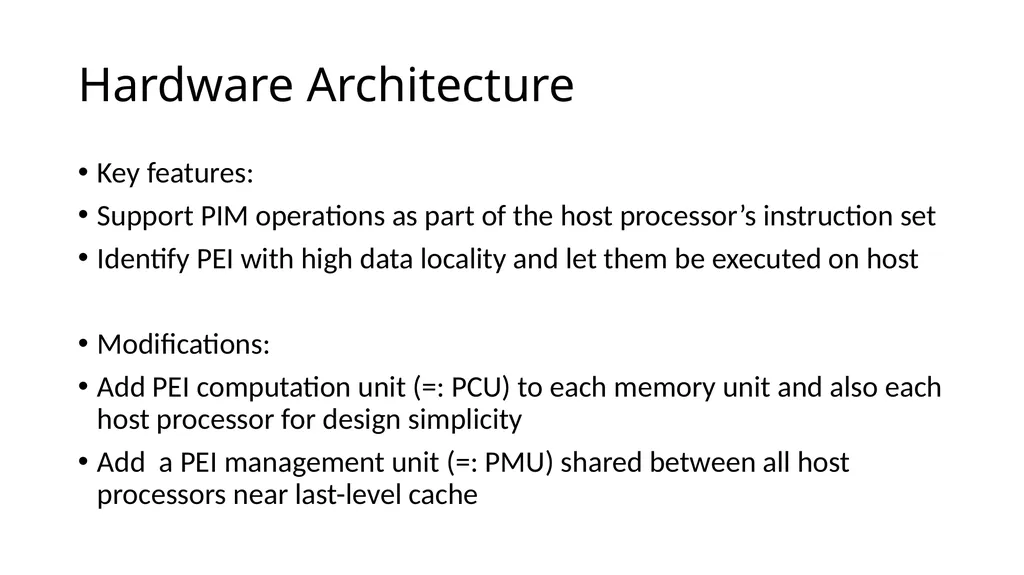
Hardware Architecture Key features:
Support PIM operations as part of the host processor’s instruction set
Identify PEI with high data locality and let them be executed on host
Modifications:
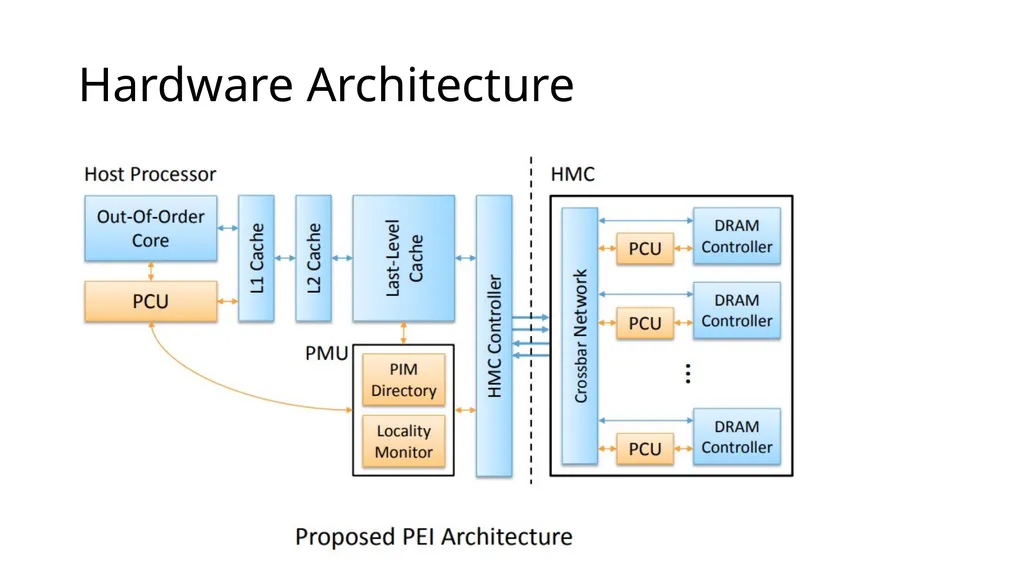
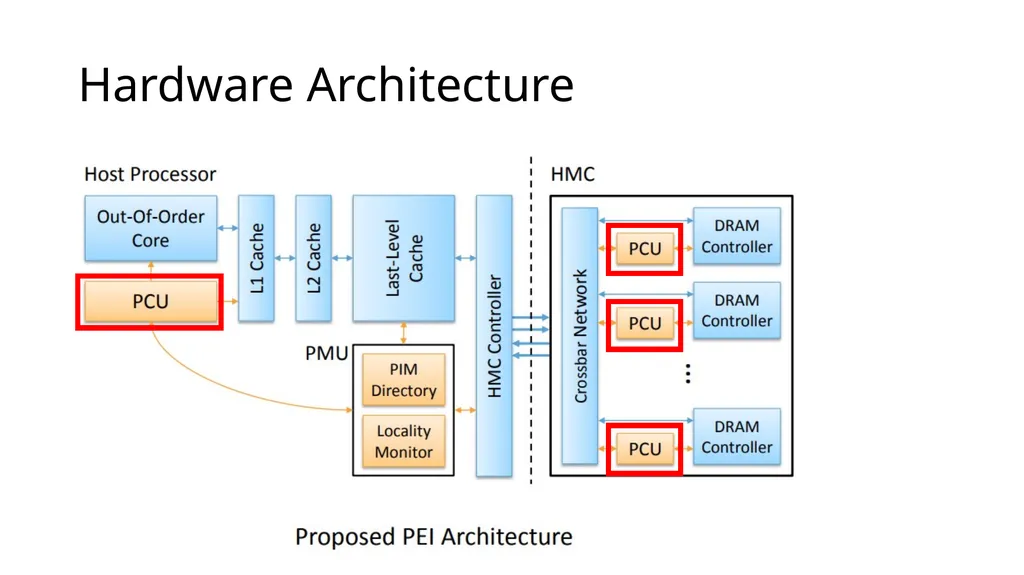
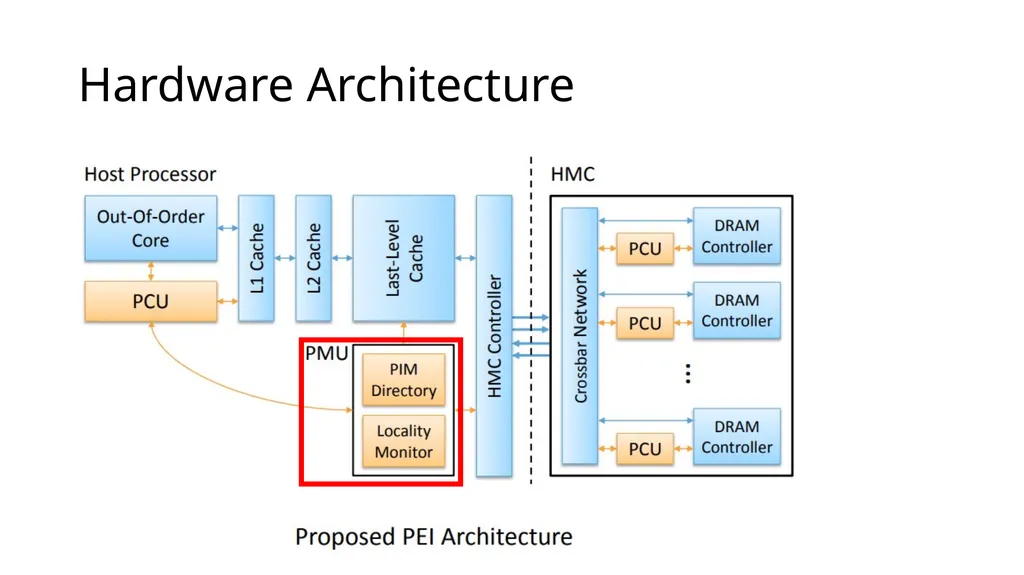
Add PEI computation unit (=: PCU) to each memory unit and also each host processor for design simplicity
Add a PEI management unit (=: PMU) shared between all host processors near last-level cache<br>
25
Hardware Architecture<br>
26
Hardware Architecture<br>
27
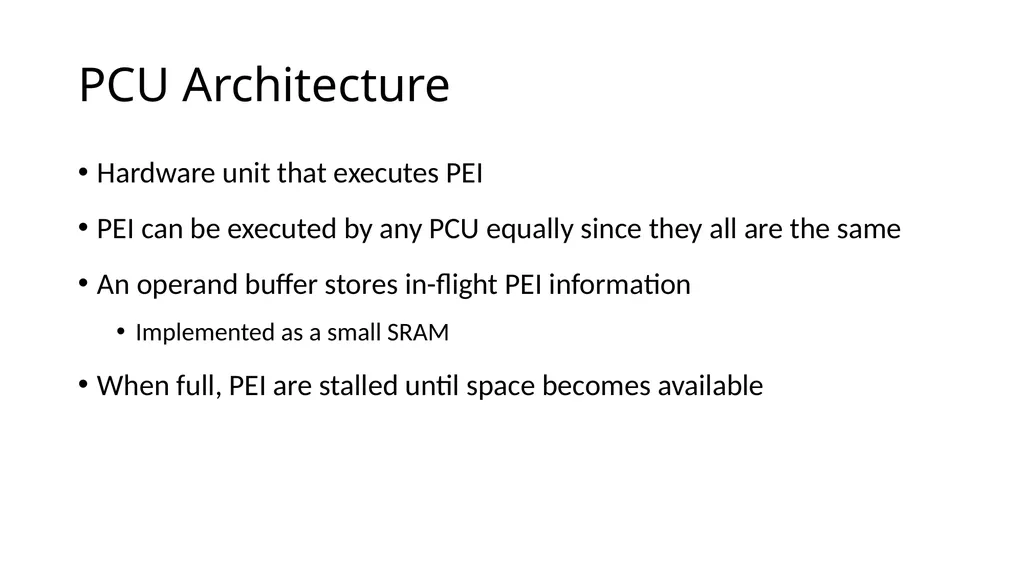
PCU Architecture Hardware unit that executes PEI
PEI can be executed by any PCU equally since they all are the same
An operand buffer stores in-flight PEI information
Implemented as a small SRAM
When full, PEI are stalled until space becomes available<br>
PEI can be executed by any PCU equally since they all are the same
An operand buffer stores in-flight PEI information
Implemented as a small SRAM
When full, PEI are stalled until space becomes available<br>
28
PCU Interface Host controls host-side PCU by manipulating memory-mapped registers inside it. For that, assemblers provide pseudo-instructions that are translated into accesses of those registers as an abstraction
Memory-side PCUs are controlled by memory (HMC) controllers
Uses special memory command that can easily be added to the packet-based communication (as claimed)<br>
Memory-side PCUs are controlled by memory (HMC) controllers
Uses special memory command that can easily be added to the packet-based communication (as claimed)<br>
29
Hardware Architecture<br>
30
Hardware Architecture Atomicity of memory-side execution can be achieved by simple modifications to the DRAM controllers
To guarantee atomicity for host-side execution, a new hardware structure is introduced: the PIM directory<br>
To guarantee atomicity for host-side execution, a new hardware structure is introduced: the PIM directory<br>
31
Hardware Architecture<br>
32
Hardware Architecture<br>
33
PMU: Locality Monitor<br>
34
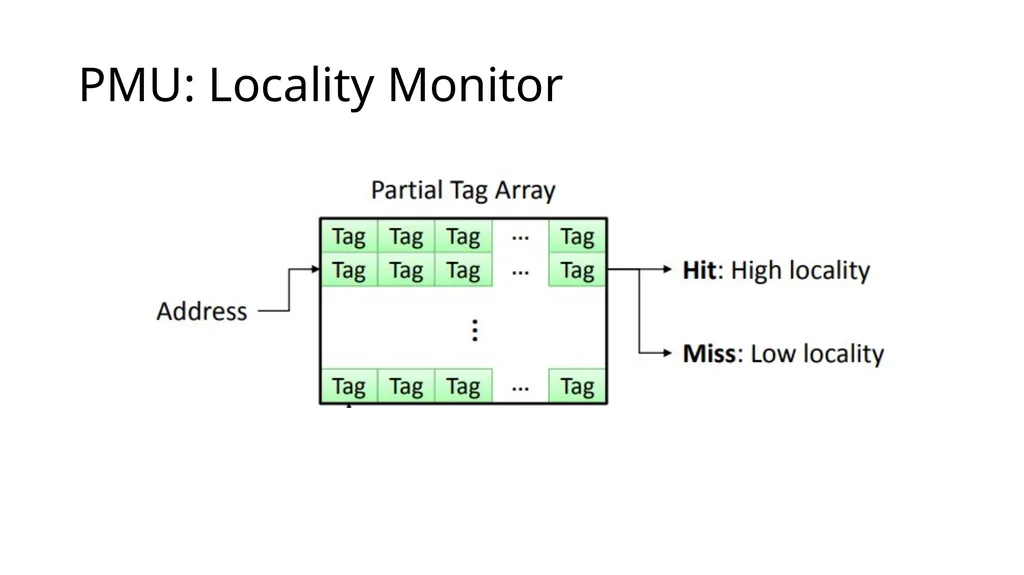
PMU: Locality Monitor Simple because of single cache block restriction
Similar structure to last-level cache tag array
Unless tag array updates as well when a PEI goes to memory as if it had accessed the corresponding last-level cache block in cache<br>
Similar structure to last-level cache tag array
Unless tag array updates as well when a PEI goes to memory as if it had accessed the corresponding last-level cache block in cache<br>
35
Hardware Architecture<br>
36
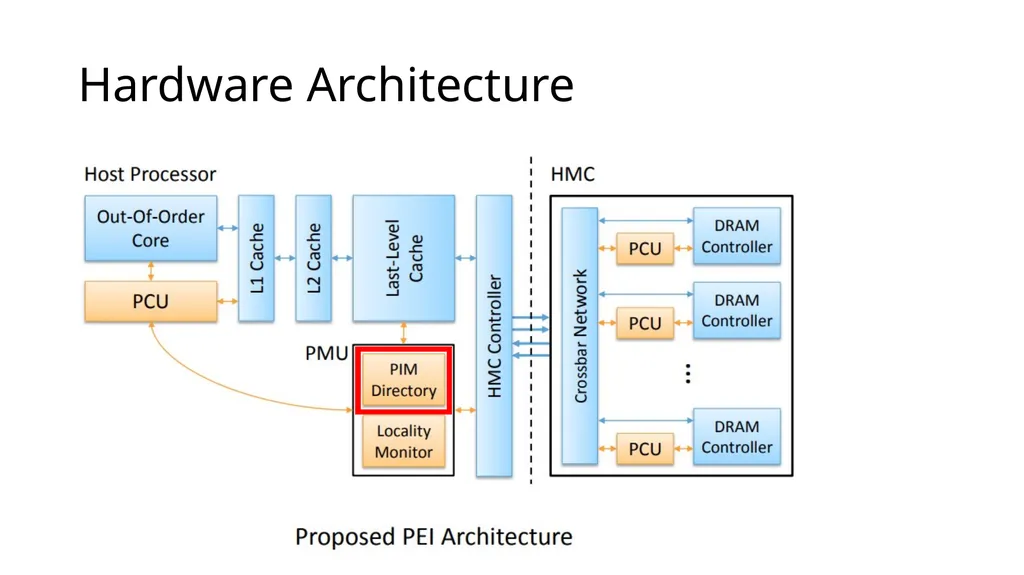
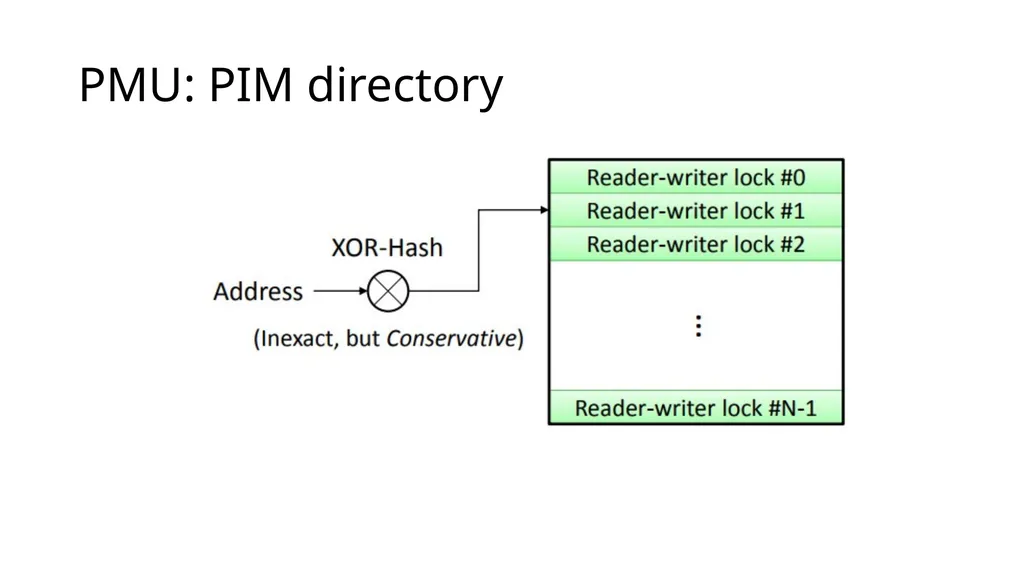
PMU: PIM directory Atomicity of memory-side execution can be achieved by simple modifications to the DRAM controllers
To guarantee atomicity for host-side execution, a new hardware structure is introduced: the PIM directory
Ideally, would track all in-flight PEI for reader/writer access safety
Very large overhead, requires fully associative table with as many entries as the added total entry number of all PCUs’ operand buffers in the system
To avoid this, rare false positives (unnecessary serialization) shall be allowed
Leads to overhead as well but paper claims it to be neglectable<br>
37
PMU: PIM directory<br>
38
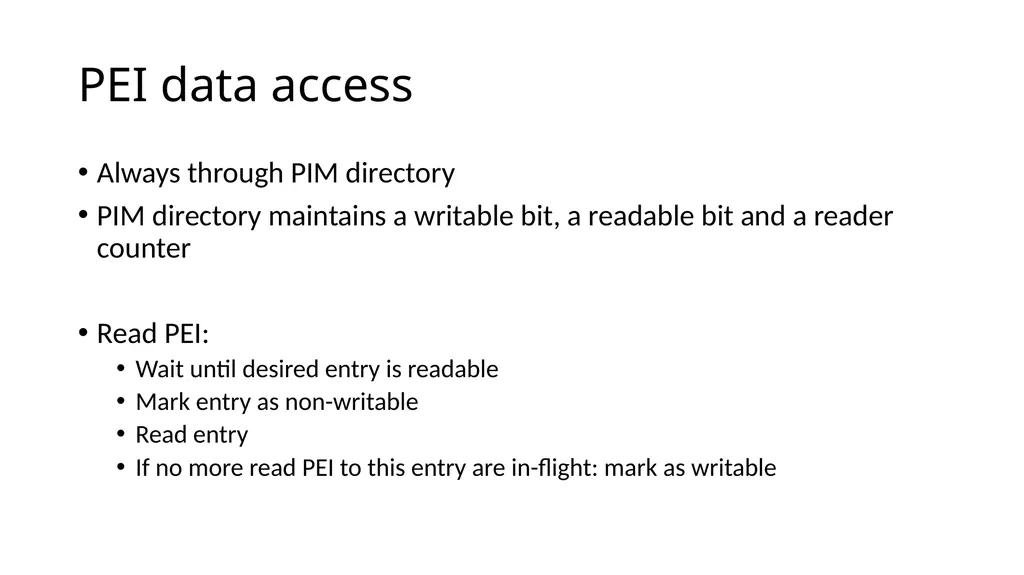
PEI data access Always through PIM directory
PIM directory maintains a writable bit, a readable bit and a reader counter
Read PEI:
Wait until desired entry is readable
Mark entry as non-writable
Read entry
If no more read PEI to this entry are in-flight: mark as writable<br>
PIM directory maintains a writable bit, a readable bit and a reader counter
Read PEI:
Wait until desired entry is readable
Mark entry as non-writable
Read entry
If no more read PEI to this entry are in-flight: mark as writable<br>
39
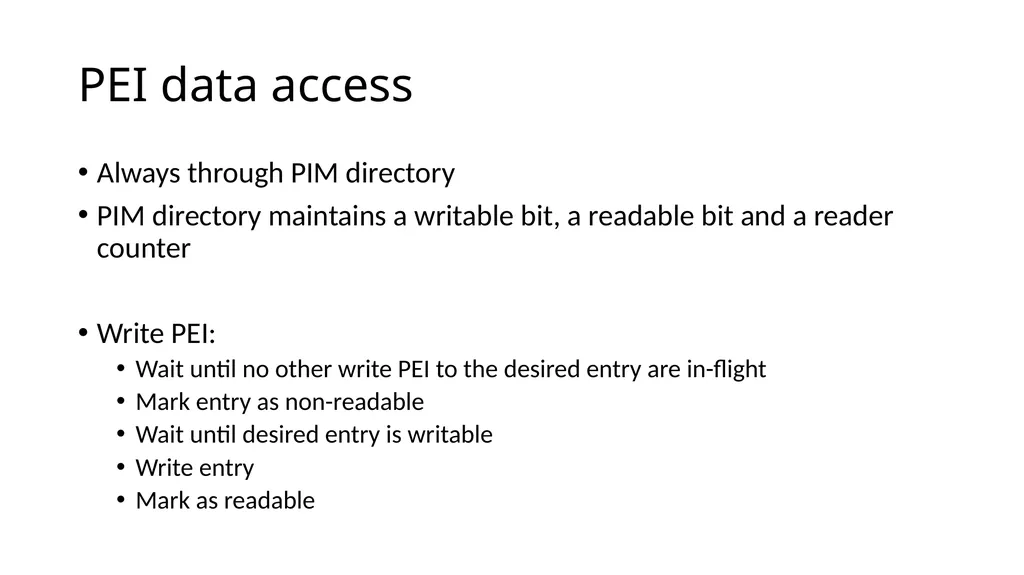
PEI data access Always through PIM directory
PIM directory maintains a writable bit, a readable bit and a reader counter
Write PEI:
Wait until no other write PEI to the desired entry are in-flight
Mark entry as non-readable
Wait until desired entry is writable
Write entry
Mark as readable<br>
PIM directory maintains a writable bit, a readable bit and a reader counter
Write PEI:
Wait until no other write PEI to the desired entry are in-flight
Mark entry as non-readable
Wait until desired entry is writable
Write entry
Mark as readable<br>
40
Hardware Architecture<br>
41
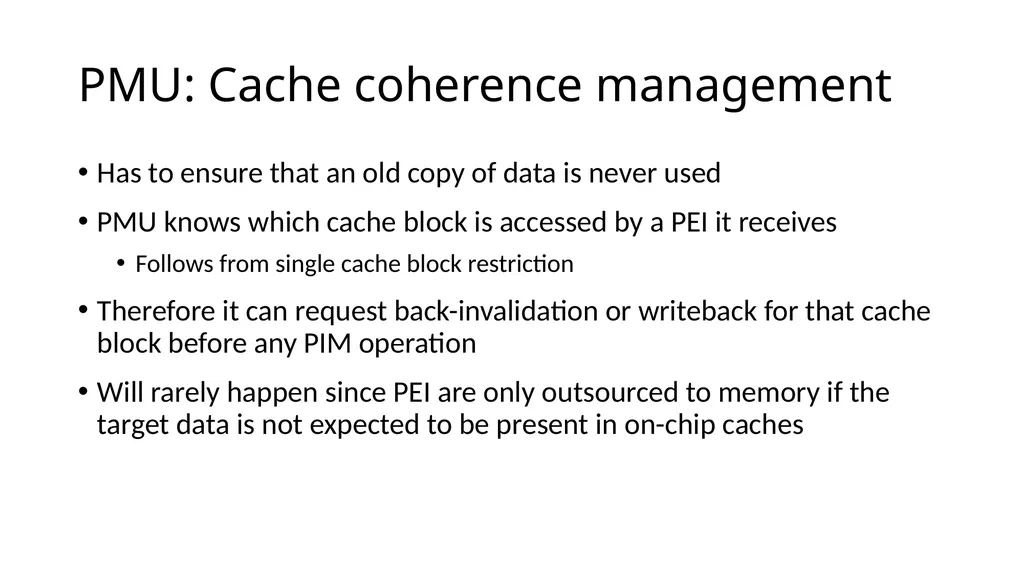
PMU: Cache coherence management Has to ensure that an old copy of data is never used
PMU knows which cache block is accessed by a PEI it receives
Follows from single cache block restriction
Therefore it can request back-invalidation or writeback for that cache block before any PIM operation
Will rarely happen since PEI are only outsourced to memory if the target data is not expected to be present in on-chip caches<br>
42
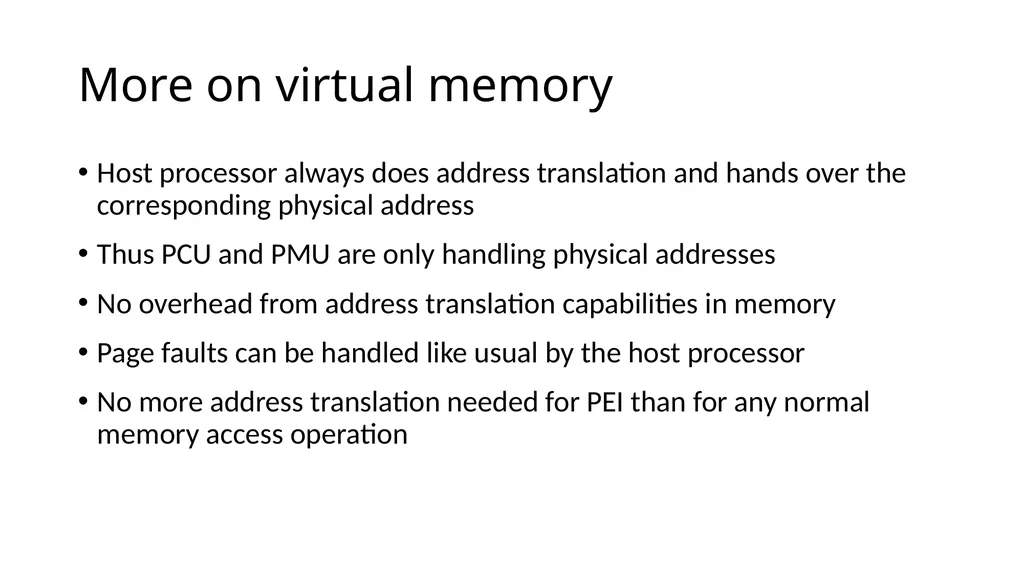
More on virtual memory Host processor always does address translation and hands over the corresponding physical address
Thus PCU and PMU are only handling physical addresses
No overhead from address translation capabilities in memory
Page faults can be handled like usual by the host processor
No more address translation needed for PEI than for any normal memory access operation<br>
Thus PCU and PMU are only handling physical addresses
No overhead from address translation capabilities in memory
Page faults can be handled like usual by the host processor
No more address translation needed for PEI than for any normal memory access operation<br>
43
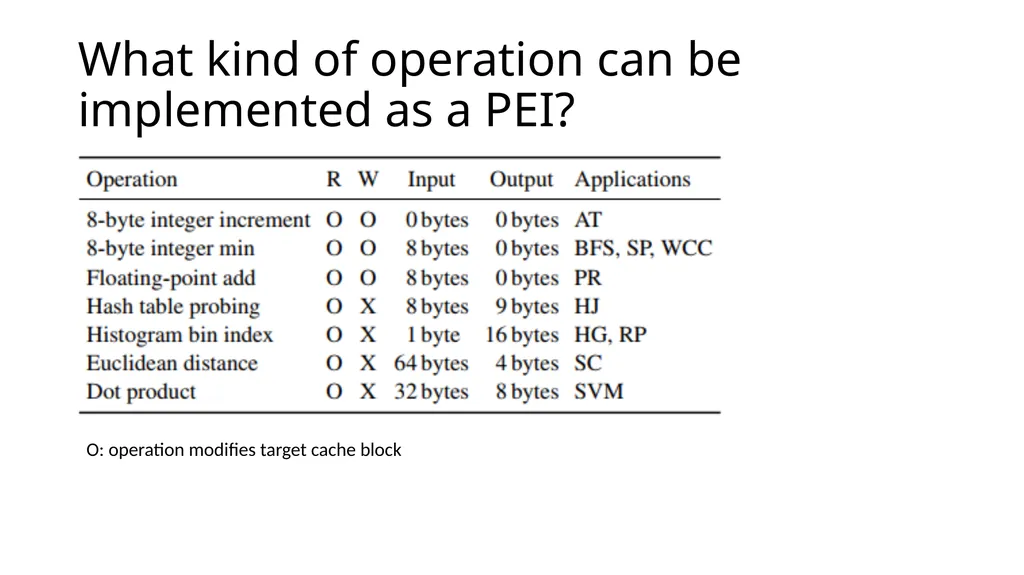
What kind of operation can be implemented as a PEI? O: operation modifies target cache block<br>
44
Experimental Evaluation<br>
45
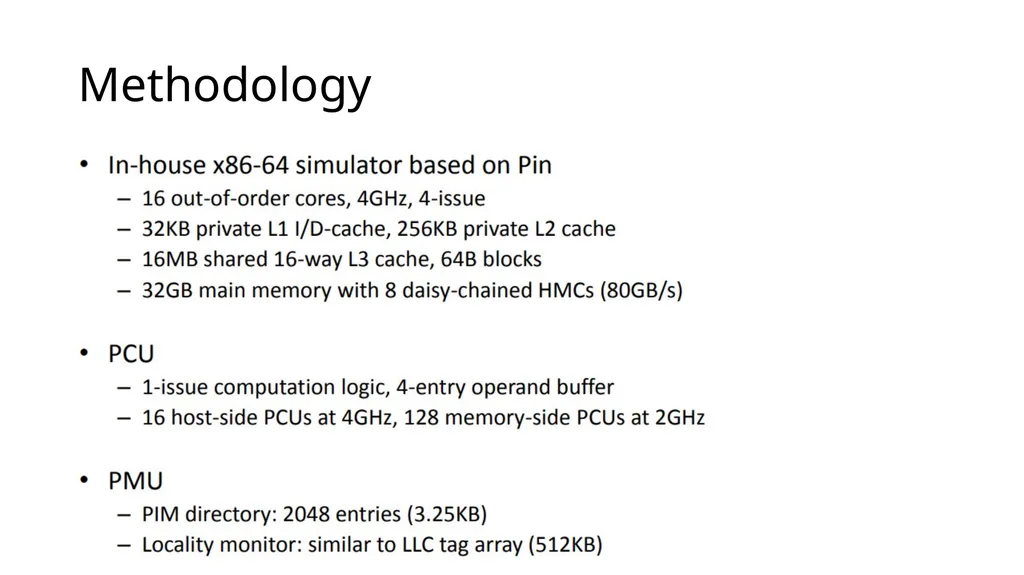
Methodology<br>
46
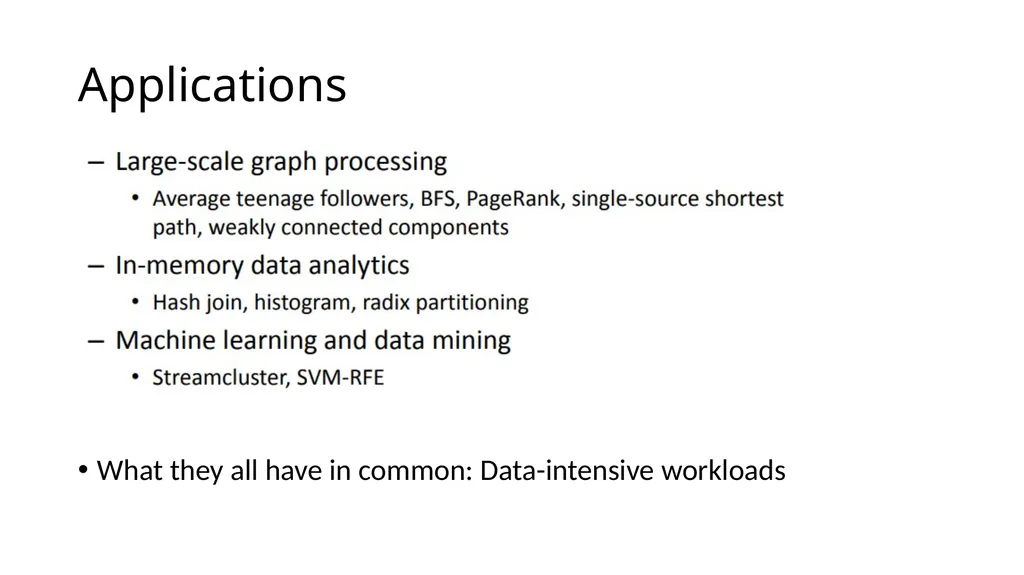
Applications What they all have in common: Data-intensive workloads<br>
47
Results<br>
48
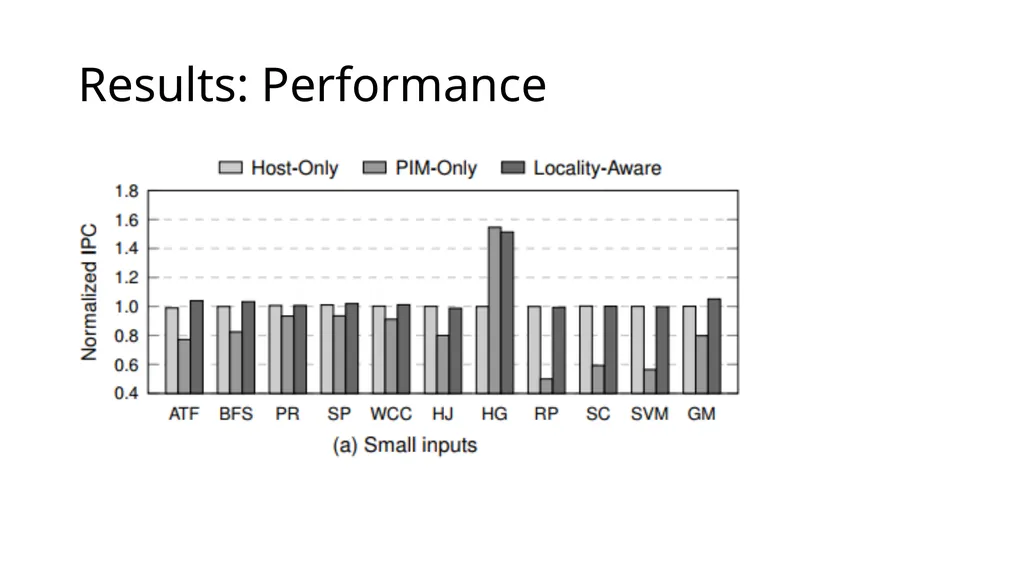
Results: Performance<br>
49
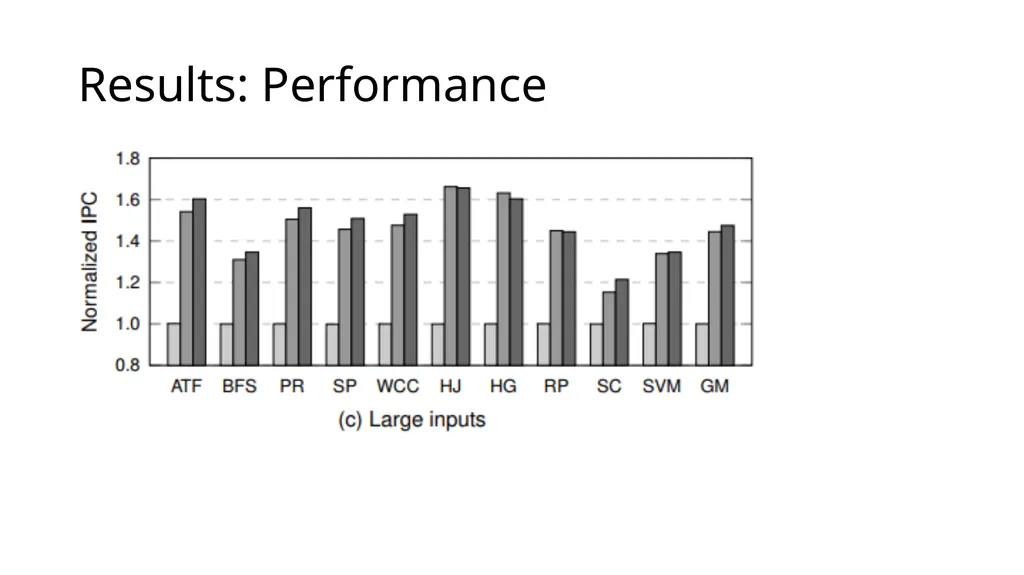
Results: Performance<br>
50
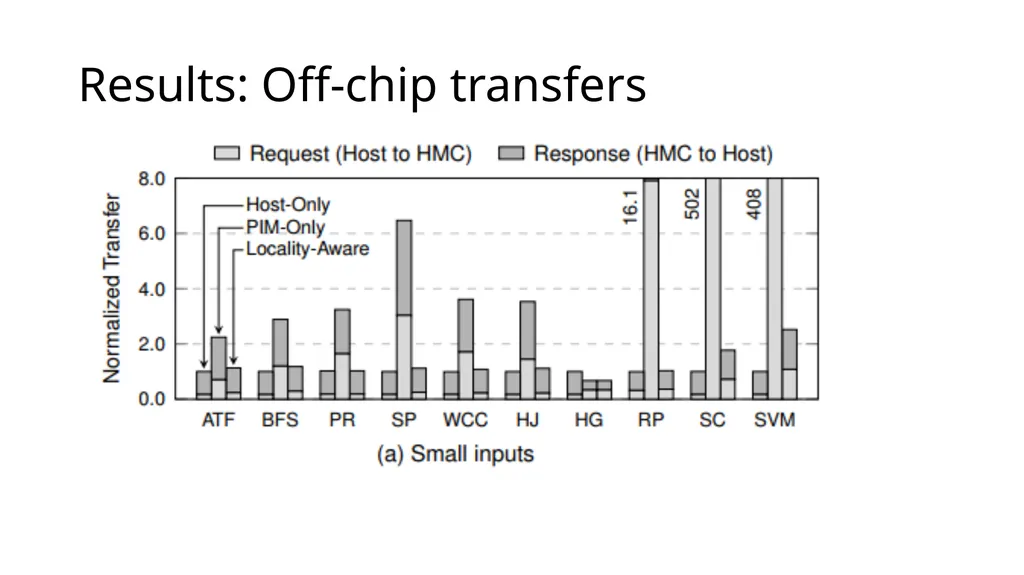
Results: Off-chip transfers<br>
51
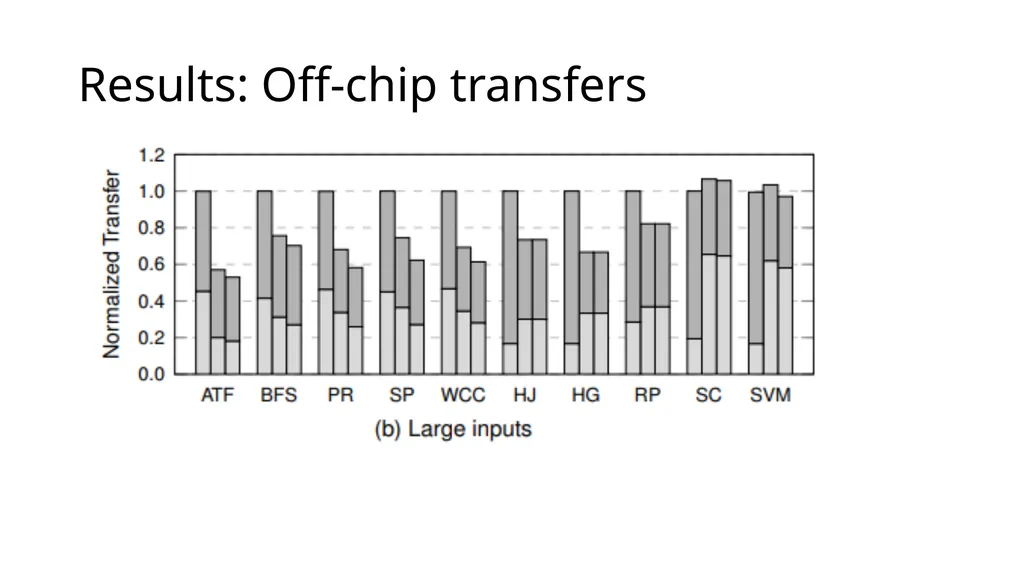
Results: Off-chip transfers<br>
52
Results: Page-rank with variable input size<br>
53
Takeaways<br>
54
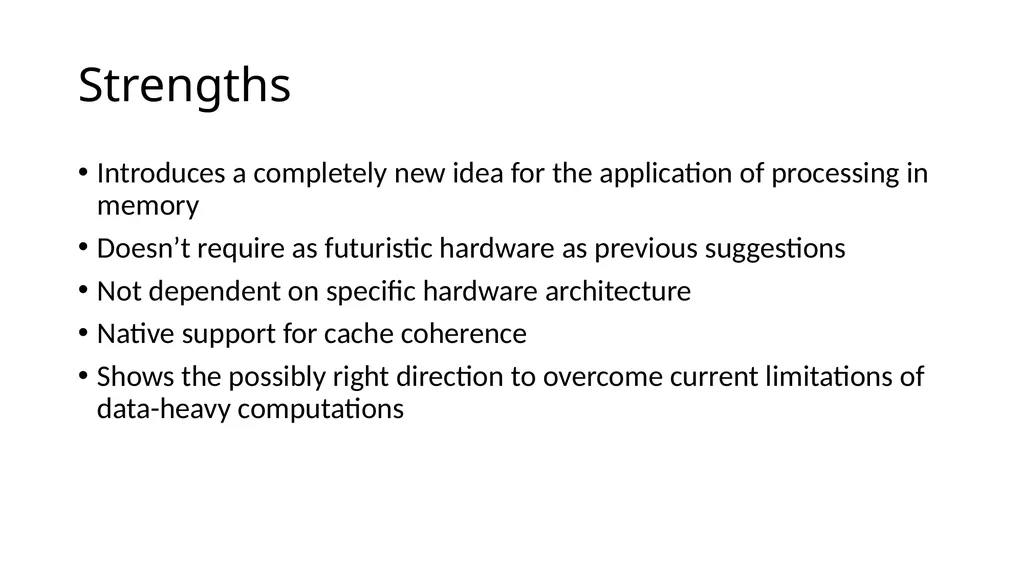
Strengths Introduces a completely new idea for the application of processing in memory
Doesn’t require as futuristic hardware as previous suggestions
Not dependent on specific hardware architecture
Native support for cache coherence
Shows the possibly right direction to overcome current limitations of data-heavy computations<br>
Doesn’t require as futuristic hardware as previous suggestions
Not dependent on specific hardware architecture
Native support for cache coherence
Shows the possibly right direction to overcome current limitations of data-heavy computations<br>
55
Weaknesses Ignores off-chip transfer of instructions
Programs still have to be manually modified to take advantage of PIM
The memory fence still adds a major change to the ISA
Lack of compatibility
Not enough details about simulation<br>
Programs still have to be manually modified to take advantage of PIM
The memory fence still adds a major change to the ISA
Lack of compatibility
Not enough details about simulation<br>
56
Questions?<br>
57
Thoughts and Discussion The paper provides an idea for the manual instruction replacement
Instead of modifying source code, let compiler automatically find potential PEI and compile them accordingly
The authors believe that their model is simple enough for a modern compiler to do this without complex program analysis
However takes compilers out of too heavy responsibility since they don’t have to decide over PIM
Do you think this is a viable solution?<br>
58
Thoughts and Discussion Can you think of a way to avoid program changes?
Can you make it fully compatible?
New idea: Move decisions even further away from programmer
Do not change ISA at all
Decide on runtime which instructions could possibly be executed as PEI
Then decide over PIM as proposed in the paper
Do you think this would work?<br>
Can you make it fully compatible?
New idea: Move decisions even further away from programmer
Do not change ISA at all
Decide on runtime which instructions could possibly be executed as PEI
Then decide over PIM as proposed in the paper
Do you think this would work?<br>
59
Discussion How does the PEI model perform in comparison to GPGPUs? For which workloads?
The single cache block restriction gives a very strong restriction to what can be performed in memory. Can’t this lack of generality become an issue e.g. for data-heavy single operations?
Can’t the direct physical memory access by all PIM/PEI units and instructions cause a safety issue?
What do you think about the overlapping pipeline stages problem? Is stalling a good solution? Can you think of a different one?<br>
60
Related Papers for Discussion<br>
61
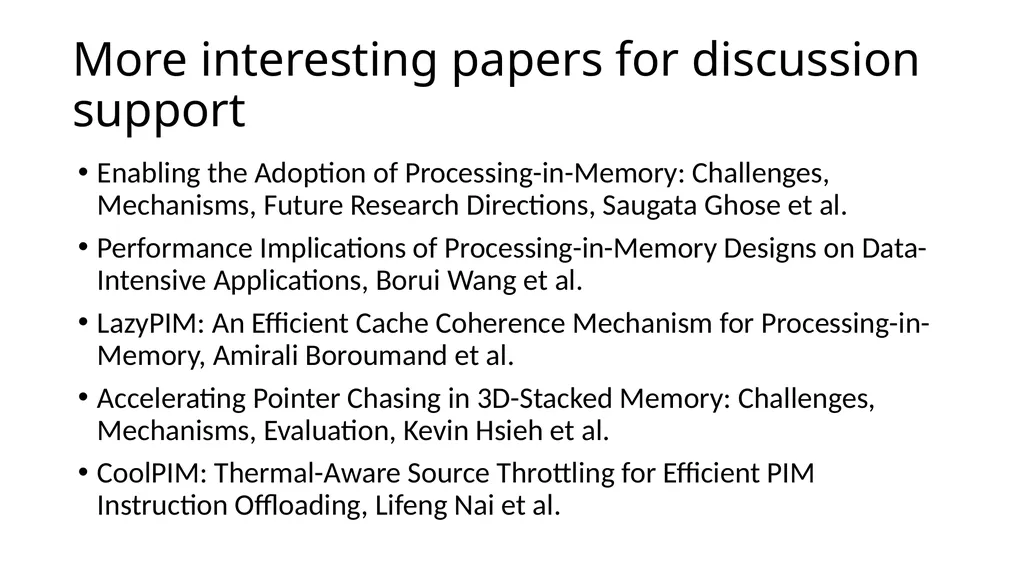
More interesting papers for discussion support Enabling the Adoption of Processing-in-Memory: Challenges, Mechanisms, Future Research Directions, Saugata Ghose et al.
Performance Implications of Processing-in-Memory Designs on Data-Intensive Applications, Borui Wang et al.
LazyPIM: An Efficient Cache Coherence Mechanism for Processing-in-Memory, Amirali Boroumand et al.
Accelerating Pointer Chasing in 3D-Stacked Memory: Challenges, Mechanisms, Evaluation, Kevin Hsieh et al.
CoolPIM: Thermal-Aware Source Throttling for Efficient PIM Instruction Offloading, Lifeng Nai et al.<br>