
Planning Council New Member Orientation 1 [Notes
PM
Published · 73 slides · 0 views
1 / 1


Description
Planning Council New Member Orientation 1 Notes for presenters: This slide can be removed While this sample presentation is titled Planning Council New Member Orientation, the content would be similar for a TGA planning body that is not a
Related Topics
Share
Embed code
Download this presentation From Below
"Planning Council New Member Orientation 1 [Notes" is the property of its rightful owner. Permission is granted to download and print the materials on this website for personal, non-commercial use only, and to display it on your personal computer provided you do not modify the materials and that you retain all copyright notices contained in the materials. By downloading content from our website, you accept the terms of this agreement.
Presentation Transcript
01
Planning Council New Member Orientation 1<br>
02
[Notes for presenters: This slide can be removed] While this sample presentation is titled Planning Council New Member Orientation, the content would be similar for a TGA planning body that is not a planning council, explaining that the legislative duties and membership composition are recommended, not required, and decisions are recommendations to the recipient.
As indicated in the notes accompanying the slides, most of the slides and activities are taken directly or adapted slightly from the Training Guide for RWHAP Part A Planning Councils/Planning Bodies: A Member’s First Planning Cycle
Consider tailoring this presentation to your PC/PB by adding in, for example, your PC/PB’s name, committee structure, policies, etc. and inserting local data.<br>
As indicated in the notes accompanying the slides, most of the slides and activities are taken directly or adapted slightly from the Training Guide for RWHAP Part A Planning Councils/Planning Bodies: A Member’s First Planning Cycle
Consider tailoring this presentation to your PC/PB by adding in, for example, your PC/PB’s name, committee structure, policies, etc. and inserting local data.<br>
03
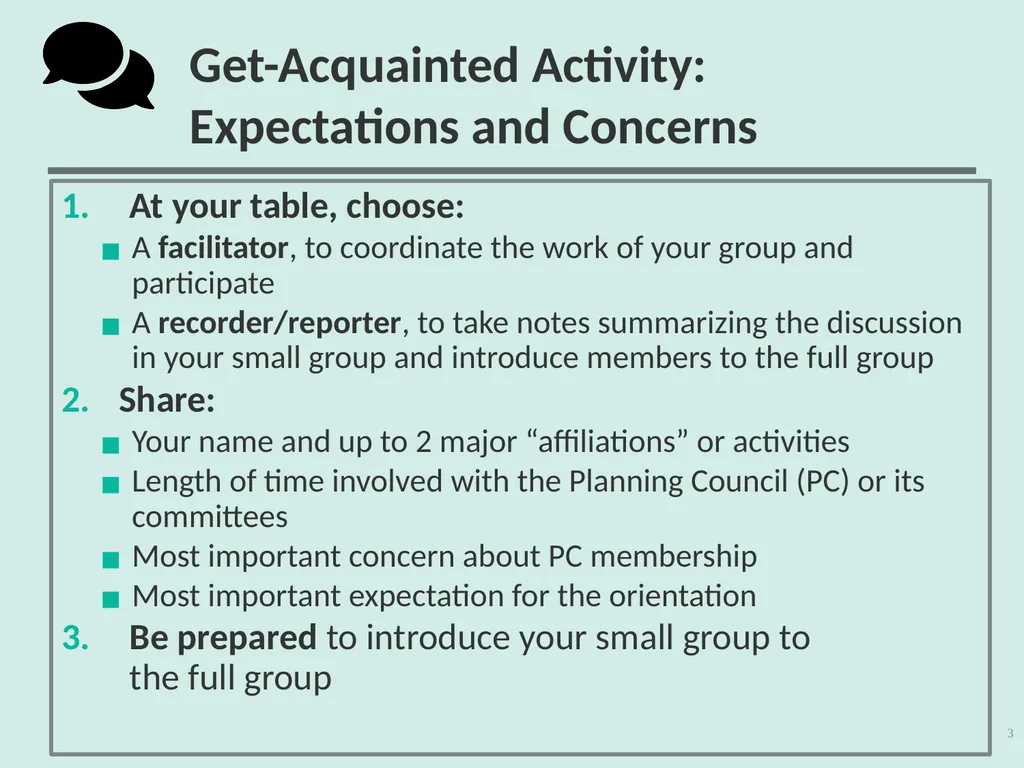
Get-Acquainted Activity: Expectations and Concerns At your table, choose:
A facilitator, to coordinate the work of your group and participate
A recorder/reporter, to take notes summarizing the discussion in your small group and introduce members to the full group
Share:
Your name and up to 2 major “affiliations” or activities
Length of time involved with the Planning Council (PC) or its committees
Most important concern about PC membership
Most important expectation for the orientation
Be prepared to introduce your small group to the full group 3<br>
A facilitator, to coordinate the work of your group and participate
A recorder/reporter, to take notes summarizing the discussion in your small group and introduce members to the full group
Share:
Your name and up to 2 major “affiliations” or activities
Length of time involved with the Planning Council (PC) or its committees
Most important concern about PC membership
Most important expectation for the orientation
Be prepared to introduce your small group to the full group 3<br>
04
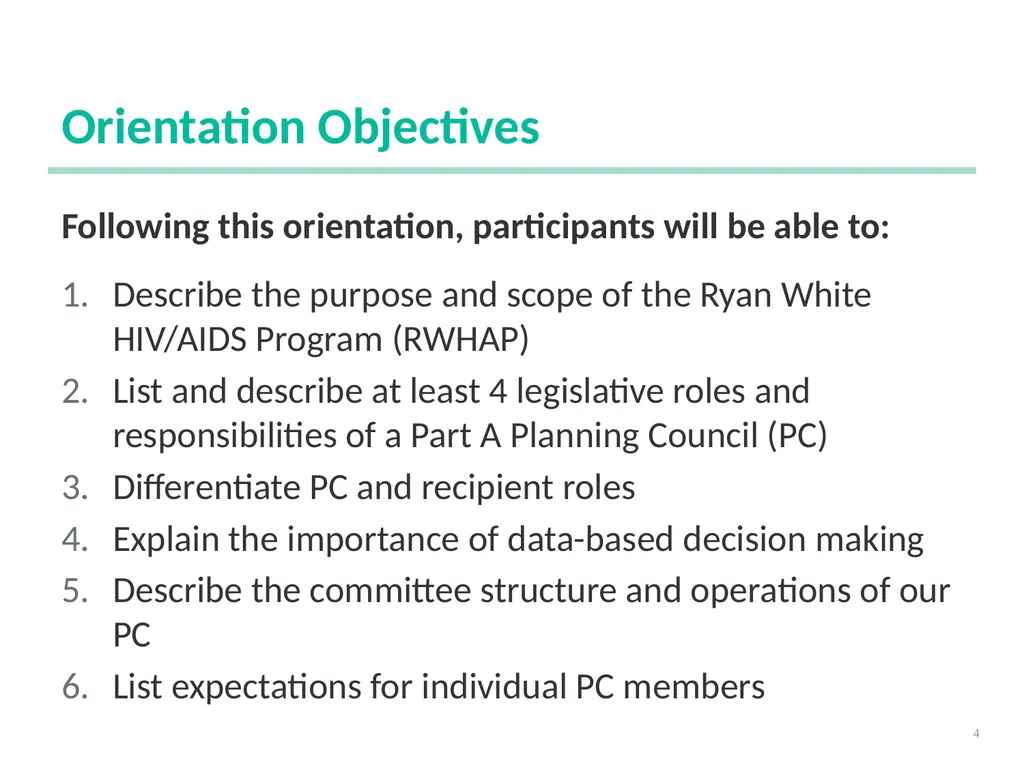
Orientation Objectives Following this orientation, participants will be able to:
Describe the purpose and scope of the Ryan White HIV/AIDS Program (RWHAP)
List and describe at least 4 legislative roles and responsibilities of a Part A Planning Council (PC)
Differentiate PC and recipient roles
Explain the importance of data-based decision making
Describe the committee structure and operations of our PC
List expectations for individual PC members 4<br>
Describe the purpose and scope of the Ryan White HIV/AIDS Program (RWHAP)
List and describe at least 4 legislative roles and responsibilities of a Part A Planning Council (PC)
Differentiate PC and recipient roles
Explain the importance of data-based decision making
Describe the committee structure and operations of our PC
List expectations for individual PC members 4<br>
05
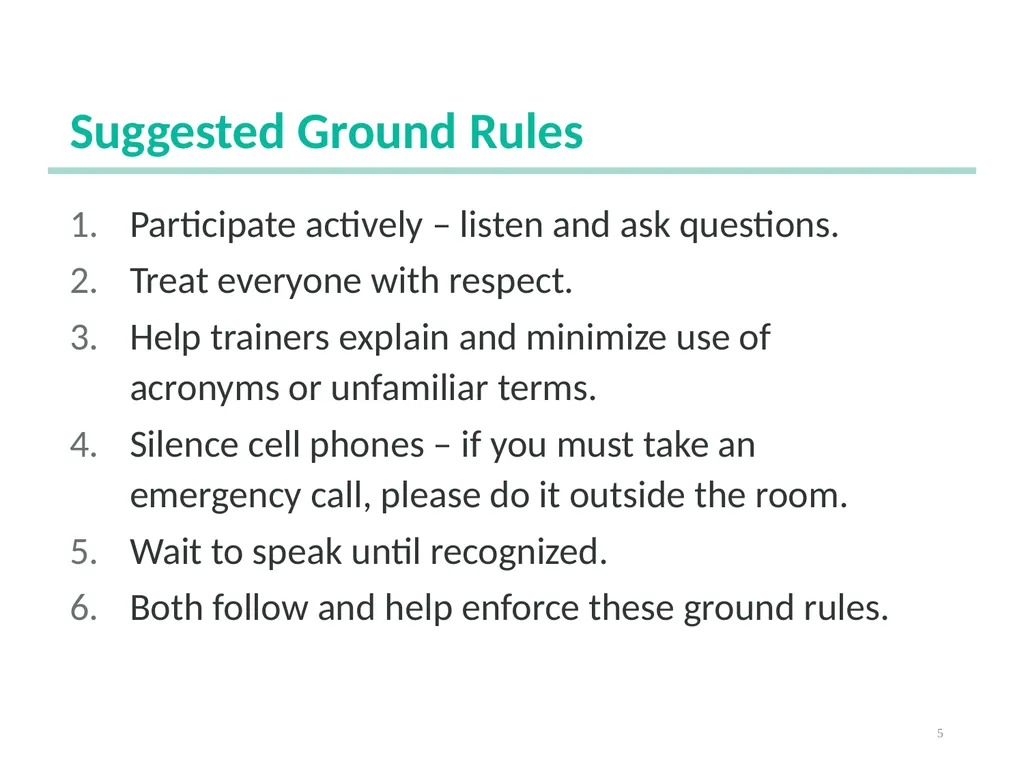
Suggested Ground Rules Participate actively – listen and ask questions.
Treat everyone with respect.
Help trainers explain and minimize use of acronyms or unfamiliar terms.
Silence cell phones – if you must take an emergency call, please do it outside the room.
Wait to speak until recognized.
Both follow and help enforce these ground rules. 5<br>
Treat everyone with respect.
Help trainers explain and minimize use of acronyms or unfamiliar terms.
Silence cell phones – if you must take an emergency call, please do it outside the room.
Wait to speak until recognized.
Both follow and help enforce these ground rules. 5<br>
06
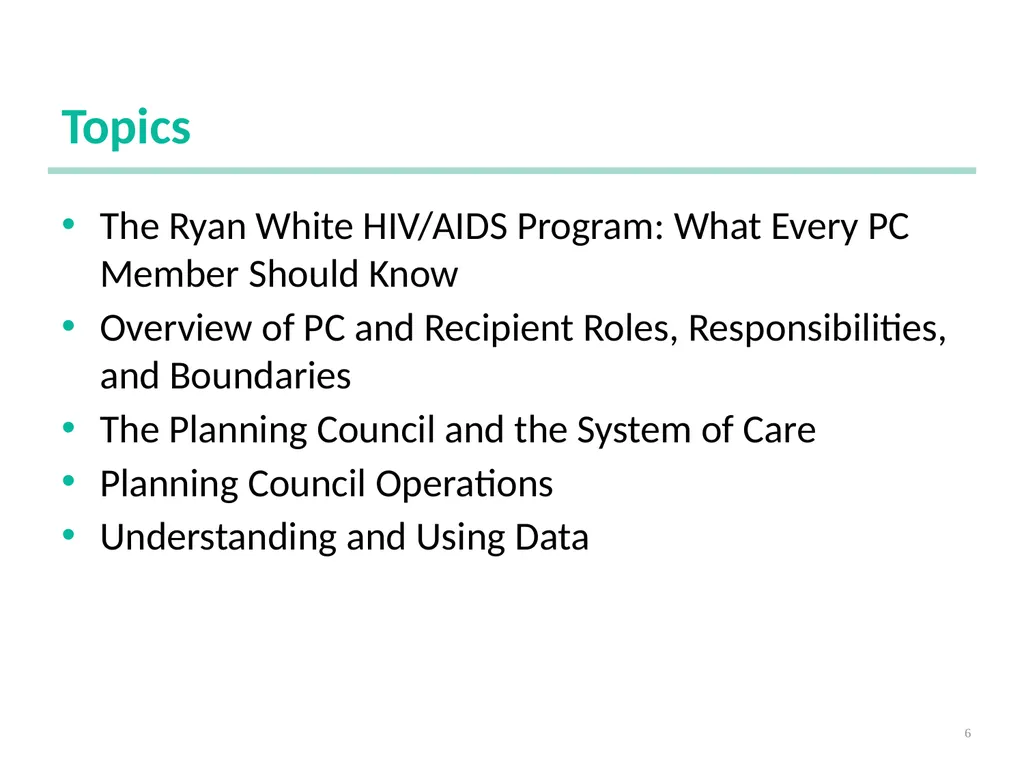
Topics The Ryan White HIV/AIDS Program: What Every PC Member Should Know
Overview of PC and Recipient Roles, Responsibilities, and Boundaries
The Planning Council and the System of Care
Planning Council Operations
Understanding and Using Data 6<br>
Overview of PC and Recipient Roles, Responsibilities, and Boundaries
The Planning Council and the System of Care
Planning Council Operations
Understanding and Using Data 6<br>
07
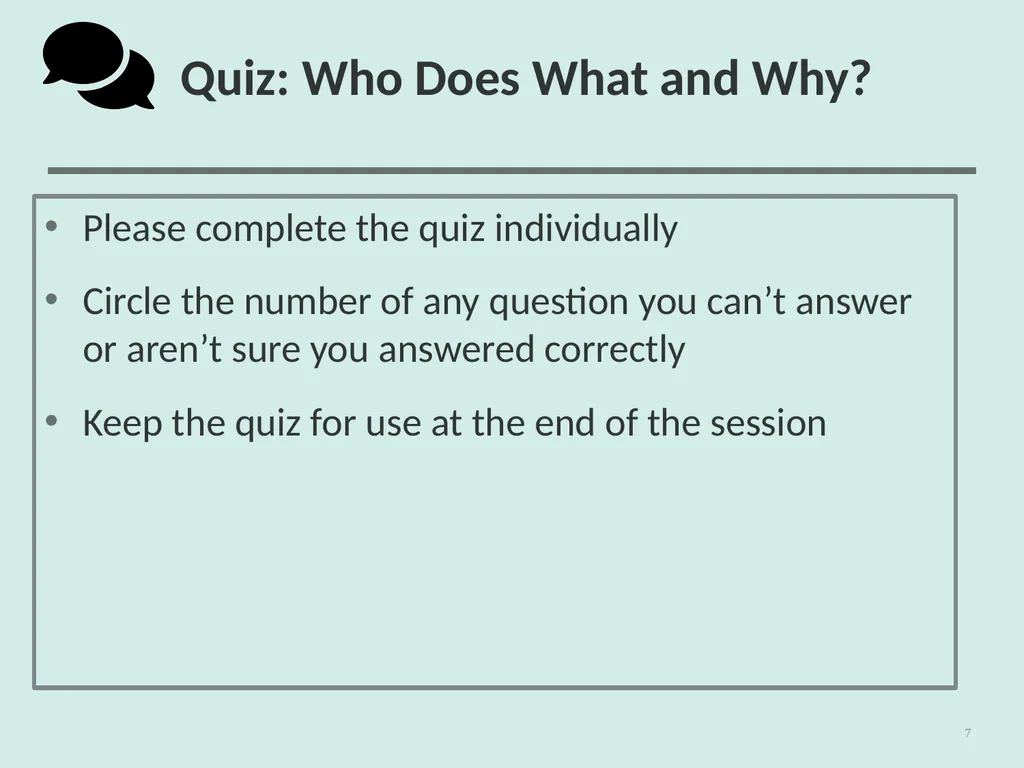
Quiz: Who Does What and Why? Please complete the quiz individually
Circle the number of any question you can’t answer or aren’t sure you answered correctly
Keep the quiz for use at the end of the session 7<br>
Circle the number of any question you can’t answer or aren’t sure you answered correctly
Keep the quiz for use at the end of the session 7<br>
08
The Ryan White HIV/AIDS Program: What Every PC Member Should Know Understanding RWHAP Purpose and Scope
Understanding Part A
Part A Community Planning 8<br>
Understanding Part A
Part A Community Planning 8<br>
09
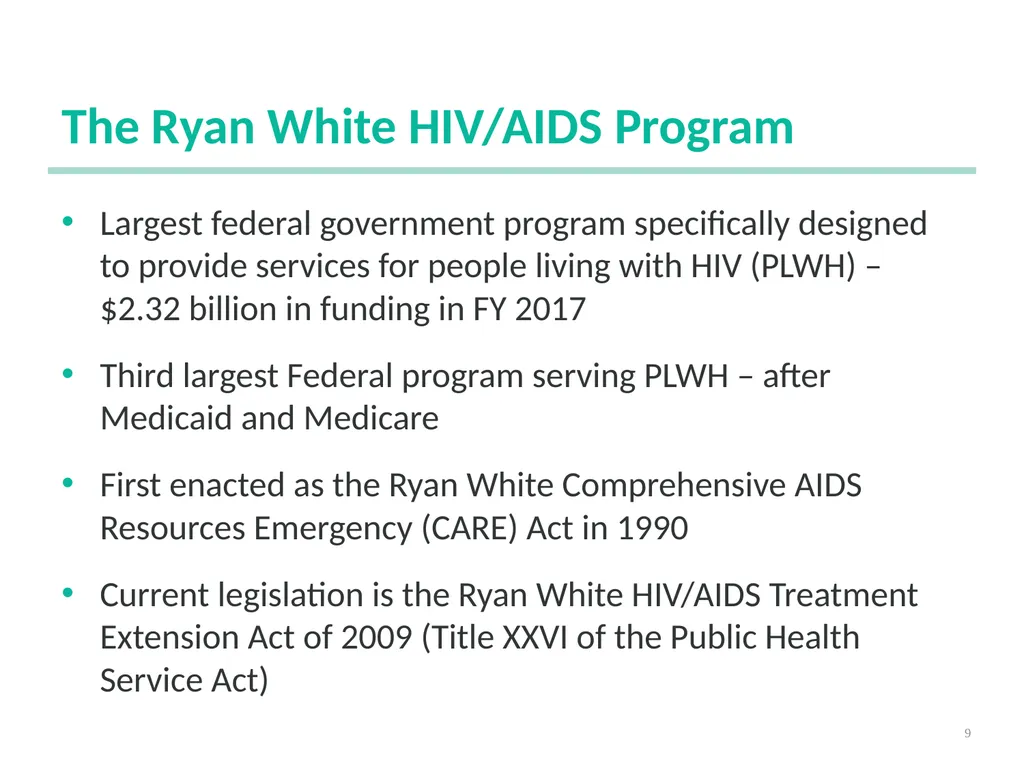
The Ryan White HIV/AIDS Program Largest federal government program specifically designed to provide services for people living with HIV (PLWH) – $2.32 billion in funding in FY 2017
Third largest Federal program serving PLWH – after Medicaid and Medicare
First enacted as the Ryan White Comprehensive AIDS Resources Emergency (CARE) Act in 1990
Current legislation is the Ryan White HIV/AIDS Treatment Extension Act of 2009 (Title XXVI of the Public Health Service Act) 9<br>
Third largest Federal program serving PLWH – after Medicaid and Medicare
First enacted as the Ryan White Comprehensive AIDS Resources Emergency (CARE) Act in 1990
Current legislation is the Ryan White HIV/AIDS Treatment Extension Act of 2009 (Title XXVI of the Public Health Service Act) 9<br>
10
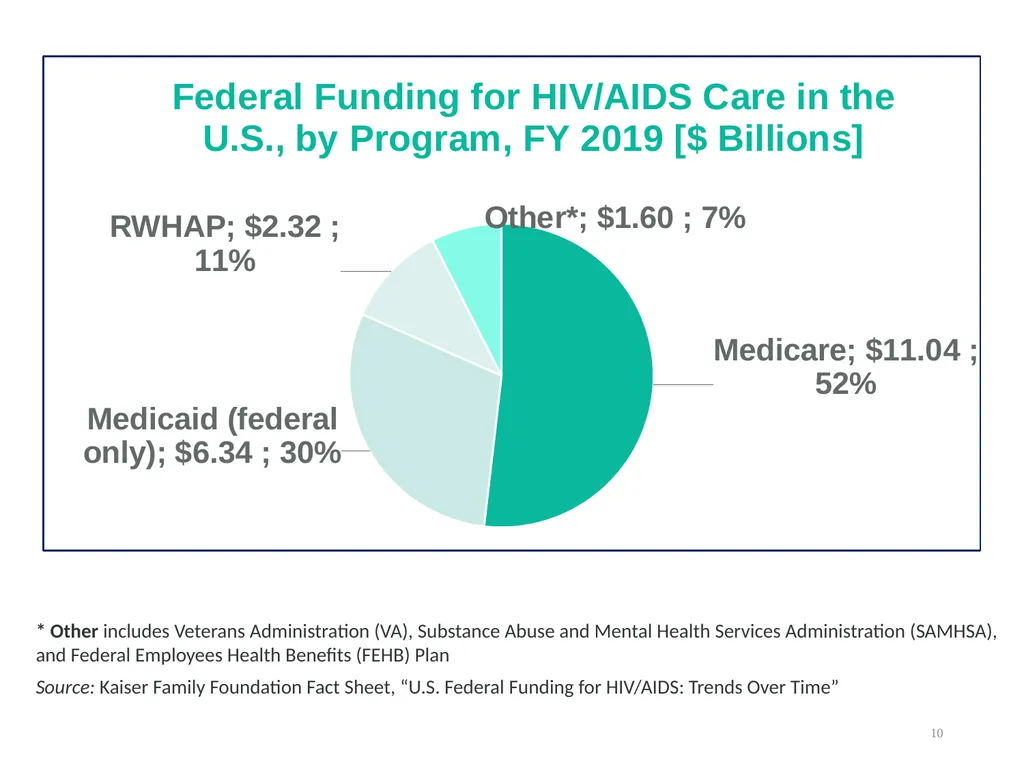
* Other includes Veterans Administration (VA), Substance Abuse and Mental Health Services Administration (SAMHSA), and Federal Employees Health Benefits (FEHB) Plan
Source: Kaiser Family Foundation Fact Sheet, “U.S. Federal Funding for HIV/AIDS: Trends Over Time” 10<br>
Source: Kaiser Family Foundation Fact Sheet, “U.S. Federal Funding for HIV/AIDS: Trends Over Time” 10<br>
11
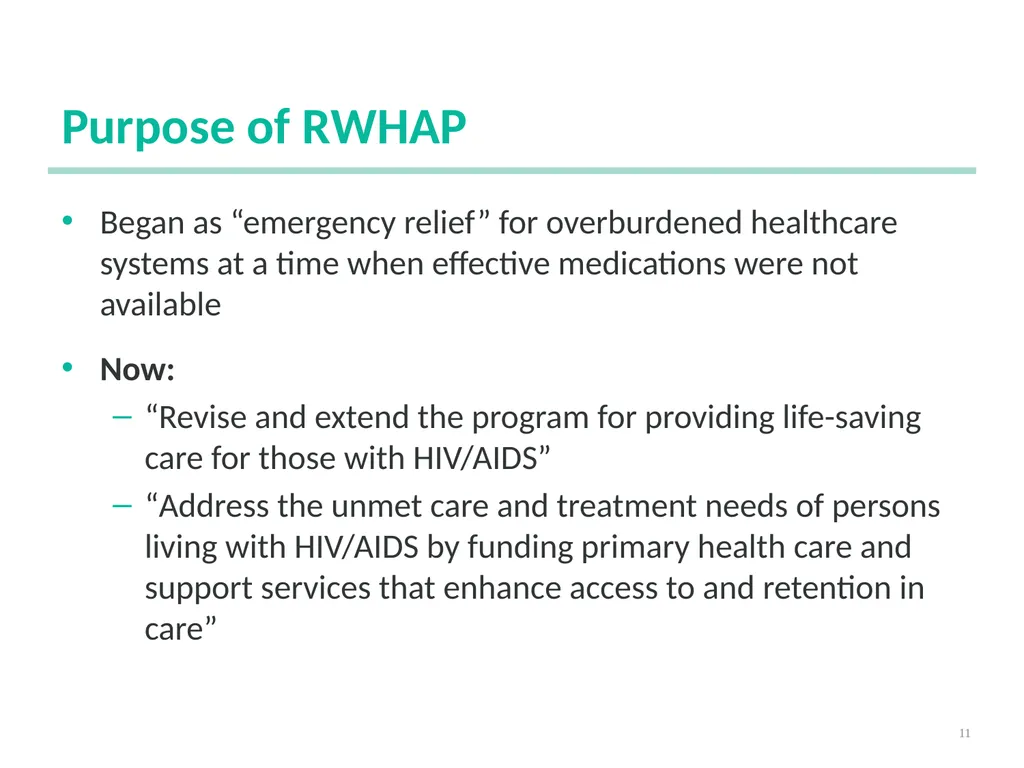
Purpose of RWHAP Began as “emergency relief” for overburdened healthcare systems at a time when effective medications were not available
Now:
“Revise and extend the program for providing life-saving care for those with HIV/AIDS”
“Address the unmet care and treatment needs of persons living with HIV/AIDS by funding primary health care and support services that enhance access to and retention in care” 11<br>
Now:
“Revise and extend the program for providing life-saving care for those with HIV/AIDS”
“Address the unmet care and treatment needs of persons living with HIV/AIDS by funding primary health care and support services that enhance access to and retention in care” 11<br>
12
RWHAP Scope Includes 5 Parts: A, B, C, D, and F
Administered by the HIV/AIDS Bureau (HAB), within the Health Resources and Services Administration (HRSA)
RWHAP Parts designed to work together to ensure a comprehensive system of care in urban, suburban, and rural communities throughout the U.S. 12<br>
Administered by the HIV/AIDS Bureau (HAB), within the Health Resources and Services Administration (HRSA)
RWHAP Parts designed to work together to ensure a comprehensive system of care in urban, suburban, and rural communities throughout the U.S. 12<br>
13
RWHAP Facts RWHAP serves PLWH who are low-income and do not have insurance that covers their HIV care and medications – over 60% have incomes below the federal poverty line
RWHAP is the payor of last resort – funds may not be used to pay for items or services that are eligible for coverage by other federal or state programs or private health insurance
RWHAP is not an “entitlement” program: it must operate using the funds appropriated annually by Congress and awarded to recipients 13<br>
RWHAP is the payor of last resort – funds may not be used to pay for items or services that are eligible for coverage by other federal or state programs or private health insurance
RWHAP is not an “entitlement” program: it must operate using the funds appropriated annually by Congress and awarded to recipients 13<br>
14
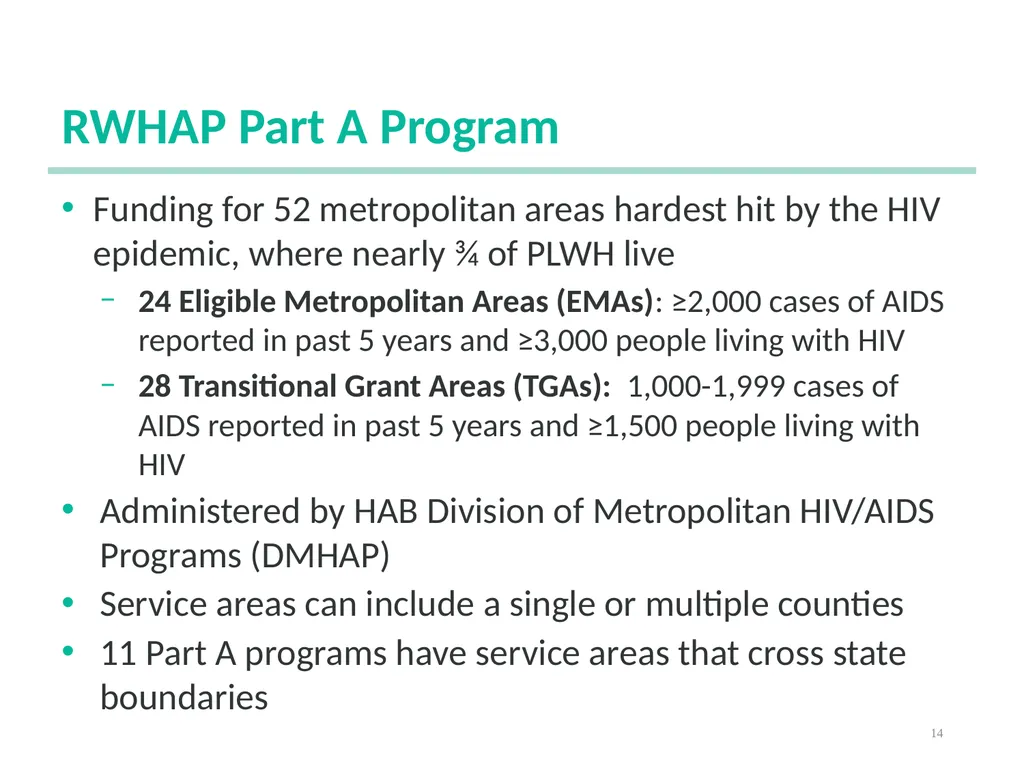
RWHAP Part A Program Funding for 52 metropolitan areas hardest hit by the HIV epidemic, where nearly ¾ of PLWH live
24 Eligible Metropolitan Areas (EMAs): ≥2,000 cases of AIDS reported in past 5 years and ≥3,000 people living with HIV
28 Transitional Grant Areas (TGAs): 1,000-1,999 cases of AIDS reported in past 5 years and ≥1,500 people living with HIV
Administered by HAB Division of Metropolitan HIV/AIDS Programs (DMHAP)
Service areas can include a single or multiple counties
11 Part A programs have service areas that cross state boundaries 14<br>
24 Eligible Metropolitan Areas (EMAs): ≥2,000 cases of AIDS reported in past 5 years and ≥3,000 people living with HIV
28 Transitional Grant Areas (TGAs): 1,000-1,999 cases of AIDS reported in past 5 years and ≥1,500 people living with HIV
Administered by HAB Division of Metropolitan HIV/AIDS Programs (DMHAP)
Service areas can include a single or multiple counties
11 Part A programs have service areas that cross state boundaries 14<br>
15
RWHAP Part A Funding RWHAP Part A programs receive both “formula” and “supplemental” funding:
Part A formula funding is based on the number of living cases of HIV and AIDS in the EMA or TGA
Minority AIDS Initiative (MAI) formula funding is based on the disproportionately affected minorities population living with HIV and AIDS
Supplemental funding is competitive, based on demonstration of additional need in the annual application 15<br>
Part A formula funding is based on the number of living cases of HIV and AIDS in the EMA or TGA
Minority AIDS Initiative (MAI) formula funding is based on the disproportionately affected minorities population living with HIV and AIDS
Supplemental funding is competitive, based on demonstration of additional need in the annual application 15<br>
16
Legislative Requirements
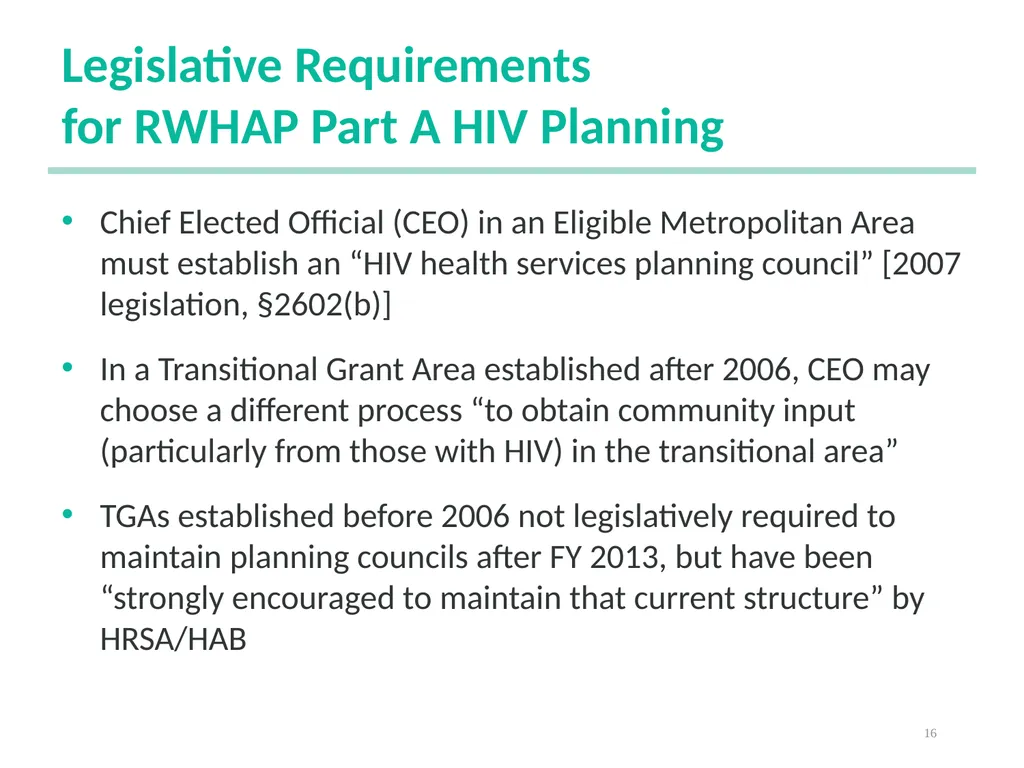
for RWHAP Part A HIV Planning Chief Elected Official (CEO) in an Eligible Metropolitan Area must establish an “HIV health services planning council” [2007 legislation, §2602(b)]
In a Transitional Grant Area established after 2006, CEO may choose a different process “to obtain community input (particularly from those with HIV) in the transitional area”
TGAs established before 2006 not legislatively required to maintain planning councils after FY 2013, but have been “strongly encouraged to maintain that current structure” by HRSA/HAB 16<br>
In a Transitional Grant Area established after 2006, CEO may choose a different process “to obtain community input (particularly from those with HIV) in the transitional area”
TGAs established before 2006 not legislatively required to maintain planning councils after FY 2013, but have been “strongly encouraged to maintain that current structure” by HRSA/HAB 16<br>
17
HRSA/HAB Suggested Principles
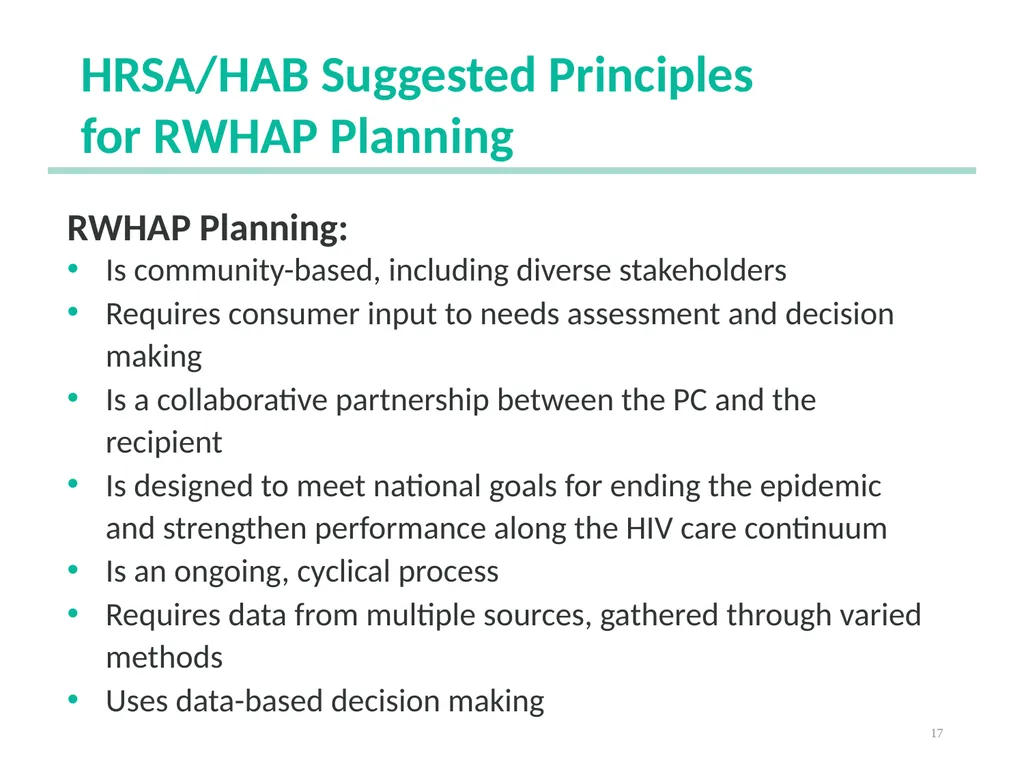
for RWHAP Planning RWHAP Planning:
Is community-based, including diverse stakeholders
Requires consumer input to needs assessment and decision making
Is a collaborative partnership between the PC and the recipient
Is designed to meet national goals for ending the epidemic and strengthen performance along the HIV care continuum
Is an ongoing, cyclical process
Requires data from multiple sources, gathered through varied methods
Uses data-based decision making 17<br>
Is community-based, including diverse stakeholders
Requires consumer input to needs assessment and decision making
Is a collaborative partnership between the PC and the recipient
Is designed to meet national goals for ending the epidemic and strengthen performance along the HIV care continuum
Is an ongoing, cyclical process
Requires data from multiple sources, gathered through varied methods
Uses data-based decision making 17<br>
18
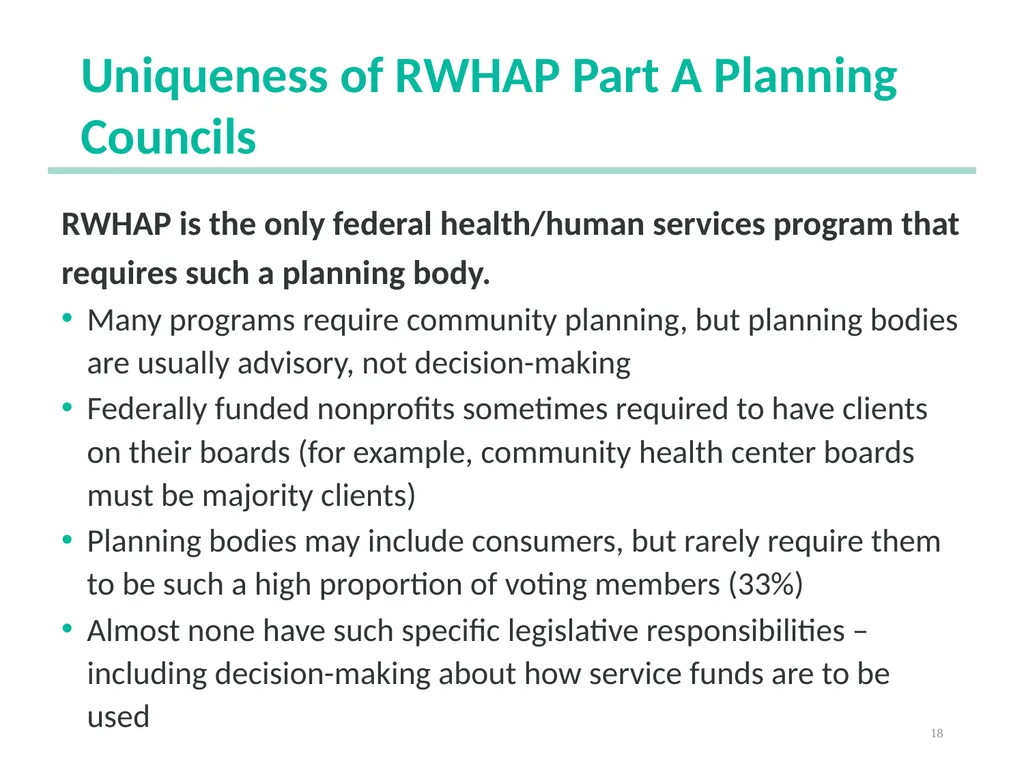
Uniqueness of RWHAP Part A Planning Councils RWHAP is the only federal health/human services program that requires such a planning body.
Many programs require community planning, but planning bodies are usually advisory, not decision-making
Federally funded nonprofits sometimes required to have clients on their boards (for example, community health center boards must be majority clients)
Planning bodies may include consumers, but rarely require them to be such a high proportion of voting members (33%)
Almost none have such specific legislative responsibilities – including decision-making about how service funds are to be used 18<br>
Many programs require community planning, but planning bodies are usually advisory, not decision-making
Federally funded nonprofits sometimes required to have clients on their boards (for example, community health center boards must be majority clients)
Planning bodies may include consumers, but rarely require them to be such a high proportion of voting members (33%)
Almost none have such specific legislative responsibilities – including decision-making about how service funds are to be used 18<br>
19
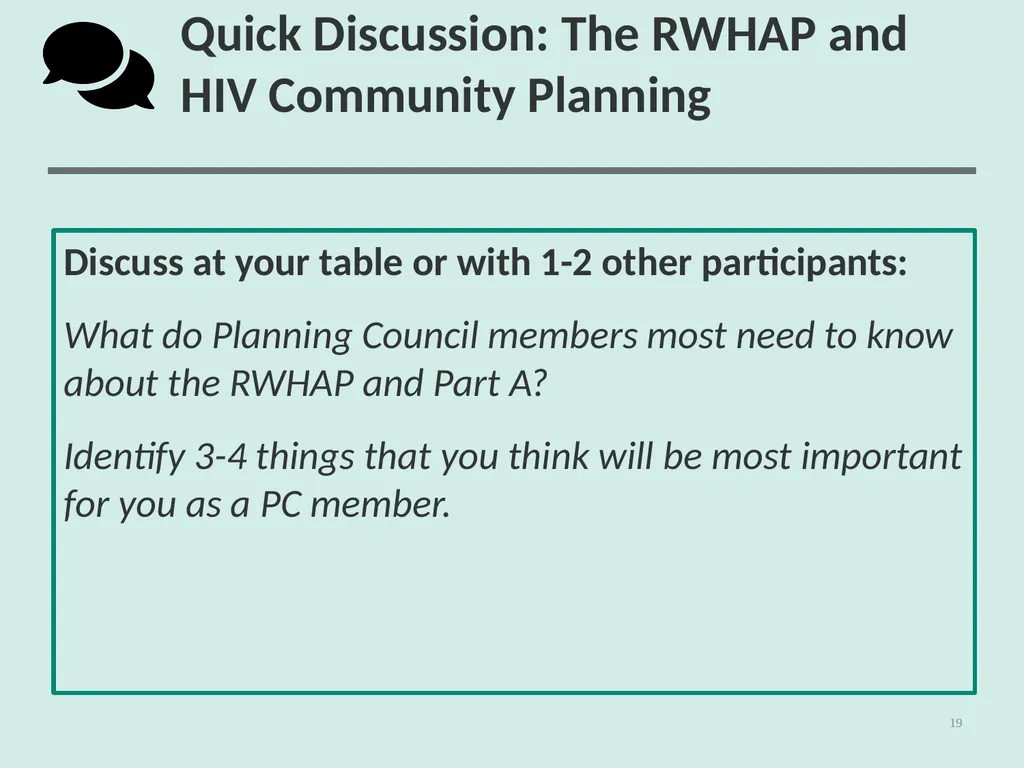
Quick Discussion: The RWHAP and HIV Community Planning Discuss at your table or with 1-2 other participants:
What do Planning Council members most need to know about the RWHAP and Part A?
Identify 3-4 things that you think will be most important for you as a PC member. 19<br>
What do Planning Council members most need to know about the RWHAP and Part A?
Identify 3-4 things that you think will be most important for you as a PC member. 19<br>
20
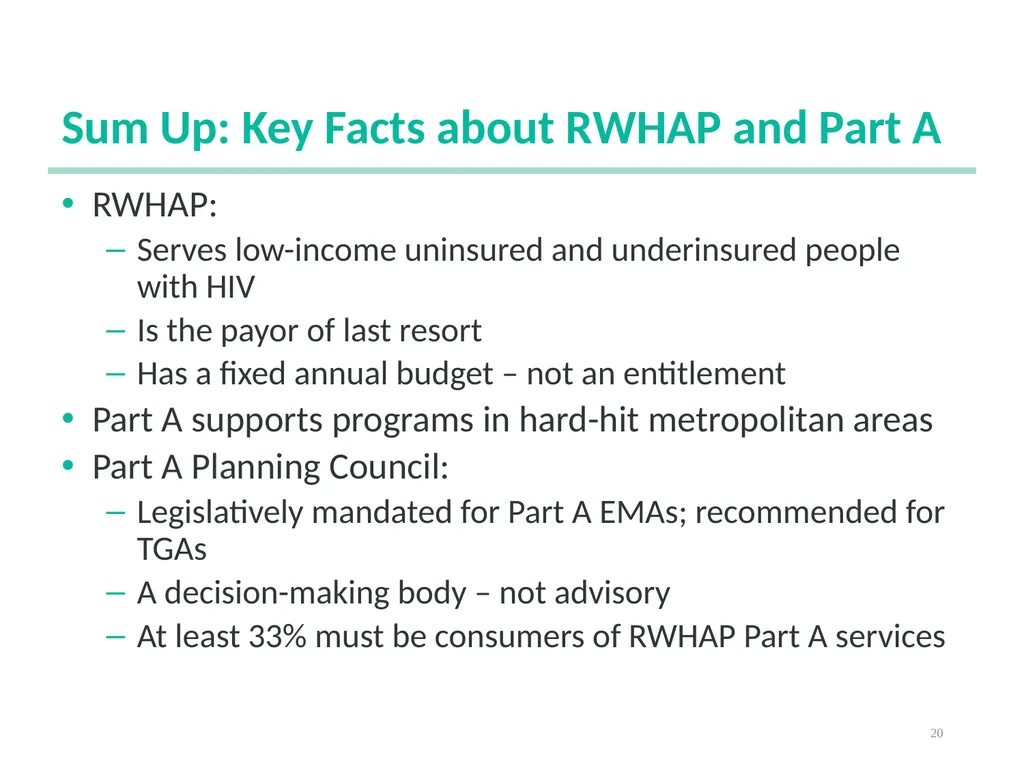
Sum Up: Key Facts about RWHAP and Part A RWHAP:
Serves low-income uninsured and underinsured people with HIV
Is the payor of last resort
Has a fixed annual budget – not an entitlement
Part A supports programs in hard-hit metropolitan areas
Part A Planning Council:
Legislatively mandated for Part A EMAs; recommended for TGAs
A decision-making body – not advisory
At least 33% must be consumers of RWHAP Part A services 20<br>
Serves low-income uninsured and underinsured people with HIV
Is the payor of last resort
Has a fixed annual budget – not an entitlement
Part A supports programs in hard-hit metropolitan areas
Part A Planning Council:
Legislatively mandated for Part A EMAs; recommended for TGAs
A decision-making body – not advisory
At least 33% must be consumers of RWHAP Part A services 20<br>
21
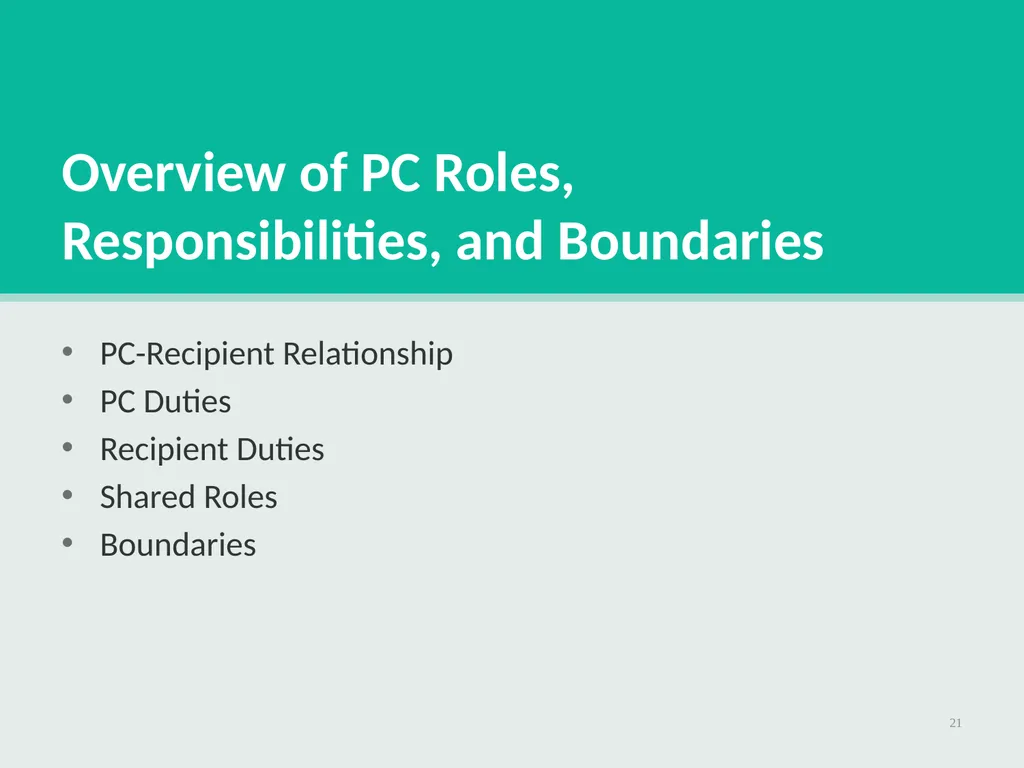
Overview of PC Roles, Responsibilities, and Boundaries PC-Recipient Relationship
PC Duties
Recipient Duties
Shared Roles
Boundaries 21<br>
PC Duties
Recipient Duties
Shared Roles
Boundaries 21<br>
22
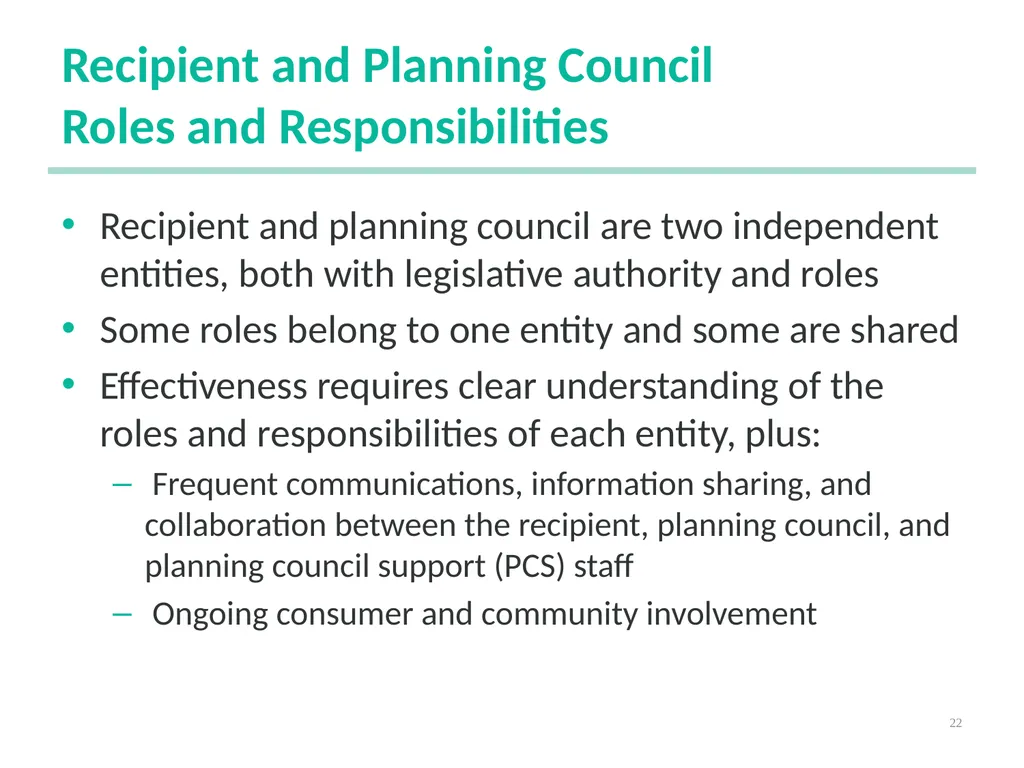
Recipient and Planning Council
Roles and Responsibilities Recipient and planning council are two independent entities, both with legislative authority and roles
Some roles belong to one entity and some are shared
Effectiveness requires clear understanding of the roles and responsibilities of each entity, plus:
Frequent communications, information sharing, and collaboration between the recipient, planning council, and planning council support (PCS) staff
Ongoing consumer and community involvement 22<br>
Some roles belong to one entity and some are shared
Effectiveness requires clear understanding of the roles and responsibilities of each entity, plus:
Frequent communications, information sharing, and collaboration between the recipient, planning council, and planning council support (PCS) staff
Ongoing consumer and community involvement 22<br>
23
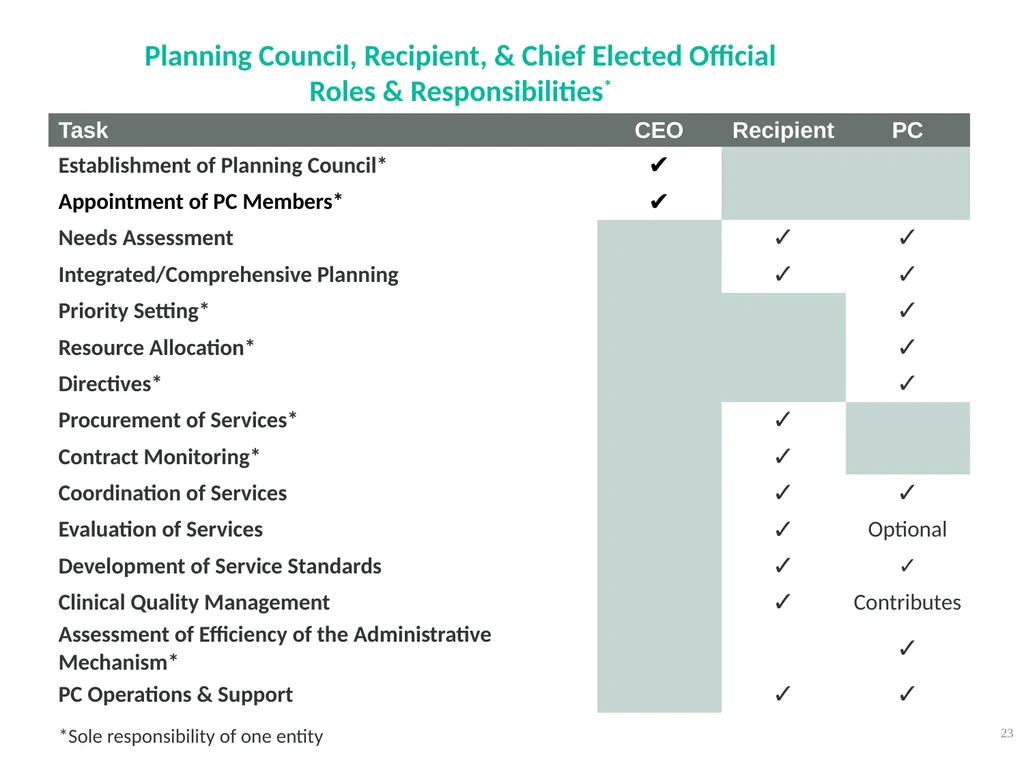
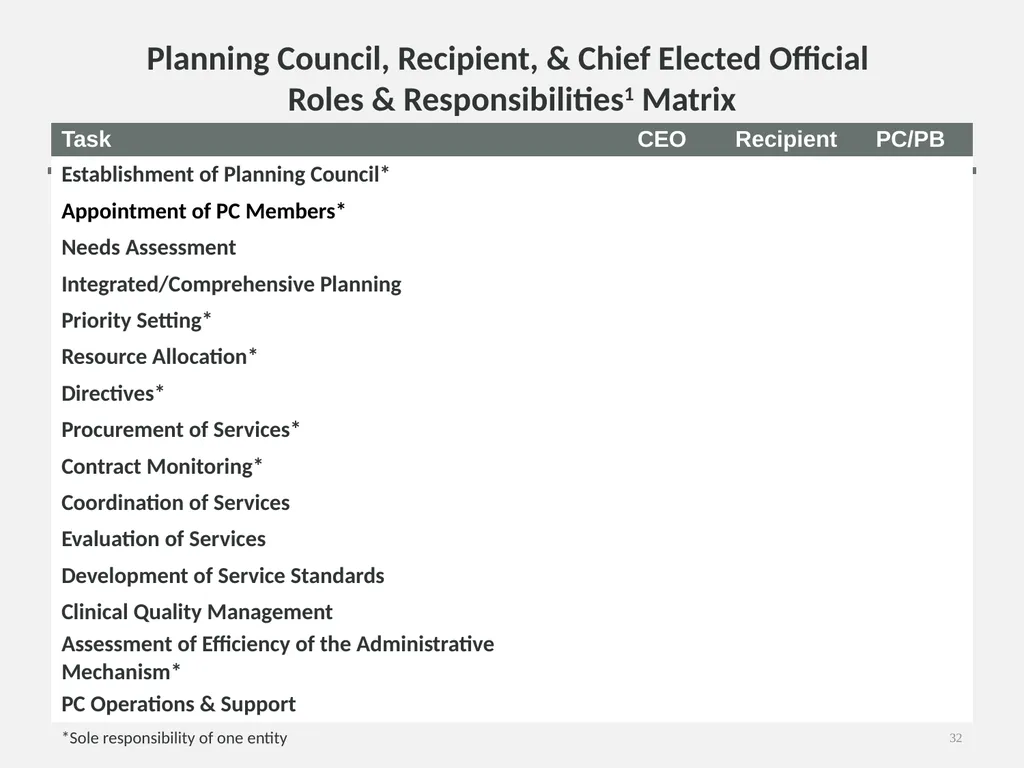
Planning Council, Recipient, & Chief Elected Official
Roles & Responsibilities* *Sole responsibility of one entity 23<br>
24
Quick Discussion: Roles and Responsibilities Matrix Looking at the Matrix:
Which tasks/roles are most familiar?
Which ones do you need to know more about? 24<br>
Which tasks/roles are most familiar?
Which ones do you need to know more about? 24<br>
25
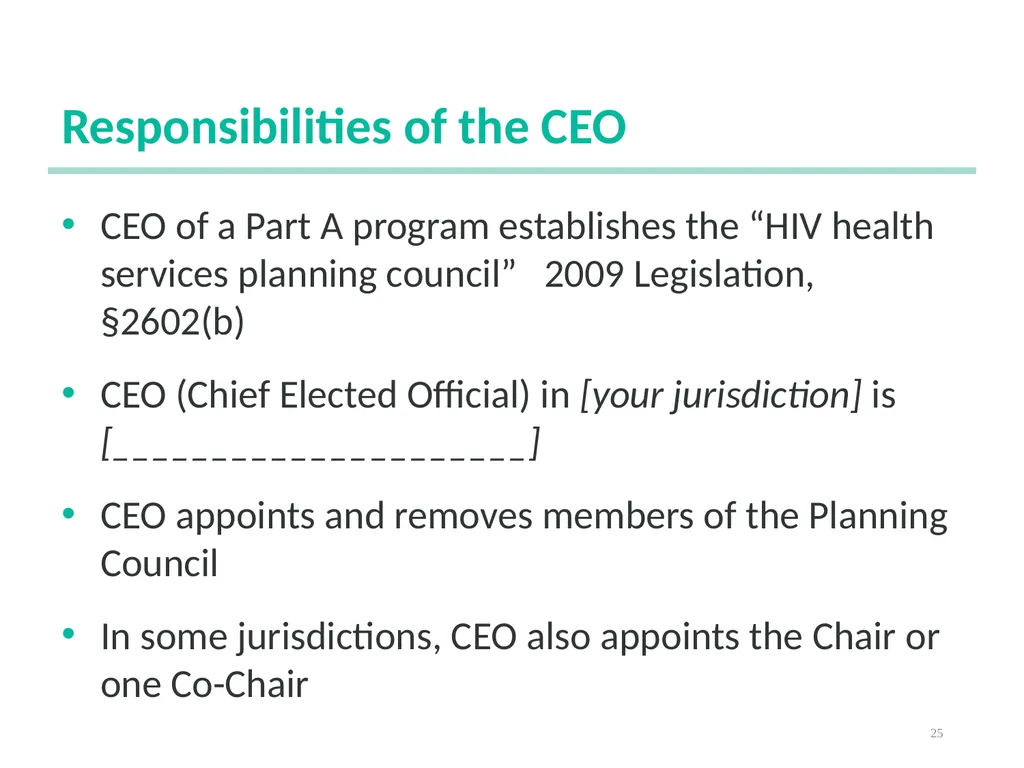
Responsibilities of the CEO CEO of a Part A program establishes the “HIV health services planning council” 2009 Legislation, §2602(b)
CEO (Chief Elected Official) in [your jurisdiction] is [_____________________]
CEO appoints and removes members of the Planning Council
In some jurisdictions, CEO also appoints the Chair or one Co-Chair 25<br>
CEO (Chief Elected Official) in [your jurisdiction] is [_____________________]
CEO appoints and removes members of the Planning Council
In some jurisdictions, CEO also appoints the Chair or one Co-Chair 25<br>
26
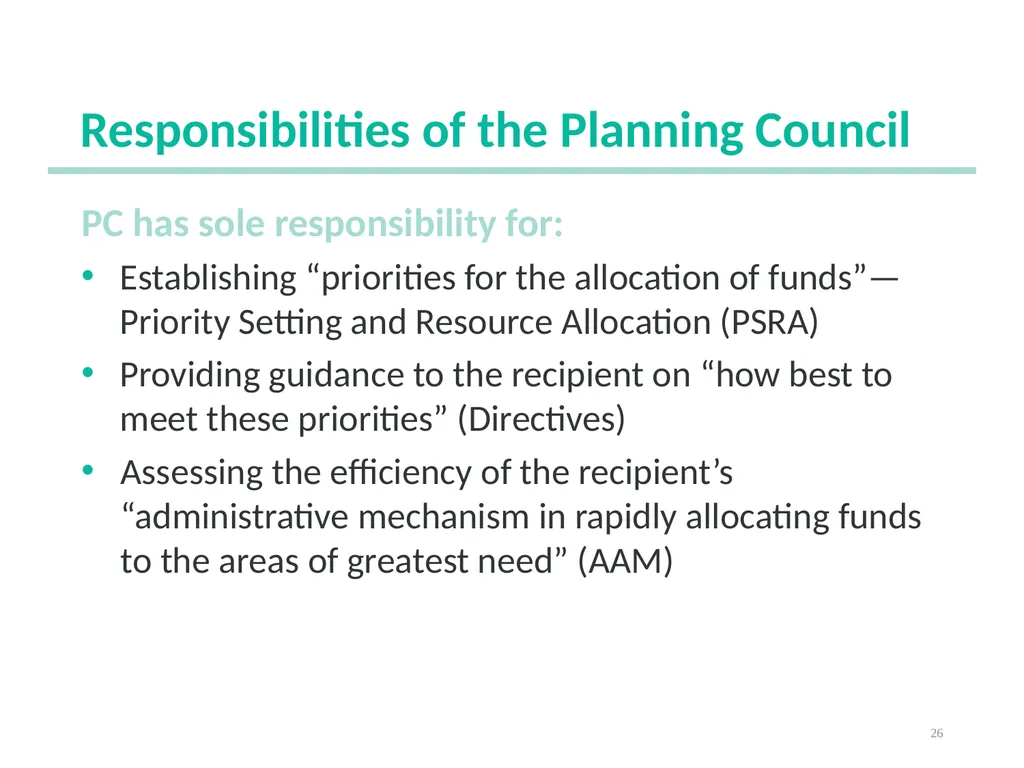
Responsibilities of the Planning Council PC has sole responsibility for:
Establishing “priorities for the allocation of funds”—Priority Setting and Resource Allocation (PSRA)
Providing guidance to the recipient on “how best to meet these priorities” (Directives)
Assessing the efficiency of the recipient’s “administrative mechanism in rapidly allocating funds to the areas of greatest need” (AAM) 26<br>
Establishing “priorities for the allocation of funds”—Priority Setting and Resource Allocation (PSRA)
Providing guidance to the recipient on “how best to meet these priorities” (Directives)
Assessing the efficiency of the recipient’s “administrative mechanism in rapidly allocating funds to the areas of greatest need” (AAM) 26<br>
27
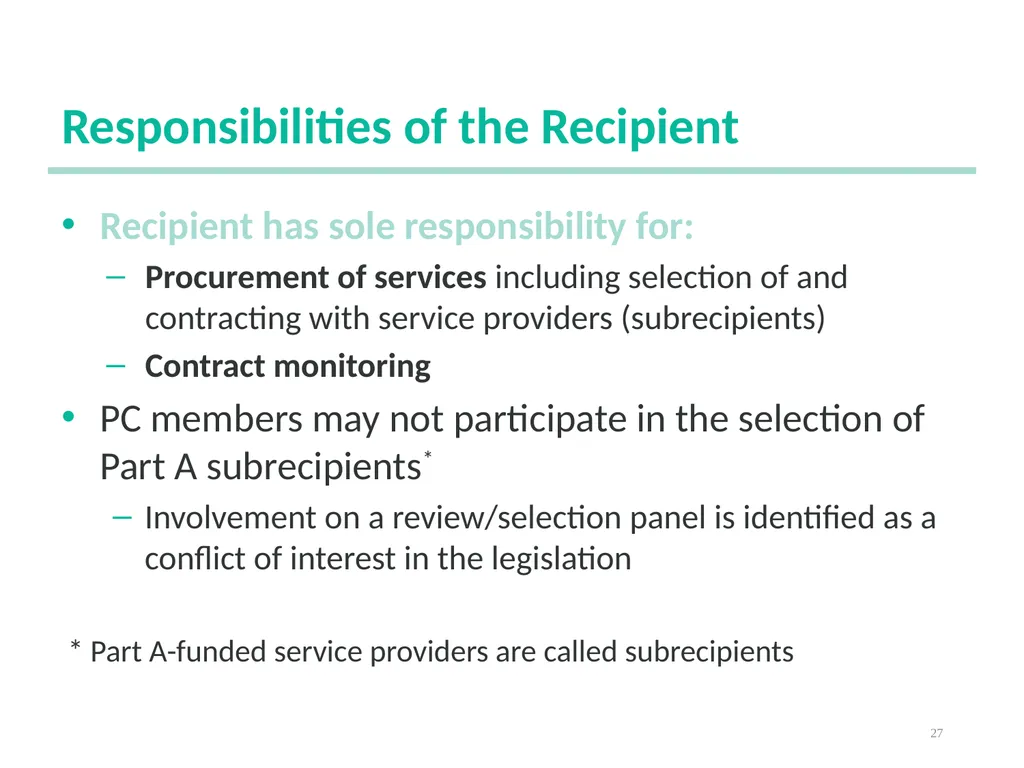
Responsibilities of the Recipient Recipient has sole responsibility for:
Procurement of services including selection of and contracting with service providers (subrecipients)
Contract monitoring
PC members may not participate in the selection of Part A subrecipients*
Involvement on a review/selection panel is identified as a conflict of interest in the legislation
* Part A-funded service providers are called subrecipients 27<br>
Procurement of services including selection of and contracting with service providers (subrecipients)
Contract monitoring
PC members may not participate in the selection of Part A subrecipients*
Involvement on a review/selection panel is identified as a conflict of interest in the legislation
* Part A-funded service providers are called subrecipients 27<br>
28
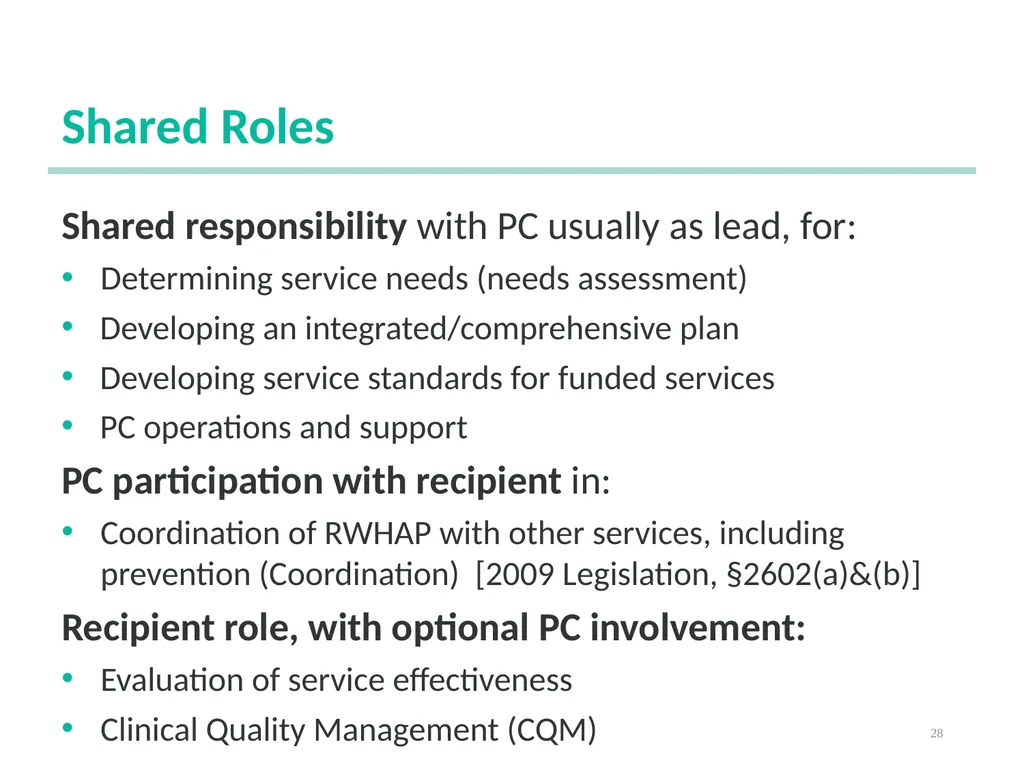
Shared Roles Shared responsibility with PC usually as lead, for:
Determining service needs (needs assessment)
Developing an integrated/comprehensive plan
Developing service standards for funded services
PC operations and support
PC participation with recipient in:
Coordination of RWHAP with other services, including prevention (Coordination) [2009 Legislation, §2602(a)&(b)]
Recipient role, with optional PC involvement:
Evaluation of service effectiveness
Clinical Quality Management (CQM) 28<br>
Determining service needs (needs assessment)
Developing an integrated/comprehensive plan
Developing service standards for funded services
PC operations and support
PC participation with recipient in:
Coordination of RWHAP with other services, including prevention (Coordination) [2009 Legislation, §2602(a)&(b)]
Recipient role, with optional PC involvement:
Evaluation of service effectiveness
Clinical Quality Management (CQM) 28<br>
29
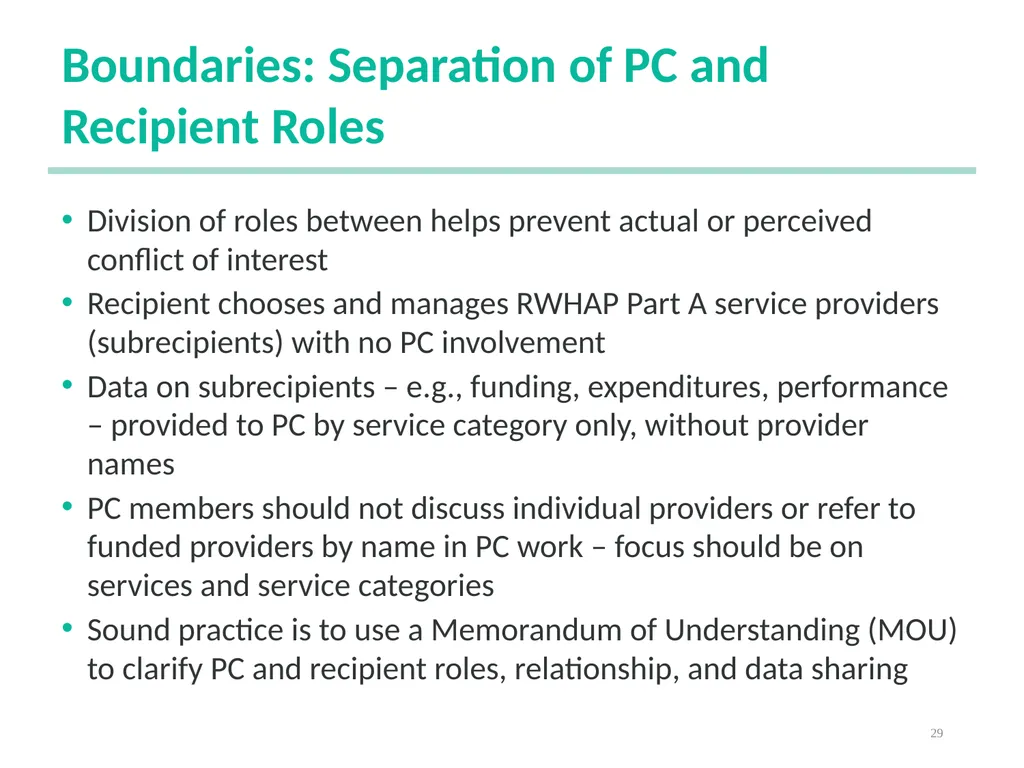
Boundaries: Separation of PC and Recipient Roles Division of roles between helps prevent actual or perceived conflict of interest
Recipient chooses and manages RWHAP Part A service providers (subrecipients) with no PC involvement
Data on subrecipients – e.g., funding, expenditures, performance – provided to PC by service category only, without provider names
PC members should not discuss individual providers or refer to funded providers by name in PC work – focus should be on services and service categories
Sound practice is to use a Memorandum of Understanding (MOU) to clarify PC and recipient roles, relationship, and data sharing 29<br>
Recipient chooses and manages RWHAP Part A service providers (subrecipients) with no PC involvement
Data on subrecipients – e.g., funding, expenditures, performance – provided to PC by service category only, without provider names
PC members should not discuss individual providers or refer to funded providers by name in PC work – focus should be on services and service categories
Sound practice is to use a Memorandum of Understanding (MOU) to clarify PC and recipient roles, relationship, and data sharing 29<br>
30
Quick Scenario:
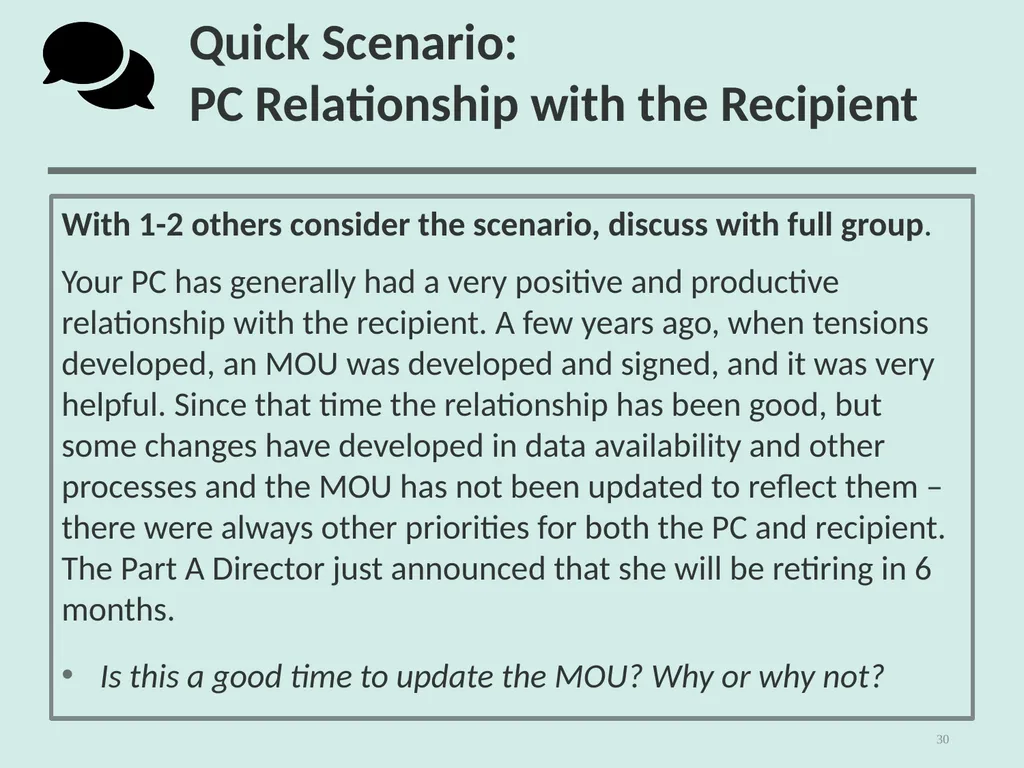
PC Relationship with the Recipient With 1-2 others consider the scenario, discuss with full group.
Your PC has generally had a very positive and productive relationship with the recipient. A few years ago, when tensions developed, an MOU was developed and signed, and it was very helpful. Since that time the relationship has been good, but some changes have developed in data availability and other processes and the MOU has not been updated to reflect them – there were always other priorities for both the PC and recipient. The Part A Director just announced that she will be retiring in 6 months.
Is this a good time to update the MOU? Why or why not? 30<br>
Your PC has generally had a very positive and productive relationship with the recipient. A few years ago, when tensions developed, an MOU was developed and signed, and it was very helpful. Since that time the relationship has been good, but some changes have developed in data availability and other processes and the MOU has not been updated to reflect them – there were always other priorities for both the PC and recipient. The Part A Director just announced that she will be retiring in 6 months.
Is this a good time to update the MOU? Why or why not? 30<br>
31
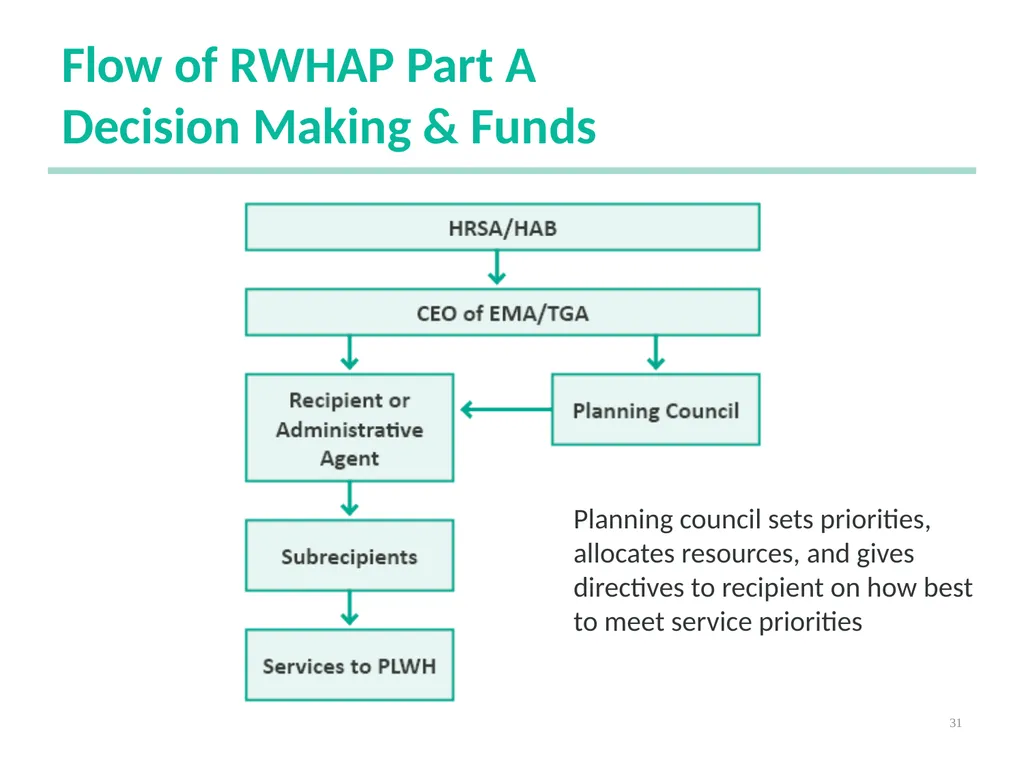
Flow of RWHAP Part A
Decision Making & Funds Planning council sets priorities, allocates resources, and gives directives to recipient on how best to meet service priorities 31<br>
32
Planning Council, Recipient, & Chief Elected Official
Roles & Responsibilities1 Matrix *Sole responsibility of one entity 32<br>
33
Quick Discussion: Review of PC and Recipient Roles and Responsibilities Based on your prior knowledge and our discussion today:
Can you fill in the matrix indicating who does what?
What are your remaining questions or concerns (if any) about the Planning Council’s roles and responsibilities? 33<br>
Can you fill in the matrix indicating who does what?
What are your remaining questions or concerns (if any) about the Planning Council’s roles and responsibilities? 33<br>
34
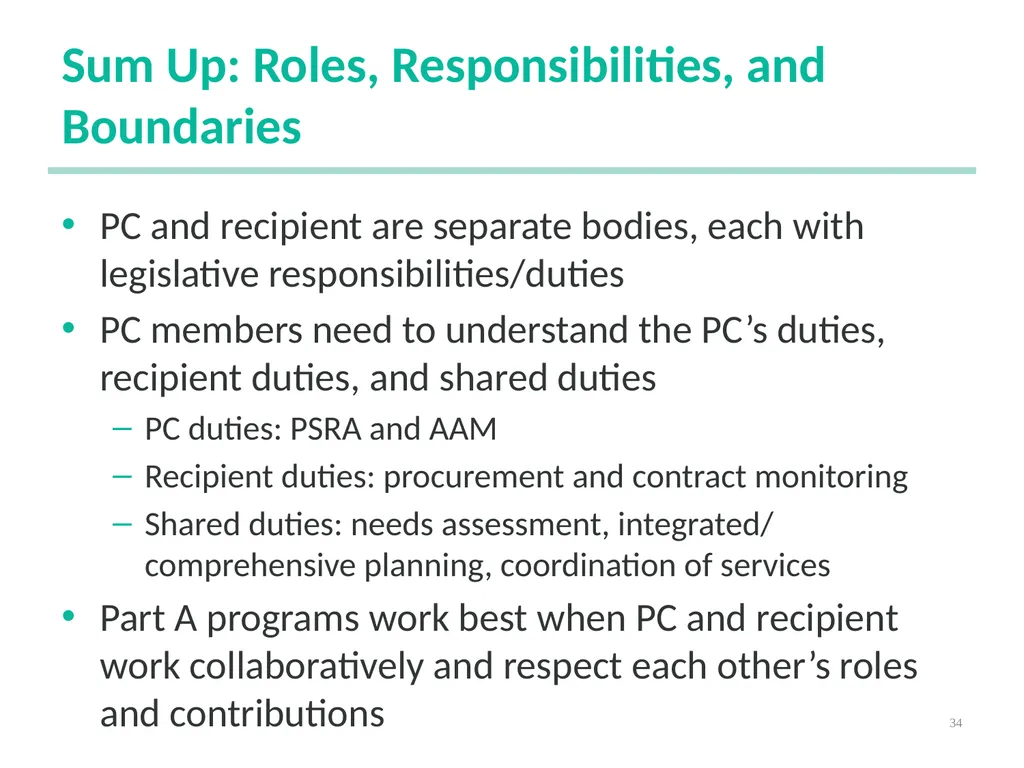
Sum Up: Roles, Responsibilities, and Boundaries PC and recipient are separate bodies, each with legislative responsibilities/duties
PC members need to understand the PC’s duties, recipient duties, and shared duties
PC duties: PSRA and AAM
Recipient duties: procurement and contract monitoring
Shared duties: needs assessment, integrated/ comprehensive planning, coordination of services
Part A programs work best when PC and recipient work collaboratively and respect each other’s roles and contributions 34<br>
PC members need to understand the PC’s duties, recipient duties, and shared duties
PC duties: PSRA and AAM
Recipient duties: procurement and contract monitoring
Shared duties: needs assessment, integrated/ comprehensive planning, coordination of services
Part A programs work best when PC and recipient work collaboratively and respect each other’s roles and contributions 34<br>
35
The Planning Council and the System of Care Importance of the System of Care
Understanding the System of Care
Fundable Service Categories 35<br>
Understanding the System of Care
Fundable Service Categories 35<br>
36
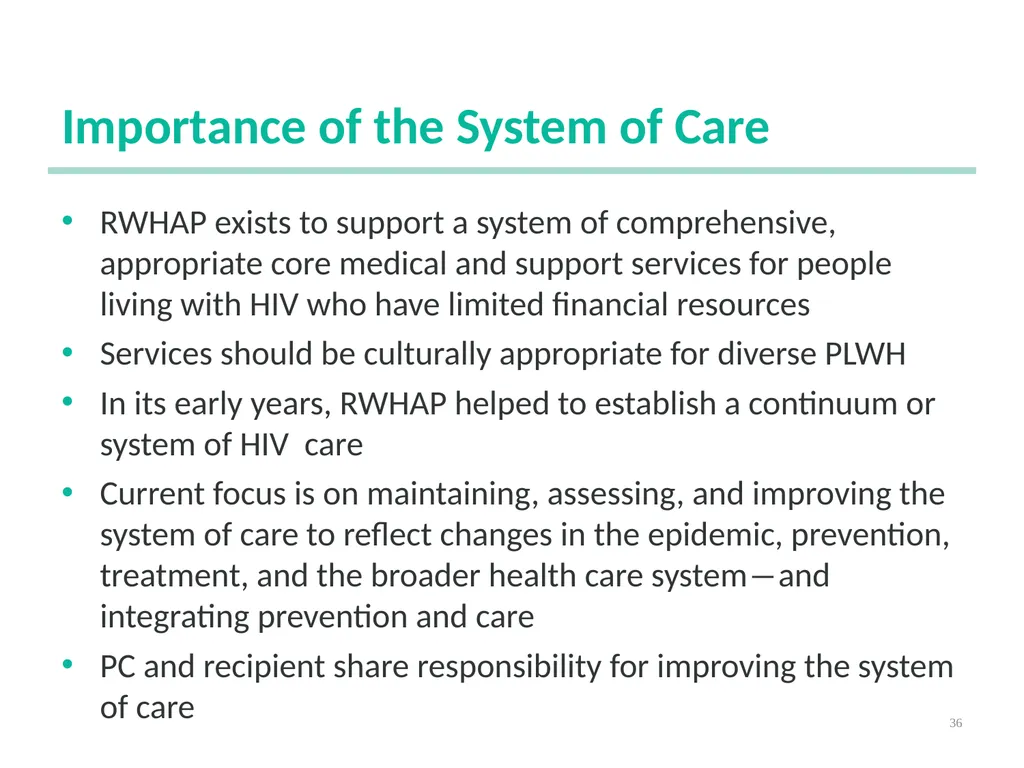
Importance of the System of Care RWHAP exists to support a system of comprehensive, appropriate core medical and support services for people living with HIV who have limited financial resources
Services should be culturally appropriate for diverse PLWH
In its early years, RWHAP helped to establish a continuum or system of HIV care
Current focus is on maintaining, assessing, and improving the system of care to reflect changes in the epidemic, prevention, treatment, and the broader health care system―and integrating prevention and care
PC and recipient share responsibility for improving the system of care 36<br>
Services should be culturally appropriate for diverse PLWH
In its early years, RWHAP helped to establish a continuum or system of HIV care
Current focus is on maintaining, assessing, and improving the system of care to reflect changes in the epidemic, prevention, treatment, and the broader health care system―and integrating prevention and care
PC and recipient share responsibility for improving the system of care 36<br>
37
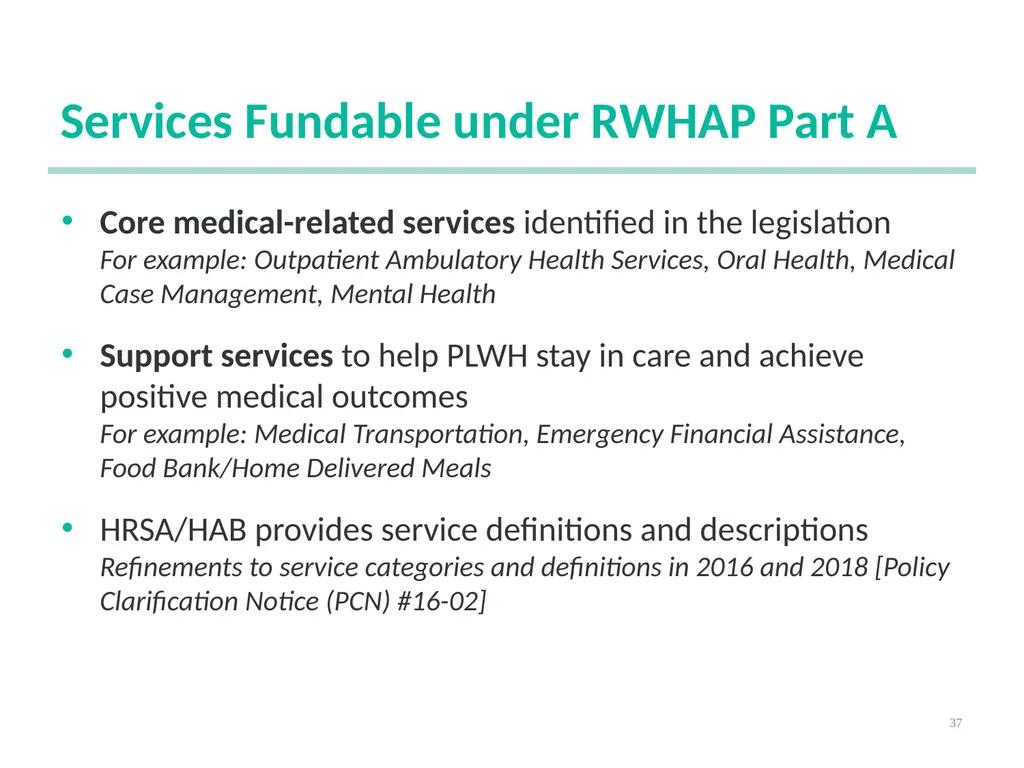
Services Fundable under RWHAP Part A Core medical-related services identified in the legislation
For example: Outpatient Ambulatory Health Services, Oral Health, Medical Case Management, Mental Health
Support services to help PLWH stay in care and achieve positive medical outcomes For example: Medical Transportation, Emergency Financial Assistance, Food Bank/Home Delivered Meals
HRSA/HAB provides service definitions and descriptions Refinements to service categories and definitions in 2016 and 2018 [Policy Clarification Notice (PCN) #16-02] 37<br>
Support services to help PLWH stay in care and achieve positive medical outcomes For example: Medical Transportation, Emergency Financial Assistance, Food Bank/Home Delivered Meals
HRSA/HAB provides service definitions and descriptions Refinements to service categories and definitions in 2016 and 2018 [Policy Clarification Notice (PCN) #16-02] 37<br>
38
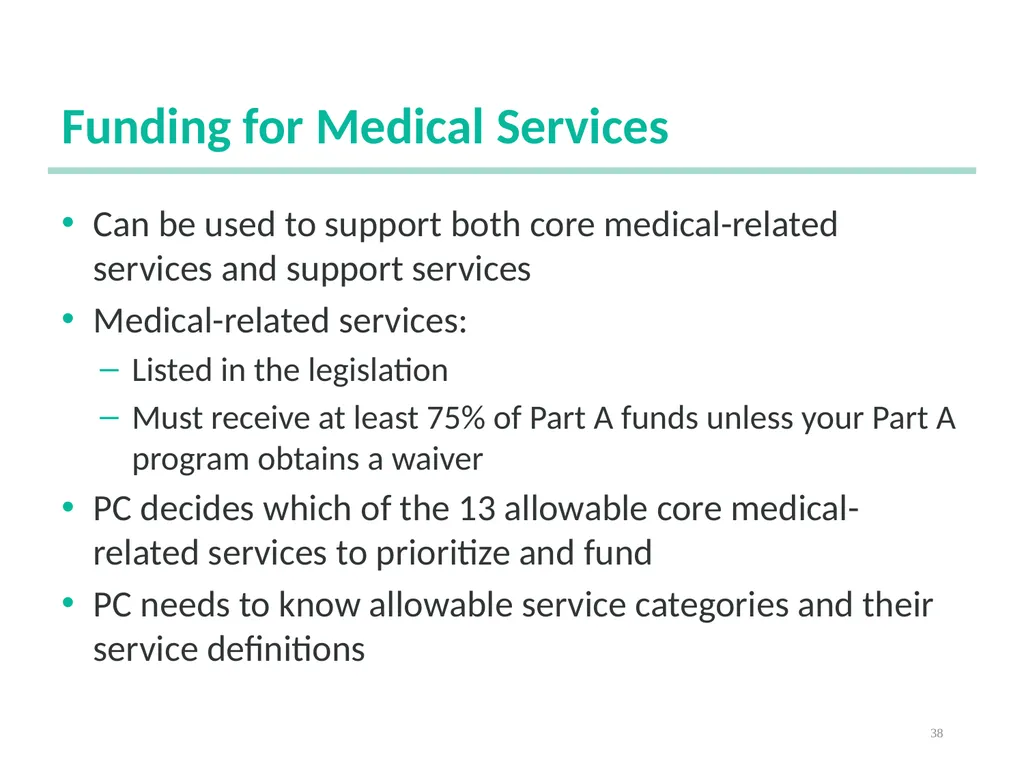
Funding for Medical Services Can be used to support both core medical-related services and support services
Medical-related services:
Listed in the legislation
Must receive at least 75% of Part A funds unless your Part A program obtains a waiver
PC decides which of the 13 allowable core medical-related services to prioritize and fund
PC needs to know allowable service categories and their service definitions 38<br>
Medical-related services:
Listed in the legislation
Must receive at least 75% of Part A funds unless your Part A program obtains a waiver
PC decides which of the 13 allowable core medical-related services to prioritize and fund
PC needs to know allowable service categories and their service definitions 38<br>
39
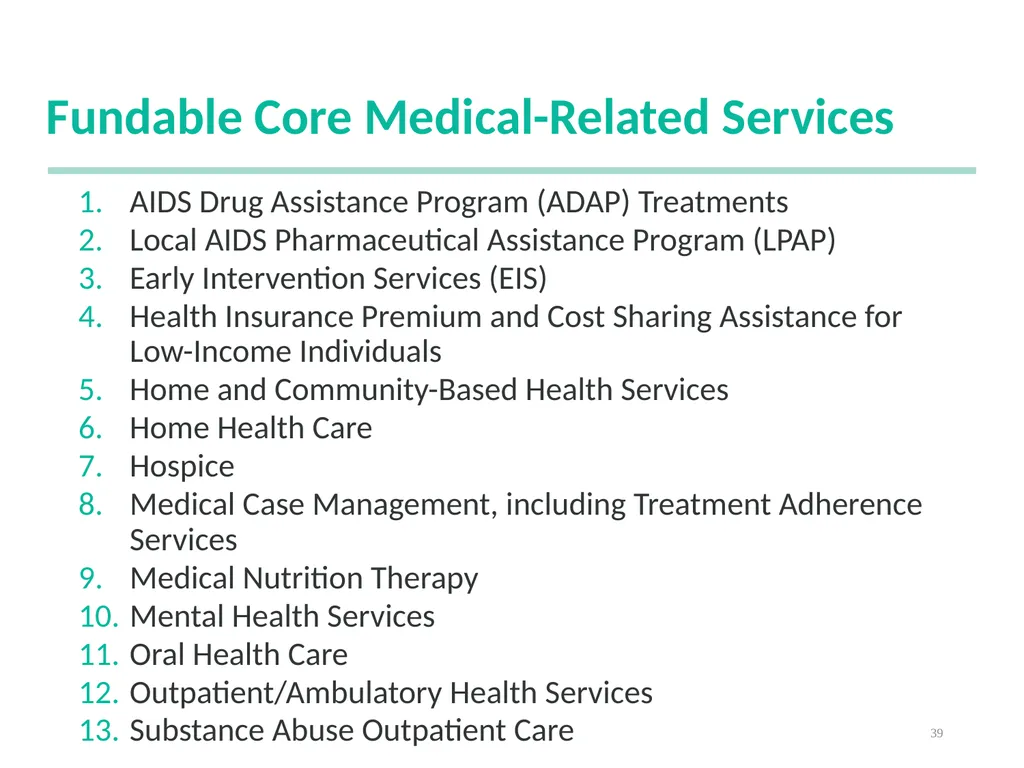
Fundable Core Medical-Related Services AIDS Drug Assistance Program (ADAP) Treatments
Local AIDS Pharmaceutical Assistance Program (LPAP)
Early Intervention Services (EIS)
Health Insurance Premium and Cost Sharing Assistance for Low-Income Individuals
Home and Community-Based Health Services
Home Health Care
Hospice
Medical Case Management, including Treatment Adherence Services
Medical Nutrition Therapy
Mental Health Services
Oral Health Care
Outpatient/Ambulatory Health Services
Substance Abuse Outpatient Care 39<br>
Local AIDS Pharmaceutical Assistance Program (LPAP)
Early Intervention Services (EIS)
Health Insurance Premium and Cost Sharing Assistance for Low-Income Individuals
Home and Community-Based Health Services
Home Health Care
Hospice
Medical Case Management, including Treatment Adherence Services
Medical Nutrition Therapy
Mental Health Services
Oral Health Care
Outpatient/Ambulatory Health Services
Substance Abuse Outpatient Care 39<br>
40
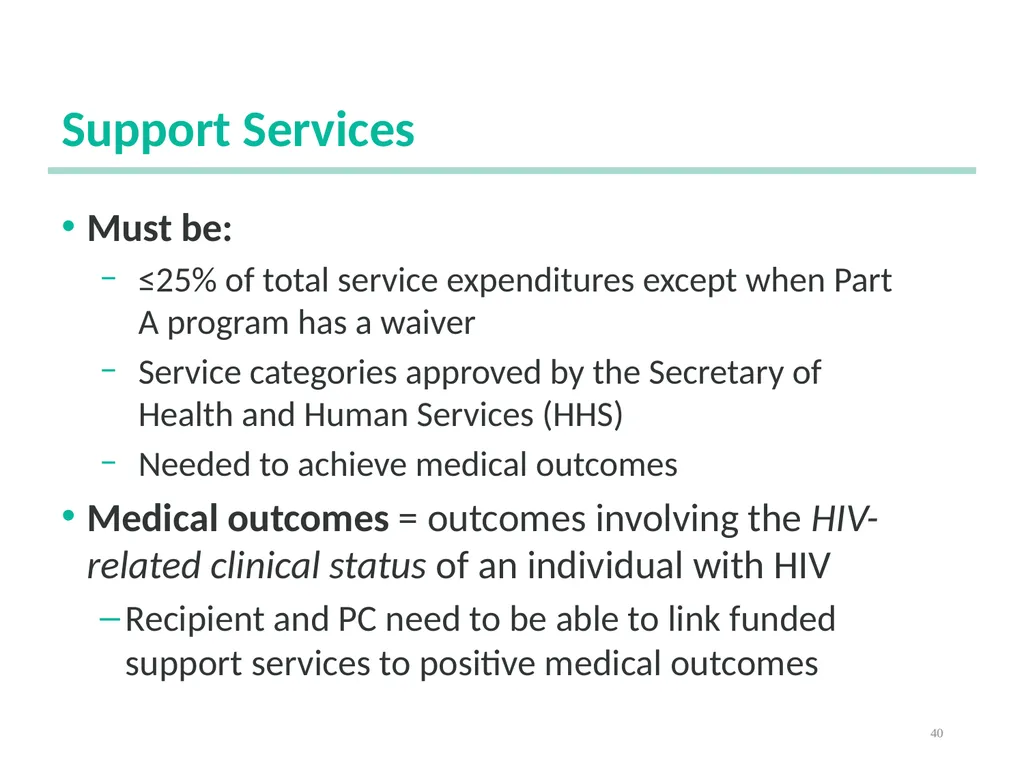
Support Services Must be:
≤25% of total service expenditures except when Part A program has a waiver
Service categories approved by the Secretary of Health and Human Services (HHS)
Needed to achieve medical outcomes
Medical outcomes = outcomes involving the HIV-related clinical status of an individual with HIV
Recipient and PC need to be able to link funded support services to positive medical outcomes 40<br>
≤25% of total service expenditures except when Part A program has a waiver
Service categories approved by the Secretary of Health and Human Services (HHS)
Needed to achieve medical outcomes
Medical outcomes = outcomes involving the HIV-related clinical status of an individual with HIV
Recipient and PC need to be able to link funded support services to positive medical outcomes 40<br>
41
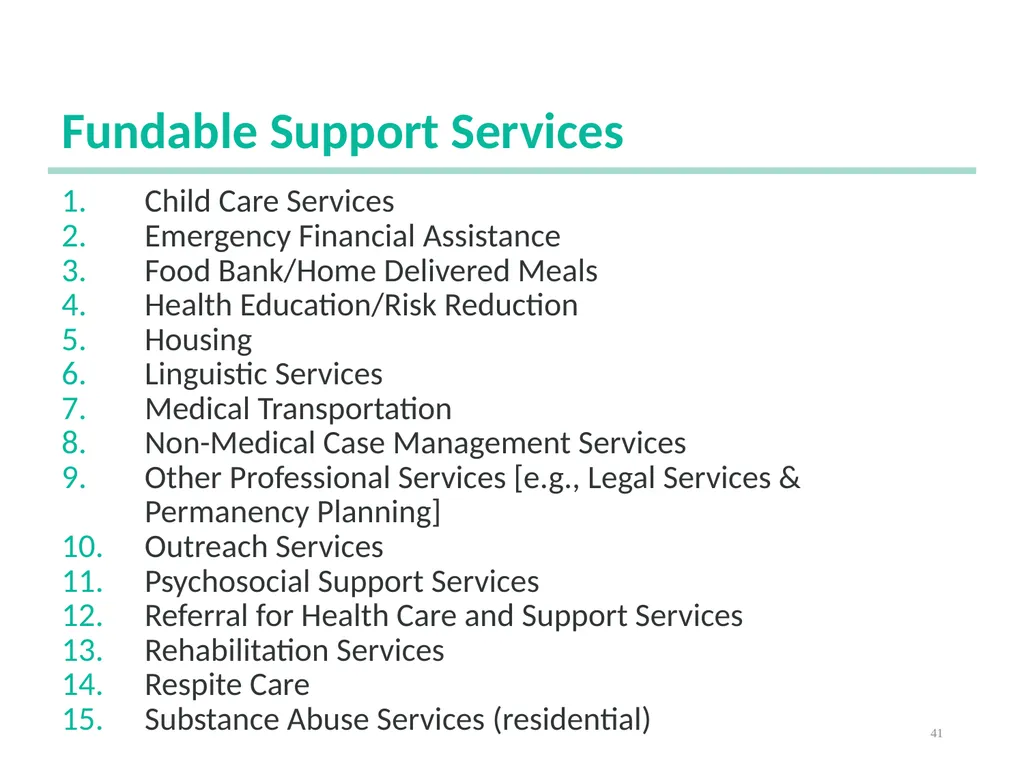
Fundable Support Services Child Care Services
Emergency Financial Assistance
Food Bank/Home Delivered Meals
Health Education/Risk Reduction
Housing
Linguistic Services
Medical Transportation
Non-Medical Case Management Services
Other Professional Services [e.g., Legal Services & Permanency Planning]
Outreach Services
Psychosocial Support Services
Referral for Health Care and Support Services
Rehabilitation Services
Respite Care
Substance Abuse Services (residential) 41<br>
Emergency Financial Assistance
Food Bank/Home Delivered Meals
Health Education/Risk Reduction
Housing
Linguistic Services
Medical Transportation
Non-Medical Case Management Services
Other Professional Services [e.g., Legal Services & Permanency Planning]
Outreach Services
Psychosocial Support Services
Referral for Health Care and Support Services
Rehabilitation Services
Respite Care
Substance Abuse Services (residential) 41<br>
42
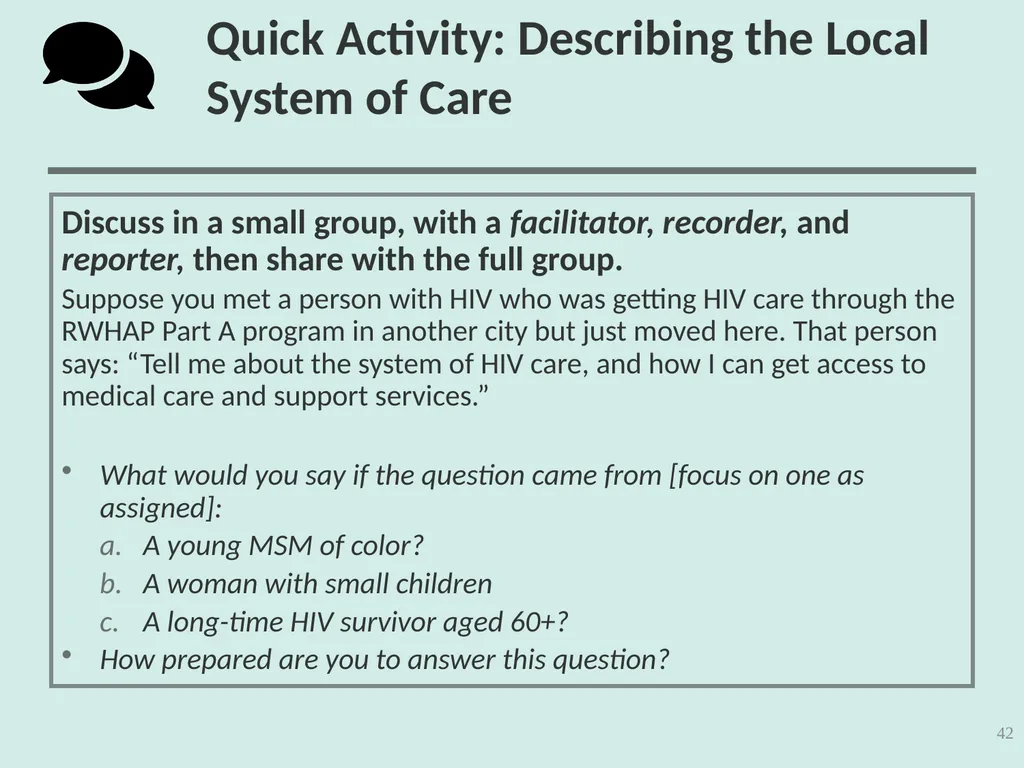
Quick Activity: Describing the Local System of Care Discuss in a small group, with a facilitator, recorder, and reporter, then share with the full group.
Suppose you met a person with HIV who was getting HIV care through the RWHAP Part A program in another city but just moved here. That person says: “Tell me about the system of HIV care, and how I can get access to medical care and support services.”
What would you say if the question came from [focus on one as assigned]:
A young MSM of color?
A woman with small children
A long-time HIV survivor aged 60+?
How prepared are you to answer this question? 42<br>
Suppose you met a person with HIV who was getting HIV care through the RWHAP Part A program in another city but just moved here. That person says: “Tell me about the system of HIV care, and how I can get access to medical care and support services.”
What would you say if the question came from [focus on one as assigned]:
A young MSM of color?
A woman with small children
A long-time HIV survivor aged 60+?
How prepared are you to answer this question? 42<br>
43
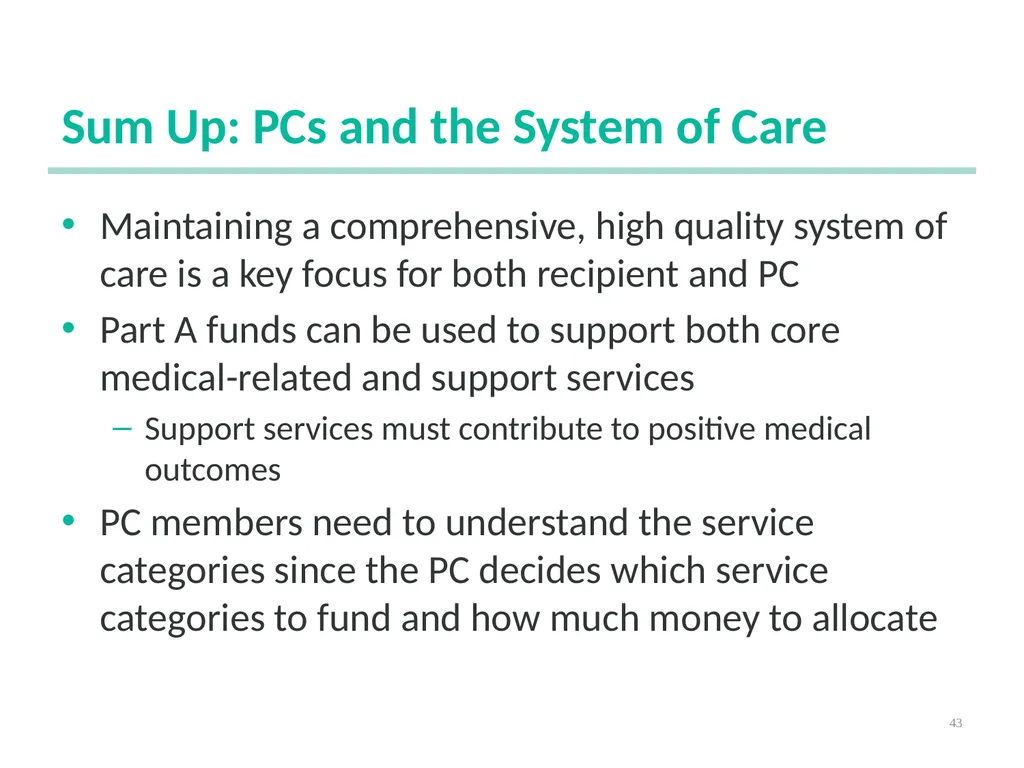
Sum Up: PCs and the System of Care Maintaining a comprehensive, high quality system of care is a key focus for both recipient and PC
Part A funds can be used to support both core medical-related and support services
Support services must contribute to positive medical outcomes
PC members need to understand the service categories since the PC decides which service categories to fund and how much money to allocate 43<br>
Part A funds can be used to support both core medical-related and support services
Support services must contribute to positive medical outcomes
PC members need to understand the service categories since the PC decides which service categories to fund and how much money to allocate 43<br>
44
Planning Council Operations Scope of PC Operations
Planning Council Support (PCS) Roles
Recipient Roles
Expectations for PC Members
Committee Structure 44<br>
Planning Council Support (PCS) Roles
Recipient Roles
Expectations for PC Members
Committee Structure 44<br>
45
Scope of PC Operations Developing and updating Bylaws, policies and procedures to ensure fair, efficient operations
Establishing and implementing grievance procedures
Managing conflict of interest
Recruiting new members – includes an open nominations process, orientation, and training
Providing training to all members at least annually
Leadership by the officers (usually Chair, Co-Chairs)
Coordination of other committees by Executive Committee
Assistance from PCS staff 45<br>
Establishing and implementing grievance procedures
Managing conflict of interest
Recruiting new members – includes an open nominations process, orientation, and training
Providing training to all members at least annually
Leadership by the officers (usually Chair, Co-Chairs)
Coordination of other committees by Executive Committee
Assistance from PCS staff 45<br>
46
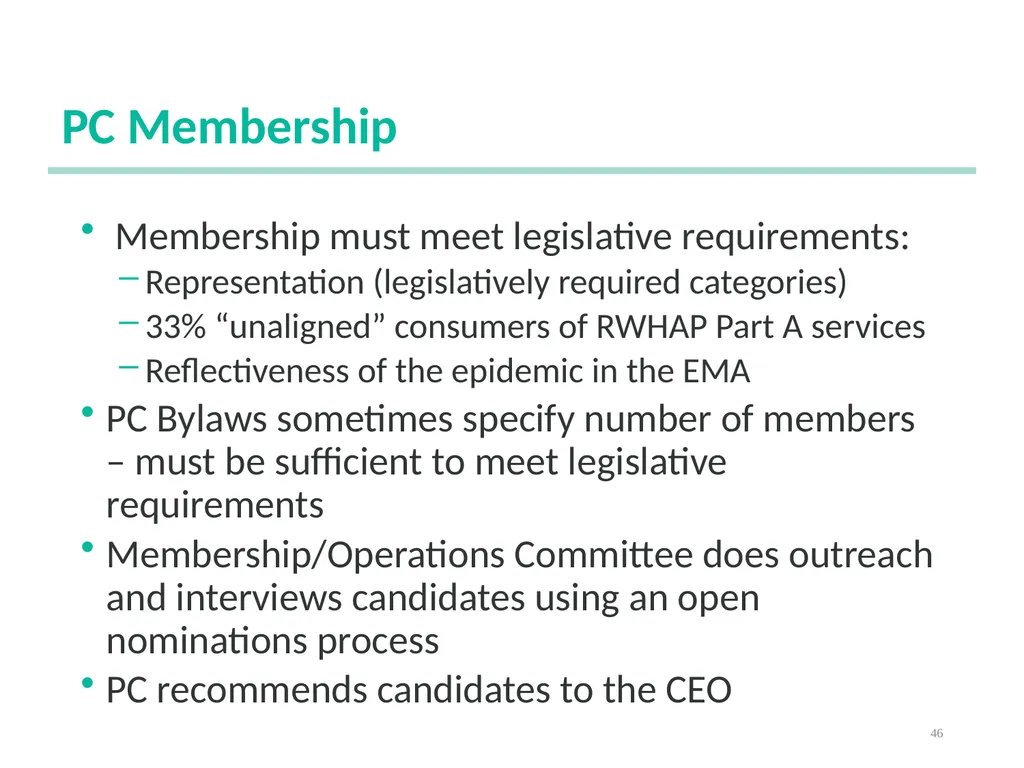
PC Membership Membership must meet legislative requirements:
Representation (legislatively required categories)
33% “unaligned” consumers of RWHAP Part A services
Reflectiveness of the epidemic in the EMA
PC Bylaws sometimes specify number of members – must be sufficient to meet legislative requirements
Membership/Operations Committee does outreach and interviews candidates using an open nominations process
PC recommends candidates to the CEO 46<br>
Representation (legislatively required categories)
33% “unaligned” consumers of RWHAP Part A services
Reflectiveness of the epidemic in the EMA
PC Bylaws sometimes specify number of members – must be sufficient to meet legislative requirements
Membership/Operations Committee does outreach and interviews candidates using an open nominations process
PC recommends candidates to the CEO 46<br>
47
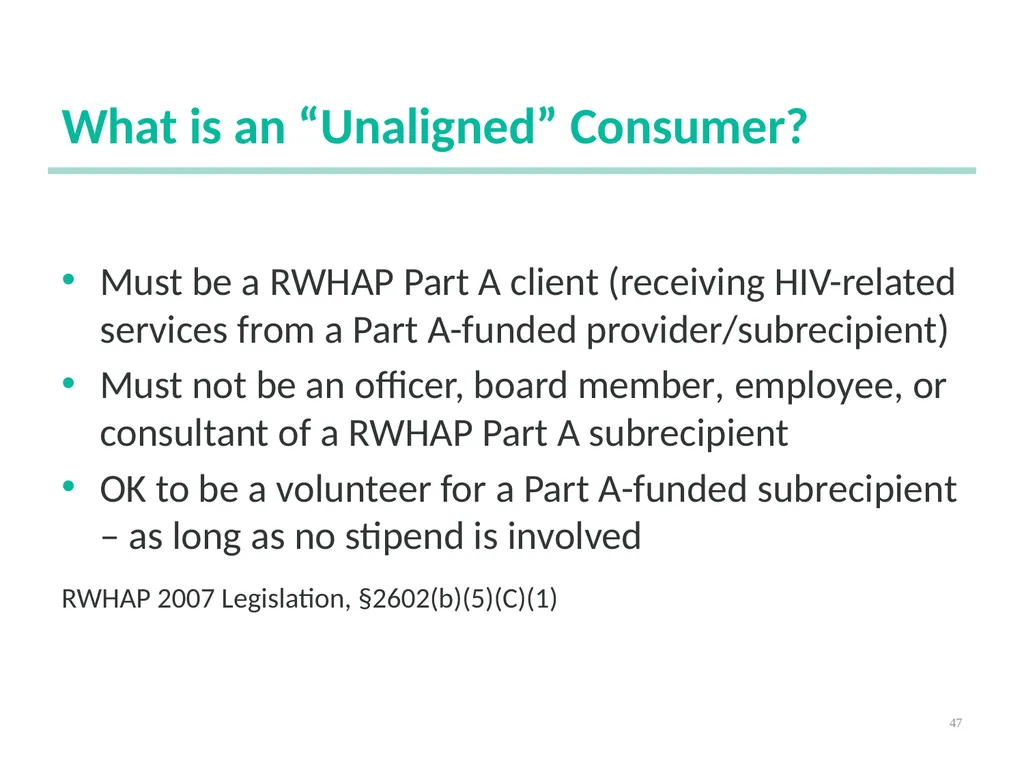
What is an “Unaligned” Consumer? Must be a RWHAP Part A client (receiving HIV-related services from a Part A-funded provider/subrecipient)
Must not be an officer, board member, employee, or consultant of a RWHAP Part A subrecipient
OK to be a volunteer for a Part A-funded subrecipient – as long as no stipend is involved
RWHAP 2007 Legislation, §2602(b)(5)(C)(1) 47<br>
Must not be an officer, board member, employee, or consultant of a RWHAP Part A subrecipient
OK to be a volunteer for a Part A-funded subrecipient – as long as no stipend is involved
RWHAP 2007 Legislation, §2602(b)(5)(C)(1) 47<br>
48
Quick Scenario for Discussion Let’s assume that the PC has had a lot of trouble finding someone from a health planning agency to serve as a member. So when someone in that category sends an application to PCS staff, the PC wants to recommend her without the usual review by the Membership Committee.
Is this OK? Why or why not? 48<br>
Is this OK? Why or why not? 48<br>
49
Role of the PC Chair or Committee Chair* in Successful Meetings Recognize the importance of meetings
Work closely with PCS staff to plan the meeting
Help develop and fully understand the agenda
Be sure needed materials are provided – and when possible projected during the discussion
Be sure materials that might be needed for reference (such as Bylaws, policies & procedures) are readily available
* Co-Chairs can share these roles 49<br>
Work closely with PCS staff to plan the meeting
Help develop and fully understand the agenda
Be sure needed materials are provided – and when possible projected during the discussion
Be sure materials that might be needed for reference (such as Bylaws, policies & procedures) are readily available
* Co-Chairs can share these roles 49<br>
50
Role of the PC Chair or Committee Chair in Successful Meetings (cont.) Be sure meetings are open, accessible and welcoming, and provide an opportunity for public comment
Establish and consistently enforce a Code of Conduct for everyone present
Manage and facilitate the meeting – set a positive, tone, maintain order, and encourage participation
Learn from experience – ask for advice in improving meetings
Help ensure that minutes are completed, reviewed, approved, and posted promptly 50<br>
Establish and consistently enforce a Code of Conduct for everyone present
Manage and facilitate the meeting – set a positive, tone, maintain order, and encourage participation
Learn from experience – ask for advice in improving meetings
Help ensure that minutes are completed, reviewed, approved, and posted promptly 50<br>
51
Role of Planning Council Support (PCS) Staff Help the PC carry out its responsibilities and operate effectively
Duties:
Staff committees and full meetings
Provide expert advice on RWHAP legislative requirements and HRSA/HAB regulations & expectations
Oversee a training program for members
Encourage member involvement and retention, with special focus on consumers
Serve as liaison with the recipient to obtain and provide information and materials
Help the PC manage its budget 51<br>
Duties:
Staff committees and full meetings
Provide expert advice on RWHAP legislative requirements and HRSA/HAB regulations & expectations
Oversee a training program for members
Encourage member involvement and retention, with special focus on consumers
Serve as liaison with the recipient to obtain and provide information and materials
Help the PC manage its budget 51<br>
52
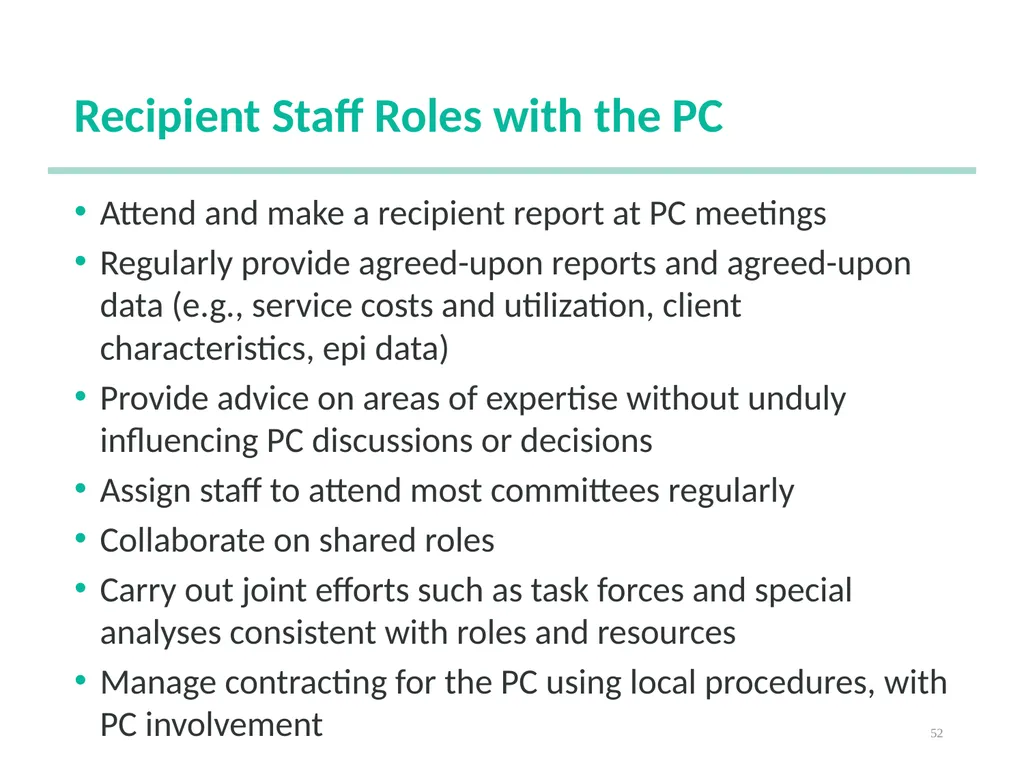
Recipient Staff Roles with the PC Attend and make a recipient report at PC meetings
Regularly provide agreed-upon reports and agreed-upon data (e.g., service costs and utilization, client characteristics, epi data)
Provide advice on areas of expertise without unduly influencing PC discussions or decisions
Assign staff to attend most committees regularly
Collaborate on shared roles
Carry out joint efforts such as task forces and special analyses consistent with roles and resources
Manage contracting for the PC using local procedures, with PC involvement 52<br>
Regularly provide agreed-upon reports and agreed-upon data (e.g., service costs and utilization, client characteristics, epi data)
Provide advice on areas of expertise without unduly influencing PC discussions or decisions
Assign staff to attend most committees regularly
Collaborate on shared roles
Carry out joint efforts such as task forces and special analyses consistent with roles and resources
Manage contracting for the PC using local procedures, with PC involvement 52<br>
53
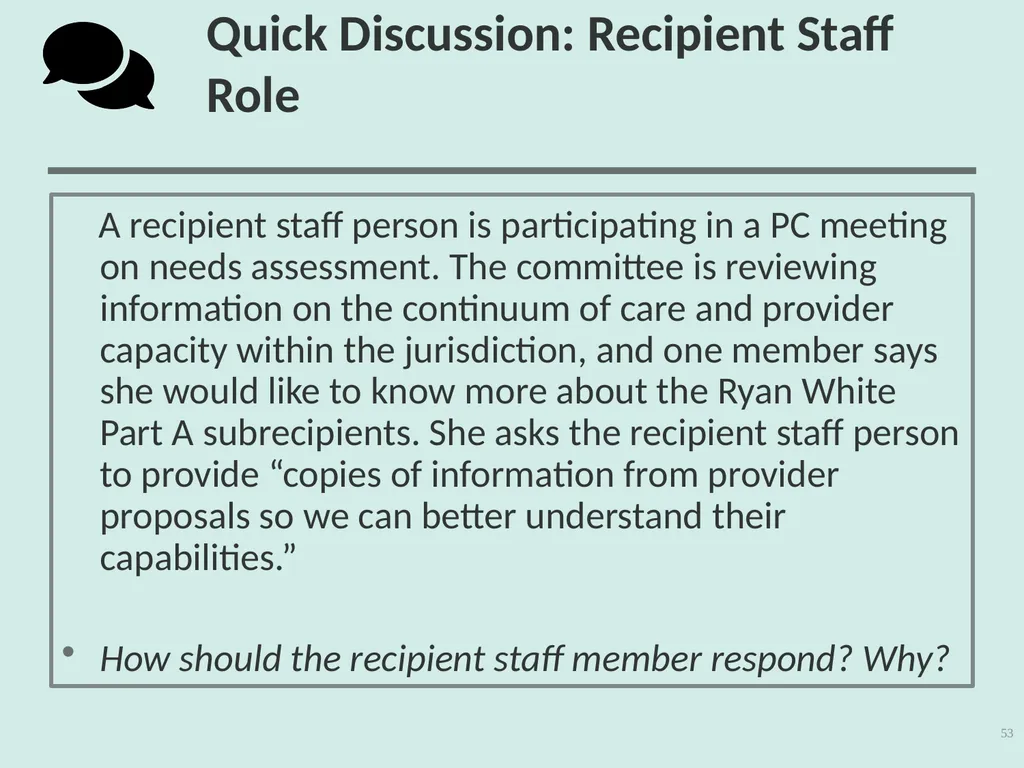
Quick Discussion: Recipient Staff Role A recipient staff person is participating in a PC meeting on needs assessment. The committee is reviewing information on the continuum of care and provider capacity within the jurisdiction, and one member says she would like to know more about the Ryan White Part A subrecipients. She asks the recipient staff person to provide “copies of information from provider proposals so we can better understand their capabilities.”
How should the recipient staff member respond? Why? 53<br>
How should the recipient staff member respond? Why? 53<br>
54
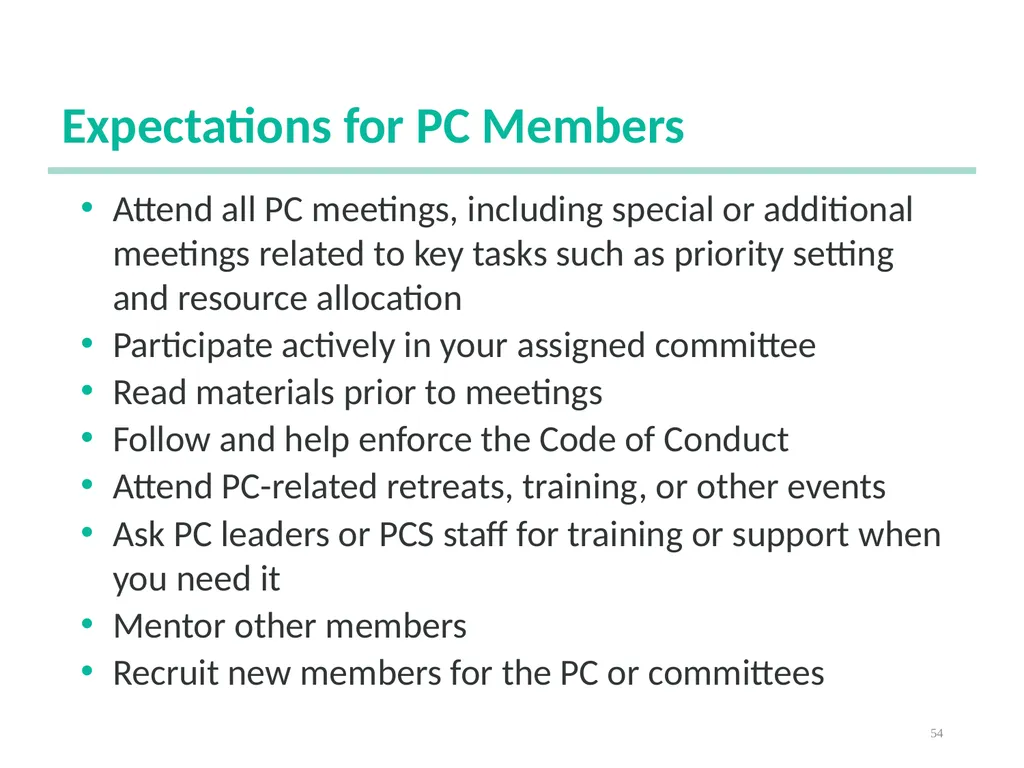
Expectations for PC Members Attend all PC meetings, including special or additional meetings related to key tasks such as priority setting and resource allocation
Participate actively in your assigned committee
Read materials prior to meetings
Follow and help enforce the Code of Conduct
Attend PC-related retreats, training, or other events
Ask PC leaders or PCS staff for training or support when you need it
Mentor other members
Recruit new members for the PC or committees 54<br>
Participate actively in your assigned committee
Read materials prior to meetings
Follow and help enforce the Code of Conduct
Attend PC-related retreats, training, or other events
Ask PC leaders or PCS staff for training or support when you need it
Mentor other members
Recruit new members for the PC or committees 54<br>
55
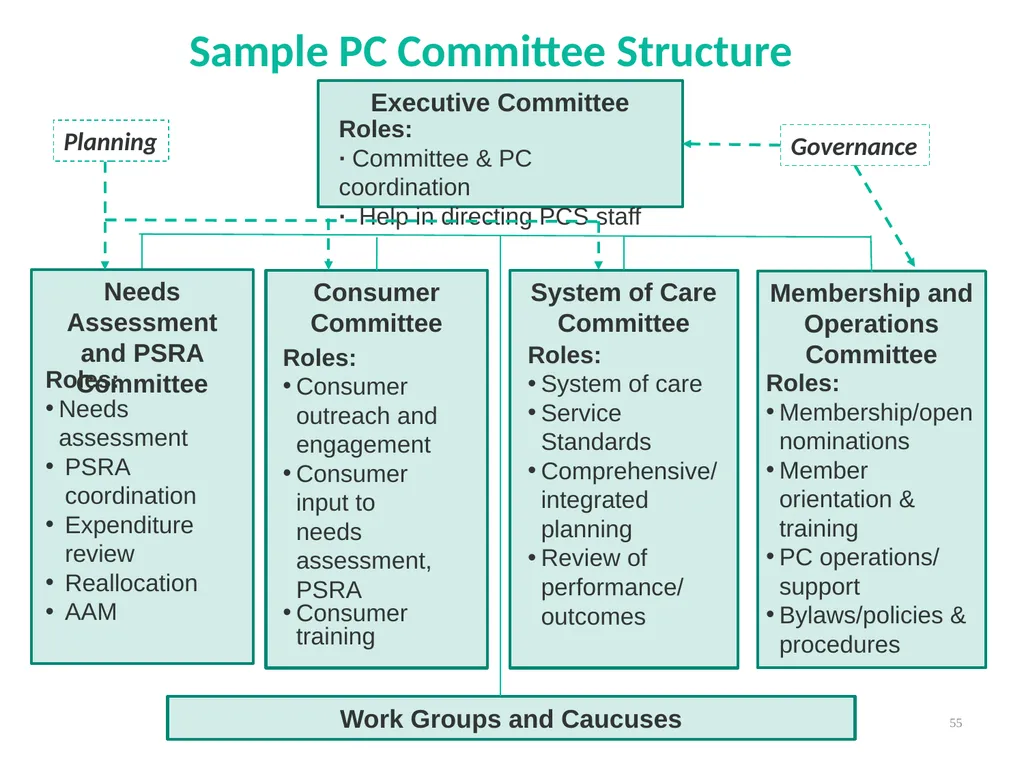
Sample PC Committee Structure Executive Committee Needs Assessment and PSRA Committee System of Care Committee Membership and Operations Committee Work Groups and Caucuses Roles:
Needs assessment
PSRA coordination
Expenditure review
Reallocation
AAM Roles:
System of care
Service Standards
Comprehensive/ integrated planning
Review of performance/ outcomes Roles:
Membership/open nominations
Member orientation & training
PC operations/ support
Bylaws/policies & procedures Consumer Committee Roles:
Consumer outreach and engagement
Consumer input to needs assessment, PSRA
Consumer training Roles:
∙ Committee & PC coordination
∙ Help in directing PCS staff Planning Governance 55<br>
Needs assessment
PSRA coordination
Expenditure review
Reallocation
AAM Roles:
System of care
Service Standards
Comprehensive/ integrated planning
Review of performance/ outcomes Roles:
Membership/open nominations
Member orientation & training
PC operations/ support
Bylaws/policies & procedures Consumer Committee Roles:
Consumer outreach and engagement
Consumer input to needs assessment, PSRA
Consumer training Roles:
∙ Committee & PC coordination
∙ Help in directing PCS staff Planning Governance 55<br>
56
How Our Planning Council Operates [Note to Presenters: Add local slides that describe how the PC operates, discussing topics such as your PC’s:
Expectations for committee membership/engagement
Policies and procedures around attendance
Policies and procedures around conflict of interest
Expense reimbursement policies and procedures
Mentoring or other help to new members
How a member can ask for help or support] 56<br>
Expectations for committee membership/engagement
Policies and procedures around attendance
Policies and procedures around conflict of interest
Expense reimbursement policies and procedures
Mentoring or other help to new members
How a member can ask for help or support] 56<br>
57
Quick Scenario: Committee Meetings Your PC requires members to serve on at least one committee, but doesn’t closely enforce attendance. Your EMA is geographically large, and members are allowed to participate in committee meetings by telephone. Several committee Co-Chairs have reported that only they and the assigned staff actually come in person. People connecting remotely seem to be doing other things rather than focusing on the discussion, and often join late or leave early. Two committee Co-Chairs say they will not be able to complete their required tasks this program year unless something changes.
What steps might your PC take to address this situation? 57<br>
What steps might your PC take to address this situation? 57<br>
58
Sum Up: PC Operations PC operations make it possible for a PC to meet its legislative responsibilities
PCS staff play a critical role – where resources are limited, PC needs clear priorities and effective use of staff
Much of a PC’s work can be done in committees if they are well-structured and coordinated by the Executive Committee
Committee meetings and full PC meetings require careful planning, sound agendas, appropriate materials, and policies & procedures that are consistently followed
The Chair plays a key role in making PC meetings successful 58<br>
PCS staff play a critical role – where resources are limited, PC needs clear priorities and effective use of staff
Much of a PC’s work can be done in committees if they are well-structured and coordinated by the Executive Committee
Committee meetings and full PC meetings require careful planning, sound agendas, appropriate materials, and policies & procedures that are consistently followed
The Chair plays a key role in making PC meetings successful 58<br>
59
Small-Group Activity: Looking Ahead Work in a small group, with a facilitator, recorder & reporter
Based on your prior knowledge and this orientation, discuss and be ready to share the following with regard to 1 member group, as assigned:
What are the 3-4 most important ways the PC can help new members from your assigned group to be active and effective?
What are the 3-4 things new members from this group need to take responsibility for doing themselves?
Member Groups: (a) consumers, (b) PLWH who are not consumers, (c) providers, (d) members whose first language is not English, (e) other types of members (e.g., state agency representatives)? 59<br>
Based on your prior knowledge and this orientation, discuss and be ready to share the following with regard to 1 member group, as assigned:
What are the 3-4 most important ways the PC can help new members from your assigned group to be active and effective?
What are the 3-4 things new members from this group need to take responsibility for doing themselves?
Member Groups: (a) consumers, (b) PLWH who are not consumers, (c) providers, (d) members whose first language is not English, (e) other types of members (e.g., state agency representatives)? 59<br>
60
Understanding and Using Data Importance of Data
Using Data in Decision Making
The HIV Care Continuum 60<br>
Using Data in Decision Making
The HIV Care Continuum 60<br>
61
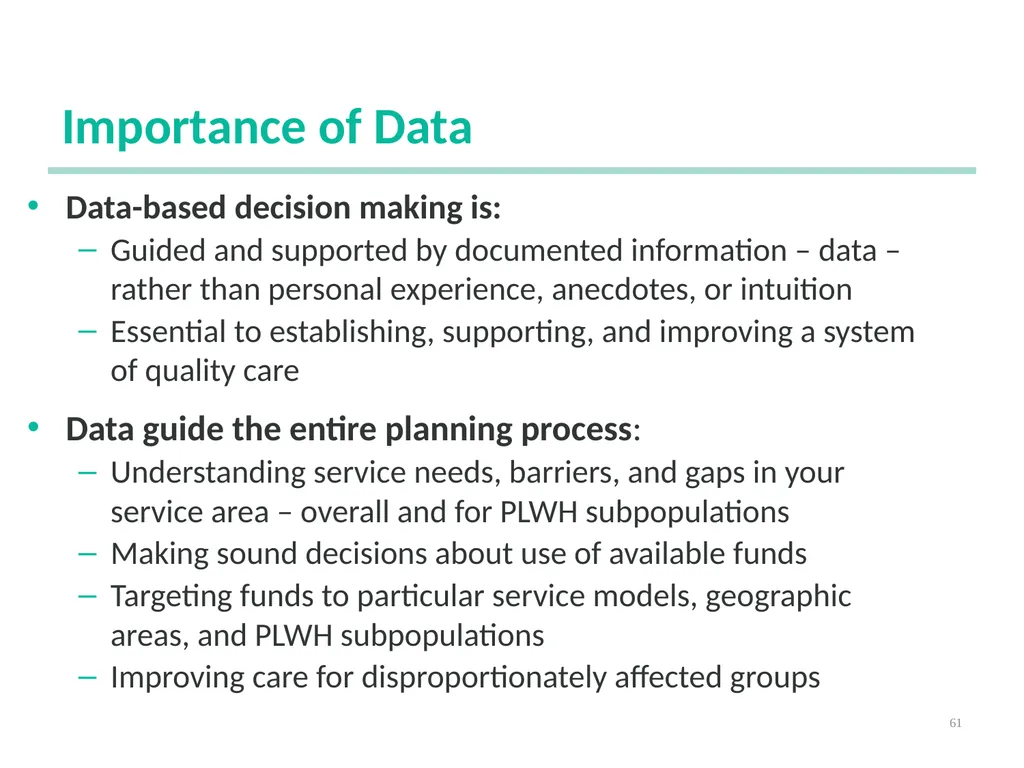
Importance of Data Data-based decision making is:
Guided and supported by documented information – data – rather than personal experience, anecdotes, or intuition
Essential to establishing, supporting, and improving a system of quality care
Data guide the entire planning process:
Understanding service needs, barriers, and gaps in your service area – overall and for PLWH subpopulations
Making sound decisions about use of available funds
Targeting funds to particular service models, geographic areas, and PLWH subpopulations
Improving care for disproportionately affected groups 61<br>
Guided and supported by documented information – data – rather than personal experience, anecdotes, or intuition
Essential to establishing, supporting, and improving a system of quality care
Data guide the entire planning process:
Understanding service needs, barriers, and gaps in your service area – overall and for PLWH subpopulations
Making sound decisions about use of available funds
Targeting funds to particular service models, geographic areas, and PLWH subpopulations
Improving care for disproportionately affected groups 61<br>
62
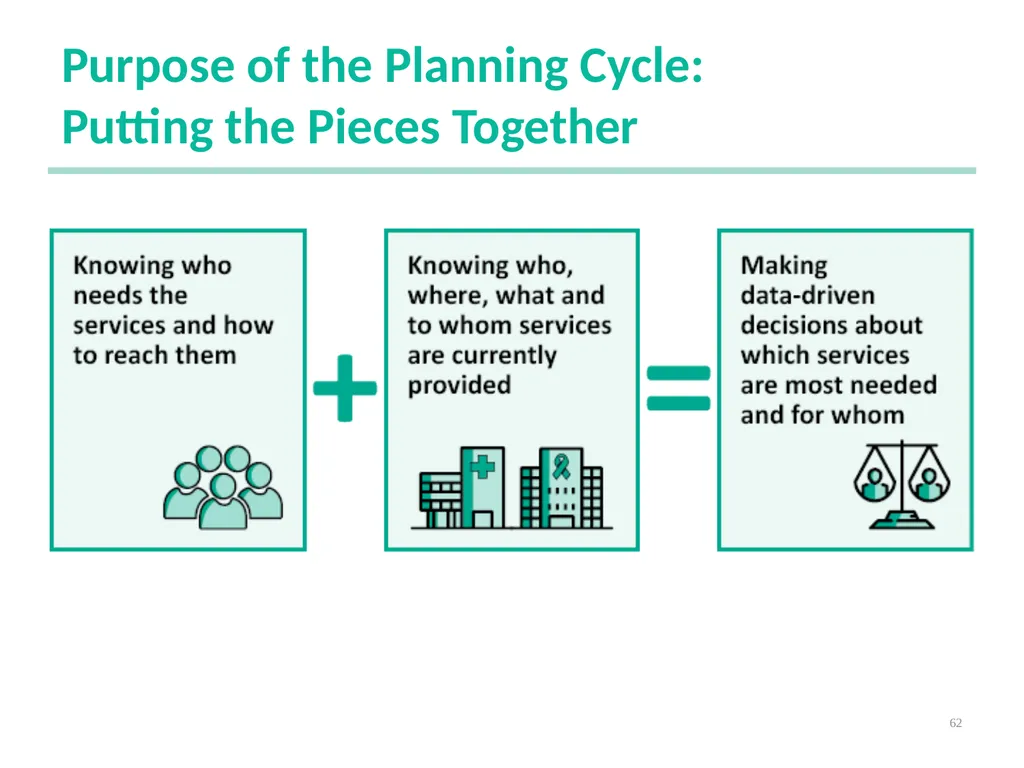
Purpose of the Planning Cycle:
Putting the Pieces Together 62<br>
63
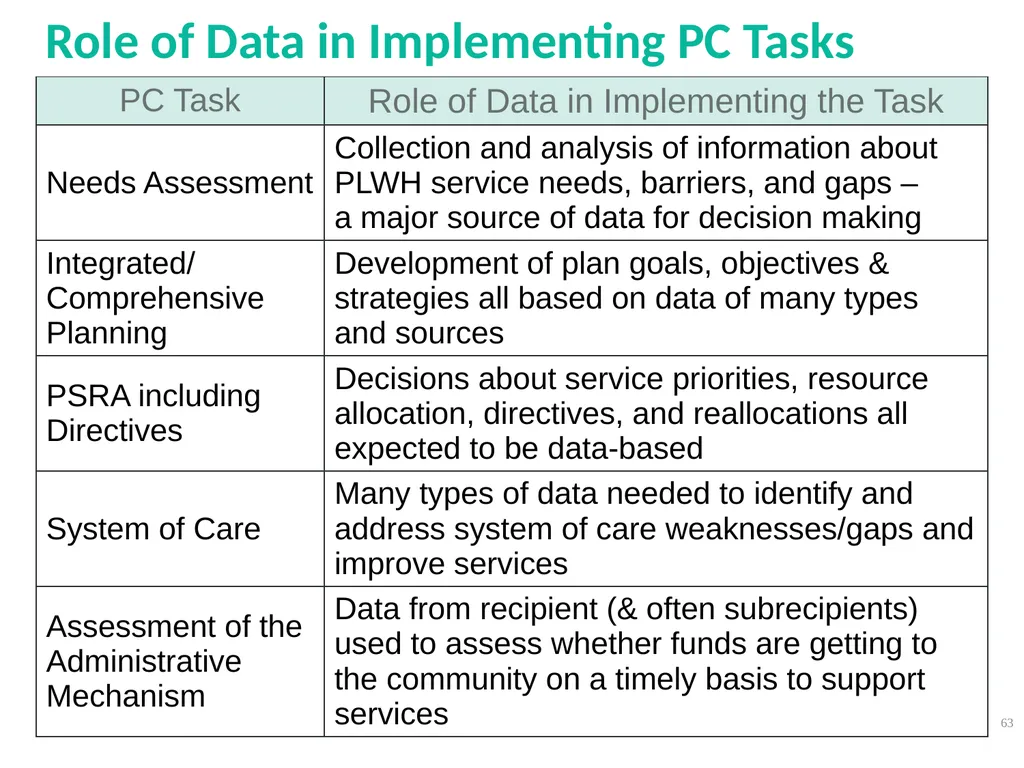
Role of Data in Implementing PC Tasks Data in Implementing PC Tasks 63<br>
64
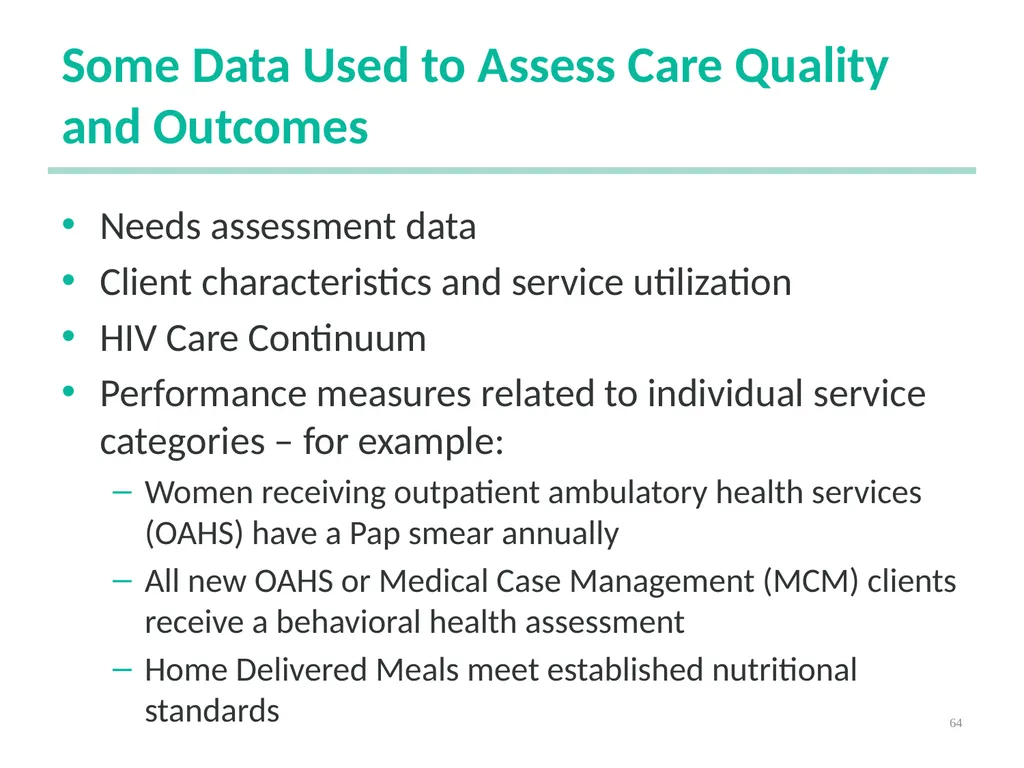
Some Data Used to Assess Care Quality and Outcomes Needs assessment data
Client characteristics and service utilization
HIV Care Continuum
Performance measures related to individual service categories – for example:
Women receiving outpatient ambulatory health services (OAHS) have a Pap smear annually
All new OAHS or Medical Case Management (MCM) clients receive a behavioral health assessment
Home Delivered Meals meet established nutritional standards 64<br>
Client characteristics and service utilization
HIV Care Continuum
Performance measures related to individual service categories – for example:
Women receiving outpatient ambulatory health services (OAHS) have a Pap smear annually
All new OAHS or Medical Case Management (MCM) clients receive a behavioral health assessment
Home Delivered Meals meet established nutritional standards 64<br>
65
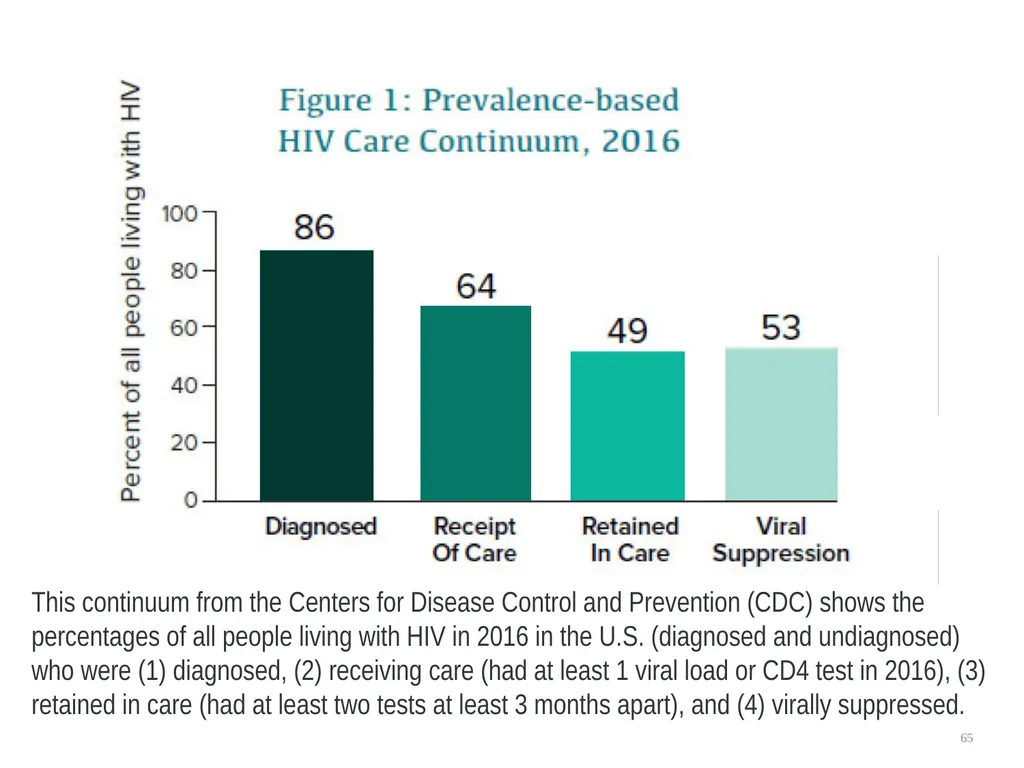
This continuum from the Centers for Disease Control and Prevention (CDC) shows the percentages of all people living with HIV in 2016 in the U.S. (diagnosed and undiagnosed) who were (1) diagnosed, (2) receiving care (had at least 1 viral load or CD4 test in 2016), (3) retained in care (had at least two tests at least 3 months apart), and (4) virally suppressed. 65<br>
66
If only people with diagnosed HIV in the U.S. are included, the percent receiving care, retained in care, and achieving viral suppression are as shown in this chart – 62% are virally suppressed. This continuum is also from the CDC. 66<br>
67
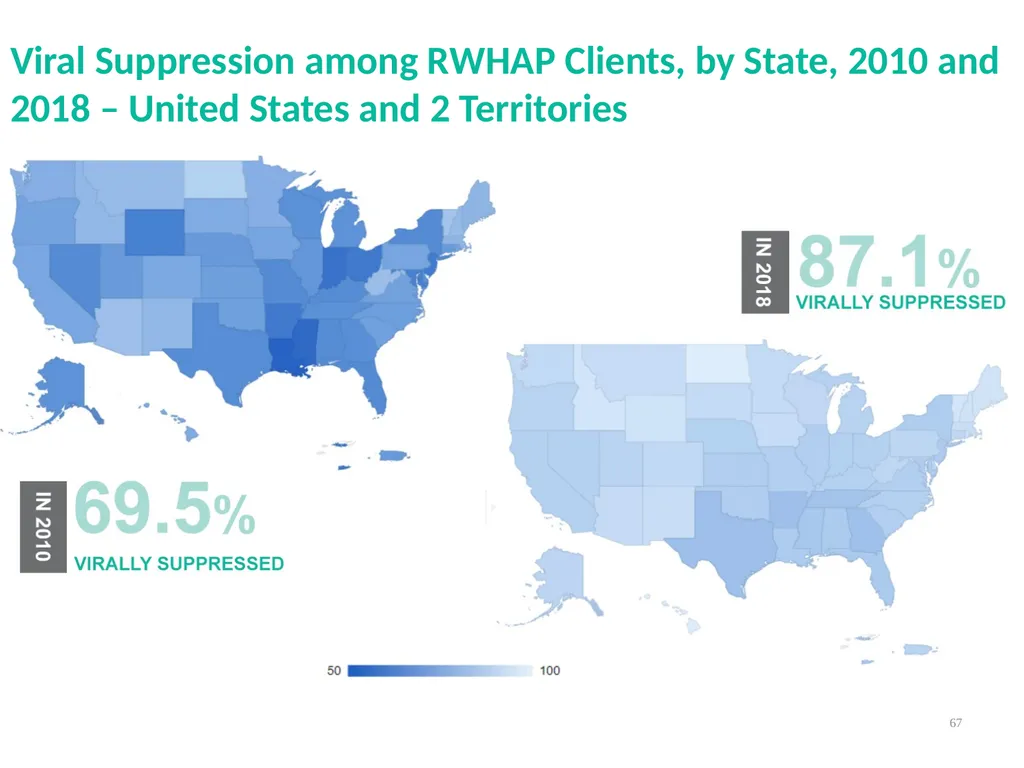
Viral Suppression among RWHAP Clients, by State, 2010 and 2018 – United States and 2 Territories 67<br>
68
[Your Jurisdiction’s] Ryan White
HIV Care Continuum [Add the HIV care continuum for your Part A jurisdiction and (if available) for RWHAP clients in your jurisdiction, and have a group discussion around how your RWHAP HIV care continuum differs from the national ones and the continuum for all PLWH:
What are the differences in linkage to care? Retention in care?
How do viral suppression rates compare?
Why do you suppose these differences exist?] 68<br>
What are the differences in linkage to care? Retention in care?
How do viral suppression rates compare?
Why do you suppose these differences exist?] 68<br>
69
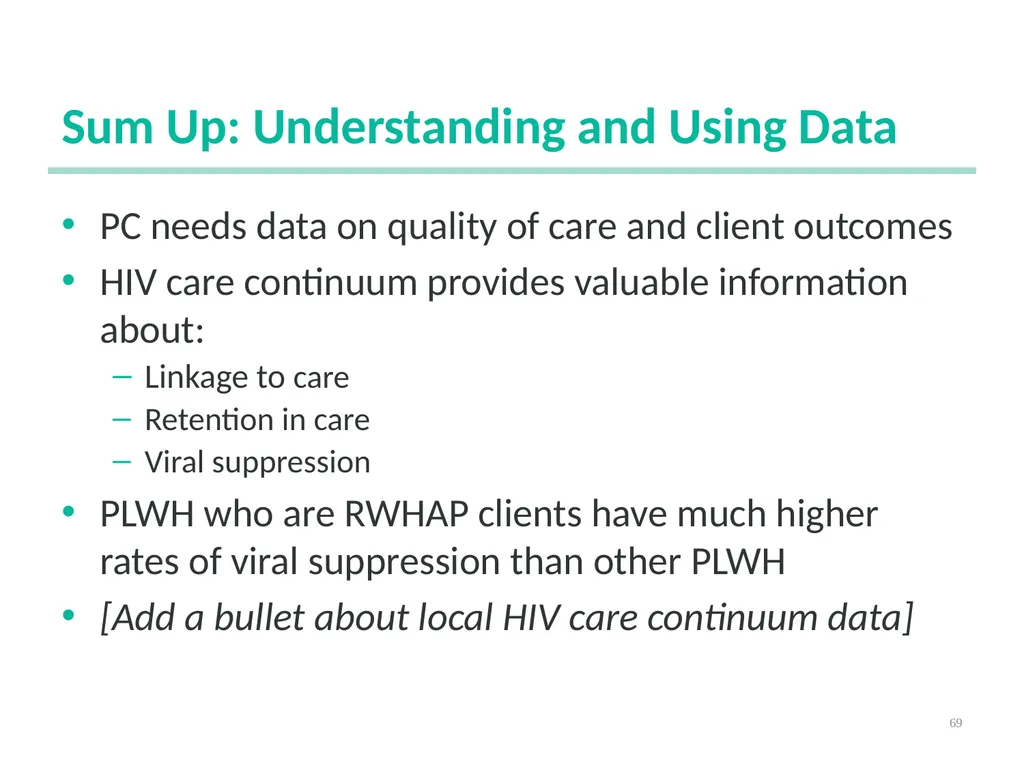
Sum Up: Understanding and Using Data PC needs data on quality of care and client outcomes
HIV care continuum provides valuable information about:
Linkage to care
Retention in care
Viral suppression
PLWH who are RWHAP clients have much higher rates of viral suppression than other PLWH
[Add a bullet about local HIV care continuum data] 69<br>
HIV care continuum provides valuable information about:
Linkage to care
Retention in care
Viral suppression
PLWH who are RWHAP clients have much higher rates of viral suppression than other PLWH
[Add a bullet about local HIV care continuum data] 69<br>
70
Session Assessment Revisiting the Quiz: Who Does What and Why?
Discussion: What you learned, what you liked and what you would change
Orientation Evaluation Form 70<br>
Discussion: What you learned, what you liked and what you would change
Orientation Evaluation Form 70<br>
71
Revisiting the Quiz: Who Does What and Why? Please take out your quiz as completed before the training
Review your answers
Add and revise your answers based on what you learned during the training
Count the number of answers you added or revised
Identify any questions that you still aren’t sure how to answer
Be ready to discuss the quiz 71<br>
Review your answers
Add and revise your answers based on what you learned during the training
Count the number of answers you added or revised
Identify any questions that you still aren’t sure how to answer
Be ready to discuss the quiz 71<br>
72
Discussion: Reflecting on Today’s Session What is the most important thing you learned today?
What did you like about this orientation session?
What would you change about this orientation session? 72<br>
What did you like about this orientation session?
What would you change about this orientation session? 72<br>
73
Orientation Evaluation Form Please complete and return the
Orientation Evaluation Form.
Thank You!<br>
Orientation Evaluation Form.
Thank You!<br>