01
Planning for a Large Space Weather Event: Preparation for and Lessons Learned from the 2024 Space Weather Interagency Tabletop Exercise
Janet Barzilla, Ph.D. 1; Diego Laramore, Ph.D. 1; A. Steve Johnson, Ph.D. 1, Shaowen Hu, Ph.D. 2; Edward Semones3
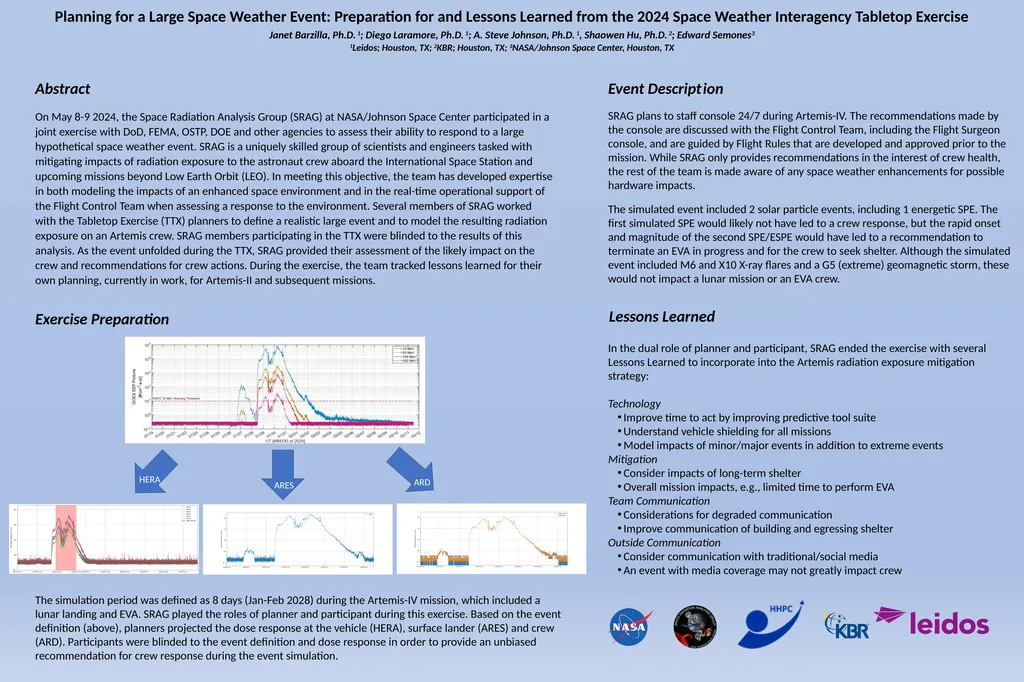
1Leidos; Houston, TX; 2KBR; Houston, TX; 3NASA/Johnson Space Center, Houston, TX Abstract On May 8-9 2024, the Space Radiation Analysis Group (SRAG) at NASA/Johnson Space Center participated in a joint exercise with DoD, FEMA, OSTP, DOE and other agencies to assess their ability to respond to a large hypothetical space weather event. SRAG is a uniquely skilled group of scientists and engineers tasked with mitigating impacts of radiation exposure to the astronaut crew aboard the International Space Station and upcoming missions beyond Low Earth Orbit (LEO). In meeting this objective, the team has developed expertise in both modeling the impacts of an enhanced space environment and in the real-time operational support of the Flight Control Team when assessing a response to the environment. Several members of SRAG worked with the Tabletop Exercise (TTX) planners to define a realistic large event and to model the resulting radiation exposure on an Artemis crew. SRAG members participating in the TTX were blinded to the results of this analysis. As the event unfolded during the TTX, SRAG provided their assessment of the likely impact on the crew and recommendations for crew actions. During the exercise, the team tracked lessons learned for their own planning, currently in work, for Artemis-II and subsequent missions. Exercise Preparation The simulation period was defined as 8 days (Jan-Feb 2028) during the Artemis-IV mission, which included a lunar landing and EVA. SRAG played the roles of planner and participant during this exercise. Based on the event definition (above), planners projected the dose response at the vehicle (HERA), surface lander (ARES) and crew (ARD). Participants were blinded to the event definition and dose response in order to provide an unbiased recommendation for crew response during the event simulation. Event Descript ion SRAG plans to staff console 24/7 during Artemis-IV. The recommendations made by the console are discussed with the Flight Control Team, including the Flight Surgeon console, and are guided by Flight Rules that are developed and approved prior to the mission. While SRAG only provides recommendations in the interest of crew health, the rest of the team is made aware of any space weather enhancements for possible hardware impacts.
The simulated event included 2 solar particle events, including 1 energetic SPE. The first simulated SPE would likely not have led to a crew response, but the rapid onset and magnitude of the second SPE/ESPE would have led to a recommendation to terminate an EVA in progress and for the crew to seek shelter. Although the simulated event included M6 and X10 X-ray flares and a G5 (extreme) geomagnetic storm, these would not impact a lunar mission or an EVA crew. Lessons Learned In the dual role of planner and participant, SRAG ended the exercise with several Lessons Learned to incorporate into the Artemis radiation exposure mitigation strategy:
Technology
Improve time to act by improving predictive tool suite
Understand vehicle shielding for all missions
Model impacts of minor/major events in addition to extreme events
Mitigation
Consider impacts of long-term shelter
Overall mission impacts, e.g., limited time to perform EVA
Team Communication
Considerations for degraded communication
Improve communication of building and egressing shelter
Outside Communication
Consider communication with traditional/social media
An event with media coverage may not greatly impact crew<br>