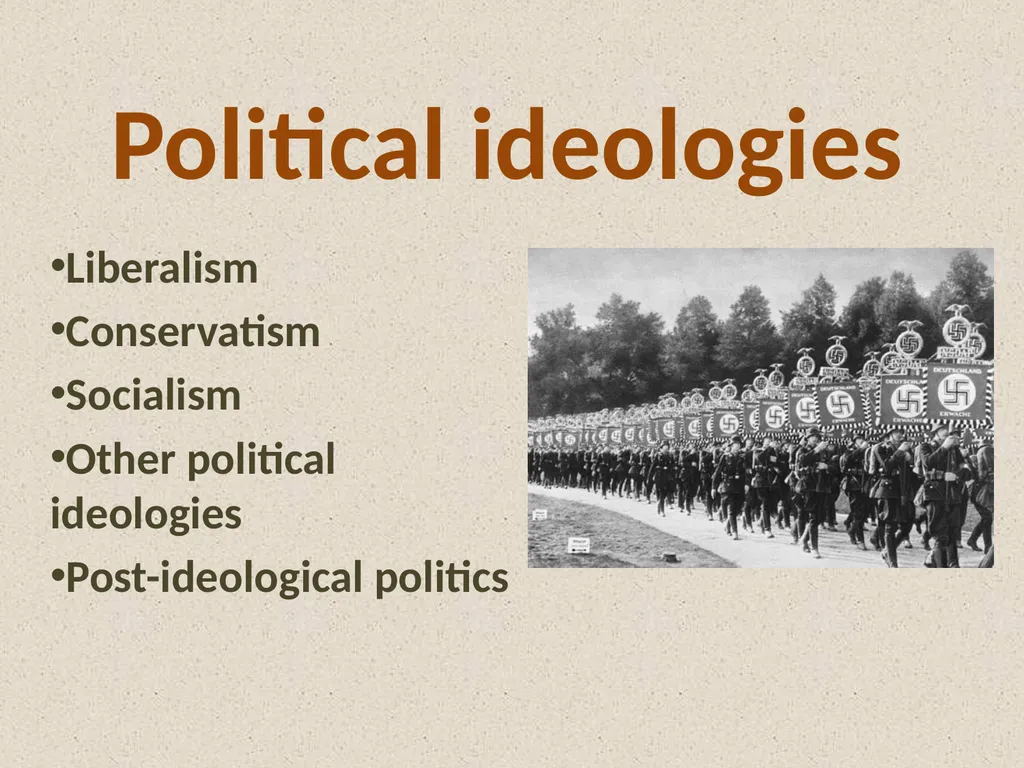
Political ideologies Liberalism Conservatism Socialism Other political ideologies Post-ideological politics What is ideology? Ideology is an interrelated set of ideas that in some way guides or inspires political action (Heywood, 2002)
"Political ideologies Liberalism Conservatism" is the property of its rightful owner. Permission is granted to
download and print the materials on this website for personal, non-commercial use only, and to display it
on your personal computer provided you do not modify the materials and that you retain all copyright
notices contained in the materials. By downloading content from our website, you accept the terms of this
agreement.
Presentation Transcript
01
Political ideologies Liberalism
Conservatism
Socialism
Other political ideologies
Post-ideological politics<br>
02
What is ideology? Ideology is ‘an interrelated set of ideas that in some way guides or inspires political action’ (Heywood, 2002)
‘An ideology is a reasonably coherent structure of thought shared by a group of people. It is a means of explaining how society works and explaining how it ought to work.’ (Dobson, 1992)
Some uses of the term see ideology as something negative, implying a distorted view of reality eg capitalist ideology, patriarchal ideology<br>
03
Liberalism Key ideas
Individual freedom
Equality of opportunity
Government by consent
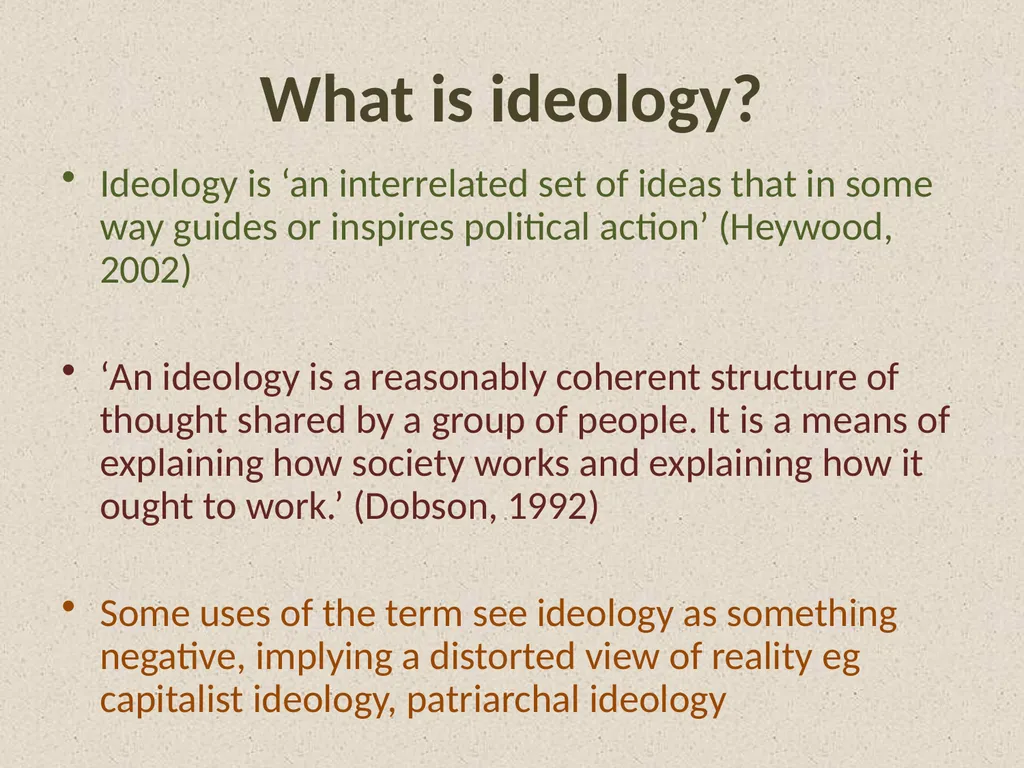
State’s role is to safeguard freedom of the individual Liberalism has influenced a variety of movements concerned with equal rights for all citizens<br>
04
Types of liberalism Classical liberalism
Progressive liberalism
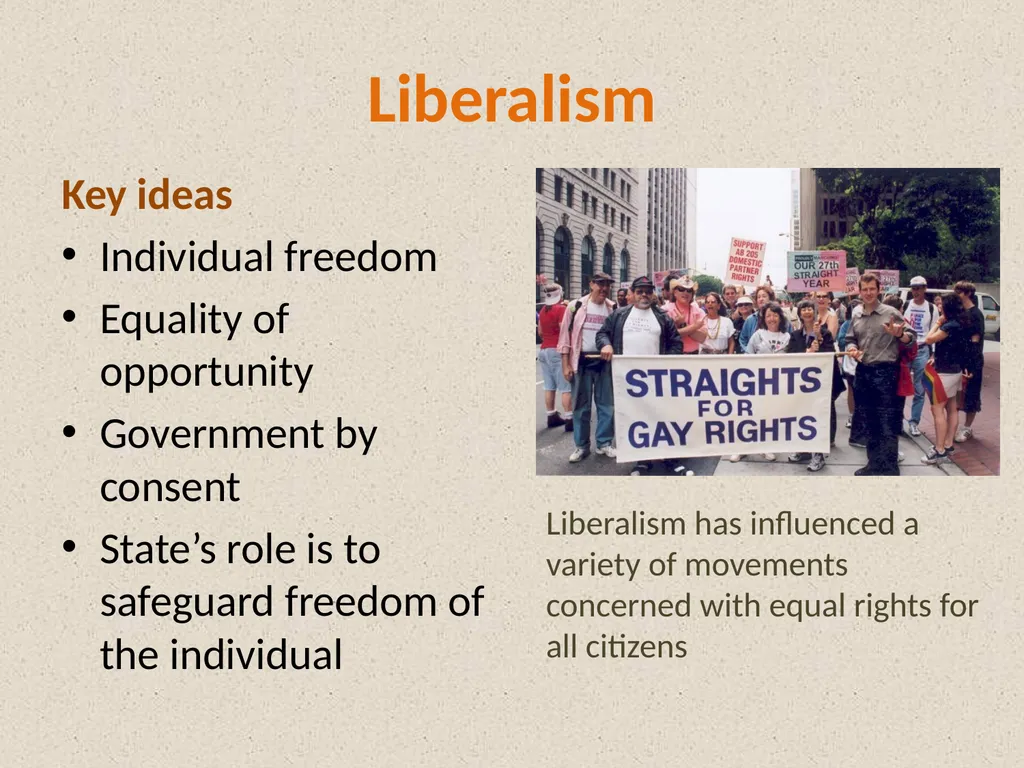
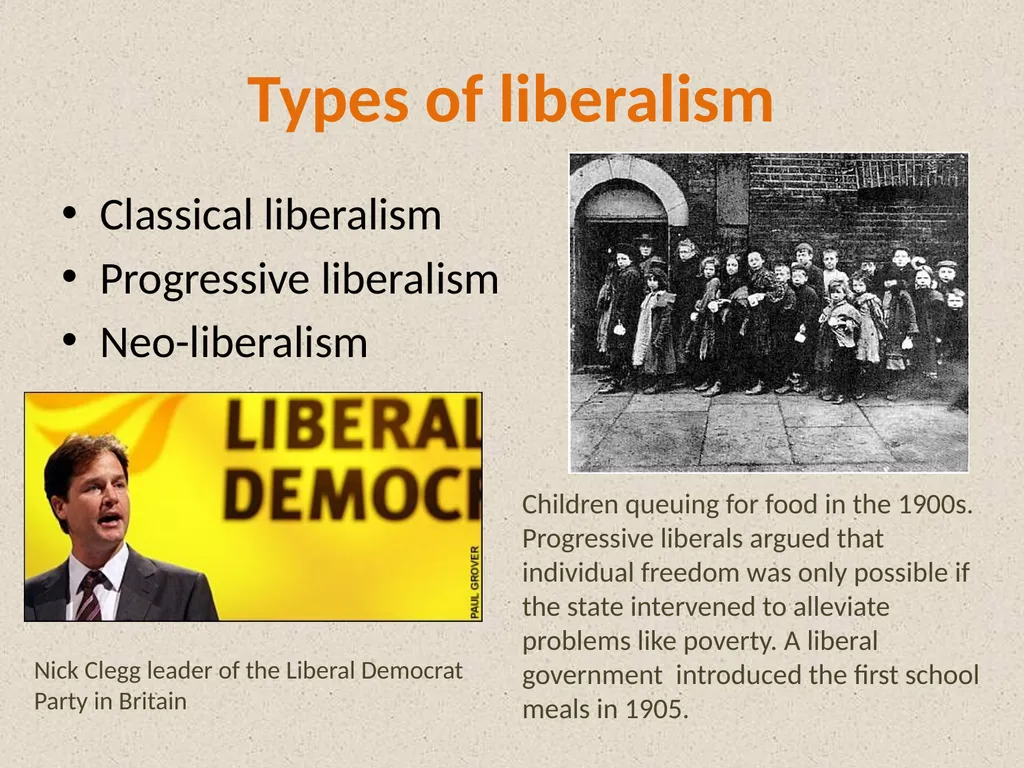
Neo-liberalism Children queuing for food in the 1900s. Progressive liberals argued that individual freedom was only possible if the state intervened to alleviate problems like poverty. A liberal government introduced the first school meals in 1905. Nick Clegg leader of the Liberal Democrat Party in Britain<br>
05
Conservatism Key ideas
Importance of tradition
Gradual social change
Human beings are imperfect and flawed
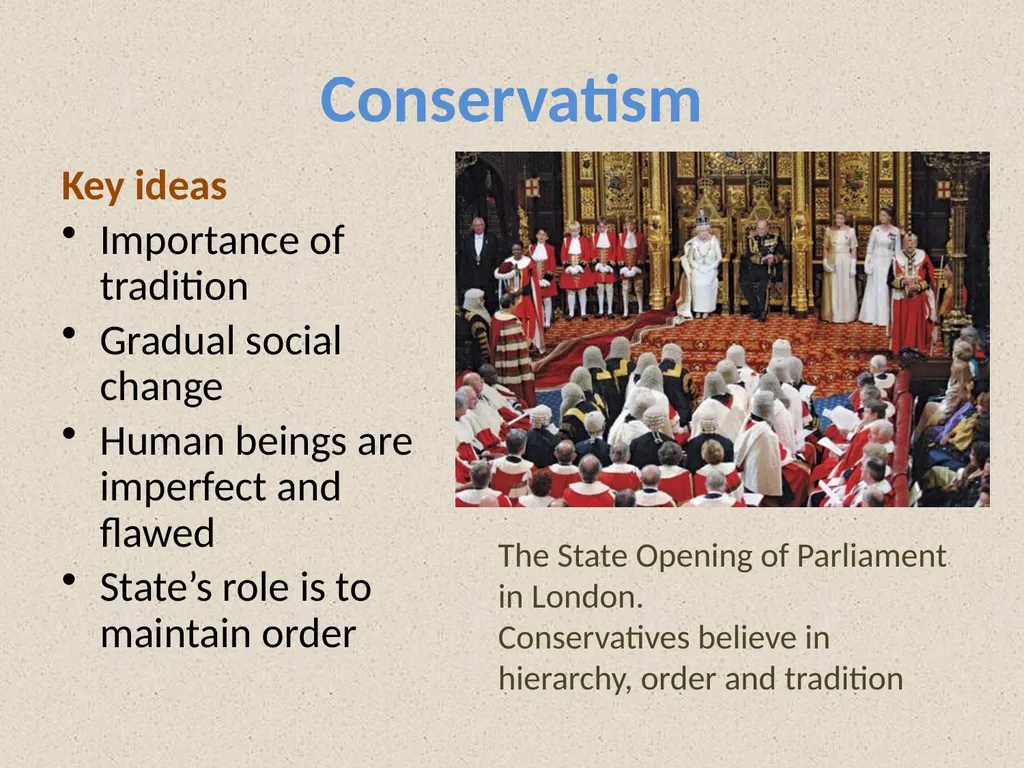
State’s role is to maintain order The State Opening of Parliament in London.
Conservatives believe in hierarchy, order and tradition<br>
06
Types of conservatism Traditional conservatism
One-nation conservatism
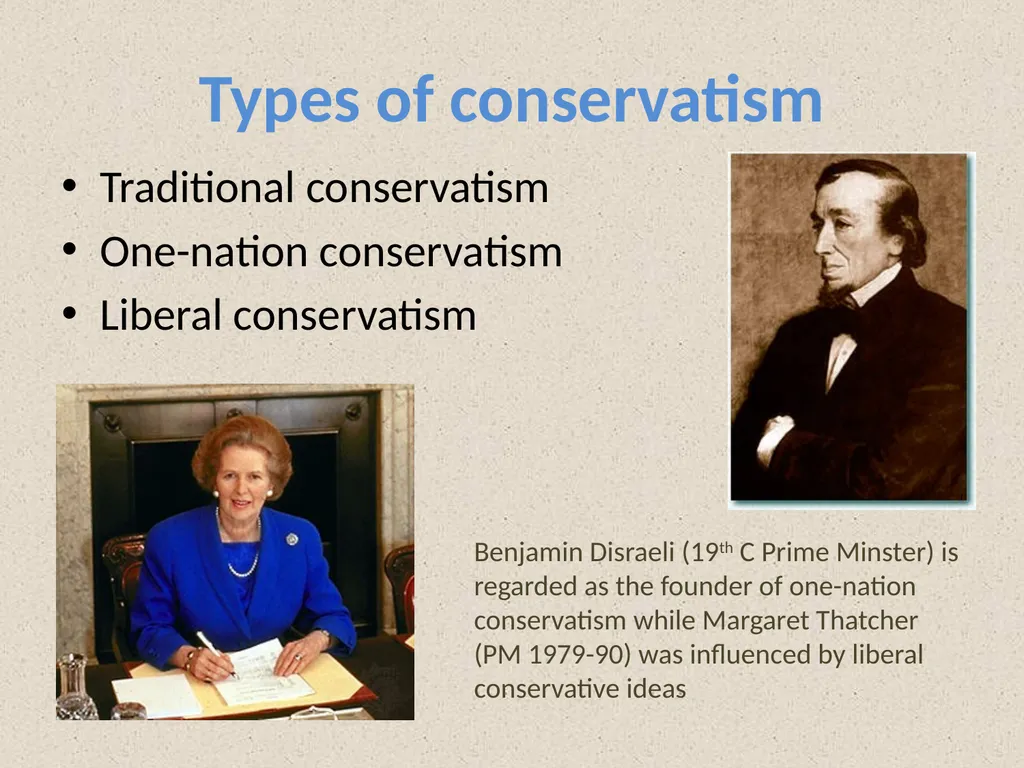
Liberal conservatism Benjamin Disraeli (19th C Prime Minster) is regarded as the founder of one-nation conservatism while Margaret Thatcher (PM 1979-90) was influenced by liberal conservative ideas<br>
07
Socialism Key ideas
Collectivism
Equality
Opposed to capitalism
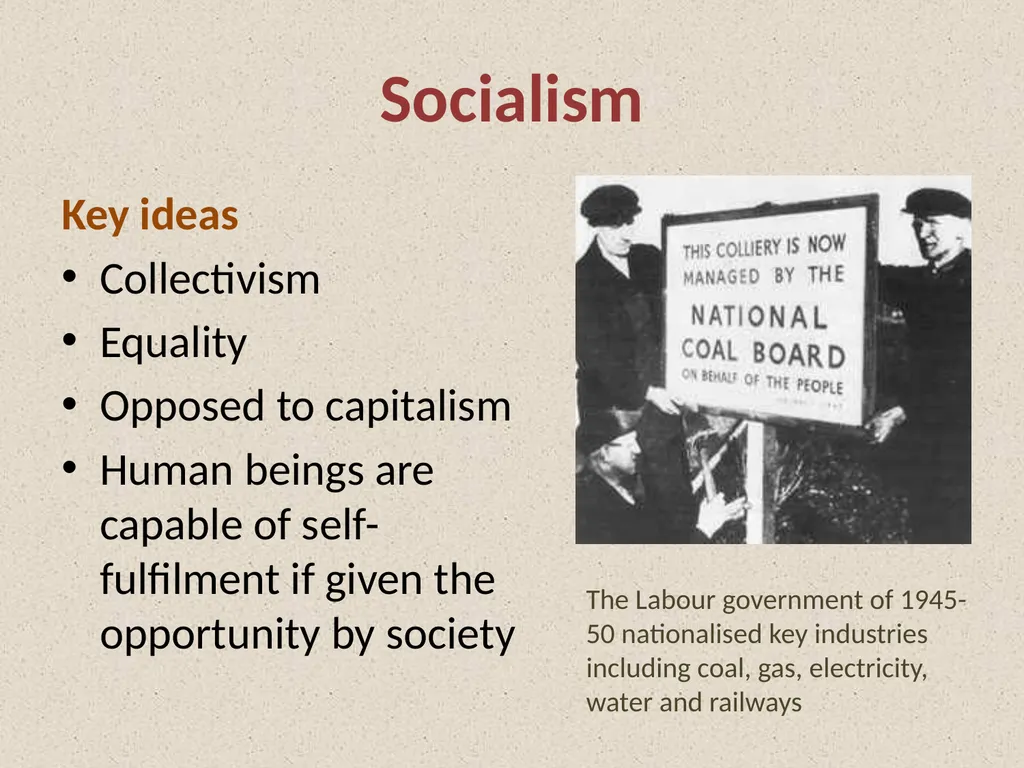
Human beings are capable of self-fulfilment if given the opportunity by society The Labour government of 1945-50 nationalised key industries including coal, gas, electricity, water and railways<br>
08
Types of socialism Revolutionary socialism
Democratic socialism
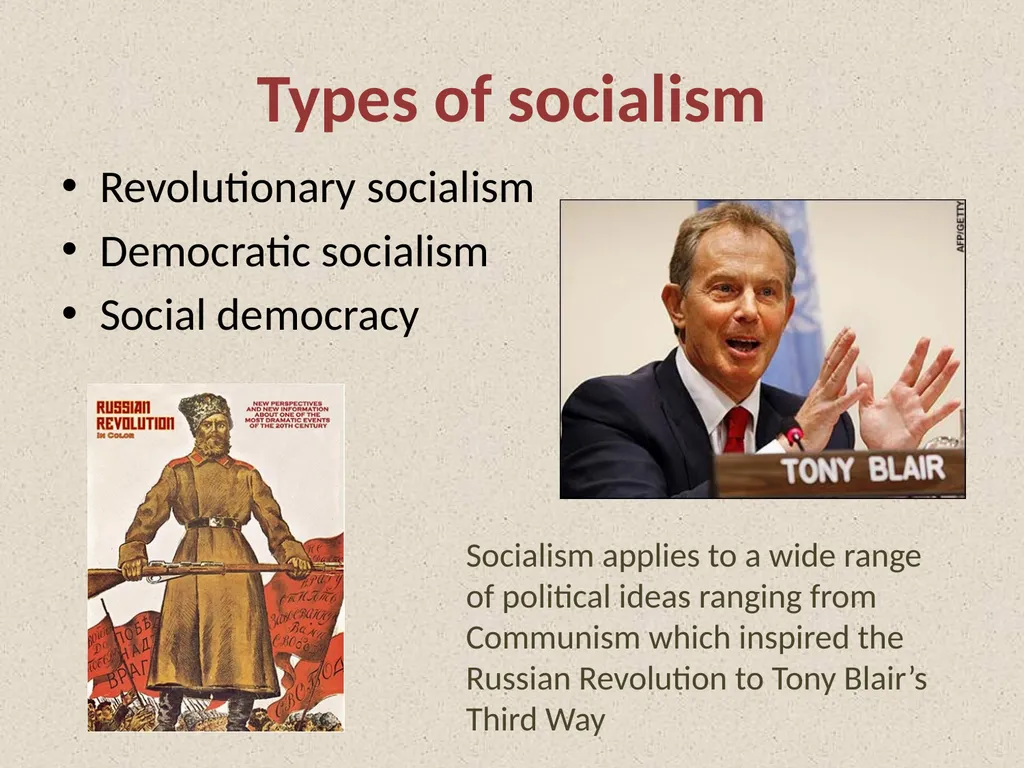
Social democracy Socialism applies to a wide range of political ideas ranging from Communism which inspired the Russian Revolution to Tony Blair’s Third Way<br>
09
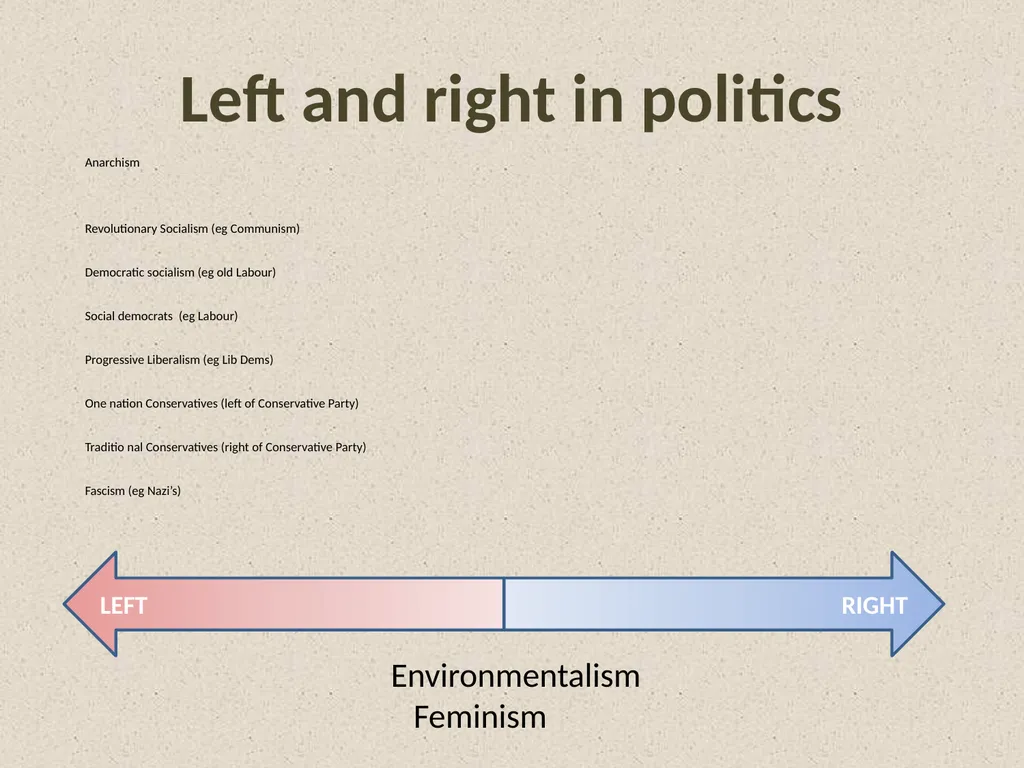
Left and right in politics Anarchism
Revolutionary Socialism (eg Communism)
Democratic socialism (eg old Labour)
Social democrats (eg Labour)
Progressive Liberalism (eg Lib Dems)
One nation Conservatives (left of Conservative Party)
Traditio nal Conservatives (right of Conservative Party)
Fascism (eg Nazi’s) Environmentalism
Feminism RIGHT LEFT<br>
10
Other political ideologies Feminism
Environmentalism
Fascism
Anarchism Some political ideologies like environmentalism are hard to classify as left or right wing<br>
11
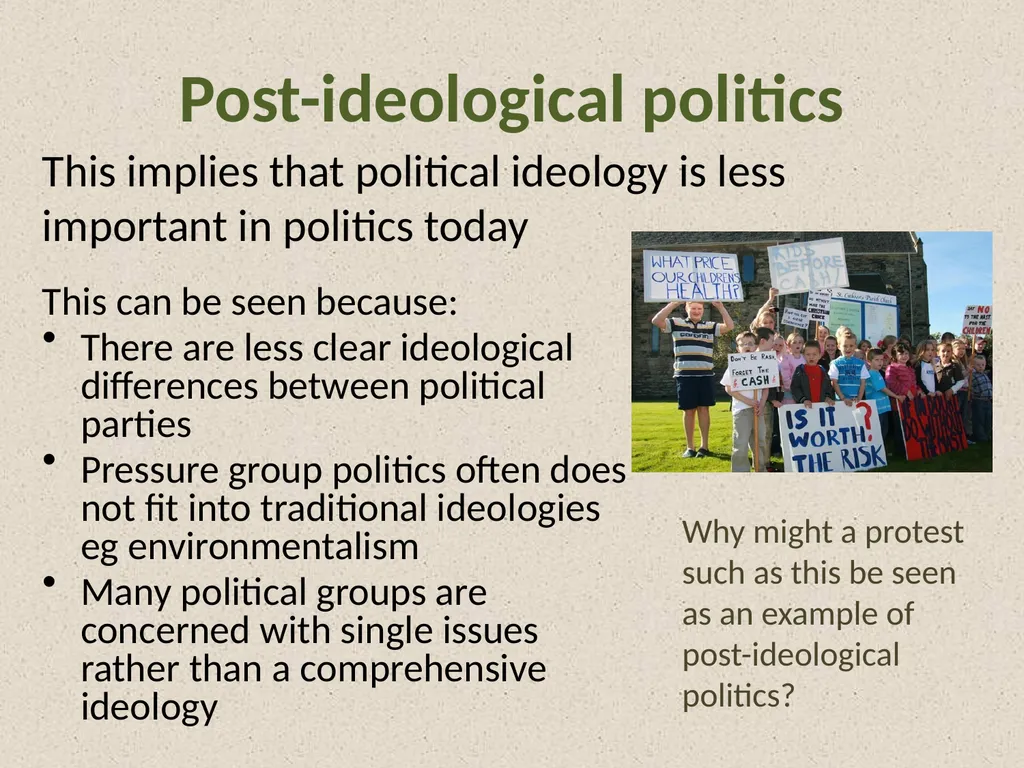
Post-ideological politics This can be seen because:
There are less clear ideological differences between political parties
Pressure group politics often does not fit into traditional ideologies eg environmentalism
Many political groups are concerned with single issues rather than a comprehensive ideology This implies that political ideology is less important in politics today Why might a protest such as this be seen as an example of post-ideological politics?<br>