
Polyvagal Theory Authored by neuroscientist Dr.





Description: Polyvagal Theory Authored by neuroscientist Dr. Stephen Porges. Porges studied chronically fussychallenging babies with Stanley Greenspan (DIR Floortime) in the 1980s (Porges was the father of a fussy baby). Why are some babies more
Related Topics
Download Presentation
"Polyvagal Theory Authored by neuroscientist Dr." is the property of its rightful owner. Permission is granted to download and print the materials on this website for personal, non-commercial use only, and to display it on your personal computer provided you do not modify the materials and that you retain all copyright notices contained in the materials. By downloading content from our website, you accept the terms of this agreement.
Presentation Transcript
slide1. Polyvagal Theory
Authored by neuroscientist Dr. Stephen Porges. Porges studied chronically fussy/challenging babies with Stanley Greenspan (DIR Floortime) in the 1980s (Porges was the father of a fussy baby). Why are some babies more challenging than others? Porges and Greenspan believed that this has to do with how the central nervous system regulates the body. Parental regulation is key in being able to cope and help (co-regulate) a chronically fussy/challenging baby.
Porges’ wife is neurobiologist Dr. Sue Carter, whose work led to understanding the relationship between social behaviour and oxytocin (the love hormone).
According to Porges, “We all come from dysfunctional families. The issue is not whether our family was dysfunctional but whether we can put meaning to the experience of our lives.”<br>
slide2. A theory is used to provide a model for why things work and how things happen.
Polyvagal Theory provides a model for understanding human thoughts, emotions and behaviour by looking at the role of the vagus nerve in our social engagement system.<br>
slide3. 12 cranial nerves emerge directly from the brain relaying information between the brain and parts of the body
The Vagus is the 10th cranial nerve starting at the brain stem and is the longest cranial nerve in the human body
'Vagus' from the latin 'wandering' - the vagus nerve wonders through our body.
The Vagus nerve is responsible for the regulation of internal organ functions, such as digestion, heart rate, and respiratory rate, blood vessel dilation, and certain reflex actions, such as coughing, sneezing, swallowing and vomiting
The Vagus carries 20% of information from the brain to the body and 80% of information from the body to the brain<br>
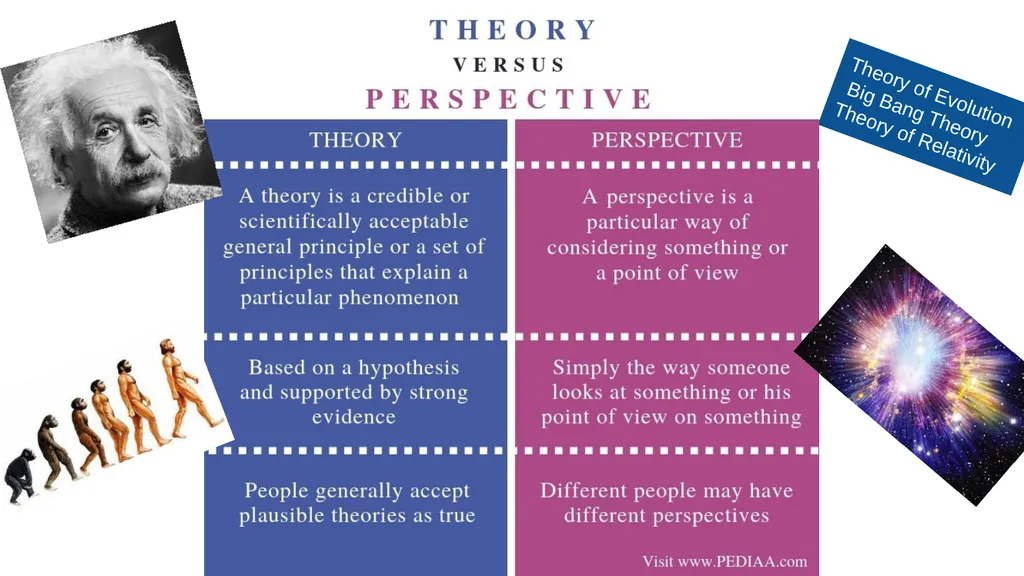
slide4. Theory Theory of Evolution
Big Bang Theory
Theory of Relativity<br>
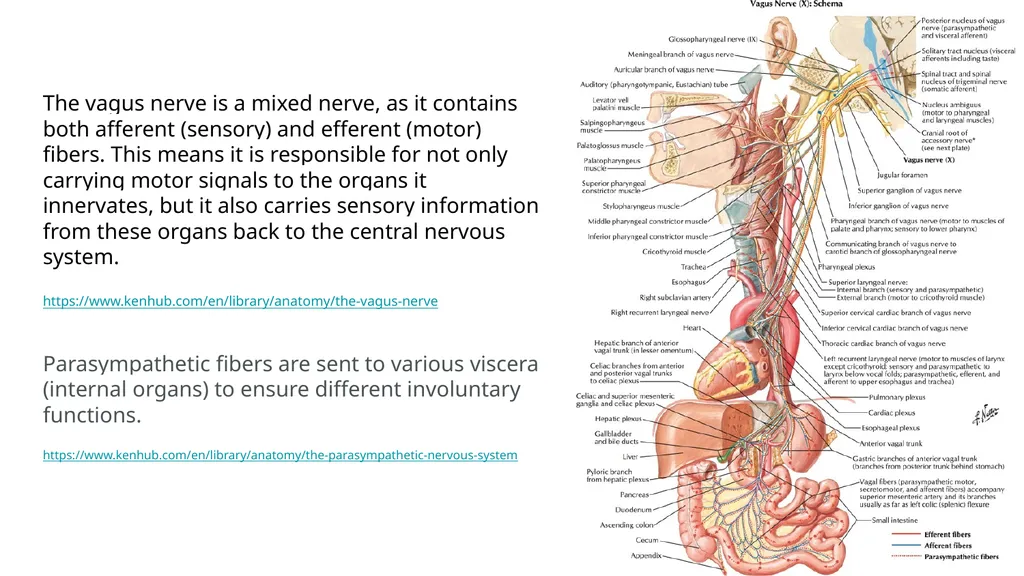
slide5. The vagus nerve is a mixed nerve, as it contains both afferent (sensory) and efferent (motor) fibers. This means it is responsible for not only carrying motor signals to the organs it innervates, but it also carries sensory information from these organs back to the central nervous system.
https://www.kenhub.com/en/library/anatomy/the-vagus-nerve
Parasympathetic fibers are sent to various viscera (internal organs) to ensure different involuntary functions.
https://www.kenhub.com/en/library/anatomy/the-parasympathetic-nervous-system<br>
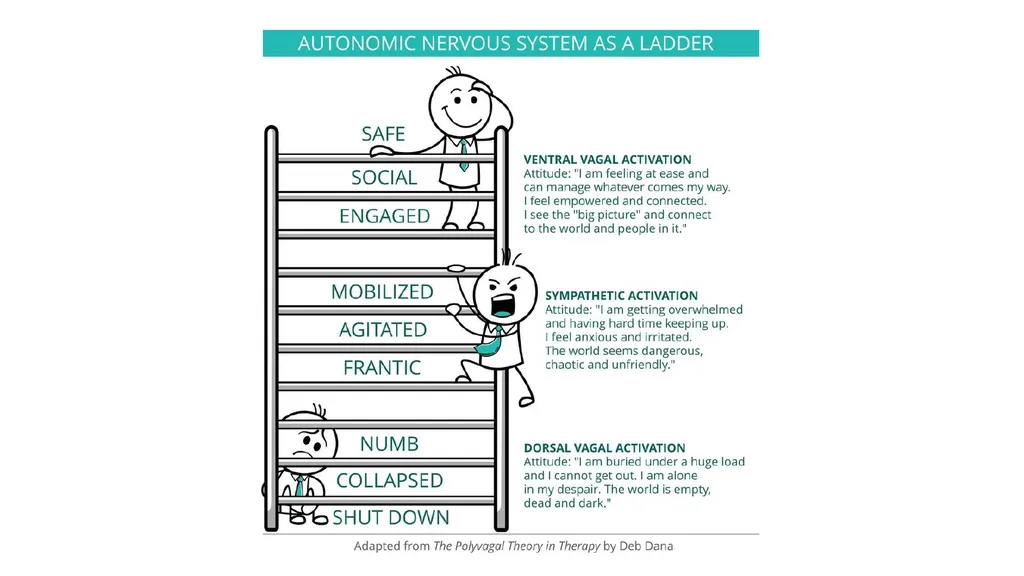
slide6. The traditional view of the autonomic nervous system presents a two-part system: the sympathetic nervous system, which is more activating (“fight/flight”), and the parasympathetic nervous system, which supports health, growth, and restoration (“rest and digest”).
Polyvagal theory identifies a third type of nervous system response - the ‘social engagement system,’ a hybrid state of activation and calming that plays a role in our ability to socially engage (or not).
Poly = several Vagal = relating to the Vagus nerve
Our autonomic nervous system is all about safety. Polyvagal Theory offers precise science to understand how one part of the autonomic nervous system (the vagus nerve) connects the brain to the heart and to the viscera (the internal organs) and relates to our human ability to connect and communicate with each other.<br>
slide7. Vagus Nerve Hacks
Hand Reflexology
https://youtu.be/GpHgKRVOdVs
Vagus Nerve Massage
https://youtu.be/9uZ1rnKF5DU
Clear Your Mind
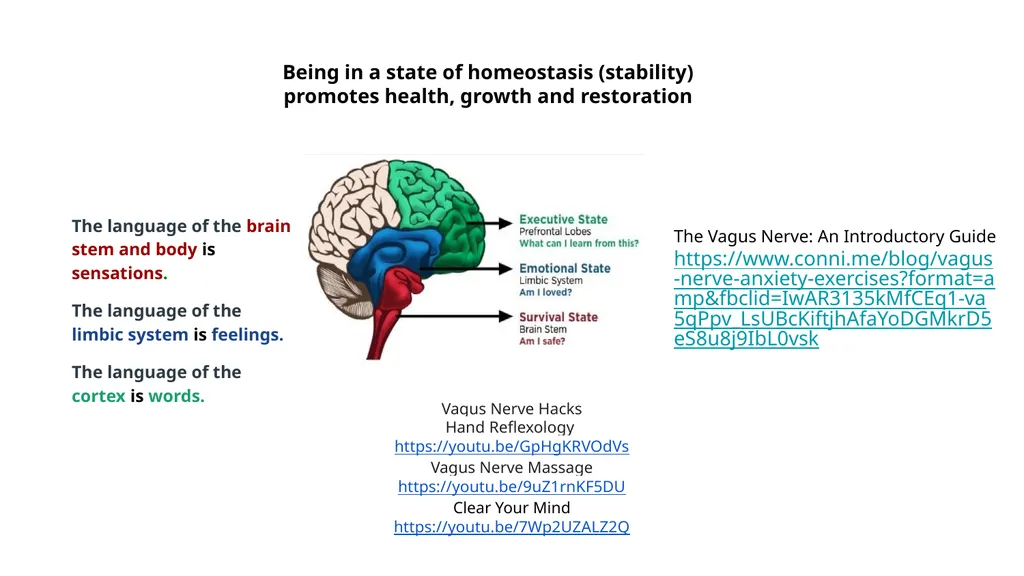
https://youtu.be/7Wp2UZALZ2Q Being in a state of homeostasis (stability) promotes health, growth and restoration The language of the brain stem and body is sensations.
The language of the limbic system is feelings.
The language of the cortex is words. The Vagus Nerve: An Introductory Guide
https://www.conni.me/blog/vagus-nerve-anxiety-exercises?format=amp&fbclid=IwAR3135kMfCEq1-va5qPpv_LsUBcKiftjhAfaYoDGMkrD5eS8u8j9IbL0vsk<br>
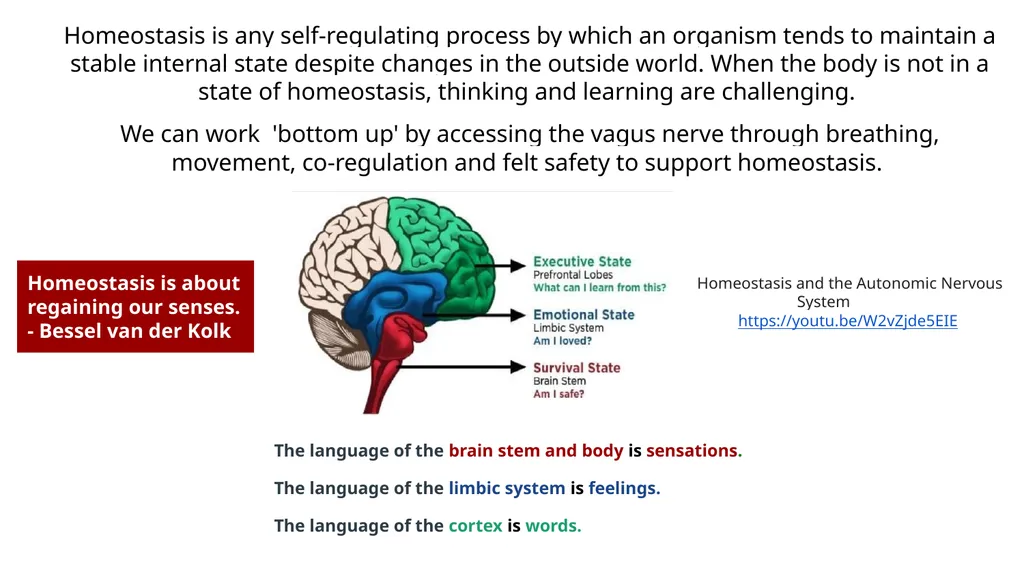
slide9. Homeostasis is any self-regulating process by which an organism tends to maintain a stable internal state despite changes in the outside world. When the body is not in a state of homeostasis, thinking and learning are challenging.
We can work 'bottom up' by accessing the vagus nerve through breathing, movement, co-regulation and felt safety to support homeostasis. Homeostasis and the Autonomic Nervous System
https://youtu.be/W2vZjde5EIE The language of the brain stem and body is sensations.
The language of the limbic system is feelings.
The language of the cortex is words. Homeostasis is about regaining our senses.
- Bessel van der Kolk<br>
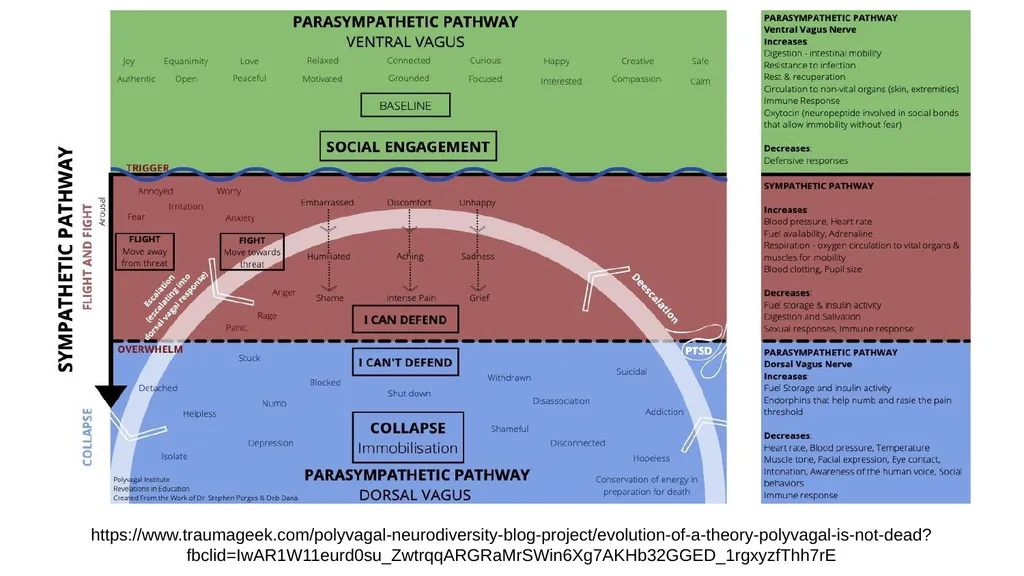
slide10. https://www.traumageek.com/polyvagal-neurodiversity-blog-project/evolution-of-a-theory-polyvagal-is-not-dead?fbclid=IwAR1W11eurd0su_ZwtrqqARGRaMrSWin6Xg7AKHb32GGED_1rgxyzfThh7rE<br>
slide12. Polyvagal Theory in Schools - Stephen Porges
https://youtu.be/Hdsw7QN9bxE<br>
slide13. Mauri = Life force<br>
slide14. Lessons Learned - David Pitonyak
https://youtu.be/sfa54F5qWD4<br>
Authored by neuroscientist Dr. Stephen Porges. Porges studied chronically fussy/challenging babies with Stanley Greenspan (DIR Floortime) in the 1980s (Porges was the father of a fussy baby). Why are some babies more challenging than others? Porges and Greenspan believed that this has to do with how the central nervous system regulates the body. Parental regulation is key in being able to cope and help (co-regulate) a chronically fussy/challenging baby.
Porges’ wife is neurobiologist Dr. Sue Carter, whose work led to understanding the relationship between social behaviour and oxytocin (the love hormone).
According to Porges, “We all come from dysfunctional families. The issue is not whether our family was dysfunctional but whether we can put meaning to the experience of our lives.”<br>
slide2. A theory is used to provide a model for why things work and how things happen.
Polyvagal Theory provides a model for understanding human thoughts, emotions and behaviour by looking at the role of the vagus nerve in our social engagement system.<br>
slide3. 12 cranial nerves emerge directly from the brain relaying information between the brain and parts of the body
The Vagus is the 10th cranial nerve starting at the brain stem and is the longest cranial nerve in the human body
'Vagus' from the latin 'wandering' - the vagus nerve wonders through our body.
The Vagus nerve is responsible for the regulation of internal organ functions, such as digestion, heart rate, and respiratory rate, blood vessel dilation, and certain reflex actions, such as coughing, sneezing, swallowing and vomiting
The Vagus carries 20% of information from the brain to the body and 80% of information from the body to the brain<br>
slide4. Theory Theory of Evolution
Big Bang Theory
Theory of Relativity<br>
slide5. The vagus nerve is a mixed nerve, as it contains both afferent (sensory) and efferent (motor) fibers. This means it is responsible for not only carrying motor signals to the organs it innervates, but it also carries sensory information from these organs back to the central nervous system.
https://www.kenhub.com/en/library/anatomy/the-vagus-nerve
Parasympathetic fibers are sent to various viscera (internal organs) to ensure different involuntary functions.
https://www.kenhub.com/en/library/anatomy/the-parasympathetic-nervous-system<br>
slide6. The traditional view of the autonomic nervous system presents a two-part system: the sympathetic nervous system, which is more activating (“fight/flight”), and the parasympathetic nervous system, which supports health, growth, and restoration (“rest and digest”).
Polyvagal theory identifies a third type of nervous system response - the ‘social engagement system,’ a hybrid state of activation and calming that plays a role in our ability to socially engage (or not).
Poly = several Vagal = relating to the Vagus nerve
Our autonomic nervous system is all about safety. Polyvagal Theory offers precise science to understand how one part of the autonomic nervous system (the vagus nerve) connects the brain to the heart and to the viscera (the internal organs) and relates to our human ability to connect and communicate with each other.<br>
slide7. Vagus Nerve Hacks
Hand Reflexology
https://youtu.be/GpHgKRVOdVs
Vagus Nerve Massage
https://youtu.be/9uZ1rnKF5DU
Clear Your Mind
https://youtu.be/7Wp2UZALZ2Q Being in a state of homeostasis (stability) promotes health, growth and restoration The language of the brain stem and body is sensations.
The language of the limbic system is feelings.
The language of the cortex is words. The Vagus Nerve: An Introductory Guide
https://www.conni.me/blog/vagus-nerve-anxiety-exercises?format=amp&fbclid=IwAR3135kMfCEq1-va5qPpv_LsUBcKiftjhAfaYoDGMkrD5eS8u8j9IbL0vsk<br>
slide9. Homeostasis is any self-regulating process by which an organism tends to maintain a stable internal state despite changes in the outside world. When the body is not in a state of homeostasis, thinking and learning are challenging.
We can work 'bottom up' by accessing the vagus nerve through breathing, movement, co-regulation and felt safety to support homeostasis. Homeostasis and the Autonomic Nervous System
https://youtu.be/W2vZjde5EIE The language of the brain stem and body is sensations.
The language of the limbic system is feelings.
The language of the cortex is words. Homeostasis is about regaining our senses.
- Bessel van der Kolk<br>
slide10. https://www.traumageek.com/polyvagal-neurodiversity-blog-project/evolution-of-a-theory-polyvagal-is-not-dead?fbclid=IwAR1W11eurd0su_ZwtrqqARGRaMrSWin6Xg7AKHb32GGED_1rgxyzfThh7rE<br>
slide12. Polyvagal Theory in Schools - Stephen Porges
https://youtu.be/Hdsw7QN9bxE<br>
slide13. Mauri = Life force<br>
slide14. Lessons Learned - David Pitonyak
https://youtu.be/sfa54F5qWD4<br>