04
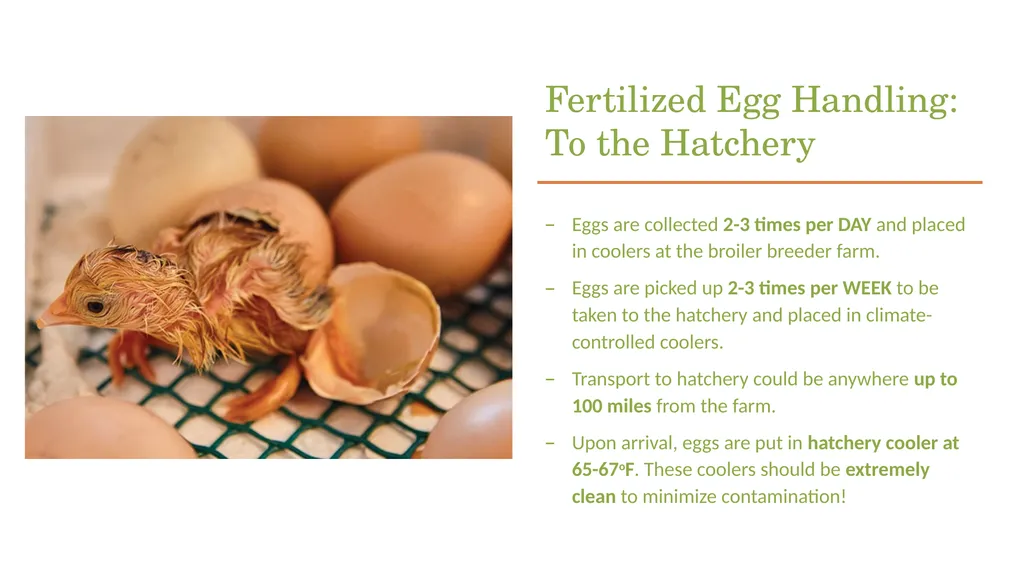
Fertilized Egg Handling: �To the Hatchery Eggs are collected 2-3 times per DAY and placed in coolers at the broiler breeder farm.
Eggs are picked up 2-3 times per WEEK to be taken to the hatchery and placed in climate-controlled coolers.
Transport to hatchery could be anywhere up to 100 miles from the farm.
Upon arrival, eggs are put in hatchery cooler at 65-67oF. These coolers should be extremely clean to minimize contamination!<br>
05
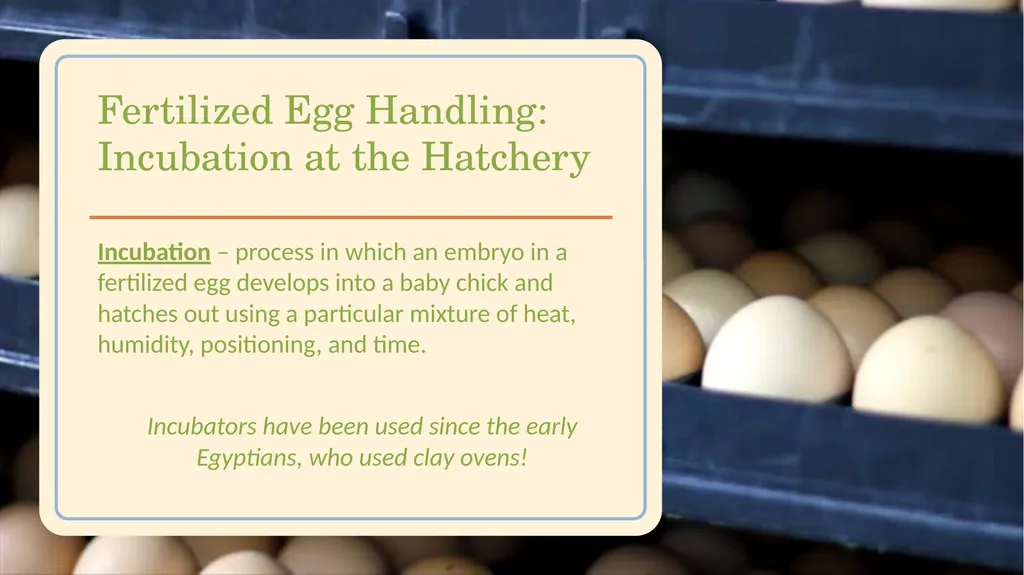
Fertilized Egg Handling: �Incubation at the Hatchery Incubation – process in which an embryo in a fertilized egg develops into a baby chick and hatches out using a particular mixture of heat, humidity, positioning, and time.
Incubators have been used since the early Egyptians, who used clay ovens!<br>
06
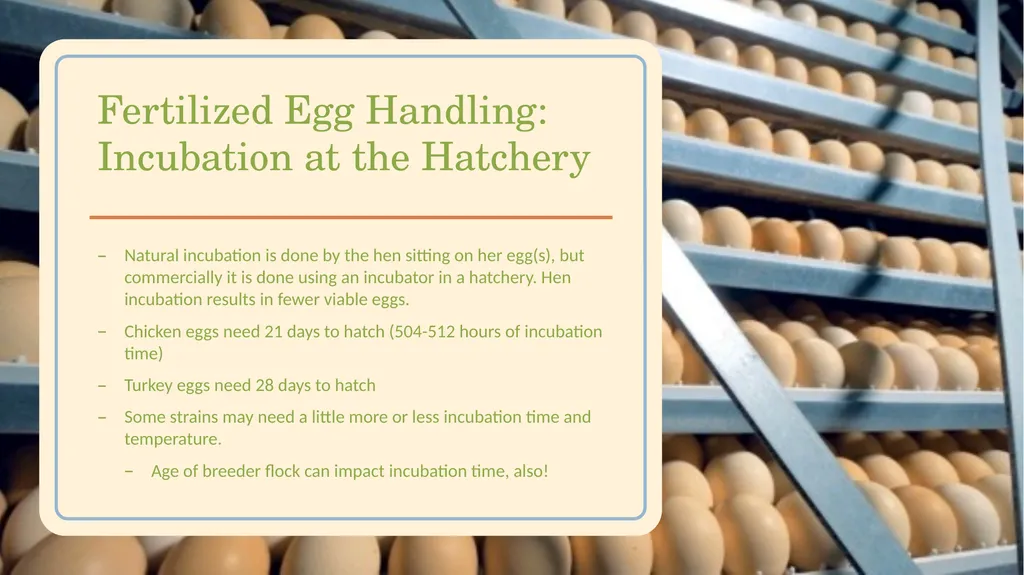
Fertilized Egg Handling: �Incubation at the Hatchery Natural incubation is done by the hen sitting on her egg(s), but commercially it is done using an incubator in a hatchery. Hen incubation results in fewer viable eggs.
Chicken eggs need 21 days to hatch (504-512 hours of incubation time)
Turkey eggs need 28 days to hatch
Some strains may need a little more or less incubation time and temperature.
Age of breeder flock can impact incubation time, also!<br>
07
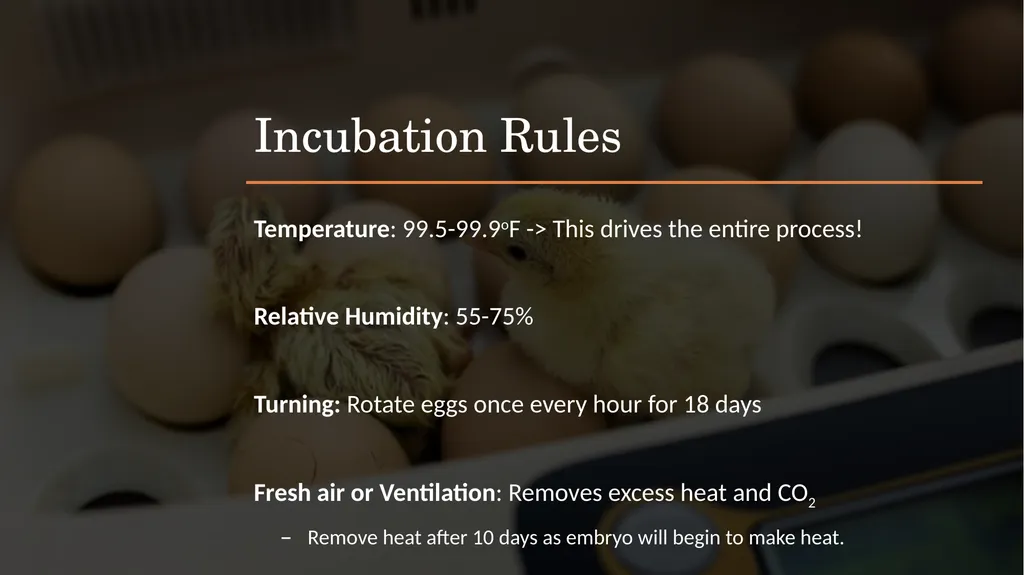
Incubation Rules Temperature: 99.5-99.9oF -> This drives the entire process!
Relative Humidity: 55-75%
Turning: Rotate eggs once every hour for 18 days
Fresh air or Ventilation: Removes excess heat and CO2
Remove heat after 10 days as embryo will begin to make heat.<br>
08
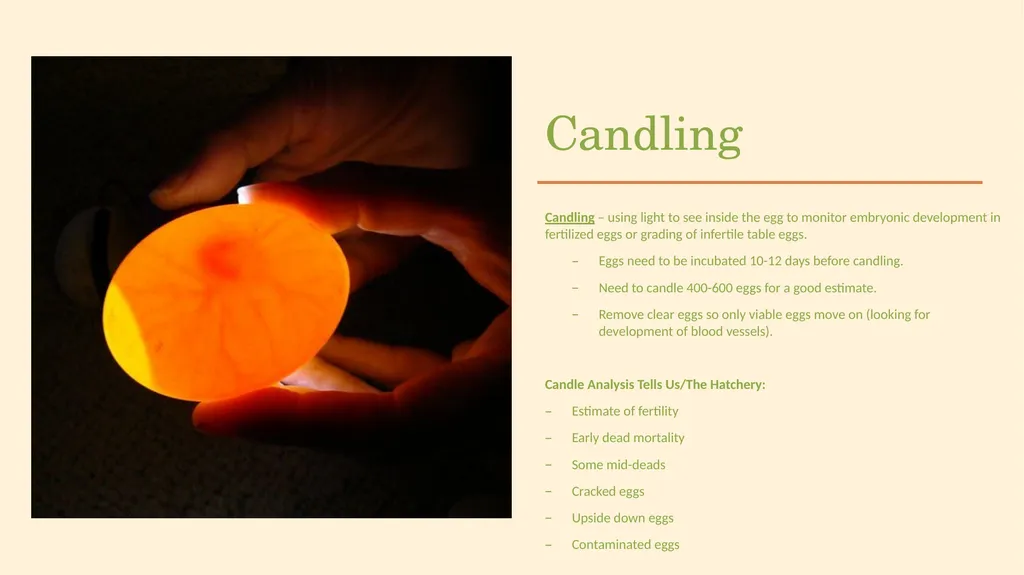
Candling Candling – using light to see inside the egg to monitor embryonic development in fertilized eggs or grading of infertile table eggs.
Eggs need to be incubated 10-12 days before candling.
Need to candle 400-600 eggs for a good estimate.
Remove clear eggs so only viable eggs move on (looking for development of blood vessels).
Candle Analysis Tells Us/The Hatchery:
Estimate of fertility
Early dead mortality
Some mid-deads
Cracked eggs
Upside down eggs
Contaminated eggs<br>
09
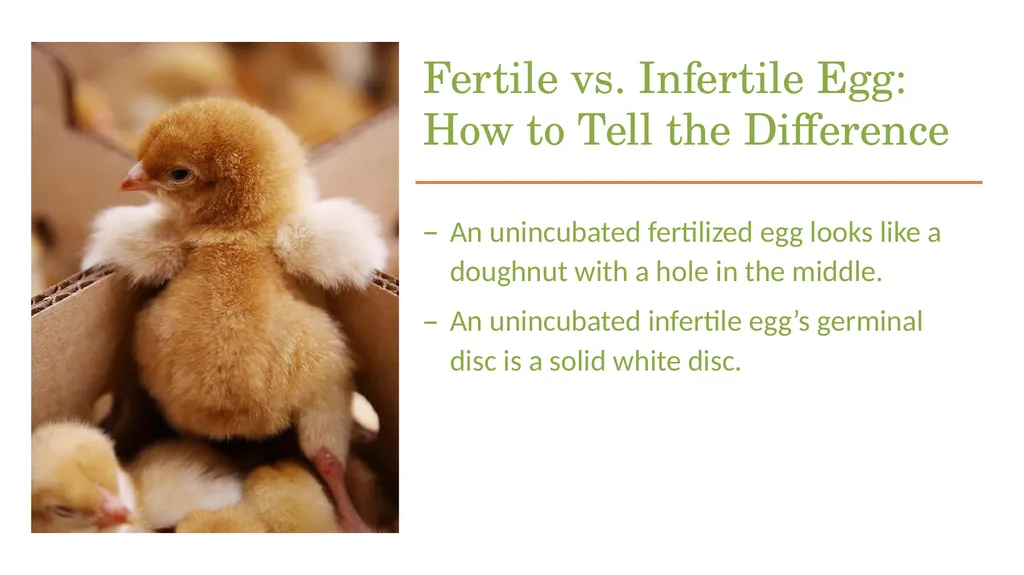
Fertile vs. Infertile Egg: �How to Tell the Difference An unincubated fertilized egg looks like a doughnut with a hole in the middle.
An unincubated infertile egg’s germinal disc is a solid white disc.<br>
10
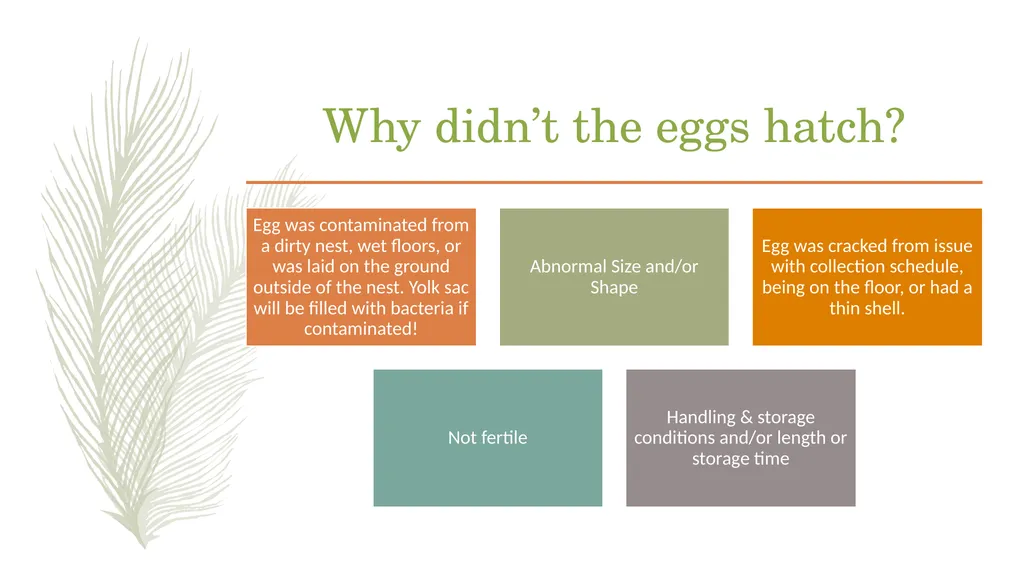
Why didn’t the eggs hatch?<br>
11
Poultry Science:�Hatchery Operation & Fertilized Eggs Unit 11: Segment 2
Embryology, Hatching & Chick Quality<br>
12
What is “Embryology”? Embryology – the development of the chicken (or other poultry) inside the egg.
The process of development begins at fertilization in the oviduct.
It takes a chicken egg 21 days to hatch, but development technically takes 22 days (1 day in the oviduct, and 21 under favorable conditions post-lay).<br>
13
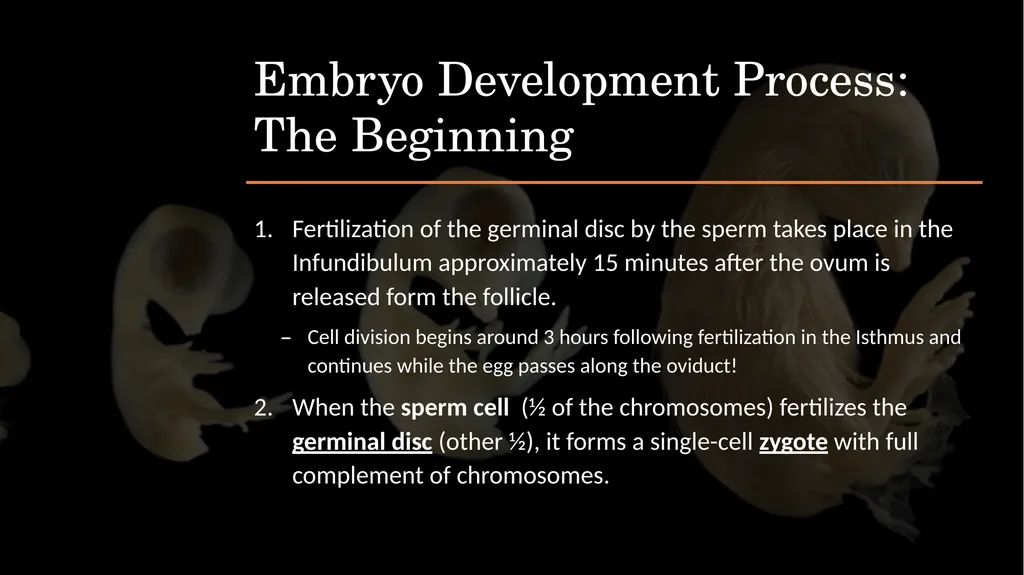
Embryo Development Process: �The Beginning Fertilization of the germinal disc by the sperm takes place in the Infundibulum approximately 15 minutes after the ovum is released form the follicle.
Cell division begins around 3 hours following fertilization in the Isthmus and continues while the egg passes along the oviduct!
When the sperm cell (½ of the chromosomes) fertilizes the germinal disc (other ½), it forms a single-cell zygote with full complement of chromosomes.<br>
14
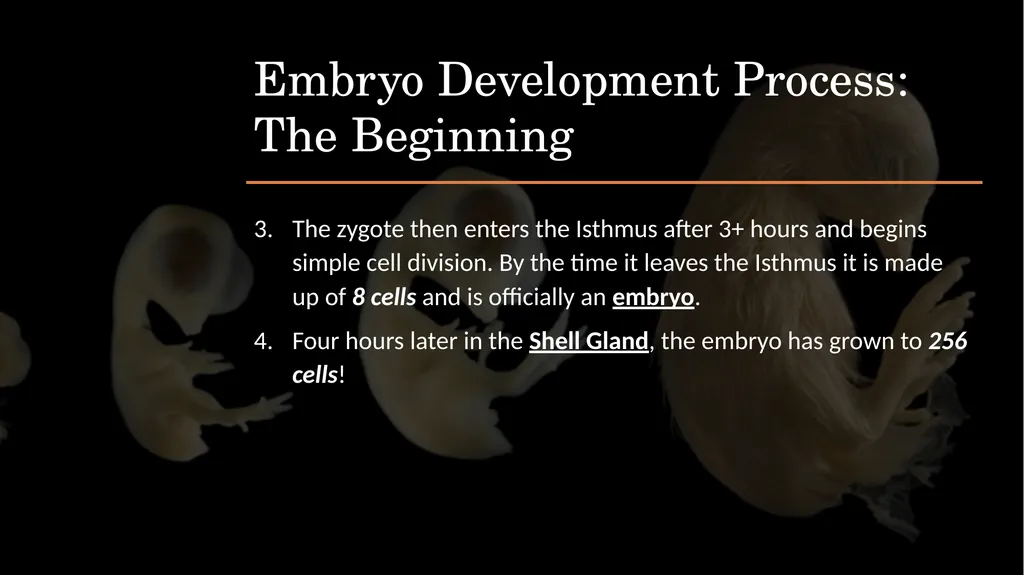
Embryo Development Process: �The Beginning The zygote then enters the Isthmus after 3+ hours and begins simple cell division. By the time it leaves the Isthmus it is made up of 8 cells and is officially an embryo.
Four hours later in the Shell Gland, the embryo has grown to 256 cells!<br>
15
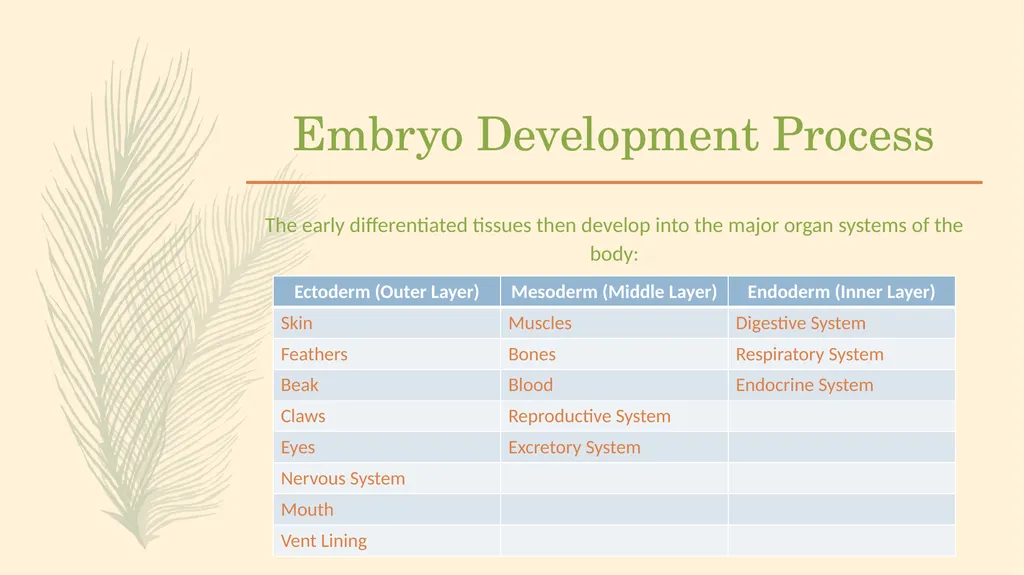
Embryo Development Process The early differentiated tissues then develop into the major organ systems of the body:<br>
16
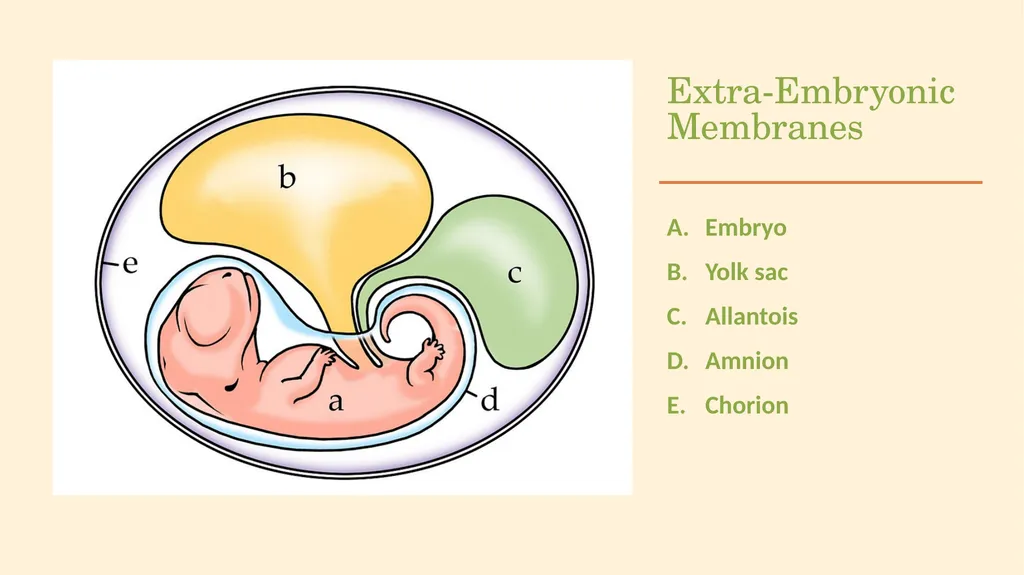
Extra-Embryonic Membranes Embryo
Yolk sac
Allantois
Amnion
Chorion<br>
17
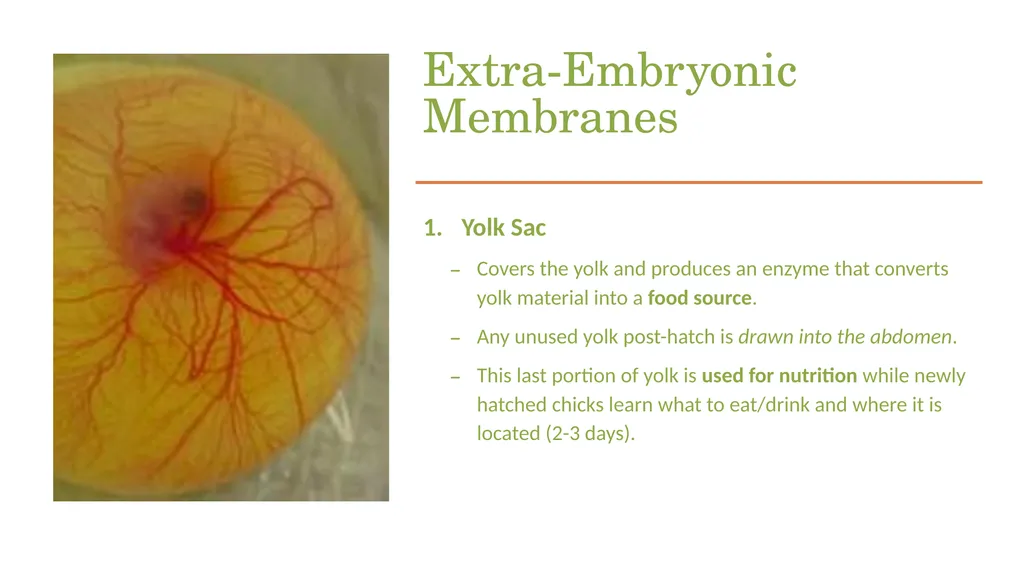
Extra-Embryonic Membranes Yolk Sac
Covers the yolk and produces an enzyme that converts yolk material into a food source.
Any unused yolk post-hatch is drawn into the abdomen.
This last portion of yolk is used for nutrition while newly hatched chicks learn what to eat/drink and where it is located (2-3 days).<br>
18
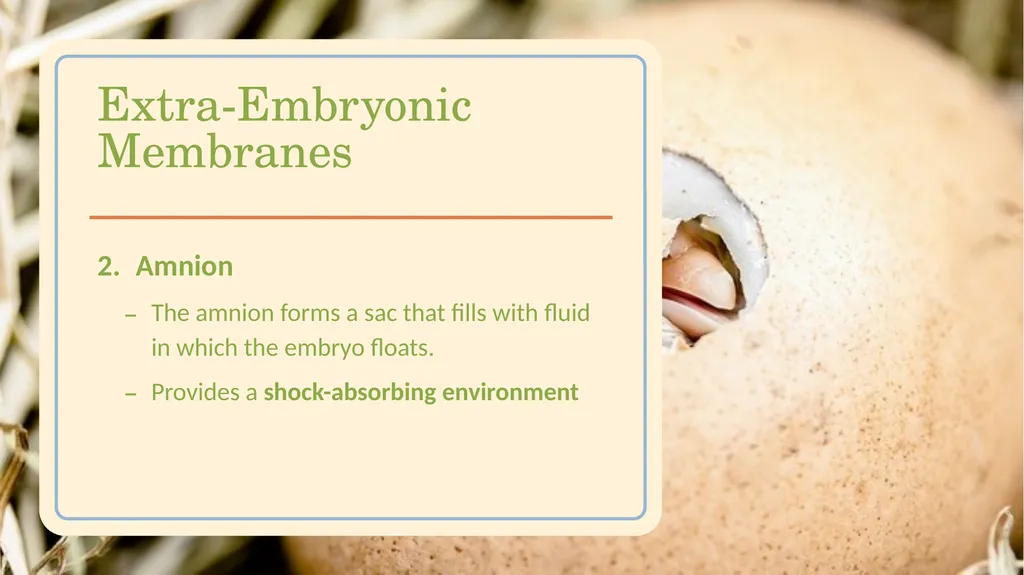
Extra-Embryonic Membranes Amnion
The amnion forms a sac that fills with fluid in which the embryo floats.
Provides a shock-absorbing environment<br>
19
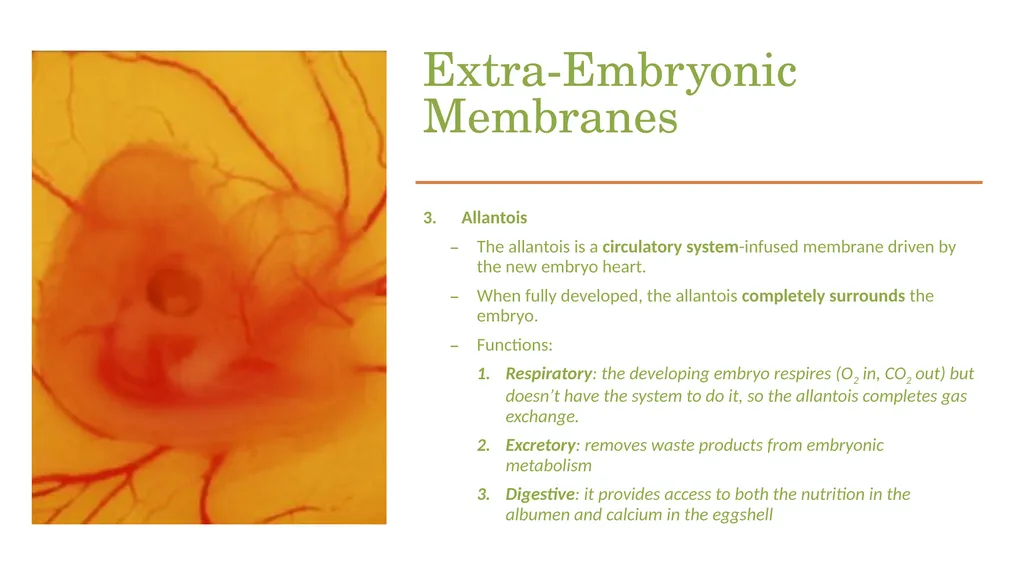
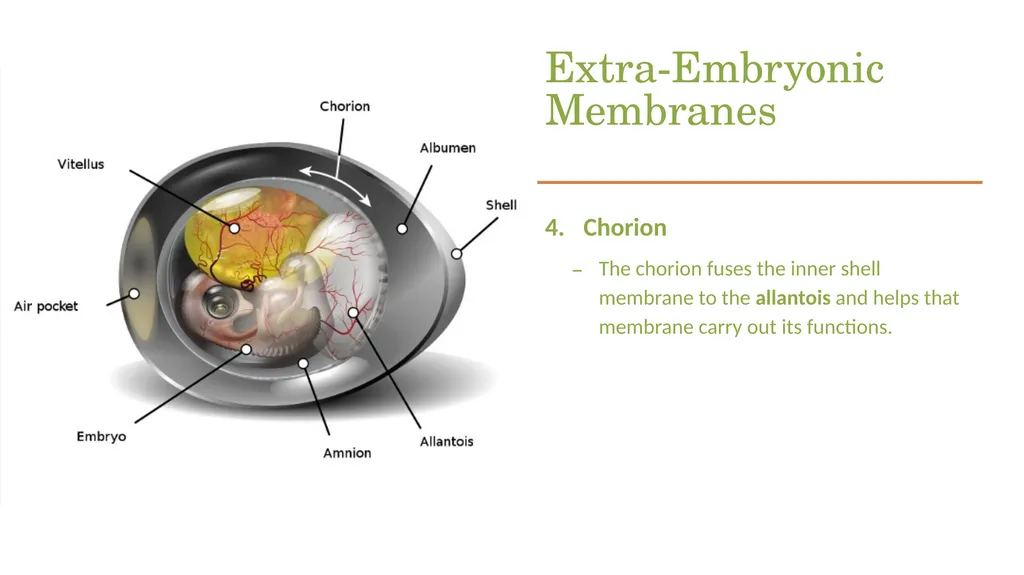
Extra-Embryonic Membranes Allantois
The allantois is a circulatory system-infused membrane driven by the new embryo heart.
When fully developed, the allantois completely surrounds the embryo.
Functions:
Respiratory: the developing embryo respires (O2 in, CO2 out) but doesn’t have the system to do it, so the allantois completes gas exchange.
Excretory: removes waste products from embryonic metabolism
Digestive: it provides access to both the nutrition in the albumen and calcium in the eggshell<br>
20
Extra-Embryonic Membranes Chorion
The chorion fuses the inner shell membrane to the allantois and helps that membrane carry out its functions.<br>
21
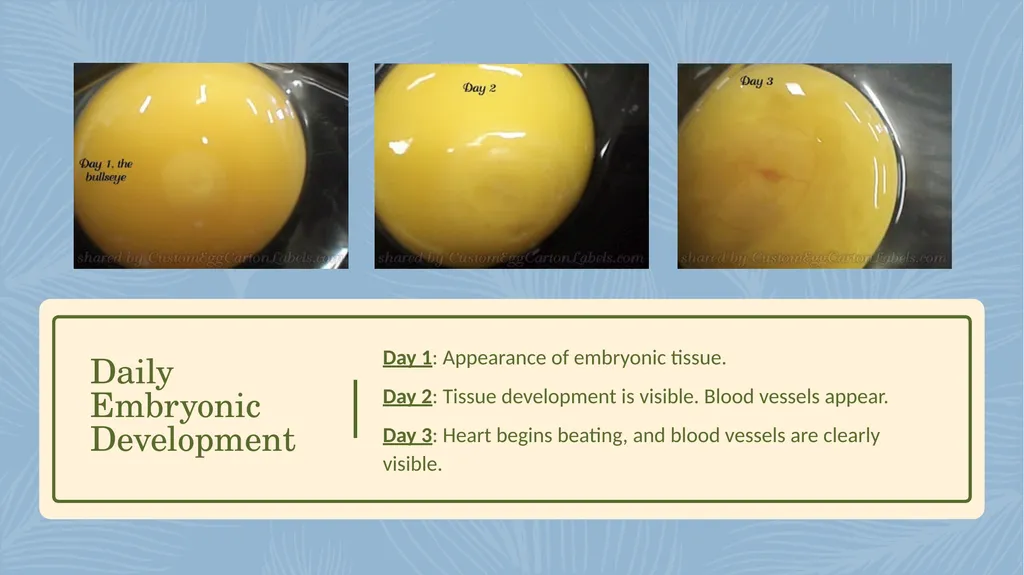
Daily Embryonic Development Day 1: Appearance of embryonic tissue.
Day 2: Tissue development is visible. Blood vessels appear.
Day 3: Heart begins beating, and blood vessels are clearly visible.<br>
22
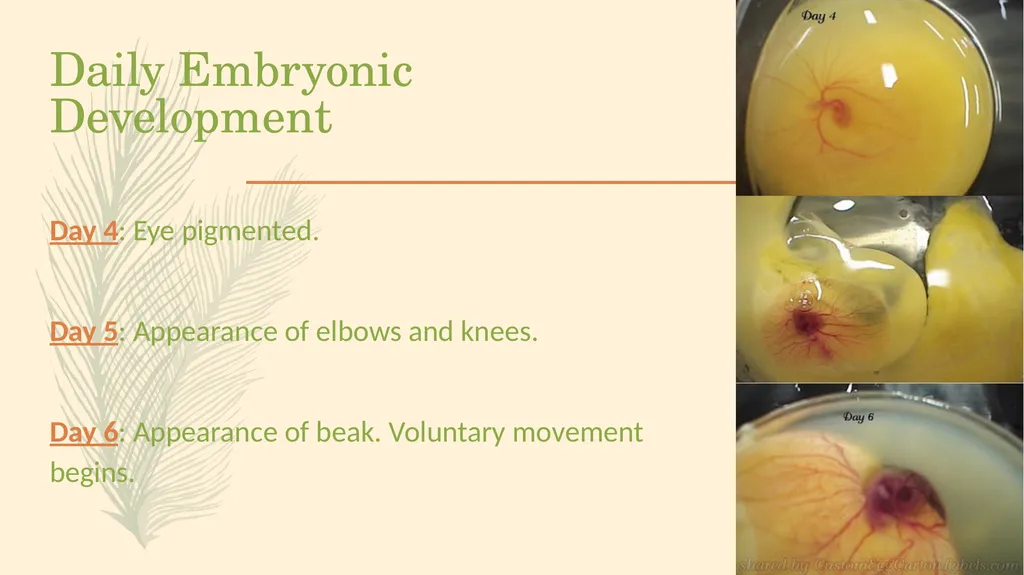
Daily Embryonic Development Day 4: Eye pigmented.
Day 5: Appearance of elbows and knees.
Day 6: Appearance of beak. Voluntary movement begins.<br>
23
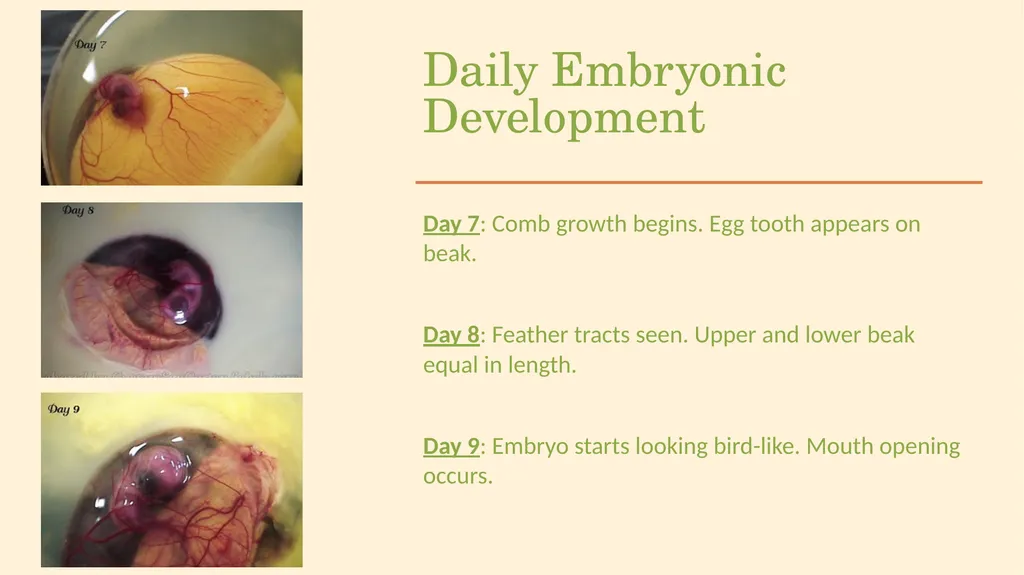
Daily Embryonic Development Day 7: Comb growth begins. Egg tooth appears on beak.
Day 8: Feather tracts seen. Upper and lower beak equal in length.
Day 9: Embryo starts looking bird-like. Mouth opening occurs.<br>
24
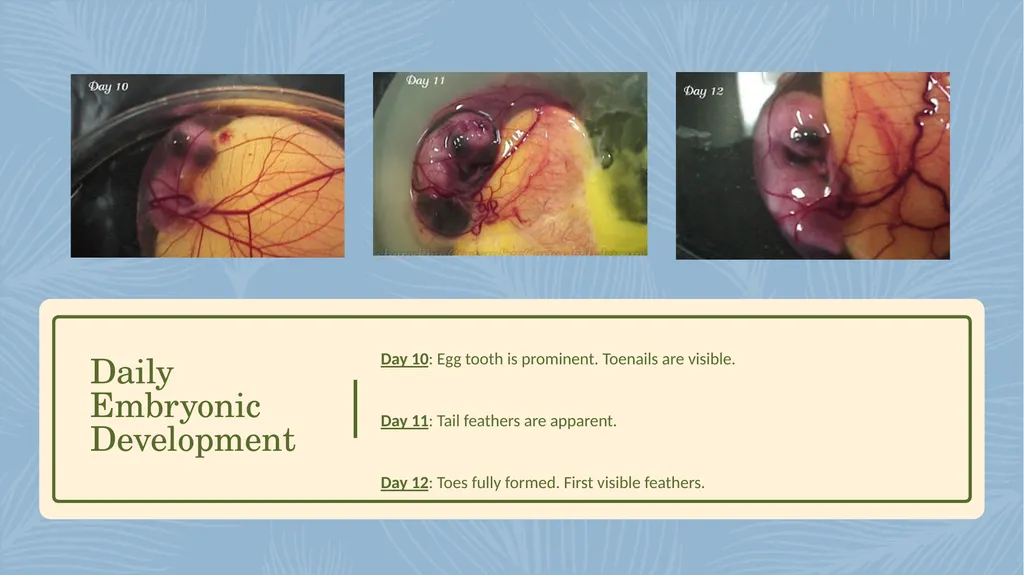
Daily Embryonic Development Day 10: Egg tooth is prominent. Toenails are visible.
Day 11: Tail feathers are apparent.
Day 12: Toes fully formed. First visible feathers.<br>
25
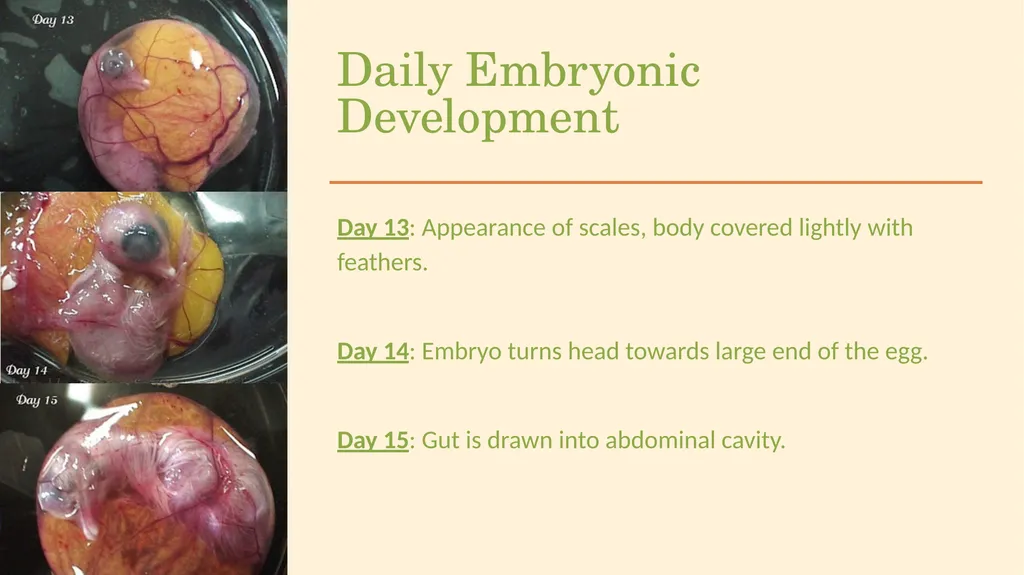
Daily Embryonic Development Day 13: Appearance of scales, body covered lightly with feathers.
Day 14: Embryo turns head towards large end of the egg.
Day 15: Gut is drawn into abdominal cavity.<br>
26
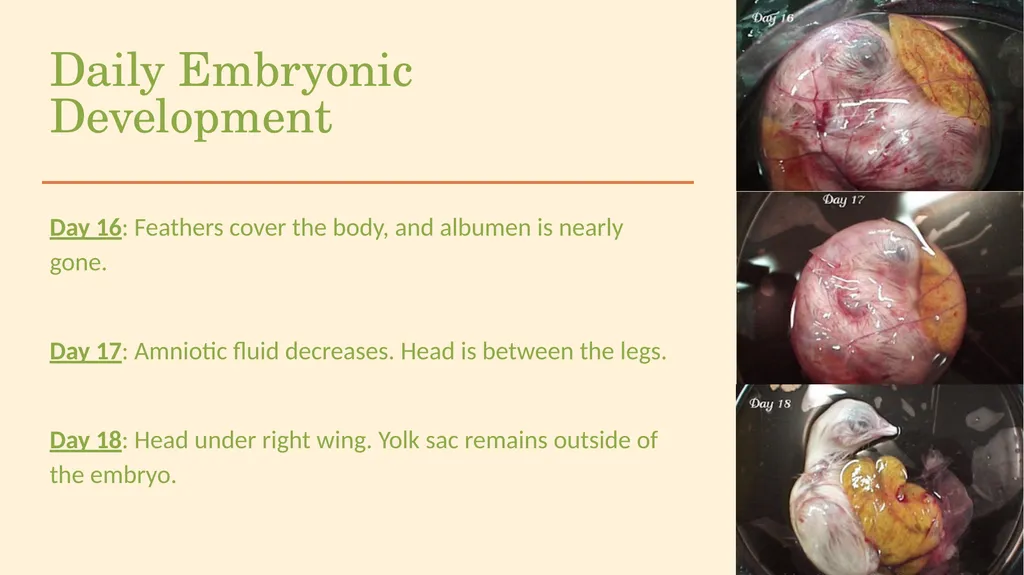
Daily Embryonic Development Day 16: Feathers cover the body, and albumen is nearly gone.
Day 17: Amniotic fluid decreases. Head is between the legs.
Day 18: Head under right wing. Yolk sac remains outside of the embryo.<br>
27
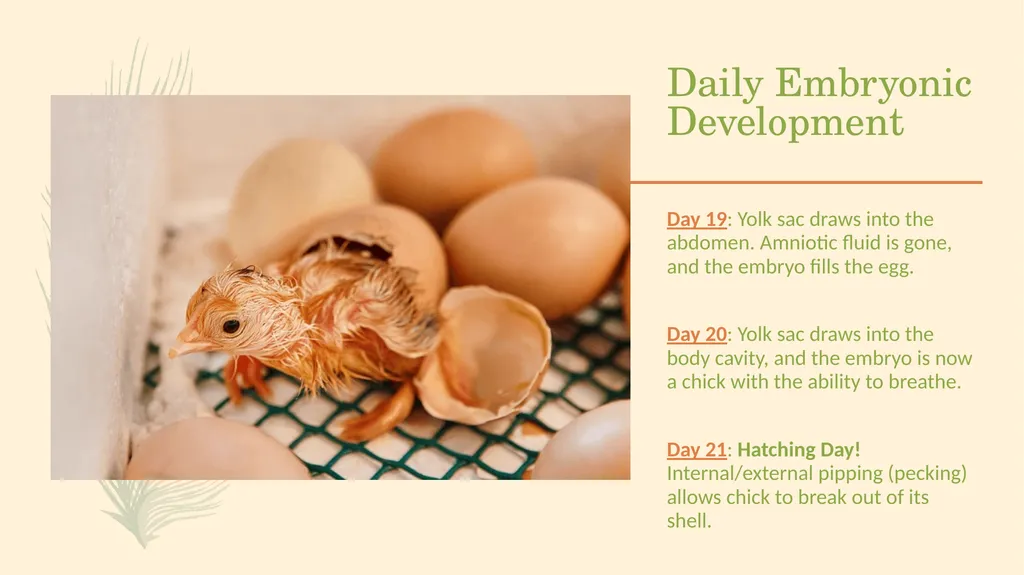
Daily Embryonic Development Day 19: Yolk sac draws into the abdomen. Amniotic fluid is gone, and the embryo fills the egg.
Day 20: Yolk sac draws into the body cavity, and the embryo is now a chick with the ability to breathe.
Day 21: Hatching Day! Internal/external pipping (pecking) allows chick to break out of its shell.<br>
28
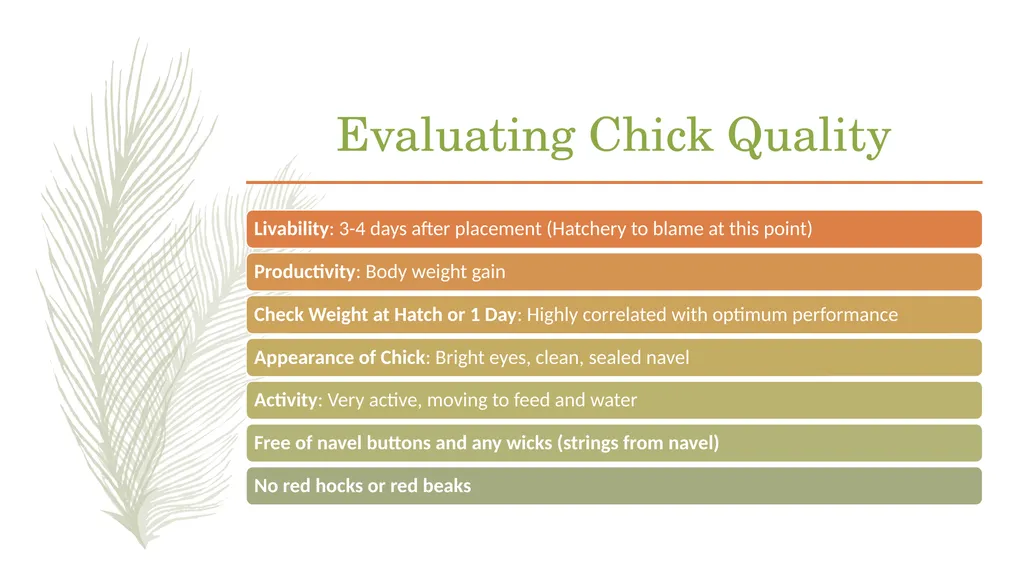
Evaluating Chick Quality<br>
29
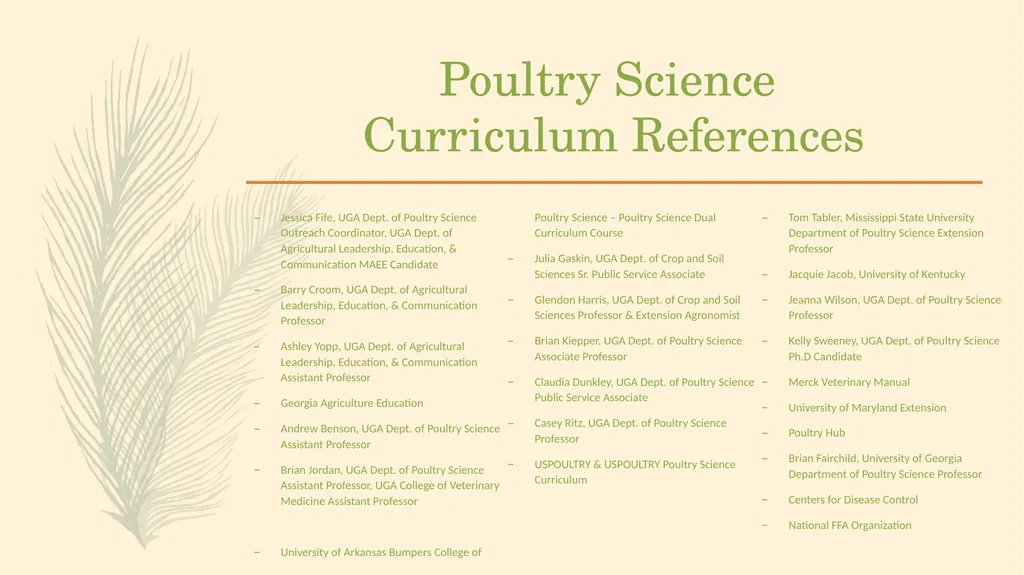
Poultry Science �Curriculum References Jessica Fife, UGA Dept. of Poultry Science Outreach Coordinator, UGA Dept. of Agricultural Leadership, Education, & Communication MAEE Candidate
Barry Croom, UGA Dept. of Agricultural Leadership, Education, & Communication Professor
Ashley Yopp, UGA Dept. of Agricultural Leadership, Education, & Communication Assistant Professor
Georgia Agriculture Education
Andrew Benson, UGA Dept. of Poultry Science Assistant Professor
Brian Jordan, UGA Dept. of Poultry Science Assistant Professor, UGA College of Veterinary Medicine Assistant Professor
University of Arkansas Bumpers College of Poultry Science – Poultry Science Dual Curriculum Course
Julia Gaskin, UGA Dept. of Crop and Soil Sciences Sr. Public Service Associate
Glendon Harris, UGA Dept. of Crop and Soil Sciences Professor & Extension Agronomist
Brian Kiepper, UGA Dept. of Poultry Science Associate Professor
Claudia Dunkley, UGA Dept. of Poultry Science Public Service Associate
Casey Ritz, UGA Dept. of Poultry Science Professor
USPOULTRY & USPOULTRY Poultry Science Curriculum
Tom Tabler, Mississippi State University Department of Poultry Science Extension Professor
Jacquie Jacob, University of Kentucky
Jeanna Wilson, UGA Dept. of Poultry Science Professor
Kelly Sweeney, UGA Dept. of Poultry Science Ph.D Candidate
Merck Veterinary Manual
University of Maryland Extension
Poultry Hub
Brian Fairchild, University of Georgia Department of Poultry Science Professor
Centers for Disease Control
National FFA Organization<br>