
PowerPoint Presentation to accompany Educational
NS
Published · 41 slides · 0 views
1 / 1


Description
PowerPoint Presentation to accompany Educational Psychology 6th Edition by John W. Santrock 2018 McGraw-Hill Higher Education. All rights reserved. CHAPTER 1 Educational Psychology: A Tool for Effective Teaching Learning Goals Describe
Related Topics
Share
Embed code
Download this presentation From Below
"PowerPoint Presentation to accompany Educational" is the property of its rightful owner. Permission is granted to download and print the materials on this website for personal, non-commercial use only, and to display it on your personal computer provided you do not modify the materials and that you retain all copyright notices contained in the materials. By downloading content from our website, you accept the terms of this agreement.
Presentation Transcript
01
PowerPoint Presentation to accompany Educational Psychology 6th Edition by John W. Santrock © 2018 McGraw-Hill Higher Education. All rights reserved.<br>
02
CHAPTER 1 Educational Psychology:
A Tool for Effective Teaching<br>
03
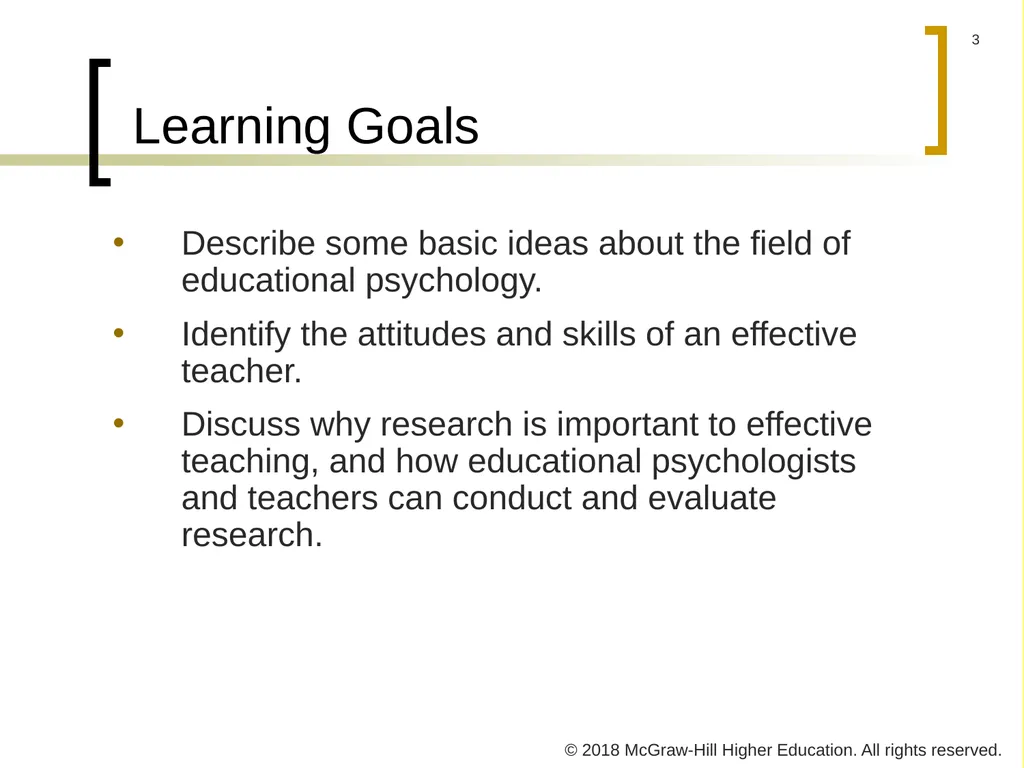
Learning Goals Describe some basic ideas about the field of educational psychology.
Identify the attitudes and skills of an effective teacher.
Discuss why research is important to effective teaching, and how educational psychologists and teachers can conduct and evaluate research.<br>
Identify the attitudes and skills of an effective teacher.
Discuss why research is important to effective teaching, and how educational psychologists and teachers can conduct and evaluate research.<br>
04
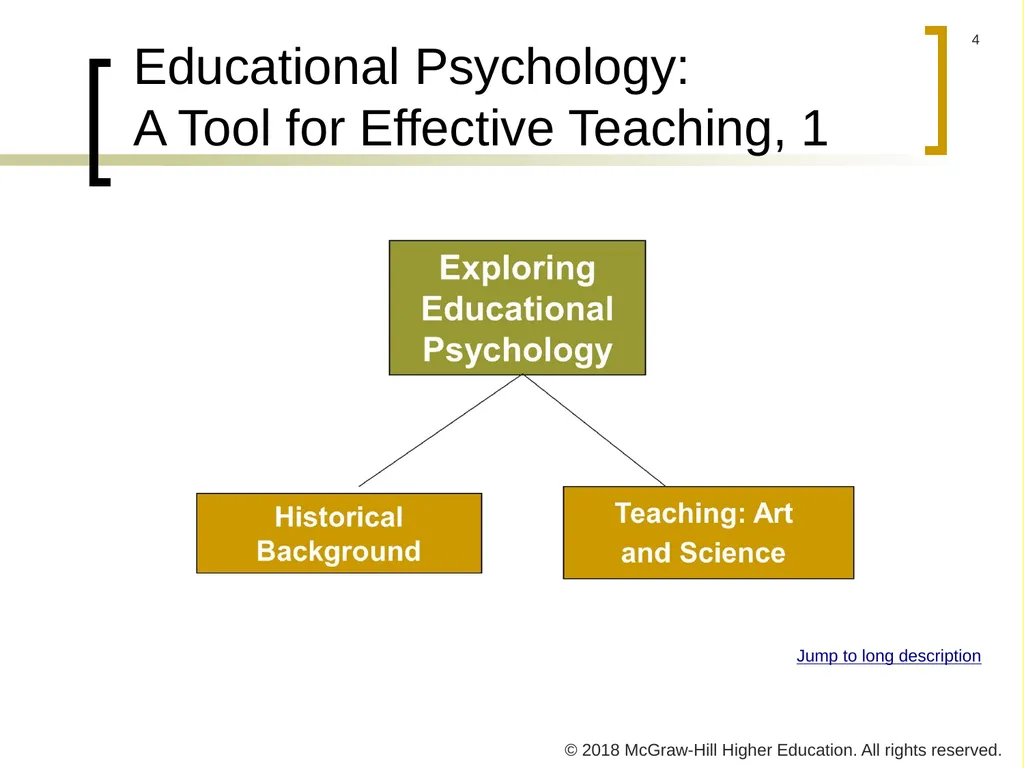
Educational Psychology:
A Tool for Effective Teaching, 1 Jump to long description<br>
05
Connecting with Teachers Effective teachers
Emphasize how to learn, rather than what to learn
Teach students how to read with genuine comprehension, shape an idea, master difficult material, and use writing to clarify thinking
Include students in the process of teaching and learning (Metzger, 1996)<br>
Emphasize how to learn, rather than what to learn
Teach students how to read with genuine comprehension, shape an idea, master difficult material, and use writing to clarify thinking
Include students in the process of teaching and learning (Metzger, 1996)<br>
06
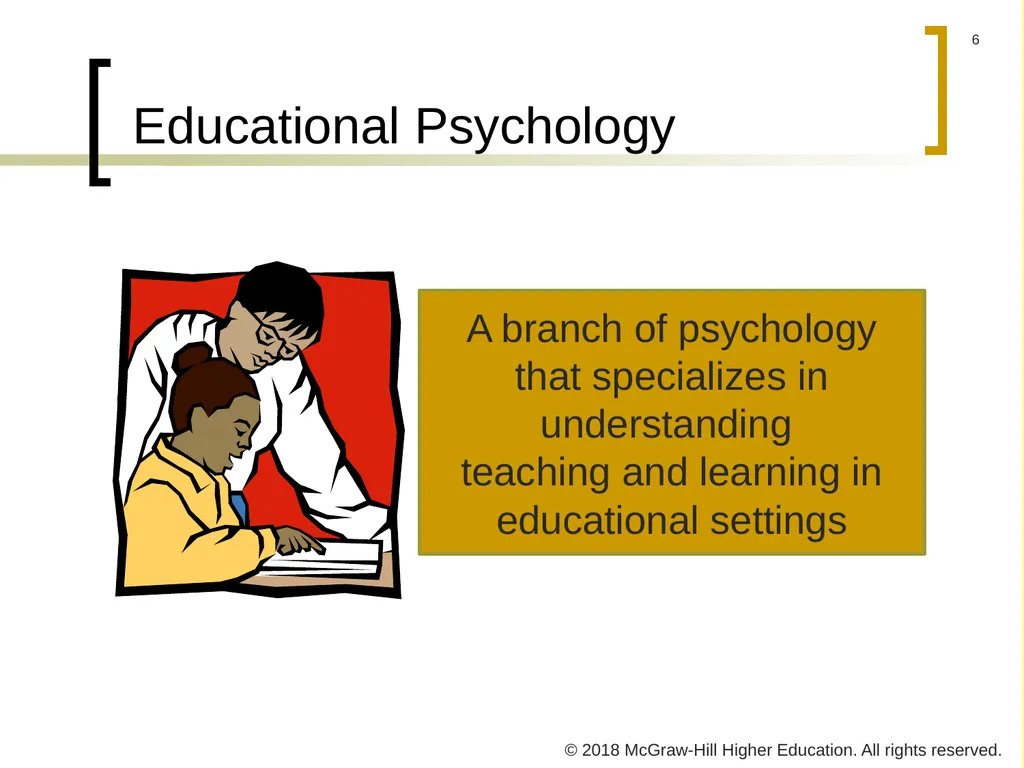
Educational Psychology A branch of psychology that specializes in understanding
teaching and learning in educational settings<br>
07
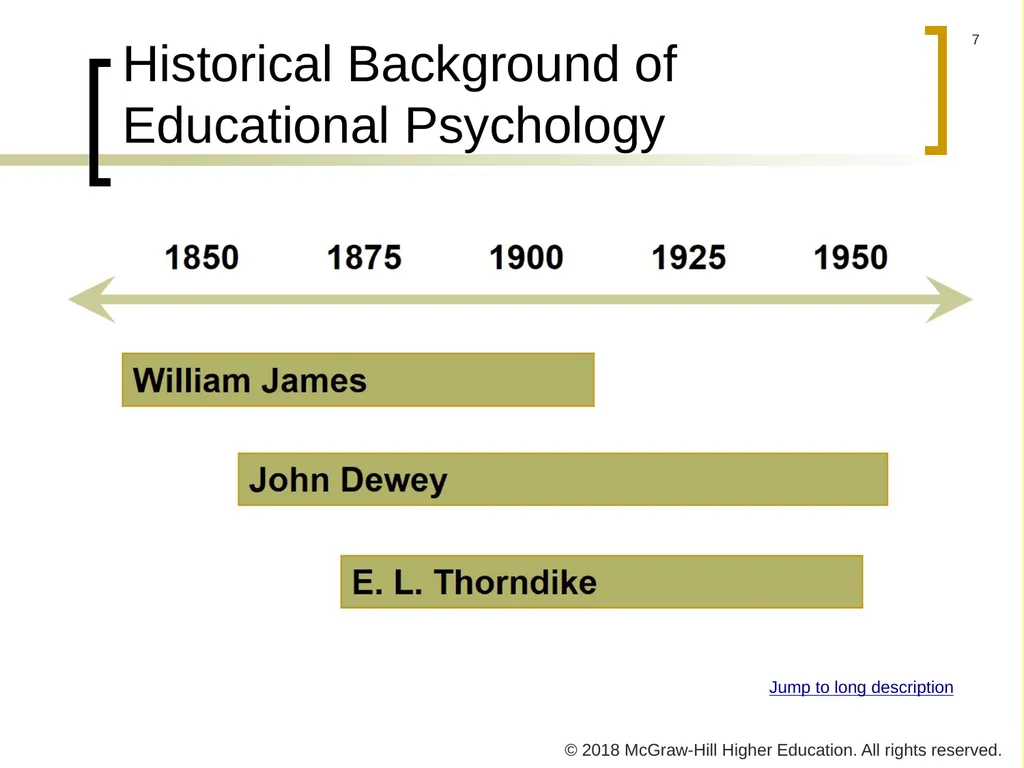
Historical Background of Educational Psychology Jump to long description<br>
08
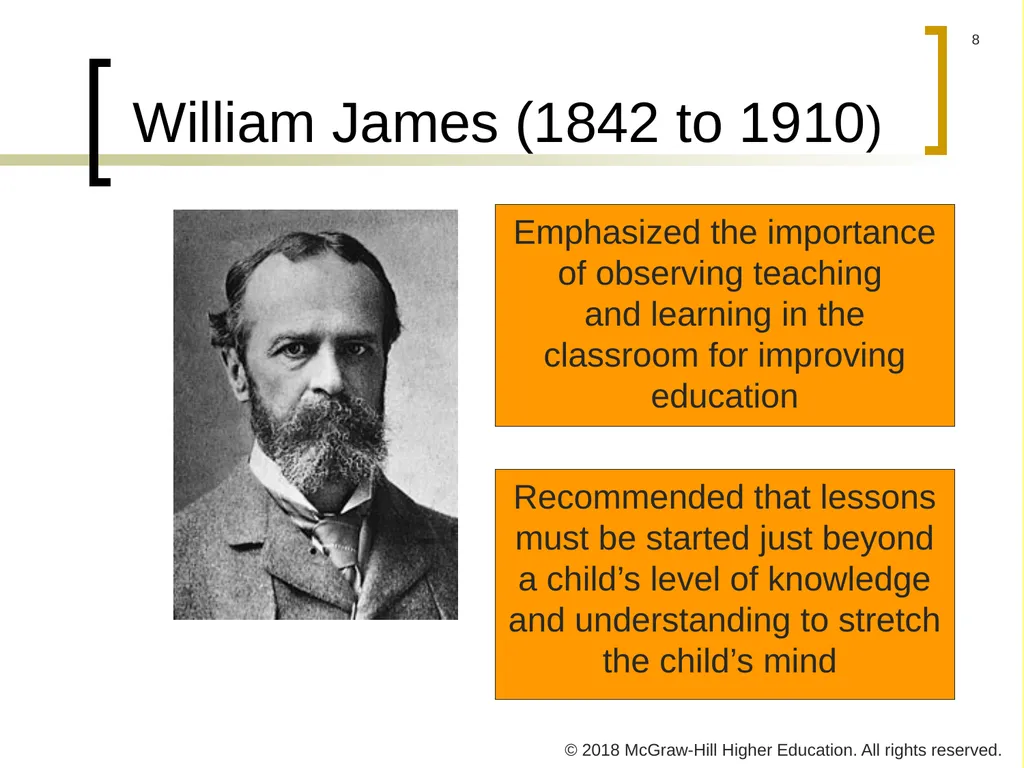
William James (1842 to 1910) Emphasized the importance of observing teaching
and learning in the classroom for improving education Recommended that lessons must be started just beyond a child’s level of knowledge and understanding to stretch the child’s mind<br>
09
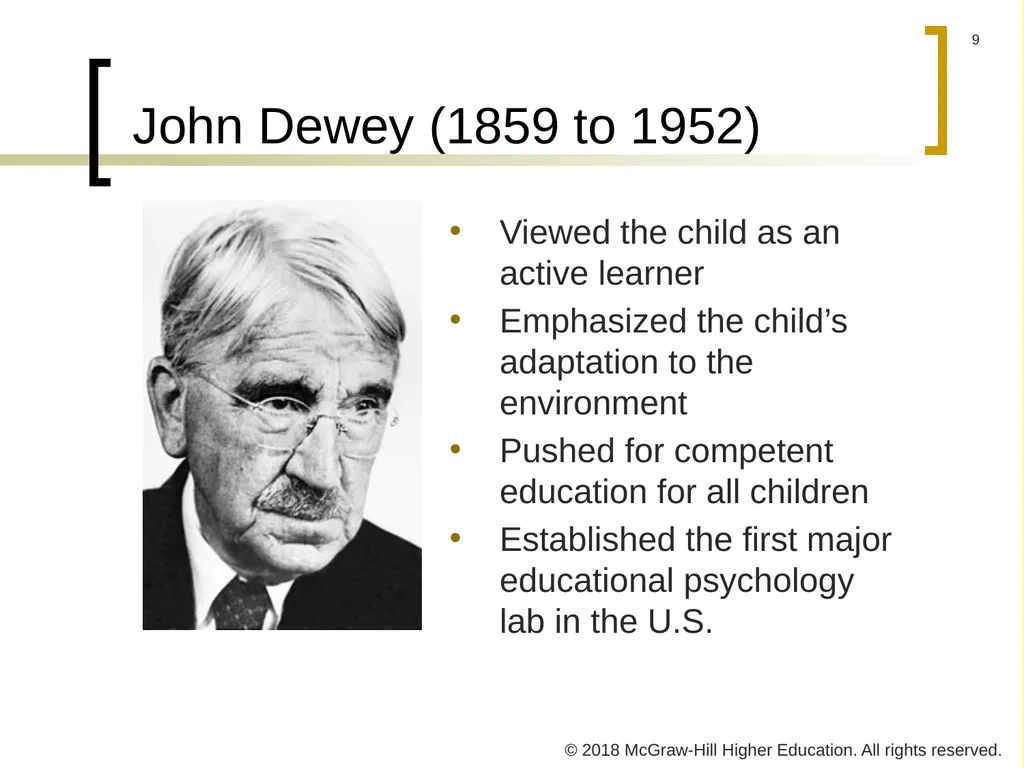
John Dewey (1859 to 1952) Viewed the child as an active learner
Emphasized the child’s adaptation to the environment
Pushed for competent education for all children
Established the first major educational psychology lab in the U.S.<br>
Emphasized the child’s adaptation to the environment
Pushed for competent education for all children
Established the first major educational psychology lab in the U.S.<br>
10
E. L. Thorndike (1874 to 1949) Initiated an emphasis on assessment and measurement
of learning
Promoted the idea that educational psychology must have a scientific base and that measurement should be a central focus<br>
Promoted the idea that educational psychology must have a scientific base and that measurement should be a central focus<br>
11
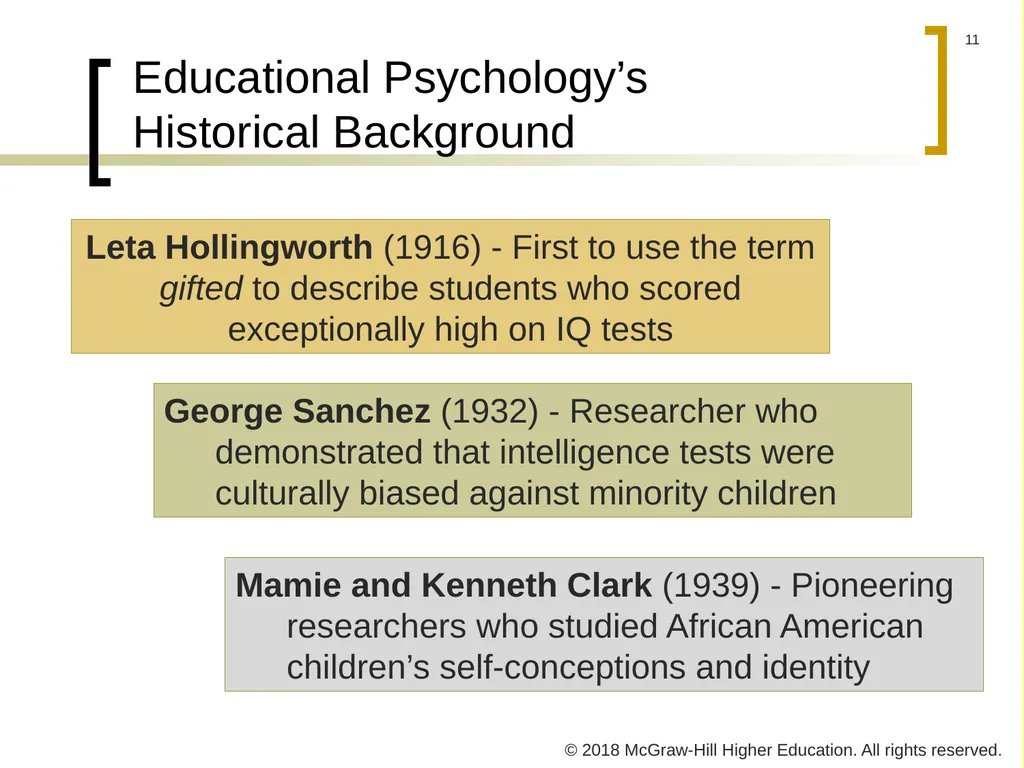
Educational Psychology’s Historical Background Leta Hollingworth (1916) - First to use the term gifted to describe students who scored exceptionally high on IQ tests George Sanchez (1932) - Researcher who demonstrated that intelligence tests were culturally biased against minority children Mamie and Kenneth Clark (1939) - Pioneering researchers who studied African American children’s self-conceptions and identity<br>
12
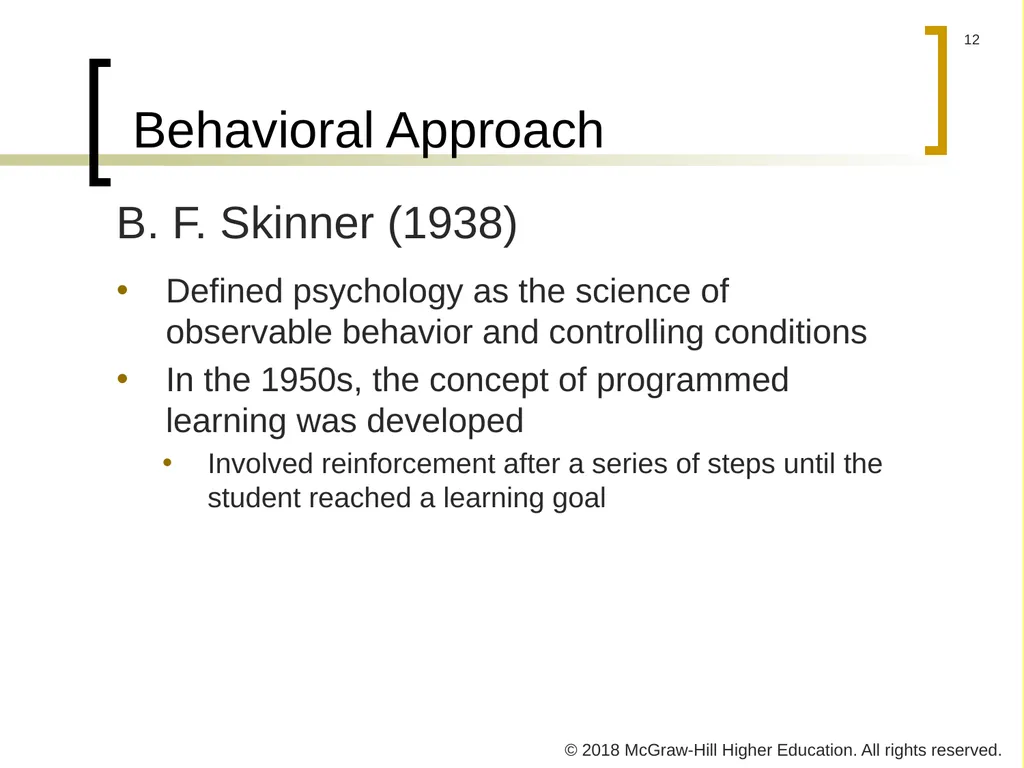
Behavioral Approach B. F. Skinner (1938)
Defined psychology as the science of observable behavior and controlling conditions
In the 1950s, the concept of programmed learning was developed
Involved reinforcement after a series of steps until the student reached a learning goal<br>
Defined psychology as the science of observable behavior and controlling conditions
In the 1950s, the concept of programmed learning was developed
Involved reinforcement after a series of steps until the student reached a learning goal<br>
13
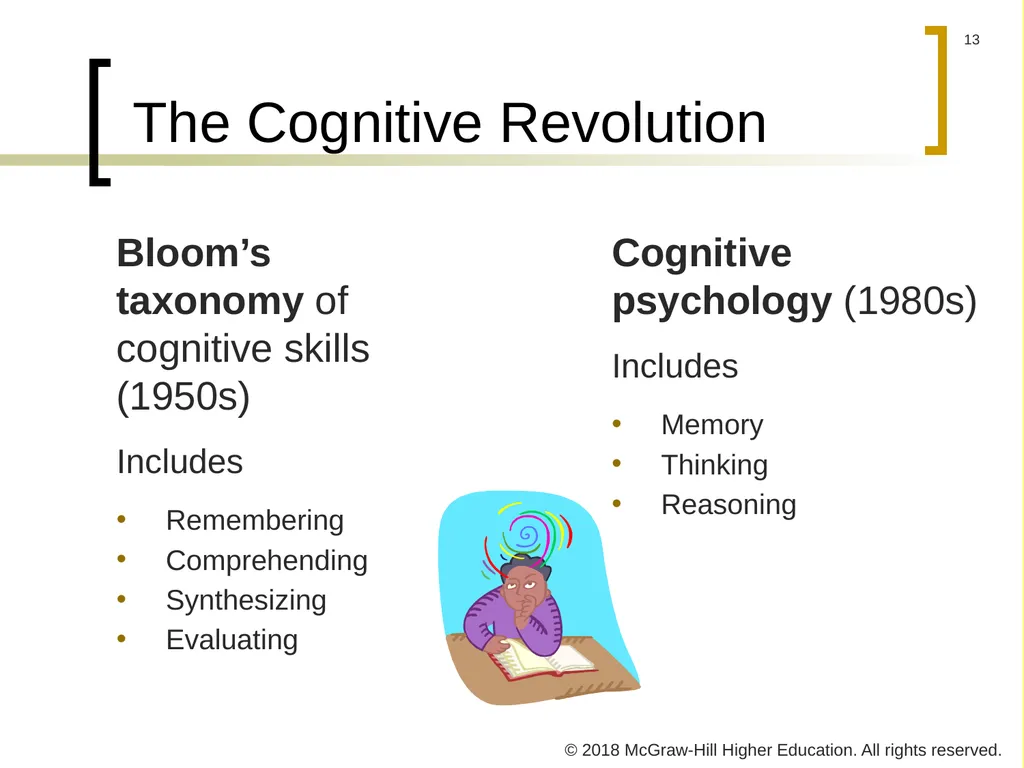
The Cognitive Revolution Bloom’s taxonomy of cognitive skills (1950s)
Includes
Remembering
Comprehending
Synthesizing
Evaluating Cognitive psychology (1980s)
Includes
Memory
Thinking
Reasoning<br>
Includes
Remembering
Comprehending
Synthesizing
Evaluating Cognitive psychology (1980s)
Includes
Memory
Thinking
Reasoning<br>
14
Teaching: Art and Science, 1 How is teaching both art and science?<br>
15
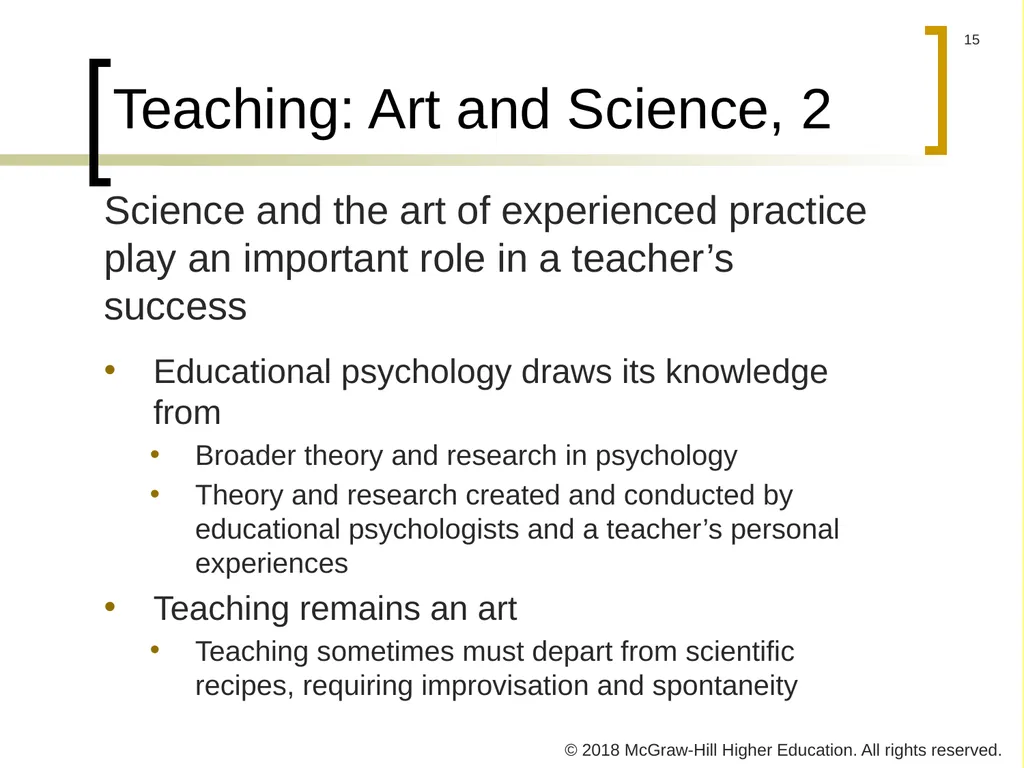
Teaching: Art and Science, 2 Science and the art of experienced practice play an important role in a teacher’s success
Educational psychology draws its knowledge from
Broader theory and research in psychology
Theory and research created and conducted by educational psychologists and a teacher’s personal experiences
Teaching remains an art
Teaching sometimes must depart from scientific recipes, requiring improvisation and spontaneity<br>
Educational psychology draws its knowledge from
Broader theory and research in psychology
Theory and research created and conducted by educational psychologists and a teacher’s personal experiences
Teaching remains an art
Teaching sometimes must depart from scientific recipes, requiring improvisation and spontaneity<br>
16
Educational Psychology: A Tool for Effective Teaching, 2 Jump to long description<br>
17
Reflection and Observation Reflection:
What were the characteristics of the most effective teachers in your educational experience?<br>
What were the characteristics of the most effective teachers in your educational experience?<br>
18
Effective Teaching
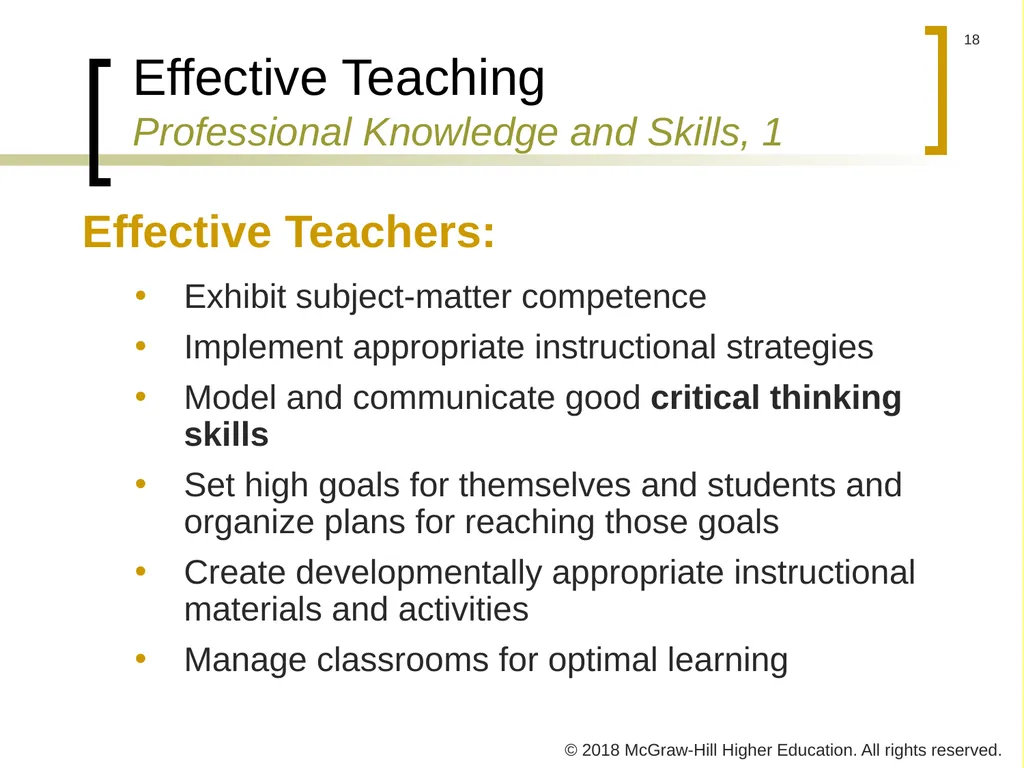
Professional Knowledge and Skills, 1 Effective Teachers:
Exhibit subject-matter competence
Implement appropriate instructional strategies
Model and communicate good critical thinking skills
Set high goals for themselves and students and organize plans for reaching those goals
Create developmentally appropriate instructional materials and activities
Manage classrooms for optimal learning<br>
Exhibit subject-matter competence
Implement appropriate instructional strategies
Model and communicate good critical thinking skills
Set high goals for themselves and students and organize plans for reaching those goals
Create developmentally appropriate instructional materials and activities
Manage classrooms for optimal learning<br>
19
Effective Teaching
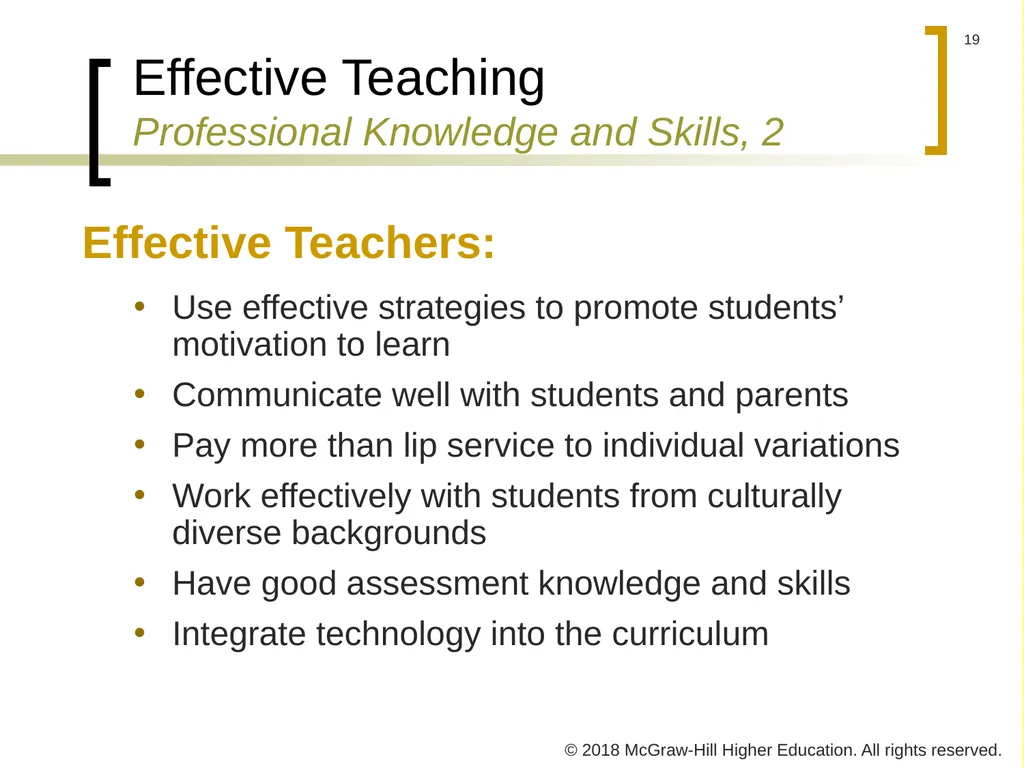
Professional Knowledge and Skills, 2 Effective Teachers:
Use effective strategies to promote students’ motivation to learn
Communicate well with students and parents
Pay more than lip service to individual variations
Work effectively with students from culturally diverse backgrounds
Have good assessment knowledge and skills
Integrate technology into the curriculum<br>
Use effective strategies to promote students’ motivation to learn
Communicate well with students and parents
Pay more than lip service to individual variations
Work effectively with students from culturally diverse backgrounds
Have good assessment knowledge and skills
Integrate technology into the curriculum<br>
20
Effective Teaching
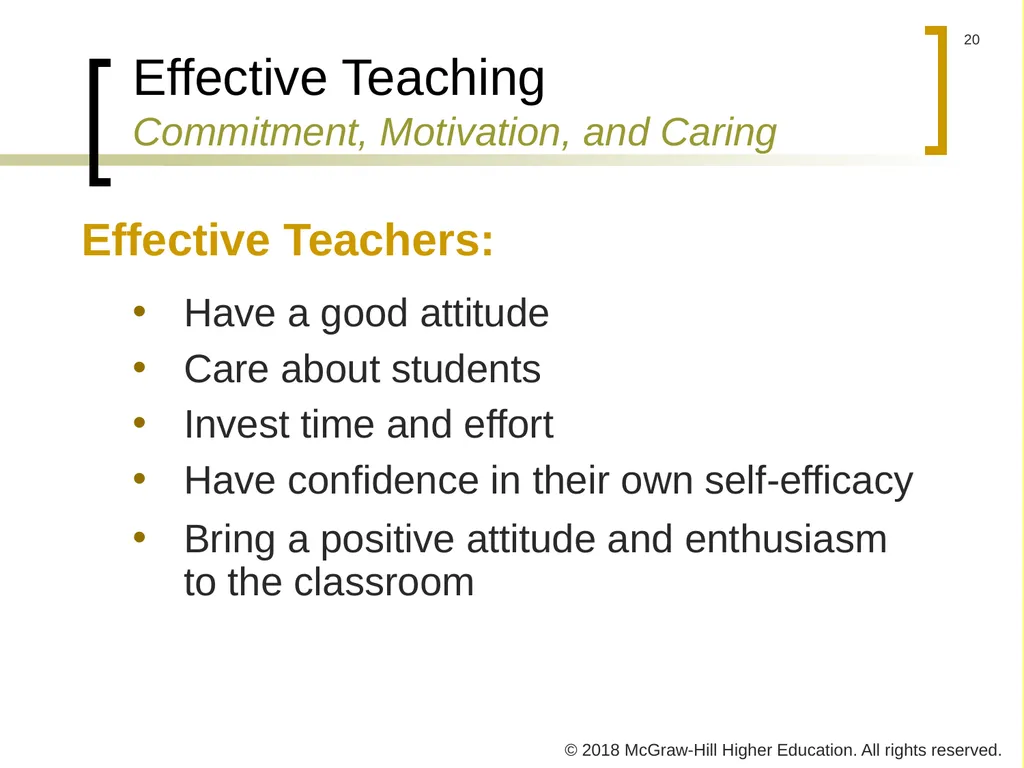
Commitment, Motivation, and Caring Effective Teachers:
Have a good attitude
Care about students
Invest time and effort
Have confidence in their own self-efficacy
Bring a positive attitude and enthusiasm to the classroom<br>
Have a good attitude
Care about students
Invest time and effort
Have confidence in their own self-efficacy
Bring a positive attitude and enthusiasm to the classroom<br>
21
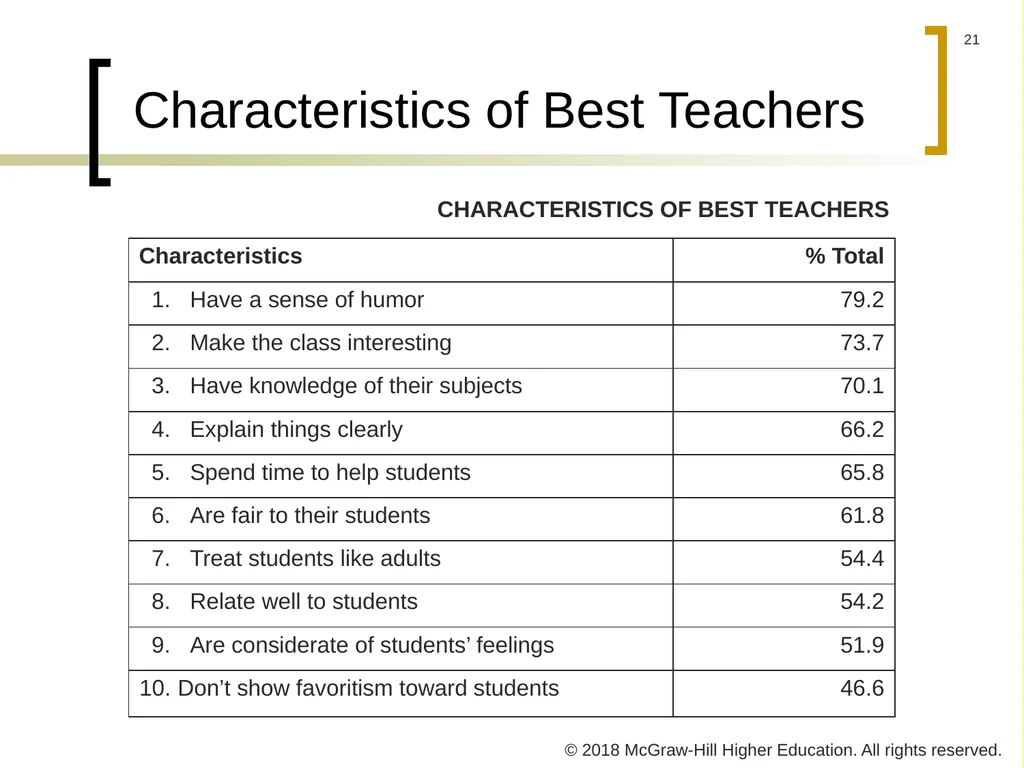
Characteristics of Best Teachers CHARACTERISTICS OF BEST TEACHERS<br>
22
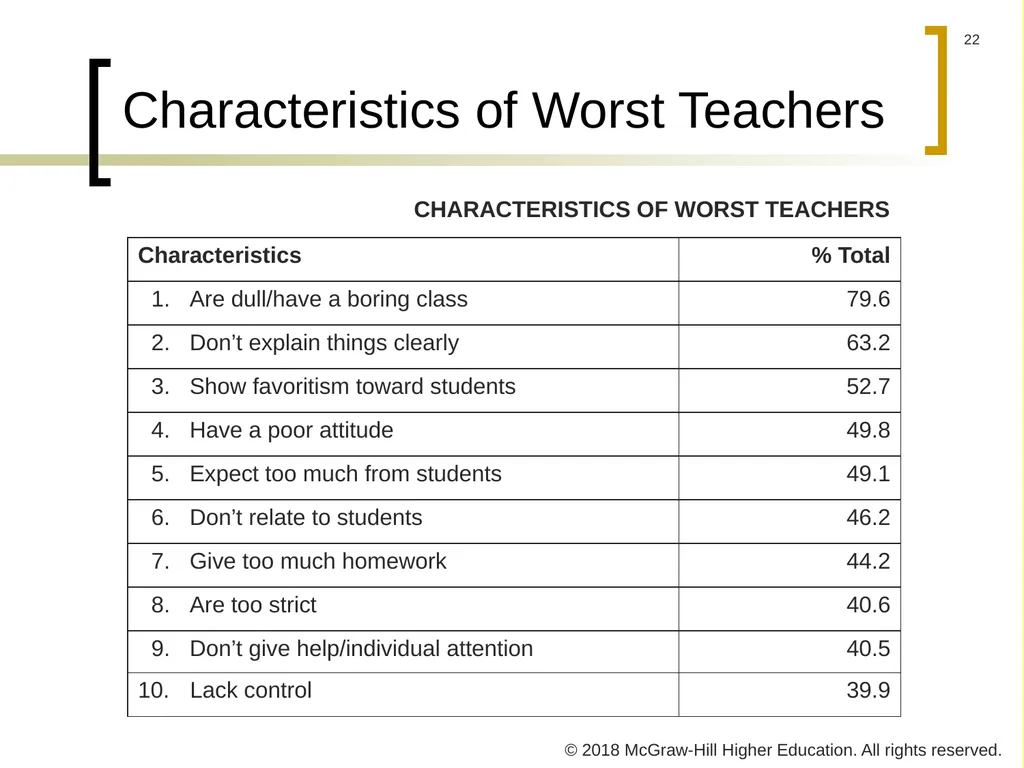
Characteristics of Worst Teachers CHARACTERISTICS OF WORST TEACHERS<br>
23
Educational Psychology:
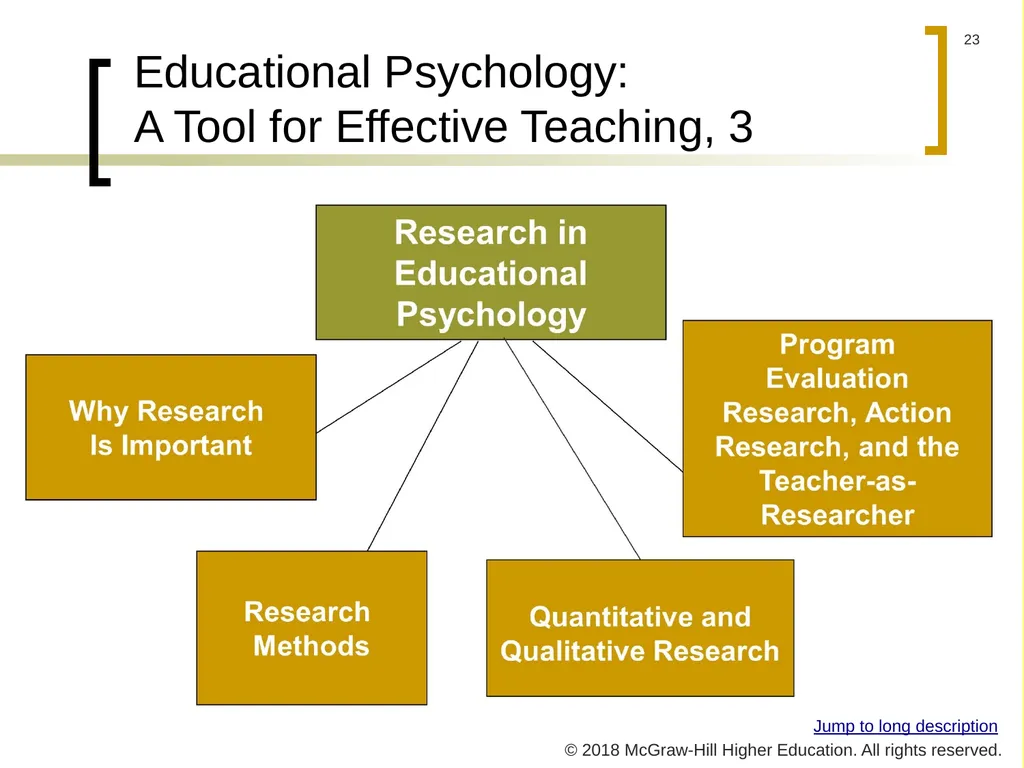
A Tool for Effective Teaching, 3 Jump to long description<br>
24
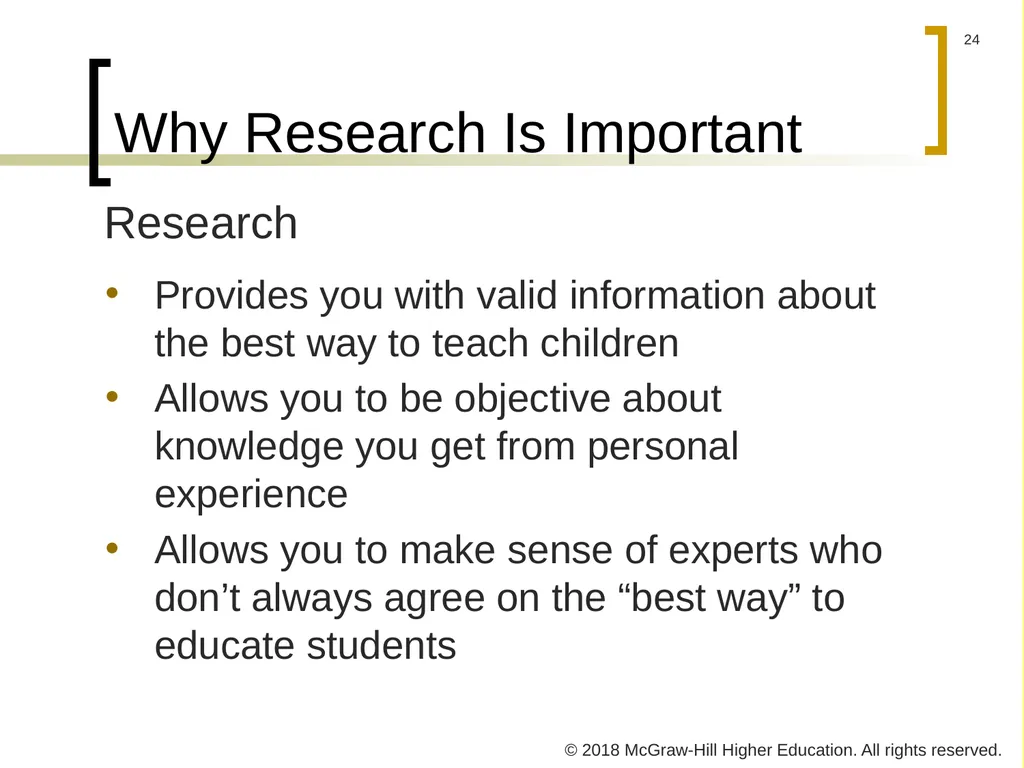
Why Research Is Important Research
Provides you with valid information about the best way to teach children
Allows you to be objective about knowledge you get from personal experience
Allows you to make sense of experts who don’t always agree on the “best way” to educate students<br>
Provides you with valid information about the best way to teach children
Allows you to be objective about knowledge you get from personal experience
Allows you to make sense of experts who don’t always agree on the “best way” to educate students<br>
25
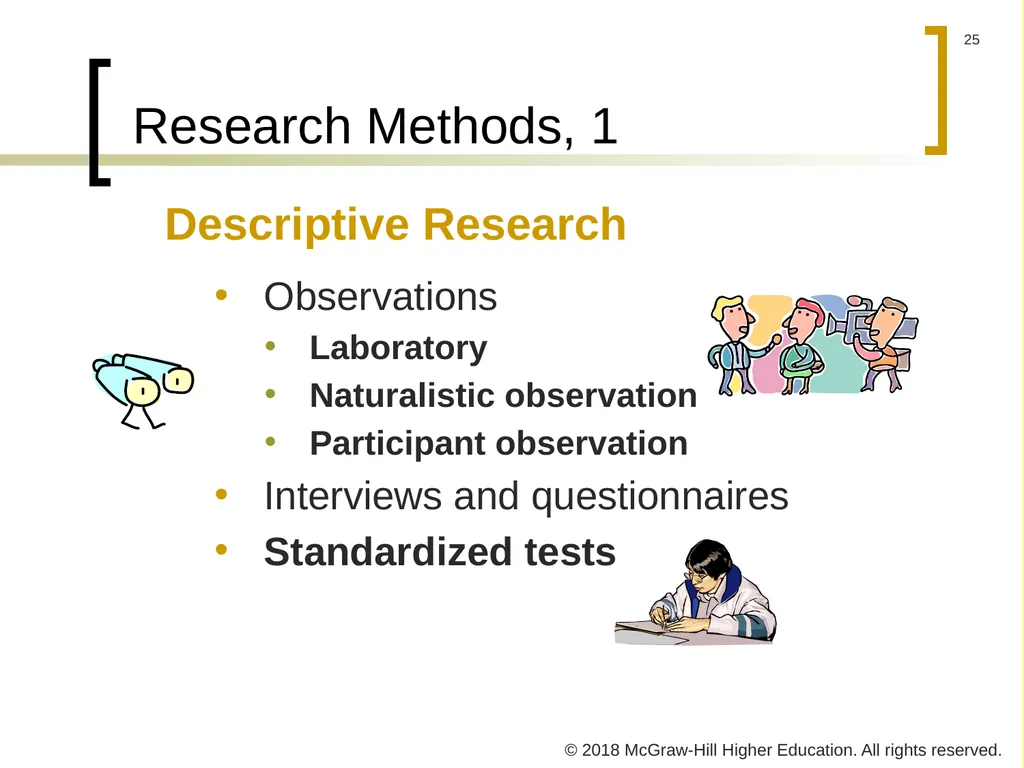
Research Methods, 1 Descriptive Research
Observations
Laboratory
Naturalistic observation
Participant observation
Interviews and questionnaires
Standardized tests<br>
Observations
Laboratory
Naturalistic observation
Participant observation
Interviews and questionnaires
Standardized tests<br>
26
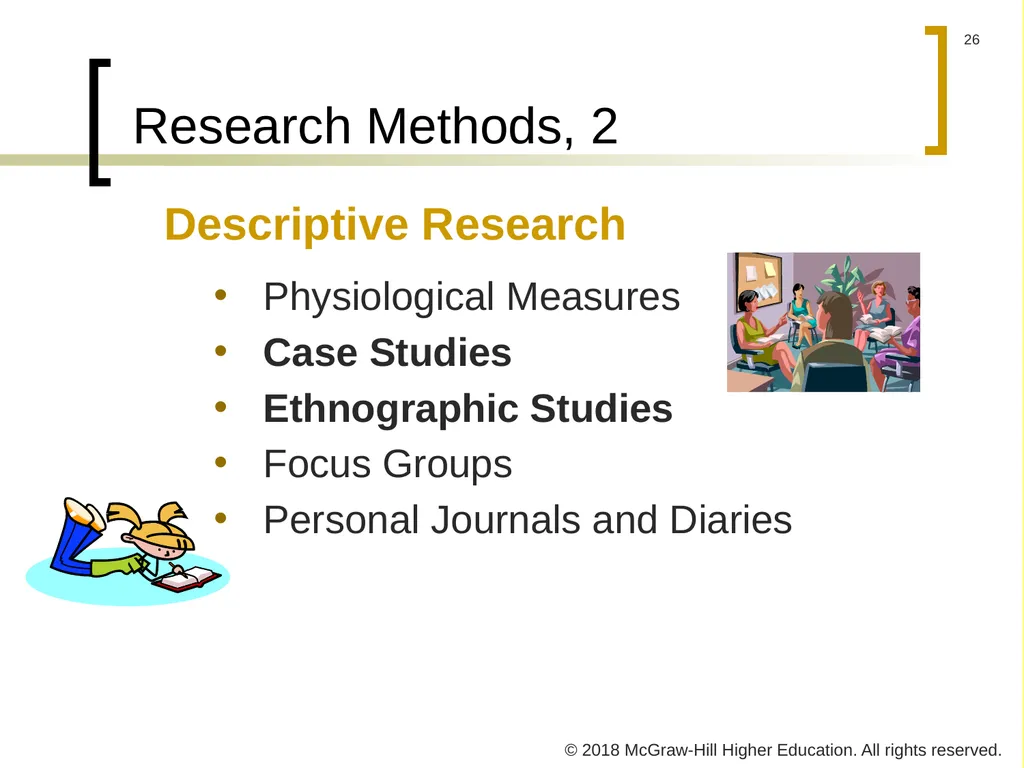
Research Methods, 2 Descriptive Research
Physiological Measures
Case Studies
Ethnographic Studies
Focus Groups
Personal Journals and Diaries<br>
Physiological Measures
Case Studies
Ethnographic Studies
Focus Groups
Personal Journals and Diaries<br>
27
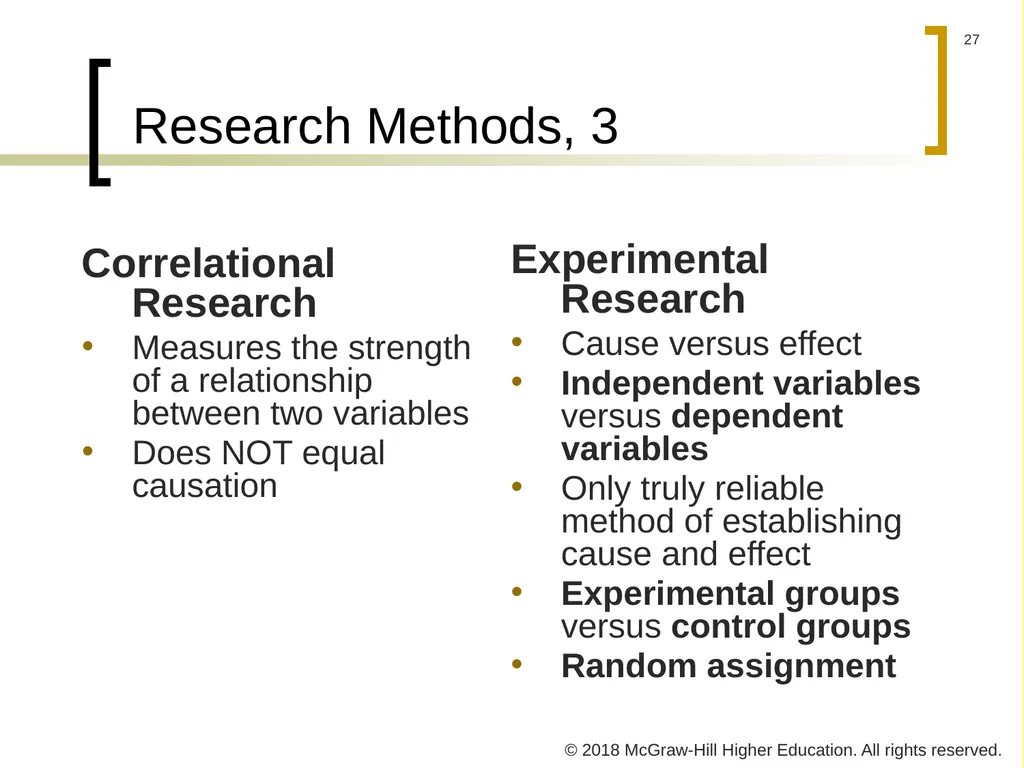
Research Methods, 3 Correlational Research
Measures the strength of a relationship between two variables
Does NOT equal causation Experimental Research
Cause versus effect
Independent variables versus dependent variables
Only truly reliable method of establishing cause and effect
Experimental groups versus control groups
Random assignment<br>
Measures the strength of a relationship between two variables
Does NOT equal causation Experimental Research
Cause versus effect
Independent variables versus dependent variables
Only truly reliable method of establishing cause and effect
Experimental groups versus control groups
Random assignment<br>
28
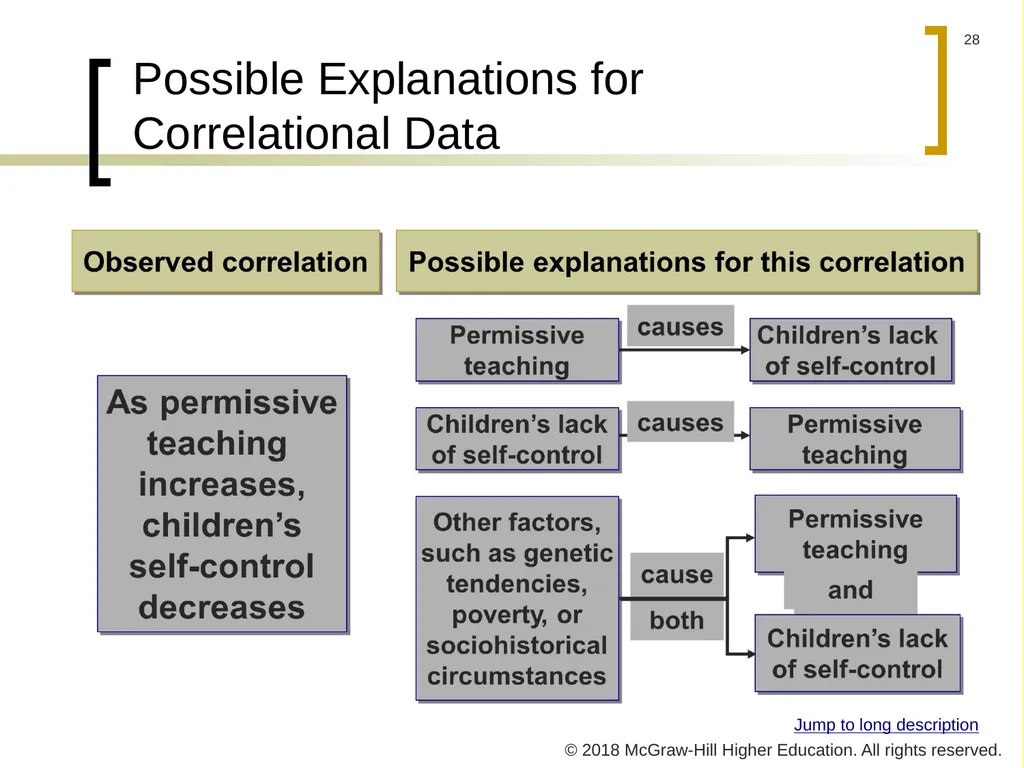
Possible Explanations for Correlational Data Jump to long description<br>
29
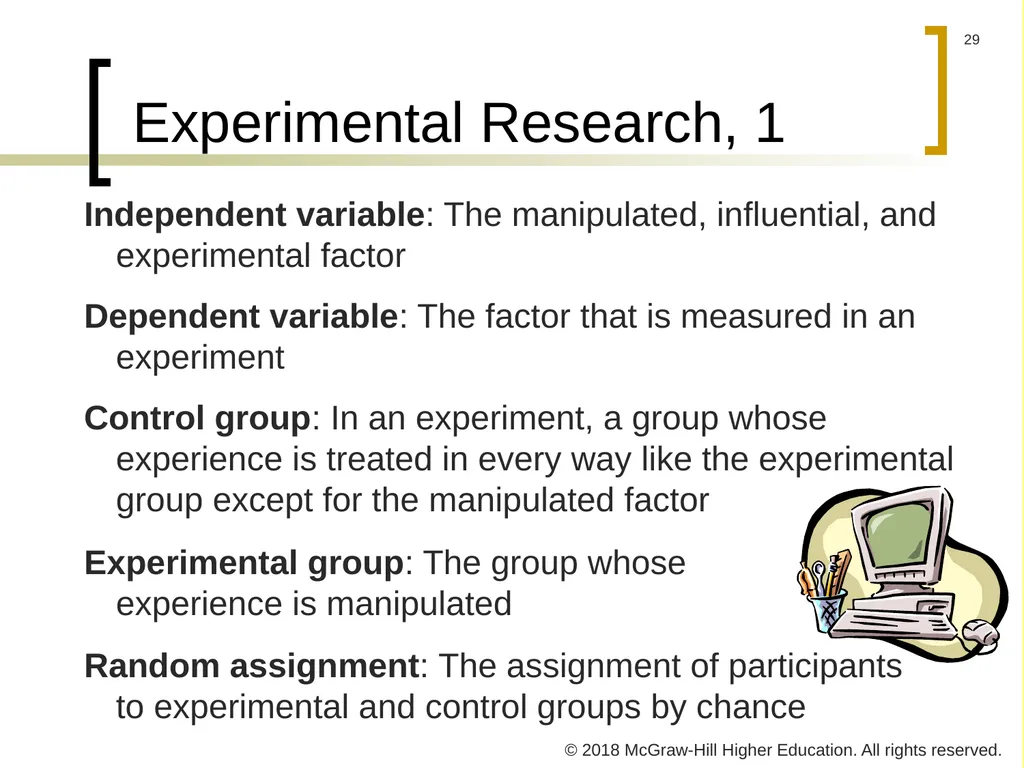
Experimental Research, 1 Independent variable: The manipulated, influential, and experimental factor
Dependent variable: The factor that is measured in an experiment
Control group: In an experiment, a group whose experience is treated in every way like the experimental group except for the manipulated factor
Experimental group: The group whose
experience is manipulated
Random assignment: The assignment of participants to experimental and control groups by chance<br>
Dependent variable: The factor that is measured in an experiment
Control group: In an experiment, a group whose experience is treated in every way like the experimental group except for the manipulated factor
Experimental group: The group whose
experience is manipulated
Random assignment: The assignment of participants to experimental and control groups by chance<br>
30
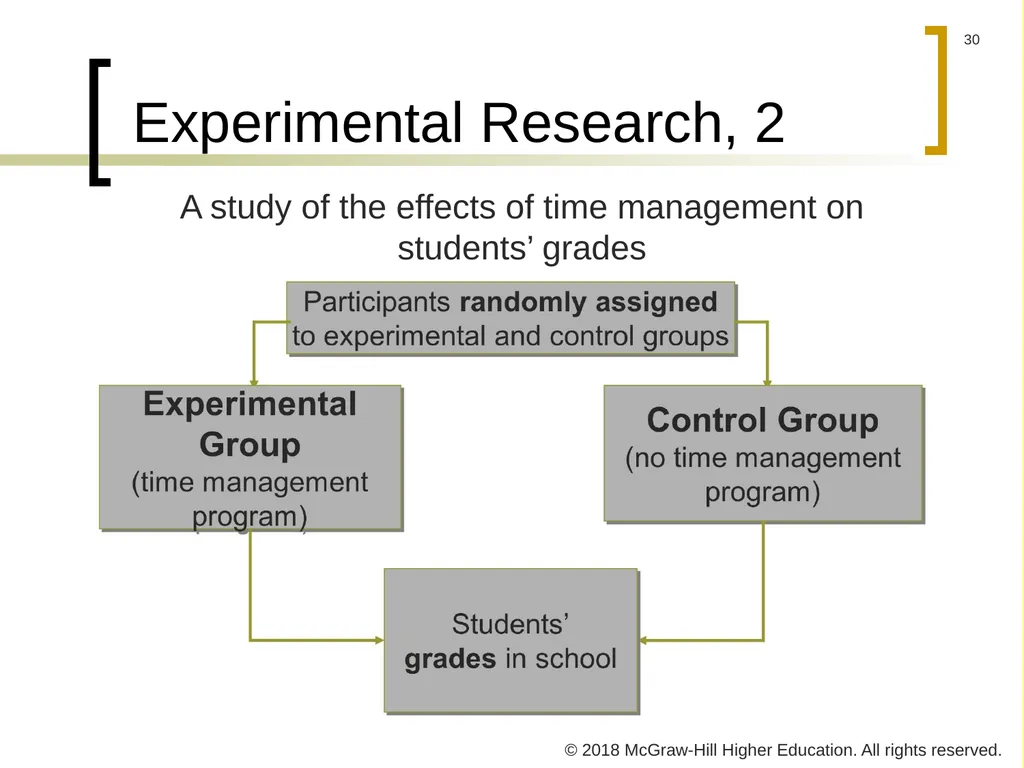
Experimental Research, 2 A study of the effects of time management on students’ grades<br>
31
Program Evaluation, Action Research, and Teacher-as-Researcher Program Evaluation: Designed to make decisions about the effectiveness of a particular program
Action Research: Used to solve a particular classroom or school problem
Teacher-as-Researcher: Teachers conduct their own studies to improve their teaching practices<br>
Action Research: Used to solve a particular classroom or school problem
Teacher-as-Researcher: Teachers conduct their own studies to improve their teaching practices<br>
32
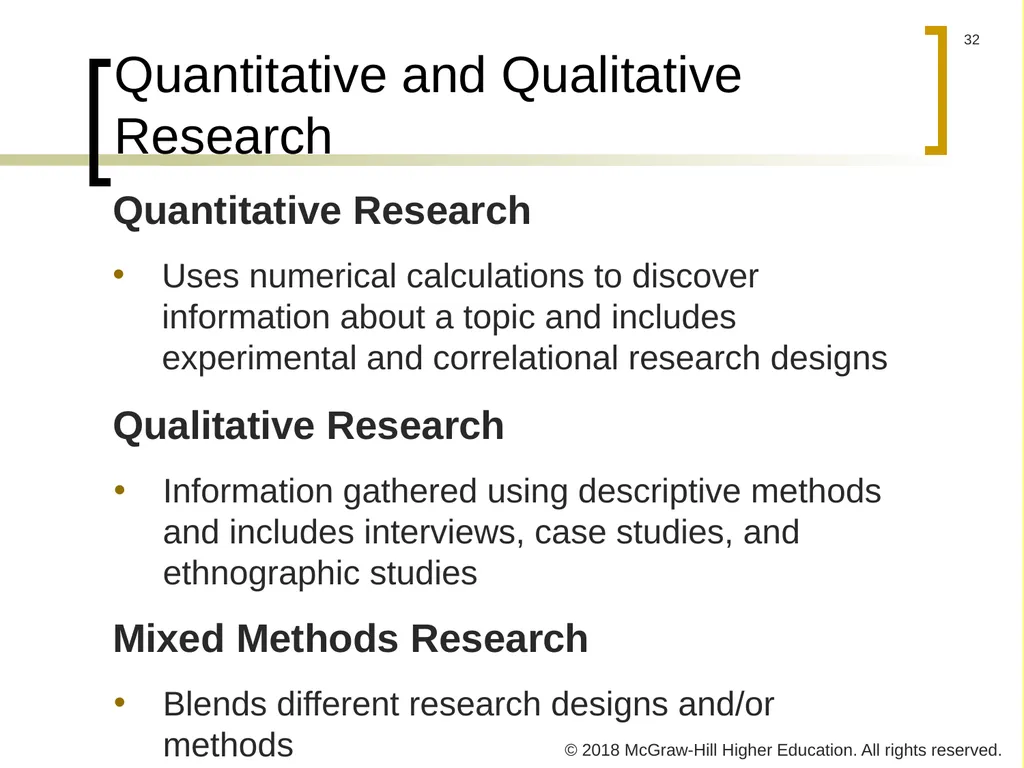
Quantitative and Qualitative Research Quantitative Research
Uses numerical calculations to discover information about a topic and includes experimental and correlational research designs Qualitative Research
Information gathered using descriptive methods and includes interviews, case studies, and ethnographic studies Mixed Methods Research
Blends different research designs and/or methods<br>
Uses numerical calculations to discover information about a topic and includes experimental and correlational research designs Qualitative Research
Information gathered using descriptive methods and includes interviews, case studies, and ethnographic studies Mixed Methods Research
Blends different research designs and/or methods<br>
33
Enter the Debate Should teachers conduct research using their students as subjects? YES NO<br>
34
Classroom Connections: Crack the Case—The Classroom Decision, 1 What issues would need to be considered in conducting such a study?
What type of research would be most appropriate?
Why?
If she compared the two different curricula and their outcomes, what would the independent variable be?<br>
What type of research would be most appropriate?
Why?
If she compared the two different curricula and their outcomes, what would the independent variable be?<br>
35
Classroom Connections: Crack the Case—The Classroom Decision, 2 If she decides to conduct an experimental study in which she compared the two different curricula and their outcomes, what would the dependent variable be?
How should Ms. Huang go about conducting her study?<br>
How should Ms. Huang go about conducting her study?<br>
36
Appendix of Image for Long Descriptions<br>
37
Educational Psychology:
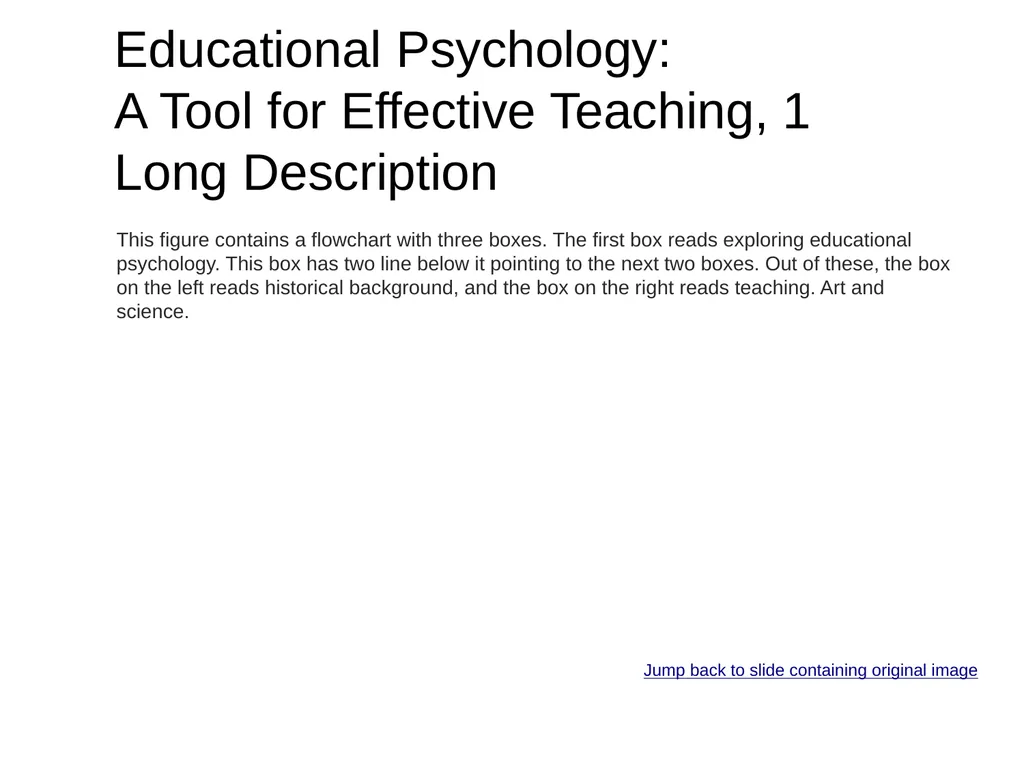
A Tool for Effective Teaching, 1 Long Description This figure contains a flowchart with three boxes. The first box reads exploring educational psychology. This box has two line below it pointing to the next two boxes. Out of these, the box on the left reads historical background, and the box on the right reads teaching. Art and science. Jump back to slide containing original image<br>
38
Historical Background of Educational Psychology Long Description This slide illustrates the historical background of educational psychology.
This timeline, from the left to the right, lists the years 1850, 1875, 1900, 1925, and 1950.
Names of the three major pioneers, William James, John Dewey, and E. L. Thorndike, are added in three text boxes below the timeline.
William James is associated from the year 1842 to 1910. John Dewey is associated from the year 1859 to 1952. E. L. Thorndike is associated from the year 1874 to 1949.
This slide illustrates the historical background of educational psychology. Three major pioneers namely William James, John Dewey, and E. L. Thorndike are considered in this image as they are said to have created and shaped the field of educational psychology.
The timeline moves from the left to the right and lists the years 1850, 1875, 1900, 1925, and 1950.
William James covers the timeline from 1842 to 1910. John Dewey covers the timeline from 1859 to 1952. E. L. Thorndike covers the timeline from 1874 to 1949. Jump back to slide containing original image<br>
This timeline, from the left to the right, lists the years 1850, 1875, 1900, 1925, and 1950.
Names of the three major pioneers, William James, John Dewey, and E. L. Thorndike, are added in three text boxes below the timeline.
William James is associated from the year 1842 to 1910. John Dewey is associated from the year 1859 to 1952. E. L. Thorndike is associated from the year 1874 to 1949.
This slide illustrates the historical background of educational psychology. Three major pioneers namely William James, John Dewey, and E. L. Thorndike are considered in this image as they are said to have created and shaped the field of educational psychology.
The timeline moves from the left to the right and lists the years 1850, 1875, 1900, 1925, and 1950.
William James covers the timeline from 1842 to 1910. John Dewey covers the timeline from 1859 to 1952. E. L. Thorndike covers the timeline from 1874 to 1949. Jump back to slide containing original image<br>
39
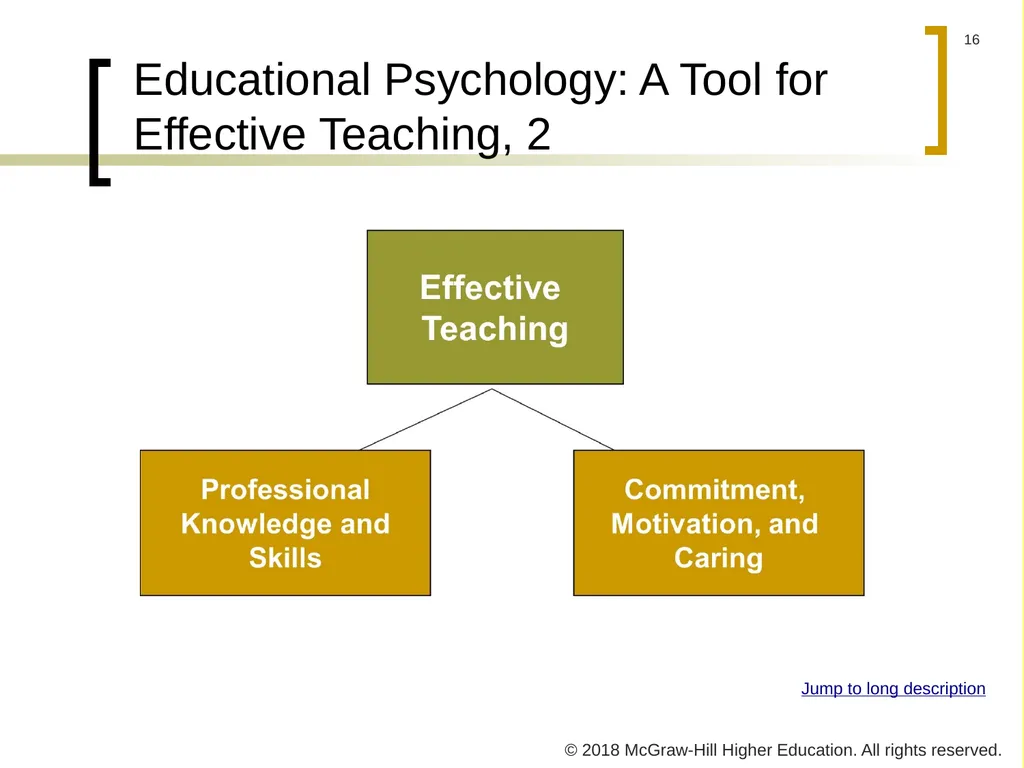
Educational Psychology: A Tool for Effective Teaching, 2 Long Description This figure contains a flowchart with three boxes. The box at the top reads effective teaching. This box has two lines that connect it to the two boxes below it. The box on the left reads professional knowledge and skills, and the box on the right reads commitment, motivation, and caring. Jump back to slide containing original image<br>
40
Educational Psychology:
A Tool for Effective Teaching, 3 Long Description This slide illustrates the use of research in education psychology with the help of a flowchart. The flowchart has five boxes. The box at the top reads research in education psychology. Four lines connect this box to the four boxes below it. From the left, these boxes read why research is important, research methods, quantitative and qualitative research, and program evaluation research, action research, and the teacher-as-researcher. Jump back to slide containing original image<br>
41
Possible Explanations for Correlational Data Long Description This slide illustrates possible explanations for correlation data. There are two header boxes next to each other with related boxes under each of them with explanations.
The title of the first box reads observed correlation. The box under this reads as permissive teaching increases, children’s self-control decreases.
The title of the second box reads possible explanations for this correlation.
The content in the first set of boxes under this reads permissive teaching causes children’s lack of self-control.
The content in the second set of boxes reads children’s lack of self-control causes permissive teaching.
The content in the third set of boxes reads other factors, such as genetic tendencies, poverty, or sociohistorical circumstances cause both permissive teaching and children’s lack of self-control. Jump back to slide containing original image<br>
The title of the first box reads observed correlation. The box under this reads as permissive teaching increases, children’s self-control decreases.
The title of the second box reads possible explanations for this correlation.
The content in the first set of boxes under this reads permissive teaching causes children’s lack of self-control.
The content in the second set of boxes reads children’s lack of self-control causes permissive teaching.
The content in the third set of boxes reads other factors, such as genetic tendencies, poverty, or sociohistorical circumstances cause both permissive teaching and children’s lack of self-control. Jump back to slide containing original image<br>