
PrEP Introduction in Nigeria Value Chain Situation
TD
Published · 31 slides · 0 views
1 / 1


Description
PrEP Introduction in Nigeria Value Chain Situation Analysis Final report December 2022 Current HIV prevention situation Preliminary findings for PrEP introduction planning Sources and notes Overview VALUES Country-led Women-focused with
Related Topics
Share
Embed code
Download this presentation From Below
"PrEP Introduction in Nigeria Value Chain Situation" is the property of its rightful owner. Permission is granted to download and print the materials on this website for personal, non-commercial use only, and to display it on your personal computer provided you do not modify the materials and that you retain all copyright notices contained in the materials. By downloading content from our website, you accept the terms of this agreement.
Presentation Transcript
01
PrEP Introduction in Nigeria
Value Chain Situation Analysis Final report
December 2022<br>
December 2022<br>
02
Current HIV prevention situation Preliminary findings for PrEP introduction planning Sources and notes Overview<br>
03
VALUES
Country-led
Women-focused with emphasis on AGYW
Informed choice
Equitable co-leadership
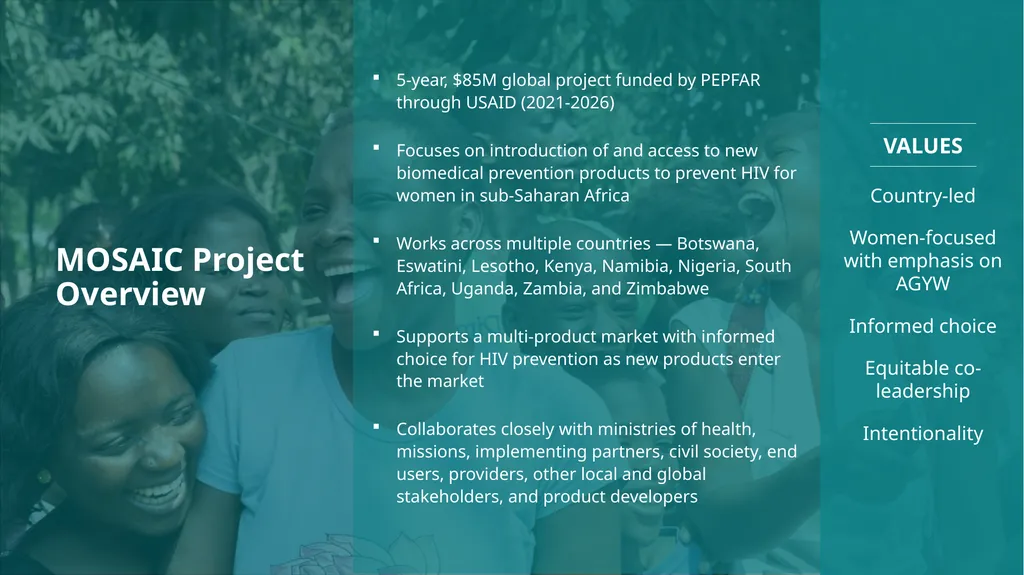
Intentionality 5-year, $85M global project funded by PEPFAR through USAID (2021-2026)
Focuses on introduction of and access to new biomedical prevention products to prevent HIV for women in sub-Saharan Africa
Works across multiple countries — Botswana, Eswatini, Lesotho, Kenya, Namibia, Nigeria, South Africa, Uganda, Zambia, and Zimbabwe
Supports a multi-product market with informed choice for HIV prevention as new products enter the market
Collaborates closely with ministries of health, missions, implementing partners, civil society, end users, providers, other local and global stakeholders, and product developers MOSAIC Project Overview<br>
Country-led
Women-focused with emphasis on AGYW
Informed choice
Equitable co-leadership
Intentionality 5-year, $85M global project funded by PEPFAR through USAID (2021-2026)
Focuses on introduction of and access to new biomedical prevention products to prevent HIV for women in sub-Saharan Africa
Works across multiple countries — Botswana, Eswatini, Lesotho, Kenya, Namibia, Nigeria, South Africa, Uganda, Zambia, and Zimbabwe
Supports a multi-product market with informed choice for HIV prevention as new products enter the market
Collaborates closely with ministries of health, missions, implementing partners, civil society, end users, providers, other local and global stakeholders, and product developers MOSAIC Project Overview<br>
04
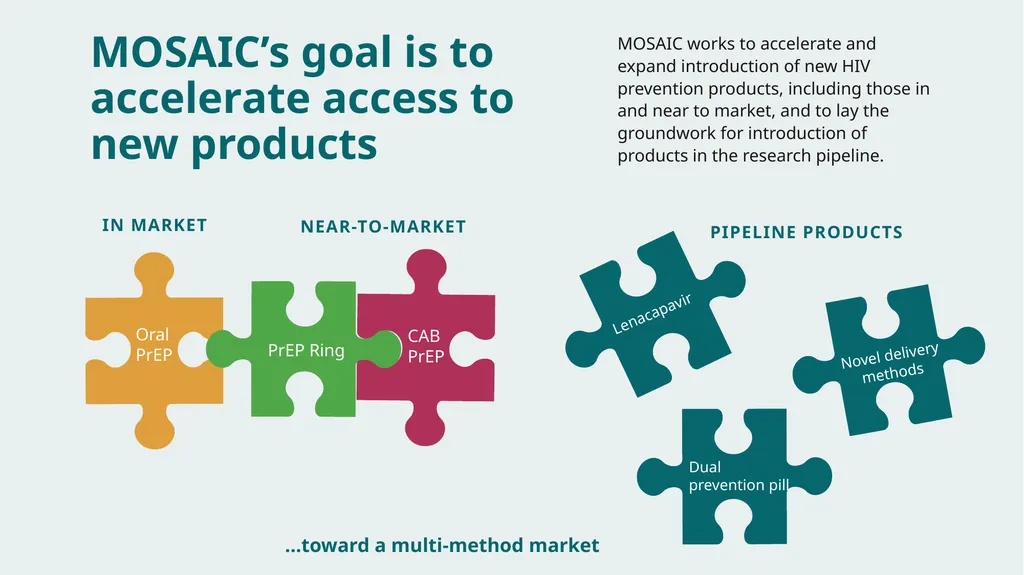
MOSAIC’s goal is to accelerate access to new products Oral PrEP CAB PrEP Lenacapavir IN MARKET NEAR-TO-MARKET PrEP Ring Dual prevention pill Novel delivery methods PIPELINE PRODUCTS MOSAIC works to accelerate and expand introduction of new HIV prevention products, including those in and near to market, and to lay the groundwork for introduction of products in the research pipeline. …toward a multi-method market<br>
05
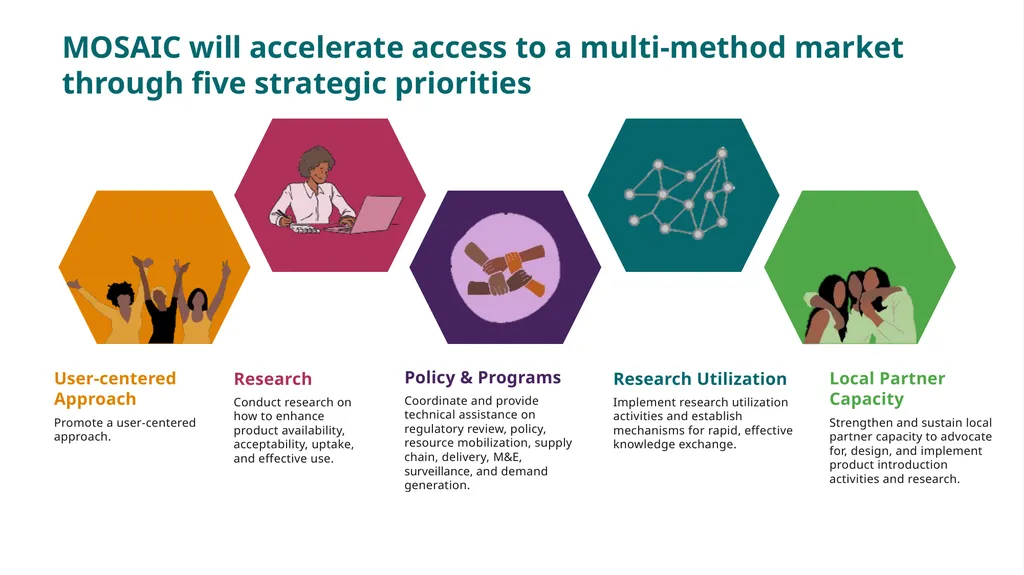
User-centered Approach
Promote a user-centered approach. Research
Conduct research on how to enhance product availability, acceptability, uptake, and effective use. Policy & Programs
Coordinate and provide technical assistance on regulatory review, policy, resource mobilization, supply chain, delivery, M&E, surveillance, and demand generation. Research Utilization
Implement research utilization activities and establish mechanisms for rapid, effective knowledge exchange. Local Partner Capacity
Strengthen and sustain local partner capacity to advocate for, design, and implement product introduction activities and research. MOSAIC will accelerate access to a multi-method market through five strategic priorities<br>
Promote a user-centered approach. Research
Conduct research on how to enhance product availability, acceptability, uptake, and effective use. Policy & Programs
Coordinate and provide technical assistance on regulatory review, policy, resource mobilization, supply chain, delivery, M&E, surveillance, and demand generation. Research Utilization
Implement research utilization activities and establish mechanisms for rapid, effective knowledge exchange. Local Partner Capacity
Strengthen and sustain local partner capacity to advocate for, design, and implement product introduction activities and research. MOSAIC will accelerate access to a multi-method market through five strategic priorities<br>
06
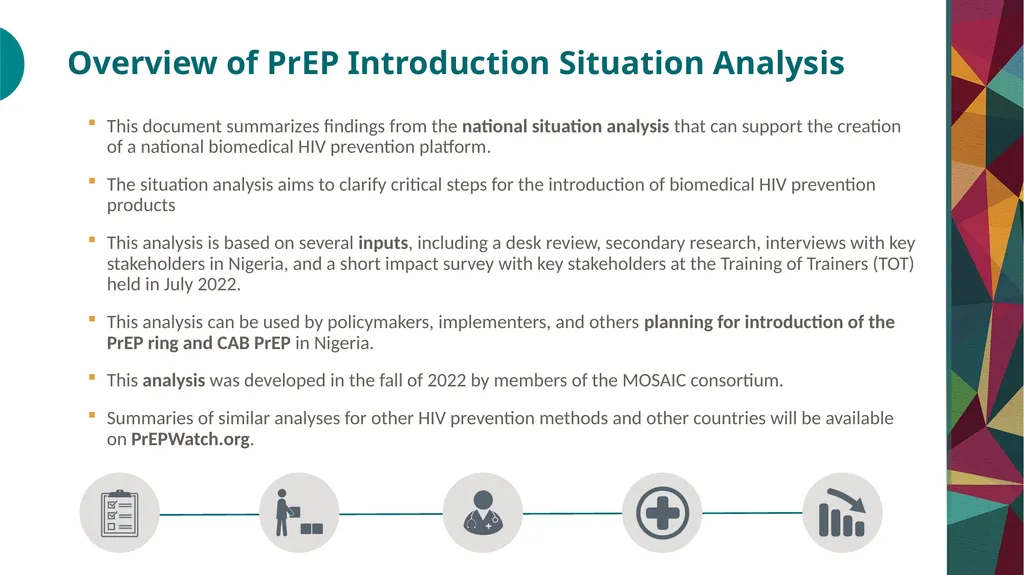
This document summarizes findings from the national situation analysis that can support the creation of a national biomedical HIV prevention platform.
The situation analysis aims to clarify critical steps for the introduction of biomedical HIV prevention products
This analysis is based on several inputs, including a desk review, secondary research, interviews with key stakeholders in Nigeria, and a short impact survey with key stakeholders at the Training of Trainers (TOT) held in July 2022.
This analysis can be used by policymakers, implementers, and others planning for introduction of the PrEP ring and CAB PrEP in Nigeria.
This analysis was developed in the fall of 2022 by members of the MOSAIC consortium.
Summaries of similar analyses for other HIV prevention methods and other countries will be available on PrEPWatch.org. Overview of PrEP Introduction Situation Analysis<br>
The situation analysis aims to clarify critical steps for the introduction of biomedical HIV prevention products
This analysis is based on several inputs, including a desk review, secondary research, interviews with key stakeholders in Nigeria, and a short impact survey with key stakeholders at the Training of Trainers (TOT) held in July 2022.
This analysis can be used by policymakers, implementers, and others planning for introduction of the PrEP ring and CAB PrEP in Nigeria.
This analysis was developed in the fall of 2022 by members of the MOSAIC consortium.
Summaries of similar analyses for other HIV prevention methods and other countries will be available on PrEPWatch.org. Overview of PrEP Introduction Situation Analysis<br>
07
Current situation of HIV prevention Preliminary findings for PrEP introduction planning Sources and notes Overview<br>
08
KEY STATISTICS
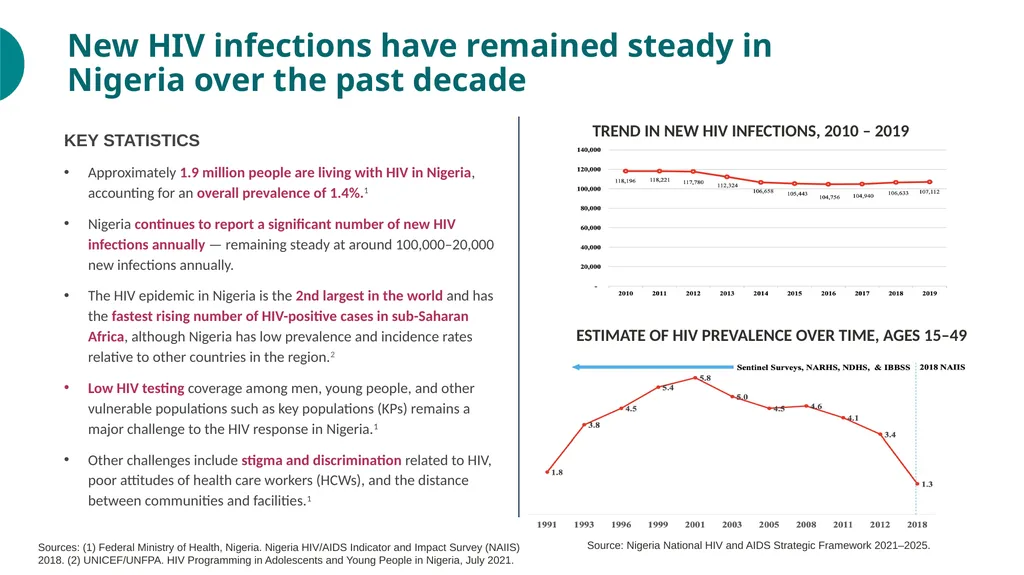
Approximately 1.9 million people are living with HIV in Nigeria, accounting for an overall prevalence of 1.4%.1
Nigeria continues to report a significant number of new HIV infections annually — remaining steady at around 100,000–20,000 new infections annually.
The HIV epidemic in Nigeria is the 2nd largest in the world and has the fastest rising number of HIV-positive cases in sub-Saharan Africa, although Nigeria has low prevalence and incidence rates relative to other countries in the region.2
Low HIV testing coverage among men, young people, and other vulnerable populations such as key populations (KPs) remains a major challenge to the HIV response in Nigeria.1
Other challenges include stigma and discrimination related to HIV, poor attitudes of health care workers (HCWs), and the distance between communities and facilities.1 Sources: (1) Federal Ministry of Health, Nigeria. Nigeria HIV/AIDS Indicator and Impact Survey (NAIIS) 2018. (2) UNICEF/UNFPA. HIV Programming in Adolescents and Young People in Nigeria, July 2021. New HIV infections have remained steady in Nigeria over the past decade Source: Nigeria National HIV and AIDS Strategic Framework 2021–2025. ESTIMATE OF HIV PREVALENCE OVER TIME, AGES 15–49 TREND IN NEW HIV INFECTIONS, 2010 – 2019<br>
Approximately 1.9 million people are living with HIV in Nigeria, accounting for an overall prevalence of 1.4%.1
Nigeria continues to report a significant number of new HIV infections annually — remaining steady at around 100,000–20,000 new infections annually.
The HIV epidemic in Nigeria is the 2nd largest in the world and has the fastest rising number of HIV-positive cases in sub-Saharan Africa, although Nigeria has low prevalence and incidence rates relative to other countries in the region.2
Low HIV testing coverage among men, young people, and other vulnerable populations such as key populations (KPs) remains a major challenge to the HIV response in Nigeria.1
Other challenges include stigma and discrimination related to HIV, poor attitudes of health care workers (HCWs), and the distance between communities and facilities.1 Sources: (1) Federal Ministry of Health, Nigeria. Nigeria HIV/AIDS Indicator and Impact Survey (NAIIS) 2018. (2) UNICEF/UNFPA. HIV Programming in Adolescents and Young People in Nigeria, July 2021. New HIV infections have remained steady in Nigeria over the past decade Source: Nigeria National HIV and AIDS Strategic Framework 2021–2025. ESTIMATE OF HIV PREVALENCE OVER TIME, AGES 15–49 TREND IN NEW HIV INFECTIONS, 2010 – 2019<br>
09
HIV risk for women in Nigeria remains high HIV prevalence is 1.8% among women ages 15–64, 0.8% among young women ages 15–24, 1% among men ages 15–64, and 0.2% among young men ages 15–24.1
Adolescent girls and young women are disproportionally affected by HIV, especially high among 20–24-year-old females.2
Prevalence is highest among KPs: brothel-based female sex workers (BBFSWs), non-brothel-based female sex workers (NBBFSWs), men who have sex with men (MSM), people who inject drugs (PWID), and transgender people (TGP).1
Nevertheless, Nigeria has made significant progress to ensure people living with HIV have access to treatment and is well-positioned to accomplish the 95–95–95 targets well in advance of 2030. At the end of 2021, progress on the targets were 90-98-95, which means:3
90% knew their status
98% were on HIV treatment, meaning 90% of all people living with HIV
95% were virally suppressed, meaning 86% of all people living with HIV Sources: (1) ) Federal Ministry of Health, Nigeria. Nigeria HIV/AIDS Indicator and Impact Survey (NAIIS) 2018. (2) UNICEF/UNFPA. HIV Programming in Adolescents and Young People in Nigeria, July 2021. (3) UNAIDS 2021 estimates. HIV PREVALENCE BY SEX AND AGE, NAIIS 2018 HIV PREVALENCE AMONG KEY AND PRIORITY POPULATIONS EPIDEMIC CONTROL AND UNAIDS 95-95-95 GOALS<br>
Adolescent girls and young women are disproportionally affected by HIV, especially high among 20–24-year-old females.2
Prevalence is highest among KPs: brothel-based female sex workers (BBFSWs), non-brothel-based female sex workers (NBBFSWs), men who have sex with men (MSM), people who inject drugs (PWID), and transgender people (TGP).1
Nevertheless, Nigeria has made significant progress to ensure people living with HIV have access to treatment and is well-positioned to accomplish the 95–95–95 targets well in advance of 2030. At the end of 2021, progress on the targets were 90-98-95, which means:3
90% knew their status
98% were on HIV treatment, meaning 90% of all people living with HIV
95% were virally suppressed, meaning 86% of all people living with HIV Sources: (1) ) Federal Ministry of Health, Nigeria. Nigeria HIV/AIDS Indicator and Impact Survey (NAIIS) 2018. (2) UNICEF/UNFPA. HIV Programming in Adolescents and Young People in Nigeria, July 2021. (3) UNAIDS 2021 estimates. HIV PREVALENCE BY SEX AND AGE, NAIIS 2018 HIV PREVALENCE AMONG KEY AND PRIORITY POPULATIONS EPIDEMIC CONTROL AND UNAIDS 95-95-95 GOALS<br>
10
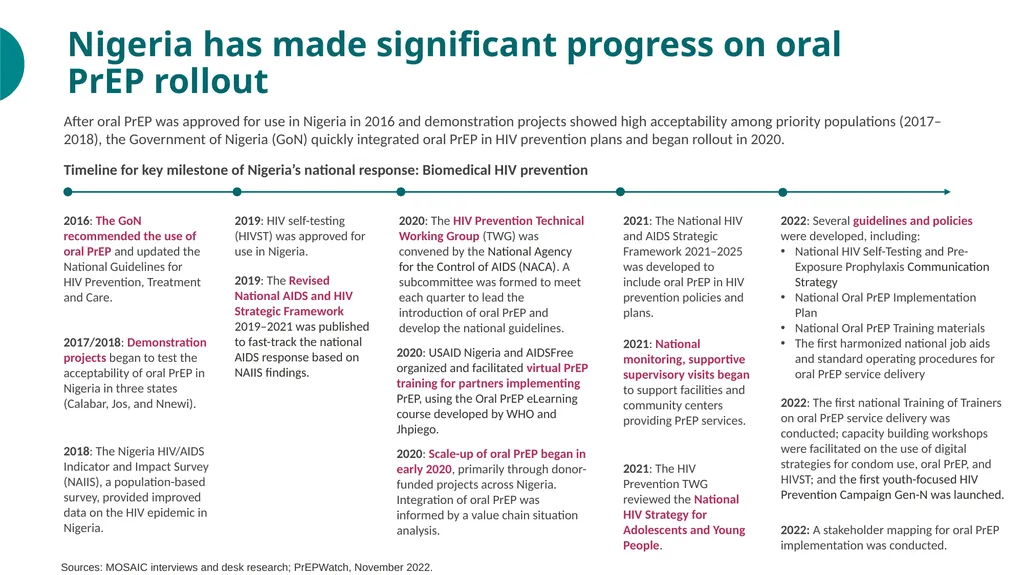
Nigeria has made significant progress on oral PrEP rollout Timeline for key milestone of Nigeria’s national response: Biomedical HIV prevention Sources: MOSAIC interviews and desk research; PrEPWatch, November 2022. 2016: The GoN recommended the use of oral PrEP and updated the National Guidelines for HIV Prevention, Treatment and Care. 2017/2018: Demonstration projects began to test the acceptability of oral PrEP in Nigeria in three states (Calabar, Jos, and Nnewi). 2018: The Nigeria HIV/AIDS Indicator and Impact Survey (NAIIS), a population-based survey, provided improved data on the HIV epidemic in Nigeria. 2019: HIV self-testing (HIVST) was approved for use in Nigeria. 2019: The Revised National AIDS and HIV Strategic Framework 2019–2021 was published to fast-track the national AIDS response based on NAIIS findings. 2020: The HIV Prevention Technical Working Group (TWG) was convened by the National Agency for the Control of AIDS (NACA). A subcommittee was formed to meet each quarter to lead the introduction of oral PrEP and develop the national guidelines. 2020: Scale-up of oral PrEP began in early 2020, primarily through donor-funded projects across Nigeria. Integration of oral PrEP was informed by a value chain situation analysis. 2020: USAID Nigeria and AIDSFree organized and facilitated virtual PrEP training for partners implementing PrEP, using the Oral PrEP eLearning course developed by WHO and Jhpiego. 2021: The National HIV and AIDS Strategic Framework 2021–2025 was developed to include oral PrEP in HIV prevention policies and plans. 2022: Several guidelines and policies were developed, including:
National HIV Self-Testing and Pre-Exposure Prophylaxis Communication Strategy
National Oral PrEP Implementation Plan
National Oral PrEP Training materials
The first harmonized national job aids and standard operating procedures for oral PrEP service delivery After oral PrEP was approved for use in Nigeria in 2016 and demonstration projects showed high acceptability among priority populations (2017–2018), the Government of Nigeria (GoN) quickly integrated oral PrEP in HIV prevention plans and began rollout in 2020. 2021: National monitoring, supportive supervisory visits began to support facilities and community centers providing PrEP services. 2021: The HIV Prevention TWG reviewed the National HIV Strategy for Adolescents and Young People. 2022: The first national Training of Trainers on oral PrEP service delivery was conducted; capacity building workshops were facilitated on the use of digital strategies for condom use, oral PrEP, and HIVST; and the first youth-focused HIV Prevention Campaign Gen-N was launched. 2022: A stakeholder mapping for oral PrEP implementation was conducted.<br>
National HIV Self-Testing and Pre-Exposure Prophylaxis Communication Strategy
National Oral PrEP Implementation Plan
National Oral PrEP Training materials
The first harmonized national job aids and standard operating procedures for oral PrEP service delivery After oral PrEP was approved for use in Nigeria in 2016 and demonstration projects showed high acceptability among priority populations (2017–2018), the Government of Nigeria (GoN) quickly integrated oral PrEP in HIV prevention plans and began rollout in 2020. 2021: National monitoring, supportive supervisory visits began to support facilities and community centers providing PrEP services. 2021: The HIV Prevention TWG reviewed the National HIV Strategy for Adolescents and Young People. 2022: The first national Training of Trainers on oral PrEP service delivery was conducted; capacity building workshops were facilitated on the use of digital strategies for condom use, oral PrEP, and HIVST; and the first youth-focused HIV Prevention Campaign Gen-N was launched. 2022: A stakeholder mapping for oral PrEP implementation was conducted.<br>
11
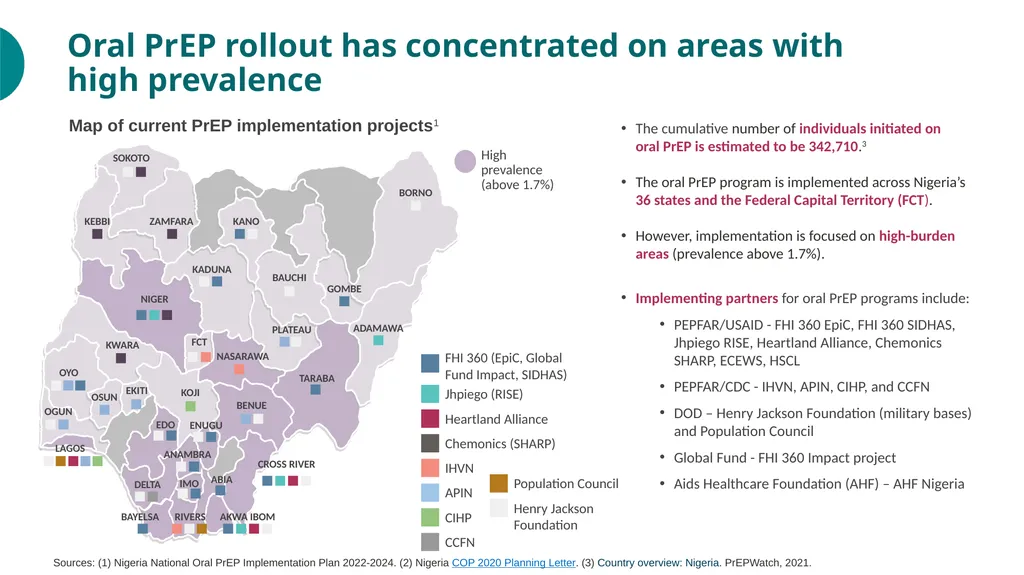
The cumulative number of individuals initiated on oral PrEP is estimated to be 342,710.3
The oral PrEP program is implemented across Nigeria’s 36 states and the Federal Capital Territory (FCT).
However, implementation is focused on high-burden areas (prevalence above 1.7%).
Implementing partners for oral PrEP programs include:
PEPFAR/USAID - FHI 360 EpiC, FHI 360 SIDHAS, Jhpiego RISE, Heartland Alliance, Chemonics SHARP, ECEWS, HSCL
PEPFAR/CDC - IHVN, APIN, CIHP, and CCFN
DOD – Henry Jackson Foundation (military bases) and Population Council
Global Fund - FHI 360 Impact project
Aids Healthcare Foundation (AHF) – AHF Nigeria EDO NIGER KANO BAUCHI EDO ADAMAWA AKWA IBOM CROSS RIVER BORNO KANO KEBBI SOKOTO ZAMFARA KWARA LAGOS Map of current PrEP implementation projects1 Sources: (1) Nigeria National Oral PrEP Implementation Plan 2022-2024. (2) Nigeria COP 2020 Planning Letter. (3) Country overview: Nigeria. PrEPWatch, 2021. FCT NASARAWA OYO OGUN OSUN EKITI BENUE PLATEAU KOJI BAYELSA RIVERS High prevalence (above 1.7%) DELTA ANAMBRA ENUGU IMO KADUNA TARABA GOMBE ABIA Oral PrEP rollout has concentrated on areas with high prevalence<br>
The oral PrEP program is implemented across Nigeria’s 36 states and the Federal Capital Territory (FCT).
However, implementation is focused on high-burden areas (prevalence above 1.7%).
Implementing partners for oral PrEP programs include:
PEPFAR/USAID - FHI 360 EpiC, FHI 360 SIDHAS, Jhpiego RISE, Heartland Alliance, Chemonics SHARP, ECEWS, HSCL
PEPFAR/CDC - IHVN, APIN, CIHP, and CCFN
DOD – Henry Jackson Foundation (military bases) and Population Council
Global Fund - FHI 360 Impact project
Aids Healthcare Foundation (AHF) – AHF Nigeria EDO NIGER KANO BAUCHI EDO ADAMAWA AKWA IBOM CROSS RIVER BORNO KANO KEBBI SOKOTO ZAMFARA KWARA LAGOS Map of current PrEP implementation projects1 Sources: (1) Nigeria National Oral PrEP Implementation Plan 2022-2024. (2) Nigeria COP 2020 Planning Letter. (3) Country overview: Nigeria. PrEPWatch, 2021. FCT NASARAWA OYO OGUN OSUN EKITI BENUE PLATEAU KOJI BAYELSA RIVERS High prevalence (above 1.7%) DELTA ANAMBRA ENUGU IMO KADUNA TARABA GOMBE ABIA Oral PrEP rollout has concentrated on areas with high prevalence<br>
12
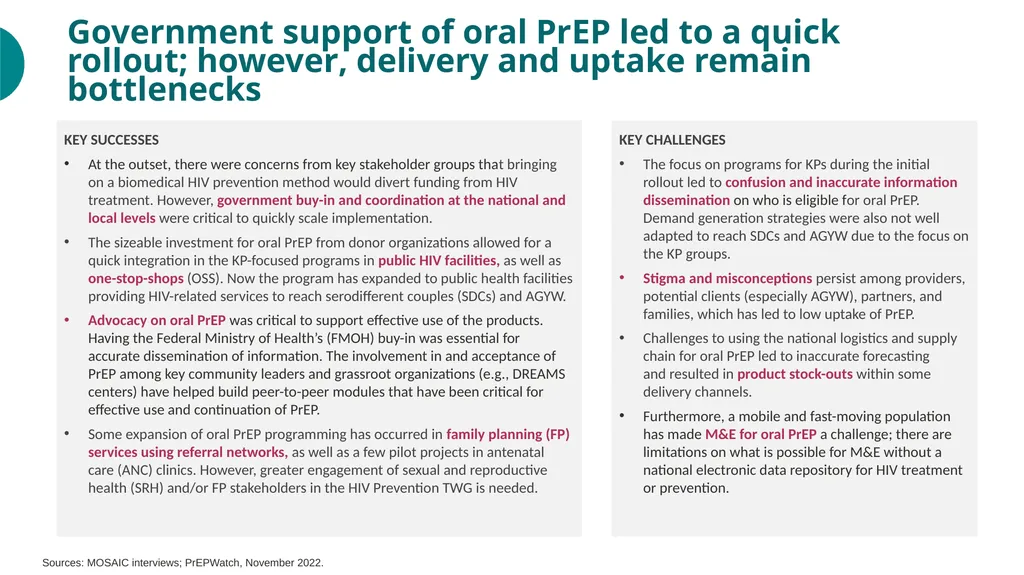
Sources: MOSAIC interviews; PrEPWatch, November 2022. Government support of oral PrEP led to a quick rollout; however, delivery and uptake remain bottlenecks KEY SUCCESSES
At the outset, there were concerns from key stakeholder groups that bringing on a biomedical HIV prevention method would divert funding from HIV treatment. However, government buy-in and coordination at the national and local levels were critical to quickly scale implementation.
The sizeable investment for oral PrEP from donor organizations allowed for a quick integration in the KP-focused programs in public HIV facilities, as well as one-stop-shops (OSS). Now the program has expanded to public health facilities providing HIV-related services to reach serodifferent couples (SDCs) and AGYW.
Advocacy on oral PrEP was critical to support effective use of the products. Having the Federal Ministry of Health’s (FMOH) buy-in was essential for accurate dissemination of information. The involvement in and acceptance of PrEP among key community leaders and grassroot organizations (e.g., DREAMS centers) have helped build peer-to-peer modules that have been critical for effective use and continuation of PrEP.
Some expansion of oral PrEP programming has occurred in family planning (FP) services using referral networks, as well as a few pilot projects in antenatal care (ANC) clinics. However, greater engagement of sexual and reproductive health (SRH) and/or FP stakeholders in the HIV Prevention TWG is needed. KEY CHALLENGES
The focus on programs for KPs during the initial rollout led to confusion and inaccurate information dissemination on who is eligible for oral PrEP. Demand generation strategies were also not well adapted to reach SDCs and AGYW due to the focus on the KP groups.
Stigma and misconceptions persist among providers, potential clients (especially AGYW), partners, and families, which has led to low uptake of PrEP.
Challenges to using the national logistics and supply chain for oral PrEP led to inaccurate forecasting and resulted in product stock-outs within some delivery channels.
Furthermore, a mobile and fast-moving population has made M&E for oral PrEP a challenge; there are limitations on what is possible for M&E without a national electronic data repository for HIV treatment or prevention.<br>
At the outset, there were concerns from key stakeholder groups that bringing on a biomedical HIV prevention method would divert funding from HIV treatment. However, government buy-in and coordination at the national and local levels were critical to quickly scale implementation.
The sizeable investment for oral PrEP from donor organizations allowed for a quick integration in the KP-focused programs in public HIV facilities, as well as one-stop-shops (OSS). Now the program has expanded to public health facilities providing HIV-related services to reach serodifferent couples (SDCs) and AGYW.
Advocacy on oral PrEP was critical to support effective use of the products. Having the Federal Ministry of Health’s (FMOH) buy-in was essential for accurate dissemination of information. The involvement in and acceptance of PrEP among key community leaders and grassroot organizations (e.g., DREAMS centers) have helped build peer-to-peer modules that have been critical for effective use and continuation of PrEP.
Some expansion of oral PrEP programming has occurred in family planning (FP) services using referral networks, as well as a few pilot projects in antenatal care (ANC) clinics. However, greater engagement of sexual and reproductive health (SRH) and/or FP stakeholders in the HIV Prevention TWG is needed. KEY CHALLENGES
The focus on programs for KPs during the initial rollout led to confusion and inaccurate information dissemination on who is eligible for oral PrEP. Demand generation strategies were also not well adapted to reach SDCs and AGYW due to the focus on the KP groups.
Stigma and misconceptions persist among providers, potential clients (especially AGYW), partners, and families, which has led to low uptake of PrEP.
Challenges to using the national logistics and supply chain for oral PrEP led to inaccurate forecasting and resulted in product stock-outs within some delivery channels.
Furthermore, a mobile and fast-moving population has made M&E for oral PrEP a challenge; there are limitations on what is possible for M&E without a national electronic data repository for HIV treatment or prevention.<br>
13
Current situation of HIV prevention Preliminary findings for PrEP introduction planning Sources and notes Overview<br>
14
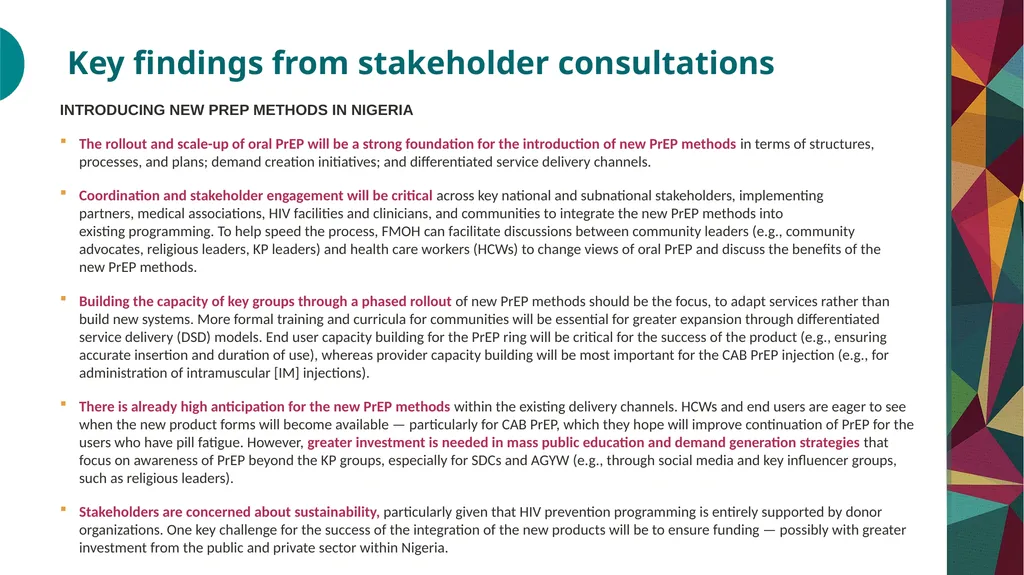
Key findings from stakeholder consultations INTRODUCING NEW PREP METHODS IN NIGERIA
The rollout and scale-up of oral PrEP will be a strong foundation for the introduction of new PrEP methods in terms of structures, processes, and plans; demand creation initiatives; and differentiated service delivery channels.
Coordination and stakeholder engagement will be critical across key national and subnational stakeholders, implementing partners, medical associations, HIV facilities and clinicians, and communities to integrate the new PrEP methods into existing programming. To help speed the process, FMOH can facilitate discussions between community leaders (e.g., community advocates, religious leaders, KP leaders) and health care workers (HCWs) to change views of oral PrEP and discuss the benefits of the new PrEP methods.
Building the capacity of key groups through a phased rollout of new PrEP methods should be the focus, to adapt services rather than build new systems. More formal training and curricula for communities will be essential for greater expansion through differentiated service delivery (DSD) models. End user capacity building for the PrEP ring will be critical for the success of the product (e.g., ensuring accurate insertion and duration of use), whereas provider capacity building will be most important for the CAB PrEP injection (e.g., for administration of intramuscular [IM] injections).
There is already high anticipation for the new PrEP methods within the existing delivery channels. HCWs and end users are eager to see when the new product forms will become available — particularly for CAB PrEP, which they hope will improve continuation of PrEP for the users who have pill fatigue. However, greater investment is needed in mass public education and demand generation strategies that focus on awareness of PrEP beyond the KP groups, especially for SDCs and AGYW (e.g., through social media and key influencer groups, such as religious leaders).
Stakeholders are concerned about sustainability, particularly given that HIV prevention programming is entirely supported by donor organizations. One key challenge for the success of the integration of the new products will be to ensure funding — possibly with greater investment from the public and private sector within Nigeria.<br>
The rollout and scale-up of oral PrEP will be a strong foundation for the introduction of new PrEP methods in terms of structures, processes, and plans; demand creation initiatives; and differentiated service delivery channels.
Coordination and stakeholder engagement will be critical across key national and subnational stakeholders, implementing partners, medical associations, HIV facilities and clinicians, and communities to integrate the new PrEP methods into existing programming. To help speed the process, FMOH can facilitate discussions between community leaders (e.g., community advocates, religious leaders, KP leaders) and health care workers (HCWs) to change views of oral PrEP and discuss the benefits of the new PrEP methods.
Building the capacity of key groups through a phased rollout of new PrEP methods should be the focus, to adapt services rather than build new systems. More formal training and curricula for communities will be essential for greater expansion through differentiated service delivery (DSD) models. End user capacity building for the PrEP ring will be critical for the success of the product (e.g., ensuring accurate insertion and duration of use), whereas provider capacity building will be most important for the CAB PrEP injection (e.g., for administration of intramuscular [IM] injections).
There is already high anticipation for the new PrEP methods within the existing delivery channels. HCWs and end users are eager to see when the new product forms will become available — particularly for CAB PrEP, which they hope will improve continuation of PrEP for the users who have pill fatigue. However, greater investment is needed in mass public education and demand generation strategies that focus on awareness of PrEP beyond the KP groups, especially for SDCs and AGYW (e.g., through social media and key influencer groups, such as religious leaders).
Stakeholders are concerned about sustainability, particularly given that HIV prevention programming is entirely supported by donor organizations. One key challenge for the success of the integration of the new products will be to ensure funding — possibly with greater investment from the public and private sector within Nigeria.<br>
15
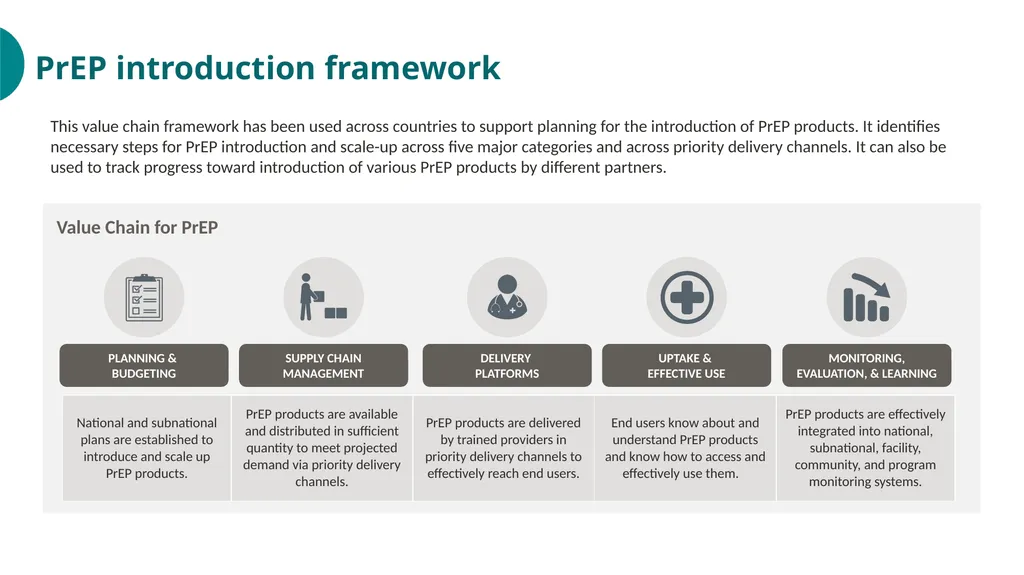
Value Chain for PrEP PLANNING &
BUDGETING SUPPLY CHAIN MANAGEMENT DELIVERY
PLATFORMS UPTAKE &
EFFECTIVE USE MONITORING, EVALUATION, & LEARNING PrEP introduction framework This value chain framework has been used across countries to support planning for the introduction of PrEP products. It identifies necessary steps for PrEP introduction and scale-up across five major categories and across priority delivery channels. It can also be used to track progress toward introduction of various PrEP products by different partners.<br>
BUDGETING SUPPLY CHAIN MANAGEMENT DELIVERY
PLATFORMS UPTAKE &
EFFECTIVE USE MONITORING, EVALUATION, & LEARNING PrEP introduction framework This value chain framework has been used across countries to support planning for the introduction of PrEP products. It identifies necessary steps for PrEP introduction and scale-up across five major categories and across priority delivery channels. It can also be used to track progress toward introduction of various PrEP products by different partners.<br>
16
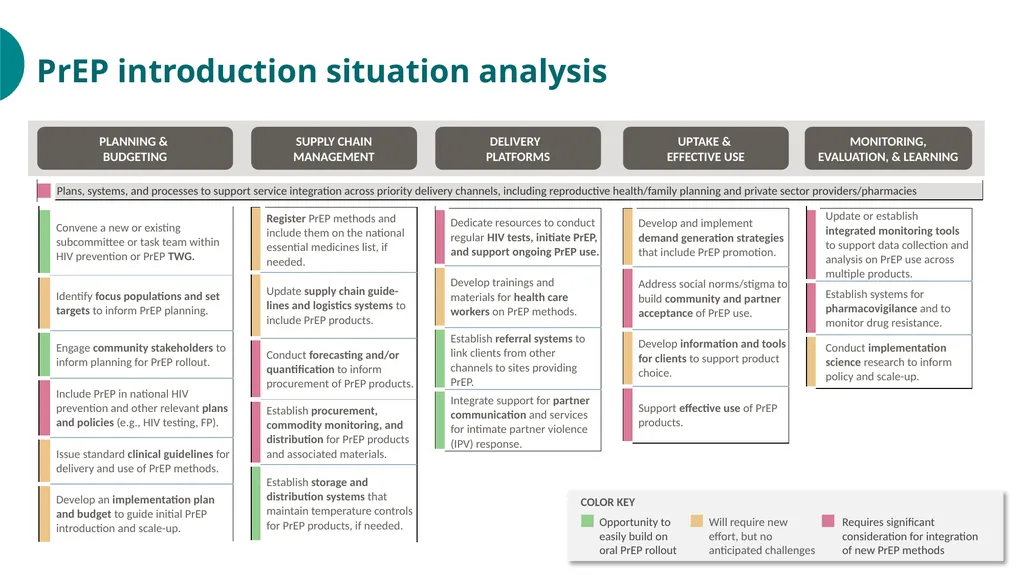
PrEP introduction situation analysis PLANNING &
BUDGETING SUPPLY CHAIN MANAGEMENT DELIVERY PLATFORMS UPTAKE &
EFFECTIVE USE MONITORING, EVALUATION, & LEARNING<br>
BUDGETING SUPPLY CHAIN MANAGEMENT DELIVERY PLATFORMS UPTAKE &
EFFECTIVE USE MONITORING, EVALUATION, & LEARNING<br>
17
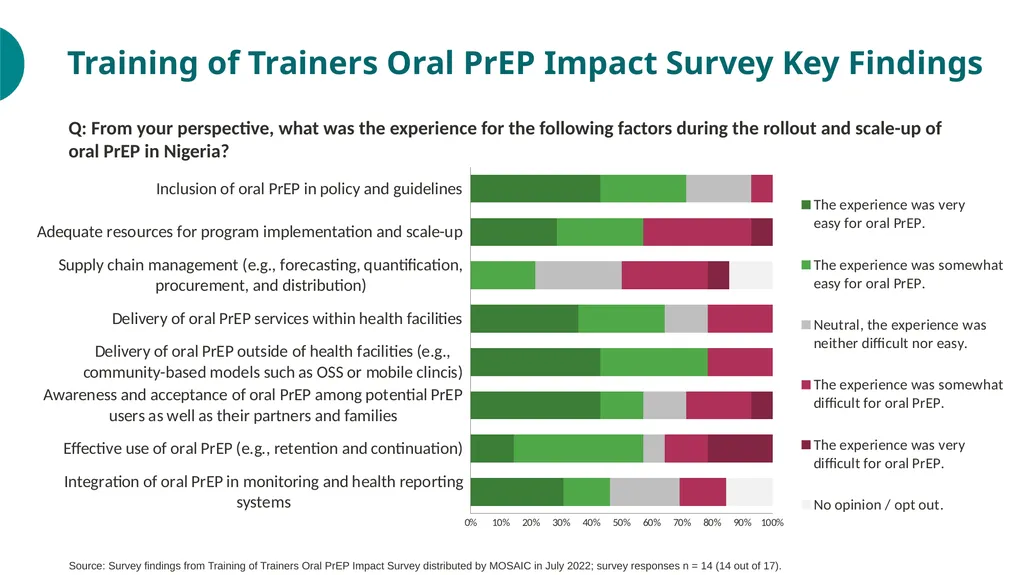
Training of Trainers Oral PrEP Impact Survey Key Findings Q: From your perspective, what was the experience for the following factors during the rollout and scale-up of oral PrEP in Nigeria? Source: Survey findings from Training of Trainers Oral PrEP Impact Survey distributed by MOSAIC in July 2022; survey responses n = 14 (14 out of 17).<br>
18
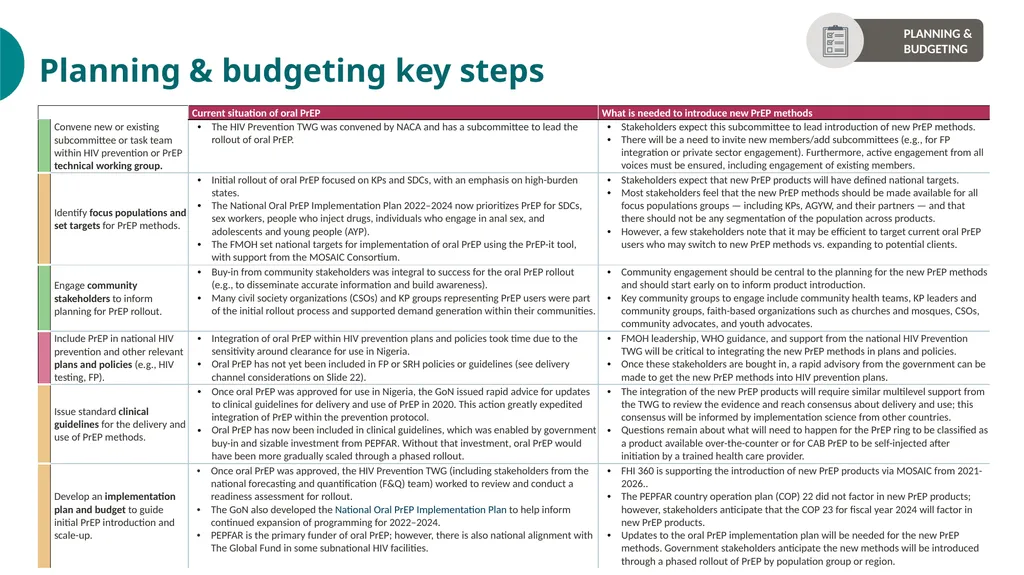
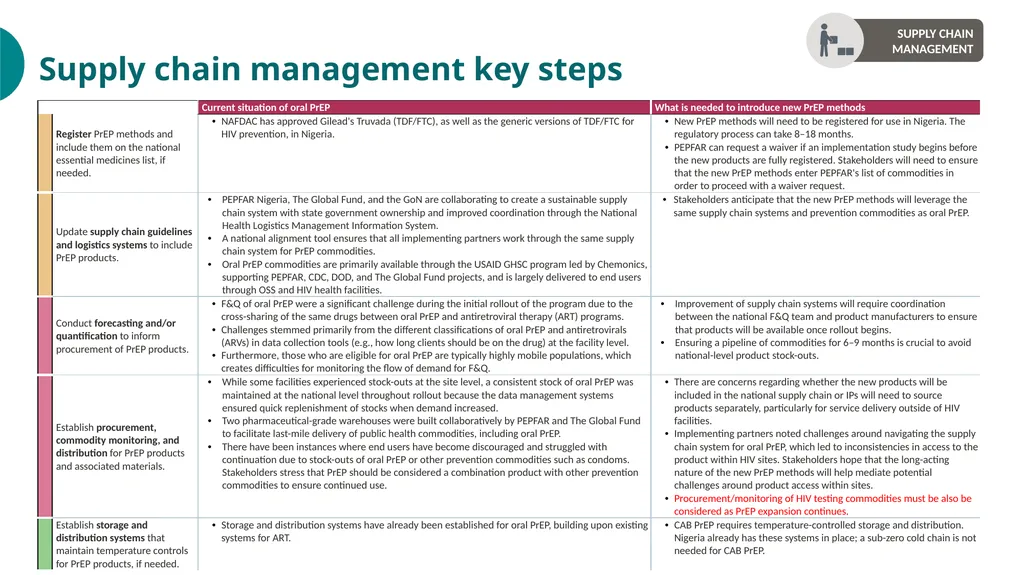
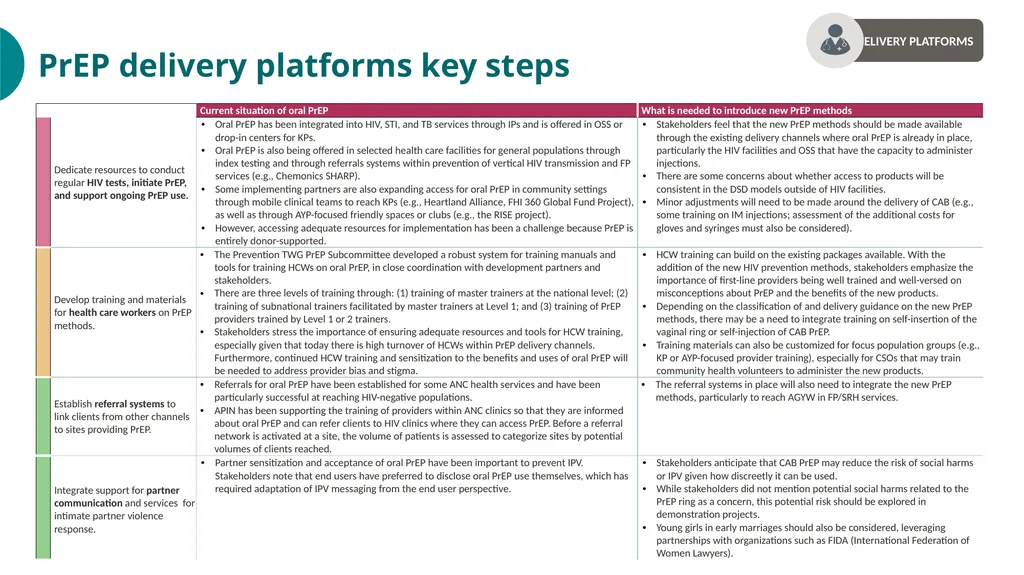
Findings from the Nigeria situation analysis are summarized below, with details included on the following slides. Nigeria PrEP introduction situation analysis<br>
19
PLANNING & BUDGETING Planning & budgeting key steps<br>
20
SUPPLY CHAIN MANAGEMENT Supply chain management key steps<br>
21
DELIVERY PLATFORMS PrEP delivery platforms key steps<br>
22
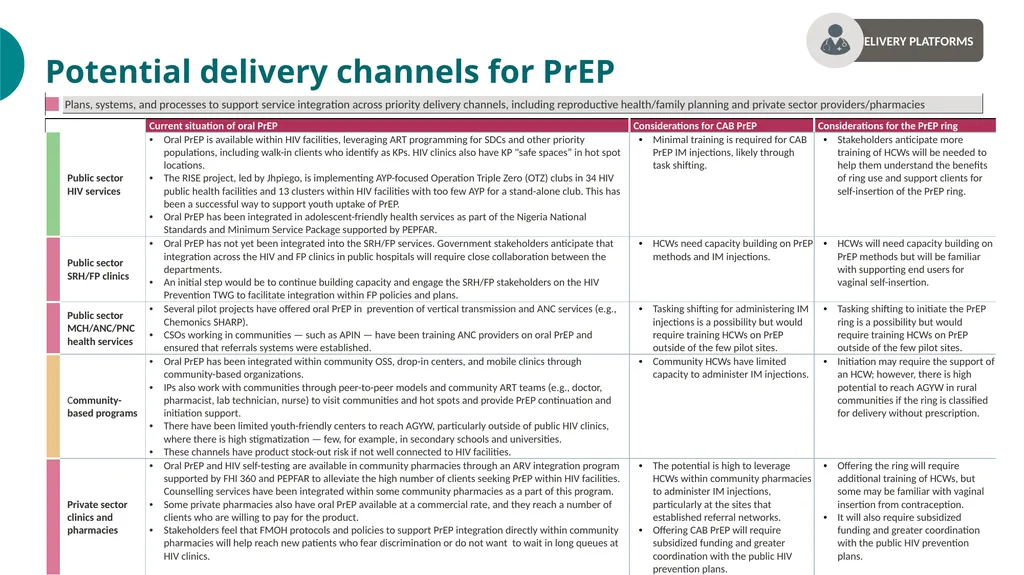
DELIVERY PLATFORMS Potential delivery channels for PrEP<br>
23
UPTAKE &
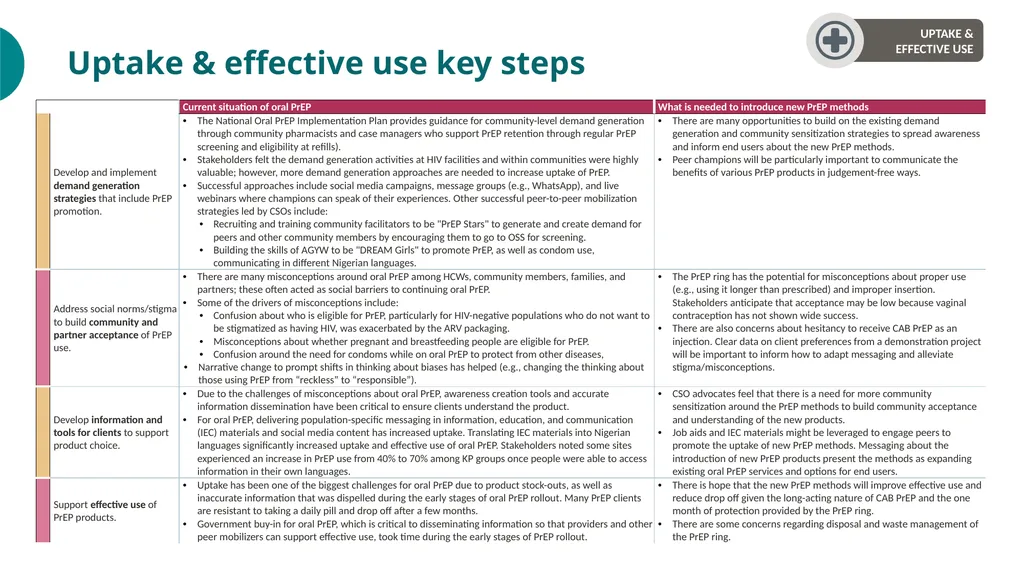
EFFECTIVE USE Uptake & effective use key steps<br>
EFFECTIVE USE Uptake & effective use key steps<br>
24
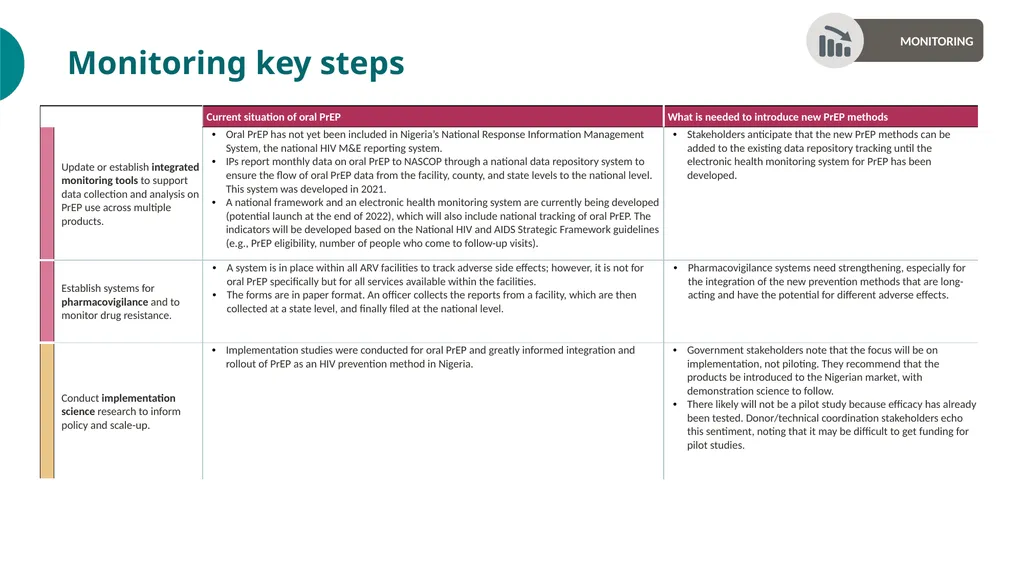
MONITORING Monitoring key steps<br>
25
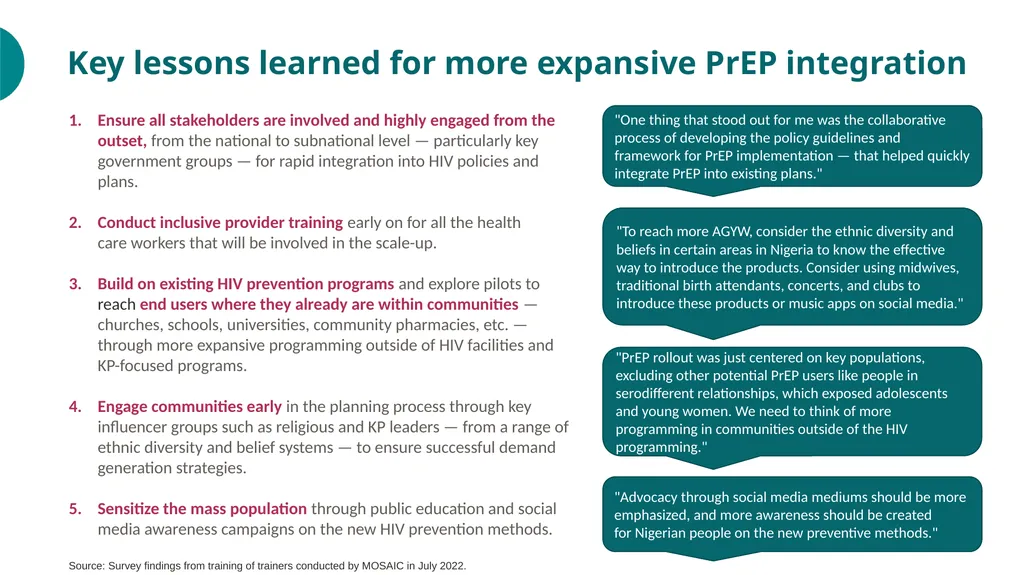
Key lessons learned for more expansive PrEP integration "Advocacy through social media mediums should be more emphasized, and more awareness should be created for Nigerian people on the new preventive methods." "To reach more AGYW, consider the ethnic diversity and beliefs in certain areas in Nigeria to know the effective way to introduce the products. Consider using midwives, traditional birth attendants, concerts, and clubs to introduce these products or music apps on social media." "One thing that stood out for me was the collaborative process of developing the policy guidelines and framework for PrEP implementation — that helped quickly integrate PrEP into existing plans." Ensure all stakeholders are involved and highly engaged from the outset, from the national to subnational level — particularly key government groups — for rapid integration into HIV policies and plans.
Conduct inclusive provider training early on for all the health care workers that will be involved in the scale-up.
Build on existing HIV prevention programs and explore pilots to reach end users where they already are within communities — churches, schools, universities, community pharmacies, etc. —through more expansive programming outside of HIV facilities and KP-focused programs.
Engage communities early in the planning process through key influencer groups such as religious and KP leaders — from a range of ethnic diversity and belief systems — to ensure successful demand generation strategies.
Sensitize the mass population through public education and social media awareness campaigns on the new HIV prevention methods. "PrEP rollout was just centered on key populations, excluding other potential PrEP users like people in serodifferent relationships, which exposed adolescents and young women. We need to think of more programming in communities outside of the HIV programming." Source: Survey findings from training of trainers conducted by MOSAIC in July 2022.<br>
Conduct inclusive provider training early on for all the health care workers that will be involved in the scale-up.
Build on existing HIV prevention programs and explore pilots to reach end users where they already are within communities — churches, schools, universities, community pharmacies, etc. —through more expansive programming outside of HIV facilities and KP-focused programs.
Engage communities early in the planning process through key influencer groups such as religious and KP leaders — from a range of ethnic diversity and belief systems — to ensure successful demand generation strategies.
Sensitize the mass population through public education and social media awareness campaigns on the new HIV prevention methods. "PrEP rollout was just centered on key populations, excluding other potential PrEP users like people in serodifferent relationships, which exposed adolescents and young women. We need to think of more programming in communities outside of the HIV programming." Source: Survey findings from training of trainers conducted by MOSAIC in July 2022.<br>
26
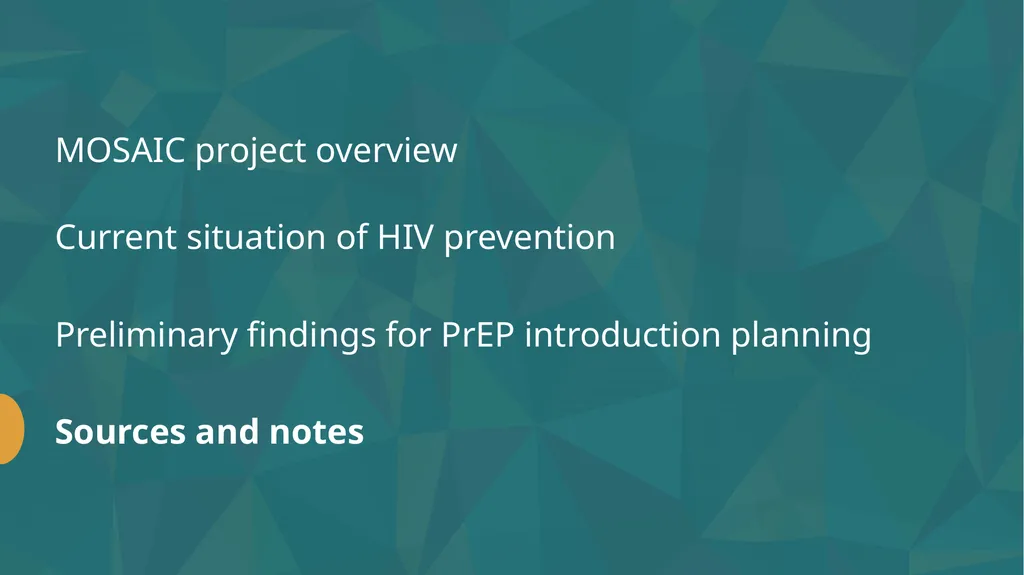
Current situation of HIV prevention Preliminary findings for PrEP introduction planning Sources and notes MOSAIC project overview<br>
27
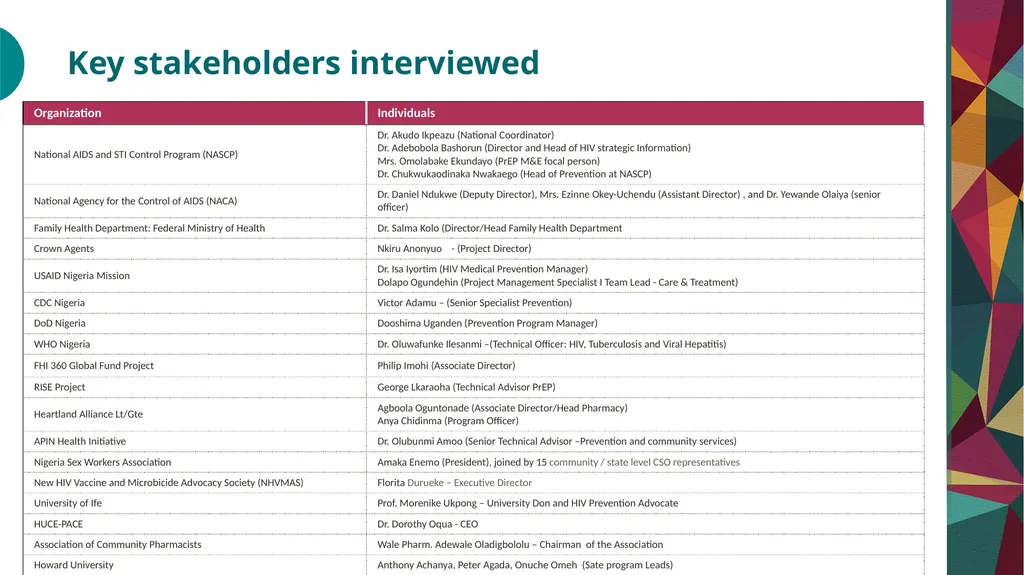
Key stakeholders interviewed<br>
28
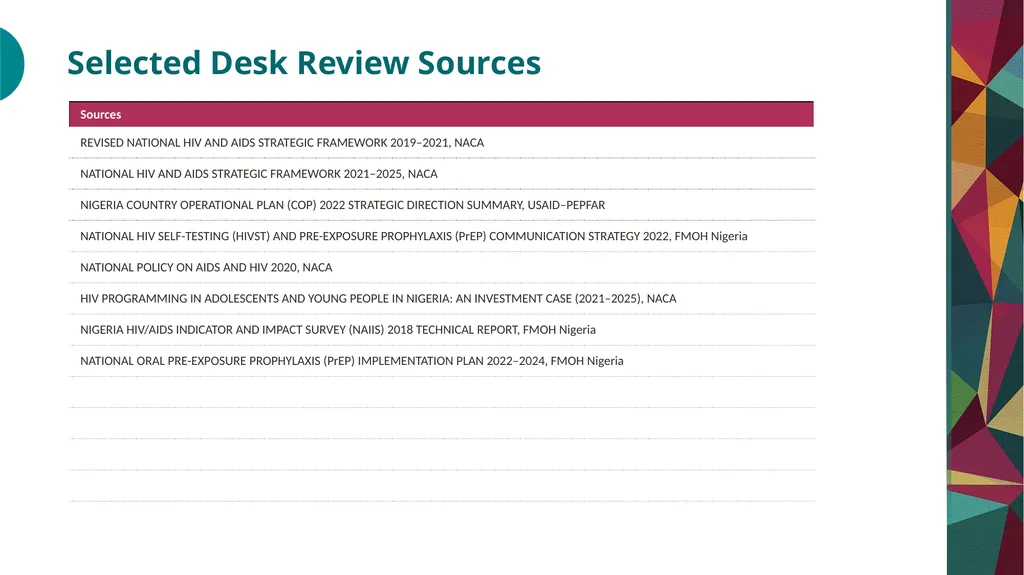
Selected Desk Review Sources<br>
29
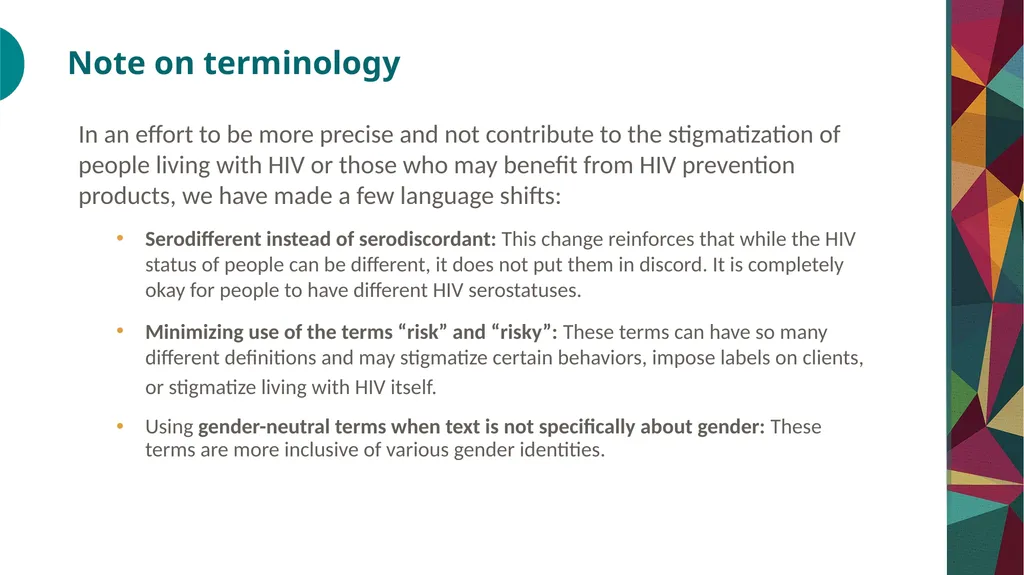
In an effort to be more precise and not contribute to the stigmatization of people living with HIV or those who may benefit from HIV prevention products, we have made a few language shifts:
Serodifferent instead of serodiscordant: This change reinforces that while the HIV status of people can be different, it does not put them in discord. It is completely okay for people to have different HIV serostatuses.
Minimizing use of the terms “risk” and “risky”: These terms can have so many different definitions and may stigmatize certain behaviors, impose labels on clients, or stigmatize living with HIV itself.
Using gender-neutral terms when text is not specifically about gender: These terms are more inclusive of various gender identities. Note on terminology<br>
Serodifferent instead of serodiscordant: This change reinforces that while the HIV status of people can be different, it does not put them in discord. It is completely okay for people to have different HIV serostatuses.
Minimizing use of the terms “risk” and “risky”: These terms can have so many different definitions and may stigmatize certain behaviors, impose labels on clients, or stigmatize living with HIV itself.
Using gender-neutral terms when text is not specifically about gender: These terms are more inclusive of various gender identities. Note on terminology<br>
30
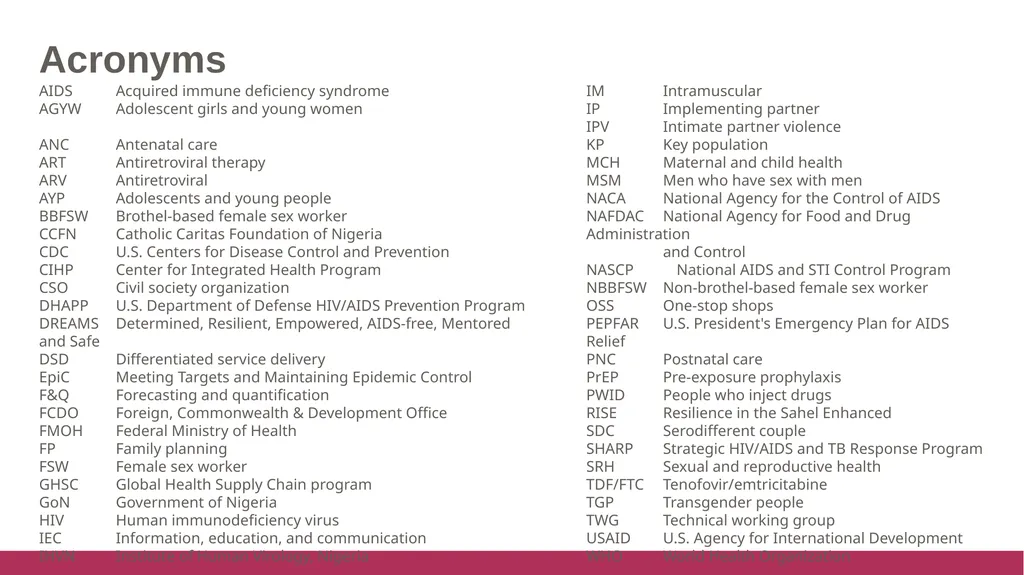
Acronyms AIDS Acquired immune deficiency syndrome
AGYW Adolescent girls and young women
ANC Antenatal care
ART Antiretroviral therapy
ARV Antiretroviral
AYP Adolescents and young people
BBFSW Brothel-based female sex worker
CCFN Catholic Caritas Foundation of Nigeria
CDC U.S. Centers for Disease Control and Prevention
CIHP Center for Integrated Health Program
CSO Civil society organization
DHAPP U.S. Department of Defense HIV/AIDS Prevention Program
DREAMS Determined, Resilient, Empowered, AIDS-free, Mentored and Safe
DSD Differentiated service delivery
EpiC Meeting Targets and Maintaining Epidemic Control
F&Q Forecasting and quantification
FCDO Foreign, Commonwealth & Development Office
FMOH Federal Ministry of Health
FP Family planning
FSW Female sex worker
GHSC Global Health Supply Chain program
GoN Government of Nigeria
HIV Human immunodeficiency virus
IEC Information, education, and communication
IHVN Institute of Human Virology, Nigeria IM Intramuscular
IP Implementing partner
IPV Intimate partner violence
KP Key population
MCH Maternal and child health
MSM Men who have sex with men
NACA National Agency for the Control of AIDS NAFDAC National Agency for Food and Drug Administration
and Control
NASCP National AIDS and STI Control Program
NBBFSW Non-brothel-based female sex worker
OSS One-stop shops
PEPFAR U.S. President's Emergency Plan for AIDS Relief
PNC Postnatal care
PrEP Pre-exposure prophylaxis
PWID People who inject drugs
RISE Resilience in the Sahel Enhanced
SDC Serodifferent couple
SHARP Strategic HIV/AIDS and TB Response Program
SRH Sexual and reproductive health
TDF/FTC Tenofovir/emtricitabine
TGP Transgender people
TWG Technical working group
USAID U.S. Agency for International Development
WHO World Health Organization<br>
AGYW Adolescent girls and young women
ANC Antenatal care
ART Antiretroviral therapy
ARV Antiretroviral
AYP Adolescents and young people
BBFSW Brothel-based female sex worker
CCFN Catholic Caritas Foundation of Nigeria
CDC U.S. Centers for Disease Control and Prevention
CIHP Center for Integrated Health Program
CSO Civil society organization
DHAPP U.S. Department of Defense HIV/AIDS Prevention Program
DREAMS Determined, Resilient, Empowered, AIDS-free, Mentored and Safe
DSD Differentiated service delivery
EpiC Meeting Targets and Maintaining Epidemic Control
F&Q Forecasting and quantification
FCDO Foreign, Commonwealth & Development Office
FMOH Federal Ministry of Health
FP Family planning
FSW Female sex worker
GHSC Global Health Supply Chain program
GoN Government of Nigeria
HIV Human immunodeficiency virus
IEC Information, education, and communication
IHVN Institute of Human Virology, Nigeria IM Intramuscular
IP Implementing partner
IPV Intimate partner violence
KP Key population
MCH Maternal and child health
MSM Men who have sex with men
NACA National Agency for the Control of AIDS NAFDAC National Agency for Food and Drug Administration
and Control
NASCP National AIDS and STI Control Program
NBBFSW Non-brothel-based female sex worker
OSS One-stop shops
PEPFAR U.S. President's Emergency Plan for AIDS Relief
PNC Postnatal care
PrEP Pre-exposure prophylaxis
PWID People who inject drugs
RISE Resilience in the Sahel Enhanced
SDC Serodifferent couple
SHARP Strategic HIV/AIDS and TB Response Program
SRH Sexual and reproductive health
TDF/FTC Tenofovir/emtricitabine
TGP Transgender people
TWG Technical working group
USAID U.S. Agency for International Development
WHO World Health Organization<br>