
Presentation of Signed Bilateral Agreements with

Description: Presentation of Signed Bilateral Agreements with International Counterparts between 2017 and 2018 03 December 2019 2 The Constitution of the Republic of South Africa places an obligation under Section 231 (3), that the National Assembly and
Related Topics
Download Presentation
"Presentation of Signed Bilateral Agreements with" is the property of its rightful owner. Permission is granted to download and print the materials on this website for personal, non-commercial use only, and to display it on your personal computer provided you do not modify the materials and that you retain all copyright notices contained in the materials. By downloading content from our website, you accept the terms of this agreement.
Presentation Transcript
slide1. Presentation of Signed Bilateral Agreements with International Counterparts
between 2017 and 2018
03 December 2019<br>
slide2. 2 The Constitution of the Republic of South Africa places an obligation under Section 231 (3), that the National Assembly and National Council of Provinces should be notified in reasonable time agreements of a technical administrative and executive nature,
Flowing from the Court Judgement on the Earthlife Africa Johannesburg and Another v Minister of Energy and Others (19529/2015) [2017] ZAWCHC 50,
The Department Tables the below mentioned Agreements for Information purpose and wish for the necessary Instruments to notify counterparts Administrations on the Entry Into Force of the Agreements. INTRODUCTION<br>
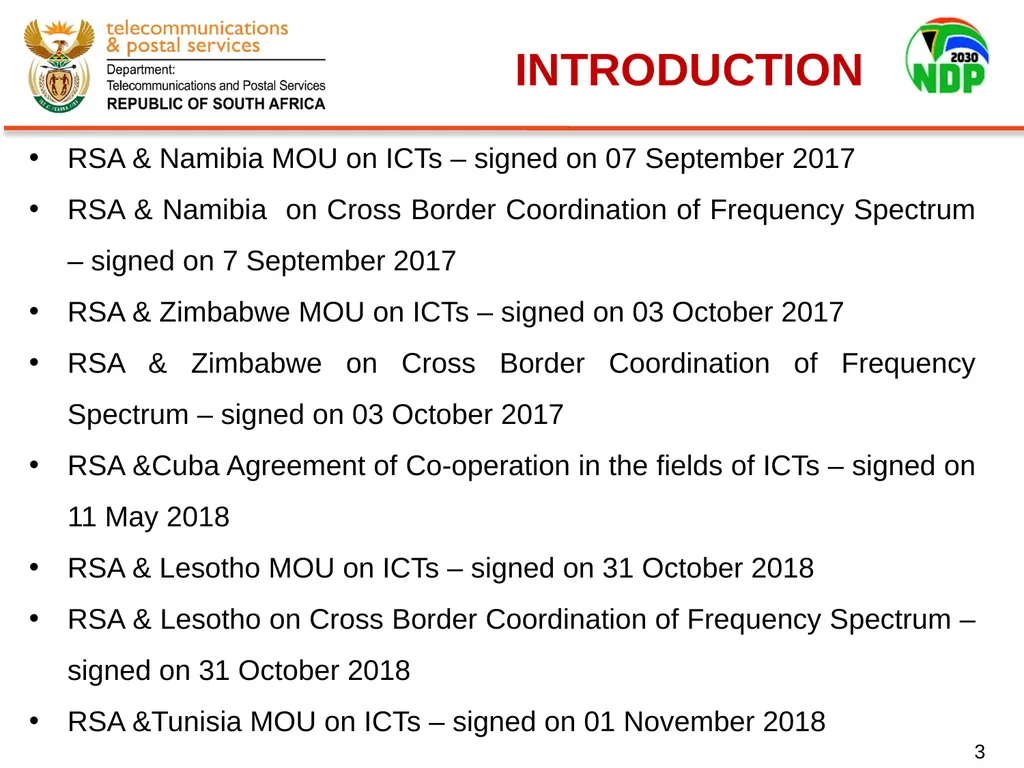
slide3. 3 RSA & Namibia MOU on ICTs – signed on 07 September 2017
RSA & Namibia on Cross Border Coordination of Frequency Spectrum – signed on 7 September 2017
RSA & Zimbabwe MOU on ICTs – signed on 03 October 2017
RSA & Zimbabwe on Cross Border Coordination of Frequency Spectrum – signed on 03 October 2017
RSA &Cuba Agreement of Co-operation in the fields of ICTs – signed on 11 May 2018
RSA & Lesotho MOU on ICTs – signed on 31 October 2018
RSA & Lesotho on Cross Border Coordination of Frequency Spectrum – signed on 31 October 2018
RSA &Tunisia MOU on ICTs – signed on 01 November 2018 INTRODUCTION<br>
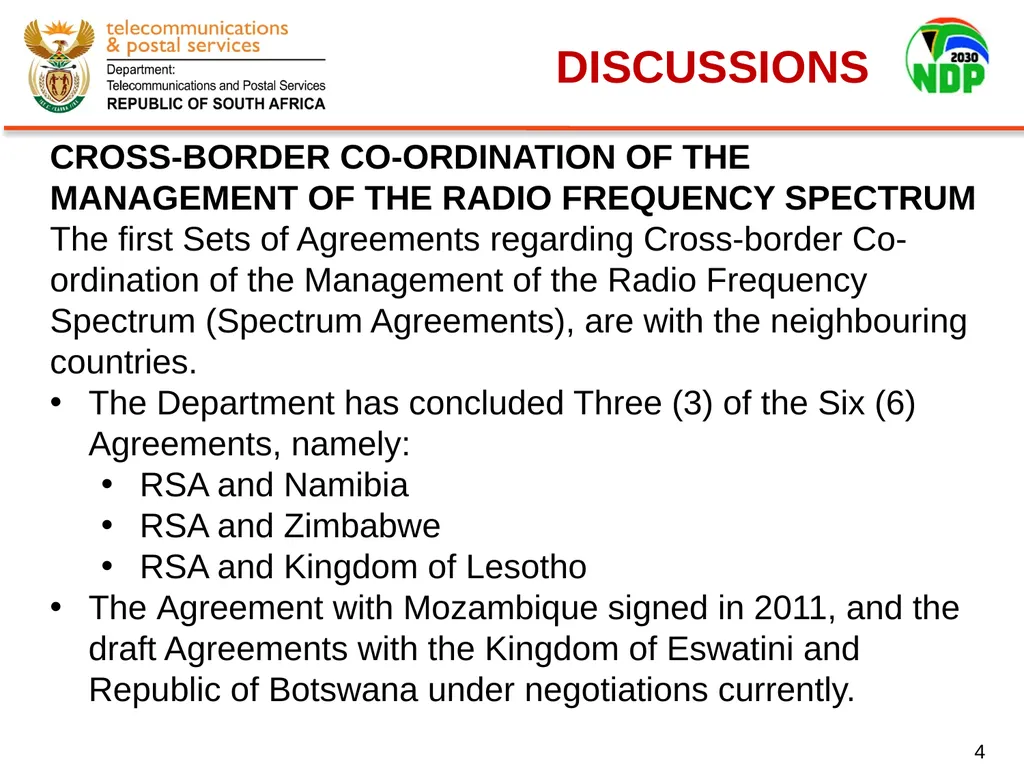
slide4. 4 CROSS-BORDER CO-ORDINATION OF THE MANAGEMENT OF THE RADIO FREQUENCY SPECTRUM
The first Sets of Agreements regarding Cross-border Co-ordination of the Management of the Radio Frequency Spectrum (Spectrum Agreements), are with the neighbouring countries.
The Department has concluded Three (3) of the Six (6) Agreements, namely:
RSA and Namibia
RSA and Zimbabwe
RSA and Kingdom of Lesotho
The Agreement with Mozambique signed in 2011, and the draft Agreements with the Kingdom of Eswatini and Republic of Botswana under negotiations currently. DISCUSSIONS<br>
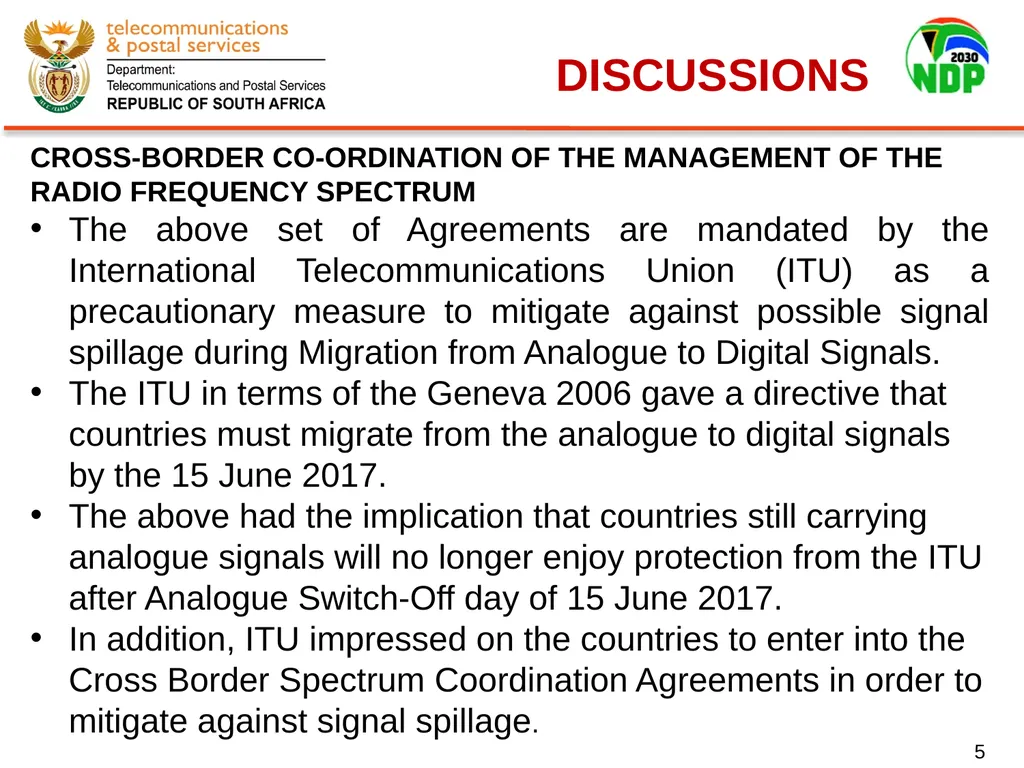
slide5. 5 CROSS-BORDER CO-ORDINATION OF THE MANAGEMENT OF THE RADIO FREQUENCY SPECTRUM
The above set of Agreements are mandated by the International Telecommunications Union (ITU) as a precautionary measure to mitigate against possible signal spillage during Migration from Analogue to Digital Signals.
The ITU in terms of the Geneva 2006 gave a directive that countries must migrate from the analogue to digital signals by the 15 June 2017.
The above had the implication that countries still carrying analogue signals will no longer enjoy protection from the ITU after Analogue Switch-Off day of 15 June 2017.
In addition, ITU impressed on the countries to enter into the Cross Border Spectrum Coordination Agreements in order to mitigate against signal spillage. DISCUSSIONS<br>
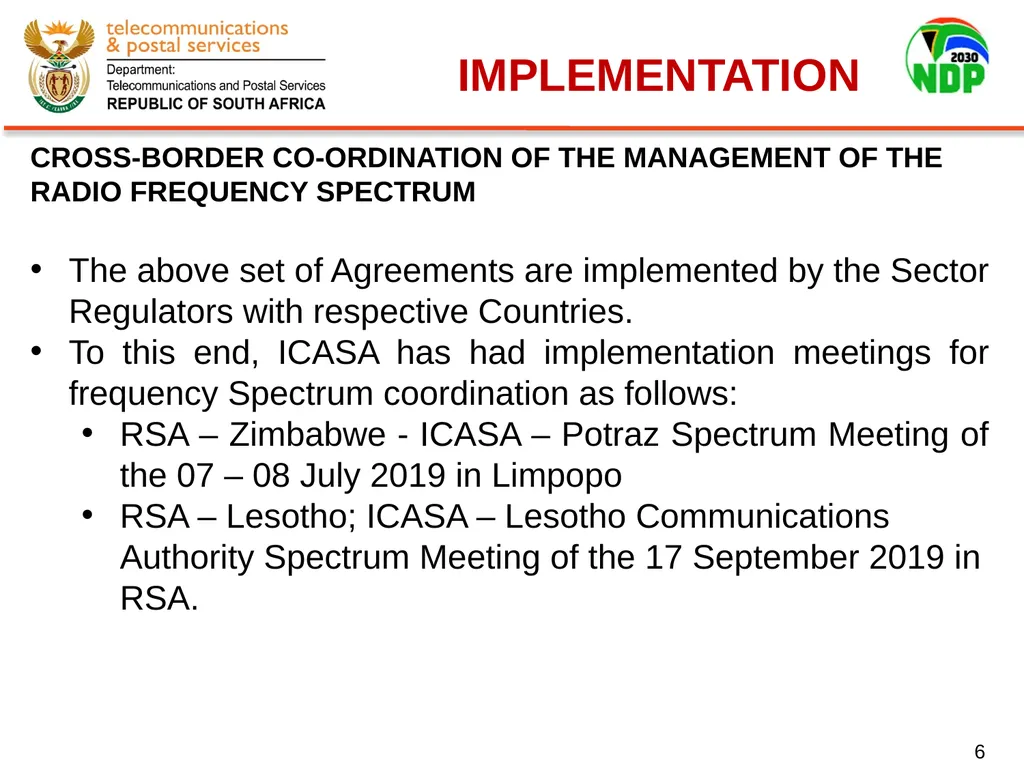
slide6. 6 CROSS-BORDER CO-ORDINATION OF THE MANAGEMENT OF THE RADIO FREQUENCY SPECTRUM
The above set of Agreements are implemented by the Sector Regulators with respective Countries.
To this end, ICASA has had implementation meetings for frequency Spectrum coordination as follows:
RSA – Zimbabwe - ICASA – Potraz Spectrum Meeting of the 07 – 08 July 2019 in Limpopo
RSA – Lesotho; ICASA – Lesotho Communications Authority Spectrum Meeting of the 17 September 2019 in RSA. IMPLEMENTATION<br>
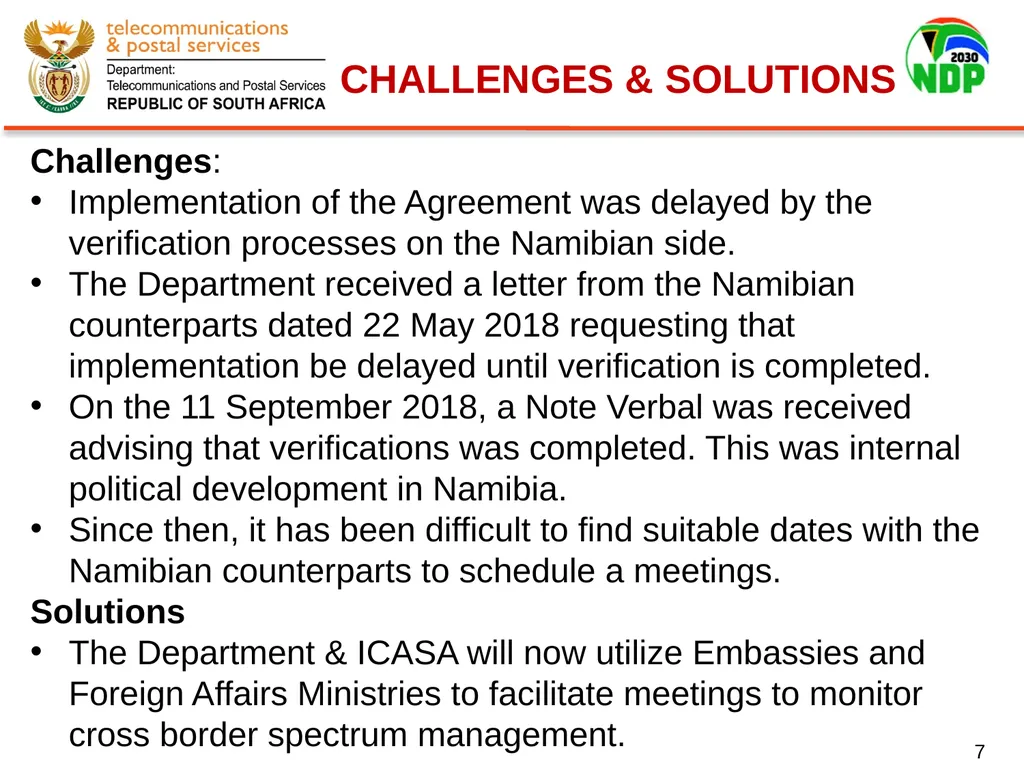
slide7. 7 Challenges:
Implementation of the Agreement was delayed by the verification processes on the Namibian side.
The Department received a letter from the Namibian counterparts dated 22 May 2018 requesting that implementation be delayed until verification is completed.
On the 11 September 2018, a Note Verbal was received advising that verifications was completed. This was internal political development in Namibia.
Since then, it has been difficult to find suitable dates with the Namibian counterparts to schedule a meetings.
Solutions
The Department & ICASA will now utilize Embassies and Foreign Affairs Ministries to facilitate meetings to monitor cross border spectrum management. CHALLENGES & SOLUTIONS<br>
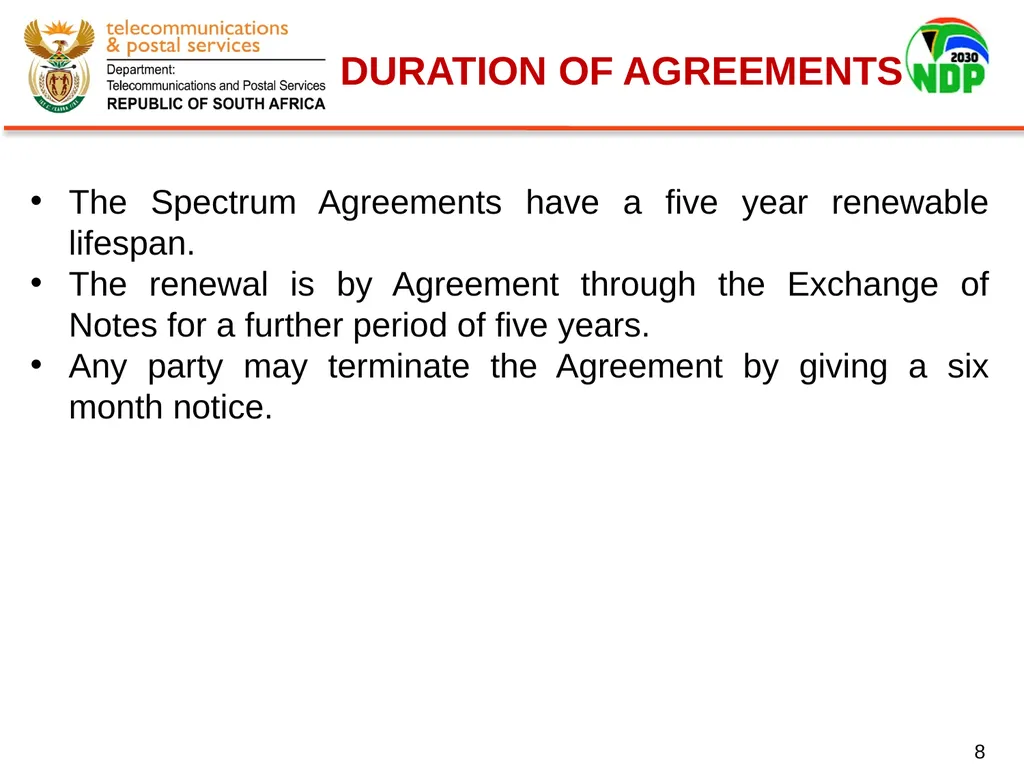
slide8. 8 The Spectrum Agreements have a five year renewable lifespan.
The renewal is by Agreement through the Exchange of Notes for a further period of five years.
Any party may terminate the Agreement by giving a six month notice. DURATION OF AGREEMENTS<br>
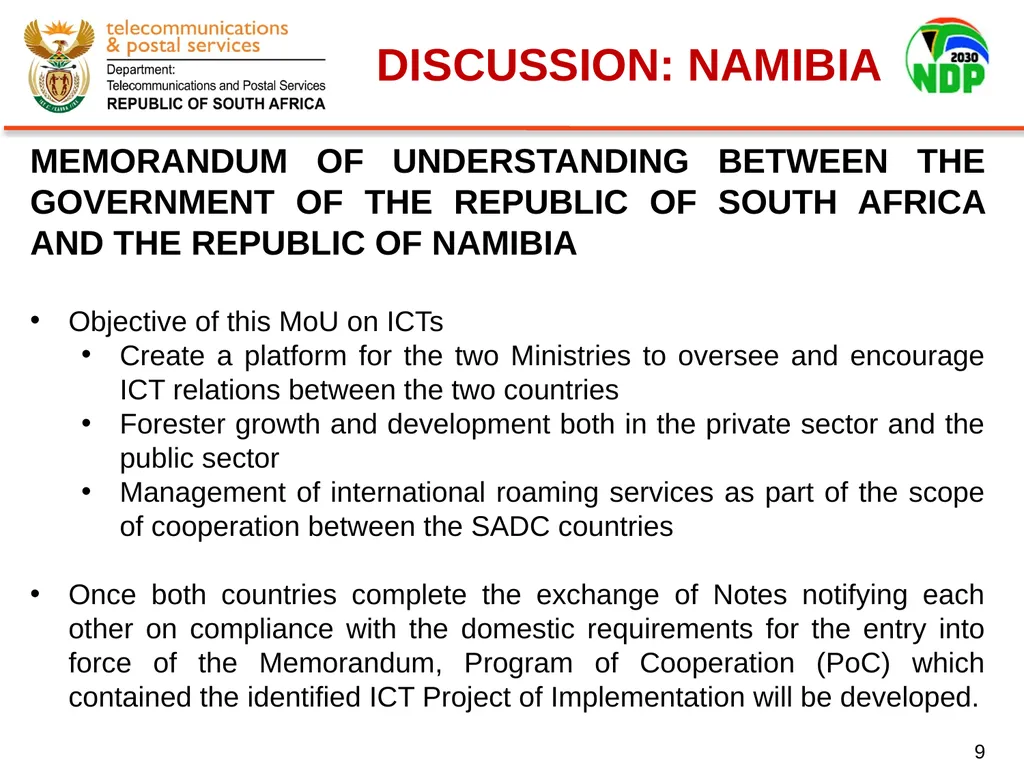
slide9. 9 MEMORANDUM OF UNDERSTANDING BETWEEN THE GOVERNMENT OF THE REPUBLIC OF SOUTH AFRICA AND THE REPUBLIC OF NAMIBIA
Objective of this MoU on ICTs
Create a platform for the two Ministries to oversee and encourage ICT relations between the two countries
Forester growth and development both in the private sector and the public sector
Management of international roaming services as part of the scope of cooperation between the SADC countries
Once both countries complete the exchange of Notes notifying each other on compliance with the domestic requirements for the entry into force of the Memorandum, Program of Cooperation (PoC) which contained the identified ICT Project of Implementation will be developed. DISCUSSION: NAMIBIA<br>
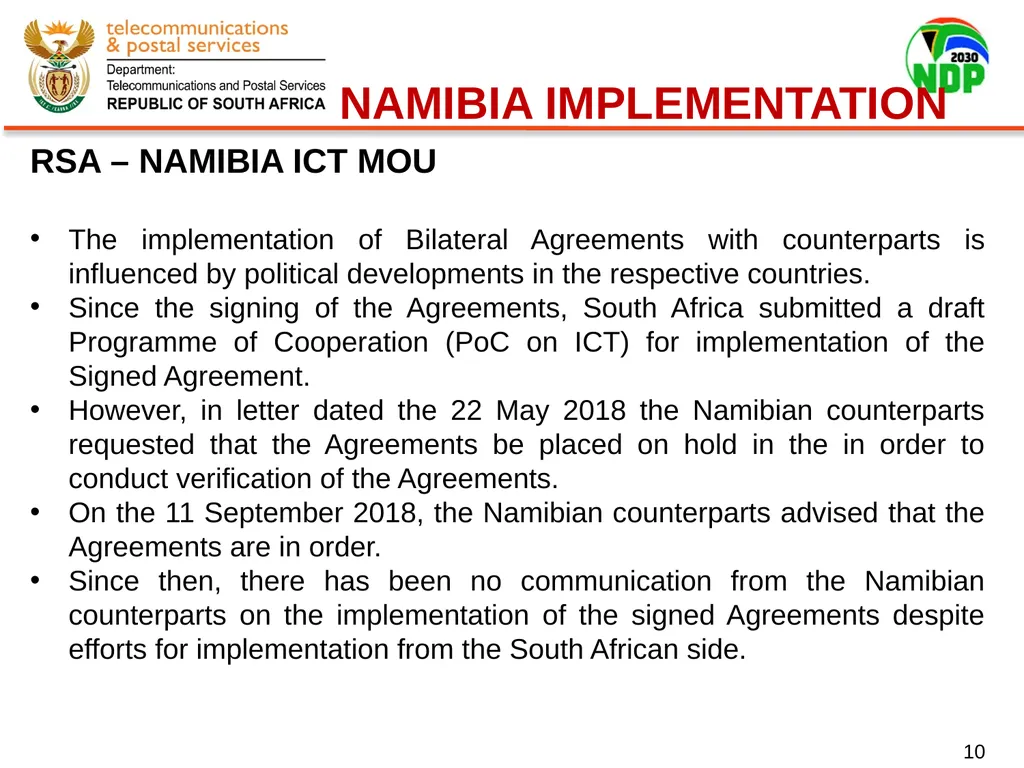
slide10. 10 RSA – NAMIBIA ICT MOU
The implementation of Bilateral Agreements with counterparts is influenced by political developments in the respective countries.
Since the signing of the Agreements, South Africa submitted a draft Programme of Cooperation (PoC on ICT) for implementation of the Signed Agreement.
However, in letter dated the 22 May 2018 the Namibian counterparts requested that the Agreements be placed on hold in the in order to conduct verification of the Agreements.
On the 11 September 2018, the Namibian counterparts advised that the Agreements are in order.
Since then, there has been no communication from the Namibian counterparts on the implementation of the signed Agreements despite efforts for implementation from the South African side. NAMIBIA IMPLEMENTATION<br>
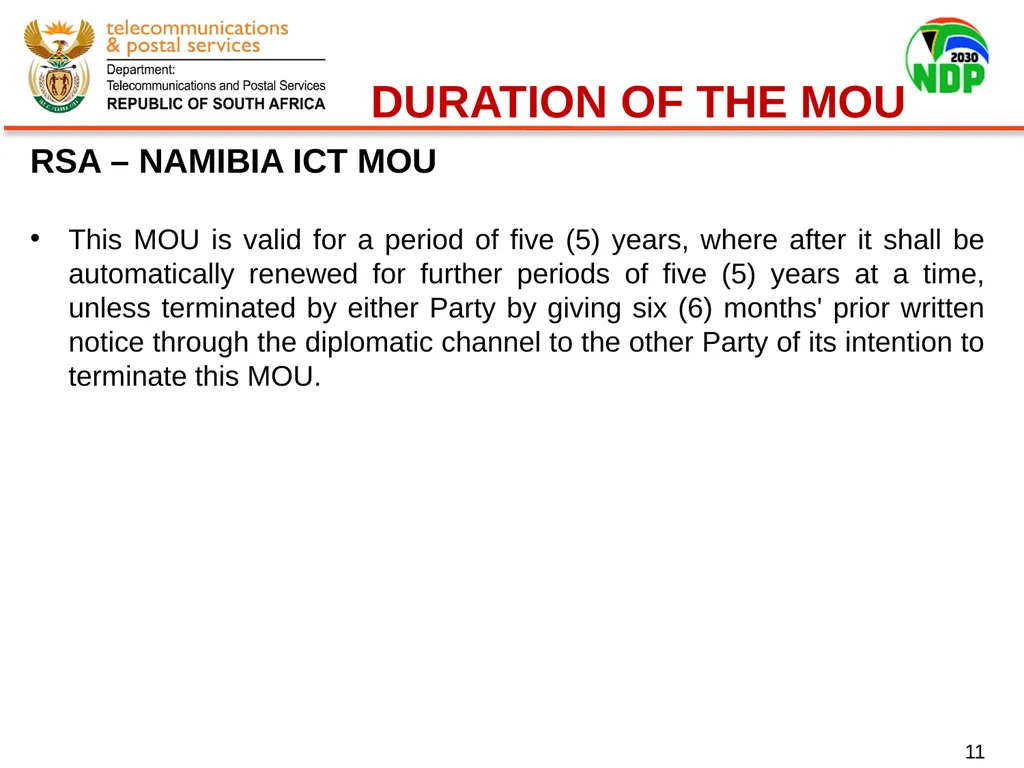
slide11. 11 RSA – NAMIBIA ICT MOU
This MOU is valid for a period of five (5) years, where after it shall be automatically renewed for further periods of five (5) years at a time, unless terminated by either Party by giving six (6) months' prior written notice through the diplomatic channel to the other Party of its intention to terminate this MOU. DURATION OF THE MOU<br>
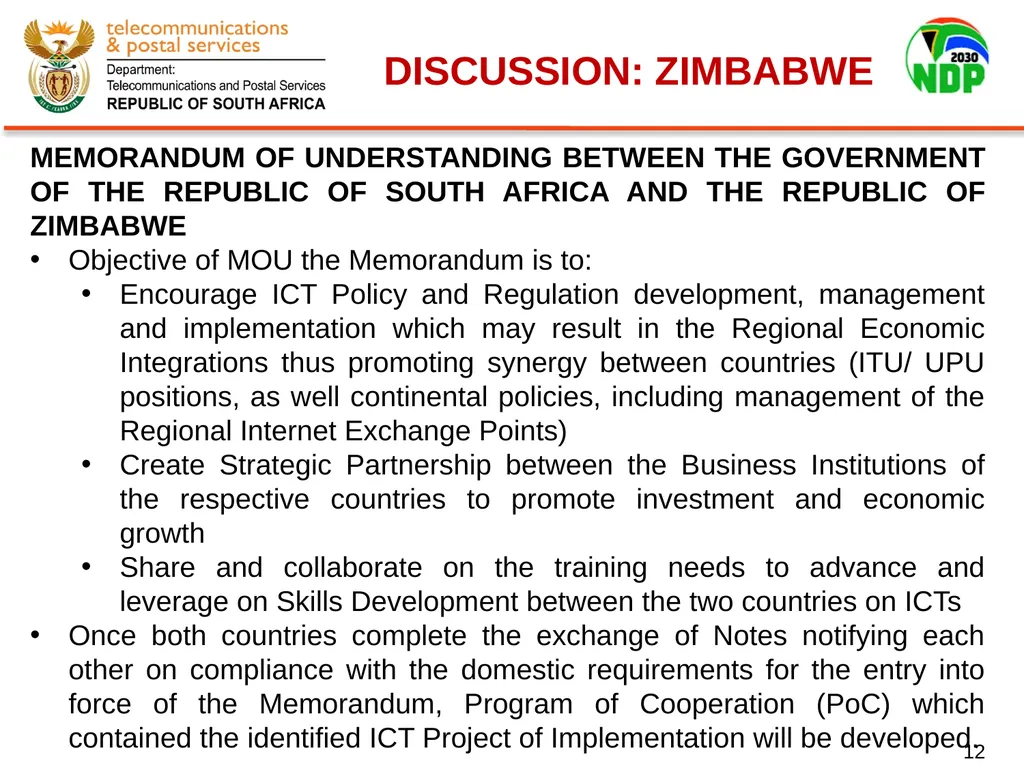
slide12. 12 MEMORANDUM OF UNDERSTANDING BETWEEN THE GOVERNMENT OF THE REPUBLIC OF SOUTH AFRICA AND THE REPUBLIC OF ZIMBABWE
Objective of MOU the Memorandum is to:
Encourage ICT Policy and Regulation development, management and implementation which may result in the Regional Economic Integrations thus promoting synergy between countries (ITU/ UPU positions, as well continental policies, including management of the Regional Internet Exchange Points)
Create Strategic Partnership between the Business Institutions of the respective countries to promote investment and economic growth
Share and collaborate on the training needs to advance and leverage on Skills Development between the two countries on ICTs
Once both countries complete the exchange of Notes notifying each other on compliance with the domestic requirements for the entry into force of the Memorandum, Program of Cooperation (PoC) which contained the identified ICT Project of Implementation will be developed. DISCUSSION: ZIMBABWE<br>
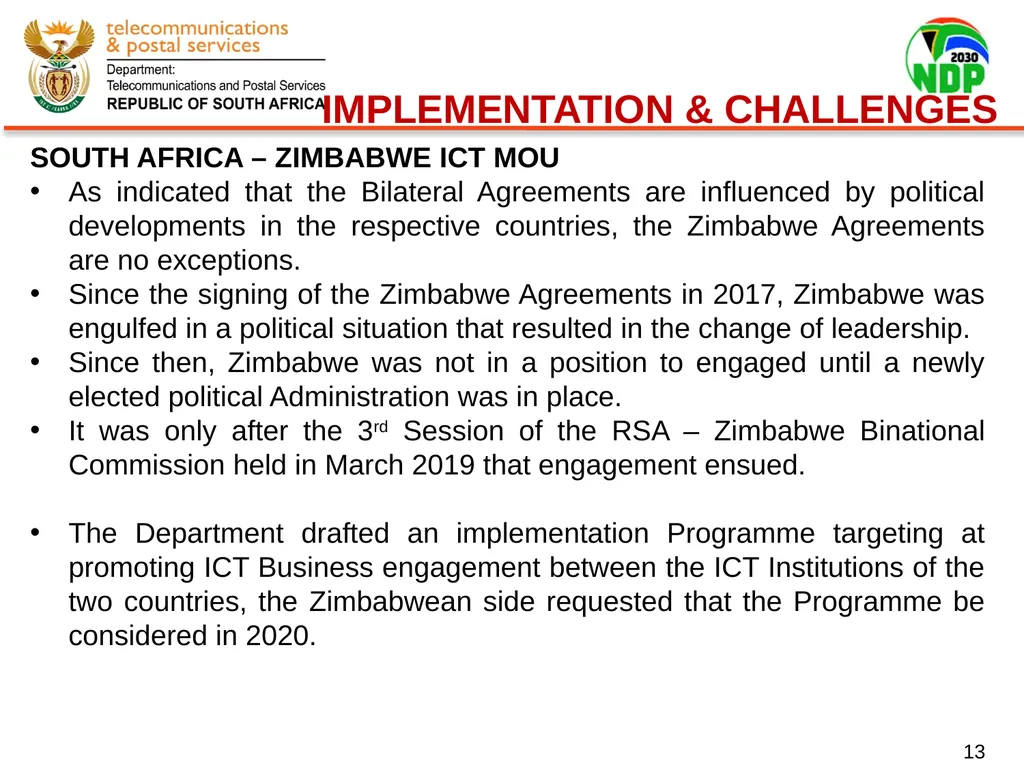
slide13. 13 SOUTH AFRICA – ZIMBABWE ICT MOU
As indicated that the Bilateral Agreements are influenced by political developments in the respective countries, the Zimbabwe Agreements are no exceptions.
Since the signing of the Zimbabwe Agreements in 2017, Zimbabwe was engulfed in a political situation that resulted in the change of leadership.
Since then, Zimbabwe was not in a position to engaged until a newly elected political Administration was in place.
It was only after the 3rd Session of the RSA – Zimbabwe Binational Commission held in March 2019 that engagement ensued.
The Department drafted an implementation Programme targeting at promoting ICT Business engagement between the ICT Institutions of the two countries, the Zimbabwean side requested that the Programme be considered in 2020. IMPLEMENTATION & CHALLENGES<br>
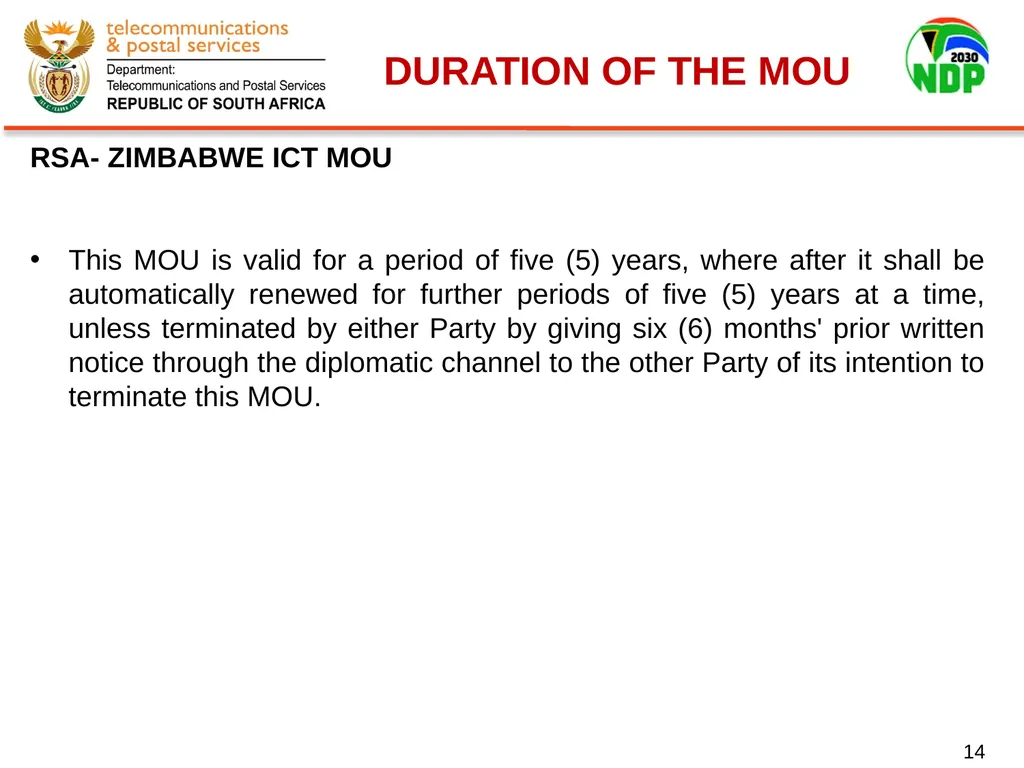
slide14. 14 RSA- ZIMBABWE ICT MOU
This MOU is valid for a period of five (5) years, where after it shall be automatically renewed for further periods of five (5) years at a time, unless terminated by either Party by giving six (6) months' prior written notice through the diplomatic channel to the other Party of its intention to terminate this MOU. DURATION OF THE MOU<br>
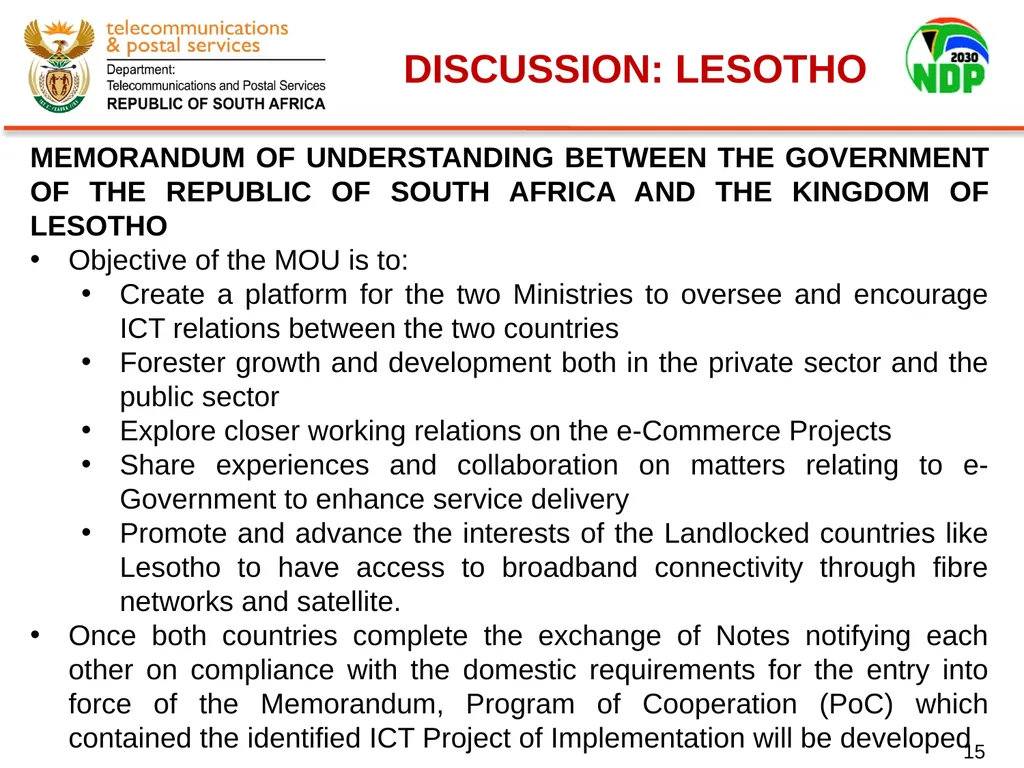
slide15. 15 MEMORANDUM OF UNDERSTANDING BETWEEN THE GOVERNMENT OF THE REPUBLIC OF SOUTH AFRICA AND THE KINGDOM OF LESOTHO
Objective of the MOU is to:
Create a platform for the two Ministries to oversee and encourage ICT relations between the two countries
Forester growth and development both in the private sector and the public sector
Explore closer working relations on the e-Commerce Projects
Share experiences and collaboration on matters relating to e-Government to enhance service delivery
Promote and advance the interests of the Landlocked countries like Lesotho to have access to broadband connectivity through fibre networks and satellite.
Once both countries complete the exchange of Notes notifying each other on compliance with the domestic requirements for the entry into force of the Memorandum, Program of Cooperation (PoC) which contained the identified ICT Project of Implementation will be developed DISCUSSION: LESOTHO<br>
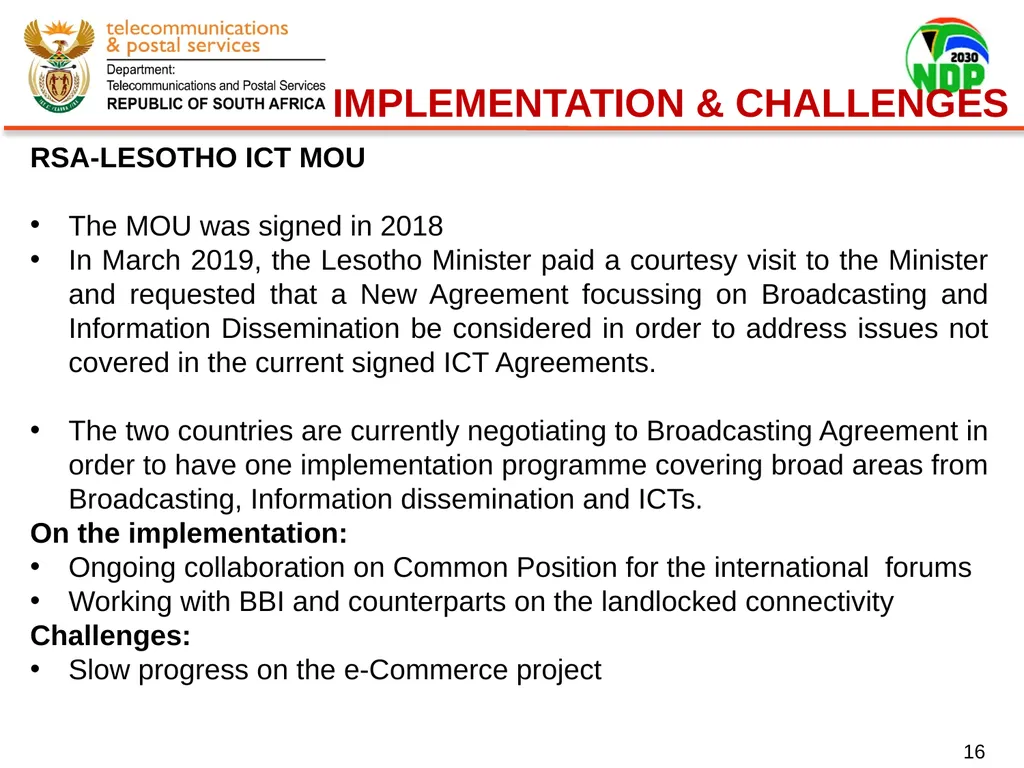
slide16. 16 RSA-LESOTHO ICT MOU
The MOU was signed in 2018
In March 2019, the Lesotho Minister paid a courtesy visit to the Minister and requested that a New Agreement focussing on Broadcasting and Information Dissemination be considered in order to address issues not covered in the current signed ICT Agreements.
The two countries are currently negotiating to Broadcasting Agreement in order to have one implementation programme covering broad areas from Broadcasting, Information dissemination and ICTs.
On the implementation:
Ongoing collaboration on Common Position for the international forums
Working with BBI and counterparts on the landlocked connectivity
Challenges:
Slow progress on the e-Commerce project IMPLEMENTATION & CHALLENGES<br>
slide17. 17 RSA-LESOTHO ICT MOU
This MOU shall remain in force for a period of five (5) years, where after it shall be automatically renewed for further periods of five (5) years at a time, unless terminated by either Party by giving six (6) months' prior written notice through the diplomatic channel to the other Party of its intention to terminate this MOU..
. DURATION OF THE MOU<br>
slide18. 18 MEMORANDUM OF UNDERSTANDING BETWEEN THE GOVERNMENT OF THE REPUBLIC OF SOUTH AFRICA AND THE GOVERNMENT OF THE REPUBLIC OF TUNISIA
Objective of MOU is to:
Advance economic and social development in the two countries towards building inclusive information society, particularly in view of the opportunities identified by the World Summit on the Information Society (WSIS)
Forge closer relations on Capacity Development on ICT including Training and Development on scares ICT Skills
Promote ICT business and investment relations both in the private and public sector domain
Collaborate within Institutions of Global Governance dealing with ICTs (ITU and UPU) as well as promote ICT Business Relations
Once both countries complete the exchange of Notes notifying each other on compliance with the domestic requirements for the entry into force of the Memorandum, Program of Cooperation (PoC) which contained the identified ICT Project of Implementation will be developed. DISCUSSION: TUNISIA<br>
slide19. 19 RSA - TUNISIA ICT MOU
A draft ICT Programme of Cooperation was communicated to the Tunisian counterparts for consideration.
Tunisia hosted the SITIC Africa from the 18 – 20 June 2019 and invited the South African ICT Business Organisation to attend the ICT Expo and explore ICT Opportunities with the Tunisia counterparts. The South African ICT Companies participated through South Africa Exports Electrical Council (SAEEC)- This is in line with the Article 3 (d) relating to encouraging and promoting business partnerships between the two countries.
Challenges:
Funding and human resource capacity to execute the MOU IMPLEMENTATION & CHALLENGES<br>
slide20. 20 RSA-TUNISIA ICT MOU
This MOU is valid for a period of five (5) years, where after it shall be automatically renewed for further periods of five (5) years at a time, unless terminated by either Party by giving six (6) months' prior written notice through the diplomatic channel to the other Party of its intention to terminate this MOU. DURATION OF THE MOU<br>
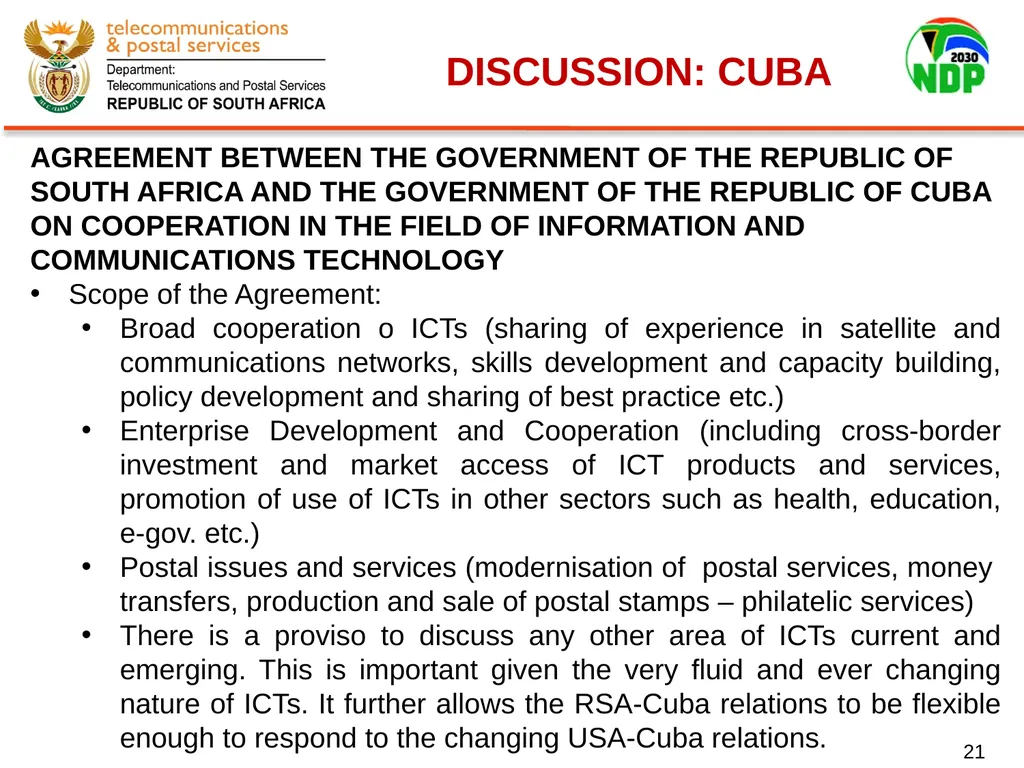
slide21. 21 AGREEMENT BETWEEN THE GOVERNMENT OF THE REPUBLIC OF SOUTH AFRICA AND THE GOVERNMENT OF THE REPUBLIC OF CUBA
ON COOPERATION IN THE FIELD OF INFORMATION AND COMMUNICATIONS TECHNOLOGY
Scope of the Agreement:
Broad cooperation o ICTs (sharing of experience in satellite and communications networks, skills development and capacity building, policy development and sharing of best practice etc.)
Enterprise Development and Cooperation (including cross-border investment and market access of ICT products and services, promotion of use of ICTs in other sectors such as health, education, e-gov. etc.)
Postal issues and services (modernisation of postal services, money transfers, production and sale of postal stamps – philatelic services)
There is a proviso to discuss any other area of ICTs current and emerging. This is important given the very fluid and ever changing nature of ICTs. It further allows the RSA-Cuba relations to be flexible enough to respond to the changing USA-Cuba relations. DISCUSSION: CUBA<br>
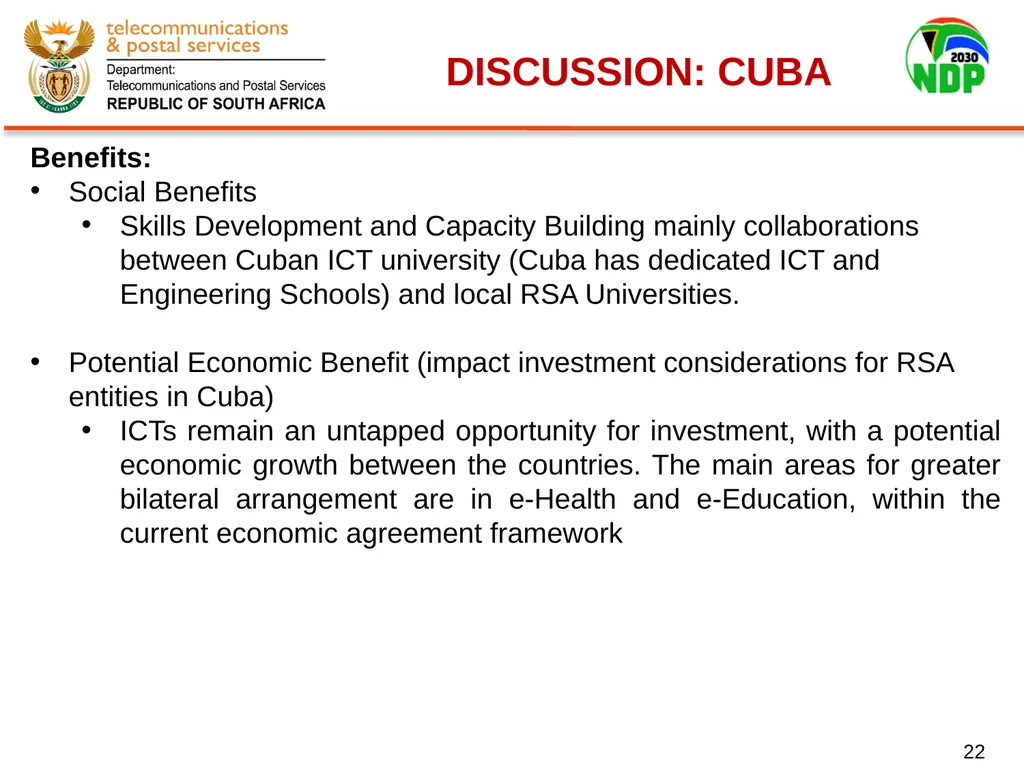
slide22. 22 Benefits:
Social Benefits
Skills Development and Capacity Building mainly collaborations between Cuban ICT university (Cuba has dedicated ICT and Engineering Schools) and local RSA Universities.
Potential Economic Benefit (impact investment considerations for RSA entities in Cuba)
ICTs remain an untapped opportunity for investment, with a potential economic growth between the countries. The main areas for greater bilateral arrangement are in e-Health and e-Education, within the current economic agreement framework DISCUSSION: CUBA<br>
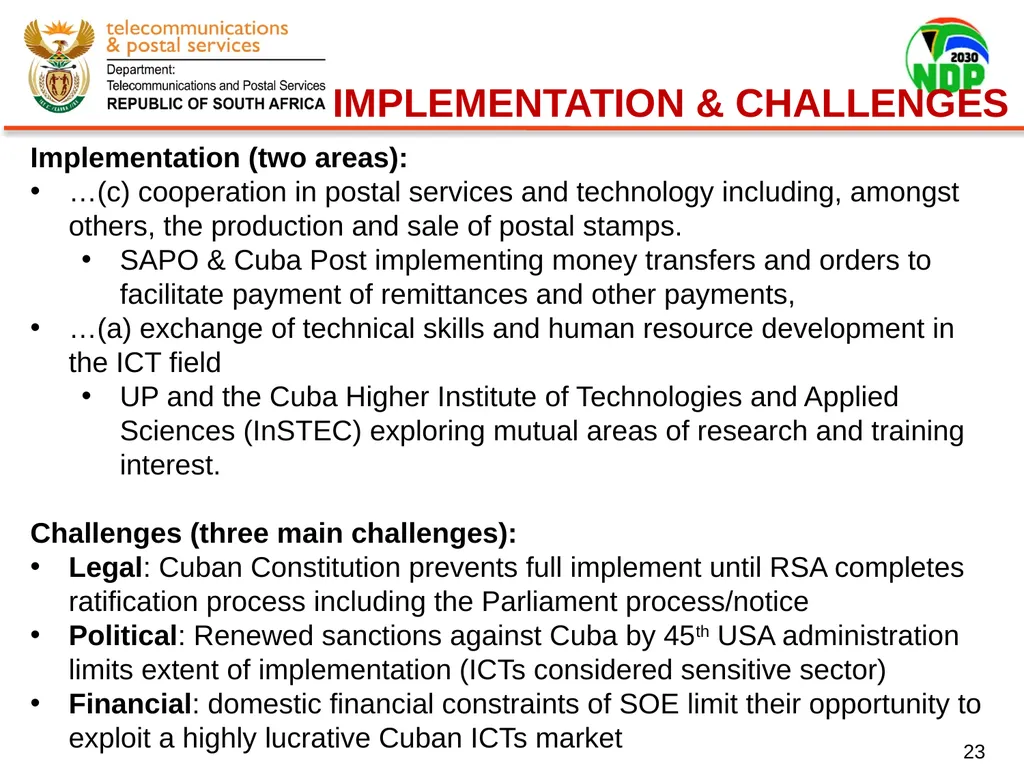
slide23. 23 Implementation (two areas):
…(c) cooperation in postal services and technology including, amongst others, the production and sale of postal stamps.
SAPO & Cuba Post implementing money transfers and orders to facilitate payment of remittances and other payments,
…(a) exchange of technical skills and human resource development in the ICT field
UP and the Cuba Higher Institute of Technologies and Applied Sciences (InSTEC) exploring mutual areas of research and training interest.
Challenges (three main challenges):
Legal: Cuban Constitution prevents full implement until RSA completes ratification process including the Parliament process/notice
Political: Renewed sanctions against Cuba by 45th USA administration limits extent of implementation (ICTs considered sensitive sector)
Financial: domestic financial constraints of SOE limit their opportunity to exploit a highly lucrative Cuban ICTs market IMPLEMENTATION & CHALLENGES<br>
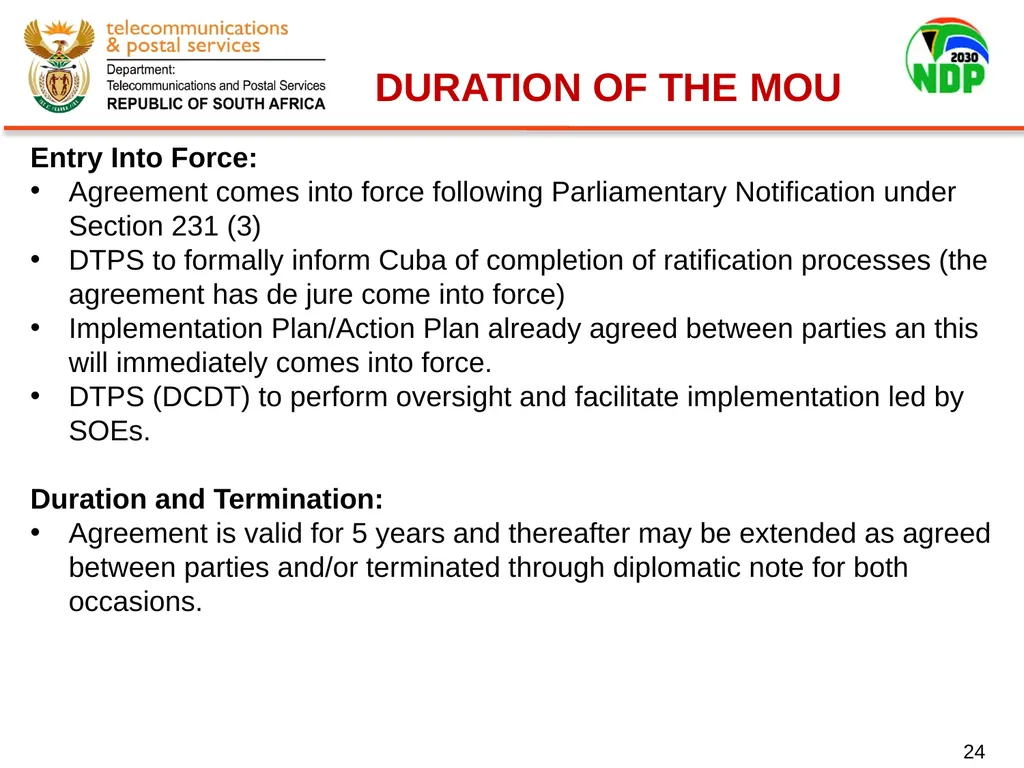
slide24. 24 Entry Into Force:
Agreement comes into force following Parliamentary Notification under Section 231 (3)
DTPS to formally inform Cuba of completion of ratification processes (the agreement has de jure come into force)
Implementation Plan/Action Plan already agreed between parties an this will immediately comes into force.
DTPS (DCDT) to perform oversight and facilitate implementation led by SOEs.
Duration and Termination:
Agreement is valid for 5 years and thereafter may be extended as agreed between parties and/or terminated through diplomatic note for both occasions. DURATION OF THE MOU<br>
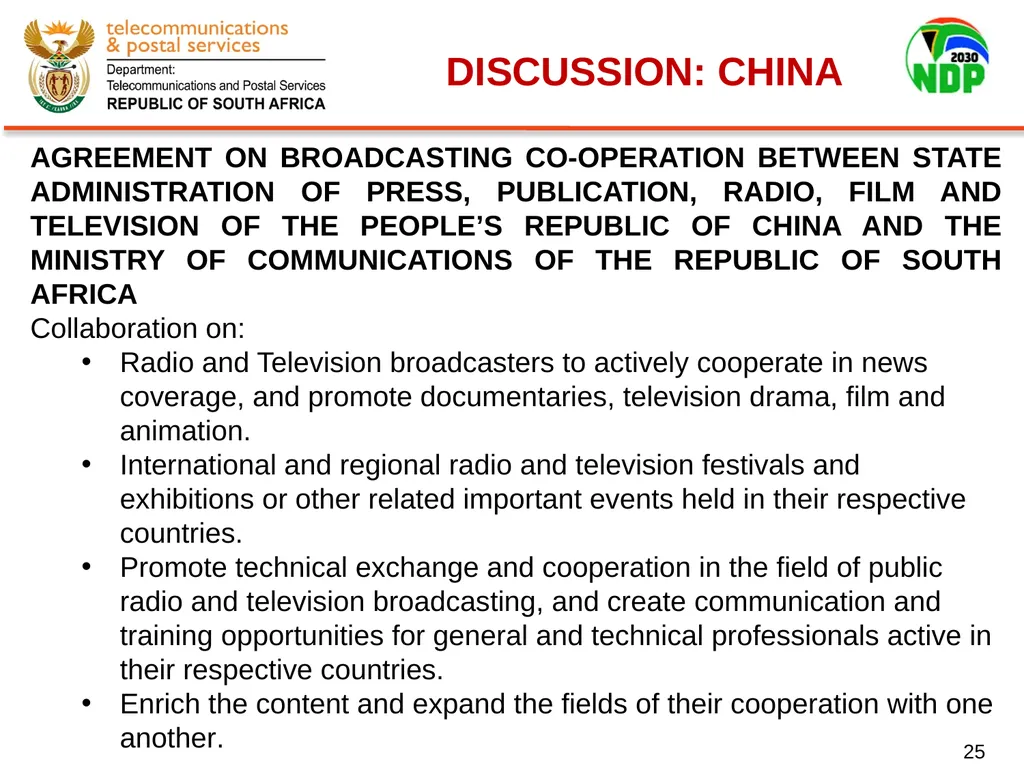
slide25. 25 AGREEMENT ON BROADCASTING CO-OPERATION BETWEEN STATE ADMINISTRATION OF PRESS, PUBLICATION, RADIO, FILM AND TELEVISION OF THE PEOPLE’S REPUBLIC OF CHINA AND THE MINISTRY OF COMMUNICATIONS OF THE REPUBLIC OF SOUTH AFRICA
Collaboration on:
Radio and Television broadcasters to actively cooperate in news coverage, and promote documentaries, television drama, film and animation.
International and regional radio and television festivals and exhibitions or other related important events held in their respective countries.
Promote technical exchange and cooperation in the field of public radio and television broadcasting, and create communication and training opportunities for general and technical professionals active in their respective countries.
Enrich the content and expand the fields of their cooperation with one another. DISCUSSION: CHINA<br>
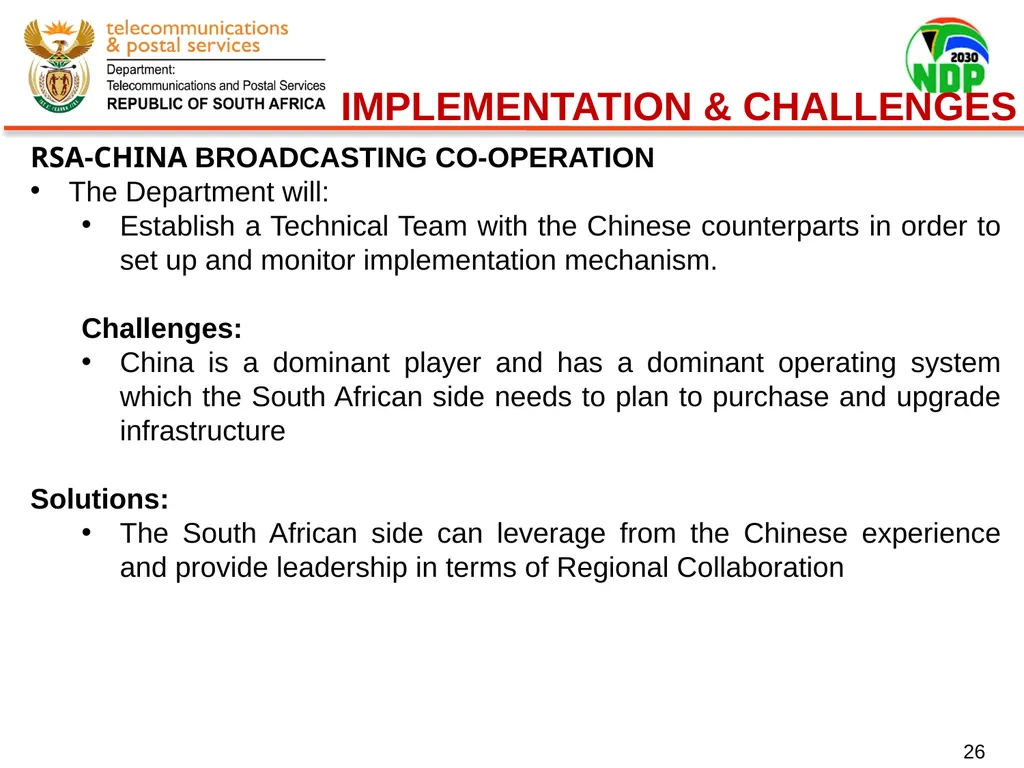
slide26. 26 RSA-CHINA BROADCASTING CO-OPERATION
The Department will:
Establish a Technical Team with the Chinese counterparts in order to set up and monitor implementation mechanism.
Challenges:
China is a dominant player and has a dominant operating system which the South African side needs to plan to purchase and upgrade infrastructure
Solutions:
The South African side can leverage from the Chinese experience and provide leadership in terms of Regional Collaboration IMPLEMENTATION & CHALLENGES<br>
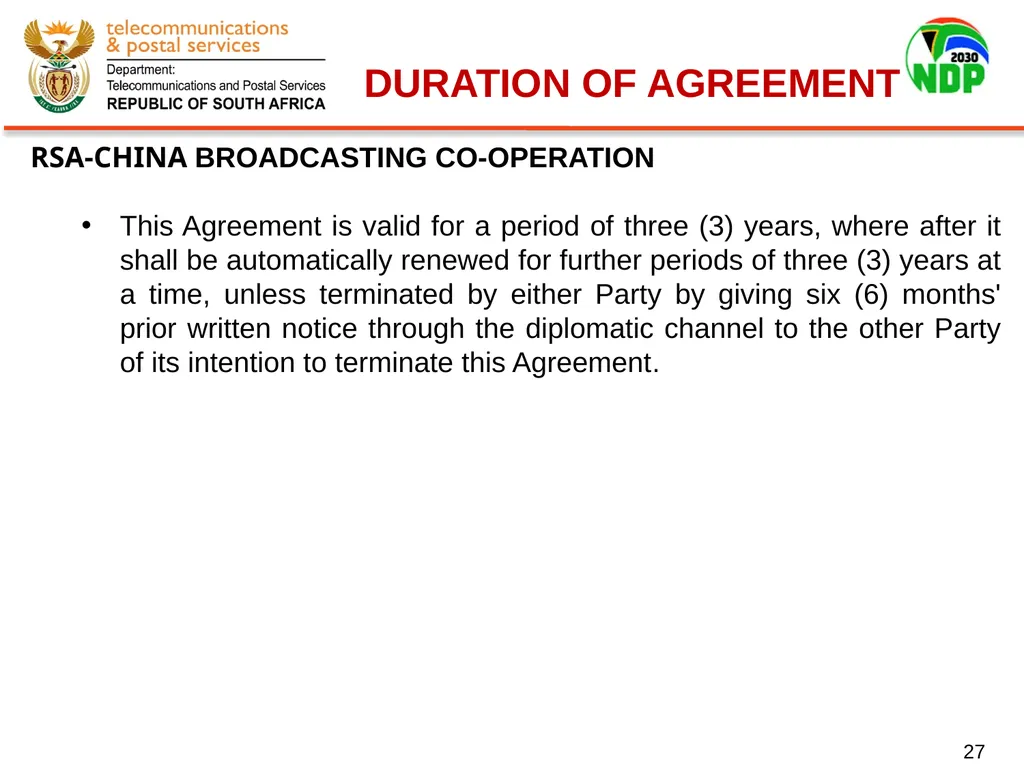
slide27. 27 RSA-CHINA BROADCASTING CO-OPERATION
This Agreement is valid for a period of three (3) years, where after it shall be automatically renewed for further periods of three (3) years at a time, unless terminated by either Party by giving six (6) months' prior written notice through the diplomatic channel to the other Party of its intention to terminate this Agreement. DURATION OF AGREEMENT<br>
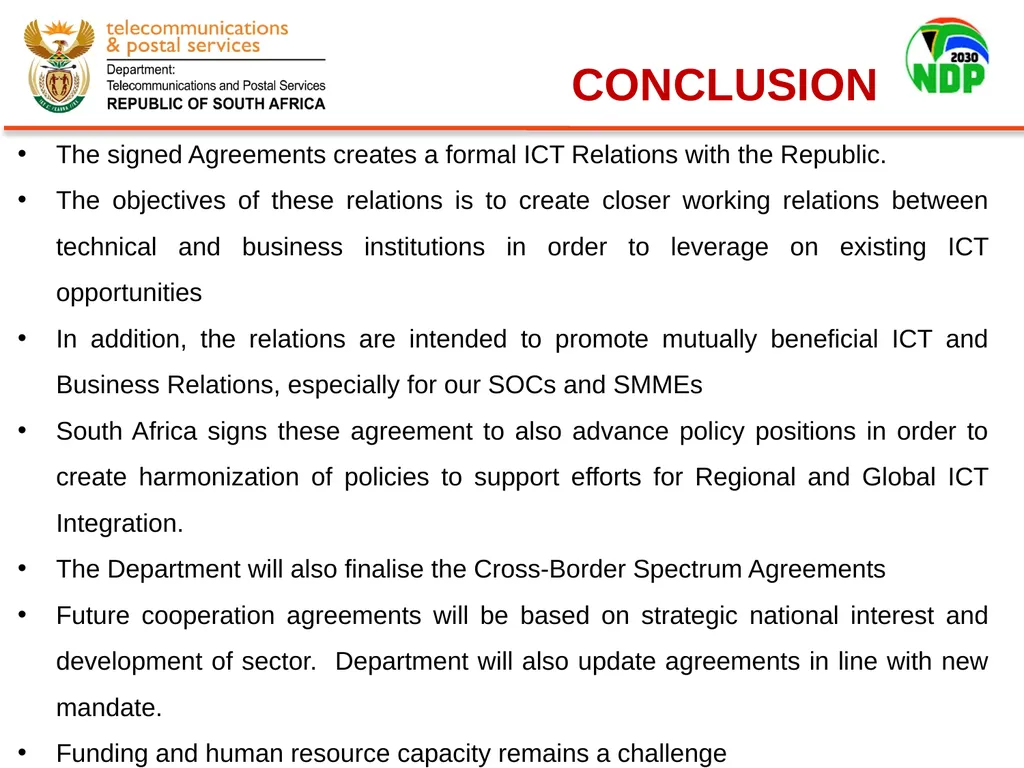
slide28. The signed Agreements creates a formal ICT Relations with the Republic.
The objectives of these relations is to create closer working relations between technical and business institutions in order to leverage on existing ICT opportunities
In addition, the relations are intended to promote mutually beneficial ICT and Business Relations, especially for our SOCs and SMMEs
South Africa signs these agreement to also advance policy positions in order to create harmonization of policies to support efforts for Regional and Global ICT Integration.
The Department will also finalise the Cross-Border Spectrum Agreements
Future cooperation agreements will be based on strategic national interest and development of sector. Department will also update agreements in line with new mandate.
Funding and human resource capacity remains a challenge CONCLUSION<br>
slide2. 2 The Constitution of the Republic of South Africa places an obligation under Section 231 (3), that the National Assembly and National Council of Provinces should be notified in reasonable time agreements of a technical administrative and executive nature,
Flowing from the Court Judgement on the Earthlife Africa Johannesburg and Another v Minister of Energy and Others (19529/2015) [2017] ZAWCHC 50,
The Department Tables the below mentioned Agreements for Information purpose and wish for the necessary Instruments to notify counterparts Administrations on the Entry Into Force of the Agreements. INTRODUCTION<br>
slide3. 3 RSA & Namibia MOU on ICTs – signed on 07 September 2017
RSA & Namibia on Cross Border Coordination of Frequency Spectrum – signed on 7 September 2017
RSA & Zimbabwe MOU on ICTs – signed on 03 October 2017
RSA & Zimbabwe on Cross Border Coordination of Frequency Spectrum – signed on 03 October 2017
RSA &Cuba Agreement of Co-operation in the fields of ICTs – signed on 11 May 2018
RSA & Lesotho MOU on ICTs – signed on 31 October 2018
RSA & Lesotho on Cross Border Coordination of Frequency Spectrum – signed on 31 October 2018
RSA &Tunisia MOU on ICTs – signed on 01 November 2018 INTRODUCTION<br>
slide4. 4 CROSS-BORDER CO-ORDINATION OF THE MANAGEMENT OF THE RADIO FREQUENCY SPECTRUM
The first Sets of Agreements regarding Cross-border Co-ordination of the Management of the Radio Frequency Spectrum (Spectrum Agreements), are with the neighbouring countries.
The Department has concluded Three (3) of the Six (6) Agreements, namely:
RSA and Namibia
RSA and Zimbabwe
RSA and Kingdom of Lesotho
The Agreement with Mozambique signed in 2011, and the draft Agreements with the Kingdom of Eswatini and Republic of Botswana under negotiations currently. DISCUSSIONS<br>
slide5. 5 CROSS-BORDER CO-ORDINATION OF THE MANAGEMENT OF THE RADIO FREQUENCY SPECTRUM
The above set of Agreements are mandated by the International Telecommunications Union (ITU) as a precautionary measure to mitigate against possible signal spillage during Migration from Analogue to Digital Signals.
The ITU in terms of the Geneva 2006 gave a directive that countries must migrate from the analogue to digital signals by the 15 June 2017.
The above had the implication that countries still carrying analogue signals will no longer enjoy protection from the ITU after Analogue Switch-Off day of 15 June 2017.
In addition, ITU impressed on the countries to enter into the Cross Border Spectrum Coordination Agreements in order to mitigate against signal spillage. DISCUSSIONS<br>
slide6. 6 CROSS-BORDER CO-ORDINATION OF THE MANAGEMENT OF THE RADIO FREQUENCY SPECTRUM
The above set of Agreements are implemented by the Sector Regulators with respective Countries.
To this end, ICASA has had implementation meetings for frequency Spectrum coordination as follows:
RSA – Zimbabwe - ICASA – Potraz Spectrum Meeting of the 07 – 08 July 2019 in Limpopo
RSA – Lesotho; ICASA – Lesotho Communications Authority Spectrum Meeting of the 17 September 2019 in RSA. IMPLEMENTATION<br>
slide7. 7 Challenges:
Implementation of the Agreement was delayed by the verification processes on the Namibian side.
The Department received a letter from the Namibian counterparts dated 22 May 2018 requesting that implementation be delayed until verification is completed.
On the 11 September 2018, a Note Verbal was received advising that verifications was completed. This was internal political development in Namibia.
Since then, it has been difficult to find suitable dates with the Namibian counterparts to schedule a meetings.
Solutions
The Department & ICASA will now utilize Embassies and Foreign Affairs Ministries to facilitate meetings to monitor cross border spectrum management. CHALLENGES & SOLUTIONS<br>
slide8. 8 The Spectrum Agreements have a five year renewable lifespan.
The renewal is by Agreement through the Exchange of Notes for a further period of five years.
Any party may terminate the Agreement by giving a six month notice. DURATION OF AGREEMENTS<br>
slide9. 9 MEMORANDUM OF UNDERSTANDING BETWEEN THE GOVERNMENT OF THE REPUBLIC OF SOUTH AFRICA AND THE REPUBLIC OF NAMIBIA
Objective of this MoU on ICTs
Create a platform for the two Ministries to oversee and encourage ICT relations between the two countries
Forester growth and development both in the private sector and the public sector
Management of international roaming services as part of the scope of cooperation between the SADC countries
Once both countries complete the exchange of Notes notifying each other on compliance with the domestic requirements for the entry into force of the Memorandum, Program of Cooperation (PoC) which contained the identified ICT Project of Implementation will be developed. DISCUSSION: NAMIBIA<br>
slide10. 10 RSA – NAMIBIA ICT MOU
The implementation of Bilateral Agreements with counterparts is influenced by political developments in the respective countries.
Since the signing of the Agreements, South Africa submitted a draft Programme of Cooperation (PoC on ICT) for implementation of the Signed Agreement.
However, in letter dated the 22 May 2018 the Namibian counterparts requested that the Agreements be placed on hold in the in order to conduct verification of the Agreements.
On the 11 September 2018, the Namibian counterparts advised that the Agreements are in order.
Since then, there has been no communication from the Namibian counterparts on the implementation of the signed Agreements despite efforts for implementation from the South African side. NAMIBIA IMPLEMENTATION<br>
slide11. 11 RSA – NAMIBIA ICT MOU
This MOU is valid for a period of five (5) years, where after it shall be automatically renewed for further periods of five (5) years at a time, unless terminated by either Party by giving six (6) months' prior written notice through the diplomatic channel to the other Party of its intention to terminate this MOU. DURATION OF THE MOU<br>
slide12. 12 MEMORANDUM OF UNDERSTANDING BETWEEN THE GOVERNMENT OF THE REPUBLIC OF SOUTH AFRICA AND THE REPUBLIC OF ZIMBABWE
Objective of MOU the Memorandum is to:
Encourage ICT Policy and Regulation development, management and implementation which may result in the Regional Economic Integrations thus promoting synergy between countries (ITU/ UPU positions, as well continental policies, including management of the Regional Internet Exchange Points)
Create Strategic Partnership between the Business Institutions of the respective countries to promote investment and economic growth
Share and collaborate on the training needs to advance and leverage on Skills Development between the two countries on ICTs
Once both countries complete the exchange of Notes notifying each other on compliance with the domestic requirements for the entry into force of the Memorandum, Program of Cooperation (PoC) which contained the identified ICT Project of Implementation will be developed. DISCUSSION: ZIMBABWE<br>
slide13. 13 SOUTH AFRICA – ZIMBABWE ICT MOU
As indicated that the Bilateral Agreements are influenced by political developments in the respective countries, the Zimbabwe Agreements are no exceptions.
Since the signing of the Zimbabwe Agreements in 2017, Zimbabwe was engulfed in a political situation that resulted in the change of leadership.
Since then, Zimbabwe was not in a position to engaged until a newly elected political Administration was in place.
It was only after the 3rd Session of the RSA – Zimbabwe Binational Commission held in March 2019 that engagement ensued.
The Department drafted an implementation Programme targeting at promoting ICT Business engagement between the ICT Institutions of the two countries, the Zimbabwean side requested that the Programme be considered in 2020. IMPLEMENTATION & CHALLENGES<br>
slide14. 14 RSA- ZIMBABWE ICT MOU
This MOU is valid for a period of five (5) years, where after it shall be automatically renewed for further periods of five (5) years at a time, unless terminated by either Party by giving six (6) months' prior written notice through the diplomatic channel to the other Party of its intention to terminate this MOU. DURATION OF THE MOU<br>
slide15. 15 MEMORANDUM OF UNDERSTANDING BETWEEN THE GOVERNMENT OF THE REPUBLIC OF SOUTH AFRICA AND THE KINGDOM OF LESOTHO
Objective of the MOU is to:
Create a platform for the two Ministries to oversee and encourage ICT relations between the two countries
Forester growth and development both in the private sector and the public sector
Explore closer working relations on the e-Commerce Projects
Share experiences and collaboration on matters relating to e-Government to enhance service delivery
Promote and advance the interests of the Landlocked countries like Lesotho to have access to broadband connectivity through fibre networks and satellite.
Once both countries complete the exchange of Notes notifying each other on compliance with the domestic requirements for the entry into force of the Memorandum, Program of Cooperation (PoC) which contained the identified ICT Project of Implementation will be developed DISCUSSION: LESOTHO<br>
slide16. 16 RSA-LESOTHO ICT MOU
The MOU was signed in 2018
In March 2019, the Lesotho Minister paid a courtesy visit to the Minister and requested that a New Agreement focussing on Broadcasting and Information Dissemination be considered in order to address issues not covered in the current signed ICT Agreements.
The two countries are currently negotiating to Broadcasting Agreement in order to have one implementation programme covering broad areas from Broadcasting, Information dissemination and ICTs.
On the implementation:
Ongoing collaboration on Common Position for the international forums
Working with BBI and counterparts on the landlocked connectivity
Challenges:
Slow progress on the e-Commerce project IMPLEMENTATION & CHALLENGES<br>
slide17. 17 RSA-LESOTHO ICT MOU
This MOU shall remain in force for a period of five (5) years, where after it shall be automatically renewed for further periods of five (5) years at a time, unless terminated by either Party by giving six (6) months' prior written notice through the diplomatic channel to the other Party of its intention to terminate this MOU..
. DURATION OF THE MOU<br>
slide18. 18 MEMORANDUM OF UNDERSTANDING BETWEEN THE GOVERNMENT OF THE REPUBLIC OF SOUTH AFRICA AND THE GOVERNMENT OF THE REPUBLIC OF TUNISIA
Objective of MOU is to:
Advance economic and social development in the two countries towards building inclusive information society, particularly in view of the opportunities identified by the World Summit on the Information Society (WSIS)
Forge closer relations on Capacity Development on ICT including Training and Development on scares ICT Skills
Promote ICT business and investment relations both in the private and public sector domain
Collaborate within Institutions of Global Governance dealing with ICTs (ITU and UPU) as well as promote ICT Business Relations
Once both countries complete the exchange of Notes notifying each other on compliance with the domestic requirements for the entry into force of the Memorandum, Program of Cooperation (PoC) which contained the identified ICT Project of Implementation will be developed. DISCUSSION: TUNISIA<br>
slide19. 19 RSA - TUNISIA ICT MOU
A draft ICT Programme of Cooperation was communicated to the Tunisian counterparts for consideration.
Tunisia hosted the SITIC Africa from the 18 – 20 June 2019 and invited the South African ICT Business Organisation to attend the ICT Expo and explore ICT Opportunities with the Tunisia counterparts. The South African ICT Companies participated through South Africa Exports Electrical Council (SAEEC)- This is in line with the Article 3 (d) relating to encouraging and promoting business partnerships between the two countries.
Challenges:
Funding and human resource capacity to execute the MOU IMPLEMENTATION & CHALLENGES<br>
slide20. 20 RSA-TUNISIA ICT MOU
This MOU is valid for a period of five (5) years, where after it shall be automatically renewed for further periods of five (5) years at a time, unless terminated by either Party by giving six (6) months' prior written notice through the diplomatic channel to the other Party of its intention to terminate this MOU. DURATION OF THE MOU<br>
slide21. 21 AGREEMENT BETWEEN THE GOVERNMENT OF THE REPUBLIC OF SOUTH AFRICA AND THE GOVERNMENT OF THE REPUBLIC OF CUBA
ON COOPERATION IN THE FIELD OF INFORMATION AND COMMUNICATIONS TECHNOLOGY
Scope of the Agreement:
Broad cooperation o ICTs (sharing of experience in satellite and communications networks, skills development and capacity building, policy development and sharing of best practice etc.)
Enterprise Development and Cooperation (including cross-border investment and market access of ICT products and services, promotion of use of ICTs in other sectors such as health, education, e-gov. etc.)
Postal issues and services (modernisation of postal services, money transfers, production and sale of postal stamps – philatelic services)
There is a proviso to discuss any other area of ICTs current and emerging. This is important given the very fluid and ever changing nature of ICTs. It further allows the RSA-Cuba relations to be flexible enough to respond to the changing USA-Cuba relations. DISCUSSION: CUBA<br>
slide22. 22 Benefits:
Social Benefits
Skills Development and Capacity Building mainly collaborations between Cuban ICT university (Cuba has dedicated ICT and Engineering Schools) and local RSA Universities.
Potential Economic Benefit (impact investment considerations for RSA entities in Cuba)
ICTs remain an untapped opportunity for investment, with a potential economic growth between the countries. The main areas for greater bilateral arrangement are in e-Health and e-Education, within the current economic agreement framework DISCUSSION: CUBA<br>
slide23. 23 Implementation (two areas):
…(c) cooperation in postal services and technology including, amongst others, the production and sale of postal stamps.
SAPO & Cuba Post implementing money transfers and orders to facilitate payment of remittances and other payments,
…(a) exchange of technical skills and human resource development in the ICT field
UP and the Cuba Higher Institute of Technologies and Applied Sciences (InSTEC) exploring mutual areas of research and training interest.
Challenges (three main challenges):
Legal: Cuban Constitution prevents full implement until RSA completes ratification process including the Parliament process/notice
Political: Renewed sanctions against Cuba by 45th USA administration limits extent of implementation (ICTs considered sensitive sector)
Financial: domestic financial constraints of SOE limit their opportunity to exploit a highly lucrative Cuban ICTs market IMPLEMENTATION & CHALLENGES<br>
slide24. 24 Entry Into Force:
Agreement comes into force following Parliamentary Notification under Section 231 (3)
DTPS to formally inform Cuba of completion of ratification processes (the agreement has de jure come into force)
Implementation Plan/Action Plan already agreed between parties an this will immediately comes into force.
DTPS (DCDT) to perform oversight and facilitate implementation led by SOEs.
Duration and Termination:
Agreement is valid for 5 years and thereafter may be extended as agreed between parties and/or terminated through diplomatic note for both occasions. DURATION OF THE MOU<br>
slide25. 25 AGREEMENT ON BROADCASTING CO-OPERATION BETWEEN STATE ADMINISTRATION OF PRESS, PUBLICATION, RADIO, FILM AND TELEVISION OF THE PEOPLE’S REPUBLIC OF CHINA AND THE MINISTRY OF COMMUNICATIONS OF THE REPUBLIC OF SOUTH AFRICA
Collaboration on:
Radio and Television broadcasters to actively cooperate in news coverage, and promote documentaries, television drama, film and animation.
International and regional radio and television festivals and exhibitions or other related important events held in their respective countries.
Promote technical exchange and cooperation in the field of public radio and television broadcasting, and create communication and training opportunities for general and technical professionals active in their respective countries.
Enrich the content and expand the fields of their cooperation with one another. DISCUSSION: CHINA<br>
slide26. 26 RSA-CHINA BROADCASTING CO-OPERATION
The Department will:
Establish a Technical Team with the Chinese counterparts in order to set up and monitor implementation mechanism.
Challenges:
China is a dominant player and has a dominant operating system which the South African side needs to plan to purchase and upgrade infrastructure
Solutions:
The South African side can leverage from the Chinese experience and provide leadership in terms of Regional Collaboration IMPLEMENTATION & CHALLENGES<br>
slide27. 27 RSA-CHINA BROADCASTING CO-OPERATION
This Agreement is valid for a period of three (3) years, where after it shall be automatically renewed for further periods of three (3) years at a time, unless terminated by either Party by giving six (6) months' prior written notice through the diplomatic channel to the other Party of its intention to terminate this Agreement. DURATION OF AGREEMENT<br>
slide28. The signed Agreements creates a formal ICT Relations with the Republic.
The objectives of these relations is to create closer working relations between technical and business institutions in order to leverage on existing ICT opportunities
In addition, the relations are intended to promote mutually beneficial ICT and Business Relations, especially for our SOCs and SMMEs
South Africa signs these agreement to also advance policy positions in order to create harmonization of policies to support efforts for Regional and Global ICT Integration.
The Department will also finalise the Cross-Border Spectrum Agreements
Future cooperation agreements will be based on strategic national interest and development of sector. Department will also update agreements in line with new mandate.
Funding and human resource capacity remains a challenge CONCLUSION<br>