PRESENTATION TITLE Presented by: Name Surname Directorate Date BRIEFING BY THE DEPARTMENT OF WATER AND SANITATION TOWARDS THE ESTABLISHMENT OF AN INDEPENDENT ECONOMIC REGULATOR Presented by Director General: Sifiso Mkhize 8 November 2017 1
Related Topics
Share
Embed code
Download this presentation From Below
"PRESENTATION TITLE Presented by: Name Surname" is the property of its rightful owner. Permission is granted to
download and print the materials on this website for personal, non-commercial use only, and to display it
on your personal computer provided you do not modify the materials and that you retain all copyright
notices contained in the materials. By downloading content from our website, you accept the terms of this
agreement.
Presentation Transcript
01
PRESENTATION TITLE
Presented by:
Name Surname
Directorate
Date BRIEFING BY THE DEPARTMENT OF WATER AND SANITATION TOWARDS THE ESTABLISHMENT OF AN INDEPENDENT ECONOMIC REGULATOR
Presented by Director General: Sifiso Mkhize
8 November 2017 1<br>
02
PRESENTATION OUTLINE BACKGROUND
PROBLEM STATEMENT
STATUS QUO
A CASE FOR CHANGE
AN EFFECTIVE ECONOMIC REGULATOR
GOVERNANCE
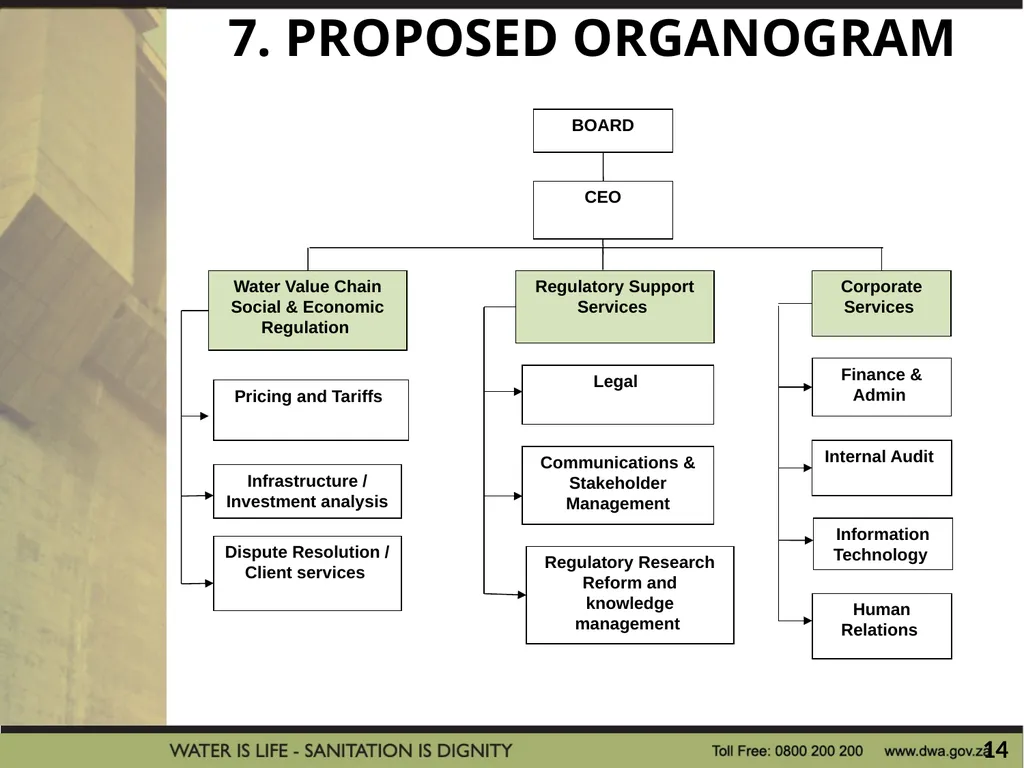
PROPOSED ORGANOGRAM
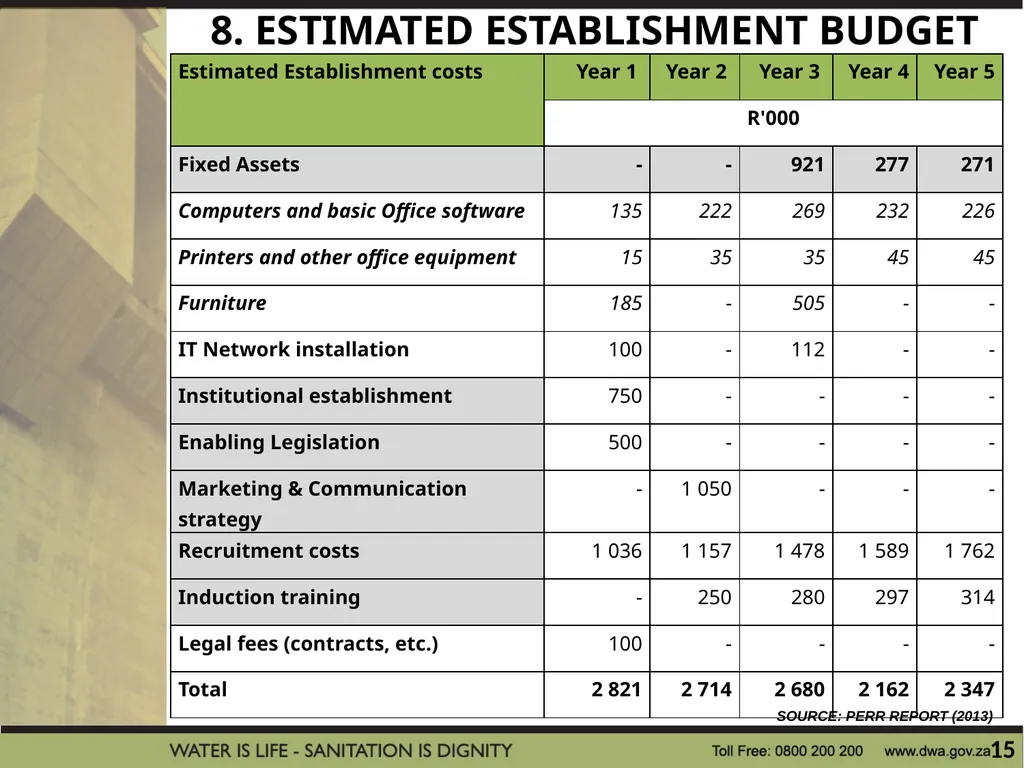
ESTIMATED BUDGET
SOURCES OF REVENUE
TRANSITIONAL PLAN
PROPOSED CONSULTATION PLAN
CONCLUSION 2<br>
03
1. BACKGROUND National regulatory function lies with the Minister = the Department is responsible for policy-making, support and the regulation of the sector.
The implementation of these functions by the Department created a conflict of interest, which affects the decision-making process.
The separation of powers and functions of the Department has been deemed necessary for the improvements in the sector, (promote improved sector performance).
The Department instituted a project to investigate the most appropriate institutional model for effective economic regulator within the sector.
The decision was made to have an internal component in 2014 and the Chief Directorate: Economic and Social Regulation was established 3<br>
04
2. PROBLEM STATEMENT (1/2) There is a need for an independent Economic Regulator within the water sector to effectively address the following challenges:
Insufficient investment in maintenance, refurbishment and replacement of infrastructure.
Poor management of services – interrupted supply, water quality, etc
High levels of unaccounted for water – theft, wastage, unbilled.
Areas still unserved, particularly in sanitation.
Weak tariff setting and billing.
Value for money in use of grants, (e.g. MIG) and Equitable Share.
High levels of debt within the sector. 4<br>
05
PROBLEM STATEMENT… (2/2) These challenges leads to:
unsustainable services;
non‐viable institutions;
degrading infrastructure, and
water users do not get the services they are entitled to and paying for, as according to their human rights. 5<br>
06
3. STATUS QUO (1/2) 1. Conflict of interest
Dual mandate: support and regulate = affects the decision-making.
A referee and a player for raw water charges - infrastructure developer and operator, as well as the management body that spends the revenue.
2. Legislative limitation
No legal provision for the establishment of the regulator as one of the institutions of the department.
3. Water Services Authorities as regulators
Self regulation for WSAs as bulk service providers
Municipalities only require and accept support from the national government department.
4. Under capacitated regulated institutions
Lack of capacity in both human resources and skills or experience within the sector. 6<br>
07
7 STATUS QUO…(2/2) 5. Skills for regulatory function
Employment processes unable to secure personnel with the required skills and expertise.
6. In effective economic regulatory function within the Department
Oversight & Regulatory functions are within the same branch.
Regulator is not recognised as an authority with independent decision.
7. Implementation of debt management
There is no implementation of the punitive measures.
8. Strong policy framework for tariff development
Raw and bulk water tariff development – legislated process and tariff approval is by the Minister.
WSAs – Municipal Council mandated to approve the tariff for water services and adheres to the prescribed norms and standards.<br>
08
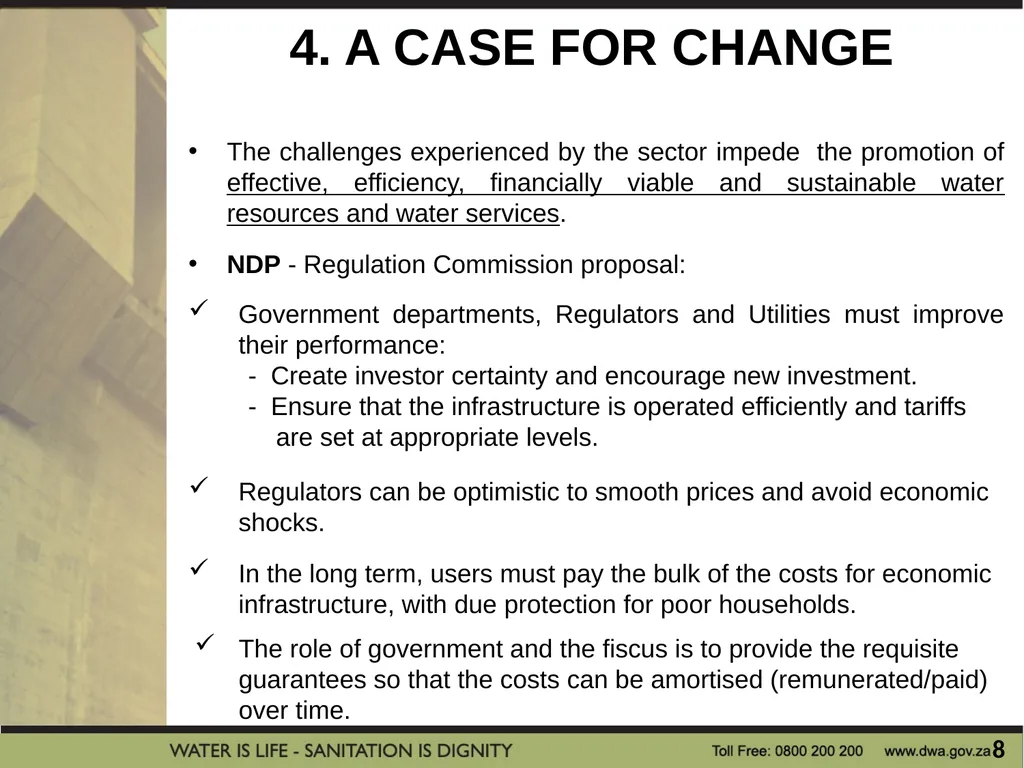
4. A CASE FOR CHANGE The challenges experienced by the sector impede the promotion of effective, efficiency, financially viable and sustainable water resources and water services.
NDP - Regulation Commission proposal:
Government departments, Regulators and Utilities must improve their performance:
- Create investor certainty and encourage new investment.
- Ensure that the infrastructure is operated efficiently and tariffs
are set at appropriate levels.
Regulators can be optimistic to smooth prices and avoid economic shocks.
In the long term, users must pay the bulk of the costs for economic infrastructure, with due protection for poor households.
The role of government and the fiscus is to provide the requisite guarantees so that the costs can be amortised (remunerated/paid) over time. 8<br>
09
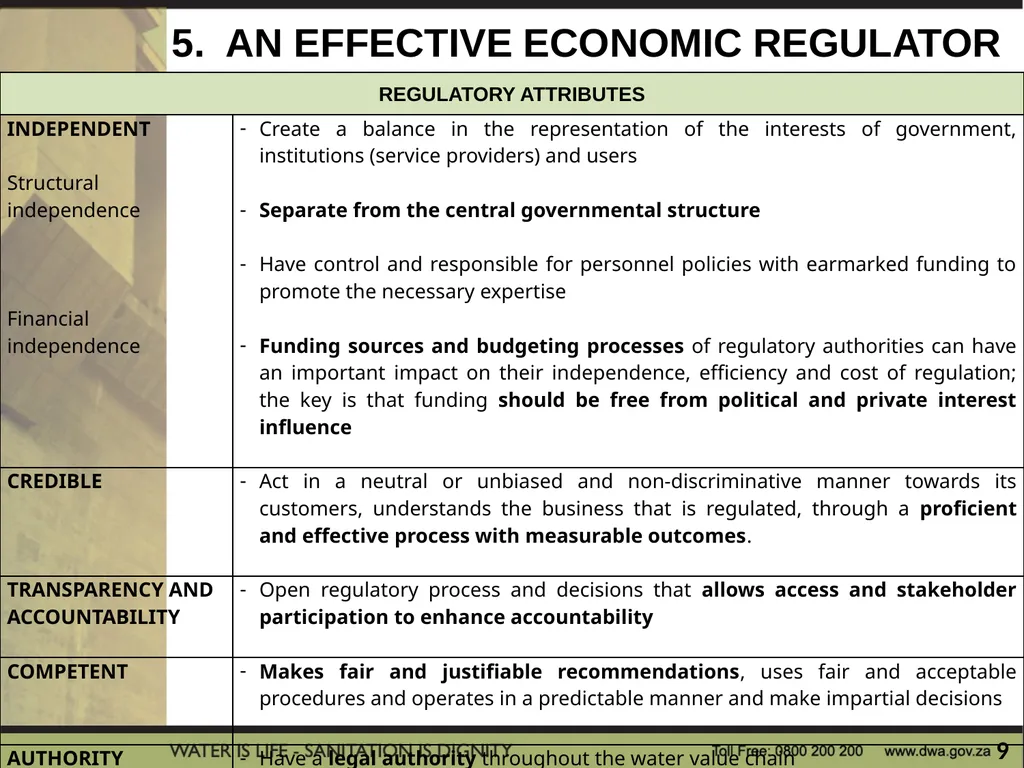
5. AN EFFECTIVE ECONOMIC REGULATOR 9<br>
10
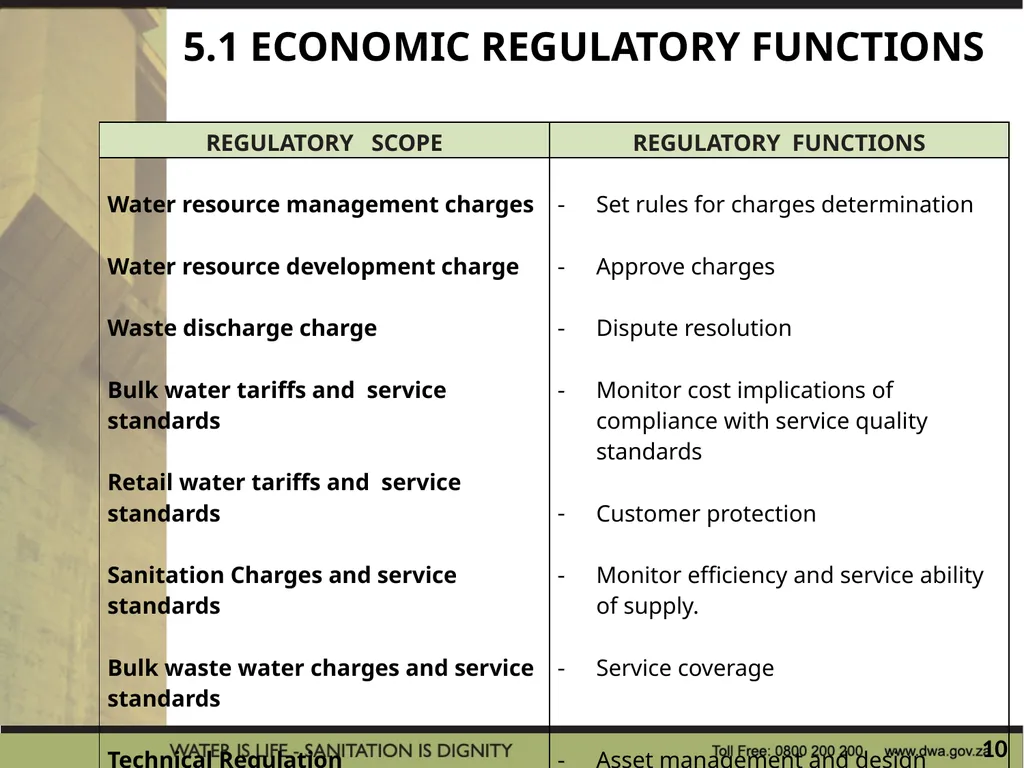
5.1 ECONOMIC REGULATORY FUNCTIONS 10<br>
11
11<br>
12
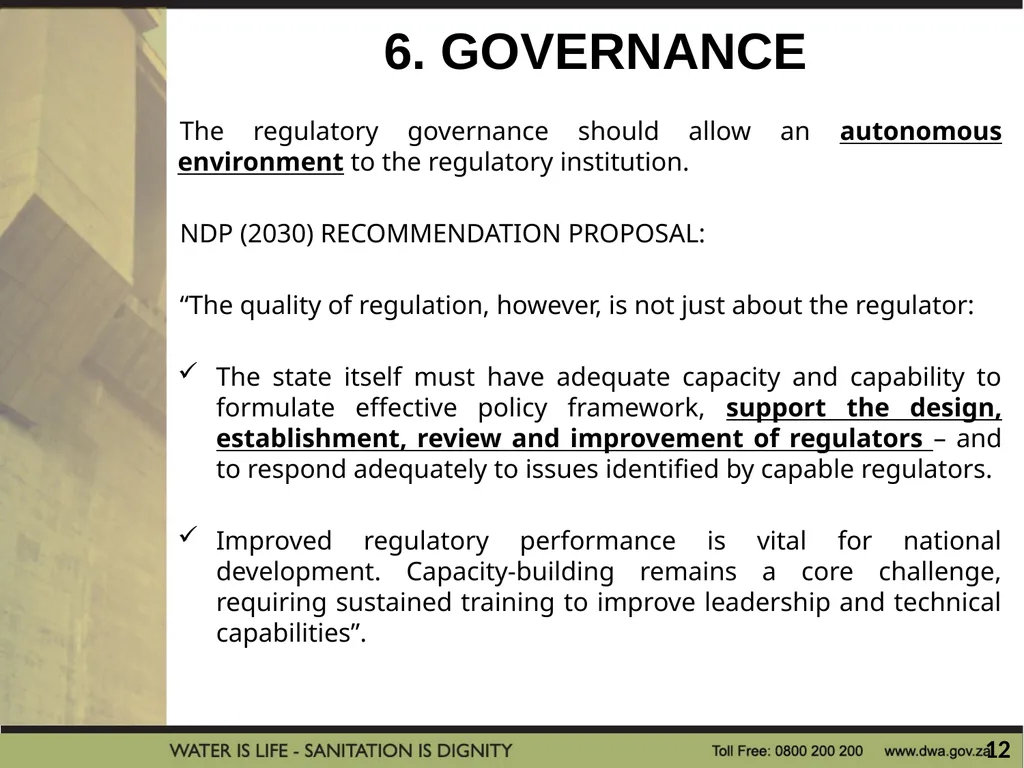
6. GOVERNANCE The regulatory governance should allow an autonomous environment to the regulatory institution.
NDP (2030) RECOMMENDATION PROPOSAL:
“The quality of regulation, however, is not just about the regulator:
The state itself must have adequate capacity and capability to formulate effective policy framework, support the design, establishment, review and improvement of regulators – and to respond adequately to issues identified by capable regulators.
Improved regulatory performance is vital for national development. Capacity‐building remains a core challenge, requiring sustained training to improve leadership and technical capabilities”. 12<br>
13
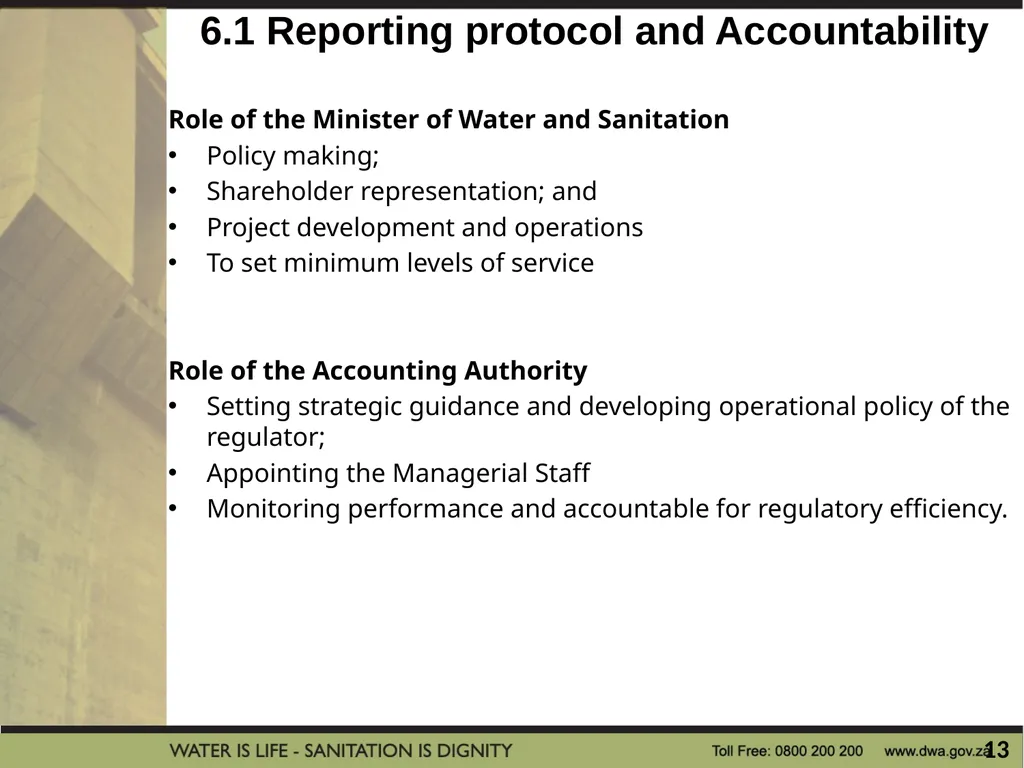
Role of the Minister of Water and Sanitation
Policy making;
Shareholder representation; and
Project development and operations
To set minimum levels of service
Role of the Accounting Authority
Setting strategic guidance and developing operational policy of the regulator;
Appointing the Managerial Staff
Monitoring performance and accountable for regulatory efficiency. 13 6.1 Reporting protocol and Accountability<br>
9. SOURCES OF REVENUE The National Treasury and the Department are expected to fund the establishment costs, with users paying the running costs in the form the Economic Regulator charge
The main source of revenue for an independent Economic Regulator will be the revenue received from the economic regulator charge once all the legal requirements are done.
It will cover the costs of operations with no profit element. 16<br>
17
10. TRANSITIONAL PLAN (1/2) Adopt a progressive and incremental approach:
To facilitate the gradual introduction of the Economic Regulatory functions to the sector.
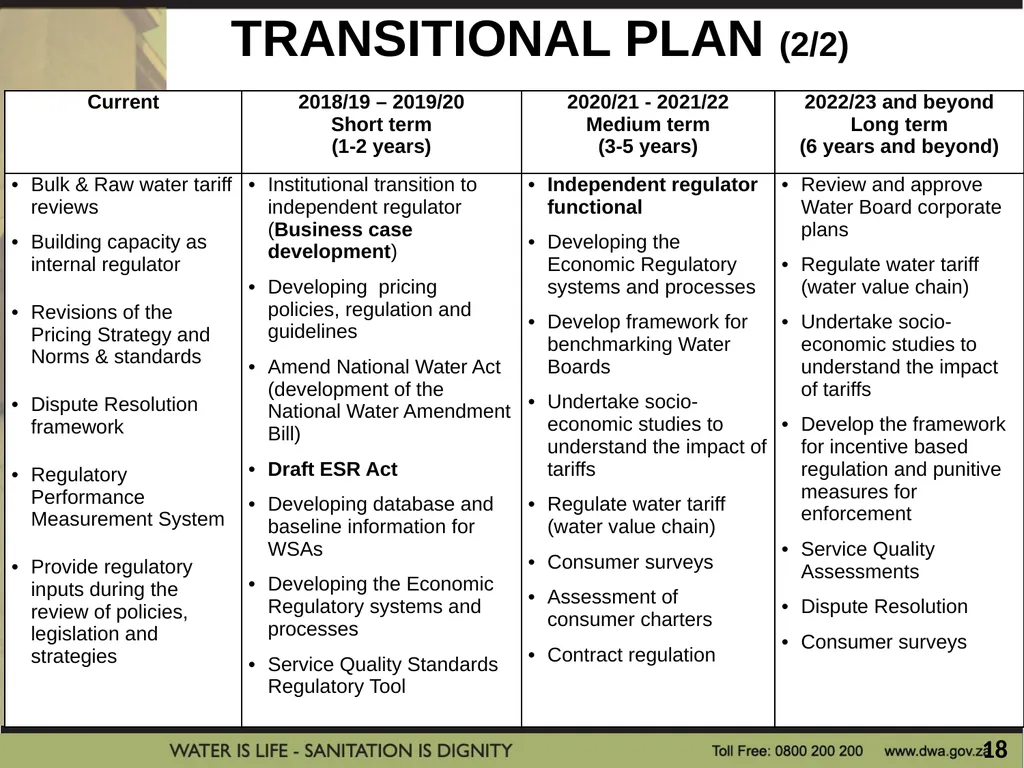
The business case provide an operational transitional plan, which consists of the functions and the timeframes towards a fully functional independent institution. 17<br>
18
TRANSITIONAL PLAN (2/2) 18<br>
19
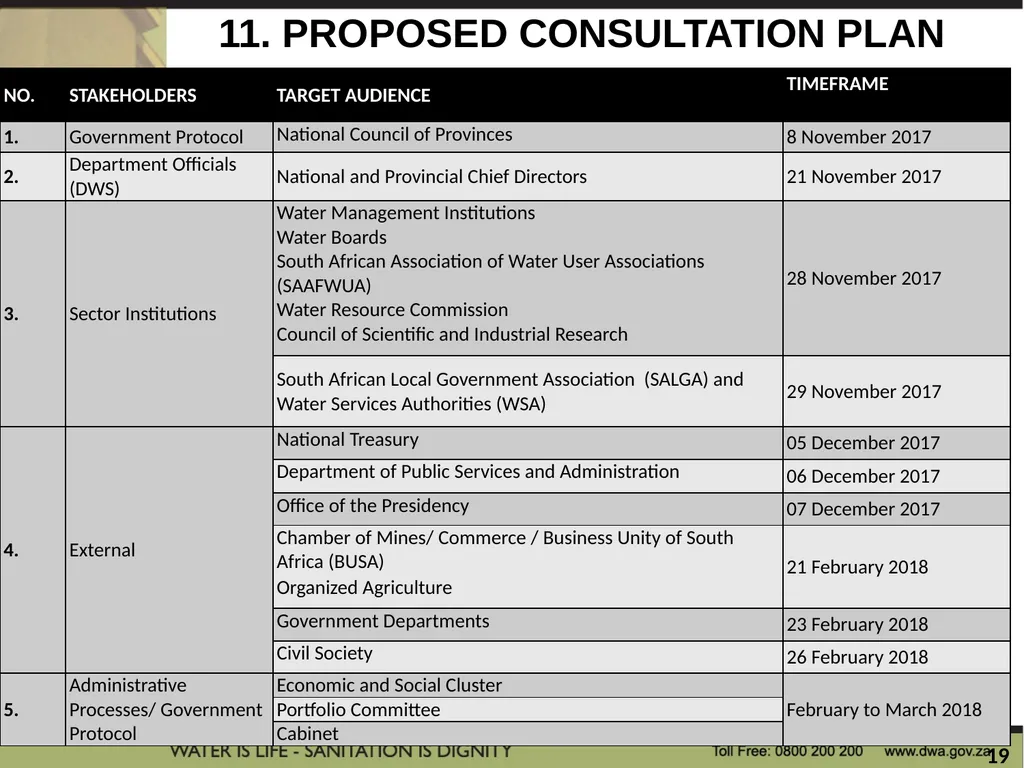
11. PROPOSED CONSULTATION PLAN 19<br>
20
12. CONCLUSION The sector is in need of an effective economic regulation, which can be achieved through the establishment of an independent institution.
To promote the NDP (2030) water sector vision:
All South Africans must have affordable access to sufficient safe water and hygienic sanitation to live healthy and dignified lives by 2030 20<br>