
Presentation to National Assembly Ad Hoc Committee
NS
Published · 16 slides · 0 views

1 / 1



Description
Presentation to National Assembly Ad Hoc Committee on Political Party Funding Tuesday 15th August 2017 What is PARI? PARI is an academic institution attached to Wits University and UCT. We undertake research and policy development in
Related Topics
Share
Embed code
Download this presentation From Below
"Presentation to National Assembly Ad Hoc Committee" is the property of its rightful owner. Permission is granted to download and print the materials on this website for personal, non-commercial use only, and to display it on your personal computer provided you do not modify the materials and that you retain all copyright notices contained in the materials. By downloading content from our website, you accept the terms of this agreement.
Presentation Transcript
01
Presentation to National Assembly Ad Hoc Committee
on Political Party Funding
Tuesday 15th August 2017<br>
on Political Party Funding
Tuesday 15th August 2017<br>
02
What is PARI? PARI is an academic institution attached to Wits University and UCT.
We undertake research and policy development in relation to public administration and state institutions.
Our approach: multi-disciplinary, evidence-based and collaborative, & critical and independent.
We have pioneered the field of institutional studies in South Africa, undertaking some of the leading research work on the nature and functioning of the South African state.<br>
03
Public funding of political parties SA has a well developed system of public funding, with three sources of funding
Represented Political Parties Fund allocates funds based on proportionality (90% of funds) and equity (10% of funds).
Parliament’s Policy on Political Party Allowances of 2005 supports parties to perform a range of internal administrative functions, to support the party leader specifically, as well as to operate constituency offices.
All 9 provincial legislatures have laws similar to the Parliamentary Allowances Policy.
Financial security decreases the influence of private interests, especially large corporate interests.
But raising and accounting for funds is important for public accountability. Removing the obligation of fundraising from political parties is not in the interest of democracy.
39 out of 54 countries have systems of direct public funding for parties or candidates.
37 out of 54 countries have legally defined transparent and equitable allocation mechanisms (Feigenblatt et al 2014, Money, Politics and Transparency).<br>
04
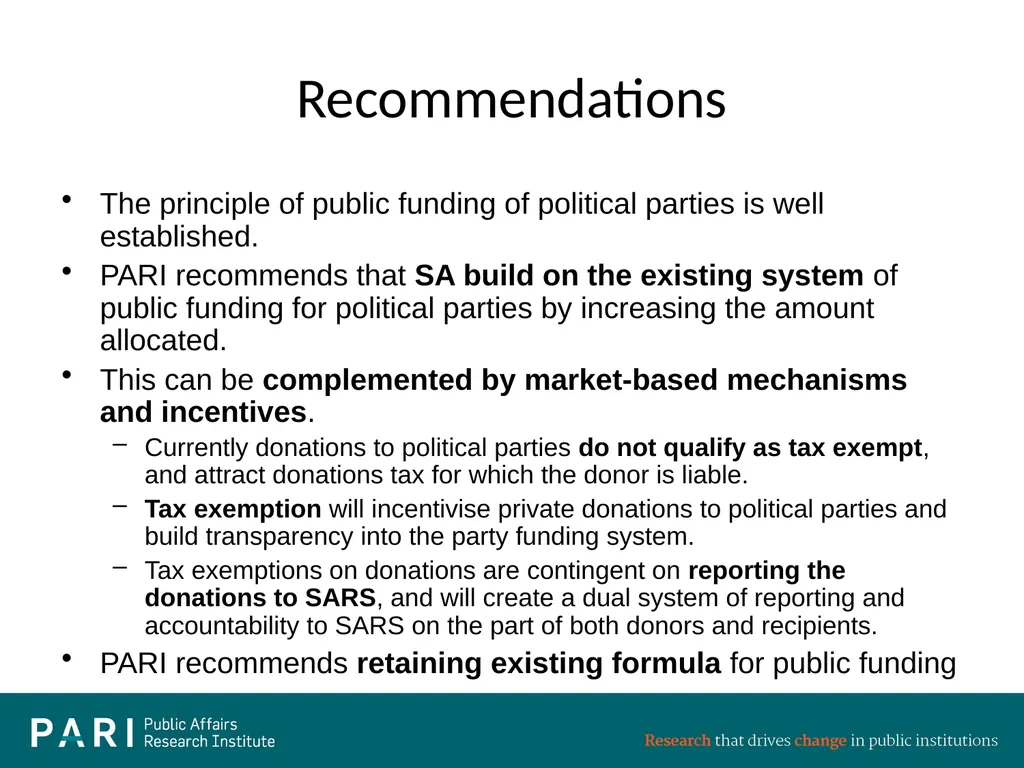
Recommendations The principle of public funding of political parties is well established.
PARI recommends that SA build on the existing system of public funding for political parties by increasing the amount allocated.
This can be complemented by market-based mechanisms and incentives.
Currently donations to political parties do not qualify as tax exempt, and attract donations tax for which the donor is liable.
Tax exemption will incentivise private donations to political parties and build transparency into the party funding system.
Tax exemptions on donations are contingent on reporting the donations to SARS, and will create a dual system of reporting and accountability to SARS on the part of both donors and recipients.
PARI recommends retaining existing formula for public funding<br>
05
Private funding of political parties 1 There are virtually no restrictions on private funding of political parties:
Parties are not required to disclose who funds them.
Donations to political parties are not required to be reported or disclosed.
In-kind donations do not need to be reported or disclosed, nor do third party fund raising efforts.
There are no limits placed on cash donations, anonymous donations, or loans.
There is no limit placed on the amounts that can be contributed, nor on contributions from overseas.
Parties are not constrained in terms of what amounts they can spend on election campaigns, either for parties or individual candidates.
In the absence of regulations, large corporates and wealthy individuals can translate their financial muscle into political power by exchanging party donations for favourable policies, government tenders and other forms of preferment.
The effect: distribute power away from the country’s poor, also to redirect public resources from essential services such as health, housing, and education into the hands of politically connected elites.<br>
06
Private funding of political parties 2 Many political parties currently receive large contributions from foreign interests. For example, the ANC has received substantial donations from China, Saudi Arabia, Libya, Malaysia, and Angola totalling over R2 billion (Money and Politics Project 2011:5).
Of the 54 countries surveyed (Feigenblatt et al 2014:34):
14 countries place a maximum limit on what corporations may contribute to campaigns. In 24 others, corporate donations are either completely banned or restricted with respect to only political parties or candidates.
25 countries restrict the amount that individuals can donate.
35 countries restrict or limit anonymous contributions.
47 countries require in-kind donations to be reported to electoral authority.
35 countries require all donations to be reported, while the remainder require donations over a certain threshold to be reported.
Four countries ban cash donations. 17 more allow cash donations that fall under a specific threshold.
23 countries require loans to parties to be disclosed, and 14 more require only parties or candidates, not both, to report loans received.<br>
07
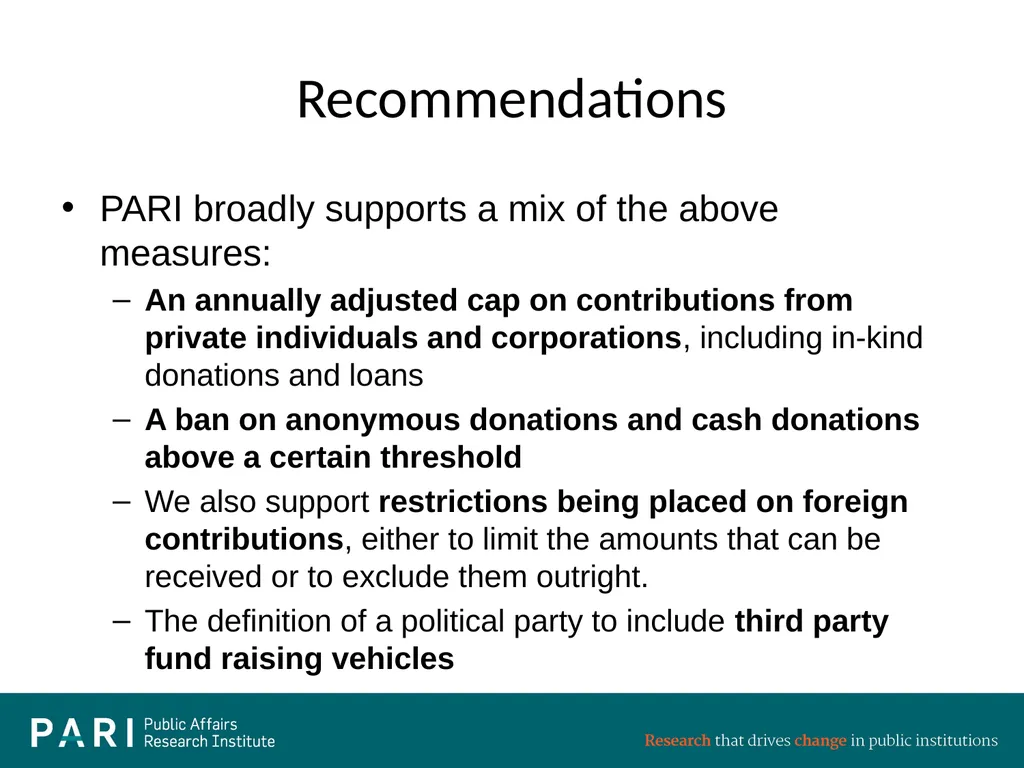
Recommendations PARI broadly supports a mix of the above measures:
An annually adjusted cap on contributions from private individuals and corporations, including in-kind donations and loans
A ban on anonymous donations and cash donations above a certain threshold
We also support restrictions being placed on foreign contributions, either to limit the amounts that can be received or to exclude them outright.
The definition of a political party to include third party fund raising vehicles<br>
08
Use of state resources The Electoral Act and Code does not explicitly prohibit the use of state resources to influence election outcomes, although it does prohibit undue influence and intimidation, as well as prohibit offering any inducement or reward to vote for or join a party.
The Code of Conduct issued in terms of the Public Service Act (No. 103 of 1994) obliges public servants to adhere to certain basic values and principles, which prohibit partisan behaviour.
The Public Service Commission is charged with monitoring and enforcing the code, although in practice they have limited capacity to monitor and act on transgressions.
National and provincial political leaders must conduct themselves in terms of the Code of Ethics for Members of the Executive in terms of the Executive Members’ Ethics Act (No. 82 of 1998). Code forbids them from exposing themselves to any situation involving the risk of a conflict between their official responsibilities and their private interests, and from using their position or any information entrusted to them to enrich themselves or improperly benefit others, including a political party.
The Public Protector is charged with investigating and prescribing sanctions for deviations from the Code.<br>
09
Use of state resources Incidents in South Africa suggest practice has been widespread:
During 2014 national and provincial elections there was an increase in the reported instances of the abuse of state resources.
National and provincial government departments delivered services and handed out food parcels and other 'gifts' close to election time and campaign visits.
‘Economic intimidation’ in which households dependent on social grants were told that voting for the opposition would result in the loss of grants and the denial of jobs, contracts, services and development opportunities
Opposition parties routinely denied permission to use public venues and stadiums for political events.
SASSA handed out blankets and food at ANC pre-election events
The Public Protector noted this was inconsistent with the provisions of Section 195 of the Constitution and constituted improper conduct.
In 51 out of 54 countries surveyed non-financial state resources such as vehicles, buildings and staff are often directed towards political ends.
Only 3 countries - Austria, the United Kingdom, and Sweden - avoided the abuse of public resources during the most recent election campaign.<br>
10
Use of state resources PARI recommends that the Electoral Act should be amended to explicitly prohibit the use of state resources to influence election outcomes, including:
Involvement of public servants, in their official roles, in party political campaigns,
The use of state resources at party political events,
The accelerated roll-out of state programmes immediately before an election.
Code of Conduct in terms of the Public Service Act (No. 103 of 1994) should be strengthened to prohibit public servants from using their office to campaign for or in any way support political parties.
The Public Service Commission’s capacity to monitor and enforce the code must be strengthened.<br>
11
Reporting Out of 54 countries 83% require parties or candidates to submit financial reports that include information on contributions and expenditures annually or within the campaign period
Within South Africa's peer group of developing democracies in Sub-Saharan Africa and BRICS (excluding the basically single-party system of China), South Africa stands alone in failing to provide for transparency of party political funding.
PARI supports the extension of reporting requirements for political parties to account for all private monies allocated to them.
This can be achieved by extending the Public Funding of Represented Political Parties Act to cover private sources of funds.
The Act establishes a framework for distribution, use, reporting, and accountability for funds, which can be done under the supervision of the IEC or another independent body set up for this purpose.
We recommend that outside election periods, annual reporting of party donations is sufficient as a starting point, but that during election periods such reporting should be required on at least a quarterly if not a monthly basis.<br>
12
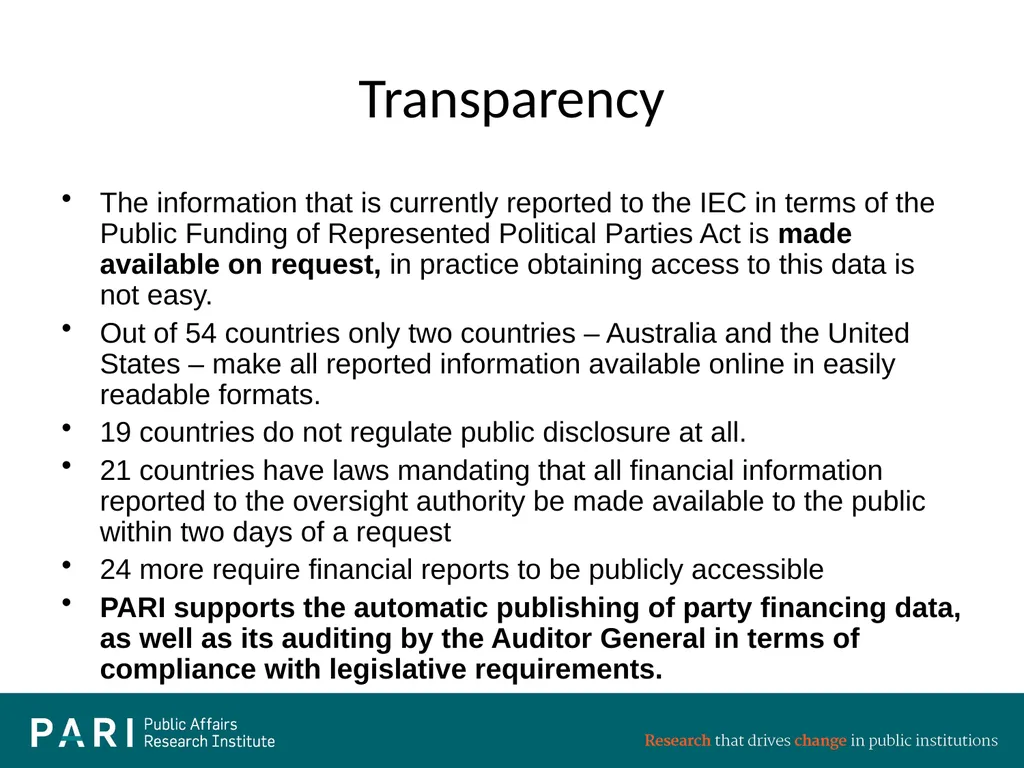
Transparency The information that is currently reported to the IEC in terms of the Public Funding of Represented Political Parties Act is made available on request, in practice obtaining access to this data is not easy.
Out of 54 countries only two countries – Australia and the United States – make all reported information available online in easily readable formats.
19 countries do not regulate public disclosure at all.
21 countries have laws mandating that all financial information reported to the oversight authority be made available to the public within two days of a request
24 more require financial reports to be publicly accessible
PARI supports the automatic publishing of party financing data, as well as its auditing by the Auditor General in terms of compliance with legislative requirements.<br>
13
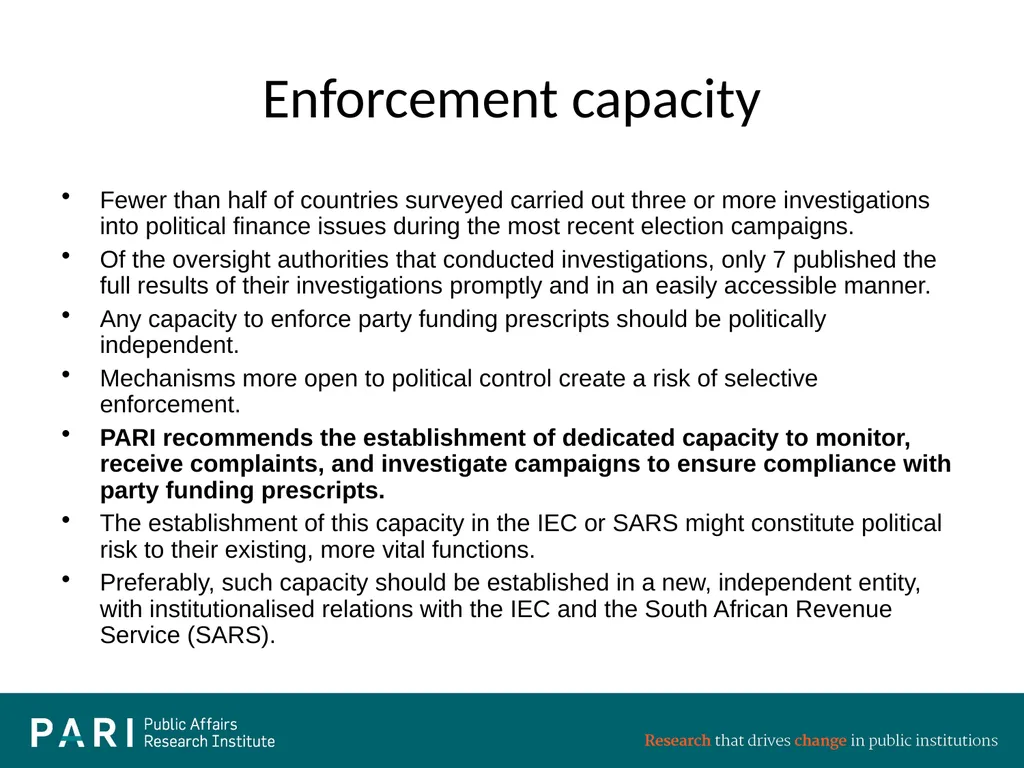
Enforcement capacity Fewer than half of countries surveyed carried out three or more investigations into political finance issues during the most recent election campaigns.
Of the oversight authorities that conducted investigations, only 7 published the full results of their investigations promptly and in an easily accessible manner.
Any capacity to enforce party funding prescripts should be politically independent.
Mechanisms more open to political control create a risk of selective enforcement.
PARI recommends the establishment of dedicated capacity to monitor, receive complaints, and investigate campaigns to ensure compliance with party funding prescripts.
The establishment of this capacity in the IEC or SARS might constitute political risk to their existing, more vital functions.
Preferably, such capacity should be established in a new, independent entity, with institutionalised relations with the IEC and the South African Revenue Service (SARS).<br>
14
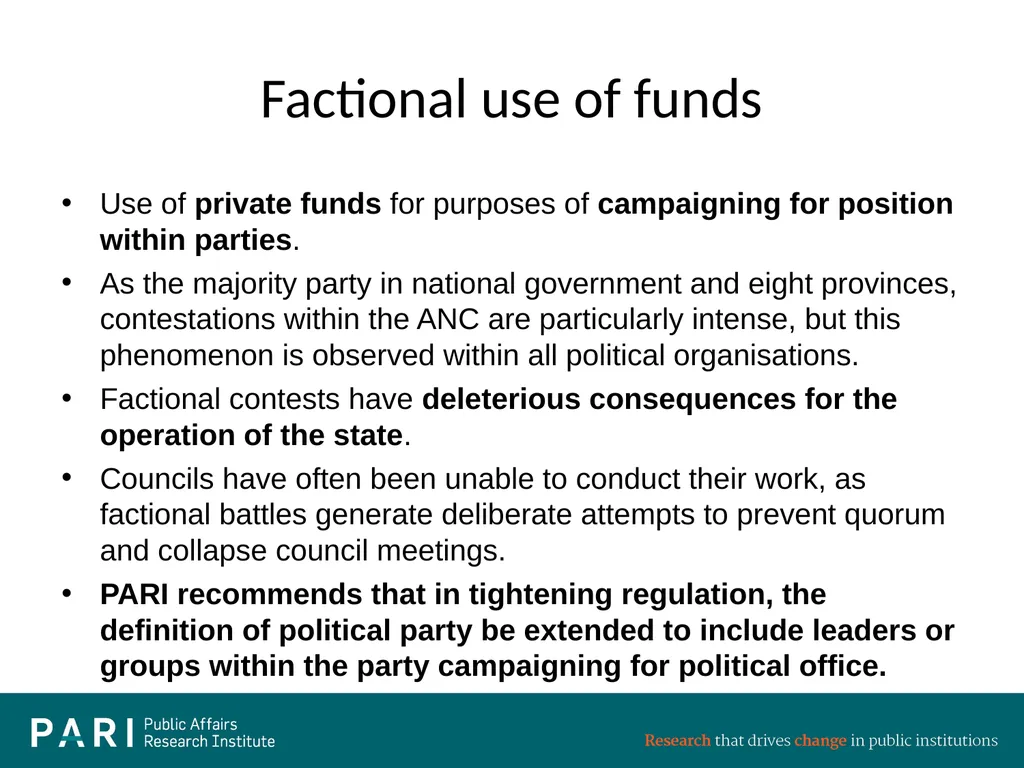
Factional use of funds Use of private funds for purposes of campaigning for position within parties.
As the majority party in national government and eight provinces, contestations within the ANC are particularly intense, but this phenomenon is observed within all political organisations.
Factional contests have deleterious consequences for the operation of the state.
Councils have often been unable to conduct their work, as factional battles generate deliberate attempts to prevent quorum and collapse council meetings.
PARI recommends that in tightening regulation, the definition of political party be extended to include leaders or groups within the party campaigning for political office.<br>
15
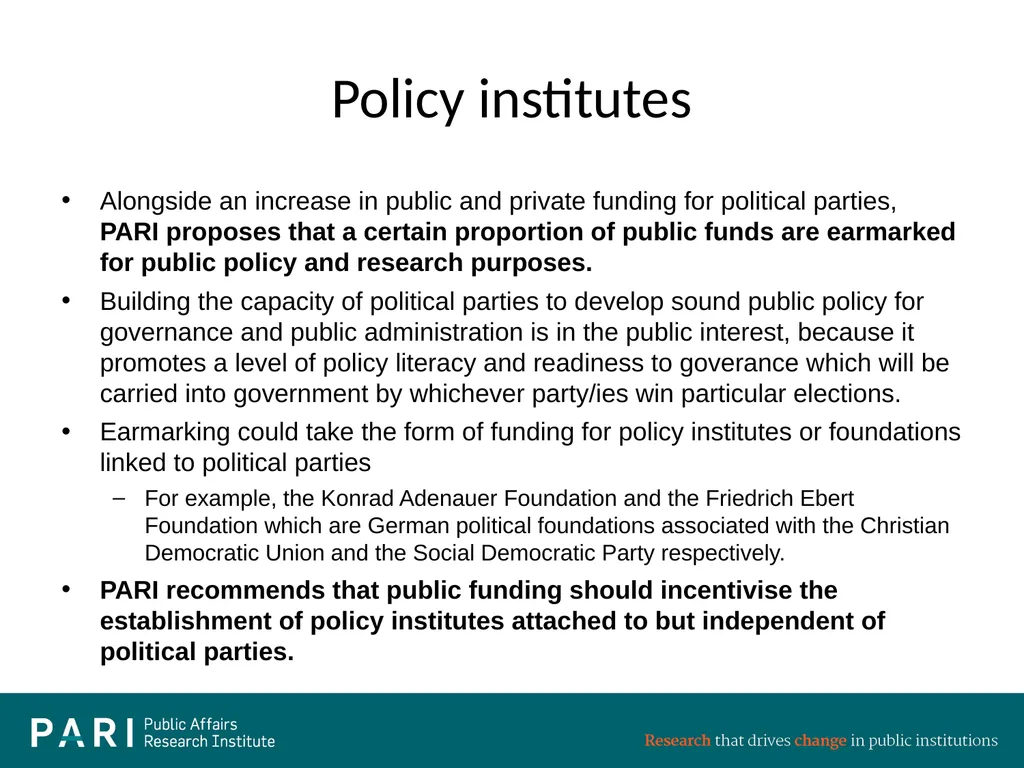
Policy institutes Alongside an increase in public and private funding for political parties, PARI proposes that a certain proportion of public funds are earmarked for public policy and research purposes.
Building the capacity of political parties to develop sound public policy for governance and public administration is in the public interest, because it promotes a level of policy literacy and readiness to goverance which will be carried into government by whichever party/ies win particular elections.
Earmarking could take the form of funding for policy institutes or foundations linked to political parties
For example, the Konrad Adenauer Foundation and the Friedrich Ebert Foundation which are German political foundations associated with the Christian Democratic Union and the Social Democratic Party respectively.
PARI recommends that public funding should incentivise the establishment of policy institutes attached to but independent of political parties.<br>
16
Deepening democracy Party funding reform: opportunity for constraining illicit activity AND deepening democracy.
Declining voter turnout, especially among young people, is widely feared as reflecting a democratic deficit which is reaching serious proportions.
The Ad Hoc Committee should consider exploring other innovative mechanisms for using party funding reform to deepen democratic participation.
A ‘democracy card’ system allocates annually to all registered voters a sum (say R100) to be spent on the party or candidate of their choice.
Democracy card system: could build on existing systems operated by banks and overseen by SASSA, both of which have effectively extended modern financial technology to all South Africans.
Legislative drafting process, at least, should anticipate such innovations on the presumption that a new party funding act, like the old one, will have a lifespan of some twenty years.<br>