
Presented by:- Mr. Bhartendu vimal Guest
TG
Published · 24 slides · 0 views
1 / 1




Description
Presented by:- Mr. Bhartendu vimal Guest faculty-Asst. Prof. Stress its responses Stress is the physiological, biochemical and behavioural response to a stimulus in an attempt to adapt that stimulus. Stress is defined as the response of
Related Topics
Share
Embed code
Download this presentation From Below
"Presented by:- Mr. Bhartendu vimal Guest" is the property of its rightful owner. Permission is granted to download and print the materials on this website for personal, non-commercial use only, and to display it on your personal computer provided you do not modify the materials and that you retain all copyright notices contained in the materials. By downloading content from our website, you accept the terms of this agreement.
Presentation Transcript
01
Presented by:-
Mr. Bhartendu vimal
Guest faculty-Asst. Prof. Stress & it's responses<br>
Mr. Bhartendu vimal
Guest faculty-Asst. Prof. Stress & it's responses<br>
02
Stress is the physiological, biochemical and behavioural response to a stimulus in an attempt to adapt that stimulus. Stress is defined as the response of the cell, or organism itself to any demand placed on it such that it causes an extension of a physiological state beyond the normal resting state (Barton, 1997). What is stress ???<br>
03
Stress is a state produced by an environmental or other factor which extends the adaptive response of an animal beyond the normal functioning to such an extent that, in either case, the chances of survival are significantly reduced (Brett, 1958).
Stress means the sum of the physiological responses by which an animal tries to maintain or establish a normal metabolism on the face of physical or chemical force (Selye, 1950) Cont…<br>
Stress means the sum of the physiological responses by which an animal tries to maintain or establish a normal metabolism on the face of physical or chemical force (Selye, 1950) Cont…<br>
04
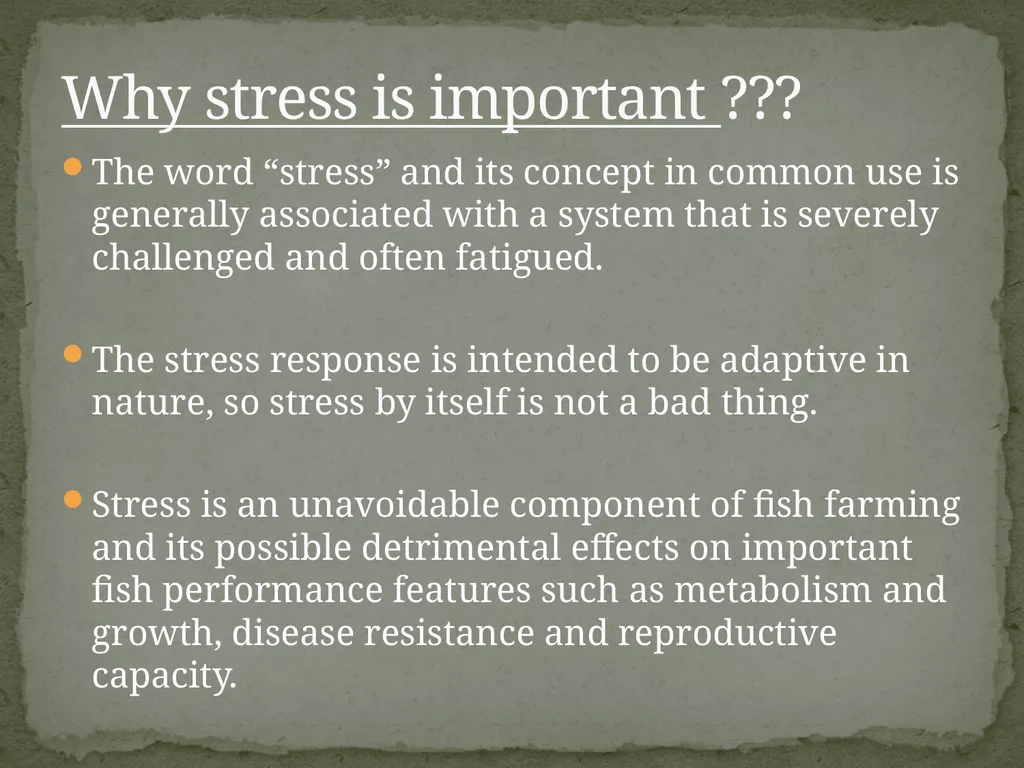
The word “stress” and its concept in common use is generally associated with a system that is severely challenged and often fatigued.
The stress response is intended to be adaptive in nature, so stress by itself is not a bad thing.
Stress is an unavoidable component of fish farming and its possible detrimental effects on important fish performance features such as metabolism and growth, disease resistance and reproductive capacity. Why stress is important ???<br>
The stress response is intended to be adaptive in nature, so stress by itself is not a bad thing.
Stress is an unavoidable component of fish farming and its possible detrimental effects on important fish performance features such as metabolism and growth, disease resistance and reproductive capacity. Why stress is important ???<br>
05
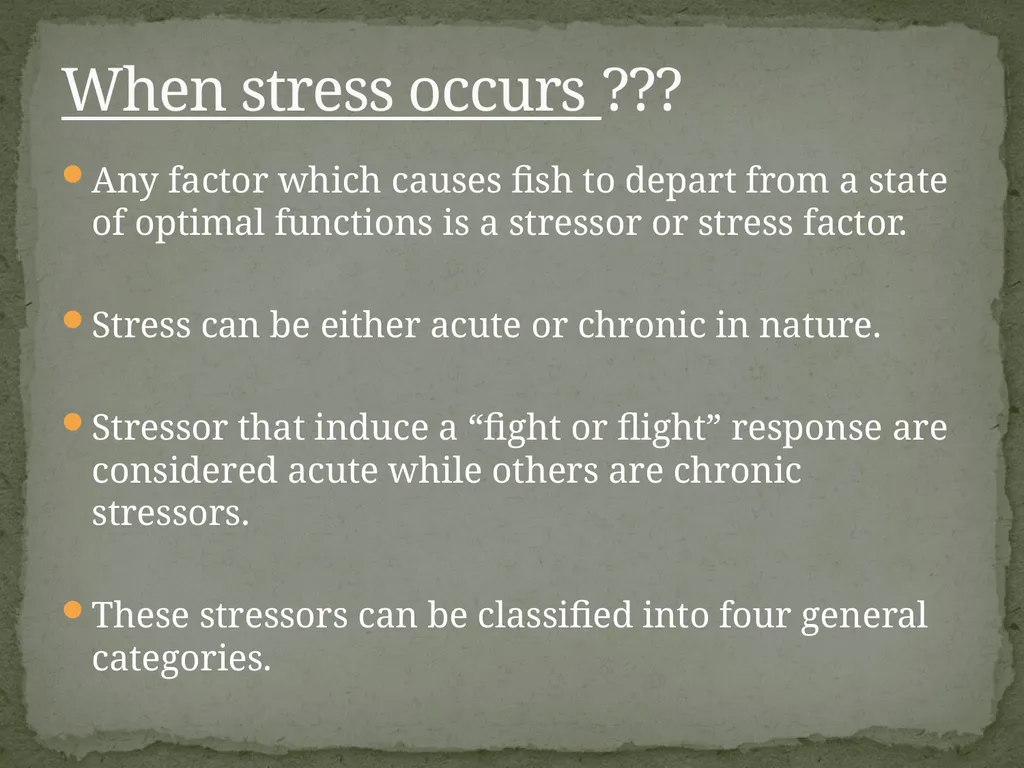
Any factor which causes fish to depart from a state of optimal functions is a stressor or stress factor.
Stress can be either acute or chronic in nature.
Stressor that induce a “fight or flight” response are considered acute while others are chronic stressors.
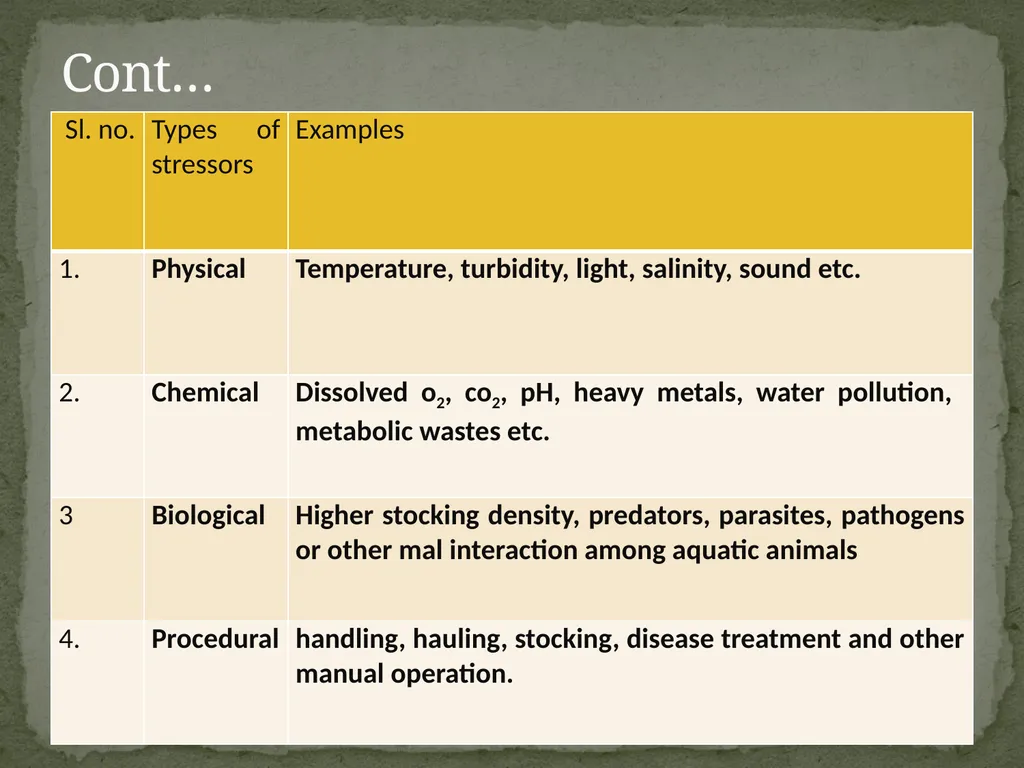
These stressors can be classified into four general categories. When stress occurs ???<br>
Stress can be either acute or chronic in nature.
Stressor that induce a “fight or flight” response are considered acute while others are chronic stressors.
These stressors can be classified into four general categories. When stress occurs ???<br>
06
Cont…<br>
07
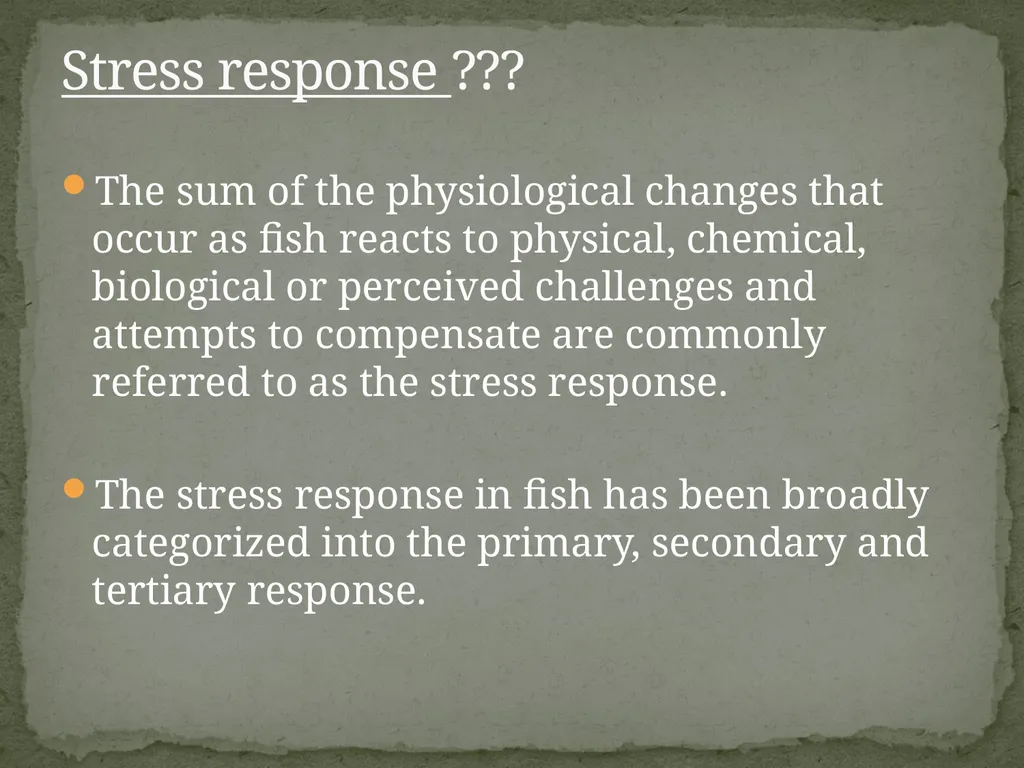
The sum of the physiological changes that occur as fish reacts to physical, chemical, biological or perceived challenges and attempts to compensate are commonly referred to as the stress response.
The stress response in fish has been broadly categorized into the primary, secondary and tertiary response. Stress response ???<br>
The stress response in fish has been broadly categorized into the primary, secondary and tertiary response. Stress response ???<br>
08
Release of adrenocorticotropic hormones (ACTH) from the adenohypophysis.
Release of “stress hormones” (catecholamines and corticosteroides) from the head kidney.
In fish, an adverse condition stimulates the afferent neural pathway that runs in the sympathetic nervous system from the hypothalamus to the chromaffin tissue of the head kidney and stimulates the chromaffin tissue which results release of catecholamines. (i) Primary stress response<br>
Release of “stress hormones” (catecholamines and corticosteroides) from the head kidney.
In fish, an adverse condition stimulates the afferent neural pathway that runs in the sympathetic nervous system from the hypothalamus to the chromaffin tissue of the head kidney and stimulates the chromaffin tissue which results release of catecholamines. (i) Primary stress response<br>
09
CRH released from hypothalamus stimulates corticotropic cells of adenohypophysis to secrete ACTH, which stimulates interrenal cells (adrenal cortex homologue) to synthesize and release corticosteroids, particularly cortisol.
Resting and unstressed levels of circulating levels corticosteroids in fish are less than 30-40 ng/ml (wedemeyer et al. 1990).
Characteristics cortisol elevation in fishes in response to acute stressors tends to range within about 30-300 ng/ml (Barton and Iwama, 1991).
Elevation of plasma catecholamines and cortisol due to primary stress leads to secondary stress response. Cont…<br>
Resting and unstressed levels of circulating levels corticosteroids in fish are less than 30-40 ng/ml (wedemeyer et al. 1990).
Characteristics cortisol elevation in fishes in response to acute stressors tends to range within about 30-300 ng/ml (Barton and Iwama, 1991).
Elevation of plasma catecholamines and cortisol due to primary stress leads to secondary stress response. Cont…<br>
10
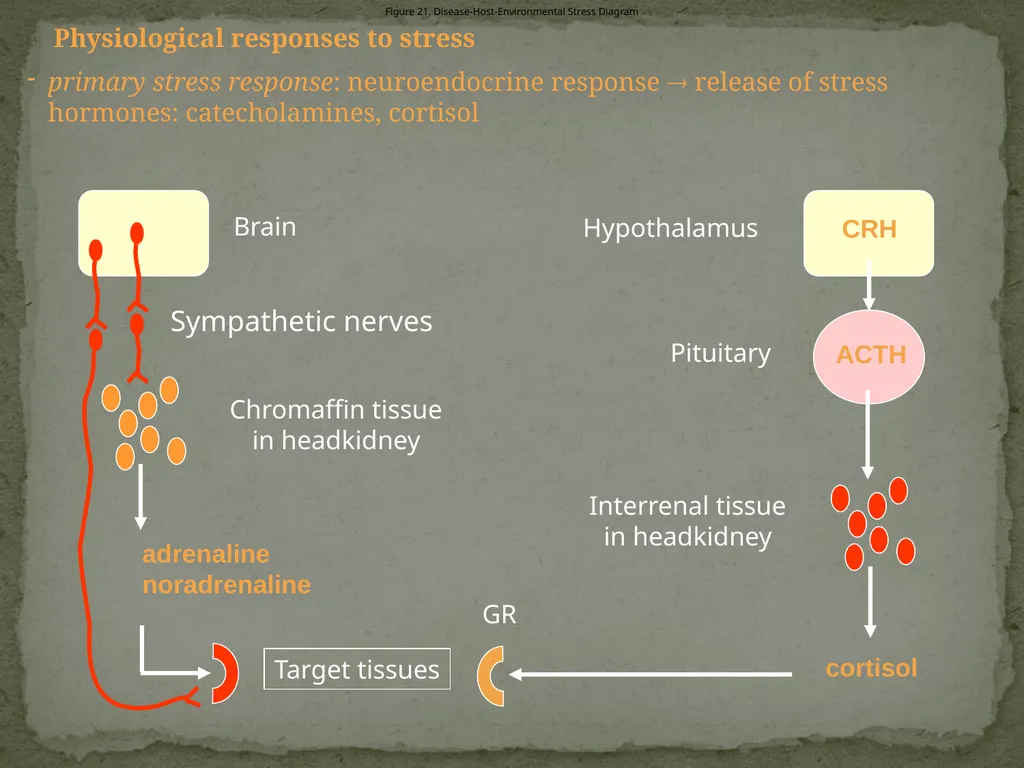
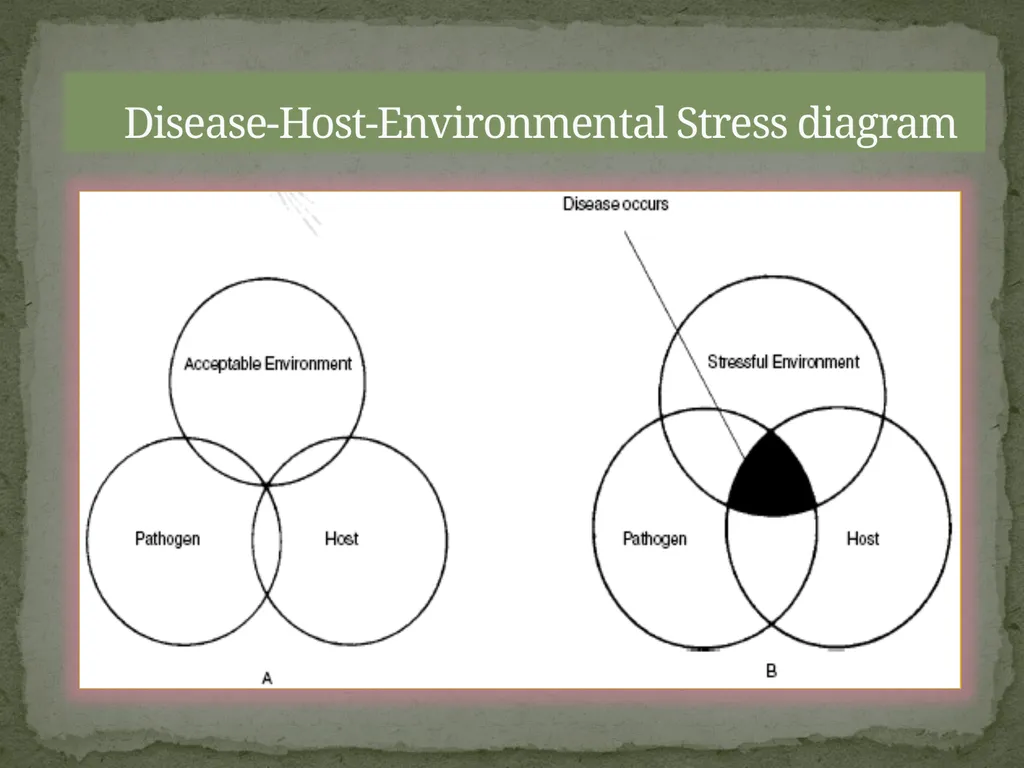
Figure 21. Disease-Host-Environmental Stress Diagram Physiological responses to stress
primary stress response: neuroendocrine response release of stress hormones: catecholamines, cortisol Target tissues GR Hypothalamus CRH ACTH Pituitary Interrenal tissue
in headkidney cortisol Brain Chromaffin tissue
in headkidney adrenaline
noradrenaline Sympathetic nerves<br>
primary stress response: neuroendocrine response release of stress hormones: catecholamines, cortisol Target tissues GR Hypothalamus CRH ACTH Pituitary Interrenal tissue
in headkidney cortisol Brain Chromaffin tissue
in headkidney adrenaline
noradrenaline Sympathetic nerves<br>
11
The stress hormones activate a number of metabolic pathways that result in alterations in blood chemistry and haematology.
The measurement of plasma glucose concentration has been used as an indicator of stressed state.
In teleost fish, cortisol enters liver cells where it binds to nuclear receptor, resulting in activation of genes that produce a series of enzymes that have a range of metabolic effects. (ii) Secondary stress response<br>
The measurement of plasma glucose concentration has been used as an indicator of stressed state.
In teleost fish, cortisol enters liver cells where it binds to nuclear receptor, resulting in activation of genes that produce a series of enzymes that have a range of metabolic effects. (ii) Secondary stress response<br>
12
This results in a suite of biochemical and physiological changes which may include hyperglycaemia, hyperlacticaemia, depletion of tissue glycogen reserves, lipolysis and inhibition of protein synthesis.
Other changes may include the osmotic and ionic disturbances due to diuresis and loss of electrolyte from the blood and change in haematology.
The stress hormones adrenalin and cortisol shown to increase plasma glucose production in fish by both gluconeogenesis and glycogenolysis. Cont…<br>
Other changes may include the osmotic and ionic disturbances due to diuresis and loss of electrolyte from the blood and change in haematology.
The stress hormones adrenalin and cortisol shown to increase plasma glucose production in fish by both gluconeogenesis and glycogenolysis. Cont…<br>
13
Catecholamine, in particular, have marked influence on cardiovascular functions leading to change of blood circulation, gill perfusion and oxygen carrying capacity of blood.
Corticosteroids on the other hand are known to stimulate the ion-transport mechanism in the gill and kidney.
These secondary stress responses are believed to be adaptive mechanisms and are particularly important for fish to recover from stress by maintaining oxygen supply to the tissues , to regain osmotic and ionic equilibrium.
Intracellular stress response is characterized by the production of a family of proteins known as heat shock proteins (HSP). Cont…<br>
Corticosteroids on the other hand are known to stimulate the ion-transport mechanism in the gill and kidney.
These secondary stress responses are believed to be adaptive mechanisms and are particularly important for fish to recover from stress by maintaining oxygen supply to the tissues , to regain osmotic and ionic equilibrium.
Intracellular stress response is characterized by the production of a family of proteins known as heat shock proteins (HSP). Cont…<br>
14
Exposure of cells or whole organisms to heat shock results in a reversible increase in the synthesis of some acute phase proteins against subsequent shock known as HSP, which plays an important role in homeostasis.
HSPs are a family of highly conserved cellular proteins which are essential for folding and translocation of newly formed proteins and renaturation of denatured proteins.
The expression of these proteins increases manifold in the cells during stress. Cont…<br>
HSPs are a family of highly conserved cellular proteins which are essential for folding and translocation of newly formed proteins and renaturation of denatured proteins.
The expression of these proteins increases manifold in the cells during stress. Cont…<br>
15
chronic exposure to stressors provokes tertiary stress responses that results in a number of pathological changes.
This response represents whole animal and population level changes associated with stress including reduction in reproductive success, impaired growth rate and decreased disease resistance.
This might be stress mediated energy repartitioning that diverts energy substrates away from vital life processes in order to cope up with the enhanced energy demand associated with stress. (iii) Tertiary stress response<br>
This response represents whole animal and population level changes associated with stress including reduction in reproductive success, impaired growth rate and decreased disease resistance.
This might be stress mediated energy repartitioning that diverts energy substrates away from vital life processes in order to cope up with the enhanced energy demand associated with stress. (iii) Tertiary stress response<br>
16
When fish and other aquatic animals experience environmental disturbances, a series of physiological changes occur following stressful challenges, which are adaptive in nature.
These physiological responses are termed as ‘general adaptive syndrome’ (GAS), Selye, 1950.
It consists of…
An alarming reaction in which “stress hormones” (catecholamine and corticosteroids) are released.
A stage of resistance during which adaptation occurs.
A stage of exhaustion in which adaptation is lost because the stress was too severe or long lasting. How stress 0ccurs ???<br>
These physiological responses are termed as ‘general adaptive syndrome’ (GAS), Selye, 1950.
It consists of…
An alarming reaction in which “stress hormones” (catecholamine and corticosteroids) are released.
A stage of resistance during which adaptation occurs.
A stage of exhaustion in which adaptation is lost because the stress was too severe or long lasting. How stress 0ccurs ???<br>
17
Disease-Host-Environmental Stress diagram<br>
18
When fish are exposed to a stressor or stressful event, the stress response is initiated by the perception of a real or perceived threat by CNS.
The response of the HPI axis begins with the release of CRH or CRF , chiefly from the hypothalamus in the brain.
CRF stimulates the corticotrophic cells of the adenohypophysis and secrete ACTH.
Circulating ACTH stimulates the inter renal tissue (ACH) to synthesize and release corticosteroids, mainly cortisol, into circulation. Cont…<br>
The response of the HPI axis begins with the release of CRH or CRF , chiefly from the hypothalamus in the brain.
CRF stimulates the corticotrophic cells of the adenohypophysis and secrete ACTH.
Circulating ACTH stimulates the inter renal tissue (ACH) to synthesize and release corticosteroids, mainly cortisol, into circulation. Cont…<br>
19
Concurrent with the elevation of circulating corticosteroids during stress is the release of catecholamines, mainly epinephrine and nor epinephrine.
Following sympathetic stimulation of the chromaffin tissue (AMH) in the kidney.
Other hormones including thyroxine, somatolactin, gonadotropins and reproductive steroids in circulation and serotonin and its derivatives in the brain can become either elevated or suppressed during stress. Cont…<br>
Following sympathetic stimulation of the chromaffin tissue (AMH) in the kidney.
Other hormones including thyroxine, somatolactin, gonadotropins and reproductive steroids in circulation and serotonin and its derivatives in the brain can become either elevated or suppressed during stress. Cont…<br>
20
Mucus: Any stress causes chemical changes in mucus which decrease its effectiveness as a chemical barrier against invading organisms.
Stress upsets the normal electrolyte (sodium, potassium and chloride) balance which results in excessive uptake of water in freshwater fish and dehydration in marine water fish.
Scales and skin are the most commonly damaged because of handling stress.
Any stress causes hormonal changes which decrease the effectiveness of an inflammatory response. Effects of stress on protective barriers<br>
Stress upsets the normal electrolyte (sodium, potassium and chloride) balance which results in excessive uptake of water in freshwater fish and dehydration in marine water fish.
Scales and skin are the most commonly damaged because of handling stress.
Any stress causes hormonal changes which decrease the effectiveness of an inflammatory response. Effects of stress on protective barriers<br>
21
Temperature stress can completely halt the activity of immune system and severely impairs the ability of the fish to quickly release antibody production.
prolonged stress severely limits the effectiveness of the immune system, thereby increasing the opportunities for an invader to cause disease. Cont…<br>
prolonged stress severely limits the effectiveness of the immune system, thereby increasing the opportunities for an invader to cause disease. Cont…<br>
22
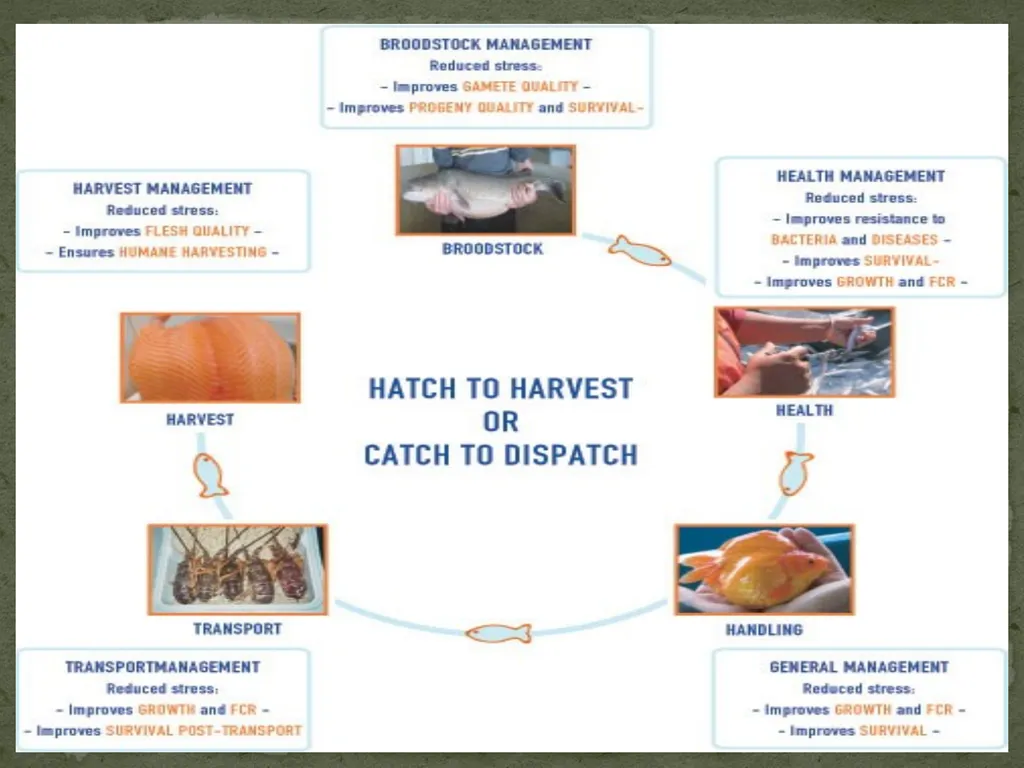
In short term, practical approaches for mitigating the detrimental effects of stress include:
Maintaining optimum water quality.
Feed given has to be of high quality that meets the nutritional requirements of the fish.
Proper sanitation implies routine removal of debris from fish tanks and disinfection of containers, nets and other equipments.
Adhering to recommended stocking densities. Approaches for stress mitigation in farmed fish<br>
Maintaining optimum water quality.
Feed given has to be of high quality that meets the nutritional requirements of the fish.
Proper sanitation implies routine removal of debris from fish tanks and disinfection of containers, nets and other equipments.
Adhering to recommended stocking densities. Approaches for stress mitigation in farmed fish<br>
23
For being with stress…… Thank you !<br>