
Preventing Radicalisation www.enfield.gov.uk
MY
Published · 18 slides · 0 views

1 / 1

Description
Preventing Radicalisation www.enfield.gov.uk Striving for excellence Preventing Radicalisation What is Prevent? Prevent is a programme run within the local council. It is a programme designed to intervene before a vulnerable person becomes
Related Topics
Share
Embed code
Download this presentation From Below
"Preventing Radicalisation www.enfield.gov.uk" is the property of its rightful owner. Permission is granted to download and print the materials on this website for personal, non-commercial use only, and to display it on your personal computer provided you do not modify the materials and that you retain all copyright notices contained in the materials. By downloading content from our website, you accept the terms of this agreement.
Presentation Transcript
01
Preventing Radicalisation www.enfield.gov.uk Striving for excellence<br>
02
Preventing Radicalisation<br>
03
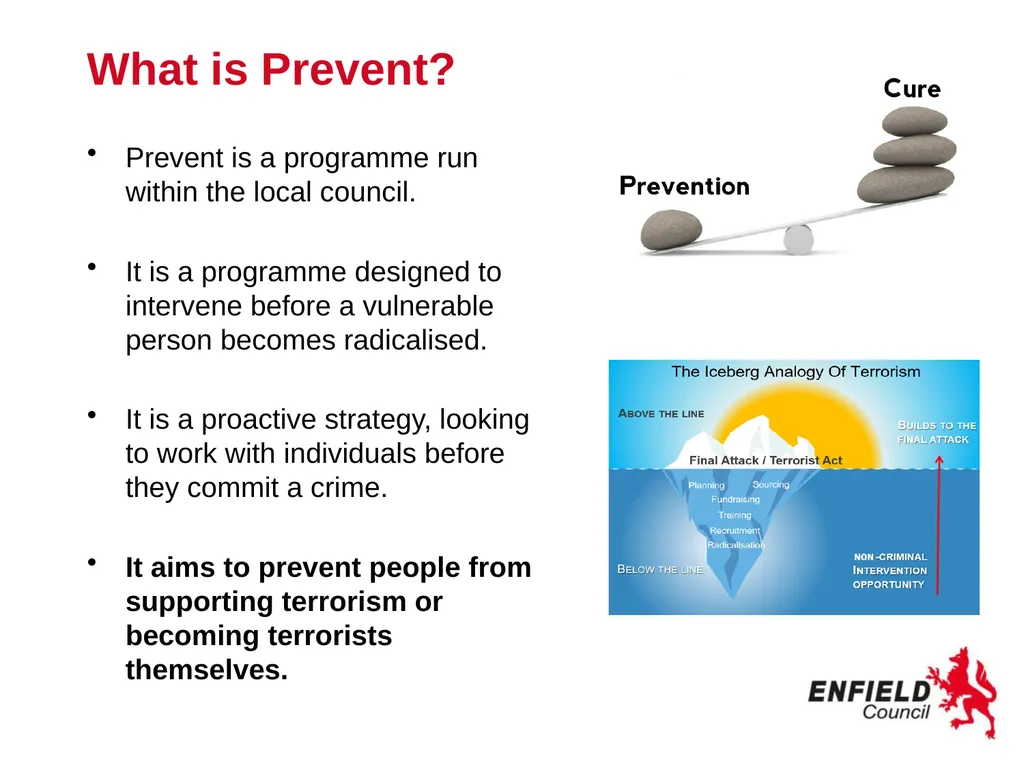
What is Prevent? Prevent is a programme run within the local council.
It is a programme designed to intervene before a vulnerable person becomes radicalised.
It is a proactive strategy, looking to work with individuals before they commit a crime.
It aims to prevent people from supporting terrorism or becoming terrorists themselves.<br>
It is a programme designed to intervene before a vulnerable person becomes radicalised.
It is a proactive strategy, looking to work with individuals before they commit a crime.
It aims to prevent people from supporting terrorism or becoming terrorists themselves.<br>
04
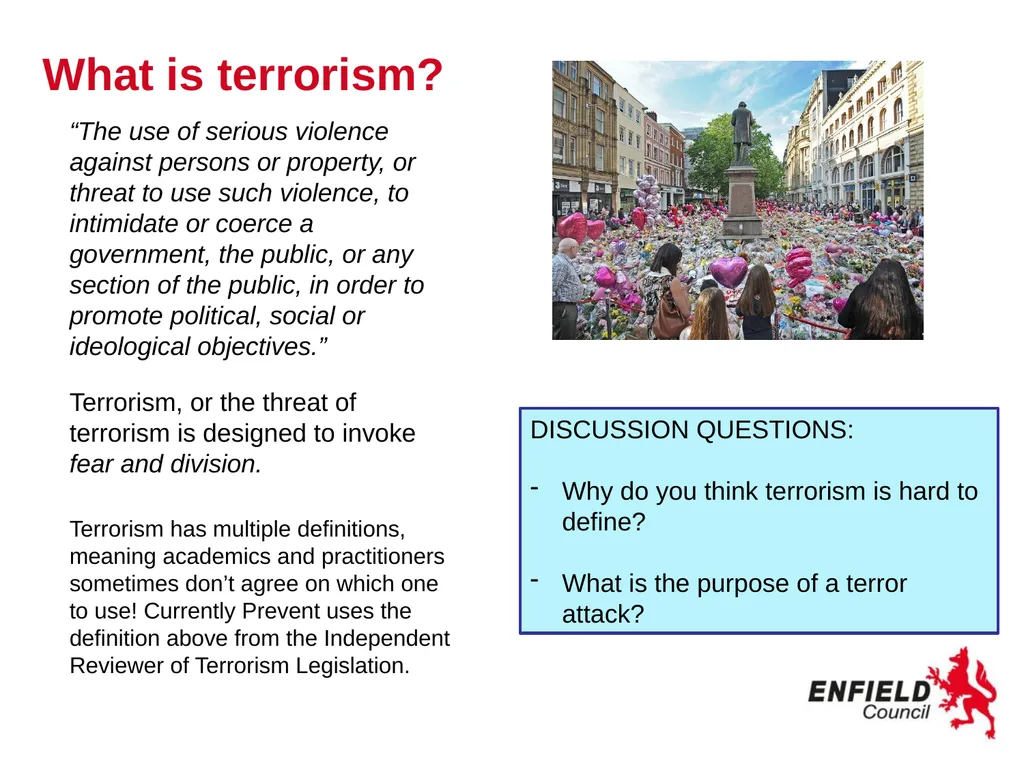
What is terrorism? “The use of serious violence against persons or property, or threat to use such violence, to intimidate or coerce a government, the public, or any section of the public, in order to promote political, social or ideological objectives.”
Terrorism, or the threat of terrorism is designed to invoke fear and division.
Terrorism has multiple definitions, meaning academics and practitioners sometimes don’t agree on which one to use! Currently Prevent uses the definition above from the Independent Reviewer of Terrorism Legislation. DISCUSSION QUESTIONS:
Why do you think terrorism is hard to define?
What is the purpose of a terror attack?<br>
Terrorism, or the threat of terrorism is designed to invoke fear and division.
Terrorism has multiple definitions, meaning academics and practitioners sometimes don’t agree on which one to use! Currently Prevent uses the definition above from the Independent Reviewer of Terrorism Legislation. DISCUSSION QUESTIONS:
Why do you think terrorism is hard to define?
What is the purpose of a terror attack?<br>
05
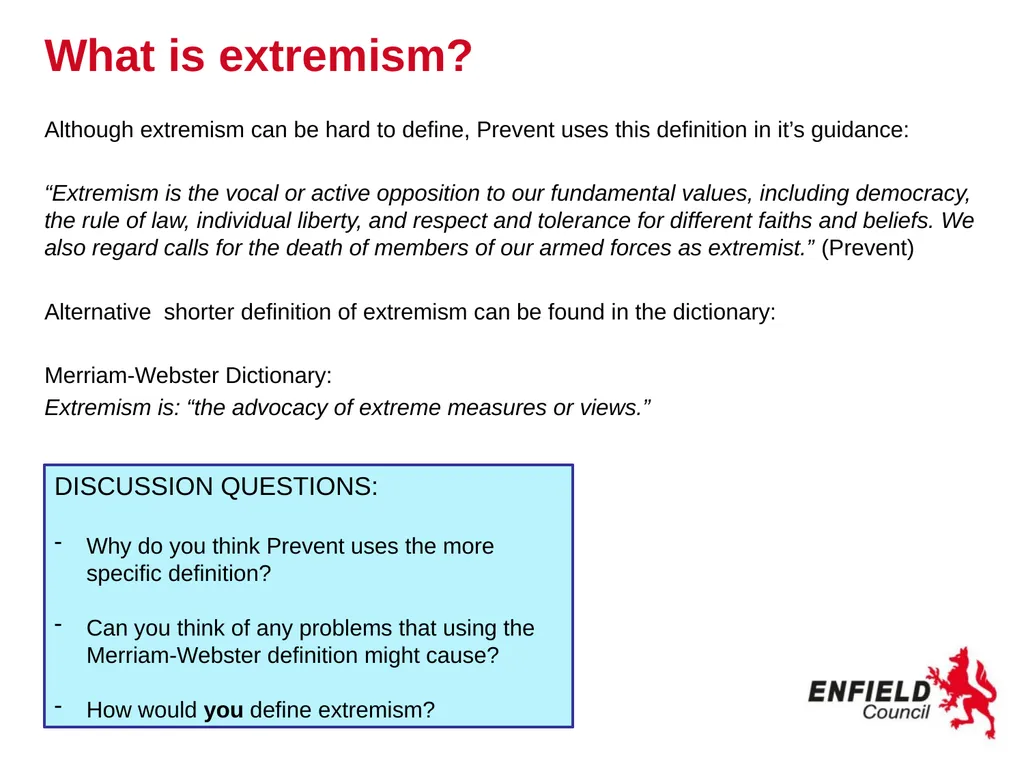
What is extremism? Although extremism can be hard to define, Prevent uses this definition in it’s guidance:
“Extremism is the vocal or active opposition to our fundamental values, including democracy, the rule of law, individual liberty, and respect and tolerance for different faiths and beliefs. We also regard calls for the death of members of our armed forces as extremist.” (Prevent)
Alternative shorter definition of extremism can be found in the dictionary:
Merriam-Webster Dictionary:
Extremism is: “the advocacy of extreme measures or views.” DISCUSSION QUESTIONS:
Why do you think Prevent uses the more specific definition?
Can you think of any problems that using the Merriam-Webster definition might cause?
How would you define extremism?<br>
“Extremism is the vocal or active opposition to our fundamental values, including democracy, the rule of law, individual liberty, and respect and tolerance for different faiths and beliefs. We also regard calls for the death of members of our armed forces as extremist.” (Prevent)
Alternative shorter definition of extremism can be found in the dictionary:
Merriam-Webster Dictionary:
Extremism is: “the advocacy of extreme measures or views.” DISCUSSION QUESTIONS:
Why do you think Prevent uses the more specific definition?
Can you think of any problems that using the Merriam-Webster definition might cause?
How would you define extremism?<br>
06
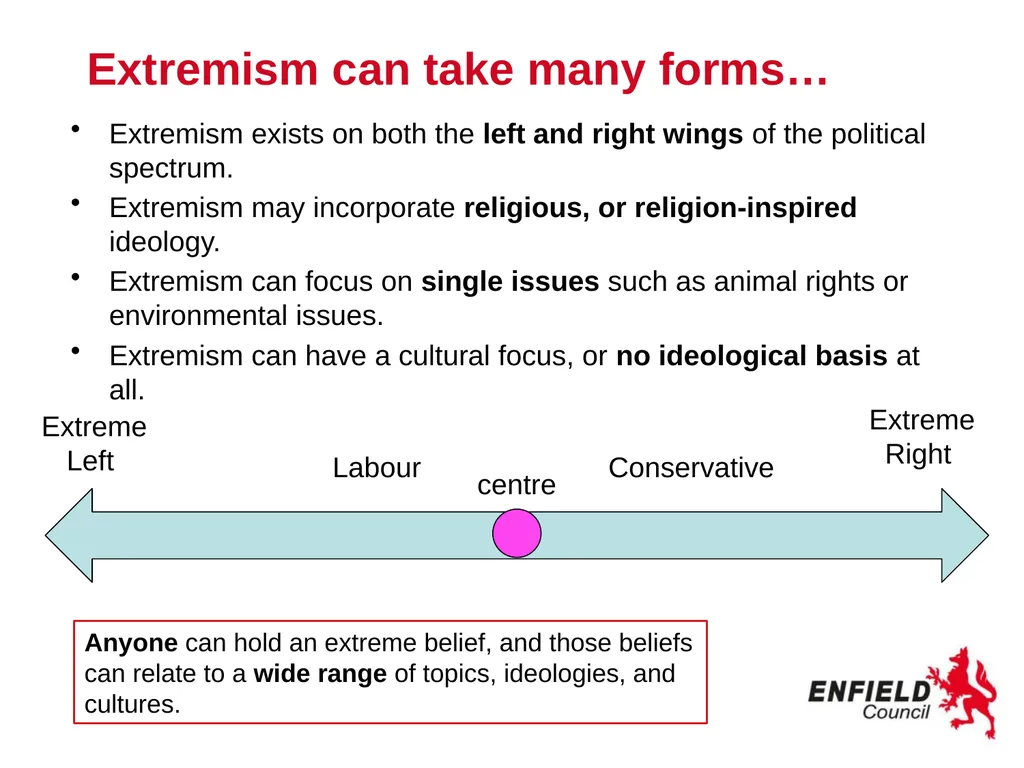
Extremism can take many forms… Anyone can hold an extreme belief, and those beliefs can relate to a wide range of topics, ideologies, and cultures. Extremism exists on both the left and right wings of the political spectrum.
Extremism may incorporate religious, or religion-inspired ideology.
Extremism can focus on single issues such as animal rights or environmental issues.
Extremism can have a cultural focus, or no ideological basis at all.<br>
Extremism may incorporate religious, or religion-inspired ideology.
Extremism can focus on single issues such as animal rights or environmental issues.
Extremism can have a cultural focus, or no ideological basis at all.<br>
07
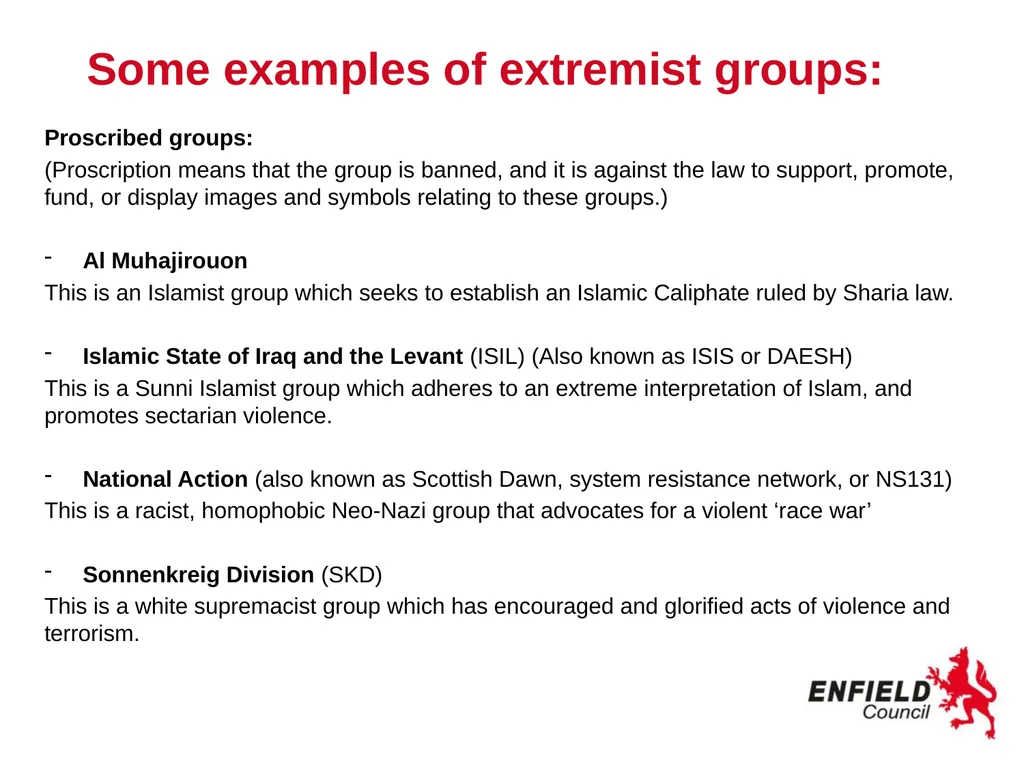
Some examples of extremist groups: Proscribed groups:
(Proscription means that the group is banned, and it is against the law to support, promote, fund, or display images and symbols relating to these groups.)
Al Muhajirouon
This is an Islamist group which seeks to establish an Islamic Caliphate ruled by Sharia law.
Islamic State of Iraq and the Levant (ISIL) (Also known as ISIS or DAESH)
This is a Sunni Islamist group which adheres to an extreme interpretation of Islam, and promotes sectarian violence.
National Action (also known as Scottish Dawn, system resistance network, or NS131)
This is a racist, homophobic Neo-Nazi group that advocates for a violent ‘race war’
Sonnenkreig Division (SKD)
This is a white supremacist group which has encouraged and glorified acts of violence and terrorism.<br>
(Proscription means that the group is banned, and it is against the law to support, promote, fund, or display images and symbols relating to these groups.)
Al Muhajirouon
This is an Islamist group which seeks to establish an Islamic Caliphate ruled by Sharia law.
Islamic State of Iraq and the Levant (ISIL) (Also known as ISIS or DAESH)
This is a Sunni Islamist group which adheres to an extreme interpretation of Islam, and promotes sectarian violence.
National Action (also known as Scottish Dawn, system resistance network, or NS131)
This is a racist, homophobic Neo-Nazi group that advocates for a violent ‘race war’
Sonnenkreig Division (SKD)
This is a white supremacist group which has encouraged and glorified acts of violence and terrorism.<br>
08
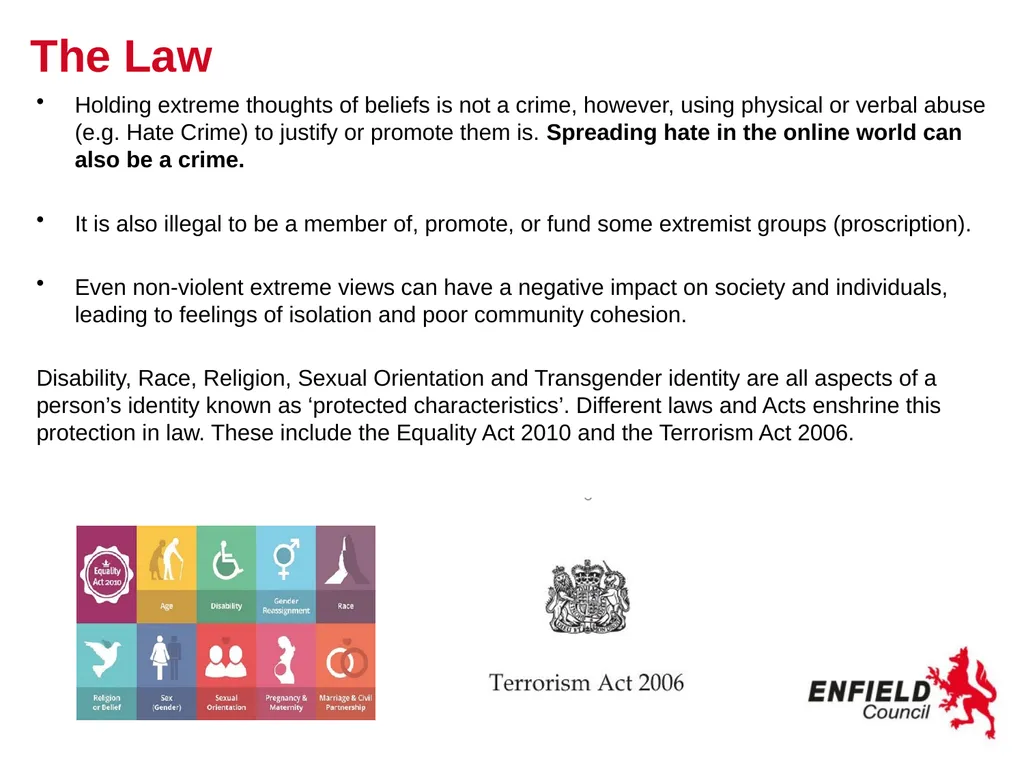
The Law Holding extreme thoughts of beliefs is not a crime, however, using physical or verbal abuse (e.g. Hate Crime) to justify or promote them is. Spreading hate in the online world can also be a crime.
It is also illegal to be a member of, promote, or fund some extremist groups (proscription).
Even non-violent extreme views can have a negative impact on society and individuals, leading to feelings of isolation and poor community cohesion.
Disability, Race, Religion, Sexual Orientation and Transgender identity are all aspects of a person’s identity known as ‘protected characteristics’. Different laws and Acts enshrine this protection in law. These include the Equality Act 2010 and the Terrorism Act 2006.<br>
It is also illegal to be a member of, promote, or fund some extremist groups (proscription).
Even non-violent extreme views can have a negative impact on society and individuals, leading to feelings of isolation and poor community cohesion.
Disability, Race, Religion, Sexual Orientation and Transgender identity are all aspects of a person’s identity known as ‘protected characteristics’. Different laws and Acts enshrine this protection in law. These include the Equality Act 2010 and the Terrorism Act 2006.<br>
09
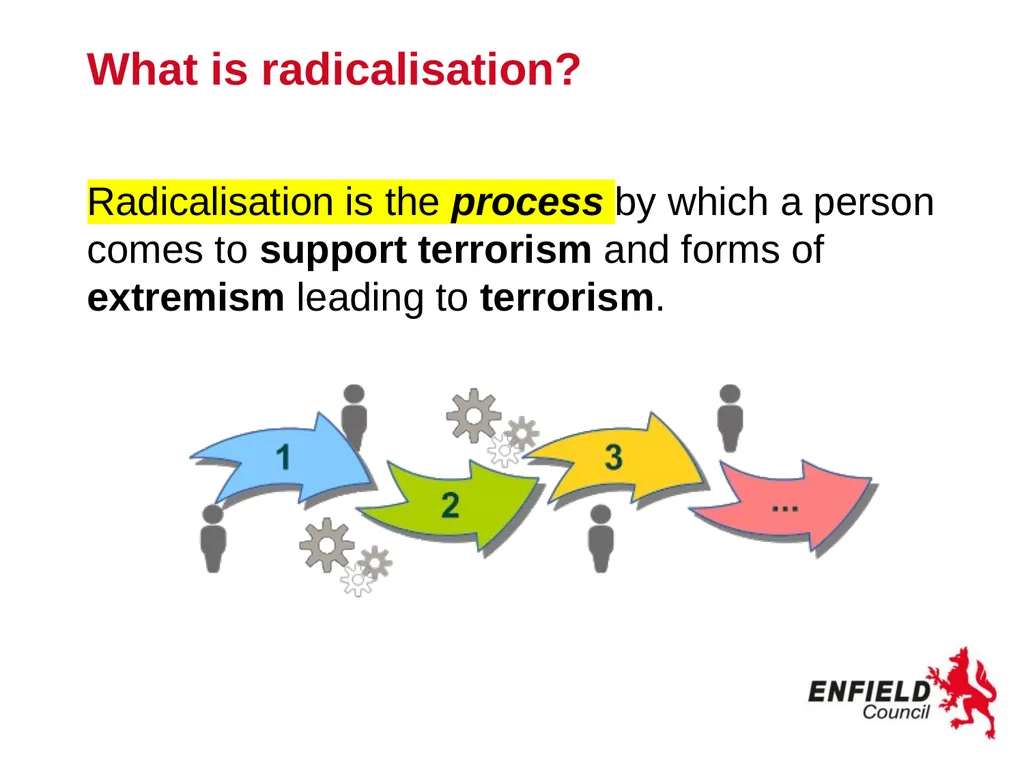
What is radicalisation? Radicalisation is the process by which a person comes to support terrorism and forms of extremism leading to terrorism.<br>
10
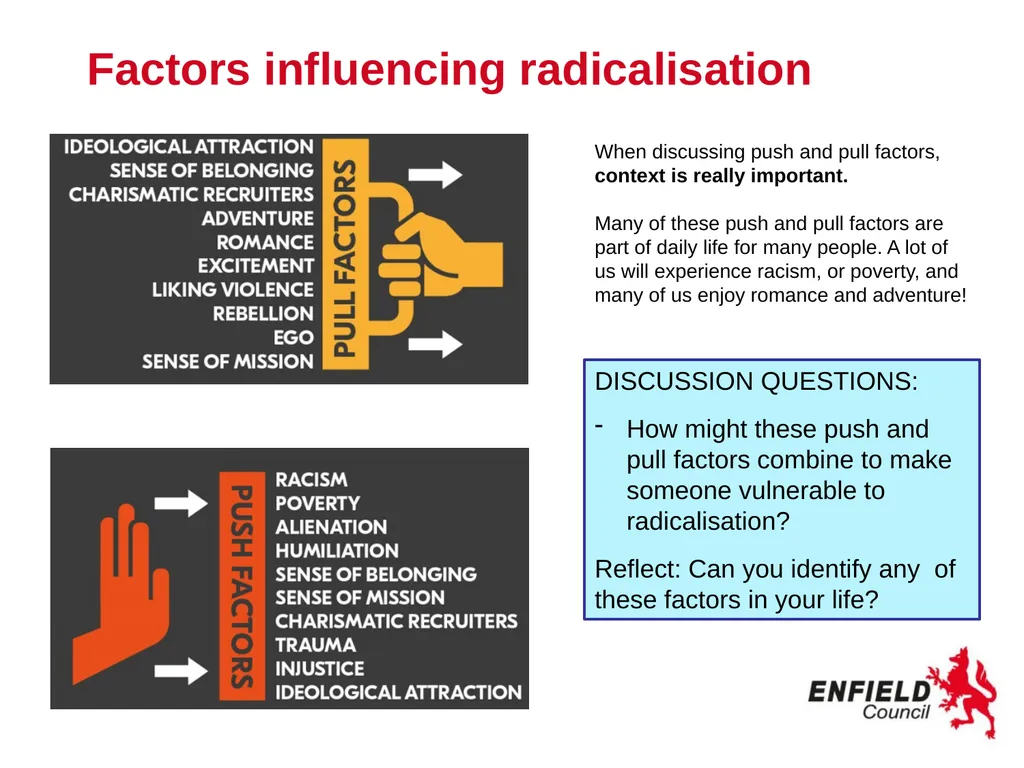
What factors combine to radicalise someone? Many factors can influence a pathway to radicalisation. It may be helpful to separate these into ‘push’ and ‘pull’ factors: Push Factors - What could happen in a person’s life to make them unhappy?
Pull Factors – What could make an extremist ideology appealing?<br>
Pull Factors – What could make an extremist ideology appealing?<br>
11
Factors influencing radicalisation DISCUSSION QUESTIONS:
How might these push and pull factors combine to make someone vulnerable to radicalisation?
Reflect: Can you identify any of these factors in your life? When discussing push and pull factors, context is really important.
Many of these push and pull factors are part of daily life for many people. A lot of us will experience racism, or poverty, and many of us enjoy romance and adventure!<br>
How might these push and pull factors combine to make someone vulnerable to radicalisation?
Reflect: Can you identify any of these factors in your life? When discussing push and pull factors, context is really important.
Many of these push and pull factors are part of daily life for many people. A lot of us will experience racism, or poverty, and many of us enjoy romance and adventure!<br>
12
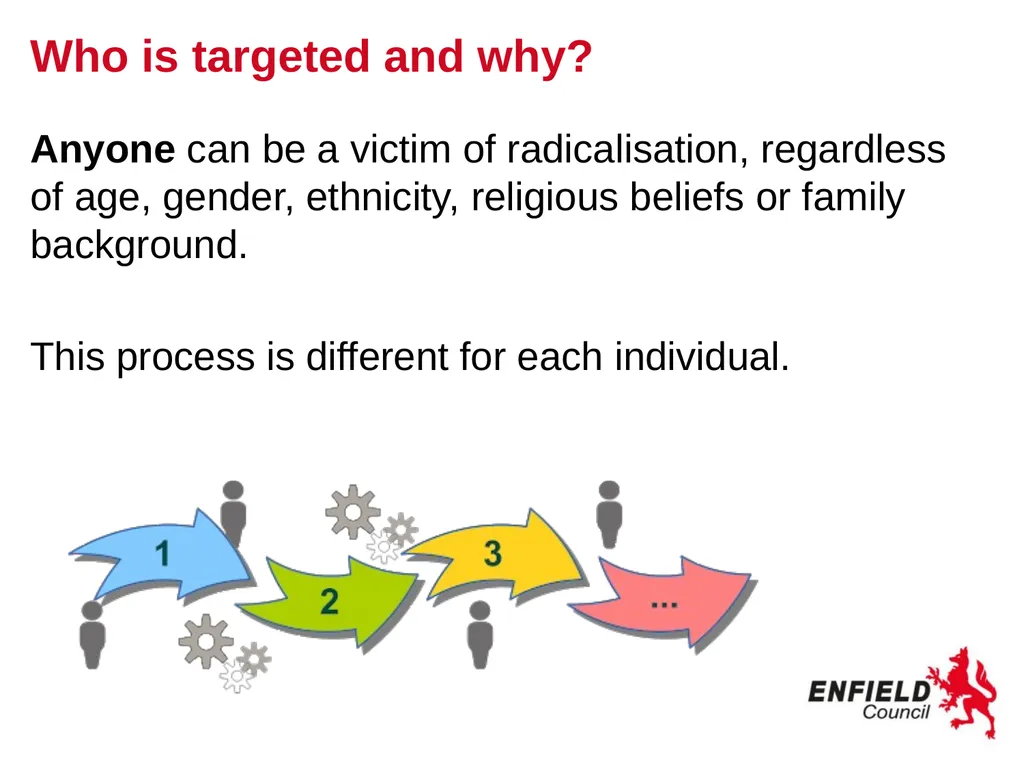
Who is targeted and why? Anyone can be a victim of radicalisation, regardless of age, gender, ethnicity, religious beliefs or family background.
This process is different for each individual.<br>
This process is different for each individual.<br>
13
Online Risks. How does the internet impact radicalisation? ‘Echo Chambers’ – it is difficult to break out of an information cycle and see different points of view.
Algorithms – bring in streams of similar content.
Accessibility – a lot of extremist content is on social media channels such as Twitter and WhatsApp.
Influencers – radical influencers use platforms such as TikTok and Instagram to attract followers and begin the radicalisation process.
Radicalisation can happen faster online.<br>
Algorithms – bring in streams of similar content.
Accessibility – a lot of extremist content is on social media channels such as Twitter and WhatsApp.
Influencers – radical influencers use platforms such as TikTok and Instagram to attract followers and begin the radicalisation process.
Radicalisation can happen faster online.<br>
14
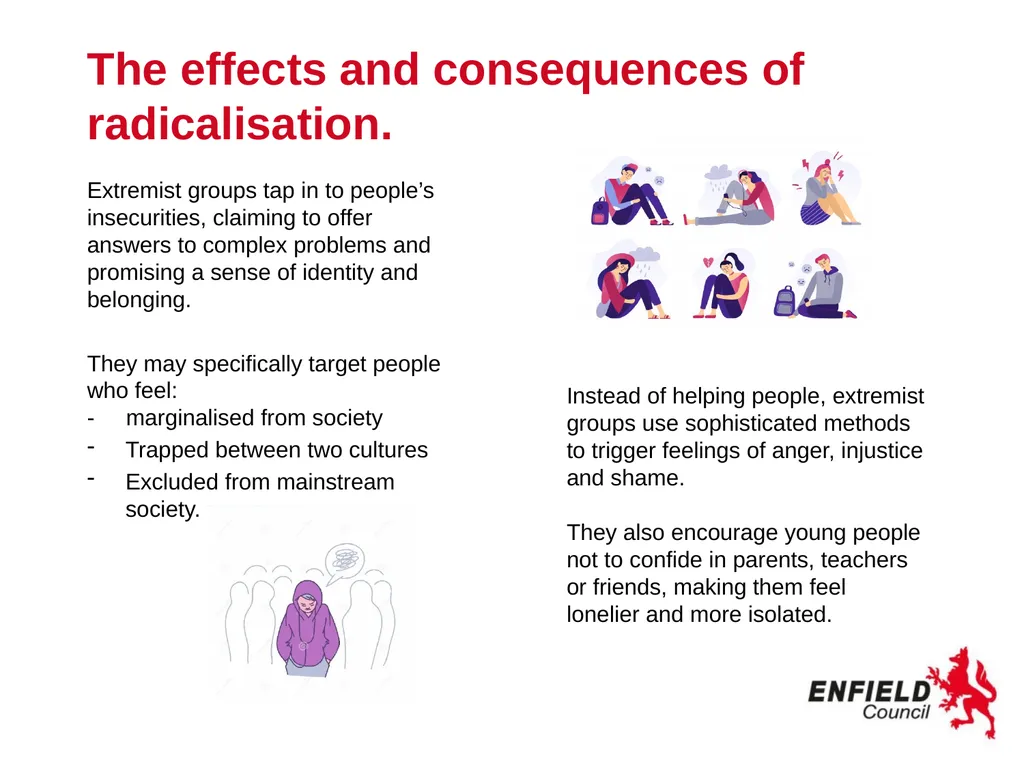
The effects and consequences of radicalisation. Extremist groups tap in to people’s insecurities, claiming to offer answers to complex problems and promising a sense of identity and belonging.
They may specifically target people who feel: - marginalised from society
Trapped between two cultures
Excluded from mainstream society. Instead of helping people, extremist groups use sophisticated methods to trigger feelings of anger, injustice and shame.
They also encourage young people not to confide in parents, teachers or friends, making them feel lonelier and more isolated.<br>
They may specifically target people who feel: - marginalised from society
Trapped between two cultures
Excluded from mainstream society. Instead of helping people, extremist groups use sophisticated methods to trigger feelings of anger, injustice and shame.
They also encourage young people not to confide in parents, teachers or friends, making them feel lonelier and more isolated.<br>
15
The effects and consequences of radicalisation. The effects of radicalisation and extremism will vary for each individual but may include feeling:
Depressed
Anxious
Angry
Isolated
Scared
They might be encouraged to do things such as:
Read or share extremist materials such as books or websites
Abuse or bully individuals or groups
Isolate themselves from existing social circles and family<br>
Depressed
Anxious
Angry
Isolated
Scared
They might be encouraged to do things such as:
Read or share extremist materials such as books or websites
Abuse or bully individuals or groups
Isolate themselves from existing social circles and family<br>
16
The effects and consequences of radicalisation. Occasionally, an individual may be radicalised to the point where they want to do dangerous or illegal things on behalf of the group. This could include:
Attacking or assaulting an individual/ a group of people
Accessing illegal online content
Attacking public property or buildings.
Buying or holding dangerous or illegal goods<br>
Attacking or assaulting an individual/ a group of people
Accessing illegal online content
Attacking public property or buildings.
Buying or holding dangerous or illegal goods<br>
17
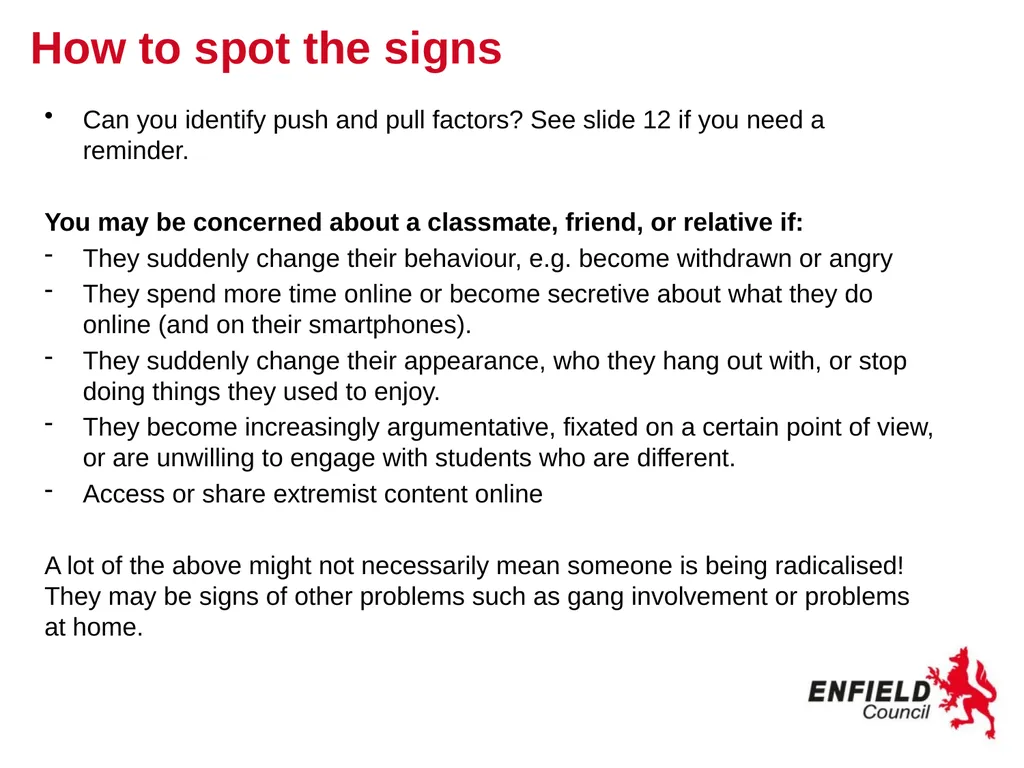
How to spot the signs Can you identify push and pull factors? See slide 12 if you need a reminder.
You may be concerned about a classmate, friend, or relative if:
They suddenly change their behaviour, e.g. become withdrawn or angry
They spend more time online or become secretive about what they do online (and on their smartphones).
They suddenly change their appearance, who they hang out with, or stop doing things they used to enjoy.
They become increasingly argumentative, fixated on a certain point of view, or are unwilling to engage with students who are different.
Access or share extremist content online
A lot of the above might not necessarily mean someone is being radicalised! They may be signs of other problems such as gang involvement or problems at home.<br>
You may be concerned about a classmate, friend, or relative if:
They suddenly change their behaviour, e.g. become withdrawn or angry
They spend more time online or become secretive about what they do online (and on their smartphones).
They suddenly change their appearance, who they hang out with, or stop doing things they used to enjoy.
They become increasingly argumentative, fixated on a certain point of view, or are unwilling to engage with students who are different.
Access or share extremist content online
A lot of the above might not necessarily mean someone is being radicalised! They may be signs of other problems such as gang involvement or problems at home.<br>
18
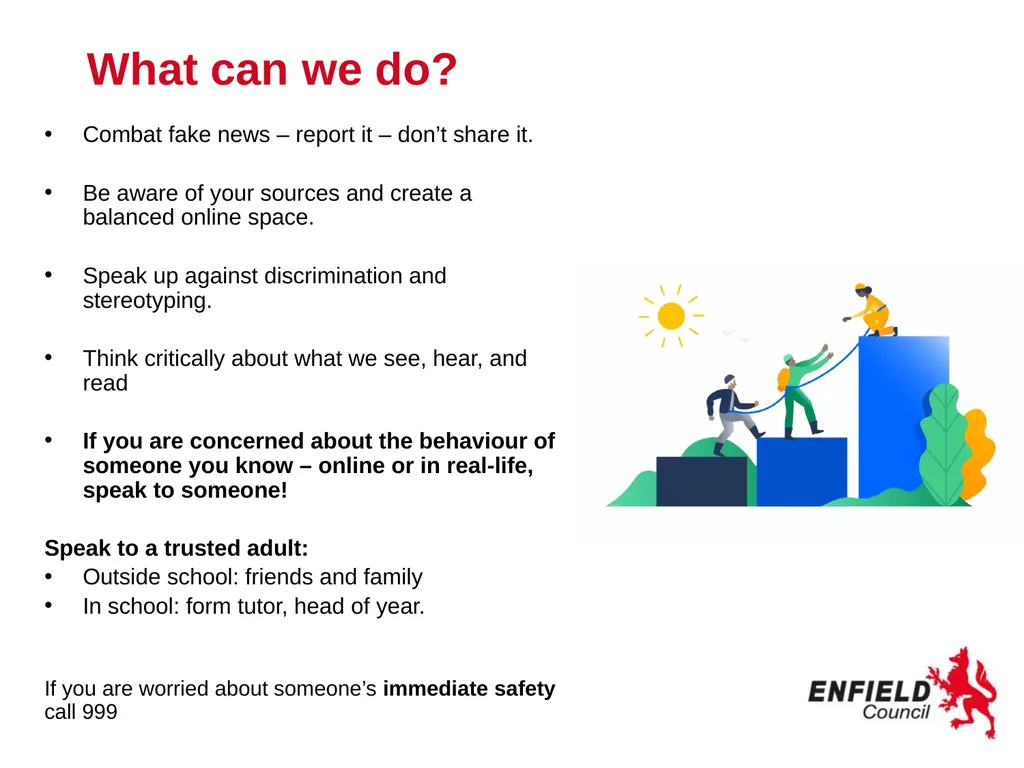
What can we do? Combat fake news – report it – don’t share it.
Be aware of your sources and create a balanced online space.
Speak up against discrimination and stereotyping.
Think critically about what we see, hear, and read
If you are concerned about the behaviour of someone you know – online or in real-life, speak to someone!
Speak to a trusted adult:
Outside school: friends and family
In school: form tutor, head of year.
If you are worried about someone’s immediate safety call 999<br>
Be aware of your sources and create a balanced online space.
Speak up against discrimination and stereotyping.
Think critically about what we see, hear, and read
If you are concerned about the behaviour of someone you know – online or in real-life, speak to someone!
Speak to a trusted adult:
Outside school: friends and family
In school: form tutor, head of year.
If you are worried about someone’s immediate safety call 999<br>