“Principle of Mineral Processing” Subject Code :
Description: Principle of Mineral Processing Subject Code : MT 410302 Unit 1 Introduction and scope of mineral processing in extractive metallurgy, Mineral resources in India, Physical characteristics exploited in mineral processing, Terminology in
Related Topics
Download Presentation
"“Principle of Mineral Processing” Subject Code :" is the property of its rightful owner. Permission is granted to download and print the materials on this website for personal, non-commercial use only, and to display it on your personal computer provided you do not modify the materials and that you retain all copyright notices contained in the materials. By downloading content from our website, you accept the terms of this agreement.
Presentation Transcript
slide1. “Principle of Mineral Processing”
Subject Code : MT 410302<br>
slide2. Unit 1
Introduction and scope of mineral processing in extractive metallurgy,
Mineral resources in India, Physical characteristics exploited in mineral
processing, Terminology in mineral processing
Physical and chemical characteristics of industrial minerals such as
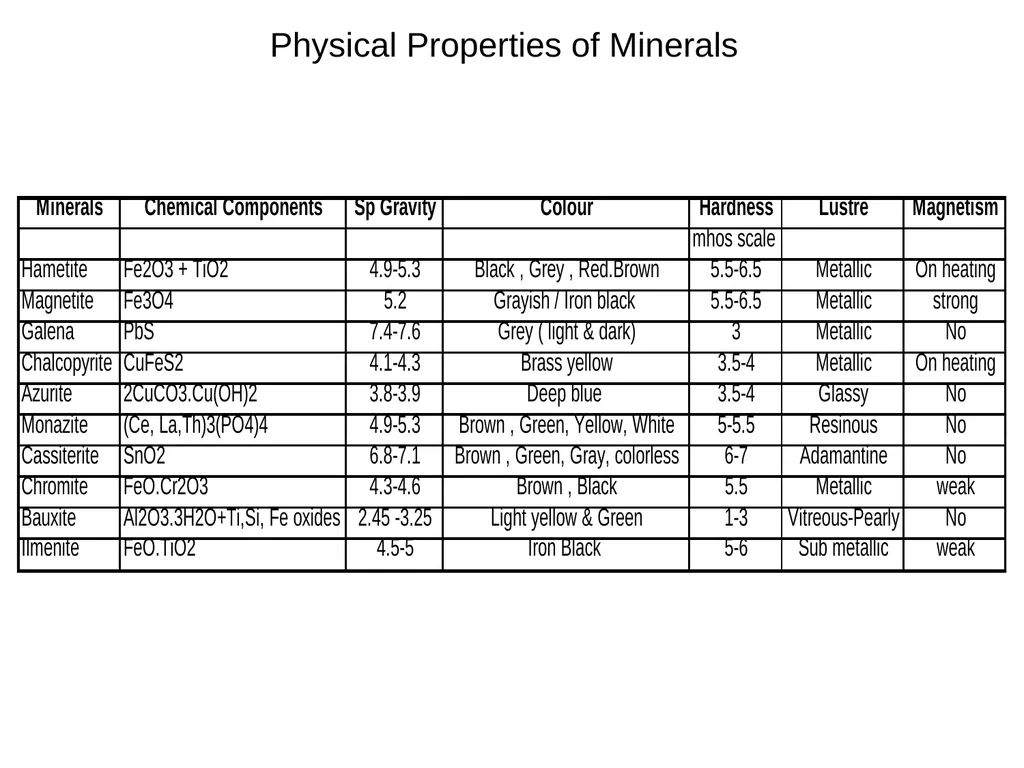
Haematite, Magnetite, Galena, Chalcopyrite, Azurite, Monazite, Cassiterite, Chromite, Bauxite and Ilmenite; Economics of ore processing. Selectivity index. Principle of Mineral Processing - Syllabus<br>
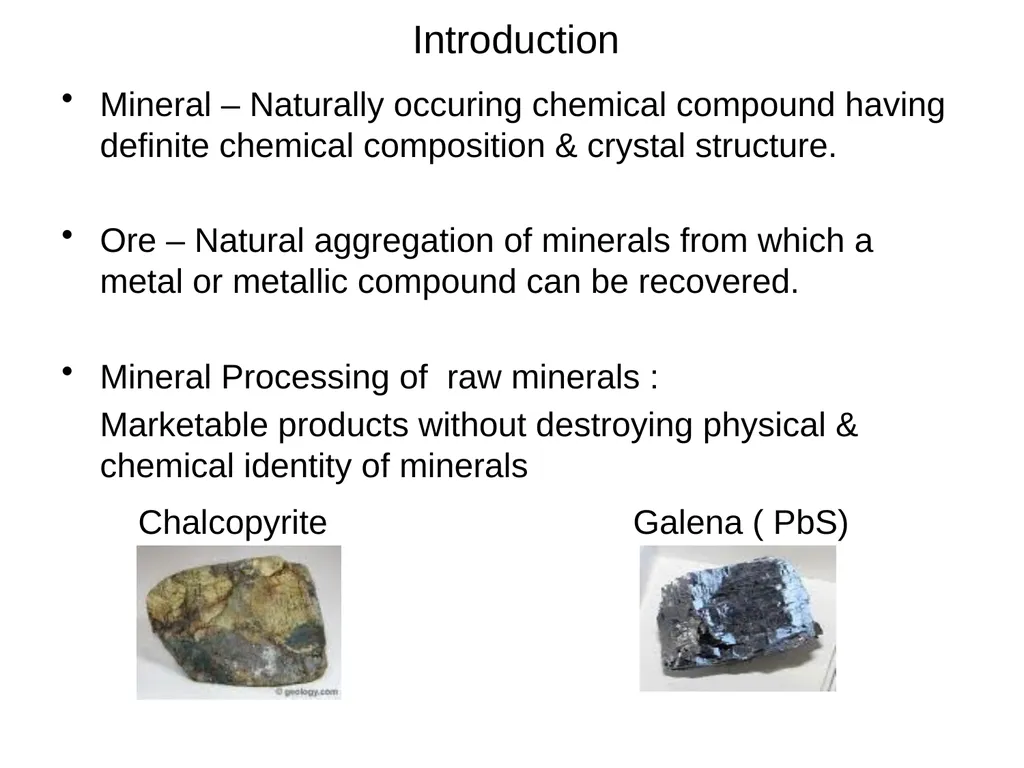
slide3. Mineral – Naturally occuring chemical compound having definite chemical composition & crystal structure.
Ore – Natural aggregation of minerals from which a metal or metallic compound can be recovered.
Mineral Processing of raw minerals :
Marketable products without destroying physical & chemical identity of minerals Introduction Chalcopyrite Galena ( PbS)<br>
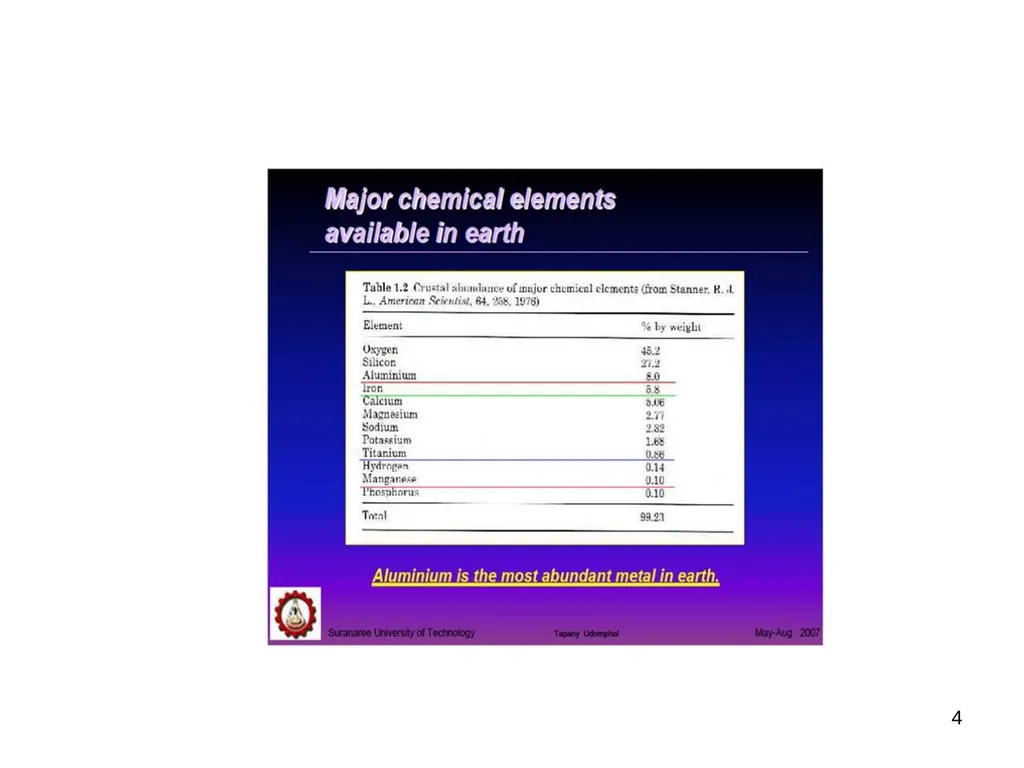
slide4. 4<br>
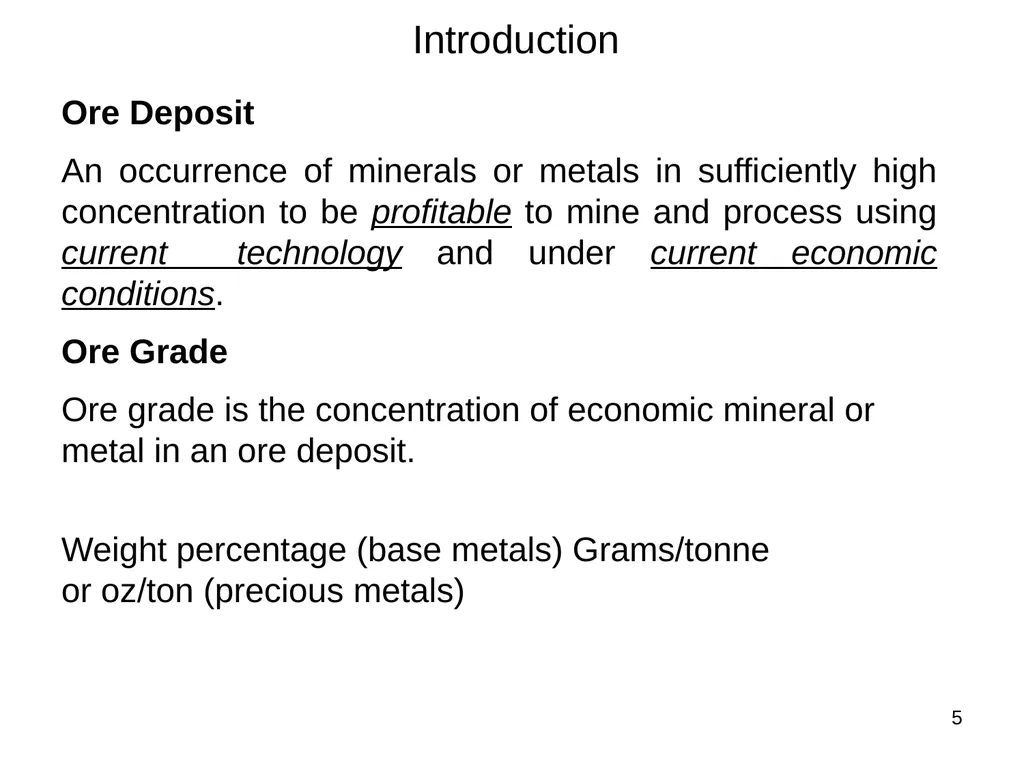
slide5. 5 Introduction Ore Deposit
An occurrence of minerals or metals in sufficiently high concentration to be profitable to mine and process using current technology and under current economic conditions.
Ore Grade
Ore grade is the concentration of economic mineral or metal in an ore deposit.
Weight percentage (base metals) Grams/tonne
or oz/ton (precious metals)<br>
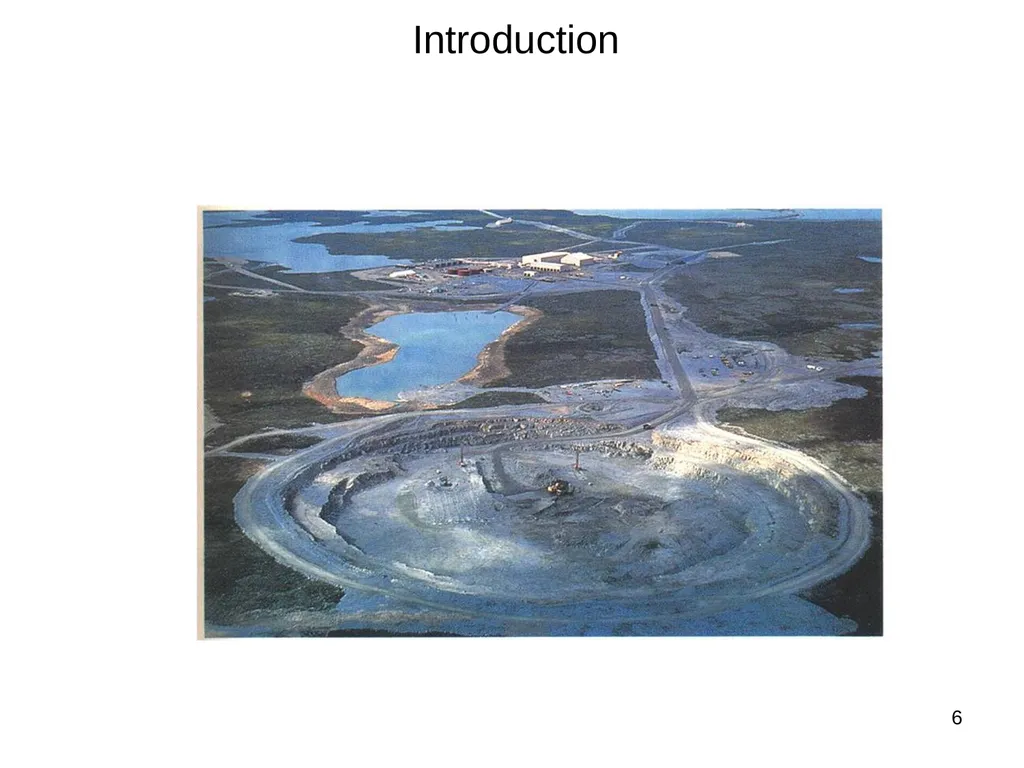
slide6. 6 Introduction<br>
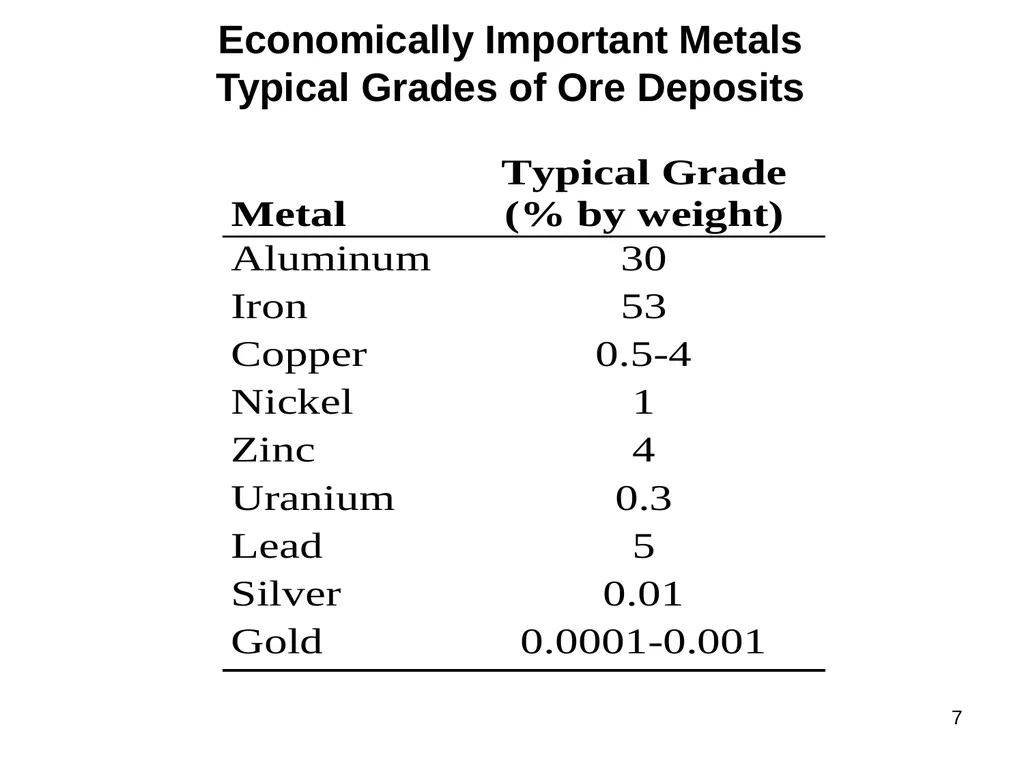
slide7. 7 Economically Important Metals Typical Grades of Ore Deposits<br>
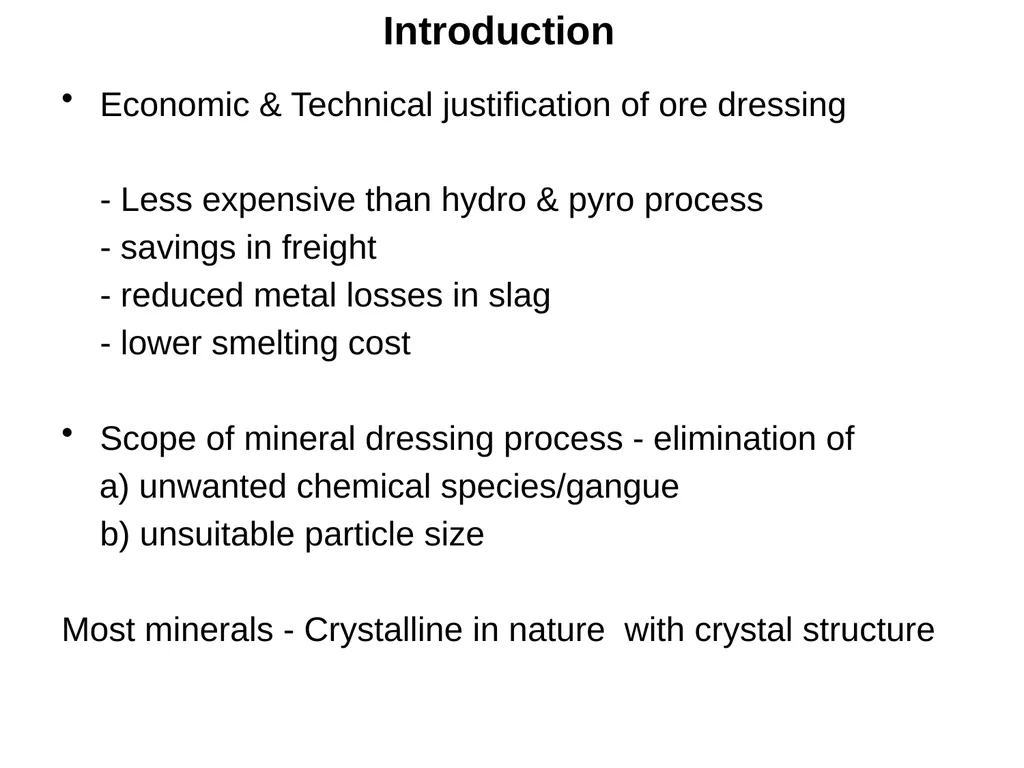
slide8. Economic & Technical justification of ore dressing
- Less expensive than hydro & pyro process
- savings in freight
- reduced metal losses in slag
- lower smelting cost
Scope of mineral dressing process - elimination of
a) unwanted chemical species/gangue
b) unsuitable particle size
Most minerals - Crystalline in nature with crystal structure Introduction<br>
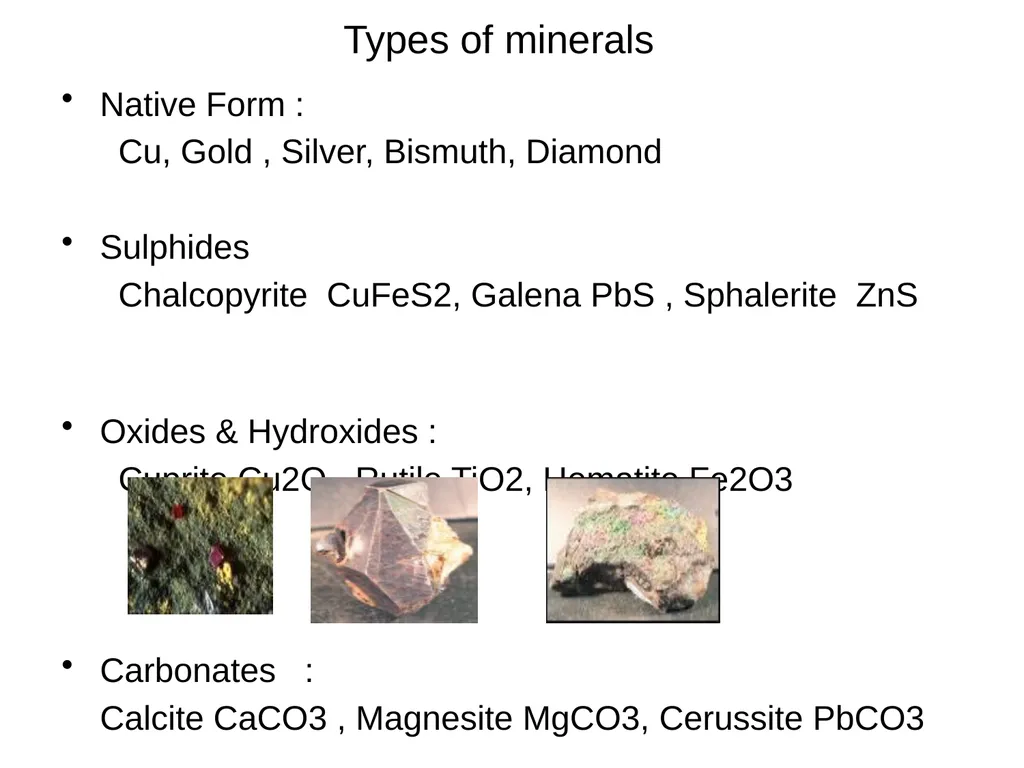
slide9. Native Form :
Cu, Gold , Silver, Bismuth, Diamond
Sulphides
Chalcopyrite CuFeS2, Galena PbS , Sphalerite ZnS
Oxides & Hydroxides :
Cuprite Cu2O , Rutile TiO2, Hematite Fe2O3
Carbonates :
Calcite CaCO3 , Magnesite MgCO3, Cerussite PbCO3 Types of minerals<br>
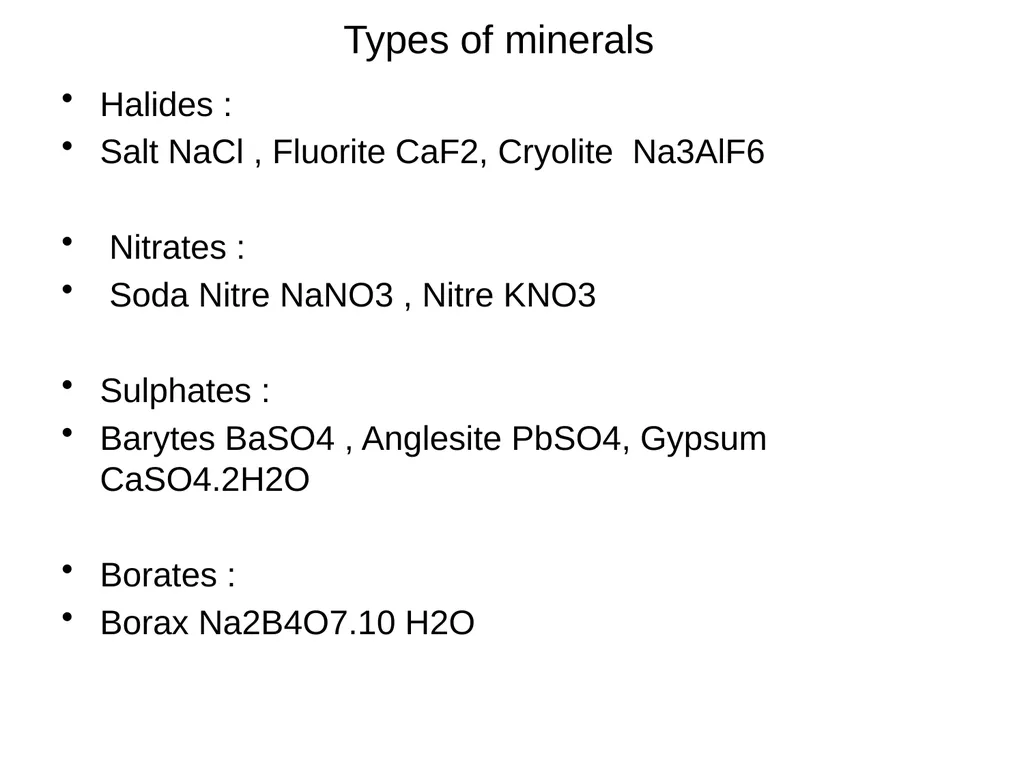
slide10. Halides :
Salt NaCl , Fluorite CaF2, Cryolite Na3AlF6
Nitrates :
Soda Nitre NaNO3 , Nitre KNO3
Sulphates :
Barytes BaSO4 , Anglesite PbSO4, Gypsum CaSO4.2H2O
Borates :
Borax Na2B4O7.10 H2O Types of minerals<br>
slide11. Mineral Resources in India<br>
slide12. Mineral Resources in India Classification of mineral resources in Indian perspective
Surplus Group : Iron ore, barite, bauxite, mica, soapstone, china
clay, gypsum, beach sand, sillimanite, ornamental stone, chromite
(low grade), dolomite and limestone ( cement grade)
Self sufficient Group: Thermal coal, lignite, chromite, pyrite etc.
Satisfactory Group : Zinc, magnesite, fireclay, ilmenite sand ( titanium) rutile, sand (titanium)<br>
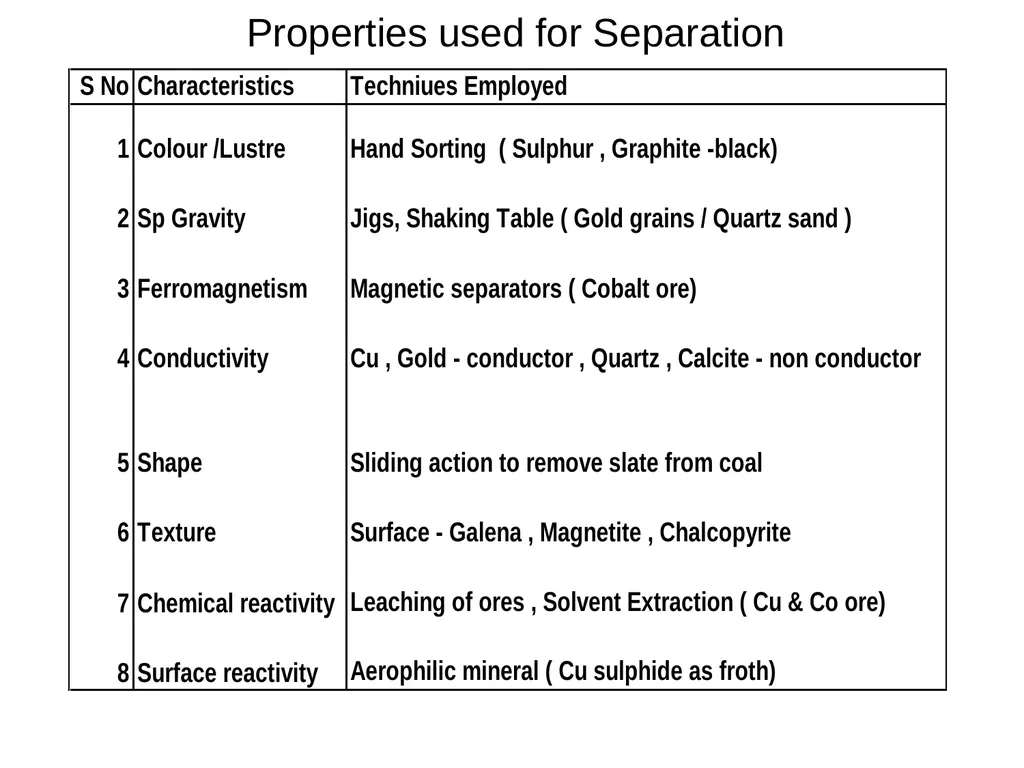
slide13. Properties used for Separation<br>
slide14. Physical Properties of Minerals<br>
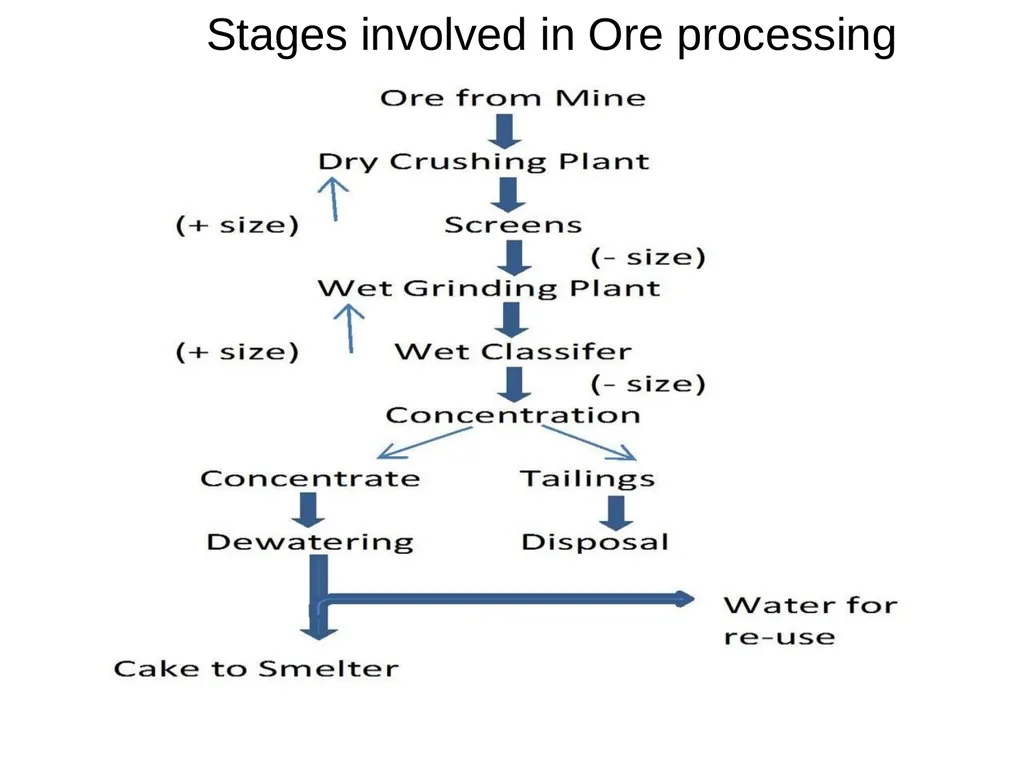
slide15. Stages involved in Ore processing<br>
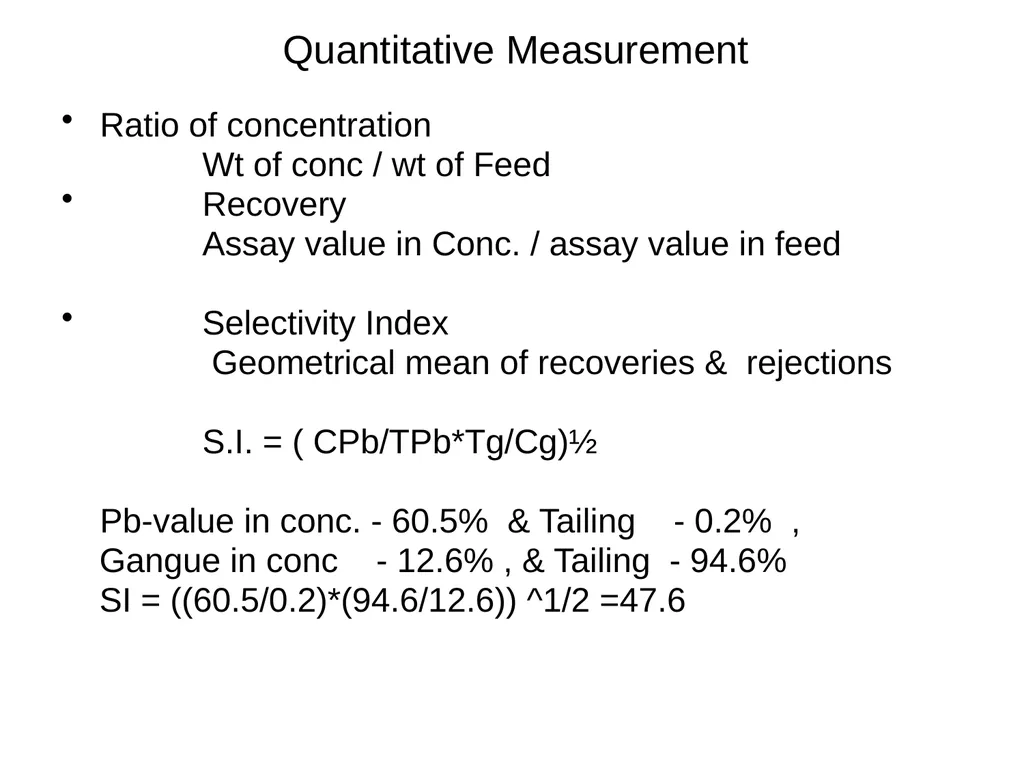
slide16. Ratio of concentration
Wt of conc / wt of Feed
Recovery
Assay value in Conc. / assay value in feed
Selectivity Index
Geometrical mean of recoveries & rejections
S.I. = ( CPb/TPb*Tg/Cg)½
Pb-value in conc. - 60.5% & Tailing - 0.2% ,
Gangue in conc - 12.6% , & Tailing - 94.6%
SI = ((60.5/0.2)*(94.6/12.6)) ^1/2 =47.6 Quantitative Measurement<br>
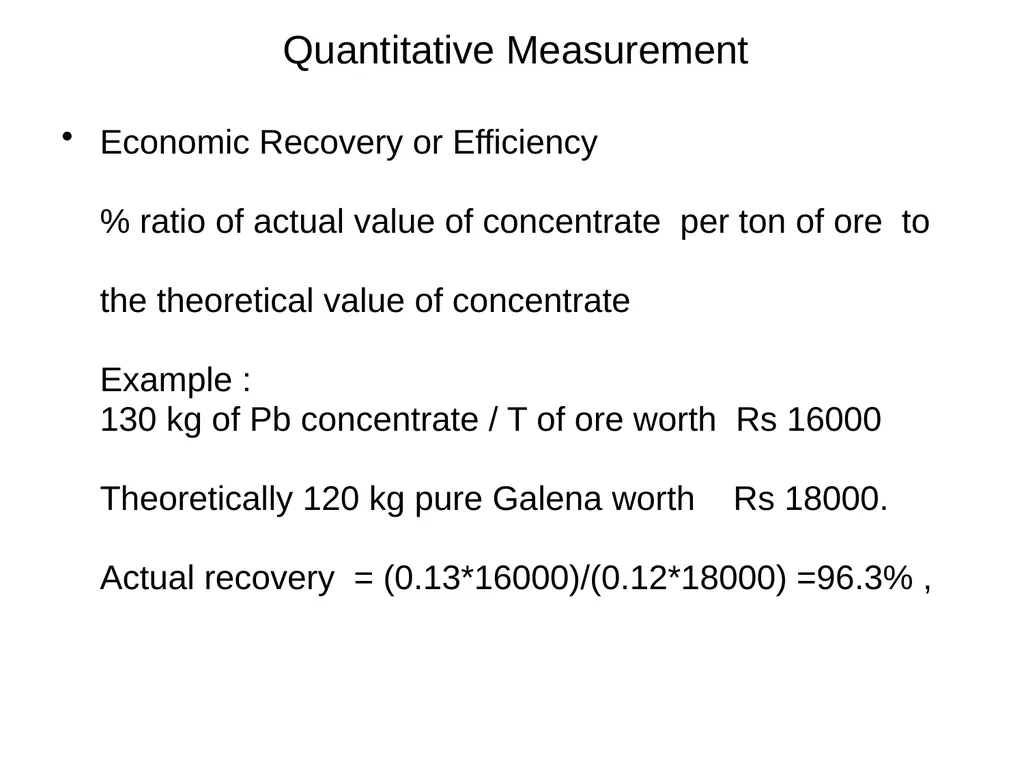
slide17. Economic Recovery or Efficiency
% ratio of actual value of concentrate per ton of ore to
the theoretical value of concentrate
Example :
130 kg of Pb concentrate / T of ore worth Rs 16000
Theoretically 120 kg pure Galena worth Rs 18000.
Actual recovery = (0.13*16000)/(0.12*18000) =96.3% , Quantitative Measurement<br>
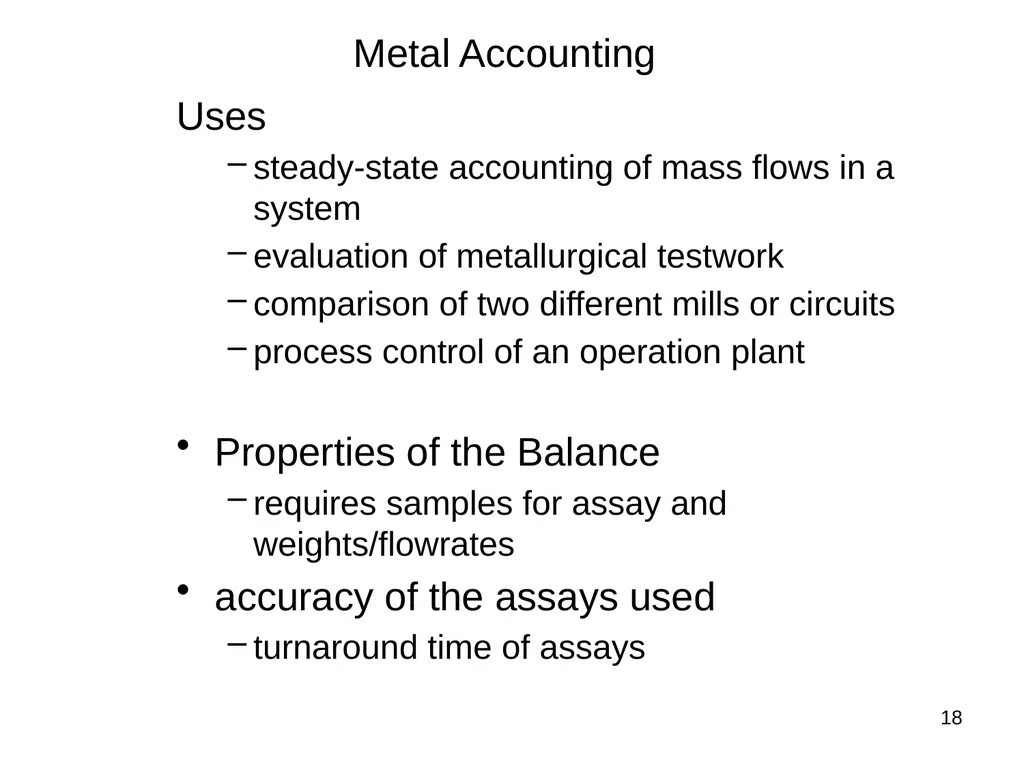
slide18. 18 Metal Accounting Uses
steady-state accounting of mass flows in a system
evaluation of metallurgical testwork
comparison of two different mills or circuits
process control of an operation plant
Properties of the Balance
requires samples for assay and weights/flowrates
accuracy of the assays used
turnaround time of assays<br>
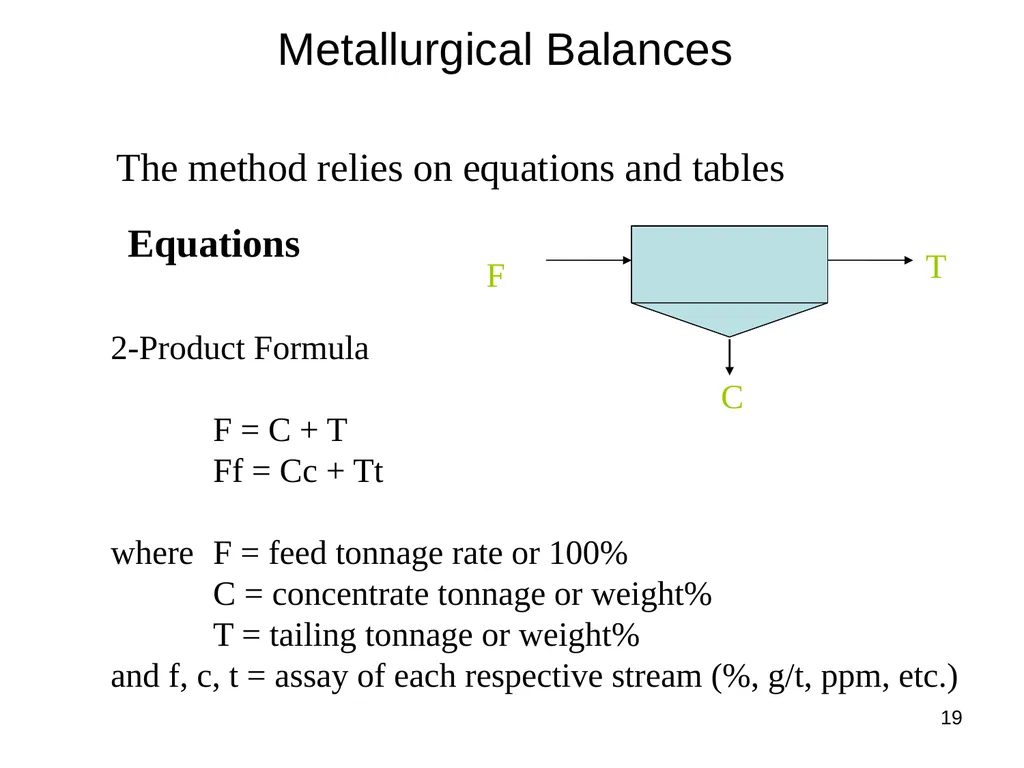
slide19. 19 Metallurgical Balances The method relies on equations and tables Equations 2-Product Formula
F = C + T
Ff = Cc + Tt
where F = feed tonnage rate or 100%
C = concentrate tonnage or weight%
T = tailing tonnage or weight%
and f, c, t = assay of each respective stream (%, g/t, ppm, etc.)<br>
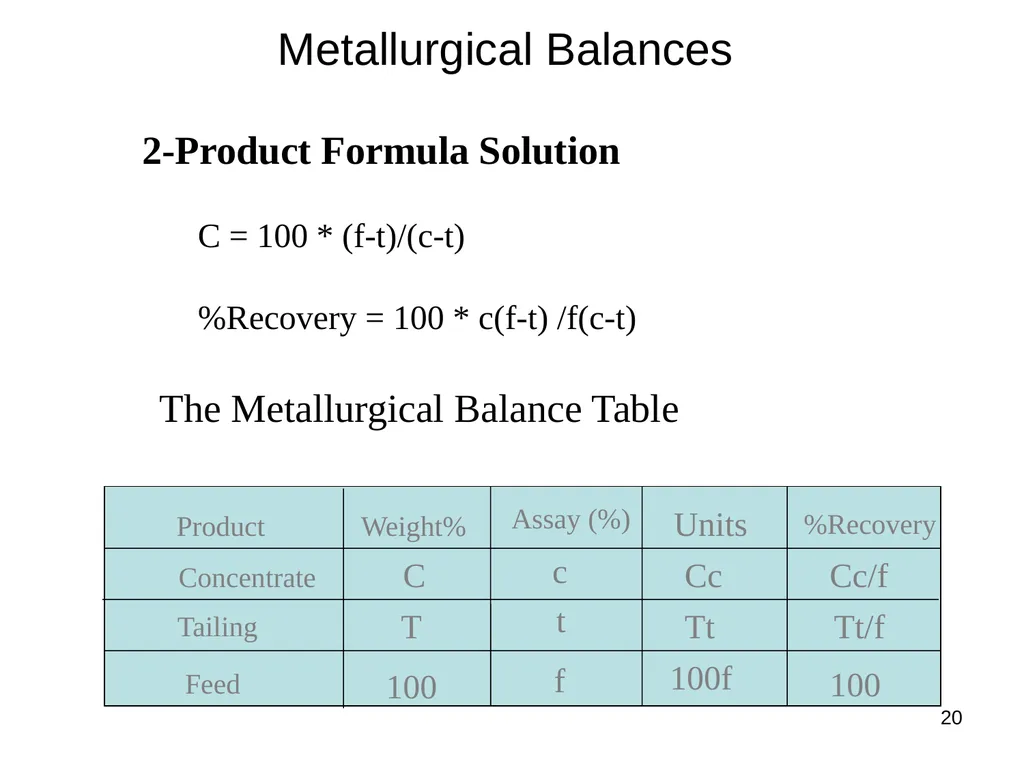
slide20. 20 Metallurgical Balances C = 100 * (f-t)/(c-t)
%Recovery = 100 * c(f-t) /f(c-t) 2-Product Formula Solution The Metallurgical Balance Table Weight% Assay (%) Units %Recovery Product Concentrate Tailing Feed T 100 C c t f Tt 100f 100 Cc Cc/f Tt/f<br>

Subject Code : MT 410302<br>
slide2. Unit 1
Introduction and scope of mineral processing in extractive metallurgy,
Mineral resources in India, Physical characteristics exploited in mineral
processing, Terminology in mineral processing
Physical and chemical characteristics of industrial minerals such as
Haematite, Magnetite, Galena, Chalcopyrite, Azurite, Monazite, Cassiterite, Chromite, Bauxite and Ilmenite; Economics of ore processing. Selectivity index. Principle of Mineral Processing - Syllabus<br>
slide3. Mineral – Naturally occuring chemical compound having definite chemical composition & crystal structure.
Ore – Natural aggregation of minerals from which a metal or metallic compound can be recovered.
Mineral Processing of raw minerals :
Marketable products without destroying physical & chemical identity of minerals Introduction Chalcopyrite Galena ( PbS)<br>
slide4. 4<br>
slide5. 5 Introduction Ore Deposit
An occurrence of minerals or metals in sufficiently high concentration to be profitable to mine and process using current technology and under current economic conditions.
Ore Grade
Ore grade is the concentration of economic mineral or metal in an ore deposit.
Weight percentage (base metals) Grams/tonne
or oz/ton (precious metals)<br>
slide6. 6 Introduction<br>
slide7. 7 Economically Important Metals Typical Grades of Ore Deposits<br>
slide8. Economic & Technical justification of ore dressing
- Less expensive than hydro & pyro process
- savings in freight
- reduced metal losses in slag
- lower smelting cost
Scope of mineral dressing process - elimination of
a) unwanted chemical species/gangue
b) unsuitable particle size
Most minerals - Crystalline in nature with crystal structure Introduction<br>
slide9. Native Form :
Cu, Gold , Silver, Bismuth, Diamond
Sulphides
Chalcopyrite CuFeS2, Galena PbS , Sphalerite ZnS
Oxides & Hydroxides :
Cuprite Cu2O , Rutile TiO2, Hematite Fe2O3
Carbonates :
Calcite CaCO3 , Magnesite MgCO3, Cerussite PbCO3 Types of minerals<br>
slide10. Halides :
Salt NaCl , Fluorite CaF2, Cryolite Na3AlF6
Nitrates :
Soda Nitre NaNO3 , Nitre KNO3
Sulphates :
Barytes BaSO4 , Anglesite PbSO4, Gypsum CaSO4.2H2O
Borates :
Borax Na2B4O7.10 H2O Types of minerals<br>
slide11. Mineral Resources in India<br>
slide12. Mineral Resources in India Classification of mineral resources in Indian perspective
Surplus Group : Iron ore, barite, bauxite, mica, soapstone, china
clay, gypsum, beach sand, sillimanite, ornamental stone, chromite
(low grade), dolomite and limestone ( cement grade)
Self sufficient Group: Thermal coal, lignite, chromite, pyrite etc.
Satisfactory Group : Zinc, magnesite, fireclay, ilmenite sand ( titanium) rutile, sand (titanium)<br>
slide13. Properties used for Separation<br>
slide14. Physical Properties of Minerals<br>
slide15. Stages involved in Ore processing<br>
slide16. Ratio of concentration
Wt of conc / wt of Feed
Recovery
Assay value in Conc. / assay value in feed
Selectivity Index
Geometrical mean of recoveries & rejections
S.I. = ( CPb/TPb*Tg/Cg)½
Pb-value in conc. - 60.5% & Tailing - 0.2% ,
Gangue in conc - 12.6% , & Tailing - 94.6%
SI = ((60.5/0.2)*(94.6/12.6)) ^1/2 =47.6 Quantitative Measurement<br>
slide17. Economic Recovery or Efficiency
% ratio of actual value of concentrate per ton of ore to
the theoretical value of concentrate
Example :
130 kg of Pb concentrate / T of ore worth Rs 16000
Theoretically 120 kg pure Galena worth Rs 18000.
Actual recovery = (0.13*16000)/(0.12*18000) =96.3% , Quantitative Measurement<br>
slide18. 18 Metal Accounting Uses
steady-state accounting of mass flows in a system
evaluation of metallurgical testwork
comparison of two different mills or circuits
process control of an operation plant
Properties of the Balance
requires samples for assay and weights/flowrates
accuracy of the assays used
turnaround time of assays<br>
slide19. 19 Metallurgical Balances The method relies on equations and tables Equations 2-Product Formula
F = C + T
Ff = Cc + Tt
where F = feed tonnage rate or 100%
C = concentrate tonnage or weight%
T = tailing tonnage or weight%
and f, c, t = assay of each respective stream (%, g/t, ppm, etc.)<br>
slide20. 20 Metallurgical Balances C = 100 * (f-t)/(c-t)
%Recovery = 100 * c(f-t) /f(c-t) 2-Product Formula Solution The Metallurgical Balance Table Weight% Assay (%) Units %Recovery Product Concentrate Tailing Feed T 100 C c t f Tt 100f 100 Cc Cc/f Tt/f<br>