
Principles of Antimicrobial Therapy The
LD
Published · 30 slides · 0 views

1 / 1



Description
Principles of Antimicrobial Therapy The development of antimicrobial drugs represents one of the most important advances in therapeutics, both in the control or cure of serious infections and in the prevention and treatment of infectious
Related Topics
Share
Embed code
Download this presentation From Below
"Principles of Antimicrobial Therapy The" is the property of its rightful owner. Permission is granted to download and print the materials on this website for personal, non-commercial use only, and to display it on your personal computer provided you do not modify the materials and that you retain all copyright notices contained in the materials. By downloading content from our website, you accept the terms of this agreement.
Presentation Transcript
01
Principles of Antimicrobial
Therapy<br>
02
The development of antimicrobial drugs represents one of the most important advances in therapeutics, both in the control or cure of serious infections and in the prevention and treatment of infectious complications of other therapeutic modalities such as cancer chemotherapy, immunosuppression, and surgery.
Antimicrobial drugs have the ability to injure or kill an invading microorganism without harming the cells of the host taking the advantage of the biochemical differences that exist between microorganisms and human beings. In most instances, this selective toxicity is relative rather than absolute, requiring that the concentration of the drug be carefully controlled to attack the microorganism, while still being tolerated by the host.
The antimicrobial drugs can be subclassified as antibacterial, antifungal, antiviral agents, and antiparasitic drugs. These agents include natural compounds, called antibiotics, as well as synthetic compounds. An antibiotic is a substance produced by one microbe that can inhibit the growth or viability of another microbe.<br>
Antimicrobial drugs have the ability to injure or kill an invading microorganism without harming the cells of the host taking the advantage of the biochemical differences that exist between microorganisms and human beings. In most instances, this selective toxicity is relative rather than absolute, requiring that the concentration of the drug be carefully controlled to attack the microorganism, while still being tolerated by the host.
The antimicrobial drugs can be subclassified as antibacterial, antifungal, antiviral agents, and antiparasitic drugs. These agents include natural compounds, called antibiotics, as well as synthetic compounds. An antibiotic is a substance produced by one microbe that can inhibit the growth or viability of another microbe.<br>
03
Classification of Antimicrobial Drugs
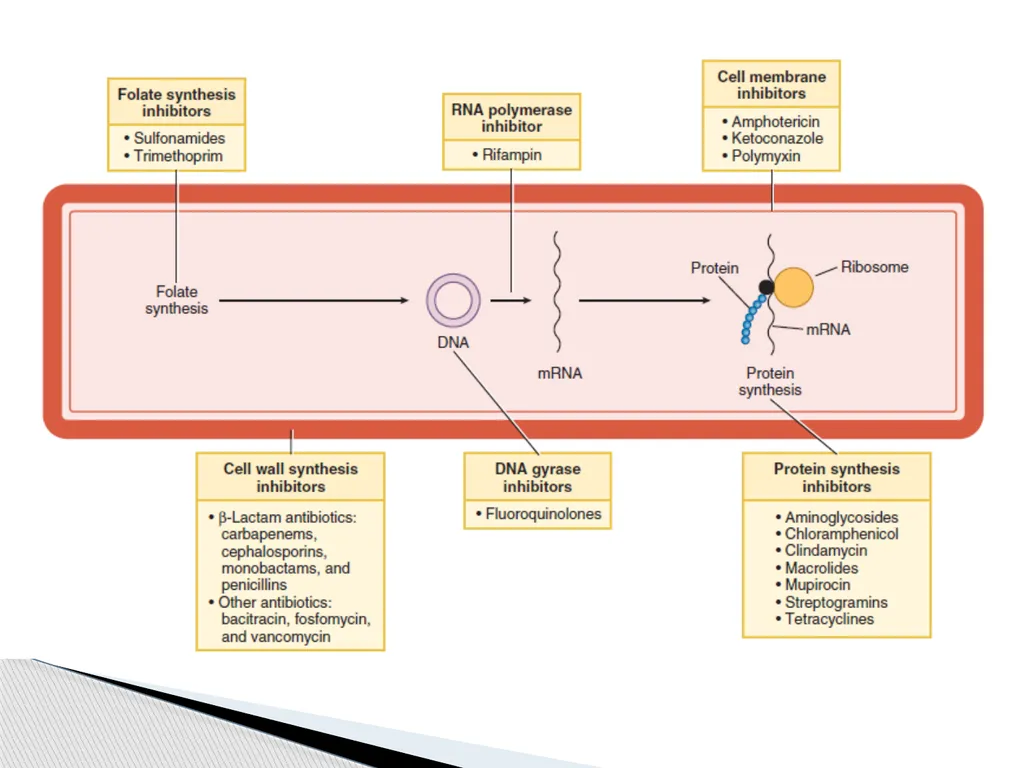
Antimicrobial drugs are usually classified on the basis of their site and mechanism of action and are subclassified on the basis of their chemical structure. The antimicrobial drugs include cell wall synthesis inhibitors, protein synthesis inhibitors, metabolic and nucleic acid inhibitors, and cell membrane inhibitors.<br>
Antimicrobial drugs are usually classified on the basis of their site and mechanism of action and are subclassified on the basis of their chemical structure. The antimicrobial drugs include cell wall synthesis inhibitors, protein synthesis inhibitors, metabolic and nucleic acid inhibitors, and cell membrane inhibitors.<br>
04
Antimicrobial Activity
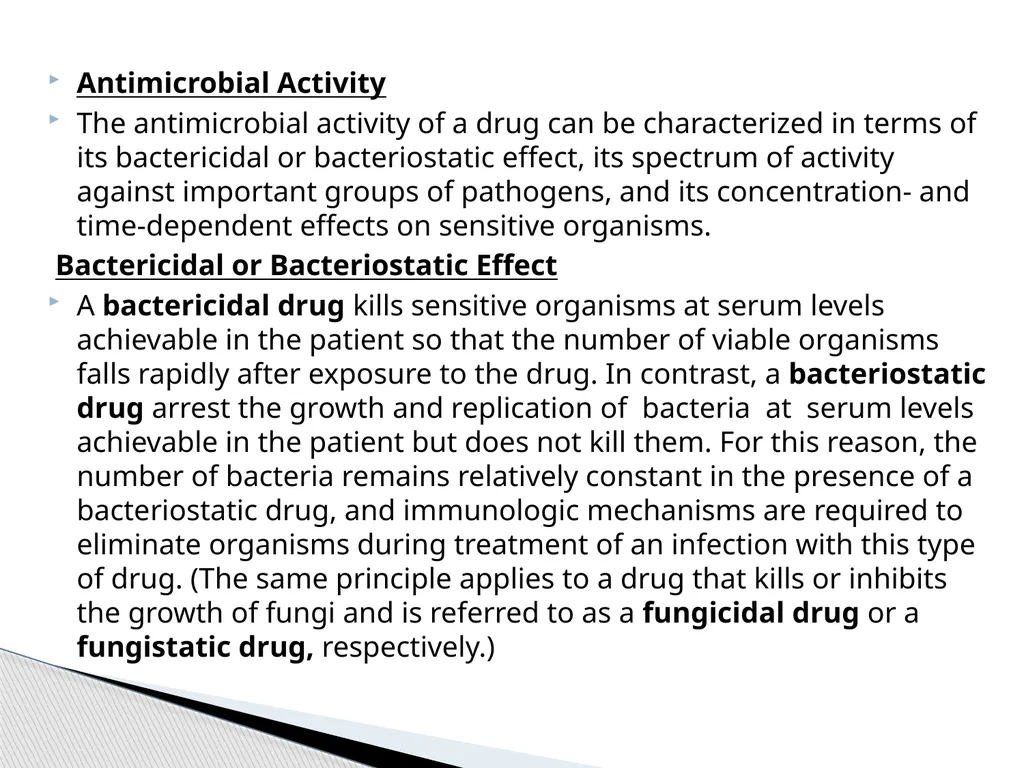
The antimicrobial activity of a drug can be characterized in terms of its bactericidal or bacteriostatic effect, its spectrum of activity against important groups of pathogens, and its concentration- and time-dependent effects on sensitive organisms.
Bactericidal or Bacteriostatic Effect
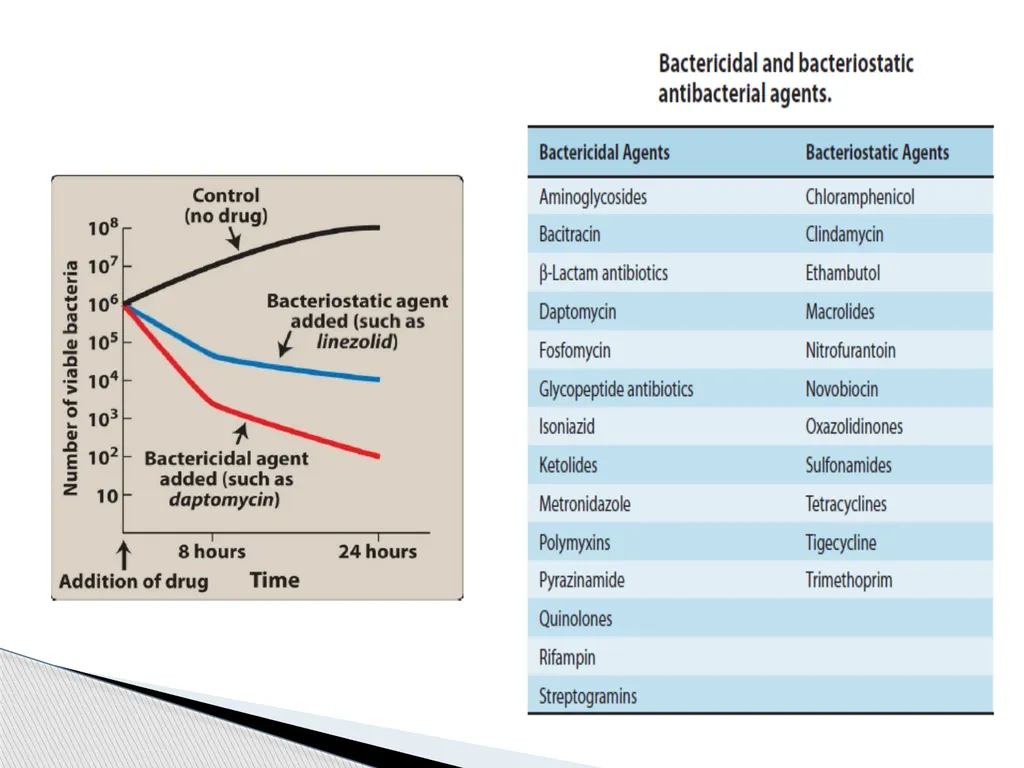
A bactericidal drug kills sensitive organisms at serum levels achievable in the patient so that the number of viable organisms falls rapidly after exposure to the drug. In contrast, a bacteriostatic drug arrest the growth and replication of bacteria at serum levels achievable in the patient but does not kill them. For this reason, the number of bacteria remains relatively constant in the presence of a bacteriostatic drug, and immunologic mechanisms are required to eliminate organisms during treatment of an infection with this type of drug. (The same principle applies to a drug that kills or inhibits the growth of fungi and is referred to as a fungicidal drug or a fungistatic drug, respectively.)<br>
The antimicrobial activity of a drug can be characterized in terms of its bactericidal or bacteriostatic effect, its spectrum of activity against important groups of pathogens, and its concentration- and time-dependent effects on sensitive organisms.
Bactericidal or Bacteriostatic Effect
A bactericidal drug kills sensitive organisms at serum levels achievable in the patient so that the number of viable organisms falls rapidly after exposure to the drug. In contrast, a bacteriostatic drug arrest the growth and replication of bacteria at serum levels achievable in the patient but does not kill them. For this reason, the number of bacteria remains relatively constant in the presence of a bacteriostatic drug, and immunologic mechanisms are required to eliminate organisms during treatment of an infection with this type of drug. (The same principle applies to a drug that kills or inhibits the growth of fungi and is referred to as a fungicidal drug or a fungistatic drug, respectively.)<br>
05
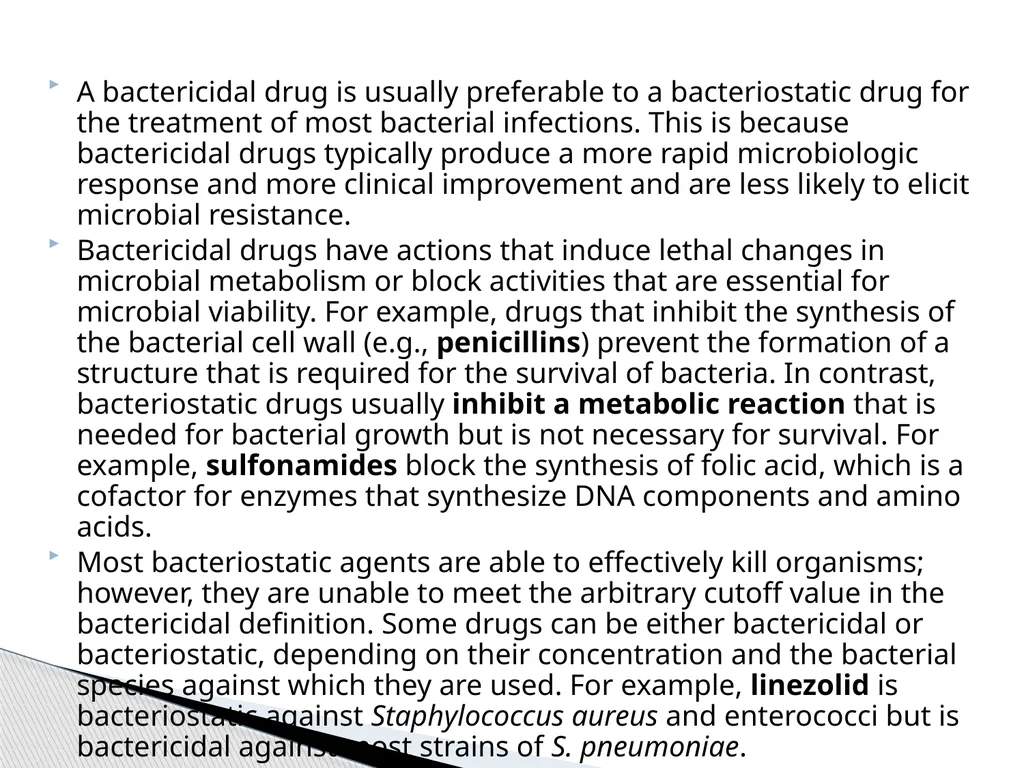
A bactericidal drug is usually preferable to a bacteriostatic drug for the treatment of most bacterial infections. This is because bactericidal drugs typically produce a more rapid microbiologic response and more clinical improvement and are less likely to elicit microbial resistance.
Bactericidal drugs have actions that induce lethal changes in microbial metabolism or block activities that are essential for microbial viability. For example, drugs that inhibit the synthesis of the bacterial cell wall (e.g., penicillins) prevent the formation of a structure that is required for the survival of bacteria. In contrast, bacteriostatic drugs usually inhibit a metabolic reaction that is needed for bacterial growth but is not necessary for survival. For example, sulfonamides block the synthesis of folic acid, which is a cofactor for enzymes that synthesize DNA components and amino acids.
Most bacteriostatic agents are able to effectively kill organisms; however, they are unable to meet the arbitrary cutoff value in the bactericidal definition. Some drugs can be either bactericidal or bacteriostatic, depending on their concentration and the bacterial species against which they are used. For example, linezolid is bacteriostatic against Staphylococcus aureus and enterococci but is bactericidal against most strains of S. pneumoniae.<br>
Bactericidal drugs have actions that induce lethal changes in microbial metabolism or block activities that are essential for microbial viability. For example, drugs that inhibit the synthesis of the bacterial cell wall (e.g., penicillins) prevent the formation of a structure that is required for the survival of bacteria. In contrast, bacteriostatic drugs usually inhibit a metabolic reaction that is needed for bacterial growth but is not necessary for survival. For example, sulfonamides block the synthesis of folic acid, which is a cofactor for enzymes that synthesize DNA components and amino acids.
Most bacteriostatic agents are able to effectively kill organisms; however, they are unable to meet the arbitrary cutoff value in the bactericidal definition. Some drugs can be either bactericidal or bacteriostatic, depending on their concentration and the bacterial species against which they are used. For example, linezolid is bacteriostatic against Staphylococcus aureus and enterococci but is bactericidal against most strains of S. pneumoniae.<br>
06
Antimicrobial Spectrum
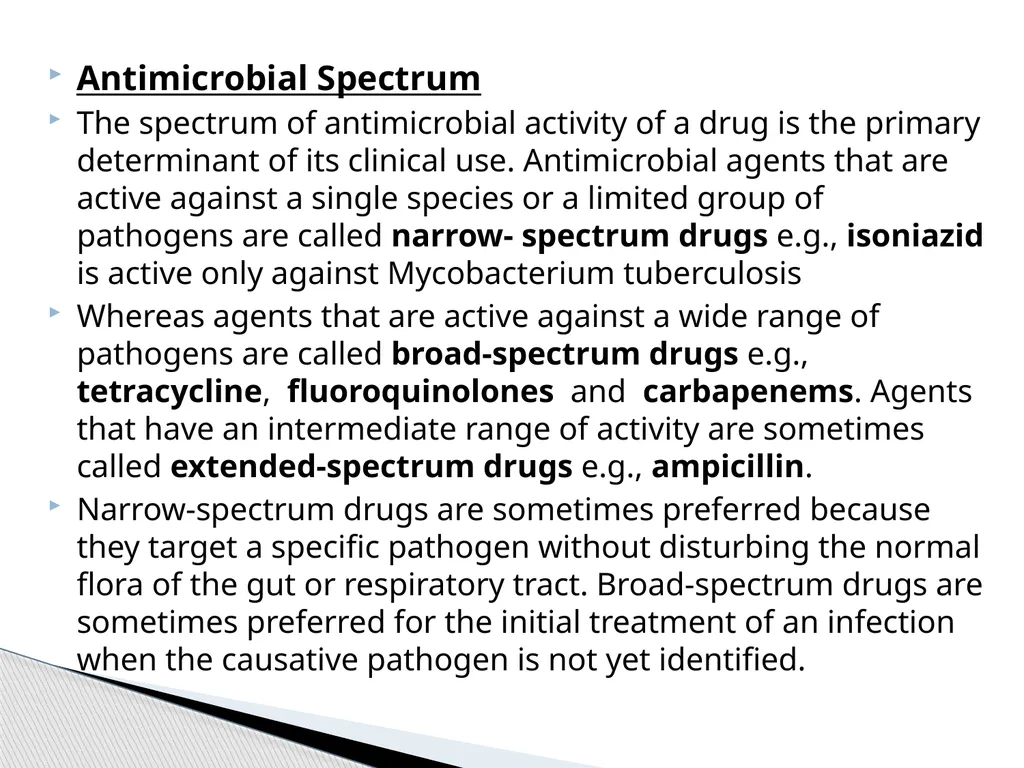
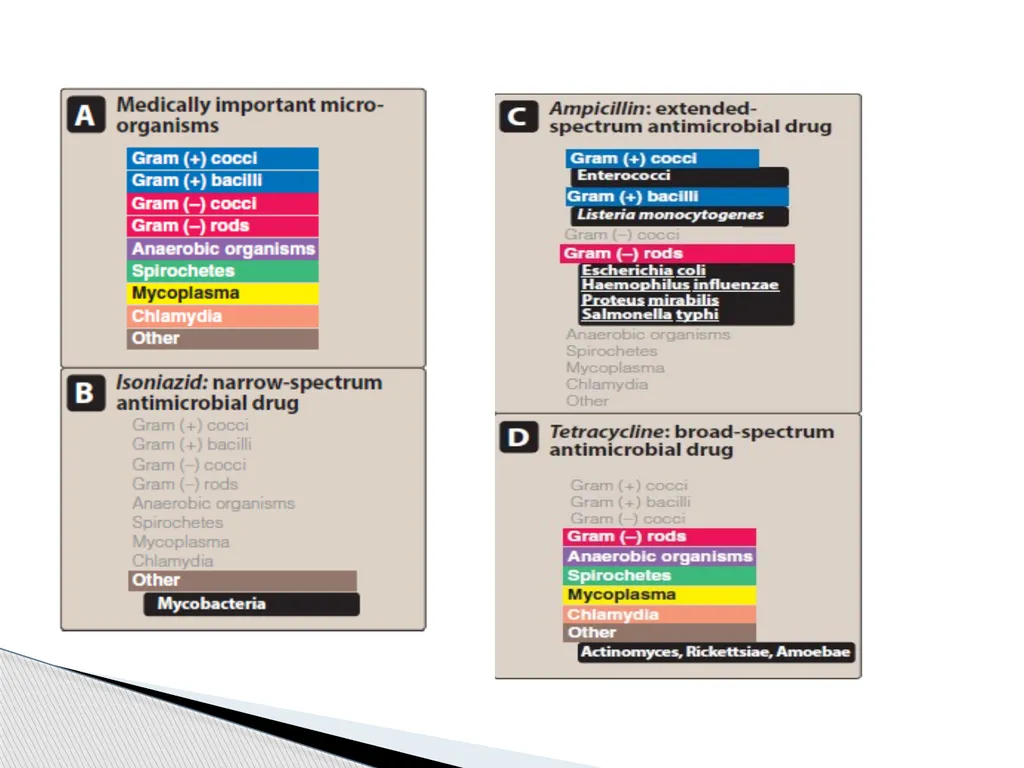
The spectrum of antimicrobial activity of a drug is the primary determinant of its clinical use. Antimicrobial agents that are active against a single species or a limited group of pathogens are called narrow- spectrum drugs e.g., isoniazid is active only against Mycobacterium tuberculosis
Whereas agents that are active against a wide range of pathogens are called broad-spectrum drugs e.g., tetracycline, fluoroquinolones and carbapenems. Agents that have an intermediate range of activity are sometimes called extended-spectrum drugs e.g., ampicillin.
Narrow-spectrum drugs are sometimes preferred because they target a specific pathogen without disturbing the normal flora of the gut or respiratory tract. Broad-spectrum drugs are sometimes preferred for the initial treatment of an infection when the causative pathogen is not yet identified.<br>
The spectrum of antimicrobial activity of a drug is the primary determinant of its clinical use. Antimicrobial agents that are active against a single species or a limited group of pathogens are called narrow- spectrum drugs e.g., isoniazid is active only against Mycobacterium tuberculosis
Whereas agents that are active against a wide range of pathogens are called broad-spectrum drugs e.g., tetracycline, fluoroquinolones and carbapenems. Agents that have an intermediate range of activity are sometimes called extended-spectrum drugs e.g., ampicillin.
Narrow-spectrum drugs are sometimes preferred because they target a specific pathogen without disturbing the normal flora of the gut or respiratory tract. Broad-spectrum drugs are sometimes preferred for the initial treatment of an infection when the causative pathogen is not yet identified.<br>
07
Concentration- and Time-Dependent Effects
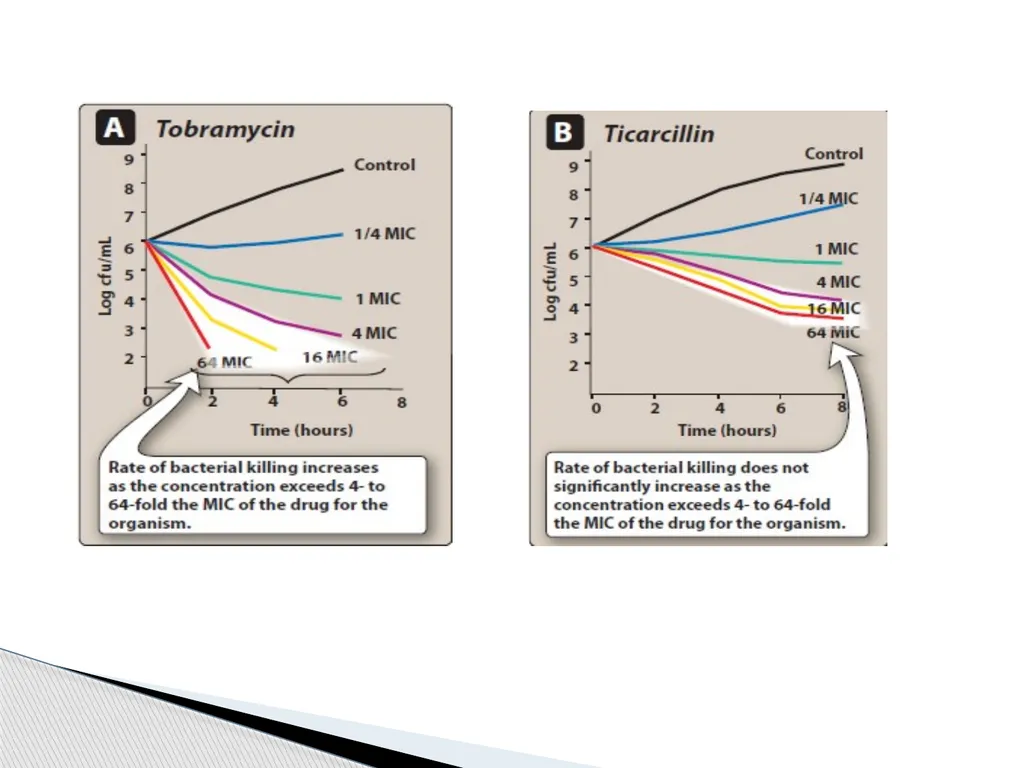
Antimicrobial drugs exhibit various concentration- and time-dependent effects that influence their clinical efficacy, dosage, and frequency of administration. Examples of these effects are the minimal inhibitory concentration (MIC) , the concentration-dependent killing rate (CDKR), Time-dependent (concentration-independent) killing and the postantibiotic effect (PAE).
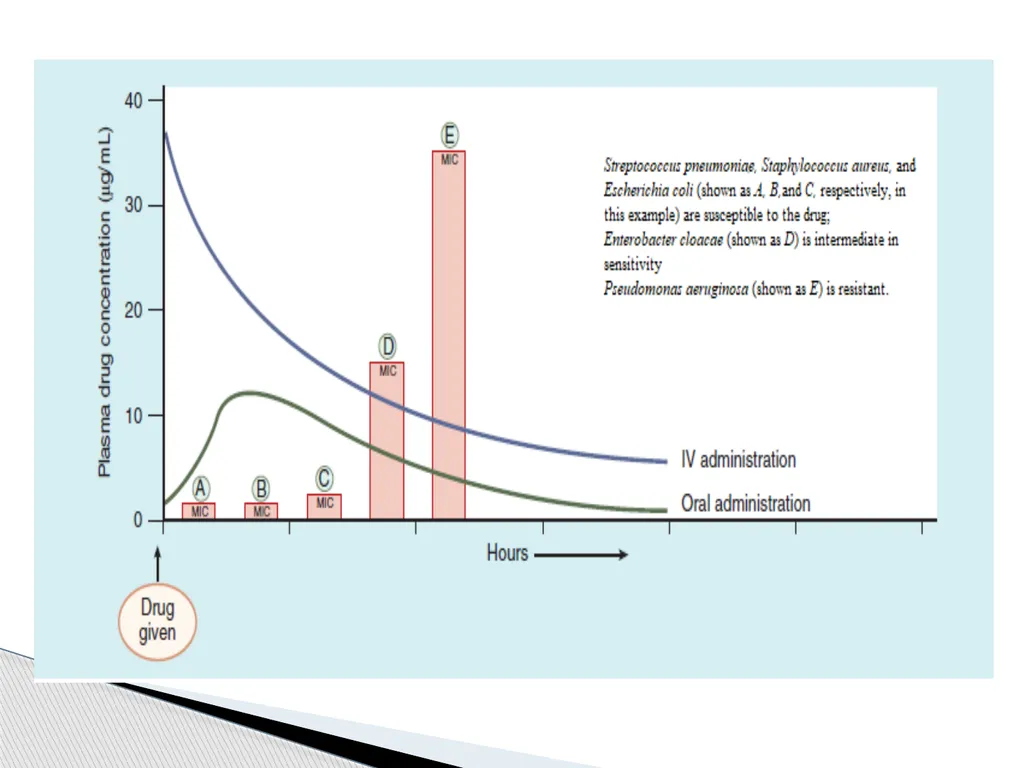
The MIC is the lowest concentration of a drug that inhibits bacterial growth after 24 hours of incubation. Based on the MIC, a particular strain of bacteria can be classified as susceptible or resistant or with intermediate sensitivity to a particular drug and is commonly used in practice to streamline therapy.
The minimum bactericidal concentration (MBC) is the lowest concentration of antimicrobial agent that results in a 99.9% decline in colony count after overnight broth dilution incubations.It is rarely determined in clinical practice due to the time and labor requirements.]<br>
Antimicrobial drugs exhibit various concentration- and time-dependent effects that influence their clinical efficacy, dosage, and frequency of administration. Examples of these effects are the minimal inhibitory concentration (MIC) , the concentration-dependent killing rate (CDKR), Time-dependent (concentration-independent) killing and the postantibiotic effect (PAE).
The MIC is the lowest concentration of a drug that inhibits bacterial growth after 24 hours of incubation. Based on the MIC, a particular strain of bacteria can be classified as susceptible or resistant or with intermediate sensitivity to a particular drug and is commonly used in practice to streamline therapy.
The minimum bactericidal concentration (MBC) is the lowest concentration of antimicrobial agent that results in a 99.9% decline in colony count after overnight broth dilution incubations.It is rarely determined in clinical practice due to the time and labor requirements.]<br>
08
An example of a CDKR: some aminoglycosides (e.g., tobramycin) and some fluoroquinolones (e.g., ciprofloxacin) show a significant increase in the rate of bacterial killing as the concentration of antibiotic increases from 4- to 64-fold the MIC of the drug for the infecting organism. Giving these drugs by a one dose per day achieves high peak levels, favoring rapid killing of the infecting pathogen.
In contrast, β-lactams, glycopeptides, macrolides, clindamycin, and linezolid effects are best predicted by the percentage of time that blood concentrations of a drug remain above the MIC. This effect is sometimes called time-dependent (or concentration-independent) killing. For example, dosing schedules for the penicillins and cephalosporins that ensure blood levels greater than the MIC for 50% and 60% of the time, respectively, provide the most clinical efficacy. Therefore, frequent dosing is important to achieve prolonged time above the MIC and kill more bacteria.
After an antibacterial drug is removed from a bacterial culture, evidence of a persistent effect on bacterial growth may exist. This effect is the PAE. Antimicrobial drugs that exhibit a long PAE are aminoglycosides and fluoroquinolones<br>
In contrast, β-lactams, glycopeptides, macrolides, clindamycin, and linezolid effects are best predicted by the percentage of time that blood concentrations of a drug remain above the MIC. This effect is sometimes called time-dependent (or concentration-independent) killing. For example, dosing schedules for the penicillins and cephalosporins that ensure blood levels greater than the MIC for 50% and 60% of the time, respectively, provide the most clinical efficacy. Therefore, frequent dosing is important to achieve prolonged time above the MIC and kill more bacteria.
After an antibacterial drug is removed from a bacterial culture, evidence of a persistent effect on bacterial growth may exist. This effect is the PAE. Antimicrobial drugs that exhibit a long PAE are aminoglycosides and fluoroquinolones<br>
09
Selection of Antimicrobial Agents
Selection of the most appropriate antimicrobial agent requires knowing: 1) The organism’s identity,
2) The organism’s susceptibility to a particular agent, 3) Pharmacokinetic Properties, 4) Host factors, 5) Adverse Effect Profile, and 6) The cost of therapy.
However, some patients require empiric therapy (immediate administration of drug(s) prior to bacterial identification and susceptibility testing).<br>
Selection of the most appropriate antimicrobial agent requires knowing: 1) The organism’s identity,
2) The organism’s susceptibility to a particular agent, 3) Pharmacokinetic Properties, 4) Host factors, 5) Adverse Effect Profile, and 6) The cost of therapy.
However, some patients require empiric therapy (immediate administration of drug(s) prior to bacterial identification and susceptibility testing).<br>
10
A. Identification of the infecting organism
Characterizing the organism is central to selection of the proper drug. A rapid assessment of the nature of the pathogen can sometimes be made on the basis of the Gram stain, which is particularly useful in identifying the presence and morphologic features of microorganisms in body fluids that are normally sterile (blood, serum, cerebrospinal fluid [CSF], pleural fluid, synovial fluid, peritoneal fluid, and urine). However, it is generally necessary to culture the infective organism to arrive at a conclusive diagnosis and determine the susceptibility to antimicrobial agents. Thus, it is essential to obtain a sample culture of the organism prior to initiating treatment. Otherwise, it is impossible to differentiate whether a negative culture is due to the absence of organisms or is a result of antimicrobial effects of administered antibiotic.
Definitive identification of the infecting organism may require other laboratory techniques, such as detection of microbial antigens, DNA, or RNA, or an inflammatory or host immune response to the microorganism.<br>
Characterizing the organism is central to selection of the proper drug. A rapid assessment of the nature of the pathogen can sometimes be made on the basis of the Gram stain, which is particularly useful in identifying the presence and morphologic features of microorganisms in body fluids that are normally sterile (blood, serum, cerebrospinal fluid [CSF], pleural fluid, synovial fluid, peritoneal fluid, and urine). However, it is generally necessary to culture the infective organism to arrive at a conclusive diagnosis and determine the susceptibility to antimicrobial agents. Thus, it is essential to obtain a sample culture of the organism prior to initiating treatment. Otherwise, it is impossible to differentiate whether a negative culture is due to the absence of organisms or is a result of antimicrobial effects of administered antibiotic.
Definitive identification of the infecting organism may require other laboratory techniques, such as detection of microbial antigens, DNA, or RNA, or an inflammatory or host immune response to the microorganism.<br>
11
Empiric therapy prior to identification of the organism
The antimicrobial agent used to treat an infection is selected after the organism has been identified and its drug susceptibility established. However, in the critically ill patient, such a delay could prove fatal, and immediate empiric therapy is indicated.
1. Timing: Acutely ill patients with infections of unknown origin for example, a neutropenic patient or a patient with meningitis require immediate treatment. If possible, therapy should be initiated after specimens for laboratory analysis have been obtained but before the results of the culture and sensitivity are available.
2. Selecting a drug: Drug choice in the absence of susceptibility data is influenced by the site of infection and the patient’s history (for example, previous infections, age, recent travel history, recent antimicrobial therapy, immune status, and whether the infection was hospital- or community-acquired). Broad-spectrum therapy may be indicated initially when the organism is unknown or poly-microbial infections are likely. The choice of agent(s) may also be guided by known association of particular organisms in a given clinical setting. For example, gram-positive cocci in the spinal fluid of a newborn infant is unlikely to be Streptococcus pneumoniae and most likely to be Streptococcus agalactiae (a group B streptococci), which is sensitive to penicillin G. By contrast, gram- positive cocci in the spinal fluid of a 40-year-old patient are most likely to be S. pneumoniae. This organism is frequently resistant to penicillin G and often requires treatment with a high-dose third- generation cephalosporin (such as ceftriaxone) or vancomycin.<br>
The antimicrobial agent used to treat an infection is selected after the organism has been identified and its drug susceptibility established. However, in the critically ill patient, such a delay could prove fatal, and immediate empiric therapy is indicated.
1. Timing: Acutely ill patients with infections of unknown origin for example, a neutropenic patient or a patient with meningitis require immediate treatment. If possible, therapy should be initiated after specimens for laboratory analysis have been obtained but before the results of the culture and sensitivity are available.
2. Selecting a drug: Drug choice in the absence of susceptibility data is influenced by the site of infection and the patient’s history (for example, previous infections, age, recent travel history, recent antimicrobial therapy, immune status, and whether the infection was hospital- or community-acquired). Broad-spectrum therapy may be indicated initially when the organism is unknown or poly-microbial infections are likely. The choice of agent(s) may also be guided by known association of particular organisms in a given clinical setting. For example, gram-positive cocci in the spinal fluid of a newborn infant is unlikely to be Streptococcus pneumoniae and most likely to be Streptococcus agalactiae (a group B streptococci), which is sensitive to penicillin G. By contrast, gram- positive cocci in the spinal fluid of a 40-year-old patient are most likely to be S. pneumoniae. This organism is frequently resistant to penicillin G and often requires treatment with a high-dose third- generation cephalosporin (such as ceftriaxone) or vancomycin.<br>
12
Determining antimicrobial susceptibility of infective organisms
After a pathogen is cultured, its susceptibility to specific antibiotics serves as a guide in choosing antimicrobial therapy. Some pathogens, such as Streptococcus pyogenes and Neisseria meningitidis, usually have predictable susceptibility patterns to certain antibiotics. In contrast, most gram-negative bacilli, enterococci, and staphylococcal species often show unpredictable susceptibility patterns and require susceptibility testing to determine appropriate antimicrobial therapy. The minimum inhibitory and bactericidal concentrations of a drug can be experimentally determined.<br>
After a pathogen is cultured, its susceptibility to specific antibiotics serves as a guide in choosing antimicrobial therapy. Some pathogens, such as Streptococcus pyogenes and Neisseria meningitidis, usually have predictable susceptibility patterns to certain antibiotics. In contrast, most gram-negative bacilli, enterococci, and staphylococcal species often show unpredictable susceptibility patterns and require susceptibility testing to determine appropriate antimicrobial therapy. The minimum inhibitory and bactericidal concentrations of a drug can be experimentally determined.<br>
13
Pharmacokinetic Properties
The pharmacokinetic properties that influence antibiotic selection include oral bioavailability, peak serum concentration, distribution to particular sites of infection, routes of elimination, and elimination half-life. An ideal antimicrobial drug for patients would have good oral bioavailability and a long plasma half-life so that it would need to be taken only once a day. Azithromycin is an example of an antibiotic that meets these criteria.
The oral route of administration is appropriate for mild infections that can be treated on an outpatient basis. Parenteral administration is used for drugs that are poorly absorbed from the GI tract (such as vancomycin, and the aminoglycosides) and for treatment of patients with serious infections such as bacterial meningitis or endocarditis, for whom it is necessary to maintain higher serum concentrations of antimicrobial agents, for critically ill patients and for patients with nausea, vomiting, gastrectomy, ileus, or diseases that may impair oral absorption.
The peak serum concentration of an antimicrobial drug should be several times greater than the MIC of the pathogenic organism for the drug to eliminate the organism. This is partly because the tissue concentrations of a drug are sometimes lower than the plasma concentration.
The urine concentration of an antimicrobial drug can be 10 to 50 times the peak serum concentration. For this reason, infections of the urinary tract can be easier to treat than are infections at other sites.<br>
The pharmacokinetic properties that influence antibiotic selection include oral bioavailability, peak serum concentration, distribution to particular sites of infection, routes of elimination, and elimination half-life. An ideal antimicrobial drug for patients would have good oral bioavailability and a long plasma half-life so that it would need to be taken only once a day. Azithromycin is an example of an antibiotic that meets these criteria.
The oral route of administration is appropriate for mild infections that can be treated on an outpatient basis. Parenteral administration is used for drugs that are poorly absorbed from the GI tract (such as vancomycin, and the aminoglycosides) and for treatment of patients with serious infections such as bacterial meningitis or endocarditis, for whom it is necessary to maintain higher serum concentrations of antimicrobial agents, for critically ill patients and for patients with nausea, vomiting, gastrectomy, ileus, or diseases that may impair oral absorption.
The peak serum concentration of an antimicrobial drug should be several times greater than the MIC of the pathogenic organism for the drug to eliminate the organism. This is partly because the tissue concentrations of a drug are sometimes lower than the plasma concentration.
The urine concentration of an antimicrobial drug can be 10 to 50 times the peak serum concentration. For this reason, infections of the urinary tract can be easier to treat than are infections at other sites.<br>
14
Sites of infection that are not readily penetrated by many antimicrobial drugs include the central nervous system, bone, prostate gland, and ocular tissues. The treatment of meningitis requires that drugs achieve adequate concentrations in the cerebrospinal fluid. The penetration and concentration of an antibacterial agent in the CSF are particularly influenced by lipid solubility of the drug (lipid soluble drugs as chloramphenicol and metronidazole penetrate significantly whereas β-lactam antibiotics, such as penicillin, are ionized and penetrate the blood-cerebrospinal fluid barrier only when the meninges are inflamed), molecular weight and protein binding of the drug.
Because antimicrobial drug concentrations are low in bone, patients with osteomyelitis must usually be treated with antibiotics for several weeks to produce a cure. The prostate gland restricts the entry of some antimicrobial drugs because the drugs have difficulty crossing the prostatic epithelium and because prostatic fluid has a low pH. These characteristics favor the entry and accumulation of weak bases (e.g., trimethoprim) and tend to exclude the entry of weak acids (e.g., penicillin).
The route of elimination affects both the selection and the use of antimicrobial drugs. Drugs that are eliminated by renal excretion (e.g., fluoroquinolones) are more effective for urinary tract infections than are drugs that are largely metabolized or undergo biliary excretion (e.g., erythromycin). Antibiotics that are eliminated by the kidneys (e.g., the aminoglycosides) can accumulate in patients whose renal function is compromised, so their dosage must be reduced in these patients.<br>
Because antimicrobial drug concentrations are low in bone, patients with osteomyelitis must usually be treated with antibiotics for several weeks to produce a cure. The prostate gland restricts the entry of some antimicrobial drugs because the drugs have difficulty crossing the prostatic epithelium and because prostatic fluid has a low pH. These characteristics favor the entry and accumulation of weak bases (e.g., trimethoprim) and tend to exclude the entry of weak acids (e.g., penicillin).
The route of elimination affects both the selection and the use of antimicrobial drugs. Drugs that are eliminated by renal excretion (e.g., fluoroquinolones) are more effective for urinary tract infections than are drugs that are largely metabolized or undergo biliary excretion (e.g., erythromycin). Antibiotics that are eliminated by the kidneys (e.g., the aminoglycosides) can accumulate in patients whose renal function is compromised, so their dosage must be reduced in these patients.<br>
15
Host Factors
Host factors that influence the choice of a drug include pregnancy, drug allergies, age and immune status, and the presence of renal impairment, hepatic insufficiency, circulation status, abscesses, or indwelling catheters and similar devices.
Most antimicrobial drugs cross the placenta and can thereby affect the fetus. For example, administering tetracyclines to a woman during pregnancy can cause permanent staining of her offspring’s teeth. Penicillins and cephalosporins, however, cause very little fetal toxicity and can be safely administered to pregnant women who are not allergic to these drugs.
Many individuals are allergic to one or more antimicrobial drugs. Penicillins are the most common cause of drug allergy.
Renal or hepatic elimination processes are often poorly developed in newborns, making neonates particularly vulnerable to the toxic effects of chloramphenicol and sulfonamides. Young children should not be treated with tetracyclines or quinolones, which affect bone growth and joints, respectively.
Decreased circulation to an anatomic area, such as the lower limbs of a diabetic patient, reduces the amount of antibiotic that reaches that site of infection, making it more difficult to treat.<br>
Host factors that influence the choice of a drug include pregnancy, drug allergies, age and immune status, and the presence of renal impairment, hepatic insufficiency, circulation status, abscesses, or indwelling catheters and similar devices.
Most antimicrobial drugs cross the placenta and can thereby affect the fetus. For example, administering tetracyclines to a woman during pregnancy can cause permanent staining of her offspring’s teeth. Penicillins and cephalosporins, however, cause very little fetal toxicity and can be safely administered to pregnant women who are not allergic to these drugs.
Many individuals are allergic to one or more antimicrobial drugs. Penicillins are the most common cause of drug allergy.
Renal or hepatic elimination processes are often poorly developed in newborns, making neonates particularly vulnerable to the toxic effects of chloramphenicol and sulfonamides. Young children should not be treated with tetracyclines or quinolones, which affect bone growth and joints, respectively.
Decreased circulation to an anatomic area, such as the lower limbs of a diabetic patient, reduces the amount of antibiotic that reaches that site of infection, making it more difficult to treat.<br>
16
The patient’s immune status is an important factor determining the success of antimicrobial therapy. Advanced age, diabetes, cancer chemotherapy, and human immunodeficiency virus (HIV) infection are among the more common causes of impaired immunity. Immunocompromised individuals should be treated with larger doses of bactericidal drugs and may require a longer duration of therapy than do immunocompetent individuals.
Many antibiotics are excreted unchanged by the kidneys, and lower doses must be used if the patient has significant renal impairment. Less commonly, hepatic insufficiency may require dosage adjustment for antimicrobial drugs that are extensively metabolized in the liver.
Antibiotic access to an abscess is poor, and the concentration of an antibiotic in an abscess is usually lower than in the surrounding tissue. Moreover, immune function is often impaired in an abscess. For these reasons, it is often necessary to surgically drain an abscess before the infection can be cured.
Foreign bodies, such as indwelling catheters, provide sites where microbes can become covered with a glycocalyx coating (biofilm) that protects them from antibiotics and immunologic destruction.<br>
Many antibiotics are excreted unchanged by the kidneys, and lower doses must be used if the patient has significant renal impairment. Less commonly, hepatic insufficiency may require dosage adjustment for antimicrobial drugs that are extensively metabolized in the liver.
Antibiotic access to an abscess is poor, and the concentration of an antibiotic in an abscess is usually lower than in the surrounding tissue. Moreover, immune function is often impaired in an abscess. For these reasons, it is often necessary to surgically drain an abscess before the infection can be cured.
Foreign bodies, such as indwelling catheters, provide sites where microbes can become covered with a glycocalyx coating (biofilm) that protects them from antibiotics and immunologic destruction.<br>
17
Adverse Effect Profile
Even though antibiotics are selectively toxic to an invading organism, any antimicrobial drug can cause mild to severe adverse effects.
Hypersensitivity or immune reactions to antimicrobial drugs or their metabolic products frequently occur. For example penicillin allergy.
High serum levels of certain antibiotics may cause toxicity by directly affecting cellular processes in the host. For example, aminoglycosides can cause ototoxicity
Superinfections: Drug therapy, particularly with broad-spectrum antimicrobials or combinations of agents, can lead to alterations of the normal microbial flora of the upper respiratory, oral, intestinal, and genitourinary tracts, permitting the overgrowth of opportunistic organisms, especially fungi or resistant bacteria. These infections usually require secondary treatments using specific anti-infective agents.<br>
Even though antibiotics are selectively toxic to an invading organism, any antimicrobial drug can cause mild to severe adverse effects.
Hypersensitivity or immune reactions to antimicrobial drugs or their metabolic products frequently occur. For example penicillin allergy.
High serum levels of certain antibiotics may cause toxicity by directly affecting cellular processes in the host. For example, aminoglycosides can cause ototoxicity
Superinfections: Drug therapy, particularly with broad-spectrum antimicrobials or combinations of agents, can lead to alterations of the normal microbial flora of the upper respiratory, oral, intestinal, and genitourinary tracts, permitting the overgrowth of opportunistic organisms, especially fungi or resistant bacteria. These infections usually require secondary treatments using specific anti-infective agents.<br>
18
Microbial Sensitivity and Resistance
Laboratory Tests for Microbial Sensitivity
Microbial sensitivity to drugs can be determined by various means, including the broth dilution test, the disk diffusion method (Kirby-Bauer test), and the E-test method.
Either the broth dilution test or the E-test method can be used to determine the MIC or MBC of a drug. On the basis of the MIC, the organism is classified as having susceptibility, intermediate sensitivity, or resistance to the drug tested. These categories are based on the relationship between the MIC and the peak serum concentration of the drug after administration of typical doses. In general, the peak serum concentration of a drug should be 4 to 10 times greater than the MIC in order for a pathogen to be susceptible to a drug. Pathogens with intermediate sensitivity may respond to treatment with maximal doses of an antimicrobial agent.<br>
Laboratory Tests for Microbial Sensitivity
Microbial sensitivity to drugs can be determined by various means, including the broth dilution test, the disk diffusion method (Kirby-Bauer test), and the E-test method.
Either the broth dilution test or the E-test method can be used to determine the MIC or MBC of a drug. On the basis of the MIC, the organism is classified as having susceptibility, intermediate sensitivity, or resistance to the drug tested. These categories are based on the relationship between the MIC and the peak serum concentration of the drug after administration of typical doses. In general, the peak serum concentration of a drug should be 4 to 10 times greater than the MIC in order for a pathogen to be susceptible to a drug. Pathogens with intermediate sensitivity may respond to treatment with maximal doses of an antimicrobial agent.<br>
19
Microbial Resistance to Drugs
Nowadays, the antimicrobial agents are vastly overprescribed in outpatient settings. The availability of antimicrobial agents without prescription in many developing countries has—by facilitating the development of resistance—already severely limited therapeutic options in the treatment of life-threatening infections. Therefore, the clinician should first determine whether antimicrobial therapy is necessary for a given patient.
Origin of Resistance
Resistance can be innate or acquired. Acquired drug resistance arises from mutation and selection or from the transfer of plasmids that confer drug resistance.
Mutation and Selection: Microbes can spontaneously mutate to a form that is resistant to a particular antimicrobial drug. These mutations occur at a relatively constant rate, such as in 1 in 1012 organisms per unit of time. If the organisms are exposed to an antimicrobial drug during this time period, the sensitive organisms may be eradicated, enabling the resistant mutant to multiply and become the dominant strain.<br>
Nowadays, the antimicrobial agents are vastly overprescribed in outpatient settings. The availability of antimicrobial agents without prescription in many developing countries has—by facilitating the development of resistance—already severely limited therapeutic options in the treatment of life-threatening infections. Therefore, the clinician should first determine whether antimicrobial therapy is necessary for a given patient.
Origin of Resistance
Resistance can be innate or acquired. Acquired drug resistance arises from mutation and selection or from the transfer of plasmids that confer drug resistance.
Mutation and Selection: Microbes can spontaneously mutate to a form that is resistant to a particular antimicrobial drug. These mutations occur at a relatively constant rate, such as in 1 in 1012 organisms per unit of time. If the organisms are exposed to an antimicrobial drug during this time period, the sensitive organisms may be eradicated, enabling the resistant mutant to multiply and become the dominant strain.<br>
20
The probability that mutation and selection of a resistant mutant will occur is increased during the exposure of an organism to suboptimal concentrations of an antibiotic, and it is also increased during prolonged exposure to an antibiotic. This observation has obvious implications for antimicrobial therapy. Laboratory tests should be used to guide the selection of an antimicrobial drug, and the dosage and duration of therapy should be adequate for the type of infection being treated. Whenever possible, the bacteriologic response to drug therapy should be verified by culturing samples of appropriate body fluids.
Transferable Resistance: Transferable resistance usually results from bacterial conjugation and the transfer of plasmids (extrachromosomal DNA) that confer drug resistance. Transferable resistance, however, can also be mediated by transformation (uptake of naked DNA) or transduction (transfer of bacterial DNA by a bacteriophage). Bacterial conjugation enables a bacterium to donate a plasmid containing genes that encode proteins responsible for resistance to an antibiotic. These genes are called resistance factors. The resistance factors can be transferred both within a particular species and between different species, so they often confer multidrug resistance. Studies have shown that resident microflora of the human body can serve as reservoirs for resistance genes, allowing the transfer of these genes to organisms that later invade and colonize the host.<br>
Transferable Resistance: Transferable resistance usually results from bacterial conjugation and the transfer of plasmids (extrachromosomal DNA) that confer drug resistance. Transferable resistance, however, can also be mediated by transformation (uptake of naked DNA) or transduction (transfer of bacterial DNA by a bacteriophage). Bacterial conjugation enables a bacterium to donate a plasmid containing genes that encode proteins responsible for resistance to an antibiotic. These genes are called resistance factors. The resistance factors can be transferred both within a particular species and between different species, so they often confer multidrug resistance. Studies have shown that resident microflora of the human body can serve as reservoirs for resistance genes, allowing the transfer of these genes to organisms that later invade and colonize the host.<br>
21
Mechanisms of Resistance
The three primary mechanisms of microbial resistance to an antibiotic are (1) inactivation of the drug by microbial enzymes, (2) decreased accumulation of the drug by the microbe, and (3) reduced affinity of the target macromolecule for the drug.
Inactivation of the drug by enzymes is an important mechanism of resistance to β-lactam antibiotics, including the penicillins. This form of resistance results from bacterial elaboration of β-lactamase enzymes that destroy the β- lactam ring. Resistance to aminoglycosides (e.g., gentamicin) is partly caused by the elaboration of drug-inactivating enzymes that acetylate, adenylate, or phosphorylate these antibiotics.<br>
The three primary mechanisms of microbial resistance to an antibiotic are (1) inactivation of the drug by microbial enzymes, (2) decreased accumulation of the drug by the microbe, and (3) reduced affinity of the target macromolecule for the drug.
Inactivation of the drug by enzymes is an important mechanism of resistance to β-lactam antibiotics, including the penicillins. This form of resistance results from bacterial elaboration of β-lactamase enzymes that destroy the β- lactam ring. Resistance to aminoglycosides (e.g., gentamicin) is partly caused by the elaboration of drug-inactivating enzymes that acetylate, adenylate, or phosphorylate these antibiotics.<br>
22
Decreased accumulation of an antibiotic can result from increased efflux or decreased uptake of the drug. Both of these mechanisms contribute to the resistance of microbes to tetracyclines and fluoroquinolones. Increased drug efflux is often mediated by membrane proteins that transport antimicrobial drugs out of bacterial cells. Decreased uptake of antimicrobial drugs can result from altered bacterial porins. Porins are membrane proteins containing channels through which drugs and other compounds enter bacteria. Resistance to penicillins by gram-negative bacilli is partly caused by altered porin channels that do not permit penicillin entry.
Reduced affinity of target molecules for antimicrobial drugs is a common mechanism of microbial resistance to most classes of antibiotics. This type of drug resistance often results from bacterial mutation followed by the selection of resistant mutants during exposure to an antimicrobial drug. For example, S. pneumoniae resistance to β-lactam antibiotics involves alterations in one or more of the major bacterial penicillin-binding proteins, resulting in decreased binding of the antibiotic to its target.<br>
Reduced affinity of target molecules for antimicrobial drugs is a common mechanism of microbial resistance to most classes of antibiotics. This type of drug resistance often results from bacterial mutation followed by the selection of resistant mutants during exposure to an antimicrobial drug. For example, S. pneumoniae resistance to β-lactam antibiotics involves alterations in one or more of the major bacterial penicillin-binding proteins, resulting in decreased binding of the antibiotic to its target.<br>
23
Combination Drug Therapy
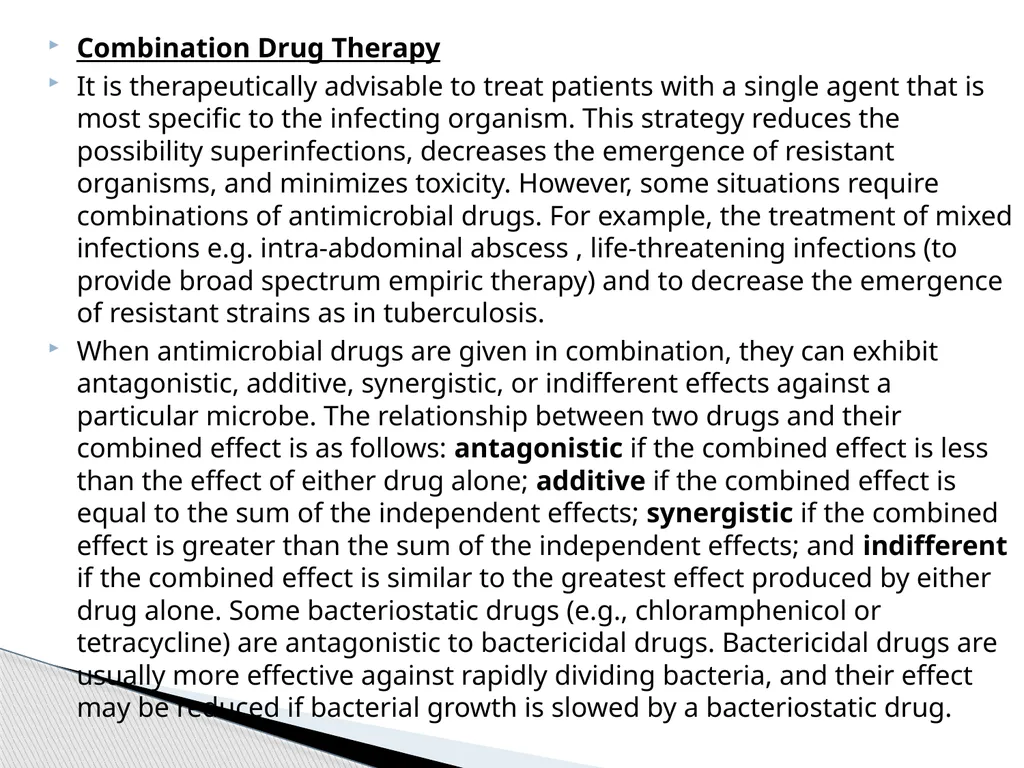
It is therapeutically advisable to treat patients with a single agent that is most specific to the infecting organism. This strategy reduces the possibility superinfections, decreases the emergence of resistant organisms, and minimizes toxicity. However, some situations require combinations of antimicrobial drugs. For example, the treatment of mixed infections e.g. intra-abdominal abscess , life-threatening infections (to provide broad spectrum empiric therapy) and to decrease the emergence of resistant strains as in tuberculosis.
When antimicrobial drugs are given in combination, they can exhibit antagonistic, additive, synergistic, or indifferent effects against a particular microbe. The relationship between two drugs and their combined effect is as follows: antagonistic if the combined effect is less than the effect of either drug alone; additive if the combined effect is equal to the sum of the independent effects; synergistic if the combined effect is greater than the sum of the independent effects; and indifferent if the combined effect is similar to the greatest effect produced by either drug alone. Some bacteriostatic drugs (e.g., chloramphenicol or tetracycline) are antagonistic to bactericidal drugs. Bactericidal drugs are usually more effective against rapidly dividing bacteria, and their effect may be reduced if bacterial growth is slowed by a bacteriostatic drug.<br>
It is therapeutically advisable to treat patients with a single agent that is most specific to the infecting organism. This strategy reduces the possibility superinfections, decreases the emergence of resistant organisms, and minimizes toxicity. However, some situations require combinations of antimicrobial drugs. For example, the treatment of mixed infections e.g. intra-abdominal abscess , life-threatening infections (to provide broad spectrum empiric therapy) and to decrease the emergence of resistant strains as in tuberculosis.
When antimicrobial drugs are given in combination, they can exhibit antagonistic, additive, synergistic, or indifferent effects against a particular microbe. The relationship between two drugs and their combined effect is as follows: antagonistic if the combined effect is less than the effect of either drug alone; additive if the combined effect is equal to the sum of the independent effects; synergistic if the combined effect is greater than the sum of the independent effects; and indifferent if the combined effect is similar to the greatest effect produced by either drug alone. Some bacteriostatic drugs (e.g., chloramphenicol or tetracycline) are antagonistic to bactericidal drugs. Bactericidal drugs are usually more effective against rapidly dividing bacteria, and their effect may be reduced if bacterial growth is slowed by a bacteriostatic drug.<br>
24
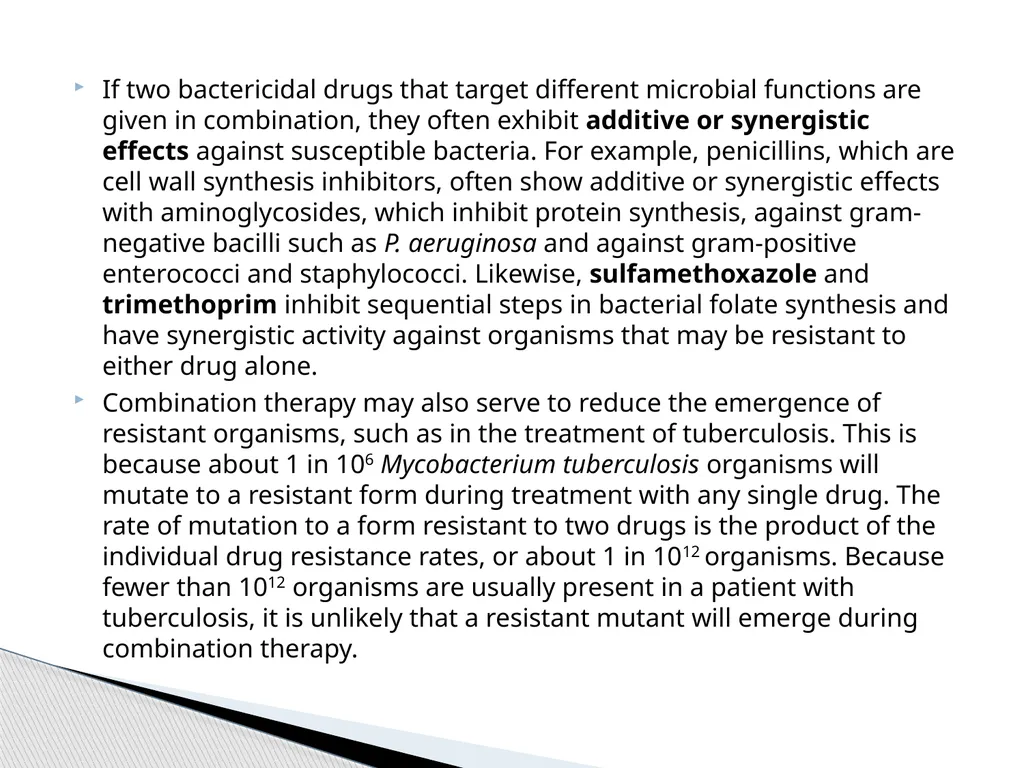
If two bactericidal drugs that target different microbial functions are given in combination, they often exhibit additive or synergistic effects against susceptible bacteria. For example, penicillins, which are cell wall synthesis inhibitors, often show additive or synergistic effects with aminoglycosides, which inhibit protein synthesis, against gram-negative bacilli such as P. aeruginosa and against gram-positive enterococci and staphylococci. Likewise, sulfamethoxazole and trimethoprim inhibit sequential steps in bacterial folate synthesis and have synergistic activity against organisms that may be resistant to either drug alone.
Combination therapy may also serve to reduce the emergence of resistant organisms, such as in the treatment of tuberculosis. This is because about 1 in 106 Mycobacterium tuberculosis organisms will mutate to a resistant form during treatment with any single drug. The rate of mutation to a form resistant to two drugs is the product of the individual drug resistance rates, or about 1 in 1012 organisms. Because fewer than 1012 organisms are usually present in a patient with tuberculosis, it is unlikely that a resistant mutant will emerge during combination therapy.<br>
Combination therapy may also serve to reduce the emergence of resistant organisms, such as in the treatment of tuberculosis. This is because about 1 in 106 Mycobacterium tuberculosis organisms will mutate to a resistant form during treatment with any single drug. The rate of mutation to a form resistant to two drugs is the product of the individual drug resistance rates, or about 1 in 1012 organisms. Because fewer than 1012 organisms are usually present in a patient with tuberculosis, it is unlikely that a resistant mutant will emerge during combination therapy.<br>