04
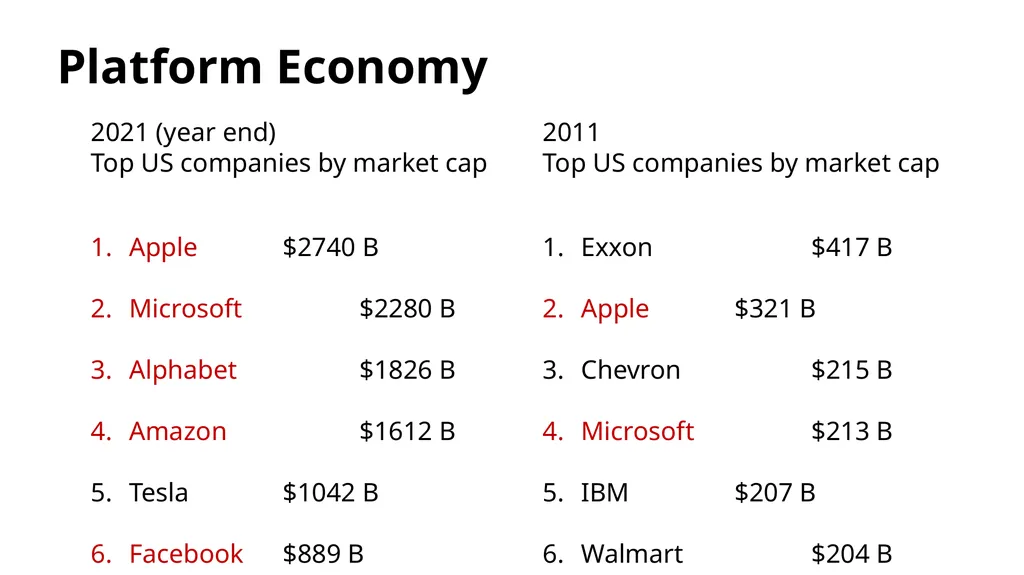
Platform Economy 2021 (year end)
Top US companies by market cap
Apple $2740 B
Microsoft $2280 B
Alphabet $1826 B
Amazon $1612 B
Tesla $1042 B
Facebook $889 B 2011
Top US companies by market cap
Exxon $417 B
Apple $321 B
Chevron $215 B
Microsoft $213 B
IBM $207 B
Walmart $204 B<br>
05
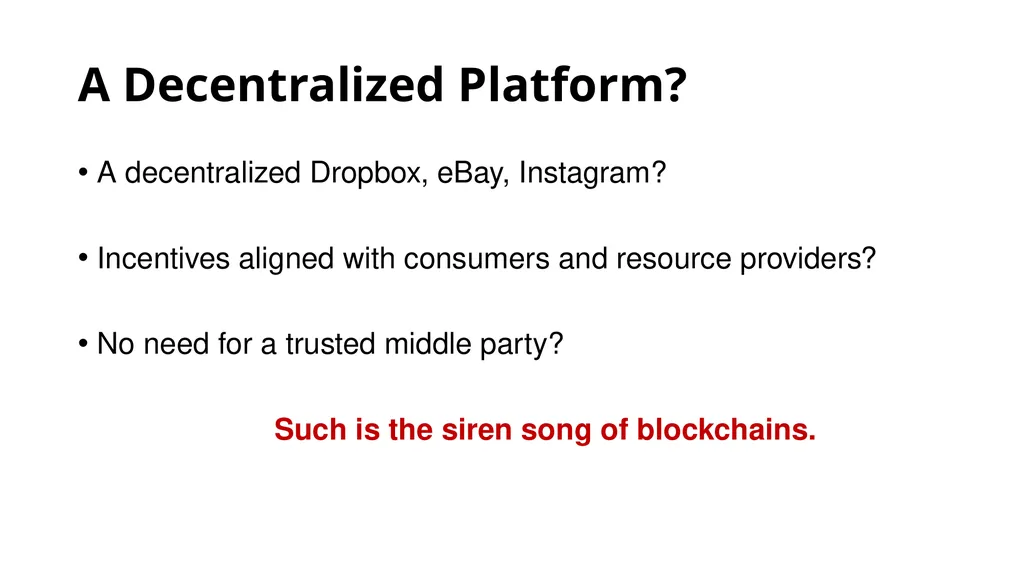
A Decentralized Platform? A decentralized Dropbox, eBay, Instagram?
Incentives aligned with consumers and resource providers?
No need for a trusted middle party?
Such is the siren song of blockchains.<br>
06
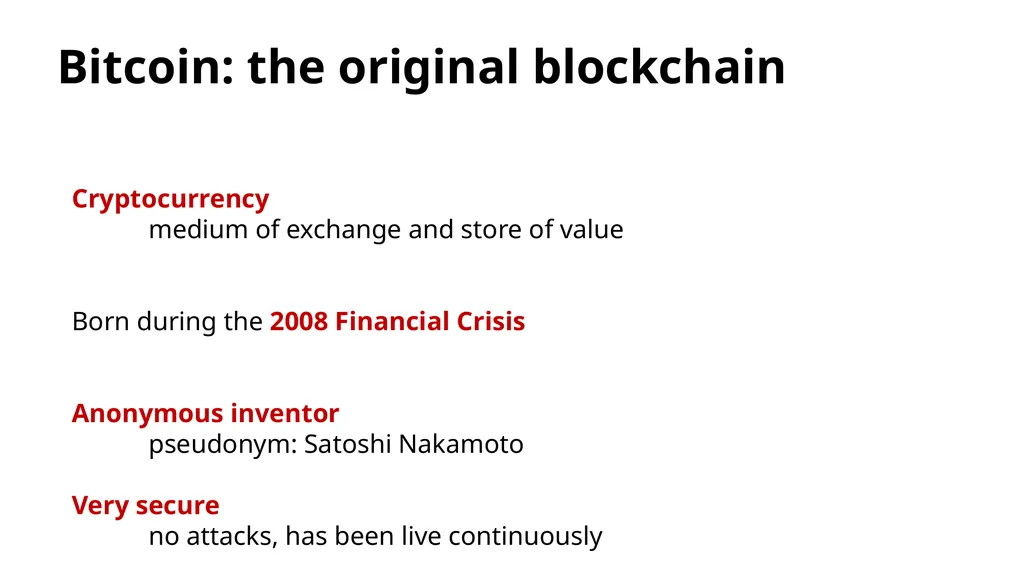
Bitcoin: the original blockchain Cryptocurrency
medium of exchange and store of value
Born during the 2008 Financial Crisis
Anonymous inventor
pseudonym: Satoshi Nakamoto
Very secure
no attacks, has been live continuously<br>
07
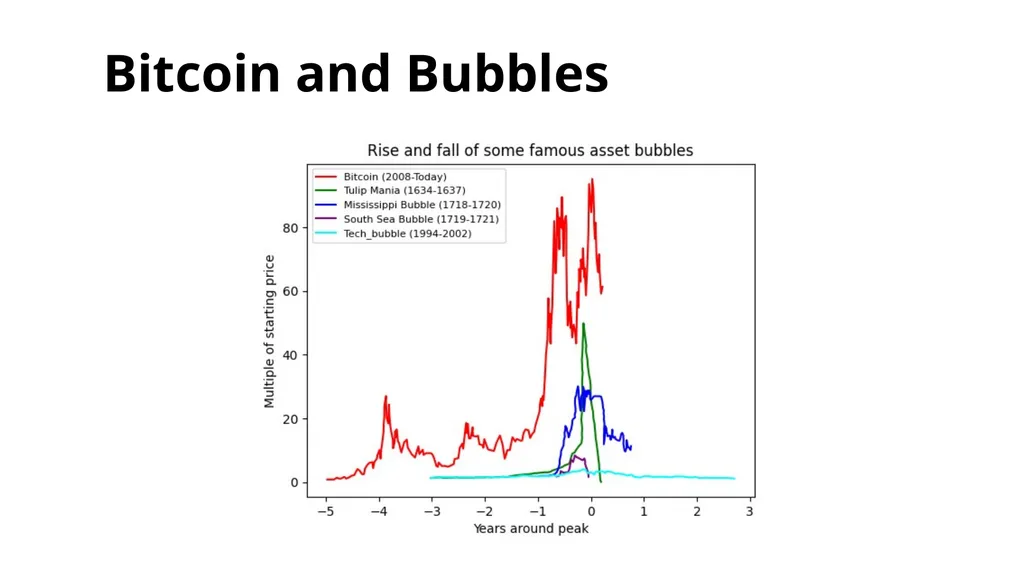
Bitcoin and Bubbles<br>
08
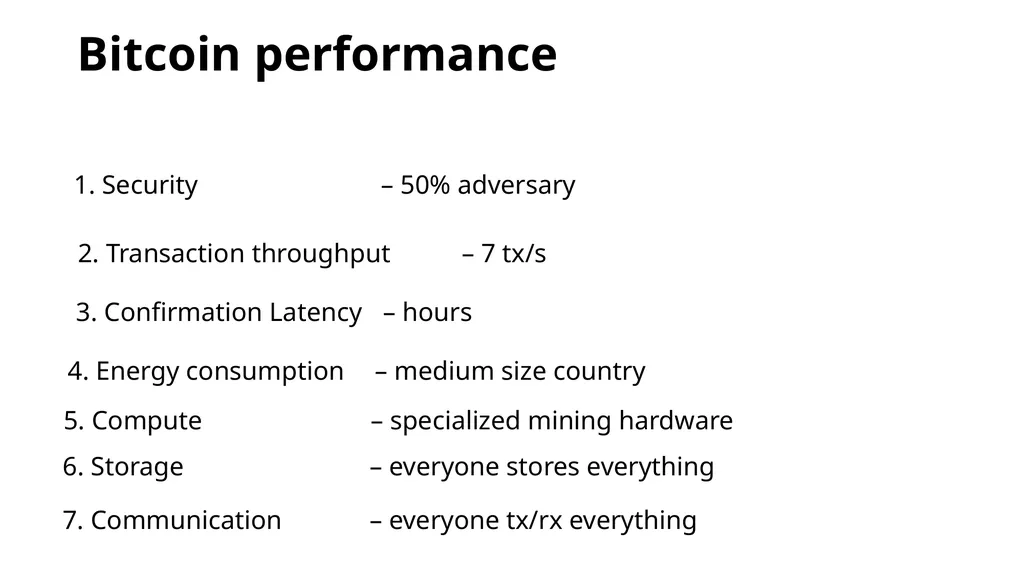
1. Security – 50% adversary 2. Transaction throughput – 7 tx/s 3. Confirmation Latency – hours Bitcoin performance 4. Energy consumption – medium size country 5. Compute – specialized mining hardware 6. Storage – everyone stores everything 7. Communication – everyone tx/rx everything<br>
09
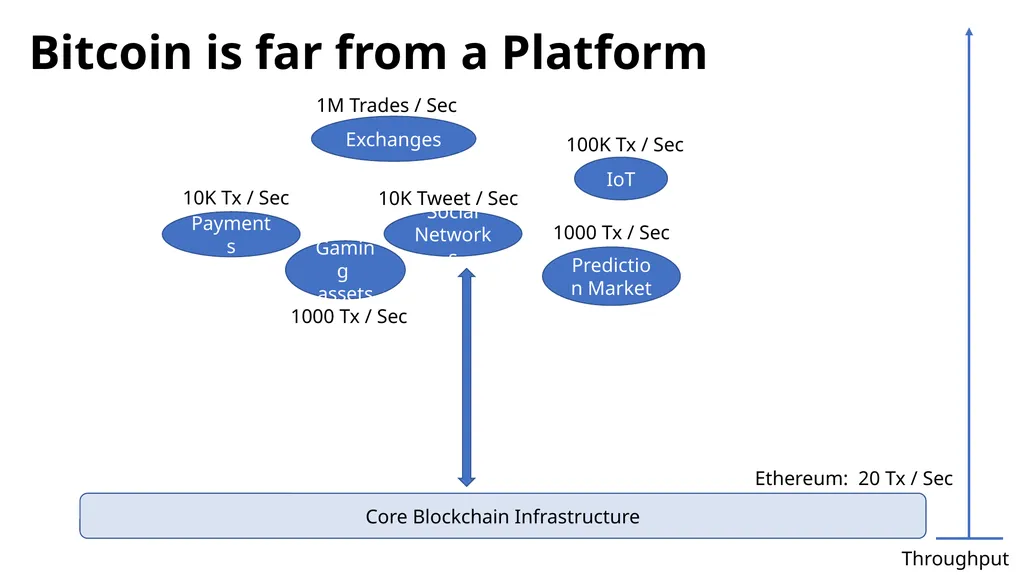
Core Blockchain Infrastructure Payments Exchanges Social Networks Prediction Market Gaming
assets IoT 10K Tx / Sec 1M Trades / Sec 10K Tweet / Sec 1000 Tx / Sec 1000 Tx / Sec 100K Tx / Sec Ethereum: 20 Tx / Sec Throughput Bitcoin is far from a Platform<br>
10
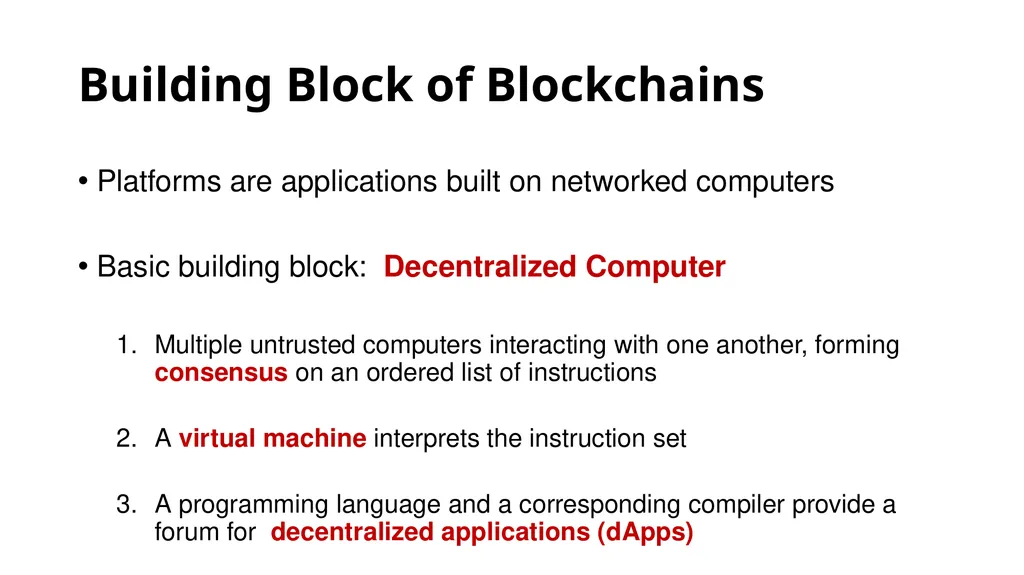
Building Block of Blockchains Platforms are applications built on networked computers
Basic building block: Decentralized Computer
Multiple untrusted computers interacting with one another, forming consensus on an ordered list of instructions
A virtual machine interprets the instruction set
A programming language and a corresponding compiler provide a forum for decentralized applications (dApps)<br>
11
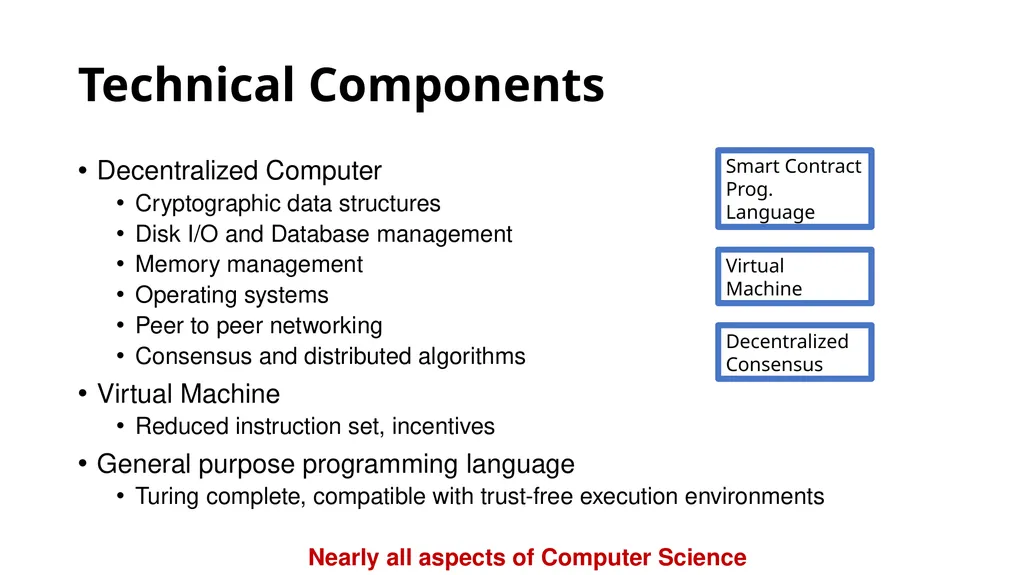
Technical Components Decentralized Computer
Cryptographic data structures
Disk I/O and Database management
Memory management
Operating systems
Peer to peer networking
Consensus and distributed algorithms
Virtual Machine
Reduced instruction set, incentives
General purpose programming language
Turing complete, compatible with trust-free execution environments
Nearly all aspects of Computer Science Decentralized Consensus Virtual Machine Smart Contract Prog. Language<br>
12
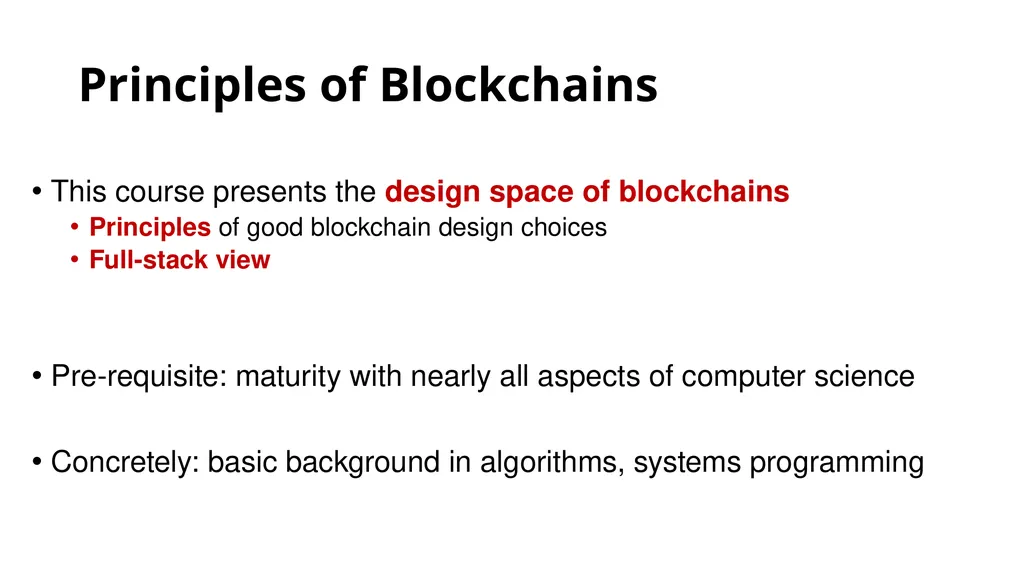
Principles of Blockchains This course presents the design space of blockchains
Principles of good blockchain design choices
Full-stack view
Pre-requisite: maturity with nearly all aspects of computer science
Concretely: basic background in algorithms, systems programming<br>
13
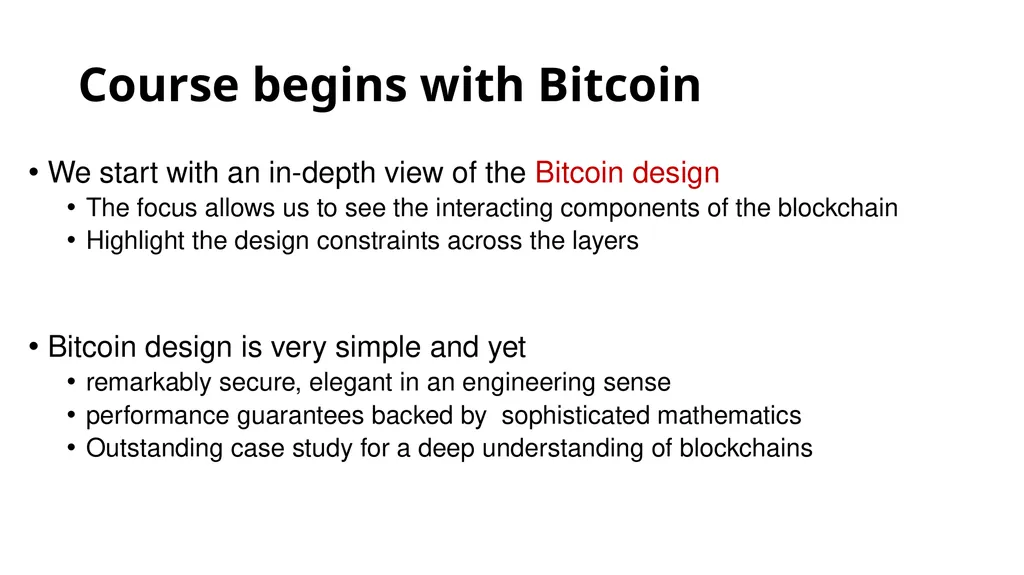
Course begins with Bitcoin We start with an in-depth view of the Bitcoin design
The focus allows us to see the interacting components of the blockchain
Highlight the design constraints across the layers
Bitcoin design is very simple and yet
remarkably secure, elegant in an engineering sense
performance guarantees backed by sophisticated mathematics
Outstanding case study for a deep understanding of blockchains<br>
14
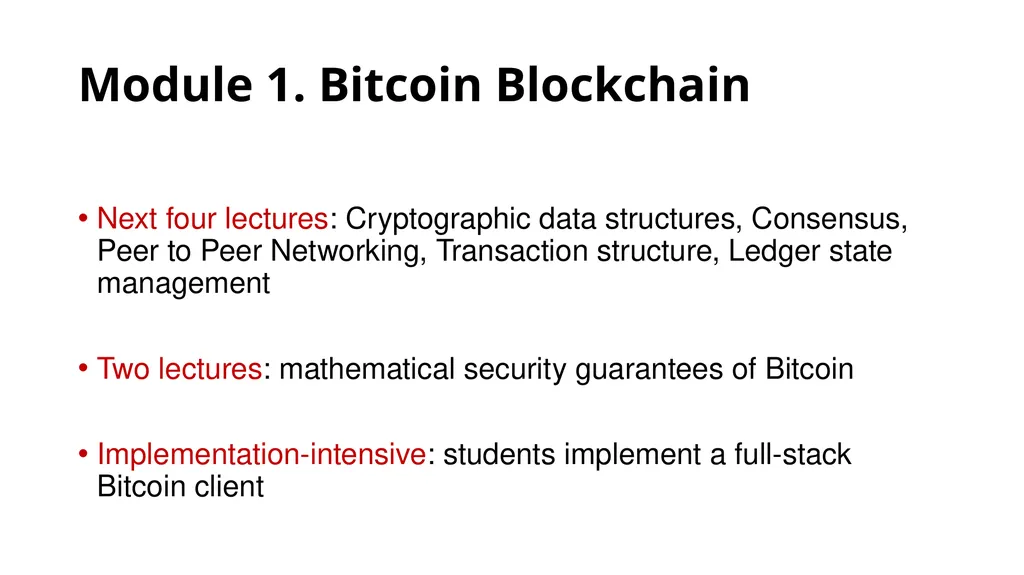
Module 1. Bitcoin Blockchain Next four lectures: Cryptographic data structures, Consensus, Peer to Peer Networking, Transaction structure, Ledger state management
Two lectures: mathematical security guarantees of Bitcoin
Implementation-intensive: students implement a full-stack Bitcoin client<br>
15
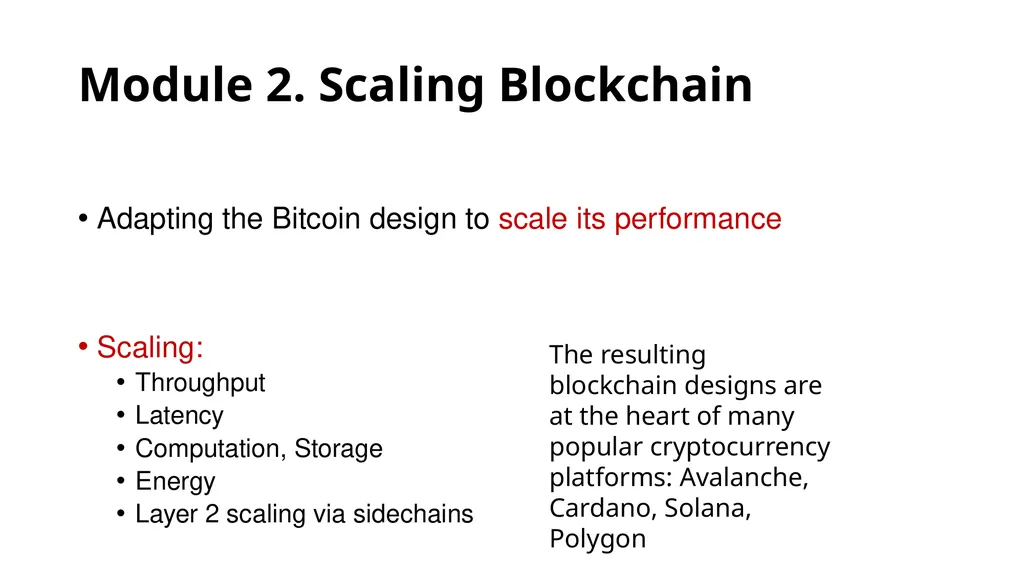
Module 2. Scaling Blockchain Adapting the Bitcoin design to scale its performance
Scaling:
Throughput
Latency
Computation, Storage
Energy
Layer 2 scaling via sidechains The resulting blockchain designs are at the heart of many popular cryptocurrency platforms: Avalanche, Cardano, Solana, Polygon<br>
16
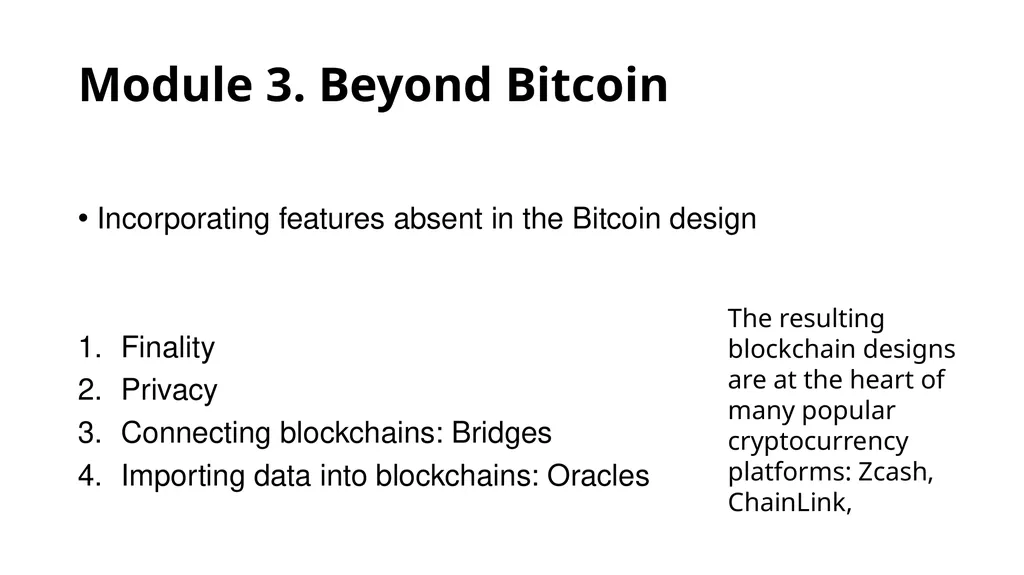
Module 3. Beyond Bitcoin Incorporating features absent in the Bitcoin design
Finality
Privacy
Connecting blockchains: Bridges
Importing data into blockchains: Oracles The resulting blockchain designs are at the heart of many popular cryptocurrency platforms: Zcash, ChainLink,<br>
17
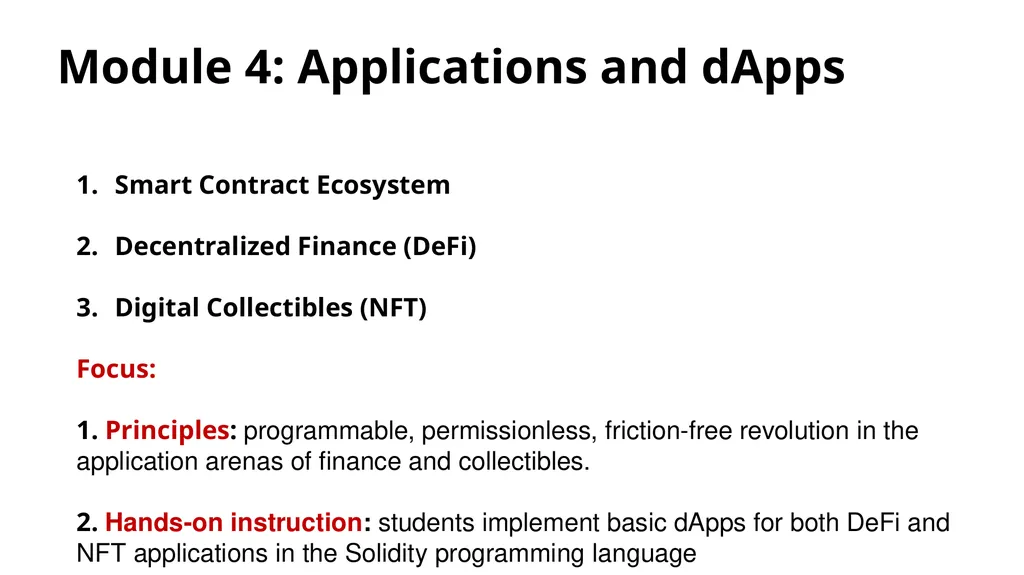
Module 4: Applications and dApps Smart Contract Ecosystem
Decentralized Finance (DeFi)
Digital Collectibles (NFT)
Focus:
1. Principles: programmable, permissionless, friction-free revolution in the application arenas of finance and collectibles.
2. Hands-on instruction: students implement basic dApps for both DeFi and NFT applications in the Solidity programming language<br>
18
Logistics: course content Website for the course: https://courses.grainger.illinois.edu/ece598pv/sp2022/
Assignments and Projects on Gitlab:
https://gitlab.engr.illinois.edu/ece598pv/ece598pv-sp2022
Communication: Instruction from staff via email
Students can post on Piazza, Discord and Gitlab<br>
19
Logistics: programming language Rust<br>
20
What is Rust? Rust is a compiled language just like C/C++. Rust code is compiled to executable binary.
Rust program is highly reliable. Rust’s type system and ownership model guarantee memory-safety and thread-safety.
Programmers eliminate many classes of bugs at compile-time, where the compiler message is highly useful to eliminate bugs and make the program more reliable.
www.rust-lang.org<br>
21
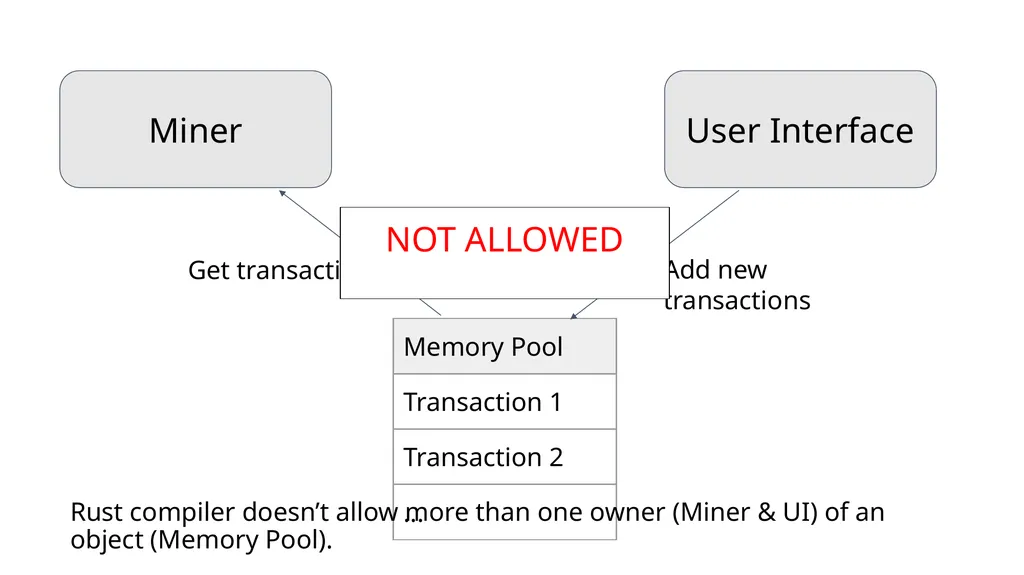
Miner User Interface Add new transactions Get transactions Rust compiler doesn’t allow more than one owner (Miner & UI) of an object (Memory Pool). NOT ALLOWED<br>
22
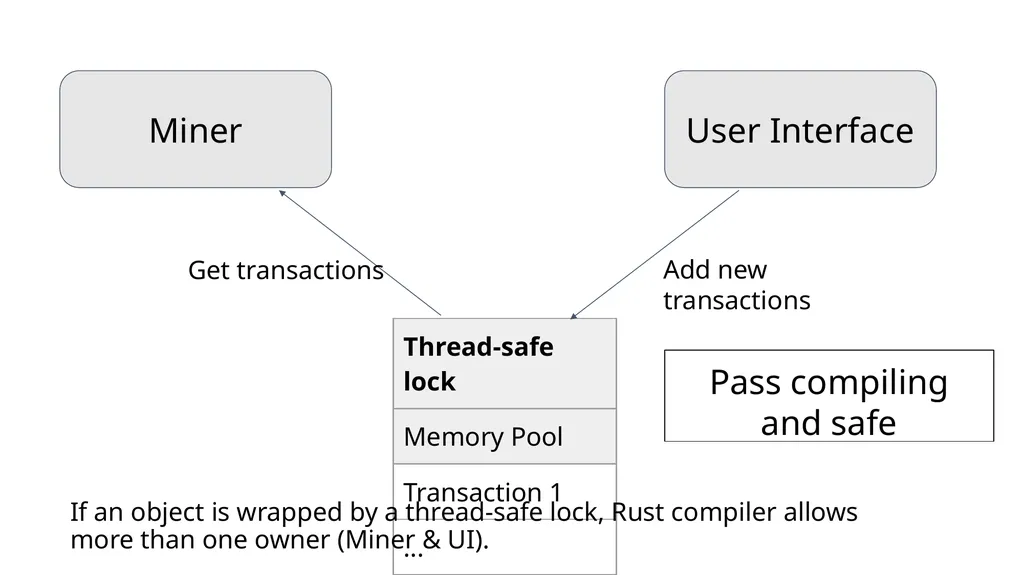
Miner User Interface Add new transactions Get transactions If an object is wrapped by a thread-safe lock, Rust compiler allows more than one owner (Miner & UI). Pass compiling
and safe<br>
23
Besides its reliability, Rust also provides good ... efficiency as C/C++,
network support as Go and Python,
functional-style programming as Scala,
community support as many other popular lanuages.<br>
24
Why is Rust chosen for blockchains? High reliability makes blockchains reliable and secure.
Good efficiency makes blockchains scalable.
Network support makes communication easy-to-code.
Influential blockchain projects are using Rust:<br>
25
Logistics: programming language Solidity<br>
26
What is Solidity? Solidity is an object-oriented, high-level language for implementing smart contracts.
Smart contracts are programs which govern the behavior of accounts within the Ethereum state.
Solidity is designed to target the Ethereum Virtual Machine (EVM).
Solidity is statically typed, like Java, C, Rust… unlike python or javascript.<br>
27
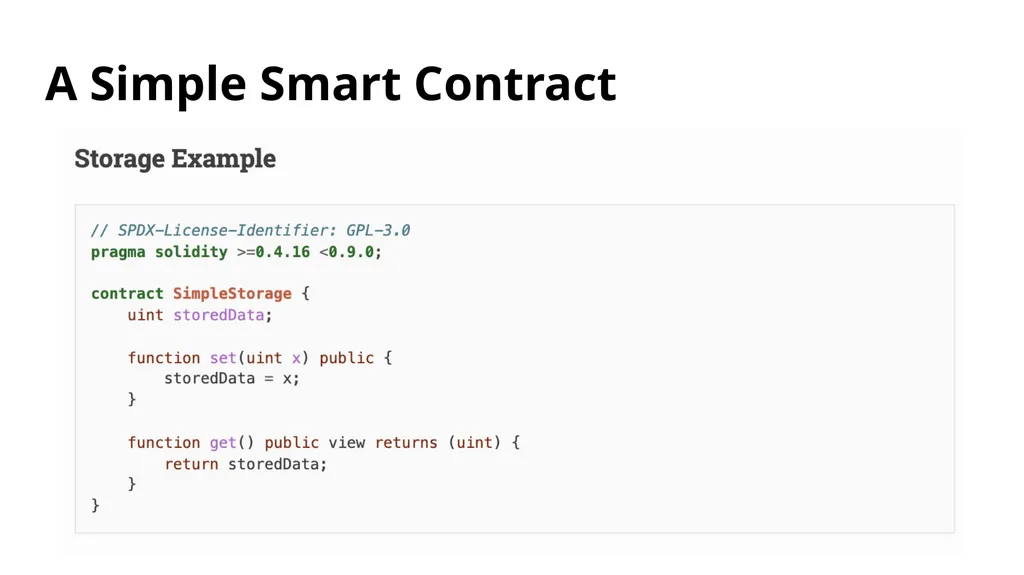
A Simple Smart Contract<br>
28
MPs using Solidity Interact with Etheruem blockchain
Mint your own tokens (like ETH / CryptoKitties)
Create decentralized market maker (like Uniswap)<br>