
Privacy Enhancing Technologies Elaine Shi Lecture

Description: Privacy Enhancing Technologies Elaine Shi Lecture 3 Differential Privacy Some slides adapted from Adam Smiths lecture and other talk slides Roadmap Defining Differential Privacy Techniques for Achieving DP Output perturbation Input
Related Topics
Download Presentation
"Privacy Enhancing Technologies Elaine Shi Lecture" is the property of its rightful owner. Permission is granted to download and print the materials on this website for personal, non-commercial use only, and to display it on your personal computer provided you do not modify the materials and that you retain all copyright notices contained in the materials. By downloading content from our website, you accept the terms of this agreement.
Presentation Transcript
slide1. Privacy Enhancing Technologies Elaine Shi Lecture 3 Differential Privacy Some slides adapted from Adam Smith’s lecture and other talk slides<br>
slide2. Roadmap Defining Differential Privacy
Techniques for Achieving DP
Output perturbation
Input perturbation
Perturbation of intermediate values
Sample and aggregate<br>
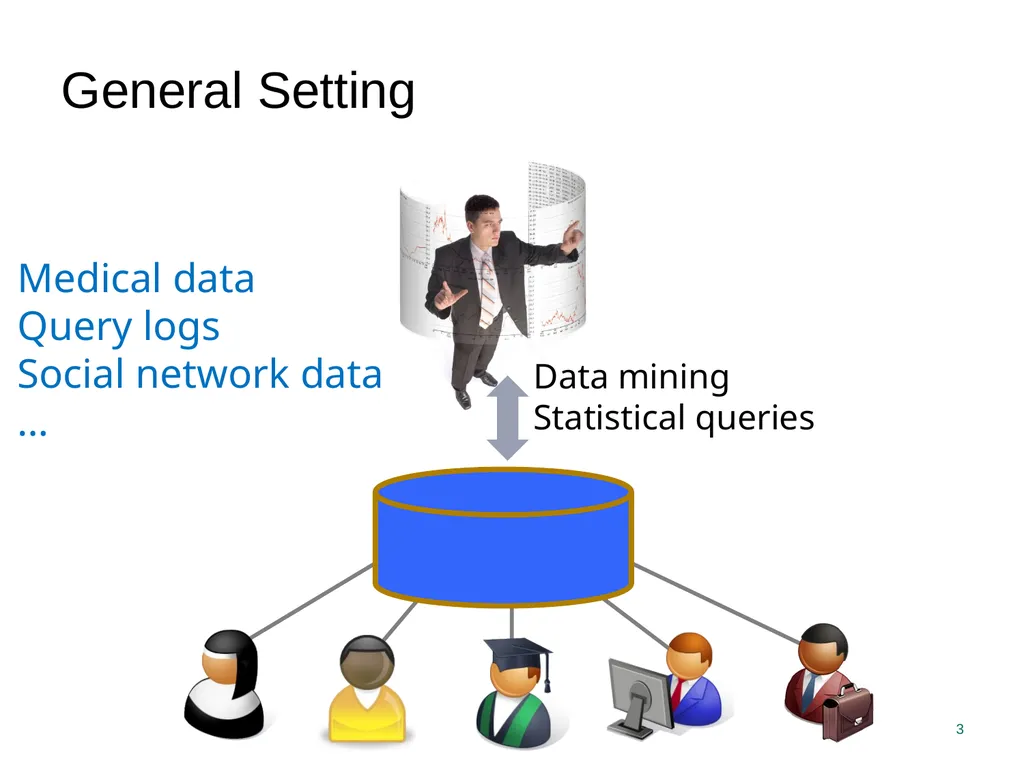
slide3. General Setting Data mining
Statistical queries Medical data
Query logs
Social network data
…<br>
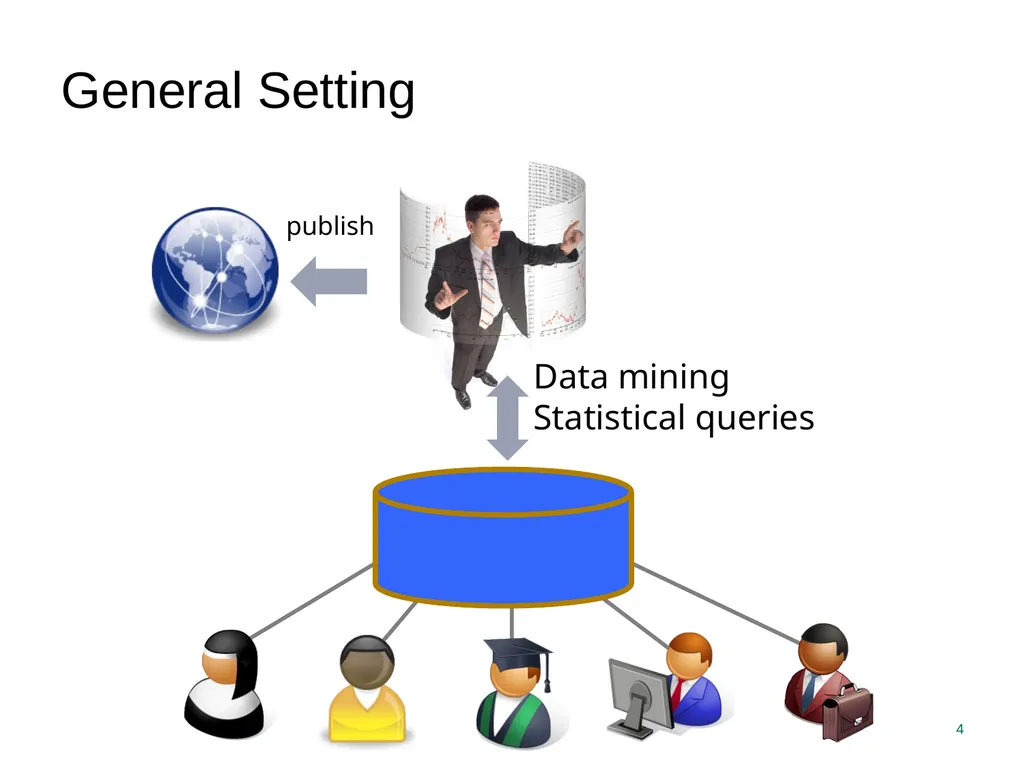
slide4. General Setting Data mining
Statistical queries publish<br>
slide5. How can you allow meaningful usage of such datasets while preserving individual privacy?<br>
slide6. Blatant Non-Privacy<br>
slide7. Blatant Non-Privacy Leak individual records
Can link with public databases to re-identify individuals
Allow adversary to reconstruct database with significant probablity<br>
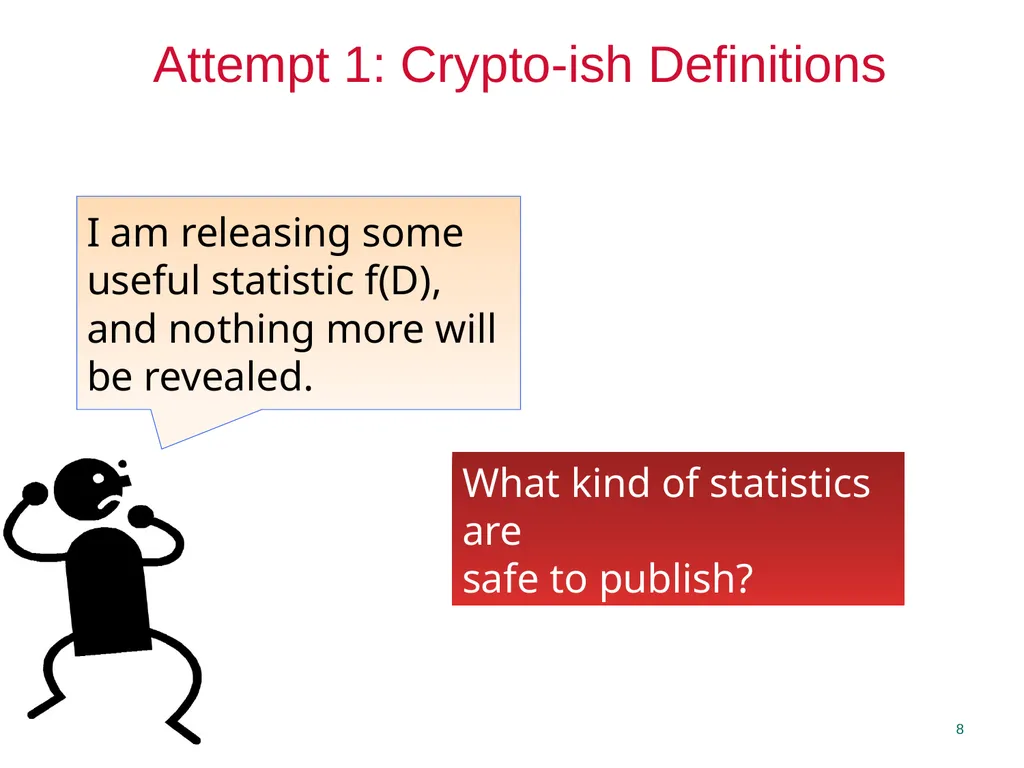
slide8. Attempt 1: Crypto-ish Definitions I am releasing some useful statistic f(D), and nothing more will be revealed. What kind of statistics are
safe to publish?<br>
slide9. How do you define privacy?<br>
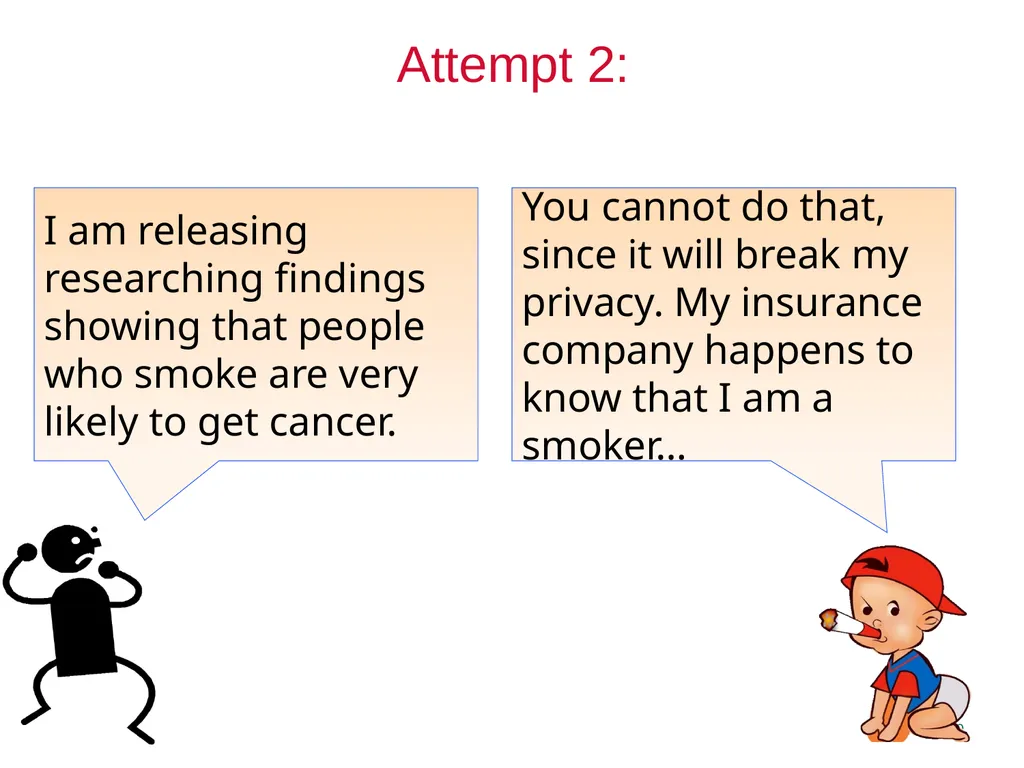
slide10. Attempt 2: I am releasing researching findings showing that people who smoke are very likely to get cancer. You cannot do that, since it will break my privacy. My insurance company happens to know that I am a smoker…<br>
slide11. Attempt 2: Absolute Disclosure Prevention “If the release of statistics S makes it possible to determine the value [of private information] more accurately than is possible without access to S, a disclosure has taken place.” [Dalenius]<br>
slide12. An Impossibility Result [informal] It is not possible to design any non-trivial mechanism that satisfies such strong notion of privacy.[Dalenius]<br>
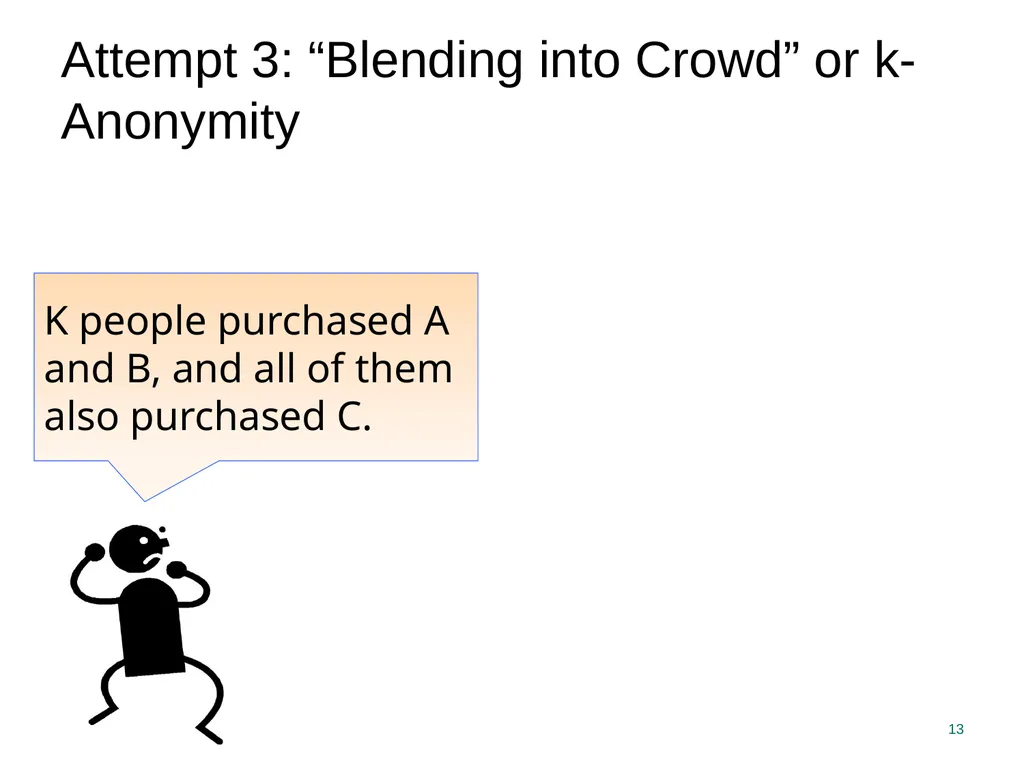
slide13. Attempt 3: “Blending into Crowd” or k-Anonymity K people purchased A and B, and all of them also purchased C.<br>
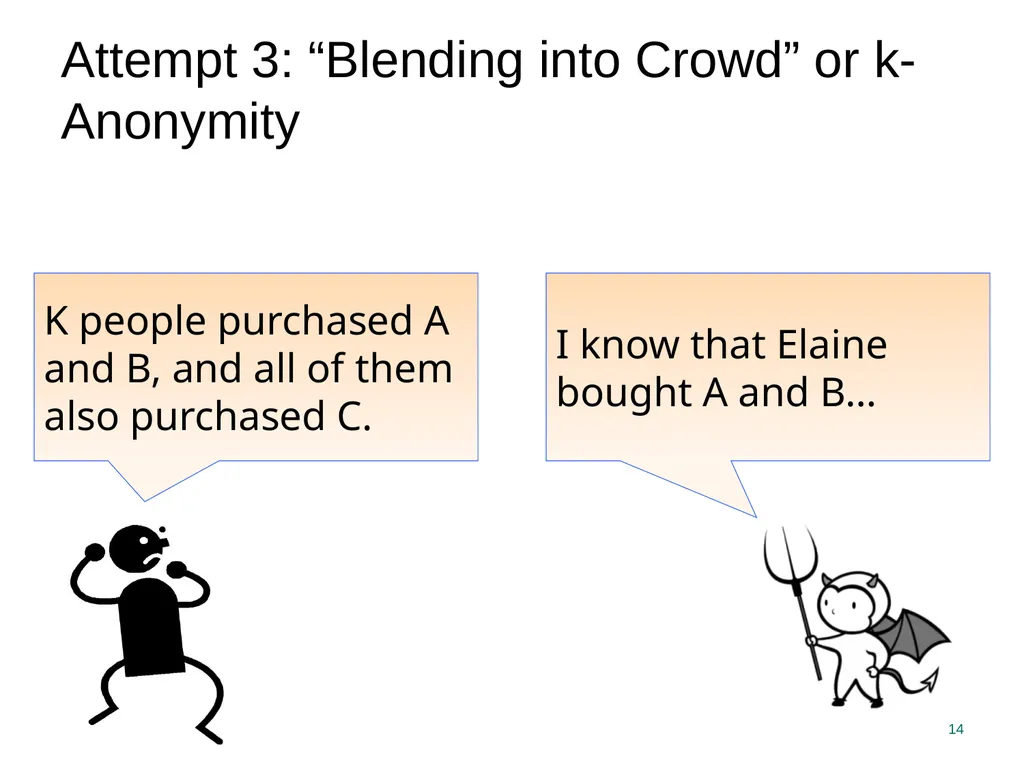
slide14. Attempt 3: “Blending into Crowd” or k-Anonymity K people purchased A and B, and all of them also purchased C. I know that Elaine bought A and B…<br>
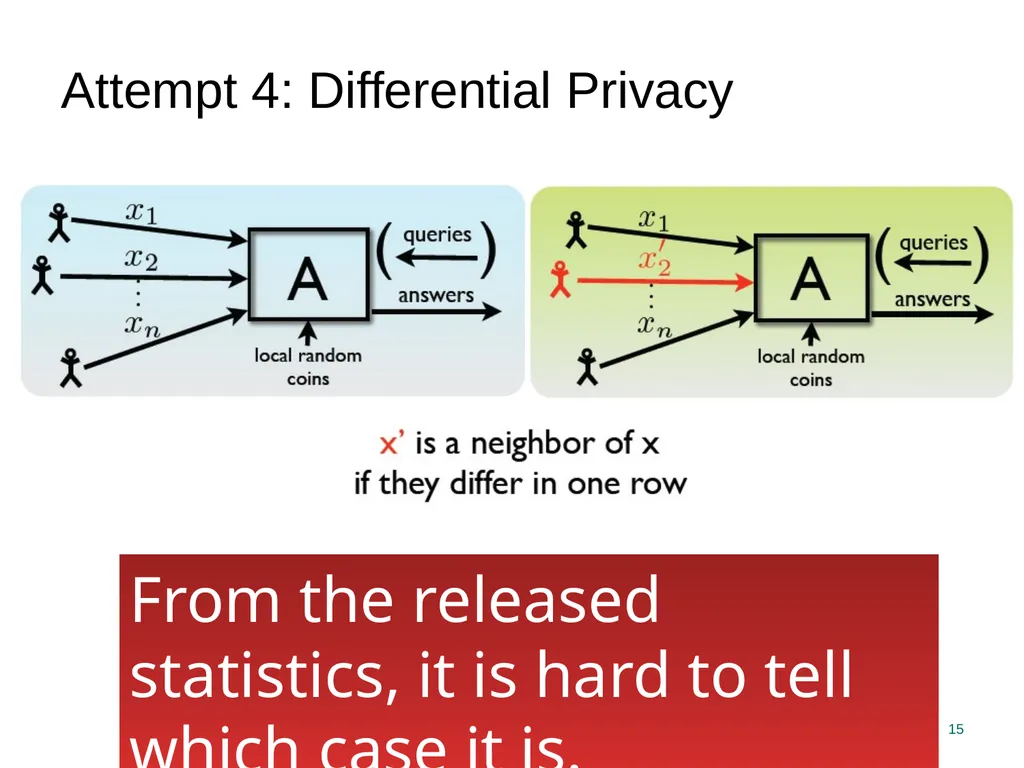
slide15. Attempt 4: Differential Privacy From the released statistics, it is hard to tell which case it is.<br>
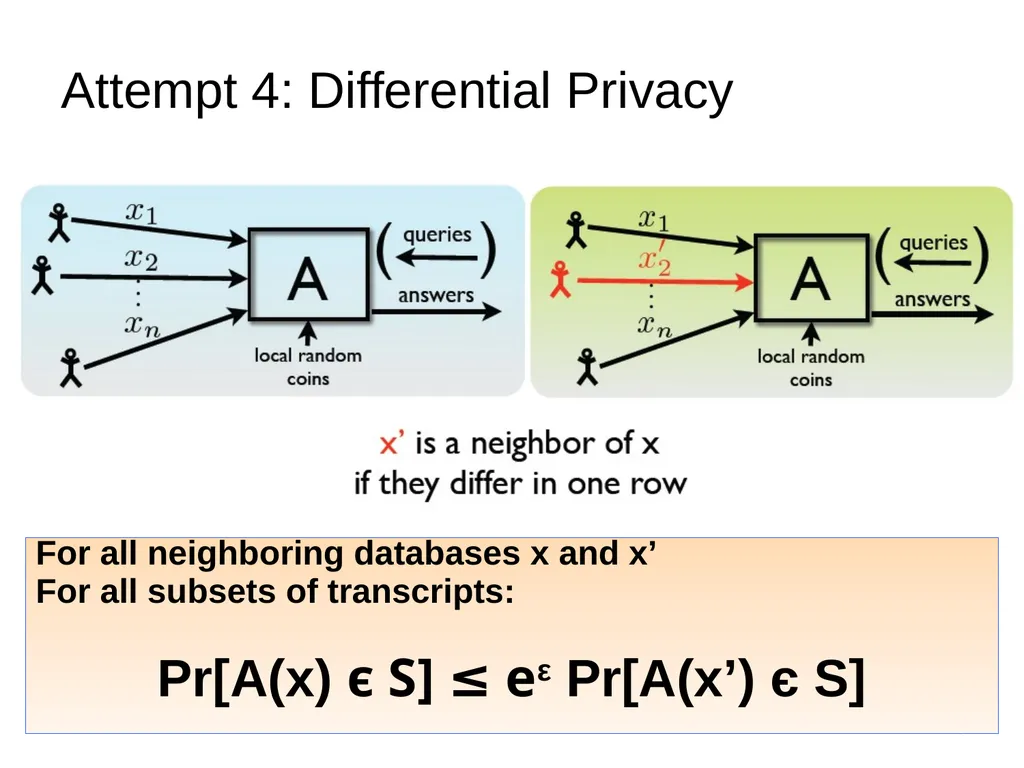
slide16. Attempt 4: Differential Privacy For all neighboring databases x and x’
For all subsets of transcripts:
Pr[A(x) є S] ≤ eε Pr[A(x’) є S]<br>
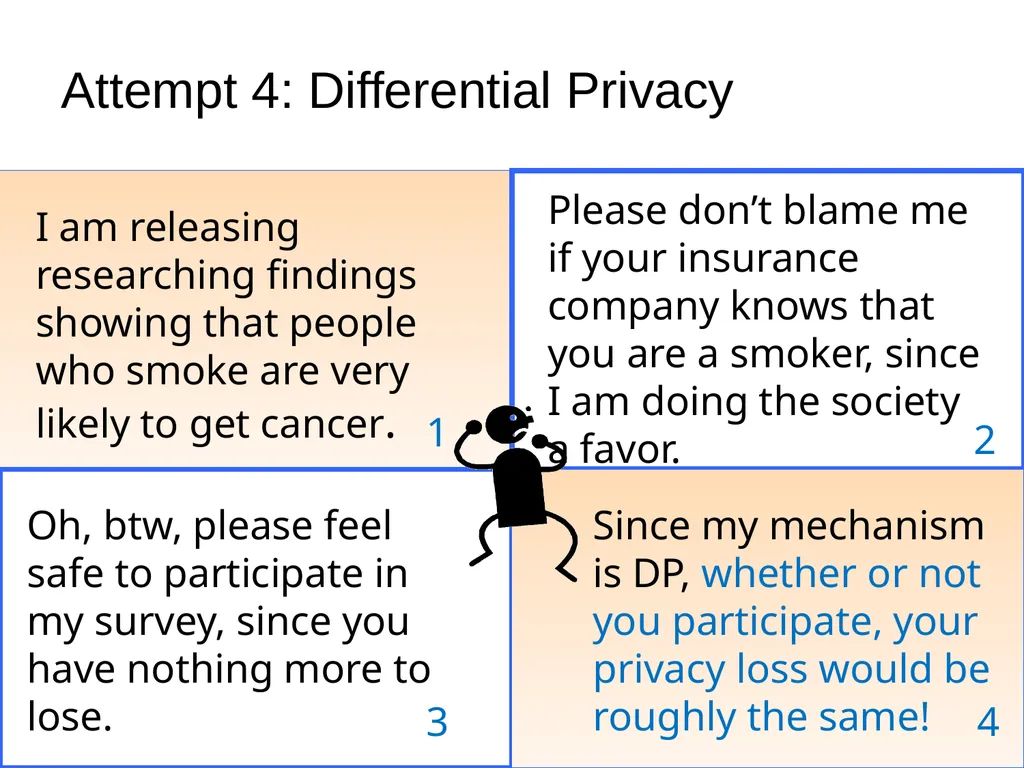
slide17. Attempt 4: Differential Privacy I am releasing researching findings showing that people who smoke are very likely to get cancer. Please don’t blame me if your insurance company knows that you are a smoker, since I am doing the society a favor. Oh, btw, please feel safe to participate in my survey, since you have nothing more to lose. Since my mechanism is DP, whether or not you participate, your privacy loss would be roughly the same! 1 2 3 4<br>
slide18. Notable Properties of DP Adversary knows arbitrary auxiliary information
No linkage attacks
Oblivious to data distribution
Sanitizer need not know the adversary’s prior distribution on the DB<br>
slide19. Notable Properties of DP<br>
slide20. DP Techniques<br>
slide21. Techniques for Achieving DP Output perturbation
Input perturbation
Perturbation of intermediate values
Sample and aggregate<br>
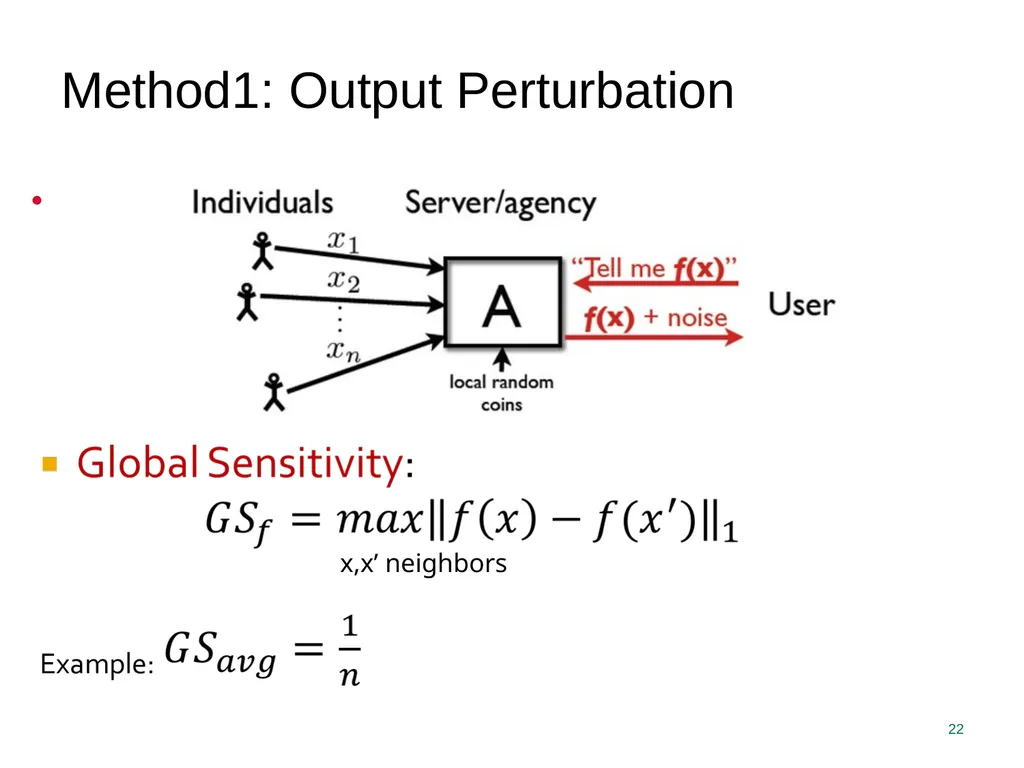
slide22. Method1: Output Perturbation x,x’ neighbors<br>
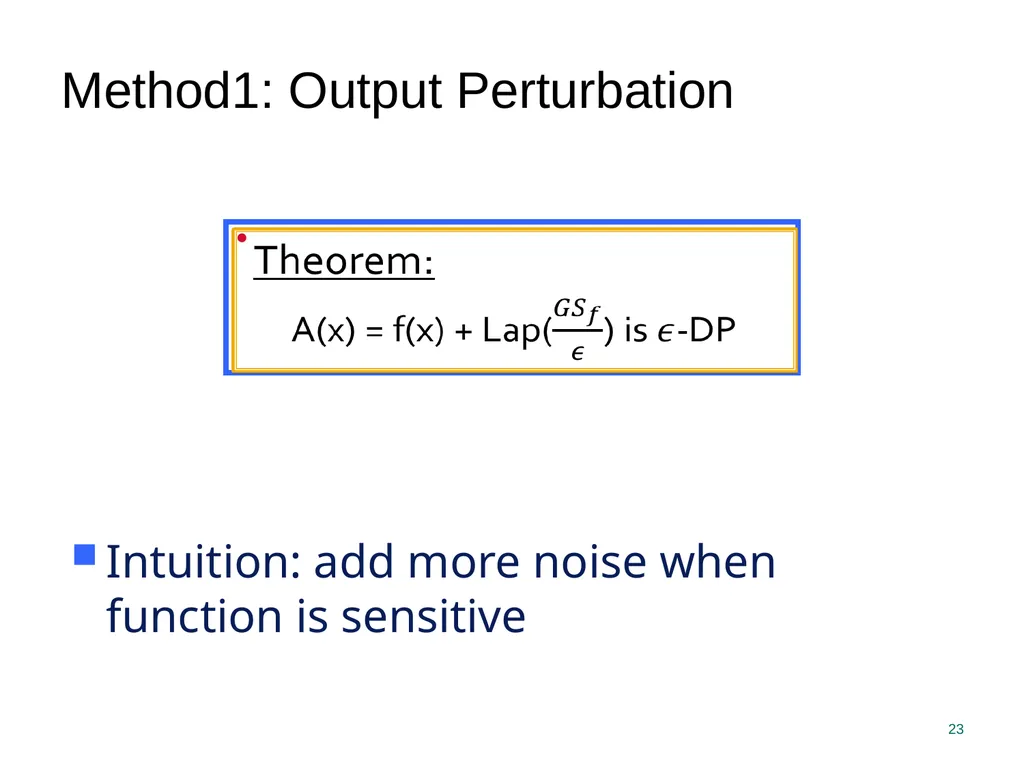
slide23. Method1: Output Perturbation Theorem:
A(x) = f(x) + Lap() is -DP Intuition: add more noise when function is sensitive<br>
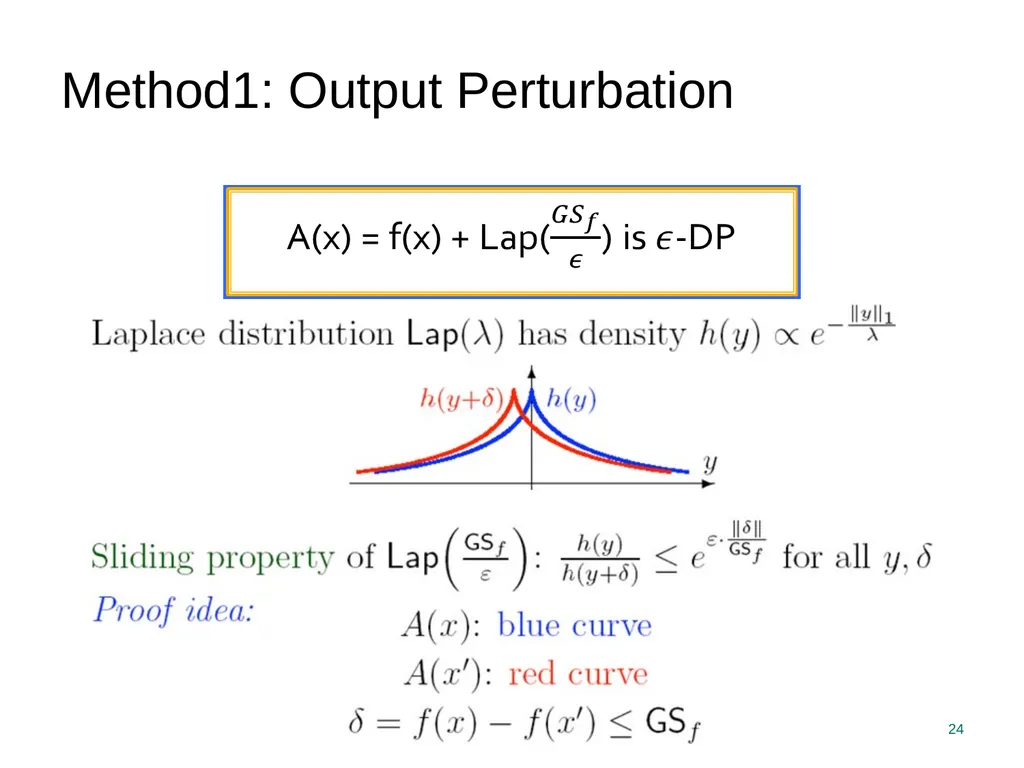
slide24. Method1: Output Perturbation A(x) = f(x) + Lap() is -DP<br>
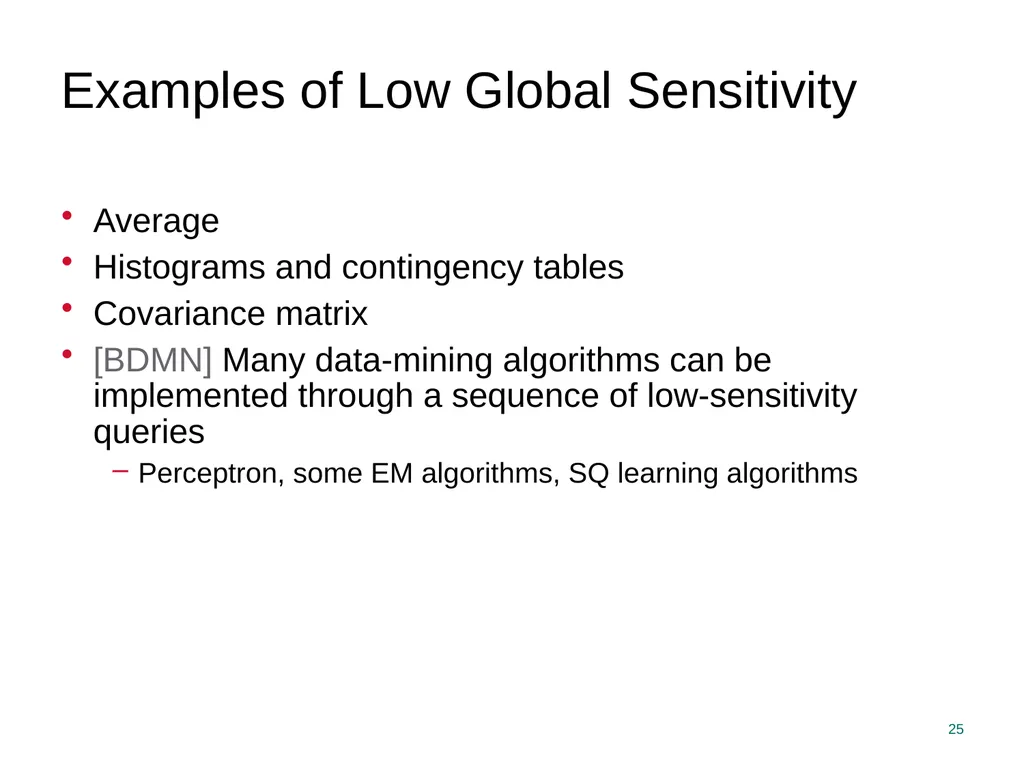
slide25. Examples of Low Global Sensitivity Average
Histograms and contingency tables
Covariance matrix
[BDMN] Many data-mining algorithms can be implemented through a sequence of low-sensitivity queries
Perceptron, some EM algorithms, SQ learning algorithms<br>
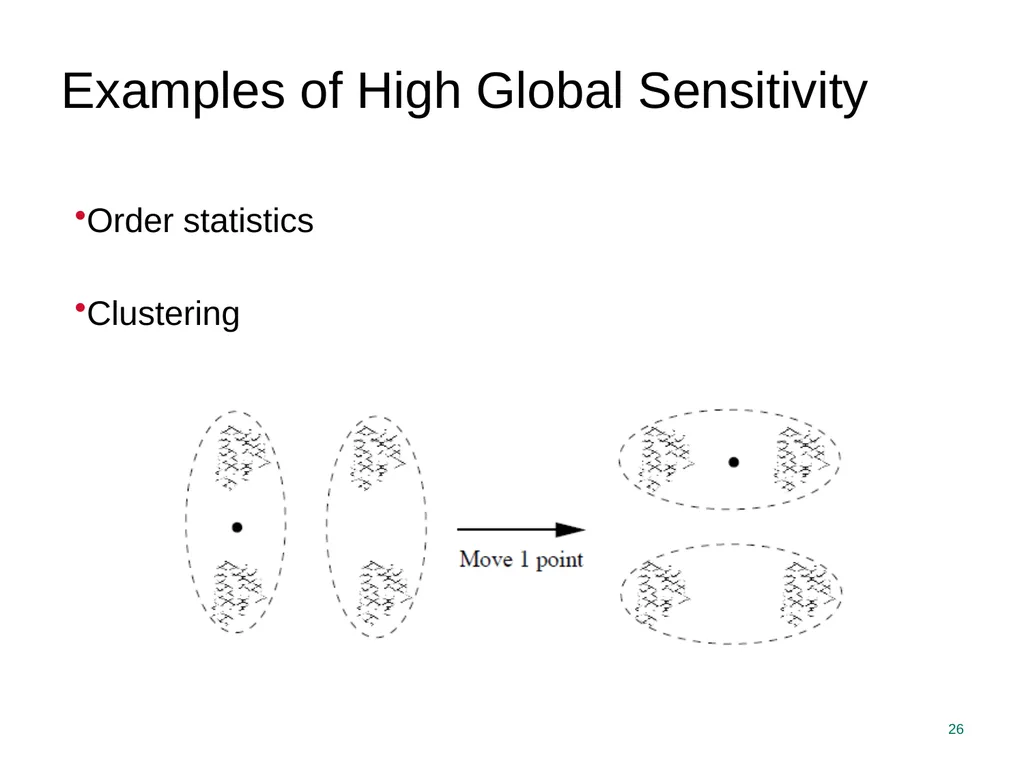
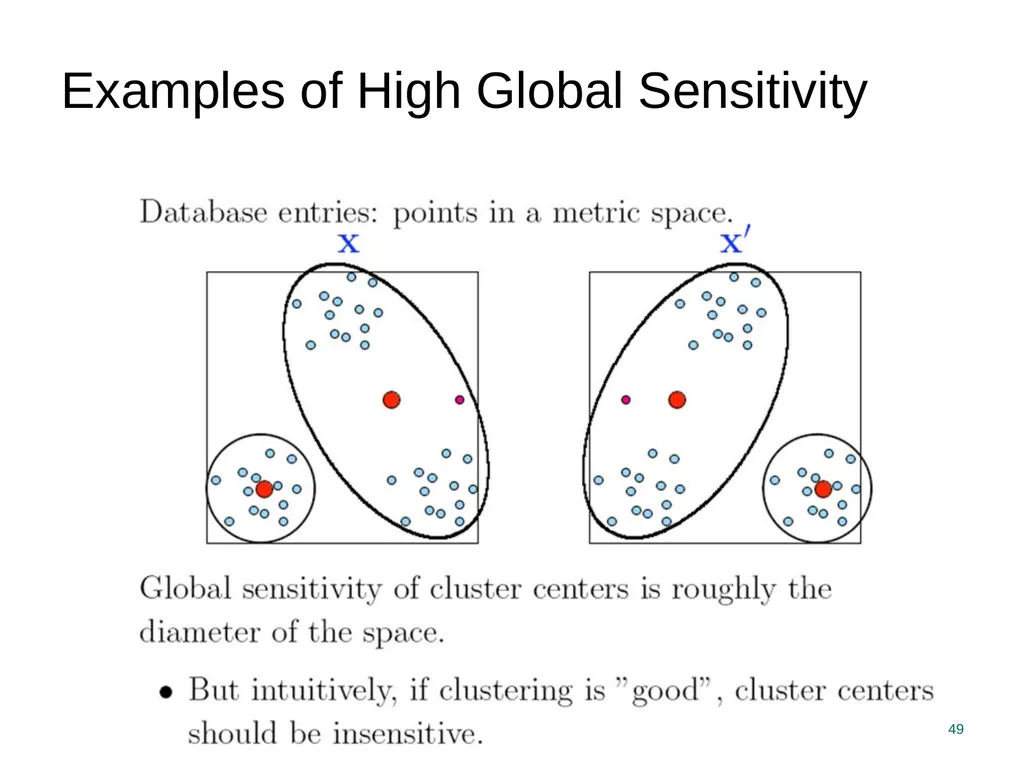
slide26. Examples of High Global Sensitivity Order statistics
Clustering<br>
slide27. PINQ<br>
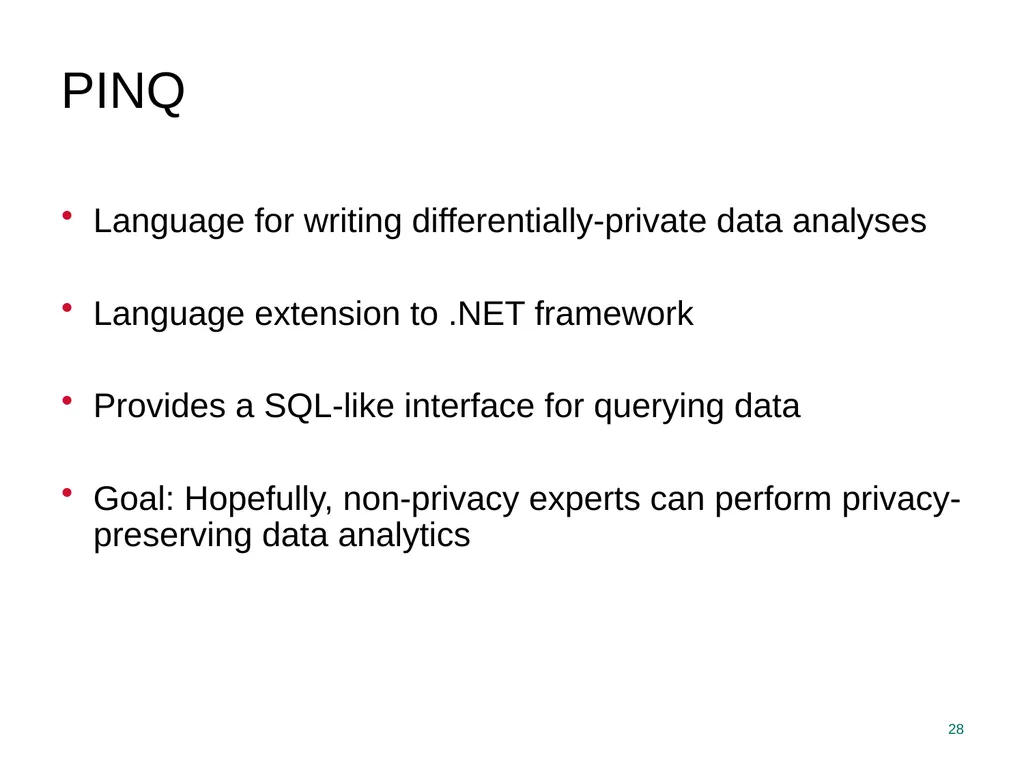
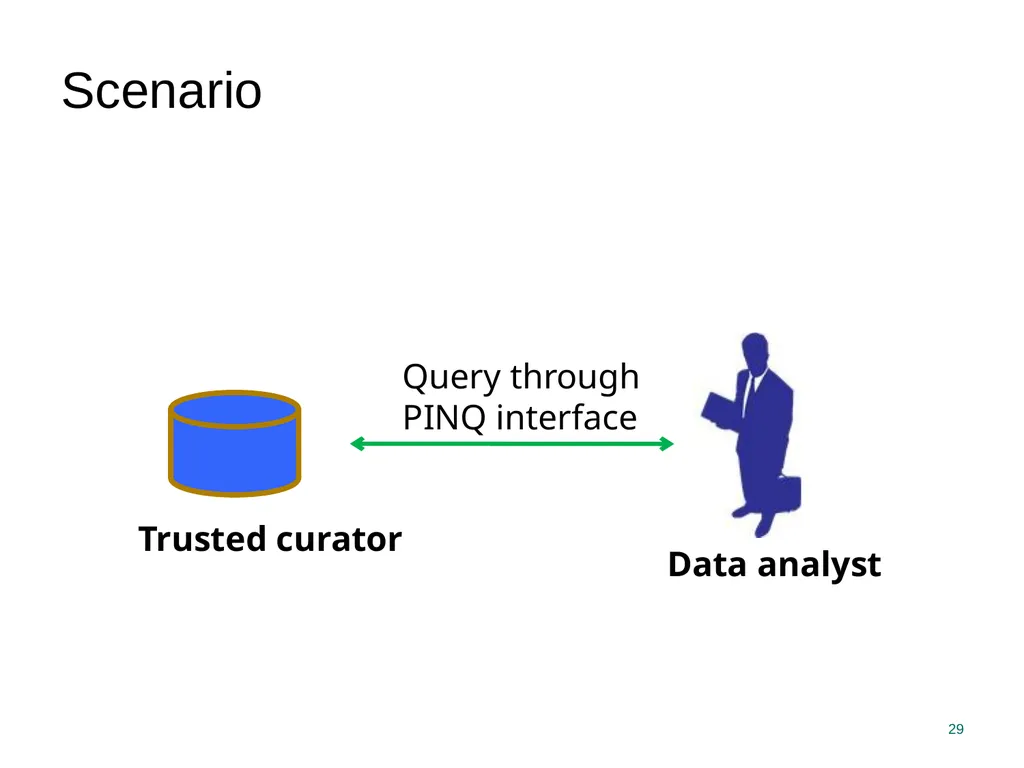
slide28. PINQ Language for writing differentially-private data analyses
Language extension to .NET framework
Provides a SQL-like interface for querying data
Goal: Hopefully, non-privacy experts can perform privacy-preserving data analytics<br>
slide29. Scenario Trusted curator Query through PINQ interface Data analyst<br>
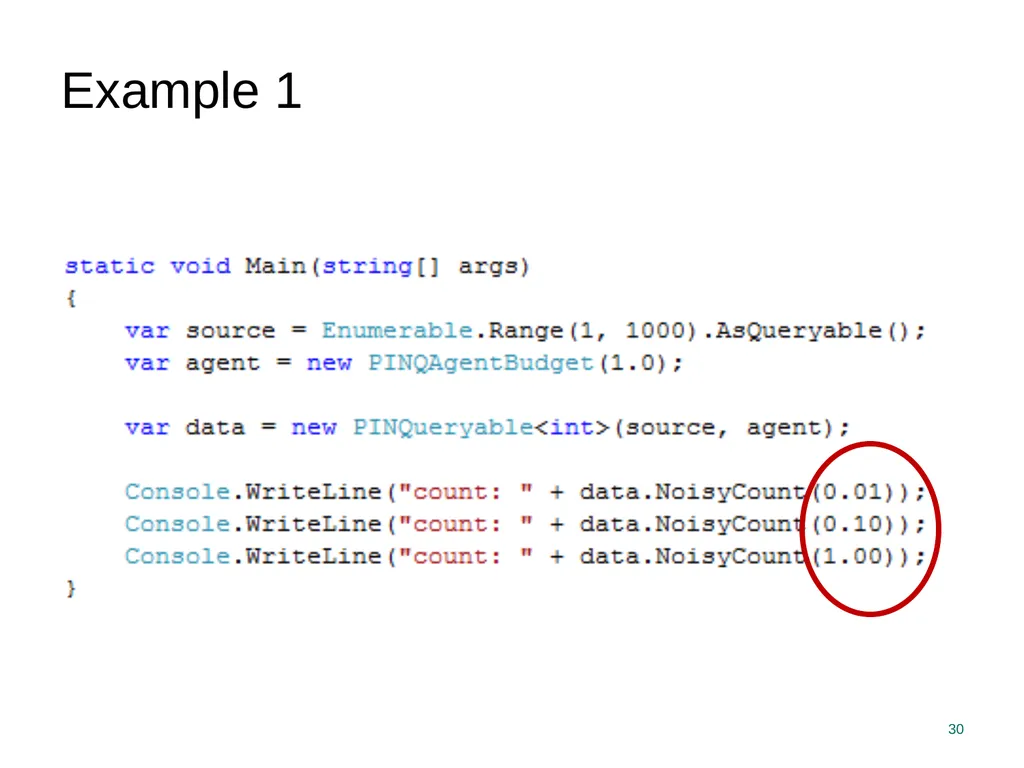
slide30. Example 1<br>
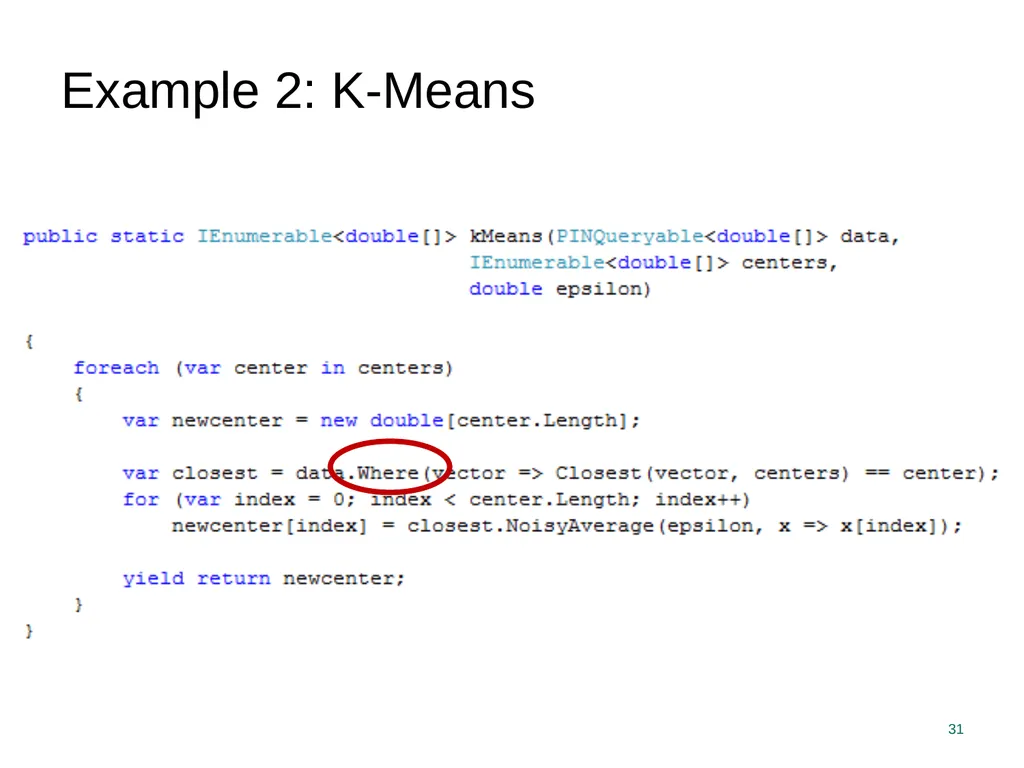
slide31. Example 2: K-Means<br>
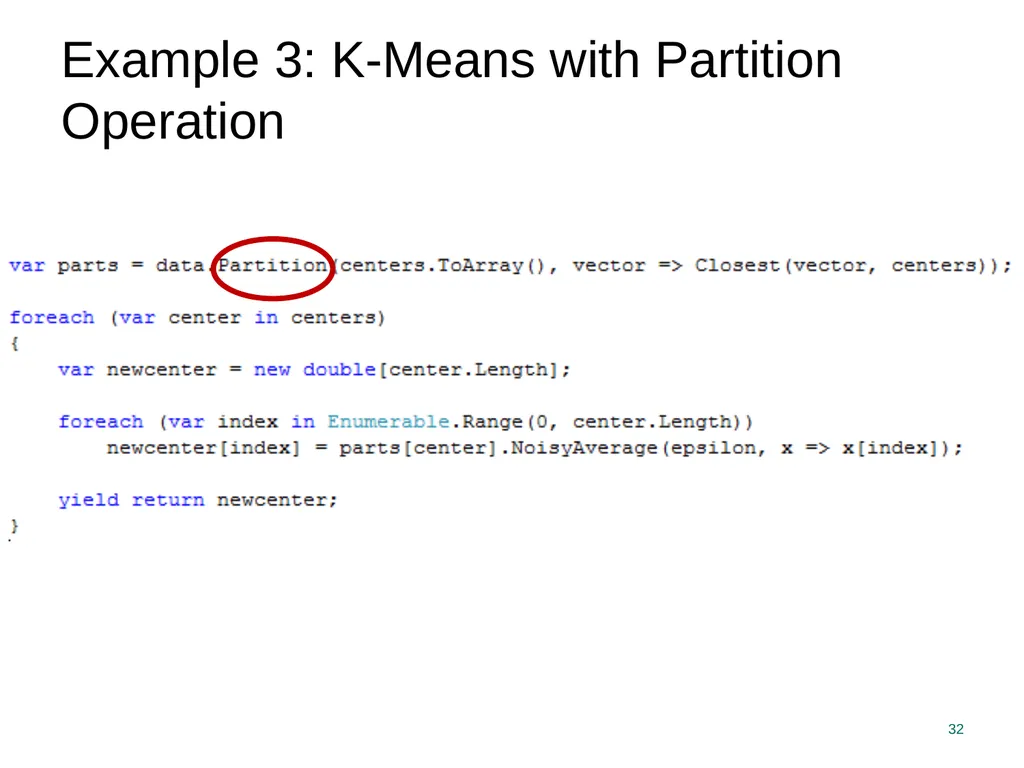
slide32. Example 3: K-Means with Partition Operation<br>
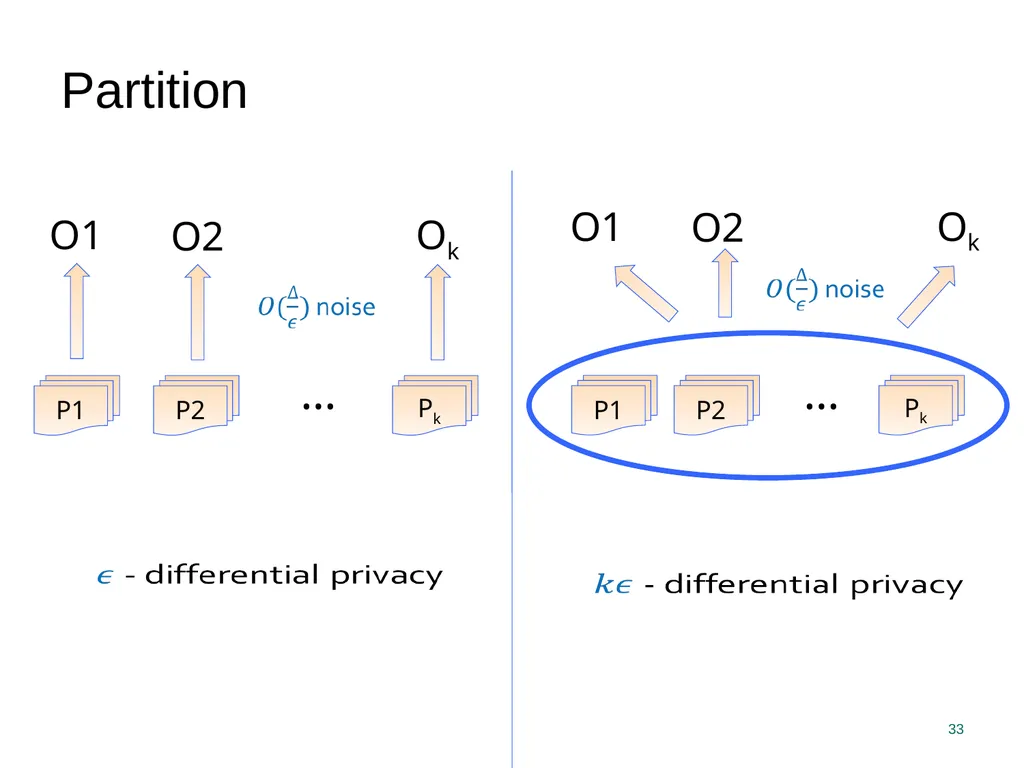
slide33. Partition P1 P2 Pk … O1 O2 Ok P1 P2 Pk … O1 O2 Ok<br>
slide34. Composition and privacy budget Sequential composition
Parallel composition<br>
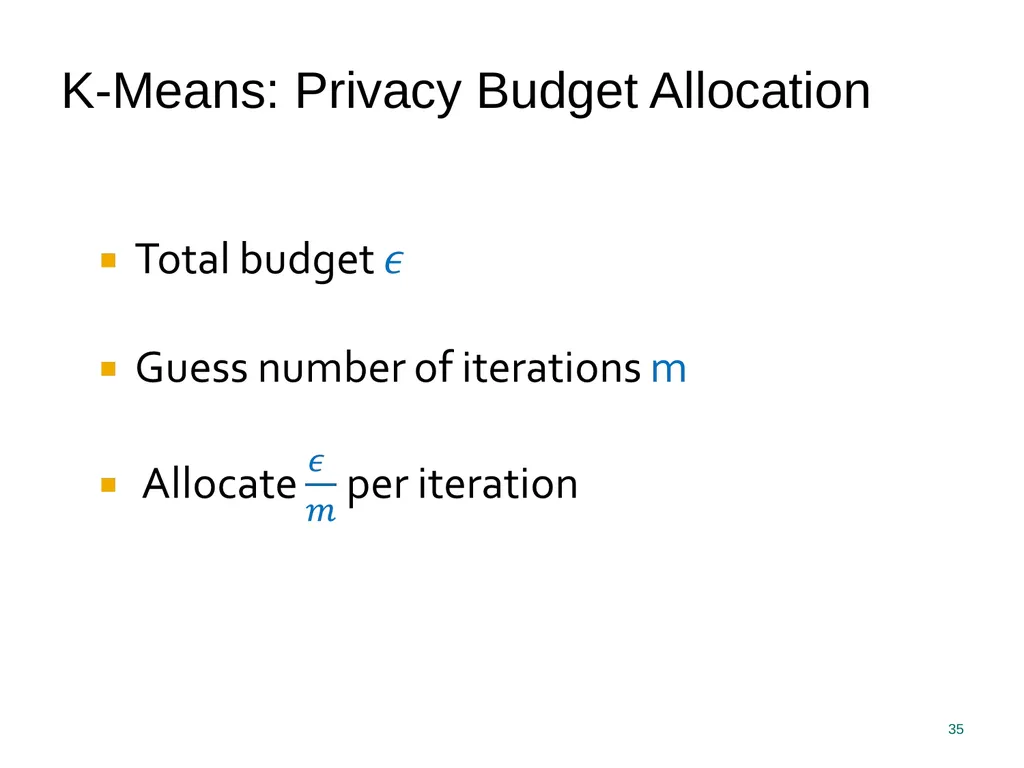
slide35. K-Means: Privacy Budget Allocation<br>
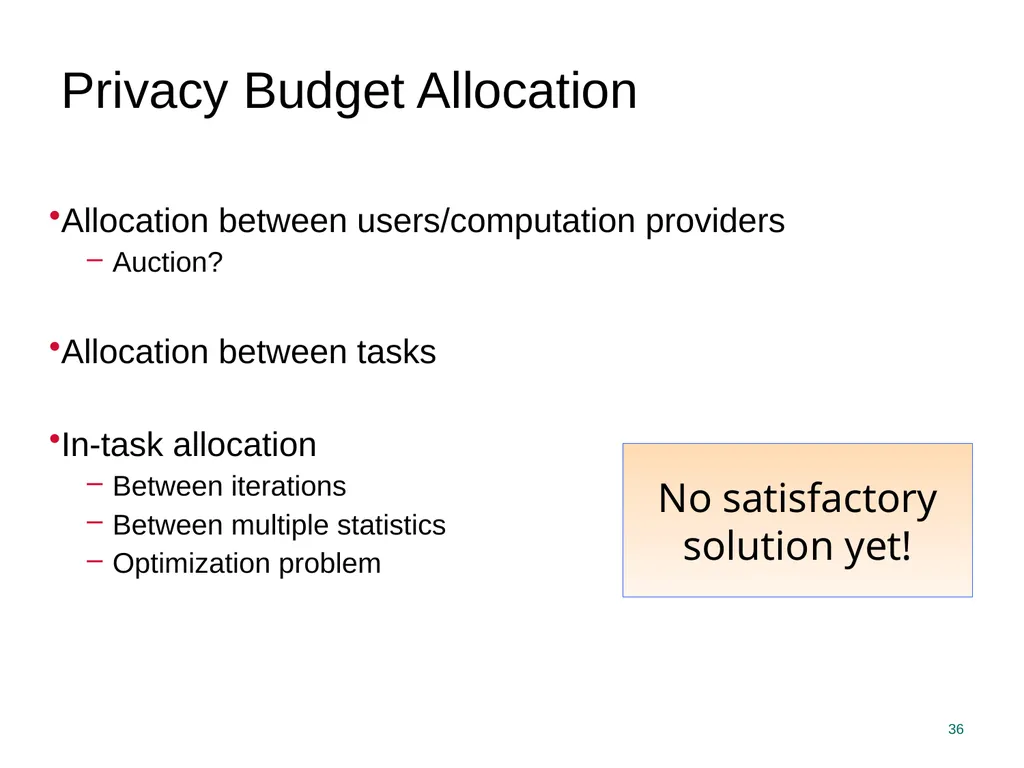
slide36. Privacy Budget Allocation Allocation between users/computation providers
Auction?
Allocation between tasks
In-task allocation
Between iterations
Between multiple statistics
Optimization problem No satisfactory solution yet!<br>
slide37. When Budget Has Exhausted ?<br>
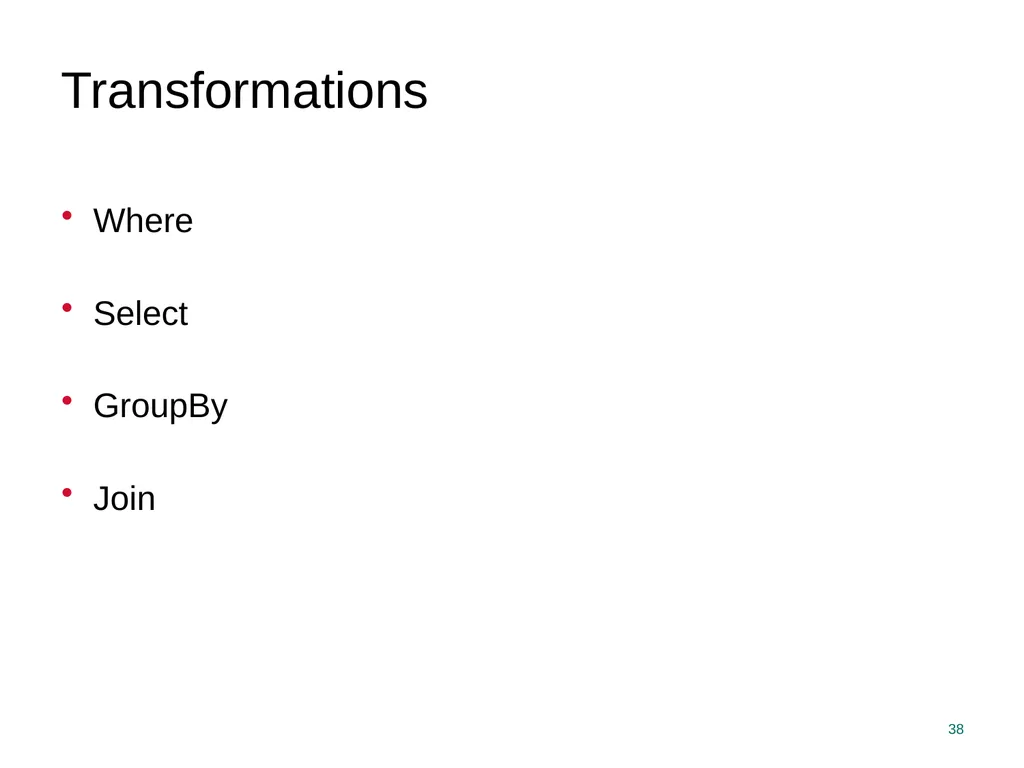
slide38. Transformations Where
Select
GroupBy
Join<br>
slide39. Method 2: Input Perturbation Please analyze this method in homework Randomized response [Warner65]<br>
slide40. Method 3: Perturb Intermediate Results<br>
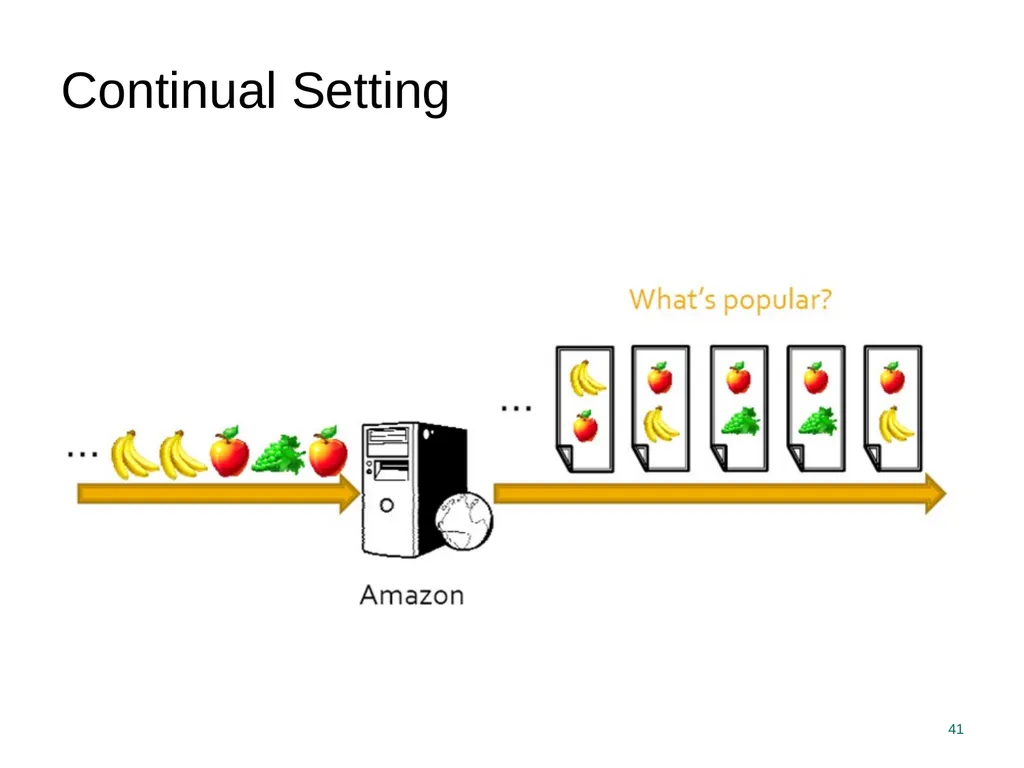
slide41. Continual Setting<br>
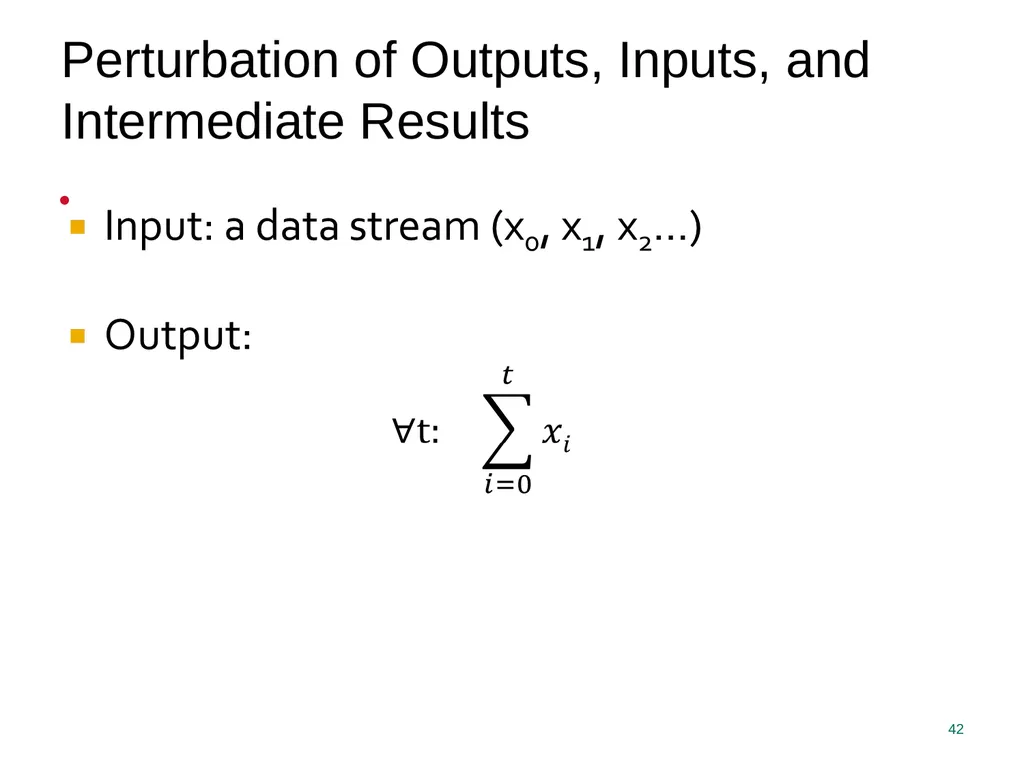
slide42. Perturbation of Outputs, Inputs, and Intermediate Results<br>
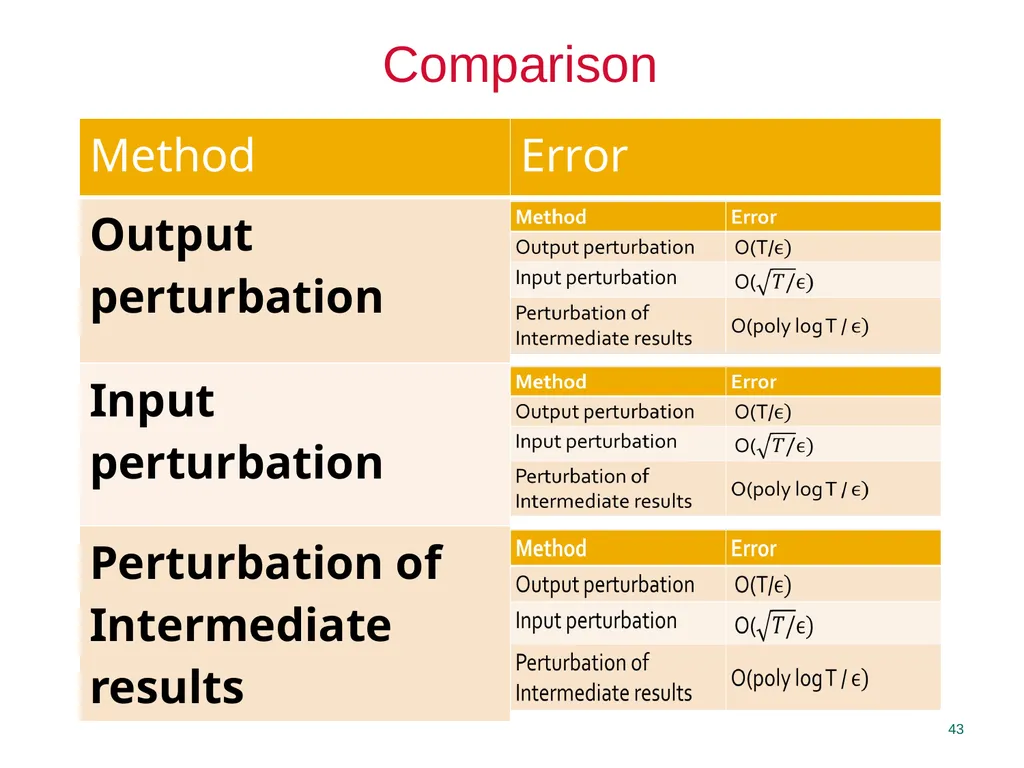
slide43. Comparison<br>
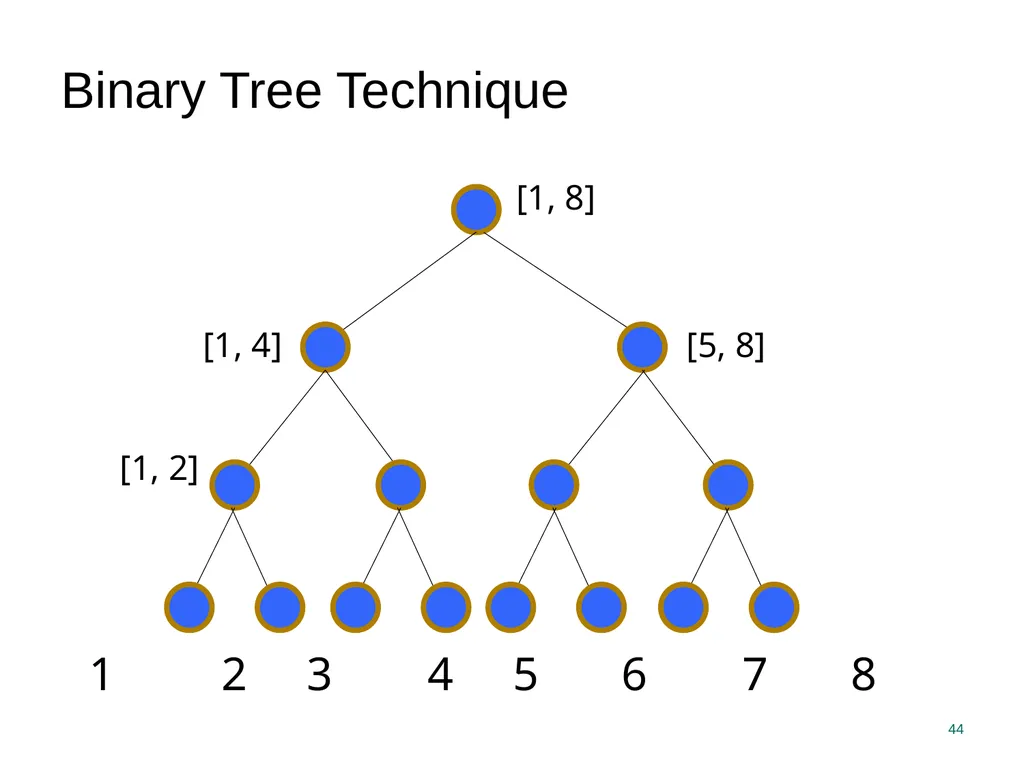
slide44. Binary Tree Technique 1 2 3 4 5 6 7 8 [1, 2] [1, 4] [5, 8] [1, 8]<br>
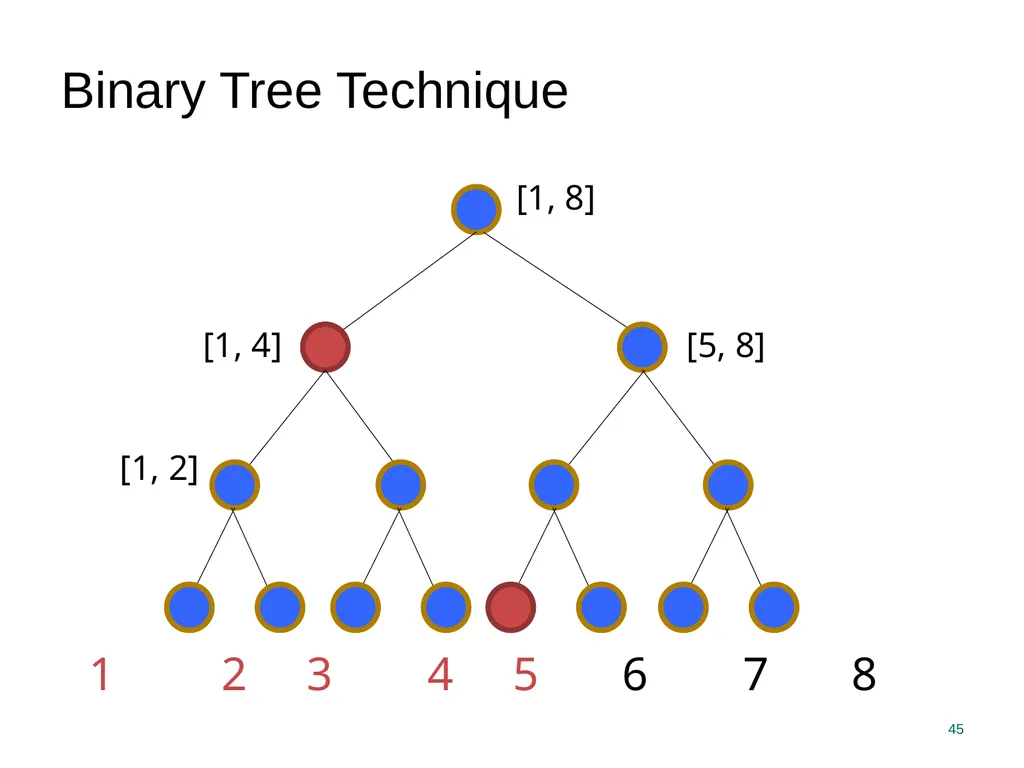
slide45. Binary Tree Technique 1 2 3 4 5 6 7 8 [1, 2] [1, 4] [5, 8] [1, 8]<br>
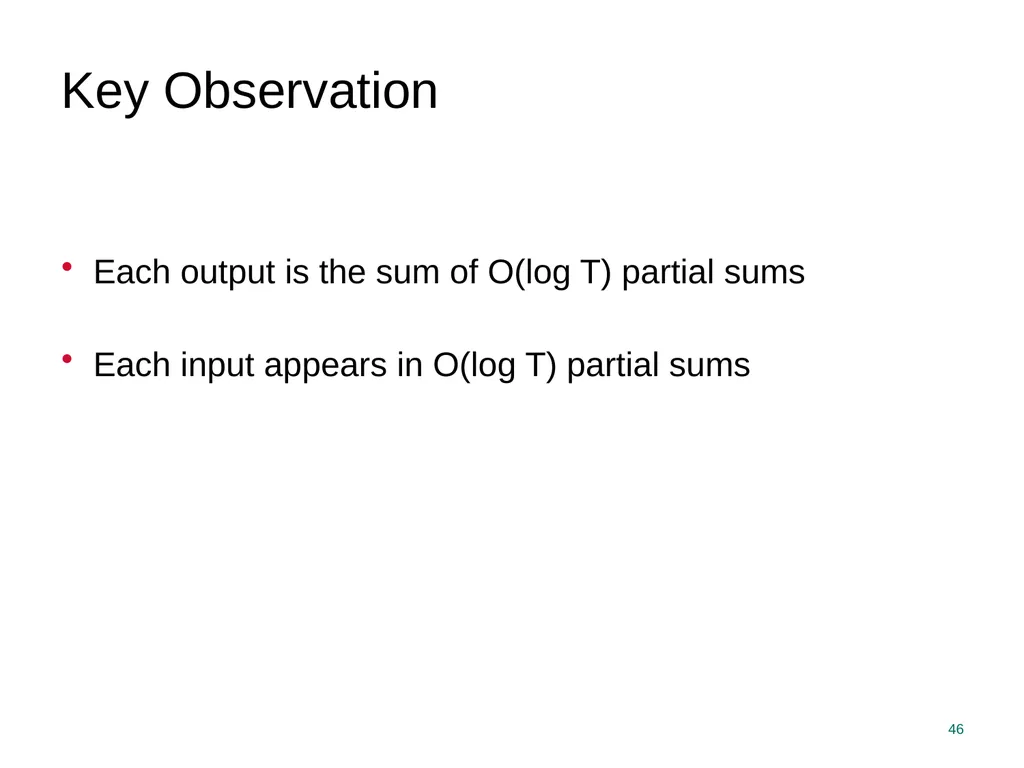
slide46. Key Observation Each output is the sum of O(log T) partial sums
Each input appears in O(log T) partial sums<br>
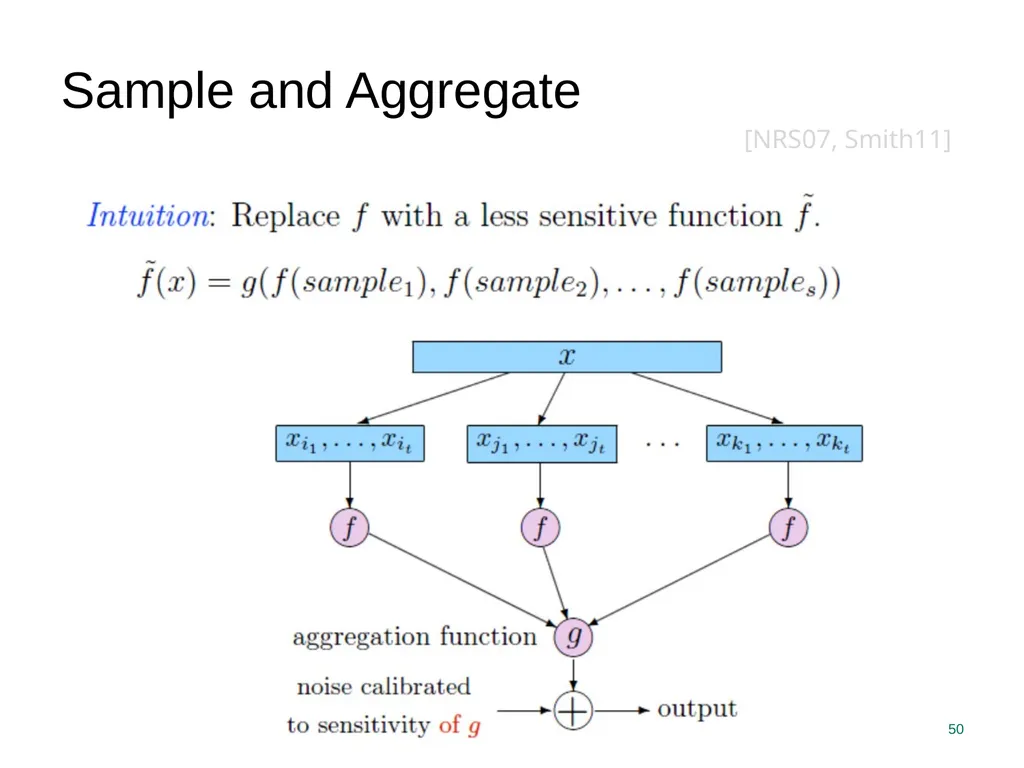
slide47. Method 4: Sample and Aggregate Data dependent techniques<br>
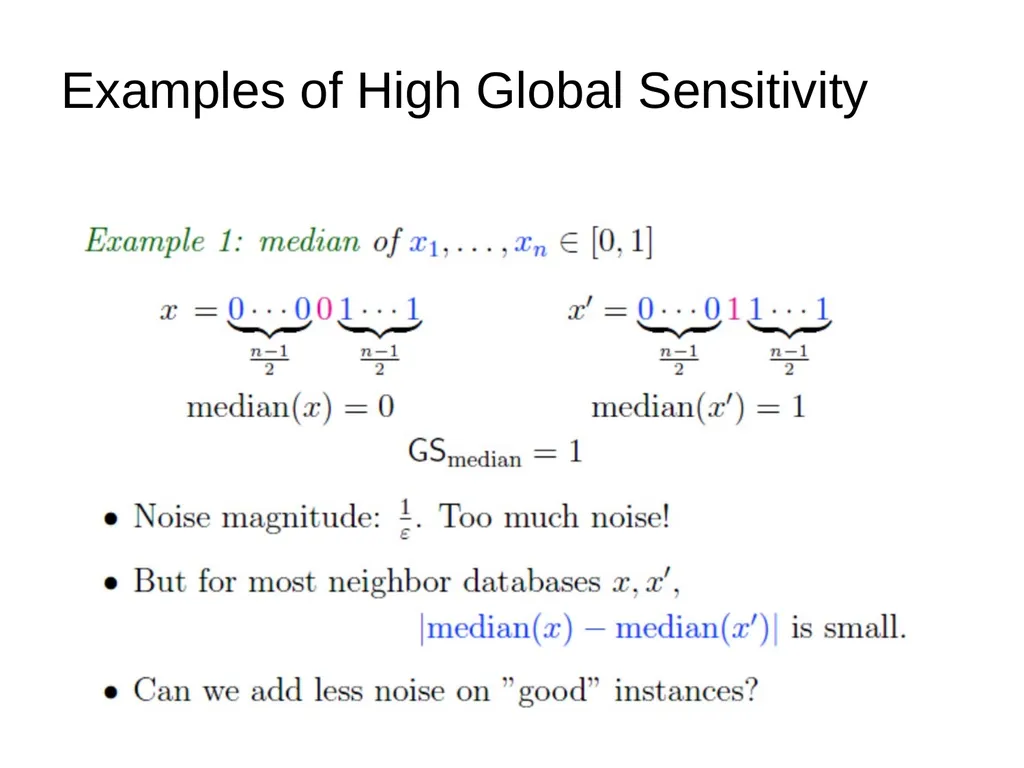
slide48. Examples of High Global Sensitivity<br>
slide49. Examples of High Global Sensitivity<br>
slide50. Sample and Aggregate [NRS07, Smith11]<br>
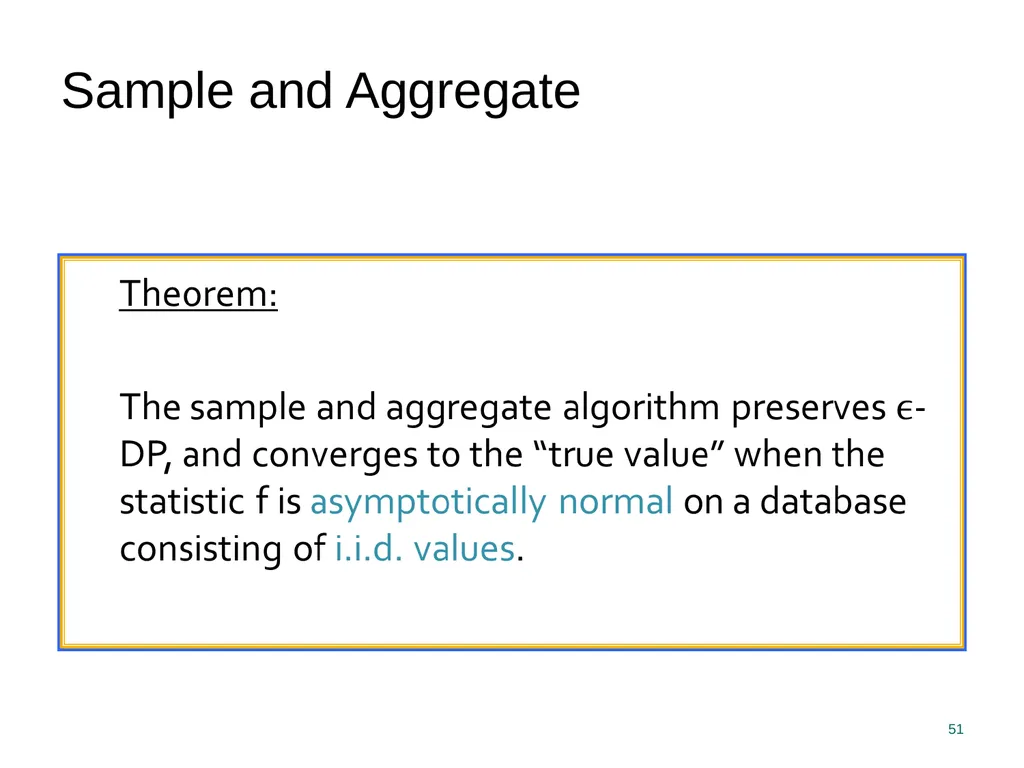
slide51. Sample and Aggregate Theorem:
The sample and aggregate algorithm preserves -DP, and converges to the “true value” when the statistic f is asymptotically normal on a database consisting of i.i.d. values.<br>
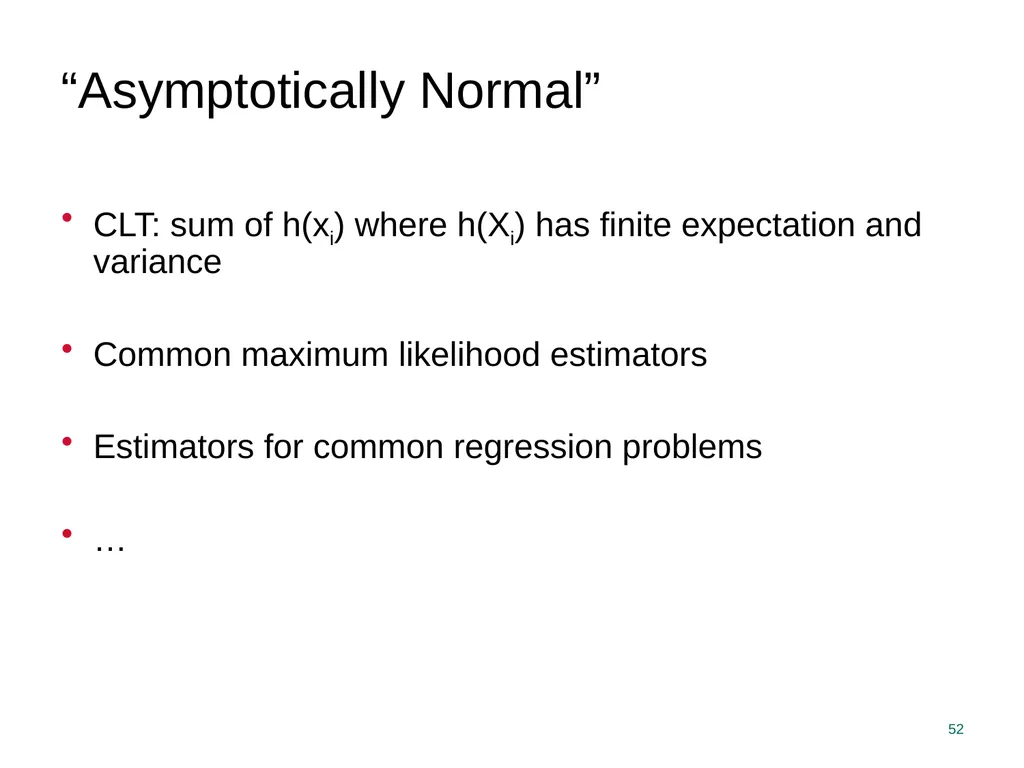
slide52. “Asymptotically Normal” CLT: sum of h(xi) where h(Xi) has finite expectation and variance
Common maximum likelihood estimators
Estimators for common regression problems
…<br>
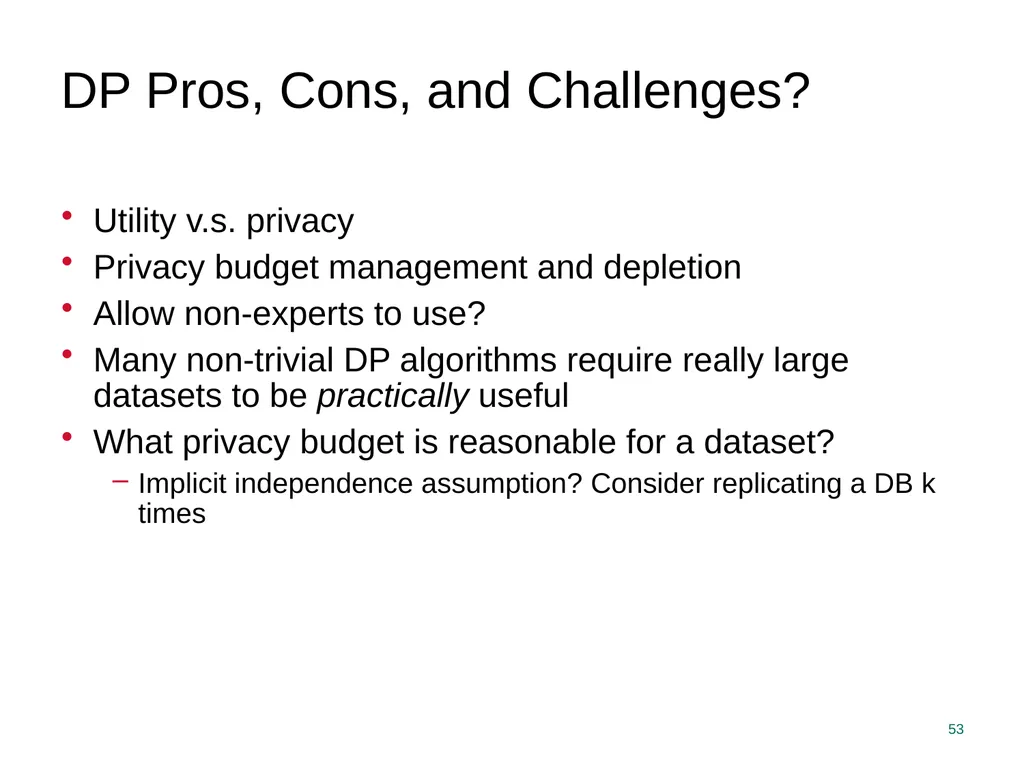
slide53. DP Pros, Cons, and Challenges? Utility v.s. privacy
Privacy budget management and depletion
Allow non-experts to use?
Many non-trivial DP algorithms require really large datasets to be practically useful
What privacy budget is reasonable for a dataset?
Implicit independence assumption? Consider replicating a DB k times<br>
slide54. Other Notions Noiseless privacy
Crowd-blending privacy<br>
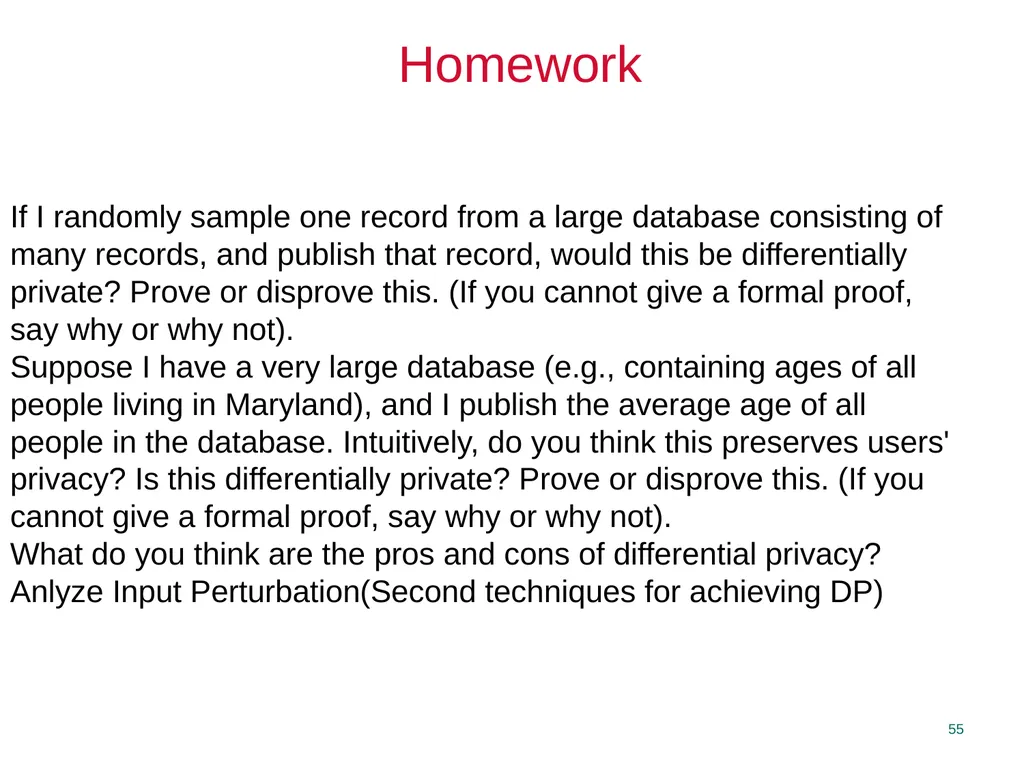
slide55. Homework If I randomly sample one record from a large database consisting of many records, and publish that record, would this be differentially private? Prove or disprove this. (If you cannot give a formal proof, say why or why not).
Suppose I have a very large database (e.g., containing ages of all people living in Maryland), and I publish the average age of all people in the database. Intuitively, do you think this preserves users' privacy? Is this differentially private? Prove or disprove this. (If you cannot give a formal proof, say why or why not).
What do you think are the pros and cons of differential privacy?
Anlyze Input Perturbation(Second techniques for achieving DP)<br>
slide56. Reading list Cynthia Dwork's video tutoial on DP
[Cynthia 06] Differential Privacy (Invited talk at ICALP 2006)
[Frank 09] Privacy Integrated Queries
[Mohan et. al. 12] GUPT: Privacy Preserving Data Analysis Made Easy
[Cynthia Dwork 09] The Differential Privacy Frontier<br>
slide2. Roadmap Defining Differential Privacy
Techniques for Achieving DP
Output perturbation
Input perturbation
Perturbation of intermediate values
Sample and aggregate<br>
slide3. General Setting Data mining
Statistical queries Medical data
Query logs
Social network data
…<br>
slide4. General Setting Data mining
Statistical queries publish<br>
slide5. How can you allow meaningful usage of such datasets while preserving individual privacy?<br>
slide6. Blatant Non-Privacy<br>
slide7. Blatant Non-Privacy Leak individual records
Can link with public databases to re-identify individuals
Allow adversary to reconstruct database with significant probablity<br>
slide8. Attempt 1: Crypto-ish Definitions I am releasing some useful statistic f(D), and nothing more will be revealed. What kind of statistics are
safe to publish?<br>
slide9. How do you define privacy?<br>
slide10. Attempt 2: I am releasing researching findings showing that people who smoke are very likely to get cancer. You cannot do that, since it will break my privacy. My insurance company happens to know that I am a smoker…<br>
slide11. Attempt 2: Absolute Disclosure Prevention “If the release of statistics S makes it possible to determine the value [of private information] more accurately than is possible without access to S, a disclosure has taken place.” [Dalenius]<br>
slide12. An Impossibility Result [informal] It is not possible to design any non-trivial mechanism that satisfies such strong notion of privacy.[Dalenius]<br>
slide13. Attempt 3: “Blending into Crowd” or k-Anonymity K people purchased A and B, and all of them also purchased C.<br>
slide14. Attempt 3: “Blending into Crowd” or k-Anonymity K people purchased A and B, and all of them also purchased C. I know that Elaine bought A and B…<br>
slide15. Attempt 4: Differential Privacy From the released statistics, it is hard to tell which case it is.<br>
slide16. Attempt 4: Differential Privacy For all neighboring databases x and x’
For all subsets of transcripts:
Pr[A(x) є S] ≤ eε Pr[A(x’) є S]<br>
slide17. Attempt 4: Differential Privacy I am releasing researching findings showing that people who smoke are very likely to get cancer. Please don’t blame me if your insurance company knows that you are a smoker, since I am doing the society a favor. Oh, btw, please feel safe to participate in my survey, since you have nothing more to lose. Since my mechanism is DP, whether or not you participate, your privacy loss would be roughly the same! 1 2 3 4<br>
slide18. Notable Properties of DP Adversary knows arbitrary auxiliary information
No linkage attacks
Oblivious to data distribution
Sanitizer need not know the adversary’s prior distribution on the DB<br>
slide19. Notable Properties of DP<br>
slide20. DP Techniques<br>
slide21. Techniques for Achieving DP Output perturbation
Input perturbation
Perturbation of intermediate values
Sample and aggregate<br>
slide22. Method1: Output Perturbation x,x’ neighbors<br>
slide23. Method1: Output Perturbation Theorem:
A(x) = f(x) + Lap() is -DP Intuition: add more noise when function is sensitive<br>
slide24. Method1: Output Perturbation A(x) = f(x) + Lap() is -DP<br>
slide25. Examples of Low Global Sensitivity Average
Histograms and contingency tables
Covariance matrix
[BDMN] Many data-mining algorithms can be implemented through a sequence of low-sensitivity queries
Perceptron, some EM algorithms, SQ learning algorithms<br>
slide26. Examples of High Global Sensitivity Order statistics
Clustering<br>
slide27. PINQ<br>
slide28. PINQ Language for writing differentially-private data analyses
Language extension to .NET framework
Provides a SQL-like interface for querying data
Goal: Hopefully, non-privacy experts can perform privacy-preserving data analytics<br>
slide29. Scenario Trusted curator Query through PINQ interface Data analyst<br>
slide30. Example 1<br>
slide31. Example 2: K-Means<br>
slide32. Example 3: K-Means with Partition Operation<br>
slide33. Partition P1 P2 Pk … O1 O2 Ok P1 P2 Pk … O1 O2 Ok<br>
slide34. Composition and privacy budget Sequential composition
Parallel composition<br>
slide35. K-Means: Privacy Budget Allocation<br>
slide36. Privacy Budget Allocation Allocation between users/computation providers
Auction?
Allocation between tasks
In-task allocation
Between iterations
Between multiple statistics
Optimization problem No satisfactory solution yet!<br>
slide37. When Budget Has Exhausted ?<br>
slide38. Transformations Where
Select
GroupBy
Join<br>
slide39. Method 2: Input Perturbation Please analyze this method in homework Randomized response [Warner65]<br>
slide40. Method 3: Perturb Intermediate Results<br>
slide41. Continual Setting<br>
slide42. Perturbation of Outputs, Inputs, and Intermediate Results<br>
slide43. Comparison<br>
slide44. Binary Tree Technique 1 2 3 4 5 6 7 8 [1, 2] [1, 4] [5, 8] [1, 8]<br>
slide45. Binary Tree Technique 1 2 3 4 5 6 7 8 [1, 2] [1, 4] [5, 8] [1, 8]<br>
slide46. Key Observation Each output is the sum of O(log T) partial sums
Each input appears in O(log T) partial sums<br>
slide47. Method 4: Sample and Aggregate Data dependent techniques<br>
slide48. Examples of High Global Sensitivity<br>
slide49. Examples of High Global Sensitivity<br>
slide50. Sample and Aggregate [NRS07, Smith11]<br>
slide51. Sample and Aggregate Theorem:
The sample and aggregate algorithm preserves -DP, and converges to the “true value” when the statistic f is asymptotically normal on a database consisting of i.i.d. values.<br>
slide52. “Asymptotically Normal” CLT: sum of h(xi) where h(Xi) has finite expectation and variance
Common maximum likelihood estimators
Estimators for common regression problems
…<br>
slide53. DP Pros, Cons, and Challenges? Utility v.s. privacy
Privacy budget management and depletion
Allow non-experts to use?
Many non-trivial DP algorithms require really large datasets to be practically useful
What privacy budget is reasonable for a dataset?
Implicit independence assumption? Consider replicating a DB k times<br>
slide54. Other Notions Noiseless privacy
Crowd-blending privacy<br>
slide55. Homework If I randomly sample one record from a large database consisting of many records, and publish that record, would this be differentially private? Prove or disprove this. (If you cannot give a formal proof, say why or why not).
Suppose I have a very large database (e.g., containing ages of all people living in Maryland), and I publish the average age of all people in the database. Intuitively, do you think this preserves users' privacy? Is this differentially private? Prove or disprove this. (If you cannot give a formal proof, say why or why not).
What do you think are the pros and cons of differential privacy?
Anlyze Input Perturbation(Second techniques for achieving DP)<br>
slide56. Reading list Cynthia Dwork's video tutoial on DP
[Cynthia 06] Differential Privacy (Invited talk at ICALP 2006)
[Frank 09] Privacy Integrated Queries
[Mohan et. al. 12] GUPT: Privacy Preserving Data Analysis Made Easy
[Cynthia Dwork 09] The Differential Privacy Frontier<br>