
Problem Definition Sheet (PDS) – Guidance and


Description: Problem Definition Sheet (PDS) Guidance and Template 1 Capability Building 2 Basic question to be resolved: As specific as possible and within this as succinct as possible question should be time-bounded and refer to a specific
Related Topics
Download Presentation
"Problem Definition Sheet (PDS) – Guidance and" is the property of its rightful owner. Permission is granted to download and print the materials on this website for personal, non-commercial use only, and to display it on your personal computer provided you do not modify the materials and that you retain all copyright notices contained in the materials. By downloading content from our website, you accept the terms of this agreement.
Presentation Transcript
slide1. Problem Definition Sheet (PDS) – Guidance and Template 1 Capability Building<br>
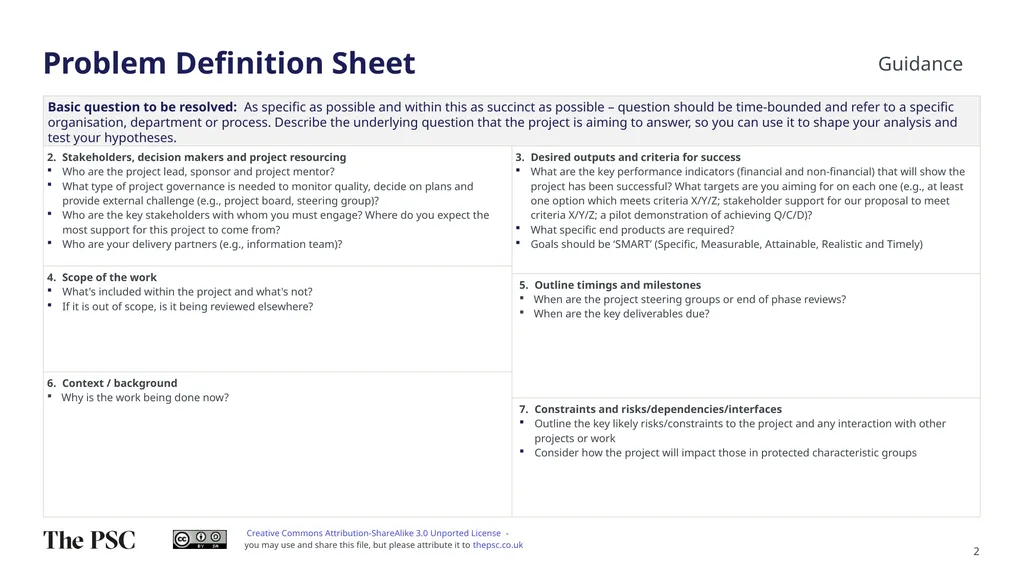
slide2. 2 Basic question to be resolved: As specific as possible and within this as succinct as possible – question should be time-bounded and refer to a specific organisation, department or process. Describe the underlying question that the project is aiming to answer, so you can use it to shape your analysis and test your hypotheses. Problem Definition Sheet Guidance<br>
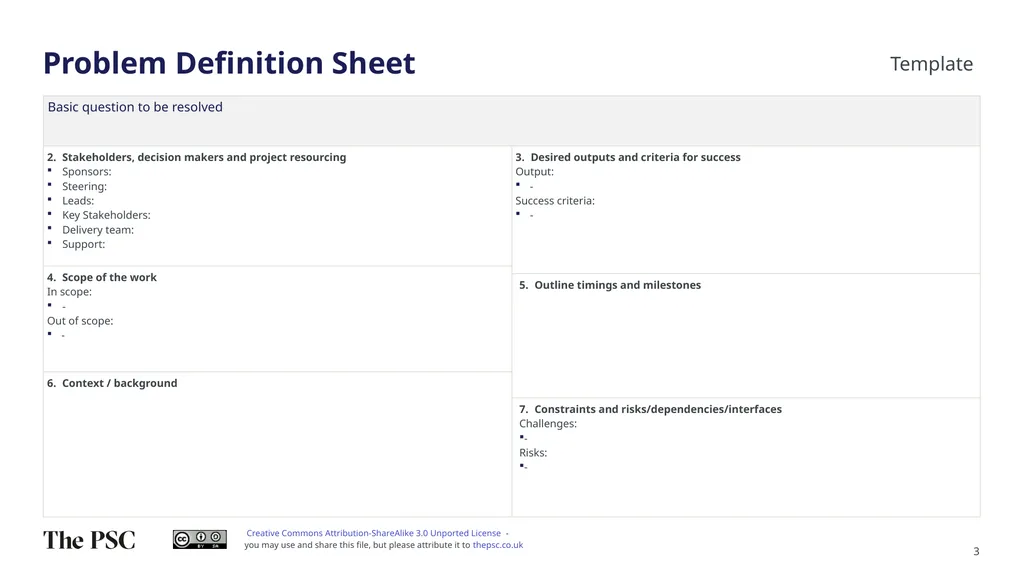
slide3. 3 Basic question to be resolved Problem Definition Sheet Template<br>
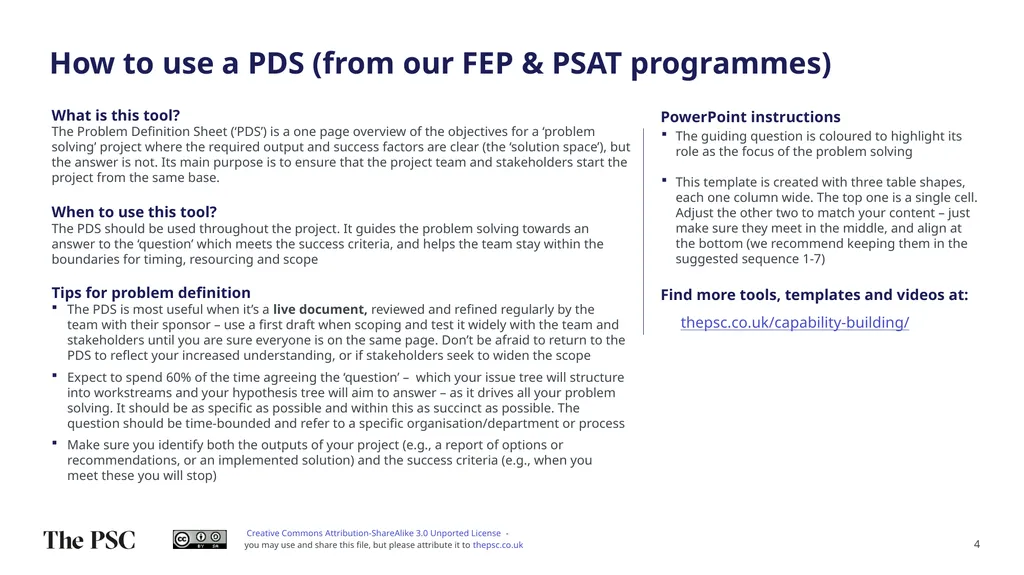
slide4. How to use a PDS (from our FEP & PSAT programmes) 4 PowerPoint instructions What is this tool?
The Problem Definition Sheet (‘PDS’) is a one page overview of the objectives for a ‘problem solving’ project where the required output and success factors are clear (the ‘solution space’), but the answer is not. Its main purpose is to ensure that the project team and stakeholders start the project from the same base. Tips for problem definition
The PDS is most useful when it’s a live document, reviewed and refined regularly by the team with their sponsor – use a first draft when scoping and test it widely with the team and stakeholders until you are sure everyone is on the same page. Don’t be afraid to return to the PDS to reflect your increased understanding, or if stakeholders seek to widen the scope
Expect to spend 60% of the time agreeing the ‘question’ – which your issue tree will structure into workstreams and your hypothesis tree will aim to answer – as it drives all your problem solving. It should be as specific as possible and within this as succinct as possible. The question should be time-bounded and refer to a specific organisation/department or process
Make sure you identify both the outputs of your project (e.g., a report of options or recommendations, or an implemented solution) and the success criteria (e.g., when you meet these you will stop) When to use this tool? The PDS should be used throughout the project. It guides the problem solving towards an answer to the ‘question’ which meets the success criteria, and helps the team stay within the boundaries for timing, resourcing and scope The guiding question is coloured to highlight its role as the focus of the problem solving
This template is created with three table shapes, each one column wide. The top one is a single cell. Adjust the other two to match your content – just make sure they meet in the middle, and align at the bottom (we recommend keeping them in the suggested sequence 1-7) Find more tools, templates and videos at: thepsc.co.uk/capability-building/<br>
slide2. 2 Basic question to be resolved: As specific as possible and within this as succinct as possible – question should be time-bounded and refer to a specific organisation, department or process. Describe the underlying question that the project is aiming to answer, so you can use it to shape your analysis and test your hypotheses. Problem Definition Sheet Guidance<br>
slide3. 3 Basic question to be resolved Problem Definition Sheet Template<br>
slide4. How to use a PDS (from our FEP & PSAT programmes) 4 PowerPoint instructions What is this tool?
The Problem Definition Sheet (‘PDS’) is a one page overview of the objectives for a ‘problem solving’ project where the required output and success factors are clear (the ‘solution space’), but the answer is not. Its main purpose is to ensure that the project team and stakeholders start the project from the same base. Tips for problem definition
The PDS is most useful when it’s a live document, reviewed and refined regularly by the team with their sponsor – use a first draft when scoping and test it widely with the team and stakeholders until you are sure everyone is on the same page. Don’t be afraid to return to the PDS to reflect your increased understanding, or if stakeholders seek to widen the scope
Expect to spend 60% of the time agreeing the ‘question’ – which your issue tree will structure into workstreams and your hypothesis tree will aim to answer – as it drives all your problem solving. It should be as specific as possible and within this as succinct as possible. The question should be time-bounded and refer to a specific organisation/department or process
Make sure you identify both the outputs of your project (e.g., a report of options or recommendations, or an implemented solution) and the success criteria (e.g., when you meet these you will stop) When to use this tool? The PDS should be used throughout the project. It guides the problem solving towards an answer to the ‘question’ which meets the success criteria, and helps the team stay within the boundaries for timing, resourcing and scope The guiding question is coloured to highlight its role as the focus of the problem solving
This template is created with three table shapes, each one column wide. The top one is a single cell. Adjust the other two to match your content – just make sure they meet in the middle, and align at the bottom (we recommend keeping them in the suggested sequence 1-7) Find more tools, templates and videos at: thepsc.co.uk/capability-building/<br>