
Process Control Course II Lecture 12 Process
Description: Process Control Course II Lecture 12 Process Control Loops Part II 1 By Prof. Alaa Kareem Mohammed 2 Type of Process Control Loop 1- Feedback Control 2- Feedforward Control 3- Feedforward-plus-Feedback Control 4- Ratio Control 5- Cascade
Related Topics
Download Presentation
"Process Control Course II Lecture 12 Process" is the property of its rightful owner. Permission is granted to download and print the materials on this website for personal, non-commercial use only, and to display it on your personal computer provided you do not modify the materials and that you retain all copyright notices contained in the materials. By downloading content from our website, you accept the terms of this agreement.
Presentation Transcript
slide1. Process Control
Course II
Lecture 12
Process Control Loops
Part II 1 By
Prof. Alaa Kareem Mohammed<br>
slide2. 2 Type of Process Control Loop 1- Feedback Control
2- Feedforward Control
3- Feedforward-plus-Feedback Control
4- Ratio Control
5- Cascade Control
6- Split Range Control<br>
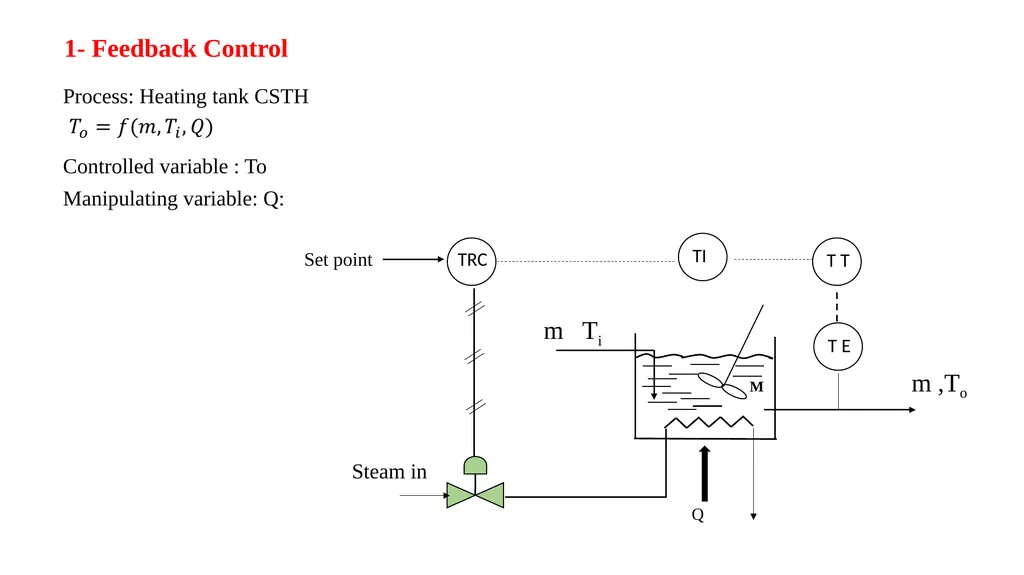
slide3. 1- Feedback Control Process: Heating tank CSTH Controlled variable : To Manipulating variable: Q:<br>
slide4. 4 A feedback loop measures a process variable and sends the measurement to a controller for comparison to set point. If the process variable is not at set point, control action is taken to return the process variable to set point. This control scheme does not take into consideration any of the other variables in the process Advantages :
1- One of the simplest process control schemes. 2- It is commonly used in the process control industry. 3- It is that directly controls the desired process variable The disadvantage of feedback loops is that it takes some time in order that the controlled variable reaches the set point. Disadvantage :<br>
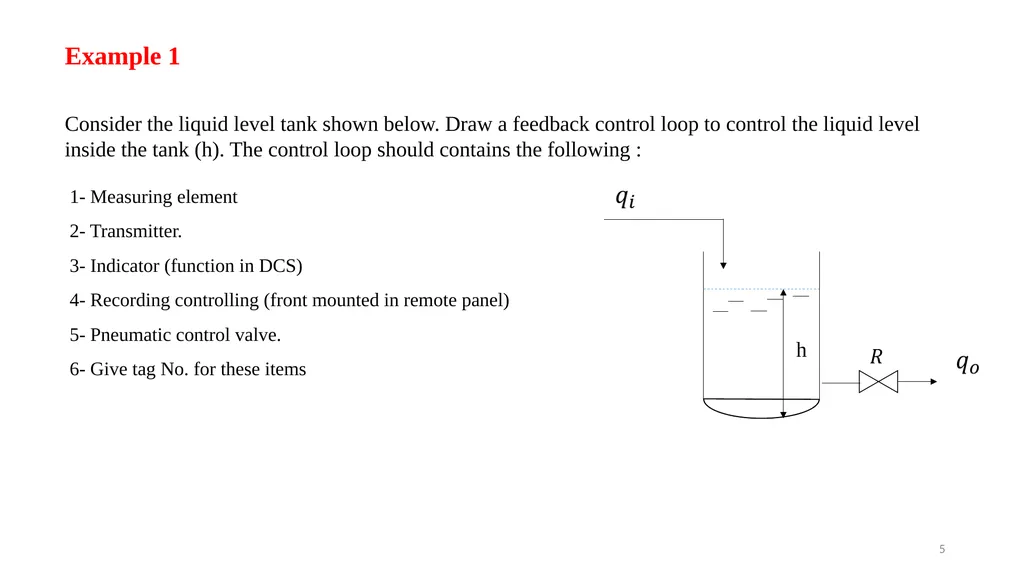
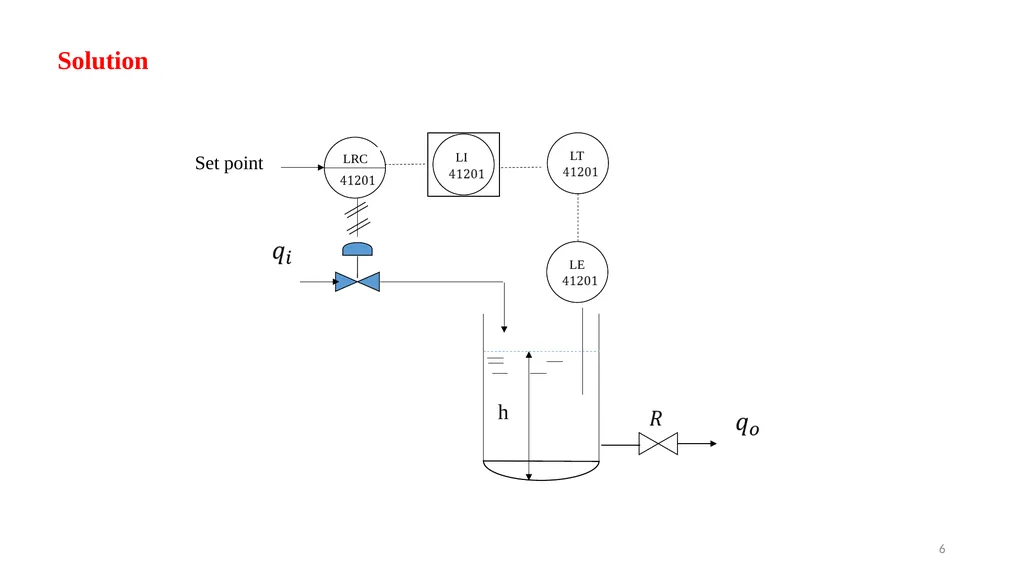
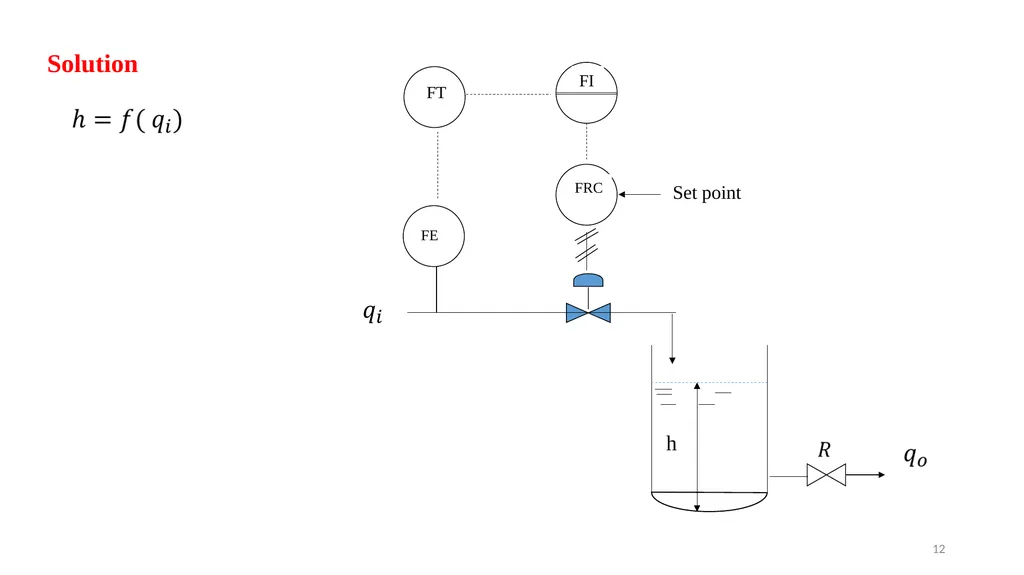
slide5. 5 Example 1 Consider the liquid level tank shown below. Draw a feedback control loop to control the liquid level inside the tank (h). The control loop should contains the following : 1- Measuring element
2- Transmitter.
3- Indicator (function in DCS)
4- Recording controlling (front mounted in remote panel)
5- Pneumatic control valve.
6- Give tag No. for these items<br>
slide6. 6 Solution Set point<br>
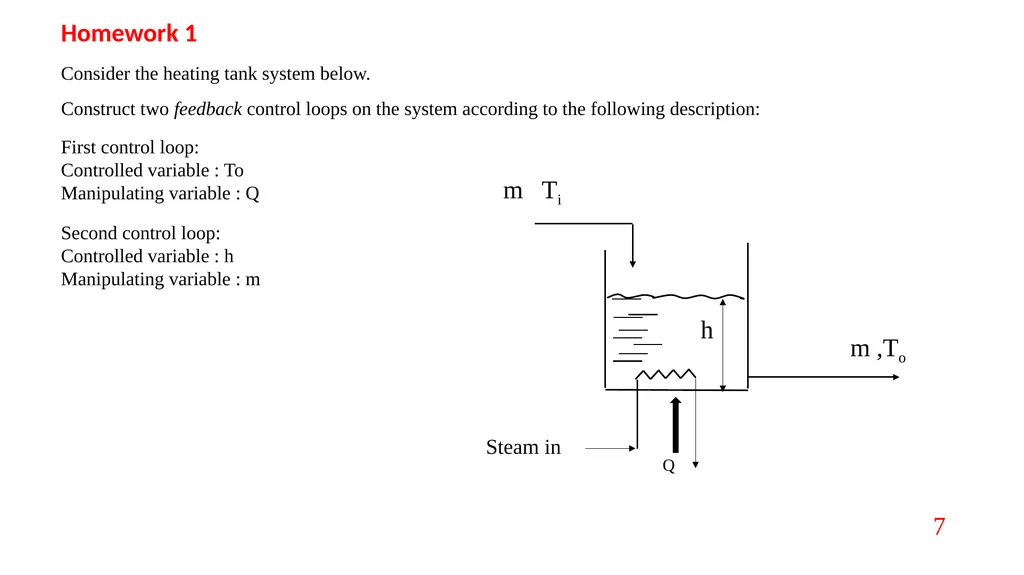
slide7. 7 Homework 1 Consider the heating tank system below. Construct two feedback control loops on the system according to the following description: First control loop:
Controlled variable : To
Manipulating variable : Q Second control loop:
Controlled variable : h
Manipulating variable : m<br>
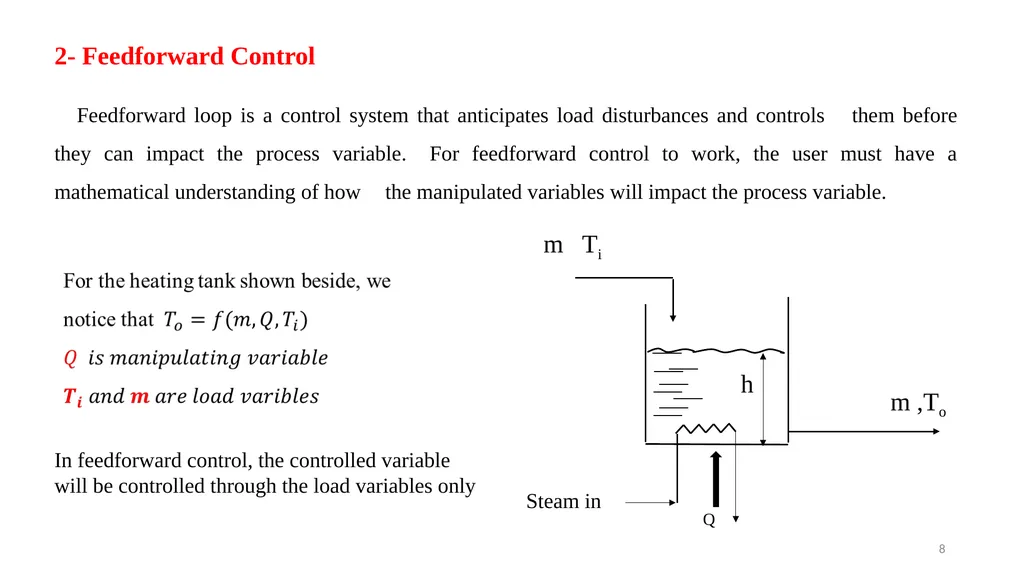
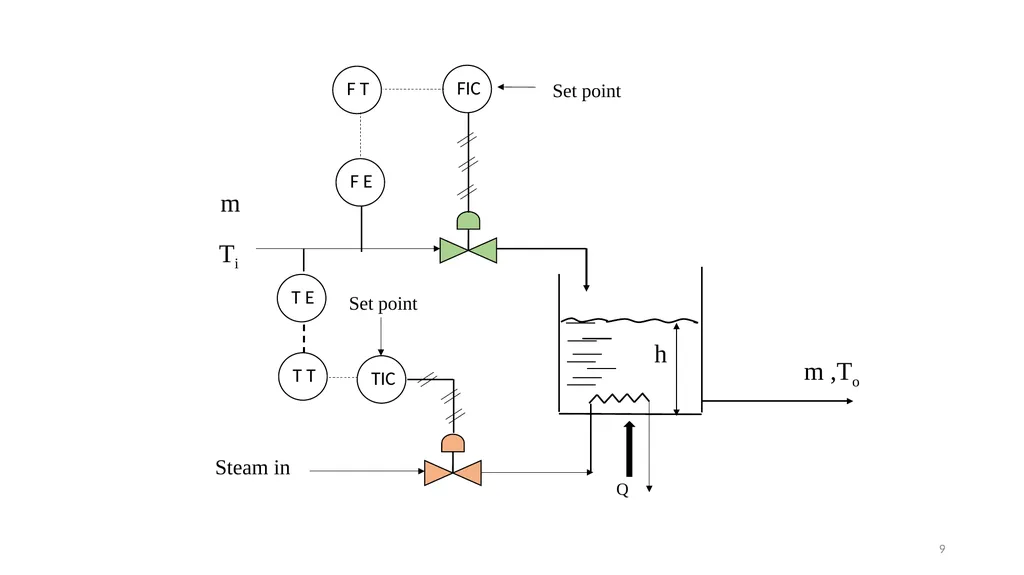
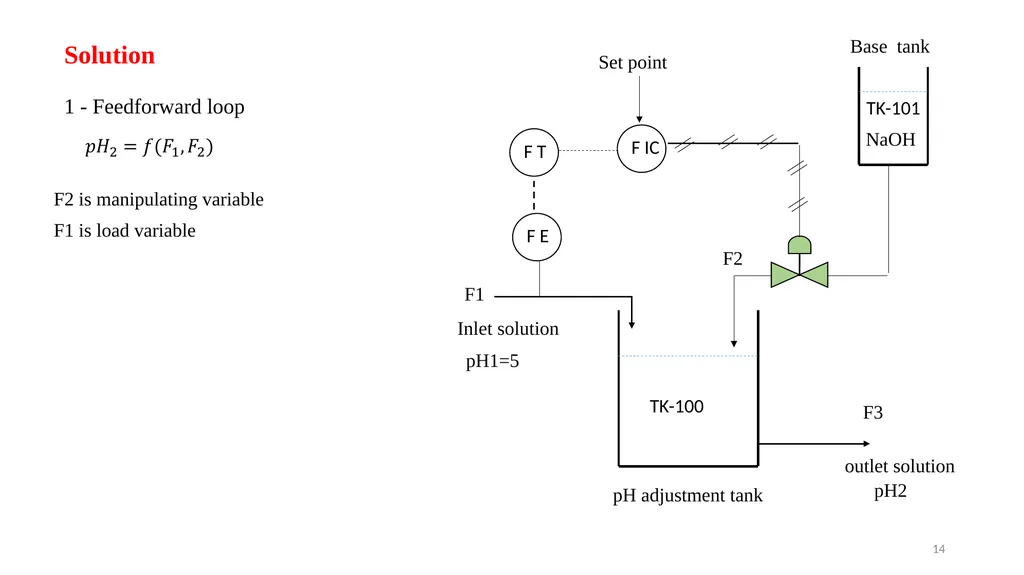
slide8. 8 2- Feedforward Control Feedforward loop is a control system that anticipates load disturbances and controls them before they can impact the process variable. For feedforward control to work, the user must have a mathematical understanding of how the manipulated variables will impact the process variable. In feedforward control, the controlled variable will be controlled through the load variables only<br>
slide9. 9<br>
slide10. 10 An advantage of feedforward control is that error is prevented, rather than corrected. Feedforward scheme is better than feedback control scheme in that it takes no time to manipulate the controlled variable when the system is subjected to a disturbance. The difficulty that face the feedforward loop is that it should take into account all the possible load disturbances in a system , but this is either difficult or costly.<br>
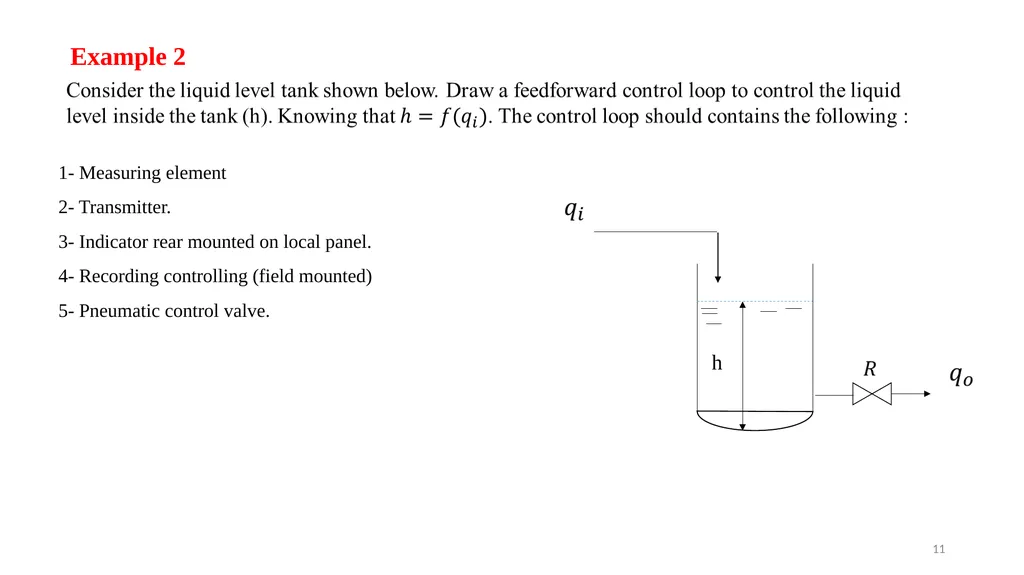
slide11. 11 Example 2 1- Measuring element
2- Transmitter.
3- Indicator rear mounted on local panel.
4- Recording controlling (field mounted)
5- Pneumatic control valve.<br>
slide12. 12 Solution<br>
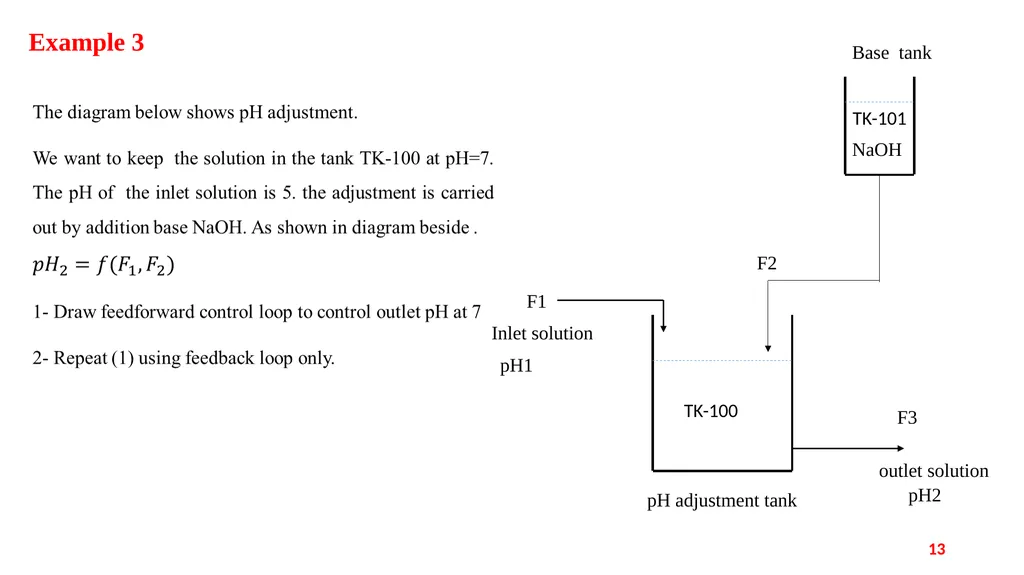
slide13. 13 Example 3 pH adjustment tank TK-100 Base tank TK-101 F1 Inlet solution outlet solution F2 NaOH pH2 pH1 F3<br>
slide14. 14 Solution 1 - Feedforward loop F2 is manipulating variable F1 is load variable<br>
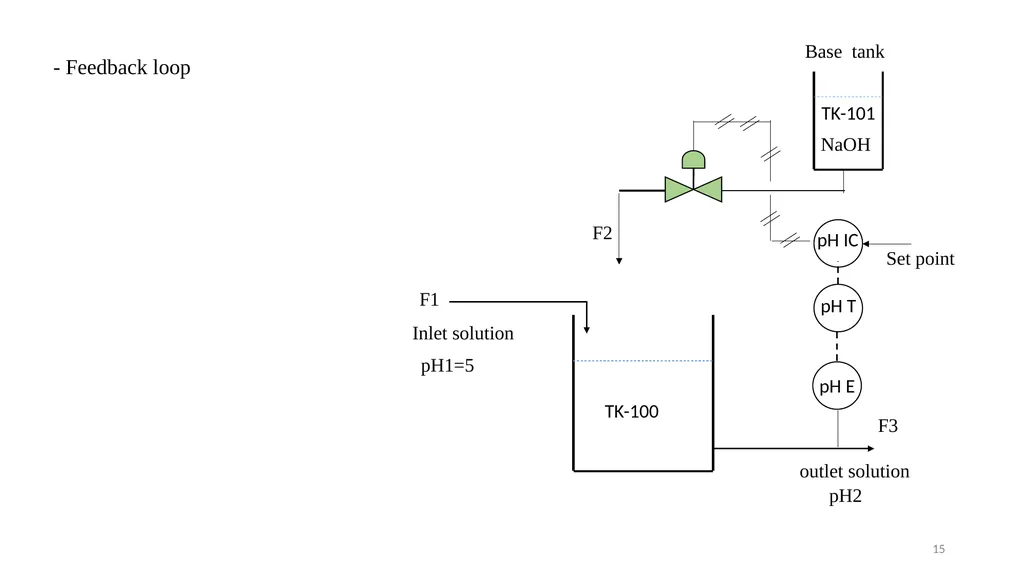
slide15. 15 - Feedback loop<br>
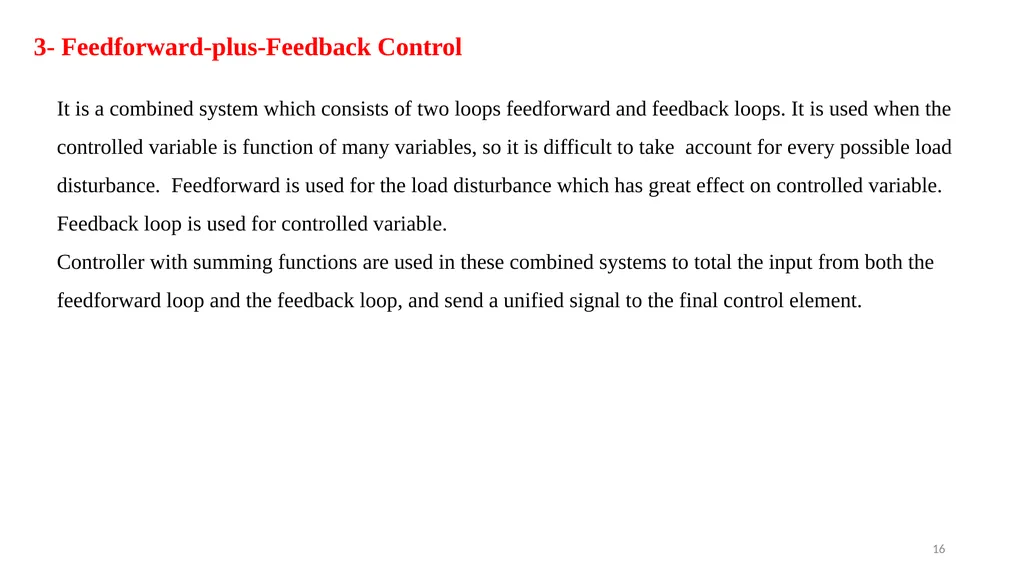
slide16. 16 3- Feedforward-plus-Feedback Control It is a combined system which consists of two loops feedforward and feedback loops. It is used when the controlled variable is function of many variables, so it is difficult to take account for every possible load disturbance. Feedforward is used for the load disturbance which has great effect on controlled variable. Feedback loop is used for controlled variable.
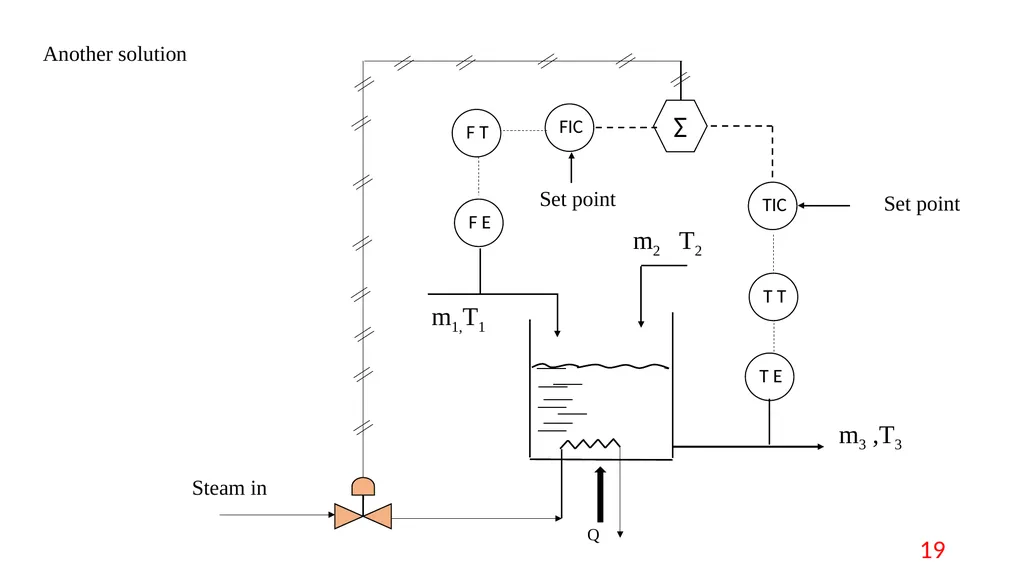
Controller with summing functions are used in these combined systems to total the input from both the feedforward loop and the feedback loop, and send a unified signal to the final control element.<br>
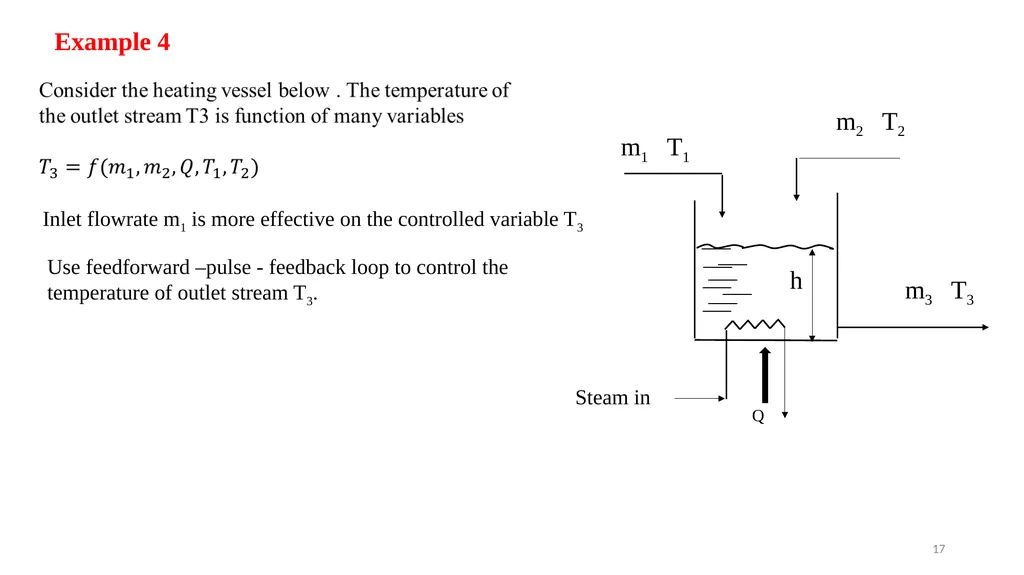
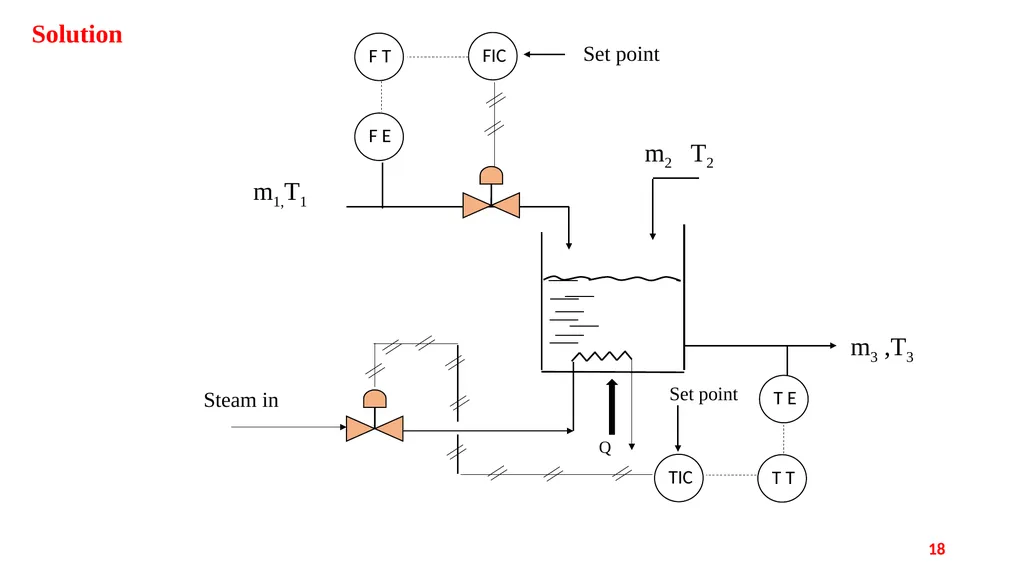
slide17. 17 Example 4 Inlet flowrate m1 is more effective on the controlled variable T3 Use feedforward –pulse - feedback loop to control the temperature of outlet stream T3.<br>
slide18. 18 Solution<br>
slide19. 19 Another solution<br>
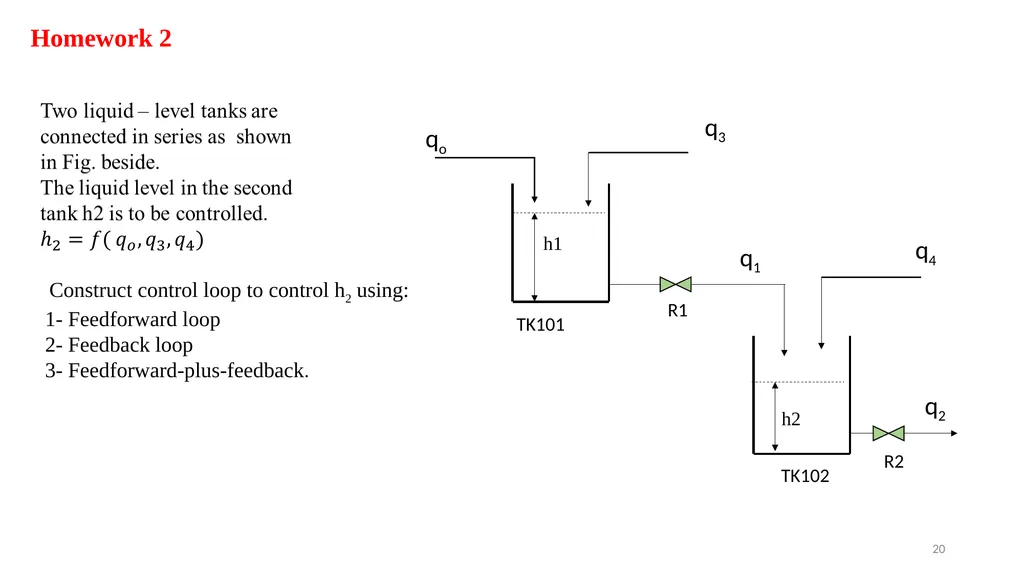
slide20. 20 h1 h2 R1 qo q1 q2 TK101 TK102 Homework 2 R2 q3 Construct control loop to control h2 using:
1- Feedforward loop
2- Feedback loop
3- Feedforward-plus-feedback. q4<br>
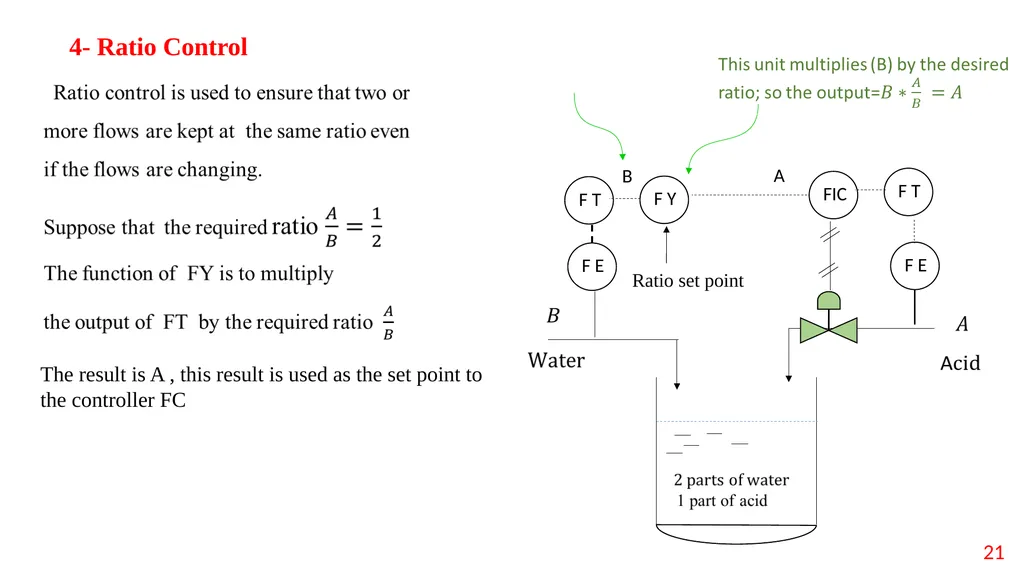
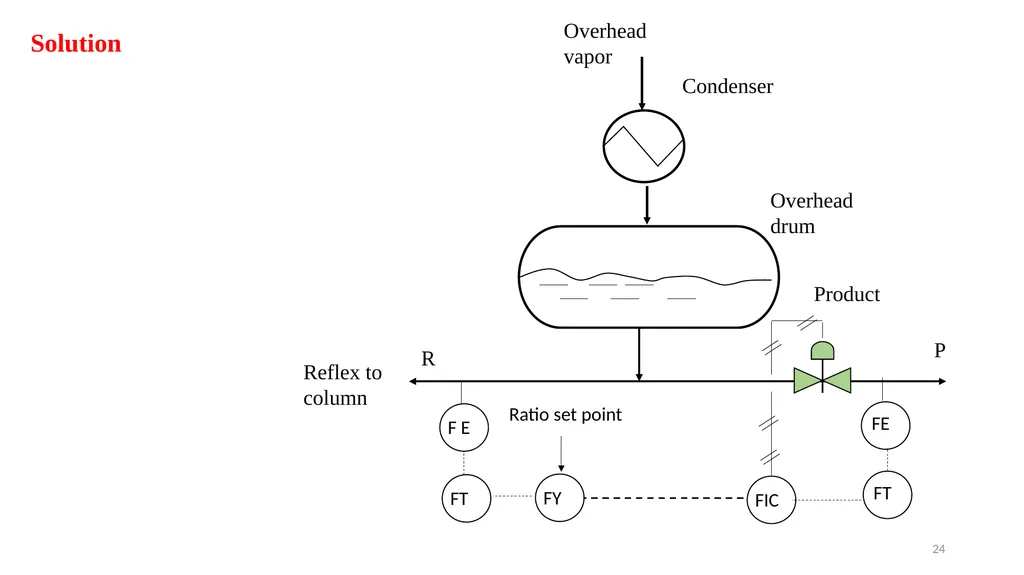
slide21. 21 4- Ratio Control The result is A , this result is used as the set point to the controller FC A Ratio set point<br>
slide22. 22 Ratio control is applied in the following cases :
1- Blending two or more flows to produce a mixture with specified composition
2- Blending two or more flows to produce a mixture with specified physical properties.
3- Maintaining correct air and fuel mixture to combustion. If the physical characteristic of the mixed flow is measured, a PID controller can be used to manipulate the ratio value For example, a measurement of the density, gasoline octane rating, color, or other characteristic could be used to control that characteristic by manipulating the ratio.<br>
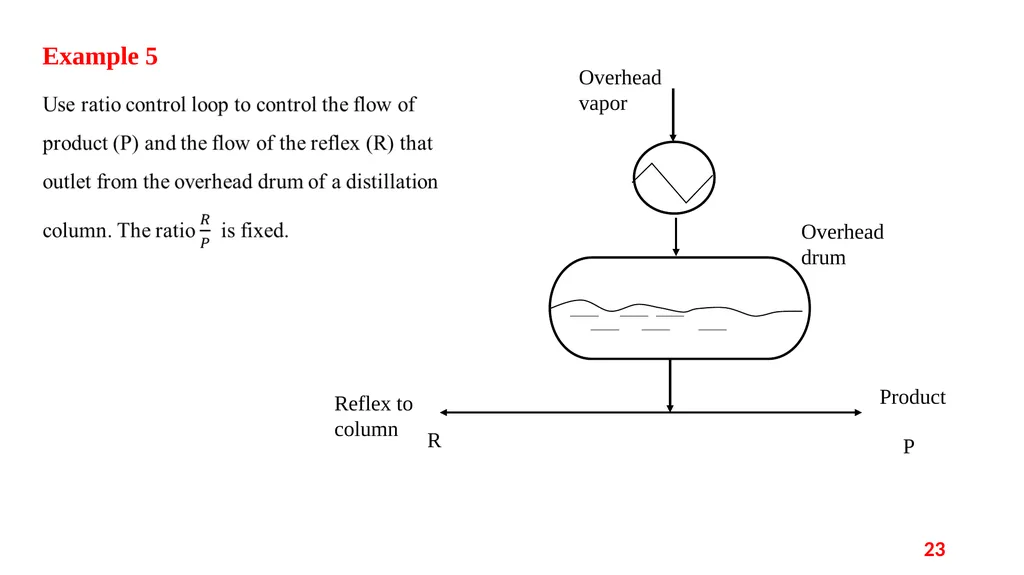
slide23. 23 Example 5<br>
slide24. 24 Solution P Overhead drum Overhead vapor Reflex to column Product R Condenser Ratio set point<br>
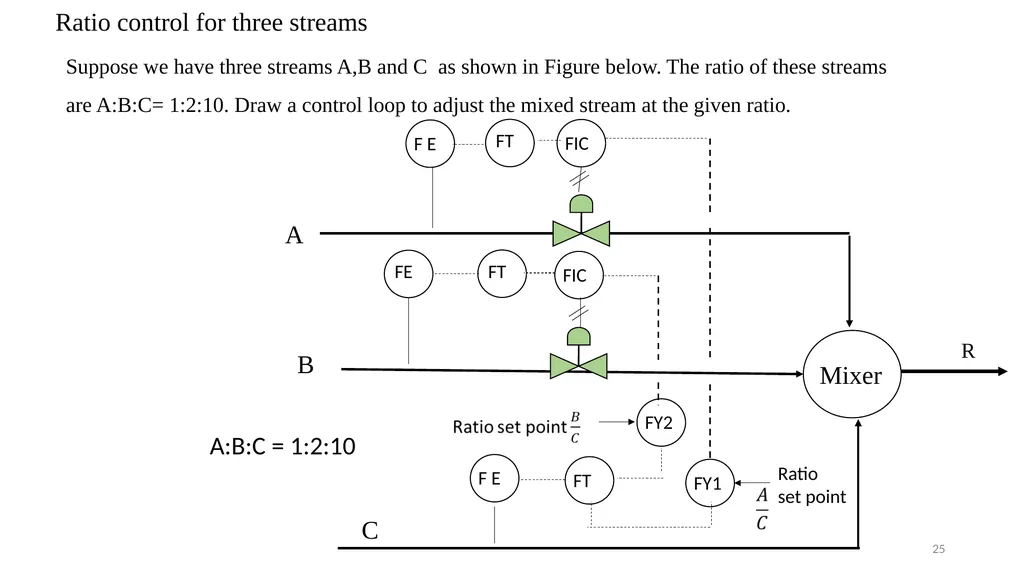
slide25. 25 Suppose we have three streams A,B and C as shown in Figure below. The ratio of these streams are A:B:C= 1:2:10. Draw a control loop to adjust the mixed stream at the given ratio. Ratio control for three streams<br>
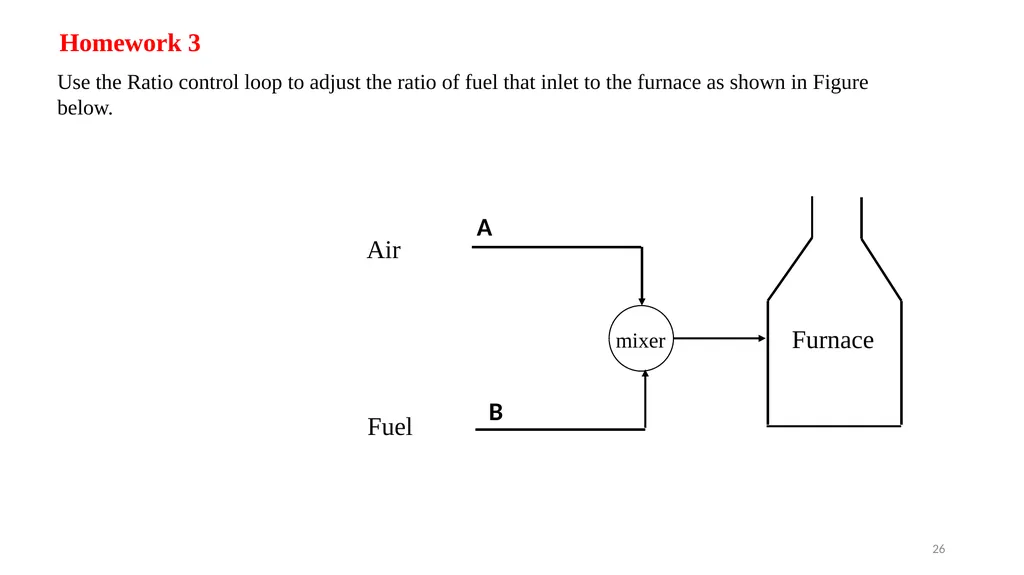
slide26. 26 Homework 3 Use the Ratio control loop to adjust the ratio of fuel that inlet to the furnace as shown in Figure below.<br>
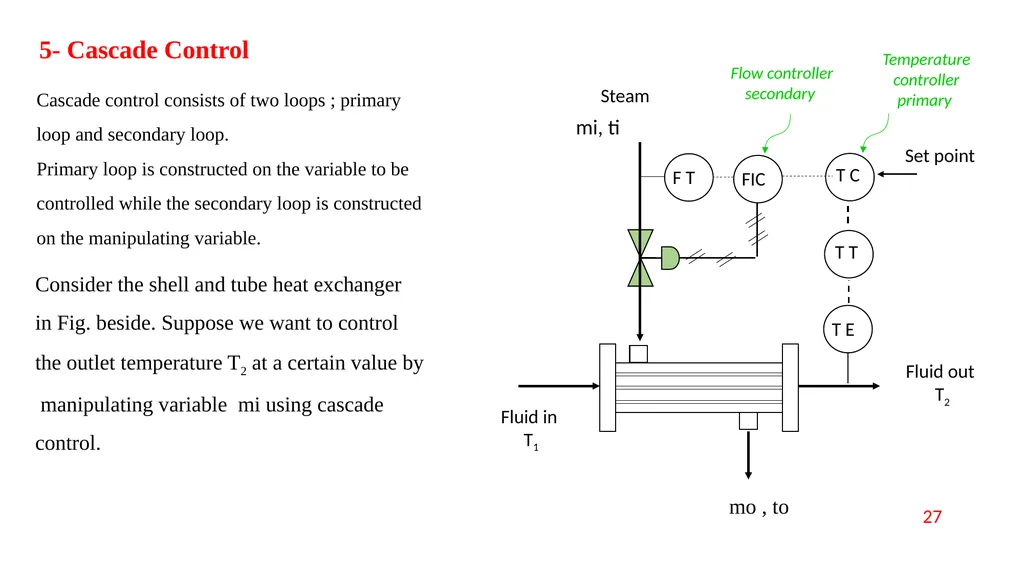
slide27. 5- Cascade Control Cascade control consists of two loops ; primary loop and secondary loop.
Primary loop is constructed on the variable to be controlled while the secondary loop is constructed on the manipulating variable. Consider the shell and tube heat exchanger in Fig. beside. Suppose we want to control the outlet temperature T2 at a certain value by manipulating variable mi using cascade control. 27<br>
slide28. 28 Requirements for cascade control:
Secondary loop process dynamics must be at least four times as fast as primary loop process dynamics.
Secondary loop must have influence over the primary loop.
Secondary loop must be measured and controllable.<br>
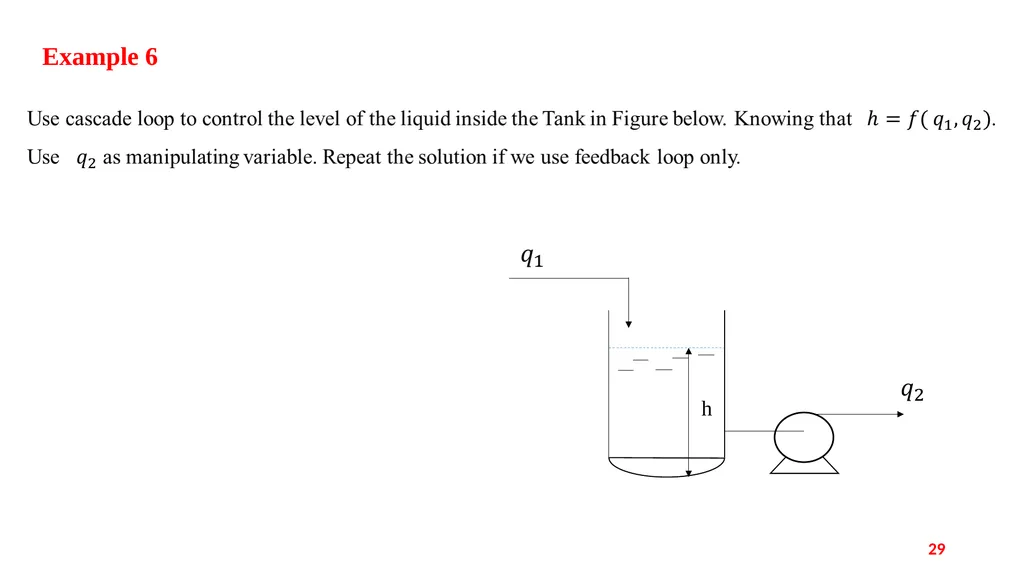
slide29. 29 Example 6<br>
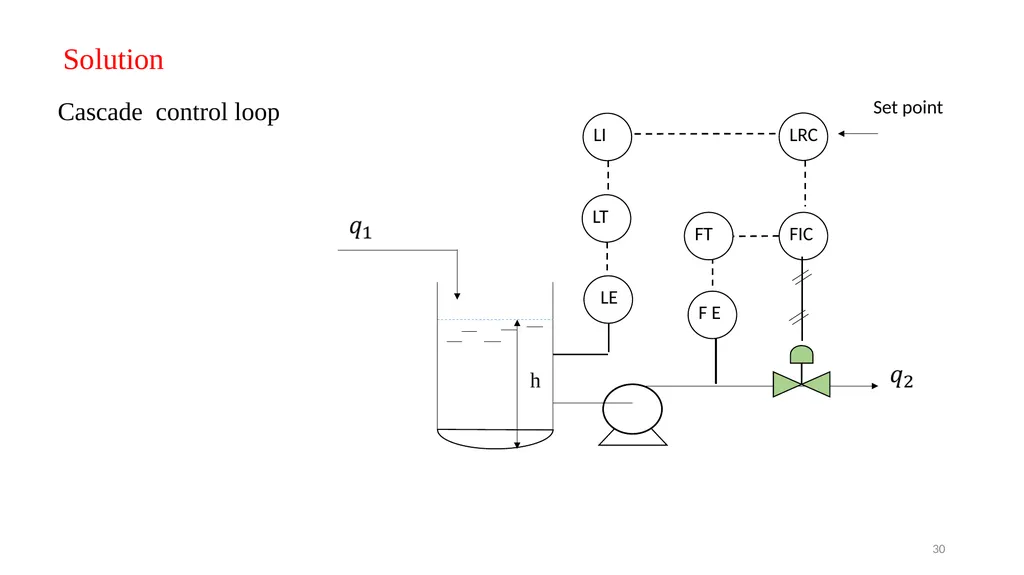
slide30. 30 Solution Cascade control loop Set point<br>
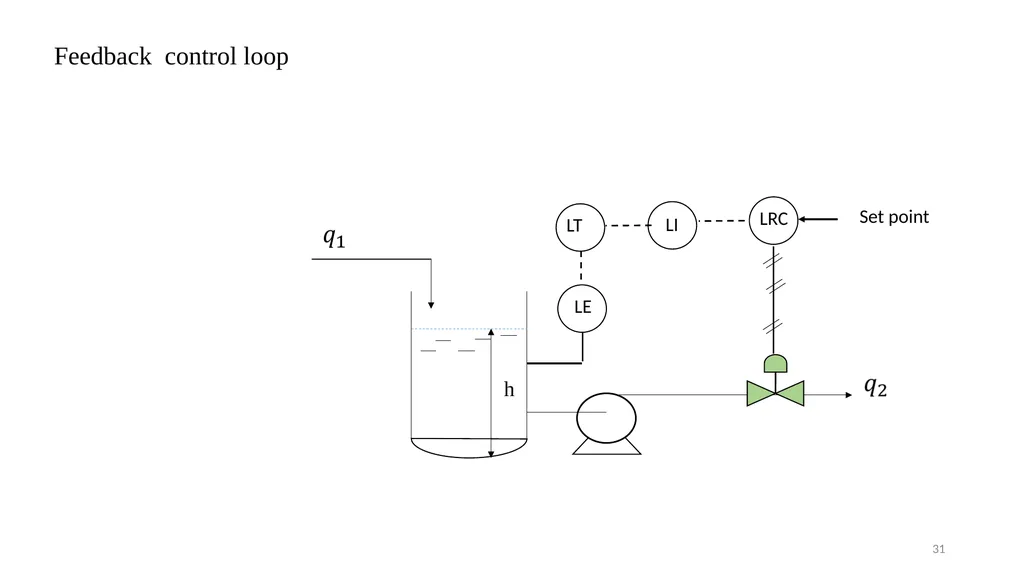
slide31. 31 Feedback control loop<br>
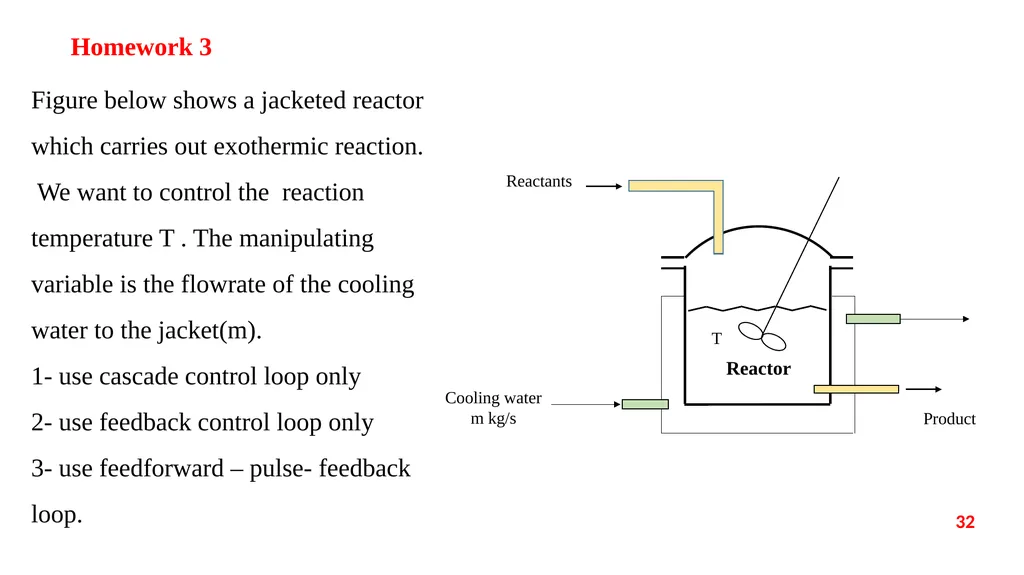
slide32. 32 Homework 3 Figure below shows a jacketed reactor which carries out exothermic reaction. We want to control the reaction temperature T . The manipulating variable is the flowrate of the cooling water to the jacket(m).
1- use cascade control loop only
2- use feedback control loop only
3- use feedforward – pulse- feedback loop.<br>
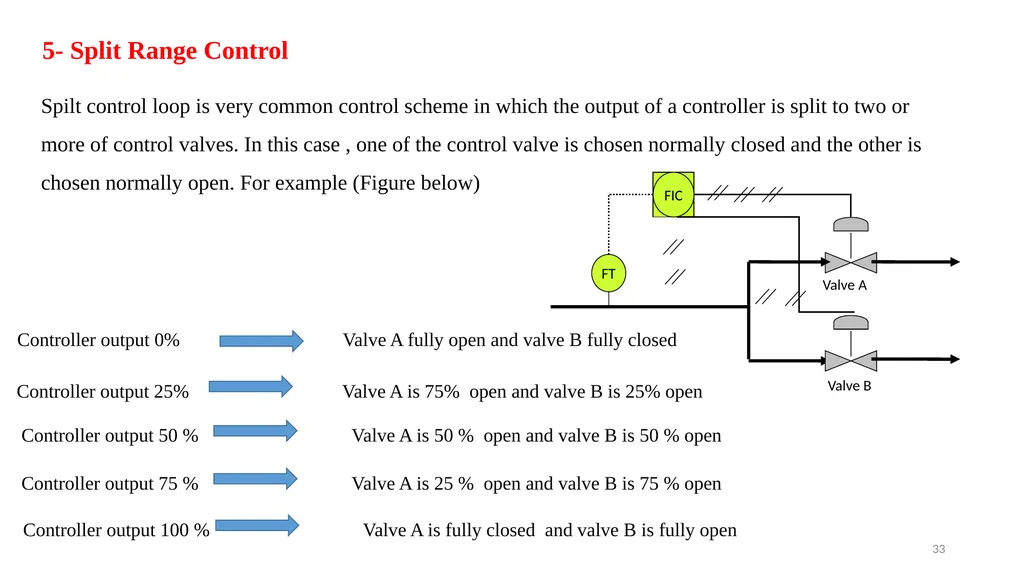
slide33. 33 5- Split Range Control Spilt control loop is very common control scheme in which the output of a controller is split to two or more of control valves. In this case , one of the control valve is chosen normally closed and the other is chosen normally open. For example (Figure below)<br>
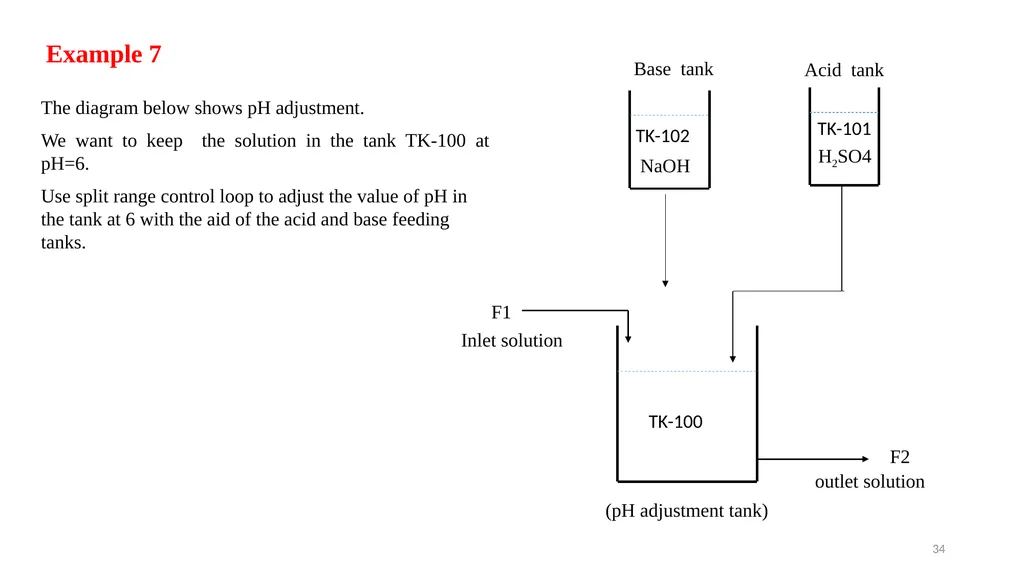
slide34. 34 Example 7 The diagram below shows pH adjustment.
We want to keep the solution in the tank TK-100 at pH=6.
Use split range control loop to adjust the value of pH in the tank at 6 with the aid of the acid and base feeding tanks.<br>
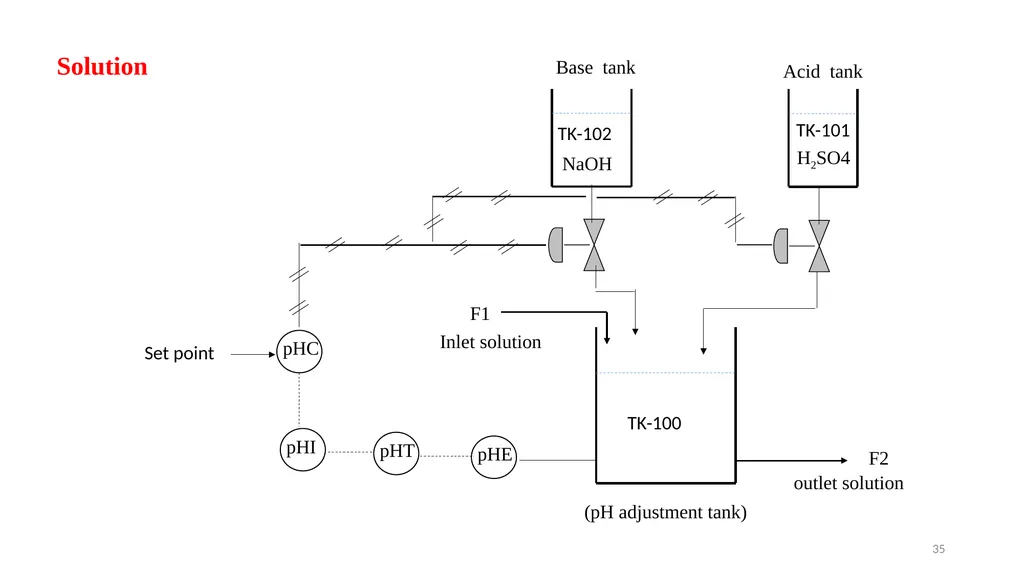
slide35. 35 Solution Set point<br>
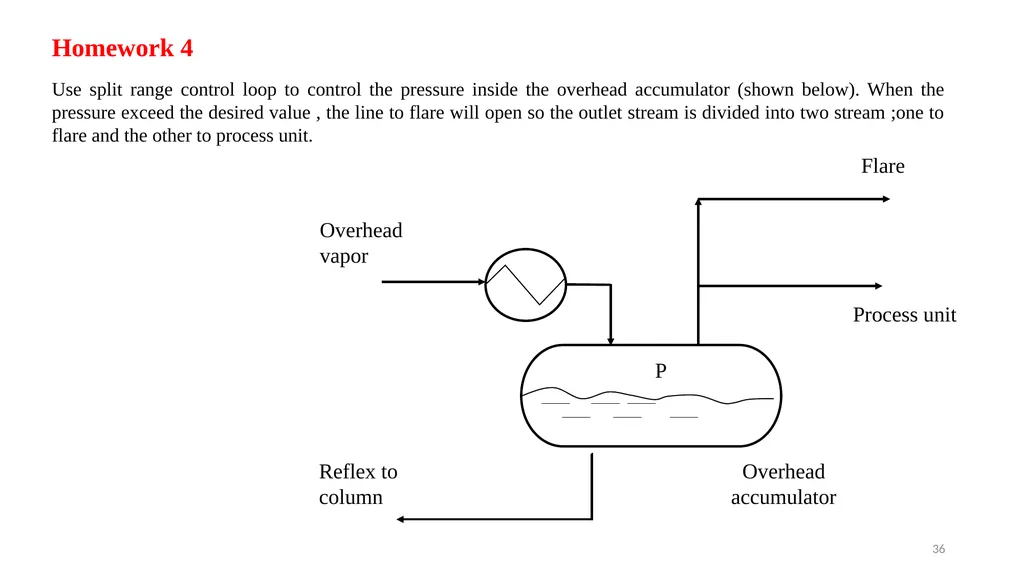
slide36. 36 Homework 4 Use split range control loop to control the pressure inside the overhead accumulator (shown below). When the pressure exceed the desired value , the line to flare will open so the outlet stream is divided into two stream ;one to flare and the other to process unit.<br>
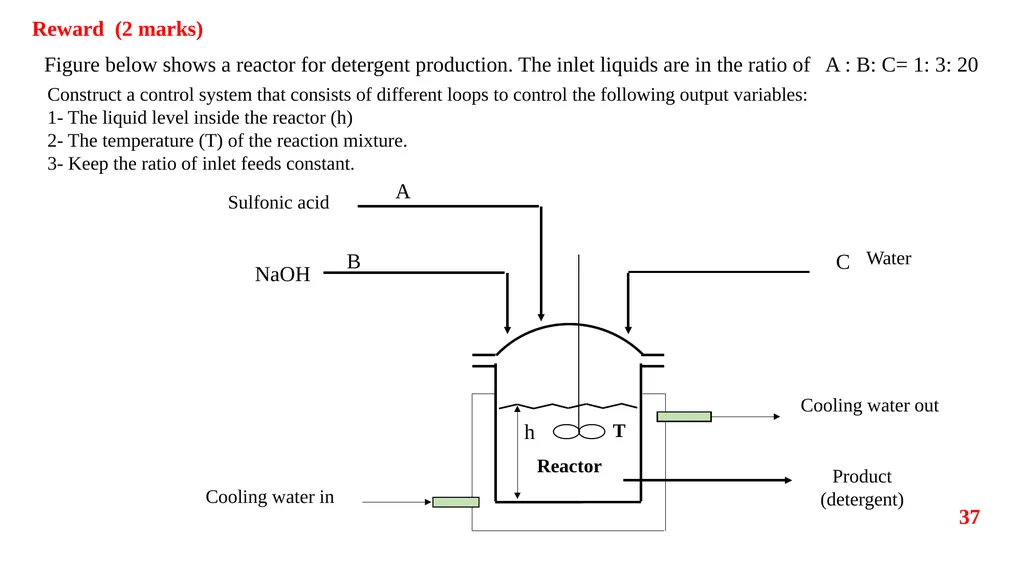
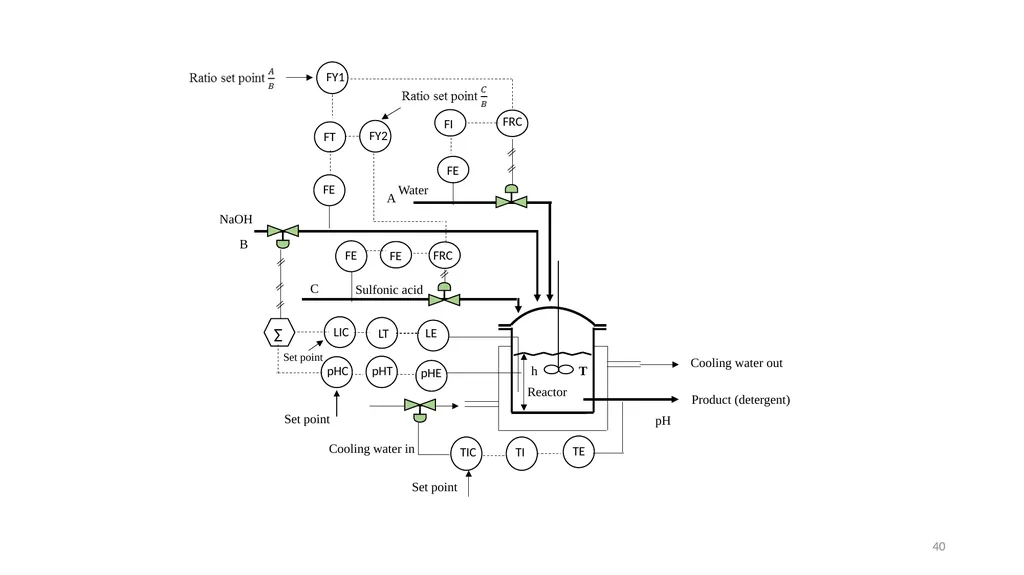
slide37. 37 Reward (2 marks) Figure below shows a reactor for detergent production. The inlet liquids are in the ratio of A : B: C= 1: 3: 20 Construct a control system that consists of different loops to control the following output variables:
1- The liquid level inside the reactor (h)
2- The temperature (T) of the reaction mixture.
3- Keep the ratio of inlet feeds constant.<br>
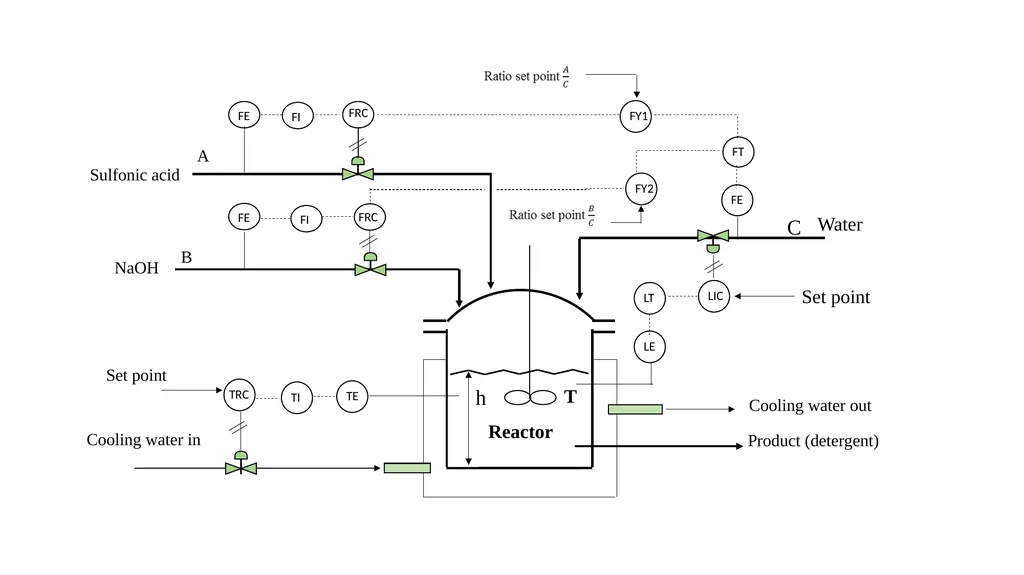
slide38. Cooling water in Product (detergent) T Reactor h Cooling water out Sulfonic acid NaOH Set point Set point<br>
slide39. 39<br>
slide40. 40<br>
slide41. 41 Thank you Any ?<br>
Course II
Lecture 12
Process Control Loops
Part II 1 By
Prof. Alaa Kareem Mohammed<br>
slide2. 2 Type of Process Control Loop 1- Feedback Control
2- Feedforward Control
3- Feedforward-plus-Feedback Control
4- Ratio Control
5- Cascade Control
6- Split Range Control<br>
slide3. 1- Feedback Control Process: Heating tank CSTH Controlled variable : To Manipulating variable: Q:<br>
slide4. 4 A feedback loop measures a process variable and sends the measurement to a controller for comparison to set point. If the process variable is not at set point, control action is taken to return the process variable to set point. This control scheme does not take into consideration any of the other variables in the process Advantages :
1- One of the simplest process control schemes. 2- It is commonly used in the process control industry. 3- It is that directly controls the desired process variable The disadvantage of feedback loops is that it takes some time in order that the controlled variable reaches the set point. Disadvantage :<br>
slide5. 5 Example 1 Consider the liquid level tank shown below. Draw a feedback control loop to control the liquid level inside the tank (h). The control loop should contains the following : 1- Measuring element
2- Transmitter.
3- Indicator (function in DCS)
4- Recording controlling (front mounted in remote panel)
5- Pneumatic control valve.
6- Give tag No. for these items<br>
slide6. 6 Solution Set point<br>
slide7. 7 Homework 1 Consider the heating tank system below. Construct two feedback control loops on the system according to the following description: First control loop:
Controlled variable : To
Manipulating variable : Q Second control loop:
Controlled variable : h
Manipulating variable : m<br>
slide8. 8 2- Feedforward Control Feedforward loop is a control system that anticipates load disturbances and controls them before they can impact the process variable. For feedforward control to work, the user must have a mathematical understanding of how the manipulated variables will impact the process variable. In feedforward control, the controlled variable will be controlled through the load variables only<br>
slide9. 9<br>
slide10. 10 An advantage of feedforward control is that error is prevented, rather than corrected. Feedforward scheme is better than feedback control scheme in that it takes no time to manipulate the controlled variable when the system is subjected to a disturbance. The difficulty that face the feedforward loop is that it should take into account all the possible load disturbances in a system , but this is either difficult or costly.<br>
slide11. 11 Example 2 1- Measuring element
2- Transmitter.
3- Indicator rear mounted on local panel.
4- Recording controlling (field mounted)
5- Pneumatic control valve.<br>
slide12. 12 Solution<br>
slide13. 13 Example 3 pH adjustment tank TK-100 Base tank TK-101 F1 Inlet solution outlet solution F2 NaOH pH2 pH1 F3<br>
slide14. 14 Solution 1 - Feedforward loop F2 is manipulating variable F1 is load variable<br>
slide15. 15 - Feedback loop<br>
slide16. 16 3- Feedforward-plus-Feedback Control It is a combined system which consists of two loops feedforward and feedback loops. It is used when the controlled variable is function of many variables, so it is difficult to take account for every possible load disturbance. Feedforward is used for the load disturbance which has great effect on controlled variable. Feedback loop is used for controlled variable.
Controller with summing functions are used in these combined systems to total the input from both the feedforward loop and the feedback loop, and send a unified signal to the final control element.<br>
slide17. 17 Example 4 Inlet flowrate m1 is more effective on the controlled variable T3 Use feedforward –pulse - feedback loop to control the temperature of outlet stream T3.<br>
slide18. 18 Solution<br>
slide19. 19 Another solution<br>
slide20. 20 h1 h2 R1 qo q1 q2 TK101 TK102 Homework 2 R2 q3 Construct control loop to control h2 using:
1- Feedforward loop
2- Feedback loop
3- Feedforward-plus-feedback. q4<br>
slide21. 21 4- Ratio Control The result is A , this result is used as the set point to the controller FC A Ratio set point<br>
slide22. 22 Ratio control is applied in the following cases :
1- Blending two or more flows to produce a mixture with specified composition
2- Blending two or more flows to produce a mixture with specified physical properties.
3- Maintaining correct air and fuel mixture to combustion. If the physical characteristic of the mixed flow is measured, a PID controller can be used to manipulate the ratio value For example, a measurement of the density, gasoline octane rating, color, or other characteristic could be used to control that characteristic by manipulating the ratio.<br>
slide23. 23 Example 5<br>
slide24. 24 Solution P Overhead drum Overhead vapor Reflex to column Product R Condenser Ratio set point<br>
slide25. 25 Suppose we have three streams A,B and C as shown in Figure below. The ratio of these streams are A:B:C= 1:2:10. Draw a control loop to adjust the mixed stream at the given ratio. Ratio control for three streams<br>
slide26. 26 Homework 3 Use the Ratio control loop to adjust the ratio of fuel that inlet to the furnace as shown in Figure below.<br>
slide27. 5- Cascade Control Cascade control consists of two loops ; primary loop and secondary loop.
Primary loop is constructed on the variable to be controlled while the secondary loop is constructed on the manipulating variable. Consider the shell and tube heat exchanger in Fig. beside. Suppose we want to control the outlet temperature T2 at a certain value by manipulating variable mi using cascade control. 27<br>
slide28. 28 Requirements for cascade control:
Secondary loop process dynamics must be at least four times as fast as primary loop process dynamics.
Secondary loop must have influence over the primary loop.
Secondary loop must be measured and controllable.<br>
slide29. 29 Example 6<br>
slide30. 30 Solution Cascade control loop Set point<br>
slide31. 31 Feedback control loop<br>
slide32. 32 Homework 3 Figure below shows a jacketed reactor which carries out exothermic reaction. We want to control the reaction temperature T . The manipulating variable is the flowrate of the cooling water to the jacket(m).
1- use cascade control loop only
2- use feedback control loop only
3- use feedforward – pulse- feedback loop.<br>
slide33. 33 5- Split Range Control Spilt control loop is very common control scheme in which the output of a controller is split to two or more of control valves. In this case , one of the control valve is chosen normally closed and the other is chosen normally open. For example (Figure below)<br>
slide34. 34 Example 7 The diagram below shows pH adjustment.
We want to keep the solution in the tank TK-100 at pH=6.
Use split range control loop to adjust the value of pH in the tank at 6 with the aid of the acid and base feeding tanks.<br>
slide35. 35 Solution Set point<br>
slide36. 36 Homework 4 Use split range control loop to control the pressure inside the overhead accumulator (shown below). When the pressure exceed the desired value , the line to flare will open so the outlet stream is divided into two stream ;one to flare and the other to process unit.<br>
slide37. 37 Reward (2 marks) Figure below shows a reactor for detergent production. The inlet liquids are in the ratio of A : B: C= 1: 3: 20 Construct a control system that consists of different loops to control the following output variables:
1- The liquid level inside the reactor (h)
2- The temperature (T) of the reaction mixture.
3- Keep the ratio of inlet feeds constant.<br>
slide38. Cooling water in Product (detergent) T Reactor h Cooling water out Sulfonic acid NaOH Set point Set point<br>
slide39. 39<br>
slide40. 40<br>
slide41. 41 Thank you Any ?<br>