
Prof. Sneha Mhatre Consumer Behaviour and

Description: Prof. Sneha Mhatre Consumer Behaviour and Positioning a Service SERVICE MARKETING TYBMS SEM 5 Definition of consumer Behaviour :- According to prof. C. G. Walter and G. W. Paul, consumer behaviour is the process whereby individuals
Related Topics
Download Presentation
"Prof. Sneha Mhatre Consumer Behaviour and" is the property of its rightful owner. Permission is granted to download and print the materials on this website for personal, non-commercial use only, and to display it on your personal computer provided you do not modify the materials and that you retain all copyright notices contained in the materials. By downloading content from our website, you accept the terms of this agreement.
Presentation Transcript
slide1. Prof. Sneha Mhatre Consumer Behaviour and Positioning a Service
{SERVICE MARKETING TYBMS SEM 5}<br>
slide2. Definition of consumer Behaviour :-
According to prof. C. G. Walter and G. W. Paul, ”consumer behaviour is the process whereby individuals decide whether, what, when, where, how and from whom to purchase goods and service.”
Meaning of consumer Behaviour :-
Consumer behaviour is a branch which deals with the various stages a consumer goes through before purchasing products or service for his end use.
In a common men’s language consumer behaviour deals with the buying behaviour of individuals.<br>
slide3. Social factors
Family influences
Reference groups
Role In the society
Social status
Personal factors
Occupation
Age
Economic condition
Lifestyle
Personality Factors influencing buyers behavior : -<br>
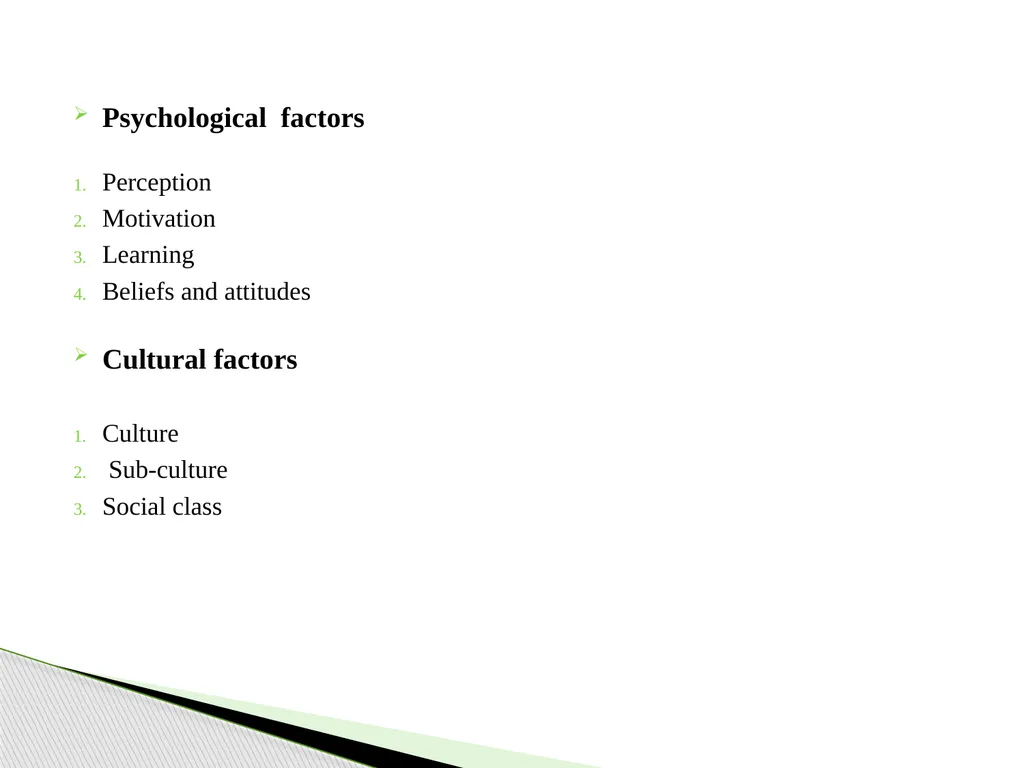
slide4. Psychological factors
Perception
Motivation
Learning
Beliefs and attitudes
Cultural factors
Culture
Sub-culture
Social class<br>
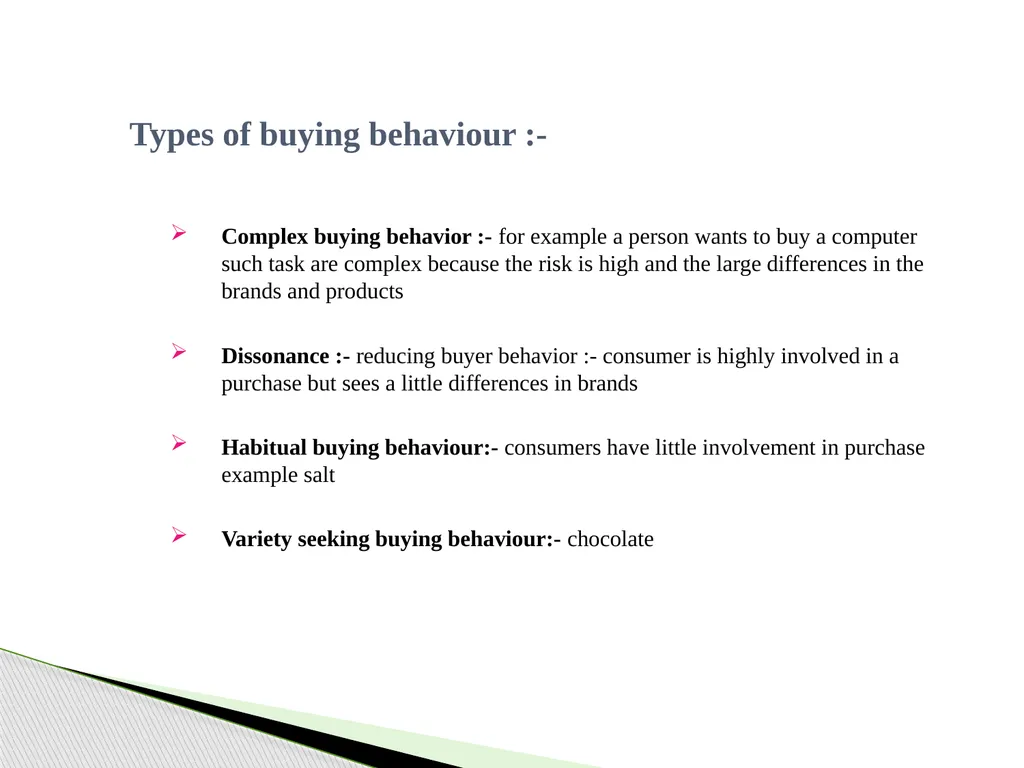
slide5. Complex buying behavior :- for example a person wants to buy a computer such task are complex because the risk is high and the large differences in the brands and products
Dissonance :- reducing buyer behavior :- consumer is highly involved in a purchase but sees a little differences in brands
Habitual buying behaviour:- consumers have little involvement in purchase example salt
Variety seeking buying behaviour:- chocolate Types of buying behaviour :-<br>
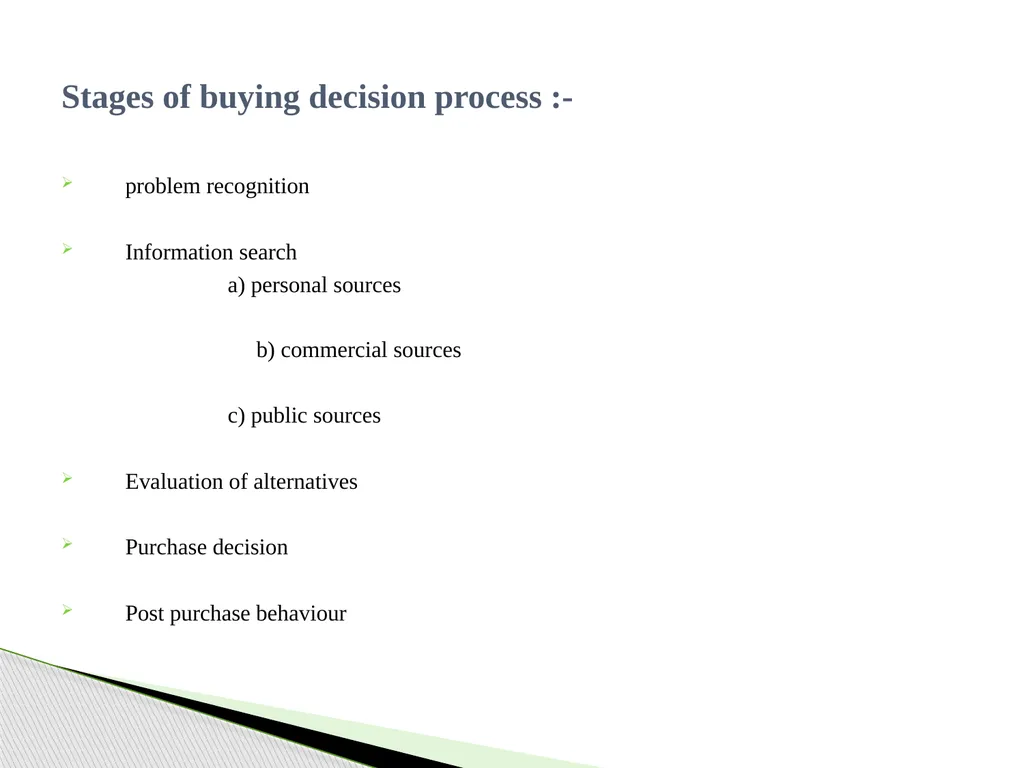
slide6. problem recognition
Information search
a) personal sources
b) commercial sources
c) public sources
Evaluation of alternatives
Purchase decision
Post purchase behaviour Stages of buying decision process :-<br>
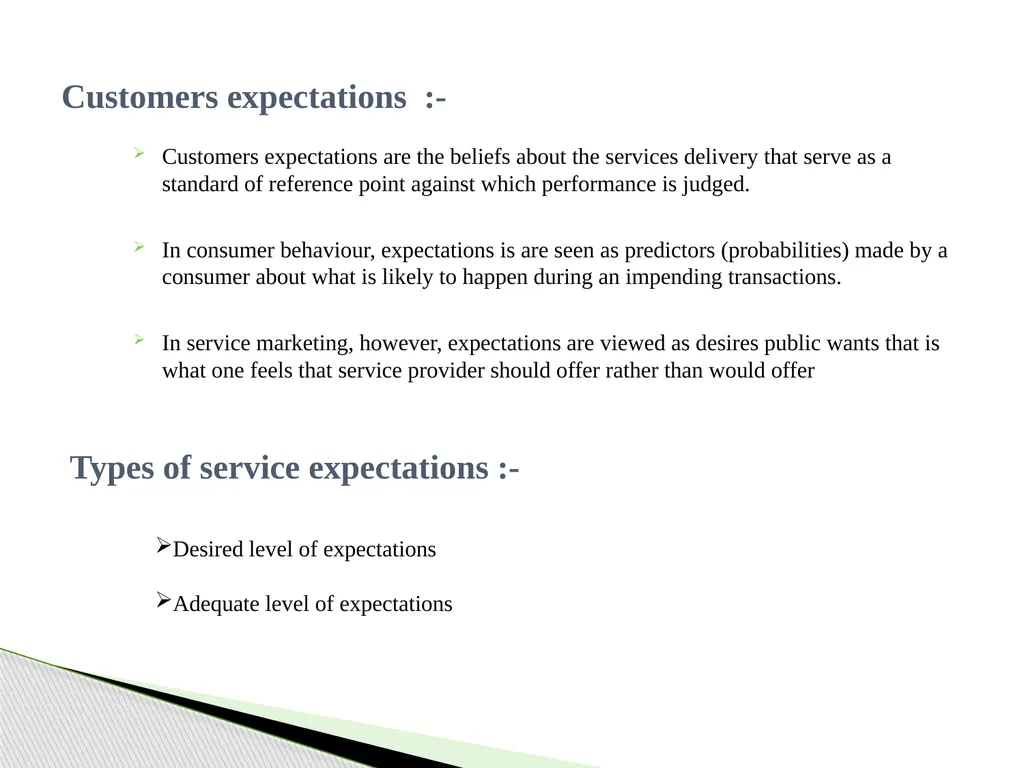
slide7. Customers expectations are the beliefs about the services delivery that serve as a standard of reference point against which performance is judged.
In consumer behaviour, expectations is are seen as predictors (probabilities) made by a consumer about what is likely to happen during an impending transactions.
In service marketing, however, expectations are viewed as desires public wants that is what one feels that service provider should offer rather than would offer Customers expectations :- Types of service expectations :- Desired level of expectations
Adequate level of expectations<br>
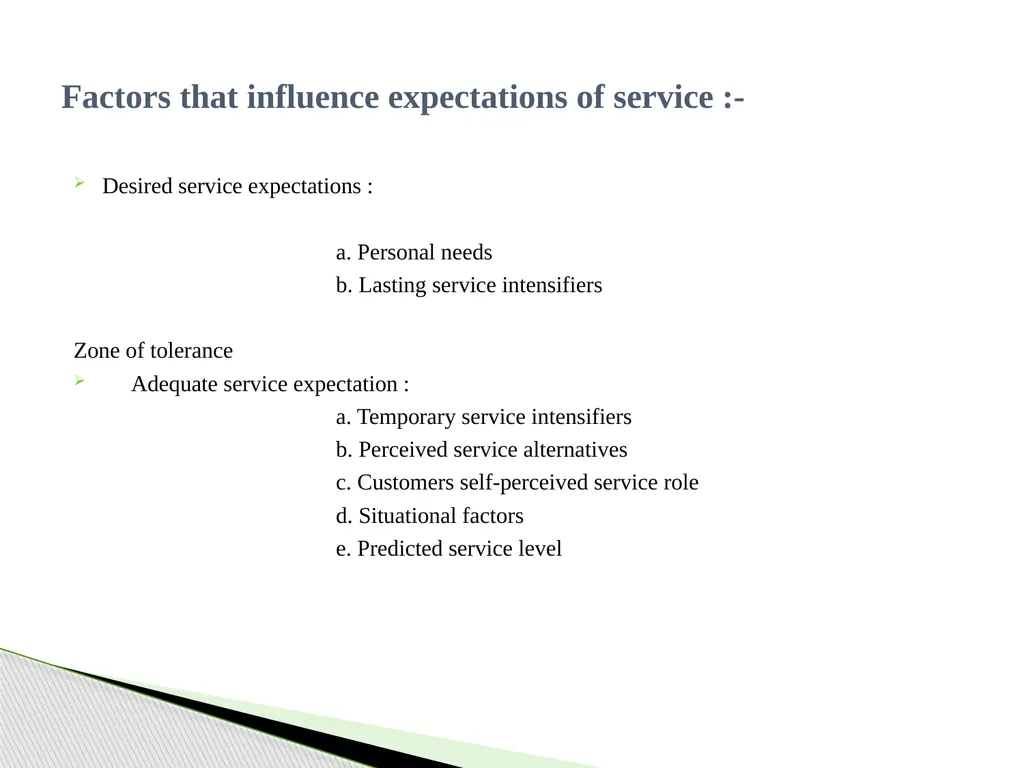
slide8. Desired service expectations :
a. Personal needs
b. Lasting service intensifiers
Zone of tolerance
Adequate service expectation :
a. Temporary service intensifiers
b. Perceived service alternatives
c. Customers self-perceived service role
d. Situational factors
e. Predicted service level Factors that influence expectations of service :-<br>
slide9. Ensuring promises reflect reality
Performing the promised service reliably
Communicating effectively with customers Managing customers expectations :-<br>
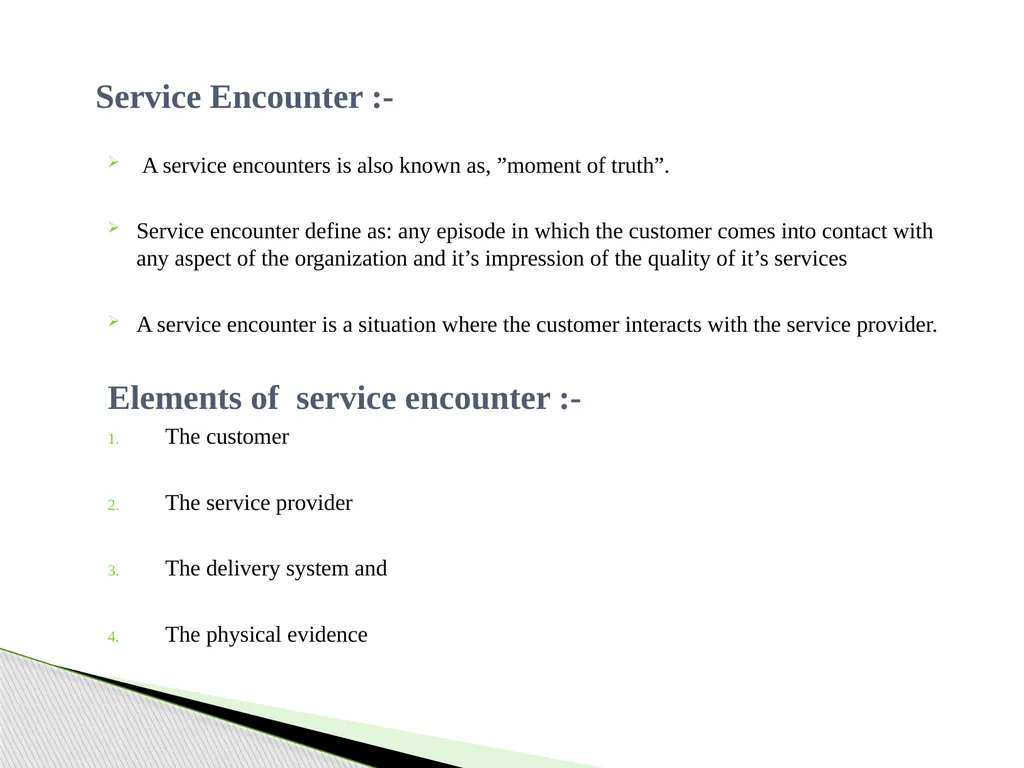
slide10. A service encounters is also known as, ”moment of truth”.
Service encounter define as: any episode in which the customer comes into contact with any aspect of the organization and it’s impression of the quality of it’s services
A service encounter is a situation where the customer interacts with the service provider.
Elements of service encounter :-
The customer
The service provider
The delivery system and
The physical evidence Service Encounter :-<br>
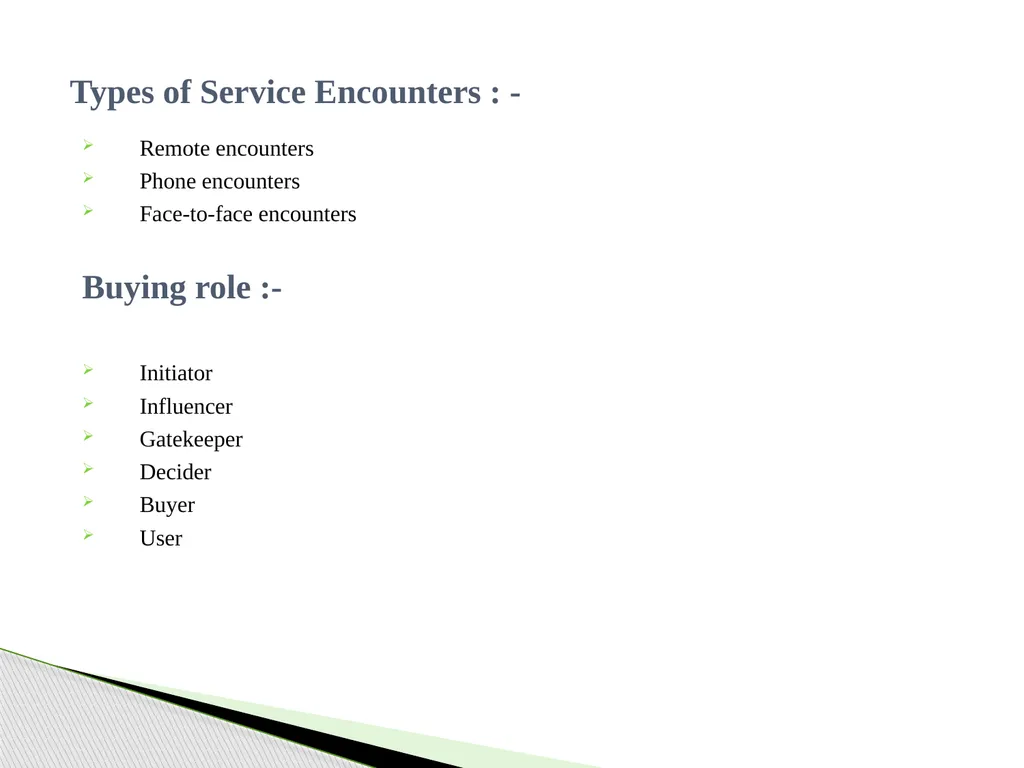
slide11. Remote encounters
Phone encounters
Face-to-face encounters
Buying role :-
Initiator
Influencer
Gatekeeper
Decider
Buyer
User Types of Service Encounters : -<br>
slide12. POSITIONING A SERVICE IN THE MARKET PLACE<br>
slide13. Definition of positioning :-
According to philip kotler, “positioning is the act of designing the company’s offer and image so that it occupies a distinct and valued place in the target customers mind.”
Meaning of positioning :-
Positioning means projecting the image of the product or service in such a way that consumers perceives its value distinctively is that of competitive offers. It is a strategic marketing tool that allows managers to determine the organization's current position.
For example:- jet airways in India has received many awards for being best airlines to serve the economy and business class travelers,<br>
slide14. Positioning what the provider does to the mind of the service seeker in order to first create and then retain customer loyalty towards the service offering by differentiating their service offering vis-à-vis competition /other alternatives.
Service providers now involved in identifying improved ways of creating service appeals and are focusing on the concept of Unique Selling Proposition.
It focuses on achieving a desirable position in the service seekers mind.
Price, distribution, people, processes, customer service and the service itself can all affect a service provider’s positioning in addition to promotion. Need for positioning :-<br>
slide15. Positioning offers the opportunity to differentiate any service.
The service provider and his service occupy a position and image in the service seeker’s mind this perception influences the purchase decision made by the service seeker.
The distinctive attributes must satisfy the following criteria :
1. Importance
2. Distinctiveness
3. Communicability
4. Superiority
5. Affordability
6. profitability Differentiation of services :-<br>
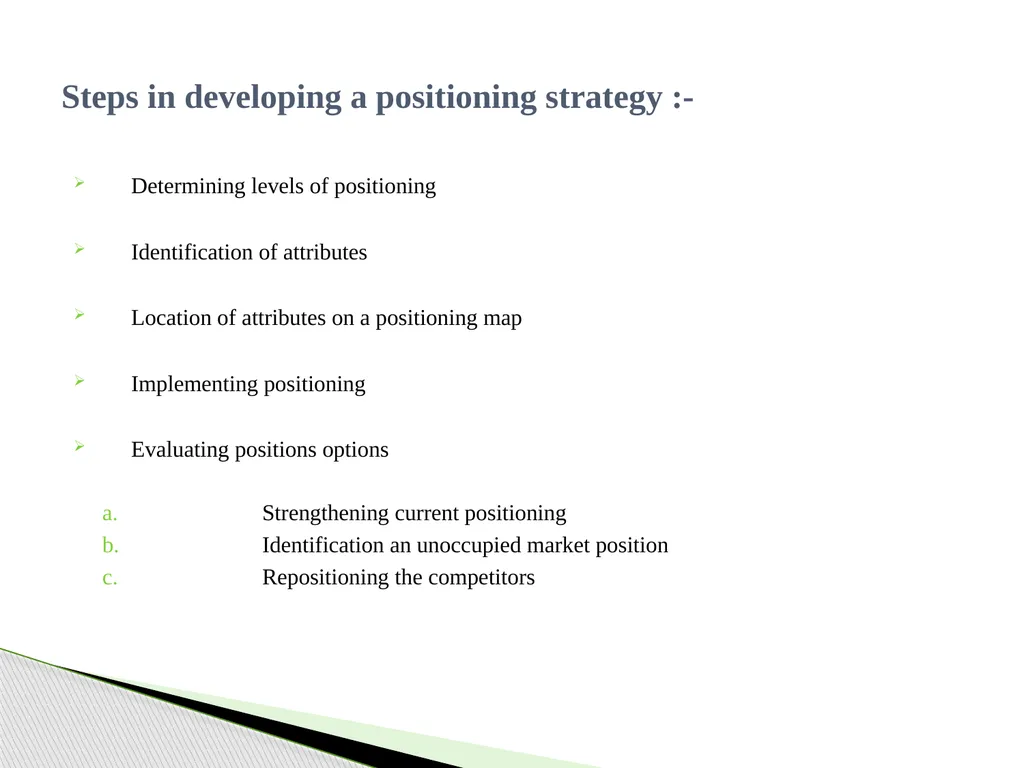
slide16. Determining levels of positioning
Identification of attributes
Location of attributes on a positioning map
Implementing positioning
Evaluating positions options
Strengthening current positioning
Identification an unoccupied market position
Repositioning the competitors Steps in developing a positioning strategy :-<br>
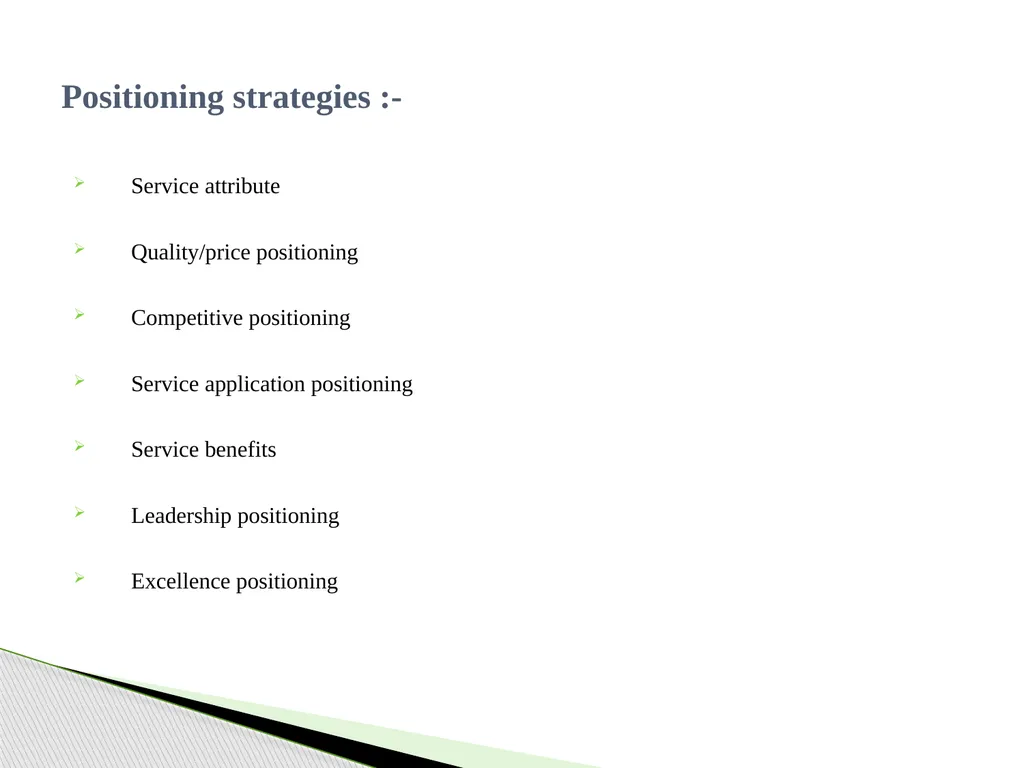
slide17. Service attribute
Quality/price positioning
Competitive positioning
Service application positioning
Service benefits
Leadership positioning
Excellence positioning Positioning strategies :-<br>
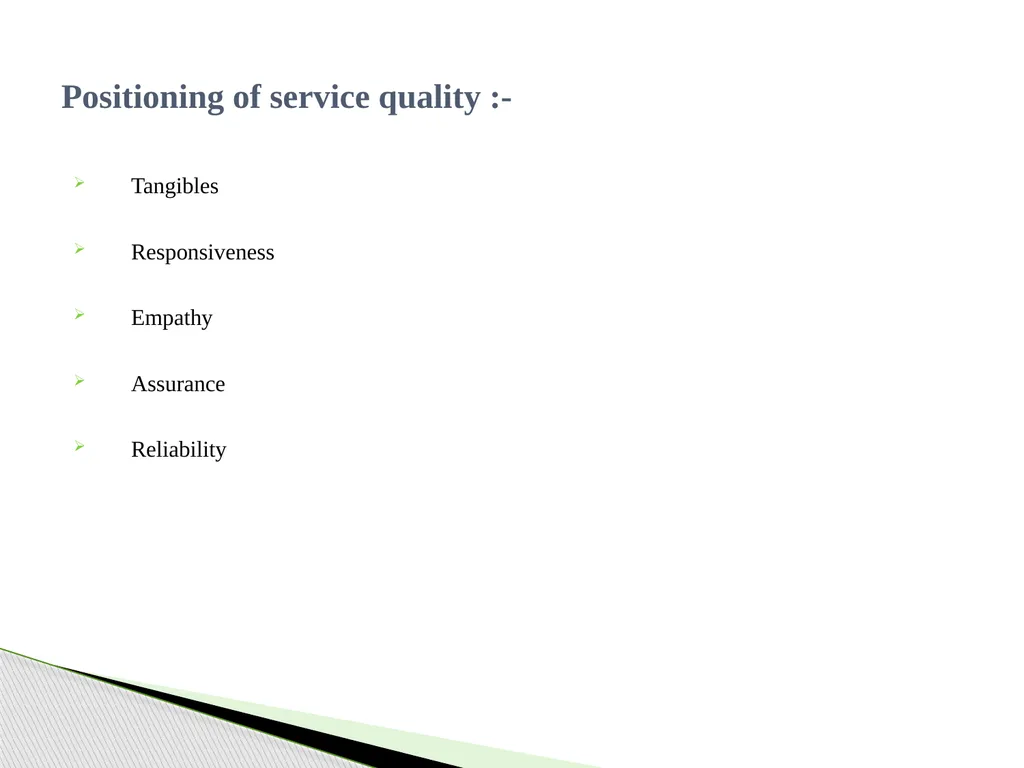
slide18. Tangibles
Responsiveness
Empathy
Assurance
Reliability Positioning of service quality :-<br>
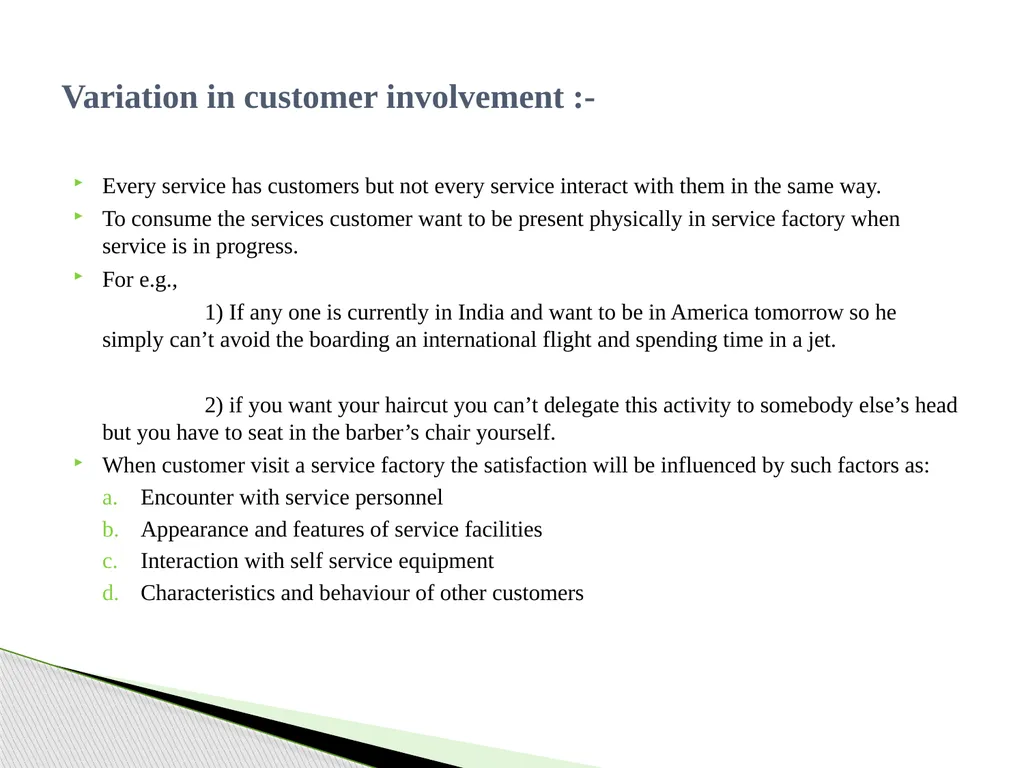
slide19. Every service has customers but not every service interact with them in the same way.
To consume the services customer want to be present physically in service factory when service is in progress.
For e.g.,
1) If any one is currently in India and want to be in America tomorrow so he simply can’t avoid the boarding an international flight and spending time in a jet.
2) if you want your haircut you can’t delegate this activity to somebody else’s head but you have to seat in the barber’s chair yourself.
When customer visit a service factory the satisfaction will be influenced by such factors as:
Encounter with service personnel
Appearance and features of service facilities
Interaction with self service equipment
Characteristics and behaviour of other customers Variation in customer involvement :-<br>
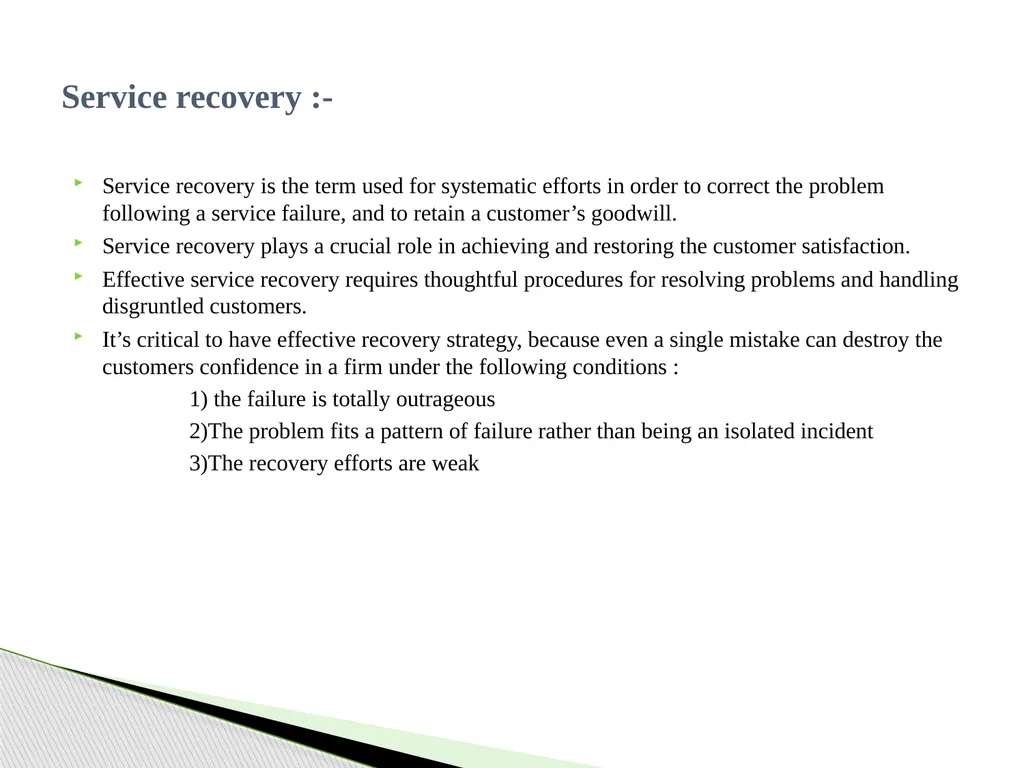
slide20. Service recovery is the term used for systematic efforts in order to correct the problem following a service failure, and to retain a customer’s goodwill.
Service recovery plays a crucial role in achieving and restoring the customer satisfaction.
Effective service recovery requires thoughtful procedures for resolving problems and handling disgruntled customers.
It’s critical to have effective recovery strategy, because even a single mistake can destroy the customers confidence in a firm under the following conditions :
1) the failure is totally outrageous
2)The problem fits a pattern of failure rather than being an isolated incident
3)The recovery efforts are weak Service recovery :-<br>
slide21. Apology
Urgent reinstatement
Empathy
Symbolic atonement
Follow-up Effective recovery :-<br>
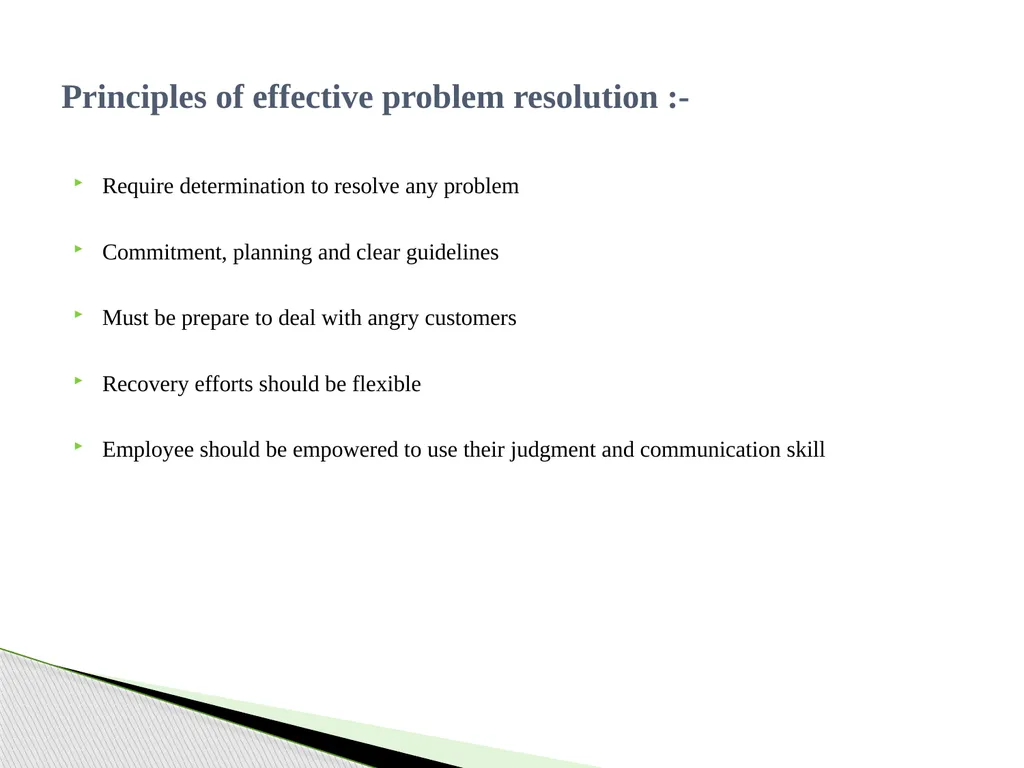
slide22. Require determination to resolve any problem
Commitment, planning and clear guidelines
Must be prepare to deal with angry customers
Recovery efforts should be flexible
Employee should be empowered to use their judgment and communication skill Principles of effective problem resolution :-<br>
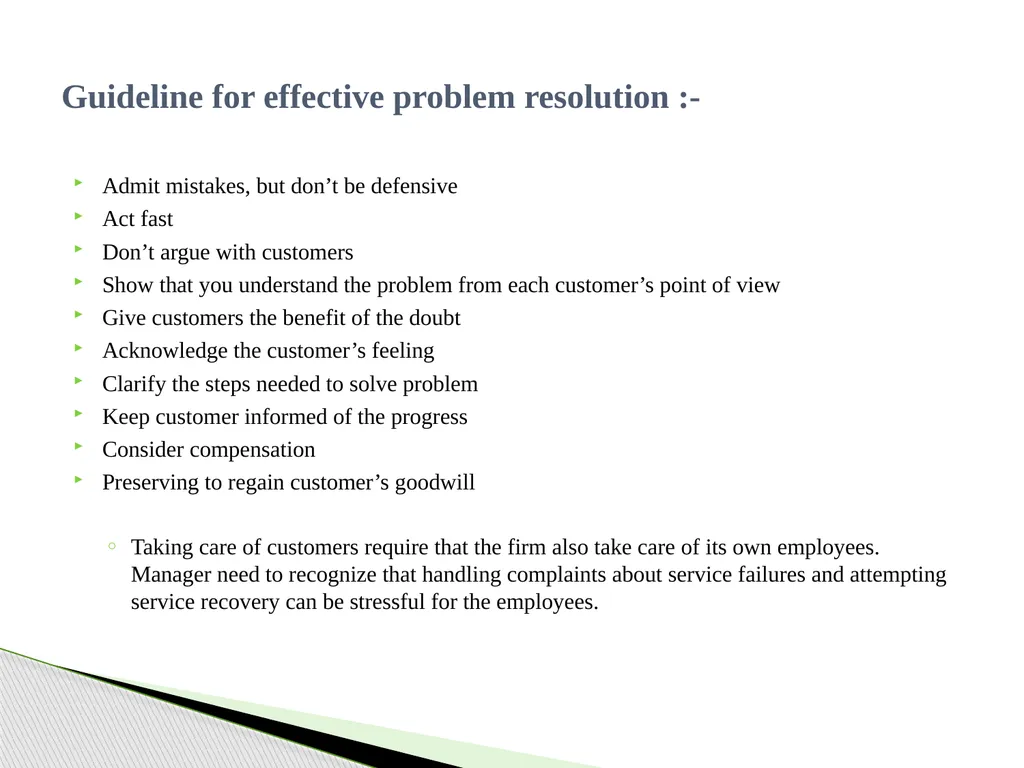
slide23. Admit mistakes, but don’t be defensive
Act fast
Don’t argue with customers
Show that you understand the problem from each customer’s point of view
Give customers the benefit of the doubt
Acknowledge the customer’s feeling
Clarify the steps needed to solve problem
Keep customer informed of the progress
Consider compensation
Preserving to regain customer’s goodwill
Taking care of customers require that the firm also take care of its own employees. Manager need to recognize that handling complaints about service failures and attempting service recovery can be stressful for the employees. Guideline for effective problem resolution :-<br>
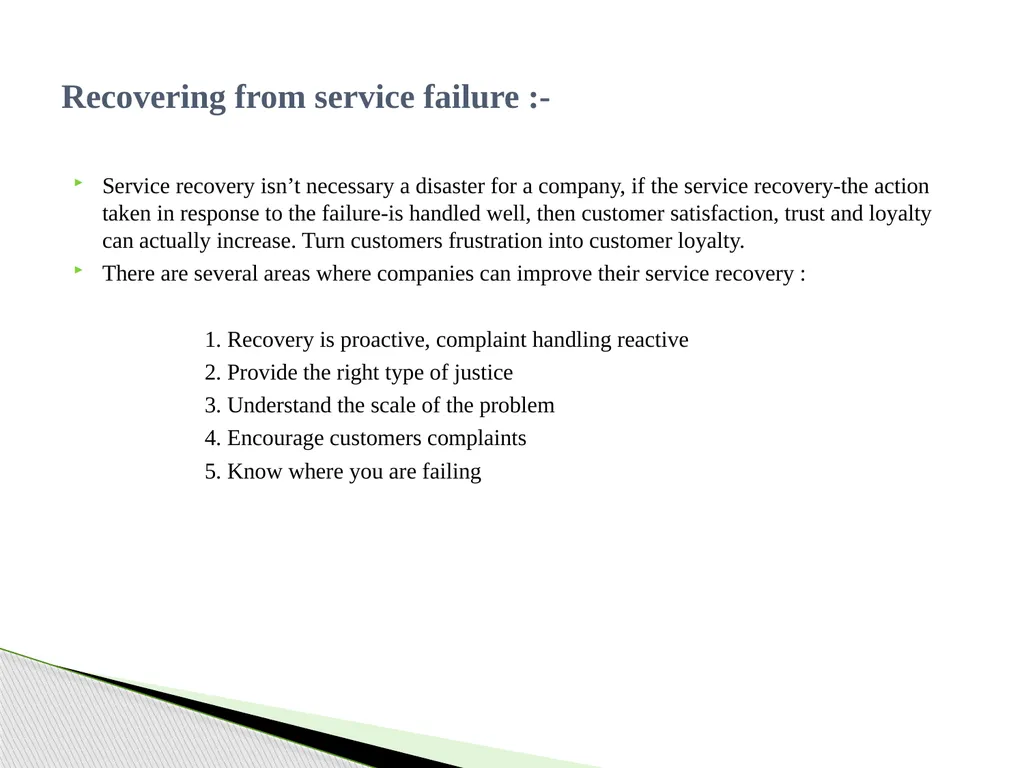
slide24. Service recovery isn’t necessary a disaster for a company, if the service recovery-the action taken in response to the failure-is handled well, then customer satisfaction, trust and loyalty can actually increase. Turn customers frustration into customer loyalty.
There are several areas where companies can improve their service recovery :
1. Recovery is proactive, complaint handling reactive
2. Provide the right type of justice
3. Understand the scale of the problem
4. Encourage customers complaints
5. Know where you are failing Recovering from service failure :-<br>
slide25. Complaint handling should be seen as a profit centre, not a cost centre. When a dissatisfied customer defects the firm loses more than just the value of the next transaction.
Therefore it pays to invest in service recovery efforts designed to protect those long term profits effective service recovery requires thoughtful procedures for resolving problems and handling dissatisfied customers.
When the complaints are made after the fact, the option for recovery is more limited. Impact of service recovery efforts on consumer loyalty :<br>
slide26. There are different levels of the customer contact with the service. As the level of customer contact with the service operation increases, service encounters are likely to be longer and more frequent.
There are three levels of customer contact representing the extent of the interaction :
1) High-level contact
2) Medium level contact
3) Low level contact Customers contact in service :-<br>
slide27. Customer resistance to change I familiar environment and long-established behavioral pattern can effective various attempts to improve productivity and even quality.
Managers of service operations can and should avoid such insensitivity towards their customers.
There are six possible steps to do it :
Develop customer trust
Understand customers habits and expectations
Pre-test new procedures and equipments
Publicize the benefits
Tech customers to use innovations and promote trial Sensitivity to customer reluctance to change :<br>
slide28. Thank-you<br>
slide2. Definition of consumer Behaviour :-
According to prof. C. G. Walter and G. W. Paul, ”consumer behaviour is the process whereby individuals decide whether, what, when, where, how and from whom to purchase goods and service.”
Meaning of consumer Behaviour :-
Consumer behaviour is a branch which deals with the various stages a consumer goes through before purchasing products or service for his end use.
In a common men’s language consumer behaviour deals with the buying behaviour of individuals.<br>
slide3. Social factors
Family influences
Reference groups
Role In the society
Social status
Personal factors
Occupation
Age
Economic condition
Lifestyle
Personality Factors influencing buyers behavior : -<br>
slide4. Psychological factors
Perception
Motivation
Learning
Beliefs and attitudes
Cultural factors
Culture
Sub-culture
Social class<br>
slide5. Complex buying behavior :- for example a person wants to buy a computer such task are complex because the risk is high and the large differences in the brands and products
Dissonance :- reducing buyer behavior :- consumer is highly involved in a purchase but sees a little differences in brands
Habitual buying behaviour:- consumers have little involvement in purchase example salt
Variety seeking buying behaviour:- chocolate Types of buying behaviour :-<br>
slide6. problem recognition
Information search
a) personal sources
b) commercial sources
c) public sources
Evaluation of alternatives
Purchase decision
Post purchase behaviour Stages of buying decision process :-<br>
slide7. Customers expectations are the beliefs about the services delivery that serve as a standard of reference point against which performance is judged.
In consumer behaviour, expectations is are seen as predictors (probabilities) made by a consumer about what is likely to happen during an impending transactions.
In service marketing, however, expectations are viewed as desires public wants that is what one feels that service provider should offer rather than would offer Customers expectations :- Types of service expectations :- Desired level of expectations
Adequate level of expectations<br>
slide8. Desired service expectations :
a. Personal needs
b. Lasting service intensifiers
Zone of tolerance
Adequate service expectation :
a. Temporary service intensifiers
b. Perceived service alternatives
c. Customers self-perceived service role
d. Situational factors
e. Predicted service level Factors that influence expectations of service :-<br>
slide9. Ensuring promises reflect reality
Performing the promised service reliably
Communicating effectively with customers Managing customers expectations :-<br>
slide10. A service encounters is also known as, ”moment of truth”.
Service encounter define as: any episode in which the customer comes into contact with any aspect of the organization and it’s impression of the quality of it’s services
A service encounter is a situation where the customer interacts with the service provider.
Elements of service encounter :-
The customer
The service provider
The delivery system and
The physical evidence Service Encounter :-<br>
slide11. Remote encounters
Phone encounters
Face-to-face encounters
Buying role :-
Initiator
Influencer
Gatekeeper
Decider
Buyer
User Types of Service Encounters : -<br>
slide12. POSITIONING A SERVICE IN THE MARKET PLACE<br>
slide13. Definition of positioning :-
According to philip kotler, “positioning is the act of designing the company’s offer and image so that it occupies a distinct and valued place in the target customers mind.”
Meaning of positioning :-
Positioning means projecting the image of the product or service in such a way that consumers perceives its value distinctively is that of competitive offers. It is a strategic marketing tool that allows managers to determine the organization's current position.
For example:- jet airways in India has received many awards for being best airlines to serve the economy and business class travelers,<br>
slide14. Positioning what the provider does to the mind of the service seeker in order to first create and then retain customer loyalty towards the service offering by differentiating their service offering vis-à-vis competition /other alternatives.
Service providers now involved in identifying improved ways of creating service appeals and are focusing on the concept of Unique Selling Proposition.
It focuses on achieving a desirable position in the service seekers mind.
Price, distribution, people, processes, customer service and the service itself can all affect a service provider’s positioning in addition to promotion. Need for positioning :-<br>
slide15. Positioning offers the opportunity to differentiate any service.
The service provider and his service occupy a position and image in the service seeker’s mind this perception influences the purchase decision made by the service seeker.
The distinctive attributes must satisfy the following criteria :
1. Importance
2. Distinctiveness
3. Communicability
4. Superiority
5. Affordability
6. profitability Differentiation of services :-<br>
slide16. Determining levels of positioning
Identification of attributes
Location of attributes on a positioning map
Implementing positioning
Evaluating positions options
Strengthening current positioning
Identification an unoccupied market position
Repositioning the competitors Steps in developing a positioning strategy :-<br>
slide17. Service attribute
Quality/price positioning
Competitive positioning
Service application positioning
Service benefits
Leadership positioning
Excellence positioning Positioning strategies :-<br>
slide18. Tangibles
Responsiveness
Empathy
Assurance
Reliability Positioning of service quality :-<br>
slide19. Every service has customers but not every service interact with them in the same way.
To consume the services customer want to be present physically in service factory when service is in progress.
For e.g.,
1) If any one is currently in India and want to be in America tomorrow so he simply can’t avoid the boarding an international flight and spending time in a jet.
2) if you want your haircut you can’t delegate this activity to somebody else’s head but you have to seat in the barber’s chair yourself.
When customer visit a service factory the satisfaction will be influenced by such factors as:
Encounter with service personnel
Appearance and features of service facilities
Interaction with self service equipment
Characteristics and behaviour of other customers Variation in customer involvement :-<br>
slide20. Service recovery is the term used for systematic efforts in order to correct the problem following a service failure, and to retain a customer’s goodwill.
Service recovery plays a crucial role in achieving and restoring the customer satisfaction.
Effective service recovery requires thoughtful procedures for resolving problems and handling disgruntled customers.
It’s critical to have effective recovery strategy, because even a single mistake can destroy the customers confidence in a firm under the following conditions :
1) the failure is totally outrageous
2)The problem fits a pattern of failure rather than being an isolated incident
3)The recovery efforts are weak Service recovery :-<br>
slide21. Apology
Urgent reinstatement
Empathy
Symbolic atonement
Follow-up Effective recovery :-<br>
slide22. Require determination to resolve any problem
Commitment, planning and clear guidelines
Must be prepare to deal with angry customers
Recovery efforts should be flexible
Employee should be empowered to use their judgment and communication skill Principles of effective problem resolution :-<br>
slide23. Admit mistakes, but don’t be defensive
Act fast
Don’t argue with customers
Show that you understand the problem from each customer’s point of view
Give customers the benefit of the doubt
Acknowledge the customer’s feeling
Clarify the steps needed to solve problem
Keep customer informed of the progress
Consider compensation
Preserving to regain customer’s goodwill
Taking care of customers require that the firm also take care of its own employees. Manager need to recognize that handling complaints about service failures and attempting service recovery can be stressful for the employees. Guideline for effective problem resolution :-<br>
slide24. Service recovery isn’t necessary a disaster for a company, if the service recovery-the action taken in response to the failure-is handled well, then customer satisfaction, trust and loyalty can actually increase. Turn customers frustration into customer loyalty.
There are several areas where companies can improve their service recovery :
1. Recovery is proactive, complaint handling reactive
2. Provide the right type of justice
3. Understand the scale of the problem
4. Encourage customers complaints
5. Know where you are failing Recovering from service failure :-<br>
slide25. Complaint handling should be seen as a profit centre, not a cost centre. When a dissatisfied customer defects the firm loses more than just the value of the next transaction.
Therefore it pays to invest in service recovery efforts designed to protect those long term profits effective service recovery requires thoughtful procedures for resolving problems and handling dissatisfied customers.
When the complaints are made after the fact, the option for recovery is more limited. Impact of service recovery efforts on consumer loyalty :<br>
slide26. There are different levels of the customer contact with the service. As the level of customer contact with the service operation increases, service encounters are likely to be longer and more frequent.
There are three levels of customer contact representing the extent of the interaction :
1) High-level contact
2) Medium level contact
3) Low level contact Customers contact in service :-<br>
slide27. Customer resistance to change I familiar environment and long-established behavioral pattern can effective various attempts to improve productivity and even quality.
Managers of service operations can and should avoid such insensitivity towards their customers.
There are six possible steps to do it :
Develop customer trust
Understand customers habits and expectations
Pre-test new procedures and equipments
Publicize the benefits
Tech customers to use innovations and promote trial Sensitivity to customer reluctance to change :<br>
slide28. Thank-you<br>